

A benchmark of batch-effect correction methods for single-cell RNA sequencing data
Open accessThe DOI matches its Crossref record; 45 of the 45 references it cites were found in a registry or an index.
Abstract
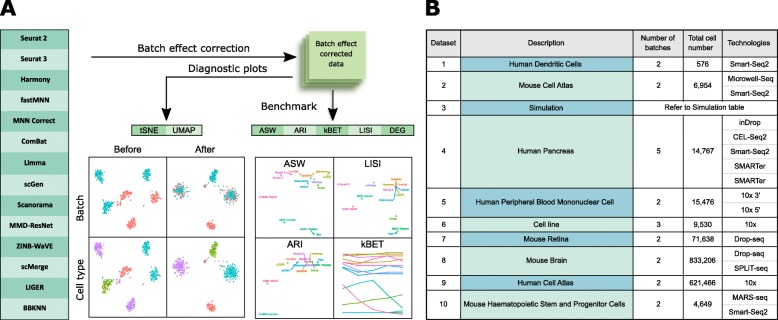
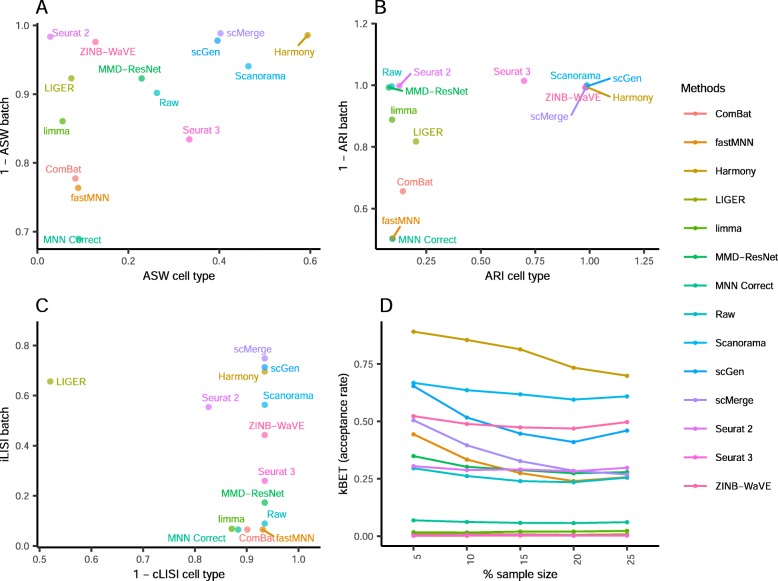
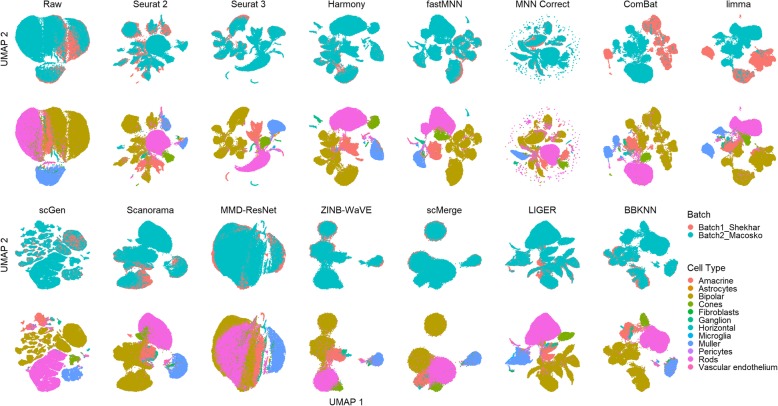
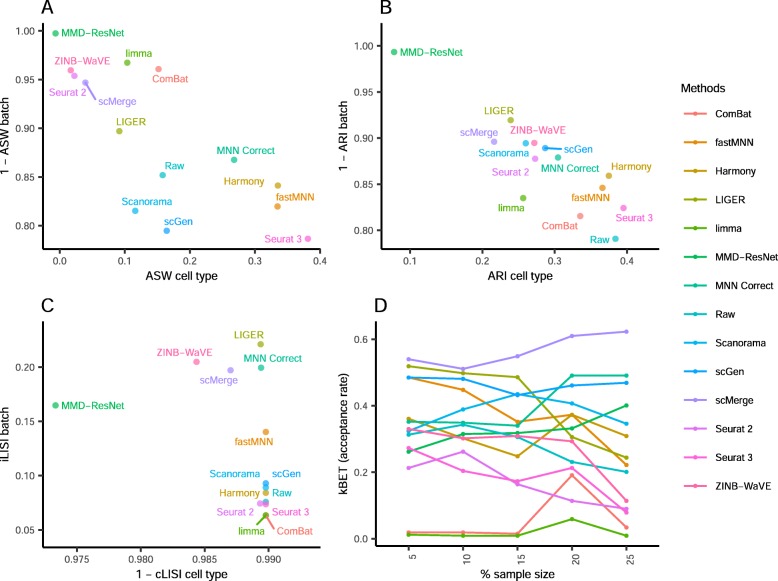
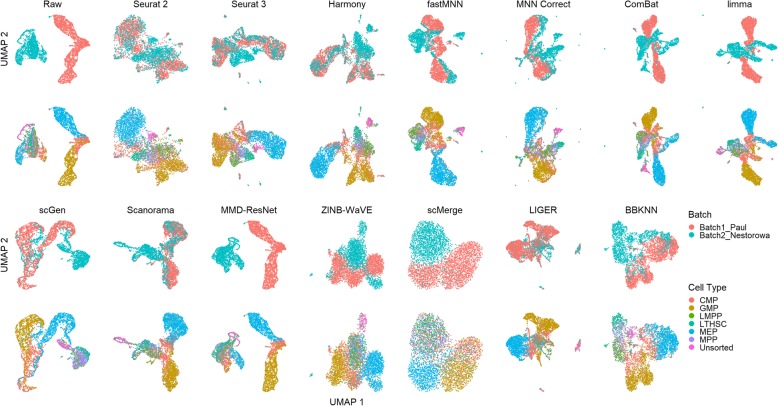
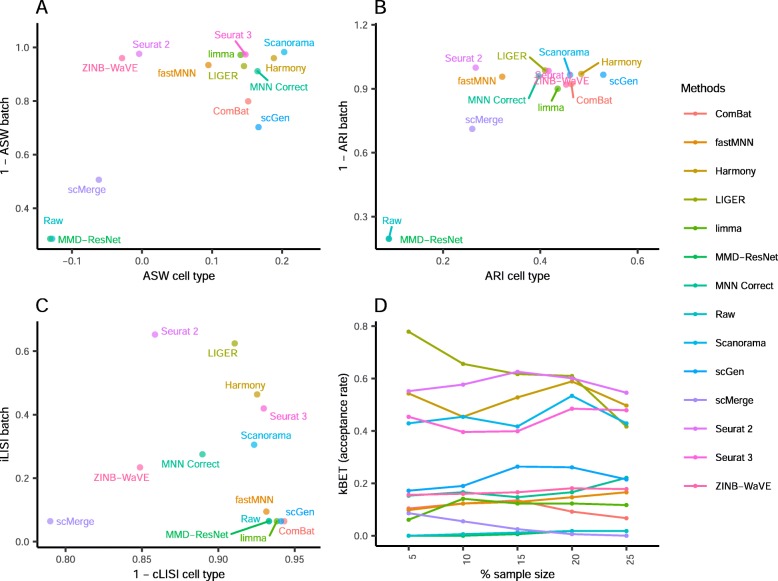
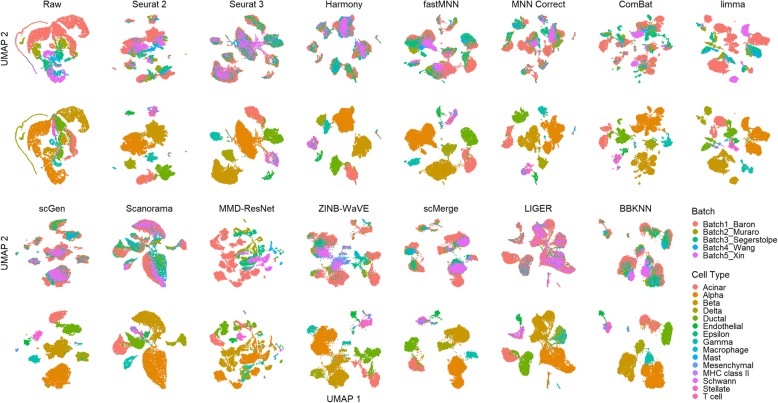
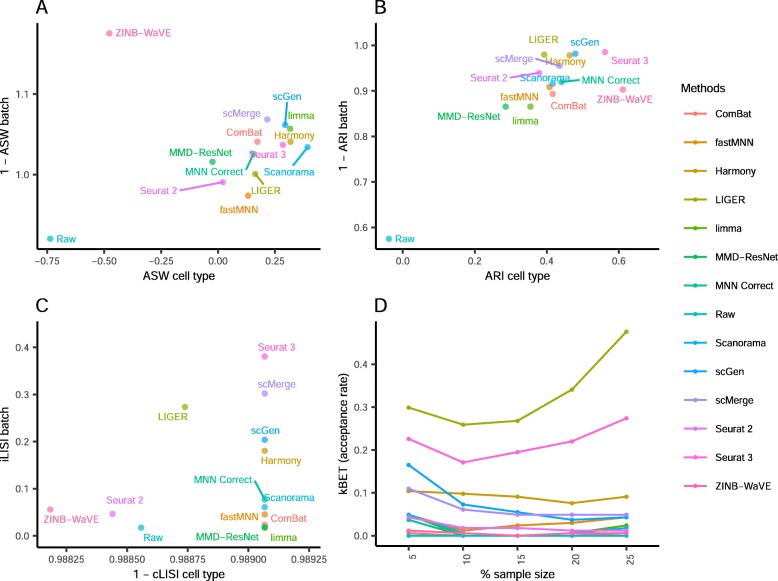
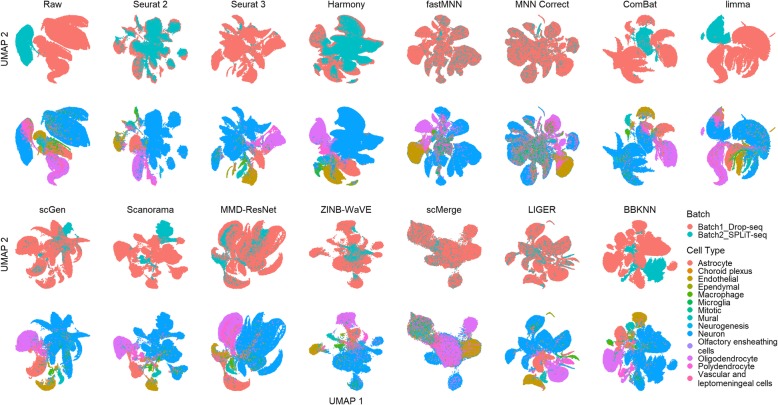
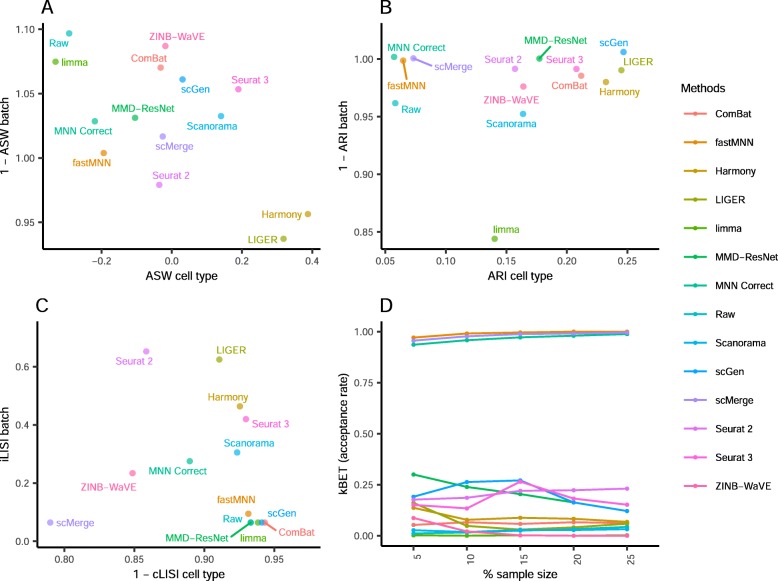
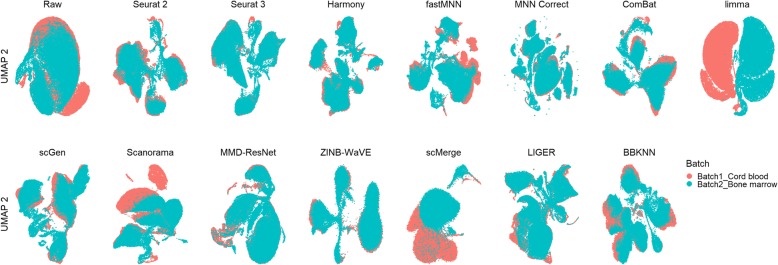
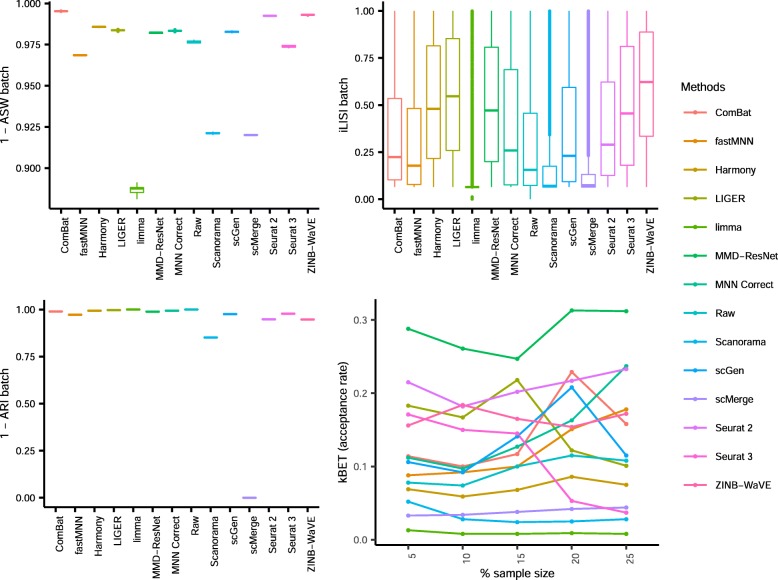
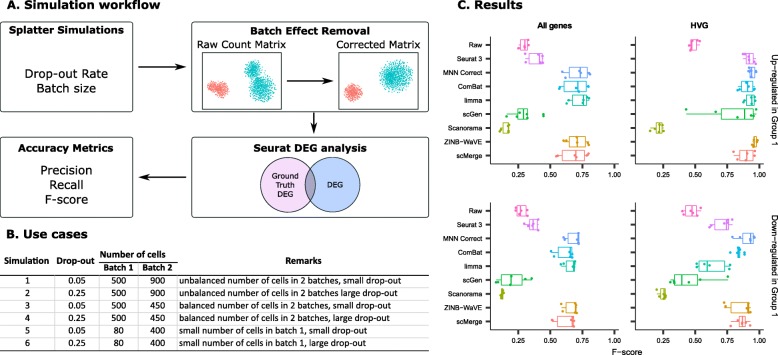
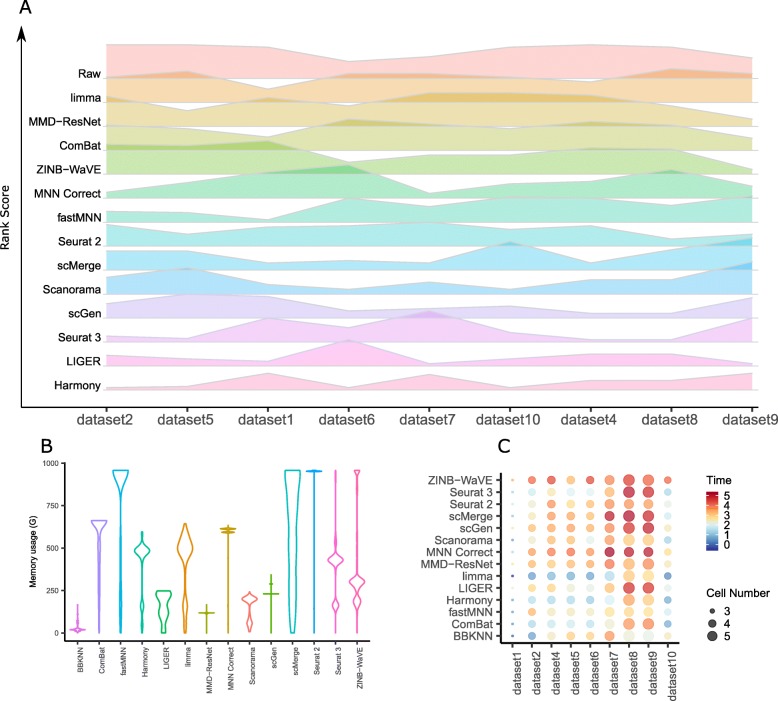
Background: Large-scale single-cell transcriptomic datasets generated using different technologies contain batch-specific systematic variations that present a challenge to batch-effect removal and data integration. With continued growth expected in scRNA-seq data, achieving effective batch integration with available computational resources is crucial. Here, we perform an in-depth benchmark study on available batch correction methods to determine the most suitable method for batch-effect removal. Results: We compare 14 methods in terms of computational runtime, the ability to handle large datasets, and batch-effect correction efficacy while preserving cell type purity. Five scenarios are designed for the study: identical cell types with different technologies, non-identical cell types, multiple batches, big data, and simulated data. Performance is evaluated using four benchmarking metrics including kBET, LISI, ASW, and ARI. We also investigate the use of batch-corrected data to study differential gene expression. Conclusion: Based on our results, Harmony, LIGER, and Seurat 3 are the recommended methods for batch integration. Due to its significantly shorter runtime, Harmony is recommended as the first method to try, with the other methods as viable alternatives.
Overview
The claims and statistics of this paper haven’t been checked yet.
Free: it reads the open-access text and checks the first 5 claims that cite a source we can check. Create a free account to check every claim.
Integrity signals
Registry
Cites
Statistics
Figures
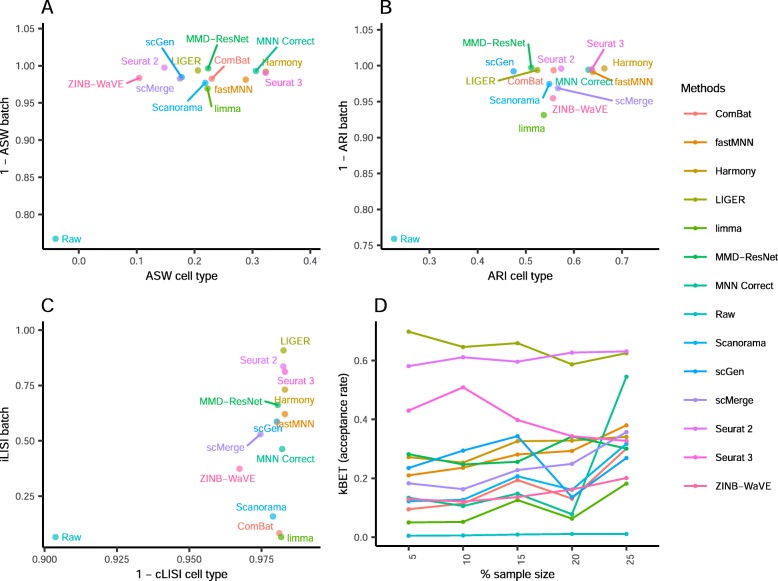
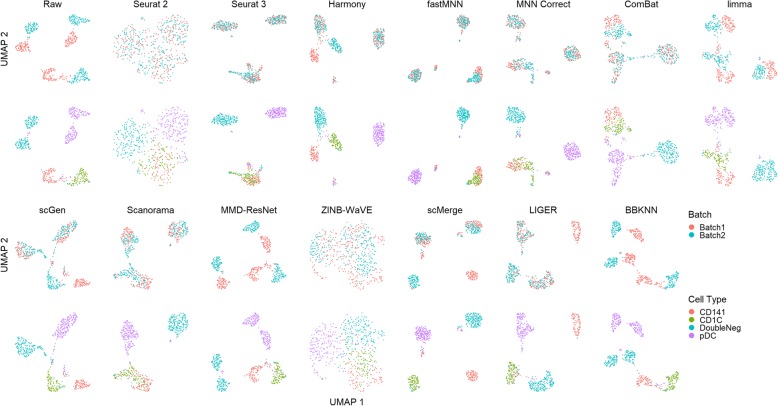
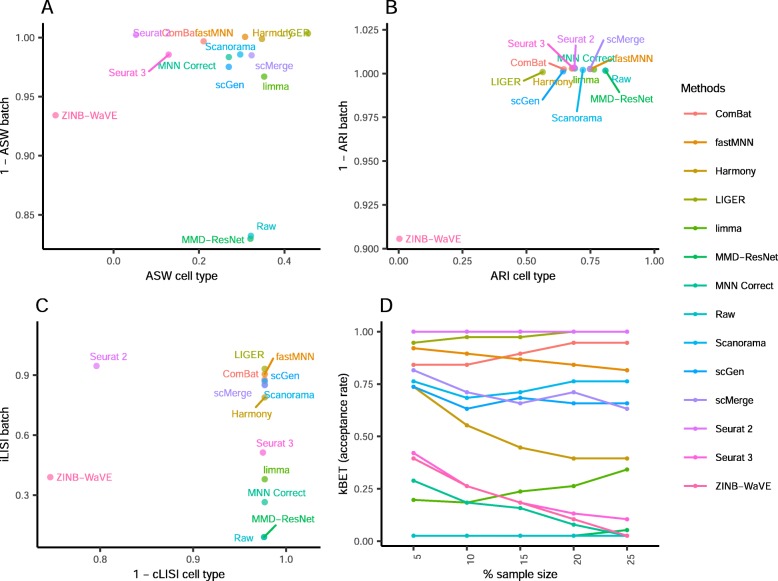
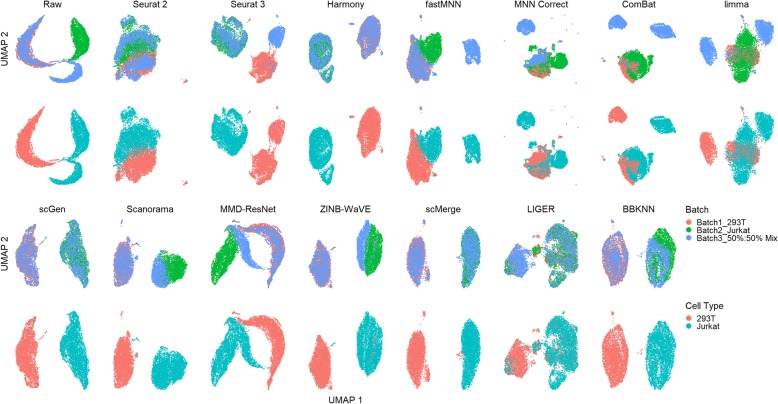
Verification
Claims the paper makes
The claims and statistics of this paper haven’t been checked yet.
Free: it reads the open-access text and checks the first 5 claims that cite a source we can check. Create a free account to check every claim.
Claims other papers make about this one
Each is checked against this paper’s own text: does it say what the citing paper says it does?
The cited source doesn’t support the claim as written.
In the citing paper
“Recent benchmark studies indicate that for simpler integration problems with relatively low biological complexity and relatively small batch effects in scRNA-Seq datasets, linear methods outperform nonlinear, more complex methods136,137, while for complicated integration tasks with large biological complexity and bigger batch effects, nonlinear methods such as scVI/scanVI outperform others138.”
From A high-resolution transcriptomic and spatial atlas of cell types in the whole mouse brain (2023) · cites this paper as [137]
Checked by a reasoning model — may be wrong.
Experimental — accuracy not yet measuredIn the citing paper
“Although SCING GRN based batch correction was not as optimized as the dedicated batch correction methods, many typical batch correction methods do not provide a batch corrected gene expression matrix for downstream analysis.44”
From SCING: Inference of robust, interpretable gene regulatory networks from single cell and spatial transcriptomics (2023) · cites this paper as [44]
In the citing paper
“Linear-embedding models such as canonical correlation analysis36 and Harmony37 were shown to perform well for batch correction on simpler integration tasks with distinct batch structures38,39.”
From Best practices for single-cell analysis across modalities (2023) · cites this paper as [38]
Self-check
Percentages, sums and reported differences re-computed from the paper’s own numbers.
The self-check needs the paper’s full text.
Citations
Cites
(2008) · Journal of Machine Learning Research · Cited by 33,051
Silhouettes: A graphical aid to the interpretation and validation of cluster analysis
Rousseeuw, P. J. (1987) · Journal of Computational and Applied Mathematics · doi:10.1016/0377-0427(87)90125-7 · Cited by 21,392 · cited 2×
“…and Uniform Manifold Approximation and Projection (UMAP) [21] visualizations in conjunction with the k - nearest neighbor batch-effect test (kBET) [22], local inverse Simpson ’ s index (LISI) [13, 23], average silhouette width (ASW) [24], and adjusted rand index (ARI) benchmarking metrics [25].”
MethodGAN(Generative Adversarial Nets)
(2017) · Journal of Japan Society for Fuzzy Theory and Intelligent Informatics · doi:10.3156/jsoft.29.5_177_2 · Cited by 19,270
Comprehensive Integration of Single-Cell Data
Stuart, T., Butler, A., Hoffman, P., Hafemeister, C., Papalexi, E., Mauck, W. M., Hao, Y., Stoeckius, M., Smibert, P., & Satija, R. (2019) · Cell · doi:10.1016/j.cell.2019.05.031 · Cited by 15,453
Integrating single-cell transcriptomic data across different conditions, technologies, and species
Butler, A., Hoffman, P., Smibert, P., Papalexi, E., & Satija, R. (2018) · Nature Biotechnology · doi:10.1038/nbt.4096 · Cited by 13,174 · cited 6×
“Seurat alignment CCA, multiCCA (Seurat 2) Seurat multiCCA uses canonical correlation analysis (CCA) to first compute the linear combinations of genes with maximum correlation between batches [4].”
BackgroundMethodInfluentialFast, sensitive and accurate integration of single-cell data with Harmony
Korsunsky, I., Millard, N., Fan, J., Slowikowski, K., Zhang, F., Wei, K., Baglaenko, Y., Brenner, M., Loh, P.-R., & Raychaudhuri, S. (2019) · Nature Methods · doi:10.1038/s41592-019-0619-0 · Cited by 10,488 · cited 5×
“Another local level metric is the LISI proposed by Kor-sunsky et al. [13, 22], which can be used to assesses batch and cell type mixing.”
MethodInfluentialSCANPY: large-scale single-cell gene expression data analysis
Wolf, F. A., Angerer, P., & Theis, F. J. (2018) · Genome Biology · doi:10.1186/s13059-017-1382-0 · Cited by 8,881 · cited 1×
“The batch correction by Scanorama was performed in conjunction with the Scanpy workflow [29].”
MethodAdjusting batch effects in microarray expression data using empirical Bayes methods
Johnson, W. E., Li, C., & Rabinovic, A. (2007) · Biostatistics · doi:10.1093/biostatistics/kxj037 · Cited by 8,658 · cited 3×
“ComBat was originally developed for microarray gene expression data [1], but had been successfully employed”
MethodHubert, L., & Arabie, P. (1985) · Journal of Classification · doi:10.1007/bf01908075 · Cited by 8,219
Massively parallel digital transcriptional profiling of single cells
Zheng, G. X. Y., Terry, J. M., Belgrader, P., Ryvkin, P., Bent, Z. W., Wilson, R., Ziraldo, S. B., Wheeler, T. D., McDermott, G. P., Zhu, J., et al. (2017) · Nature Communications · doi:10.1038/ncomms14049 · Cited by 7,353
Research works printed but not linked: 5
- Lun A Further MNN algorithm development 2019
- Goodfellow I, Pouget-Abadie J, Mirza M, Xu B, Warde-Farley D, Ozair S, et al. Generative adversarial nets. In: Ghahramani Z, Welling M, Cortes C, Lawrence ND, Weinberger KQ, editors. Adv Neural Inf Process Syst 27: Curran Associates, Inc; 2014. p. 2672–80. Available from: http://papers.nips.cc/paper/5423-generative-adversarial-nets.pdf. Accessed 11 Mar 2019.
- Korsunsky I LISI 2019
- Deng Y, Bao F, Dai Q, Wu LF, Altschuler SJ. Massive single-cell RNA-seq analysis and imputation via deep learning. bioRxiv. 2018:315556 Available from: http://biorxiv.org/content/early/2018/11/27/315556.abstract. Accessed 5 July 2019.
- Tran HTN, Ang KS, Chevrier M, Zhang X, Lee NYS, Goh M, Chen J. A benchmark of batch-effect correction methods for single-cell RNA sequencing data. Simulations. Github Repository. https://github.com/JinmiaoChenLab/Batch-effect-removal-benchmarking. 2019. PMC6964114 31948481
Cited by
Items 701–800 of 1,005
A comparison of integration methods for single‐cell RNA sequencing data and ATAC sequencing data
Kan, Y., Wang, W., Qi, Y., Zhang, Z., Liang, X., & Jin, S. (2025) · Quantitative Biology · doi:10.1002/qub2.91 · Cited by 5
Partially characterized topology guides reliable anchor-free scRNA-integration
He, C., Filippidis, P., Kleinstein, S. H., & Guan, L. (2025) · Communications Biology · doi:10.1038/s42003-025-07988-y · Cited by 4
“This innovative design prioritizes conservation of desired cellular het-82 erogeneity amid batch-effect removal and offers reliable integration.”
A single-cell landscape of the regenerating spinal cord of zebrafish
Yao, L., Cai, X., Yang, S., Song, Y., Xing, L., Li, G., Cui, Z., & Chen, J. (2025) · Neural Regeneration Research · doi:10.4103/nrr.nrr-d-24-01163 · Cited by 4
“14.3), considering Gene Ontology (GO) categories with a false discovery rate (FDR) 0.05 as significantly enriched.”
InfluentialSelf-citationGao, R., Qing, P., Chen, H., Hu, Z., Yang, Q., Lu, C., Liu, H., Zeng, R., Tang, Y., Yu, F. D., et al. (2025) · Advanced Science · doi:10.1002/advs.202503480 · Cited by 6
Decoding cell fate: integrated experimental and computational analysis at the single-cell level
Zhou, Y., Hou, S., Miao, X., Zhang, G., Li, Z., Zhang, D., Lin, Y., & Lin, Y. (2025) · Bioinformatics · doi:10.1093/bioinformatics/btaf603 · Cited by 4
“…modality, biological interpretation is complicated by batch effects (i.e. from different samples, labs, platforms), and benchmark studies have shown a trade-off between removing batch effects and preserving true biological variation (Korsunsky et al. 2019, Tran et al. 2020, Luecken et al. 2022).”
Chatterjee, P., Stevens, H. Y., Kippner, L. E., Yeago, C., Drissi, H., Mautner, K., Boden, S. D., Gibson, G. C., & Roy, K. (2026) · Molecular Therapy — Nucleic Acids · doi:10.1016/j.omtn.2026.102839 · Cited by 4
Hamraoui, A., Onfroy, A., Sénamaud‐Beaufort, C., Coulpier, F., Lemoine, S., Jourdren, L., & Thomas‐Chollier, M. (2026) · NAR Genomics and Bioinformatics · doi:10.1093/nargab/lqag070 · Cited by 4
“In contrast to bulk and single-cell short-read RNA-seq, for which extensive public data for benchmarking are available [ 56 , 60–62 ], single-cell and spatial long-read transcrip-tomics still lacks comprehensive benchmark resources.”
Integrating Multiple Single-Cell RNA Sequencing Datasets Using Adversarial Autoencoders
Wang, X., Zhang, C., Wang, L., & Zheng, P. (2023) · International Journal of Molecular Sciences · doi:10.3390/ijms24065502 · Cited by 7
“At present, researchers have proposed a number of methods for batch effect correction [8].”
BackgroundMethodPavan, R. R., Diniz, F., El-Dahr, S. S., & Tortelote, G. G. (2023) · Frontiers in Bioinformatics · doi:10.3389/fbinf.2023.1144266 · Cited by 4
“Because variations in cell dissociation and isolation protocols, sequencing depth, sample size and differences in computational methods applied have been shown to interfere with the single transcriptome profiling of cells (Adam et al., 2017; Lake et al., 2017; Jiang, 2019; Potter and Steven Potter, 2019; Stuart et al.…”
MethodComputational and Systems Biology Advances to Enable Bioagent Agnostic Signatures
Lin, A., Torres, C., Hobbs, E. C., Bardhan, J. P., Aley, S. B., Spencer, C. T., Taylor, K., & Chiang, T. (2024) · Health Security · doi:10.1089/hs.2023.0076 · Cited by 5
“Therefore, scalable computational models will likely be required sooner for environmental samples than for clinical samples.”
BackgroundDistinct molecular profiles drive multifaceted characteristics of colorectal cancer metastatic seeds
Zhao, Y., Zhang, B., Ma, Y., Guo, M., Zhao, F., Chen, J., Wang, B., Jin, H., Zhou, F., Guan, J., et al. (2024) · The Journal of Experimental Medicine · doi:10.1084/jem.20231359 · Cited by 4
“The function FindIntegrationAnchors from Seurat was then used to integrate different samples and remove batch effects and biological covariates (Tran et al., 2020).”
Self-citationOnline application for the diagnosis of atherosclerosis by six genes
Zhao, Z., Chen, S., Wei, H., Ma, W., Shi, W., Si, Y., Wang, J., Wang, L., & Li, X. (2024) · PLoS ONE · doi:10.1371/journal.pone.0301912 · Cited by 4
“Some bioinformatics strategies, such as the comBat function, have been developed for microarray data batch correction [12].”
MethodPathway metrics accurately stratify T cells to their cells states
Livne, D., & Efroni, S. (2024) · BioData Mining · doi:10.1186/s13040-024-00416-7 · Cited by 4
“Notably, [28] demonstrated that imputation could significantly improve downstream analysis for datasets with high dropout rates, particularly in low-coverage scRNA-seq experiments.”
Yin, C., Chi, K., Chen, Z., Zhuang, S., Ye, Y., Zhang, B., & Cai, C. (2025) · Frontiers in Pharmacology · doi:10.3389/fphar.2025.1529525 · Cited by 4
George, S., & Johdi, N. A. (2025) · Current Molecular Medicine · doi:10.2174/0115665240355043250130110501 · Cited by 5
Single-Cell Transcriptomics in Spinal Cord Studies: Progress and Perspectives
Maihemuti, M., Mimi, M. A., Sohag, S. M., & Hasan, M. M. (2025) · BioChem · doi:10.3390/biochem5020016 · Cited by 4
“Although several algorithms (e.g., MNN, Harmony, and Seurat) exist to correct batch effects, challenges persist, especially when integrating data across conditions, platforms, or species [88].”
Lazaro, O., Li, S., Smiley, J. S., Carter, W., House, A., Awosika, O., Robertson, S., Haskell, A. K., Hinkel, R. D., Hickey, B. E., et al. (2026) · Scientific Reports · doi:10.1038/s41598-026-69205-y · Cited by 4
Lim, H. S., & Qiu, P. (2021) · PLoS Computational Biology · doi:10.1371/journal.pcbi.1008804 · Cited by 5
“These three methods were selected from a previous benchmarking study for batch-effect correction, where they showed varying levels of performance in two different datasets [24].”
MethodResultInfluentialComputational Methods for Detecting Large-Scale Structural Rearrangements in Chromosomes
Jilani, M., & Haspel, N. (2021) · Exon Publications eBooks · doi:10.36255/exonpublications.bioinformatics.2021.ch3 · Cited by 4
Hirakawa, M. P., Tjahjono, N., Light, Y. K., Chintalapudi, P., Butler, K. S., Branda, S. S., & Krishnakumar, R. (2021) · Cytotherapy · doi:10.1016/s1465324921003212 · Cited by 4
Xu, J., Chen, X., Chen, Y., Wang, Q., Jin, Y., & Zhao, H. (2022) · Genetics Research · doi:10.1155/2022/8422339 · Cited by 4
Database Matching Under Adversarial Column Deletions
Bakirtas, S., & Erkip, E. (2023) · IEEE Information Theory Workshop (ITW) · doi:10.1109/itw55543.2023.10161615 · Cited by 4
“databases, several groups initiated rigorous analyses of the database matching problem which has applications beyond privacy, such as image processing [8], computer vision [9], single-cell biological data alignment [10], [11] and DNA sequencing, which is shown to be equivalent to matching”
BackgroundZhang, B., Wu, H., Wang, Y., Xuan, C., & Gao, J. (2023) · IEEE Journal of Biomedical and Health Informatics · doi:10.1109/jbhi.2023.3311340 · Cited by 4
“In benchmarking the integration of single-cell genomics data [3], Harmony, LIGER, and Seurat 3 perform well on all 14 metrics in a variety of situations.”
Chen, A. A., Clark, K. A., Dewey, B. E., DuVal, A. L., Pellegrini, N., Nair, G., Jalkh, Y., Khalil, S., Zurawski, J., Calabresi, P. A., et al. (2024) · PLoS Computational Biology · doi:10.1371/journal.pcbi.1012241 · Cited by 4
A single-cell clusters similarity measure for different batches, datasets, and samplesPreprint
González-Velasco, Ó., Sánchez-Luis, E., Rosa, E. D. L., Sánchez-Santos, J. M., & Rivas, J. D. L. (2022) · bioRxiv (Cold Spring Harbor Laboratory) · doi:10.1101/2022.03.14.483731 · Cited by 6
Li, M., Zhang, X., Ang, K. S., & Chen, J. (2022) · bioRxiv (Cold Spring Harbor Laboratory) · doi:10.1101/2022.05.10.491296 · Cited by 5
Self-citationMosquera, J. V., Auguste, G. E., Wong, D., Turner, A. W., Hodonsky, C. J., Cardenas, C. L. L., Theofilatos, K., Bos, M. M., Kavousi, M., Peyser, P. A., et al. (2022) · bioRxiv (Cold Spring Harbor Laboratory) · doi:10.1101/2022.10.24.513520 · Cited by 4
Dozer: Debiased personalized gene co-expression networks for population-scale scRNA-seq dataPreprint
Lu, S., & Keleş, S. (2023) · bioRxiv (Cold Spring Harbor Laboratory) · doi:10.1101/2023.04.25.538290 · Cited by 4
“Although this can cause systematic differences in expression between batches and requires correction (Tran et al., 2020) before the data can be analyzed jointly, it further provides an opportunity to evaluate the impact of sequencing depth on estimated network features as the underlying…”
Emili, E., Ródriguez-Fernández, D., Pérez-Posada, A., García-Castro, H., & Solana, J. (2024) · bioRxiv (Cold Spring Harbor Laboratory) · doi:10.1101/2024.02.28.581916 · Cited by 4
Towards a unified framework for single‐cell ‐omics‐based disease prediction through AI
Barberis, M., & Xie, J. (2025) · Clinical and Translational Medicine · doi:10.1002/ctm2.70290 · Cited by 4
“While statistical and deep learning methods have made significant progress in batch effect removal, 25 technical variations in sample preparation, sequencing depth and library construction can still obscure biological signals.”
Language may be all omics needs: Harmonizing multimodal data for omics understanding with CellHermesPreprint
Gao, Y., Wang, W., Zhao, Y., Dong, K., Shan, C., Zheng, W., Richter, T., Li, Z., Chen, S., Theis, F. J., et al. (2025) · bioRxiv (Cold Spring Harbor Laboratory) · doi:10.1101/2025.11.07.687322 · Cited by 7
Composite quantile regression approach to batch effect correction in microbiome data
Park, J. W., & Park, T. (2025) · Frontiers in Microbiology · doi:10.3389/fmicb.2025.1484183 · Cited by 3
Pratama, R., Hilton, J. A., Cherry, J. M., & Song, G. (2025) · Bioinformatics · doi:10.1093/bioinformatics/btaf350 · Cited by 4
Zhang, M., Zhang, B., Tao, Q.-Q., Wang, X.-Y., Guan, X.-X., Dong, Z., Guo, X., Qi, W., Cheng, W.-Z., Zhang, X., et al. (2025) · European Journal of Pharmacology · doi:10.1016/j.ejphar.2025.177867 · Cited by 4
Self-citationBu Zhong Yi Qi Tang targets key monocyte-associated genes to enhance sepsis therapy
Zhou, Y., Sun, W., Zhou, J., Yang, P., Wang, J., Xu, B., Hou, J., & Yang, K. (2025) · Journal of Ethnopharmacology · doi:10.1016/j.jep.2025.120610 · Cited by 3
AEnet: a practical tool to construct the splicing-associated phenotype atlas at a single cell level
Liu, S., Chen, X., Huang, X., Wang, Y., Huang, W., Qin, P., Li, R., Zou, X., Pang, W., Huang, X., et al. (2025) · GigaScience · doi:10.1093/gigascience/giaf110 · Cited by 3
“Second, AS events can also be affected by batch effects, an inherent limitation of single-cell techniques [ 24 ].”
Revealing the Best Strategies for Rare Cell Type Detection in Multi-Sample Single-Cell Datasets
Ye, Z., Yan, Y., Yu, Y., & Wu, H. S. (2025) · Genes · doi:10.3390/genes17010031 · Cited by 4
“This preprocessing step aligns shared biological signals across individuals while minimizing technical noise, thereby improving cross-sample comparability [26,36,37].”
Sun, M., Wu, C., Wu, J., Liu, L., Gu, L., Wang, Z., Yang, X., & Xu, F. (2026) · Frontiers in Aging Neuroscience · doi:10.3389/fnagi.2025.1657523 · Cited by 6
Probing the Feasibility of Single-Cell Fixed RNA Sequencing from FFPE Tissue
Liu, X., Naughton, K. A., Karsen, S. D., Bentley, P., Duggan, L., Chaudhary, N., Smith, K. M., Phillips, L. A., Chang, D., & Mahi, N. A. (2026) · International Journal of Molecular Sciences · doi:10.3390/ijms27031605 · Cited by 3
“Cell types were annotated using a combination of manual and automated reference-based methods [29,30].”
Integrating Spatial Proteogenomics in Cancer Research
Wang, Y., Wu, Y., Zhang, F., Periasamy, P., You, H., Goh, D. L. M., Fincham, R. E. A., Ning, X., Wu, D., Liu, L., et al. (2026) · Advanced Science · doi:10.1002/advs.202520744 · Cited by 4
Single-cell atlas of hepatic cellular plasticity and immune niche reprogramming in liver cirrhosis
Zhang, Q., Zhou, N., Kan, X., Zhang, Z., Fang, Y., Liu, H., & Chen, Y. (2026) · Journal of Translational Medicine · doi:10.1186/s12967-026-07858-z · Cited by 3
“To harmonize the data and address potential batch effects (e.g., stemming from library preparation and sequencing runs), we employed the Harmony algorithm, a commonly utilized tool for integrating single-cell data across multiple samples [49, 50].”
The transformative role of single-cell analysis in multifactorial disorders research
Wang, C., Ko, C.-C., Kumar, S., Xuan, D. T. M., Lin, H.-R., Lee, Y.-K., Nguyen, N. U. N., Pei-Ming, Y., & Solomon, D. D. (2026) · Methods · doi:10.1016/j.ymeth.2026.03.009 · Cited by 3
Yan, C., Corbett, R., Trinh, D. L. N., Jin, D., Laskin, J. J., Bailey, M. L., & Marra, M. A. (2026) · Frontiers in Genetics · doi:10.3389/fgene.2026.1755978 · Cited by 3
“All methods were implemented as described in Tran et al. (2020).”
InfluentialSingle-Cell Multi-Omics Reveal Gene Regulatory Mechanisms Underlying Cardiac Embryonic Development
Feng, E., Zheng, X., Zhu, F., Xiang, L., Liu, C., Wang, L., Cao, Y., & Dai, Y. (2026) · Genes · doi:10.3390/genes17040414 · Cited by 3
“Samples are often collected across broad developmental windows and across different platforms, leading to pronounced batch effects, variable sequencing depths, and ambient RNA contamination from highly transcriptionally active cell populations such as cardiomyocytes [61–63].”
Next-generation kidney tissue analysis — spatial omics and digital pathology
Yoshikawa, T., Bülow, R. D., Boor, P., & Yanagita, M. (2026) · Nature Reviews Nephrology · doi:10.1038/s41581-026-01102-z · Cited by 6
“Although computational correction may help to mitigate these effects 178 , distinguishing technical variations from true biological differences remains challenging, particularly when integrating data from different tissue sections or time points.”
Single-cell ecology of coral-algal symbiosis breakdown
Bonacolta, A. M., Snyder, G. A., Karp, R. F., Yeager, E., Wen, A. D. E., Dennison, C. E., Nonell, J., Traylor‐Knowles, N., Baker, A. C., & del Campo, J. (2026) · Microbiome · doi:10.1186/s40168-026-02506-6 · Cited by 3
RefTM: reference-guided topic modeling of single-cell chromatin accessibility data
Zhang, Z., Chen, S., & Lin, Z. (2022) · Briefings in Bioinformatics · doi:10.1093/bib/bbac540 · Cited by 3
Omada: robust clustering of transcriptomes through multiple testing
Kariotis, S., Tan, P. F., Lu, H., Rhodes, C. J., Wilkins, M. R., Lawrie, A., & Wang, D. Y. Q. (2024) · GigaScience · doi:10.1093/gigascience/giae039 · Cited by 3
A new exploration: characterization of the differentiation trajectory of prostate cancer cells
Yang, J., Wang, C., Ma, X., Li, J., Yuan, H., Tan, R., Ling, L., & Zhou, X. (2024) · Discover Oncology · doi:10.1007/s12672-024-01303-7 · Cited by 3
Wang, Y., & Du, P.-F. (2025) · Frontiers in Genetics · doi:10.3389/fgene.2025.1553352 · Cited by 3
HemAtlas: A Multi-omics Hematopoiesis Database
Kang, Z., Zhu, T., Zou, D., Liu, M., Zhang, Y., Wang, L., Zhang, Z., & Liu, F. (2025) · Genomics Proteomics & Bioinformatics · doi:10.1093/gpbjnl/qzaf026 · Cited by 3
“Various integration algorithms have different integration performance to correct the non-biological information [25].”
Parker, M. T., Amar, S., Campoy, J. A., Krause, K., Tusso, S., Marek, M., Hüettel, B., & Schneeberger, K. (2025) · PLoS Biology · doi:10.1371/journal.pbio.3003085 · Cited by 3
Measuring evolutionary cancer dynamics from genome sequencing, one patient at a time
Caravagna, G. (2020) · Statistical Applications in Genetics and Molecular Biology · doi:10.1515/sagmb-2020-0075 · Cited by 3
SAREV : A review on statistical analytics of single‐cell RNA sequencing data
Ellis, D. D., Wu, D., & Datta, S. (2021) · Wiley Interdisciplinary Reviews Computational Statistics · doi:10.1002/wics.1558 · Cited by 4
“H. T. N. Tran et al. (2020) benchmark 14 methods of batch correction in their benchmark study.”
BackgroundXue, Y., Pyong, K. H., Oh, S. S., Tao, Y., & Liu, T. (2022) · Frontiers in Public Health · doi:10.3389/fpubh.2022.916407 · Cited by 4
“In terms of time validity, realtime collection and analysis of psychological states avoid the deviation of analysis results caused by the lag of data collection in traditional research methods (23, 24).”
MethodSingle-cell analysis in endometrial research
Cao, D., Wang, J., Yao, Y., & Yeung, W. S. B. (2022) · Reproductive and Developmental Medicine · doi:10.1097/rd9.0000000000000037 · Cited by 3
SCdenoise: a reference-based scRNA-seq denoising method using semi-supervised learning
Zhong, F., Zeng, Y., Liu, Y., & Yang, Y. (2022) · IEEE International Conference on Bioinformatics and Biomedicine (BIBM) · doi:10.1109/bibm55620.2022.9995005 · Cited by 3
“We extracted five datasets from the previous study [16].”
MethodXu, X., & Li, X. (2023) · Briefings in Bioinformatics · doi:10.1093/bib/bbac608 · Cited by 3
Braband, K. L., Nedwed, A. S., Helbich, S. S., Simon, M., Beumer, N., Brors, B., Marini, F., & Delacher, M. (2023) · Frontiers in Immunology · doi:10.3389/fimmu.2023.1232511 · Cited by 3
Essential procedures of single-cell RNA sequencing in multiple myeloma and its translational value
Du, J., Gu, X.-R., Yu, X., Cao, Y.-J., & Hou, J. (2023) · Blood Science · doi:10.1097/bs9.0000000000000172 · Cited by 3
Liang, S., Dou, J., Iqbal, R., & Chen, K. (2024) · Communications Biology · doi:10.1038/s42003-024-05988-y · Cited by 3
“7), and a hyperparameter search can help fi nd suitable ones.”
InfluentialChelu, A., Cartwright, E. J., & Dobrzynski, H. (2024) · Scientific Reports · doi:10.1038/s41598-024-63542-6 · Cited by 3
CBA: Cluster-Guided Batch Alignment for Single Cell RNA-seq
Yu, W., Mahfouz, A. E., & Reinders, M. J. T. (2021) · Frontiers in Genetics · doi:10.3389/fgene.2021.644211 · Cited by 3
“Typically, the quantification of these batch effects is clouded by biological differences between batches, such as additional cell types or cells in different states (Tran et al., 2020).”
BackgroundREBET: a method to determine the number of cell clusters based on batch effect removal
Fang, Z., Lin, C., Xu, Y., Li, H., & Xu, Q. (2021) · Briefings in Bioinformatics · doi:10.1093/bib/bbab204 · Cited by 3
MLG: multilayer graph clustering for multi-condition scRNA-seq data
Lu, S., Conn, D. J., Chen, S., Johnson, K. D., Bresnick, E. H., & Keleş, S. (2021) · Nucleic Acids Research · doi:10.1093/nar/gkab823 · Cited by 3
“This leads to documented notable differences among these methods [14].”
ResultLiu, A., & Kang, H. M. (2022) · PLoS Genetics · doi:10.1371/journal.pgen.1009571 · Cited by 3
Chen, J., Li, M., Zhang, X., & Ang, K. S. (2022) · Research Square · doi:10.21203/rs.3.rs-1643794/v1 · Cited by 3
Self-citationInterpretable phenotype decoding from multicondition sequencing data with ALPINE
Lee, W.-H., Li, L., Dannenfelser, R., & Yao, V. (2025) · Genome Research · doi:10.1101/gr.280566.125 · Cited by 3
“The first, a brain cancer data set, provides a benchmark for disentangling patient, sex, and cancer-type covariates.”
InfluentialImage Analysis: Understanding and Mitigating Batch Effects in Histopathology
Gindra, R. H., Boushehri, S. S., Wagner, S. J., Tran, M., Winter, D. J. E., Schnabel, J. A., Saur, D., Marr, C., & Peng, T. (2025) · Trillium Pathology · doi:10.47184/tp.2025.01.03 · Cited by 2
Yang, J., Fan, L.-Y., & Shi, K. (2024) · International Journal of Medical Sciences · doi:10.7150/ijms.94812 · Cited by 2
“We then applied Harmony R package for batch integration [23, 24].”
MethodBa, T., Hao, M., Zhang, L., Gao, C., & Wang, Y. (2024) · Bioinformatics · doi:10.1093/bioinformatics/btae480 · Cited by 3
“However, CCA, while effectively addressing batch effects, may inadequately consider local information, potentially obscuring biological specificity and leading to overcorrection issues (Luecken et al. 2022, Tran et al. 2020).”
BackgroundMethodInfluentialAndrade, A. X., Nguyen, S. N., Marckx, A., & Montillo, A. A. (2026) · Nature Communications · doi:10.1038/s41467-026-72666-4 · Cited by 2
Human Fibroblast–Myeloid Cell Tissue Atlas Across the Lungs, Synovium, Skin, and Heart
MacDonald, L., Apostolopoulou, K., Hardy, O. M., Toitou, M., Kania, G., Błyszczuk, P., Micheroli, R., Otto, T. D., Kurowska‐Stolarska, M., & Ospelt, C. (2026) · Arthritis & Rheumatology · doi:10.1002/art.70238 · Cited by 2
SCITUNA: single-cell data integration tool using network alignment
Houdjedj, A., Marouf, Y., Myradov, M., Doğan, S. O., Erten, B. O., Taştan, Ö., Erten, C., & Kazan, H. (2025) · BMC Bioinformatics · doi:10.1186/s12859-025-06087-3 · Cited by 2
“Several different types of computational methods have been proposed for batch effect removal in single-cell data integration [4–6].”
Hsiao, C., Liao, W., Li, J., Chou, Y., Chou, Y., Lin, J.-R., Chen, C., & Liu, C. (2025) · Cancer Cell International · doi:10.1186/s12935-025-03811-0 · Cited by 2
“First, although the batch effect of the different samples has been corrected using Harmony, which performs well for integrating different batches and cell types [49], variation from unknown sources may still exist [50].”
Mao, R., Wang, L., Zhang, H., Gong, J., & Liu, H. (2025) · Frontiers in Molecular Neuroscience · doi:10.3389/fnmol.2025.1604670 · Cited by 2
Smmit: A pipeline for integrating multiple single-cell multi-omics samples
Wan, C., & Ji, Z. (2025) · Computational and Structural Biotechnology Journal · doi:10.1016/j.csbj.2025.08.020 · Cited by 2
Du, Z., Yi, J., Li, J., You, H.-R., You, Z., Huang, Z.-A., & Huang, Y. (2025) · Knowledge-Based Systems · doi:10.1016/j.knosys.2025.114416 · Cited by 5
Wan, L., Zhou, Y., Wang, X., Qi, J., & Jin, S. (2025) · Briefings in Bioinformatics · doi:10.1093/bib/bbaf503 · Cited by 2
“However, as increasingly large single-cell datasets are generated,particularly those derived from different experimental batches and platforms, batch effects present a significant challenge for data integration [6].”
BestopCloud: an integrated one-stop solution for single-cell RNA sequencing data analysis
Pan, R., Li, C., Shi, F., Wang, P., Liu, J., Wang, T., Lian, C., Zheng, W., Wei, H., Song, K., et al. (2025) · BMC Genomics · doi:10.1186/s12864-025-12072-0 · Cited by 2
“Harmony is a widely recognized, efficient, and reliable technique for batch effect correction that has demonstrated exceptional performance in previous benchmarking studies, capable of correcting batch effects while maximizing the preservation of true biological variation [41].”
Aggressive prostate cancer is associated with pericyte dysfunction
Martínez-Romero, A., Martinez‐Larrinaga, A., Grego‐Bessa, J., Garcia‐Longarte, S., van Splunder, H., Astobiza, I., Ercilla, A., Bozal‐Basterra, L., Mendizabal, I., Villacampa, P., et al. (2025) · Molecular Oncology · doi:10.1002/1878-0261.70135 · Cited by 3
“To correct for batch effects, we utilized Harmony with patients’ IDs as covariates, which has been demonstrated to scale well to hundreds of thousands of cells and ranks among the top integration tools [35].”
A systematic characterization of fibroblast subtypes and heterogeneity
Zhu, X. H., Kang, H., Zhao, Z., & Jia, P. (2025) · iScience · doi:10.1016/j.isci.2025.113915 · Cited by 2
Song, Z., Klyuchnikov, E., Badbaran, A., Tan, L., Dress, R. J., Czajkowski, E., Weßler, S., Massoud, R., Wolschke, C., Schimrock, A., et al. (2025) · Biomarker Research · doi:10.1186/s40364-025-00868-x · Cited by 2
“[48–52] We profiled the transcriptome of over 777,000 cells from 25 samples of ten patients in one single experiment.”
Mapping the Microenvironment: How Spatial‐Omics Is Advancing the Understanding of Allograft Fate
Mou, L., & Pu, Z. (2025) · Clinical Transplantation · doi:10.1111/ctr.70373 · Cited by 2
“Due to differences in reagents, equipment, and operating procedures, single-cell data generated at different centers often exhibit significant batch effects [84].”
Ma, Q., Wang, L., & Li, W. (2025) · mSystems · doi:10.1128/msystems.00223-25 · Cited by 2
Qi, G., Wang, L., Nan, M., Fu, Y., Ren, Q., Zhang, Y., Sun, Z., Shi, Z., Lu, J., & Gao, J. (2026) · Communications Biology · doi:10.1038/s42003-025-09418-5 · Cited by 2
Systems-level understanding of plant immune networks through single-cell and spatial omics
Thingujam, D., Tan, Z., Wang, Y., Phukan, U. J., & Mukhtar, M. S. (2026) · Current Opinion in Plant Biology · doi:10.1016/j.pbi.2026.102870 · Cited by 2
Zhao, Z., Zhou, J., Jia, W., Xie, Y., Zhou, Y., Ning, C., Cao, X., Yu, Y., & Wang, X. (2026) · International Journal of Biological Macromolecules · doi:10.1016/j.ijbiomac.2026.151525 · Cited by 2
Yang, J., Shyr, Y., & Liu, Q. (2026) · Genome biology · doi:10.1186/s13059-026-04055-5 · Cited by 2
“The LISI can be used to assess goodness of cell type integration [63].”
Single-cell RNA sequencing offers novel perspectives in viral infection research
Zhang, H., Li, Y., Li, H., Liu, S., Wang, D., Chen, H., Liu, Q., & Wang, X. (2026) · Frontiers in Cellular and Infection Microbiology · doi:10.3389/fcimb.2026.1798303 · Cited by 2
Transcriptomic Meta-Analysis as a Framework for Robust Cross-Study Biological Inference
Olivas-Bernal, C. A., Vargas‐Albores, F., Garibay-Valdéz, E., Cicala, F., & Martínez‐Porchas, M. (2026) · International Journal of Molecular Sciences · doi:10.3390/ijms27114674 · Cited by 2
“Recent implementations such as pyComBat have further reduced computational cost while preserving the empirical Bayes framework, facilitating the routine application of correction procedures in large-scale integrative analyses [75,76].”
[An optimized protocol of meniscus cell extraction for single-cell RNA sequencing].
Chen, N., Wu, H., Deng, Z., Liao, Z., Feng, S., Luo, Z., Chu, Y., Qiu, G., Li, X., Yu, J. H., et al. (2021) · Europe PMC (PubMed Central) · doi:10.12122/j.issn.1673-4254.2021.09.04 · Cited by 2
“[29]Tran HTN, Ang KS, Chevrier M, et al.”
BackgroundOn the relation between input and output distributions of scRNA-seq experiments
Schwabe, D., & Falcke, M. (2021) · Bioinformatics · doi:10.1093/bioinformatics/btab841 · Cited by 2
Privacy preserving validation for multiomic prediction models
Ahmed, T., Carty, M., Wenric, S., Dry, J. R., Salahudeen, A. A., Khan, A. A., Lefkofsky, E., Stumpe, M. C., & Pelossof, R. (2022) · Briefings in Bioinformatics · doi:10.1093/bib/bbac110 · Cited by 2
“Batch integration entails joint embedding of batch-biased expression data in a shared embedding space where batch variations are minimized [2, 3].”
Cardiovascular utility of single cell RNA-Seq
Safabakhsh, S., Feng, W., Miller, C. L., & Laksman, Z. (2022) · Current Opinion in Cardiology · doi:10.1097/hco.0000000000001014 · Cited by 2
“scRNA-seq data has recently started being utilized to classify cell types and states identified through spatial transcriptomics at progressively higher resolutions via innovative deconvolution [57,58] or mapping [59] approaches.”
MethodA primer on single‐cell RNA ‐seq analysis using dendritic cells as a case study
Protti, G., & Spreafico, R. (2024) · FEBS Letters · doi:10.1002/1873-3468.15009 · Cited by 2
“We refer the interested readers to tuto-rials [14] and benchmarks [67,68] for a comprehensive review of integration QC metrics.”
Cell-to-cell distance that combines gene expression and gene embeddings
Guo, F., Gan, D., & Li, J. (2024) · Computational and Structural Biotechnology Journal · doi:10.1016/j.csbj.2024.10.044 · Cited by 2
Prater, K. E., & Lin, K. (2024) · Glia · doi:10.1002/glia.24633 · Cited by 2
“Batch correction methods can take several forms, which have been overviewed in many benchmarking papers (Chu et al., 2022; Luecken et al., 2022; Tran et al., 2020).”
Leveraging Spatial Transcriptomics to Decode Craniofacial Development
Oliver, J. D., Raju, R., Myo, A. C., Stipano, E., Wright, M., & D’Souza, R. N. (2025) · Genes · doi:10.3390/genes16050557 · Cited by 3
“Available computational batch correction resources such as Harmony, LIGER, Seurat v5, and MNN can largely achieve the batch integration and removal of batch effects, substantially alleviating traditional barriers to integrating datasets [6–8].”
Xie, L., Jiang, P., & Chang, C. (2025) · Genomics Proteomics & Bioinformatics · doi:10.1093/gpbjnl/qzaf052 · Cited by 3
“Correspondingly, batch effect removal algorithms [13,14] have been proposed to integrate data partially affected by batch effects, albeit with the risk of over-correction that may lead to unreliable downstream analyses [15].”
Metadata
- Authors
- Tran, H. T. N., Ang, K. S., Chevrier, M., Zhang, X., Lee, N. Y. S., Goh, M., & Chen, J.
- Affiliations
- Agency for Science, Technology and Research (SG)
- Corresponding author
- Chen, Jinmiao
- Venue
- Genome Biology
- Published
- 2020-01-16
- Volume
- 21
- Issue
- 1
- Pages
- 12-12
- ISSN
- 1465-6906 (ISSN-L)
- 1474-760X
- PMC
- PMC6964114
- OpenAlex
- W3002417351
- Cited by
- 1,113
- References
- 45
- Citations by year
- 2026: 145 · 2025: 170 · 2024: 188 · 2023: 187 · 2022: 180 · 2021: 178 · 2020: 62
- FWCI
- 50.62
- Type
- journal article
- Language
- en
- Open access
- gold
- doi.org
- Licence
- cc-by
- creativecommons.org/licenses/by/4.0/ (tdm)
- creativecommons.org/licenses/by/4.0/ (vor)
- Locations
- Genome biology (publishedVersion, cc-by)
- PubMed Central (publishedVersion, cc-by)
- PubMed (publishedVersion)
- DOAJ (DOAJ: Directory of Open Access Journals) (submittedVersion, cc-by-sa)
- Funders
- Singapore Immunology Network (NA)
- Topics
- Life Sciences › Biochemistry, Genetics and Molecular Biology › Molecular Biology › Single-cell and spatial transcriptomics
- Life Sciences › Biochemistry, Genetics and Molecular Biology › Molecular Biology › Gene expression and cancer classification
- Life Sciences › Biochemistry, Genetics and Molecular Biology › Molecular Biology › Bioinformatics and Genomic Networks
- Keywords
- batch effect correction, single-cell RNA sequencing, benchmarking, data integration, harmony, LIGER, Seurat, LiSi, adjusted Rand index, differential gene expression, computational time
- MeSH terms
- Big Data, RNA-Seq, Algorithms, Animals, Humans, Benchmarking, Mice, Single-Cell Analysis
About these checks
Registry, retraction, Cites and statistics results are computed, not judged, with one exception: a printed reference that no index lists is read once by a model before it counts as a citation error. Claims are extracted by a model and kept only when their quote appears verbatim in the text; each cited source is then checked, with a model’s help, for whether it says what the claim relies on. Those verdicts can be wrong — read the claim’s quote and the cited source before relying on one.
Statistics and arithmetic are recomputed, not judged.
Confidence bands are shown only for fields calibrated on our annotated test set. None is calibrated yet, so no band is shown.
What counts as a claim ›How we measure confidence ›How we check this ›
Are you an author, or do you see a problem with this page? Request a review
Data sources
Bibliographic data: Semantic Scholar, OpenAlex, Crossref.
Contains information from the Semantic Scholar Academic Graph Datasets, made available under the ODC Attribution License (ODC-BY 1.0).
Semantic Scholar’s data is described in: Kinney, R., et al. (2023). The Semantic Scholar Open Data Platform. arXiv:2301.10140.
