

A benchmark of batch-effect correction methods for single-cell RNA sequencing data
Open accessThe DOI matches its Crossref record; 45 of the 45 references it cites were found in a registry or an index.
Abstract
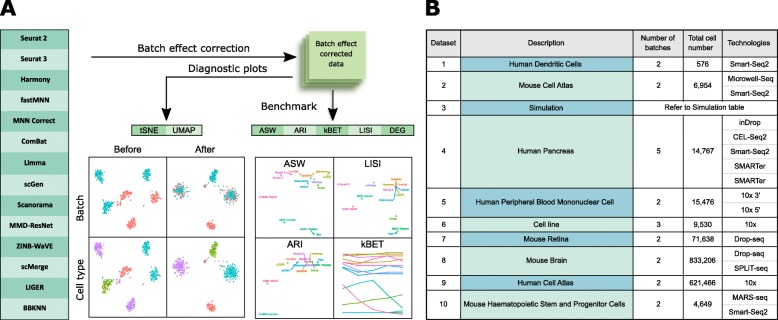
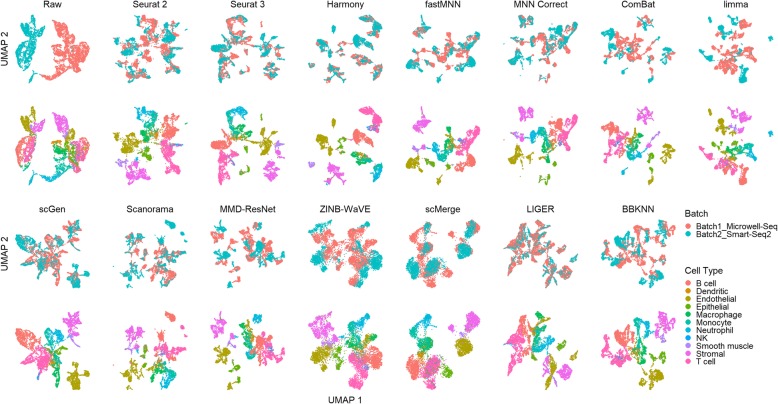
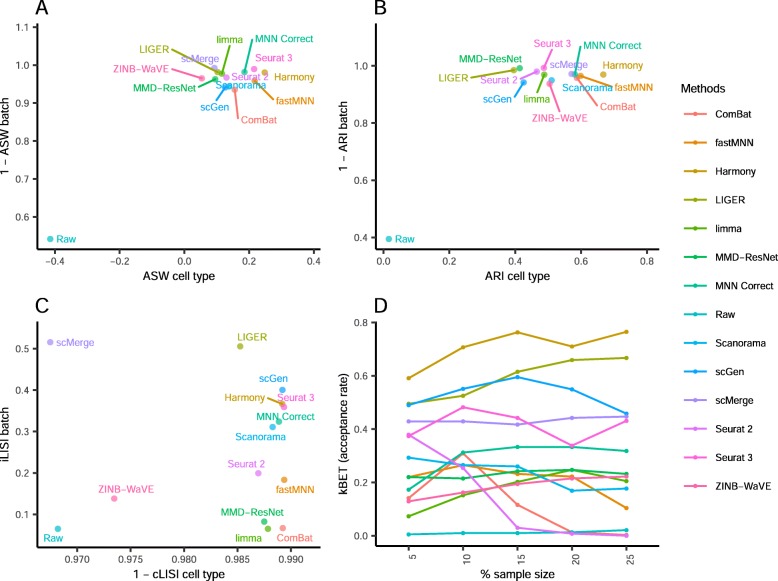
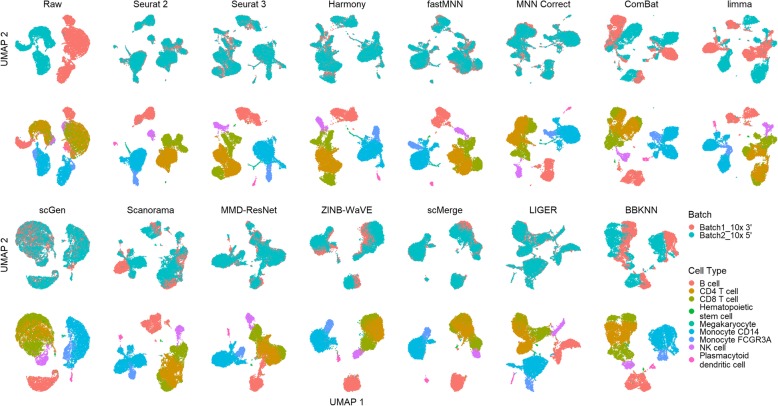
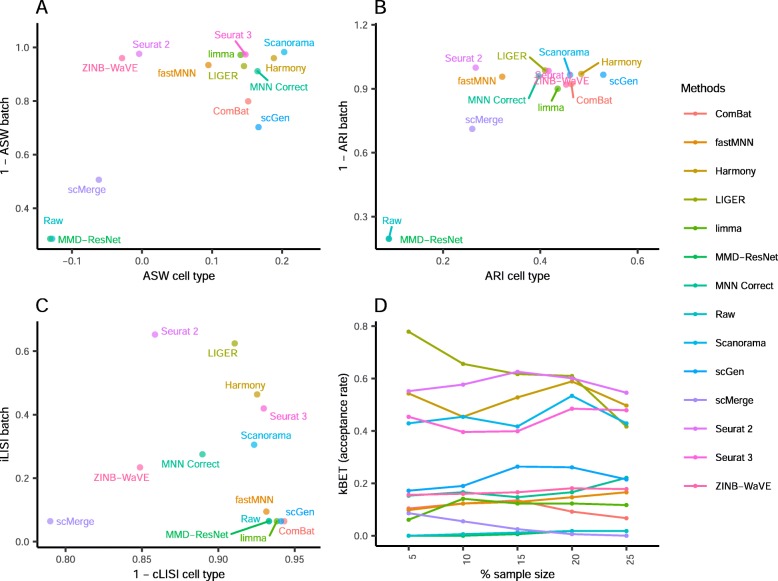
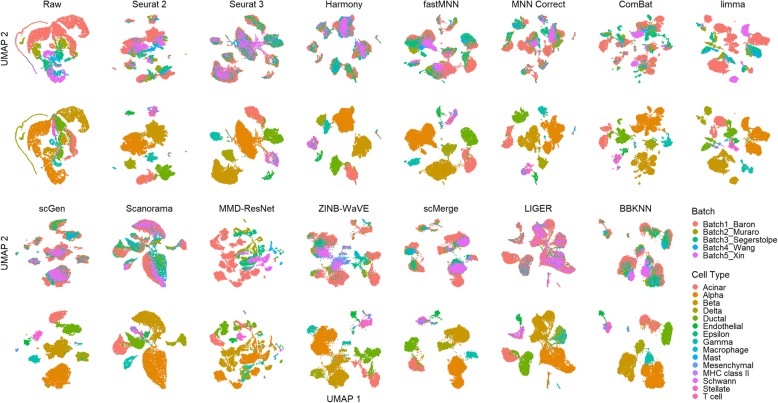
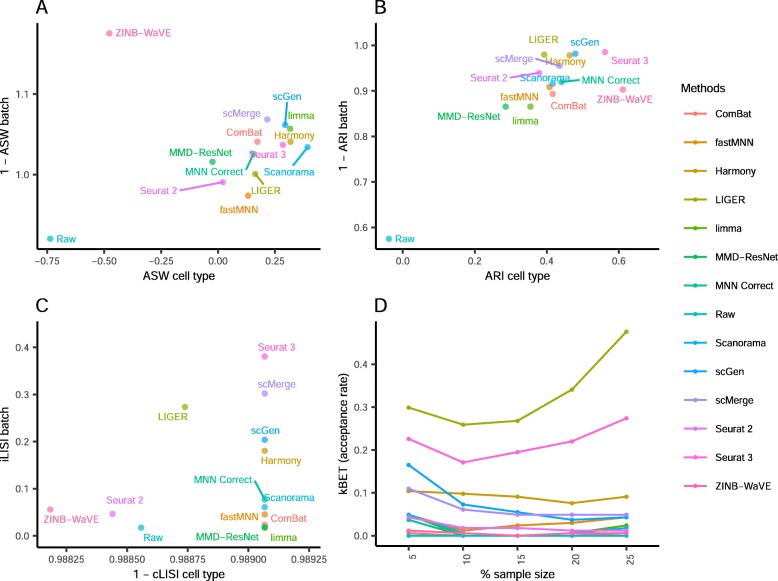
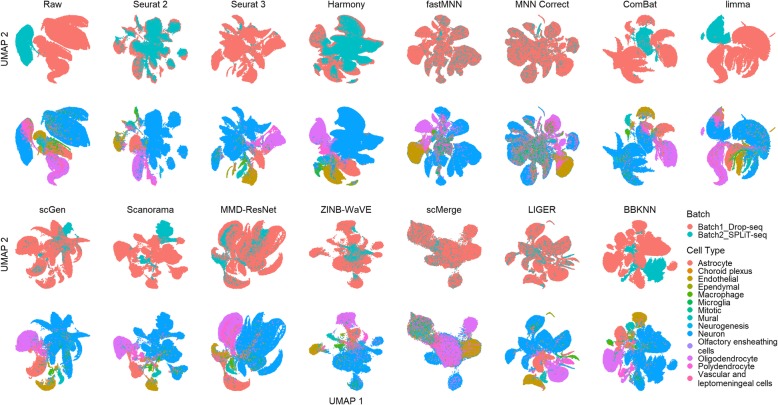
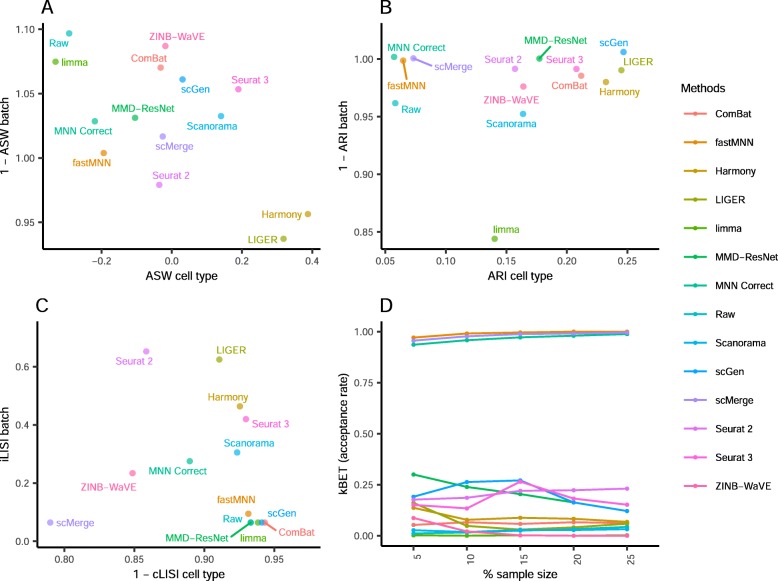
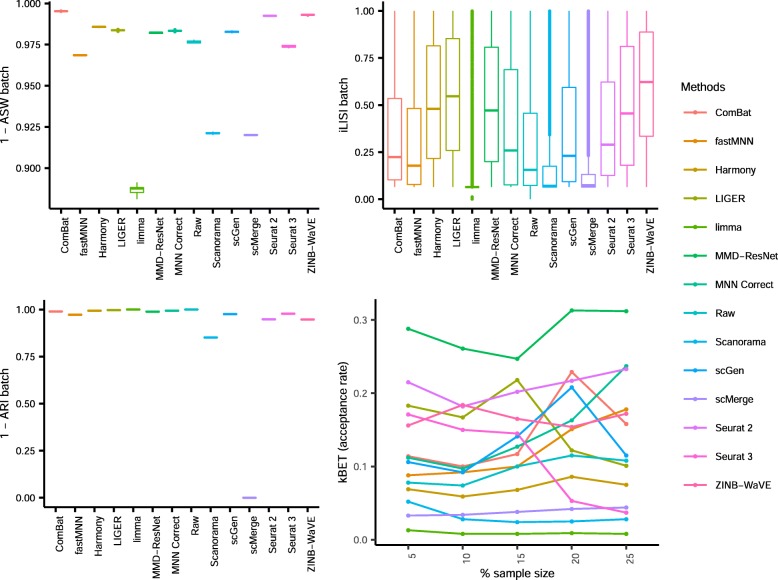
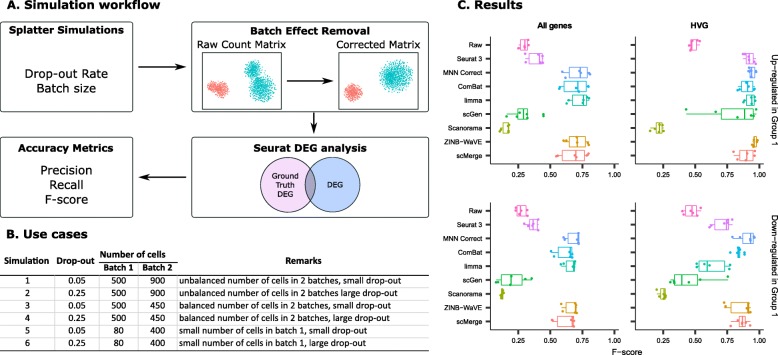
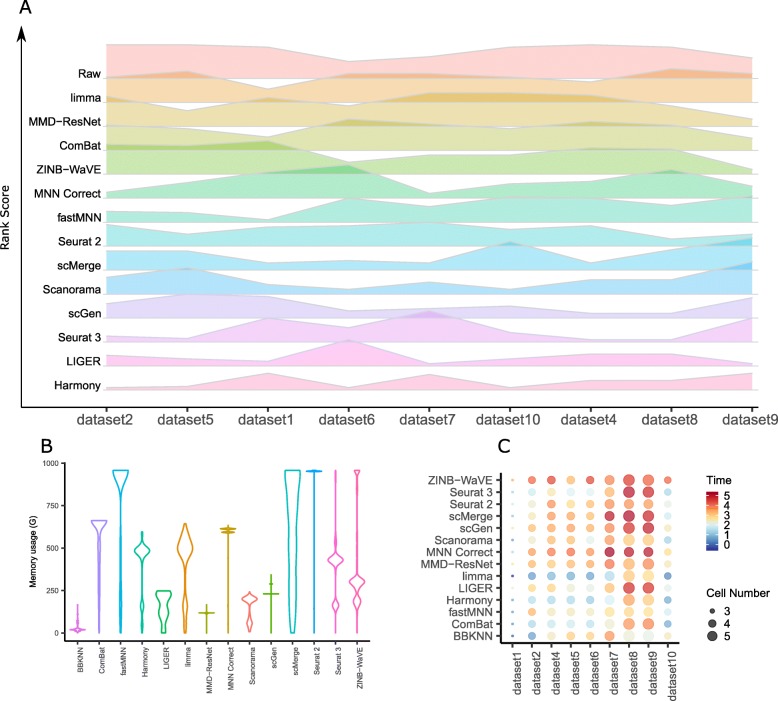
Background: Large-scale single-cell transcriptomic datasets generated using different technologies contain batch-specific systematic variations that present a challenge to batch-effect removal and data integration. With continued growth expected in scRNA-seq data, achieving effective batch integration with available computational resources is crucial. Here, we perform an in-depth benchmark study on available batch correction methods to determine the most suitable method for batch-effect removal. Results: We compare 14 methods in terms of computational runtime, the ability to handle large datasets, and batch-effect correction efficacy while preserving cell type purity. Five scenarios are designed for the study: identical cell types with different technologies, non-identical cell types, multiple batches, big data, and simulated data. Performance is evaluated using four benchmarking metrics including kBET, LISI, ASW, and ARI. We also investigate the use of batch-corrected data to study differential gene expression. Conclusion: Based on our results, Harmony, LIGER, and Seurat 3 are the recommended methods for batch integration. Due to its significantly shorter runtime, Harmony is recommended as the first method to try, with the other methods as viable alternatives.
Overview
The claims and statistics of this paper haven’t been checked yet.
Free: it reads the open-access text and checks the first 5 claims that cite a source we can check. Create a free account to check every claim.
Integrity signals
Registry
Cites
Statistics
Figures
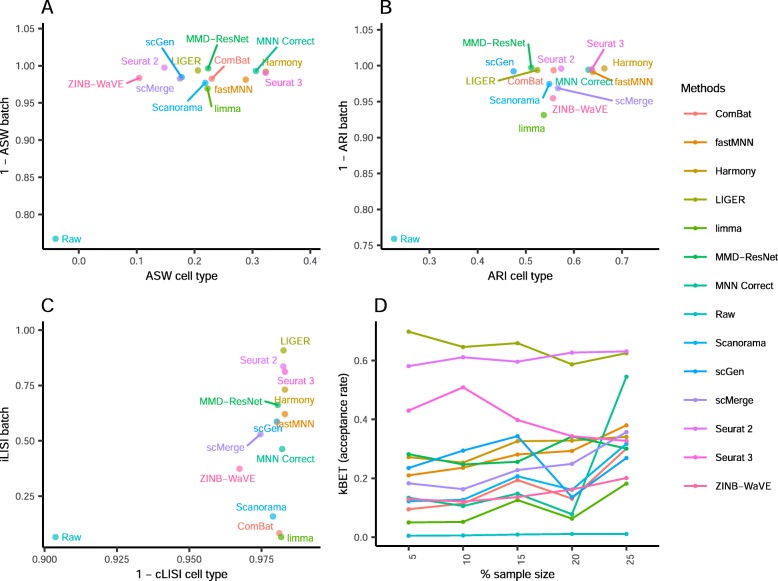
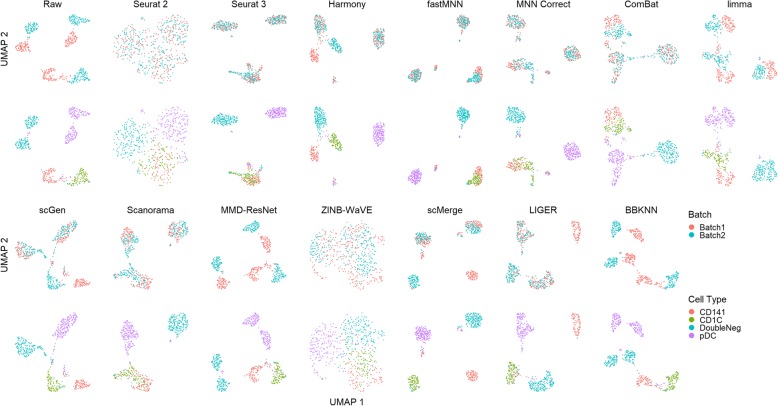
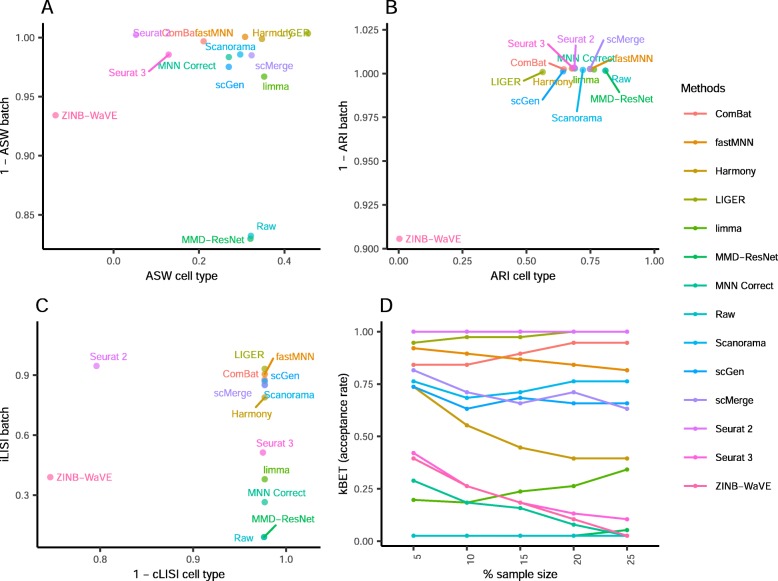
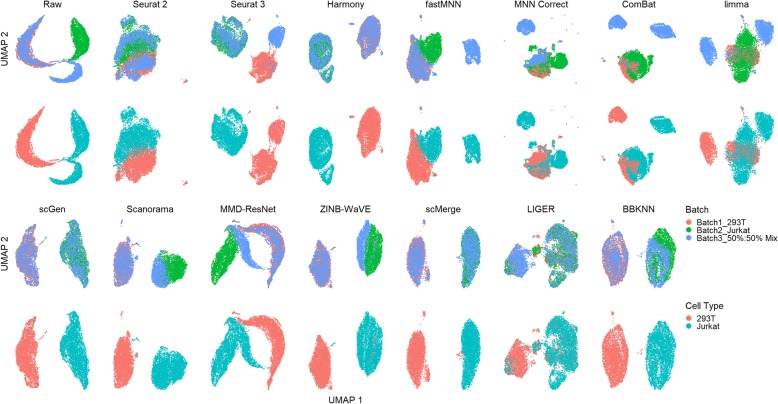
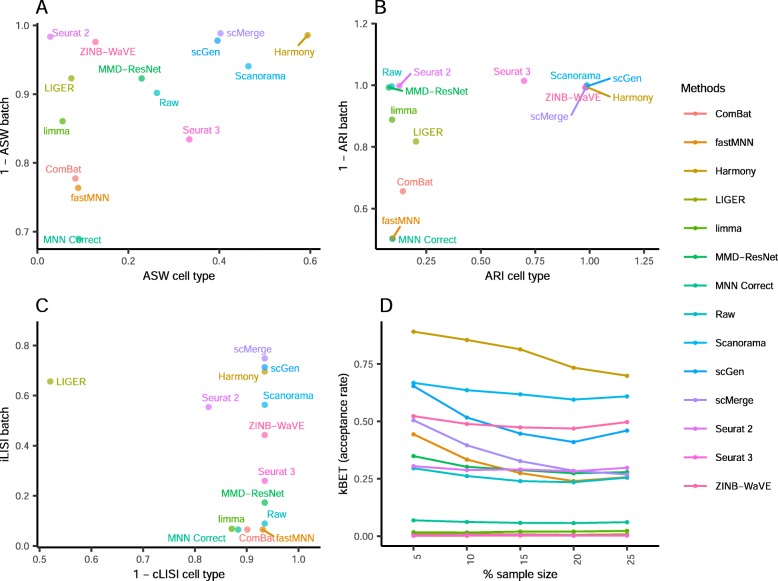
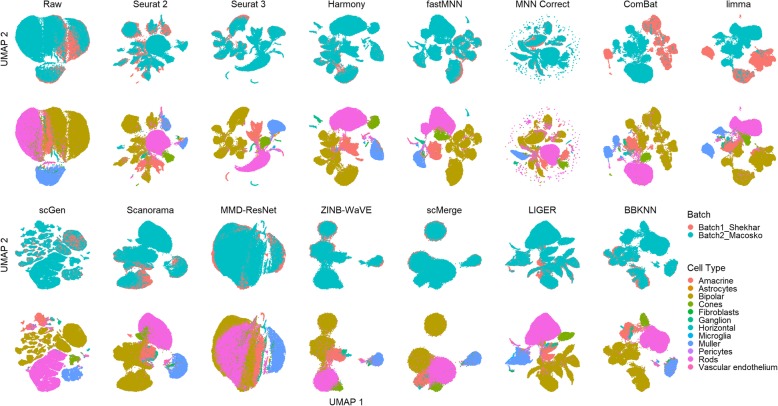
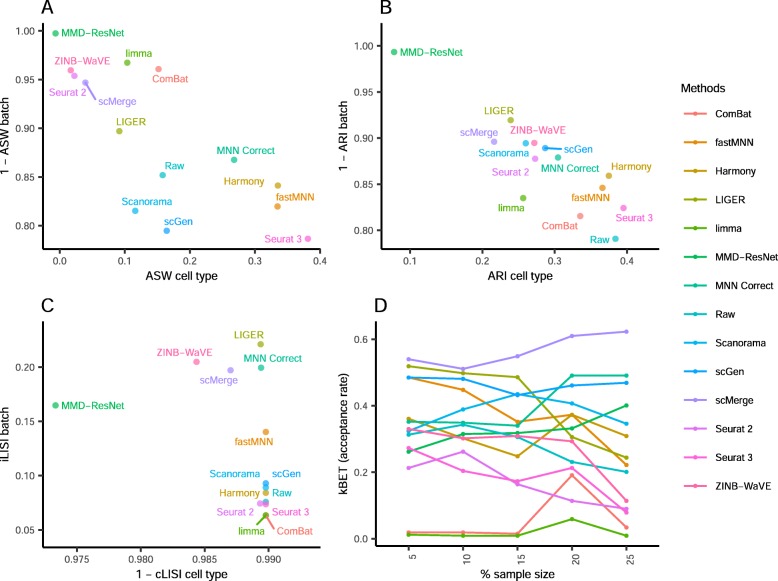
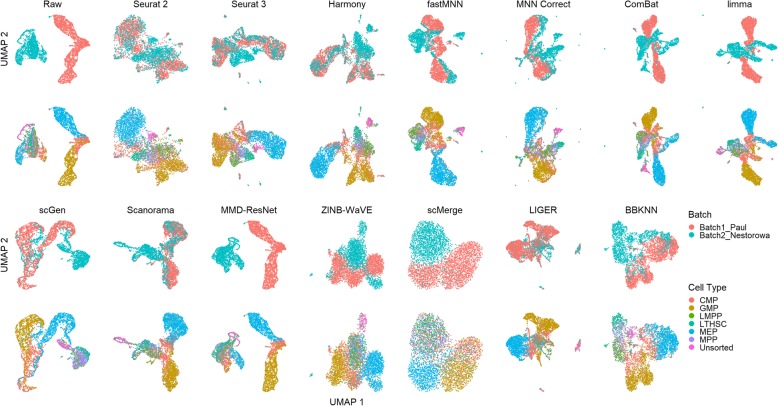
Verification
Claims the paper makes
The claims and statistics of this paper haven’t been checked yet.
Free: it reads the open-access text and checks the first 5 claims that cite a source we can check. Create a free account to check every claim.
Claims other papers make about this one
Each is checked against this paper’s own text: does it say what the citing paper says it does?
The cited source doesn’t support the claim as written.
In the citing paper
“Recent benchmark studies indicate that for simpler integration problems with relatively low biological complexity and relatively small batch effects in scRNA-Seq datasets, linear methods outperform nonlinear, more complex methods136,137, while for complicated integration tasks with large biological complexity and bigger batch effects, nonlinear methods such as scVI/scanVI outperform others138.”
From A high-resolution transcriptomic and spatial atlas of cell types in the whole mouse brain (2023) · cites this paper as [137]
Checked by a reasoning model — may be wrong.
Experimental — accuracy not yet measuredIn the citing paper
“Although SCING GRN based batch correction was not as optimized as the dedicated batch correction methods, many typical batch correction methods do not provide a batch corrected gene expression matrix for downstream analysis.44”
From SCING: Inference of robust, interpretable gene regulatory networks from single cell and spatial transcriptomics (2023) · cites this paper as [44]
In the citing paper
“Linear-embedding models such as canonical correlation analysis36 and Harmony37 were shown to perform well for batch correction on simpler integration tasks with distinct batch structures38,39.”
From Best practices for single-cell analysis across modalities (2023) · cites this paper as [38]
Self-check
Percentages, sums and reported differences re-computed from the paper’s own numbers.
The self-check needs the paper’s full text.
Citations
Cites
(2008) · Journal of Machine Learning Research · Cited by 33,051
Silhouettes: A graphical aid to the interpretation and validation of cluster analysis
Rousseeuw, P. J. (1987) · Journal of Computational and Applied Mathematics · doi:10.1016/0377-0427(87)90125-7 · Cited by 21,392 · cited 2×
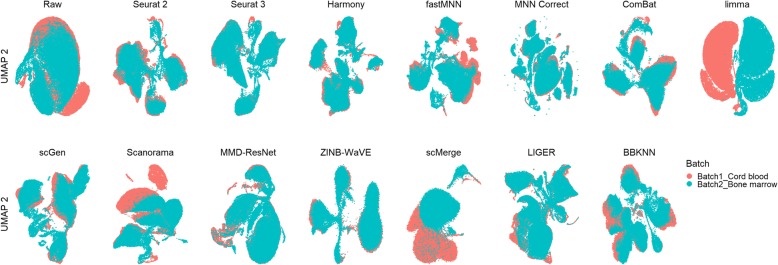
“…and Uniform Manifold Approximation and Projection (UMAP) [21] visualizations in conjunction with the k - nearest neighbor batch-effect test (kBET) [22], local inverse Simpson ’ s index (LISI) [13, 23], average silhouette width (ASW) [24], and adjusted rand index (ARI) benchmarking metrics [25].”
MethodGAN(Generative Adversarial Nets)
(2017) · Journal of Japan Society for Fuzzy Theory and Intelligent Informatics · doi:10.3156/jsoft.29.5_177_2 · Cited by 19,270
Comprehensive Integration of Single-Cell Data
Stuart, T., Butler, A., Hoffman, P., Hafemeister, C., Papalexi, E., Mauck, W. M., Hao, Y., Stoeckius, M., Smibert, P., & Satija, R. (2019) · Cell · doi:10.1016/j.cell.2019.05.031 · Cited by 15,453
Integrating single-cell transcriptomic data across different conditions, technologies, and species
Butler, A., Hoffman, P., Smibert, P., Papalexi, E., & Satija, R. (2018) · Nature Biotechnology · doi:10.1038/nbt.4096 · Cited by 13,174 · cited 6×
“Seurat alignment CCA, multiCCA (Seurat 2) Seurat multiCCA uses canonical correlation analysis (CCA) to first compute the linear combinations of genes with maximum correlation between batches [4].”
BackgroundMethodInfluentialFast, sensitive and accurate integration of single-cell data with Harmony
Korsunsky, I., Millard, N., Fan, J., Slowikowski, K., Zhang, F., Wei, K., Baglaenko, Y., Brenner, M., Loh, P.-R., & Raychaudhuri, S. (2019) · Nature Methods · doi:10.1038/s41592-019-0619-0 · Cited by 10,488 · cited 5×
“Another local level metric is the LISI proposed by Kor-sunsky et al. [13, 22], which can be used to assesses batch and cell type mixing.”
MethodInfluentialSCANPY: large-scale single-cell gene expression data analysis
Wolf, F. A., Angerer, P., & Theis, F. J. (2018) · Genome Biology · doi:10.1186/s13059-017-1382-0 · Cited by 8,881 · cited 1×
“The batch correction by Scanorama was performed in conjunction with the Scanpy workflow [29].”
MethodAdjusting batch effects in microarray expression data using empirical Bayes methods
Johnson, W. E., Li, C., & Rabinovic, A. (2007) · Biostatistics · doi:10.1093/biostatistics/kxj037 · Cited by 8,658 · cited 3×
“ComBat was originally developed for microarray gene expression data [1], but had been successfully employed”
MethodHubert, L., & Arabie, P. (1985) · Journal of Classification · doi:10.1007/bf01908075 · Cited by 8,219
Massively parallel digital transcriptional profiling of single cells
Zheng, G. X. Y., Terry, J. M., Belgrader, P., Ryvkin, P., Bent, Z. W., Wilson, R., Ziraldo, S. B., Wheeler, T. D., McDermott, G. P., Zhu, J., et al. (2017) · Nature Communications · doi:10.1038/ncomms14049 · Cited by 7,353
Research works printed but not linked: 5
- Lun A Further MNN algorithm development 2019
- Goodfellow I, Pouget-Abadie J, Mirza M, Xu B, Warde-Farley D, Ozair S, et al. Generative adversarial nets. In: Ghahramani Z, Welling M, Cortes C, Lawrence ND, Weinberger KQ, editors. Adv Neural Inf Process Syst 27: Curran Associates, Inc; 2014. p. 2672–80. Available from: http://papers.nips.cc/paper/5423-generative-adversarial-nets.pdf. Accessed 11 Mar 2019.
- Korsunsky I LISI 2019
- Deng Y, Bao F, Dai Q, Wu LF, Altschuler SJ. Massive single-cell RNA-seq analysis and imputation via deep learning. bioRxiv. 2018:315556 Available from: http://biorxiv.org/content/early/2018/11/27/315556.abstract. Accessed 5 July 2019.
- Tran HTN, Ang KS, Chevrier M, Zhang X, Lee NYS, Goh M, Chen J. A benchmark of batch-effect correction methods for single-cell RNA sequencing data. Simulations. Github Repository. https://github.com/JinmiaoChenLab/Batch-effect-removal-benchmarking. 2019. PMC6964114 31948481
Cited by
Items 401–500 of 1,005
Empirical Analysis of Data Streaming and Batch Learning Models for Network Intrusion Detection
Adewole, K. S., Salau-Ibrahim, T. T., Imoize, A. L., Oladipo, I. D., AbdulRaheem, M., Awotunde, J. B., Balogun, A. O., Isiaka, R. M., & Aro, T. O. (2022) · Electronics · doi:10.3390/electronics11193109 · Cited by 22
“If If the system must respond to rapidly changing data, such as intrusion data, then a more reactive solution is required [33,34]. system must respond to rapidly changing data, such as intrusion data, then a more reactive solution is required [33,34].”
BackgroundImpact of Data Preprocessing on Integrative Matrix Factorization of Single Cell Data
Hsu, L. L., & Culhane, A. C. (2020) · Frontiers in Oncology · doi:10.3389/fonc.2020.00973 · Cited by 21
“A benchmark comparison of 14 methods for integration of scRNA-seq datasets, on datasets from different technologies with identical cell types, non-identical cell types, multiple batches, big data, and simulated data revealed that harmony, LIGER, and Seurat 3 CCA are most performant (65).”
MethodThe tumor microenvironment across four dimensions: assessing space and time in cancer biology
Larson, C. R., Mandloi, A., Acharyya, S., & Carstens, J. L. (2025) · Frontiers in Immunology · doi:10.3389/fimmu.2025.1554114 · Cited by 19
Xu, X., Liu, J., Qin, W., Ding, C., Cai, Z., Shu, D., Zhong, H., Hu, Y., Yu, M., Zhou, L., et al. (2025) · Advanced Science · doi:10.1002/advs.202406225 · Cited by 22
Kalantari-Dehaghi, M., Esfahani, N. G., & Emadi‐Baygi, M. (2025) · Human Genomics · doi:10.1186/s40246-025-00884-w · Cited by 21
“Batch effects add another layer of difficulty since experiments are often run in multiple batches, bringing in systematic biases that are tricky to correct fully [100].”
Liver in infections: a single-cell and spatial transcriptomics perspective
Zou, J., Li, J., Zhong, X. Y., Tang, D., Fan, X., & Chen, R. (2023) · Journal of Biomedical Science · doi:10.1186/s12929-023-00945-z · Cited by 18
“Cell subpopulations are then localised through deconvolution and mapping [79, 80].”
MethodNatural product P57 induces hypothermia through targeting pyridoxal kinase
Wang, R., Xiao, L., Pan, J., Bao, G., Zhu, Y., Zhu, D., Wang, J., Pei, C., Ma, Q., Fu, X., et al. (2023) · Nature Communications · doi:10.1038/s41467-023-41435-y · Cited by 17
scPML: pathway-based multi-view learning for cell type annotation from single-cell RNA-seq data
Du, Z., Hu, W.-L., Li, J., Shang, X., You, Z., Chen, Z., & Huang, Y. (2023) · Communications Biology · doi:10.1038/s42003-023-05634-z · Cited by 19
“21 and 22).”
JOINTLY: interpretable joint clustering of single-cell transcriptomes
Møller, A. F., & Madsen, J. G. S. (2023) · Nature Communications · doi:10.1038/s41467-023-44279-8 · Cited by 18
“However, in benchmarks, such linear methods are not ef fi cient at removing batch effects 4 likely because batch effects can be highly non-linear 8 .”
Revealing molecular mechanisms of early-onset tongue cancer by spatial transcriptomics
Patysheva, M. R., Сергеевна, К. Е., Khozyainova, A. A., Prostakishina, E. A., Korobeynikov, V., Menyailo, M. E., Iamshchikov, P. S., Loos, D. M., Kovalev, O. I., Zavyalova, M. V., et al. (2024) · Scientific Reports · doi:10.1038/s41598-024-76044-2 · Cited by 19
Monette, A., Aguilar‐Mahecha, A., Altınmakas, E., Angelos, M. G., Assad, N., Batist, G., Bommareddy, P. K., Bonilla, D. L., Borchers, C. H., Church, S., et al. (2024) · Clinical Cancer Research · doi:10.1158/1078-0432.ccr-24-2469 · Cited by 17
Preparation of single-cell suspensions of mouse glomeruli for high-throughput analysis
Korin, B., Chung, J.-J., Avraham, S., & Shaw, A. S. (2021) · Nature Protocols · doi:10.1038/s41596-021-00578-2 · Cited by 17
RgCop-A regularized copula based method for gene selection in single-cell RNA-seq data
Lall, S., Ray, S., & Bandyopadhyay, S. (2021) · PLoS Computational Biology · doi:10.1371/journal.pcbi.1009464 · Cited by 20
Zheng, M., Hu, Z. Q., Zhou, W., Kong, Y., Wu, R., Zhang, B., Long, H., Jia, S., Lu, Q., & Zhao, M. (2022) · Clinical Immunology · doi:10.1016/j.clim.2022.109172 · Cited by 17
Single-Cell RNA Sequencing Procedures and Data Analysis
Wolfien, M., David, R., & Galow, A.-M. (2021) · Exon Publications eBooks · doi:10.36255/exonpublications.bioinformatics.2021.ch2 · Cited by 21
“compared 14 methods in terms of computational runtime, the ability to handle large datasets, and batch-effect correction efficacy, while preserving cell type purity (46).”
MethodSingle-Cell Profiling in Multiple Myeloma: Insights, Problems, and Promises
Samur, M., Szalat, R. E., & Munshi, N. C. (2023) · Blood · doi:10.1182/blood.2022017145 · Cited by 21
Application and prospects of single-cell and spatial omics technologies in woody plants
Liang, S., Li, Y., Chen, Y., Huang, H., Zhou, R., & Ma, T. (2023) · Forestry Research · doi:10.48130/fr-2023-0027 · Cited by 19
Sun, T., Grassam-Rowe, A., Pu, Z., Li, Y., Ren, H., An, Y., Guo, X., Hu, W., Liu, Y., Zheng, Y., et al. (2023) · Nature Communications · doi:10.1038/s41467-023-42658-9 · Cited by 18
Single-Cell Sequencing: High-Resolution Analysis of Cellular Heterogeneity in Autoimmune Diseases
Tang, X., Zhang, Y., Zhang, H., Zhang, N., Dai, Z., Cheng, Q., & Li, Y. (2024) · Clinical Reviews in Allergy & Immunology · doi:10.1007/s12016-024-09001-6 · Cited by 17
“Several methods have been developed to remove the batch effect [194].”
Wu, C.-H., Zhou, X., & Chen, M. (2025) · Genome biology · doi:10.1186/s13059-025-03525-6 · Cited by 17
Zhang, Y., Aevermann, B. D., Bakken, T. E., Miller, J. A., Hodge, R. D., Lein, E. S., & Scheuermann, R. H. (2020) · Briefings in Bioinformatics · doi:10.1093/bib/bbaa339 · Cited by 19
“17 To date, there are more than 10 methods that have been proposed to correct the batch effects 333 of scRNAseq data; among them, Harmony [31], LIGER [32], and Seurat 3 [21] are the 334 recommended algorithms for batch integration [33].”
MethodCell-level metadata are indispensable for documenting single-cell sequencing datasets
Puntambekar, S., Hesselberth, J. R., Riemondy, K. A., & Fu, R. (2021) · PLoS Biology · doi:10.1371/journal.pbio.3001077 · Cited by 22
HDMC: a novel deep learning-based framework for removing batch effects in single-cell RNA-seq data
Wang, X., Wang, J., Zhang, H., Huang, S., & Yin, Y. (2021) · Bioinformatics · doi:10.1093/bioinformatics/btab821 · Cited by 16
Processing single-cell RNA-seq datasets using SingCellaR
Wang, G., Wen, W. X., Mead, A. J., Roy, A., Psaila, B., & Thongjuea, S. (2022) · STAR Protocols · doi:10.1016/j.xpro.2022.101266 · Cited by 17
Sonrel, A., Luetge, A., Soneson, C., Mallona, I., Germain, P., Knyazev, S., Gilis, J., Gerber, R., Seurinck, R., Paul, D., et al. (2023) · Genome biology · doi:10.1186/s13059-023-02962-5 · Cited by 18
“This lack of standards can, for example, lead to different rankings of the same methods for the same task (Luecken, Büttner, et al. 2022; Chazarra-Gil et al. 2021; Tran et al. 2020).”
MethodRezcallah, M. C., Almazi, J. G., & Ammit, A. J. (2020) · Cellular Signalling · doi:10.1016/j.cellsig.2020.109868 · Cited by 16
Yu, Z., Xu, Z., Fu, T., Liu, S., Cui, J., Zhang, B., Liang, J., Pang, C., Ke, Y., Wang, R., et al. (2025) · Nature Communications · doi:10.1038/s41467-025-58094-w · Cited by 16
HiCat: a semi-supervised approach for cell type annotation
Bi, C., Bai, K., & Zhang, X. (2025) · Briefings in Bioinformatics · doi:10.1093/bib/bbaf428 · Cited by 15
“We choose Harmony since it was recommended as top 3 batch effect removal methods in a recent benchmark study [40] Harmony functions within the PCs space,iteratively adjusting the data to synchronize shared cell types across datasets,all while preserving biological variation.”
Self-citationProtein-level batch-effect correction enhances robustness in MS-based proteomics
Chen, Q., Cao, Z., Liu, Y., Zhang, N., Xie, Y., Chen, H., Mai, Y., Duan, S., Li, J., Yu, Y., et al. (2025) · Nature Communications · doi:10.1038/s41467-025-64718-y · Cited by 17
Monnier, L., & Cournède, P.-H. (2024) · PLoS Computational Biology · doi:10.1371/journal.pcbi.1011880 · Cited by 17
Ysasi, A. B., Engler, A., Bawa, P., Wang, F., Conrad, R. D., Yeung, A. K., Rock, J. R., Beane, J., Mazzilli, S. A., Franklin, R. A., et al. (2024) · iScience · doi:10.1016/j.isci.2024.110169 · Cited by 15
Bhayana, S., Schytz, P. A., Olesen, E. T. B., Soh, K., & Das, V. (2024) · American Journal Of Pathology · doi:10.1016/j.ajpath.2024.07.007 · Cited by 15
Chen, L., Hu, Y., Li, Y., Zhang, B., Wang, J., Deng, M., Zhang, J., Zhu, W., Gu, H., & Zhang, L. (2024) · Scientific Reports · doi:10.1038/s41598-024-78911-4 · Cited by 16
Hu, X., Li, H., Chen, M., Qian, J., & Jiang, H. (2025) · Communications Biology · doi:10.1038/s42003-025-07947-7 · Cited by 16
“Indeed, various BEC methods have been proposed in recent years, and a recent benchmark study compared 14 BEC methods in terms of batch mixing, accuracy of cell type annotation, computational ef fi ciency for large datasets, etc., and recommended Harmony, LIGER and Seurat as top performers 9 .”
Yifan, C., Fan, Y., & Pu, J. (2020) · Journal of Molecular and Cellular Cardiology · doi:10.1016/j.yjmcc.2020.03.005 · Cited by 16
Advances in Single-Cell Multi-Omics and Application in Cardiovascular Research
Zhang, X., Qiu, H., Zhang, F., & Ding, S. (2022) · Frontiers in Cell and Developmental Biology · doi:10.3389/fcell.2022.883861 · Cited by 15
Self-citationDimensionality reduction for visualizing high-dimensional biological data
Malepathirana, T., Senanayake, D., Vidanaarachchi, R., Gautam, V., & Halgamuge, S. K. (2022) · Biosystems · doi:10.1016/j.biosystems.2022.104749 · Cited by 16
Sreenivasan, V. K. A., Dore, R., Resch, J., Maier, J., Dietrich, C., Henck, J., Balachandran, S., Mittag, J., & Spielmann, M. (2023) · Development · doi:10.1242/dev.201228 · Cited by 16
Wong, M., Wei, Y., & Ho, Y. (2023) · Current Opinion in HIV and AIDS · doi:10.1097/coh.0000000000000809 · Cited by 16
Deep Fair Clustering via Maximizing and Minimizing Mutual Information: Theory, Algorithm and Metric
Zeng, P., Li, Y., Hu, P., Peng, D., Lv, J., & Peng, X. (2023) · IEEE Computer Society Conference on Computer Vision and Pattern Recognition/Proceedings - IEEE Computer Society Conference on Computer Vision and Pattern Recognition/Proceedings · doi:10.1109/cvpr52729.2023.02297 · Cited by 29
“Taking single-cell RNA clustering as a showcase, standard methods would partition data based on sequencing techniques (group information) instead of intrinsic cell types (cluster information), since cells sequenced by different techniques would result in different expression levels [36] and most clustering methods can…”
MethodscTOP: physics-inspired order parameters for cellular identification and visualization
Yampolskaya, M., Herriges, M. J., Ikonomou, L., Kotton, D. N., & Mehta, P. (2023) · Development · doi:10.1242/dev.201873 · Cited by 17
Combined BRAF, MEK, and heat‐shock protein 90 inhibition in advanced BRAF V600‐mutant melanoma
Eroglu, Z., Chen, Y. A., Smalley, I., Li, J., Markowitz, J., Brohl, A. S., Tetteh, L. F., Taylor, H., Sondak, V. K., Khushalani, N. I., et al. (2023) · Cancer · doi:10.1002/cncr.35029 · Cited by 16
“ISCVA consists of two major components: the back ‐ end scripts, functions using R packages (e.g., Seurat 17 and SingleR 18 ; R Foundation for Statistical Computing) for quality control and cell ‐ type classification, and the front ‐ end JavaScripts for interactive investigation.”
MethodLee, Y., Song, J., Jeong, Y., Choi, E., Ahn, C. W., & Jang, W. (2023) · Computers in Biology and Medicine · doi:10.1016/j.compbiomed.2023.107685 · Cited by 15
Dong, J., Zhou, P., Wu, Y., wang, W., Chen, Y., Zhou, X., Xie, H., Gao, Y., Lu, J., Yang, J., et al. (2021) · Briefings in Bioinformatics · doi:10.1093/bib/bbab366 · Cited by 17
Self-citationKannan, S., Farid, M., Lin, B. L., Miyamoto, M., & Kwon, C. (2020) · bioRxiv (Cold Spring Harbor Laboratory) · doi:10.1101/2020.04.02.022632 · Cited by 16
Ren, H., Zhou, X., Yang, J., Kou, K., Chen, T., Pu, Z., Ye, K., Fan, X., Zhang, D., Kang, X., et al. (2023) · Scientific Data · doi:10.1038/s41597-023-02333-6 · Cited by 15
“There are extensive suggested solutions for ‘correcting’ batch differences 24 .”
BackgroundBenchmarking informatics workflows for data-independent acquisition single-cell proteomics
Wang, J., Huang, Y., Lu, F., Xu, Q., Yang, Z., Jiang, Y., Shi, S.-W., Pan, J., Yang, Y., & Fang, Q. (2025) · Nature Communications · doi:10.1038/s41467-025-65174-4 · Cited by 17
Toward informed batch correction for single-cell transcriptome integration
Li, S., Luecken, M. D., Marioni, J. C., Teichmann, S. A., & He, P. (2026) · Nature Computational Science · doi:10.1038/s43588-025-00943-1 · Cited by 18
“Despite extensive benchmarking efforts 3,4,8–11 , integration methods continue to face the challenge of an imbalanced trade-off—either removing true biological variability (overcorrection) or failing to fully eliminate technical noise (undercorrection), as illustrated in Fig.”
Unbiased integration of single cell transcriptome replicates
Loza, M., Teraguchi, S., Standley, D. M., & Díez, D. (2022) · NAR Genomics and Bioinformatics · doi:10.1093/nargab/lqac022 · Cited by 15
“However, the authors found that each method performed differently on each test, with no obviously superior method (3).”
InfluentialOne Cell At a Time (OCAT): a unified framework to integrate and analyze single-cell RNA-seq data
Wang, C. X., Zhang, L., & Wang, B. (2022) · Genome biology · doi:10.1186/s13059-022-02659-1 · Cited by 14
“[8], we integrate the five pancreatic datasets using OCAT, and benchmark with Seurat v3, Harmony, and Scanorama.”
MethodInfluentialBazyari, M. J., Saadat, Z., Firouzjaei, A. A., & Aghaee‐Bakhtiari, S. H. (2023) · Biochemistry and Biophysics Reports · doi:10.1016/j.bbrep.2023.101491 · Cited by 15
Fouché, A., & Zinovyev, A. Y. (2023) · Frontiers in Bioinformatics · doi:10.3389/fbinf.2023.1191961 · Cited by 16
Exploring the role of LIAS-related cuproptosis in systemic lupus erythematosus
Li, Y., Xu, B., Zhang, J., Liu, X., Ganesan, K., & Shi, G. (2023) · Lupus · doi:10.1177/09612033231211429 · Cited by 14
Loss of immune cell identity with age inferred from large atlases of single cell transcriptomes
Connolly, E. C., Pan, T. C., Aluru, M. R., Chockalingam, S. P., Dhere, V. R., & Gibson, G. C. (2024) · Aging Cell · doi:10.1111/acel.14306 · Cited by 18
“Single cell profiling is generally subject to batch effects (Tran et al., 2020 ) where heterogeneity can arise not only from sample- to-sample technical issues, but also biological differences.”
Kiaee, K., Jodat, Y. A., Bassous, N. J., Matharu, N. K., & Shin, S. R. (2021) · Cells · doi:10.3390/cells10123422 · Cited by 15
“Many methods have been recently developed to mitigate batch effects without confounding biological variations, in depth review and benchmarks are reported elsewhere [27,28].”
BackgroundMethodHirakawa, M. P., Tjahjono, N., Light, Y. K., Celebi, A., Celebi, N., Chintalapudi, P., Butler, K. S., Branda, S. S., & Krishnakumar, R. (2022) · iScience · doi:10.1016/j.isci.2022.103759 · Cited by 15
“Data processed across two different experimental runs was normalized using COMBAT (Johnson et al., 2007; Tran et al., 2020).”
MethodWang, X., Zhang, C., Zhang, Y., Meng, X., Zhang, Z., Shi, X., & Song, T. (2022) · International Journal of Molecular Sciences · doi:10.3390/ijms23042082 · Cited by 15
“…four types of human dendritic cells (DCs), i.e., CD1C DC CD141 DC, plasmacytoid DC (pDC), and double-negative cells (DoubleNeg) [23] Two types of biologically similar cells, CD1C DC from batch1 and CD141 DC from batch2, were removed to ensure the two sub-datasets contained batch-specific cells [16].”
BackgroundMethodInfluentialErythropoietin re-wires cognition-associated transcriptional networks
Singh, M., Zhao, Y., Gastaldi, V. D., Wojcik, S. M., Curto, Y., Kawaguchi, R., Merino, R. M., Garcia‐Agudo, L. F., Taschenberger, H., Brose, N., et al. (2023) · Nature Communications · doi:10.1038/s41467-023-40332-8 · Cited by 16
“Here, we classify the major neuronal and non-neuronal cell types from the murine hippocampus using the computational ef fi ciency of integrated snRNA-seq datasets from EPO and PL samples 28,29 .”
A pulmonologist's guide to perform and analyse cross-species single lung cell transcriptomics
Pennitz, P., Kirsten, H., Friedrich, V. D., Wyler, E., Goekeri, C., Obermayer, B., Heinz, G. A., Mashreghi, M., Büttner, M., Trimpert, J., et al. (2022) · European Respiratory Review · doi:10.1183/16000617.0056-2022 · Cited by 15
GLOBE: a contrastive learning-based framework for integrating single-cell transcriptome datasets
Yan, X., Zheng, R., & Li, M. (2022) · Briefings in Bioinformatics · doi:10.1093/bib/bbac311 · Cited by 14
Huang, M. C., Zhang, Z., & Zhang, N. R. (2020) · bioRxiv (Cold Spring Harbor Laboratory) · doi:10.1101/2020.08.03.234765 · Cited by 15
Replication of single-cell proteomics data reveals important computational challengesPreprint
Vanderaa, C., & Gatto, L. (2021) · bioRxiv (Cold Spring Harbor Laboratory) · doi:10.1101/2021.04.12.439408 · Cited by 15
“Other batch correction methods have been developed for scRNA-Seq data and were extensively benchmarked elsewhere [25, 26].”
MethodWhat Single Cell RNA Sequencing Has Taught Us about Chronic Obstructive Pulmonary Disease
Sin, D. D. (2024) · Tuberculosis & respiratory diseases · doi:10.4046/trd.2024.0001 · Cited by 13
“Although there are statistical approaches to address batch effects, they may not fully mitigate the noise and may in certain cases eliminate some of the signal within the experimental data 20 .”
BackgroundDeep Batch Integration and Denoise of Single‐Cell RNA‐Seq Data
Lu, Q., Zhang, G., Zhang, S., & Chen, Y. (2024) · Advanced Science · doi:10.1002/advs.202308934 · Cited by 14
Roy, Z. A. V., Kak, G., Korshoj, L. E., Menousek, J. P., Heim, C. E., Fallet, R. W., Campbell, J. R., Geary, C. R., Liu, B., Gorantla, S., et al. (2024) · Cell Reports Medicine · doi:10.1016/j.xcrm.2024.101790 · Cited by 15
Systems immunology insights into brain metastasis
Dong, W., Sheng, J., Cui, J. Z. M., Zhao, H., & Wong, S. T. C. (2024) · Trends in Immunology · doi:10.1016/j.it.2024.09.010 · Cited by 14
Single-cell sequencing reveals the mechanisms of multiple myeloma progression: clarity or confusion?
Xiang, Y., Sun, G., Tian, L., Xiang, P., & Xie, C. (2025) · Annals of Hematology · doi:10.1007/s00277-025-06241-0 · Cited by 13
“Encouragingly, efforts are being made to address these pitfalls, and sc-seq will provide invaluable insights into life sciences [ 158 – 160 ].”
Xu, W.-X., Ye, Y., Chen, J., Guo, X., Li, C., Luo, J., Lu, L., & Chen, X. (2025) · Frontiers in Oncology · doi:10.3389/fonc.2025.1606195 · Cited by 13
Self-citationMapping the tumor immune landscape: single-cell RNA sequencing in cancer immunotherapy
Huang, Y., Zhang, M., & Gao, Q. (2025) · Cancer Letters · doi:10.1016/j.canlet.2025.218012 · Cited by 15
Maitra, C., Seal, D. B., Das, V., & De, R. K. (2023) · Frontiers in Molecular Biosciences · doi:10.3389/fmolb.2023.1184748 · Cited by 13
“Batch effects in single cell datasets pose great challenges in data integration and compromises the results (Haghverdi et al., 2018; Tran et al., 2020).”
BackgroundCell-type annotation with accurate unseen cell-type identification using multiple references
Xiong, Y.-X., Wang, M.-G., Chen, L., & Zhang, X.-F. (2023) · PLoS Computational Biology · doi:10.1371/journal.pcbi.1011261 · Cited by 13
Self-citationGioacchino, E., Zhang, W., Koyunlar, C., Zink, J., de Looper, H. W. J., Gussinklo, K. J., Hoogenboezem, R., Bosch, D. A., Bindels, E., Touw, I. P., et al. (2024) · British Journal of Haematology · doi:10.1111/bjh.19585 · Cited by 13
Vicidomini, R., Nguyen, T. H., Choudhury, S. D., Brody, T., & Serpe, M. (2021) · Current Protocols · doi:10.1002/cpz1.37 · Cited by 13
“Seurat version 3 provides a highly recommended method for batch integration that performs well on simple tasks with distinct biological signals (Luecken et al., 2020; Tran et al., 2020).”
MethodJiang, T., Zhou, W., Sheng, Q., Yu, J., Xie, Y., Ding, N., Zhang, Y., Xu, J., & Li, Y. (2022) · Nucleic Acids Research · doi:10.1093/nar/gkac922 · Cited by 15
“Next, the batch effects from different samples or datasets were removed by Harmony (30).”
MethodMultisite assessment of reproducibility in high‐content cell migration imaging data
Hu, J., Serra‐Picamal, X., Bakker, G., Troys, M. V., Winograd-Katz, S. E., Ege, N., Gong, X., Didan, Y., Grosheva, I., Polansky, O., et al. (2023) · Molecular Systems Biology · doi:10.15252/msb.202211490 · Cited by 13
“Similar batch effect removal approaches have been important for meta-analysis in other fields and data types, such as from RNA-sequencing and peptide-centered proteomics via mass spectrometry (Leek et al, 2010; Gregori et al, 2012; Tran et al, 2020).”
MethodHu, X., Zhang, Z., Long, L., Gu, M., Chen, W., Pan, B., Wu, X., Wang, C., Li, C., Zheng, L., et al. (2024) · Frontiers in Immunology · doi:10.3389/fimmu.2024.1307748 · Cited by 12
The effect of data transformation on low-dimensional integration of single-cell RNA-seq
Park, Y., & Hauschild, A.-C. (2024) · BMC Bioinformatics · doi:10.1186/s12859-024-05788-5 · Cited by 12
“Subsequently, they utilized t-SNE and UMAP for the visualization and quality evaluation of the batch correction [17].”
MethodA joint analysis of single cell transcriptomics and proteomics using transformer
Chen, Y., Fan, X., Shi, C., Shi, Z., & Wang, C. (2025) · npj Systems Biology and Applications · doi:10.1038/s41540-024-00484-9 · Cited by 13
“Although Seurat and totalVI provide methods for integrating data from different sources or batches, they cannot fully correct for batch effects, particularly when consolidating multiple CITE-seq datasets with partially over-lapping protein panels 20 .”
SpaSEG: unsupervised deep learning for multi-task analysis of spatially resolved transcriptomics
Bai, Y., Guo, X., Liu, K., Zheng, B., Wei, Y., Wang, Y., Zhang, W. H., Luo, Q., Yin, J., Wu, L. L., et al. (2025) · Genome biology · doi:10.1186/s13059-025-03697-1 · Cited by 13
“S39), while effectively decoupling intrinsic biological variations from technical artifacts such as the batch effect across adjacent sections [38, 61].”
Tekgüç, M., Matsumoto, T., Altenburger, L. M., Kobayashi, K., Hiratsuka, K., Higashi, Y., Rizki-Safitri, A., Miyoshi, T., El-Jouni, W., Arnaout, M. A., et al. (2026) · npj Biomedical Innovations. · doi:10.1038/s44385-025-00063-5 · Cited by 12
“…μ Mfor7or18days Lastly, our scRNA-seq analysis was limited by the freezing and ship-ping processofsingle-cellsuspensions, whichhindered robustcomparisons with existing datasets from fetal and adult human kidneys and kidney organoids, even when applying batch correction methods such as Harmony 56 .”
Single-cell RNA sequencing analysis of T helper cell differentiation and heterogeneity
Jaroušek, R., Mikulová, A., Daďová, P., Tauš, P., Kurucová, T., Plevová, K., Tichý, B., & Kubala, L. (2022) · Biochimica et Biophysica Acta (BBA) - Molecular Cell Research · doi:10.1016/j.bbamcr.2022.119321 · Cited by 16
Approaches of Single-Cell Analysis in Crop Improvement
Srivastava, U., & Singh, S. (2022) · Springer protocols handbooks/Springer protocols · doi:10.1007/978-1-0716-2533-0_14 · Cited by 12
Li, Y., Wang, W., Wang, D., Zhang, L., Wang, X., He, J., Cao, L., Li, K., & Xie, H. (2022) · Genes · doi:10.3390/genes13122276 · Cited by 12
“The sample collection time and single-cell sequencing time were completely different among these five patients [11,12], and a strong batch effect was potentially present across different samples.”
BackgroundWu, J., Wang, S., Liu, Y., Zhang, T., Wang, X., & Miao, C. (2023) · Frontiers in Immunology · doi:10.3389/fimmu.2023.1132661 · Cited by 12
“We integrated all these scRNA through “Harmony” algorithm and gathered total 9 ccRCC and 9 normal kidney samples (28, 29).”
MethodCeglia, N., Sethna, Z. M., Freeman, S. S., Uhlitz, F., Bojilova, V., Rusk, N., Burman, B., Chow, A. T., Salehi, S., Kabeer, F., et al. (2023) · Nature Communications · doi:10.1038/s41467-023-39985-2 · Cited by 12
ScRNAPip: A systematic and dynamic pipeline for single‐cell RNA sequencing analysis
Xu, L., Zhang, J., He, Y., Yang, Q., Mu, T., Guo, Q., Li, Y., Tong, T., Chen, S., & Ye, R. D. (2023) · iMeta · doi:10.1002/imt2.132 · Cited by 12
“In Tran HTN's study [16], the ASW index is used to evaluate performance.”
MethodBranching topology of the human embryo transcriptome revealed by Entropy Sort Feature Weighting
Radley, A., Boeing, S., & Smith, A. G. (2024) · Development · doi:10.1242/dev.202832 · Cited by 12
Information‐Distilled Generative Label‐Free Morphological Profiling Encodes Cellular Heterogeneity
Lo, M. C. K., Siu, D. M. D., Lee, K. C. M., Wong, J. S. J., Yeung, M. C. F., Hsin, M. K. Y., Ho, J., & Tsia, K. K. (2024) · Advanced Science · doi:10.1002/advs.202307591 · Cited by 14
“In parallel, a few methods have been developed to address batch effect correction in single-cell omics analysis [14, 15].”
MethodZhang, C., Liu, L., Zhang, Y., Li, M., Fang, S., Kang, Q., Chen, A., Xu, X., Zhang, Y., & Li, Y. (2024) · GigaScience · doi:10.1093/gigascience/giae042 · Cited by 14
“We applied the following integration methods: (1) Harmony(8) implemented in the 505 SCANPY package external module harmony_integrate; (2) Combat(62) implemented in the 506 SCANPY package module combat; (3) Scanorama(11) implemented in the SCANPY package 507 external module scanorama_integrate; (4) BBKNN(12) implemente…”
Chen, Z., Zhang, J., Liu, J. J., Dai, Y. Q., Lee, D., Min, M. R., Xu, M., & Gerstein, M. (2021) · Bioinformatics · doi:10.1093/bioinformatics/btab283 · Cited by 15
Expression quantitative trait locus studies in the era of single-cell omics
Luo, J., Wu, X., Cheng, Y., Chen, G., Wang, J., & Song, X. (2023) · Frontiers in Genetics · doi:10.3389/fgene.2023.1182579 · Cited by 11
“(Tran et al., 2020) compared 14 batch effect correction methods in five scenarios.”
MethodWei, K., Zhang, X., & Yang, D. (2023) · PeerJ · doi:10.7717/peerj.16643 · Cited by 11
Self-citationPanahi, B., Hamid, R., Jacob, F., & Jalaly, H. M. (2025) · Current Plant Biology · doi:10.1016/j.cpb.2025.100523 · Cited by 12
scDA: Single cell discriminant analysis for single-cell RNA sequencing data
Shi, Q., Li, X., Peng, Q., Zhang, C., & Chen, L. (2021) · Computational and Structural Biotechnology Journal · doi:10.1016/j.csbj.2021.05.046 · Cited by 11
“We next tested the prediction ability of scDA across datasets as batches or batch effects are really common between different scRNA-seq experiments [30], e.g., from different labs, sequencing protocols or subjects.”
MethodOliveira, C. S., Nixon, B., & Lord, T. (2022) · Frontiers in Cell and Developmental Biology · doi:10.3389/fcell.2022.782996 · Cited by 12
A downsampling method enables robust clustering and integration of single-cell transcriptome data
Ren, J., Zhang, Q., Zhou, Y., Hu, Y., Lyu, X., Fang, H., Yang, J., Yu, R., Shi, X., & Li, Q. (2022) · Journal of Biomedical Informatics · doi:10.1016/j.jbi.2022.104093 · Cited by 11
Community-driven ELIXIR activities in single-cell omics
Czarnewski, P., Mahfouz, A. E., Calogero, R., Palagi, P. M., Portell-Silva, L., Gonzalez‐Uriarte, A., Soneson, C., Burdett, T., Szomolay, B., Videm, P., et al. (2022) · F1000Research · doi:10.12688/f1000research.122312.1 · Cited by 14
Yan, X., Zheng, R., Wu, F., & Li, M. (2023) · Bioinformatics · doi:10.1093/bioinformatics/btad099 · Cited by 11
Krokidis, M. G., Vrahatis, A. G., Lazaros, K., & Vlamos, P. (2023) · Applied Sciences · doi:10.3390/app13095553 · Cited by 11
Li, X., Wang, Q., Ai, L., & Cheng, K. (2023) · Experimental Biology and Medicine · doi:10.1177/15353702231191109 · Cited by 12
“17,18 Cell clustering and annotation First, the SCTransform function in Seurat (v4.”
Method
Metadata
- Authors
- Tran, H. T. N., Ang, K. S., Chevrier, M., Zhang, X., Lee, N. Y. S., Goh, M., & Chen, J.
- Affiliations
- Agency for Science, Technology and Research (SG)
- Corresponding author
- Chen, Jinmiao
- Venue
- Genome Biology
- Published
- 2020-01-16
- Volume
- 21
- Issue
- 1
- Pages
- 12-12
- ISSN
- 1465-6906 (ISSN-L)
- 1474-760X
- PMC
- PMC6964114
- OpenAlex
- W3002417351
- Cited by
- 1,113
- References
- 45
- Citations by year
- 2026: 145 · 2025: 170 · 2024: 188 · 2023: 187 · 2022: 180 · 2021: 178 · 2020: 62
- FWCI
- 50.62
- Type
- journal article
- Language
- en
- Open access
- gold
- doi.org
- Licence
- cc-by
- creativecommons.org/licenses/by/4.0/ (tdm)
- creativecommons.org/licenses/by/4.0/ (vor)
- Locations
- Genome biology (publishedVersion, cc-by)
- PubMed Central (publishedVersion, cc-by)
- PubMed (publishedVersion)
- DOAJ (DOAJ: Directory of Open Access Journals) (submittedVersion, cc-by-sa)
- Funders
- Singapore Immunology Network (NA)
- Topics
- Life Sciences › Biochemistry, Genetics and Molecular Biology › Molecular Biology › Single-cell and spatial transcriptomics
- Life Sciences › Biochemistry, Genetics and Molecular Biology › Molecular Biology › Gene expression and cancer classification
- Life Sciences › Biochemistry, Genetics and Molecular Biology › Molecular Biology › Bioinformatics and Genomic Networks
- Keywords
- batch effect correction, single-cell RNA sequencing, benchmarking, data integration, harmony, LIGER, Seurat, LiSi, adjusted Rand index, differential gene expression, computational time
- MeSH terms
- Big Data, RNA-Seq, Algorithms, Animals, Humans, Benchmarking, Mice, Single-Cell Analysis
About these checks
Registry, retraction, Cites and statistics results are computed, not judged, with one exception: a printed reference that no index lists is read once by a model before it counts as a citation error. Claims are extracted by a model and kept only when their quote appears verbatim in the text; each cited source is then checked, with a model’s help, for whether it says what the claim relies on. Those verdicts can be wrong — read the claim’s quote and the cited source before relying on one.
Statistics and arithmetic are recomputed, not judged.
Confidence bands are shown only for fields calibrated on our annotated test set. None is calibrated yet, so no band is shown.
What counts as a claim ›How we measure confidence ›How we check this ›
Are you an author, or do you see a problem with this page? Request a review
Data sources
Bibliographic data: Semantic Scholar, OpenAlex, Crossref.
Contains information from the Semantic Scholar Academic Graph Datasets, made available under the ODC Attribution License (ODC-BY 1.0).
Semantic Scholar’s data is described in: Kinney, R., et al. (2023). The Semantic Scholar Open Data Platform. arXiv:2301.10140.
