

A benchmark of batch-effect correction methods for single-cell RNA sequencing data
Open accessThe DOI matches its Crossref record; 45 of the 45 references it cites were found in a registry or an index.
Abstract
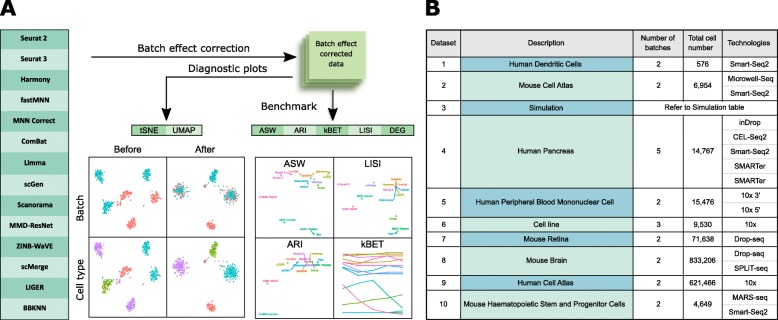
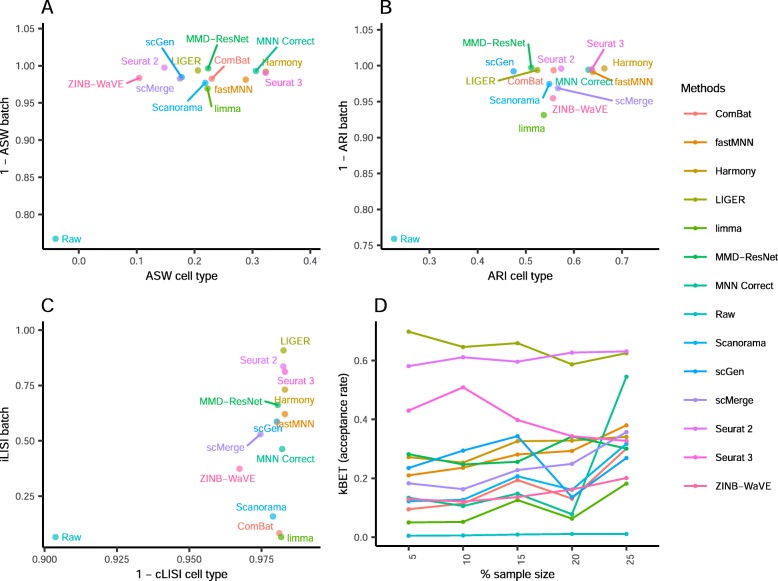
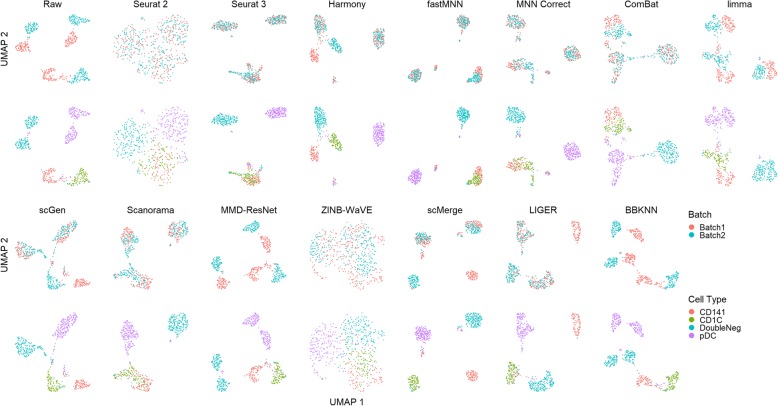
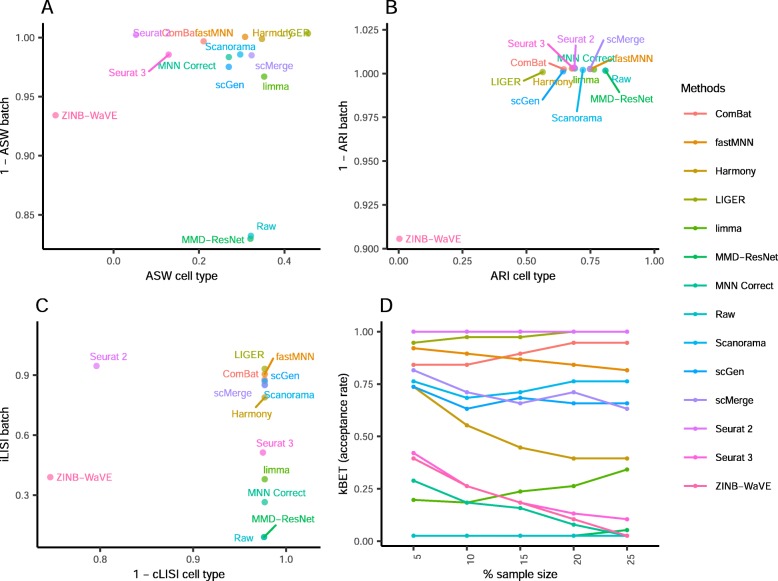
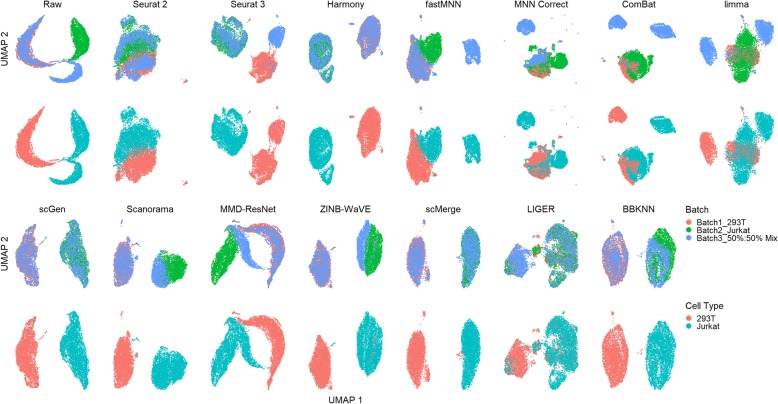
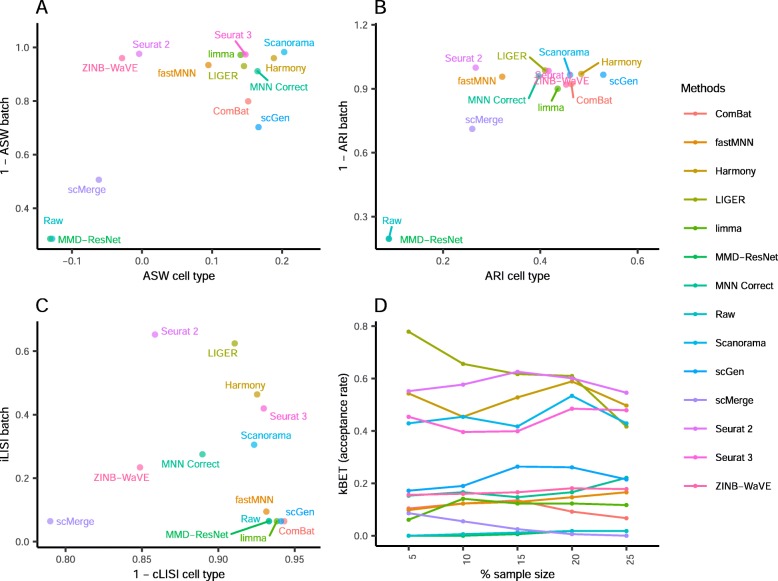
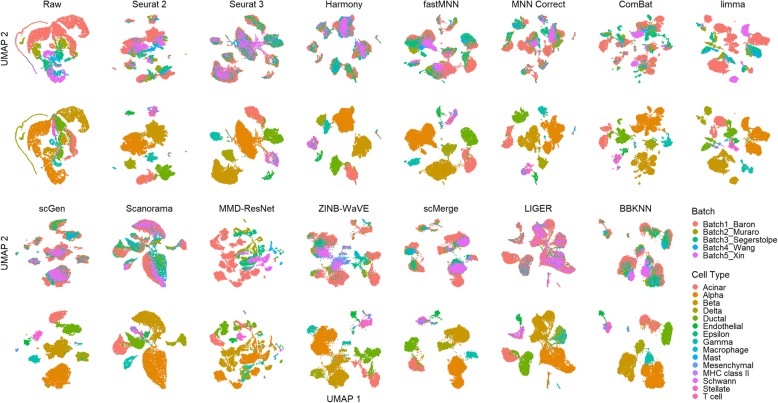
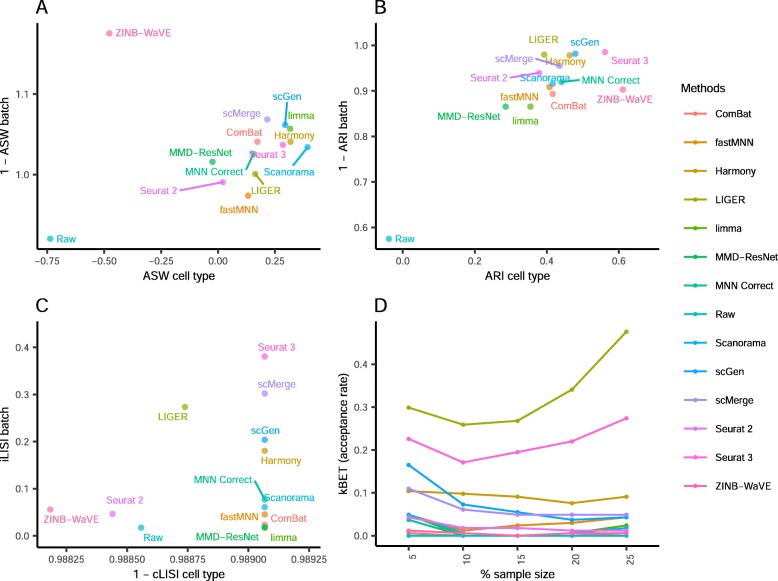
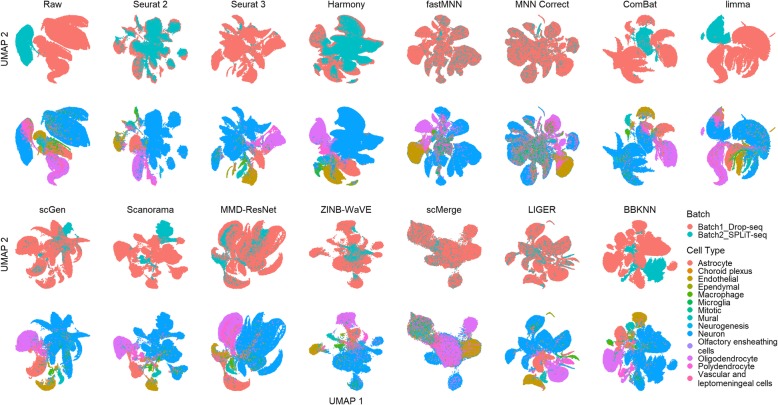
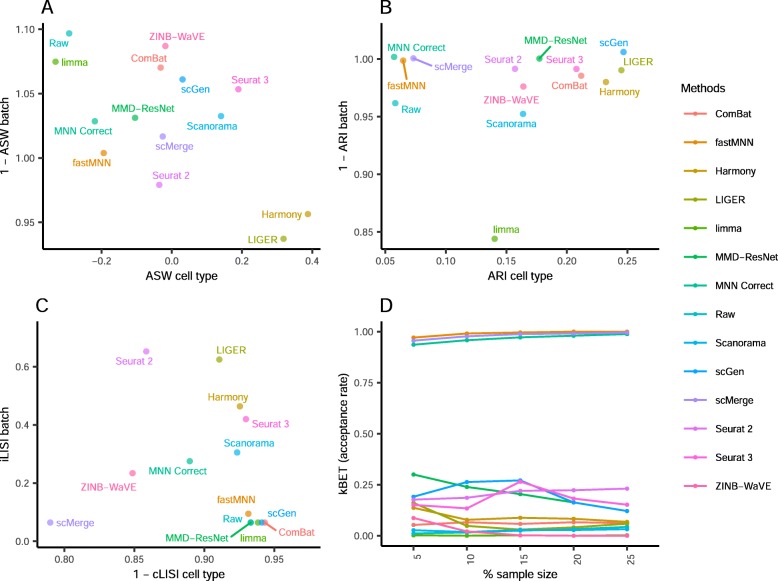
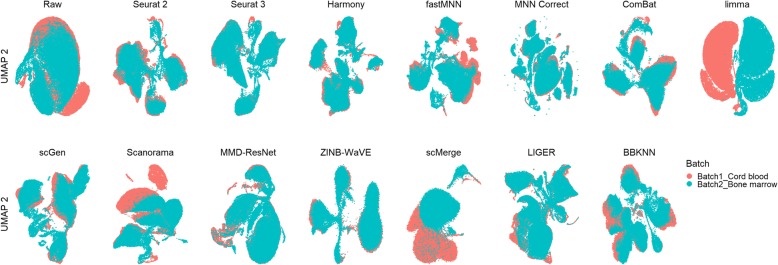
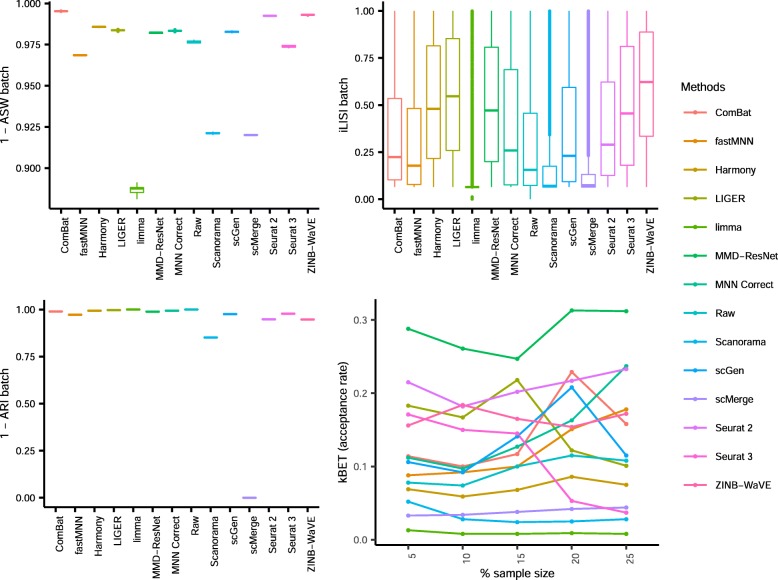
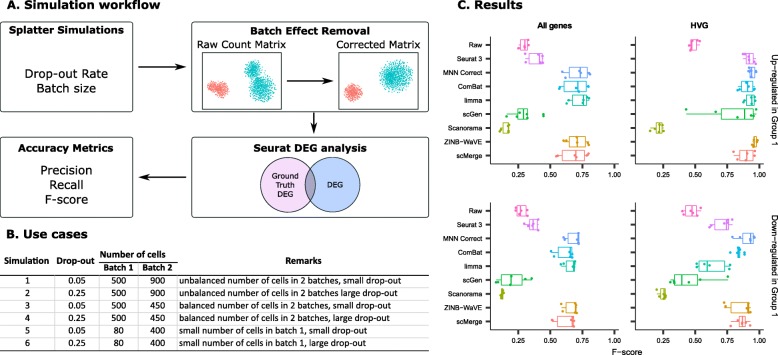
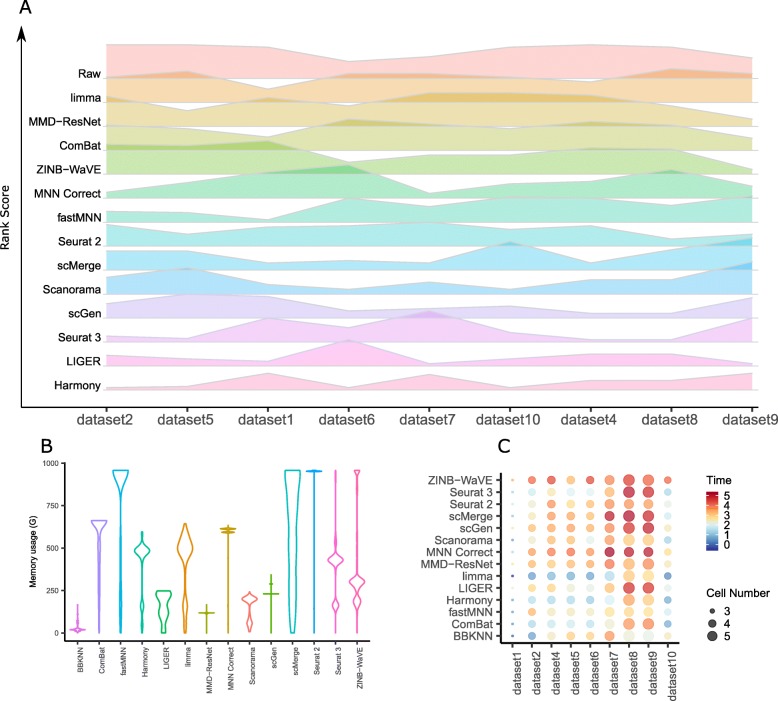
Background: Large-scale single-cell transcriptomic datasets generated using different technologies contain batch-specific systematic variations that present a challenge to batch-effect removal and data integration. With continued growth expected in scRNA-seq data, achieving effective batch integration with available computational resources is crucial. Here, we perform an in-depth benchmark study on available batch correction methods to determine the most suitable method for batch-effect removal. Results: We compare 14 methods in terms of computational runtime, the ability to handle large datasets, and batch-effect correction efficacy while preserving cell type purity. Five scenarios are designed for the study: identical cell types with different technologies, non-identical cell types, multiple batches, big data, and simulated data. Performance is evaluated using four benchmarking metrics including kBET, LISI, ASW, and ARI. We also investigate the use of batch-corrected data to study differential gene expression. Conclusion: Based on our results, Harmony, LIGER, and Seurat 3 are the recommended methods for batch integration. Due to its significantly shorter runtime, Harmony is recommended as the first method to try, with the other methods as viable alternatives.
Overview
The claims and statistics of this paper haven’t been checked yet.
Free: it reads the open-access text and checks the first 5 claims that cite a source we can check. Create a free account to check every claim.
Integrity signals
Registry
Cites
Statistics
Figures
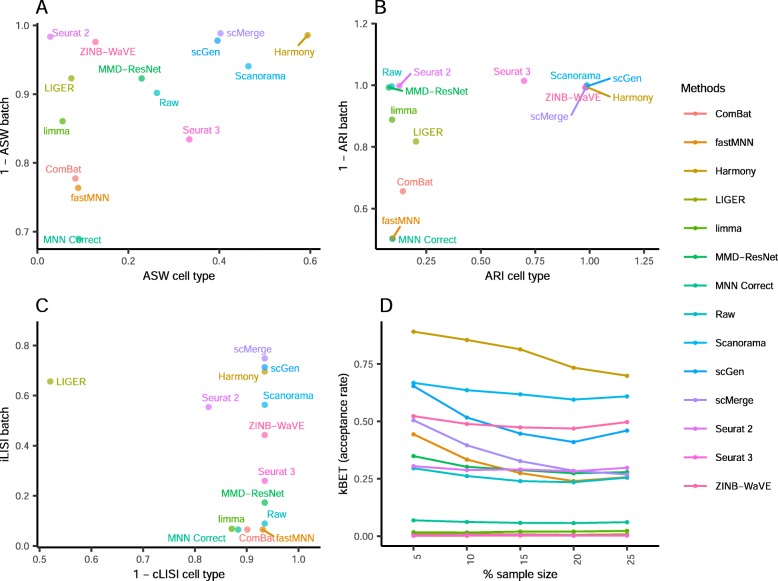
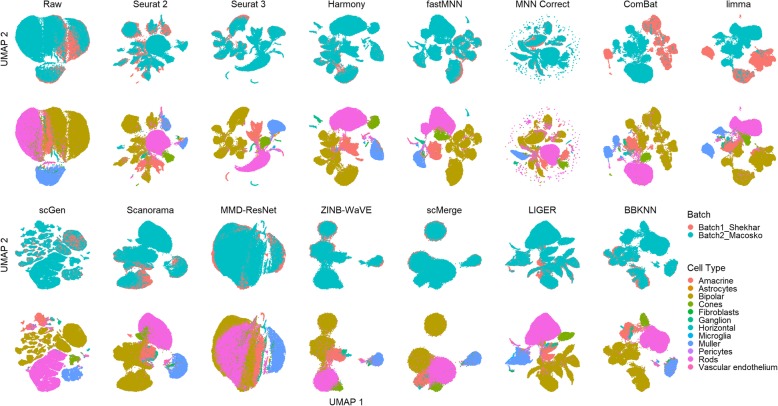
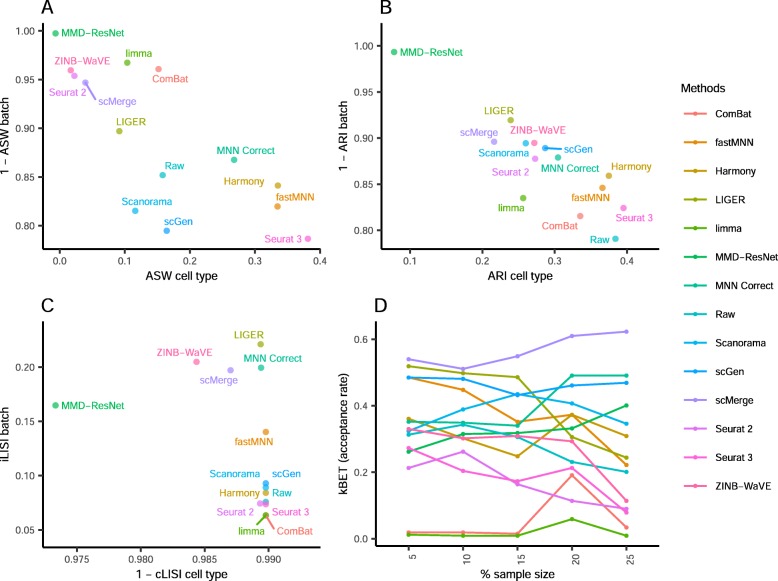
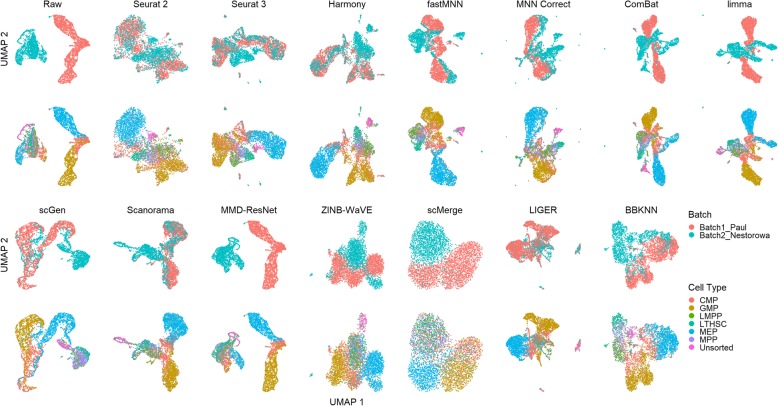
Verification
Claims the paper makes
The claims and statistics of this paper haven’t been checked yet.
Free: it reads the open-access text and checks the first 5 claims that cite a source we can check. Create a free account to check every claim.
Claims other papers make about this one
Each is checked against this paper’s own text: does it say what the citing paper says it does?
The cited source doesn’t support the claim as written.
In the citing paper
“Recent benchmark studies indicate that for simpler integration problems with relatively low biological complexity and relatively small batch effects in scRNA-Seq datasets, linear methods outperform nonlinear, more complex methods136,137, while for complicated integration tasks with large biological complexity and bigger batch effects, nonlinear methods such as scVI/scanVI outperform others138.”
From A high-resolution transcriptomic and spatial atlas of cell types in the whole mouse brain (2023) · cites this paper as [137]
Checked by a reasoning model — may be wrong.
Experimental — accuracy not yet measuredIn the citing paper
“Although SCING GRN based batch correction was not as optimized as the dedicated batch correction methods, many typical batch correction methods do not provide a batch corrected gene expression matrix for downstream analysis.44”
From SCING: Inference of robust, interpretable gene regulatory networks from single cell and spatial transcriptomics (2023) · cites this paper as [44]
In the citing paper
“Linear-embedding models such as canonical correlation analysis36 and Harmony37 were shown to perform well for batch correction on simpler integration tasks with distinct batch structures38,39.”
From Best practices for single-cell analysis across modalities (2023) · cites this paper as [38]
Self-check
Percentages, sums and reported differences re-computed from the paper’s own numbers.
The self-check needs the paper’s full text.
Citations
Cites
(2008) · Journal of Machine Learning Research · Cited by 33,051
Silhouettes: A graphical aid to the interpretation and validation of cluster analysis
Rousseeuw, P. J. (1987) · Journal of Computational and Applied Mathematics · doi:10.1016/0377-0427(87)90125-7 · Cited by 21,392 · cited 2×
“…and Uniform Manifold Approximation and Projection (UMAP) [21] visualizations in conjunction with the k - nearest neighbor batch-effect test (kBET) [22], local inverse Simpson ’ s index (LISI) [13, 23], average silhouette width (ASW) [24], and adjusted rand index (ARI) benchmarking metrics [25].”
MethodGAN(Generative Adversarial Nets)
(2017) · Journal of Japan Society for Fuzzy Theory and Intelligent Informatics · doi:10.3156/jsoft.29.5_177_2 · Cited by 19,270
Comprehensive Integration of Single-Cell Data
Stuart, T., Butler, A., Hoffman, P., Hafemeister, C., Papalexi, E., Mauck, W. M., Hao, Y., Stoeckius, M., Smibert, P., & Satija, R. (2019) · Cell · doi:10.1016/j.cell.2019.05.031 · Cited by 15,453
Integrating single-cell transcriptomic data across different conditions, technologies, and species
Butler, A., Hoffman, P., Smibert, P., Papalexi, E., & Satija, R. (2018) · Nature Biotechnology · doi:10.1038/nbt.4096 · Cited by 13,174 · cited 6×
“Seurat alignment CCA, multiCCA (Seurat 2) Seurat multiCCA uses canonical correlation analysis (CCA) to first compute the linear combinations of genes with maximum correlation between batches [4].”
BackgroundMethodInfluentialFast, sensitive and accurate integration of single-cell data with Harmony
Korsunsky, I., Millard, N., Fan, J., Slowikowski, K., Zhang, F., Wei, K., Baglaenko, Y., Brenner, M., Loh, P.-R., & Raychaudhuri, S. (2019) · Nature Methods · doi:10.1038/s41592-019-0619-0 · Cited by 10,488 · cited 5×
“Another local level metric is the LISI proposed by Kor-sunsky et al. [13, 22], which can be used to assesses batch and cell type mixing.”
MethodInfluentialSCANPY: large-scale single-cell gene expression data analysis
Wolf, F. A., Angerer, P., & Theis, F. J. (2018) · Genome Biology · doi:10.1186/s13059-017-1382-0 · Cited by 8,881 · cited 1×
“The batch correction by Scanorama was performed in conjunction with the Scanpy workflow [29].”
MethodAdjusting batch effects in microarray expression data using empirical Bayes methods
Johnson, W. E., Li, C., & Rabinovic, A. (2007) · Biostatistics · doi:10.1093/biostatistics/kxj037 · Cited by 8,658 · cited 3×
“ComBat was originally developed for microarray gene expression data [1], but had been successfully employed”
MethodHubert, L., & Arabie, P. (1985) · Journal of Classification · doi:10.1007/bf01908075 · Cited by 8,219
Massively parallel digital transcriptional profiling of single cells
Zheng, G. X. Y., Terry, J. M., Belgrader, P., Ryvkin, P., Bent, Z. W., Wilson, R., Ziraldo, S. B., Wheeler, T. D., McDermott, G. P., Zhu, J., et al. (2017) · Nature Communications · doi:10.1038/ncomms14049 · Cited by 7,353
Research works printed but not linked: 5
- Lun A Further MNN algorithm development 2019
- Goodfellow I, Pouget-Abadie J, Mirza M, Xu B, Warde-Farley D, Ozair S, et al. Generative adversarial nets. In: Ghahramani Z, Welling M, Cortes C, Lawrence ND, Weinberger KQ, editors. Adv Neural Inf Process Syst 27: Curran Associates, Inc; 2014. p. 2672–80. Available from: http://papers.nips.cc/paper/5423-generative-adversarial-nets.pdf. Accessed 11 Mar 2019.
- Korsunsky I LISI 2019
- Deng Y, Bao F, Dai Q, Wu LF, Altschuler SJ. Massive single-cell RNA-seq analysis and imputation via deep learning. bioRxiv. 2018:315556 Available from: http://biorxiv.org/content/early/2018/11/27/315556.abstract. Accessed 5 July 2019.
- Tran HTN, Ang KS, Chevrier M, Zhang X, Lee NYS, Goh M, Chen J. A benchmark of batch-effect correction methods for single-cell RNA sequencing data. Simulations. Github Repository. https://github.com/JinmiaoChenLab/Batch-effect-removal-benchmarking. 2019. PMC6964114 31948481
Cited by
Items 601–700 of 1,005
Baglaenko, Y., Wagner, C. A., Bhoj, V. G., Brodin, P., Gershwin, M. E., Graham, D. B., Invernizzi, P., Kídd, K. K., Korsunsky, I., Levy, M., et al. (2023) · Cambridge Prisms Precision Medicine · doi:10.1017/pcm.2023.14 · Cited by 7
Zhan, X., Yin, Y., & Zhang, H. (2024) · Bioinformatics · doi:10.1093/bioinformatics/btae127 · Cited by 7
“Large-scale scRNA-seq datasets generated from different experiment platforms usually contain batch-specific systematic variations, the so-called ‘batch effect’ (Tran et al. 2020).”
BackgroundTarDis: Achieving robust and structured disentanglement of multiple covariates
İnecik, K., Kara, A., Rose, A., Haniffa, M. A., & Theis, F. J. (2026) · Cell Systems · doi:10.1016/j.cels.2026.101573 · Cited by 8
Townsend, H. A., Rosenberger, K. J., Vanderlinden, L. A., Inamo, J., & Zhang, F. (2024) · Frontiers in Immunology · doi:10.3389/fimmu.2024.1454263 · Cited by 10
Depth-corrected multi-factor dissection of chromatin accessibility for scATAC-seq data with PACS
Miao, Z., Wang, J., Park, K., Kuang, D., & Kim, J. (2025) · Nature Communications · doi:10.1038/s41467-024-55580-5 · Cited by 8
“As noted by other studies 40 – 42 , there is always a tradeoff between batch correction and conservation of biological effects.”
Potts, C. M., Yang, X., Lynes, M. D., Malka, K. T., & Liaw, L. (2025) · Journal of the American Heart Association · doi:10.1161/jaha.124.038465 · Cited by 7
Ding, M., Mao, S., Wu, H., Fang, S., Zhen, N., Chen, T., Zhu, J., Tang, X., Wang, X., Sun, F., et al. (2025) · Advanced Science · doi:10.1002/advs.202407671 · Cited by 8
Wilson, S. B., Vanslambrouck, J. M., Murphy, A., Neavin, D. R., Powell, J. E., Howden, S. E., & Little, M. H. (2026) · iScience · doi:10.1016/j.isci.2026.115752 · Cited by 7
Calia, G., Marguerit, S., Mota, A. P. Z., Vidal, M., Schuler, H., Brasileiro, A. C. M., Guimarães, P. M., & Bottini, S. (2025) · PLANT PHYSIOLOGY · doi:10.1093/plphys/kiaf618 · Cited by 9
SSBER: removing batch effect for single-cell RNA sequencing data
Zhang⋆, Y., & Wang, F. (2021) · BMC Bioinformatics · doi:10.1186/s12859-021-04165-w · Cited by 7
“What’s more, we collected the cell line dataset [16] as an example to illustrate the impact of anchor pairs.”
BackgroundMethodInfluentialSugimoto, M., Tada, Y., Shichino, S., Koyamatsu, S., Tsumaki, N., & Abe, K. (2022) · DNA Research · doi:10.1093/dnares/dsac017 · Cited by 7
“batch effects) can occur in the analysis of each experimental batch.(5) Therefore, if multiple samples can be grouped together and processed simultaneously in a single library preparation, not only can the analysis cost be greatly reduced, but batch effects can be reduced and more precise scRNA-seq analysis can be per…”
BackgroundScreening single-cell trajectories via continuity assessments for cell transition potential
Zheng, Z., Chang, L., Li, Y., Liu, K., Mu, J., Zhang, S., Li, J., Wu, Y., Zou, L., Ni, Q., et al. (2023) · Briefings in Bioinformatics · doi:10.1093/bib/bbad356 · Cited by 7
“Other authors have developed tools for batch effect correction that filter out unwanted source of variation in larger-scale single-cell experiments to preclude trajectories distortion by technical noise [16].”
BackgroundScalable integration of multiomic single-cell data using generative adversarial networks
Giansanti, V., Giannese, F., Botrugno, O. A., Gandolfi, G., Balestrieri, C., Antoniotti, M., Tonon, G., & Cittaro, D. (2024) · Bioinformatics · doi:10.1093/bioinformatics/btae300 · Cited by 8
“While horizontal integration is essentially a problem of batch correction (Tran et al. 2020), integration of multi-modal data requires solving the vertical and/or diagonal settings.”
Xu, H., Ye, Y., Duan, R., Gao, Y., Hu, Y., & Gao, L. (2024) · Advanced Science · doi:10.1002/advs.202306770 · Cited by 8
Toward generalizable phenotype prediction from single-cell morphology representations
Tomkinson, J., Kern, R., Mattson, C., & Way, G. P. (2024) · BMC Methods · doi:10.1186/s44330-024-00014-3 · Cited by 8
“This variability highlights the challenges of accurately annotating phenotypic signatures in unseen data and underscores the necessity of careful dataset alignment, including batch effect correction [44–46], to enhance the generalizability of image-based profiling.”
The Human Lung Cell Atlas: a transformational resource for cells of the respiratory system
Meyer, K. B., Wilbrey-Clark, A., Nawijn, M. C., & Teichmann, S. A. (2021) · European Respiratory Society eBooks · doi:10.1183/2312508x.10010920 · Cited by 8
Integration of Multiple scRNA-Seq Datasets on the Autoencoder Latent Space
Riva, S. G., Cazzaniga, P., & Tangherloni, A. (2021) · IEEE International Conference on Bioinformatics and Biomedicine (BIBM) · doi:10.1109/bibm52615.2021.9669807 · Cited by 7
Single-Cell Antibody Sequencing in Atherosclerosis Research
Saigusa, R., Durant, C. P., Suryawanshi, V., & Ley, K. F. (2022) · Methods in molecular biology · doi:10.1007/978-1-0716-1924-7_46 · Cited by 7
Single-cell technologies uncover intra-tumor heterogeneity in childhood cancers
Lo, Y., Liu, Y., Kammersgaard, M. B., Koladiya, A., Keyes, T., & Davis, K. L. (2023) · Seminars in Immunopathology · doi:10.1007/s00281-022-00981-1 · Cited by 7
“A comparison and benchmark study of the scRNA-seq normalization approach using common datasets has been reported in a recent study, where Harmony, linked inference of genomic experimental relationships (LIGER), and Seurat 3 were identified as the recommended methods for batch effect correction efficacy while preservin…”
MethodDomain adaptation for supervised integration of scRNA-seq data
Sun, Y., & Qiu, P. (2023) · Communications Biology · doi:10.1038/s42003-023-04668-7 · Cited by 9
“(1) We unify cell type annotations to be the most general level across the batches to be integrated.”
BackgroundLiu, X. S., Liu, Z., Morgan, T. R. M., & Norden‐Krichmar, T. M. (2023) · Human Immunology · doi:10.1016/j.humimm.2023.110735 · Cited by 8
“Cell types were annotated using a combination of manual and automated reference-based methods [17–19].”
Suryawanshi, H., Morozov, P. S., Muthukumar, T., tenOever, B. R., Yamaji, M., Williams, Z., & Tuschl, T. (2020) · bioRxiv (Cold Spring Harbor Laboratory) · doi:10.1101/2020.04.11.034603 · Cited by 7
Babcock, B. R., Kosters, A., Yang, J., White, M. L., & Ghosn, E. (2021) · bioRxiv (Cold Spring Harbor Laboratory) · doi:10.1101/2021.08.18.456898 · Cited by 8
Evaluating the Utilities of Large Language Models in Single-cell Data AnalysisPreprint
Zhao, H., Liu, T., Li, K., Wang, Y., & Li, H. (2023) · Research Square · doi:10.21203/rs.3.rs-3376641/v1 · Cited by 16
Xie, Y., Yang, J., Ouyang, J. F., & Petretto, E. G. (2024) · Briefings in Bioinformatics · doi:10.1093/bib/bbae482 · Cited by 6
DOLPHIN advances single-cell transcriptomics beyond gene level by leveraging exon and junction reads
Song, K., Zheng, Y., Zhao, B., Eidelman, D. H., Tang, J., & Ding, J. (2025) · Nature Communications · doi:10.1038/s41467-025-61580-w · Cited by 8
The validation of quality attributes in Primary Human Hepatocytes Standard
Peng, Z., Wu, J., Zhang, F., Jia, X., Wu, Z., Dai, H., Huang, D., Cheng, X., Pan, G., & Huang, R. (2025) · Cell Regeneration · doi:10.1186/s13619-025-00258-6 · Cited by 6
“This method performed a multi-sample principal component analysis and subsequent calculations in the principal component space instead of the original gene space, which optimized the computation speed and reduced the noise in neighbor detection (Tran et al. 2020).”
Causal network analysis of omics data using prior knowledge databases
Svinin, G. Е., & Glaab, E. (2025) · Briefings in Bioinformatics · doi:10.1093/bib/bbaf654 · Cited by 8
“Preprocessing steps like normalization and batch correction are essential to ensure data compatibility [18, 19].”
Decoding Vascular Cell Diversity: Single-Cell Approaches to Mechanisms of Vascular Disease
Schwartzman, W. E., Jiang, J., Rao, J. S., Schnitzler, G. R., Maurya, M., Widdup, L., Pepin, M. E., Kang, H. Y., Zheng, C. X., & Gupta, R. M. (2026) · Circulation Research · doi:10.1161/circresaha.125.326001 · Cited by 6
Spatial omics for profiling the dynamic tumor microenvironment
Nguyen, H. N., Eapen, M. M., Nguyen, Q. H., & Sharma, A. (2026) · Clinical & Translational Immunology · doi:10.1002/cti2.70084 · Cited by 8
“23”
Fang, C., Selega, A., & Campbell, K. R. (2024) · Genome biology · doi:10.1186/s13059-024-03304-9 · Cited by 7
FABP5+ macrophages contribute to lipid metabolism dysregulation in type A aortic dissection
Chen, X., Chen, R., Wu, Y., Yu, A., Wang, F., Ying, C., Yin, Y., Chen, X., Ma, H., & Fu, Y.-F. (2024) · International Immunopharmacology · doi:10.1016/j.intimp.2024.113438 · Cited by 6
Single-cell epigenetics and multiomics analysis in kidney research
Aihara, S., & Muto, Y. (2025) · Clinical and Experimental Nephrology · doi:10.1007/s10157-025-02679-8 · Cited by 8
Rigorous integration of single-cell ATAC-seq data using regularized barycentric mapping
Zhu, S., Hua, H., & Chen, S. (2025) · Nature Machine Intelligence · doi:10.1038/s42256-025-01099-3 · Cited by 8
“…that the Fountain-enhanced data more effectively uncover cell type-specific biological pathways, as indicated by the discovery of a greater number of highly cell-type-associated biological pathways in the enhanced data’s unique DAPs (Supplementary Note 9 and Supplementary Tables 7 and 8).”
Suzuki, K., Yokoi, A., Yoshida, K., Suzuki, H., Kitagawa, M., Asano‐Inami, E., Matsuo, S., Yoshihara, M., Tamauchi, S., Yoshikawa, N., et al. (2025) · Communications Biology · doi:10.1038/s42003-025-08771-9 · Cited by 7
Piña, Y., Law, V., Sahebjam, S., Tran, N., Siddarajappa, N., Li, J., Mo, Q., Phadke, M. S., Arrington, J., Macaulay, R. J. B., et al. (2025) · Neuro-Oncology · doi:10.1093/neuonc/noaf183 · Cited by 6
“ISCVA consists of 2 major components: the back-end scripts, functions utilizing R packages (eg, Seurat 34 and SingleR 35 ) for quality control and cell type classification, and the front-end JavaScripts for interactive investigation.”
GRACE: a comprehensive web-based platform for integrative single-cell transcriptome analysis
Yu, H., Wang, Y., Zhang, X., & Wang, Z. (2022) · NAR Genomics and Bioinformatics · doi:10.1093/nargab/lqad050 · Cited by 6
Self-citationShiino, S., Tokura, M., Nakayama, J., Yoshida, M., Suto, A., & Yamamoto, Y. (2023) · Cells · doi:10.3390/cells12182286 · Cited by 6
“algorithms were applied to the integrated datasets [18,19] following the instructions in the Quick start vignettes (https://portals.”
MethodSuperCellCyto: enabling efficient analysis of large scale cytometry datasets
Putri, G., Howitt, G., Marsh‐Wakefield, F., Ashhurst, T. M., & Phipson, B. (2024) · Genome biology · doi:10.1186/s13059-024-03229-3 · Cited by 6
“This issue is particularly pronounced when using methods primarily developed for scRNAseq data [23].”
MethodDatabase Matching Under Noisy Synchronization Errors
Bakirtas, S., & Erkip, E. (2024) · IEEE Transactions on Information Theory · doi:10.1109/tit.2024.3388990 · Cited by 6
“More recently, motivated by the need for aligning single-cell data obtained from multiple biological sources/experiments [30], [31], in [41] Chen et al.”
BackgroundscVIC: deep generative modeling of heterogeneity for scRNA-seq data
Xiong, J., Gong, F., Ma, L., & Wan, L. (2024) · Bioinformatics Advances · doi:10.1093/bioadv/vbae086 · Cited by 7
Xu, Y., Zang, Z., Hu, B., Yuan, Y., Tan, C., Xia, J., & Li, S. Z. (2024) · Briefings in Bioinformatics · doi:10.1093/bib/bbae687 · Cited by 6
Comprehensive noise reduction in single-cell data with the RECODE platform
Imoto, Y. (2025) · Cell Reports Methods · doi:10.1016/j.crmeth.2025.101178 · Cited by 9
“In our integration analysis, I used benchmark datasets 4–7 from Tran et al. 8 These included dataset 4: human pancreas analyzed via multiple protocols (Figures S2C and S3C), dataset 5: human pancreas using 3 ′ and 5 ′ 10X Chromium protocols (Figures S2B and S3B), dataset 6: cell line comparison…”
InfluentialChen, Z., Yang, Z., Xiaojun, Y. U. A. N., Zhang, X., & Hao, P. (2021) · BMC Bioinformatics · doi:10.1186/s12859-021-04136-1 · Cited by 6
Self-citationSCIBER: a simple method for removing batch effects from single-cell RNA-sequencing data
Gan, D., & Li, J. (2022) · Bioinformatics · doi:10.1093/bioinformatics/btac819 · Cited by 7
Muto, Y., Li, H., & Humphreys, B. D. (2022) · Springer eBooks · doi:10.1007/978-3-031-11570-7_5 · Cited by 6
Proximal tubule responses to injury: interrogation by single-cell transcriptomics
Cippà, P. E., & McMahon, A. P. (2023) · Current Opinion in Nephrology & Hypertension · doi:10.1097/mnh.0000000000000893 · Cited by 6
scParser: sparse representation learning for scalable single-cell RNA sequencing data analysis
Zhao, K., So, H., & Lin, Z. (2024) · Genome biology · doi:10.1186/s13059-024-03345-0 · Cited by 6
Ye, X., Wei, J., Yue, M., Wang, Y., Chen, H., Zhang, Y., Wang, Y., Zhang, M., Huang, P., & Yu, R. (2021) · Frontiers in Genetics · doi:10.3389/fgene.2021.637322 · Cited by 6
Spatial protein and RNA analysis on the same tissue section using MICS technologyPreprint
Neil, E., Park, D., Hennessey, R. C., DiBiasio, E. C., DiBuono, M., Lafayette, H., Lloyd, E., Lo, H., Femel, J., Makrigiorgos, A., et al. (2023) · bioRxiv (Cold Spring Harbor Laboratory) · doi:10.1101/2023.10.27.564191 · Cited by 6
Hu, H., Zhang, S., Choi, Y., Malladi, V. S., & Quon, G. (2025) · bioRxiv (Cold Spring Harbor Laboratory) · doi:10.1101/2025.01.28.635153 · Cited by 6
“The aggregated dataset was a gold-standard benchmarking dataset originally analyzed in the context of batch-effect correction, as described in Tran et al., in 2020 (Tran et al., 2020).”
Principled PCA separates signal from noise in omics count dataPreprint
Stanley, J. S., Yang, J., Li, R., Lindenbaum, O., Kobak, D., Landa, B., & Kluger, Y. (2025) · bioRxiv (Cold Spring Harbor Laboratory) · doi:10.1101/2025.02.03.636129 · Cited by 6
scSSL-Bench: Benchmarking Self-Supervised Learning for Single-Cell DataPreprint
Ovcharenko, O., Barkmann, F., Toma, P., Daunhawer, I., Vogt, J. E., Schelter, S., & Boeva, V. (2025) · arXiv (Cornell University) · doi:10.48550/arxiv.2506.10031 · Cited by 10
“These metrics were introduced in single-cell integration benchmarking (scIB) (B ¨ uttner et al., 2019; Luecken et al., 2022; Tran et al., 2020), a tool that is widely used in the single-cell community, see Appendix C for details.”
HArmonized single-cell RNA-seq Cell type Assisted Deconvolution (HASCAD)
Chiu, Y., Ni, C., & Huang, Y. (2023) · BMC Medical Genomics · doi:10.1186/s12920-023-01674-w · Cited by 5
Di, Z., Yang, B., Li, M., Wu, Y., & Ji, H. (2024) · Computational Biology and Chemistry · doi:10.1016/j.compbiolchem.2024.108261 · Cited by 6
Multi-Slice Spatial Transcriptomics Data Integration Analysis with STG3Net
Fang, D., Zhu, F., & Min, W. (2024) · IEEE International Conference on Bioinformatics and Biomedicine (BIBM) · doi:10.1109/bibm62325.2024.10822331 · Cited by 9
“The F1 score of the LISI [21] is calculated as follows: A higher F1 score indicates superior batch correction.”
Sun, J., Dong, Q., Wei, J., Gao, Y., Yu, Z., Hu, X., & Zhang, Y. (2025) · NAR Genomics and Bioinformatics · doi:10.1093/nargab/lqaf082 · Cited by 6
“We applied the Seurat standard workflow [ 15 ] for preprocessing the single-cell transcriptomic data, including quality control, log normalization, scaling, and batch effect correction using Harmony [ 16 , 17 ].”
The Advance of Single-Cell RNA Sequencing Applications in Ocular Physiology and Disease Research
Cheng, Y., Gu, S., Lu, X., & Pei, C. (2025) · Biomolecules · doi:10.3390/biom15081120 · Cited by 6
“To reduce the batch effects, some approaches such as algorithms (e.g., Harmony [83], ComBat [84]) and emerging deep learning have been employed to improve data integration fidelity.”
Harmony-based data integration for distributed single-cell multi-omics data
Yuan, R., Rong, Z., Hu, H., Liu, T., Tao, S., Chen, W., & Tang, L. (2025) · PLoS Computational Biology · doi:10.1371/journal.pcbi.1013526 · Cited by 5
Genetic and epigenetic drivers of neurodegenerative disorders
Roy, K., Syed, M., Narad, P., & Sengupta, A. (2025) · Progress in brain research · doi:10.1016/bs.pbr.2025.08.002 · Cited by 5
Probing cellular landscapes in plants via single-cell transcriptomics
Usman, B., Khan, N., Wang, Y., Gupta, R., Kwon, S. W., & Kim, S. T. (2025) · Plant Science · doi:10.1016/j.plantsci.2025.112964 · Cited by 5
Sun, H., Gao, M., Liu, Z., Zg, Z., Li, X., Huang, H., Li, T., Shi, J., Yan, J., Sun, M., et al. (2026) · npj Precision Oncology · doi:10.1038/s41698-026-01293-5 · Cited by 5
“Harmony (version 0.1.1), the top batch mixing method with good performance, was used to eliminate batch effects in the PCA space when clustering major cell lineages before any clustering analysis or cell type annotation 76,77 .”
InfluentialNgassam, B. T., Niu, H., Pang, S., Shydlouskaya, V., & Andrews, T. S. (2026) · Frontiers in Bioinformatics · doi:10.3389/fbinf.2025.1715821 · Cited by 5
“The current state-of-the-art non-DL integration method is Harmony (Korsunsky et al., 2019), which uses an iterative clustering then correction approach and is consistently among the top-performing methods in recent benchmarks (Tran et al., 2020; Antonsson and Melsted, 2024).”
InfluentialMultiomics approaches to cardiovascular disease: technological innovations and clinical translation
Zehra, B., Vinod, N., Bineshaq, S., Aleksandrova, I., Tambi, R., Faizan, M., Alasrawi, S., Almarri, M., Brueckner, M. K., Kuebler, W. M., et al. (2026) · American Journal of Physiology-Heart and Circulatory Physiology · doi:10.1152/ajpheart.00024.2026 · Cited by 5
Liu, N., Han, G., Gu, Q., Zhang, Y., & Chen, M. M. (2026) · Cell Death and Disease · doi:10.1038/s41419-026-08769-z · Cited by 5
“This technical noise directly interferes with the precise recognition of tumors by AI models, leading to poor consistency in cross-platform analyses [187 – 191].”
InfluentialKendiukhov, I. (2026) · Biogerontology · doi:10.1007/s10522-026-10471-8 · Cited by 7
“…data is sensitive to normalization, batch effects, donor structure, and pseudoreplication (Wolf et al. 2018; Hafemeister and Satija 2019; Stuart et al. 2019; Haghverdi et al. 2018; Korsunsky et al. 2019; Tran et al. 2020; Stephanie et al. 2018; Zimmerman et al. 2021; Squair et al. 2021).”
Representing and extracting knowledge from single-cell data
Mihai, I. S., Chafle, S., & Henriksson, J. (2023) · Biophysical Reviews · doi:10.1007/s12551-023-01091-4 · Cited by 6
“The performance of many algorithms has been benchmarked (Tran et al. 2020).”
MethodHe, Y., Qi, W., Xie, X., & Jiang, H. (2024) · BMC Medical Genomics · doi:10.1186/s12920-024-01871-1 · Cited by 5
scCTS: identifying the cell type-specific marker genes from population-level single-cell RNA-seq
Chen, L., Guo, Z., Deng, T., & Wu, H. (2024) · Genome biology · doi:10.1186/s13059-024-03410-8 · Cited by 6
Lu, Y.-A., Smith, T. A., Deshpande, S., Liao, C., Talabani, B., Grigorieva, I., Mason, A., Andrews, R., Bowen, T., Taylor, P. R., et al. (2024) · Scientific Reports · doi:10.1038/s41598-024-73102-7 · Cited by 5
“The data was then processed using Harmony (version 0.1.1) for batch effect correction 12,13 .”
MethodInfluentialRobust self-supervised learning strategy to tackle the inherent sparsity in single-cell RNA-seq data
Park, S., & Lee, H. (2024) · Briefings in Bioinformatics · doi:10.1093/bib/bbae586 · Cited by 6
Hierarchical marker genes selection in scRNA-seq analysis
Sun, Y., & Qiu, P. (2024) · PLoS Computational Biology · doi:10.1371/journal.pcbi.1012643 · Cited by 6
Comparative single-cell analysis of the adult heart and coronary vasculature
Balachandran, S., Pozojevic, J., Sreenivasan, V. K. A., & Spielmann, M. (2022) · Mammalian Genome · doi:10.1007/s00335-022-09968-7 · Cited by 5
The Role of Artificial Intelligence in Therapeutic Drug Monitoring and Clinical Toxicity
Saikia, S., Prajapati, J. B., Prajapati, B. G., Padma, V. V., & Pathak, Y. V. (2022) · Springer eBooks · doi:10.1007/978-3-031-12398-6_5 · Cited by 7
Evaluation of Computational Methods for Single Cell Multi-Omics Integration
Wani, S. A., & Quadri, S. M. K. (2023) · Procedia Computer Science · doi:10.1016/j.procs.2023.01.246 · Cited by 5
Analyzing genomic and epigenetic profiles in single cells by hybrid transposase (scGET-seq)
Cittaro, D., Lazarević, D., Tonon, G., & Giannese, F. (2023) · STAR Protocols · doi:10.1016/j.xpro.2023.102176 · Cited by 5
MASI enables fast model-free standardization and integration of single-cell transcriptomics data
Xu, Y., Kramann, R., McCord, R. P., & Hayat, S. (2023) · Communications Biology · doi:10.1038/s42003-023-04820-3 · Cited by 5
“Besides these label transferring methods, we further included batch-effect correction methods, including Scanorama 16 , LIGER 6 , and Seurat 7 , since these three batch-correction methods were listed as top methods by a previous benchmark study 55 .”
Statistical and machine learning methods for immunoprofiling based on single-cell data
Zhang, J., Li, J., & Lin, L. (2023) · Human Vaccines & Immunotherapeutics · doi:10.1080/21645515.2023.2234792 · Cited by 7
“In a benchmark study conducted by Tran et al.(33) the performance of various methods, including MNN, Seurat, scVI, and scAlign, were compared in terms of batch-effect correction.”
MethodSingle-Cell RNA Sequencing and Its Applications in Pituitary Research
Yang, S., Deng, C., Pu, C., Bai, X., Tian, C., Chang, M., & Feng, M. (2024) · Neuroendocrinology · doi:10.1159/000540352 · Cited by 5
“Batch effects are addressed using tools like Seurat3, Liger, and Harmony, with Harmony noted for computational ef fi ciency [38].”
Barkmann, F., Yates, J., Czyż, P., Kraft, A., Glettig, M. C., Beerenwinkel, N., & Boeva, V. (2025) · Cancer Research · doi:10.1158/0008-5472.can-25-0940 · Cited by 6
Jeng, S., Chi, Y.-C., Ma, M.-C., Chan, S.-H., & Sun, H. S. (2021) · Computational Biology and Chemistry · doi:10.1016/j.compbiolchem.2021.107515 · Cited by 6
Learning Cell Annotation under Multiple Reference Datasets by Multisource Domain Adaptation
Liu, Y., Yan, H., Shen, L.-C., & Yu, D. (2022) · Journal of Chemical Information and Modeling · doi:10.1021/acs.jcim.2c01277 · Cited by 5
Wagner, F. (2020) · bioRxiv (Cold Spring Harbor Laboratory) · doi:10.1101/2020.06.08.140673 · Cited by 5
Zhou, Y., Sheng, Q., Qi, J., Hua, J., Yang, B., Wan, L., & Jin, S. (2023) · Genome Research · doi:10.1101/gr.277522.122 · Cited by 5
“Recent benchmarking studies (Tran et al. 2020; Luecken et al. 2022) also revealed the inferior performance of these approaches on complex integration tasks.”
BackgroundHögel-Starck, C., Timonen, V. A., Atarsaikhan, G., Mogollón, I., Polso, M., Hassinen, A., Honkanen, J. K., Sarmento, C. D., Koski, J., Soini, J., et al. (2024) · bioRxiv (Cold Spring Harbor Laboratory) · doi:10.1101/2024.05.17.594648 · Cited by 5
Zhang, Y., & Hou, Q. (2025) · bioRxiv (Cold Spring Harbor Laboratory) · doi:10.1101/2025.03.12.642755 · Cited by 12
“Widely used methods such as ComBat[47], Mutual Nearest Neighbors (MNN)[48], Harmony[49], and Seurat [50] have been effective in single-cell transcriptomics[51].”
GeneJepa: A Predictive World Model of the TranscriptomePreprint
Litman, E., Myers, T. D., Agarwal, V., Mittal, E., Li, O., Gopinath, A., & Kassis, T. (2025) · bioRxiv · doi:10.1101/2025.10.14.682378 · Cited by 7
“…enable linear probes for annotation; and support perturbation reasoning with strong out-of-domain robustness, surpassing generative token baselines including scGPT in accuracy and calibration on held-out regimes (Zhang et al., 2025; Luecken et al., 2022; Tran et al., 2020; Cui et al., 2024).”
Integrating single-cell data with biological variables
Zhou, Y., Sheng, Q., & Jin, S. (2025) · Proceedings of the National Academy of Sciences · doi:10.1073/pnas.2416516122 · Cited by 5
“We curated nine single - cell datasets, including eight datasets collected for benchmarking integration methods (4, 15) and one from a recent cross - species study (16).”
Hu, C., Cui, J., He, R., Han, M., Liu, Y., Zhou, J., Fan, D., Ding, X., Xiang, L., Lou, B., et al. (2025) · Fundamental Research · doi:10.1016/j.fmre.2025.09.022 · Cited by 6
SC-framework: A robust and FAIR semi-interactive environment for single-cell resolution datasets
Schultheis, H., Detleffsen, J., Wiegandt, R., Bentsen, M. S., Alayoubi, Y., Valente, G. T., Keßler, M. F., Bruns, B., Mirza, D., Usanayo, A., et al. (2026) · iScience · doi:10.1016/j.isci.2026.116631 · Cited by 5
“53 However, comparison of multiple batch correction methods in the context of a specific dataset would often be preferable.”
Lu, Y., Liu, J., Wang, S., Gan, J., Cao, W., & Wu, B. (2026) · PeerJ · doi:10.7717/peerj.20701 · Cited by 4
“42.0) ( Tran et al., 2020 ).”
InfluentialPadial-Fuillerat, E., Martínez-Manjón, J. E., Zwir, I. J. S., Arroyo, M. J., Blázquez‐Sánchez, M., Rodríguez‐Temporal, D., Rodríguez, B. M., Mancera, L., & del Val, C. (2026) · Journal of Proteome Research · doi:10.1021/acs.jproteome.5c00534 · Cited by 5
Cai, X., Yang, J., Wang, W., Zhan, X., Chen, X., Ji, D., Liu, K., Li, X., Zhang, Y., Qian, C., et al. (2026) · npj Breast Cancer · doi:10.1038/s41523-026-00917-0 · Cited by 5
Cutting‑edge advances in endocrine therapy for breast cancer (Review)
Yumei, D. O. N. G., Shao, L., Li, Q., Qi, Y., Liu, T., Wei, S., & Qi, H. (2026) · Oncology Letters · doi:10.3892/ol.2026.15569 · Cited by 4
GatorST: A Versatile Contrastive Meta‐Learning Framework for Spatial Transcriptomic Data Analysis
Zhang, Z., Liu, Y., Wang, S., Ma, Q., Song, Q., & Bian, J. (2026) · Small Methods · doi:10.1002/smtd.202600006 · Cited by 5
“We utilized Harmony [ 28 ] as the batch integration algorithm because of its strong performance in single-cell data integration [ 29 ].”
Pan-cancer single-cell atlases of mouse and human tumor-associated dendritic cells
Caro, A. A., Kancheva, D., Hadadi, É., Boeckx, B., Nolf, C. D., Bardet, P. M. R., Verstaen, K., Li, L., Oueslati, L., Figueras-Duch, N., et al. (2026) · Nature Communications · doi:10.1038/s41467-026-73721-w · Cited by 6
“For the batch correction of the atlases, we chose to use the harmony package 67 , shown to be one of the best performing methods in a recent benchmarking study 168 .”
Jia, Y., Li, S., Jiang, R., & Chen, S. (2024) · IEEE Transactions on Computational Biology and Bioinformatics · doi:10.1109/tcbb.2024.3372970 · Cited by 4
“[27].”
McLean, A. K., Reynolds, G., & Pratt, A. G. (2024) · Biomedicines · doi:10.3390/biomedicines12061297 · Cited by 4
Integrating single-cell multi-omics data through self-supervised clustering
Zeng, Y., Chen, J., Pan, Z., Yu, W., & Yang, Y. (2024) · Applied Soft Computing · doi:10.1016/j.asoc.2024.112541 · Cited by 4
Self-citationCharacterization of subcutaneous and visceral de-differentiated fat cells
Li, Y., Zhang, H., Ibáñez, C. F., & Xie, M. (2025) · Molecular Metabolism · doi:10.1016/j.molmet.2025.102105 · Cited by 4
“This method effectively identi fi ed and corrected batch effects in multidimensional space while preserving biological variability, facilitating unbiased integration of cells across different datasets [55,56].”
Metadata
- Authors
- Tran, H. T. N., Ang, K. S., Chevrier, M., Zhang, X., Lee, N. Y. S., Goh, M., & Chen, J.
- Affiliations
- Agency for Science, Technology and Research (SG)
- Corresponding author
- Chen, Jinmiao
- Venue
- Genome Biology
- Published
- 2020-01-16
- Volume
- 21
- Issue
- 1
- Pages
- 12-12
- ISSN
- 1465-6906 (ISSN-L)
- 1474-760X
- PMC
- PMC6964114
- OpenAlex
- W3002417351
- Cited by
- 1,113
- References
- 45
- Citations by year
- 2026: 145 · 2025: 170 · 2024: 188 · 2023: 187 · 2022: 180 · 2021: 178 · 2020: 62
- FWCI
- 50.62
- Type
- journal article
- Language
- en
- Open access
- gold
- doi.org
- Licence
- cc-by
- creativecommons.org/licenses/by/4.0/ (tdm)
- creativecommons.org/licenses/by/4.0/ (vor)
- Locations
- Genome biology (publishedVersion, cc-by)
- PubMed Central (publishedVersion, cc-by)
- PubMed (publishedVersion)
- DOAJ (DOAJ: Directory of Open Access Journals) (submittedVersion, cc-by-sa)
- Funders
- Singapore Immunology Network (NA)
- Topics
- Life Sciences › Biochemistry, Genetics and Molecular Biology › Molecular Biology › Single-cell and spatial transcriptomics
- Life Sciences › Biochemistry, Genetics and Molecular Biology › Molecular Biology › Gene expression and cancer classification
- Life Sciences › Biochemistry, Genetics and Molecular Biology › Molecular Biology › Bioinformatics and Genomic Networks
- Keywords
- batch effect correction, single-cell RNA sequencing, benchmarking, data integration, harmony, LIGER, Seurat, LiSi, adjusted Rand index, differential gene expression, computational time
- MeSH terms
- Big Data, RNA-Seq, Algorithms, Animals, Humans, Benchmarking, Mice, Single-Cell Analysis
About these checks
Registry, retraction, Cites and statistics results are computed, not judged, with one exception: a printed reference that no index lists is read once by a model before it counts as a citation error. Claims are extracted by a model and kept only when their quote appears verbatim in the text; each cited source is then checked, with a model’s help, for whether it says what the claim relies on. Those verdicts can be wrong — read the claim’s quote and the cited source before relying on one.
Statistics and arithmetic are recomputed, not judged.
Confidence bands are shown only for fields calibrated on our annotated test set. None is calibrated yet, so no band is shown.
What counts as a claim ›How we measure confidence ›How we check this ›
Are you an author, or do you see a problem with this page? Request a review
Data sources
Bibliographic data: Semantic Scholar, OpenAlex, Crossref.
Contains information from the Semantic Scholar Academic Graph Datasets, made available under the ODC Attribution License (ODC-BY 1.0).
Semantic Scholar’s data is described in: Kinney, R., et al. (2023). The Semantic Scholar Open Data Platform. arXiv:2301.10140.
