

Mapping insecticide resistance in Anopheles gambiae (s.l.) from Côte d'Ivoire
Open accessThe DOI matches its Crossref record; 50 of the 50 references it cites were found in a registry or an index; 27 of the 40 sources its claims cite were checked for support.
Abstract
BACKGROUND: Insecticide resistance in malaria vectors is an increasing threat to vector control tools currently deployed in endemic countries. Resistance management must be an integral part of National Malaria Control Programmes' (NMCPs) next strategic plans to alleviate the risk of control failure. This obviously will require a clear database on insecticide resistance to support the development of such a plan. The present work gathers original data on insecticide resistance between 2009 and 2015 across Côte d'Ivoire in West Africa. METHODS: Two approaches were adopted to build or update the resistance data in the country. Resistance monitoring was conducted between 2013 and 2015 in 35 sentinel sites across the country using the WHO standard procedure of susceptibility test on adult mosquitoes. Four insecticide families (pyrethroids, organochlorides, carbamates and organophosphates) were tested. In addition to this survey, we also reviewed the literature to assemble existing data on resistance between 2009 and 2015. RESULTS: (below 0.5) and elevated activity of insecticide detoxifying enzymes, mainly mixed function oxidases (MFO), esterase and glutathione S-transferase (GST) in almost all study sites. CONCLUSION: This detailed map of resistance highlights the urgent need to develop new vector control tools to complement current long-lasting insecticidal nets (LLINs) although it is yet unclear whether these resistance mechanisms will impact malaria transmission control. Researchers, industry, WHO and stakeholders must urgently join forces to develop alternative tools. By then, NMCPs must strive to develop effective tactics or plans to manage resistance keeping in mind country-specific context and feasibility.
Overview
CoChat Summary
TL;DR
This paper maps insecticide resistance in *Anopheles gambiae* (s.l.) across Côte d’Ivoire using WHO susceptibility tests, literature data, and biochemical/molecular assays from 2009–2015. It finds widespread resistance to pyrethroids, organochlorides, and carbamates, with organophosphates still active in some sites, and links resistance to kdr, ace-1R, and elevated detoxification enzymes.
Key findings
- Resistance to pyrethroids was widespread in all 43 localities studied; only two northern areas (Kaforo and Korhogo) were fully susceptible to deltamethrin with 98–100% mortality.
- DDT resistance was widespread, with mortality ranging from 0–43% in 21/23 areas tested; carbamate resistance was also present, with bendiocarb resistance unclear only in Duekoue and San Pedro.
- The kdr L1014F mutation was found in all 29 sites tested, with allele frequencies ranging from 0.4 to 1; 18/29 populations had high frequencies (≥0.8).
- The ace-1R G119S mutation was detected in 25 areas, with the highest frequencies in Tiassale and Yaokoffikro (0.50); elevated detoxification enzyme activity was also common, including GST elevation in 18/20 populations and oxidase activity up to 4-fold higher than Kisumu.
Methods
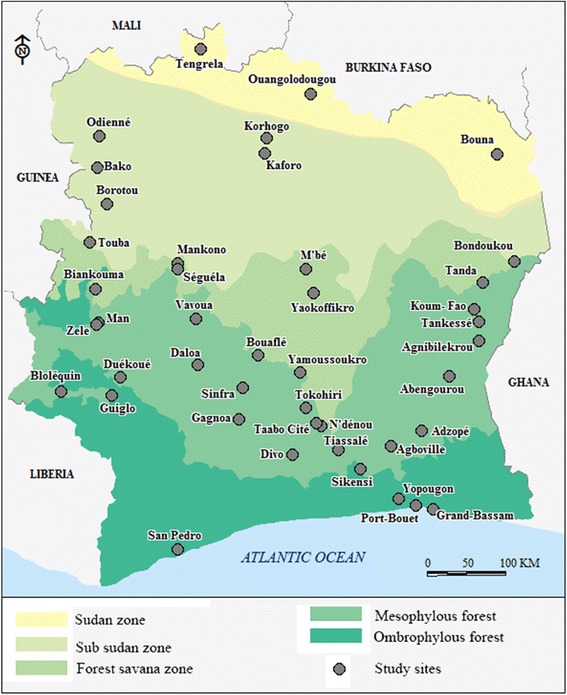
- Field monitoring: mosquito larvae were collected from 35 localities between June 2013 and December 2015, reared to adults, and tested with WHO standard bioassays; the authors also added published/reported data from 8 more localities for a total of 43 sites.
- Resistance testing: WHO tube assays were run on 2–4-day-old unfed adult females against 4 pyrethroids, 1 organochloride, 2 carbamates, and 3 organophosphates, with Kisumu as the susceptible reference strain.
- Mechanism analysis: species identification, kdr L1014F/L1014S and ace-1R G119S genotyping, and biochemical assays of MFO, esterases, and GST were performed; mortality was classified using WHO thresholds and genotype/enzyme data were analyzed with Fisher’s exact tests and Kruskal-Wallis tests.
Limitations
- The paper states that it is still unclear whether the resistance mechanisms identified will impact malaria transmission control.
- Evident from the text: the biochemical assays were conducted on mosquitoes from only 22 sites, and the kdr/ace-1R genotyping was reported for subsets of sites (29/43 and 25 areas), so coverage was not uniform across all localities.
Model-written summary. Check it against the paper before relying on it.
Integrity signals
Registry
Cites
Statistics
Figures
Verification
Claims the paper makes
17 Valid · 2 Not valid · 4 Not checked · 37 Own results and interpretations
Some cited sources support this claim and some don’t — read each source’s verdict below.
In the paper
“Some of these have shown promising results against wild free-flying multi-resistant An. gambiae (s.s.) in experimental huts [34, 43–45].”
§ Mapping insecticide resistance in Anopheles gambiae (s.l.) from Côte d’Ivoire > Discussion
What the sources say
- Not checked — no full text of the sourcecites [34] Stump AD Atieli FK Vulule JM Besansky NJ Dynamics of the pyrethroid knockdown resistance allele in western Kenyan populations of Anopheles gambiae in response to insecticide-treated bed net trials Am J Trop Med Hyg 2004 70 591 596 15210997 source
- Disputedcites [43] Tungu P Magesa S Maxwell C Malima R Masue D Sudi W Evaluation of PermaNet 3.0 a deltamethrin-PBO combination net against Anopheles gambiae and pyrethroid-resistant Culex quinquefasciatus mosquitoes: an experimental hut trial in Tanzania Malar J 2010 9 21 10.1186/1475-2875-9-21 20085631 PMC2817703 sourceExperimental — accuracy not yet measured
The Methods (Experimental hut trial) identify the local An. gambiae as pyrethroid-susceptible, and the Results confirm 100% mortality in resistance tests. The Discussion says PermaNet 3.0 had limited capacity to control multiply resistant mosquitoes; the resistant mosquitoes tested in the huts were Cx. quinquefasciatus, not An. gambiae. Thus this trial does not show promising results against multi-resistant An. gambiae. (LLM, conf=0.88)
Checked by a reasoning model — may be wrong.
- Partly supportedcites [44] Corbel V Chabi J Dabiré RK Etang J Nwane P Pigeon O Field efficacy of a new mosaic long-lasting mosquito net (PermaNet® 3.0) against pyrethroid-resistant malaria vectors: a multi centre study in Western and Central Africa Malar J 2010 9 113 10.1186/1475-2875-9-113 20423479 PMC2877060 sourceExperimental — accuracy not yet measured
The Background describes PermaNet® 3.0 as a net combining deltamethrin with the synergist piperonyl butoxide. The Results report promising experimental-hut performance against free-flying, pyrethroid-resistant An. gambiae s.s., particularly in Vallée du Kou. They do not establish that those An. gambiae s.s. populations were multi-resistant; the reported resistance there is primarily associated with the kdr mutation. (LLM, conf=0.84)
- Not checked — no full text of the sourcecites [45] N’Guessan R Asidi A Boko P Odjo A Akogbeto M Pigeon O An experimental hut evaluation of PermaNet® 3.0, a deltamethrin-piperonyl butoxide combination net, against pyrethroid-resistant Anopheles gambiae and Culex quinquefasciatus mosquitoes in southern Benin Trans R Soc Trop Med Hyg 2010 104 758 765 10.1016/j.trstmh.2010.08.008 20956008 source
hedgedstates a cause- Asserted: passes — The authors put it forward as true.
- Checkable: passes — It can be checked against evidence.
- Load-bearing: unclear — It is unclear whether the paper’s conclusions depend on it.
- Based: passes — The paper gives a reason why it holds.
The cited sources that could be checked couldn’t confirm or dispute this claim.
In the paper
“The distribution of resistance was patchy, and its intensity varies from one malaria vector population to another, highlighting the local selection of such phenotypes [21] as already illustrated in Culex pipiens species [22].”
§ Mapping insecticide resistance in Anopheles gambiae (s.l.) from Côte d’Ivoire > Discussion
What the sources say
- Could not verifycites [21] Ayala D Ullastres A González J Adaptation through chromosomal inversions in Anopheles Front Genet 2014 5 129 10.3389/fgene.2014.00129 24904633 PMC4033225 sourceExperimental — accuracy not yet measured
The ‘Insecticide resistance’ section discusses resistance in Anopheles and associations with chromosomal inversions, including some observations in natural populations. It does not describe a patchy distribution or varying resistance intensity between vector populations, or conclude that those patterns indicate local selection (searched for those terms and geographic variation in resistance). (LLM, conf=0.72)
- Not checked — no full text of the sourcecites [22] Labbe P Lenormand T Raymond M On the worldwide spread of an insecticide resistance gene: a role for local selection: Resistance gene: history, drift or selection J Evol Biol 2005 18 1471 1484 10.1111/j.1420-9101.2005.00938.x 16313460 source
plainstates a cause- Asserted: passes — The authors put it forward as true.
- Checkable: passes — It can be checked against evidence.
- Load-bearing: passes — The paper’s conclusions depend on it.
- Based: passes — The paper gives a reason why it holds.
- Could not verify
Every source the paper cites for this claim was checked and supports it.
In the paper
“Currently, the increasing use of insecticides for malaria vector control plays an important role in the insecticide selection pressure.”
§ Mapping insecticide resistance in Anopheles gambiae (s.l.) from Côte d’Ivoire > Discussion
What the sources say
- Supportedcites [32] Mathias DK Ochomo E Atieli F Ombok M Nabie Bayoh M Olang G Spatial and temporal variation in the kdr allele L1014S in Anopheles gambiae s.s. and phenotypic variability in susceptibility to insecticides in western Kenya Malar J 2011 10 10 10.1186/1475-2875-10-10 21235783 PMC3029224 source
The Discussion (page unavailable) reports a strong temporal association between insecticide-treated net ownership and the resistance allele’s frequency, and says the nets were likely the most important selection pressure in the western Kenyan study population. This supports the claim that increased insecticide use for vector control contributes to selection pressure. (LLM, conf=0.90)
plainstates a cause- Asserted: passes — The authors put it forward as true.
- Checkable: passes — It can be checked against evidence.
- Load-bearing: passes — The paper’s conclusions depend on it.
- Based: passes — The paper gives a reason why it holds.
- Supported
The cited sources support only part of this claim — read each source’s verdict below.
In the paper
“The longitudinal study was completed in four African countries (Benin, Cameroon, Kenya and Sudan) in 2016 and found no association between resistance and malaria prevalence where LLIN use was high [42].”
§ Mapping insecticide resistance in Anopheles gambiae (s.l.) from Côte d’Ivoire > Discussion
What the sources say
- Partly supportedcites [42] Bradley J Ogouyèmi-Hounto A Cornélie S Fassinou J de Tove YSS Adéothy AA Insecticide-treated nets provide protection against malaria to children in an area of insecticide resistance in Southern Benin Malar J 2017 16 225 10.1186/s12936-017-1873-1 28549431 PMC5446701 sourceExperimental — accuracy not yet measured
The Discussion reports no association between resistance and malaria prevalence where LLIN use was high. But the Methods describe cross-sectional surveys conducted in Benin in July 2015, not a longitudinal study completed across four countries in 2016. The Background mentions a broader five-country investigation but says this paper reports the Benin assessment. (LLM, conf=0.92)
plain- Asserted: passes — The authors put it forward as true.
- Checkable: passes — It can be checked against evidence.
- Load-bearing: unclear — It is unclear whether the paper’s conclusions depend on it.
- Based: passes — The paper gives a reason why it holds.
- Partly supported
A result the paper reports from its own data — it cites no other source for it, so there is none to check. The quote shows it is in the paper.
In the paper
“Organophosphate insecticides (chlorpyrifos-methyl, pyrimifos-methyl and fenithrotion) induced far higher mortality than any other insecticide family.”
§ Mapping insecticide resistance in Anopheles gambiae (s.l.) from Côte d’Ivoire > Results > Insecticide susceptibility across the country
plainstates a cause- Asserted: passes — The authors put it forward as true.
- Checkable: passes — It can be checked against evidence.
- Load-bearing: passes — The paper’s conclusions depend on it.
- Based: passes — The paper gives a reason why it holds.
25 more claims
Create a free account to see all 60 claims and to verify the 2 references still open.
- It may state two separate claims as one. 18
- Probably not a substantial claim. 14
Claims other papers make about this one
Each is checked against this paper’s own text: does it say what the citing paper says it does?
The source backs part of the claim, not all of it — or backs it for a different population, condition or comparison.
In the citing paper
“Consistent with recent studies carried out in the area of Bouaké [7, 9, 13, 36], there was a high frequency of both kdr and ace1R genes in An. gambiae and An. coluzzii, with a higher frequency for An. gambiae; probably due to selection pressure through the use of insecticide.”
From Entomological indicators of malaria transmission prior to a cluster-randomized controlled trial of a 'lethal house lure' intervention in central Côte d'Ivoire (2022) · cites this paper as [13]
Experimental — accuracy not yet measuredThe cited source says what the claim attributes to it.
In the citing paper
“The main malaria vector, Anopheles gambiae sensu lato (s.l.) was highly resistant to almost all public health classes of insecticides [13], with 125.8 bites per human per night and entomological inoculation rates (EIR), reaching 459.9 infected bites per human per night in some rural places of the districts [14].”
Self-check
Percentages, sums and reported differences re-computed from the paper’s own numbers.
Self-check results appear here once an independent check has confirmed them.
Cited works that were retracted
Works this paper cites that were later retracted, from the retraction notices publishers deposit. Major when the notice came out before this paper was published.
Rated major: it would touch a result — a value a result rests on, reported and recomputed p-values on opposite sides of the significance level, two passages that conflict with no sign which is right, or a cited work retracted before this paper was published.
In the paper
“Besides that, increase in kdr frequencies was evidenced in An. gambiae (s.l.) after the distribution of LLINs in Kenya [34], Niger [35], Senegal [36] and Benin [37].”
Cited work 10.1371/journal.pone.0097700 · retracted 2016-05-19 · notice 10.1371/journal.pone.0156196 · this paper published 2018-01-08
Citations
Cites
1 retracted
Ndiath, M. O., Mazenot, C., Sokhna, C., & Trape, J.-F. (2014) · PLoS ONE · doi:10.1371/journal.pone.0097700 · Cited by 37 · cited 2×
“Besides that, increase in kdr frequencies was evidenced in An. gambiae (s.l.) after the distribution of LLINs in Kenya [34], Niger [35], Senegal [36] and Benin [37].”
BackgroundRetractedGENEPOP (Version 1.2): Population Genetics Software for Exact Tests and Ecumenicism
Raymond, M., & Rousset, F. (1995) · Journal of Heredity · doi:10.1093/oxfordjournals.jhered.a111573 · Cited by 15,397
Identification of Single Specimens of the Anopheles Gambiae Complex by the Polymerase Chain Reaction
Scott, J. A., Brogdon, W. G., & Collins, F. H. (1993) · The American Journal of Tropical Medicine and Hygiene · doi:10.4269/ajtmh.1993.49.520 · Cited by 1,659
Martinez‐Torres, D., Chandre, F., Williamson, M. S., Darriet, F., Bergé, J. B., Devonshire, A. L., Guillet, P., Pasteur, N., & Pauron, D. (1998) · Insect Molecular Biology · doi:10.1046/j.1365-2583.1998.72062.x · Cited by 1,040
Ranson, H., Jensen, B., Vulule, J. M., Wang, X., Hemingway, J., & Collins, F. H. (2000) · Insect Molecular Biology · doi:10.1046/j.1365-2583.2000.00209.x · Cited by 645
Anopheles coluzzii and Anopheles amharicus, new members of the Anopheles gambiae complex
COETZEE, M., HUNT, R. H., WILKERSON, R., TORRE, A. D., COULIBALY, M. B., & BESANSKY, N. J. (2013) · Zootaxa · doi:10.11646/zootaxa.3619.3.2 · Cited by 548
N’Guessan, R., Corbel, V., Akogbéto, M., & Rowland, M. (2007) · Emerging Infectious Diseases · doi:10.3201/eid1302.060631 · Cited by 548 · cited 1×
“However, some studies have shown a decrease of entomological efficiency in strong resistance zone [39].”
BackgroundSelf-citationCharacterizing, controlling and eliminating residual malaria transmission
Killeen, G. F. (2014) · Malaria Journal · doi:10.1186/1475-2875-13-330 · Cited by 506
Nkya, T. E., Akhouayri, I., Kisinza, W., & David, J.-P. (2013) · Insect Biochemistry and Molecular Biology · doi:10.1016/j.ibmb.2012.10.006 · Cited by 402 · cited 1×
“Some studies have also shown that mosquito larvae exposed to sublethal doses of pollutants, herbicides or pesticides display an insecticide resistance through increased activities of insecticide-detoxifying enzymes [26, 27].”
BackgroundAbanyie, F. A., McCracken, C., Kirwan, P., Molloy, S. F., Asaolu, S. O., Holland, C. V., Gutman, J., & Lamb, T. J. (2013) · Malaria Journal · doi:10.1186/1475-2875-12-1 · Cited by 338
THE IMPORTANCE OF MOSQUITO BEHAVIOURAL ADAPTATIONS TO MALARIA CONTROL IN AFRICA
Gatton, M. L., Chitnis, N., Churcher, T., Donnelly, M. J., Ghani, A. C., Godfray, H. C. J., Gould, F., Hastings, I., Marshall, J., Ranson, H., et al. (2013) · Evolution · doi:10.1111/evo.12063 · Cited by 336
Favia, G., Lanfrancotti, A., Spanos, L., Sidén‐Kiamos, I., & Louis, C. (2001) · Insect Molecular Biology · doi:10.1046/j.1365-2583.2001.00236.x · Cited by 278
On the distribution and genetic differentiation of Anopheles gambiae s.s. molecular forms
della Torre, A., Tu, Z., & Petrarca, V. (2005) · Insect Biochemistry and Molecular Biology · doi:10.1016/j.ibmb.2005.02.006 · Cited by 244
Santolamazza, F., Calzetta, M., Etang, J., Barrese, E., Dia, I., Caccone, A., Donnelly, M. J., Petrarca, V., Simard, F., Pinto, J., et al. (2008) · Malaria Journal · doi:10.1186/1475-2875-7-74 · Cited by 231 · cited 4×
“These mutations have also been detected with high frequencies in An. gambiae (s.l.) in many regions of West Africa [28, 29] with ecological similarities in Burkina Faso and Benin (cotton, rice and urban/suburban vegetable growing areas) [30, 31].”
BackgroundInfluentialSTUMP, A. D., ATIELI, F. K., VULULE, J. M., & BESANSKY, N. J. (2004) · The American Journal of Tropical Medicine and Hygiene · doi:10.4269/ajtmh.2004.70.591 · Cited by 168 · cited 3×
“The longitudinal study was completed in four African countries (Benin, Cameroon, Kenya and Sudan) in 2016 and found no association between resistance and malaria prevalence where LLIN use was high [42].”
BackgroundSilva, A. P. B., Santos, J. M. M., & Martins, A. J. (2014) · Parasites & Vectors · doi:10.1186/1756-3305-7-450 · Cited by 160
Mathias, D. K., Ochomo, E., Atieli, F., Ombok, M., Nabie Bayoh, M., Olang, G., Muhia, D., Kamau, L., Vulule, J. M., Hamel, M. J., et al. (2011) · Malaria Journal · doi:10.1186/1475-2875-10-10 · Cited by 158 · cited 1×
“[32], ITN coverage for populations has been associated with a development of strong insecticide selection pressure by pyrethroid and increase of kdr allele frequency.”
BackgroundHENRY, M.-C., ASSI, S.-B., ROGIER, C., DOSSOU-YOVO, J., CHANDRE, F., GUILLET, P., & CARNEVALE, P. (2005) · The American Journal of Tropical Medicine and Hygiene · doi:10.4269/ajtmh.2005.73.859 · Cited by 150 · cited 1×
“Despite the multiple resistance observed in the country, LLINs effectiveness has, until now, never been questioned [38].”
BackgroundKnox, T. B., Juma, E. O., Ochomo, E. O., Pates Jamet, H., Ndungo, L., Chege, P., Bayoh, N. M., N’Guessan, R., Christian, R. N., Hunt, R. H., et al. (2014) · Parasites & Vectors · doi:10.1186/1756-3305-7-76 · Cited by 146
Self-citationChanging trends in US mesothelioma incidence
Weill, H., Hughes, J. M., & Churg, A. M. (2004) · Occupational and Environmental Medicine · doi:10.1136/oem.2003.010165 · Cited by 139
Corbel, V., & N’Guessan, R. (2013) · Anopheles mosquitoes - New insights into malaria vectors · doi:10.5772/56117 · Cited by 136
Self-citationCzeher, C., Labbo, R., Arzika, I., & Duchemin, J.-B. (2008) · Malaria Journal · doi:10.1186/1475-2875-7-189 · Cited by 134 · cited 2×
“Besides that, increase in kdr frequencies was evidenced in An. gambiae (s.l.) after the distribution of LLINs in Kenya [34], Niger [35], Senegal [36] and Benin [37].”
BackgroundTungu, P., Magesa, S., Maxwell, C., Malima, R., Masue, D., Sudi, W., Myamba, J., Pigeon, O., & Rowland, M. (2010) · Malaria Journal · doi:10.1186/1475-2875-9-21 · Cited by 119
Corbel, V., Chabi, J., Dabiré, R. K., Etang, J., Nwane, P., Pigeon, O., Akogbeto, M., & Hougard, J.-M. (2010) · Malaria Journal · doi:10.1186/1475-2875-9-113 · Cited by 116
Adaptation through chromosomal inversions in Anopheles
Ayala, D., Ullastres, A., & González, J. (2014) · Frontiers in Genetics · doi:10.3389/fgene.2014.00129 · Cited by 111 · cited 1×
“The distribution of resistance was patchy, and its intensity varies from one malaria vector population to another, highlighting the local selection of such phenotypes [21] as already illustrated in Culex pipiens species [22].”
BackgroundInsecticide resistance in the Anopheles gambiae complex in Benin: a nationwide survey
DJOGBÉNOU, L., PASTEUR, N., AKOGBÉTO, M., WEILL, M., & CHANDRE, F. (2011) · Medical and Veterinary Entomology · doi:10.1111/j.1365-2915.2010.00925.x · Cited by 103 · cited 1×
“) in many regions of West Africa [28, 29] with ecological similarities in Burkina Faso and Benin (cotton, rice and urban/suburban vegetable growing areas) [30, 31].”
BackgroundN’Guessan, R., Asidi, A., Boko, P., Odjo, A., Akogbeto, M., Pigeon, O., & Rowland, M. (2010) · Transactions of the Royal Society of Tropical Medicine and Hygiene · doi:10.1016/j.trstmh.2010.08.008 · Cited by 101
Self-citationJones, C. M., Toé, H. K., Sanou, A., Namountougou, M., Hughes, A., Diabaté, A., Dabiré, R., Simard, F., & Ranson, H. (2012) · PLoS ONE · doi:10.1371/journal.pone.0045995 · Cited by 97 · cited 1×
“) in many regions of West Africa [28, 29] with ecological similarities in Burkina Faso and Benin (cotton, rice and urban/suburban vegetable growing areas) [30, 31].”
BackgroundKleinschmidt, I., Mnzava, A. P., Kafy, H. T., Mbogo, C., Bashir, A. I., Bigoga, J., Adechoubou, A., Raghavendra, K., Knox, T. B., Malik, E. M., et al. (2015) · Malaria Journal · doi:10.1186/s12936-015-0782-4 · Cited by 89 · cited 1×
“study to ascertain the potential loss of epidemiological effectiveness of these core insecticidal interventions as a result of decreased susceptibility of malaria vectors to the insecticides used [41].”
BackgroundAhoua Alou, L. P., Koffi, A. A., Adja, M. A., Tia, E., Kouassi, P. K., Koné, M., & Chandre, F. (2010) · Malaria Journal · doi:10.1186/1475-2875-9-167 · Cited by 81 · cited 1×
“) populations of Côte d’Ivoire and agricultural use of pyrethroids, carbamates and organophosphates insecticides to protect cotton, cocoa, coffee and rice crops [5, 23, 24].”
BackgroundSelf-citationPooda, S. H., Rayaissé, J.-B., Hien, D. F. D. S., Léfèvre, T., Yerbanga, R. S., Bengaly, Z., Dabiré, R. K., Bélem, A. M. G., Sidibé, I., Solano, P., et al. (2015) · Malaria Journal · doi:10.1186/s12936-015-1001-z · Cited by 80 · cited 2×
“indoor residual spraying, larviciding, outdoor vector control set up and use of drugs with insecticidal properties such as Ivermectin) [47, 48].”
BackgroundInfluentialPoupardin, R., Riaz, M. A., Jones, C. M., Chandor-Proust, A., Reynaud, S., & David, J.-P. (2012) · Aquatic Toxicology · doi:10.1016/j.aquatox.2012.02.001 · Cited by 76 · cited 1×
“Some studies have also shown that mosquito larvae exposed to sublethal doses of pollutants, herbicides or pesticides display an insecticide resistance through increased activities of insecticide-detoxifying enzymes [26, 27].”
BackgroundOn the worldwide spread of an insecticide resistance gene: a role for local selection
LABBE, P., LENORMAND, T., & RAYMOND, M. (2005) · Journal of Evolutionary Biology · doi:10.1111/j.1420-9101.2005.00938.x · Cited by 75 · cited 1×
“The distribution of resistance was patchy, and its intensity varies from one malaria vector population to another, highlighting the local selection of such phenotypes [21] as already illustrated in Culex pipiens species [22].”
BackgroundSinka, M. E., Golding, N., Massey, N. C., Wiebe, A., Huang, Z., Hay, S. I., & Moyes, C. L. (2016) · Malaria Journal · doi:10.1186/s12936-016-1187-8 · Cited by 70
N'Guessan, R., Ngufor, C., Kudom, A. A., Boko, P., Odjo, A., Malone, D., & Rowland, M. (2014) · PLoS ONE · doi:10.1371/journal.pone.0087710 · Cited by 67 · cited 1×
“The second group represents a group of new LLINs under development combining two insecticides with a different mode of action seems to be promising for controlling resistant mosquitoes [46].”
BackgroundSelf-citationUnderpinning Sustainable Vector Control through Informed Insecticide Resistance Management
Thomsen, E. K., Strode, C., Hemmings, K., Hughes, A. J., Chanda, E., Musapa, M., Kamuliwo, M., Phiri, F. N., Muzia, L., Chanda, J., et al. (2014) · PLoS ONE · doi:10.1371/journal.pone.0099822 · Cited by 63 · cited 1×
“Updated insecticide resistance data will also help to choose relevant areas to implement such randomized controlled trials [50, 51].”
BackgroundChouaibou, M. S., Chabi, J., Bingham, G. V., Knox, T. B., N’Dri, L., Kesse, N. B., Bonfoh, B., & Jamet, H. V. P. (2012) · BMC Infectious Diseases · doi:10.1186/1471-2334-12-214 · Cited by 62 · cited 1×
“) populations of Côte d’Ivoire and agricultural use of pyrethroids, carbamates and organophosphates insecticides to protect cotton, cocoa, coffee and rice crops [5, 23, 24].”
BackgroundYahouédo, G. A., Cornelie, S., Djègbè, I., Ahlonsou, J., Aboubakar, S., Soares, C., Akogbéto, M., & Corbel, V. (2016) · Parasites & Vectors · doi:10.1186/s13071-016-1661-8 · Cited by 59
Koffi, A. A., Ahoua Alou, L. P., Adja, M. A., Chandre, F., & Pennetier, C. (2013) · Malaria Journal · doi:10.1186/1475-2875-12-151 · Cited by 55 · cited 1×
“submitted) where multiple resistance was confirmed a few years ago [40].”
BackgroundSelf-citationBradley, J., Ogouyèmi-Hounto, A., Cornélie, S., Fassinou, J., de Tove, Y. S. S., Adéothy, A. A., Tokponnon, F. T., Makoutode, P., Adechoubou, A., Legba, T., et al. (2017) · Malaria Journal · doi:10.1186/s12936-017-1873-1 · Cited by 53 · cited 1×
“The longitudinal study was completed in four African countries (Benin, Cameroon, Kenya and Sudan) in 2016 and found no association between resistance and malaria prevalence where LLIN use was high [42].”
BackgroundKoffi, A. A., Ahoua Alou, L. P., Kabran, J.-P. K., N'Guessan, R., & Pennetier, C. (2013) · PLoS ONE · doi:10.1371/journal.pone.0082387 · Cited by 46 · cited 2×
“coluzzii that are widespread over the country [4, 5].”
BackgroundSelf-citationDjènontin, A., Pennetier, C., Zogo, B., Soukou, B. K., Ole-Sangba, M., Akogbéto, M., Chandre, F., Yadav, R. S., & Corbel, V. (2014) · PLoS ONE · doi:10.1371/journal.pone.0087934 · Cited by 45 · cited 2×
“indoor residual spraying, larviciding, outdoor vector control set up and use of drugs with insecticidal properties such as Ivermectin) [47, 48].”
BackgroundInfluentialSelf-citationLong-term trends in Anopheles gambiae insecticide resistance in Côte d’Ivoire
Edi, C. A., Koudou, B. G., Bellai, L., Adja, A. M., Chouaibou, M., Bonfoh, B., Barry, S. J., Johnson, P. C., Müller, P., Dongus, S., et al. (2014) · Parasites & Vectors · doi:10.1186/s13071-014-0500-z · Cited by 42
An Operational Framework for Insecticide Resistance Management Planning
Chanda, E., Thomsen, E. K., Musapa, M., Kamuliwo, M., Brogdon, W. G., Norris, D. E., Masaninga, F., Wirtz, R., Sikaala, C. H., Muleba, M., et al. (2016) · Emerging Infectious Diseases · doi:10.3201/eid2205.150984 · Cited by 41 · cited 1×
“Updated insecticide resistance data will also help to choose relevant areas to implement such randomized controlled trials [50, 51].”
BackgroundJohn, R., Ephraim, T., & Andrew, A. (2008) · Malaria Journal · doi:10.1186/1475-2875-7-92 · Cited by 40 · cited 2×
“A reduction in the susceptibility of An. gambiae (s.l.) populations subjected to ITNs was also observed in Uganda [33].”
BackgroundOKORIE, P. N., ADEMOWO, O. G., IRVING, H., KELLY‐HOPE, L. A., & WONDJI, C. S. (2015) · Medical and Veterinary Entomology · doi:10.1111/mve.12089 · Cited by 34 · cited 4×
“These mutations have also been detected with high frequencies in An. gambiae (s.l.) in many regions of West Africa [28, 29] with ecological similarities in Burkina Faso and Benin (cotton, rice and urban/suburban vegetable growing areas) [30, 31].”
BackgroundInfluentialDjogbénou, L., Assogba, B. S., Djossou, L., & Makoutodé, M. (2016) · Journal of Vector Ecology · doi:10.1111/jvec.12191 · Cited by 34 · cited 1×
“In urban areas, another selection pressure source suggested is the pesticides used for vegetable growing [25].”
BackgroundAïzoun, N., Aïkpon, R., & Akogbéto, M. (2014) · Asian Pacific Journal of Tropical Biomedicine · doi:10.1016/s2221-1691(14)60238-0 · Cited by 31 · cited 4×
“The longitudinal study was completed in four African countries (Benin, Cameroon, Kenya and Sudan) in 2016 and found no association between resistance and malaria prevalence where LLIN use was high [42].”
BackgroundInfluentialAhoua Alou, L. P., Koffi, A. A., Adja, M. A., Assi, S. B., Kouassi, P. K., & N’Guessan, R. (2012) · Parasites & Vectors · doi:10.1186/1756-3305-5-289 · Cited by 26
Self-citationRemote Effect of Insecticide-Treated Nets and the Personal Protection against Malaria Mosquito Bites
Moiroux, N., Chandre, F., Hougard, J.-M., Corbel, V., & Pennetier, C. (2017) · PLOS ONE · doi:10.1371/journal.pone.0170732 · Cited by 23 · cited 1×
“As an example, a recent study highlighted the long-range effect (deterrent or attractive) of ITNs that may have significant consequences for personal and community protection against malaria transmission [53].”
BackgroundSelf-citation
Research works printed but not linked: 1
- Koffi AA Ahoua AP Adja AM Konan L San M Koné M Profil entomologique du paludisme en Côte d’Ivoire 1956-2009 2009 PNLP-ANVR/OMS/Afro In rapport d’activité
Cited by
Mapping trends in insecticide resistance phenotypes in African malaria vectors
Hancock, P. A., Hendriks, C. J. M., Tangena, J.-A., Gibson, H., Hemingway, J., Coleman, M., Gething, P. W., Cameron, E., Bhatt, S., & Moyes, C. L. (2020) · PLOS Biology · doi:10.1371/journal.pbio.3000633 · Cited by 201
Efficacy of vector control tools against malaria-infected mosquitoes
Mulatier, M., Camara, S., Koffi, A., Carrasco, D., Porciani, A., Chandre, F., Moiroux, N., Lefevre, T., Dabiré, R., Assi, S., et al. (2019) · Scientific Reports · doi:10.1038/s41598-019-43195-6 · Cited by 158
Self-citationCamara, S., Alou, L. P. A., Koffi, A. A., Clegban, Y. C. M., Kabran, J.-P. K., Koffi, F. M., Koffi, K. E., & Pennetier, C. (2018) · Parasite · doi:10.1051/parasite/2018042 · Cited by 90
“This pronounced difference is reason for grave concern because such resistance levels are widespread in Côte d’Ivoire [7] and in the entire West-African region [9, 38].”
BackgroundInfluentialSelf-citationNamountougou, M., Soma, D. D., Kientega, M., Balboné, M., Kaboré, D. P. A., Drabo, S. F., Coulibaly, A. Y., Fournet, F., Baldet, T., Diabaté, A., et al. (2019) · Acta Tropica · doi:10.1016/j.actatropica.2019.105054 · Cited by 68
Stica, C. J., Jeffries, C. L., Irish, S. R., Barry, Y., Camara, D., Yansane, I., Kristan, M., Walker, T., & Messenger, L. A. (2019) · Malaria Journal · doi:10.1186/s12936-019-2875-y · Cited by 56
Metadata
- Authors
- Camara, S., Koffi, A. A., Ahoua Alou, L. P., Koffi, K., Kabran, J.-P. K., Koné, A., Koffi, M. F., N’Guessan, R., & Pennetier, C.
- Affiliations
- Institut National de Santé Publique (CI)
- Université Félix Houphouët-Boigny (CI)
- London School of Hygiene & Tropical Medicine (GB)
- Centre National de la Recherche Scientifique (FR)
- Corresponding author
- Koffi, Alphonsine A.
- Pennetier, Cédric
- Venue
- Parasites & Vectors
- Published
- 2018-01-08
- Volume
- 11
- Issue
- 1
- Pages
- 19-19
- ISSN
- 1756-3305 (ISSN-L)
- PMC
- PMC5759872
- OpenAlex
- W2783970110
- Cited by
- 99
- References
- 50
- Citations by year
- 2026: 6 · 2025: 14 · 2024: 12 · 2023: 18 · 2022: 9 · 2021: 12 · 2020: 14 · 2019: 9 · 2018: 5
- FWCI
- 9.52
- Type
- journal article
- Language
- en
- Open access
- gold
- doi.org
- Licence
- cc-by
- Locations
- Parasites & Vectors (publishedVersion, cc-by)
- PubMed Central (publishedVersion, cc-by)
- PubMed (publishedVersion)
- LSHTM Research Online (London School of Hygiene and Tropical Medicine) (acceptedVersion)
- HAL (submittedVersion, other-oa)
- DOAJ (DOAJ: Directory of Open Access Journals) (submittedVersion, cc-by-sa)
- Greater South Information System
- Funders
- World Health Organization
- Vestergaard
- Topics
- Health Sciences › Medicine › Public Health, Environmental and Occupational Health › Malaria Research and Control
- Life Sciences › Biochemistry, Genetics and Molecular Biology › Molecular Biology › Insect Resistance and Genetics
- Life Sciences › Immunology and Microbiology › Parasitology › Vector-borne infectious diseases
- Keywords
- insecticide resistance, Anopheles gambiae, malaria vectors, resistance mapping, pyrethroid insecticides, carbamates, organophosphates, insecticide resistance management, mixed function oxidase, esterase, glutathione S-transferase, long-lasting insecticidal nets, Côte d'Ivoire
- MeSH terms
- Mosquito Vectors, Animals, Anopheles, Biological Assay, Entomology, Insecticide Resistance, Insecticides, Cote d'Ivoire, Insect Proteins, Gene Expression Profiling
About these checks
Registry, retraction, Cites and statistics results are computed, not judged, with one exception: a printed reference that no index lists is read once by a model before it counts as a citation error. Claims are extracted by a model and kept only when their quote appears verbatim in the text; each cited source is then checked, with a model’s help, for whether it says what the claim relies on. Those verdicts can be wrong — read the claim’s quote and the cited source before relying on one.
The claim verdicts this report counts are experimental: their accuracy is not yet measured.
A language model drew the claims from the paper on 2026-10-10, under version 3 of the claim definition (model deepseek-v4.1-flash, prompt extract-v3).
A second model labelled each claim on 2026-10-10 (model jev-1.13-20260917, definition revision gold-guideline-v0.2).
Cited sources are checked with a language model’s help (gpt-6-sol).
Statistics and arithmetic are recomputed, not judged.
Confidence bands are shown only for fields calibrated on our annotated test set. None is calibrated yet, so no band is shown.
What counts as a claim ›How we measure confidence ›How we check this ›
Are you an author, or do you see a problem with this page? Request a review
Data sources
Bibliographic data: Semantic Scholar, OpenAlex, Crossref.
Contains information from the Semantic Scholar Academic Graph Datasets, made available under the ODC Attribution License (ODC-BY 1.0).
Semantic Scholar’s data is described in: Kinney, R., et al. (2023). The Semantic Scholar Open Data Platform. arXiv:2301.10140.
