

Alterations in fecal microbiota composition by probiotic supplementation in healthy adults: a systematic review of randomized controlled trials
Open accessThe DOI matches its Crossref record; 57 of the 57 references it cites were found in a registry or an index.
Abstract
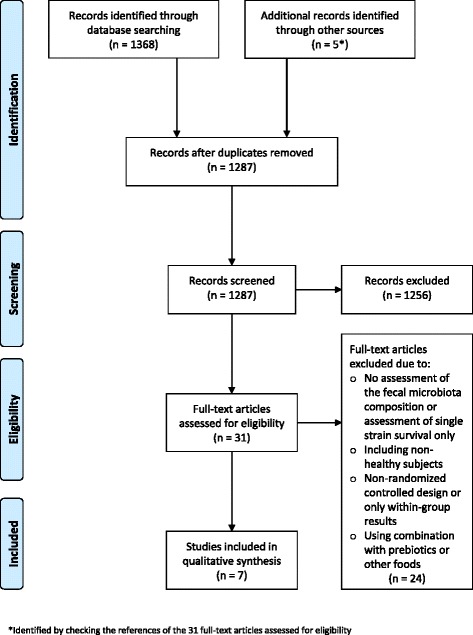
BACKGROUND: The effects of probiotic supplementation on fecal microbiota composition in healthy adults have not been well established. We aimed to provide a systematic review of the potential evidence for an effect of probiotic supplementation on the composition of human fecal microbiota as assessed by high-throughput molecular approaches in randomized controlled trials (RCTs) of healthy adults. METHODS: The survey of peer-reviewed papers was performed on 17 August 2015 by a literature search through PubMed, SCOPUS, and ISI Web of Science. Additional papers were identified by checking references of relevant papers. Search terms included healthy adult, probiotic, bifidobacterium, lactobacillus, gut microbiota, fecal microbiota, intestinal microbiota, intervention, and (clinical) trial. RCTs of solely probiotic supplementation and placebo in healthy adults that examined alteration in composition of overall fecal microbiota structure assessed by shotgun metagenomic sequencing, 16S ribosomal RNA sequencing, or phylogenetic microarray methods were included. Independent collection and quality assessment of studies were performed by two authors using predefined criteria including methodological quality assessment of reports of the clinical trials based on revised tools from PRISMA/Cochrane and by the Jadad score. RESULTS: Seven RCTs investigating the effect of probiotic supplementation on fecal microbiota in healthy adults were identified and included in the present systematic review. The quality of the studies was assessed as medium to high. Still, no effects were observed on the fecal microbiota composition in terms of α-diversity, richness, or evenness in any of the included studies when compared to placebo. Only one study found that probiotic supplementation significantly modified the overall structure of the fecal bacterial community in terms of β-diversity when compared to placebo. CONCLUSIONS: This systematic review of the pertinent literature demonstrates a lack of evidence for an impact of probiotics on fecal microbiota composition in healthy adults. Future studies would benefit from pre-specifying the primary outcome and transparently reporting the results including effect sizes, confidence intervals, and P values as well as providing a clear distinction of between-group and within-group comparisons.
Overview
The claims and statistics of this paper haven’t been checked yet.
Free: it reads the open-access text and checks the first 5 claims that cite a source we can check. Create a free account to check every claim.
Integrity signals
Registry
Cites
Statistics
Figures
Verification
Claims the paper makes
The claims and statistics of this paper haven’t been checked yet.
Free: it reads the open-access text and checks the first 5 claims that cite a source we can check. Create a free account to check every claim.
Claims other papers make about this one
Each is checked against this paper’s own text: does it say what the citing paper says it does?
The source backs part of the claim, not all of it — or backs it for a different population, condition or comparison.
In the citing paper
“While this could align with the observed lack of efficacy of HN019, it is also commonly observed that probiotics do not change the microbiota composition in healthy adults.15”
From Eight-Week Supplementation With Bifidobacterium lactis HN019 and Functional Constipation: A Randomized Clinical Trial (2024) · cites this paper as [15]
Experimental — accuracy not yet measuredThe source backs part of the claim, not all of it — or backs it for a different population, condition or comparison.
In the citing paper
“A systematic review, including seven RCTs summarised by Kristensen et al, also demonstrated a similar negative efficacy of probiotics supplement on faecal microbiota composition in healthy participants.48”
From Efficacy in bowel movement and change of gut microbiota on adult functional constipation patients treated with probiotics-containing products: a systematic review and meta-analysis (2024) · cites this paper as [48]
Experimental — accuracy not yet measuredThe cited source says what the claim attributes to it.
In the citing paper
“However, the lack of effect of the probiotic on the stool microbiota is in agreement with the findings of a systematic review of seven RCTs,”
The cited source says what the claim attributes to it.
In the citing paper
“a systematic review of seven RCTs, which investigated the effect of probiotic supplementation on the stool microbiota and revealed that probiotics had no effects on the stool microbiota composition in terms of α -diversity, richness, or evenness when compared to placebo 45 .”
In the citing paper
“In fact, a 2016 systematic review by Kristensen et al. found that probiotics have no impact on alpha-diversity, evenness and richness in the faecal microbiota across several studies on healthy individuals, bar one which noted an effect on beta-diversity [52].”
From Effect of Diet on the Gut Microbiota: Rethinking Intervention Duration (2019) · cites this paper as [52]
1 more claim about this paper
Create a free account to see every claim other papers make about this one.
Self-check
Percentages, sums and reported differences re-computed from the paper’s own numbers.
The self-check needs the paper’s full text.
Citations
Cites
Preferred Reporting Items for Systematic Reviews and Meta-Analyses: the PRISMA statement
Moher, D., Liberati, A., Tetzlaff, J., Altman, D. G., & for the PRISMA Group (2009) · BMJ · doi:10.1136/bmj.b2535 · Cited by 83,823
Preferred reporting items for systematic reviews and meta-analyses: the PRISMA Statement.
(2009) · PubMed Central · Cited by 44,859
Preferred reporting items for systematic reviews and meta-analyses: The PRISMA statement
Moher, D., Liberati, A., Tetzlaff, J., Altman, D. G., & the PRISMA Group* (2009) · Annals of Internal Medicine · doi:10.7326/0003-4819-151-4-200908180-00135 · Cited by 37,554
Liberati, A., Altman, D. G., Tetzlaff, J., Mulrow, C., Gøtzsche, P. C., Ioannidis, J. P. A., Clarke, M., Devereaux, P. J., Kleijnen, J., & Moher, D. (2009) · PLoS Medicine · doi:10.1371/journal.pmed.1000100 · Cited by 28,164 · cited 1×
“Risk of bias was further assessed regarding concealment of randomization, early termination of trial, blinding of patients, healthcare providers, data collectors and outcome assessors, reporting of drop-out or withdrawal, selective outcome reporting, and other potential biases [32, 33].”
BackgroundNaïve Bayesian Classifier for Rapid Assignment of rRNA Sequences into the New Bacterial Taxonomy
Wang, Q., Garrity, G. M., Tiedje, J. M., & Cole, J. R. (2007) · Applied and Environmental Microbiology · doi:10.1128/aem.00062-07 · Cited by 19,885 · cited 1×
“Several studies have examined the effects of region choice when evaluating fecal microbiota composition with no current international consensus [47, 49–51].”
BackgroundPreferred Reporting Items for Systematic Reviews and Meta-Analyses: The PRISMA Statement
Moher, D., Liberati, A., Tetzlaff, J., & Altman, D. G. (2009) · Journal of Clinical Epidemiology · doi:10.1016/j.jclinepi.2009.06.005 · Cited by 19,575
Assessing the quality of reports of randomized clinical trials: Is blinding necessary?
Jadad, A. R., Moore, R. A., Carroll, D., Jenkinson, C., Reynolds, D. J. M., Gavaghan, D. J., & McQuay, H. J. (1996) · Controlled Clinical Trials · doi:10.1016/0197-2456(95)00134-4 · Cited by 17,582 · cited 1×
“clinical trials was performed independently by NBK and TB using a three-item instrument (the Jadad score) that evaluates likelihood of bias in research reports [31].”
MethodA human gut microbial gene catalogue established by metagenomic sequencing
MetaHIT Consortium, Qin, J., Li, R., Raes, J., Arumugam, M., Burgdorf, K. S., Manichanh, C., Nielsen, T., Pons, N., Levenez, F., et al. (2010) · Nature · doi:10.1038/nature08821 · Cited by 11,624 · cited 1×
“Compositional information can be achieved by mapping the reads to a microbial gene reference catalogue [34], as was done by Brahe et al.”
MethodSelf-citationZhang, Q., Wang, C., Zheng, M., Li, Y., Li, J., Zhang, L., Shang, X., & Yan, C. (2015) · Cerebrovascular Diseases · doi:10.1159/000369778 · Cited by 11,533
Diet rapidly and reproducibly alters the human gut microbiome
David, L. A., Maurice, C. F., Carmody, R. N., Gootenberg, D. B., Button, J. E., Wolfe, B. E., Ling, A. V., Devlin, A. S., Varma, Y., Fischbach, M. A., et al. (2014) · Nature · doi:10.1038/nature12820 · Cited by 10,100 · cited 1×
“animalbased, amount of dietary fibers and fat) influence the fecal microbiota composition and function [36–38].”
BackgroundHill (2014) · doi:10.1038/nrgastro.2014.66 · Cited by 9,592 · cited 1×
“safe and efficacious manner [12].”
The environment and disease: association or causation?
Hill, A. B. (2015) · Journal of the Royal Society of Medicine · doi:10.1177/0141076814562718 · Cited by 7,285
Cochrane Handbook for Systematic Reviews of Interventions Version 5.0.1. The Cochrane Collaboration
Higgins, J. P. T., Green, S. R., & Higgins, J. P. T. (2008) · Cited by 7,226
The Environment and Disease: Association or Causation?
Hill, A. B. (1965) · Proceedings of the Royal Society of Medicine · doi:10.1177/003591576505800503 · Cited by 6,974 · cited 1×
“The information provided by such studies would enable the identification of the dosage needed to observe an impact on the relevant outcome and add to the likelihood that an observed association is causal [41].”
BackgroundA metagenome-wide association study of gut microbiota in type 2 diabetes
Qin, J., Li, Y., Cai, Z., Li, S., Zhu, J., Zhang, F., Liang, S., Zhang, W., Guan, Y., Shen, D., et al. (2012) · Nature · doi:10.1038/nature11450 · Cited by 6,762 · cited 1×
“shifts in fecal microbiota [6–11].”
Self-citationThe gut microbiota as an environmental factor that regulates fat storage
Bäckhed, F., Ding, H., Wang, T., Hooper, L. V., Koh, G. Y., Nagy, A., Semenkovich, C. F., & Gordon, J. I. (2004) · Proceedings of the National Academy of Sciences · doi:10.1073/pnas.0407076101 · Cited by 6,245 · cited 1×
“The human gut microbiota refers to the microbes that reside inside the gut and partake in several functions beneficial to the host including fermentation of otherwise indigestible dietary fibers and other food items [1], synthesis of vitamins and amino acids [2], prevention of pathogen colonization [3], maturation and…”
BackgroundThe gut microbiota shapes intestinal immune responses during health and disease
Round, J. L., & Mazmanian, S. K. (2009) · Nature Reviews Immunology · doi:10.1038/nri2515 · Cited by 5,029 · cited 1×
“org/publicdomain/ze the immune system [4], modulation of gastrointestinal hormone release, and regulation of brain behavior through bidirectional neuronal signaling as part of the gutbrain axis [5].”
BackgroundRichness of human gut microbiome correlates with metabolic markers
Le Chatelier, E., Nielsen, T., Qin, J., Prifti, E., Hildebrand, F., Falony, G., Almeida, M., Arumugam, M., Batto, J.-M., Kennedy, S., et al. (2013) · Nature · doi:10.1038/nature12506 · Cited by 4,662 · cited 1×
“shifts in fecal microbiota [6–11].”
Self-citationDong, Y., Hao, L., Shi, Z., Wang, G., Zhang, Z., & Han, C. (2013) · Urologia Internationalis · doi:10.1159/000351405 · Cited by 4,540
Personalized nutrition by prediction of glycemic responses
Zeevi, D., Korem, T., Zmora, N., Israeli, D., Rothschild, D., Weinberger, A., Ben-Yacov, O., Lador, D., Avnit-Sagi, T., Lotan-Pompan, M., et al. (2015) · Cell · doi:10.1016/j.cell.2015.11.001 · Cited by 2,929 · cited 1×
“animalbased, amount of dietary fibers and fat) influence the fecal microbiota composition and function [36–38].”
BackgroundDisentangling type 2 diabetes and metformin treatment signatures in the human gut microbiota
MetaHIT consortium, Forslund, K., Hildebrand, F., Nielsen, T., Falony, G., Le Chatelier, E., Sunagawa, S., Prifti, E., Vieira-Silva, S., Gudmundsdottir, V., et al. (2015) · Nature · doi:10.1038/nature15766 · Cited by 2,116 · cited 1×
“shifts in fecal microbiota [6–11].”
Self-citationBlundell, J. E., Baker, J. L., Boyland, E., Blaak, E., Charzewska, J., de Henauw, S., Frühbeck, G., Gonzalez-Gross, M., Hebebrand, J., Holm, L., et al. (2017) · Obesity Facts · doi:10.1159/000455952 · Cited by 1,945
Zhang, X., Zhang, D., Jia, H., Feng, Q., Wang, D., Liang, D., Wu, X., Li, J., Tang, L., Li, Y., et al. (2015) · Nature Medicine · doi:10.1038/nm.3914 · Cited by 1,690 · cited 1×
“shifts in fecal microbiota [6–11].”
Bacteria as vitamin suppliers to their host: A gut microbiota perspective
LeBlanc, J. G., Milani, C., de Giori, G. S., Sesma, F., van Sinderen, D., & Ventura, M. (2013) · Current Opinion in Biotechnology · doi:10.1016/j.copbio.2012.08.005 · Cited by 1,613 · cited 1×
“The human gut microbiota refers to the microbes that reside inside the gut and partake in several functions beneficial to the host including fermentation of otherwise indigestible dietary fibers and other food items [1], synthesis of vitamins and amino acids [2], prevention of pathogen colonization [3], maturation and…”
BackgroundThe interplay between the intestinal microbiota and the brain
Collins, S. M., Surette, M., & Bercik, P. (2012) · Nature Reviews Microbiology · doi:10.1038/nrmicro2876 · Cited by 1,611 · cited 1×
“org/publicdomain/ze the immune system [4], modulation of gastrointestinal hormone release, and regulation of brain behavior through bidirectional neuronal signaling as part of the gutbrain axis [5].”
BackgroundGut microbiome development along the colorectal adenoma-carcinoma sequence
Feng, Q., Liang, S., Jia, H., Stadlmayr, A., Tang, L., Lan, Z., Zhang, D., Xia, H., Xu, X., Jie, Z., et al. (2015) · Nature Communications · doi:10.1038/ncomms7528 · Cited by 1,506 · cited 1×
“shifts in fecal microbiota [6–11].”
Yu, J., Feng, Q., Wong, S. H., Zhang, D., Liang, Q. Y., Qin, Y., Tang, L., Zhao, H., Stenvang, J., Li, Y., et al. (2017) · Gut · doi:10.1136/gutjnl-2015-309800 · Cited by 1,253 · cited 1×
“shifts in fecal microbiota [6–11].”
Claesson, M. J., O'Sullivan, O., Wang, Q., Nikkilä, J., Marchesi, J. R., Smidt, H., de Vos, W. M., Ross, R. P., & O'Toole, P. W. (2009) · PLoS ONE · doi:10.1371/journal.pone.0006669 · Cited by 880 · cited 2×
“In general, using phylogenic microarray approaches have the advantages of being cost-efficient for compositional characterization; however cross-hybridization may occur and only taxa that are covered by the reference sequences can be detected [47].”
BackgroundBäckhed, F., Fraser, C. M., Ringel, Y., Sanders, M. E., Sartor, R. B., Sherman, P. M., Versalovic, J., Young, V., & Finlay, B. B. (2012) · Cell Host & Microbe · doi:10.1016/j.chom.2012.10.012 · Cited by 836 · cited 2×
“Interpretation of an effect on the composition of fecal microbiota in healthy individuals may be particularly complicated due to the lack of an internationally accepted consensus definition of a normal or a healthy fecal microbial community [17, 18].”
BackgroundCharteris, Kelly, Morelli, & Collins (1998) · Journal of Applied Microbiology · doi:10.1046/j.1365-2672.1998.00407.x · Cited by 774 · cited 1×
“Ingested probiotics must survive hostile environments including acidic, protease and bile-salt rich conditions during their passage through the gastrointestinal tract [42, 43].”
BackgroundMicroencapsulation of probiotics for gastrointestinal delivery
Cook, M. T., Tzortzis, G., Charalampopoulos, D., & Khutoryanskiy, V. V. (2012) · Journal of Controlled Release · doi:10.1016/j.jconrel.2012.06.003 · Cited by 756 · cited 1×
“Ingested probiotics must survive hostile environments including acidic, protease and bile-salt rich conditions during their passage through the gastrointestinal tract [42, 43].”
BackgroundFord, A. C., Quigley, E. M. M., Lacy, B. E., Lembo, A. J., Saito, Y. A., Schiller, L. R., Soffer, E. E., Spiegel, B. M. R., & Moayyedi, P. (2014) · American Journal of Gastroenterology · doi:10.1038/ajg.2014.202 · Cited by 747 · cited 1×
“The therapeutic effect of probiotic supplementation has been studied in a broad range of diseases, particularly in regard to gastrointestinal and metabolic disorders where results have supported the potential use of probiotics as therapeutic agents (reviewed in [15, 16]).”
BackgroundIntestinal microbiota in human health and disease: the impact of probiotics
Gerritsen, J., Smidt, H., Rijkers, G. T., & de Vos, W. M. (2011) · Genes & Nutrition · doi:10.1007/s12263-011-0229-7 · Cited by 724 · cited 1×
“tinal barrier function through effects on the epithelium and mucus lining, production of anti-microbial substances, competition with pathogenic bacteria, and regulation of luminal acidity (reviewed in [13, 14]).”
BackgroundMcNulty, N. P., Yatsunenko, T., Hsiao, A., Faith, J. J., Muegge, B. D., Goodman, A. L., Henrissat, B., Oozeer, R., Cools-Portier, S., Gobert, G., et al. (2011) · Science Translational Medicine · doi:10.1126/scitranslmed.3002701 · Cited by 549 · cited 1×
“Despite these limitations, several probiotic interventions aiming to observe alterations in fecal microbiota composition have been performed in healthy adults [19–28].”
BackgroundGenomic approaches to studying the human microbiota
Weinstock, G. M. (2012) · Nature · doi:10.1038/nature11553 · Cited by 539 · cited 2×
“The sequencing platforms differ in costs, coverage, and length of reads with the Illumina platform becoming more widely used [45].”
MethodQuantifying Diet-Induced Metabolic Changes of the Human Gut Microbiome
Shoaie, S., Ghaffari, P., Kovatcheva-Datchary, P., Mardinoglu, A., Sen, P., Pujos-Guillot, E., de Wouters, T., Juste, C., Rizkalla, S., Chilloux, J., et al. (2015) · Cell Metabolism · doi:10.1016/j.cmet.2015.07.001 · Cited by 420 · cited 1×
“animalbased, amount of dietary fibers and fat) influence the fecal microbiota composition and function [36–38].”
BackgroundWorld Gastroenterology Organisation Global Guidelines: Probiotics and Prebiotics October 2011
Guarner, F., Khan, A. G., Garisch, J., Eliakim, R., Gangl, A., Thomson, A., Krabshuis, J., Lemair, T., Kaufmann, P., de Paula, J. A., et al. (2012) · Journal of Clinical Gastroenterology · doi:10.1097/mcg.0b013e3182549092 · Cited by 418 · cited 1×
“8 × 10(12) CFU twice daily depending on strain and disease, based on at least one well designed clinical trial showing a beneficial effect for a health promoting or therapeutic outcome [40].”
BackgroundEndt, K., Stecher, B., Chaffron, S., Slack, E., Tchitchek, N., Benecke, A., Van Maele, L., Sirard, J.-C., Mueller, A. J., Heikenwalder, M., et al. (2010) · PLoS Pathogens · doi:10.1371/journal.ppat.1001097 · Cited by 344
Mizrahi-Man, O., Davenport, E. R., & Gilad, Y. (2013) · PLoS ONE · doi:10.1371/journal.pone.0053608 · Cited by 340
Rastogi, G., & Sani, R. K. (2011) · Microbes and Microbial Technology · doi:10.1007/978-1-4419-7931-5_2 · Cited by 294 · cited 1×
“The targeted 16S rRNA approach provides information at the taxonomic level in the form of abundance and phylogenetic relationship, but the method has pitfalls in PCR amplification steps [46] and cross-platform comparison is not straightforward.”
MethodRijkers, G. T., Bengmark, S., Enck, P., Haller, D., Herz, U., Kalliomaki, M., Kudo, S., Lenoir-Wijnkoop, I., Mercenier, A., Myllyluoma, E., et al. (2010) · The Journal of Nutrition · doi:10.3945/jn.109.113779 · Cited by 271 · cited 1×
“tinal barrier function through effects on the epithelium and mucus lining, production of anti-microbial substances, competition with pathogenic bacteria, and regulation of luminal acidity (reviewed in [13, 14]).”
BackgroundSimon, M.-C., Strassburger, K., Nowotny, B., Kolb, H., Nowotny, P., Burkart, V., Zivehe, F., Hwang, J.-H., Stehle, P., Pacini, G., et al. (2015) · Diabetes Care · doi:10.2337/dc14-2690 · Cited by 253 · cited 12×
“Only one study [24] is explicitly labeled as a pilot trial, reporting a multitude of outcomes, only in part addressing multiple testing.”
BackgroundMethodInfluentialMcFarland, L. V. (2014) · BMJ Open · doi:10.1136/bmjopen-2014-005047 · Cited by 235 · cited 2×
“Interpretation of an effect on the composition of fecal microbiota in healthy individuals may be particularly complicated due to the lack of an internationally accepted consensus definition of a normal or a healthy fecal microbial community [17, 18].”
BackgroundBacterial flora-typing with targeted, chip-based Pyrosequencing
Sundquist, A., Bigdeli, S., Jalili, R., Druzin, M. L., Waller, S., Pullen, K. M., El-Sayed, Y. Y., Taslimi, M. M., Batzoglou, S., & Ronaghi, M. (2007) · BMC Microbiology · doi:10.1186/1471-2180-7-108 · Cited by 231 · cited 1×
“Several studies have examined the effects of region choice when evaluating fecal microbiota composition with no current international consensus [47, 49–51].”
Ferrario, C., Taverniti, V., Milani, C., Fiore, W., Laureati, M., De Noni, I., Stuknyte, M., Chouaia, B., Riso, P., & Guglielmetti, S. (2014) · The Journal of Nutrition · doi:10.3945/jn.114.197723 · Cited by 228 · cited 14×
“2014 [27] 22/34* (56 %) 23–55 years Italy L.”
BackgroundMethodInfluentialLahti, L., Salonen, A., Kekkonen, R. A., Salojärvi, J., Jalanka-Tuovinen, J., Palva, A., Orešič, M., & de Vos, W. M. (2013) · PeerJ · doi:10.7717/peerj.32 · Cited by 196 · cited 2×
“The quality of the included studies is generally Table 1 Characteristics of the studies reviewed Study Participant characteristics Intervention Design Microbiomics Sample size calculation Probiotic effects on fecal microbiota compared to placebo Lahti et al. 2013 [22] 25/25 (72”
BackgroundBrahe, L. K., Le Chatelier, E., Prifti, E., Pons, N., Kennedy, S., Blædel, T., Håkansson, J., Dalsgaard, T. K., Hansen, T., Pedersen, O., et al. (2015) · British Journal of Nutrition · doi:10.1017/s0007114515001786 · Cited by 171 · cited 13×
“20–45 years Denmark L. casei W8® (1010 CFU) in capsules Double-blinded, parallel, two-armed, placebo (capsules) controlled (28 days) 16S rRNA (regions V3 and V4) sequencing on Roche 454 pyrosequencing platform No ↔ α- and β-diversity Brahe et al. 2015 [20] 34/58* (100”
BackgroundMethodInfluentialSelf-citationProbiotics as Complementary Treatment for Metabolic Disorders
Le Barz, M., Anhê, F. F., Varin, T. V., Desjardins, Y., Levy, E., Roy, D., Urdaci, M. C., & Marette, A. (2015) · Diabetes & Metabolism Journal · doi:10.4093/dmj.2015.39.4.291 · Cited by 142 · cited 1×
“The therapeutic effect of probiotic supplementation has been studied in a broad range of diseases, particularly in regard to gastrointestinal and metabolic disorders where results have supported the potential use of probiotics as therapeutic agents (reviewed in [15, 16]).”
BackgroundThe Evidence to Support Health Claims for Probiotics
Farnworth, E. R. (2008) · Journal of Nutrition · doi:10.1093/jn/138.6.1250s · Cited by 137 · cited 1×
“Yet, the site of action may be proximal to the colon and it is not necessarily possible to conclude on the degree of colonization or even the amount of bacteria that produce the effect [44].”
BackgroundGnotobiotic Mouse Immune Response Induced by Bifidobacterium sp. Strains Isolated from Infants
Ménard, O., Butel, M.-J., Gaboriau-Routhiau, V., & Waligora-Dupriet, A.-J. (2008) · Applied and Environmental Microbiology · doi:10.1128/aem.01261-07 · Cited by 124 · cited 1×
“Considering that the impact on the fecal microbiota may differ among strains of the same bacterial species [39], despite close phylogenetic relationships, a potential source of heterogeneity is the use of various probiotic agents.”
BackgroundHaller, D., Antoine, J., Bengmark, S., Enck, P., Rijkers, G. T., & Lenoir‐Wijnkoop, I. (2010) · Journal of Nutrition · doi:10.3945/jn.109.113746 · Cited by 114 · cited 1×
“of carry-over effects [35].”
A probiotics-containing biscuit modulates the intestinal microbiota in the elderly
Rampelli, S., Candela, M., Severgnini, M., Biagi, E., Turroni, S., Roselli, M., Carnevali, P., Donini, L., & Brigidi, P. (2013) · The Journal of nutrition, health and aging · doi:10.1007/s12603-012-0372-x · Cited by 85 · cited 13×
“2013 [23] 32/32 (59 %) 71–88 years Italy B.”
BackgroundMethodInfluentialCandela, M., Consolandi, C., Severgnini, M., Biagi, E., Castiglioni, B., Vitali, B., De Bellis, G., & Brigidi, P. (2010) · BMC Microbiology · doi:10.1186/1471-2180-10-116 · Cited by 69 · cited 1×
“array has demonstrated good reproducibility by cluster analysis of the phylogenetic fingerprint in samples from the same participant [47, 48].”
BackgroundHanifi, A., Culpepper, T., Mai, V., Anand, A., Ford, A. L., Ukhanova, M., Christman, M., Tompkins, T. A., & Dahl, W. J. (2015) · Beneficial Microbes · doi:10.3920/bm2014.0031 · Cited by 65 · cited 10×
“1 or not specified) (n = 2) [19, 24], or both (versions not specified) (n = 1) [21], while two did not report the database used.”
BackgroundMethodInfluentialZhang, J., Wang, L., Guo, Z., Sun, Z., Gesudu, Q., Kwok, L., Menghebilige, & Zhang, H. (2014) · FEMS Microbiology Ecology · doi:10.1111/1574-6941.12328 · Cited by 64
Plaza-Díaz, J., Fernández-Caballero, J., Chueca, N., García, F., Gómez-Llorente, C., Sáez-Lara, M., Fontana, L., & Gil, Á. (2015) · Nutrients · doi:10.3390/nu7063999 · Cited by 58 · cited 1×
“Despite these limitations, several probiotic interventions aiming to observe alterations in fecal microbiota composition have been performed in healthy adults [19–28].”
BackgroundBjerg, A. T., Sørensen, M., Krych, L., Hansen, L. H., Astrup, A., Kristensen, M., & Nielsen, D. (2015) · Beneficial Microbes · doi:10.3920/bm2014.0033 · Cited by 17 · cited 14×
“1 or not specified) (n = 2) [19, 24], or both (versions not specified) (n = 1) [21], while two did not report the database used.”
BackgroundMethodInfluential
Cited by
Gut microbiota in human metabolic health and disease
Fan, Y., & Pedersen, O. (2021) · Nature Reviews Microbiology · doi:10.1038/s41579-020-0433-9 · Cited by 4,724
Self-citationRole of the gut microbiota in nutrition and health
Valdes, A. M., Walter, J., Segal, E., & Spector, T. D. (2018) · BMJ · doi:10.1136/bmj.k2179 · Cited by 2,375
Zmora, N., Zilberman-Schapira, G., Suez, J., Mor, U., Dori-Bachash, M., Bashiardes, S., Kotler, E., Zur, M., Regev-Lehavi, D., Brik, R. B.-Z., et al. (2018) · Cell · doi:10.1016/j.cell.2018.08.041 · Cited by 1,695
“Probiotics Differentially Affect Permissive and Resistant Human Individuals Finally, as the effect of probiotics on the human GI microbiome remains inconclusive (Kristensen et al., 2016), we sought to determine probiotic impact on microbiome composition and function and the host transcriptome, and whether these follow…”
InfluentialThe pros, cons, and many unknowns of probiotics
Suez, J., Zmora, N., Segal, E., & Elinav, E. (2019) · Nature Medicine · doi:10.1038/s41591-019-0439-x · Cited by 1,398
Human gut microbiota/microbiome in health and diseases: a review
Gomaa, E. Z. (2020) · Antonie van Leeuwenhoek · doi:10.1007/s10482-020-01474-7 · Cited by 1,294
“The most commonly used probiotic species are Lactobacillus, Bifidobacteria and yeasts, such as Saccharomyces boulardii (Kristensen et al. 2016).”
Background
Metadata
- Authors
- Kristensen, N. B., Bryrup, T., Allin, K. H., Nielsen, T., Hansen, T. H., & Pedersen, O.
- Affiliations
- University of Copenhagen (DK)
- Corresponding author
- Kristensen, Nadja B.
- Venue
- Genome Medicine
- Published
- 2016-05-10
- Volume
- 8
- Issue
- 1
- Pages
- 52-52
- ISSN
- 1756-994X (ISSN-L)
- PMC
- PMC4862129
- OpenAlex
- W2343150225
- Cited by
- 561
- References
- 57
- Citations by year
- 2026: 34 · 2025: 44 · 2024: 64 · 2023: 53 · 2022: 57 · 2021: 67 · 2020: 74 · 2019: 66 · 2018: 53 · 2017: 34 · 2016: 15
- FWCI
- 6.47
- Type
- journal article
- Language
- en
- Open access
- gold
- doi.org
- Licence
- cc-by
- Locations
- Genome Medicine (publishedVersion, cc-by)
- PubMed Central (publishedVersion, cc-by)
- PubMed (publishedVersion)
- Research at the University of Copenhagen (University of Copenhagen) (acceptedVersion, cc-by)
- Funders
- The Novo Nordisk Foundation
- Topics
- Life Sciences › Agricultural and Biological Sciences › Food Science › Probiotics and Fermented Foods
- Life Sciences › Biochemistry, Genetics and Molecular Biology › Molecular Biology › Gut microbiota and health
- Health Sciences › Nursing › Nutrition and Dietetics › Infant Nutrition and Health
- Keywords
- probiotics, fecal microbiota, gut microbiota composition, healthy adults, Bifidobacterium, Lactobacillus, alpha diversity, beta diversity, microbiome, placebo comparison, metagenomic sequencing
- MeSH terms
- Adult, Bacteria, Feces, Humans, Phylogeny, Randomized Controlled Trials as Topic, Probiotics, Microbiota, Healthy Volunteers
About these checks
Registry, retraction, Cites and statistics results are computed, not judged, with one exception: a printed reference that no index lists is read once by a model before it counts as a citation error. Claims are extracted by a model and kept only when their quote appears verbatim in the text; each cited source is then checked, with a model’s help, for whether it says what the claim relies on. Those verdicts can be wrong — read the claim’s quote and the cited source before relying on one.
Statistics and arithmetic are recomputed, not judged.
Confidence bands are shown only for fields calibrated on our annotated test set. None is calibrated yet, so no band is shown.
What counts as a claim ›How we measure confidence ›How we check this ›
Are you an author, or do you see a problem with this page? Request a review
Data sources
Bibliographic data: Semantic Scholar, OpenAlex, Crossref.
Contains information from the Semantic Scholar Academic Graph Datasets, made available under the ODC Attribution License (ODC-BY 1.0).
Semantic Scholar’s data is described in: Kinney, R., et al. (2023). The Semantic Scholar Open Data Platform. arXiv:2301.10140.
