

Mapping research in student engagement and educational technology in higher education: a systematic evidence map
Open accessThe DOI matches its Crossref record; 175 of the 182 references it cites were found in a registry or an index; 6 of the 54 sources its claims cite were checked for support.
Abstract
Abstract Digital technology has become a central aspect of higher education, inherently affecting all aspects of the student experience. It has also been linked to an increase in behavioural, affective and cognitive student engagement, the facilitation of which is a central concern of educators. In order to delineate the complex nexus of technology and student engagement, this article systematically maps research from 243 studies published between 2007 and 2016. Research within the corpus was predominantly undertaken within the United States and the United Kingdom, with only limited research undertaken in the Global South, and largely focused on the fields of Arts & Humanities, Education, and Natural Sciences, Mathematics & Statistics. Studies most often used quantitative methods, followed by mixed methods, with little qualitative research methods employed. Few studies provided a definition of student engagement, and less than half were guided by a theoretical framework. The courses investigated used blended learning and text-based tools (e.g. discussion forums) most often, with undergraduate students as the primary target group. Stemming from the use of educational technology, behavioural engagement was by far the most often identified dimension, followed by affective and cognitive engagement. This mapping article provides the grounds for further exploration into discipline-specific use of technology to foster student engagement.
Overview
CoChat Summary
TL;DR
This systematic evidence map synthesizes 243 studies published 2007–2016 on student engagement and educational technology in higher education. It finds research concentrated in the US and UK, dominated by quantitative methods, often lacking definitions or theory, and most frequently linking blended learning and text-based tools to behavioural engagement.
Key findings
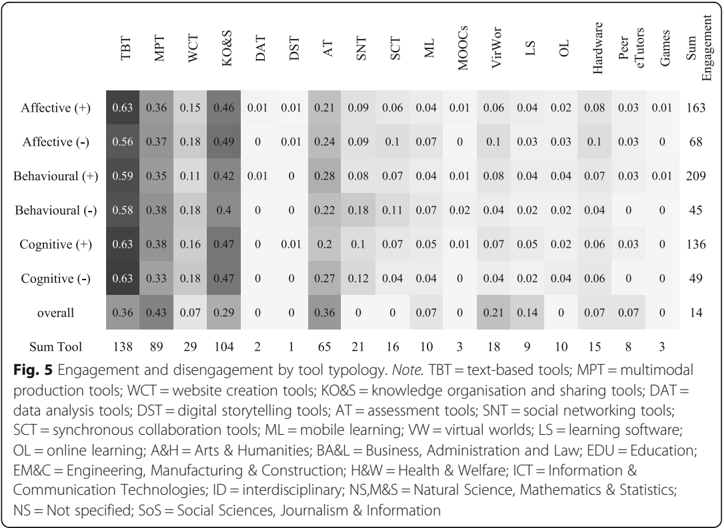
- Across 243 studies, behavioural engagement was documented in 209 studies (86%), affective engagement in 163 (67%), and cognitive engagement in 136 (56%); 117 studies (48%) showed all three dimensions.
- Most studies used quantitative methods (103, 42%), followed by mixed methods (84, 35%) and qualitative methods (56, 23%); 225 studies (93%) lacked a definition of student engagement, and 59% did not employ a theoretical model.
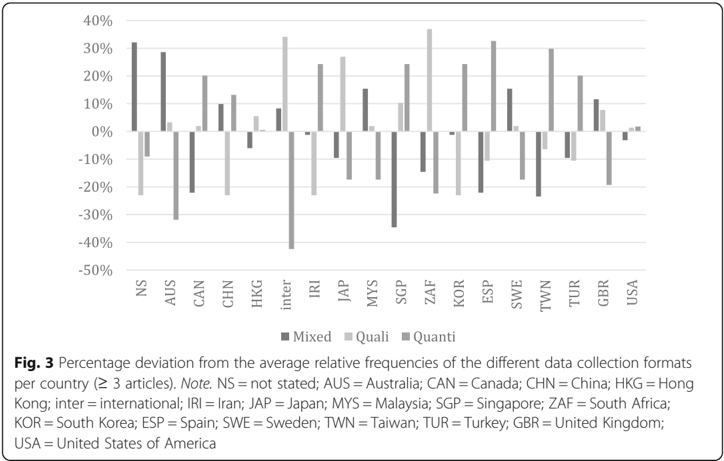
- Research was concentrated in the US (86 studies, 35.4%), UK (26, 10.7%), Australia (19, 7.8%), Taiwan (18, 7.4%), and China (9, 3.7%); top tools were LMS (n = 89), discussion forums (n = 80), videos (n = 44), recorded lectures (n = 25), and chat (n = 24).
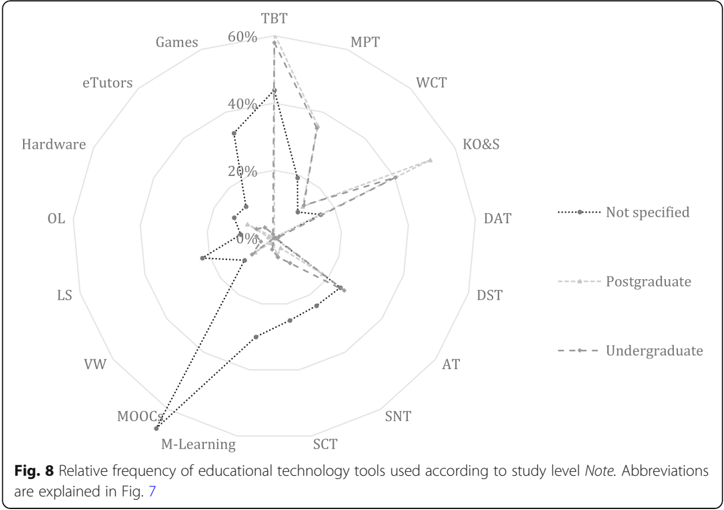
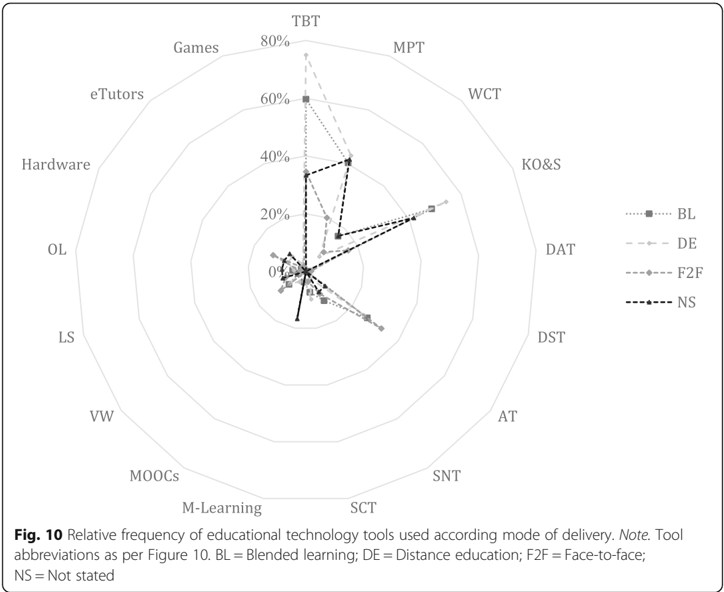
- Blended learning was the most researched mode of delivery (109 studies), followed by distance education (72) and face-to-face instruction (55); undergraduate students were the primary population (146 studies, 60%), while 41 studies (17%) did not specify study level.
Methods
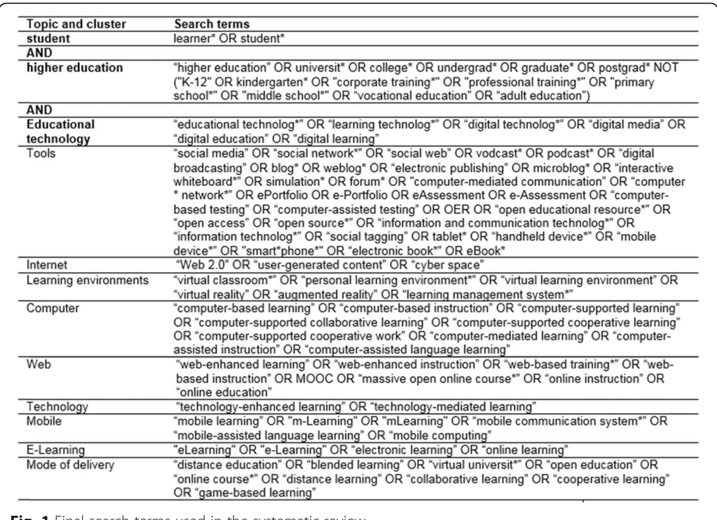
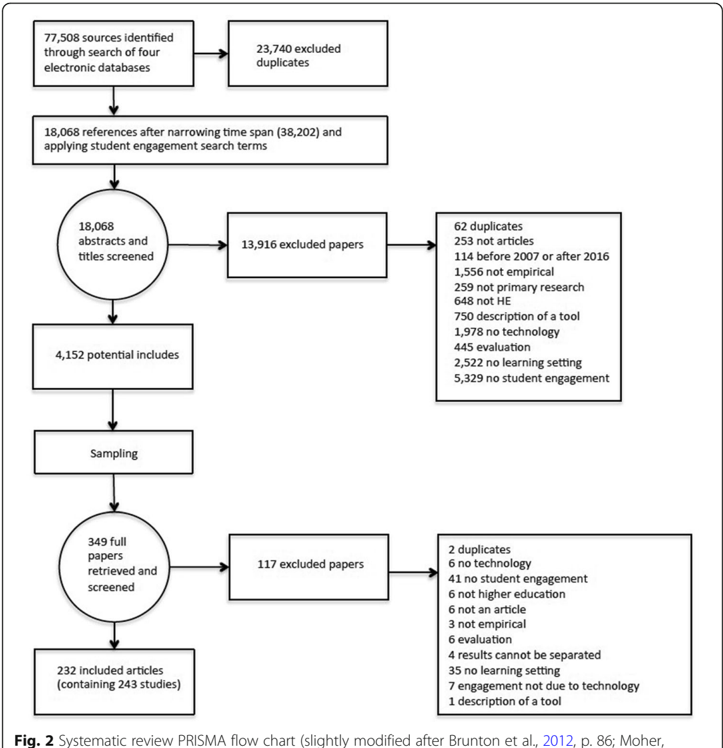
- Systematic evidence map/systematic review; four databases (ERIC, Web of Science, Scopus, PsycINFO) were searched in July 2017, retrieving 77,508 initial references, 53,768 after duplicate removal, and 18,068 records after adjusting the period to 2007–2016.
- After title/abstract screening, 4,152 potentially relevant articles remained; sample size estimation (5% error range, 50% proportion, 5% alpha) produced 349 sampled articles stratified by publishing year, and full-text screening left 232 articles containing 243 studies.
- Data were extracted using an extensive coding system covering study methodology, sample, learning scenario, mode of delivery, educational technology, and cognitive, affective, or behavioural engagement/disengagement indicators.
Limitations
- Stated: only English-language articles were included; grey literature, book chapters, monographs, and journals not indexed in the four databases were excluded; the review was limited to 2007–2016; the sampling strategy likely accounts for low numbers of studies from South America and Africa.
- Stated: peer review was used as a baseline quality criterion, and the human possibility of overlooking or misinterpreting information during coding cannot be fully excluded.
- Evident from the text: the authors note that search and sampling strategy may contribute to geographic imbalance, and they frame student engagement as remaining under-theorised and often considered only fragmentally in the corpus.
Model-written summary. Check it against the paper before relying on it.
Integrity signals
Registry
Cites
Statistics
Figures
Verification
Claims the paper makes
6 Valid · 1 Not valid · 30 Not checked · 118 Own results and interpretations
The cited sources support only part of this claim — read each source’s verdict below.
In the paper
“Linked to this, educational technology research has, however, lacked theoretical guidance (Al-Sakkaf, Omar, & Ahmad, 2019; Hew, Lan, Tang, Jia, & Lo, 2019; Lundin, Bergviken Rensfeldt, Hillman, Lantz-Andersson, & Peterson, 2018).”
- Also stated in: § Introduction · plain
“educational technology research has, however, lacked theoretical guidance (Al-Sakkaf, Omar, & Ahmad, 2019; Hew, Lan, Tang, Jia, & Lo, 2019; Lundin, Bergviken Rensfeldt, Hillman, Lantz-Andersson, & Peterson, 2018).”
What the sources say
- Not checked — no full text of the sourcecites Al-Sakkaf, Omar, & Ahmad, 2019 matched to “A systematic literature review of student engagement in software visualization: a theoretical perspective” (2019) source
- Not checked — no full text of the sourcecites Hew, Lan, Tang, Jia, & Lo, 2019 matched to “Where is the “theory” within the field of educational technology research?” (2019) source
- Partly supportedcites Lundin, Bergviken Rensfeldt, Hillman, Lantz-Andersson, & Peterson, 2018 matched to “Higher education dominance and siloed knowledge: a systematic review of flipped classroom research” (2018) sourceExperimental — accuracy not yet measured
The Abstract says that flipped classroom research often lacks anchoring in learning theory or instructional design, and the Discussion and conclusions recommends stronger theoretical anchoring. The citing sentence extends this finding to educational technology research generally, which the paper does not establish. (LLM, conf=0.87)
plain- Asserted: passes — The authors put it forward as true.
- Checkable: passes — It can be checked against evidence.
- Load-bearing: passes — The paper’s conclusions depend on it.
- Based: passes — The paper gives a reason why it holds.
- Also stated in: § Introduction · plain
The sources with a verdict support this claim; the rest weren’t checked yet, have no full text we could read, or their verdicts aren’t rated yet.
In the paper
“Reviews that have included research using a range of methodologies, have found a limited number of studies employing qualitative methods (e.g. Connolly, Boyle, MacArthur, Hainey, & Boyle, 2012; Kay & LeSage, 2009; Lundin et al., 2018).”
What the sources say
- Not checked — no full text of the sourcecites Connolly et al., 2012 matched to “A systematic literature review of empirical evidence on computer games and serious games” (2012) source
- Not checked — no full text of the sourcecites Kay & LeSage, 2009 matched to “Examining the benefits and challenges of using audience response systems: A review of the literature” (2009) source
- Supportedcites Lundin et al., 2018 matched to “Higher education dominance and siloed knowledge: a systematic review of flipped classroom research” (2018) source
In Discussion and conclusions (page unavailable), Lundin et al. say that qualitative analyses of actual student learning are rare in the flipped-classroom research they reviewed. They also report that simple course questionnaires and pre- and post-tests make up a large part of that research. This supports the citing sentence’s point in the context of flipped-classroom studies. (LLM, conf=0.86)
plain- Asserted: passes — The authors put it forward as true.
- Checkable: passes — It can be checked against evidence.
- Load-bearing: passes — The paper’s conclusions depend on it.
- Based: passes — The paper gives a reason why it holds.
Every source the paper cites for this claim was checked and supports it.
In the paper
“with students showing, for example, disinterest in topics chosen e.g., (Sullivan & Longnecker, 2014)”
What the sources say
- Supportedcites Sullivan & Longnecker, 2014 matched to “Class blogs as a teaching tool to promote writing and student interaction” (2014) source
Table 5 (Conclusion) records a student saying that the week's posts did not necessarily interest them and another asking to choose topics instead of using a fixed set of readings. These comments support the cited example of student disinterest, though the paper also reports positive views of some blog topics. (LLM, conf=0.88)
plain- Asserted: passes — The authors put it forward as true.
- Checkable: passes — It can be checked against evidence.
- Load-bearing: unclear — It is unclear whether the paper’s conclusions depend on it.
- Based: passes — The paper gives a reason why it holds.
- Supported
Every source the paper cites for this claim was checked and supports it.
In the paper
“and continued avoidance of using blogs in some cases, despite introductory training e.g., (Keiller & Inglis-Jassiem, 2015).”
What the sources say
- Supportedcites Keiller & Inglis-Jassiem, 2015 matched to “A lesson in listening: Is the student voice heard in the rush to incorporate technology into health professions education?” (2015) source
The Intervention section says students were invited to training on accessing and using a university-based blogging platform. The Results section reports that students did not access the platform during the study period and cited unfamiliarity with blogging even after training. (LLM, conf=0.94)
plain- Asserted: passes — The authors put it forward as true.
- Checkable: passes — It can be checked against evidence.
- Load-bearing: unclear — It is unclear whether the paper’s conclusions depend on it.
- Based: passes — The paper gives a reason why it holds.
- Supported
In the paper
“Out of 27 identified reviews (see Additional file 3), only 14 report the countries included”
What the sources say
- Not matchedcites Additional file 3
This doesn’t read as a citation we can look up.
plain- Asserted: passes — The authors put it forward as true.
- Checkable: passes — It can be checked against evidence.
- Load-bearing: passes — The paper’s conclusions depend on it.
- Based: passes — The paper gives a reason why it holds.
- Not matched
87 more claims
Create a free account to see all 155 claims and to verify the 1 reference still open.
- Probably not a substantial claim. 27
- It may state two separate claims as one. 44
- The quote only partly states this claim. 2
Claims other papers make about this one
Each is checked against this paper’s own text: does it say what the citing paper says it does?
The source backs part of the claim, not all of it — or backs it for a different population, condition or comparison.
In the citing paper
“As previous LA and educational technology reviews have found (e.g., Bergdahl et al., 2020;Bond et al., 2020;Banihashem et al., 2022), there is an underrepresentation of African and South and Central American research, although this might be due in some part to the search strategy employed for this review.”
From Unpacking student engagement in higher education learning analytics: a systematic review (2024) · cites this paper as Bond et al., 2020
Experimental — accuracy not yet measuredThe source backs part of the claim, not all of it — or backs it for a different population, condition or comparison.
In the citing paper
“HELA research also focused heavily on undergraduate students, with only a small percentage of studies exploring postgraduate student engagement (Bergdahl et al., 2020;Bond et al., 2020), and a large proportion of participants (60%) were from a STEM discipline, which raises questions of wider study generalisability (Kaliisa et al., 2024).”
From Unpacking student engagement in higher education learning analytics: a systematic review (2024) · cites this paper as Bond et al., 2020
Experimental — accuracy not yet measuredThe source backs part of the claim, not all of it — or backs it for a different population, condition or comparison.
In the citing paper
“Studies suggest that professional development and training in LA can improve educators' capacity to use data-driven insights to support student learning (Bergdahl et al., 2020;Bond et al., 2020;Gašević et al., 2019).”
From Unpacking student engagement in higher education learning analytics: a systematic review (2024) · cites this paper as Bond et al., 2020
Experimental — accuracy not yet measuredThe cited source says what the claim attributes to it.
In the citing paper
“Given that the nexus between SE and technology use in higher education has not yet been comprehensively researched, a systematic review was conducted into this topic”
From Facilitating student engagement through educational technology in higher education: A systematic review in the field of arts and humanities (2020) · cites this paper as Bond et al., 2020
The cited source says what the claim attributes to it.
In the citing paper
“Student engagement is often conceptualized along three dimensions: behavioral, cognitive, and affective engagement (Fredericks et al., 2004; Bond et al., 2020).”
From Effects of Generative AI on Engagement and Performance Within Asynchronous Online Courses (2026) · cites this paper as Bond et al., 2020
2 more claims about this paper
Create a free account to see every claim other papers make about this one.
Self-check
Percentages, sums and reported differences re-computed from the paper’s own numbers.
Each contradiction between two passages listed here was confirmed by an independent check.
Rated major: it would touch a result — a value a result rests on, reported and recomputed p-values on opposite sides of the significance level, two passages that conflict with no sign which is right, or a cited work retracted before this paper was published.
In the paper
“59% (n = 100) of studies did not employ a theoretical model in their research. Of the 41% (n = 100) that did”
Reported 59 · recomputed 41.152263
Rated minor: it would not touch a result — a value no result rests on, a p-value that stays on the same side of the significance level, or a conflict that is clerical, resolved elsewhere in the paper, or outside its own findings.
In the paper
§ Discussion
“Natural Sciences, Mathematics & Statistics, nevertheless, assuming rank 3 with 38 studies (15.6%).”
§ Method
“Natural Sciences, Mathematics & Statistics (37) being the top three study fields”
Citations
Cites
Preferred Reporting Items for Systematic Reviews and Meta-Analyses: the PRISMA statement
Moher, D., Liberati, A., Tetzlaff, J., Altman, D. G., & for the PRISMA Group (2009) · BMJ · doi:10.1136/bmj.b2535 · Cited by 83,823
(1978) · Medical Entomology and Zoology · Cited by 53,488
The Discovery of Grounded Theory: Strategies for Qualitative Research.
Wagner, H. R., Glaser, B. G., & Strauss, A. L. (1968) · Social Forces · doi:10.2307/2575405 · Cited by 46,361
Preferred reporting items for systematic reviews and meta-analyses: the PRISMA Statement.
(2009) · PubMed Central · Cited by 44,859
The Discovery of Grounded Theory; Strategies for Qualitative Research
Glaser, B. G., Strauss, A. L., & Strutzel, E. (1968) · Nursing Research · doi:10.1097/00006199-196807000-00014 · Cited by 39,449
Kytle, J., & Bandura, A. (1978) · Contemporary Sociology · doi:10.2307/2065952 · Cited by 25,422 · cited 1×
“Studies coded as SCL included those exploring social learning (Bandura, 1971) and social”
MethodSchool Engagement: Potential of the Concept, State of the Evidence
Fredricks, J. A., Blumenfeld, P. C., & Paris, A. H. (2004) · Review of Educational Research · doi:10.3102/00346543074001059 · Cited by 12,581 · cited 2×
“Therefore, more qualitative and ethnographic measures should also be employed, such as student observations with thick descriptions, which can help shed light on the complexity of teaching and learning environments (Fredricks et al., 2004; Heflin, Shewmaker, & Nguyen, 2017).”
BackgroundPierce, W. D., & Bandura, A. (1977) · Canadian Journal of Sociology / Cahiers canadiens de sociologie · doi:10.2307/3340496 · Cited by 9,650
Bandura, A. (1977) · Zenodo (CERN European Organization for Nuclear Research) · doi:10.5281/zenodo.15521699 · Cited by 7,607
The Discovery of Grounded Theory: Strategies for Qualitative Research
Brodsky, C. M. (1968) · Psychosomatics · doi:10.1016/s0033-3182(68)71872-7 · Cited by 6,679
Research works printed but not linked: 1
- Astin, A. W. (1984). Student involvement: A developmental theory for higher education. Journal of College Student Development, 25(4), 297–308.
Cited by
Items 1,001–1,053 of 1,053
Vi, T. V. (2025) · SN Social Sciences · doi:10.1007/s43545-025-01236-0 · Cited by 5
“The application of virtual reality (Radianti et al. 2020), blended learning (Bond et al. 2020), or digital project-based learning (Floridi 2013) shows great potential in improving the educational environment.”
Rosli, M. S. R., & Wahid, N. B. A. (2023) · AIP conference proceedings · doi:10.1063/5.0148743
Wang, P., & Luo, K. (2026) · Frontiers in Psychology · doi:10.3389/fpsyg.2026.1888349
Lezama, M. T. F., Romero, Y. V. V., Soto, R. M. H., Chávez, P. V. A., & Morales, A. E. P. (2026) · F1000Research · doi:10.12688/f1000research.183195.1
Dai, W.-A., Wu, L., & Fuller, C. (2025) · Higher Education Research & Development · doi:10.1080/07294360.2025.2591259
“It is widely accepted that student engagement consists of three components, including behavioural, cognitive, and affective engagement (Bond et al., 2020).”
OECD (2023) · OECD eBooks · doi:10.1787/fe45c386-fr
Hussain, A. H., Ummihusna, A., Eni, S., Mohamad, W., & Musa, N. C. (2024) · International Journal of Academic Research in Business and Social Sciences · doi:10.6007/ijarbss/v14-i6/21996
DIGITALIZATION OF EDUCATION AND STUDENTS' ABILITY TO LEARN POST COVID 19 PANDEMICS
Syaktanti, R. F., Mundayat, A. A., & Utami, T. (2023) · International Journal of Education and Social Science Research · doi:10.37500/ijessr.2023.6303
“The use of technology or digitalization also touches the world of education, where the integration between the world of teachers and technology creates new challenges for the world of teachers themselves [5].”
BackgroundStudent Engagement, Online Learning and COVID-19: A Law School Perspective
McNamara, J. R., Hews, R., & Nay, Z. (2022) · Springer eBooks · doi:10.1007/978-981-19-2568-9_4
Perceived Pedagogical Value of Digital Technologies Among Engineering Students
Lončarević, I., Samardžić, S., & Lakatoš, R. (2026) · International Journal of Cognitive Research in Science Engineering and Education · doi:10.23947/2334-8496-2026-14-2-159-175
Hornbuckle, B. K., Valai, A., McCombs, A., & Griffin, E. (2024) · Journal of Science Education and Technology · doi:10.1007/s10956-024-10163-3
“Learning technology tools such as text-based tools, knowledge organization and sharing, and multimodal production tools including PRSs can be effective at enhancing student engagement (Bond et al., 2020; Henrie et al., 2015).”
Rosario, D. S. (2023) · International Journal of Research Publications · doi:10.47119/ijrp10013911220235817
Karataş, A., Ulutaş, M., & Akyol, B. (2024) · Adnan Menderes Üniversitesi Sosyal Bilimler Enstitüsü Dergisi · doi:10.30803/adusobed.1570030
The Discourse on Student Engagement and Motivation Among Foreign Students in Finland
Fuchs, K. (2024) · International Journal of Changes in Education · doi:10.47852/bonviewijce42022224
Zhang, W., & Zhi, X. (2026) · Frontiers in Education · doi:10.3389/feduc.2026.1828159 · Cited by 1
Reframing student engagement: a systems approach to bridging learner–lecturer dualities
Crafford, G., & Frick, L. (2026) · Studies in Higher Education · doi:10.1080/03075079.2026.2660123
Twesigye, M., Barigye, E., & Tibanyendera, B. (2023) · East African Journal of Education Studies · doi:10.37284/eajes.6.2.1328 · Cited by 2
Intal, G. L., Anave, D. M., Competente, L. A. M., Relayo, R. A., & Resari, J.-L. A. C. (2023) · International Conference on Information Systems Engineering (ICISE) · doi:10.1145/3641032.3641047
“According to Hong et al., student participation is the measurement of the level of schooling and an essential to a student’s success [2] [3] [4].”
BackgroundInfluentialPerspective Chapter: Enhancing Student Teachers’ Professional Development through Active Learning
Skrefsrud, T. (2023) · Education and human development · doi:10.5772/intechopen.112399
Carniel, L., Espinosa, T., & Heidemann, L. A. (2025) · Educação em Revista · doi:10.1590/0102-469853973 · Cited by 11
-, N. F., & Wu, Y. (2026) · Journal of Digital Pedagogy · doi:10.61071/jdp.2690
SAMASHOVA, G., Azimbayeva, Z., Kurymbay, S., et al. (2026) · Frontiers in Education · doi:10.3389/feduc.2026.1866375
Station Rotation Model: Effects on the Achievement Level of Grade 10 Learners in Circles
Guadiario, F., & Salazar, D. A. (2026) · Indonesian Journal of Education Research (IJoER) · doi:10.37251/ijoer.v7i1.2401
Barroga, C. J., & Daza, S. (2025) · Psychology and Education A Multidisciplinary Journal · doi:10.70838/pemj.381001
Understanding Students’ Behavior in Learning Management Systems Through Their Personality Traits
Alseitova, A., Oliveira, W., Li, Z., & Hamari, J. (2025) · Technology Knowledge and Learning · doi:10.1007/s10758-025-09931-w · Cited by 2
“…3 (Oudat & Othman, 2024) to 1 https://moodle.org/ 2 https://blackboard.com 3 https://canvas.com facilitate course delivery, assignments, and student interaction (Gamage et al., 2022 ; Bond et al., 2020 ; Crompton et al., 2020 ; Oliveira et al., 2021; Swerzenski, 2021; Mpungose & Khoza, 2022 ).”
Villafranca, L. P. T. J. B., & Madarang, A. S. (2024) · International Journal of Research Publications · doi:10.47119/ijrp1001501620246762
“However, the lowest ranking of formative assessments points to significant barriers in their implementation, including time constraints, ambiguity in their execution, resource scarcity, and inadequate training (Bond et al., 2020).”
Postiglione, E. D. M., Astudillo, M. R. V., Powaczuk, A. C. H., & Barreto, C. R. (2025) · Caderno Pedagógico · doi:10.54033/cadpedv22n8-234
Bond, M., Bedenlier, S., Marín, V. I., & Händel, M. (2021) · Figshare · doi:10.6084/m9.figshare.16531443
Self-citationBond, M., Bedenlier, S., Marín, V. I., & Händel, M. (2021) · Figshare · doi:10.6084/m9.figshare.16531449
Self-citationLiu, Y., Chong, M. C., Han, Y., Wang, H., & Xiong, L. (2024) · Figshare · doi:10.6084/m9.figshare.26723076
Bond, M., Bedenlier, S., Marín, V. I., & Händel, M. (2021) · Figshare · doi:10.6084/m9.figshare.16531437
Self-citationBond, M., Bedenlier, S., Marín, V. I., & Händel, M. (2021) · Figshare · doi:10.6084/m9.figshare.16531458
Self-citationBond, M., Bedenlier, S., Marín, V. I., & Händel, M. (2021) · Figshare · doi:10.6084/m9.figshare.16531446
Self-citationKaliisa, R., Jivet, I., & Prinsloo, P. (2023) · Figshare · doi:10.6084/m9.figshare.22735401
Digital learning design : designing effective online and blended learning
Müller, C. (2025) · Zürcher Hochschule für Angewandte Wissenschaften digital collection (Zurich University of Applied Sciences) · doi:10.21256/zhaw-33303
Teng, Y., & Wang, X. (2021) · Figshare · doi:10.6084/m9.figshare.14691864
Bond, M., Bedenlier, S., Marín, V. I., & Händel, M. (2021) · Figshare · doi:10.6084/m9.figshare.16531455
Self-citationLi, L., Ismail, S. M., Patra, I., et al. (2024) · Figshare · doi:10.6084/m9.figshare.26693593
Bond, M., Bedenlier, S., Marín, V. I., & Händel, M. (2021) · Figshare · doi:10.6084/m9.figshare.16531464
Self-citationBond, M., Bedenlier, S., Marín, V. I., & Händel, M. (2021) · Figshare · doi:10.6084/m9.figshare.16531440
Self-citationBond, M., Bedenlier, S., Marín, V. I., & Händel, M. (2021) · Figshare · doi:10.6084/m9.figshare.16531452
Self-citationBond, M., Bedenlier, S., Marín, V. I., & Händel, M. (2021) · Figshare · doi:10.6084/m9.figshare.16531461
Self-citationMapping the Assessment of Student Engagement in TEL: An Exploratory Review
Aresta, M., Santos, C., Pedro, L. F. M. G., & Lousada, M. (2025) · IEEE International Conference on Advanced Learning Technologies (ICALT) · doi:10.1109/icalt64023.2025.00103
“Recognized as a strong predictor of learning outcomes [4], [6], [7], 'student engagement' is often defined as a student’s investment in learning and characterized by active participation and effortful involvement within a reciprocal relationship where institutions are also responsible for fostering…”
Engaging Minds With Hybrid Models in Business Education: Insights From India's B-Schools
Kumar, P. (2025) · Advances in computational intelligence and robotics book series · doi:10.4018/979-8-3373-7523-6.ch005
Rahman, Y. A., & Habibi, M. W. (2026) · IJORER International Journal of Recent Educational Research · doi:10.46245/ijorer.v7i5.1583
“Research indicates that the impact of technology on academic achievement ranges from small to moderate, depending heavily on how the technology is used pedagogically, rather than merely on the presence of digital tools (Bond et al., 2020; Timotheou et al., 2023).”
Maqoqa, T. T. (2026) · Futurity Education · doi:10.57125/fed.2026.09.15
“Evidence from higher-education technology research shows that behavioural, cognitive and affective engagement are shaped by pedagogy rather than by tool presence alone (Bond et al., 2020).”
Al‐Hattami, H. M. (2026) · VINE Journal of Information and Knowledge Management Systems · doi:10.1108/vjikms-05-2026-0327
der Merwe, N. V., Papageorgiou, E., Terblanche, W., & Lubbe, I. (2026) · Accounting Education · doi:10.1080/09639284.2026.2742947
Learn AI with AI: Designing conversational agents to support older adults in learning about AI
KangJie, E. T., Song, T., Shi, M., & Lee, Y. (2026) · International Journal of Human-Computer Studies · doi:10.1016/j.ijhcs.2026.103953
McCarthy, S., Palmer, E., Falkner, N., Ngiam, W. X. Q., & Double, K. S. (2026) · Higher Education Research & Development · doi:10.1080/07294360.2026.2739891
Metadata
- Authors
- Bond, M., Buntins, K., Bedenlier, S., Zawacki-Richter, O., & Kerres, M.
- Affiliations
- Carl von Ossietzky Universität Oldenburg (DE)
- University of Duisburg-Essen (DE)
- Corresponding author
- Bond, Melissa
- Venue
- International Journal of Educational Technology in Higher Education
- Published
- 2020-01-22
- Volume
- 17
- Issue
- 1
- ISSN
- 2365-9440 (ISSN-L)
- OpenAlex
- W3014646985
- Cited by
- 1,097
- References
- 182
- Citations by year
- 2026: 257 · 2025: 216 · 2024: 187 · 2023: 170 · 2022: 123 · 2021: 118 · 2020: 26
- FWCI
- 165.40
- Type
- journal article
- Language
- en
- Open access
- diamond
- doi.org
- Licence
- cc-by
- creativecommons.org/licenses/by/4.0 (tdm)
- creativecommons.org/licenses/by/4.0 (vor)
- Locations
- International Journal of Educational Technology in Higher Education (publishedVersion, cc-by)
- UniSA Research Outputs Repository (University of South Australia) (acceptedVersion, other-oa)
- Adelaide Research & Scholarship (AR&S) (University of Adelaide) (submittedVersion, cc-by)
- DOAJ (DOAJ: Directory of Open Access Journals) (submittedVersion, cc-by-sa)
- Funders
- Bundesministerium für Bildung und Forschung (16DHL1007)
- Topics
- Social Sciences › Education › Online and Blended Learning
- Social Sciences › Education › Educational Technology in Learning
- Physical Sciences › Computer Science › Computer Science Applications › Online Learning and Analytics
- Keywords
- student engagement, educational technology, higher education, behavioral engagement, emotional engagement, cognitive engagement, blended learning, online forums, undergraduate students, research gaps
About these checks
Registry, retraction, Cites and statistics results are computed, not judged, with one exception: a printed reference that no index lists is read once by a model before it counts as a citation error. Claims are extracted by a model and kept only when their quote appears verbatim in the text; each cited source is then checked, with a model’s help, for whether it says what the claim relies on. Those verdicts can be wrong — read the claim’s quote and the cited source before relying on one.
The claim verdicts this report counts are experimental: their accuracy is not yet measured.
A language model drew the claims from the paper on 2026-09-29, under version 3 of the claim definition (model deepseek-v4.1-flash, prompt extract-v3).
A second model labelled each claim on 2026-09-29 (model jev-1.13-20260917, definition revision gold-guideline-v0.2).
Cited sources are checked with a language model’s help (gpt-6-sol).
Statistics and arithmetic are recomputed, not judged.
Confidence bands are shown only for fields calibrated on our annotated test set. None is calibrated yet, so no band is shown.
What counts as a claim ›How we measure confidence ›How we check this ›
Are you an author, or do you see a problem with this page? Request a review
Data sources
Bibliographic data: Semantic Scholar, OpenAlex, Crossref.
Contains information from the Semantic Scholar Academic Graph Datasets, made available under the ODC Attribution License (ODC-BY 1.0).
Semantic Scholar’s data is described in: Kinney, R., et al. (2023). The Semantic Scholar Open Data Platform. arXiv:2301.10140.
