

Mapping research in student engagement and educational technology in higher education: a systematic evidence map
Open accessThe DOI matches its Crossref record; 175 of the 182 references it cites were found in a registry or an index; 6 of the 54 sources its claims cite were checked for support.
Abstract
Abstract Digital technology has become a central aspect of higher education, inherently affecting all aspects of the student experience. It has also been linked to an increase in behavioural, affective and cognitive student engagement, the facilitation of which is a central concern of educators. In order to delineate the complex nexus of technology and student engagement, this article systematically maps research from 243 studies published between 2007 and 2016. Research within the corpus was predominantly undertaken within the United States and the United Kingdom, with only limited research undertaken in the Global South, and largely focused on the fields of Arts & Humanities, Education, and Natural Sciences, Mathematics & Statistics. Studies most often used quantitative methods, followed by mixed methods, with little qualitative research methods employed. Few studies provided a definition of student engagement, and less than half were guided by a theoretical framework. The courses investigated used blended learning and text-based tools (e.g. discussion forums) most often, with undergraduate students as the primary target group. Stemming from the use of educational technology, behavioural engagement was by far the most often identified dimension, followed by affective and cognitive engagement. This mapping article provides the grounds for further exploration into discipline-specific use of technology to foster student engagement.
Overview
CoChat Summary
TL;DR
This systematic evidence map synthesizes 243 studies published 2007–2016 on student engagement and educational technology in higher education. It finds research concentrated in the US and UK, dominated by quantitative methods, often lacking definitions or theory, and most frequently linking blended learning and text-based tools to behavioural engagement.
Key findings
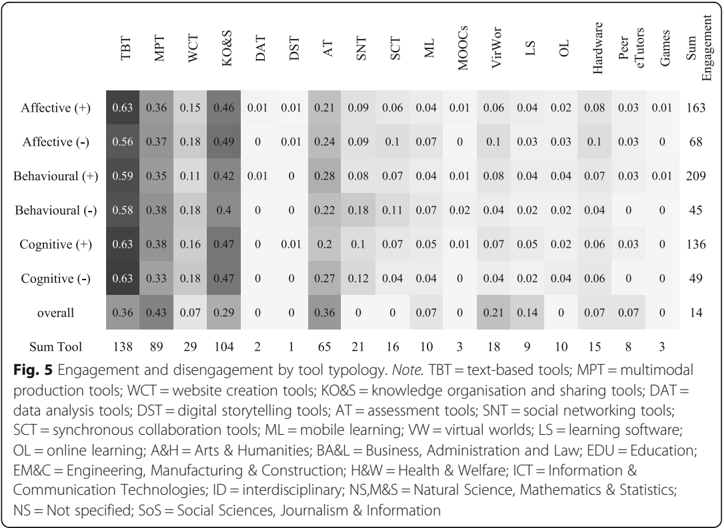
- Across 243 studies, behavioural engagement was documented in 209 studies (86%), affective engagement in 163 (67%), and cognitive engagement in 136 (56%); 117 studies (48%) showed all three dimensions.
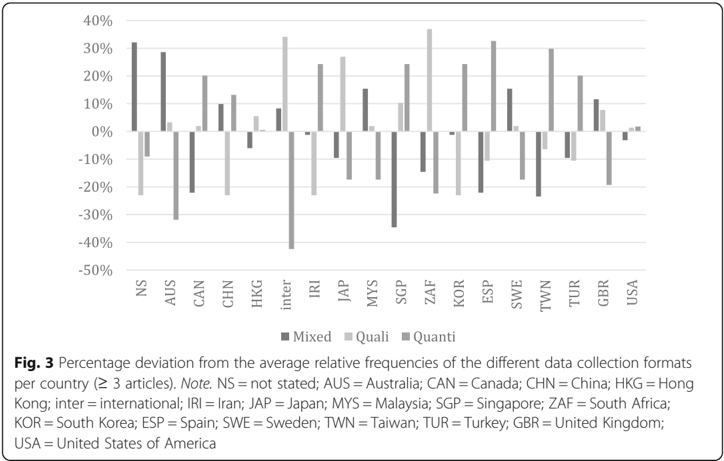
- Most studies used quantitative methods (103, 42%), followed by mixed methods (84, 35%) and qualitative methods (56, 23%); 225 studies (93%) lacked a definition of student engagement, and 59% did not employ a theoretical model.
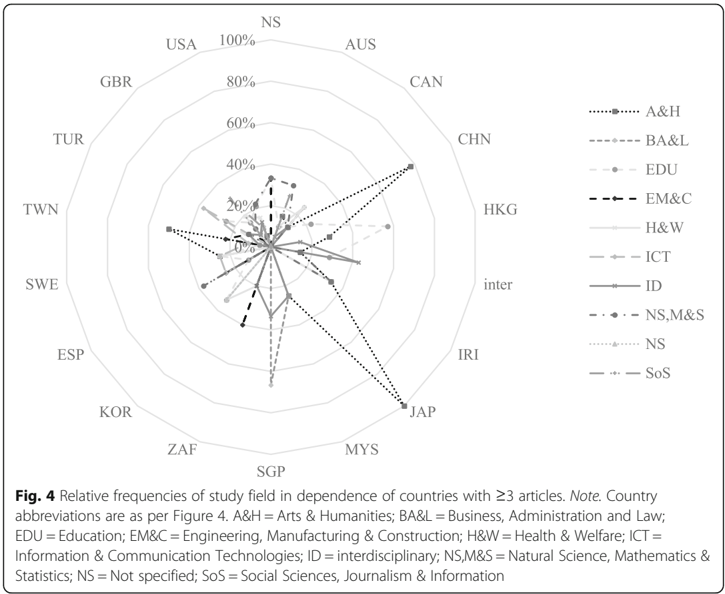
- Research was concentrated in the US (86 studies, 35.4%), UK (26, 10.7%), Australia (19, 7.8%), Taiwan (18, 7.4%), and China (9, 3.7%); top tools were LMS (n = 89), discussion forums (n = 80), videos (n = 44), recorded lectures (n = 25), and chat (n = 24).
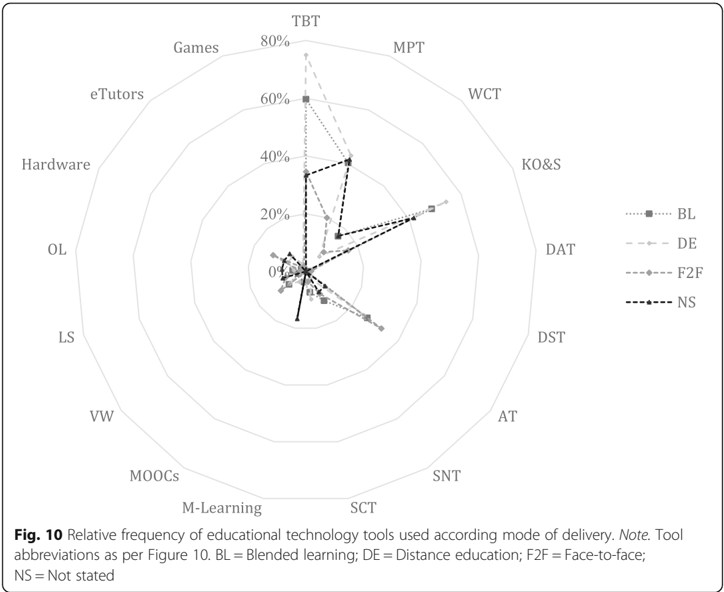
- Blended learning was the most researched mode of delivery (109 studies), followed by distance education (72) and face-to-face instruction (55); undergraduate students were the primary population (146 studies, 60%), while 41 studies (17%) did not specify study level.
Methods
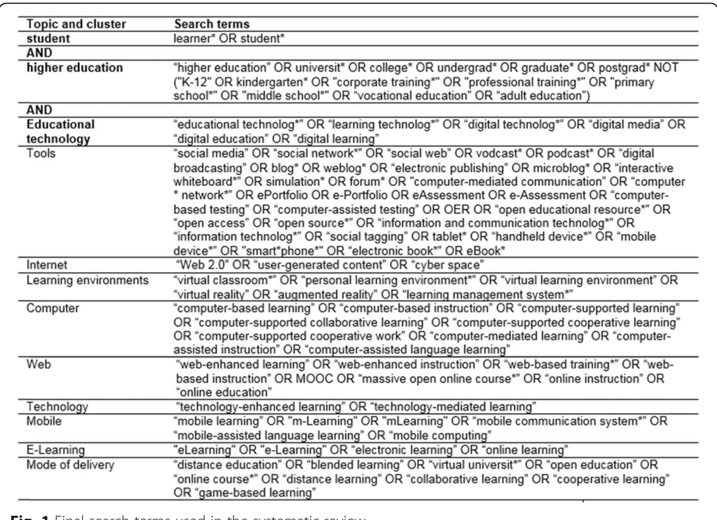
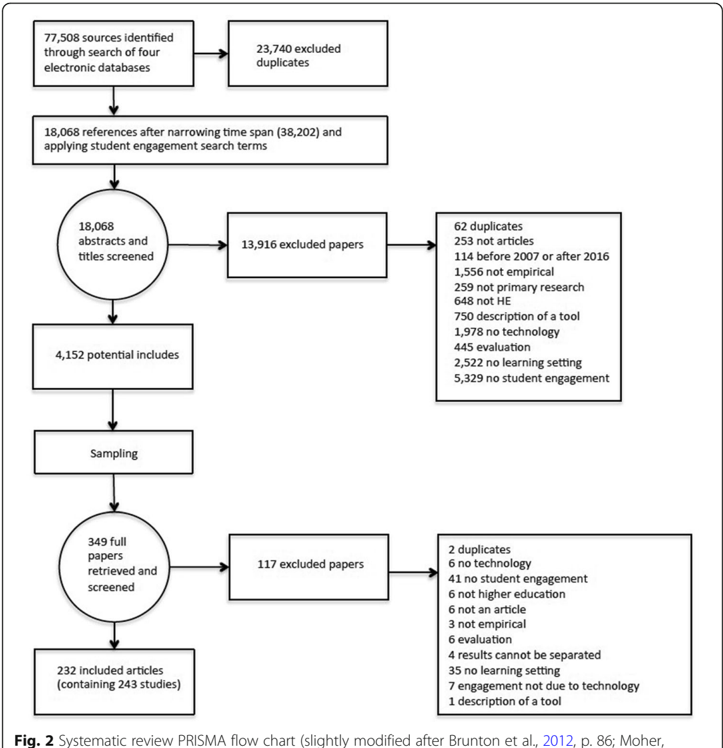
- Systematic evidence map/systematic review; four databases (ERIC, Web of Science, Scopus, PsycINFO) were searched in July 2017, retrieving 77,508 initial references, 53,768 after duplicate removal, and 18,068 records after adjusting the period to 2007–2016.
- After title/abstract screening, 4,152 potentially relevant articles remained; sample size estimation (5% error range, 50% proportion, 5% alpha) produced 349 sampled articles stratified by publishing year, and full-text screening left 232 articles containing 243 studies.
- Data were extracted using an extensive coding system covering study methodology, sample, learning scenario, mode of delivery, educational technology, and cognitive, affective, or behavioural engagement/disengagement indicators.
Limitations
- Stated: only English-language articles were included; grey literature, book chapters, monographs, and journals not indexed in the four databases were excluded; the review was limited to 2007–2016; the sampling strategy likely accounts for low numbers of studies from South America and Africa.
- Stated: peer review was used as a baseline quality criterion, and the human possibility of overlooking or misinterpreting information during coding cannot be fully excluded.
- Evident from the text: the authors note that search and sampling strategy may contribute to geographic imbalance, and they frame student engagement as remaining under-theorised and often considered only fragmentally in the corpus.
Model-written summary. Check it against the paper before relying on it.
Integrity signals
Registry
Cites
Statistics
Figures
Verification
Claims the paper makes
6 Valid · 1 Not valid · 30 Not checked · 118 Own results and interpretations
The cited sources support only part of this claim — read each source’s verdict below.
In the paper
“Linked to this, educational technology research has, however, lacked theoretical guidance (Al-Sakkaf, Omar, & Ahmad, 2019; Hew, Lan, Tang, Jia, & Lo, 2019; Lundin, Bergviken Rensfeldt, Hillman, Lantz-Andersson, & Peterson, 2018).”
- Also stated in: § Introduction · plain
“educational technology research has, however, lacked theoretical guidance (Al-Sakkaf, Omar, & Ahmad, 2019; Hew, Lan, Tang, Jia, & Lo, 2019; Lundin, Bergviken Rensfeldt, Hillman, Lantz-Andersson, & Peterson, 2018).”
What the sources say
- Not checked — no full text of the sourcecites Al-Sakkaf, Omar, & Ahmad, 2019 matched to “A systematic literature review of student engagement in software visualization: a theoretical perspective” (2019) source
- Not checked — no full text of the sourcecites Hew, Lan, Tang, Jia, & Lo, 2019 matched to “Where is the “theory” within the field of educational technology research?” (2019) source
- Partly supportedcites Lundin, Bergviken Rensfeldt, Hillman, Lantz-Andersson, & Peterson, 2018 matched to “Higher education dominance and siloed knowledge: a systematic review of flipped classroom research” (2018) sourceExperimental — accuracy not yet measured
The Abstract says that flipped classroom research often lacks anchoring in learning theory or instructional design, and the Discussion and conclusions recommends stronger theoretical anchoring. The citing sentence extends this finding to educational technology research generally, which the paper does not establish. (LLM, conf=0.87)
plain- Asserted: passes — The authors put it forward as true.
- Checkable: passes — It can be checked against evidence.
- Load-bearing: passes — The paper’s conclusions depend on it.
- Based: passes — The paper gives a reason why it holds.
- Also stated in: § Introduction · plain
The sources with a verdict support this claim; the rest weren’t checked yet, have no full text we could read, or their verdicts aren’t rated yet.
In the paper
“Reviews that have included research using a range of methodologies, have found a limited number of studies employing qualitative methods (e.g. Connolly, Boyle, MacArthur, Hainey, & Boyle, 2012; Kay & LeSage, 2009; Lundin et al., 2018).”
What the sources say
- Not checked — no full text of the sourcecites Connolly et al., 2012 matched to “A systematic literature review of empirical evidence on computer games and serious games” (2012) source
- Not checked — no full text of the sourcecites Kay & LeSage, 2009 matched to “Examining the benefits and challenges of using audience response systems: A review of the literature” (2009) source
- Supportedcites Lundin et al., 2018 matched to “Higher education dominance and siloed knowledge: a systematic review of flipped classroom research” (2018) source
In Discussion and conclusions (page unavailable), Lundin et al. say that qualitative analyses of actual student learning are rare in the flipped-classroom research they reviewed. They also report that simple course questionnaires and pre- and post-tests make up a large part of that research. This supports the citing sentence’s point in the context of flipped-classroom studies. (LLM, conf=0.86)
plain- Asserted: passes — The authors put it forward as true.
- Checkable: passes — It can be checked against evidence.
- Load-bearing: passes — The paper’s conclusions depend on it.
- Based: passes — The paper gives a reason why it holds.
Every source the paper cites for this claim was checked and supports it.
In the paper
“with students showing, for example, disinterest in topics chosen e.g., (Sullivan & Longnecker, 2014)”
What the sources say
- Supportedcites Sullivan & Longnecker, 2014 matched to “Class blogs as a teaching tool to promote writing and student interaction” (2014) source
Table 5 (Conclusion) records a student saying that the week's posts did not necessarily interest them and another asking to choose topics instead of using a fixed set of readings. These comments support the cited example of student disinterest, though the paper also reports positive views of some blog topics. (LLM, conf=0.88)
plain- Asserted: passes — The authors put it forward as true.
- Checkable: passes — It can be checked against evidence.
- Load-bearing: unclear — It is unclear whether the paper’s conclusions depend on it.
- Based: passes — The paper gives a reason why it holds.
- Supported
Every source the paper cites for this claim was checked and supports it.
In the paper
“and continued avoidance of using blogs in some cases, despite introductory training e.g., (Keiller & Inglis-Jassiem, 2015).”
What the sources say
- Supportedcites Keiller & Inglis-Jassiem, 2015 matched to “A lesson in listening: Is the student voice heard in the rush to incorporate technology into health professions education?” (2015) source
The Intervention section says students were invited to training on accessing and using a university-based blogging platform. The Results section reports that students did not access the platform during the study period and cited unfamiliarity with blogging even after training. (LLM, conf=0.94)
plain- Asserted: passes — The authors put it forward as true.
- Checkable: passes — It can be checked against evidence.
- Load-bearing: unclear — It is unclear whether the paper’s conclusions depend on it.
- Based: passes — The paper gives a reason why it holds.
- Supported
In the paper
“Out of 27 identified reviews (see Additional file 3), only 14 report the countries included”
What the sources say
- Not matchedcites Additional file 3
This doesn’t read as a citation we can look up.
plain- Asserted: passes — The authors put it forward as true.
- Checkable: passes — It can be checked against evidence.
- Load-bearing: passes — The paper’s conclusions depend on it.
- Based: passes — The paper gives a reason why it holds.
- Not matched
87 more claims
Create a free account to see all 155 claims and to verify the 1 reference still open.
- Probably not a substantial claim. 27
- It may state two separate claims as one. 44
- The quote only partly states this claim. 2
Claims other papers make about this one
Each is checked against this paper’s own text: does it say what the citing paper says it does?
The source backs part of the claim, not all of it — or backs it for a different population, condition or comparison.
In the citing paper
“As previous LA and educational technology reviews have found (e.g., Bergdahl et al., 2020;Bond et al., 2020;Banihashem et al., 2022), there is an underrepresentation of African and South and Central American research, although this might be due in some part to the search strategy employed for this review.”
From Unpacking student engagement in higher education learning analytics: a systematic review (2024) · cites this paper as Bond et al., 2020
Experimental — accuracy not yet measuredThe source backs part of the claim, not all of it — or backs it for a different population, condition or comparison.
In the citing paper
“HELA research also focused heavily on undergraduate students, with only a small percentage of studies exploring postgraduate student engagement (Bergdahl et al., 2020;Bond et al., 2020), and a large proportion of participants (60%) were from a STEM discipline, which raises questions of wider study generalisability (Kaliisa et al., 2024).”
From Unpacking student engagement in higher education learning analytics: a systematic review (2024) · cites this paper as Bond et al., 2020
Experimental — accuracy not yet measuredThe source backs part of the claim, not all of it — or backs it for a different population, condition or comparison.
In the citing paper
“Studies suggest that professional development and training in LA can improve educators' capacity to use data-driven insights to support student learning (Bergdahl et al., 2020;Bond et al., 2020;Gašević et al., 2019).”
From Unpacking student engagement in higher education learning analytics: a systematic review (2024) · cites this paper as Bond et al., 2020
Experimental — accuracy not yet measuredThe cited source says what the claim attributes to it.
In the citing paper
“Given that the nexus between SE and technology use in higher education has not yet been comprehensively researched, a systematic review was conducted into this topic”
From Facilitating student engagement through educational technology in higher education: A systematic review in the field of arts and humanities (2020) · cites this paper as Bond et al., 2020
The cited source says what the claim attributes to it.
In the citing paper
“Student engagement is often conceptualized along three dimensions: behavioral, cognitive, and affective engagement (Fredericks et al., 2004; Bond et al., 2020).”
From Effects of Generative AI on Engagement and Performance Within Asynchronous Online Courses (2026) · cites this paper as Bond et al., 2020
2 more claims about this paper
Create a free account to see every claim other papers make about this one.
Self-check
Percentages, sums and reported differences re-computed from the paper’s own numbers.
Each contradiction between two passages listed here was confirmed by an independent check.
Rated major: it would touch a result — a value a result rests on, reported and recomputed p-values on opposite sides of the significance level, two passages that conflict with no sign which is right, or a cited work retracted before this paper was published.
In the paper
“59% (n = 100) of studies did not employ a theoretical model in their research. Of the 41% (n = 100) that did”
Reported 59 · recomputed 41.152263
Rated minor: it would not touch a result — a value no result rests on, a p-value that stays on the same side of the significance level, or a conflict that is clerical, resolved elsewhere in the paper, or outside its own findings.
In the paper
§ Discussion
“Natural Sciences, Mathematics & Statistics, nevertheless, assuming rank 3 with 38 studies (15.6%).”
§ Method
“Natural Sciences, Mathematics & Statistics (37) being the top three study fields”
Citations
Cites
Preferred Reporting Items for Systematic Reviews and Meta-Analyses: the PRISMA statement
Moher, D., Liberati, A., Tetzlaff, J., Altman, D. G., & for the PRISMA Group (2009) · BMJ · doi:10.1136/bmj.b2535 · Cited by 83,823
(1978) · Medical Entomology and Zoology · Cited by 53,488
The Discovery of Grounded Theory: Strategies for Qualitative Research.
Wagner, H. R., Glaser, B. G., & Strauss, A. L. (1968) · Social Forces · doi:10.2307/2575405 · Cited by 46,361
Preferred reporting items for systematic reviews and meta-analyses: the PRISMA Statement.
(2009) · PubMed Central · Cited by 44,859
The Discovery of Grounded Theory; Strategies for Qualitative Research
Glaser, B. G., Strauss, A. L., & Strutzel, E. (1968) · Nursing Research · doi:10.1097/00006199-196807000-00014 · Cited by 39,449
Kytle, J., & Bandura, A. (1978) · Contemporary Sociology · doi:10.2307/2065952 · Cited by 25,422 · cited 1×
“Studies coded as SCL included those exploring social learning (Bandura, 1971) and social”
MethodSchool Engagement: Potential of the Concept, State of the Evidence
Fredricks, J. A., Blumenfeld, P. C., & Paris, A. H. (2004) · Review of Educational Research · doi:10.3102/00346543074001059 · Cited by 12,581 · cited 2×
“Therefore, more qualitative and ethnographic measures should also be employed, such as student observations with thick descriptions, which can help shed light on the complexity of teaching and learning environments (Fredricks et al., 2004; Heflin, Shewmaker, & Nguyen, 2017).”
BackgroundPierce, W. D., & Bandura, A. (1977) · Canadian Journal of Sociology / Cahiers canadiens de sociologie · doi:10.2307/3340496 · Cited by 9,650
Bandura, A. (1977) · Zenodo (CERN European Organization for Nuclear Research) · doi:10.5281/zenodo.15521699 · Cited by 7,607
The Discovery of Grounded Theory: Strategies for Qualitative Research
Brodsky, C. M. (1968) · Psychosomatics · doi:10.1016/s0033-3182(68)71872-7 · Cited by 6,679
Student Involvement: A Developmental Theory for Higher Education
Astin, A. W. (2014) · Routledge eBooks · doi:10.4324/9781315051888-15 · Cited by 5,265
Handbook of Research on Student Engagement
(2012) · doi:10.1007/978-1-4614-2018-7 · Cited by 3,050 · cited 3×
“…(2015) operationalised engagement from a behavioural perspective, most of the articles did not have a clearly defined statement of engagement, which is no longer considered acceptable in student engagement research (Appleton, Christenson, & Furlong, 2008; Christenson, Reschly, & Wylie, 2012).”
BackgroundA systematic literature review of empirical evidence on computer games and serious games
Connolly, T. M., Boyle, E. A., MacArthur, E., Hainey, T., & Boyle, J. M. (2012) · Computers & Education · doi:10.1016/j.compedu.2012.03.004 · Cited by 2,890 · cited 3×
“Reviews that have included research using a range of methodologies, have found a limited number of studies employing qualitative methods (e.g. Connolly, Boyle, MacArthur, Hainey, & Boyle, 2012; Kay & LeSage, 2009; Lundin et al., 2018).”
BackgroundThe use of flipped classrooms in higher education: A scoping review
O'Flaherty, J., & Phillips, C. (2015) · The Internet and Higher Education · doi:10.1016/j.iheduc.2015.02.002 · Cited by 2,152
Framing student engagement in higher education
Kahu, E. R. (2013) · Studies in Higher Education · doi:10.1080/03075079.2011.598505 · Cited by 2,103 · cited 5×
“…exists that will satisfy all stake-holders (Solomonides, 2013), and no one project can be expected to possibly examine every sub-construct of student engagement (Kahu, 2013), it is important for each research project to begin with a clear definition of their own understanding (Boekaerts, 2016).”
BackgroundInfluentialStudent engagement with school: Critical conceptual and methodological issues of the construct
Appleton, J. J., Christenson, S. L., & Furlong, M. J. (2008) · Psychology in the Schools · doi:10.1002/pits.20303 · Cited by 1,956 · cited 5×
“…force that energises behaviour (Lim, 2004; Reeve, 2012; Reschly & Christenson, 2012), whereas student engagement is energy and effort in action; an observable manifestation (Appleton et al., 2008; Eccles & Wang, 2012; Kuh, 2009; Skinner & Pitzer, 2012), evidenced through a range of indicators.”
BackgroundInfluentialStudent engagement literature review
Trowler, V. (2010) · Cited by 1,852
Unmasking the Effects of Student Engagement on First-Year College Grades and Persistence
Kuh, G. D., Cruce, T. M., Shoup, R., Kinzie, J., & Gonyea, R. M. (2008) · The Journal of Higher Education · doi:10.1080/00221546.2008.11772116 · Cited by 1,840 · cited 1×
“What is student engagement Student engagement has been linked to improved achievement, persistence and retention (Finn, 2006; Kuh, Cruce, Shoup, Kinzie, & Gonyea, 2008), with disengagement having a profound effect on student learning outcomes and cognitive development (Ma, Han, Yang, & Cheng,…”
BackgroundWhat Matters to Student Success: A Review of the Literature
Kuh, G. D., Kinzie, J. L., Buckley, J., Bridges, B. K., & Hayek, J. C. (2006) · Cited by 1,824
Broadbent, J., & Poon, W. L. (2015) · The Internet and Higher Education · doi:10.1016/j.iheduc.2015.04.007 · Cited by 1,692
A Self-determination Theory Perspective on Student Engagement
Reeve, J. (2012) · Handbook of Research on Student Engagement · doi:10.1007/978-1-4614-2018-7_7 · Cited by 1,650 · cited 2×
“…the literature is that motivation is an antecedent to engagement; it is the intent and unobservable force that energises behaviour (Lim, 2004; Reeve, 2012; Reschly & Christenson, 2012), whereas student engagement is energy and effort in action; an observable manifestation (Appleton et al.,…”
BackgroundAgency as a fourth aspect of students’ engagement during learning activities
Reeve, J., & Tseng, C.-M. (2011) · Contemporary Educational Psychology · doi:10.1016/j.cedpsych.2011.05.002 · Cited by 1,618 · cited 1×
“…about whether there are three components e.g., (Eccles, 2016) — affective/emotional, cognitive and behavioural — or whether there are four, with the recent suggested addition of agentic engagement (Reeve, 2012; Reeve & Tseng, 2011) and social engagement (Fredricks, Filsecker, & Lawson, 2016).”
BackgroundKoehler, M. J., & Mishra, P. (2005) · Journal of Educational Computing Research · doi:10.2190/0ew7-01wb-bkhl-qdyv · Cited by 1,437 · cited 1×
“Rather, careful planning, sound pedagogy and appropriate tools are vital (Englund, Olofsson, & Price, 2017; Koehler & Mishra, 2005; Popenici, 2013), as “ technology can amplify great teaching, but great technology cannot replace poor teaching ” (OECD, 2015b), p. 4.”
BackgroundWhat Student Affairs Professionals Need to Know About Student Engagement
Kuh, G. D. (2009) · Journal of College Student Development · doi:10.1353/csd.0.0099 · Cited by 1,298 · cited 1×
“…force that energises behaviour (Lim, 2004; Reeve, 2012; Reschly & Christenson, 2012), whereas student engagement is energy and effort in action; an observable manifestation (Appleton et al., 2008; Eccles & Wang, 2012; Kuh, 2009; Skinner & Pitzer, 2012), evidenced through a range of indicators.”
BackgroundEuropean Framework for the Digital Competence of Educators: DigCompEdu
(2017) · RePEc: Research Papers in Economics · doi:10.2760/178382 · Cited by 1,276 · cited 1×
“…digital literacy has been growing, alongside mounting recognition of its importance for active citizenship (Choi, Glassman, & Cristol, 2017; OECD, 2015a; Redecker, 2017), and the development of interdisciplinary and collaborative skills (Barak & Levenberg, 2016; Oliver, & de St Jorre, Trina, 2018).”
BackgroundAn Introduction to Systematic Reviews
Gough, D., Oliver, S., & Thomas, J. (2017) · doi:10.4135/9781036234942 · Cited by 1,239
Junco, R. (2012) · Computers & Education · doi:10.1016/j.compedu.2011.08.004 · Cited by 1,233 · cited 1×
“…self-efficacy (Alioon & Delialio ğ lu, 2017; Bouta, Retalis, & Paraskeva, 2012), increase participation and involvement in courses as well as the wider university community (Junco, 2012; Salaber, 2014), and predict increased student engagement (Chen, Lambert, & Guidry, 2010; Rashid & Asghar, 2016).”
BackgroundAcademic Emotions and Student Engagement
Pekrun, R., & Linnenbrink-Garcia, L. (2012) · Handbook of Research on Student Engagement · doi:10.1007/978-1-4614-2018-7_12 · Cited by 1,181 · cited 2×
“This is especially helpful to integrate research findings into practice, given that student engagement and disengagement are rarely one-dimensional; it is not enough to focus only on one aspect of engagement, but also to look at aspects that are adjacent to it (Pekrun & Linnenbrink-Garcia, 2012).”
BackgroundDevelopmental Dynamics of Student Engagement, Coping, and Everyday Resilience
Skinner, E. A., & Pitzer, J. R. (2012) · Handbook of Research on Student Engagement · doi:10.1007/978-1-4614-2018-7_2 · Cited by 1,152 · cited 1×
“…force that energises behaviour (Lim, 2004; Reeve, 2012; Reschly & Christenson, 2012), whereas student engagement is energy and effort in action; an observable manifestation (Appleton et al., 2008; Eccles & Wang, 2012; Kuh, 2009; Skinner & Pitzer, 2012), evidenced through a range of indicators.”
BackgroundStudent Engagement: What Is It? Why Does It Matter?
Finn, J. D., & Zimmer, K. S. (2012) · Handbook of Research on Student Engagement · doi:10.1007/978-1-4614-2018-7_5 · Cited by 1,139 · cited 2×
“…(Finn, 2006; Kuh, Cruce, Shoup, Kinzie, & Gonyea, 2008), with disengagement having a profound effect on student learning outcomes and cognitive development (Ma, Han, Yang, & Cheng, 2015), and being a predictor of student dropout in both secondary school and higher education (Finn & Zimmer, 2012).”
BackgroundBoyle, E. A., Hainey, T., Connolly, T. M., Gray, G., Earp, J., Ott, M., Lim, T., Ninaus, M., Ribeiro, C., & Pereira, J. (2016) · Computers & Education · doi:10.1016/j.compedu.2015.11.003 · Cited by 1,133 · cited 1×
“Whilst other reviews of educational technology and student engagement have found studies to be largely STEM focused (Boyle et al., 2016; Li et al., 2017; Lundin et al., 2018; Nikou & Economides, 2018), this corpus features a more balanced scope of research, with the fields of Arts & Humanities (42…”
BackgroundStudent engagement in the educational interface: Understanding the mechanisms of student success
Kahu, E. R., & Nelson, K. (2018) · Higher Education Research & Development · doi:10.1080/07294360.2017.1344197 · Cited by 1,108 · cited 1×
“…and Paris ’ s (2004) conceptualisation of the three dimensions of student engagement (behavioural, emotional, cognitive), and sociocultural theories of engagement such as Kahu (2013) and Kahu and Nelson (2018), have done much to shape and refine our understanding of this complex phenomenon.”
BackgroundStudents’ engagement in first‐year university
Krause, K., & Coates, H. (2008) · Assessment & Evaluation in Higher Education · doi:10.1080/02602930701698892 · Cited by 1,075 · cited 1×
“Therefore, calls have been made for a greater understanding of the role that educational technology plays in affecting student engagement, in order to strengthen teaching practice and lead to improved outcomes for students (Castañeda & Selwyn, 2018; Krause & Coates, 2008; Nelson Laird & Kuh, 2005).”
BackgroundClarifying differences between review designs and methods
Gough, D., Thomas, J., & Oliver, S. (2012) · Systematic Reviews · doi:10.1186/2046-4053-1-28 · Cited by 1,063
Tamim, R. M., Bernard, R. M., Borokhovski, E., Abrami, P. C., & Schmid, R. F. (2011) · Review of Educational Research · doi:10.3102/0034654310393361 · Cited by 1,029 · cited 1×
“There is, however, no guarantee of active student engagement as a result of using technology (Kirkwood, 2009), with Tamim, Bernard, Borokhovski, Abrami, and Schmid ’ s (2011) second-order meta-analysis finding only a small to moderate impact on student achievement across 40 years.”
ResultMeasuring student engagement in technology-mediated learning: A review
Henrie, C. R., Halverson, L. R., & Graham, C. R. (2015) · Computers & Education · doi:10.1016/j.compedu.2015.09.005 · Cited by 1,010 · cited 9×
“…can be costly, however, both in time and money, so this is suggested in combination with computerised learning analytic data, which can provide measurable, objective and timely insight into how certain manifestations of engagement change over time (Henrie et al., 2015; Ma et al., 2015).”
BackgroundMethodResultInfluentialSouth African Journal of Higher Education
(2014) · African Studies Companion Online · doi:10.1163/_afco_asc_645 · Cited by 994
Jingle, Jangle, and Conceptual Haziness: Evolution and Future Directions of the Engagement Construct
Reschly, A. L., & Christenson, S. L. (2012) · Handbook of Research on Student Engagement · doi:10.1007/978-1-4614-2018-7_1 · Cited by 980 · cited 2×
“…is that motivation is an antecedent to engagement; it is the intent and unobservable force that energises behaviour (Lim, 2004; Reeve, 2012; Reschly & Christenson, 2012), whereas student engagement is energy and effort in action; an observable manifestation (Appleton et al., 2008; Eccles &…”
BackgroundKuh, G. D. (2001) · IUScholarWorks (Indiana University) · Cited by 894
Winstone, N. E., Nash, R. A., Parker, M., & Rowntree, J. (2017) · Educational Psychologist · doi:10.1080/00461520.2016.1207538 · Cited by 884
Peer Review: A Flawed Process at the Heart of Science and Journals
Smith, R. (2006) · Journal of the Royal Society of Medicine · doi:10.1177/014107680609900414 · Cited by 880 · cited 2×
“…were limited to those published in peer-reviewed journals, due to the rigorous process under which they are published, and their trustworthiness in academia (Nicholas et al., 2015), although concerns within the scientific community with the peer-review process are acknowledged e.g. ( Smith, 2006).”
BackgroundHenderson, M., Selwyn, N., & Aston, R. (2017) · Studies in Higher Education · doi:10.1080/03075079.2015.1007946 · Cited by 863 · cited 1×
“In parallel to this increased attention on student engagement, digital technology has become a central aspect of higher education, inherently affecting all aspects of the student experience (Barak, 2018; Henderson, Selwyn, & Aston, 2017; Selwyn, 2016).”
BackgroundFredricks, J. A., Filsecker, M., & Lawson, M. A. (2016) · Learning and Instruction · doi:10.1016/j.learninstruc.2016.02.002 · Cited by 851 · cited 1×
“…about whether there are three components e.g., (Eccles, 2016) — affective/emotional, cognitive and behavioural — or whether there are four, with the recent suggested addition of agentic engagement (Reeve, 2012; Reeve & Tseng, 2011) and social engagement (Fredricks, Filsecker, & Lawson, 2016).”
BackgroundImproving student engagement: Ten proposals for action
Zepke, N., & Leach, L. (2010) · Active Learning in Higher Education · doi:10.1177/1469787410379680 · Cited by 806
Students, Computers and Learning: Making the Connection
OECD (2015) · PISA · doi:10.1787/9789264239555-en · Cited by 787
Sun, J. C., & Rueda, R. (2012) · British Journal of Educational Technology · doi:10.1111/j.1467-8535.2010.01157.x · Cited by 785 · cited 1×
“Time and effort was given as a definition in four studies (Gleason, 2012; Hatzipanagos & Code, 2016; Price, Richardson, & Jelfs, 2007; Sun & Rueda, 2012), with expending physical and psychological energy (Ivala & Gachago, 2012) another definition.”
MethodEngaging online learners: The impact of Web-based learning technology on college student engagement
Chen, P.-S. D., Lambert, A. D., & Guidry, K. R. (2010) · Computers & Education · doi:10.1016/j.compedu.2009.11.008 · Cited by 785 · cited 2×
“…gain insight into this, has been focused on undergraduate students e.g., (Henrie et al., 2015; Webb, Clough, O ’ Reilly, Wilmott, & Witham, 2017), with Chen et al. (2010) finding a positive relationship be-tween the use of technology and student engagement, particularly earlier in university study.”
BackgroundExamining the benefits and challenges of using audience response systems: A review of the literature
Kay, R. H., & LeSage, A. (2009) · Computers & Education · doi:10.1016/j.compedu.2009.05.001 · Cited by 705 · cited 4×
“…student engagement and educational technology were previously identified in other student engagement and technology reviews (Connolly et al., 2012; Kay & LeSage, 2009; Lundin et al., 2018), it is studies like that by Lopera Medina (2014) in this sample, which reveal how people perceive this…”
BackgroundInfluentialNew Conceptual Frameworks for Student Engagement Research, Policy, and Practice
Lawson, M. A., & Lawson, H. A. (2013) · Review of Educational Research · doi:10.3102/0034654313480891 · Cited by 681 · cited 3×
“…strength and depth of student engagement theorising remains e.g. (Boekaerts, 2016; Kahn, 2014; Zepke, 2018), the quality of which has had a direct impact on the rigour of subsequent research (Lawson & Lawson, 2013; Trowler, 2010), prompting calls for further synthesis (Azevedo, 2015; Eccles, 2016).”
BackgroundMetamorphic Testing: A Review of Challenges and Opportunities
Chen, T. Y., Kuo, F.-C., Liu, H., Poon, P.-L., Towey, D., Tse, T. H., & Zhou, Z. Q. (2019) · ACM Computing Surveys · doi:10.1145/3143561 · Cited by 665
Miake-Lye, I. M., Hempel, S., Shanman, R., & Shekelle, P. G. (2016) · Systematic Reviews · doi:10.1186/s13643-016-0204-x · Cited by 660
Rashid, T., & Asghar, H. M. (2016) · Computers in Human Behavior · doi:10.1016/j.chb.2016.05.084 · Cited by 649 · cited 1×
“…self-efficacy (Alioon & Delialio ğ lu, 2017; Bouta, Retalis, & Paraskeva, 2012), increase participation and involvement in courses as well as the wider university community (Junco, 2012; Salaber, 2014), and predict increased student engagement (Chen, Lambert, & Guidry, 2010; Rashid & Asghar, 2016).”
BackgroundSocial Media Use in Medical Education: A Systematic Review
Cheston, C. C., Flickinger, T. E., & Chisolm, M. S. (2013) · Academic Medicine · doi:10.1097/acm.0b013e31828ffc23 · Cited by 638 · cited 3×
“Results of the systematic map further confirm the focus that prior educational technology research has placed on undergraduate students as the target group and participants in technology-enhanced learning settings e.g. (Cheston et al., 2013; Henrie et al., ).”
BackgroundEngagement in digital entertainment games: A systematic review
Boyle, E. A., Connolly, T. M., Hainey, T., & Boyle, J. M. (2012) · Computers in Human Behavior · doi:10.1016/j.chb.2011.11.020 · Cited by 630
McCutcheon, K., Lohan, M., Traynor, M., & Martin, D. (2015) · Journal of Advanced Nursing · doi:10.1111/jan.12509 · Cited by 615
The evidence for ‘flipping out’: A systematic review of the flipped classroom in nursing education
Betihavas, V., Bridgman, H., Kornhaber, R., & Cross, M. (2016) · Nurse Education Today · doi:10.1016/j.nedt.2015.12.010 · Cited by 597
A systematic review of research on the flipped learning method in engineering education
Karabulut‐Ilgu, A., Jaramillo Cherrez, N., & Jahren, C. T. (2018) · British Journal of Educational Technology · doi:10.1111/bjet.12548 · Cited by 581
Hu, S., & Kuh, G. D. (2002) · Research in Higher Education · doi:10.1023/a:1020114231387 · Cited by 565 · cited 1×
“When developing their definitions, authors in these 18 studies referenced 22 different sources, with the work of Kuh and colleagues e.g., (Hu & Kuh, 2002; Kuh, 2001; Kuh et al., 2006), as well as Astin (1984), the only authors referred to more than once.”
MethodQuin, D. (2017) · Review of Educational Research · doi:10.3102/0034654316669434 · Cited by 565
A model of online and general campus‐based student engagement
Coates, H. (2007) · Assessment & Evaluation in Higher Education · doi:10.1080/02602930600801878 · Cited by 501 · cited 1×
“…a range of literature, this is not a finite list, and it is recognised that students might experience these indicators on a continuum at varying times (Coates, 2007; Payne, 2017), depending on their valence (positive or negative) and activation (high or low) (Pekrun & Linnenbrink-Garcia, 2012).”
BackgroundAn Online Engagement Framework for Higher Education
(2018) · doi:10.24059/olj.v22i1.1175 · Cited by 497
Computer-based technology and student engagement: a critical review of the literature
Schindler, L. A., Burkholder, G. J., Morad, O. A., & Marsh, C. (2017) · International Journal of Educational Technology in Higher Education · doi:10.1186/s41239-017-0063-0 · Cited by 475 · cited 3×
“This variance in definitions and sources reflects the ongoing complexity of the construct (Zepke, 2018), and serves to reinforce the need for a clearer understanding across the field (Schindler et al., 2017).”
BackgroundIntroduction to systematic reviews: (657462011-001)
O'Connor, E., Whitlock, E., & Spring, B. (2011) · PsycEXTRA Dataset · doi:10.1037/e657462011-001 · Cited by 463
Impact of mobile technology on student attitudes, engagement, and learning
Heflin, H., Shewmaker, J., & Nguyen, J. (2017) · Computers & Education · doi:10.1016/j.compedu.2017.01.006 · Cited by 462 · cited 1×
“Therefore, more qualitative and ethnographic measures should also be employed, such as student observations with thick descriptions, which can help shed light on the complexity of teaching and learning environments (Fredricks et al., 2004; Heflin, Shewmaker, & Nguyen, 2017).”
BackgroundMore than tools? Making sense of the ongoing digitizations of higher education
Castañeda, L., & Selwyn, N. (2018) · International Journal of Educational Technology in Higher Education · doi:10.1186/s41239-018-0109-y · Cited by 445 · cited 2×
“Therefore, calls have been made for a greater understanding of the role that educational technology plays in affecting student engagement, in order to strengthen teaching practice and lead to improved outcomes for students (Castañeda & Selwyn, 2018; Krause & Coates, 2008; Nelson Laird & Kuh, 2005).”
BackgroundEnglund, C., Olofsson, A. D., & Price, L. (2017) · Higher Education Research & Development · doi:10.1080/07294360.2016.1171300 · Cited by 423 · cited 1×
“Rather, careful planning, sound pedagogy and appropriate tools are vital (Englund, Olofsson, & Price, 2017; Koehler & Mishra, 2005; Popenici, 2013), as “ technology can amplify great teaching, but great technology cannot replace poor teaching ” (OECD, 2015b), p. 4.”
BackgroundAzevedo, R. (2015) · Educational Psychologist · doi:10.1080/00461520.2015.1004069 · Cited by 418 · cited 1×
“…strength and depth of student engagement theorising remains e.g. (Boekaerts, 2016; Kahn, 2014; Zepke, 2018), the quality of which has had a direct impact on the rigour of subsequent research (Lawson & Lawson, 2013; Trowler, 2010), prompting calls for further synthesis (Azevedo, 2015; Eccles, 2016).”
BackgroundFacilitating Student Engagement Through Educational Technology: Towards a Conceptual Framework
Bond, M., & Bedenlier, S. (2019) · Journal of Interactive Media in Education · doi:10.5334/jime.528 · Cited by 374 · cited 1×
“Further research is invited in particular into how educational technology affects cognitive and affective engagement, whilst considering how this fits within the broader sociocultural framework of engagement (Bond, 2019a).”
BackgroundSelf-citationBen-Eliyahu, A., Moore, D., Dorph, R., & Schunn, C. D. (2018) · Contemporary Educational Psychology · doi:10.1016/j.cedpsych.2018.01.002 · Cited by 349
How is the use of technology in education evaluated? A systematic review
Lai, J. W. M., & Bower, M. (2019) · Computers & Education · doi:10.1016/j.compedu.2019.01.010 · Cited by 334 · cited 1×
“…of over 50 individual educational technology applications and tools were identified in the 243 studies, in line with results found in other large-scale systematic reviews (e.g., Lai & Bower, 2019), concerns were raised over how the research team could meaningfully analyse and report the results.”
ResultArnold, N., & Paulus, T. (2010) · The Internet and Higher Education · doi:10.1016/j.iheduc.2010.04.002 · Cited by 331 · cited 1×
“…tools were used, indicated that some students found it difficult to express themselves in short posts e.g., (Cook & Bissonnette, 2016), that conversations lacked authenticity e.g., (Arnold & Paulus, 2010), and that some did not want to mix personal and academic spaces e.g., (Ivala & Gachago, 2012).”
MethodUsing qualitative methods to develop a survey measure of math and science engagement
Fredricks, J. A., Wang, M.-T., Schall Linn, J., Hofkens, T. L., Sung, H., Parr, A., & Allerton, J. (2016) · Learning and Instruction · doi:10.1016/j.learninstruc.2016.01.009 · Cited by 331
Laird, T. F. N., & Kuh, G. D. (2005) · Research in Higher Education · doi:10.1007/s11162-004-1600-y · Cited by 320 · cited 2×
“Therefore, calls have been made for a greater understanding of the role that educational technology plays in affecting student engagement, in order to strengthen teaching practice and lead to improved outcomes for students (Castañeda & Selwyn, 2018; Krause & Coates, 2008; Nelson Laird & Kuh, 2005).”
BackgroundUse of Web 2.0 technologies in K-12 and higher education: The search for evidence-based practice
Hew, K. F., & Cheung, W. S. (2013) · Educational Research Review · doi:10.1016/j.edurev.2012.08.001 · Cited by 291
Choi, M., Glassman, M., & Cristol, D. (2017) · Computers & Education · doi:10.1016/j.compedu.2017.01.002 · Cited by 285
Digital downsides: exploring university students’ negative engagements with digital technology
Selwyn, N. (2016) · Teaching in Higher Education · doi:10.1080/13562517.2016.1213229 · Cited by 281 · cited 1×
“In parallel to this increased attention on student engagement, digital technology has become a central aspect of higher education, inherently affecting all aspects of the student experience (Barak, 2018; Henderson, Selwyn, & Aston, 2017; Selwyn, 2016).”
BackgroundHunsu, N. J., Adesope, O., & Bayly, D. J. (2016) · Computers & Education · doi:10.1016/j.compedu.2015.11.013 · Cited by 272 · cited 3×
“Reflecting findings from other systematic and literature reviews on the topic (Abdool, Nirula, Bonato, Rajji, & Silver, 2017; Hunsu et al., 2016; Kaliisa & Picard, 2017; Lundin et al., 2018), 59% ( n = 100) of studies did not employ a theoretical model in their research.”
BackgroundBedenlier, S., Bond, M., Buntins, K., Zawacki-Richter, O., & Kerres, M. (2020) · Australasian Journal of Educational Technology · doi:10.14742/ajet.5477 · Cited by 270
Self-citationGraduate attributes for 2020 and beyond: recommendations for Australian higher education providers
Oliver, B., & Jorre de St Jorre, T. (2018) · Higher Education Research & Development · doi:10.1080/07294360.2018.1446415 · Cited by 266 · cited 1×
“…digital literacy has been growing, alongside mounting recognition of its importance for active citizenship (Choi, Glassman, & Cristol, 2017; OECD, 2015a; Redecker, 2017), and the development of interdisciplinary and collaborative skills (Barak & Levenberg, 2016; Oliver, & de St Jorre, Trina, 2018).”
BackgroundDelialioğlu, Ö. (2012) · OpenMETU (Middle East Technical University) · Cited by 265
Where is the “theory” within the field of educational technology research?
Hew, K. F., Lan, M., Tang, Y., Jia, C., & Lo, C. K. (2019) · British Journal of Educational Technology · doi:10.1111/bjet.12770 · Cited by 264 · cited 2×
“Linked to this, educational technology research has, however, lacked theoretical guidance (Al-Sakkaf, Omar, & Ahmad, 2019; Hew, Lan, Tang, Jia, & Lo, 2019; Lundin, Bergviken Rensfeldt, Hillman, Lantz-Andersson, & Peterson, 2018).”
BackgroundEngagement in HCI: Conception, Theory and Measurement
Doherty, K., & Doherty, G. (2019) · ACM Computing Surveys · doi:10.1145/3234149 · Cited by 264
Ma, J., Han, X., Yang, J., & Cheng, J. (2015) · The Internet and Higher Education · doi:10.1016/j.iheduc.2014.09.005 · Cited by 246 · cited 2×
“…can be costly, however, both in time and money, so this is suggested in combination with computerised learning analytic data, which can provide measurable, objective and timely insight into how certain manifestations of engagement change over time (Henrie et al., 2015; Ma et al., 2015).”
BackgroundBond, M., Zawacki‐Richter, O., & Nichols, M. (2019) · British Journal of Educational Technology · doi:10.1111/bjet.12730 · Cited by 243 · cited 4×
“…technology research in top tier peer-reviewed journals, with only 4% of articles published in the British Journal of Educational Technology ( BJET ) in the past decade (Bond, 2019b) and 2% of articles in the Australasian Journal of Educational Technology (AJET) (Bond, 2018) hailing from Africa.”
BackgroundResultInfluentialSelf-citationPeer review: still king in the digital age
NICHOLAS, D., WATKINSON, A., JAMALI, H. R., HERMAN, E., TENOPIR, C., VOLENTINE, R., ALLARD, S., & LEVINE, K. (2015) · Learned Publishing · doi:10.1087/20150104 · Cited by 242 · cited 1×
“…were limited to those published in peer-reviewed journals, due to the rigorous process under which they are published, and their trustworthiness in academia (Nicholas et al., 2015), although concerns within the scientific community with the peer-review process are acknowledged e.g. ( Smith, 2006).”
BackgroundPart I Commentary: So What Is Student Engagement Anyway?
Eccles, J., & Wang, M.-T. (2012) · Handbook of Research on Student Engagement · doi:10.1007/978-1-4614-2018-7_6 · Cited by 239 · cited 2×
“There has also been confusion as to whether the terms ‘ engagement ’ and ‘ motivation ’ can and should be used interchangeably (Reschly & Christenson, 2012), especially when used by policy makers and institutions (Eccles & Wang, 2012).”
BackgroundThe Use of Mobile Learning in Science: A Systematic Review
Crompton, H., Burke, D., Gregory, K. H., & Gräbe, C. (2016) · Journal of Science Education and Technology · doi:10.1007/s10956-015-9597-x · Cited by 228
Higher education dominance and siloed knowledge: a systematic review of flipped classroom research
Lundin, M., Bergviken Rensfeldt, A., Hillman, T., Lantz-Andersson, A., & Peterson, L. (2018) · International Journal of Educational Technology in Higher Education · doi:10.1186/s41239-018-0101-6 · Cited by 227 · cited 7×
“…other reviews of educational technology and student engagement have found studies to be largely STEM focused (Boyle et al., 2016; Li et al., 2017; Lundin et al., 2018; Nikou & Economides, 2018), this corpus features a more balanced scope of research, with the fields of Arts & Humanities (42…”
BackgroundInfluentialJärvelä, S., Järvenoja, H., Malmberg, J., Isohätälä, J., & Sobocinski, M. (2016) · Learning and Instruction · doi:10.1016/j.learninstruc.2016.01.005 · Cited by 220
Engagement as an inherent aspect of the learning process
Boekaerts, M. (2016) · Learning and Instruction · doi:10.1016/j.learninstruc.2016.02.001 · Cited by 217 · cited 2×
“…exists that will satisfy all stake-holders (Solomonides, 2013), and no one project can be expected to possibly examine every sub-construct of student engagement (Kahu, 2013), it is important for each research project to begin with a clear definition of their own understanding (Boekaerts, 2016).”
BackgroundStudent engagement: rhetoric and reality
Baron, P., & Corbin, L. (2012) · Higher Education Research & Development · doi:10.1080/07294360.2012.655711 · Cited by 213 · cited 1×
“Student engagement is a multifaceted and complex construct (Appleton et al., 2008; Ben-Eliyahu, Moore, Dorph, & Schunn, 2018), which some have called a ‘ meta-construct ’ (e.g. Fredricks et al., 2004; Kahu, 2013), and likened to blind men describing an elephant (Baron & Corbin, 2012; Eccles, 2016).”
BackgroundMediendidaktik: Konzeption und Entwicklung mediengestützter Lernangebote
Kerres, M. (2012) · Oldenbourg Wissenschaftsverlag eBooks · doi:10.1524/9783486716924 · Cited by 212
Self-citationThe Research Question in Social Research: What is its Role?
Bryman, A. (2007) · International Journal of Social Research Methodology · doi:10.1080/13645570600655282 · Cited by 211 · cited 1×
“Although it is recognised that not all studies have research questions (Bryman, 2007), or only develop them throughout the research process, such as with grounded theory (Glaser & Strauss, 1967), a surprising number of quantitative studies (36%, n = 37) did not have research questions.”
BackgroundTheorising student engagement in higher education
Kahn, P. E. (2014) · British Educational Research Journal · doi:10.1002/berj.3121 · Cited by 197 · cited 1×
“However, criticism about the strength and depth of student engagement theorising remains e.g. (Boekaerts, 2016; Kahn, 2014; Zepke, 2018), the quality of which has had a direct impact on the rigour of subsequent research (Lawson & Lawson, 2013; Trowler, 2010), prompting calls for further synthesis…”
BackgroundThe Impact of a Question-Embedded Video-based Learning Tool on E-learning *
Vural, Ö. F. (2013) · Educational Sciences Theory & Practice · Cited by 197
How Appropriate are Popular Sample Size Formulas?
Kupper, L. L., & Hafner, K. B. (1989) · The American Statistician · doi:10.1080/00031305.1989.10475628 · Cited by 196 · cited 1×
“With the intention to draw a sample that estimates the population parameters with a predetermined error range, we used methods of sample size estimation in the social sciences (Kupper & Hafner, 1989).”
Method(2017) · Murdoch University Research Portal · Cited by 193
How Do We Model Learning at Scale? A Systematic Review of Research on MOOCs
Joksimović, S., Poquet, O., Kovanović, V., Dowell, N., Mills, C., Gašević, D., Dawson, S., Graesser, A. C., & Brooks, C. (2018) · Review of Educational Research · doi:10.3102/0034654317740335 · Cited by 182
Face‐to‐face versus online tutoring support in distance education
Price, L., Richardson, J. T. E., & Jelfs, A. (2007) · Studies in Higher Education · doi:10.1080/03075070601004366 · Cited by 168 · cited 1×
“Time and effort was given as a definition in four studies (Gleason, 2012; Hatzipanagos & Code, 2016; Price, Richardson, & Jelfs, 2007; Sun & Rueda, 2012), with expending physical and psychological energy (Ivala & Gachago, 2012) another definition.”
MethodiP ads in higher education—Hype and hope
Nguyen, L., Barton, S. M., & Nguyen, L. T. (2015) · British Journal of Educational Technology · doi:10.1111/bjet.12137 · Cited by 168
Engagement Across Developmental Periods
Mahatmya, D., Lohman, B. J., Matjasko, J. L., & Farb, A. F. (2012) · Handbook of Research on Student Engagement · doi:10.1007/978-1-4614-2018-7_3 · Cited by 163
Part II Commentary: Motivation and Engagement: Conceptual, Operational, and Empirical Clarity
Martin, A. J. (2012) · Springer eBooks · doi:10.1007/978-1-4614-2018-7_14 · Cited by 161
Howard, S. K., Ma, J., & Yang, J. (2016) · Computers & Education · doi:10.1016/j.compedu.2016.05.008 · Cited by 158 · cited 1×
“Without careful planning and sound pedagogy, technology can promote disengagement and impede rather than help learning (Howard, Ma, & Yang, 2016; Popenici, 2013).”
BackgroundAre digital natives open to change? Examining flexible thinking and resistance to change
Barak, M. (2018) · Computers & Education · doi:10.1016/j.compedu.2018.01.016 · Cited by 157 · cited 1×
“In parallel to this increased attention on student engagement, digital technology has become a central aspect of higher education, inherently affecting all aspects of the student experience (Barak, 2018; Henderson, Selwyn, & Aston, 2017; Selwyn, 2016).”
BackgroundStudent engagement research in higher education: questioning an academic orthodoxy
Zepke, N. (2014) · Teaching in Higher Education · doi:10.1080/13562517.2014.901956 · Cited by 155
Alienation, agency and authenticity: a synthesis of the literature on student engagement
Wimpenny, K., & Savin-Baden, M. (2013) · Teaching in Higher Education · doi:10.1080/13562517.2012.725223 · Cited by 153
E‐learning: you don't always get what you hope for
Kirkwood, A. (2009) · Technology, Pedagogy and Education · doi:10.1080/14759390902992576 · Cited by 149 · cited 1×
“There is, however, no guarantee of active student engagement as a result of using technology (Kirkwood, 2009), with Tamim, Bernard, Borokhovski, Abrami, and Schmid ’ s (2011) second-order meta-analysis finding only a small to moderate impact on student achievement across 40 years.”
ResultEccles, J. S. (2016) · Learning and Instruction · doi:10.1016/j.learninstruc.2016.02.003 · Cited by 149 · cited 3×
“…strength and depth of student engagement theorising remains e.g. (Boekaerts, 2016; Kahn, 2014; Zepke, 2018), the quality of which has had a direct impact on the rigour of subsequent research (Lawson & Lawson, 2013; Trowler, 2010), prompting calls for further synthesis (Azevedo, 2015; Eccles, 2016).”
BackgroundStudent engagement in neo-liberal times: what is missing?
Zepke, N. (2018) · Higher Education Research & Development · doi:10.1080/07294360.2017.1370440 · Cited by 139 · cited 3×
“This variance in definitions and sources reflects the ongoing complexity of the construct (Zepke, 2018), and serves to reinforce the need for a clearer understanding across the field (Schindler et al., 2017).”
BackgroundMobile technology and mathematics: effects on students’ attitudes, engagement, and achievement
Fabian, K., Topping, K. J., & Barron, I. G. (2015) · Journal of Computers in Education · doi:10.1007/s40692-015-0048-8 · Cited by 138
The Student Engagement Handbook, Practice in Higher Education
Timmis, S., & Williams, J. (2013) · Cited by 137
Barak, M., & Levenberg, A. (2016) · Computers & Education · doi:10.1016/j.compedu.2016.04.003 · Cited by 137 · cited 1×
“…digital literacy has been growing, alongside mounting recognition of its importance for active citizenship (Choi, Glassman, & Cristol, 2017; OECD, 2015a; Redecker, 2017), and the development of interdisciplinary and collaborative skills (Barak & Levenberg, 2016; Oliver, & de St Jorre, Trina, 2018).”
BackgroundNikou, S. A., & Economides, A. A. (2018) · Computers & Education · doi:10.1016/j.compedu.2018.06.006 · Cited by 127 · cited 5×
“…reviews of educational technology and student engagement have found studies to be largely STEM focused (Boyle et al., 2016; Li et al., 2017; Lundin et al., 2018; Nikou & Economides, 2018), this corpus features a more balanced scope of research, with the fields of Arts & Humanities (42 studies, 17.3”
BackgroundMethodInfluentialSchooling Redesigned: Towards Innovative Learning Systems
OECD (2015) · Educational Research and Innovation · doi:10.1787/9789264245914-en · Cited by 126
Promoting Student Engagement in the Classroom
Bundick, M. J., Quaglia, R. J., Corso, M. J., & Haywood, D. E. (2014) · Teachers College Record: The Voice of Scholarship in Education · doi:10.1177/016146811411600411 · Cited by 117
The effect of authentic m‐learning activities on student engagement and motivation
Alioon, Y., & Delialioğlu, Ö. (2019) · British Journal of Educational Technology · doi:10.1111/bjet.12559 · Cited by 117 · cited 1×
“…has the potential to make teaching and learning processes more intensive (Kerres, 2013), improve student self-regulation and self-efficacy (Alioon & Delialio ğ lu, 2017; Bouta, Retalis, & Paraskeva, 2012), increase participation and involvement in courses as well as the wider university…”
BackgroundAlrasheedi, M., Capretz, L. F., & Raza, A. (2015) · Journal of Educational Computing Research · doi:10.1177/0735633115571928 · Cited by 113 · cited 1×
“…increased as a result of technology include interest and enjoyment (Li et al., 2017), improved confidence (Smith & Lambert, 2014) and attitudes (Nikou & Economides, 2018), as well as enhanced relationships with peers and teachers e.g., (Alrasheedi, Capretz, & Raza, 2015; Atmacasoy & Aksu, 2018).”
BackgroundLearning methods for teacher education: the use of online discussions to improve critical thinking
Szabo, Z., & Schwartz, J. (2011) · Technology, Pedagogy and Education · doi:10.1080/1475939x.2010.534866 · Cited by 111 · cited 1×
“%) showed all three dimensions of affective, cognitive and behavioural student engagement e.g., (Szabo & Schwartz, 2011), including six studies that used established student engagement questionnaires, such as the NSSE (e.g., Delialioglu, 2012), or self-developed addressing these three dimensions.”
BackgroundNeira, E. A. S., Salinas, J., & Crosetti, B. D. B. (2017) · International Journal of Emerging Technologies in Learning (iJET) · doi:10.3991/ijet.v12i05.6939 · Cited by 111
Ivala, E. N., & Gachago, D. (2016) · South African Journal of Higher Education · doi:10.20853/26-1-156 · Cited by 109 · cited 2×
“…tools were used, indicated that some students found it difficult to express themselves in short posts e.g., (Cook & Bissonnette, 2016), that conversations lacked authenticity e.g., (Arnold & Paulus, 2010), and that some did not want to mix personal and academic spaces e.g., (Ivala & Gachago, 2012).”
MethodBouta, H., Retalis, S., & Paraskeva, F. (2011) · Computers & Education · doi:10.1016/j.compedu.2011.08.031 · Cited by 108 · cited 1×
“…make teaching and learning processes more intensive (Kerres, 2013), improve student self-regulation and self-efficacy (Alioon & Delialio ğ lu, 2017; Bouta, Retalis, & Paraskeva, 2012), increase participation and involvement in courses as well as the wider university community (Junco, 2012;…”
BackgroundEducational technology research trends in Turkey from 1990 to 2011
Küçük, S., Aydemir, M., Yıldırım, G., Arpacık, Ö., & Göktaş, Y. (2013) · Computers & Education · doi:10.1016/j.compedu.2013.04.016 · Cited by 108 · cited 1×
“…and 13% mixed (Baydas, Kucuk, Yilmaz, Aydemir, & Goktas, 2015), and likewise a review of educational technology research from Turkey 1990 – 2011 revealed that 53% of articles used quantitative methods, 22% qualitative and 10% mixed methods (Kucuk, Aydemir, Yildirim, Arpacik, & Goktas, 2013).”
BackgroundEngaging learners in online learning environments
Lim, C. P. (2004) · TechTrends · doi:10.1007/bf02763440 · Cited by 106 · cited 1×
“…across the literature is that motivation is an antecedent to engagement; it is the intent and unobservable force that energises behaviour (Lim, 2004; Reeve, 2012; Reschly & Christenson, 2012), whereas student engagement is energy and effort in action; an observable manifestation…”
BackgroundResearch trends in instructional design and technology journals
Bodily, R., Leary, H., & West, R. E. (2019) · British Journal of Educational Technology · doi:10.1111/bjet.12712 · Cited by 99 · cited 3×
“This is rather representative of the field, with an analysis of instructional design and technology research from 2007 to 2017 listing the most productive countries as the US, Taiwan, UK, Australia and Turkey (Bodily, Leary, & West, 2019).”
BackgroundInfluentialEngaging students in learning: a review of a conceptual organiser
Leach, L., & Zepke, N. (2011) · Higher Education Research & Development · doi:10.1080/07294360.2010.509761 · Cited by 88
The instrumental value of conceptual frameworks in educational technology research
Antonenko, P. D. (2015) · Educational Technology Research and Development · doi:10.1007/s11423-014-9363-4 · Cited by 81 · cited 2×
“…reviews, see Additional file 1), this article develops “ a tentative theory ” in the hopes of “ plot[ting] the conceptual landscape … [and chart] possible routes to explore it ” (Antonenko, 2015, pp. 57 – 67) for researchers, practitioners, learning designers, admin-istrators and policy makers.”
BackgroundEducational technology research trends from 2002 to 2014
Baydaş, Ö., Küçük, S., Yılmaz, R. M., Aydemir, M., & Göktaş, Y. (2015) · Scientometrics · doi:10.1007/s11192-015-1693-4 · Cited by 79 · cited 1×
“…Technology Research & Development (ETR&D) from 2002 to 2014 revealing that 40% of articles used quantitative methods, 26% qualitative and 13% mixed (Baydas, Kucuk, Yilmaz, Aydemir, & Goktas, 2015), and likewise a review of educational technology research from Turkey 1990 – 2011 revealed that 53%…”
BackgroundAugmented Reality Games for Learning: A Literature Review
Li, J., van der Spek, E. D., Feijs, L. M. G., Wang, F., & Hu, J. (2017) · Lecture notes in computer science · doi:10.1007/978-3-319-58697-7_46 · Cited by 78 · cited 5×
“Whilst other reviews of educational technology and student engagement have found studies to be largely STEM focused (Boyle et al., 2016; Li et al., 2017; Lundin et al., 2018; Nikou & Economides, 2018), this corpus features a more balanced scope of research, with the fields of Arts & Humanities (42…”
BackgroundMethodInfluentialWebb, L., Clough, J., O’Reilly, D., Wilmott, D., & Witham, G. (2017) · Nurse Education Today · doi:10.1016/j.nedt.2016.10.007 · Cited by 77 · cited 1×
“…a young area, most of the research undertaken to gain insight into this, has been focused on undergraduate students e.g., (Henrie et al., 2015; Webb, Clough, O ’ Reilly, Wilmott, & Witham, 2017), with Chen et al. (2010) finding a positive relationship be-tween the use of technology and…”
BackgroundMediendidaktik: Konzeption und Entwicklung mediengestützter Lernangebote
Kerres, M. (2013) · doi:10.1524/9783486736038 · Cited by 77
Self-citationBlended learning at pre-service teacher education in Turkey: A systematic review
Atmacasoy, A., & Aksu, M. (2018) · Education and Information Technologies · doi:10.1007/s10639-018-9723-5 · Cited by 74 · cited 1×
“…increased as a result of technology include interest and enjoyment (Li et al., 2017), improved confidence (Smith & Lambert, 2014) and attitudes (Nikou & Economides, 2018), as well as enhanced relationships with peers and teachers e.g., (Alrasheedi, Capretz, & Raza, 2015; Atmacasoy & Aksu, 2018).”
BackgroundBrunton, G., Stansfield, C., Caird, J., & Thomas, J. (2017) · SAGE Publications Ltd eBooks · doi:10.4135/9781036234942.n5 · Cited by 66
Simulation in Undergraduate Psychiatry: Exploring the Depth of Learner Engagement
Abdool, P. S., Nirula, L., Bonato, S., Rajji, T. K., & Silver, I. L. (2017) · Academic Psychiatry · doi:10.1007/s40596-016-0633-9 · Cited by 66 · cited 2×
“Reflecting findings from other systematic and literature reviews on the topic (Abdool, Nirula, Bonato, Rajji, & Silver, 2017; Hunsu et al., 2016; Kaliisa & Picard, 2017; Lundin et al., 2018), 59% ( n = 100) of studies did not employ a theoretical model in their research.”
BackgroundGreenwood, L., & Kelly, C. (2018) · Emotional and Behavioural Difficulties · doi:10.1080/13632752.2018.1511113 · Cited by 65
Engagement as a Volitional Construct: A Framework for Evidence-Based Research on Educational Games
Filsecker, M., & Kerres, M. (2014) · Simulation & Gaming · doi:10.1177/1046878114553569 · Cited by 63
Self-citationSalaber, J. M. (2014) · The International Journal of Management Education · doi:10.1016/j.ijme.2014.03.006 · Cited by 62 · cited 1×
“…self-efficacy (Alioon & Delialio ğ lu, 2017; Bouta, Retalis, & Paraskeva, 2012), increase participation and involvement in courses as well as the wider university community (Junco, 2012; Salaber, 2014), and predict increased student engagement (Chen, Lambert, & Guidry, 2010; Rashid & Asghar, 2016).”
BackgroundCommunication Behaviors and Trust in Collaborative Online Teams
Bulu, S. T., & Yıldırım, Z. (2008) · OpenMETU (Middle East Technical University) · Cited by 60
van Rooij, E., Brouwer, J., Fokkens-Bruinsma, M., Jansen, E. P. W. A., Donche, V., & Noyens, D. (2018) · Pedagogische Studiën · Cited by 57
Deriving a typology of Web 2.0 learning technologies
Bower, M. (2016) · British Journal of Educational Technology · doi:10.1111/bjet.12344 · Cited by 56 · cited 1×
“For further elaboration on each category, please see Bower (2015).”
BackgroundStudent engagement: three models for its investigation
Payne, L. (2019) · Journal of Further and Higher Education · doi:10.1080/0309877x.2017.1391186 · Cited by 55 · cited 1×
“…a range of literature, this is not a finite list, and it is recognised that students might experience these indicators on a continuum at varying times (Coates, 2007; Payne, 2017), depending on their valence (positive or negative) and activation (high or low) (Pekrun & Linnenbrink-Garcia, 2012).”
Background(2012) · Cited by 52
Bedenlier, S., Bond, M., Buntins, K., Zawacki‐Richter, O., & Kerres, M. (2019) · Springer eBooks · doi:10.1007/978-3-658-27602-7_7 · Cited by 51 · cited 2×
“However, several challenges were also encountered - some of which are addressed and discussed in another publication (Bedenlier, 2020b) - resulting in limitations to this study.”
BackgroundSelf-citationO’Gorman, E., Salmon, N., & Murphy, C. (2015) · International Journal of Inclusive Education · doi:10.1080/13603116.2015.1095251 · Cited by 50
A typology of Web 2.0 learning technologies
Bower, M. (2015) · Cited by 50
Smith, T., & Lambert, R. (2014) · Health Education · doi:10.1108/he-07-2013-0030 · Cited by 50 · cited 1×
“Specific indicators of engagement that increased as a result of technology include interest and enjoyment (Li et al., 2017), improved confidence (Smith & Lambert, 2014) and attitudes (Nikou & Economides, 2018), as well as enhanced relationships with peers and teachers e.g., (Alrasheedi, Capretz, &…”
BackgroundEnhancing the online learning experience using virtual interactive classrooms
Andrew, L., Ewens, B., & Maslin-Prothero, S. (2015) · Australian Journal of Advanced Nursing · doi:10.37464/2015.324.1583 · Cited by 49
Podcast creation as transformative music engagement
Bolden, B., & Nahachewsky, J. (2014) · Music Education Research · doi:10.1080/14613808.2014.969219 · Cited by 49 · cited 1×
“The most popular definition of student engagement within these studies was that of active participation and involvement in learning and university life e.g., (Bolden & Nahachewsky, 2015; bFukuzawa & Boyd, 2016), which was also found by Joksimovi ć et al. (2018) in their review of MOOC research.”
BackgroundStudent Attitudes about Distance Education: Focusing on Context and Effective Practices
Smidt, E., Bunk, J. A., McGrory, B., Li, R., & Gatenby, T. (2014) · IAFOR Journal of Education · doi:10.22492/ije.2.1.02 · Cited by 48 · cited 1×
“%) e.g., (Smidt, Bunk, McGrory, Li, & Gatenby, 2014) and disappointment e.g., (Granberg, 2010) , as well as other affective disengagement ( n = 18, 7% each).”
Gleason, J. (2012) · College Teaching · doi:10.1080/87567555.2011.637249 · Cited by 45 · cited 1×
“Time and effort was given as a definition in four studies (Gleason, 2012; Hatzipanagos & Code, 2016; Price, Richardson, & Jelfs, 2007; Sun & Rueda, 2012), with expending physical and psychological energy (Ivala & Gachago, 2012) another definition.”
MethodInternational Undergraduate Student Engagement: Implications for Higher Education Administrators
Wekullo, C. S. (2019) · Journal of International Students · doi:10.32674/jis.v9i1.257 · Cited by 43
Granberg, C. (2010) · Technology Pedagogy and Education · doi:10.1080/1475939x.2010.513766 · Cited by 43 · cited 1×
“%) e.g., (Smidt, Bunk, McGrory, Li, & Gatenby, 2014) and disappointment e.g., (Granberg, 2010) , as well as other affective disengagement ( n = 18, 7% each).”
Ikpeze, C. H. (2007) · Fisher Digital Publications (St. John Fisher College) · Cited by 42
A Relational and multidimensional model of student engagement
Solomonides, I. (2013) · Cited by 41
Mobile APP for motivation to learning: an engineering case
Jou, M., Lin, Y.-T., & Tsai, H. (2015) · Interactive Learning Environments · doi:10.1080/10494820.2015.1075136 · Cited by 37 · cited 1×
“…intervention has worked or not when applied to e.g. a group of students in a certain setting as done in the study on using mobile apps on student performance in engineering education by Jou, Lin, and Tsai (2016 ), however, not all student engagement indicators can actually be measured in this way.”
BackgroundTechniques for identifying cross-disciplinary and ‘hard-to-detect’ evidence for systematic review
O’Mara-Eves, A., Brunton, G., McDaid, D., Kavanagh, J., Oliver, S. R., & Thomas, J. (2013) · Research Synthesis Methods · doi:10.1002/jrsm.1094 · Cited by 33
Shonfeld, M., & Ronen, I. K. (2015) · IAFOR Journal of Education · doi:10.22492/ije.3.2.01 · Cited by 29 · cited 1×
“For example, affective engagement was identified in 163 studies, with 63% of these studies using text-based tools (e.g., Bulu & Yildirim, 2008) , and cognitive engagement identified in 136 studies, with 47% of those using knowledge organisation & sharing tools e.g., (Shonfeld & Ronen, 2015).”
BackgroundUsing the Apple iPad to facilitate student-led group work and seminar presentation
Davies, M. W. (2014) · Nurse Education in Practice · doi:10.1016/j.nepr.2014.01.006 · Cited by 28 · cited 1×
“Of the remaining 39 studies, 12 did not indicate their mode of delivery, whilst the other 27 studies combined or compared modes of delivery, e.g. comparing face to face courses to blended learning, such as the study on using iPads in undergraduate nursing education by Davies (2014).”
BackgroundNorris, L., & Coutas, P. (2014) · Australian Review of Applied Linguistics · doi:10.1075/aral.37.1.03nor · Cited by 22 · cited 1×
“The potential that educational technology has to improve student engagement, has long been recognised (Norris & Coutas, 2014), however it is not merely a case of technology plus students equals engagement.”
BackgroundThe “British” voice of educational technology research: 50th birthday reflection
Crook, C. (2019) · British Journal of Educational Technology · doi:10.1111/bjet.12757 · Cited by 21 · cited 2×
“Therefore, framing research in educational technology with a stronger theoretical basis, can assist with locating the “ field ’ s disciplinary alignment ” (Crook, 2019), p. 486 and further drive conversations forward.”
BackgroundFukuzawa, S., & Boyd, C. (2016) · The Canadian Journal for the Scholarship of Teaching and Learning · doi:10.5206/cjsotl-rcacea.2016.1.7 · Cited by 21
Bond, M. (2018) · Australasian Journal of Educational Technology · doi:10.14742/ajet.4363 · Cited by 20 · cited 6×
“By contrast, a lack of African research was apparent in this review, which is also evident in educational technology research in top tier peer-reviewed journals, with only 4% of articles published in the British Journal of Educational Technology ( BJET ) in the past decade (Bond, 2019b) and 2% of articles in the Austr…”
BackgroundMethodInfluentialSelf-citationAl-Sakkaf, A., Omar, M., & Ahmad, M. (2019) · Computer Science Education · doi:10.1080/08993408.2018.1564611 · Cited by 19 · cited 1×
“These findings also reflect the state of the field in general (Al-Sakkaf et al., 2019; Bond, 2019b; Hennessy, Girvan, Mavrikis, Price, & Winters, 2018).”
BackgroundMansouri, S. A., & Piki, A. (2016) · Innovations in Education and Teaching International · doi:10.1080/14703297.2014.997777 · Cited by 18 · cited 1×
“…showing, for example, disinterest in topics chosen e.g., (Sullivan & Longnecker, 2014), anxiety over their lack of blogging knowledge and skills e.g., (Mansouri & Piki, 2016), and continued avoidance of using blogs in some cases, despite introductory training e.g., (Keiller & Inglis-Jassiem, 2015).”
BackgroundClass blogs as a teaching tool to promote writing and student interaction
Sullivan, M., & Longnecker, N. (2014) · Australasian Journal of Educational Technology · doi:10.14742/ajet.322 · Cited by 15 · cited 1×
“%) using website creation tools , used blogs, with students showing, for example, disinterest in topics chosen e.g., (Sullivan & Longnecker, 2014), anxiety over their lack of blogging knowledge and skills e.g., (Mansouri & Piki, 2016), and continued avoidance of using blogs in some cases, despite…”
MethodTowards a new vision for university governance, pedagogies and student engagement
Popenici, Ş. (2013) · Cited by 15
(2016) · Contemporary issues in technology and teacher education · Cited by 15
A. DePaolo, C., & Wilkinson, K. (2014) · Interdisciplinary Journal of e-Skills and Lifelong Learning · doi:10.28945/2057 · Cited by 15 · cited 1×
“…tools were used, students found timed assessment stressful, particularly when trying to complete complex mathematical solutions e.g., (Gupta, 2009), as well as quizzes given at the end of lectures, with some students preferring take-up time of content first e.g., (DePaolo & Wilkinson, 2014).”
MethodAcademic Success Factors: An IT Student Perspective
Aasheim, C. (2011) · J. Inf. Technol. Educ. Res. · doi:10.28945/1518 · Cited by 14
Lopera Medina, S. (2014) · PROFILE Issues in Teachers' Professional Development · doi:10.15446/profile.v16n1.36939 · Cited by 10 · cited 2×
“…previously identified in other student engagement and technology reviews (Connolly et al., 2012; Kay & LeSage, 2009; Lundin et al., 2018), it is studies like that by Lopera Medina (2014) in this sample, which reveal how people perceive this educational experience and the actual how of the process.”
BackgroundResearch & evaluation for busy students and practitioners 2e
Kara, H. (2017) · Bristol University Press eBooks · doi:10.2307/j.ctt1t89fsw · Cited by 10 · cited 1×
“Kaliisa and Picard (2017) argue that, without theory, research can result in disorganised accounts and issues with interpreting data, with research effectively “ sit[ting] in a void if it ’ s not theoretically connected ” (Kara, 2017), p. 56.”
BackgroundMeasuring Student Engagement in an Online Program.
Bigatel, P. M., & Williams, V. (2015) · Online journal of distance learning administration · Cited by 9
Using Emerging Technologies to Promote Student Engagement and Learning in Agricultural Mathematics
Gupta, M. L. (2009) · The International Journal of Learning: Annual Review · doi:10.18848/1447-9494/cgp/v16i10/46658 · Cited by 8 · cited 1×
“…assessment tools were used, students found timed assessment stressful, particularly when trying to complete complex mathematical solutions e.g., (Gupta, 2009), as well as quizzes given at the end of lectures, with some students preferring take-up time of content first e.g., (DePaolo &…”
MethodKeiller, L., & Inglis-Jassiem, G. (2015) · African Journal of Health Professions Education · doi:10.7196/ajhpe.371 · Cited by 6 · cited 1×
“…showing, for example, disinterest in topics chosen e.g., (Sullivan & Longnecker, 2014), anxiety over their lack of blogging knowledge and skills e.g., (Mansouri & Piki, 2016), and continued avoidance of using blogs in some cases, despite introductory training e.g., (Keiller & Inglis-Jassiem, 2015).”
BackgroundHennessy, S., Girvan, C., Mavrikis, M., Price, S., & Winters, N. (2018) · British Journal of Educational Technology · doi:10.1111/bjet.12598 · Cited by 6
Hatzipanagos, S., & Code, J. (2016) · Research Portal (King's College London) · Cited by 5
Research works printed but not linked: 1
- Astin, A. W. (1984). Student involvement: A developmental theory for higher education. Journal of College Student Development, 25(4), 297–308.
Cited by
Emergency remote teaching in higher education: mapping the first global online semester
Bond, M., Bedenlier, S., Marín, V. I., & Händel, M. (2021) · International Journal of Educational Technology in Higher Education · doi:10.1186/s41239-021-00282-x · Cited by 527
“3%, which was lower than that found in a review of 242 pre-pandemic higher education studies (Bond et al., 2020), at 26.”
BackgroundResultInfluentialSelf-citationSalas‐Pilco, S. Z., Yang, Y., & Zhang, Z. (2022) · British Journal of Educational Technology · doi:10.1111/bjet.13190 · Cited by 411
“More engaged students are considered more likely to be academically successful (Bond et al., 2020).”
BackgroundThe Influence of ChatGPT on Student Engagement: A Systematic Review and Future Research Agenda
Lo, C. K., Hew, K. F., & Jong, M. S.-Y. (2024) · Computers & Education · doi:10.1016/j.compedu.2024.105100 · Cited by 392
Heilporn, G., Lakhal, S., & Bélisle, M. (2021) · International Journal of Educational Technology in Higher Education · doi:10.1186/s41239-021-00260-3 · Cited by 381
Facilitating student engagement through the flipped learning approach in K-12: A systematic review
Bond, M. (2020) · Computers & Education · doi:10.1016/j.compedu.2020.103819 · Cited by 380
“2 Defining student engagement in flipped learning research As in other reviews on educational technology and student engagement (Bond et al., 2020; Henrie et al., 2015), only 13 studies (12%) in this corpus gave a definition of engagement (see”
BackgroundMethodInfluentialSelf-citation
Metadata
- Authors
- Bond, M., Buntins, K., Bedenlier, S., Zawacki-Richter, O., & Kerres, M.
- Affiliations
- Carl von Ossietzky Universität Oldenburg (DE)
- University of Duisburg-Essen (DE)
- Corresponding author
- Bond, Melissa
- Venue
- International Journal of Educational Technology in Higher Education
- Published
- 2020-01-22
- Volume
- 17
- Issue
- 1
- ISSN
- 2365-9440 (ISSN-L)
- OpenAlex
- W3014646985
- Cited by
- 1,097
- References
- 182
- Citations by year
- 2026: 257 · 2025: 216 · 2024: 187 · 2023: 170 · 2022: 123 · 2021: 118 · 2020: 26
- FWCI
- 165.40
- Type
- journal article
- Language
- en
- Open access
- diamond
- doi.org
- Licence
- cc-by
- creativecommons.org/licenses/by/4.0 (tdm)
- creativecommons.org/licenses/by/4.0 (vor)
- Locations
- International Journal of Educational Technology in Higher Education (publishedVersion, cc-by)
- UniSA Research Outputs Repository (University of South Australia) (acceptedVersion, other-oa)
- Adelaide Research & Scholarship (AR&S) (University of Adelaide) (submittedVersion, cc-by)
- DOAJ (DOAJ: Directory of Open Access Journals) (submittedVersion, cc-by-sa)
- Funders
- Bundesministerium für Bildung und Forschung (16DHL1007)
- Topics
- Social Sciences › Education › Online and Blended Learning
- Social Sciences › Education › Educational Technology in Learning
- Physical Sciences › Computer Science › Computer Science Applications › Online Learning and Analytics
- Keywords
- student engagement, educational technology, higher education, behavioral engagement, emotional engagement, cognitive engagement, blended learning, online forums, undergraduate students, research gaps
About these checks
Registry, retraction, Cites and statistics results are computed, not judged, with one exception: a printed reference that no index lists is read once by a model before it counts as a citation error. Claims are extracted by a model and kept only when their quote appears verbatim in the text; each cited source is then checked, with a model’s help, for whether it says what the claim relies on. Those verdicts can be wrong — read the claim’s quote and the cited source before relying on one.
The claim verdicts this report counts are experimental: their accuracy is not yet measured.
A language model drew the claims from the paper on 2026-09-29, under version 3 of the claim definition (model deepseek-v4.1-flash, prompt extract-v3).
A second model labelled each claim on 2026-09-29 (model jev-1.13-20260917, definition revision gold-guideline-v0.2).
Cited sources are checked with a language model’s help (gpt-6-sol).
Statistics and arithmetic are recomputed, not judged.
Confidence bands are shown only for fields calibrated on our annotated test set. None is calibrated yet, so no band is shown.
What counts as a claim ›How we measure confidence ›How we check this ›
Are you an author, or do you see a problem with this page? Request a review
Data sources
Bibliographic data: Semantic Scholar, OpenAlex, Crossref.
Contains information from the Semantic Scholar Academic Graph Datasets, made available under the ODC Attribution License (ODC-BY 1.0).
Semantic Scholar’s data is described in: Kinney, R., et al. (2023). The Semantic Scholar Open Data Platform. arXiv:2301.10140.
