

Mapping research in student engagement and educational technology in higher education: a systematic evidence map
Open accessThe DOI matches its Crossref record; 175 of the 182 references it cites were found in a registry or an index; 6 of the 54 sources its claims cite were checked for support.
Abstract
Abstract Digital technology has become a central aspect of higher education, inherently affecting all aspects of the student experience. It has also been linked to an increase in behavioural, affective and cognitive student engagement, the facilitation of which is a central concern of educators. In order to delineate the complex nexus of technology and student engagement, this article systematically maps research from 243 studies published between 2007 and 2016. Research within the corpus was predominantly undertaken within the United States and the United Kingdom, with only limited research undertaken in the Global South, and largely focused on the fields of Arts & Humanities, Education, and Natural Sciences, Mathematics & Statistics. Studies most often used quantitative methods, followed by mixed methods, with little qualitative research methods employed. Few studies provided a definition of student engagement, and less than half were guided by a theoretical framework. The courses investigated used blended learning and text-based tools (e.g. discussion forums) most often, with undergraduate students as the primary target group. Stemming from the use of educational technology, behavioural engagement was by far the most often identified dimension, followed by affective and cognitive engagement. This mapping article provides the grounds for further exploration into discipline-specific use of technology to foster student engagement.
Overview
CoChat Summary
TL;DR
This systematic evidence map synthesizes 243 studies published 2007–2016 on student engagement and educational technology in higher education. It finds research concentrated in the US and UK, dominated by quantitative methods, often lacking definitions or theory, and most frequently linking blended learning and text-based tools to behavioural engagement.
Key findings
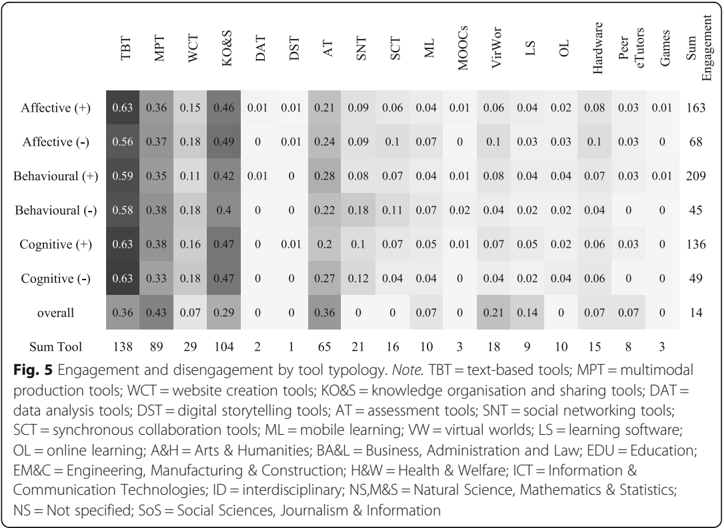
- Across 243 studies, behavioural engagement was documented in 209 studies (86%), affective engagement in 163 (67%), and cognitive engagement in 136 (56%); 117 studies (48%) showed all three dimensions.
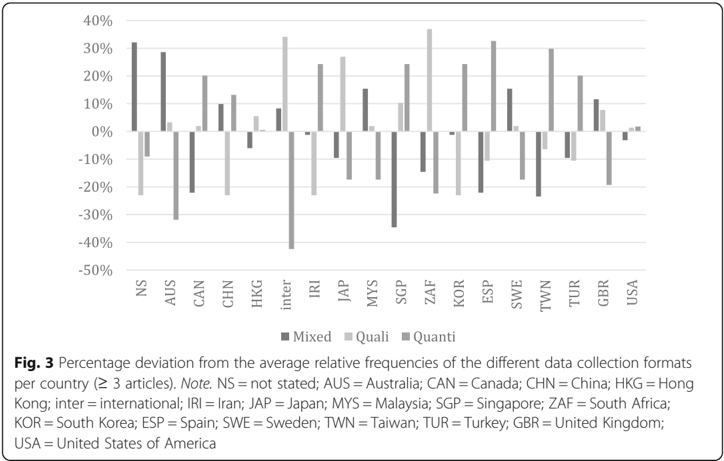
- Most studies used quantitative methods (103, 42%), followed by mixed methods (84, 35%) and qualitative methods (56, 23%); 225 studies (93%) lacked a definition of student engagement, and 59% did not employ a theoretical model.
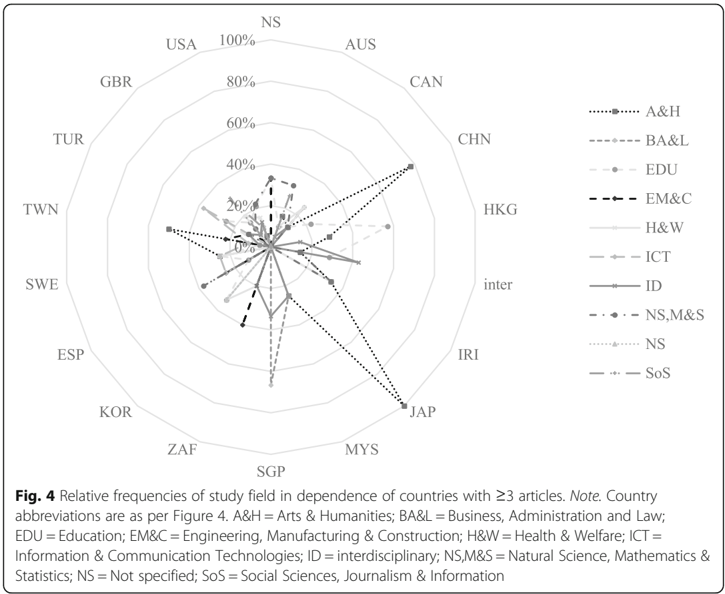
- Research was concentrated in the US (86 studies, 35.4%), UK (26, 10.7%), Australia (19, 7.8%), Taiwan (18, 7.4%), and China (9, 3.7%); top tools were LMS (n = 89), discussion forums (n = 80), videos (n = 44), recorded lectures (n = 25), and chat (n = 24).
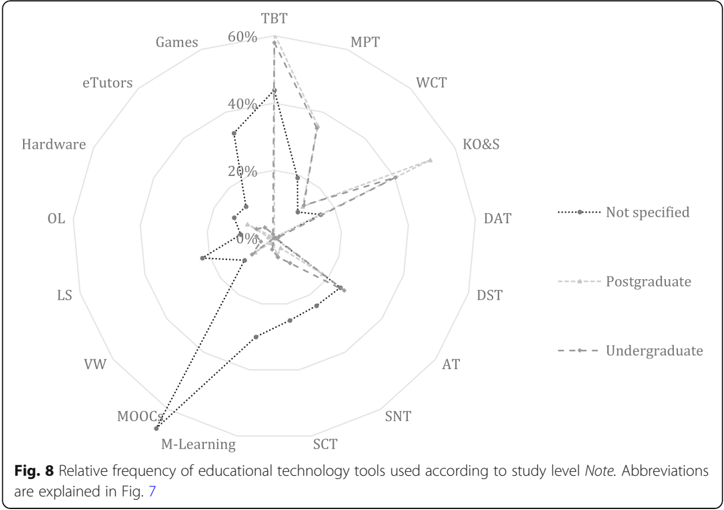
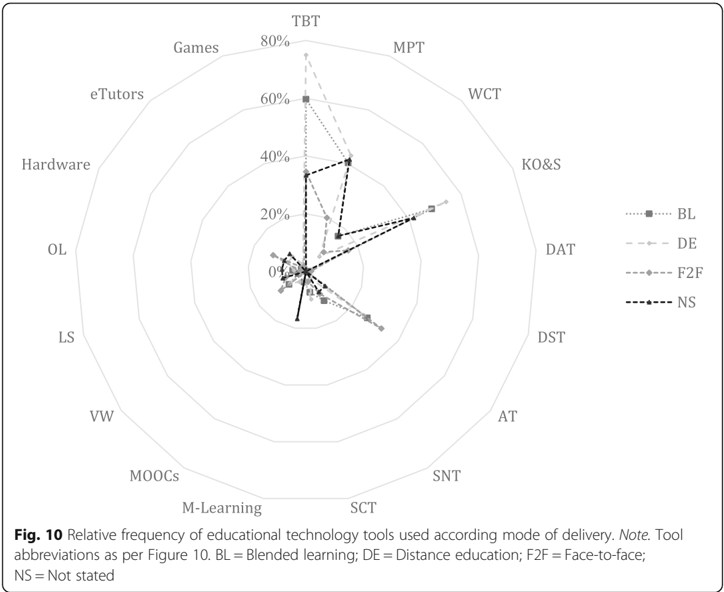
- Blended learning was the most researched mode of delivery (109 studies), followed by distance education (72) and face-to-face instruction (55); undergraduate students were the primary population (146 studies, 60%), while 41 studies (17%) did not specify study level.
Methods
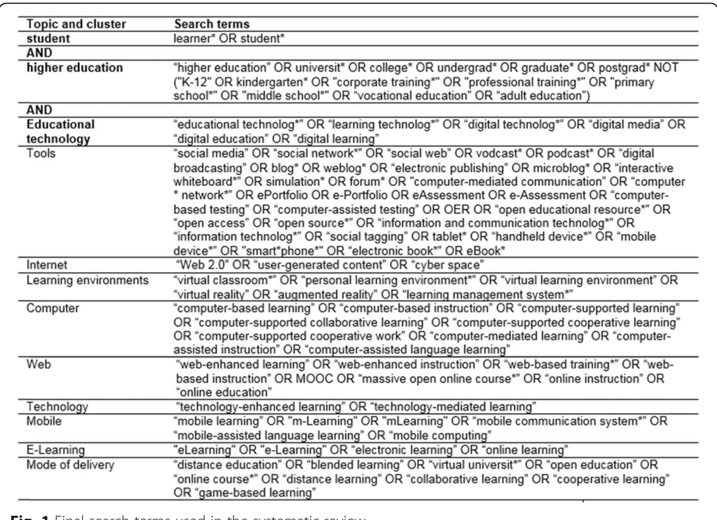
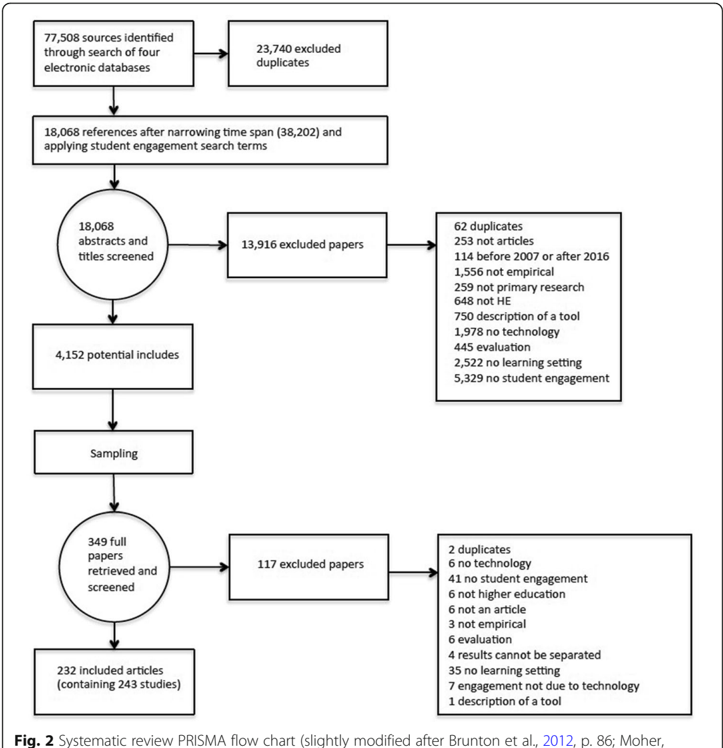
- Systematic evidence map/systematic review; four databases (ERIC, Web of Science, Scopus, PsycINFO) were searched in July 2017, retrieving 77,508 initial references, 53,768 after duplicate removal, and 18,068 records after adjusting the period to 2007–2016.
- After title/abstract screening, 4,152 potentially relevant articles remained; sample size estimation (5% error range, 50% proportion, 5% alpha) produced 349 sampled articles stratified by publishing year, and full-text screening left 232 articles containing 243 studies.
- Data were extracted using an extensive coding system covering study methodology, sample, learning scenario, mode of delivery, educational technology, and cognitive, affective, or behavioural engagement/disengagement indicators.
Limitations
- Stated: only English-language articles were included; grey literature, book chapters, monographs, and journals not indexed in the four databases were excluded; the review was limited to 2007–2016; the sampling strategy likely accounts for low numbers of studies from South America and Africa.
- Stated: peer review was used as a baseline quality criterion, and the human possibility of overlooking or misinterpreting information during coding cannot be fully excluded.
- Evident from the text: the authors note that search and sampling strategy may contribute to geographic imbalance, and they frame student engagement as remaining under-theorised and often considered only fragmentally in the corpus.
Model-written summary. Check it against the paper before relying on it.
Integrity signals
Registry
Cites
Statistics
Figures
Verification
Claims the paper makes
6 Valid · 1 Not valid · 30 Not checked · 118 Own results and interpretations
The cited sources support only part of this claim — read each source’s verdict below.
In the paper
“Linked to this, educational technology research has, however, lacked theoretical guidance (Al-Sakkaf, Omar, & Ahmad, 2019; Hew, Lan, Tang, Jia, & Lo, 2019; Lundin, Bergviken Rensfeldt, Hillman, Lantz-Andersson, & Peterson, 2018).”
- Also stated in: § Introduction · plain
“educational technology research has, however, lacked theoretical guidance (Al-Sakkaf, Omar, & Ahmad, 2019; Hew, Lan, Tang, Jia, & Lo, 2019; Lundin, Bergviken Rensfeldt, Hillman, Lantz-Andersson, & Peterson, 2018).”
What the sources say
- Not checked — no full text of the sourcecites Al-Sakkaf, Omar, & Ahmad, 2019 matched to “A systematic literature review of student engagement in software visualization: a theoretical perspective” (2019) source
- Not checked — no full text of the sourcecites Hew, Lan, Tang, Jia, & Lo, 2019 matched to “Where is the “theory” within the field of educational technology research?” (2019) source
- Partly supportedcites Lundin, Bergviken Rensfeldt, Hillman, Lantz-Andersson, & Peterson, 2018 matched to “Higher education dominance and siloed knowledge: a systematic review of flipped classroom research” (2018) sourceExperimental — accuracy not yet measured
The Abstract says that flipped classroom research often lacks anchoring in learning theory or instructional design, and the Discussion and conclusions recommends stronger theoretical anchoring. The citing sentence extends this finding to educational technology research generally, which the paper does not establish. (LLM, conf=0.87)
plain- Asserted: passes — The authors put it forward as true.
- Checkable: passes — It can be checked against evidence.
- Load-bearing: passes — The paper’s conclusions depend on it.
- Based: passes — The paper gives a reason why it holds.
- Also stated in: § Introduction · plain
The sources with a verdict support this claim; the rest weren’t checked yet, have no full text we could read, or their verdicts aren’t rated yet.
In the paper
“Reviews that have included research using a range of methodologies, have found a limited number of studies employing qualitative methods (e.g. Connolly, Boyle, MacArthur, Hainey, & Boyle, 2012; Kay & LeSage, 2009; Lundin et al., 2018).”
What the sources say
- Not checked — no full text of the sourcecites Connolly et al., 2012 matched to “A systematic literature review of empirical evidence on computer games and serious games” (2012) source
- Not checked — no full text of the sourcecites Kay & LeSage, 2009 matched to “Examining the benefits and challenges of using audience response systems: A review of the literature” (2009) source
- Supportedcites Lundin et al., 2018 matched to “Higher education dominance and siloed knowledge: a systematic review of flipped classroom research” (2018) source
In Discussion and conclusions (page unavailable), Lundin et al. say that qualitative analyses of actual student learning are rare in the flipped-classroom research they reviewed. They also report that simple course questionnaires and pre- and post-tests make up a large part of that research. This supports the citing sentence’s point in the context of flipped-classroom studies. (LLM, conf=0.86)
plain- Asserted: passes — The authors put it forward as true.
- Checkable: passes — It can be checked against evidence.
- Load-bearing: passes — The paper’s conclusions depend on it.
- Based: passes — The paper gives a reason why it holds.
Every source the paper cites for this claim was checked and supports it.
In the paper
“with students showing, for example, disinterest in topics chosen e.g., (Sullivan & Longnecker, 2014)”
What the sources say
- Supportedcites Sullivan & Longnecker, 2014 matched to “Class blogs as a teaching tool to promote writing and student interaction” (2014) source
Table 5 (Conclusion) records a student saying that the week's posts did not necessarily interest them and another asking to choose topics instead of using a fixed set of readings. These comments support the cited example of student disinterest, though the paper also reports positive views of some blog topics. (LLM, conf=0.88)
plain- Asserted: passes — The authors put it forward as true.
- Checkable: passes — It can be checked against evidence.
- Load-bearing: unclear — It is unclear whether the paper’s conclusions depend on it.
- Based: passes — The paper gives a reason why it holds.
- Supported
Every source the paper cites for this claim was checked and supports it.
In the paper
“and continued avoidance of using blogs in some cases, despite introductory training e.g., (Keiller & Inglis-Jassiem, 2015).”
What the sources say
- Supportedcites Keiller & Inglis-Jassiem, 2015 matched to “A lesson in listening: Is the student voice heard in the rush to incorporate technology into health professions education?” (2015) source
The Intervention section says students were invited to training on accessing and using a university-based blogging platform. The Results section reports that students did not access the platform during the study period and cited unfamiliarity with blogging even after training. (LLM, conf=0.94)
plain- Asserted: passes — The authors put it forward as true.
- Checkable: passes — It can be checked against evidence.
- Load-bearing: unclear — It is unclear whether the paper’s conclusions depend on it.
- Based: passes — The paper gives a reason why it holds.
- Supported
In the paper
“Out of 27 identified reviews (see Additional file 3), only 14 report the countries included”
What the sources say
- Not matchedcites Additional file 3
This doesn’t read as a citation we can look up.
plain- Asserted: passes — The authors put it forward as true.
- Checkable: passes — It can be checked against evidence.
- Load-bearing: passes — The paper’s conclusions depend on it.
- Based: passes — The paper gives a reason why it holds.
- Not matched
87 more claims
Create a free account to see all 155 claims and to verify the 1 reference still open.
- Probably not a substantial claim. 27
- It may state two separate claims as one. 44
- The quote only partly states this claim. 2
Claims other papers make about this one
Each is checked against this paper’s own text: does it say what the citing paper says it does?
The source backs part of the claim, not all of it — or backs it for a different population, condition or comparison.
In the citing paper
“As previous LA and educational technology reviews have found (e.g., Bergdahl et al., 2020;Bond et al., 2020;Banihashem et al., 2022), there is an underrepresentation of African and South and Central American research, although this might be due in some part to the search strategy employed for this review.”
From Unpacking student engagement in higher education learning analytics: a systematic review (2024) · cites this paper as Bond et al., 2020
Experimental — accuracy not yet measuredThe source backs part of the claim, not all of it — or backs it for a different population, condition or comparison.
In the citing paper
“HELA research also focused heavily on undergraduate students, with only a small percentage of studies exploring postgraduate student engagement (Bergdahl et al., 2020;Bond et al., 2020), and a large proportion of participants (60%) were from a STEM discipline, which raises questions of wider study generalisability (Kaliisa et al., 2024).”
From Unpacking student engagement in higher education learning analytics: a systematic review (2024) · cites this paper as Bond et al., 2020
Experimental — accuracy not yet measuredThe source backs part of the claim, not all of it — or backs it for a different population, condition or comparison.
In the citing paper
“Studies suggest that professional development and training in LA can improve educators' capacity to use data-driven insights to support student learning (Bergdahl et al., 2020;Bond et al., 2020;Gašević et al., 2019).”
From Unpacking student engagement in higher education learning analytics: a systematic review (2024) · cites this paper as Bond et al., 2020
Experimental — accuracy not yet measuredThe cited source says what the claim attributes to it.
In the citing paper
“Given that the nexus between SE and technology use in higher education has not yet been comprehensively researched, a systematic review was conducted into this topic”
From Facilitating student engagement through educational technology in higher education: A systematic review in the field of arts and humanities (2020) · cites this paper as Bond et al., 2020
The cited source says what the claim attributes to it.
In the citing paper
“Student engagement is often conceptualized along three dimensions: behavioral, cognitive, and affective engagement (Fredericks et al., 2004; Bond et al., 2020).”
From Effects of Generative AI on Engagement and Performance Within Asynchronous Online Courses (2026) · cites this paper as Bond et al., 2020
2 more claims about this paper
Create a free account to see every claim other papers make about this one.
Self-check
Percentages, sums and reported differences re-computed from the paper’s own numbers.
Each contradiction between two passages listed here was confirmed by an independent check.
Rated major: it would touch a result — a value a result rests on, reported and recomputed p-values on opposite sides of the significance level, two passages that conflict with no sign which is right, or a cited work retracted before this paper was published.
In the paper
“59% (n = 100) of studies did not employ a theoretical model in their research. Of the 41% (n = 100) that did”
Reported 59 · recomputed 41.152263
Rated minor: it would not touch a result — a value no result rests on, a p-value that stays on the same side of the significance level, or a conflict that is clerical, resolved elsewhere in the paper, or outside its own findings.
In the paper
§ Discussion
“Natural Sciences, Mathematics & Statistics, nevertheless, assuming rank 3 with 38 studies (15.6%).”
§ Method
“Natural Sciences, Mathematics & Statistics (37) being the top three study fields”
Citations
Cites
Preferred Reporting Items for Systematic Reviews and Meta-Analyses: the PRISMA statement
Moher, D., Liberati, A., Tetzlaff, J., Altman, D. G., & for the PRISMA Group (2009) · BMJ · doi:10.1136/bmj.b2535 · Cited by 83,823
(1978) · Medical Entomology and Zoology · Cited by 53,488
The Discovery of Grounded Theory: Strategies for Qualitative Research.
Wagner, H. R., Glaser, B. G., & Strauss, A. L. (1968) · Social Forces · doi:10.2307/2575405 · Cited by 46,361
Preferred reporting items for systematic reviews and meta-analyses: the PRISMA Statement.
(2009) · PubMed Central · Cited by 44,859
The Discovery of Grounded Theory; Strategies for Qualitative Research
Glaser, B. G., Strauss, A. L., & Strutzel, E. (1968) · Nursing Research · doi:10.1097/00006199-196807000-00014 · Cited by 39,449
Kytle, J., & Bandura, A. (1978) · Contemporary Sociology · doi:10.2307/2065952 · Cited by 25,422 · cited 1×
“Studies coded as SCL included those exploring social learning (Bandura, 1971) and social”
MethodSchool Engagement: Potential of the Concept, State of the Evidence
Fredricks, J. A., Blumenfeld, P. C., & Paris, A. H. (2004) · Review of Educational Research · doi:10.3102/00346543074001059 · Cited by 12,581 · cited 2×
“Therefore, more qualitative and ethnographic measures should also be employed, such as student observations with thick descriptions, which can help shed light on the complexity of teaching and learning environments (Fredricks et al., 2004; Heflin, Shewmaker, & Nguyen, 2017).”
BackgroundPierce, W. D., & Bandura, A. (1977) · Canadian Journal of Sociology / Cahiers canadiens de sociologie · doi:10.2307/3340496 · Cited by 9,650
Bandura, A. (1977) · Zenodo (CERN European Organization for Nuclear Research) · doi:10.5281/zenodo.15521699 · Cited by 7,607
The Discovery of Grounded Theory: Strategies for Qualitative Research
Brodsky, C. M. (1968) · Psychosomatics · doi:10.1016/s0033-3182(68)71872-7 · Cited by 6,679
Research works printed but not linked: 1
- Astin, A. W. (1984). Student involvement: A developmental theory for higher education. Journal of College Student Development, 25(4), 297–308.
Cited by
Items 301–400 of 1,053
Mapping artificial intelligence research in higher education toward sustainable development
Hong, T. T. M., Tung, N. T. T., & Thanh, N. T. P. (2025) · Discover Sustainability · doi:10.1007/s43621-025-02162-0 · Cited by 20
“This view is consistent with Bond et al. [5] who pointed out that these journals are sometimes of questionable quality.”
InfluentialAlqurni, J. S. (2026) · Frontiers in Artificial Intelligence · doi:10.3389/frai.2026.1738730 · Cited by 15
Face-to-face versus online-based lectures: A COVID-19 induced study on assessments
Fisher, D. W., Solomons, D., & Makhathini, K. B. (2022) · Frontiers in Education · doi:10.3389/feduc.2022.1045311 · Cited by 9
The tensions of student engagement with technology
Greener, S. (2022) · Interactive Learning Environments · doi:10.1080/10494820.2022.2048550 · Cited by 16
Shirazi, F., Sharif, F., Molazem, Z., et al. (2021) · Journal of Professional Nursing · doi:10.1016/j.profnurs.2021.05.001 · Cited by 7
He, X., & Wen, J. (2025) · SAGE Open · doi:10.1177/21582440251377995 · Cited by 15
“LE mainly consists of three types: behavioral, cognitive, and emotional engagement (Bond et al., 2020; Sharif-Nia et al., 2023; Vezne et al., 2023).”
Minecraft as a Tool to Enhance Engagement in Higher Education
AlJanah, S., Teh, P. S., Tay, J. Y., Aiyenitaju, O., & Nawaz, R. (2023) · Springer proceedings in complexity · doi:10.1007/978-3-031-19560-0_38 · Cited by 8
A technology-enhanced scaffolding instructional design for fully online courses
Yang, J., Jiang, R., & Su, H. (2022) · Australasian Journal of Educational Technology · doi:10.14742/ajet.6991 · Cited by 9
Culbreth, D., & Martin, F. (2025) · Educational Technology Research and Development · doi:10.1007/s11423-025-10504-y · Cited by 13
“…specific classifications such as books read, application runtime, accessing course material, cursor behavior, assignments completed, and forum replies (Bond et al., 2020; Fotaris et al., 2016; Gupta, 2023; Kiatkeeree & Ruangjaroon, 2022; Kuromiya et al., 2022; Sun & Rueda, 2012; Sung et al., 2021).”
Liu, Z., Zhang, X., Liu, W., Chen, W., Li, Y., & Zhou, Y. (2025) · Education and Information Technologies · doi:10.1007/s10639-025-13496-7 · Cited by 12
“This aligns with research suggesting that ongoing digital teaching training and support can improve teaching outcomes (Bond et al., 2020; Hunter, 2015).”
Kohan, N., Bagheri‐Nesami, M., & Ahmady, S. (2021) · Journal of Nursing and Midwifery Sciences · doi:10.4103/jnms.jnms_27_21 · Cited by 7
Wıbowo, F. C., Hasbey, H., Aziz, T. A., Darman, D. R., Kusuma, A. A. K., Ihsan, I., & Bunyamin, M. A. H. (2025) · Multidisciplinary Science Journal · doi:10.31893/multiscience.2025583 · Cited by 12
Estrategias de enseñanza en entornos virtuales: Un análisis crítico de la efectividad educativa
Solórzano, F. L. R. (2024) · Horizon Nexus Journal. · doi:10.70881/hnj/v2/n3/6 · Cited by 6
“Esto permite que las recomendaciones resultantes sean aplicables en una variedad de contextos educativos, tanto en instituciones que ya han adoptado el aprendizaje virtual de manera permanente como en aquellas que lo utilizan de forma complementaria al aprendizaje presencial (Bond et al., 2021).”
Towards Inclusive Classrooms: Shaping South African Higher Education for Employability
Wang, X., & Wan, X. (2024) · The Asia-Pacific Education Researcher · doi:10.1007/s40299-024-00902-w · Cited by 9
“" Student engagement" was incorporated from the research by Bond et al. (2020).”
Choo, C., Fahrni, M. L., & Ming, L. C. (2022) · International Journal of Emerging Technologies in Learning (iJET) · doi:10.3991/ijet.v17i22.32777 · Cited by 9
Student Engagement in Distance Learning in Teacher Education Programs During the Spring 2020
Zellweger, F., & Kocher, M. (2021) · MedienPädagogik Zeitschrift für Theorie und Praxis der Medienbildung · doi:10.21240/mpaed/40/2021.11.24.x · Cited by 6
Tecnologico de Monterrey, M., Vázquez‐Villegas, P., Garay-Rondero, C. L., Tecnologico de Monterrey, M., Deng, B., Mejía‐Manzano, L. A., Tecnologico de Monterrey, M., Chen, D., Membrillo‐Hernández, J., & Corresponding author, T. D. M. (2023) · International Journal of Instruction · doi:10.29333/iji.2023.16452a · Cited by 9
The Challenges of Higher Education and its Contribution to Sustainable Development
Jordi, G., Alvado, A., Sorribes, J., & Boyra, J. (2022) · Higher Education Research · doi:10.11648/j.her.20220701.11 · Cited by 5
Danmaku-Based Automatic Analysis of Real-Time Online Learning Engagement
Zeng, L., Tan, Z., Ke, Y., & Xia, L. (2024) · International Journal of Interactive Mobile Technologies (iJIM) · doi:10.3991/ijim.v18i08.48025 · Cited by 11
Odularu, A. T., Khalo, X., Mashiyi, N., & Nkohla, M. B. (2023) · Preprints.org · doi:10.20944/preprints202305.0573.v1 · Cited by 5
How can a task-based project enhance students’ transferable skills? An investigation
Heng, L., & Yeh, H. (2024) · Educational Research · doi:10.1080/00131881.2024.2309887 · Cited by 10
“…of technologies on the ways people interact with each other and with the broader social world, have been gaining the attention of researchers (Bond et al. 2020; De Oliveira et al. 2015; Godwin-Jones 2015; Heng and Yeh 2022; Kajaama and Kumpulainen 2019; Manca, Bocconi, and Gleason 2021;…”
BackgroundInfluentialModise, M.-E. P., & Mudau, P. K. (2022) · The Journal of Continuing Higher Education · doi:10.1080/07377363.2022.2067731 · Cited by 18
“The 18 selected studies listed in Table 2 were qualitatively synthesised using the extensive coding system developed by Bond et al. (2020).”
MethodChahal, A., Kadian, R., Yadav, R., & Prakash, C. (2025) · Journal of Applied Research in Higher Education · doi:10.1108/jarhe-06-2024-0305 · Cited by 6
Kawane, T., Adu-Gyamfi, B., & Shaw, R. (2023) · International Journal of Disaster Resilience in the Built Environment · doi:10.1108/ijdrbe-12-2022-0125 · Cited by 7
Using Mobile Devices in Teaching Large University Classes: How Does It Affect Exam Success?
Feraco, T., Casali, N., Tortora, C., Bon, C. D., Accarrino, D., & Meneghetti, C. (2020) · Frontiers in Psychology · doi:10.3389/fpsyg.2020.01363 · Cited by 9
“Previous studies also found SRS use and out-of-class activities to be positively associated with engagement (Heng, 2014; Bond et al., 2020) and, in turn, with achievement (Lei et al., 2018).”
BackgroundResultInfluentialInsights into enhancing student engagement: A practical application of blended learning
Tran, T. T., & Nagirikandalage, P. (2025) · The International Journal of Management Education · doi:10.1016/j.ijme.2025.101167 · Cited by 17
Hu, Z., & Razlog, R. (2023) · Journal for the Education of Gifted Young Scientists · doi:10.17478/jegys.1277401 · Cited by 15
French, S., Ravn, S., Balcaite, E., & Moore, E. (2023) · Pacific Journal of Technology Enhanced Learning · doi:10.24135/pjtel.v1i2.172 · Cited by 11
“Drawing upon the educational literature, in this paper we employ a tripartite definition of engagement as being comprised of cognitive, behavioural and affective components (Fredricks et al., 2004; Kahu and Nelson 2018; Bond et al., 2020).”
MethodSetiyawan, A., Soeharto, S., Maričić, M., et al. (2025) · Technology Knowledge and Learning · doi:10.1007/s10758-025-09918-7 · Cited by 6
Alruthaya, A. S. M., Khan, S., Saini, A., & Muthaly, S. (2025) · Computers in Human Behavior Reports · doi:10.1016/j.chbr.2025.100824 · Cited by 17
Kebahagiaan Mahasiswa ditinjau dari Optimisme dan Student Engagement
Mafaza, N., Kawuryan, F., & Pramono, R. B. (2021) · Jurnal Psikologi Perseptual · doi:10.24176/perseptual.v6i2.6877 · Cited by 15
Blended Learning: Threats and Hurdles in Developing Countries: A Case Study of Nigeria and Kenya.
Sele, J. P., Nyakerario, F., & Wanjiku, C. (2023) · Greener Journal of Social Sciences · doi:10.15580/gjss.2023.1.112024176 · Cited by 11
EFL VIETNAMESE STUDENT ENGAGEMENT IN FACE-TO-FACE LEARNING ENVIRONMENT
Huong, T. L. K. (2022) · European Journal of Education Studies · doi:10.46827/ejes.v9i12.4604 · Cited by 13
Abdullah, A., Kamaludin, A., & Romli, A. (2020) · Emerging Technology in Computing, Communication and Electronics (ETCCE) · doi:10.1109/etcce51779.2020.9350899 · Cited by 8
“Engagement is a very important research topic of higher education and literature confirms that using educational technology such as LMS can promote better engagement [10].”
BackgroundFacilitated learning or technical distraction? Sociologically exploring online university learning
Ragusa, A. T., & Crampton, A. L. (2024) · Technology Pedagogy and Education · doi:10.1080/1475939x.2023.2294117 · Cited by 7
“Educators’ calls for qualitative research relating ET to pedagogy and learning goals (Bedenlier et al., 2020) and systematic literature reviews (Bond et al., 2020) note ET research lacks ‘coherence or integrity during this relentless pursuit of the new’ because of its focus on ET device evaluation…”
BackgroundInfluentialGlobal emergency remote education in secondary schools during the COVID-19 pandemicPreprint
Lab, S. (2021) · OSF Preprints (OSF Preprints) · doi:10.31219/osf.io/7k59g · Cited by 8
Factors affecting student behavioural engagement in an inquiry-based online learning environmentPreprint
Mamun, M. A. A., & Lawrie, G. A. (2021) · Research Square · doi:10.21203/rs.3.rs-249144/v1 · Cited by 5
“Researchers have endeavoured to de ne and understand various dimensions of student engagement that apply across various contexts (Bond et al., 2020).”
BackgroundHossain, M. M. (2023) · International Journal of Information and Learning Technology · doi:10.1108/ijilt-04-2022-0094 · Cited by 5
Factors Influencing Student Engagement During COVID-19 Emergency Remote Teaching
Ekici, M., & Ekici, D. İ. (2021) · Advances in educational technologies and instructional design book series · doi:10.4018/978-1-7998-7275-7.ch007 · Cited by 6
Bedenlier, S., Händel, M., Kammerl, R., Gläser‐Zikuda, M., Kopp, B., & Ziegler, A. (2021) · MedienPädagogik Zeitschrift für Theorie und Praxis der Medienbildung · doi:10.21240/mpaed/40/2021.11.18.x · Cited by 15
Self-citationAmzalag, M., Beimel, D., & Zviel-Girshin, R. (2025) · Computers and Education Open · doi:10.1016/j.caeo.2025.100313 · Cited by 22
Rajab, K. D., Hamdi, M., Reshan, M. S. A., Asiri, Y., Shaikh, A., & Rajab, A. D. (2022) · Electronics · doi:10.3390/electronics11050694 · Cited by 8
Zheng, Q., & Pan, X. (2025) · Interactive Learning Environments · doi:10.1080/10494820.2025.2547263 · Cited by 6
“Bond et al. (2020) described learning engagement as “the energy and effort that students employ within their learning community, observable via any number of behavioral, cognitive, or affective indicators across a continuum” (p. 3).”
Online Higher Education: The Importance of Students’ Epistemological Beliefs, Well-Being, and Fun
--, S., Sheehy, K., & Rofiah, K. (2021) · IAFOR Journal of Education · doi:10.22492/ije.9.6.01 · Cited by 6
León, R. R.-D., Cham‐Pérez, M. L. L., Elizondo, V. A., Villarreal-Villarreal, A., Ortiz, A., Vélez-Saboyá, C. S., Lozoya-Santos, J. D. J., Cebral-Loureda, M., & Ramírez-Moreno, M. A. (2024) · Data · doi:10.3390/data9050068 · Cited by 6
Kadarisma, G., Juandi, D., & Darhim, D. (2024) · Infinity Journal · doi:10.22460/infinity.v13i2.p531-552 · Cited by 10
Enhancing the organisation and the management of built environment higher education courses
Gomis, K., Saini, M. S., Pathirage, C., & Arif, M. (2022) · Quality Assurance in Education · doi:10.1108/qae-01-2022-0020 · Cited by 7
Alharbi, B. A., Ibrahem, U. M., Moussa, M. A., Abdelwahab, S. M., & Diab, H. M. (2022) · Education Sciences · doi:10.3390/educsci12120917 · Cited by 22
Love, R., Cohen, P. R., Venture, G., & Kulić, D. (2025) · ACM Trans. Hum. Robot Interact. · doi:10.1145/3743692 · Cited by 4
“Educators are interested in educational technologies that can increase this metric [11], as student engagement has been shown to predict academic proficiency and motivation [28].”
Limonova, V., dos Santos, A. M. P., Mamede, H. S., & Filipe, V. M. D. J. (2024) · Lecture notes in networks and systems · doi:10.1007/978-3-031-60224-5_7 · Cited by 16
Capability Assessment of Cultivating Innovative Talents for Higher Schools Based on Machine Learning
Huang, R., Sun, Y., Zhang, Z., Wang, B., Ma, J., & Chu, Y. (2024) · International Journal of Information and Communication Technology Education · doi:10.4018/ijicte.343635 · Cited by 9
Arthur, F., Yidana, M. B., & Acquah, B. Y. S. (2025) · SAGE Open · doi:10.1177/21582440251342212 · Cited by 11
“…lens, encompassing various dimensions such as emotional response (affective), mental commitment (cognitive), focus and involvement (behavioral), interactions and relationships (social), and active participation (agen-tic) (Ajabshir, 2024; Bond et al., 2020; Reeve & Jang, 2022; Reeve et al., 2020).”
InfluentialOmarsaib, M. (2024) · Information and Learning Sciences · doi:10.1108/ils-01-2024-0012 · Cited by 5
Radaelli, M. R. R., GOULART, S. D. O., & Astudillo, M. R. V. (2022) · Revista de Educação Pública · doi:10.29286/rep.v31ijan/dez.13397 · Cited by 12
The Role of Hybrid Learning in Achieving the Sustainable Development Goals
Martins, F. P., Cezarino, L. O., Challco, G. C., Liboni, L. B., Dermeval, D., Bittencourt, I. M., Paiva, R., Silva, A., Marques, L. B., Isotani, S., et al. (2025) · Sustainable Development · doi:10.1002/sd.3374 · Cited by 19
Teng, Y., & Wang, X. (2023) · Education and Information Technologies · doi:10.1007/s10639-023-12342-y · Cited by 9
“Emotional student engage - ment lays more emphasis on positive reactions of students such as enjoyment and interest (Bond et al., 2020; Fredricks et al., 2004).”
Evaluating art students' engagement with digital technologies in classroom settings
Shiri, M., & Baigutov, K. (2024) · International Journal of ADVANCED AND APPLIED SCIENCES · doi:10.21833/ijaas.2024.11.025 · Cited by 15
Slamet, T. I., Brush, T. A., & Kwon, K. (2024) · Technology Knowledge and Learning · doi:10.1007/s10758-024-09740-7 · Cited by 9
“The term has been linked to the success of students in school in terms of learning outcomes, cognitive development, and academic achievement (Appleton et al., 2008; Bond et al., 2020 ).”
Amashi, R., Koppikar, U., Vijayalakshmi, M., & Kandakatla, R. (2022) · IEEE Global Engineering Education Conference (EDUCON) · doi:10.1109/educon52537.2022.9766541 · Cited by 9
“Affective, cognitive and behavioral are the three widely accepted dimensions of student engagement [12-15].”
BackgroundInstructional management strategies for addressing low student engagement in mathematics
Verdeflor, R. N., Tenedero, E. Q., Bordios, A. G., Panit, N. M., & Espinosa, C. (2024) · Environment and Social Psychology · doi:10.59429/esp.v9i12.3229 · Cited by 20
“As a multidimensional psycho-social process, it involves three interrelated dimensions: behavioral, emotional, and cognitive engagement [31,34] .”
Modise, M.-E. P. (2022) · International Journal of Learning Teaching and Educational Research · doi:10.26803/ijlter.21.5.5 · Cited by 9
Bandono, A., Mukhlis, M., Susilo, A., & Prabowo, A. R. (2023) · International Journal of Learning Teaching and Educational Research · doi:10.26803/ijlter.22.10.12 · Cited by 18
“Future research should focus on how the use of educational technology might enhance students' collaborative learning, particularly when it comes to problem-solving, communication, and finishing assignments (Bond et al., 2020).”
BackgroundEffectivity and students’ satisfaction to a tutorial in statistics through a webinar
Sugilar, S. (2020) · Journal of Physics Conference Series · doi:10.1088/1742-6596/1663/1/012035 · Cited by 5
Evaluating the Effectiveness of Gather Town on EFL Students' Reading Speed and IELTS Scores
Chen, G., Fan, Y., & Liao, Z. (2025) · International Journal of Mobile and Blended Learning · doi:10.4018/ijmbl.383511 · Cited by 4
Yan, N., Batako, A. D. L., Czanner, G., & Zhang, A. (2024) · Technology Knowledge and Learning · doi:10.1007/s10758-024-09799-2 · Cited by 13
“This diversity is particularly valuable given the limited research in developing countries (Bond et al., 2020).”
Aruğaslan, E. (2025) · Journal of Computer and Education Research · doi:10.18009/jcer.1549186 · Cited by 6
Li, R., & Lin, X. (2024) · Interactive Learning Environments · doi:10.1080/10494820.2024.2440880 · Cited by 12
“Online environments facilitate asynchronous and synchronous communication through digital tools and platforms, enabling students to interact with peers beyond time and space constraints (Bond et al., 2020).”
Özüdoğru, M. (2021) · Bartın University Journal of Faculty of Education · doi:10.14686/buefad.797154 · Cited by 6
“The results of some studies showed that while behavioral engagement predicted the achievement (Bond et al., 2020; Bowden et al., 2019; Henrie et al., 2015; Marks, 2000; Reeve, 2013; Reeve & Tseng, 2011; Skinner & Pitzer, 2012), this was not true for either emotional engagement or cognitive…”
BackgroundResultInfluentialEDTF: A User-Centered Approach to Digital Educational Games Design and Development
Maxim, R. I., & Arnedo-Moreno, J. (2025) · Information · doi:10.3390/info16090794 · Cited by 8
Políticas educativas das escolas na tomada de decisão da retenção escolar
Santos, N. N., & Monteiro, V. (2023) · Education Policy Analysis Archives · doi:10.14507/epaa.31.7586 · Cited by 7
Çer, E. (2025) · STEM Education · doi:10.3934/steme.2025018 · Cited by 10
Construction of a Learning Engagement Evaluation Model Based on Multi-modal Data Fusion
Chen, J., & Parameshachari, B. D. (2022) · International Conference on Knowledge Engineering and Communication Systems (ICKECS) · doi:10.1109/ickecs56523.2022.10060326 · Cited by 5
“…impact analysis methods such as cross lag analysis and structural equation model to establish the competitive model of other factors in the learning environment and group learning engagement factors ad determine the optimal impact path by putting forward the strategy to improve the investment [14].”
MethodPair learning in virtual laboratories: implications for engagement, self-efficacy, and anxiety
Wu, T., Sarwono, E., & Huang, Y. (2025) · Social Psychology of Education · doi:10.1007/s11218-025-10086-w · Cited by 5
“Finally, behavioral engagement includes the active participation, focused atten - tion, and enthusiasm of learners in educational activities (Bond et al., 2020 ; Fred - ricks et al., 2004 ; Teng & Wang, 2021 ; Zhoc et al., 2019 ).”
Eren, E., Ergüleç, F., & Kara, A. (2025) · Education and Information Technologies · doi:10.1007/s10639-025-13723-1 · Cited by 15
“This issue has become increasingly salient within higher education, where digital transformation is reshaping pedagogical practices, learning environments, and the expectations placed on both students and faculty (Bond et al., 2020; Selwyn, 2021 ).”
Social Network Sites as Community Building Tools in Educational Networking
Nizzolino, S., & Canals, A. (2021) · International Journal of e-Collaboration · doi:10.4018/ijec.2021100110 · Cited by 6
Does digital competence really matter? The impact of attitude and ICT on research performance
Rani, S., Danu, A., & Himanshu (2025) · Journal of Applied Research in Higher Education · doi:10.1108/jarhe-07-2024-0351 · Cited by 14
Modise, M.-E. P., & Mudau, P. K. (2021) · doi:10.25159/unisarxiv/000015.v1 · Cited by 4
Ragab, K., Fernández-Ahumada, E., & Martínez-Jiménez, E. (2024) · Springer eBooks · doi:10.1007/978-3-031-65215-8_5 · Cited by 6
Wang, L., van der Rijst, R. M., Admiraal, W., & de Jonge, M. (2026) · Computers & Education · doi:10.1016/j.compedu.2026.105625 · Cited by 19
Mısır, S. K., & Thomas, M. (2026) · Journal of Intelligence · doi:10.3390/jintelligence14030034 · Cited by 8
Self-Efficacy Literature Review: Graduate Students
Visoso, C. (2024) · Open Journal of Social Sciences · doi:10.4236/jss.2024.123010 · Cited by 8
Co-creation: a collaborative odyssey in dental education with students at the helm
Campbell, F., & Rogers, H. J. (2024) · BDJ · doi:10.1038/s41415-024-7849-y · Cited by 5
Almutlaq, S. A. (2024) · Journal of Language Teaching and Research · doi:10.17507/jltr.1505.09 · Cited by 9
“However, reviewing literature regarding students’ engagement reveals variations in its definitions and scopes (Bond et al., 2020; Hiver et al., 2021).”
BackgroundIncidencia de la Metodología JiTTwT en el rendimiento académico de estudiantes universitarios
Pérez-Suasnavas, A.-L., & Cela, K. (2021) · ESPIRAL CUADERNOS DEL PROFESORADO · doi:10.25115/ecp.v15i30.6500 · Cited by 6
Effect of Student’s Perception of Learning Innovation on Student Engagement and Student Satisfaction
Setyawati, A., Wijaya, S., & Widjaja, D. C. (2022) · Petra International Journal of Business Studies · doi:10.9744/ijbs.5.2.198-205 · Cited by 11
Reconceptualizing of GenAI adoption in higher education: A task-based perspective
Chaieb, M., Cuel, R., & Bouzaabia, R. (2026) · The International Journal of Management Education · doi:10.1016/j.ijme.2026.101365 · Cited by 12
Sørensen, M. T., & Stenalt, M. H. (2025) · Higher Education Research & Development · doi:10.1080/07294360.2025.2514502 · Cited by 10
“For additional reviews utilising machine learning with EPPI, see Bond et al. (2020) and Lillejord et al. (2018).”
Xiaoyan, Z., Ismail, I. S., & Narasuman, S. (2023) · Atlantis Highlights in Computer Sciences/Atlantis highlights in computer sciences · doi:10.2991/978-94-6463-040-4_125 · Cited by 7
Parto, L. E., & Yango, A. R. (2023) · Technium Social Sciences Journal · doi:10.47577/tssj.v44i1.8935 · Cited by 4
“The total population of the study was 51 ALS teachers in the six (6) City Schools Division Offices in the Province of Laguna.”
BackgroundKöstler, V. (2023) · MedienPädagogik Zeitschrift für Theorie und Praxis der Medienbildung · doi:10.21240/mpaed/54/2023.08.10.x · Cited by 12
Smartphone as a Self-regulatory Planning Tool: Promise or Peril
Hartley, K., Shreve, E., Gianoutsos, D., & Bendixen, L. D. (2022) · International Journal of Interactive Mobile Technologies (iJIM) · doi:10.3991/ijim.v16i14.28783 · Cited by 5
Knight, S. (2025) · International Journal of Qualitative Methods · doi:10.1177/16094069251318590 · Cited by 9
Bhuttah, T. M., Ullah, N., Shahid, N. A., & Sarwat, S. (2021) · Humanities & Social Sciences Reviews · doi:10.18510/hssr.2021.9387 · Cited by 6
“The more involved and motivated students are in their academic environment, the more likely they are to redirect that enthusiasm back into their studies, resulting in a variety of short and long-term results that can also enhance engagement (Bond et al., 2020, p. 3).”
BackgroundKim, E. J., & Kim, H. R. (2025) · BMC Nursing · doi:10.1186/s12912-025-03961-6 · Cited by 6
“Initially, the experimental group displayed lower interest, possibly because of their unfamiliarity with the new teaching methods and perceived task difficulty [29].”
InfluentialDescribing teacher educators’ metatalk moves enacted for teaching how to teach concepts
Soysal, Y., & Soysal, S. (2023) · Education Inquiry · doi:10.1080/20004508.2023.2299055 · Cited by 6
Internet of Things Performance Evaluation from Three Decades in Education
Jatmiko, B., Prahanı, B. K., Saphıra, H. V., Parno, P., Siswanto, J., & Uulaa, R. F. R. (2023) · Journal of Law and Sustainable Development · doi:10.55908/sdgs.v11i8.1500 · Cited by 4
“One of the primary goals for worldwide technological advancements is to increase student involvement (Bond et al., 2020; Dakhi et al., 2020; Farrell & Brunton, 2020; Papadakis et al., 2021; Rashidov & Rasulov, 2020).”
BackgroundAnwar, S., Butt, A. A., & Menekşe, M. (2025) · International Journal of STEM Education · doi:10.1186/s40594-025-00551-5 · Cited by 4
“However, concepts like engagement are often not well-studied or defined in technology applications (Bond et al., 2020).”
A Study of the Effects of E-learning on the Learning Effectiveness of Students
Lau, L. (2023) · Journal of Education Humanities and Social Sciences · doi:10.54097/ehss.v8i.4623 · Cited by 11
John, J. A., N.A., J. P. S., AlSalman, M., Ahmed, E., & Hasan, F. (2022) · International Journal on Recent and Innovation Trends in Computing and Communication · doi:10.17762/ijritcc.v10i7.5559 · Cited by 4
Metadata
- Authors
- Bond, M., Buntins, K., Bedenlier, S., Zawacki-Richter, O., & Kerres, M.
- Affiliations
- Carl von Ossietzky Universität Oldenburg (DE)
- University of Duisburg-Essen (DE)
- Corresponding author
- Bond, Melissa
- Venue
- International Journal of Educational Technology in Higher Education
- Published
- 2020-01-22
- Volume
- 17
- Issue
- 1
- ISSN
- 2365-9440 (ISSN-L)
- OpenAlex
- W3014646985
- Cited by
- 1,097
- References
- 182
- Citations by year
- 2026: 257 · 2025: 216 · 2024: 187 · 2023: 170 · 2022: 123 · 2021: 118 · 2020: 26
- FWCI
- 165.40
- Type
- journal article
- Language
- en
- Open access
- diamond
- doi.org
- Licence
- cc-by
- creativecommons.org/licenses/by/4.0 (tdm)
- creativecommons.org/licenses/by/4.0 (vor)
- Locations
- International Journal of Educational Technology in Higher Education (publishedVersion, cc-by)
- UniSA Research Outputs Repository (University of South Australia) (acceptedVersion, other-oa)
- Adelaide Research & Scholarship (AR&S) (University of Adelaide) (submittedVersion, cc-by)
- DOAJ (DOAJ: Directory of Open Access Journals) (submittedVersion, cc-by-sa)
- Funders
- Bundesministerium für Bildung und Forschung (16DHL1007)
- Topics
- Social Sciences › Education › Online and Blended Learning
- Social Sciences › Education › Educational Technology in Learning
- Physical Sciences › Computer Science › Computer Science Applications › Online Learning and Analytics
- Keywords
- student engagement, educational technology, higher education, behavioral engagement, emotional engagement, cognitive engagement, blended learning, online forums, undergraduate students, research gaps
About these checks
Registry, retraction, Cites and statistics results are computed, not judged, with one exception: a printed reference that no index lists is read once by a model before it counts as a citation error. Claims are extracted by a model and kept only when their quote appears verbatim in the text; each cited source is then checked, with a model’s help, for whether it says what the claim relies on. Those verdicts can be wrong — read the claim’s quote and the cited source before relying on one.
The claim verdicts this report counts are experimental: their accuracy is not yet measured.
A language model drew the claims from the paper on 2026-09-29, under version 3 of the claim definition (model deepseek-v4.1-flash, prompt extract-v3).
A second model labelled each claim on 2026-09-29 (model jev-1.13-20260917, definition revision gold-guideline-v0.2).
Cited sources are checked with a language model’s help (gpt-6-sol).
Statistics and arithmetic are recomputed, not judged.
Confidence bands are shown only for fields calibrated on our annotated test set. None is calibrated yet, so no band is shown.
What counts as a claim ›How we measure confidence ›How we check this ›
Are you an author, or do you see a problem with this page? Request a review
Data sources
Bibliographic data: Semantic Scholar, OpenAlex, Crossref.
Contains information from the Semantic Scholar Academic Graph Datasets, made available under the ODC Attribution License (ODC-BY 1.0).
Semantic Scholar’s data is described in: Kinney, R., et al. (2023). The Semantic Scholar Open Data Platform. arXiv:2301.10140.
