

Mapping research in student engagement and educational technology in higher education: a systematic evidence map
Open accessThe DOI matches its Crossref record; 175 of the 182 references it cites were found in a registry or an index; 6 of the 54 sources its claims cite were checked for support.
Abstract
Abstract Digital technology has become a central aspect of higher education, inherently affecting all aspects of the student experience. It has also been linked to an increase in behavioural, affective and cognitive student engagement, the facilitation of which is a central concern of educators. In order to delineate the complex nexus of technology and student engagement, this article systematically maps research from 243 studies published between 2007 and 2016. Research within the corpus was predominantly undertaken within the United States and the United Kingdom, with only limited research undertaken in the Global South, and largely focused on the fields of Arts & Humanities, Education, and Natural Sciences, Mathematics & Statistics. Studies most often used quantitative methods, followed by mixed methods, with little qualitative research methods employed. Few studies provided a definition of student engagement, and less than half were guided by a theoretical framework. The courses investigated used blended learning and text-based tools (e.g. discussion forums) most often, with undergraduate students as the primary target group. Stemming from the use of educational technology, behavioural engagement was by far the most often identified dimension, followed by affective and cognitive engagement. This mapping article provides the grounds for further exploration into discipline-specific use of technology to foster student engagement.
Overview
CoChat Summary
TL;DR
This systematic evidence map synthesizes 243 studies published 2007–2016 on student engagement and educational technology in higher education. It finds research concentrated in the US and UK, dominated by quantitative methods, often lacking definitions or theory, and most frequently linking blended learning and text-based tools to behavioural engagement.
Key findings
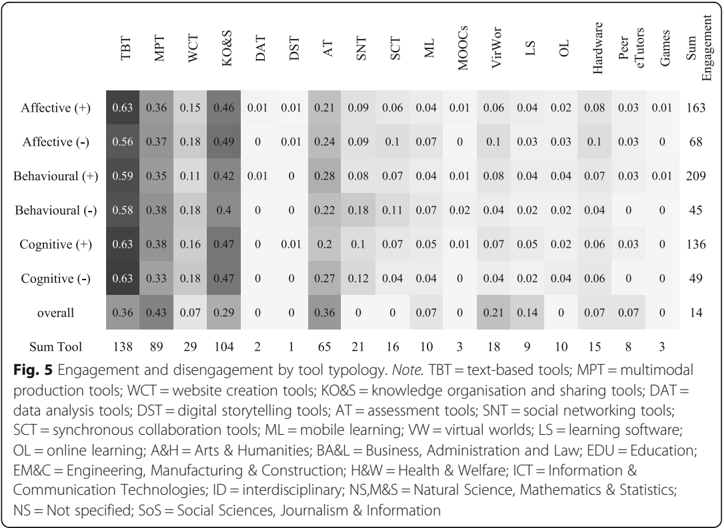
- Across 243 studies, behavioural engagement was documented in 209 studies (86%), affective engagement in 163 (67%), and cognitive engagement in 136 (56%); 117 studies (48%) showed all three dimensions.
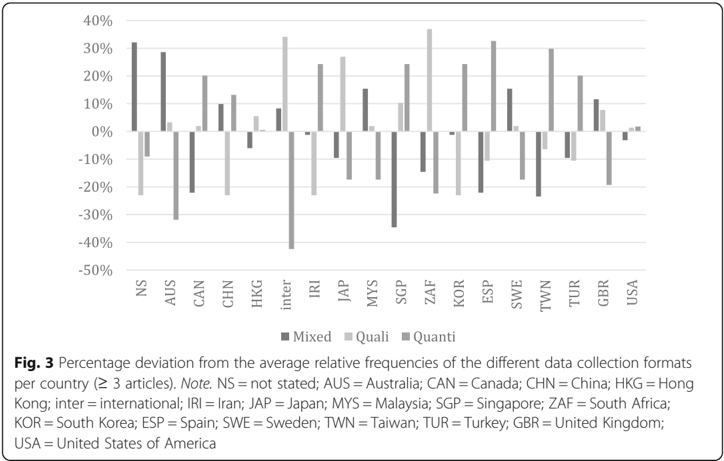
- Most studies used quantitative methods (103, 42%), followed by mixed methods (84, 35%) and qualitative methods (56, 23%); 225 studies (93%) lacked a definition of student engagement, and 59% did not employ a theoretical model.
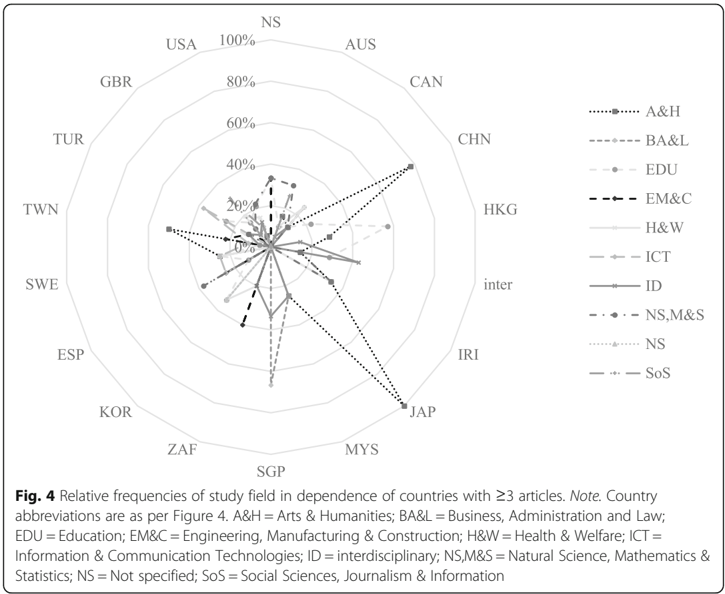
- Research was concentrated in the US (86 studies, 35.4%), UK (26, 10.7%), Australia (19, 7.8%), Taiwan (18, 7.4%), and China (9, 3.7%); top tools were LMS (n = 89), discussion forums (n = 80), videos (n = 44), recorded lectures (n = 25), and chat (n = 24).
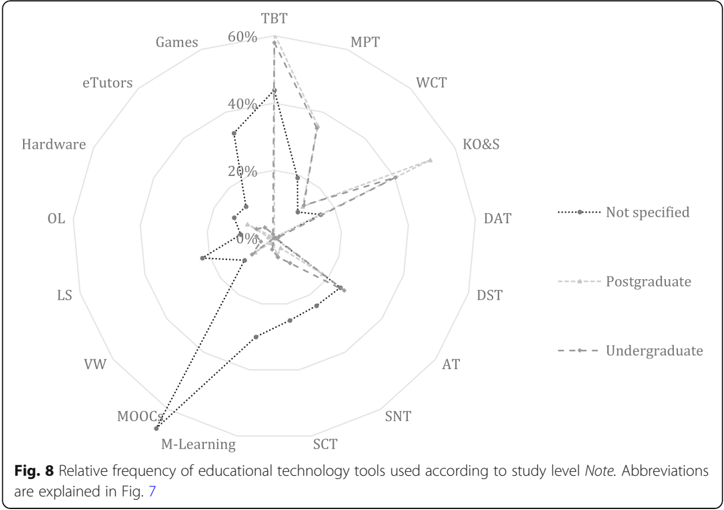
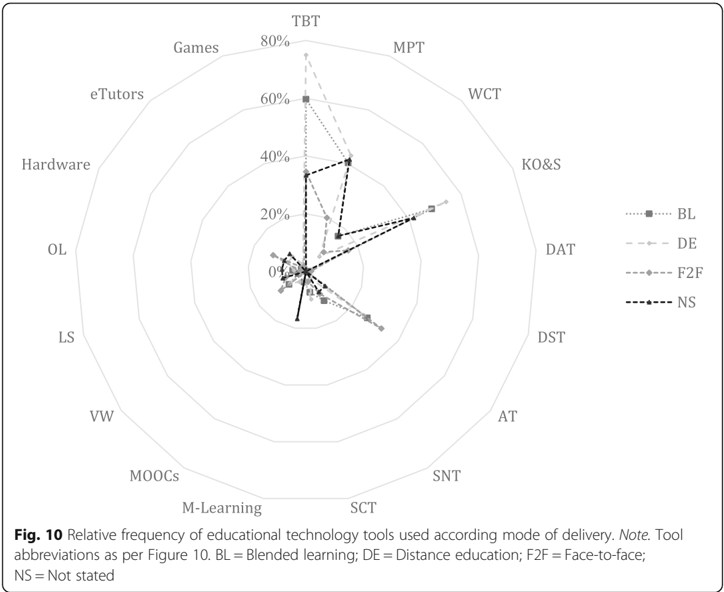
- Blended learning was the most researched mode of delivery (109 studies), followed by distance education (72) and face-to-face instruction (55); undergraduate students were the primary population (146 studies, 60%), while 41 studies (17%) did not specify study level.
Methods
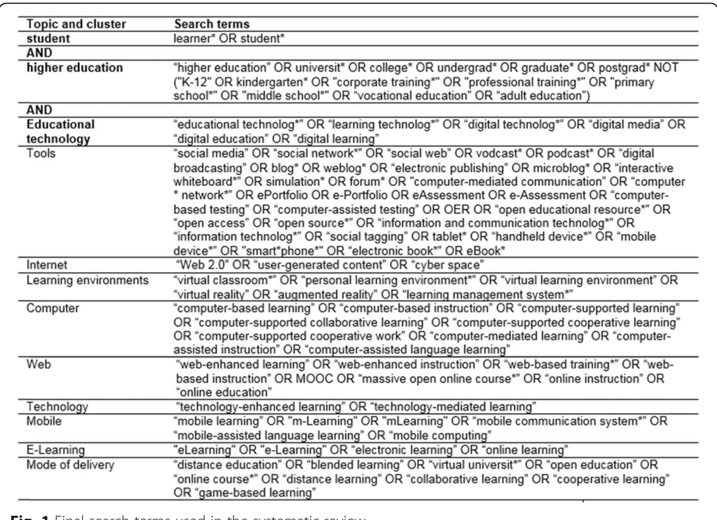
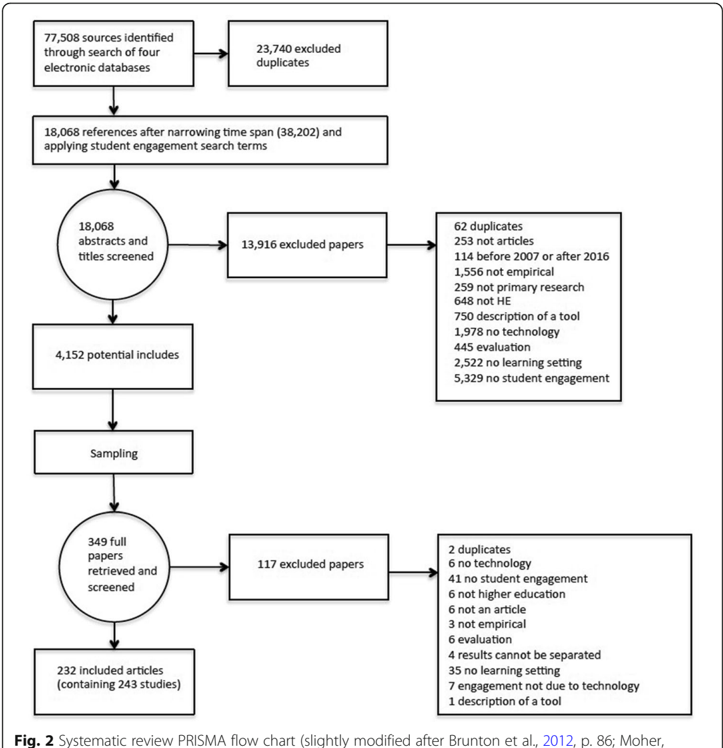
- Systematic evidence map/systematic review; four databases (ERIC, Web of Science, Scopus, PsycINFO) were searched in July 2017, retrieving 77,508 initial references, 53,768 after duplicate removal, and 18,068 records after adjusting the period to 2007–2016.
- After title/abstract screening, 4,152 potentially relevant articles remained; sample size estimation (5% error range, 50% proportion, 5% alpha) produced 349 sampled articles stratified by publishing year, and full-text screening left 232 articles containing 243 studies.
- Data were extracted using an extensive coding system covering study methodology, sample, learning scenario, mode of delivery, educational technology, and cognitive, affective, or behavioural engagement/disengagement indicators.
Limitations
- Stated: only English-language articles were included; grey literature, book chapters, monographs, and journals not indexed in the four databases were excluded; the review was limited to 2007–2016; the sampling strategy likely accounts for low numbers of studies from South America and Africa.
- Stated: peer review was used as a baseline quality criterion, and the human possibility of overlooking or misinterpreting information during coding cannot be fully excluded.
- Evident from the text: the authors note that search and sampling strategy may contribute to geographic imbalance, and they frame student engagement as remaining under-theorised and often considered only fragmentally in the corpus.
Model-written summary. Check it against the paper before relying on it.
Integrity signals
Registry
Cites
Statistics
Figures
Verification
Claims the paper makes
6 Valid · 1 Not valid · 30 Not checked · 118 Own results and interpretations
The cited sources support only part of this claim — read each source’s verdict below.
In the paper
“Linked to this, educational technology research has, however, lacked theoretical guidance (Al-Sakkaf, Omar, & Ahmad, 2019; Hew, Lan, Tang, Jia, & Lo, 2019; Lundin, Bergviken Rensfeldt, Hillman, Lantz-Andersson, & Peterson, 2018).”
- Also stated in: § Introduction · plain
“educational technology research has, however, lacked theoretical guidance (Al-Sakkaf, Omar, & Ahmad, 2019; Hew, Lan, Tang, Jia, & Lo, 2019; Lundin, Bergviken Rensfeldt, Hillman, Lantz-Andersson, & Peterson, 2018).”
What the sources say
- Not checked — no full text of the sourcecites Al-Sakkaf, Omar, & Ahmad, 2019 matched to “A systematic literature review of student engagement in software visualization: a theoretical perspective” (2019) source
- Not checked — no full text of the sourcecites Hew, Lan, Tang, Jia, & Lo, 2019 matched to “Where is the “theory” within the field of educational technology research?” (2019) source
- Partly supportedcites Lundin, Bergviken Rensfeldt, Hillman, Lantz-Andersson, & Peterson, 2018 matched to “Higher education dominance and siloed knowledge: a systematic review of flipped classroom research” (2018) sourceExperimental — accuracy not yet measured
The Abstract says that flipped classroom research often lacks anchoring in learning theory or instructional design, and the Discussion and conclusions recommends stronger theoretical anchoring. The citing sentence extends this finding to educational technology research generally, which the paper does not establish. (LLM, conf=0.87)
plain- Asserted: passes — The authors put it forward as true.
- Checkable: passes — It can be checked against evidence.
- Load-bearing: passes — The paper’s conclusions depend on it.
- Based: passes — The paper gives a reason why it holds.
- Also stated in: § Introduction · plain
The sources with a verdict support this claim; the rest weren’t checked yet, have no full text we could read, or their verdicts aren’t rated yet.
In the paper
“Reviews that have included research using a range of methodologies, have found a limited number of studies employing qualitative methods (e.g. Connolly, Boyle, MacArthur, Hainey, & Boyle, 2012; Kay & LeSage, 2009; Lundin et al., 2018).”
What the sources say
- Not checked — no full text of the sourcecites Connolly et al., 2012 matched to “A systematic literature review of empirical evidence on computer games and serious games” (2012) source
- Not checked — no full text of the sourcecites Kay & LeSage, 2009 matched to “Examining the benefits and challenges of using audience response systems: A review of the literature” (2009) source
- Supportedcites Lundin et al., 2018 matched to “Higher education dominance and siloed knowledge: a systematic review of flipped classroom research” (2018) source
In Discussion and conclusions (page unavailable), Lundin et al. say that qualitative analyses of actual student learning are rare in the flipped-classroom research they reviewed. They also report that simple course questionnaires and pre- and post-tests make up a large part of that research. This supports the citing sentence’s point in the context of flipped-classroom studies. (LLM, conf=0.86)
plain- Asserted: passes — The authors put it forward as true.
- Checkable: passes — It can be checked against evidence.
- Load-bearing: passes — The paper’s conclusions depend on it.
- Based: passes — The paper gives a reason why it holds.
Every source the paper cites for this claim was checked and supports it.
In the paper
“with students showing, for example, disinterest in topics chosen e.g., (Sullivan & Longnecker, 2014)”
What the sources say
- Supportedcites Sullivan & Longnecker, 2014 matched to “Class blogs as a teaching tool to promote writing and student interaction” (2014) source
Table 5 (Conclusion) records a student saying that the week's posts did not necessarily interest them and another asking to choose topics instead of using a fixed set of readings. These comments support the cited example of student disinterest, though the paper also reports positive views of some blog topics. (LLM, conf=0.88)
plain- Asserted: passes — The authors put it forward as true.
- Checkable: passes — It can be checked against evidence.
- Load-bearing: unclear — It is unclear whether the paper’s conclusions depend on it.
- Based: passes — The paper gives a reason why it holds.
- Supported
Every source the paper cites for this claim was checked and supports it.
In the paper
“and continued avoidance of using blogs in some cases, despite introductory training e.g., (Keiller & Inglis-Jassiem, 2015).”
What the sources say
- Supportedcites Keiller & Inglis-Jassiem, 2015 matched to “A lesson in listening: Is the student voice heard in the rush to incorporate technology into health professions education?” (2015) source
The Intervention section says students were invited to training on accessing and using a university-based blogging platform. The Results section reports that students did not access the platform during the study period and cited unfamiliarity with blogging even after training. (LLM, conf=0.94)
plain- Asserted: passes — The authors put it forward as true.
- Checkable: passes — It can be checked against evidence.
- Load-bearing: unclear — It is unclear whether the paper’s conclusions depend on it.
- Based: passes — The paper gives a reason why it holds.
- Supported
In the paper
“Out of 27 identified reviews (see Additional file 3), only 14 report the countries included”
What the sources say
- Not matchedcites Additional file 3
This doesn’t read as a citation we can look up.
plain- Asserted: passes — The authors put it forward as true.
- Checkable: passes — It can be checked against evidence.
- Load-bearing: passes — The paper’s conclusions depend on it.
- Based: passes — The paper gives a reason why it holds.
- Not matched
87 more claims
Create a free account to see all 155 claims and to verify the 1 reference still open.
- Probably not a substantial claim. 27
- It may state two separate claims as one. 44
- The quote only partly states this claim. 2
Claims other papers make about this one
Each is checked against this paper’s own text: does it say what the citing paper says it does?
The source backs part of the claim, not all of it — or backs it for a different population, condition or comparison.
In the citing paper
“As previous LA and educational technology reviews have found (e.g., Bergdahl et al., 2020;Bond et al., 2020;Banihashem et al., 2022), there is an underrepresentation of African and South and Central American research, although this might be due in some part to the search strategy employed for this review.”
From Unpacking student engagement in higher education learning analytics: a systematic review (2024) · cites this paper as Bond et al., 2020
Experimental — accuracy not yet measuredThe source backs part of the claim, not all of it — or backs it for a different population, condition or comparison.
In the citing paper
“HELA research also focused heavily on undergraduate students, with only a small percentage of studies exploring postgraduate student engagement (Bergdahl et al., 2020;Bond et al., 2020), and a large proportion of participants (60%) were from a STEM discipline, which raises questions of wider study generalisability (Kaliisa et al., 2024).”
From Unpacking student engagement in higher education learning analytics: a systematic review (2024) · cites this paper as Bond et al., 2020
Experimental — accuracy not yet measuredThe source backs part of the claim, not all of it — or backs it for a different population, condition or comparison.
In the citing paper
“Studies suggest that professional development and training in LA can improve educators' capacity to use data-driven insights to support student learning (Bergdahl et al., 2020;Bond et al., 2020;Gašević et al., 2019).”
From Unpacking student engagement in higher education learning analytics: a systematic review (2024) · cites this paper as Bond et al., 2020
Experimental — accuracy not yet measuredThe cited source says what the claim attributes to it.
In the citing paper
“Given that the nexus between SE and technology use in higher education has not yet been comprehensively researched, a systematic review was conducted into this topic”
From Facilitating student engagement through educational technology in higher education: A systematic review in the field of arts and humanities (2020) · cites this paper as Bond et al., 2020
The cited source says what the claim attributes to it.
In the citing paper
“Student engagement is often conceptualized along three dimensions: behavioral, cognitive, and affective engagement (Fredericks et al., 2004; Bond et al., 2020).”
From Effects of Generative AI on Engagement and Performance Within Asynchronous Online Courses (2026) · cites this paper as Bond et al., 2020
2 more claims about this paper
Create a free account to see every claim other papers make about this one.
Self-check
Percentages, sums and reported differences re-computed from the paper’s own numbers.
Each contradiction between two passages listed here was confirmed by an independent check.
Rated major: it would touch a result — a value a result rests on, reported and recomputed p-values on opposite sides of the significance level, two passages that conflict with no sign which is right, or a cited work retracted before this paper was published.
In the paper
“59% (n = 100) of studies did not employ a theoretical model in their research. Of the 41% (n = 100) that did”
Reported 59 · recomputed 41.152263
Rated minor: it would not touch a result — a value no result rests on, a p-value that stays on the same side of the significance level, or a conflict that is clerical, resolved elsewhere in the paper, or outside its own findings.
In the paper
§ Discussion
“Natural Sciences, Mathematics & Statistics, nevertheless, assuming rank 3 with 38 studies (15.6%).”
§ Method
“Natural Sciences, Mathematics & Statistics (37) being the top three study fields”
Citations
Cites
Preferred Reporting Items for Systematic Reviews and Meta-Analyses: the PRISMA statement
Moher, D., Liberati, A., Tetzlaff, J., Altman, D. G., & for the PRISMA Group (2009) · BMJ · doi:10.1136/bmj.b2535 · Cited by 83,823
(1978) · Medical Entomology and Zoology · Cited by 53,488
The Discovery of Grounded Theory: Strategies for Qualitative Research.
Wagner, H. R., Glaser, B. G., & Strauss, A. L. (1968) · Social Forces · doi:10.2307/2575405 · Cited by 46,361
Preferred reporting items for systematic reviews and meta-analyses: the PRISMA Statement.
(2009) · PubMed Central · Cited by 44,859
The Discovery of Grounded Theory; Strategies for Qualitative Research
Glaser, B. G., Strauss, A. L., & Strutzel, E. (1968) · Nursing Research · doi:10.1097/00006199-196807000-00014 · Cited by 39,449
Kytle, J., & Bandura, A. (1978) · Contemporary Sociology · doi:10.2307/2065952 · Cited by 25,422 · cited 1×
“Studies coded as SCL included those exploring social learning (Bandura, 1971) and social”
MethodSchool Engagement: Potential of the Concept, State of the Evidence
Fredricks, J. A., Blumenfeld, P. C., & Paris, A. H. (2004) · Review of Educational Research · doi:10.3102/00346543074001059 · Cited by 12,581 · cited 2×
“Therefore, more qualitative and ethnographic measures should also be employed, such as student observations with thick descriptions, which can help shed light on the complexity of teaching and learning environments (Fredricks et al., 2004; Heflin, Shewmaker, & Nguyen, 2017).”
BackgroundPierce, W. D., & Bandura, A. (1977) · Canadian Journal of Sociology / Cahiers canadiens de sociologie · doi:10.2307/3340496 · Cited by 9,650
Bandura, A. (1977) · Zenodo (CERN European Organization for Nuclear Research) · doi:10.5281/zenodo.15521699 · Cited by 7,607
The Discovery of Grounded Theory: Strategies for Qualitative Research
Brodsky, C. M. (1968) · Psychosomatics · doi:10.1016/s0033-3182(68)71872-7 · Cited by 6,679
Research works printed but not linked: 1
- Astin, A. W. (1984). Student involvement: A developmental theory for higher education. Journal of College Student Development, 25(4), 297–308.
Cited by
Items 401–500 of 1,053
Toquero, C. M. D. (2021) · Journal of Digital Educational Technology · doi:10.21601/jdet/11310 · Cited by 7
“It has also been linked to an increase in behavioral, affective, and cognitive student engagement, the facilitation of which is a central concern of educators” (Bond et al., 2020, p. 1).”
BackgroundGarcía, F. J. G., López-Francés, I., & Molla‐Esparza, C. (2023) · Pixel-Bit Revista de Medios y Educación · doi:10.12795/pixelbit.95555 · Cited by 5
Mertayasa, I. N. E., Agustini, K., & Subawa, I. G. B. (2022) · International Conference Vocational Education and Technology · doi:10.4108/eai.27-11-2021.2315631 · Cited by 8
Welmer, A., Asaba, E., Brodin, N., & Swärdh, E. (2025) · Frontiers in Education · doi:10.3389/feduc.2025.1557379 · Cited by 6
Appleby, A. M. (2023) · Journal of Criminal Justice Education · doi:10.1080/10511253.2023.2253128 · Cited by 7
Digital Learning Design: Designing Effective Online and Blended Learning
Müller, C. (2025) · Springer briefs in education · doi:10.1007/978-3-031-89045-1 · Cited by 14
Baigi, F., Yeganeh, M., & Bemanian, M. (2024) · Frontiers in Built Environment · doi:10.3389/fbuil.2024.1463658 · Cited by 9
Metaverse in Higher Education: Reshaping Pedagogies and Entrepreneurial Ventures
Akbar, K., Mbonye, V., & Govender, T. (2024) · Advances in e-business research series · doi:10.4018/979-8-3693-2422-6.ch008 · Cited by 5
ENHANCING STUDENTS’ ENGAGEMENT IN FLSP CLASS: THE IMPACT OF NEARPOD
Metaria, Muniroh, S., & Zubaidi, N. (2024) · Celtic A Journal of Culture English Language Teaching Literature and Linguistics · doi:10.22219/celtic.v11i1.33329 · Cited by 13
How Fantasy May Affect Student Engagement in Gamified Fully Online Classes: A Mixed-Method Study
Bai, S., Hew, K. F., & Gonda, D. E. (2022) · International Conference on Information Technology Based Higher Education and Training (ITHET) · doi:10.1109/ithet56107.2022.10031915 · Cited by 3
“More engaged students tend to achieve more satisfactory academic performance [1].”
BackgroundAnalyzing factors influencing student engagement in an educative social media platform
Lobo-Quintero, R., Hernández‐Leo, D., Taibi, D., Theophilou, E., & Sánchez-Reina, J. R. (2024) · Behaviour and Information Technology · doi:10.1080/0144929x.2024.2406259 · Cited by 12
“As several studies have argued, when individuals are actively engaged, they are more likely to immerse themselves in the learning experience, make meaningful connections with their peers, and develop a deeper understanding of learning topics (Boekaerts 2016; Bond et al. 2020).”
Francisco, J. C. (2023) · Journal of English Language Teaching and Applied Linguistics · doi:10.32996/jeltal.2023.5.2.18 · Cited by 4
Wang, J., & Guo, K. (2025) · System · doi:10.1016/j.system.2025.103857 · Cited by 9
Xu, X., Thien, L. M., Lin, J., & Li, Y. (2025) · Education and Information Technologies · doi:10.1007/s10639-025-13594-6 · Cited by 5
“This gap is significant as systemic improvement in higher education often involves more complex interactions between technology, pedagogy, and student needs (Bizami et al., 2023; Bond et al., 2020).”
Peters, M., Pérez-Navarro, A., & Fàbregues, S. (2022) · The Electronic Journal of e-Learning · doi:10.34190/ejel.20.4.2327 · Cited by 3
UNVEILING STUDENT PERSPECTIVES: EXPLORING THE IMPACT OF GAMIFICATION IN ENGLISH LANGUAGE TEACHING
Yazid, S. R., Heriyawati, D. F., & Mistar, J. (2024) · English Review Journal of English Education · doi:10.25134/erjee.v12i1.9371 · Cited by 15
“The participants' favorable reactions to the competitive aspect of gamification align with previous research that highlights the motivating influence of competition on both engagement and performance (Bond et al., 2020).”
ResultZammit, E., Raffaele, C. D., Scerri, D., Aquilina, R., Calleja, J., & Rizzo, A. (2024) · Lecture notes in networks and systems · doi:10.1007/978-3-031-71530-3_16 · Cited by 6
Quantifying online engagement at three levels of undergraduate study
McKenna, B. A., Wehr, J. B., & Kopittke, P. M. (2024) · Cogent Education · doi:10.1080/2331186x.2024.2345939 · Cited by 8
“In a global mapping review, 243 studies examined technology and student engagement (Bond et al., 2020).”
Silvestre-López, A.-J., & Girón-García, C. (2023) · English language education · doi:10.1007/978-3-031-27825-9_11 · Cited by 6
Web 2.0 tools and information literacy instruction in UK university libraries: Hype or reality?
Shire, W., & McKinney, P. (2021) · Journal of Information Literacy · doi:10.11645/15.2.2821 · Cited by 7
“…IL teaching (Deodato, 2018; Godwin, 2009) and that the supposed benefits of technology-enhanced constructivist learning, such as increased levels of student engagement, are ‘under-theorised’ and ‘only considered fragmentally in research’ across the higher education sector (Bond et al., 2020, p.21).”
BackgroundInfluentialStudent experiences and preferences for offline interactions with university lecturers
Ragusa, A. T. (2025) · Rural Society · doi:10.1080/10371656.2025.2465168 · Cited by 7
“…quality, and suitability, of learning engagement theory, and research noting the concept “student-engagement” suffers from definitional ambiguity restricts its utility for evaluating student-satisfaction and academic progress (Bond et al., 2020; Tomlinson, 2018), informed the instrument content.”
Vo, T. D. (2021) · Open Access Victoria University of Wellington | Te Herenga Waka (Figshare) · doi:10.26686/wgtn.14138144.v1 · Cited by 10
Zheng, X., Hasegawa, S., Gu, W., & Ota, K. (2024) · Education Sciences · doi:10.3390/educsci14060556 · Cited by 4
Behavioral Intention of Women to Use E-Learning
Abbas, H. A. (2024) · International Journal of Technology and Human Interaction · doi:10.4018/ijthi.343520 · Cited by 7
Economic Processes and Social Results of Digitalization of the Educational Sphere
Afanasyeva, T. S., Ilyina, I., Fetisova, G. V., & Pokrovskaia, N. N. (2021) · Advances in economics, business and management research/Advances in Economics, Business and Management Research · doi:10.2991/aebmr.k.210222.006 · Cited by 3
“The topic of digitalization of the educational environment has been quite actively discussed in scientific circles in recent years, and even that small part of the research that we use in this work to demonstrate the specifics of transformations in the educational sphere proves the ever-increasing relevance of this is…”
BackgroundNguyen, N. D.-H., Nguyen, P. V., & Pham, H. T. (2025) · SAGE Open · doi:10.1177/21582440251392369 · Cited by 7
“Student engagement is extensively recognized in academic literature as a multifaceted construct emerging from interactions between students and their educational contexts (Bond et al., 2020; Kahu & Nelson, 2018; Lawson & Lawson, 2013).”
Grouping Strategy Effects on Students' Engagement in Technology-Enhanced Collaborative Learning
Esfijani, A., & Sadeghi, F. (2024) · International and National Conference on E-Learning and E-Teaching (ICeLeT) · doi:10.1109/icelet62507.2024.10493061 · Cited by 5
“Student engagement defined by Bond et al., as “the energy and effort that students employ within their learning community, observable via any number of behavioral, cognitive or affective indicators across a continuum” [22].”
BackgroundBelliston, S. L. (2020) · Digital Scholarship - UNLV (University of Nevada Reno) · doi:10.34917/23469710 · Cited by 5
Sari, A. A. (2023) · Jurnal Pendidikan Guru Sekolah Dasar · doi:10.47134/pgsd.v1i2.168 · Cited by 5
Kanagaraj, P., Arulappan, J., Pradhan, A., & Mohamed, S. M. M. (2024) · SAGE Open Nursing · doi:10.1177/23779608241272484 · Cited by 5
“The students are expected to actively participate, show positive conduct, self-regulated, display deep learning and understanding, and should demonstrate positive reactions to the learning environment, peers, and teachers (Bond et al., 2020).”
BackgroundImpact of Feedback Features on Students' Learning Strategies: A Systematic Literature Review
Chan, C. M.-P., Mendes, A. J., & Pang, P. C. (2024) · IEEE Frontiers in Education Conference (FIE) · doi:10.1109/fie61694.2024.10892939 · Cited by 4
“According to [29], participation/interaction/involvement was ranked first among the top ten student engagement indicators.”
Bouktif, S., & Nimmi, K. (2024) · IEEE International Conference on Progress in Informatics and Computing · doi:10.1109/pic62406.2024.10892772 · Cited by 3
“This type of system is essential when it comes to student behavior analysis in order to asses his/her academic performances [10] and computer vision has played a significant role so far.”
Perspectives of Visible Learning for Quality Learning Environment: A Case Study
Tong, H. C. C., Sidhu, G. K., & Wang, R. (2023) · Environment-Behaviour Proceedings Journal · doi:10.21834/e-bpj.v8i25.4839 · Cited by 3
“Student engagement consists of behavioural, emotional, and cognitive engagement, which are keys to improving student learning achievement (Bond et al., 2020).”
BackgroundThe Development of the Participatory Approach to Digital Learning: Research Findings from Poland
Jarkiewicz, A. B., Krawczyk, A. M., & Szulewicz, E. (2025) · Technology Knowledge and Learning · doi:10.1007/s10758-025-09848-4 · Cited by 6
Yang, C., Xu, Z., Lin, Y., & Zhang, Y. (2026) · Computers & Education · doi:10.1016/j.compedu.2026.105720 · Cited by 3
Dvořáková, K., Emmer, J., Janktová, R., & Klementová, K. (2023) · Tuning Journal for Higher Education · doi:10.18543/tjhe.2327 · Cited by 5
Implications of Message Length and Delay in Undergraduate Online Discussions
López-Francés, I., García, F. J. G., López, B. G., & Molla‐Esparza, C. (2022) · RIED Revista Iberoamericana de Educación a Distancia · doi:10.5944/ried.25.2.32810 · Cited by 4
“Since the turn of the century, Higher Education institutions around the world have increasingly invested in educational technology and learning management systems (Bond et al., 2020; Müller & Wulf, 2020) and even more so in the Covid-19 pandemic (Abu Talib et al., 2021; Z. Chen et al., 2021).”
BackgroundAffordances and Core Features of Successful Digital Courses Design in Higher Education
Khodabandelou, R., Yousef, A. M. F., & Elhaj, A. (2025) · Open Praxis · doi:10.55982/openpraxis.17.3.890 · Cited by 13
Bibliometric analysis of studies on mental health in higher education from 1960 to 2024
Ertem, H. Y. (2025) · Discover Psychology · doi:10.1007/s44202-025-00402-y · Cited by 6
“The result based on this disparity in publication output is compatible with the research in the literature [37–39].”
Tourism Education and Digital Learning Environments: The Contribution of Transformative Learning
Kallou, S., Kikilia, A., & Kalogiannakis, M. (2024) · Springer proceedings in business and economics · doi:10.1007/978-3-031-54342-5_9 · Cited by 4
eLearning Engagement in a Transformative Social Learning Environment
Crawford, C. M., & Simons, M. A. (2021) · Advances in educational technologies and instructional design book series · doi:10.4018/978-1-7998-6956-6 · Cited by 6
Marissa, D. N., & Allahji, W. (2021) · Springer eBooks · doi:10.1007/978-3-030-84067-9_22 · Cited by 4
Manyuen, M., Boonlue, S., Neanchaleay, J., & Nittayathammakul, V. (2022) · International Journal of Advanced Computer Science and Applications · doi:10.14569/ijacsa.2022.0130960 · Cited by 3
Jauregui, J., Schrepel, C. P., & McClintock, A. H. (2022) · Medical Education · doi:10.1111/medu.15015 · Cited by 3
“Just like the barista in the black apron, an engaged student is defined by the energy and effort that they employ through interacting with others across a continuum of three dimensions: cognitive, affective and behavioural.(1,3,7) The cognitive domain is the student's available and intentionally invested mental resour…”
BackgroundEnhancing Student Involvement in a Technologically Connected World
Boone, J. B. (2020) · Advances in mobile and distance learning book series · doi:10.4018/978-1-7998-3583-7.ch002 · Cited by 3
Eremionkhale, A. E., Sadeh, J., & Sun, Y. (2025) · International Review of Economics Education · doi:10.1016/j.iree.2025.100327 · Cited by 3
Nitsche, J., Busse, T. S., Kernebeck, S., & Ehlers, J. P. (2022) · International Journal of Environmental Research and Public Health · doi:10.3390/ijerph191610184 · Cited by 3
Utilizing The Pandemic Disruption To Identify Distance Learning Challenges
Champa, T., Waterbury, T., & McQuinn, A. (2021) · Quarterly review of distance education · doi:10.1108/qrde-06-2021-0004 · Cited by 3
Artificial Intelligence as a Harbinger of Engagement and Collaboration
Ouariach, S., Ouariach, F. Z., & Khaldi, M. (2025) · Advances in educational technologies and instructional design book series · doi:10.4018/979-8-3373-2262-9.ch006 · Cited by 6
Yin, X., Ye, J., Yu, S., Li, H., & Lu, G. (2025) · Education and Information Technologies · doi:10.1007/s10639-025-13831-y · Cited by 9
“Several studies have highlighted various factors that may influence students’ academic performance, such as their AI literacy (Southworth et al., 2023), perception of technology (Yang et al., 2024), and engagement (Bond et al., 2020).”
Vorobel, O., & Finn, H. (2025) · Journal of Ethnic and Cultural Studies · doi:10.29333/ejecs/2206 · Cited by 3
“Engagement in the Second Language Writing Classroom Bond et al. (2020) offer a succinct definition for student engagement in that it encompasses the energy and effort that students put forth in a learning community, and relationships, classroom activities, and the learning environment can all…”
Buntins, K., Mulders, M., & Schröder, N. (2023) · MedienPädagogik Zeitschrift für Theorie und Praxis der Medienbildung · doi:10.21240/mpaed/54/2023.11.19.x · Cited by 4
Self-citationUsing Technology to Enhance Student Engagement in STEM Subjects in Higher Education
Chakabwata, W. (2022) · Advances in educational technologies and instructional design book series · doi:10.4018/978-1-6684-5920-1.ch009 · Cited by 4
García-Hirschfeld, E. C., Santos, M. Á. R., & López-Martín, C. (2025) · The International Journal of Management Education · doi:10.1016/j.ijme.2024.101124 · Cited by 8
Grothaus, C. (2023) · Online Learning · doi:10.24059/olj.v27i3.3413 · Cited by 8
Student Engagement Among Undergraduate Students in Southeast Asia: Systematic Literature Review
Immanuella, B. D. U., Kurniawati, F., & Rifameutia, T. (2023) · Journal of Innovation in Educational and Cultural Research · doi:10.46843/jiecr.v4i4.961 · Cited by 13
“The more engaged students will be more likely to succeed academically (Bond et al., 2020).”
BackgroundAlseitova, A., Oliveira, W., Li, Z., Shi, L., & Hamari, J. (2024) · IEEE International Conference on Advanced Learning Technologies (ICALT) · doi:10.1109/icalt61570.2024.00008 · Cited by 3
“The integration of educational technology tools has become integral to contemporary education, as evidenced by numerous studies [1]–[3].”
BackgroundThe Impact of Digital Learning Technology on Higher Education Students' Mental Health
Oztosun, L., Gonzo, F. C., & Nadda, V. K. (2023) · Advances in educational technologies and instructional design book series · doi:10.4018/978-1-6684-8282-7.ch005 · Cited by 9
Xiangze, Z., & Abdullah, Z. B. (2023) · SSRN Electronic Journal · doi:10.2139/ssrn.4534571 · Cited by 3
Current Trends in Smart Classrooms and Sustainable Internet of Things
Çela, E., Fonkam, M. M., Eappen, P., & Vajjhala, N. R. (2024) · Advances in business information systems and analytics book series · doi:10.4018/979-8-3693-5498-8.ch001 · Cited by 9
Utilization of Web-Facilitated Learning to Improve Teacher Skills in Identifying Basic Competencies
Rahman, M. R., Panggayuh, B. P., & Rusydiyah, E. F. (2022) · Journal of Innovation in Educational and Cultural Research · doi:10.46843/jiecr.v3i2.87 · Cited by 8
“Specifically for education, Bond et al (2020) stated that the use of technology has the potential to make the learning process more intensive, can increase student motivation (Alioon & Delialioğlu, 2019), stimulate students to be more actively involved in the learning process and motivate students…”
BackgroundApplication of RNN-ET-Based Digital Education Using Speech Interactions
Nayak, I., Bansal, S., Kale, P., Tonpe, S. S., Kumar, C. S., & Rastogi, R. (2023) · International Conference on Self Sustainable Artificial Intelligence Systems (ICSSAS) · doi:10.1109/icssas57918.2023.10331628 · Cited by 5
“Over the past decade, educators, researchers, and politicians have all paid more attention to the potential benefits [17]of digitalization for student achievement.”
BackgroundEl rol del contexto educativo digital vs presencial en perfiles de engagement académico
Marenco-Escuderos, A. D., Restrepo, D., & Rambal-Rivaldo, L. I. (2024) · Revista de Investigación Educativa · doi:10.6018/rie.545371 · Cited by 3
Yan-jun, Y., & Tan, J. (2025) · SAGE Open · doi:10.1177/21582440251336512 · Cited by 10
“As a result, research on the relationship between learners’ perceptions of new technology and their engagement has been done (Bernacki et al., 2020; Binder, 2022; Bond et al., 2020; Code et al., 2020).”
Faldet, A.-C., Skrefsrud, T., Somby, H. M., & Stalheim, O. R. (2025) · Professional Development in Education · doi:10.1080/19415257.2025.2518536 · Cited by 4
Fahey, B., & Boddy, S. (2024) · AJP Advances in Physiology Education · doi:10.1152/advan.00036.2024 · Cited by 3
Blended online courses: students’ learning experiences and engaging instructional strategies
Heilporn, G., Lakhal, S., & Bélisle, M. (2023) · Pedagogies An International Journal · doi:10.1080/1554480x.2023.2219255 · Cited by 9
“Furthermore, student engagement is “shaped by a range of structural and internal influences, including the complex interplay of relationships, learning activities and the learning environment” (Bond et al., 2020, p. 3).”
BackgroundLai, D., Lew, S. L., & Ooi, S. Y. (2025) · Frontiers in Computer Science · doi:10.3389/fcomp.2025.1662386 · Cited by 3
Wang, L., & Li, X. (2023) · Comunicar · doi:10.58262/v32i78.17 · Cited by 2
Tang, X., Ni, J., Meng, Y., Chen, Q., & Zhang, L. (2026) · Sustainability · doi:10.3390/su18020736 · Cited by 6
Institutionalization of Bioethics in Higher Education Institutions: A Systematic Mapping
Frez-Pulgar, G., Valdés, Y., Negrier-Seguel, V., Gutiérrez-Gutiérrez, F., Cáceres-Senn, M., Glasserman‐Morales, L. D., & Hochstetter-Diez, J. (2025) · Journal of Bioethical Inquiry · doi:10.1007/s11673-025-10442-7 · Cited by 3
“Appropriate use of educational technology in higher education not only facilitates learning but can also significantly increase student engagement, fostering a more interactive and engaged learning environment (Bond, et al. 2020).”
Zhang, Z. (2026) · PLoS ONE · doi:10.1371/journal.pone.0347428 · Cited by 2
Jiang, C. (2023) · SAGE Open · doi:10.1177/21582440231181435 · Cited by 3
“…Allahyari, 2019; L. J. Zhang et al., 2019; Zhao & Liao, 2021), learning engagement (Baek & Lee, 2018; Bergdahl et al., 2020; Bond & Bedenlier, 2019; Bond et al., 2020; Soffer & Cohen, 2019; Wang & Hofkens, 2020; Xie et al., 2020; Yun & Park, 2018), and learning anxiety (Aydın, 2018; Cassady &…”
Hochuli, K., & Jud, J. (2025) · Learning Culture and Social Interaction · doi:10.1016/j.lcsi.2025.100923 · Cited by 8
Reflections on the Future of Statistics Education in a Technological Era
Alexander, C. L., Gaskell, J., & Davies, V. (2026) · Teaching Statistics · doi:10.1002/test.70047 · Cited by 6
“We do not focus on educational technologies such as live polling tools, as, while important, they are not specific to statistical education and have been explored in detail elsewhere (Bond et al., 2020; Grani´c, 2022).”
Apostol, R. L., & Santos, L. S. P. D. (2023) · European Journal of Education Studies · doi:10.46827/ejes.v10i11.5084 · Cited by 10
Lawrence, J., Brown, A. V., Redmond, P., Cohen, J. A., Foote, S. M., & Stone, C. (2024) · Student Success · doi:10.5204/ssj.3453 · Cited by 8
“…regular and ongoing synchronous and asynchronous formal and informal activities, actions, energy, and behaviours that involve the learner within their learning environment and broader learning community, where the end goal is to enhance and achieve learning (Bond et al., 2020; Remond et al., 2018).”
BackgroundThe Promise of Occupational Therapy: Occupational Engagement
da Cruz, D. M. C. (2023) · The Open Journal of Occupational Therapy · doi:10.15453/2168-6408.2111 · Cited by 3
Li, J. (2022) · Wireless Communications and Mobile Computing · doi:10.1155/2022/7563351 · Cited by 2
Money Matters: A Mixed-Methods Needs Assessment of US Young Adults' Financial NeedsPreprint
Bradford, B. C., Mallick, D. B., & Baraniuk, R. G. (2023) · EdArXiv (OSF Preprints) · doi:10.35542/osf.io/khtfu · Cited by 3
Psychometric Evaluation of a Creative Thinking Performance Test for Science EducationPreprint
Hasibuan, M. P., Sunarno, W., & Vh, E. S. (2025) · Research Square · doi:10.21203/rs.3.rs-8184708/v1 · Cited by 2
Mudra, H., & Sastria, E. (2023) · JURNAL TARBIYAH · doi:10.30829/tar.v30i1.2414 · Cited by 2
Promoting listening skills with an educational tool: VoScreen
MERZİFONLUOĞLU, A. (2023) · Journal of Educational Technology and Online Learning · doi:10.31681/jetol.1343391 · Cited by 5
Online learning during the pandemic of COVID-19: Experiences of students and universities
Savić, I., & Alčaković, S. (2022) · The European Journal of Applied Economics · doi:10.5937/ejae19-39714 · Cited by 4
“Digital technology has become one of the top priorities of higher education, and it directly affects all elements of the student experience (Bond et al., 2020).”
BackgroundWu, T., Hapsari, I. P., & Huang, Y. (2026) · ReCALL · doi:10.1017/s0958344025100451 · Cited by 6
“Some researchers view that engagement involves both behavior and emotion (Skinner, 2016), while others propose a three-dimensional model encompassing cognitive, behavioral, and emotional aspects (Bond et al ., 2020; Fredricks et al ., 2004; Skinner, 2016).”
Cross, L., Carey, E., Benham‐Clarke, S., Hartley, A., Mathews, F., Burn, A., Newlove‐Delgado, T., & Ford, T. J. (2024) · Emotional and Behavioural Difficulties · doi:10.1080/13632752.2024.2360778 · Cited by 4
“Whilst there is growing evidence highlighting the potential of technology to enhance learning experiences (e.g. Bond et al. 2020), our findings underscore the importance of interaction within learning, with interpersonal relationships between fellow peers and the classroom teacher playing a central…”
Exploring the User Experience (UX) of University Learning Management System (LMS)
Ibrahim, E. N. M., & Aziz, E. A. A. A. (2022) · International Journal of Academic Research in Progressive Education and Development · doi:10.6007/ijarped/v11-i3/14454 · Cited by 3
“Previous research has observed an association between the use of LMSs and student satisfaction (Redmond et al. 2018) and technology does have direct positive impact on student’s engagement, self-directed learning and desirable learning outcomes (Bond et al., 2020).”
BackgroundNooriani, S., Oveisi, S., Alizadeh, A., & Olfati, F. (2022) · Payām-i naw. · doi:10.61186/jgbfnm.19.2.41 · Cited by 2
“This pedagogical practice, whose presence in higher education has increased significantly, reinforces human characteristics, to benefits in the state of mind during the process )21(.”
Student Inclusion through Theoretical Reframing
Lamberti, A. P. (2022) · Discourse and Writing/Rédactologie · doi:10.31468/dwr.923 · Cited by 2
“Teachers and administrators are concerned especially with the pandemic’s toll on mental health (Wang et al., 2020) and student engagement (Bond et al., 2020).”
BackgroundRubenstein, D. A., & Kim, C. (2024) · Cellular and Molecular Bioengineering · doi:10.1007/s12195-024-00802-5 · Cited by 2
“Further, use of emerging technology has been shown to increase student engagement [1].”
Wibawa, E. A., Mulyani, H., & Darmawan, R. (2023) · Polyglot Jurnal Ilmiah · doi:10.19166/pji.v1i19.5995 · Cited by 11
Integration of Digital Technologies in Entrepreneurship Education in Nigeria
Wahab, F. K., & Akintade, E. A. (2025) · IGI Global eBooks · doi:10.4018/979-8-3693-7863-2.ch010 · Cited by 7
Wang, X., Zalli, M. M. M., & Tan, P. (2024) · Salud Ciencia y Tecnología - Serie de Conferencias · doi:10.56294/sctconf20251338 · Cited by 2
Rosak-Szyrocka, J., Apostu, S. A., & Akkaya, B. (2023) · Scientific Papers of Silesian University of Technology Organization and Management Series · doi:10.29119/1641-3466.2023.181.30 · Cited by 7
“Digitalization has altered the entire educational structure globally during the last decade, with practitioners, scholars, and policymakers paying close attention to educational progress (Bond et al., 2020; Pan et al., 2023; Rosak-Szyrocka, Zywiolek et al., 2022).”
Technologies used for visually impaired individuals in the museum environment: a systematic review
İşlek, D., & Aşıksoy, G. (2025) · Elsevier eBooks · doi:10.1016/b978-0-443-26482-5.00017-1 · Cited by 3
Redefining Learning Pathways: The Impact of AI-Enhanced Micro-Credentials on Education Efficiency
Asrifan, A., Sadaruddin, S., Ashar, A., Nonci, J., Setiawan, T., & Erniati, E. (2024) · Advances in educational technologies and instructional design book series · doi:10.4018/979-8-3693-5488-9.ch012 · Cited by 4
Asynchronous Discussion Forum: A Reflective E-learning Platform During COVID-19
Arora, B. (2021) · doi:10.1109/slae54202.2021.9686841 · Cited by 2
Analysis of the Impact of ChatGPT Utilization on the Levels of Laziness and Productivity
Arin, I. A., Farkhan, A., Muhamad, F., & Anjani, F. T. (2024) · International Conference on Technology Innovation and Its Applications (ICTIIA) · doi:10.1109/ictiia61827.2024.10761147 · Cited by 3
“These technologies can intensify teaching and learning processes, boost student self-efficacy and self-regulation, and increase participation in class and the broader university community [12].”
Peñalver, J., Marín, V. I., & Camaño, D. A. (2024) · European Journal of Education and Psychology · doi:10.32457/ejep.v17i2.2730 · Cited by 3
Xu, X., Dai, A., Wei, S., & Tan, L. (2024) · IEEE Frontiers in Education Conference (FIE) · doi:10.1109/fie61694.2024.10893059 · Cited by 2
Metadata
- Authors
- Bond, M., Buntins, K., Bedenlier, S., Zawacki-Richter, O., & Kerres, M.
- Affiliations
- Carl von Ossietzky Universität Oldenburg (DE)
- University of Duisburg-Essen (DE)
- Corresponding author
- Bond, Melissa
- Venue
- International Journal of Educational Technology in Higher Education
- Published
- 2020-01-22
- Volume
- 17
- Issue
- 1
- ISSN
- 2365-9440 (ISSN-L)
- OpenAlex
- W3014646985
- Cited by
- 1,097
- References
- 182
- Citations by year
- 2026: 257 · 2025: 216 · 2024: 187 · 2023: 170 · 2022: 123 · 2021: 118 · 2020: 26
- FWCI
- 165.40
- Type
- journal article
- Language
- en
- Open access
- diamond
- doi.org
- Licence
- cc-by
- creativecommons.org/licenses/by/4.0 (tdm)
- creativecommons.org/licenses/by/4.0 (vor)
- Locations
- International Journal of Educational Technology in Higher Education (publishedVersion, cc-by)
- UniSA Research Outputs Repository (University of South Australia) (acceptedVersion, other-oa)
- Adelaide Research & Scholarship (AR&S) (University of Adelaide) (submittedVersion, cc-by)
- DOAJ (DOAJ: Directory of Open Access Journals) (submittedVersion, cc-by-sa)
- Funders
- Bundesministerium für Bildung und Forschung (16DHL1007)
- Topics
- Social Sciences › Education › Online and Blended Learning
- Social Sciences › Education › Educational Technology in Learning
- Physical Sciences › Computer Science › Computer Science Applications › Online Learning and Analytics
- Keywords
- student engagement, educational technology, higher education, behavioral engagement, emotional engagement, cognitive engagement, blended learning, online forums, undergraduate students, research gaps
About these checks
Registry, retraction, Cites and statistics results are computed, not judged, with one exception: a printed reference that no index lists is read once by a model before it counts as a citation error. Claims are extracted by a model and kept only when their quote appears verbatim in the text; each cited source is then checked, with a model’s help, for whether it says what the claim relies on. Those verdicts can be wrong — read the claim’s quote and the cited source before relying on one.
The claim verdicts this report counts are experimental: their accuracy is not yet measured.
A language model drew the claims from the paper on 2026-09-29, under version 3 of the claim definition (model deepseek-v4.1-flash, prompt extract-v3).
A second model labelled each claim on 2026-09-29 (model jev-1.13-20260917, definition revision gold-guideline-v0.2).
Cited sources are checked with a language model’s help (gpt-6-sol).
Statistics and arithmetic are recomputed, not judged.
Confidence bands are shown only for fields calibrated on our annotated test set. None is calibrated yet, so no band is shown.
What counts as a claim ›How we measure confidence ›How we check this ›
Are you an author, or do you see a problem with this page? Request a review
Data sources
Bibliographic data: Semantic Scholar, OpenAlex, Crossref.
Contains information from the Semantic Scholar Academic Graph Datasets, made available under the ODC Attribution License (ODC-BY 1.0).
Semantic Scholar’s data is described in: Kinney, R., et al. (2023). The Semantic Scholar Open Data Platform. arXiv:2301.10140.
