

Mapping research in student engagement and educational technology in higher education: a systematic evidence map
Open accessThe DOI matches its Crossref record; 175 of the 182 references it cites were found in a registry or an index; 6 of the 54 sources its claims cite were checked for support.
Abstract
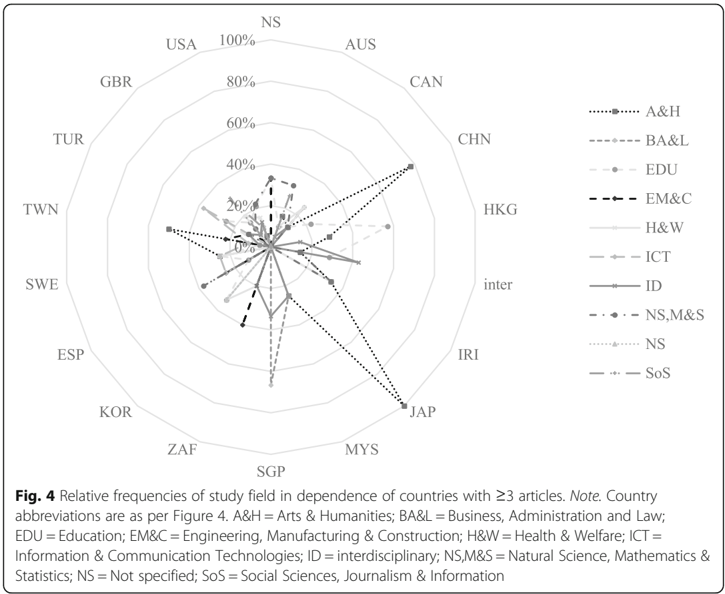
Abstract Digital technology has become a central aspect of higher education, inherently affecting all aspects of the student experience. It has also been linked to an increase in behavioural, affective and cognitive student engagement, the facilitation of which is a central concern of educators. In order to delineate the complex nexus of technology and student engagement, this article systematically maps research from 243 studies published between 2007 and 2016. Research within the corpus was predominantly undertaken within the United States and the United Kingdom, with only limited research undertaken in the Global South, and largely focused on the fields of Arts & Humanities, Education, and Natural Sciences, Mathematics & Statistics. Studies most often used quantitative methods, followed by mixed methods, with little qualitative research methods employed. Few studies provided a definition of student engagement, and less than half were guided by a theoretical framework. The courses investigated used blended learning and text-based tools (e.g. discussion forums) most often, with undergraduate students as the primary target group. Stemming from the use of educational technology, behavioural engagement was by far the most often identified dimension, followed by affective and cognitive engagement. This mapping article provides the grounds for further exploration into discipline-specific use of technology to foster student engagement.
Overview
CoChat Summary
TL;DR
This systematic evidence map synthesizes 243 studies published 2007–2016 on student engagement and educational technology in higher education. It finds research concentrated in the US and UK, dominated by quantitative methods, often lacking definitions or theory, and most frequently linking blended learning and text-based tools to behavioural engagement.
Key findings
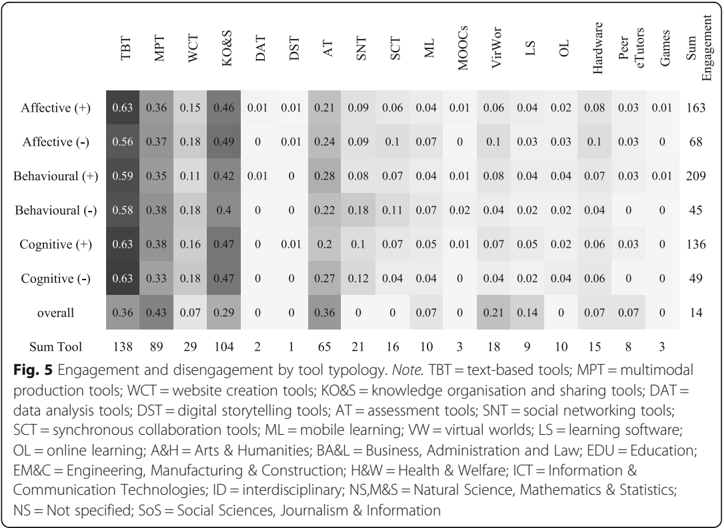
- Across 243 studies, behavioural engagement was documented in 209 studies (86%), affective engagement in 163 (67%), and cognitive engagement in 136 (56%); 117 studies (48%) showed all three dimensions.
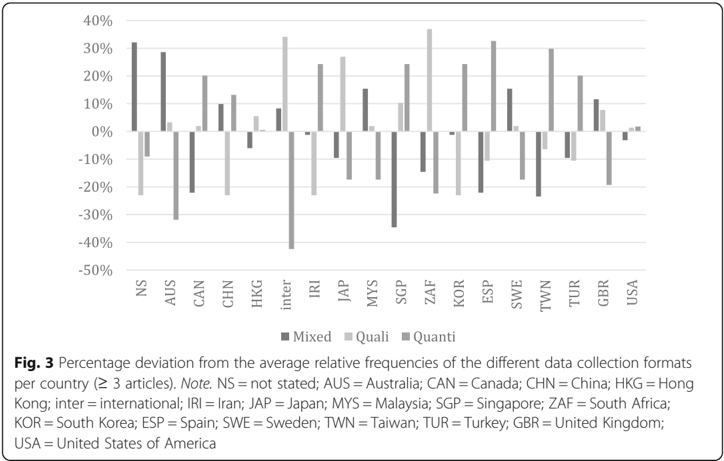
- Most studies used quantitative methods (103, 42%), followed by mixed methods (84, 35%) and qualitative methods (56, 23%); 225 studies (93%) lacked a definition of student engagement, and 59% did not employ a theoretical model.
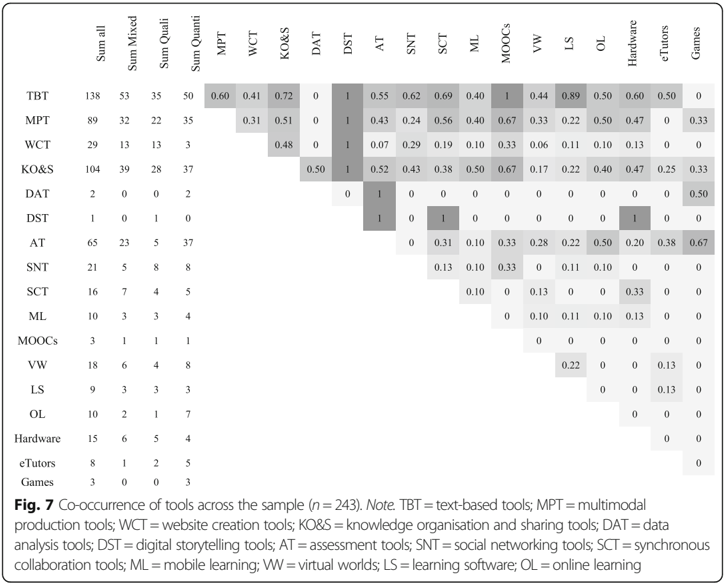
- Research was concentrated in the US (86 studies, 35.4%), UK (26, 10.7%), Australia (19, 7.8%), Taiwan (18, 7.4%), and China (9, 3.7%); top tools were LMS (n = 89), discussion forums (n = 80), videos (n = 44), recorded lectures (n = 25), and chat (n = 24).
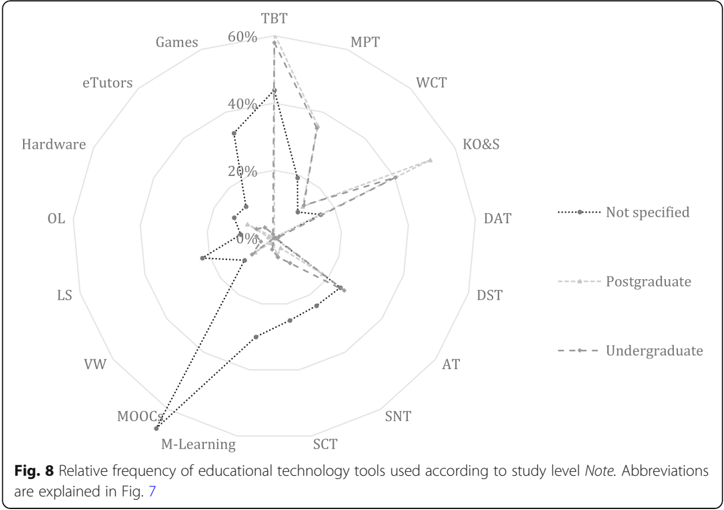
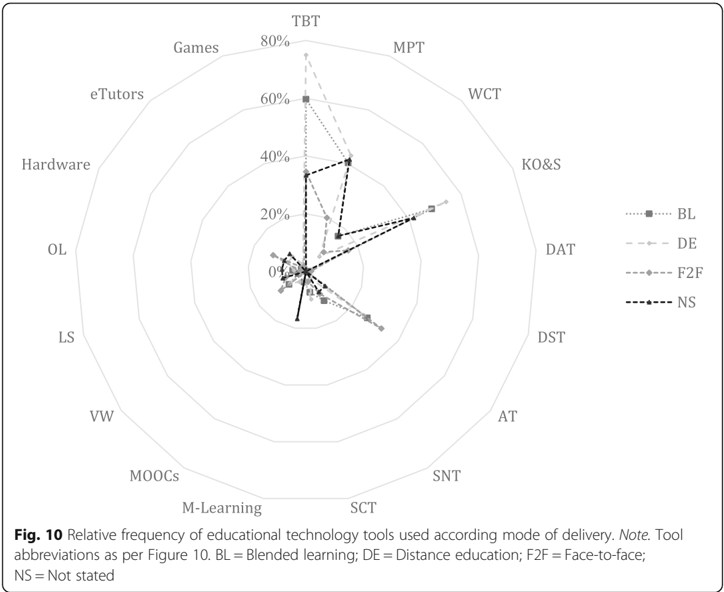
- Blended learning was the most researched mode of delivery (109 studies), followed by distance education (72) and face-to-face instruction (55); undergraduate students were the primary population (146 studies, 60%), while 41 studies (17%) did not specify study level.
Methods
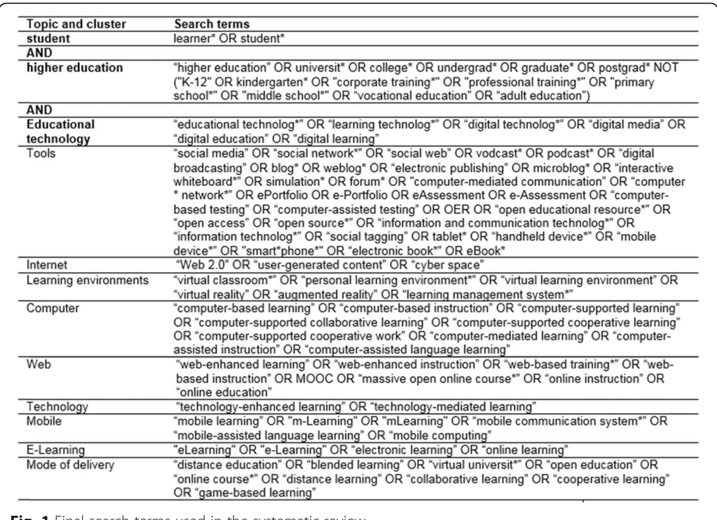
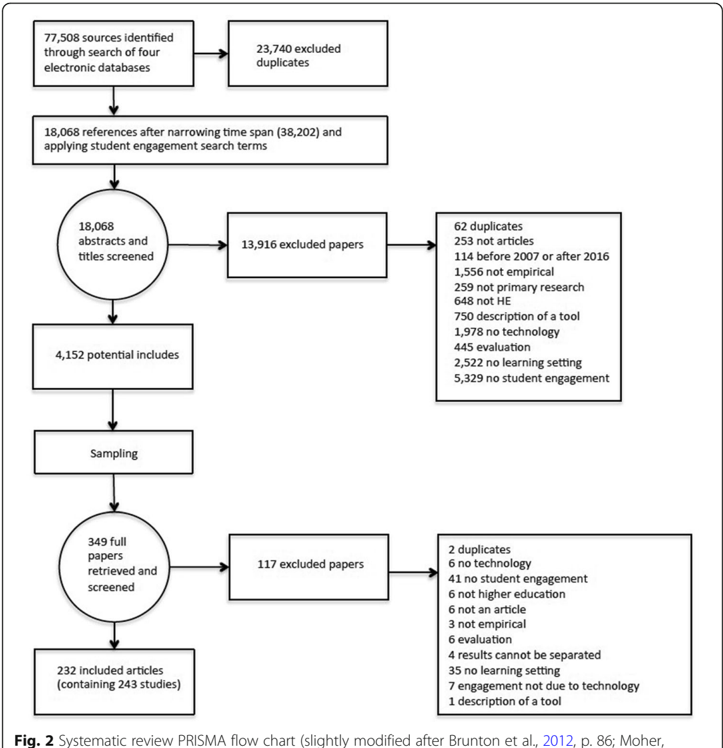
- Systematic evidence map/systematic review; four databases (ERIC, Web of Science, Scopus, PsycINFO) were searched in July 2017, retrieving 77,508 initial references, 53,768 after duplicate removal, and 18,068 records after adjusting the period to 2007–2016.
- After title/abstract screening, 4,152 potentially relevant articles remained; sample size estimation (5% error range, 50% proportion, 5% alpha) produced 349 sampled articles stratified by publishing year, and full-text screening left 232 articles containing 243 studies.
- Data were extracted using an extensive coding system covering study methodology, sample, learning scenario, mode of delivery, educational technology, and cognitive, affective, or behavioural engagement/disengagement indicators.
Limitations
- Stated: only English-language articles were included; grey literature, book chapters, monographs, and journals not indexed in the four databases were excluded; the review was limited to 2007–2016; the sampling strategy likely accounts for low numbers of studies from South America and Africa.
- Stated: peer review was used as a baseline quality criterion, and the human possibility of overlooking or misinterpreting information during coding cannot be fully excluded.
- Evident from the text: the authors note that search and sampling strategy may contribute to geographic imbalance, and they frame student engagement as remaining under-theorised and often considered only fragmentally in the corpus.
Model-written summary. Check it against the paper before relying on it.
Integrity signals
Registry
Cites
Statistics
Figures
Verification
Claims the paper makes
6 Valid · 1 Not valid · 30 Not checked · 118 Own results and interpretations
The cited sources support only part of this claim — read each source’s verdict below.
In the paper
“Linked to this, educational technology research has, however, lacked theoretical guidance (Al-Sakkaf, Omar, & Ahmad, 2019; Hew, Lan, Tang, Jia, & Lo, 2019; Lundin, Bergviken Rensfeldt, Hillman, Lantz-Andersson, & Peterson, 2018).”
- Also stated in: § Introduction · plain
“educational technology research has, however, lacked theoretical guidance (Al-Sakkaf, Omar, & Ahmad, 2019; Hew, Lan, Tang, Jia, & Lo, 2019; Lundin, Bergviken Rensfeldt, Hillman, Lantz-Andersson, & Peterson, 2018).”
What the sources say
- Not checked — no full text of the sourcecites Al-Sakkaf, Omar, & Ahmad, 2019 matched to “A systematic literature review of student engagement in software visualization: a theoretical perspective” (2019) source
- Not checked — no full text of the sourcecites Hew, Lan, Tang, Jia, & Lo, 2019 matched to “Where is the “theory” within the field of educational technology research?” (2019) source
- Partly supportedcites Lundin, Bergviken Rensfeldt, Hillman, Lantz-Andersson, & Peterson, 2018 matched to “Higher education dominance and siloed knowledge: a systematic review of flipped classroom research” (2018) sourceExperimental — accuracy not yet measured
The Abstract says that flipped classroom research often lacks anchoring in learning theory or instructional design, and the Discussion and conclusions recommends stronger theoretical anchoring. The citing sentence extends this finding to educational technology research generally, which the paper does not establish. (LLM, conf=0.87)
plain- Asserted: passes — The authors put it forward as true.
- Checkable: passes — It can be checked against evidence.
- Load-bearing: passes — The paper’s conclusions depend on it.
- Based: passes — The paper gives a reason why it holds.
- Also stated in: § Introduction · plain
The sources with a verdict support this claim; the rest weren’t checked yet, have no full text we could read, or their verdicts aren’t rated yet.
In the paper
“Reviews that have included research using a range of methodologies, have found a limited number of studies employing qualitative methods (e.g. Connolly, Boyle, MacArthur, Hainey, & Boyle, 2012; Kay & LeSage, 2009; Lundin et al., 2018).”
What the sources say
- Not checked — no full text of the sourcecites Connolly et al., 2012 matched to “A systematic literature review of empirical evidence on computer games and serious games” (2012) source
- Not checked — no full text of the sourcecites Kay & LeSage, 2009 matched to “Examining the benefits and challenges of using audience response systems: A review of the literature” (2009) source
- Supportedcites Lundin et al., 2018 matched to “Higher education dominance and siloed knowledge: a systematic review of flipped classroom research” (2018) source
In Discussion and conclusions (page unavailable), Lundin et al. say that qualitative analyses of actual student learning are rare in the flipped-classroom research they reviewed. They also report that simple course questionnaires and pre- and post-tests make up a large part of that research. This supports the citing sentence’s point in the context of flipped-classroom studies. (LLM, conf=0.86)
plain- Asserted: passes — The authors put it forward as true.
- Checkable: passes — It can be checked against evidence.
- Load-bearing: passes — The paper’s conclusions depend on it.
- Based: passes — The paper gives a reason why it holds.
Every source the paper cites for this claim was checked and supports it.
In the paper
“with students showing, for example, disinterest in topics chosen e.g., (Sullivan & Longnecker, 2014)”
What the sources say
- Supportedcites Sullivan & Longnecker, 2014 matched to “Class blogs as a teaching tool to promote writing and student interaction” (2014) source
Table 5 (Conclusion) records a student saying that the week's posts did not necessarily interest them and another asking to choose topics instead of using a fixed set of readings. These comments support the cited example of student disinterest, though the paper also reports positive views of some blog topics. (LLM, conf=0.88)
plain- Asserted: passes — The authors put it forward as true.
- Checkable: passes — It can be checked against evidence.
- Load-bearing: unclear — It is unclear whether the paper’s conclusions depend on it.
- Based: passes — The paper gives a reason why it holds.
- Supported
Every source the paper cites for this claim was checked and supports it.
In the paper
“and continued avoidance of using blogs in some cases, despite introductory training e.g., (Keiller & Inglis-Jassiem, 2015).”
What the sources say
- Supportedcites Keiller & Inglis-Jassiem, 2015 matched to “A lesson in listening: Is the student voice heard in the rush to incorporate technology into health professions education?” (2015) source
The Intervention section says students were invited to training on accessing and using a university-based blogging platform. The Results section reports that students did not access the platform during the study period and cited unfamiliarity with blogging even after training. (LLM, conf=0.94)
plain- Asserted: passes — The authors put it forward as true.
- Checkable: passes — It can be checked against evidence.
- Load-bearing: unclear — It is unclear whether the paper’s conclusions depend on it.
- Based: passes — The paper gives a reason why it holds.
- Supported
In the paper
“Out of 27 identified reviews (see Additional file 3), only 14 report the countries included”
What the sources say
- Not matchedcites Additional file 3
This doesn’t read as a citation we can look up.
plain- Asserted: passes — The authors put it forward as true.
- Checkable: passes — It can be checked against evidence.
- Load-bearing: passes — The paper’s conclusions depend on it.
- Based: passes — The paper gives a reason why it holds.
- Not matched
87 more claims
Create a free account to see all 155 claims and to verify the 1 reference still open.
- Probably not a substantial claim. 27
- It may state two separate claims as one. 44
- The quote only partly states this claim. 2
Claims other papers make about this one
Each is checked against this paper’s own text: does it say what the citing paper says it does?
The source backs part of the claim, not all of it — or backs it for a different population, condition or comparison.
In the citing paper
“As previous LA and educational technology reviews have found (e.g., Bergdahl et al., 2020;Bond et al., 2020;Banihashem et al., 2022), there is an underrepresentation of African and South and Central American research, although this might be due in some part to the search strategy employed for this review.”
From Unpacking student engagement in higher education learning analytics: a systematic review (2024) · cites this paper as Bond et al., 2020
Experimental — accuracy not yet measuredThe source backs part of the claim, not all of it — or backs it for a different population, condition or comparison.
In the citing paper
“HELA research also focused heavily on undergraduate students, with only a small percentage of studies exploring postgraduate student engagement (Bergdahl et al., 2020;Bond et al., 2020), and a large proportion of participants (60%) were from a STEM discipline, which raises questions of wider study generalisability (Kaliisa et al., 2024).”
From Unpacking student engagement in higher education learning analytics: a systematic review (2024) · cites this paper as Bond et al., 2020
Experimental — accuracy not yet measuredThe source backs part of the claim, not all of it — or backs it for a different population, condition or comparison.
In the citing paper
“Studies suggest that professional development and training in LA can improve educators' capacity to use data-driven insights to support student learning (Bergdahl et al., 2020;Bond et al., 2020;Gašević et al., 2019).”
From Unpacking student engagement in higher education learning analytics: a systematic review (2024) · cites this paper as Bond et al., 2020
Experimental — accuracy not yet measuredThe cited source says what the claim attributes to it.
In the citing paper
“Given that the nexus between SE and technology use in higher education has not yet been comprehensively researched, a systematic review was conducted into this topic”
From Facilitating student engagement through educational technology in higher education: A systematic review in the field of arts and humanities (2020) · cites this paper as Bond et al., 2020
The cited source says what the claim attributes to it.
In the citing paper
“Student engagement is often conceptualized along three dimensions: behavioral, cognitive, and affective engagement (Fredericks et al., 2004; Bond et al., 2020).”
From Effects of Generative AI on Engagement and Performance Within Asynchronous Online Courses (2026) · cites this paper as Bond et al., 2020
2 more claims about this paper
Create a free account to see every claim other papers make about this one.
Self-check
Percentages, sums and reported differences re-computed from the paper’s own numbers.
Each contradiction between two passages listed here was confirmed by an independent check.
Rated major: it would touch a result — a value a result rests on, reported and recomputed p-values on opposite sides of the significance level, two passages that conflict with no sign which is right, or a cited work retracted before this paper was published.
In the paper
“59% (n = 100) of studies did not employ a theoretical model in their research. Of the 41% (n = 100) that did”
Reported 59 · recomputed 41.152263
Rated minor: it would not touch a result — a value no result rests on, a p-value that stays on the same side of the significance level, or a conflict that is clerical, resolved elsewhere in the paper, or outside its own findings.
In the paper
§ Discussion
“Natural Sciences, Mathematics & Statistics, nevertheless, assuming rank 3 with 38 studies (15.6%).”
§ Method
“Natural Sciences, Mathematics & Statistics (37) being the top three study fields”
Citations
Cites
Preferred Reporting Items for Systematic Reviews and Meta-Analyses: the PRISMA statement
Moher, D., Liberati, A., Tetzlaff, J., Altman, D. G., & for the PRISMA Group (2009) · BMJ · doi:10.1136/bmj.b2535 · Cited by 83,823
(1978) · Medical Entomology and Zoology · Cited by 53,488
The Discovery of Grounded Theory: Strategies for Qualitative Research.
Wagner, H. R., Glaser, B. G., & Strauss, A. L. (1968) · Social Forces · doi:10.2307/2575405 · Cited by 46,361
Preferred reporting items for systematic reviews and meta-analyses: the PRISMA Statement.
(2009) · PubMed Central · Cited by 44,859
The Discovery of Grounded Theory; Strategies for Qualitative Research
Glaser, B. G., Strauss, A. L., & Strutzel, E. (1968) · Nursing Research · doi:10.1097/00006199-196807000-00014 · Cited by 39,449
Kytle, J., & Bandura, A. (1978) · Contemporary Sociology · doi:10.2307/2065952 · Cited by 25,422 · cited 1×
“Studies coded as SCL included those exploring social learning (Bandura, 1971) and social”
MethodSchool Engagement: Potential of the Concept, State of the Evidence
Fredricks, J. A., Blumenfeld, P. C., & Paris, A. H. (2004) · Review of Educational Research · doi:10.3102/00346543074001059 · Cited by 12,581 · cited 2×
“Therefore, more qualitative and ethnographic measures should also be employed, such as student observations with thick descriptions, which can help shed light on the complexity of teaching and learning environments (Fredricks et al., 2004; Heflin, Shewmaker, & Nguyen, 2017).”
BackgroundPierce, W. D., & Bandura, A. (1977) · Canadian Journal of Sociology / Cahiers canadiens de sociologie · doi:10.2307/3340496 · Cited by 9,650
Bandura, A. (1977) · Zenodo (CERN European Organization for Nuclear Research) · doi:10.5281/zenodo.15521699 · Cited by 7,607
The Discovery of Grounded Theory: Strategies for Qualitative Research
Brodsky, C. M. (1968) · Psychosomatics · doi:10.1016/s0033-3182(68)71872-7 · Cited by 6,679
Research works printed but not linked: 1
- Astin, A. W. (1984). Student involvement: A developmental theory for higher education. Journal of College Student Development, 25(4), 297–308.
Cited by
Items 701–800 of 1,053
Najem, K., Seghroucheni, Y. Z., & Ziti, S. (2026) · Discover Education · doi:10.1007/s44217-026-02181-7 · Cited by 1
Mananquil, C. T., Arevalo, A. R., & Pancho, R. L. (2024) · IEEE International Conference on Humanoid, Nanotechnology, Information Technology, Communication and Control, Environment, and Management (HNICEM) · doi:10.1109/hnicem64917.2024.11258858
“Research shows a correlation between increased engagement and better information retention [5].”
Discipline-Sensitive Generative AI in Higher Education
López-López, E. M., Bru-Cordero, O., & Correa-Álvarez, C. D. (2026) · Encyclopedia · doi:10.3390/encyclopedia6060119 · Cited by 4
Pedagogical approaches, curricula and assessments for digital education
OECD (2023) · OECD eBooks · doi:10.1787/01b37cb5-en · Cited by 1
Kappusheva, I. S., Miroliubova, N. A., Novikova, A. R., et al. (2026) · doi:10.31483/r-169095
Kyrnis, N., Ворощук, О., Іванівна, С. О., Kravchenko, Н., & Сидор, М. Б. (2026) · EDUWEB · doi:10.46502/issn.1856-7576/2026.20.01.14
Student Responses to Tolitoli Local Language Learning
Marto, H., Rahmawati, K. R., Insiano, D. A., & Anisha, N. (2024) · Jurnal Ilmiah Sekolah Dasar · doi:10.23887/jisd.v8i4.80887
“The use of technology in education has created complex interactions with student involvement (Balalle, 2024; Bond et al., 2020).”
The Use of Digital Flipbooks to Teach Clean and Healthy Living Habits to Early Childhood
Ainiyah, N., Dayu, D. P. K., & Munirah (2025) · Jurnal Pendidikan Anak Usia Dini Undiksha · doi:10.23887/paud.v13i3.95431
Journal Club Insights: Case Studies on Generative AI in Biomedical Laboratory Science Education
Necip, F., & Qvist, C. C. (2025) · Tidsskriftet Læring og Medier (LOM) · doi:10.7146/lom.v17i31.148812 · Cited by 1
“Evaluations that capture how students experience their learning and the factors influencing these experiences, rather than assessments that merely determine whether digital interactions were effective are much needed in this research area (Bond et al., 2020).”
What Does Inclusion Mean Online? College Students' Perspectives in Digital Classrooms
Parijal, N.-A. M., Absil, N. T., Alvarado, H. A. L., & Jackaria, P. M. (2026) · IGI Global eBooks · doi:10.4018/979-8-3373-8785-7.ch007
Шкарбан, І. (2022) · Innovate Pedagogy · doi:10.32843/2663-6085/2022/44/2.27
Rojo-Ramos, J., Polo-Campos, I., Hernández-Mosqueira, C., et al. (2023) · International Journal of Environmental Research and Public Health · doi:10.3390/ijerph20043463
Liu, D., & Paracha, S. (2026) · Innovations in Education and Teaching International · doi:10.1080/14703297.2026.2703709
LibroTech: Arquitectura y Flujos para una Biblioteca Escolar Virtual Gamificada
Costa-Tebar, F., Martínez, A. L., Honrado, J. J., Luna-Lorente, B., Vergara-Picazo, L., Gallud, J. A., Tesoriero, R., Lozano, M. D., & Sebastián, G. (2026) · Revista de la Asociación Interacción Persona Ordenador (AIPO) · doi:10.65234/interaccion.142
“…con evaluación continua (Hasibuan et al., 2023); (ii) el impacto de la integración tecnológica en los servicios bibliotecarios y en el aprendizaje del alumnado (Konlan et al., 2025); y (iii) la necesidad de alinear infraestructura, formación docente y objetivos curriculares (Bond et al., 2020).”
InfluentialDesai, S., Hanji, S. V., Munshi, M. M., & Pabba, C. (2025) · The TQM Journal · doi:10.1108/tqm-11-2024-0433 · Cited by 2
Meta-Analysis Study: Implementation of Rapport Element in Mathematics Education
Jumiran, M. N., Masri, R., Adnan, M., & Tahir, N. (2022) · Journal of Science and Mathematics Letters · doi:10.37134/jsml.vol10.sp.2.2022 · Cited by 2
Tariq, O., & SAID, O. (2023) · World Journal of Advanced Research and Reviews · doi:10.30574/wjarr.2023.20.2.2394
“…ICTs in education has been linked to an increase in cognitive and affective student engagement, which is a central concern for modern educators (Bond et al., 2020), for one of the aims of education in the new millennium is to equip students with soft skills to help them face the challenges of…”
BackgroundLearner analytics: Hindsight evaluation at course-level
Bassett-Dubsky, R. C. (2023) · Research in Education and Learning Innovation Archives · doi:10.7203/realia.30.25526
Toward Solutions for Destructive Collective Irrationality
Moghaddam, F. M. (2025) · SpringerBriefs in psychology · doi:10.1007/978-3-031-91875-9_4
Creating a Ground-breaking Interprofessional Education Program for Optimal Healthcare Delivery
Mudhol, B., Shahani, S., & Parveen, S. (2023) · Salud Ciencia y Tecnología · doi:10.56294/saludcyt2023461
Ma, Z. L., Motevalli, S., Ostovar, S., & Bailey, R. P. (2026) · Interactive Learning Environments · doi:10.1080/10494820.2026.2718952
السلام, إ. ع. ا. ع., عزمي, ن. ج., صالح, إ. ص. ا., & العليم, ر. ع. ع. (2023) · مجلة دراسات تربوية واجتماعية · doi:10.21608/jsu.2023.344929
Engagement in Online Learning: a Pilot Study
Gorchakova, O. Y., Filkina, A. V., Larionova, A. V., & Tolstova, M. A. (2025) · Psychological Science and Education · doi:10.17759/pse.2025300404 · Cited by 1
Learner analytics: Hindsight evaluation at course-level
Bassett-Dubsky, R. C. (2023) · Research in Education and Learning Innovation Archives · doi:10.7203/realia.31.25526
Social Network Sites as Community Building Tools in Educational Networking
Nizzolino, S., & Canals, A. (2021) · Advances in social networking and online communities book series · doi:10.4018/978-1-7998-7764-6.ch004
Andrini, V. S. (2026) · Journal of Education for Students Placed at Risk (JESPAR) · doi:10.1080/10824669.2026.2682589
Global Research Trends on Learning Technology in Psychology: A Bibliometrics Analysis
Jailani, M., Mahanani, S., Moruk, S. V., Giyono, & Suparman, S. (2025) · Journal of Teaching and Learning · doi:10.22329/jtl.v19i3.9370 · Cited by 1
Mao, M., & Liao, F. (2023) · International Conference on Information Science and Education (ICISE-IE) · doi:10.1109/icise-ie60962.2023.10456505
“…cited literature includes: Bond, M. et al.’s study about mapping research in student engagement and educational technology in higher education [13], Kahu, E. R., & Nelson, K.’s study about understanding the mechanisms of student success [14], Shivangi Dhawan ‘ s study on the online learning…”
BackgroundNguyen, H. N. N., Huynh, C. N., Le, T. M. T., Nguyen, T. T. D., Tran, K. T., Ly, T. K. T., Nguyen, L. T., & Thai, D. H. (2026) · International Conference on Education and Training Technologies (ICETT) · doi:10.1109/icett70124.2026.11666320
“Bond et al. [10] highlight that in digital environments, engagement is characterized by active interaction with course content (behavioral), deep processing of information and self-regulation (cognitive), and positive feelings toward the learning community and instructors (emotional).”
Learners' Intention to Adopt Virtual Experiences in Higher Education
Sinha, D., Sinha, S., Phutela, N., & Goyal, S. (2025) · Advances in computational intelligence and robotics book series · doi:10.4018/979-8-3693-8915-7.ch014
Grande, R. C., & Edig, M. M. N. (2024) · EPRA International Journal of Environmental Economics Commerce and Educational Management · doi:10.36713/epra16522
Gülşen, F. U. (2026) · Frontiers in Psychology · doi:10.3389/fpsyg.2026.1858552
Liu, Y., Du, W., & Zhang, S. (2026) · Acta Psychologica · doi:10.1016/j.actpsy.2026.107732 · Cited by 1
Kuran, M., Rhode, J., Burgin, X. D., & Ekici, N. (2025) · Journal of Educational Impact. · doi:10.70617/eduimpact.2025.13
Zenda, R., & Dewa, A. (2025) · Progressio South African Journal for Open and Distance Learning Practice · doi:10.25159/2663-5895/17443 · Cited by 2
Development and Practice of an AI‐Enabled Smart Teaching Model in Basic Mechanics Education
Tu, B., Wang, G., Liu, L., He, H., & Wei, T. (2026) · Computer Applications in Engineering Education · doi:10.1002/cae.70191 · Cited by 1
“The Assessment and Evaluation Module integrates functions such as online quizzes, homework submission, and examination systems, realizing the automated processing of the entire assessment and evaluation process [27].”
The Impact of COVID-19 on the United States Higher Education System
Wormer, P. V. (2025) · PDXScholar (Portland State University) · doi:10.15760/honors.1627 · Cited by 1
The Study of Students’ Engagement and Faculty Engagement in Management Education in India
Mishra, P., Sharma, S., & Sharma, M. (2026) · Palgrave studies in democracy, innovation, and entrepreneurship for growth · doi:10.1007/978-3-032-09791-0_8
Hashish, E. A. A., Felemban, R. A., & Allehaiby, W. H. (2026) · BMC Medical Education · doi:10.1186/s12909-026-10239-1
“The present findings are consistent with previous educational research suggesting that student engagement serves as an important mechanism linking teaching practices with higher-order cognitive outcomes [21, 39, 51–53].”
Asprilla, A. A. T. (2026) · Revista Iberoamericana de Innovación Científica JA TUAIDA · doi:10.59722/riic.v3i2.1245
Blended Learning in the Spotlight of Educational Management - A Scientometric Analysis
Antonić, J. J., Srok, A., & Vretenar, N. (2024) · Journal of information and organizational sciences · doi:10.31341/jios.48.2.3 · Cited by 2
“Behavioural engagement was by far the most frequently identified dimension related to educational technology use, followed by affective and cognitive engagement [32].”
Meng, Y., Wang, Z., & Ruan, B. (2026) · Frontiers in Psychology · doi:10.3389/fpsyg.2026.1903940
“Recent reviews further emphasize that student engagement remains a complex and context-sensitive construct, and that learning analytics studies often over-rely on behavioral traces while under-representing emotional and cognitive dimensions (Bond et al., 2020).”
Mohammad, N., & Antao, M. A. (2026) · Journal of Education and Academic Settings · doi:10.62596/70zj3n02
Mao, M., Zhu, S., Leng, X., & Qin, Q. (2026) · Frontiers in Psychology · doi:10.3389/fpsyg.2026.1705646 · Cited by 2
The Historical Evolution of Education: From Social Survival to Digital Learning
Liu, A. (2024) · Unveiling seven continents yearbook journal · doi:10.65326/u7y566817
Impact of Interactive Digital Learning on Student Engagement
Aburub, F., Abdel‐Rahem, R. A., & Al-Remawi, M. M. (2026) · International Conference on Computational Intelligence Approaches and Applications (ICCIAA) · doi:10.1109/icciaa68481.2026.11543761 · Cited by 1
Ranjan, A., & Mukherjee, S. (2026) · Journal of Services Marketing · doi:10.1108/jsm-06-2025-0423 · Cited by 2
COLLECTIVE LEADERSHIP: ITS RELATIONS TO TEACHERS' EFFICACY UNDER THE NEW NORMAL OF EDUCATION
DESIO, J. C. C. (2022) · International Journal of Research Publications · doi:10.47119/ijrp1001031620223468
مسعود, م. أ. ا. أ. (2024) · مجلة جامعة جنوب الوادى الدولية للعلوم التربوية · doi:10.21608/musi.2024.281868.1156
Development and Validation of Open Distance e-Learning Student Engagement Scale (ODeL-SES)
Fatunbi, A. M., Adewale, E. O., Taiwo, O. A., Olabisi, M., Falowo, S. P., & Olaotan, Y. O. (2026) · IGI Global eBooks · doi:10.4018/979-8-3373-5057-8.ch007
Rahman, E. F., Piantari, E., Husaeni, D. F. A., et al. (2026) · Jurnal Pembelajaran Bimbingan dan Pengelolaan Pendidikan · doi:10.17977/um065.v6.i9.2026.14
Budiansyah, Y. (2025) · JURNAL IQRA · doi:10.25217/ji.v10i2.6434 · Cited by 1
Suasnavas, A. L. P. (2024) · El Servicio de Difusión de la Creación Intelectual (National University of La Plata) · doi:10.35537/10915/165771 · Cited by 1
Capturing multidimensional engagement within small groups: A multimodal perspective
Zou, X., Hmelo‐Silver, C. E., Hong, D., Glazewski, K. D., Mott, B., & Lester, J. C. (2026) · Computers and Education Open · doi:10.1016/j.caeo.2026.100418
Alhroot, M., & Rawwad, T. A. (2026) · Sustainability · doi:10.3390/su18105129
Vu, T.-D. N., Nguyen, H.-N., Hoan, C. A. N., Dang, P.-N. N., & Thi, H. P. (2026) · Research Square · doi:10.21203/rs.3.rs-9273708/v1
Matashu, M., & Khameli, E. (2026) · Journal of Education Technology · doi:10.23887/jet.v10i01.94361
Zhao, J., Vandermeersche, G., Faddar, J., & Lombaerts, K. (2026) · Journal of Research on Technology in Education · doi:10.1080/15391523.2026.2711658
Dahake, P. S., Dahake, N. S., & Santos, V. (2025) · Advances in computational intelligence and robotics book series · doi:10.4018/979-8-3373-5097-4.ch018
Aggarwal, P., Kumari, A., & Srivastava, A. (2024) · Lecture notes in electrical engineering · doi:10.1007/978-981-97-5227-0_25
Артыкбаевна, К. Д., Myrzabayev, A., Mamirova, K., Kuandykova, E., Yerekeyeva, S., SAULEMBAYEV, A. T., Amerbekov, E., Nazarova, G., Токтаганова, Г. Б., & Avezov, M. M. (2026) · Frontiers in Education · doi:10.3389/feduc.2026.1894372
ERGÜN, C. (2025) · IGI Global eBooks · doi:10.4018/979-8-3373-0004-7.ch008 · Cited by 1
Özgür, S. D., & Erdemir, A. Ü. (2026) · Research Papers in Education · doi:10.1080/02671522.2026.2697476
Taguba, J., & Manaligod, S. I. E. (2026) · Journal of interdisciplinary perspectives · doi:10.69569/jip.2026.054
Enchanting Learning: Generative AI and Fairy Tale Interpretations in Teacher Education
Zagami, J. (2026) · Springer eBooks · doi:10.1007/978-3-032-12174-5_8
Great Acts Are Made Up of Small Deeds: Artificial Intelligence in Business Education
Ahmed, R., Riyami, S. A., & Ahmad, N. (2025) · Advances in computational intelligence and robotics book series · doi:10.4018/979-8-3693-7332-3.ch013
Contingency E-Learning for Accounting: Effective Communication in the New Normal Era
Hifni, S., Sayudi, A., Wijaya, R., & Yamin, M. (2021) · GATR Accounting and Finance Review · doi:10.35609/afr.2021.6.3(3
Revolutionizing Education: Supporting Digital Transformation with ChatGPT
Baytiyeh, H. (2024) · Springer eBooks · doi:10.1007/978-3-031-70779-7_5
Jiayao, T. A. N. G., & Tse, A. W. C. (2022) · International Conference on Education and E-Learning (ICEEL) · doi:10.1145/3578837.3578850
Zakirova, F. M., Pozilova, S., Nazirova, G., & Zakirova, M. (2025) · International Conference on Education and Training Technologies (ICETT) · doi:10.1109/icett66247.2025.11136819
“The student perceptions are “the energy and effort that students employ within their learning community, observable via any number of behavioral, cognitive or affective indicators across a continuum” [15, p.3].”
Udo, M.-A. A., Imafidon, F. I., & Godwin³, A. (2026) · Research Square · doi:10.21203/rs.3.rs-10443013/v1 · Cited by 1
Evaluación del rol del estudiante en un programa de educación virtual en la plataforma e-ducativa
Rios-Lin, I. K., Gómez, S. O., & Aparicio, I. M. G. (2025) · Entrelíneas · doi:10.56368/entrelineas425
Trends, impact, and thematic evolution of research on university teaching in blended models
Polanía, L. R., Forero, F. E. M., & Castillo, V. S. (2024) · Data & Metadata · doi:10.56294/dm2024340
Koodamara, N. K., Layek, D., Noronha, S. F., & Rao, R. (2023) · SSRN Electronic Journal · doi:10.2139/ssrn.4656832
The Influence of Technology, Social Media, and Digital Learning on Generational Identity
Haashni, S. (2026) · IGI Global eBooks · doi:10.4018/979-8-3373-8074-2.ch013
Aidil, A., Rusdin, R., Ihsanniati, N. S., et al. (2026) · Adabuna Jurnal Pendidikan dan Pemikiran · doi:10.38073/adabuna.v5i2.4704
Popular movie effects on advanced finance course performance: flipped classroom vs in-class view
Brahmana, R. K., & Yau, J. T.-H. (2025) · Higher Education Skills and Work-based Learning · doi:10.1108/heswbl-04-2024-0115 · Cited by 1
Sinha, D., Sinha, S., Phutela, N., Grover, P., & Kandpal, V. (2026) · Humanities and Social Sciences Communications · doi:10.1057/s41599-026-07139-6 · Cited by 1
“There are many factors apart from learning activities that impact students ’ engagement, encompassing the connections or the relationships and the learning environment (Bond et al., 2020).”
Kiran, V., & Dalei, P. (2026) · Journal of Criminal Justice Education · doi:10.1080/10511253.2026.2694419
HUMAN CAPITAL FORMATION THROUGH DIGITAL EDUCATION PLATFORMS: AN EMPIRICAL ANALYSIS
Vanishree, G. (2026) · International Journal of Research -GRANTHAALAYAH · doi:10.29121/granthaalayah.v14.i7se.2026.7038
Uy, G. A., Ilagan, J. B., Ilagan, J. R., et al. (2026) · Communications in computer and information science · doi:10.1007/978-3-032-30833-7_17
Bergdahl, N., Bond, M., & Brown, A. (2025) · Emerald Group Publishing Limited eBooks · doi:10.1108/978-1-83708-556-920251010 · Cited by 3
Self-citationPalunčić, D. (2026) · Progressio South African Journal for Open and Distance Learning Practice · doi:10.25159/2663-5895/21896
“Recent systematic reviews indicate that student engagement is influenced not only by technology adoption but also by the quality of interaction, feedback mechanisms, and opportunities for collaborative participation (Bond et al. 2020).”
Commonwealth Collaboration to Build Back Better
Haßler, B., & Education, O. D. &. (2022) · doi:10.53832/21ccem.1
The Study of Different Teaching Innovation Paths in Higher Education
Shi, S. (2024) · Advances in Social Science, Education and Humanities Research/Advances in social science, education and humanities research · doi:10.2991/978-2-38476-265-1_10
Themeli, A., Kotsifakos, D., & Psaromiligkos, Y. (2026) · Applied Sciences · doi:10.3390/app16073398 · Cited by 2
Batool, S. S., Ali, M. Q., Shiza, et al. (2025) · AL-ĪMĀN Research Journal · doi:10.63283//irj.03.03/04
Sari, Y. P., Hamer, W., & Lisdiana, A. (2025) · Digital Learning Social Science and Life-course Studies · doi:10.70211/disolife.v1i1.256 · Cited by 7
Lutter, L., Frohn, S. A. L., & Thelen, M. G. P. C. A. T. (2021) · doi:10.33965/celda2021_202108c038
“…cognitive and affective engagement in online courses were stipulated as goals of the integration of the online into the in-person lecture (Bond et al., 2020; Galikyan & Admiraal, 2019), as well as communicative measures that acknowledge the new roles and responsibilities instructors and…”
BackgroundArega, K. L. (2023) · Research Square · doi:10.21203/rs.3.rs-3362584/v1
Jiang, J. (2026) · US-China Education Review A · doi:10.17265/2161-623x/2026.09.002
“Bond et al. (2020) likewise show that research on technology and student engagement spans different activities, disciplines, and learning contexts.”
Chen, X., Xiong, Y., & Gao, W. (2026) · Computers in the Schools · doi:10.1080/07380569.2026.2712290
Distance Learning Tools in Health Sciences: A Training Course for Higher Education Faculty
de Almeida, R. S., & Trigueiro, M. J. (2025) · Advances in computational intelligence and robotics book series · doi:10.4018/979-8-3373-7729-2.ch012
Supentri, S., Isjoni, I., Caska, C., & Erlinda, S. (2026) · F1000Research · doi:10.12688/f1000research.180069.3
Deng, Y., & Ye, A. (2026) · Frontiers in Human Dynamics · doi:10.3389/fhumd.2026.1872842
Usability and Accessibility of Web Design Lessons Based on a Taxonomic Model
Dochkova-Todorova, J., Todorov, T., Todorova–Ekmekci, M., & Sabev, N. (2026) · Lecture notes in networks and systems · doi:10.1007/978-3-032-18891-5_5
Assessing Academic Quality in Online Universities: An Analysis of Accreditation StandardsPreprint
Modesti, G. (2025) · SSRN Electronic Journal · doi:10.2139/ssrn.5146560
Subarkah, P., Setyanto, A., Muhammad, A. H., & Syafrizal, M. (2026) · International Electronics Symposium (IES) · doi:10.1109/ies71033.2026.11702637
Sari, P. W. T., Nissa, H. Z., & Nastain, M. (2026) · Jurnal Riset Madrasah Ibtidaiyah (JURMIA) · doi:10.32665/jurmia.v6i1.5654
Metadata
- Authors
- Bond, M., Buntins, K., Bedenlier, S., Zawacki-Richter, O., & Kerres, M.
- Affiliations
- Carl von Ossietzky Universität Oldenburg (DE)
- University of Duisburg-Essen (DE)
- Corresponding author
- Bond, Melissa
- Venue
- International Journal of Educational Technology in Higher Education
- Published
- 2020-01-22
- Volume
- 17
- Issue
- 1
- ISSN
- 2365-9440 (ISSN-L)
- OpenAlex
- W3014646985
- Cited by
- 1,097
- References
- 182
- Citations by year
- 2026: 257 · 2025: 216 · 2024: 187 · 2023: 170 · 2022: 123 · 2021: 118 · 2020: 26
- FWCI
- 165.40
- Type
- journal article
- Language
- en
- Open access
- diamond
- doi.org
- Licence
- cc-by
- creativecommons.org/licenses/by/4.0 (tdm)
- creativecommons.org/licenses/by/4.0 (vor)
- Locations
- International Journal of Educational Technology in Higher Education (publishedVersion, cc-by)
- UniSA Research Outputs Repository (University of South Australia) (acceptedVersion, other-oa)
- Adelaide Research & Scholarship (AR&S) (University of Adelaide) (submittedVersion, cc-by)
- DOAJ (DOAJ: Directory of Open Access Journals) (submittedVersion, cc-by-sa)
- Funders
- Bundesministerium für Bildung und Forschung (16DHL1007)
- Topics
- Social Sciences › Education › Online and Blended Learning
- Social Sciences › Education › Educational Technology in Learning
- Physical Sciences › Computer Science › Computer Science Applications › Online Learning and Analytics
- Keywords
- student engagement, educational technology, higher education, behavioral engagement, emotional engagement, cognitive engagement, blended learning, online forums, undergraduate students, research gaps
About these checks
Registry, retraction, Cites and statistics results are computed, not judged, with one exception: a printed reference that no index lists is read once by a model before it counts as a citation error. Claims are extracted by a model and kept only when their quote appears verbatim in the text; each cited source is then checked, with a model’s help, for whether it says what the claim relies on. Those verdicts can be wrong — read the claim’s quote and the cited source before relying on one.
The claim verdicts this report counts are experimental: their accuracy is not yet measured.
A language model drew the claims from the paper on 2026-09-29, under version 3 of the claim definition (model deepseek-v4.1-flash, prompt extract-v3).
A second model labelled each claim on 2026-09-29 (model jev-1.13-20260917, definition revision gold-guideline-v0.2).
Cited sources are checked with a language model’s help (gpt-6-sol).
Statistics and arithmetic are recomputed, not judged.
Confidence bands are shown only for fields calibrated on our annotated test set. None is calibrated yet, so no band is shown.
What counts as a claim ›How we measure confidence ›How we check this ›
Are you an author, or do you see a problem with this page? Request a review
Data sources
Bibliographic data: Semantic Scholar, OpenAlex, Crossref.
Contains information from the Semantic Scholar Academic Graph Datasets, made available under the ODC Attribution License (ODC-BY 1.0).
Semantic Scholar’s data is described in: Kinney, R., et al. (2023). The Semantic Scholar Open Data Platform. arXiv:2301.10140.
