

Mapping research in student engagement and educational technology in higher education: a systematic evidence map
Open accessThe DOI matches its Crossref record; 175 of the 182 references it cites were found in a registry or an index; 6 of the 54 sources its claims cite were checked for support.
Abstract
Abstract Digital technology has become a central aspect of higher education, inherently affecting all aspects of the student experience. It has also been linked to an increase in behavioural, affective and cognitive student engagement, the facilitation of which is a central concern of educators. In order to delineate the complex nexus of technology and student engagement, this article systematically maps research from 243 studies published between 2007 and 2016. Research within the corpus was predominantly undertaken within the United States and the United Kingdom, with only limited research undertaken in the Global South, and largely focused on the fields of Arts & Humanities, Education, and Natural Sciences, Mathematics & Statistics. Studies most often used quantitative methods, followed by mixed methods, with little qualitative research methods employed. Few studies provided a definition of student engagement, and less than half were guided by a theoretical framework. The courses investigated used blended learning and text-based tools (e.g. discussion forums) most often, with undergraduate students as the primary target group. Stemming from the use of educational technology, behavioural engagement was by far the most often identified dimension, followed by affective and cognitive engagement. This mapping article provides the grounds for further exploration into discipline-specific use of technology to foster student engagement.
Overview
CoChat Summary
TL;DR
This systematic evidence map synthesizes 243 studies published 2007–2016 on student engagement and educational technology in higher education. It finds research concentrated in the US and UK, dominated by quantitative methods, often lacking definitions or theory, and most frequently linking blended learning and text-based tools to behavioural engagement.
Key findings
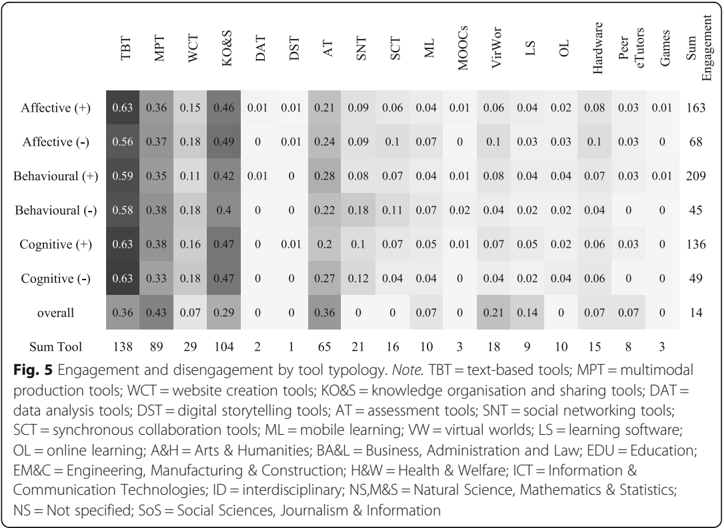
- Across 243 studies, behavioural engagement was documented in 209 studies (86%), affective engagement in 163 (67%), and cognitive engagement in 136 (56%); 117 studies (48%) showed all three dimensions.
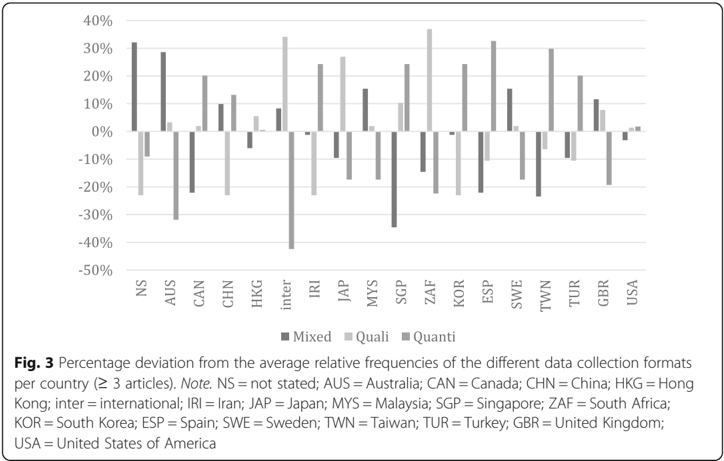
- Most studies used quantitative methods (103, 42%), followed by mixed methods (84, 35%) and qualitative methods (56, 23%); 225 studies (93%) lacked a definition of student engagement, and 59% did not employ a theoretical model.
- Research was concentrated in the US (86 studies, 35.4%), UK (26, 10.7%), Australia (19, 7.8%), Taiwan (18, 7.4%), and China (9, 3.7%); top tools were LMS (n = 89), discussion forums (n = 80), videos (n = 44), recorded lectures (n = 25), and chat (n = 24).
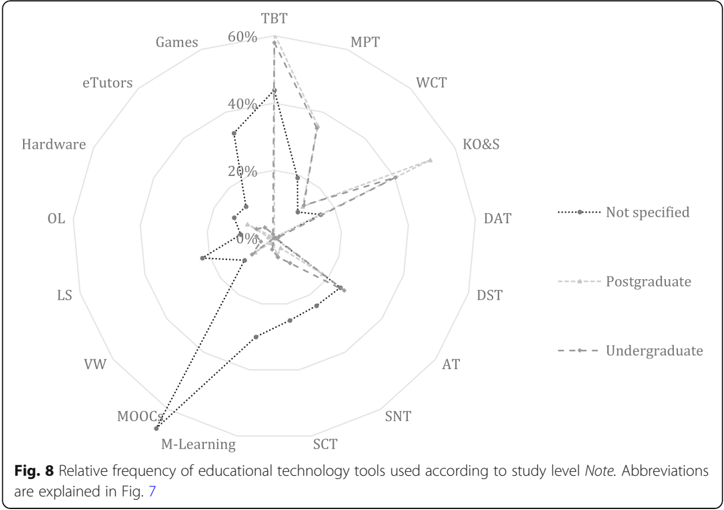
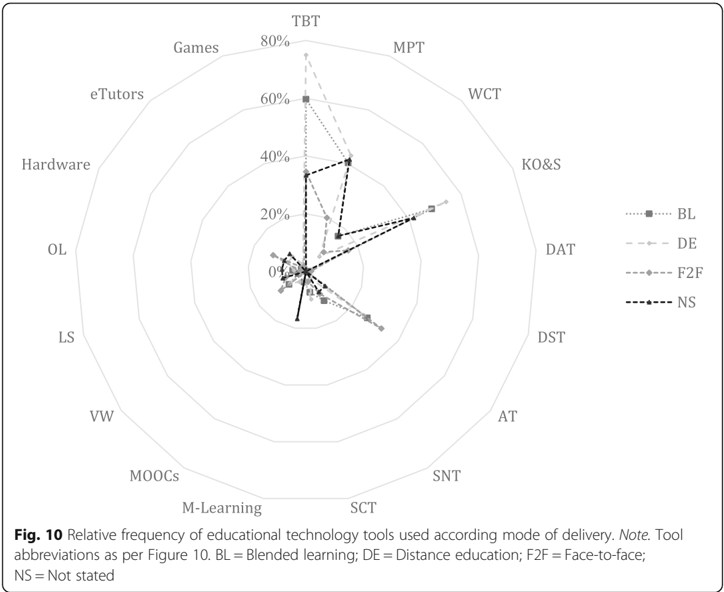
- Blended learning was the most researched mode of delivery (109 studies), followed by distance education (72) and face-to-face instruction (55); undergraduate students were the primary population (146 studies, 60%), while 41 studies (17%) did not specify study level.
Methods
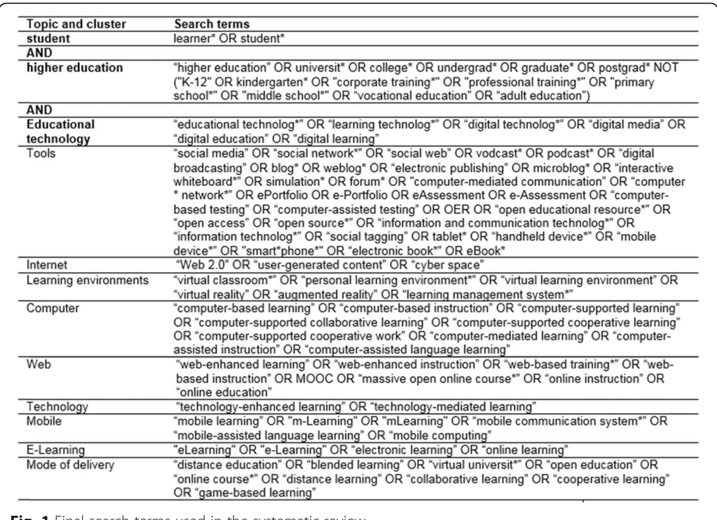
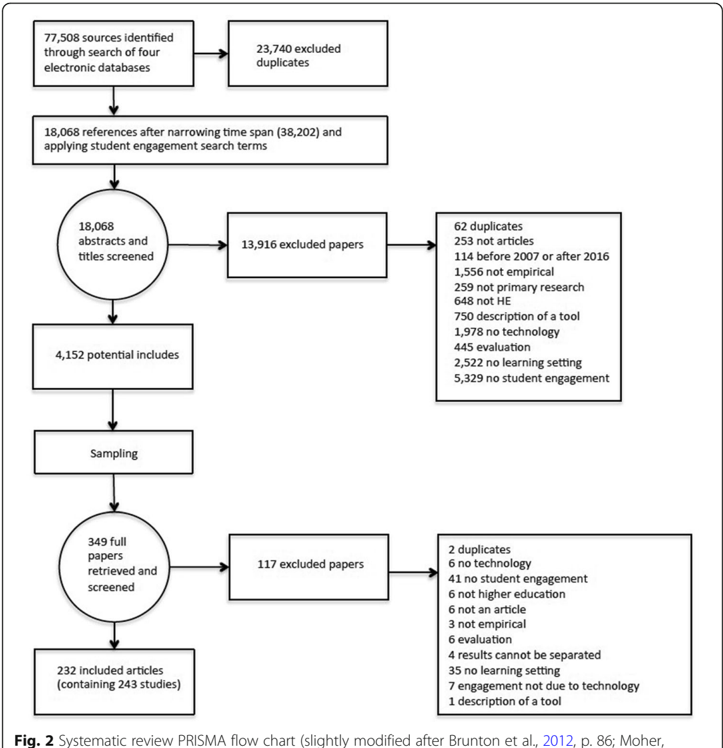
- Systematic evidence map/systematic review; four databases (ERIC, Web of Science, Scopus, PsycINFO) were searched in July 2017, retrieving 77,508 initial references, 53,768 after duplicate removal, and 18,068 records after adjusting the period to 2007–2016.
- After title/abstract screening, 4,152 potentially relevant articles remained; sample size estimation (5% error range, 50% proportion, 5% alpha) produced 349 sampled articles stratified by publishing year, and full-text screening left 232 articles containing 243 studies.
- Data were extracted using an extensive coding system covering study methodology, sample, learning scenario, mode of delivery, educational technology, and cognitive, affective, or behavioural engagement/disengagement indicators.
Limitations
- Stated: only English-language articles were included; grey literature, book chapters, monographs, and journals not indexed in the four databases were excluded; the review was limited to 2007–2016; the sampling strategy likely accounts for low numbers of studies from South America and Africa.
- Stated: peer review was used as a baseline quality criterion, and the human possibility of overlooking or misinterpreting information during coding cannot be fully excluded.
- Evident from the text: the authors note that search and sampling strategy may contribute to geographic imbalance, and they frame student engagement as remaining under-theorised and often considered only fragmentally in the corpus.
Model-written summary. Check it against the paper before relying on it.
Integrity signals
Registry
Cites
Statistics
Figures
Verification
Claims the paper makes
6 Valid · 1 Not valid · 30 Not checked · 118 Own results and interpretations
The cited sources support only part of this claim — read each source’s verdict below.
In the paper
“Linked to this, educational technology research has, however, lacked theoretical guidance (Al-Sakkaf, Omar, & Ahmad, 2019; Hew, Lan, Tang, Jia, & Lo, 2019; Lundin, Bergviken Rensfeldt, Hillman, Lantz-Andersson, & Peterson, 2018).”
- Also stated in: § Introduction · plain
“educational technology research has, however, lacked theoretical guidance (Al-Sakkaf, Omar, & Ahmad, 2019; Hew, Lan, Tang, Jia, & Lo, 2019; Lundin, Bergviken Rensfeldt, Hillman, Lantz-Andersson, & Peterson, 2018).”
What the sources say
- Not checked — no full text of the sourcecites Al-Sakkaf, Omar, & Ahmad, 2019 matched to “A systematic literature review of student engagement in software visualization: a theoretical perspective” (2019) source
- Not checked — no full text of the sourcecites Hew, Lan, Tang, Jia, & Lo, 2019 matched to “Where is the “theory” within the field of educational technology research?” (2019) source
- Partly supportedcites Lundin, Bergviken Rensfeldt, Hillman, Lantz-Andersson, & Peterson, 2018 matched to “Higher education dominance and siloed knowledge: a systematic review of flipped classroom research” (2018) sourceExperimental — accuracy not yet measured
The Abstract says that flipped classroom research often lacks anchoring in learning theory or instructional design, and the Discussion and conclusions recommends stronger theoretical anchoring. The citing sentence extends this finding to educational technology research generally, which the paper does not establish. (LLM, conf=0.87)
plain- Asserted: passes — The authors put it forward as true.
- Checkable: passes — It can be checked against evidence.
- Load-bearing: passes — The paper’s conclusions depend on it.
- Based: passes — The paper gives a reason why it holds.
- Also stated in: § Introduction · plain
The sources with a verdict support this claim; the rest weren’t checked yet, have no full text we could read, or their verdicts aren’t rated yet.
In the paper
“Reviews that have included research using a range of methodologies, have found a limited number of studies employing qualitative methods (e.g. Connolly, Boyle, MacArthur, Hainey, & Boyle, 2012; Kay & LeSage, 2009; Lundin et al., 2018).”
What the sources say
- Not checked — no full text of the sourcecites Connolly et al., 2012 matched to “A systematic literature review of empirical evidence on computer games and serious games” (2012) source
- Not checked — no full text of the sourcecites Kay & LeSage, 2009 matched to “Examining the benefits and challenges of using audience response systems: A review of the literature” (2009) source
- Supportedcites Lundin et al., 2018 matched to “Higher education dominance and siloed knowledge: a systematic review of flipped classroom research” (2018) source
In Discussion and conclusions (page unavailable), Lundin et al. say that qualitative analyses of actual student learning are rare in the flipped-classroom research they reviewed. They also report that simple course questionnaires and pre- and post-tests make up a large part of that research. This supports the citing sentence’s point in the context of flipped-classroom studies. (LLM, conf=0.86)
plain- Asserted: passes — The authors put it forward as true.
- Checkable: passes — It can be checked against evidence.
- Load-bearing: passes — The paper’s conclusions depend on it.
- Based: passes — The paper gives a reason why it holds.
Every source the paper cites for this claim was checked and supports it.
In the paper
“with students showing, for example, disinterest in topics chosen e.g., (Sullivan & Longnecker, 2014)”
What the sources say
- Supportedcites Sullivan & Longnecker, 2014 matched to “Class blogs as a teaching tool to promote writing and student interaction” (2014) source
Table 5 (Conclusion) records a student saying that the week's posts did not necessarily interest them and another asking to choose topics instead of using a fixed set of readings. These comments support the cited example of student disinterest, though the paper also reports positive views of some blog topics. (LLM, conf=0.88)
plain- Asserted: passes — The authors put it forward as true.
- Checkable: passes — It can be checked against evidence.
- Load-bearing: unclear — It is unclear whether the paper’s conclusions depend on it.
- Based: passes — The paper gives a reason why it holds.
- Supported
Every source the paper cites for this claim was checked and supports it.
In the paper
“and continued avoidance of using blogs in some cases, despite introductory training e.g., (Keiller & Inglis-Jassiem, 2015).”
What the sources say
- Supportedcites Keiller & Inglis-Jassiem, 2015 matched to “A lesson in listening: Is the student voice heard in the rush to incorporate technology into health professions education?” (2015) source
The Intervention section says students were invited to training on accessing and using a university-based blogging platform. The Results section reports that students did not access the platform during the study period and cited unfamiliarity with blogging even after training. (LLM, conf=0.94)
plain- Asserted: passes — The authors put it forward as true.
- Checkable: passes — It can be checked against evidence.
- Load-bearing: unclear — It is unclear whether the paper’s conclusions depend on it.
- Based: passes — The paper gives a reason why it holds.
- Supported
In the paper
“Out of 27 identified reviews (see Additional file 3), only 14 report the countries included”
What the sources say
- Not matchedcites Additional file 3
This doesn’t read as a citation we can look up.
plain- Asserted: passes — The authors put it forward as true.
- Checkable: passes — It can be checked against evidence.
- Load-bearing: passes — The paper’s conclusions depend on it.
- Based: passes — The paper gives a reason why it holds.
- Not matched
87 more claims
Create a free account to see all 155 claims and to verify the 1 reference still open.
- Probably not a substantial claim. 27
- It may state two separate claims as one. 44
- The quote only partly states this claim. 2
Claims other papers make about this one
Each is checked against this paper’s own text: does it say what the citing paper says it does?
The source backs part of the claim, not all of it — or backs it for a different population, condition or comparison.
In the citing paper
“As previous LA and educational technology reviews have found (e.g., Bergdahl et al., 2020;Bond et al., 2020;Banihashem et al., 2022), there is an underrepresentation of African and South and Central American research, although this might be due in some part to the search strategy employed for this review.”
From Unpacking student engagement in higher education learning analytics: a systematic review (2024) · cites this paper as Bond et al., 2020
Experimental — accuracy not yet measuredThe source backs part of the claim, not all of it — or backs it for a different population, condition or comparison.
In the citing paper
“HELA research also focused heavily on undergraduate students, with only a small percentage of studies exploring postgraduate student engagement (Bergdahl et al., 2020;Bond et al., 2020), and a large proportion of participants (60%) were from a STEM discipline, which raises questions of wider study generalisability (Kaliisa et al., 2024).”
From Unpacking student engagement in higher education learning analytics: a systematic review (2024) · cites this paper as Bond et al., 2020
Experimental — accuracy not yet measuredThe source backs part of the claim, not all of it — or backs it for a different population, condition or comparison.
In the citing paper
“Studies suggest that professional development and training in LA can improve educators' capacity to use data-driven insights to support student learning (Bergdahl et al., 2020;Bond et al., 2020;Gašević et al., 2019).”
From Unpacking student engagement in higher education learning analytics: a systematic review (2024) · cites this paper as Bond et al., 2020
Experimental — accuracy not yet measuredThe cited source says what the claim attributes to it.
In the citing paper
“Given that the nexus between SE and technology use in higher education has not yet been comprehensively researched, a systematic review was conducted into this topic”
From Facilitating student engagement through educational technology in higher education: A systematic review in the field of arts and humanities (2020) · cites this paper as Bond et al., 2020
The cited source says what the claim attributes to it.
In the citing paper
“Student engagement is often conceptualized along three dimensions: behavioral, cognitive, and affective engagement (Fredericks et al., 2004; Bond et al., 2020).”
From Effects of Generative AI on Engagement and Performance Within Asynchronous Online Courses (2026) · cites this paper as Bond et al., 2020
2 more claims about this paper
Create a free account to see every claim other papers make about this one.
Self-check
Percentages, sums and reported differences re-computed from the paper’s own numbers.
Each contradiction between two passages listed here was confirmed by an independent check.
Rated major: it would touch a result — a value a result rests on, reported and recomputed p-values on opposite sides of the significance level, two passages that conflict with no sign which is right, or a cited work retracted before this paper was published.
In the paper
“59% (n = 100) of studies did not employ a theoretical model in their research. Of the 41% (n = 100) that did”
Reported 59 · recomputed 41.152263
Rated minor: it would not touch a result — a value no result rests on, a p-value that stays on the same side of the significance level, or a conflict that is clerical, resolved elsewhere in the paper, or outside its own findings.
In the paper
§ Discussion
“Natural Sciences, Mathematics & Statistics, nevertheless, assuming rank 3 with 38 studies (15.6%).”
§ Method
“Natural Sciences, Mathematics & Statistics (37) being the top three study fields”
Citations
Cites
Preferred Reporting Items for Systematic Reviews and Meta-Analyses: the PRISMA statement
Moher, D., Liberati, A., Tetzlaff, J., Altman, D. G., & for the PRISMA Group (2009) · BMJ · doi:10.1136/bmj.b2535 · Cited by 83,823
(1978) · Medical Entomology and Zoology · Cited by 53,488
The Discovery of Grounded Theory: Strategies for Qualitative Research.
Wagner, H. R., Glaser, B. G., & Strauss, A. L. (1968) · Social Forces · doi:10.2307/2575405 · Cited by 46,361
Preferred reporting items for systematic reviews and meta-analyses: the PRISMA Statement.
(2009) · PubMed Central · Cited by 44,859
The Discovery of Grounded Theory; Strategies for Qualitative Research
Glaser, B. G., Strauss, A. L., & Strutzel, E. (1968) · Nursing Research · doi:10.1097/00006199-196807000-00014 · Cited by 39,449
Kytle, J., & Bandura, A. (1978) · Contemporary Sociology · doi:10.2307/2065952 · Cited by 25,422 · cited 1×
“Studies coded as SCL included those exploring social learning (Bandura, 1971) and social”
MethodSchool Engagement: Potential of the Concept, State of the Evidence
Fredricks, J. A., Blumenfeld, P. C., & Paris, A. H. (2004) · Review of Educational Research · doi:10.3102/00346543074001059 · Cited by 12,581 · cited 2×
“Therefore, more qualitative and ethnographic measures should also be employed, such as student observations with thick descriptions, which can help shed light on the complexity of teaching and learning environments (Fredricks et al., 2004; Heflin, Shewmaker, & Nguyen, 2017).”
BackgroundPierce, W. D., & Bandura, A. (1977) · Canadian Journal of Sociology / Cahiers canadiens de sociologie · doi:10.2307/3340496 · Cited by 9,650
Bandura, A. (1977) · Zenodo (CERN European Organization for Nuclear Research) · doi:10.5281/zenodo.15521699 · Cited by 7,607
The Discovery of Grounded Theory: Strategies for Qualitative Research
Brodsky, C. M. (1968) · Psychosomatics · doi:10.1016/s0033-3182(68)71872-7 · Cited by 6,679
Research works printed but not linked: 1
- Astin, A. W. (1984). Student involvement: A developmental theory for higher education. Journal of College Student Development, 25(4), 297–308.
Cited by
Items 801–900 of 1,053
Ethical Implications of AI in Personalized Learning
Madeline, A. (2025) · Advances in computational intelligence and robotics book series · doi:10.4018/979-8-3693-8744-3.ch010
Bitegeko, R. M. (2026) · Educational Technology Quarterly · doi:10.55056/etq.1116
“While engagement can occur in traditional settings, EET postulates that technology enhances participation and social interaction in ways difficult to achieve through stand-alone pedagogical practices [ 16, 76, 79 ] .”
Maqbool, S., Zafeer, M. U., & Al-Masaeid, M. (2025) · Advances in computational intelligence and robotics book series · doi:10.4018/979-8-3373-4217-7.ch008 · Cited by 1
Alcantara, G. A., Sacan, E. R., Vequiso, A. T. T., Piscos, J. A. F. A., Zabate, Z. R. R., Lee, J. M. T., & Peteros, E. D. L. (2026) · Multidisciplinary Science Journal · doi:10.31893/multiscience.2027084
“In recent years, interest in the concept of student engagement has increased, and many scholars have focused on understanding the many factors that come into play when students are actively participating (Bond et al., 2020).”
Yan, S., Xu, Q., & Hu, D. (2026) · Studies in Higher Education · doi:10.1080/03075079.2026.2696022
Qasmi, F. (2025) · IEEE Smart World Congress (SWC) · doi:10.1109/swc65939.2025.00284
“Recent worldwide occurrences, like the COVID-19 pandemic, have greatly hastened this digital revolution in education by exposing structural flaws in traditional pedagogies and spurring the quick uptake of remote learning technology [2].”
El-Sayed, F. E.-Z. K., Rashed, S., & Elsaiad, H. S. A. E.-A. (2023) · Assiut Scientific Nursing Journal · doi:10.21608/asnj.2023.234528.1665
OECD (2023) · OECD eBooks · doi:10.1787/65d70dbc-en
Gronseth, S. L., McNeil, S., & Lopez, M. Y. (2026) · Educational Technology Research and Development · doi:10.1007/s11423-026-10591-5 · Cited by 2
Development of Innovative Pedagogical Practices for a Modern Learning Experience: Introduction
Koyama, D. (2021) · CSMFL Publications eBooks · doi:10.46679/978819484836300
Effect Of Augmented Reality-Based Textbook On Geometry Spatial Ability Of Deaf Students: A-B-A SSR
Puspitasari, L. A., & Sugiman (2026) · Riemann Research of Mathematics and Mathematics Education · doi:10.38114/riemann.v8i1.196
“Technology-enhanced environments that promote meaningful interaction can influence not only performance outcomes but also students’ engagement and learning experiences (Bond et al., 2020; Nisa, 2019).”
Qutlımuratovich, S. T. (2025) · International Journal of Pedagogics · doi:10.37547/ijp/volume05issue04-72 · Cited by 1
Doddanavar, I., Agrawal, S., Rote, S., & Subramanyam, A. (2025) · IGI Global eBooks · doi:10.4018/979-8-3373-7917-3.ch008
Mutuzo, I., Kibanja, G., Nsereko, G. M., Ssewannonda, R., & Baluku, M. M. (2026) · Discover Psychology · doi:10.1007/s44202-026-00680-0
The Impact of Artificial Intelligence on the Learning Process among Students
Anghel, G. A., Matei, F. L., & CÎRSTEA, C. I. (2026) · Journal of Education Society & Multiculturalism · doi:10.2478/jesm-2026-0001
Retracted: Using Computer Vision and AI for Monitoring Student Attention in Classrooms
Alawneh, Y. J., Al-Khateeb, R. H., Salah, L. A. F., Khazen, D., Salman, F. N., & Hole, S. (2025) · IEEE International Conference on ICT in Business Industry & Government (ICTBIG) · doi:10.1109/ictbig68706.2025.11323999
“Improve edge computing performance and latency [9].”
RetractedEngaged Learning Practices of Students in Chemistry Learning
Upadhyaya, I. R., Pokharel, S., & Ghimire, P. M. (2023) · Interdisciplinary Research in Education · doi:10.3126/ire.v8i1.56728
“In recent times, engaged learning has emerged as a vital aspect of effective classroom pedagogy, receiving considerable attention in educational circles (Handelsman et al., 2005; Bond et al., 2020).”
BackgroundEngineering Student Attitude Towards New Technologies Employed in Active Teaching
Leão, C. P., & Ferreira, A. C. (2021) · Advances in intelligent systems and computing · doi:10.1007/978-3-030-68201-9_63 · Cited by 1
Digital mind mapping tools for B2 tertiary EFL students: An exploration of impacts on writing
Altamimi, R. N. (2026) · Acta Psychologica · doi:10.1016/j.actpsy.2026.107556
Li, Y., Qi, Z., Zhang, T., Liu, K., & Huang, C. (2026) · Journal of International Students · doi:10.32674/jdgvhq96
Muzafar, N., & Ahmad, N. J. (2026) · Applied Research · doi:10.1002/appl.70092 · Cited by 2
Purba, J. P., Pasaribu, S. T., Maibang, D. F., Tarigan, C. O. B., & Sitorus, N. K. (2025) · COMPETITOR Jurnal Pendidikan Kepelatihan Olahraga · doi:10.26858/cpjok.v17i3.651
Using Inquisitive AI Feedback to Enhance Formative Assessment in First-Year Engineering
de Freitas, C. C. S. (2025) · IEEE World Engineering Education Conference (EDUNINE) · doi:10.1109/edunine62377.2025.10981408
Mercado, R. L., Paculanang, R., Pagaura, J. M., Pajo, S., Pamplona, C., Pleños, M., & Regodon, L. P. (2026) · International Conference on e-Education, e-Business, e-Management and e-Learning · doi:10.1109/ic4e69618.2026.11631339
“When integrated with student-generated video-making, microlearning also supports the development of 21st-century skills such as creativity, digital communication, and self-directed learning — competencies highly valued in STEM education [5].”
Şentürk, C., & Yağcı, A. (2026) · Journal of Computers in Education · doi:10.1007/s40692-026-00392-3
Qi, Z., Aziz, W., & Butler, C. (2024) · Research Square · doi:10.21203/rs.3.rs-4629892/v1
Mapunda, B. B. (2026) · EAST AFRICAN JOURNAL OF EDUCATION AND SOCIAL SCIENCES · doi:10.46606/eajess2026v07i02.0490
Sang, N. Q., Thao, N., Tam, D. T. M., & Duc, M. L. (2025) · SSRN Electronic Journal · doi:10.2139/ssrn.5264269
Duan, K., Mao, F., Ruiming, L., Jin, X., Huang, H., & Wen, M. (2026) · PLoS ONE · doi:10.1371/journal.pone.0346261 · Cited by 1
Ajayi, V. O., Penda, B. M., & Ameh, R. F. (2025) · European Journal of Mathematics and Science Education · doi:10.12973/ejmse.6.4.223
CANTIK Economic Learning Model as a Stimulator of Students' Reactive Behavior
Setiaji, C. A., Rinawati, A., Rahmawati, L., & Ibrahim, N. (2025) · JURNAL IQRA · doi:10.25217/ji.v10i3.6626 · Cited by 1
Impact of the Learning Environmental Factors on Group Engagement: A Deep Learning Approach
Desai, S., Munshi, M. M., Hanji, S. V., & Pabba, C. (2025) · South Asian Journal of Management · doi:10.62206/sajm.31.6.2024.150-173 · Cited by 2
Goodarzi, A., Rezai, A., & Ashkani, P. (2024) · Research Square · doi:10.21203/rs.3.rs-4785778/v1 · Cited by 1
Liu, M., & Dacanay, M. L. D. (2025) · International Journal of Education and Humanities · doi:10.54097/vdmjtv75 · Cited by 1
Empirical Essays on Technology Supported Learning: Studies of Danish Higher Education
Franck, M. S. (2023) · OpenArchive@CBS (Copenhagen Business School) · doi:10.22439/phd.02.2023
Fernandez, I. J. (2026) · QualiSearch Journal of Educational Research and Practice · doi:10.66437/qjerp.v2i2.021
Compromiso académico en estudiantes de posgrado en Colombia
Romero-García, L. (2024) · Revista Iberoamericana de Educación Superior · doi:10.22201/iisue.20072872e.2024.44.1895 · Cited by 5
Zengin, E. (2026) · Discover Education · doi:10.1007/s44217-026-01747-9
“The potential of educational technologies to increase student engagement [13] overlaps with efforts to support individual development through STEM activities and practical training in village-life centers.”
Mapping the landscape in HEIs: a systematic review of factors influencing EdTech adoption
Ravi, H., & Radhakrishna, V. (2024) · Higher Education Evaluation and Development · doi:10.1108/heed-07-2024-0033 · Cited by 9
Mouloud, K., & Ahmed, B. D. (2026) · Journal of Sports and Physical Activity · doi:10.64268/jospa.v2i1.24
Influence of Integrating AI on Engagement of College Students
Salhab, R. A. (2025) · IGI Global eBooks · doi:10.4018/979-8-3693-9861-6.ch008
Quimbay, M. D. P. R. (2026) · Journal of Participatory Research Methods · doi:10.35844/001c.163535
Sánchez, C. X. M., Sánchez, N. K. M., & Merino, M. J. M. (2026) · Revista Multidisciplinaria Voces de América y el Caribe · doi:10.69821/remuvac.v3i4.419
Equity as Infrastructure: Recentering High-Impact Practices in Education 4.0 Frameworks
Rivard, J. K. (2026) · Educational Point · doi:10.71176/edup/19325
“A parallel evidence map of student engagement and educational technology research (Bond et al., 2020) reaches a similar conclusion about the field’s uneven attention to social, cultural, and ethical dimensions.”
Integración de las TIC e influencia en el aprendizaje de los estudiantes de Maestría Virtual
Toaza, V. P. C., Imbaquingo, R. E. S., Chusin, Y. A. S., & Sánchez, V. H. R. (2026) · Revista Científica Multidisciplinar G-nerando · doi:10.66473/rcmg.v7i1.1104
Generating Class Datasets for Teaching Qualitative Data Analysis Course to Graduate Students
Rubtsova, A., & McGee, R. E. (2024) · Pedagogy in Health Promotion · doi:10.1177/23733799241304395
“The student engagement and active learning is a corner-stone of our approach, as a framework potentially offering improved academic outcomes (Bond et al., 2020; Reeve & Lee, 2014).”
Mahmudah, G. N., Fajrussalam, H., & Hikmatunisa, N. P. (2026) · Jurnal Penelitian Pendidikan IPA · doi:10.29303/jppipa.v12i8.15898
“Previous studies have also shown that educational technologies can enhance student engagement and contribute to more meaningful learning experiences (Bond et al., 2020; Nkomo et al., 2021).”
Briones, O. Z., Ancajima, R. A. S., & Soto, E. E. O. (2026) · Frontiers in Education · doi:10.3389/feduc.2026.1797679
Fadiji, A. W., Wildschut, A., Cromhout, A., & Shoko, P. (2025) · Psychological Studies · doi:10.1007/s12646-025-00833-6 · Cited by 7
Aukkanit, N., Chopvitayakun, S., Sirichokworrakit, S., Chutrtong, J., Sangsuwon, C., & Kularbphettong, K. (2026) · Lecture notes in networks and systems · doi:10.1007/978-3-032-13153-9_5
Omarsaib, M. (2026) · Innovations in Education and Teaching International · doi:10.1080/14703297.2026.2619476
Perodaud, M., Crovello, H., Douai, A., & Mirbel, I. (2026) · International Review of Economics Education · doi:10.1016/j.iree.2026.100345
A Step Beyond in Industrial Chemistry Education: Digitalization and Sustainability
Köfter, B., Altundağ, C. K., & Yücel, A. S. (2025) · IGI Global eBooks · doi:10.4018/979-8-3373-5077-6.ch006 · Cited by 3
Engagement responsive pedagogy with the PRISM framework for inclusive and adaptive learning
Ibitoye, A., Chishti, I., Akinyemi, J. D., Abiodun, A. O., & Onifade, O. F. W. (2026) · Discover Education · doi:10.1007/s44217-026-01798-y
“…and motivational factors also play significant roles in shaping engagement [26]. explores how the learning environment, both physical and digital, can affect students’ academic drive, while [27] presents a conceptual framework that outlines key strategies for fostering sustained online engagement.”
Forschungssynthesen in der Mediendidaktik Ansätze und Herausforderungen
Bedenlier, S., Buntins, K., Wilmers, A., & Kerres, M. (2023) · MedienPädagogik Zeitschrift für Theorie und Praxis der Medienbildung · doi:10.21240/mpaed/54.x
Self-citationLearning Mode Differences in AI-Assisted and Collaborative Learning
Chang, C. (2026) · American Journal of Distance Education · doi:10.1080/08923647.2026.2724654
Learning Environment as an Influencer of Students’ Performance in A University in China
Su, C. (2024) · Journal of Education and Educational Research · doi:10.54097/53wwyp21 · Cited by 1
Li, H., & Yoon, S. J. (2023) · SSRN Electronic Journal · doi:10.2139/ssrn.4620654
The frequency and acceptance of educational technology as a learning tool among faculty members
Shavandi, F., Momtaz, H. E., Moradi, N., Cheraghi, Z., & Seidi, M. (2025) · Majallah-i dānishkadah-i pizishkī.Dānishgāh-i ̒ulūm-i pizishkī va khadamāt-i bihdāshtī- darmānī-i Tihrān./Majallah-i dānishkadah-i pizishkī.Dānishgāh-i ̒ulūm-i pizishkī va khadamāt-i bihdāshtī- darmānī-i Tihrān. · doi:10.61186/edcj.18.1.132 · Cited by 1
Ready Player One: Gamification of a Criminal Justice Course
Gehring, K. S., & Marshall, E. A. (2022) · Journal of Criminal Justice Education · doi:10.1080/10511253.2022.2130383 · Cited by 1
Digital Competence and Career Progression of Female Academics in Universities in Rivers State
Owen-Amadi, P. O. (2026) · International Journal of Research and Review · doi:10.52403/ijrr.20260526 · Cited by 1
Acceso tecnológico, participación y mejora de la comprensión lectora en estudiantes de bachillerato
Solorio, K. P., Pedraza, D. G., & Pulido, M. I. M. (2026) · Revista Multidisciplinar Epistemología de las Ciencias · doi:10.71112/tnw71643
Shams, M. S. (2026) · Journal of Applied Research in Higher Education · doi:10.1108/jarhe-12-2025-1070
Revealing the Inner World of Students: A Journey into Dynamics of Learning Management System Usage
Palma, H., & Genton, E. A. (2025) · Psychology and Education A Multidisciplinary Journal · doi:10.70838/pemj.430401
Qi, P. (2024) · Higher education and practice. · doi:10.62381/h241618
Hermawan, T. (2026) · Journal of Education and Teaching Learning · doi:10.59211/mjpjetl.v4i1.167
“The official academic review of the curriculum highlights that schools and teachers are given room to design learning according to student needs and contextual conditions [13], [14], [15].”
Teachers' use of digital tools (2018)
OECD (2023) · doi:10.1787/98dd57af-en · Cited by 1
Babu, J. K., Shcherbakova, N. S., SHICHIYAKH, R. A., Anuchina, O., Tagibova, A. A., & Rudresh, S. (2025) · International Conference on Computing Technologies & Data Communication (ICCTDC) · doi:10.1109/icctdc64446.2025.11158878
“Feature extraction from images while retaining important information is the responsibility of the CNN which follows the pooling layer [10].”
RetractedRETRACTED: Enhancing family education pattern recognition with a random forest algorithm
Xia, J., & Zhang, S. (2023) · Journal of Intelligent & Fuzzy Systems · doi:10.3233/jifs-234976
“Thegoalofstudy[11]wastomethodically mapandexaminethebodyofknowledgeregarding theconnectionbetweendigitaltechnologyandcol-legestudentinvolvement.”
RetractedZhang, G., Lou, J., & Wang, T. (2026) · Frontiers in Psychology · doi:10.3389/fpsyg.2026.1773192
Адиганов, Д. А., & Блинова, М. Л. (2026) · Человеческий капитал. · doi:10.25629/hc.2026.09.08
A Study on Digital System-Driven Flipped Classroom Model in University English Teaching
Luo, H. (2026) · Smart innovation, systems and technologies · doi:10.1007/978-3-032-25609-6_19
Do self-efficacy and self-regulated learning influence student engagement in gen z students?
Nurfauziah, R., & Mulawarman, M. (2026) · Counsenesia Indonesian Journal Of Guidance and Counseling · doi:10.36728/cijgc.v7i1.6440
“External factors include the learning environment, task difficulty, lecturer support, and peer support (Bond, M., et al., 2020).”
Themeli, A., Kotsifakos, D., & Psaromiligkos, Y. (2025) · South-East Europe Design Automation, Computer Engineering, Computer Networks and Social Media Conference (SEEDA-CECNSM) · doi:10.1109/seeda-cecnsm68644.2025.11329864
“Restrictions apply. studied indicators of engagement were participation/ interaction and achievement [15].”
Krishna, S. S., & Kumar, S. (2026) · International Journal of Educational Reform · doi:10.1177/10567879261434018
Mercado, F. M., Rivera, J., & Baldovino, F. P. (2026) · Journal of Interdisciplinary Studies in Education · doi:10.32674/jfrs6f53
Al-Kout, A. A. H. A. Q. (2026) · Arid International Journal of Educational and physcological sciences · doi:10.36772/arid.aijeps.2026.1514
Akhsani, L., & Susilo, B. E. (2023) · AIP conference proceedings · doi:10.1063/5.0125930
Chen, X., Cai, S., & Yao, H. (2026) · Education and Information Technologies · doi:10.1007/s10639-026-14064-3
“At the same time, this study adjusted the outcome variable from technology use to student engagement, reflecting the theoretical evo - lution of educational technology research from a focus on technology adoption to learning effectiveness (Bond et al., 2020).”
Sherif, V., Patterson, J. A., & Redger-Marquardt, C. (2025) · Emerald Group Publishing Limited eBooks · doi:10.1108/979-8-88730-897-520251010
Rozinah, S., Bahri, S., Nurbarkah, S. S., Yusuf, M., & Mughnie, N. (2026) · Berkala Ilmiah Pendidikan · doi:10.51214/bip.v6i2.1995
Nimmo, F. (2024) · New language learning and teaching environments · doi:10.1007/978-3-031-66241-6_8 · Cited by 1
Almario, J. I. F., Quiambao, A. S., Sangalang, A. M., Manlutac, A. M., Tolentino, J. C. G., & Miranda, J. P. P. (2024) · Multidisciplinary Journal for Education Social and Technological Sciences · doi:10.4995/muse.2024.19347 · Cited by 3
“Further, according to Bond et al. (2020), the brisk adaptation of education’s digital transformation is not influenced; other sectors are developing as well.”
BackgroundTroidl, K., & Schroll-Decker, I. (2022) · Zeitschrift für Weiterbildungsforschung · doi:10.1007/s40955-022-00229-3
Impact of Visiting the Jurnal Pendidikan IPA Indonesia Website to the Author's Knowledge
Parmin, P., Savitri, E. N., Amalia, A. V., et al. (2021) · AL-TA LIM · doi:10.15548/jt.v28i2.706
Revolutionizing Financial Accounting: Student Engagement in a Blended Learning Approach
Kottara, C., Asonitou, S., Kavalieraki-Foka, D., Gkikas, G., & Georgios, G. (2025) · WSEAS TRANSACTIONS ON BUSINESS AND ECONOMICS · doi:10.37394/23207.2025.22.206 · Cited by 2
Knowledge Map of Learner characteristics in Blended Learning: A Bibliometric Analysis
Abdullah, N. S., & Yaru, X. (2024) · International Journal of Advanced Research in Future Ready Learning and Education · doi:10.37934/frle.37.1.6588 · Cited by 1
Using implicit psychological mechanisms to predict student success in digital higher education
Klinke, C., Schipper, M., Paul-Poudevigne, A., & Eckert, M. (2025) · Acta Psychologica · doi:10.1016/j.actpsy.2025.106016 · Cited by 1
Herramientas digitales que facilitan la docencia en educación básica
Cañar, M. D. L. Á. L., Valarezo, T. M. J., Quilumbango, J. V. T., & Supe, M. A. G. (2026) · Revista Ciencia Innovadora · doi:10.64422/rci.v4n1.2026.136 · Cited by 1
Student Perceptions of Literacy Learning with Digital Storytelling
Brom, K. (2022) · University of North Texas Digital Library (University of North Texas) · doi:10.12794/metadc1944289
Alkasasbeh, W. J., Al–Nawaiseh, S. J., Shorman, D. A., Orhan, B. E., Grivas, G. V., & Alrahahleh, W. A. (2026) · Cogent Education · doi:10.1080/2331186x.2026.2722756 · Cited by 1
Aung, P. N., Hallinger, P., & Showanasai, P. (2026) · Journal of Higher Education Policy and Management · doi:10.1080/1360080x.2026.2620244
Classroom Engagement and Attitudes towards Mathematics among Junior High School Students
Arre, A. M. B., & Jatulan, G. C. (2026) · International Journal of Research on Multidisciplinary Studies · doi:10.67903/ijroms0238
Brown Adam, C., Ferguson, S., & Duffy Melissa, C. (2025) · Emerald Group Publishing Limited eBooks · doi:10.1108/979-8-88730-879-120251012
Júnior, J. J. R. T. D. B., Rodrigues, R. L., & Amorim, A. N. (2026) · Entertainment Computing · doi:10.1016/j.entcom.2026.101216
Artificial Intelligence-Based Customer Churn Prediction for Smart Business in Education Sector
Vijaya, V., Jajam, N., & Mishra, A. S. (2025) · Future education and learning spaces · doi:10.1007/978-981-96-7937-9_4 · Cited by 1
Levy, R., & Blass, E. (2026) · SAGE Open · doi:10.1177/21582440261443148
“There is some evidence from higher education that retention is similarly supported by student co-construction of the curriculum (Bond et al., 2020; Brook et al., 2020; Sims et al., 2017) and the flexibility in adapting to students’ learning preferences (Zepke et al., 2006).”
Dunque, R. C., & Mohammad, N. K. (2026) · Journal of Pedagogy and Education Science · doi:10.56741/iistr.jpes.002159
“Bond et al. [10] reported that educational technologies contribute to improved student engagement and participation in learning activities.”
InfluentialHsieh, M.-Y. (2025) · Research in Science & Technological Education · doi:10.1080/02635143.2025.2546984 · Cited by 3
“…learning performance, evaluating the technological efficacy in facilitating knowledge acquisition (Alqurashi 2019; Blasco-Arcas et al. 2013; Bond et al. 2020); and (3) course advancements, measuring satisfaction with the technological interaction of ChatGPT in educational settings (Chen,…”
Metadata
- Authors
- Bond, M., Buntins, K., Bedenlier, S., Zawacki-Richter, O., & Kerres, M.
- Affiliations
- Carl von Ossietzky Universität Oldenburg (DE)
- University of Duisburg-Essen (DE)
- Corresponding author
- Bond, Melissa
- Venue
- International Journal of Educational Technology in Higher Education
- Published
- 2020-01-22
- Volume
- 17
- Issue
- 1
- ISSN
- 2365-9440 (ISSN-L)
- OpenAlex
- W3014646985
- Cited by
- 1,097
- References
- 182
- Citations by year
- 2026: 257 · 2025: 216 · 2024: 187 · 2023: 170 · 2022: 123 · 2021: 118 · 2020: 26
- FWCI
- 165.40
- Type
- journal article
- Language
- en
- Open access
- diamond
- doi.org
- Licence
- cc-by
- creativecommons.org/licenses/by/4.0 (tdm)
- creativecommons.org/licenses/by/4.0 (vor)
- Locations
- International Journal of Educational Technology in Higher Education (publishedVersion, cc-by)
- UniSA Research Outputs Repository (University of South Australia) (acceptedVersion, other-oa)
- Adelaide Research & Scholarship (AR&S) (University of Adelaide) (submittedVersion, cc-by)
- DOAJ (DOAJ: Directory of Open Access Journals) (submittedVersion, cc-by-sa)
- Funders
- Bundesministerium für Bildung und Forschung (16DHL1007)
- Topics
- Social Sciences › Education › Online and Blended Learning
- Social Sciences › Education › Educational Technology in Learning
- Physical Sciences › Computer Science › Computer Science Applications › Online Learning and Analytics
- Keywords
- student engagement, educational technology, higher education, behavioral engagement, emotional engagement, cognitive engagement, blended learning, online forums, undergraduate students, research gaps
About these checks
Registry, retraction, Cites and statistics results are computed, not judged, with one exception: a printed reference that no index lists is read once by a model before it counts as a citation error. Claims are extracted by a model and kept only when their quote appears verbatim in the text; each cited source is then checked, with a model’s help, for whether it says what the claim relies on. Those verdicts can be wrong — read the claim’s quote and the cited source before relying on one.
The claim verdicts this report counts are experimental: their accuracy is not yet measured.
A language model drew the claims from the paper on 2026-09-29, under version 3 of the claim definition (model deepseek-v4.1-flash, prompt extract-v3).
A second model labelled each claim on 2026-09-29 (model jev-1.13-20260917, definition revision gold-guideline-v0.2).
Cited sources are checked with a language model’s help (gpt-6-sol).
Statistics and arithmetic are recomputed, not judged.
Confidence bands are shown only for fields calibrated on our annotated test set. None is calibrated yet, so no band is shown.
What counts as a claim ›How we measure confidence ›How we check this ›
Are you an author, or do you see a problem with this page? Request a review
Data sources
Bibliographic data: Semantic Scholar, OpenAlex, Crossref.
Contains information from the Semantic Scholar Academic Graph Datasets, made available under the ODC Attribution License (ODC-BY 1.0).
Semantic Scholar’s data is described in: Kinney, R., et al. (2023). The Semantic Scholar Open Data Platform. arXiv:2301.10140.
