

Mapping research in student engagement and educational technology in higher education: a systematic evidence map
Open accessThe DOI matches its Crossref record; 175 of the 182 references it cites were found in a registry or an index; 6 of the 54 sources its claims cite were checked for support.
Abstract
Abstract Digital technology has become a central aspect of higher education, inherently affecting all aspects of the student experience. It has also been linked to an increase in behavioural, affective and cognitive student engagement, the facilitation of which is a central concern of educators. In order to delineate the complex nexus of technology and student engagement, this article systematically maps research from 243 studies published between 2007 and 2016. Research within the corpus was predominantly undertaken within the United States and the United Kingdom, with only limited research undertaken in the Global South, and largely focused on the fields of Arts & Humanities, Education, and Natural Sciences, Mathematics & Statistics. Studies most often used quantitative methods, followed by mixed methods, with little qualitative research methods employed. Few studies provided a definition of student engagement, and less than half were guided by a theoretical framework. The courses investigated used blended learning and text-based tools (e.g. discussion forums) most often, with undergraduate students as the primary target group. Stemming from the use of educational technology, behavioural engagement was by far the most often identified dimension, followed by affective and cognitive engagement. This mapping article provides the grounds for further exploration into discipline-specific use of technology to foster student engagement.
Overview
CoChat Summary
TL;DR
This systematic evidence map synthesizes 243 studies published 2007–2016 on student engagement and educational technology in higher education. It finds research concentrated in the US and UK, dominated by quantitative methods, often lacking definitions or theory, and most frequently linking blended learning and text-based tools to behavioural engagement.
Key findings
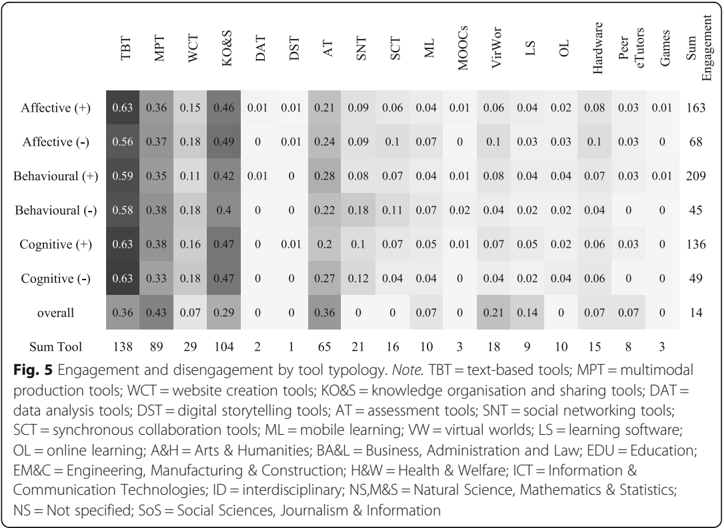
- Across 243 studies, behavioural engagement was documented in 209 studies (86%), affective engagement in 163 (67%), and cognitive engagement in 136 (56%); 117 studies (48%) showed all three dimensions.
- Most studies used quantitative methods (103, 42%), followed by mixed methods (84, 35%) and qualitative methods (56, 23%); 225 studies (93%) lacked a definition of student engagement, and 59% did not employ a theoretical model.
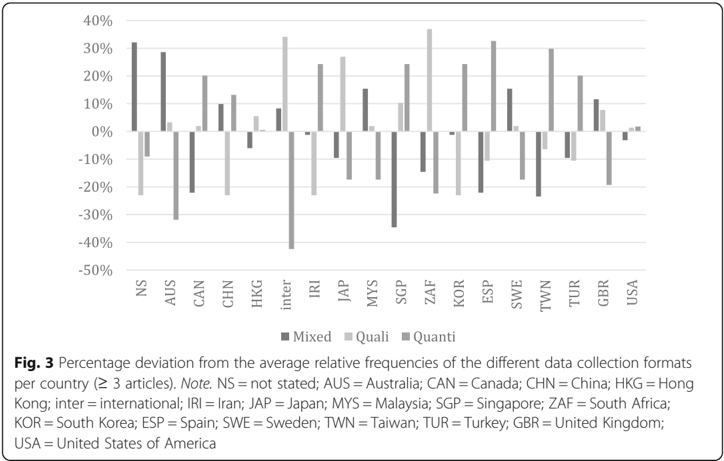
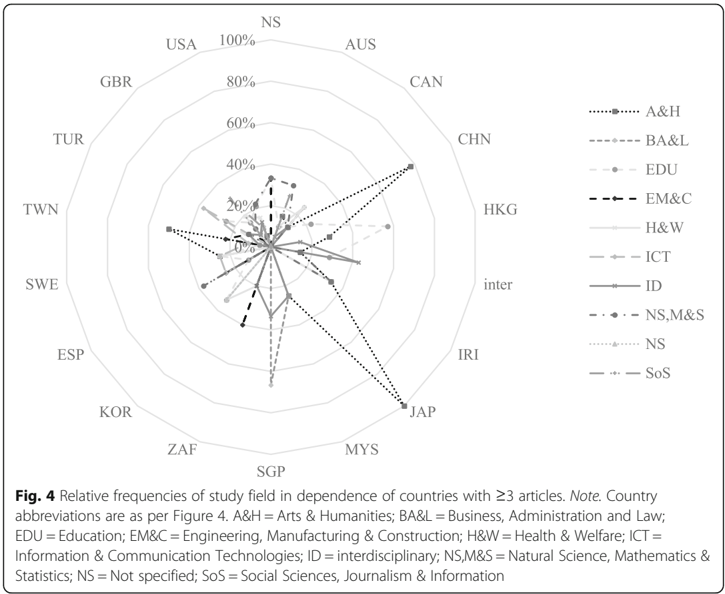
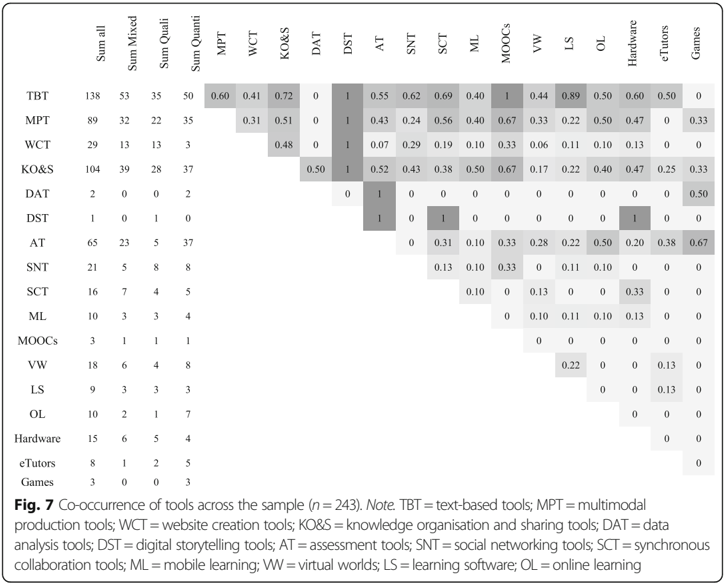
- Research was concentrated in the US (86 studies, 35.4%), UK (26, 10.7%), Australia (19, 7.8%), Taiwan (18, 7.4%), and China (9, 3.7%); top tools were LMS (n = 89), discussion forums (n = 80), videos (n = 44), recorded lectures (n = 25), and chat (n = 24).
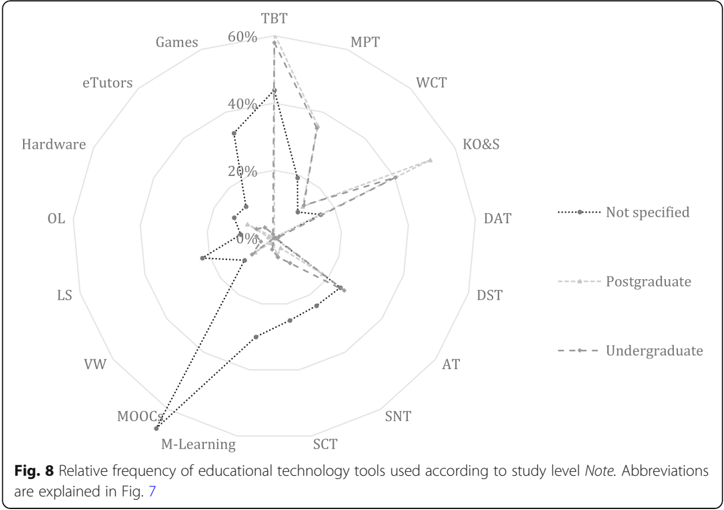
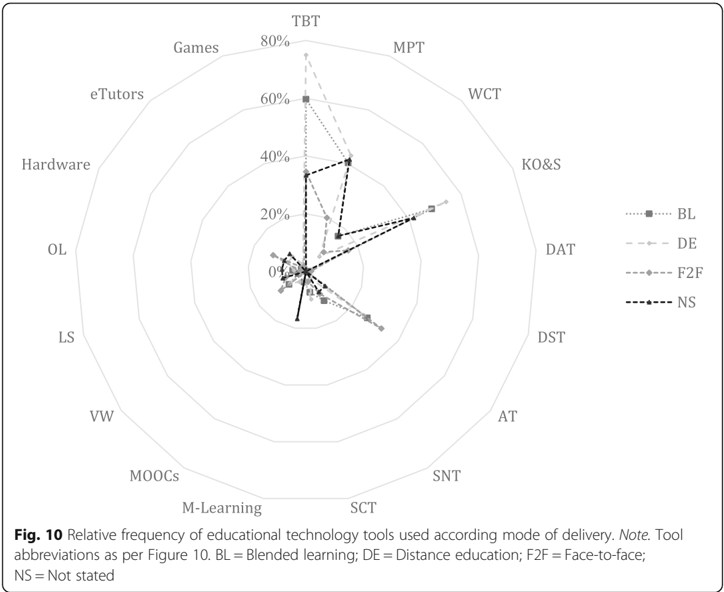
- Blended learning was the most researched mode of delivery (109 studies), followed by distance education (72) and face-to-face instruction (55); undergraduate students were the primary population (146 studies, 60%), while 41 studies (17%) did not specify study level.
Methods
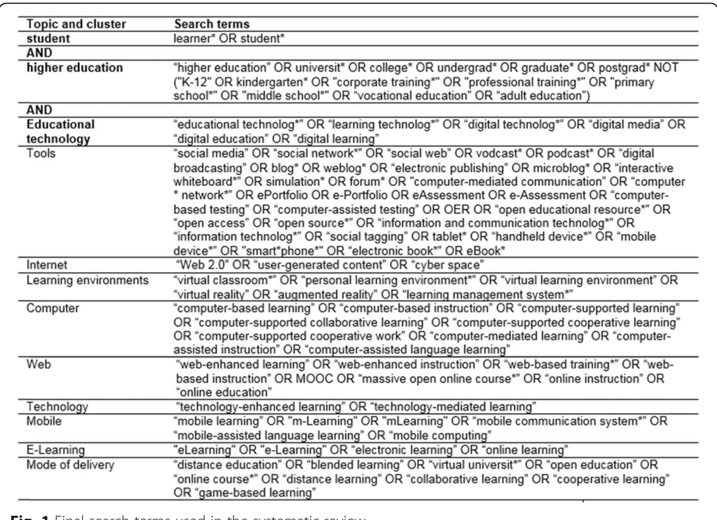
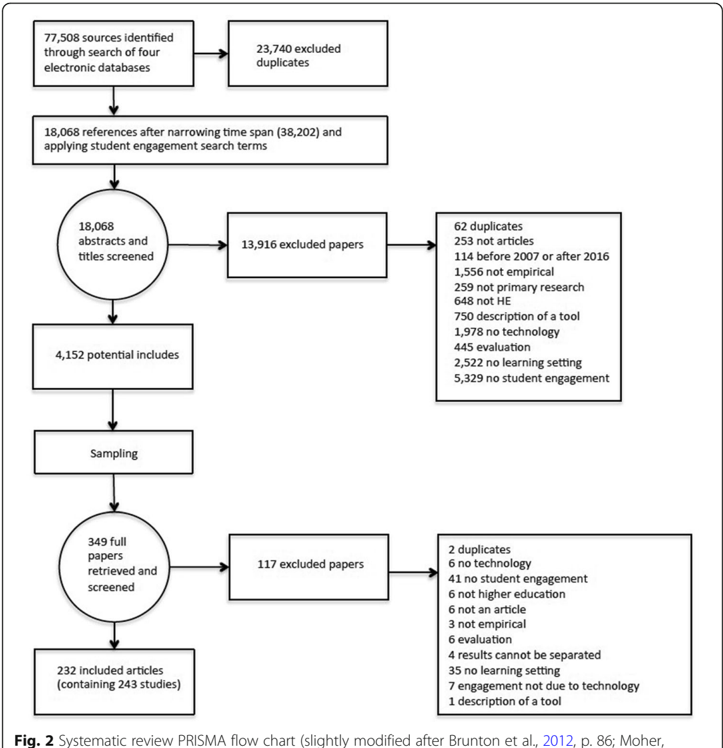
- Systematic evidence map/systematic review; four databases (ERIC, Web of Science, Scopus, PsycINFO) were searched in July 2017, retrieving 77,508 initial references, 53,768 after duplicate removal, and 18,068 records after adjusting the period to 2007–2016.
- After title/abstract screening, 4,152 potentially relevant articles remained; sample size estimation (5% error range, 50% proportion, 5% alpha) produced 349 sampled articles stratified by publishing year, and full-text screening left 232 articles containing 243 studies.
- Data were extracted using an extensive coding system covering study methodology, sample, learning scenario, mode of delivery, educational technology, and cognitive, affective, or behavioural engagement/disengagement indicators.
Limitations
- Stated: only English-language articles were included; grey literature, book chapters, monographs, and journals not indexed in the four databases were excluded; the review was limited to 2007–2016; the sampling strategy likely accounts for low numbers of studies from South America and Africa.
- Stated: peer review was used as a baseline quality criterion, and the human possibility of overlooking or misinterpreting information during coding cannot be fully excluded.
- Evident from the text: the authors note that search and sampling strategy may contribute to geographic imbalance, and they frame student engagement as remaining under-theorised and often considered only fragmentally in the corpus.
Model-written summary. Check it against the paper before relying on it.
Integrity signals
Registry
Cites
Statistics
Figures
Verification
Claims the paper makes
6 Valid · 1 Not valid · 30 Not checked · 118 Own results and interpretations
The cited sources support only part of this claim — read each source’s verdict below.
In the paper
“Linked to this, educational technology research has, however, lacked theoretical guidance (Al-Sakkaf, Omar, & Ahmad, 2019; Hew, Lan, Tang, Jia, & Lo, 2019; Lundin, Bergviken Rensfeldt, Hillman, Lantz-Andersson, & Peterson, 2018).”
- Also stated in: § Introduction · plain
“educational technology research has, however, lacked theoretical guidance (Al-Sakkaf, Omar, & Ahmad, 2019; Hew, Lan, Tang, Jia, & Lo, 2019; Lundin, Bergviken Rensfeldt, Hillman, Lantz-Andersson, & Peterson, 2018).”
What the sources say
- Not checked — no full text of the sourcecites Al-Sakkaf, Omar, & Ahmad, 2019 matched to “A systematic literature review of student engagement in software visualization: a theoretical perspective” (2019) source
- Not checked — no full text of the sourcecites Hew, Lan, Tang, Jia, & Lo, 2019 matched to “Where is the “theory” within the field of educational technology research?” (2019) source
- Partly supportedcites Lundin, Bergviken Rensfeldt, Hillman, Lantz-Andersson, & Peterson, 2018 matched to “Higher education dominance and siloed knowledge: a systematic review of flipped classroom research” (2018) sourceExperimental — accuracy not yet measured
The Abstract says that flipped classroom research often lacks anchoring in learning theory or instructional design, and the Discussion and conclusions recommends stronger theoretical anchoring. The citing sentence extends this finding to educational technology research generally, which the paper does not establish. (LLM, conf=0.87)
plain- Asserted: passes — The authors put it forward as true.
- Checkable: passes — It can be checked against evidence.
- Load-bearing: passes — The paper’s conclusions depend on it.
- Based: passes — The paper gives a reason why it holds.
- Also stated in: § Introduction · plain
The sources with a verdict support this claim; the rest weren’t checked yet, have no full text we could read, or their verdicts aren’t rated yet.
In the paper
“Reviews that have included research using a range of methodologies, have found a limited number of studies employing qualitative methods (e.g. Connolly, Boyle, MacArthur, Hainey, & Boyle, 2012; Kay & LeSage, 2009; Lundin et al., 2018).”
What the sources say
- Not checked — no full text of the sourcecites Connolly et al., 2012 matched to “A systematic literature review of empirical evidence on computer games and serious games” (2012) source
- Not checked — no full text of the sourcecites Kay & LeSage, 2009 matched to “Examining the benefits and challenges of using audience response systems: A review of the literature” (2009) source
- Supportedcites Lundin et al., 2018 matched to “Higher education dominance and siloed knowledge: a systematic review of flipped classroom research” (2018) source
In Discussion and conclusions (page unavailable), Lundin et al. say that qualitative analyses of actual student learning are rare in the flipped-classroom research they reviewed. They also report that simple course questionnaires and pre- and post-tests make up a large part of that research. This supports the citing sentence’s point in the context of flipped-classroom studies. (LLM, conf=0.86)
plain- Asserted: passes — The authors put it forward as true.
- Checkable: passes — It can be checked against evidence.
- Load-bearing: passes — The paper’s conclusions depend on it.
- Based: passes — The paper gives a reason why it holds.
Every source the paper cites for this claim was checked and supports it.
In the paper
“with students showing, for example, disinterest in topics chosen e.g., (Sullivan & Longnecker, 2014)”
What the sources say
- Supportedcites Sullivan & Longnecker, 2014 matched to “Class blogs as a teaching tool to promote writing and student interaction” (2014) source
Table 5 (Conclusion) records a student saying that the week's posts did not necessarily interest them and another asking to choose topics instead of using a fixed set of readings. These comments support the cited example of student disinterest, though the paper also reports positive views of some blog topics. (LLM, conf=0.88)
plain- Asserted: passes — The authors put it forward as true.
- Checkable: passes — It can be checked against evidence.
- Load-bearing: unclear — It is unclear whether the paper’s conclusions depend on it.
- Based: passes — The paper gives a reason why it holds.
- Supported
Every source the paper cites for this claim was checked and supports it.
In the paper
“and continued avoidance of using blogs in some cases, despite introductory training e.g., (Keiller & Inglis-Jassiem, 2015).”
What the sources say
- Supportedcites Keiller & Inglis-Jassiem, 2015 matched to “A lesson in listening: Is the student voice heard in the rush to incorporate technology into health professions education?” (2015) source
The Intervention section says students were invited to training on accessing and using a university-based blogging platform. The Results section reports that students did not access the platform during the study period and cited unfamiliarity with blogging even after training. (LLM, conf=0.94)
plain- Asserted: passes — The authors put it forward as true.
- Checkable: passes — It can be checked against evidence.
- Load-bearing: unclear — It is unclear whether the paper’s conclusions depend on it.
- Based: passes — The paper gives a reason why it holds.
- Supported
In the paper
“Out of 27 identified reviews (see Additional file 3), only 14 report the countries included”
What the sources say
- Not matchedcites Additional file 3
This doesn’t read as a citation we can look up.
plain- Asserted: passes — The authors put it forward as true.
- Checkable: passes — It can be checked against evidence.
- Load-bearing: passes — The paper’s conclusions depend on it.
- Based: passes — The paper gives a reason why it holds.
- Not matched
87 more claims
Create a free account to see all 155 claims and to verify the 1 reference still open.
- Probably not a substantial claim. 27
- It may state two separate claims as one. 44
- The quote only partly states this claim. 2
Claims other papers make about this one
Each is checked against this paper’s own text: does it say what the citing paper says it does?
The source backs part of the claim, not all of it — or backs it for a different population, condition or comparison.
In the citing paper
“As previous LA and educational technology reviews have found (e.g., Bergdahl et al., 2020;Bond et al., 2020;Banihashem et al., 2022), there is an underrepresentation of African and South and Central American research, although this might be due in some part to the search strategy employed for this review.”
From Unpacking student engagement in higher education learning analytics: a systematic review (2024) · cites this paper as Bond et al., 2020
Experimental — accuracy not yet measuredThe source backs part of the claim, not all of it — or backs it for a different population, condition or comparison.
In the citing paper
“HELA research also focused heavily on undergraduate students, with only a small percentage of studies exploring postgraduate student engagement (Bergdahl et al., 2020;Bond et al., 2020), and a large proportion of participants (60%) were from a STEM discipline, which raises questions of wider study generalisability (Kaliisa et al., 2024).”
From Unpacking student engagement in higher education learning analytics: a systematic review (2024) · cites this paper as Bond et al., 2020
Experimental — accuracy not yet measuredThe source backs part of the claim, not all of it — or backs it for a different population, condition or comparison.
In the citing paper
“Studies suggest that professional development and training in LA can improve educators' capacity to use data-driven insights to support student learning (Bergdahl et al., 2020;Bond et al., 2020;Gašević et al., 2019).”
From Unpacking student engagement in higher education learning analytics: a systematic review (2024) · cites this paper as Bond et al., 2020
Experimental — accuracy not yet measuredThe cited source says what the claim attributes to it.
In the citing paper
“Given that the nexus between SE and technology use in higher education has not yet been comprehensively researched, a systematic review was conducted into this topic”
From Facilitating student engagement through educational technology in higher education: A systematic review in the field of arts and humanities (2020) · cites this paper as Bond et al., 2020
The cited source says what the claim attributes to it.
In the citing paper
“Student engagement is often conceptualized along three dimensions: behavioral, cognitive, and affective engagement (Fredericks et al., 2004; Bond et al., 2020).”
From Effects of Generative AI on Engagement and Performance Within Asynchronous Online Courses (2026) · cites this paper as Bond et al., 2020
2 more claims about this paper
Create a free account to see every claim other papers make about this one.
Self-check
Percentages, sums and reported differences re-computed from the paper’s own numbers.
Each contradiction between two passages listed here was confirmed by an independent check.
Rated major: it would touch a result — a value a result rests on, reported and recomputed p-values on opposite sides of the significance level, two passages that conflict with no sign which is right, or a cited work retracted before this paper was published.
In the paper
“59% (n = 100) of studies did not employ a theoretical model in their research. Of the 41% (n = 100) that did”
Reported 59 · recomputed 41.152263
Rated minor: it would not touch a result — a value no result rests on, a p-value that stays on the same side of the significance level, or a conflict that is clerical, resolved elsewhere in the paper, or outside its own findings.
In the paper
§ Discussion
“Natural Sciences, Mathematics & Statistics, nevertheless, assuming rank 3 with 38 studies (15.6%).”
§ Method
“Natural Sciences, Mathematics & Statistics (37) being the top three study fields”
Citations
Cites
Preferred Reporting Items for Systematic Reviews and Meta-Analyses: the PRISMA statement
Moher, D., Liberati, A., Tetzlaff, J., Altman, D. G., & for the PRISMA Group (2009) · BMJ · doi:10.1136/bmj.b2535 · Cited by 83,823
(1978) · Medical Entomology and Zoology · Cited by 53,488
The Discovery of Grounded Theory: Strategies for Qualitative Research.
Wagner, H. R., Glaser, B. G., & Strauss, A. L. (1968) · Social Forces · doi:10.2307/2575405 · Cited by 46,361
Preferred reporting items for systematic reviews and meta-analyses: the PRISMA Statement.
(2009) · PubMed Central · Cited by 44,859
The Discovery of Grounded Theory; Strategies for Qualitative Research
Glaser, B. G., Strauss, A. L., & Strutzel, E. (1968) · Nursing Research · doi:10.1097/00006199-196807000-00014 · Cited by 39,449
Kytle, J., & Bandura, A. (1978) · Contemporary Sociology · doi:10.2307/2065952 · Cited by 25,422 · cited 1×
“Studies coded as SCL included those exploring social learning (Bandura, 1971) and social”
MethodSchool Engagement: Potential of the Concept, State of the Evidence
Fredricks, J. A., Blumenfeld, P. C., & Paris, A. H. (2004) · Review of Educational Research · doi:10.3102/00346543074001059 · Cited by 12,581 · cited 2×
“Therefore, more qualitative and ethnographic measures should also be employed, such as student observations with thick descriptions, which can help shed light on the complexity of teaching and learning environments (Fredricks et al., 2004; Heflin, Shewmaker, & Nguyen, 2017).”
BackgroundPierce, W. D., & Bandura, A. (1977) · Canadian Journal of Sociology / Cahiers canadiens de sociologie · doi:10.2307/3340496 · Cited by 9,650
Bandura, A. (1977) · Zenodo (CERN European Organization for Nuclear Research) · doi:10.5281/zenodo.15521699 · Cited by 7,607
The Discovery of Grounded Theory: Strategies for Qualitative Research
Brodsky, C. M. (1968) · Psychosomatics · doi:10.1016/s0033-3182(68)71872-7 · Cited by 6,679
Research works printed but not linked: 1
- Astin, A. W. (1984). Student involvement: A developmental theory for higher education. Journal of College Student Development, 25(4), 297–308.
Cited by
Items 501–600 of 1,053
Engajamento e desengajamento online: um estudo quantitativo com estudantes do ensino superior
Irala, V. B., & Ortega, F. D. C. (2024) · EccoS – Revista Científica · doi:10.5585/eccos.n69.24623 · Cited by 2
Examining Social, Personal, and Technological Factors Influencing Student's ICT Usage
Dar, W. A., & Jan, K. (2021) · Advances in educational technologies and instructional design book series · doi:10.4018/978-1-7998-7607-6.ch012 · Cited by 3
Data-Driven Analysis of Student Engagement in Time-Limited Computer Laboratories
Cagliero, L., Canale, L., & Farinetti, L. (2023) · Algorithms · doi:10.3390/a16100464 · Cited by 6
Student Reading Motivation: Attitudes, Engagement and Strategies
Barotas, L., & Palma, R. C. (2023) · Asian Journal of Education and Social Studies · doi:10.9734/ajess/2023/v38i1815 · Cited by 2
Putra, A. B. N. R., Mukhadis, A., Ulfatin, N., et al. (2020) · doi:10.1109/icet51153.2020.9276609 · Cited by 2
“It has also been linked to increased student engagement in behavioral, affective, and cognitive, for which facilitation is a major concern of educators [9].”
BackgroundEmpowering Education Harnessing AI Tools for Innovative Content Development
Hossain, M., Amin, S. Z., & Hossain, F. (2025) · Advances in computational intelligence and robotics book series · doi:10.4018/979-8-3693-6507-6.ch012 · Cited by 6
Education Technologies Based on Artificial Intelligence
Sudha, R. V., Prasad, G. N. R., & Ramakrishna, K. (2023) · Cognitive science and technology · doi:10.1007/978-981-99-2746-3_24 · Cited by 2
Empowering Medical Educators: A UTAUT Analysis of Technology Adoption in Inquiry-Based Learning
Anderson, M. C., York, C. S., Hodge-Zickerman, A., Park, Y. S., & Rhode, J. (2024) · Technology Knowledge and Learning · doi:10.1007/s10758-023-09709-y · Cited by 2
“Technology has become an integral part of education (Bond et al., 2020; Camilleri & Camilleri, 2021; Chao et al., 2022) even though faculty may have reasons for resistance to accept and utilize educational technology for the design and delivery of IBL activities (Chao et al., 2022; Foo et al.,…”
Liao, L.-L., Chang, L., Lai, I., Lo, Y.-P., & Hsu, C.-C. (2026) · Innovations in Education and Teaching International · doi:10.1080/14703297.2026.2628009 · Cited by 1
Addressing EFL Paper-Based Assignment Into WhatsApp
Eppendi, J., & VEGA, N. D. (2020) · doi:10.2991/assehr.k.201230.064 · Cited by 2
“Moreover, [7] [8] technology does now not only teach students to appraise era and creatively and innovatively design technological answers, but it also gives genuinely proper motives for engaging students in mastering in every different Advances in Social Science, Education and Humanities Research, volume 512”
BackgroundAlharbi, B. A., Ibrahem, U. M., Moussa, M., et al. (2022) · Research Square · doi:10.21203/rs.3.rs-1703584/v1 · Cited by 2
Sison, M. O., & Bautista, S. C. (2021) · International Journal of Academic Research in Progressive Education and Development · doi:10.6007/ijarped/v10-i2/9799 · Cited by 7
Buntins, K., Bedenlier, S., & Zawacki‐Richter, O. (2025) · Learning Media and Technology · doi:10.1080/17439884.2025.2495602 · Cited by 4
“The case of China-based research is interesting, as the discrepancy between references and citations may indicate that Chinese studies are increasingly seen as relevant and worthy of citation – although they have been less represented in peer-reviewed research syntheses.”
InfluentialSelf-citationMeng, X., Yang, B., & Zhang, Z. (2025) · International Journal of Knowledge Management · doi:10.4018/ijkm.373306 · Cited by 7
How Engaged is Your Student? A Review of Online Learning Tools
Rahmalan, H. B., Mohamad, S. N. M., Ahmad, N., Rahman, A. F. N. A., Nasir, M. N. I. M., & Sidek, S. (2022) · Applied Informatics International Conference (AiIC) · doi:10.1109/aiic54368.2022.9914587 · Cited by 4
Analysis of information risks in education
Boyarov, E. N., Abramova, S. V., Stankevich, P. V., & Владимировна, К. И. (2021) · Perspectives of science and education · doi:10.32744/pse.2021.3.32 · Cited by 3
Chinese Teachers’ Perceptions on Perceived Teacher Support and Student Engagement
Shu, Z., Mottan, K., Chen, H., & Pang, Y. (2024) · Environment-Behaviour Proceedings Journal · doi:10.21834/e-bpj.v9i30.6197 · Cited by 3
Effects of Generative AI on Engagement and Performance Within Asynchronous Online Courses
Flores, F., Norman, K., & Hanshaw, G. (2026) · Open Praxis · doi:10.55982/openpraxis.18.2.980 · Cited by 2
“…and affective engagement—that highlights complementary but distinct aspects of how students participate in learning (Fredricks et al., 2004; Bond et al., 2020 While previous research extensively covers engagement strategies in online learning environments, there is limited direct…”
Tang, Y., & Smit, U. (2026) · Journal of International Education in Business · doi:10.1108/jieb-05-2025-0060 · Cited by 3
On Predicting Exam Performance Using Version Control Systems’ Features
Canale, L., Cagliero, L., Farinetti, L., & Torchiano, M. (2024) · Computers · doi:10.3390/computers13060150 · Cited by 5
Schrum, K. (2023) · International Journal for the Scholarship of Teaching and Learning · doi:10.20429/ijsotl.2023.17116 · Cited by 7
Mostert, K., & Toit, C. D. (2023) · Journal of Psychology in Africa · doi:10.1080/14330237.2023.2233205 · Cited by 2
Increasing student engagement with COIL Padlet
Miller, B. T., Göldi, S., & Lin, M. H. (. (2023) · International Conference on Higher Education Advances (HEAd) · doi:10.4995/head23.2023.16234 · Cited by 7
“These indicators range from “learning from peers” and “deep learning” for cognitive student engagement, to “participation/ involvement” and “achievement” for behavioural student engagement and “positive interaction with teachers and peers”, “enjoyment” and “interest” for affective student engagement; however to fully…”
BackgroundResultInfluentialKenesbekova, S., Olzhabayevna, M. A., Kusainova, M. A., Zhanbyrbayeva, S., & Alipbayeva, L. E. (2024) · Journal of Education and e-Learning Research · doi:10.20448/jeelr.v11i2.5598 · Cited by 5
Exploring Students’ Perceptions on Effective Online Tutoring at a Distance Education Institution
Enwereji, P. C., Rooyen, A. A. V., & Terblanche, E. A. J. (2023) · The Electronic Journal of e-Learning · doi:10.34190/ejel.21.4.3131 · Cited by 9
“Technology is essential to all facets of higher education, but it is especially crucial in institutions of distance learning where it is used for engagement, research, as well as teaching and learning (Bond et al ., 2020).”
BackgroundArtificial Intelligence-Driven Instruction and Its Impact on Heutagogy and Student Engagement
Mupaikwa, E. (2024) · Advances in computational intelligence and robotics book series · doi:10.4018/979-8-3693-4268-8.ch007 · Cited by 4
Cirstea, A. (2022) · Journal of Learning Development in Higher Education · doi:10.47408/jldhe.vi23.809 · Cited by 2
“This study does not aim to enforce distinctions between these complementary and often overlapping aspects of engagement (Bond et al., 2020), but rather to dwell on this tripartite conceptual perspective to examine self-reported motivations for engagement in learning development (LD) tutorials at a…”
BackgroundInfluentialMokoena, P. P., & Hattingh, C. (2024) · International Conference on Tourism Research · doi:10.34190/ictr.7.1.2184 · Cited by 5
“Bond et al, (2020) explain student engagement as the “energy and effort” students employ within their learning community, for attaining knowledge.”
BackgroundInfluentialSubaşı, M., Koçak, G., Taş, Y., & Yerdelen, S. (2023) · International Journal of Contemporary Educational Research · doi:10.33200/ijcer.1099080 · Cited by 3
Chakawodza, J. M., Nakedi, M. E. M., & Kizito, R. N. (2024) · International Journal of Learning Teaching and Educational Research · doi:10.26803/ijlter.23.3.13 · Cited by 9
LANGUAGE TEACHING AND LEARNING IN EMERGENCY REMOTE TEACHING: ARE LEARNERS REALLY ENGAGED?
Hà, L. T., Ngoc, V. P. H., & Canh, T. T. T. (2021) · VNU Journal of Foreign Studies · doi:10.25073/2525-2445/vnufs.4778 · Cited by 3
The Impact of Student Engagement and Motivation in the Statistics Learning Process
Lumbantoruan, J. H. (2023) · Journal of Research in Mathematics Education · doi:10.17583/redimat.12884 · Cited by 11
“…focused on overall engagement, cognitive, behavioral, or emotional engagement in regular classrooms at undergraduate level (McKellar et al., 2020; Bond et al., 2020). ipsum More recently, several studies have begun to examine momentary engagement in science classes and optimal learning moments…”
BackgroundAppel, H. B., Martínez-Fernández, M. C., & Fernández‐Martínez, E. (2023) · Journal of virtual exchange · doi:10.21827/jve.6.39836 · Cited by 4
“Online learning has implications for many aspects of student learning experience (Bond et al., 2020).”
BackgroundStudent engagement in the first year of university in Wales during COVID-19
Young, N., Smith, E. R., & Hodgkin, K. (2024) · Journal of Further and Higher Education · doi:10.1080/0309877x.2024.2327031 · Cited by 4
“According to Bond et al. (2020, 1), ‘digital technology has become a central aspect of higher education, inherently affecting all aspects of the student experience’.”
Students’ Engagement in a Mathematical Investigation through Online Problem-Based Learning
Manalaysay, E. G. (2023) · International Journal on Studies in Education · doi:10.46328/ijonse.175 · Cited by 2
“Students’ engagement is multidimensional in nature, encompassing cognitive, behavioral, and affective components (Bond et al., 2020).”
BackgroundKorchak, A., Patarakin, E., & Costley, J. (2025) · RUDN Journal of Informatization in Education · doi:10.22363/2312-8631-2025-22-1-37-57 · Cited by 10
Interactive Mathematics E-Textbook: Innovation In Learning Integer Operations With The Wise Approach
Sembiring, H. S. P., Sabariah, & Rahayu, E. Y. (2025) · JKTP Jurnal Kajian Teknologi Pendidikan · doi:10.17977/um038v8i12025p046 · Cited by 2
Taridi, M., Chowdhury, R., Yaakob, M. F. M., Ridwan, A., Habibi, A., & Anwar, K. (2025) · Technology Pedagogy and Education · doi:10.1080/1475939x.2025.2553583 · Cited by 3
South African teachers' engagement in Teach Online: A case study about short course design
Stott, A. E. (2022) · Perspectives in Education · doi:10.18820/2519593x/pie.v40.i1.16
Majjate, H., Bellarhmouch, Y., Jeghal, A., Yahyaouy, A., Tairi, H., & Zidani, K. A. (2024) · Lecture notes in networks and systems · doi:10.1007/978-3-031-74491-4_60 · Cited by 1
Elmouhib, S., & Moussa, A. (2025) · Communications in computer and information science · doi:10.1007/978-3-031-80438-0_15 · Cited by 1
Gallegos, C. V. C. (2026) · ASCE MAGAZINE · doi:10.70577/asce.v5i1.448 · Cited by 1
Liu, D., Saunders, S., & Paracha, S. (2026) · Innovations in Education and Teaching International · doi:10.1080/14703297.2026.2641475 · Cited by 1
Changpetch, C., Panjaburee, P., & Srisawasdi, N. (2021) · Journal of Computers in Education · doi:10.1007/s40692-021-00200-0 · Cited by 5
“The relationship between the use of technology and the benefits and impact on students is a scientific quest that has been developed worldwide in recent decades, with a particular focus on university students (Bond et al., 2020).”
BackgroundLet’s Do It Differently: Exploring the Effectiveness of 5E-Supported EFL Grammar Instruction
Bataineh, R. F., & Al-Dolat, H. (2024) · International Journal of Arabic-English Studies · doi:10.33806/ijaes.v25i1.747 · Cited by 2
Lobo, J. (2026) · Physical Education Theory and Methodology · doi:10.17309/tmfv.2026.4.02 · Cited by 1
“Bond et al. (2020) showed that educational technology research is increasingly tied to behavioral, affective, and cognitive engagement, which provides a useful lens for interpreting digital PE as a learner-development space.”
ICT Use Behaviour and Student Alienation: A Descriptive Correlational Study
Dar, W. A., & Jan, K. (2021) · International Journal of Virtual and Personal Learning Environments · doi:10.4018/ijvple.285600 · Cited by 4
Hou, Y., Xiao, C., Yang, H., Juan, M., Zhao, G., & Wang, C. (2026) · BMC Medical Education · doi:10.1186/s12909-025-08564-y · Cited by 2
“This trend aligns with the global emphasis on systematically integrating information technology to promote the deep fusion of online and offline instruction [3, 4], thereby facilitating the development of more intelligent and high-quality teaching models [5].”
Online Teacher Education and Interactive Technologies
Getenet, S. T., & Tualaulelei, E. (2026) · Cambridge University Press eBooks · doi:10.1017/9781009527354 · Cited by 1
Wahab, A. Y. L., Kurniawan, A., Daniarti, Y., Anggraini, D. R., & Swara, M. M. (2022) · JURNAL IQRA · doi:10.25217/ji.v7i2.1730 · Cited by 3
“These changes and innovations are part of the role of technology which is slowly easing the human role by providing all-digital activities and task automation that streamline human tasks in terms of presenting information and data and reconstructing space for assignment changes (Bond et al., 2020).”
BackgroundChang, A., & Smith, A. E. (2023) · Preprints.org · doi:10.20944/preprints202311.0900.v1
Digitality in Ethics Learning Units
Dörfer, C., Lozano, M. M. M., Ulloa-Duque, G. S., & Calderón, J. O. (2020) · International Journal on Lifelong Education and Leadership · doi:10.25233/ijlel.782400 · Cited by 1
“Student engagement and attitude can be improved as result of technology, interest, confidence and relationships with colleagues and instructors (Bond et al., 2020, 5).”
BackgroundIrvine, L., & Cunningham, S. (2024) · Student Success · doi:10.5204/ssj.3197 · Cited by 1
“Engagement is also seen as cyclical in that the more engaged a student is with their studies, the more effort and energy they will exert leading to a sense of empowerment (Bond et al., 2020).”
BackgroundJayman, M., & Lynam, S. (2024) · Social Sciences · doi:10.3390/socsci13070343 · Cited by 4
“Although digital technologies were not new in education, the onset of the pandemic dramatically accelerated their implementation (Bond et al. 2020).”
Gray, R., Russell, M., & Reeves, E. P. (2025) · Innovative Higher Education · doi:10.1007/s10755-025-09855-4 · Cited by 1
Fostering Active Learning in an International Joint Classroom: A Case Study
Griebel, S., Thielsch, A., Gibson, P., Reiffenrath, T., Beissinger, T. M., & Chiteka, A. (2022) · Teaching & Learning Inquiry The ISSOTL Journal · doi:10.20343/teachlearninqu.10.37 · Cited by 3
“and learning can become difficult if students and/or teachers are unfamiliar with a course setting or the teaching/learning approach (Bond et al. 2020; Chang and Gomes 2020; Crose 2011; Dumford and Miller 2018; Ellis, Pardo, and Han 2016; Thielsch 2017; Tualaulelei et al. 2021).”
BackgroundHayahay, H. P. E., & -, M. F. A. (2023) · International Journal of Social Sciences and Educational Studies · doi:10.23918/ijsses.v10i2p301 · Cited by 3
Exploring Student Engagement, Creativity, and Critical Thinking in Higher Education
Álvarez‐Huerta, P., Muela, A., & Hermida, I. L. (2026) · Active Learning in Higher Education · doi:10.1177/14697874261457089 · Cited by 2
Valtiņš, K., Araignon, C., Puertas, E., & Stathopoulou, E. (2026) · Pedagogy Culture and Society · doi:10.1080/14681366.2026.2708190 · Cited by 1
“When learning is linked to daily-life problems, motivation, retention, applicability and engagement increase (Bond et al. 2020; Freeman et al. 2014).”
Alruthaya, A. S. M., Khan, S., Saini, A., & Muthaly, S. (2025) · SSRN Electronic Journal · doi:10.2139/ssrn.5247479 · Cited by 1
Accessible Augmented Reality Chemistry Lab for Students in Developing Countries
Samson, F., Shidende, D., & Moebs, S. (2024) · IST-Africa Conference (IST-Africa) · doi:10.23919/ist-africa63983.2024.10569711 · Cited by 6
“Countries across Africa have implemented different strategies using technology to enhance teaching and learning [3][4].”
BackgroundAccounting Student's Engagement in Hybrid Learning Environment
Laily, N., Sulikah, S., Herdiani, A., & Ardhani, L. (2024) · KnE Social Sciences · doi:10.18502/kss.v9i6.15282 · Cited by 3
“…research on hybrid learning is still limited because this learning model is relatively new, more research is needed to explain how hybrid learning affects student engagement [13], fourth; the majority of previous studies used qualitative and exploratory approaches to answer research problems.”
BackgroundHammad, S. N. M. (2023) · Pakistan Journal of Educational Research · doi:10.52337/pjer.v6i2.786 · Cited by 4
Chudam, W., Khajornsilp, J., & Mahaniyom, S. (2023) · International Journal of Professional Business Review · doi:10.26668/businessreview/2023.v8i7.3336 · Cited by 1
“It is in line of Bond et al. which revealed that digital technology has become a central aspect of higher education, inherently affecting all aspects of the student experience (Bond et al., 2020).”
BackgroundDiao, J., Tang, X., Wang, T., Ding, X., & Chen, L. (2026) · Education and Information Technologies · doi:10.1007/s10639-025-13877-y · Cited by 2
Room for collaboration: Analyzing group learning in spatial digital learning environments
Montag, M. J., Söbke, H., Wolf, M., Wehking, F., & Kraft, E. (2025) · Computers and Education Open · doi:10.1016/j.caeo.2025.100308 · Cited by 4
Predicting Student Success in Online Learning Using Machine Learning and Explainable AI
Phani Gayatri, S., Dinesh, G., Gupta, D., & Nair, A. R. (2025) · International Conference on Advancement in Computation & Computer Technologies (InCACCT) · doi:10.1109/incacct65424.2025.11011419 · Cited by 1
“Subsequently, in the paper by Bond et al. [11], the authors offered a comprehensive and systematic description of the relationship between students’ participation and educational technology, as well as a conceptually integrated review of the relevant literature that offers valuable insights into…”
Lubis, R. L. (2024) · Springer eBooks · doi:10.1007/978-3-031-58795-5_10 · Cited by 1
Shea, P., & Rice, M. F. (2023) · Online Learning · doi:10.24059/olj.v27i3.4152 · Cited by 6
Sustainable Teaching: Teacher Readiness for Online Teaching Working from Home
Joseph, C. (2023) · Accounting, finance, sustainability, governance & fraud · doi:10.1007/978-981-19-9079-3_13 · Cited by 1
University Education 5.0: Intelligent Models for Optimizing Learning and Academic Management
Rodríguez, F. J. S., Torres, G. M. T. M., Murillo, L. P. H., & Benavides, S. M. T. (2025) · Salud Ciencia y Tecnología - Serie de Conferencias · doi:10.56294/sctconf20251751
Rodionov, G. Y., & Maklasova, E. V. (2023) · Психология Журнал Высшей школы экономики · doi:10.17323/1813-8918-2023-1-49-61 · Cited by 5
Zheng, Z., Huang, X., & Zhou, J. (2024) · Comunicar · doi:10.58262/v32i78.10
Molina, L. L., & Ortega-Aragón, F.-J. (2026) · Social Sciences & Humanities Open · doi:10.1016/j.ssaho.2026.103208 · Cited by 1
Visualization analysis of learning analytics research based on CiteSpace
Yuan, L., Razak, R. A., Kamsin, A., Abdul-Rahman, S.-S., Feng, D., & Chen, L. (2026) · Journal of Applied Research in Higher Education · doi:10.1108/jarhe-08-2025-0697 · Cited by 4
van Vuuren, E. C. J., Muller, A., & Strydom, F. (2023) · Perspectives in Education · doi:10.38140/pie.v41i1.6337 · Cited by 1
Dzimba, E., & van der Poll, J. A. (2023) · The Eurasia Proceedings of Educational and Social Sciences · doi:10.55549/epess.1413285 · Cited by 1
Carniel, L., Espinosa, T., & Heidemann, L. (2025) · Educação em revista · doi:10.1590/0102-469853973t
“Interview 12 Martins et al., 2022; Fredricks et al., 2004; Bond, 2020; Salmela-Aro et al., 2021; Buntins et al., 2021; Greene, 2015; Yang et al., 2022; Yang et al., 2023; Yilmaz & Banyard, 2020; Henrie et al., 2015; Stroet et al., 2013; Jimerson et al., 2003.”
InfluentialAttendance and learning platforms in college course success
Chang, I. (2025) · Active Learning in Higher Education · doi:10.1177/14697874251347189 · Cited by 2
“The use of individual response technology (e.g., iClickers) (Heden & Ahlstrom, 2016) and assessment tools (Bedenlier et al., 2020) were effective at promoting engagement, and EdTech increased behavioral engagement the most followed by cognitive engagement (Bond et al., 2020).”
Instagram as a Learning Space to Introduce Virtual Technology Tools Into Post-COVID Higher Education
Belanche, D., Flavián, M., Ibáñez‐Sánchez, S., & Pérez-Rueda, A. (2021) · Advances in educational technologies and instructional design book series · doi:10.4018/978-1-7998-6963-4.ch010 · Cited by 4
Shannaq, B., Shakir, M., maqbali, S. A., al Shukaili, H., & Ail, F. (2024) · Journal of Infrastructure Policy and Development · doi:10.24294/jipd9655 · Cited by 3
“Student engagement, as it is used in high-level educational research, defines a wide range of processes (Bond et al., 2020).”
Sedigo, K. M. C., Labadan, C. B., & Comon, J. D. (2025) · American Journal of Arts and Human Science · doi:10.54536/ajahs.v4i2.4258 · Cited by 1
“Learners’ engagement is the energy and effort they devote while interacting with the learning process (Bond, 2020; Khlaif et al. , 2021).”
InfluentialStudent’s Attention and Alertness Monitoring System using AI
Patil, S., Jani, A., Jondhale, D., et al. (2024) · doi:10.1109/mitadtsocicon60330.2024.10575441 · Cited by 1
“Automatic student grading and formative assessment are two of AI's primary features [12, 13, 17-19].”
BackgroundOECD (2023) · OECD eBooks · doi:10.1787/7b9ff260-en · Cited by 1
Chaka, C., & Nkhobo, T. (2023) · Springer eBooks · doi:10.1007/978-981-19-9056-4_4 · Cited by 1
Hey, ChatGPT: How should we teach law to Generation AI?
Divino, S. B. S. (2024) · Journal of Applied Learning & Teaching · doi:10.37074/jalt.2024.7.2.6 · Cited by 5
En metode til undersøgelse af digitale interaktioner fra de studerendes perspektiv
Stenalt, M. H. (2022) · Tidsskriftet Læring og Medier (LOM) · doi:10.7146/lom.v15i26.130397 · Cited by 2
THE PERCEPTION OF E-LEARNING QUALITY IN HIGHER EDUCATION: SEM-ANN APPROACH
Ruso, J., Rakić, A., Arsić, S., & Milošević, I. M. (2024) · TEME · doi:10.22190/teme220929005r · Cited by 2
“It is formed by various fundamental and internal factors, including the combined interaction of relations, learning processes, and learning conditions (Bond et al., 2020).”
BackgroundTorrisi‐Steele, G. (2022) · Issues in Informing Science and Information Technology · doi:10.28945/4973 · Cited by 1
Supentri, S., Isjoni, I., Caska, C., & Erlinda, S. (2026) · F1000Research · doi:10.12688/f1000research.180069.2 · Cited by 1
Xu, S., Chen, P., & ZHANG, G. (2024) · Journal of Educational and Social Research · doi:10.36941/jesr-2024-0025 · Cited by 1
“Instructional knowledge competence indicators can comprehensively reflect teachers’ teaching competence and level beyond the mere application and operation of technology (Bond et al., 2020).”
BackgroundCadornigara, M. L. (2025) · International Journal of Research Studies in Education · doi:10.5861/ijrse.2025.25846 · Cited by 1
Introduction to Learners, Teachers, Media, and Technology in ODDE
Dennen, V. P. (2022) · Handbook of Open, Distance and Digital Education · doi:10.1007/978-981-19-0351-9_88-1 · Cited by 1
Scavassa, M. B. A., Pimentel, E. P., Braga, J. C., & Dotta, S. (2024) · Anais do ... Simpósio Brasileiro de Informática na Educação/Anais do Simpósio Brasileiro de Informática na Educação · doi:10.5753/sbie.2024.242824 · Cited by 1
Student engagement with a novel online assessment strategy
Jordan, S., & Bolton, J. P. R. (2023) · International Journal of Assessment Tools in Education · doi:10.21449/ijate.1424064 · Cited by 5
“In recent years, much has been written about student engagement, especially in an online environment (Bond et al., 2020).”
Application of machine learning and adaptive matching tracking in Japanese teaching platform system
Wang, H. (2023) · International Journal of Systems Assurance Engineering and Management · doi:10.1007/s13198-023-02151-4 · Cited by 2
Do Students Read Instructor Emails? A Case Study of Intervention Email Open Rates
Bernuy, A. Z., Ye, R., Tran, E., Sibia, N., Mandal, A., Shaikh, H., Simion, B., Liut, M., Petersen, A., & Williams, J. J. (2023) · Koli Calling International Conference on Computing Education Research · doi:10.1145/3631802.3631813 · Cited by 5
Syamsidar, S., Rusdiah, R., & Sulastri, S. (2026) · Interactive Learning Environments · doi:10.1080/10494820.2026.2664834 · Cited by 3
“…of structured quality assessment follows recommendations for strengthening interpretive validity in systematic educational reviews (Petticrew & Roberts, 2006), particularly in emerging research domains where methodological heterogeneity may affect synthesis reliability (Bond et al., 2020).”
InfluentialAcceso y uso de información sobre compromiso estudiantil para la gestión en docencia universitaria
Zapata, G., Förster, C. E., Letelier, C., Martín, R. D. V., Salazar, J., & Uribe, D. (2023) · Calidad en la educación · doi:10.31619/caledu.n58.1330 · Cited by 2
“…y compromiso estudiantil ha recibido creciente interés, al mismo tiempo que el levantamiento de datos y su uso en la gestión y toma de decisiones en docencia (Bond et al., 2020; Hagel, Carr & Devlin, 2012; Kinzie, Cogswell & Wheatle, 2015; Strydom & Mentz, 2016; Trogden, Kennedy & Biyani, 2022).”
BackgroundInstructional Approaches for Learner Engagement in Large Classes
Christopher, P., Nero, R., & Aye, L. (2025) · IGI Global eBooks · doi:10.4018/979-8-3373-0644-5.ch006 · Cited by 2
Metadata
- Authors
- Bond, M., Buntins, K., Bedenlier, S., Zawacki-Richter, O., & Kerres, M.
- Affiliations
- Carl von Ossietzky Universität Oldenburg (DE)
- University of Duisburg-Essen (DE)
- Corresponding author
- Bond, Melissa
- Venue
- International Journal of Educational Technology in Higher Education
- Published
- 2020-01-22
- Volume
- 17
- Issue
- 1
- ISSN
- 2365-9440 (ISSN-L)
- OpenAlex
- W3014646985
- Cited by
- 1,097
- References
- 182
- Citations by year
- 2026: 257 · 2025: 216 · 2024: 187 · 2023: 170 · 2022: 123 · 2021: 118 · 2020: 26
- FWCI
- 165.40
- Type
- journal article
- Language
- en
- Open access
- diamond
- doi.org
- Licence
- cc-by
- creativecommons.org/licenses/by/4.0 (tdm)
- creativecommons.org/licenses/by/4.0 (vor)
- Locations
- International Journal of Educational Technology in Higher Education (publishedVersion, cc-by)
- UniSA Research Outputs Repository (University of South Australia) (acceptedVersion, other-oa)
- Adelaide Research & Scholarship (AR&S) (University of Adelaide) (submittedVersion, cc-by)
- DOAJ (DOAJ: Directory of Open Access Journals) (submittedVersion, cc-by-sa)
- Funders
- Bundesministerium für Bildung und Forschung (16DHL1007)
- Topics
- Social Sciences › Education › Online and Blended Learning
- Social Sciences › Education › Educational Technology in Learning
- Physical Sciences › Computer Science › Computer Science Applications › Online Learning and Analytics
- Keywords
- student engagement, educational technology, higher education, behavioral engagement, emotional engagement, cognitive engagement, blended learning, online forums, undergraduate students, research gaps
About these checks
Registry, retraction, Cites and statistics results are computed, not judged, with one exception: a printed reference that no index lists is read once by a model before it counts as a citation error. Claims are extracted by a model and kept only when their quote appears verbatim in the text; each cited source is then checked, with a model’s help, for whether it says what the claim relies on. Those verdicts can be wrong — read the claim’s quote and the cited source before relying on one.
The claim verdicts this report counts are experimental: their accuracy is not yet measured.
A language model drew the claims from the paper on 2026-09-29, under version 3 of the claim definition (model deepseek-v4.1-flash, prompt extract-v3).
A second model labelled each claim on 2026-09-29 (model jev-1.13-20260917, definition revision gold-guideline-v0.2).
Cited sources are checked with a language model’s help (gpt-6-sol).
Statistics and arithmetic are recomputed, not judged.
Confidence bands are shown only for fields calibrated on our annotated test set. None is calibrated yet, so no band is shown.
What counts as a claim ›How we measure confidence ›How we check this ›
Are you an author, or do you see a problem with this page? Request a review
Data sources
Bibliographic data: Semantic Scholar, OpenAlex, Crossref.
Contains information from the Semantic Scholar Academic Graph Datasets, made available under the ODC Attribution License (ODC-BY 1.0).
Semantic Scholar’s data is described in: Kinney, R., et al. (2023). The Semantic Scholar Open Data Platform. arXiv:2301.10140.
