

The Polarization of the U.S. Labor Market
The DOI matches its Crossref record; 7 of the 7 references it cites were found in a registry or an index; none of the 16 sources its claims cite is checked for support yet.
Abstract
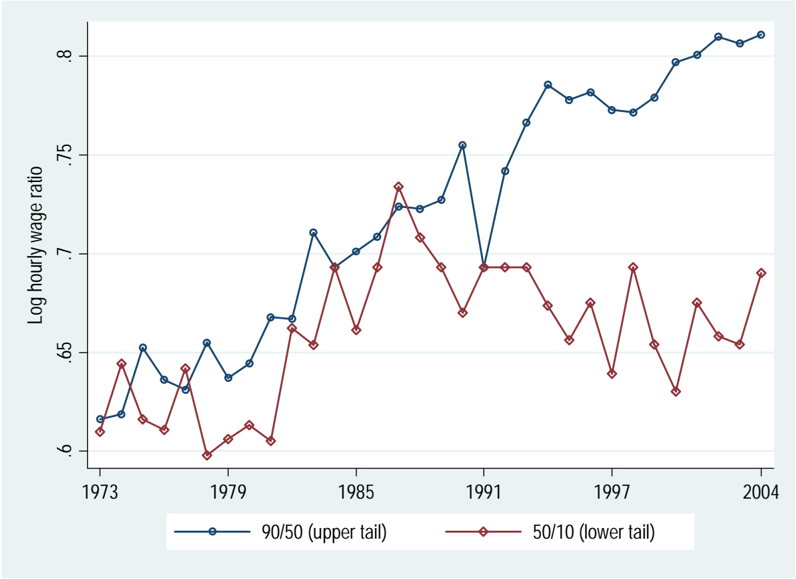
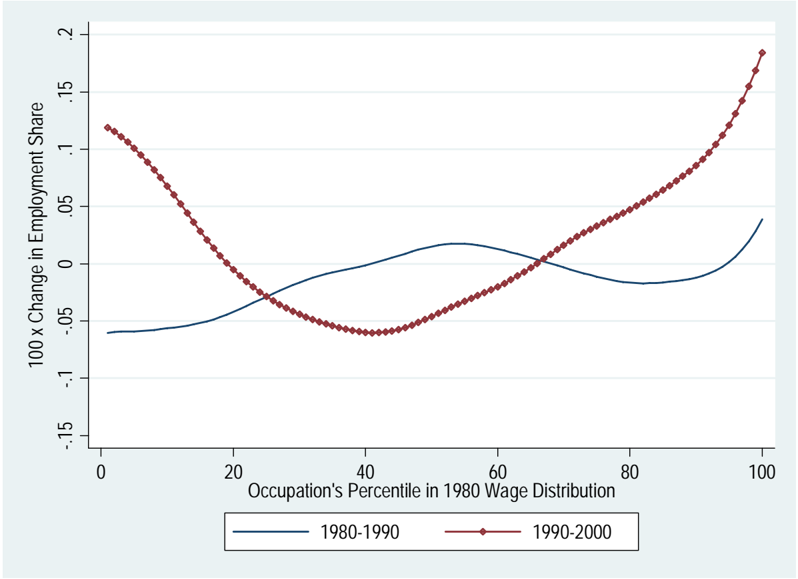
This paper analyzes a marked change in the evolution of the U.S. wage structure over the past fifteen years: divergent trends in upper-tail (90/50) and lower-tail (50/10) wage inequality. We document that wage inequality in the top half of distribution has displayed an unchecked and rather smooth secular rise for the last 25 years (since 1980). Wage inequality in the bottom half of the distribution also grew rapidly from 1979 to 1987, but it has ceased growing (and for some measures actually narrowed) since the late 1980s. Furthermore we find that occupational employment growth shifted from monotonically increasing in wages (education) in the 1980s to a pattern of more rapid growth in jobs at the top and bottom relative to the middles of the wage (education) distribution in the 1990s. We characterize these patterns as the "polarization" of the U.S. labor market, with employment polarizing into high-wage and low-wage jobs at the expense of middle-wage work. We show how a model of computerization in which computers most strongly complement the non-routine (abstract) cognitive tasks of high-wage jobs, directly substitute for the routine tasks found in many traditional middle-wage jobs, and may have little direct impact on non-routine manual tasks in relatively low-wage jobs can help explain the observed polarization of the U.S. labor market.
Overview
CoChat Summary
TL;DR
This paper documents that U.S. wage inequality diverged after the late 1980s: upper-tail inequality kept rising while lower-tail inequality stopped growing, and employment growth shifted from monotonic skill upgrading in the 1980s to polarization into high- and low-wage jobs in the 1990s. The authors argue that a model of computerization—complementing abstract tasks, substituting for routine tasks, and having little direct effect on non-routine manual tasks—can help explain these patterns.
Key findings
- From 1979 to 1987, upper-half (90/50) and lower-half (50/10) wage inequality rose similarly, expanding the 90-10 log wage differential by 21 log points; after 1987, upper-half inequality continued rising while the 50-10 differential contracted by 4 log points from 1987 to 2004, leaving only 4 log points of 90-10 growth since 1987.
- Occupational employment growth changed from monotonically increasing in wages/education in the 1980s to polarized growth in the 1990s: employment grew more rapidly below the 25th and above the 65th percentiles of the occupational wage distribution and declined in the middle (25th to 65th percentiles).
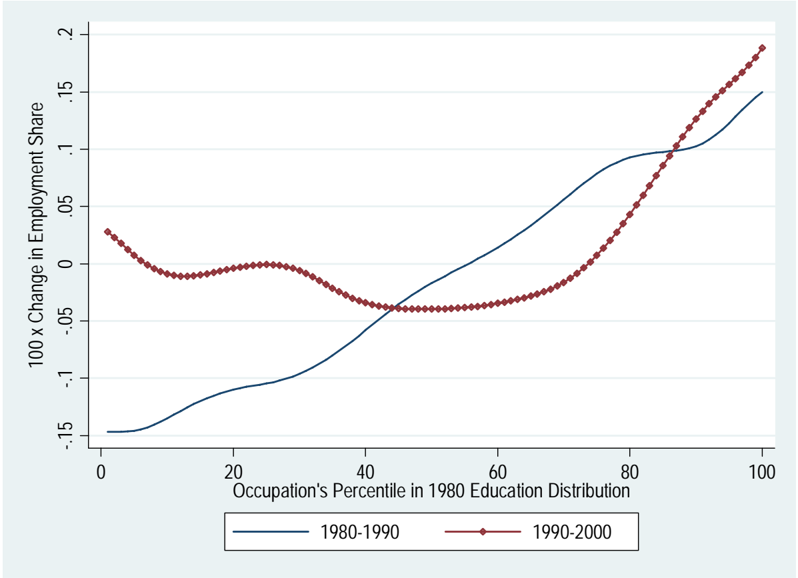
- Using 1980 occupational education percentiles, employment growth was near-monotonic in the 1980s but polarized in the 1990s, with more rapid growth at the bottom than the middle and the most rapid, diverging gains at the top.
- The authors find that quantity and price changes covary positively throughout the earnings distribution in both the 1980s and 1990s, suggesting labor demand shifts are central to explaining wage structure changes.
Methods
- The paper combines descriptive analysis of U.S. wage and employment data with a conceptual task-based model of computerization.
- Wage inequality trends are measured using Current Population Survey May samples for 1973–78 and Merged Outgoing Rotation Group samples for 1979–2004, focusing on 90/50 and 50/10 log hourly wage differentials.
- Employment polarization is analyzed using 1980, 1990, and 2000 Census Integrated Public Use Microsamples, ranking occupations by 1980 median hourly wage or average years of schooling and fitting locally weighted smoothing regressions of decadal employment-share growth on initial skill percentile.
Limitations
- Stated: the model assumes only two worker types, with college workers supplying abstract skill and high school workers substituting between routine and manual tasks; a more complete model would allow endogenous education responses, routine skills for college workers, abstract skills for high school workers, and heterogeneity in abstract skills among college workers.
- Stated: the “social norms” explanation for upper-tail skewness is intriguing but needs refinement to be directly testable, and the minimum wage explanation fits lower-tail inequality trends only to 1987.
- Evident: the paper is largely descriptive and theoretical rather than a causal test of computerization; the model’s predictions are used to interpret observed polarization, but the text does not report direct causal estimates linking computerization to the wage and employment changes.
Model-written summary. Check it against the paper before relying on it.
Integrity signals
Registry
Cites
Statistics
Figures
Verification
Claims the paper makes
0 Valid · 3 Not valid · 14 Not checked · 49 Own results and interpretations
A result the paper states — it cites no source for it, so there is none to check. The quote shows it is in the paper.
In the paper
“The net effect has been a slower growth of only 4 log points in the 90-10 log wage differential since 1987.”
plain- Asserted: passes — The authors put it forward as true.
- Checkable: passes — It can be checked against evidence.
- Load-bearing: passes — The paper’s conclusions depend on it.
- Based: passes — The paper gives a reason why it holds.
A result the paper reports from its own data — it cites no other source for it, so there is none to check. The quote shows it is in the paper.
In the paper
“Using this skill measure, we find near-monotonic (almost linear) increases in employment growth moving up the education distribution in the 1980s.”
plainstates an association- Asserted: passes — The authors put it forward as true.
- Checkable: passes — It can be checked against evidence.
- Load-bearing: unclear — It is unclear whether the paper’s conclusions depend on it.
- Based: passes — The paper gives a reason why it holds.
A result the paper reports from its own data — it cites no other source for it, so there is none to check. The quote shows it is in the paper.
In the paper
“We document that wage inequality in the top half of distribution has displayed an unchecked and rather smooth secular rise for the last 25 years (since 1980).”
- Also stated in: § ABSTRACT · plain
“wage inequality in the top half of the distribution has exhibited an unchecked secular rise for the last 25 years (since 1980)”
plain- Asserted: passes — The authors put it forward as true.
- Checkable: passes — It can be checked against evidence.
- Load-bearing: passes — The paper’s conclusions depend on it.
- Based: passes — The paper gives a reason why it holds.
- Also stated in: § ABSTRACT · plain
A result the paper reports from its own data — it cites no other source for it, so there is none to check. The quote shows it is in the paper.
In the paper
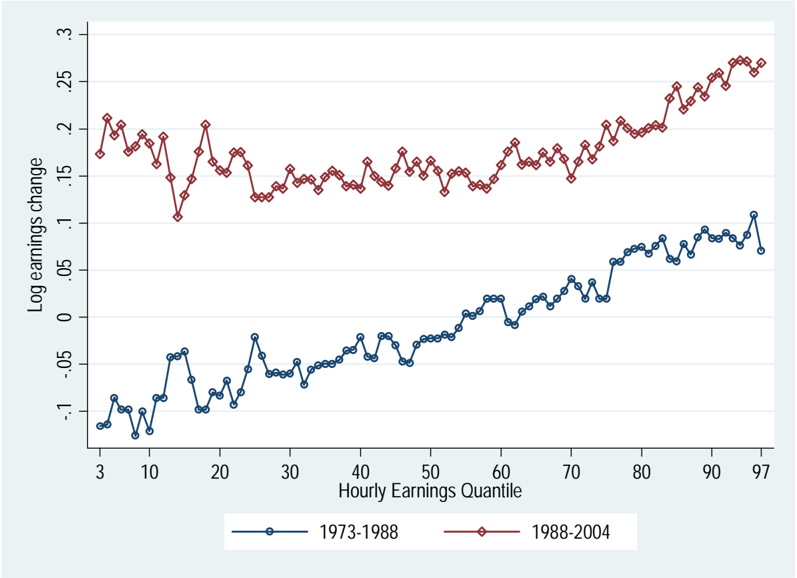
“The figure shows an almost linear spreading out of the entire wage distribution (from the 3 rd to 97 th percentile) in the first half of the sample (driven by changes in the 1980s).”
plainstates a cause- Asserted: passes — The authors put it forward as true.
- Checkable: passes — It can be checked against evidence.
- Load-bearing: passes — The paper’s conclusions depend on it.
- Based: passes — The paper gives a reason why it holds.
A result the paper reports from its own data — it cites no other source for it, so there is none to check. The quote shows it is in the paper.
In the paper
“The plot shows similar substantial increases in upper-half (90-50) and lower-half (50-10) wage inequality from 1979 to 1987, expanding the 90-10 log wage differential by 21 log points.”
plain- Asserted: passes — The authors put it forward as true.
- Checkable: passes — It can be checked against evidence.
- Load-bearing: passes — The paper’s conclusions depend on it.
- Based: passes — The paper gives a reason why it holds.
37 more claims
Create a free account to see all 66 claims and every source verdict.
- It may state two separate claims as one. 20
- Probably not a substantial claim. 5
- The quote only partly states this claim. 1
Claims other papers make about this one
Each is checked against this paper’s own text: does it say what the citing paper says it does?
The source backs part of the claim, not all of it — or backs it for a different population, condition or comparison.
In the citing paper
“Since the 1980s, the U.S. labor market has experienced declines in middle-skill, middle-income jobs in manufacturing and construction as a result of improvements in assembly line automation and the displacement of routine production jobs offshore, among other explanations (Acemoglu and Autor 2011; Autor, Katz, and Kearney 2006; Kalleberg 2009).”
From Beyond the Great Recession: Labor Market Polarization and Ongoing Fertility Decline in the United States (2019) · cites this paper as Autor, Katz, and Kearney 2006
Experimental — accuracy not yet measuredThe cited source says what the claim attributes to it.
In the citing paper
“Prior research on computer-based automation posited that routine work was most susceptible to replacement by computers (Autor et al., 2006; Acemoglu and Autor, 2011).”
From Large language models at work in China’s labor market (2025) · cites this paper as Autor et al., 2006
Citations
Cites
The Skill Content of Recent Technological Change: An Empirical Exploration
Autor, D. H., Levy, F., & Murnane, R. J. (2003) · The Quarterly Journal of Economics · doi:10.1162/003355303322552801 · Cited by 6,205
Self-citationIncome Inequality in the United States, 1913-1998
Piketty, T., & Saez, E. (2003) · The Quarterly Journal of Economics · doi:10.1162/00335530360535135 · Cited by 3,769
Lousy and Lovely Jobs: The Rising Polarization of Work in Britain
Goos, M., & Manning, A. (2007) · Review of Economics and Statistics · doi:10.1162/rest.89.1.118 · Cited by 2,285
Why Has CEO Pay Increased So Much?*
Gabaix, X., & Landier, A. (2008) · Quarterly Journal of Economics · doi:10.1162/qjec.2008.123.1.49 · Cited by 1,764
Skill‐Biased Technological Change and Rising Wage Inequality: Some Problems and Puzzles
Card, D., & DiNardo, J. E. (2002) · Journal of Labor Economics · doi:10.1086/342055 · Cited by 1,714
Technical Change, Job Tasks, and Rising Educational Demands: Looking outside the Wage Structure
Spitz‐Oener, A. (2006) · Journal of Labor Economics · doi:10.1086/499972 · Cited by 1,241
Changes in Unemployment and Wage Inequality: An Alternative Theory and Some Evidence
Acemoglu, D. (1999) · American Economic Review · doi:10.1257/aer.89.5.1259 · Cited by 634
Research works printed but not linked: 3
- Antràs Garicano, Quarterly Journal of Economics (forthcoming).
- Katz Lawrence F, 1999, North-Holland, 1463
- Lemieux Thomas, American Economic Review (forthcoming).
Cited by
Items 1,001–1,100 of 1,479
FDI and onshore task composition: evidence from German firms with affiliates in the Czech Republic
Koerner, K., & Moigne, M. L. (2023) · Journal for Labour Market Research · doi:10.1186/s12651-023-00346-7 · Cited by 2
Trends in effort at work in the UK
Giménez-Nadal, J. I., & Sevilla, A. (2022) · Oxford Economic Papers · doi:10.1093/oep/gpad043 · Cited by 5
Schneider, B. (2023) · European Review of Economic History · doi:10.1093/ereh/head028 · Cited by 2
Brain over brawn: Job polarisation, structural change, and skill prices
Paweenawat, S. W., & Liao, L. (2024) · The Economic and Labour Relations Review · doi:10.1017/elr.2024.1 · Cited by 4
Gahrmann, C., Kößler, F. J., Mytrofanova, M., & Klumb, P. L. (2024) · Occupational Health Science · doi:10.1007/s41542-024-00204-z · Cited by 2
Arntz, M., Blesse, S., & Dörrenberg, P. (2026) · Labour Economics · doi:10.1016/j.labeco.2026.102897 · Cited by 2
Zhou, P., Li, X., & Shen, Y. (2024) · PLoS ONE · doi:10.1371/journal.pone.0314362 · Cited by 3
Ünal, E., & Bulut, Ö. U. (2024) · İstanbul Ticaret Üniversitesi Sosyal Bilimler Dergisi · doi:10.46928/iticusbe.1574089 · Cited by 2
Rising Income Inequality and the Impact of r‐g$$ r\hbox{-} g $$ in the United States
Abatemarco, A., Lagomarsino, E., & Spiganti, A. (2025) · Review of Income and Wealth · doi:10.1111/roiw.70000 · Cited by 4
Winners and losers when firms robotize: wage effects across occupations and education
Barth, E., Røed, M., Schøne, P., & Umblijs, J. (2025) · Scandinavian Journal of Economics · doi:10.1111/sjoe.12593 · Cited by 5
Displacement of labor by capital: Its implication on stock liquidity
Kim, J., Mazumder, S., & Su, Q. (2025) · International Review of Finance · doi:10.1111/irfi.70026 · Cited by 3
Employability of higher education graduates in Spain: crisis and new challenges
Pastor, J. I. M. (2017) · Forum Sociológico · doi:10.4000/sociologico.1829 · Cited by 2
Changing structure of Employment in Europe: Polarization Issue
Náplava, R. (2019) · Review of Economic Perspectives · doi:10.2478/revecp-2019-0016 · Cited by 3
Skill bias, trade, and wage dispersion
Monte, F. (2010) · Journal of International Economics · doi:10.1016/j.jinteco.2010.11.004 · Cited by 37
A Simple Theory of Managerial Talent, Pay Contracts and Wage Distribution
Wu, Y. (2011) · London School of Economics and Political Science Research Online (London School of Economics and Political Science) · Cited by 2
Is that where you work or what you do? Understanding job polarization in Brazil
Nogueira, V. A. (2016) · Summit (Simon Fraser University) · doi:10.13140/rg.2.2.27126.60480 · Cited by 4
Status and income inequality in a knowledge economy
Peng, B. (2014) · The Journal of Economic Inequality · doi:10.1007/s10888-014-9274-y · Cited by 2
Long-term developments in human labor and their political implications
Cordes, C. (2009) · Revue de philosophie économique · doi:10.3917/rpec.102.0081 · Cited by 2
INTERGENERATIONAL CHANGES IN THE CONTEXT OF EARLY MOTHERHOOD
Woodward, L. J., Friesen, M. D., Raudino, A., Fergusson, D. M., & Horwood, L. J. (2013) · Journal of Family Studies · doi:10.5172/jfs.2013.3497 · Cited by 5
L’évolution des inégalités dans les pays industrialisés : le point sur la situation
Lemieux, T. (2009) · L Actualité économique · doi:10.7202/038708ar · Cited by 3
Baby Boom retirees and Florida's job structure*
Dewey, J., & Denslow, D. (2012) · Cited by 2
Consumption inequality in the Great Recession
Lee, H., & Painter, G. D. (2016) · Journal of Economic and Social Measurement · doi:10.3233/jem-160424 · Cited by 3
Lim, J., & Dall’erba, S. (2016) · Regional Science Policy & Practice · doi:10.1111/rsp3.12083 · Cited by 2
Surfing the Waves of Digital Automation in Spanish Labor Market
Masllorens, J. L. I. (2019) · Springer proceedings in complexity · doi:10.1007/978-3-030-30809-4_41 · Cited by 2
Innovation, technology adoption and employment: Evidence synthesis
Uğur, M. (2019) · Springer eBooks · doi:10.1007/978-3-319-57365-6_2-1 · Cited by 4
Robotization and Welfare Trends in Future
Kencebay, B. (2020) · IntechOpen eBooks · doi:10.5772/intechopen.93346 · Cited by 3
Changes Over Time in the Cost of Job Loss for Young Men and Women
Barnette, J., Odongo, K. O., & Reynolds, C. L. (2020) · The B E Journal of Economic Analysis & Policy · doi:10.1515/bejeap-2020-0005 · Cited by 5
Robotisation, Artificial Intelligence, Employment and the Fourth Industrial Revolution
Avis, J. (2020) · Springer eBooks · doi:10.1007/978-3-030-52032-8_3 · Cited by 2
Is social polarization bad for the planet? A theoretical inquiry
Verchère, A. (2021) · Bulletin of Economic Research · doi:10.1111/boer.12303 · Cited by 3
JOB QUALITY AND INSTITUTIONAL DYNAMICS OF COMPETITION IN POSTFORDIST CAPITALISM
Vidal, M. (2011) · eScholarship (California Digital Library) · Cited by 3
Acting on justiciable problems in a welfare state context: Does income matter?
Hoekstra, M. S., & ter Voert, M. (2022) · Law & Policy · doi:10.1111/lapo.12199 · Cited by 3
Job polarisation and household borrowing
Cantarella, M., & Kavonius, I. K. (2024) · The Journal of Economic Inequality · doi:10.1007/s10888-024-09624-x · Cited by 2
Codara, L., & Sgobbi, F. (2020) · SOCIOLOGIA DEL LAVORO · doi:10.3280/sl2020-157012 · Cited by 2
Educational Self-Selection, Tasks Assignment and Rising Wage InequalityPreprint
Dupuy, A. (2007) · SSRN Electronic Journal · doi:10.2139/ssrn.1033368 · Cited by 3
Vallizadeh, E., C, J. M. A., & Ziesemer, T. (2015) · Munich Personal RePEc Archive (Ludwig Maximilian University of Munich) · Cited by 12
Boustan, L. P., Ferreira, F. V., Winkler, H., et al. (2010) · SSRN Electronic Journal · doi:10.2139/ssrn.1666543 · Cited by 2
Welfare Benefits of Agglomeration and Worker HeterogeneityPreprint
Teulings, C. N., Ossokina, I. V., & de Groot, H. L. F. (2014) · SSRN Electronic Journal · doi:10.2139/ssrn.2496881 · Cited by 2
Have Unskilled Youths Become More Vulnerable to Unemployment in Switzerland?Preprint
Ferro-Luzzi, G., Falter, J., Weber, S., & Garibian, V. (2010) · SSRN Electronic Journal · doi:10.2139/ssrn.1715394 · Cited by 2
Gries, T., Grundmann, R., Palnau, I., et al. (2015) · RePEc: Research Papers in Economics · Cited by 2
Christopoulou, R., & Jimeno, J. F. (2008) · Cited by 6
College Premium and Earnings Dispersion in Norway and the US, 1970-2001: The Role of Field of Study
Eika, L. (2010) · NORA - Norwegian Open Research Archives · Cited by 2
A Joint Theory of Polarization and DeunionizationPreprint
Föll, T., & Hartmann, A. (2019) · RePEc: Research Papers in Economics · Cited by 2
Maintaining high employment in Norway
Sila, U., & Hemmings, P. (2020) · OECD Economics Department working papers · doi:10.1787/7e1993a1-en · Cited by 4
The Long-Term Consequences of the Tech Bubble on Skilled Workers' EarningsPreprint
Hombert, J., & Matray, A. (2018) · SSRN Electronic Journal · doi:10.2139/ssrn.3187093 · Cited by 5
Organization of Knowledge and TaxationPreprint
Kapička, M., & Slavık, C. (2021) · SSRN Electronic Journal · doi:10.2139/ssrn.3939244 · Cited by 4
Pica, G., & Mora, J. V. R. (2009) · SSRN Electronic Journal · doi:10.2139/ssrn.1494263 · Cited by 1
The Impact of Globalisation on the Euro Area MacroeconomyPreprint
Anderton, R., & Hiebert, P. (2009) · SSRN Electronic Journal · doi:10.2139/ssrn.1448566 · Cited by 2
Globalization and Imperfect Labor Market SortingPreprint
Davidson, C., Heyman, F., Matusz, S. J., Sjöholm, F., & Zhu, S. C. (2011) · SSRN Electronic Journal · doi:10.2139/ssrn.1742244 · Cited by 9
Which Factors Drive the Skill-Mix of Migrants in the Long-Run?Preprint
Beerli, A., & Indergand, R. (2015) · SSRN Electronic Journal · doi:10.2139/ssrn.2597586 · Cited by 2
Do Counter-Stereotypical Female Role Models Impact Women's Occupational Choices?Preprint
Chhaochharia, V., Du, M., & Niessen‐Ruenzi, A. (2021) · SSRN Electronic Journal · doi:10.2139/ssrn.3796264 · Cited by 2
Inside the Decline of the Labor Share: Technical Change, Market Power, and Structural ChangePreprint
Moreira, S. F. (2022) · SSRN Electronic Journal · doi:10.2139/ssrn.4049730 · Cited by 2
Schlögl, L., & Sumner, A. (2020) · Springer eBooks · doi:10.1007/978-3-030-30131-6_4 · Cited by 2
Cohort-Specific Experiences of Industrial Decline and Intergenerational Income MobilityPreprint
Seltzer, N. (2020) · doi:10.31235/osf.io/ve9bd · Cited by 2
Lordan, G., & Stringer, E.-J. (2022) · SSRN Electronic Journal · doi:10.2139/ssrn.4114742 · Cited by 2
Household Debt Overhang and Human Capital InvestmentPreprint
Manso, G., Rivera, A., Wang, H., & Xia, H. (2022) · SSRN Electronic Journal · doi:10.2139/ssrn.4190550 · Cited by 2
Automation risk and local development in micro-regions: evidence from HungaryPreprint
Németh, J., Szabó, N., & Sipos, N. (2023) · Research Square · doi:10.21203/rs.3.rs-3619607/v1 · Cited by 2
Automation risk and subjective wellbeing in the UKPreprint
Zheng, J., Rohenkohl, B., Barahona, M., & Clarke, J. (2024) · medRxiv · doi:10.1101/2024.01.18.24301484 · Cited by 3
The Labor Market Impact of Artificial Intelligence: Evidence from US RegionsPreprint
Huang, Y. (2025) · SSRN Electronic Journal · doi:10.2139/ssrn.5137231 · Cited by 4
Drabowicz, T. (2012) · Cadmus - EUI Research Repository (European University Institute) · doi:10.2870/46469 · Cited by 3
U.S. Job Polarization Persists
Canon, M. E., & Liu, Y. (2014) · Economic Synopses · doi:10.20955/es.2014.21 · Cited by 1
Snower, D. J. (2019) · Economics · doi:10.5018/economics-ejournal.ja.2019-37 · Cited by 2
Skill-Biased Technological Change and Job Polarization and Evidences from The Turkish Labor Market
DAĞLI, İ., & Kösekahyaoğlu, L. (2021) · İktisadi İdari ve Siyasal Araştırmalar Dergisi · doi:10.25204/iktisad.901039 · Cited by 2
Martín‐Legendre, J. I., García, P. C., & Santos, J. M. S. (2023) · Journal of Economic Studies · doi:10.1108/jes-05-2022-0262 · Cited by 1
The future of taxation in changing labour markets
Christl, M., Livanos, I., & Papini, A. (2023) · Public Sector Economics · doi:10.3326/pse.47.4.7 · Cited by 2
Employment and wage dynamics in the electricity sector: Evidence from Portugal 2002–2020
Alvarelhão, A. C., Resende, J., & Carneiro, A. J. M. (2024) · Energy Economics · doi:10.1016/j.eneco.2024.107310 · Cited by 2
Tan, J. (2020) · Labour Economics · doi:10.1016/j.labeco.2024.102604 · Cited by 3
ORGANİZASYONLARIN GELİŞİMİ ve DİJİTAL DÖNÜŞÜMLERİ
Bayraktar, M. (2024) · Organizasyon ve yönetim bilimleri dergisi. · doi:10.69785/oybd.1014143 · Cited by 1
Guo, Y., & Wang, S. (2025) · Social Indicators Research · doi:10.1007/s11205-024-03501-w · Cited by 2
Technology and evolution of occupational employment in Egypt (1998–2018): a task-based framework
Elsayed, M. M., & Nazier, H. (2025) · Seikei ronsō/Review of economics and political science · doi:10.1108/reps-04-2024-0008 · Cited by 1
Little to Lose: Exit Options and Attitudes towards Automation in Chinese Manufacturing
Wu, N., & Sun, Z. (2025) · The China Quarterly · doi:10.1017/s0305741024001577 · Cited by 2
Financing human capital: a survey and synthesis
Maug, E. G. (2026) · Foundations and Trends® in Finance · doi:10.1108/ftfin-04-2025-0067 · Cited by 7
Zhang, X., Gutin, I., Monnat, S. M., & Montez, J. K. (2025) · SSM - Population Health · doi:10.1016/j.ssmph.2025.101849 · Cited by 1
Equalising the effects of automation? The role of task overlap for job finding
Dabed, D., Genz, S., & Rademakers, E. (2025) · Labour Economics · doi:10.1016/j.labeco.2025.102766 · Cited by 2
Why are there so many bad jobs? The role of bargaining power and structural change
Pacitti, A., Cauvel, M., & Greene, M. (2025) · Competition & Change · doi:10.1177/10245294251371760 · Cited by 1
The role of housing in processes of wealth polarisation and de-polarisation in Australia
Wiesel, I., Meekes, J., & Chandrashekeran, S. (2025) · Housing Studies · doi:10.1080/02673037.2025.2548820 · Cited by 1
Skill‐Biased Technological Changes, Nonseparable Utility, and Dynamic Optimal Capital Tax
Li, Q., & Li, W. (2025) · Journal of Public Economic Theory · doi:10.1111/jpet.70065 · Cited by 1
Prado, S., & Sato, Y. (2025) · Cliometrica · doi:10.1007/s11698-025-00319-5 · Cited by 1
Technical change, wage inequality, and optimal taxes in an assignment model
Chen, B.-L., & Liang, F.-C. (2026) · Quantitative Economics · doi:10.3982/qe2361 · Cited by 2
Household production time and inequality in material living standards in the U.S., 1965–2018
Gautham, L., & Folbre, N. R. (2026) · Journal of Public Economics · doi:10.1016/j.jpubeco.2026.105582 · Cited by 4
Forecasting emerging job opportunities using the subject-action-object approach
Mousavi, K., Fahimifar, S., & Vanaki, A. S. (2026) · Technological Forecasting and Social Change · doi:10.1016/j.techfore.2026.124536 · Cited by 1
Firm networks and global technology diffusion
Bastos, P., Stapleton, K., Taglioni, D., & Wei, H. Y. (2026) · Journal of International Economics · doi:10.1016/j.jinteco.2026.104240 · Cited by 1
Routine-Biased Technological Change and the Gender Wage Gap Among Formal Workers in Indonesia
Jamil, W. I., Brodjonegoro, B. P. S., & Widyawati, D. (2026) · Economies · doi:10.3390/economies14040112 · Cited by 1
The impact of industrial robots on employment in China
Li, R., Masron, T. A., & Hu, H. (2026) · Journal of the Asia Pacific Economy · doi:10.1080/13547860.2026.2659688 · Cited by 1
Hang, L., Tong, S., Ge, X., & Gorbachev, D. (2026) · Research in Transportation Economics · doi:10.1016/j.retrec.2026.101778 · Cited by 1
Remote Work and Hiring Requirements: Cross-Country Evidence from Job Postings
Wang, S., Zhang, L., & Liao, Z. (2026) · Administrative Science Quarterly · doi:10.1177/00018392261450609 · Cited by 6
Entry Costs, Task Variety, and Skill Flexibility: A Simple Theory of (Top) Income Skewness
Atolia, M., & Kurokawa, Y. (2020) · The B E Journal of Macroeconomics · doi:10.1515/bejm-2019-0221 · Cited by 1
Zorn, N. (2012) · Interventions économiques · doi:10.4000/interventionseconomiques.1708 · Cited by 4
A New Analysis of Broadband Adoption Rates By Minority Households
Shapiro, R. J., & Hassett, K. A. (2010) · Cited by 1
Private Incentives for Specialization in a Changing and Unpredictable Labor Market
Parro, F. (2015) · Theoretical Economics Letters · doi:10.4236/tel.2015.52020 · Cited by 1
Ouverture commerciale et marché du travail : une revue de la littérature
Laffineur, C. (2014) · Revue d économie politique · doi:10.3917/redp.243.0361 · Cited by 2
Low, declining, polarizing: job skill in Florida*
Dewey, J., & Denslow, D. (2012) · Cited by 1
Park, J., & Lee, B. (2015) · Cited by 1
African-Americans in the U.S. Economy Since Emancipation
Sundstrom, W. A. (2015) · Routledge eBooks · doi:10.4324/9780203075616.ch27 · Cited by 1
Student Work and Paying for College: How the Jobs Crisis Affects College Affordability
Dwyer, R. E. (2016) · Emerald Group Publishing Limited eBooks · doi:10.1108/s0277-283320160000028010 · Cited by 2
Shaffer, D. W. (2007) · BRILL eBooks · doi:10.1163/9789087903121_004 · Cited by 2
Telegdy, Á. (2018) · Hitelintézeti szemle · doi:10.25201/fer.17.3.528 · Cited by 4
The role of headhunters in wage inequality: It's all about matching
Gorn, A. (2020) · Review of Economic Dynamics · doi:10.1016/j.red.2020.10.006 · Cited by 5
Fan, M., & Pena, A. A. (2020) · Journal of Economics Race and Policy · doi:10.1007/s41996-020-00056-z · Cited by 1
Ariza, J. F., & Bara, J. L. R. (2020) · Revue internationale du Travail · doi:10.1111/ilrf.12152 · Cited by 2
Ariza, J. F., & Bara, J. L. R. (2020) · Revista Internacional del Trabajo · doi:10.1111/ilrs.12158 · Cited by 2
Metadata
- Authors
- Autor, D. H., Katz, L. F., & Kearney, M. S.
- Affiliations
- National Bureau of Economic Research (US)
- Brookings Institution (US)
- Venue
- American Economic Review
- Publisher
- American Economic Association
- Published
- 2006-04-01
- Volume
- 96
- Issue
- 2
- Pages
- 189-194
- ISSN
- 0002-8282 (ISSN-L)
- OpenAlex
- W3124544360
- Cited by
- 1,594
- References
- 4
- Citations by year
- 2026: 75 · 2025: 108 · 2024: 122 · 2023: 90 · 2022: 89 · 2021: 100 · 2020: 107 · 2019: 96 · 2018: 93 · 2017: 74 · 2016: 76 · 2015: 91 · 2014: 78 · 2013: 81 · 2012: 59
- FWCI
- 110.81
- Type
- journal article
- Language
- en
- Open access
- closed
- Locations
- American Economic Review (publishedVersion)
- RePEc: Research Papers in Economics (submittedVersion)
- Topics
- Social Sciences › Economics, Econometrics and Finance › Economics and Econometrics › Labor market dynamics and wage inequality
- Social Sciences › Economics, Econometrics and Finance › General Economics, Econometrics and Finance › Economic Theory and Policy
- Social Sciences › Sociology and Political Science › Income, Poverty, and Inequality
- Keywords
- labor market polarization, wage inequality, wage distribution, computerization, high-wage jobs, low-wage employment, United States labor market
About these checks
Registry, retraction, Cites and statistics results are computed, not judged, with one exception: a printed reference that no index lists is read once by a model before it counts as a citation error. Claims are extracted by a model and kept only when their quote appears verbatim in the text; each cited source is then checked, with a model’s help, for whether it says what the claim relies on. Those verdicts can be wrong — read the claim’s quote and the cited source before relying on one.
A language model drew the claims from the paper on 2026-10-12, under version 3 of the claim definition (model deepseek-v4.1-flash, prompt extract-v3).
A second model labelled each claim on 2026-10-12 (model jev-1.13-20260917, definition revision gold-guideline-v0.2).
Statistics and arithmetic are recomputed, not judged.
Confidence bands are shown only for fields calibrated on our annotated test set. None is calibrated yet, so no band is shown.
What counts as a claim ›How we measure confidence ›How we check this ›
Are you an author, or do you see a problem with this page? Request a review
Data sources
Bibliographic data: Semantic Scholar, OpenAlex, Crossref.
Contains information from the Semantic Scholar Academic Graph Datasets, made available under the ODC Attribution License (ODC-BY 1.0).
Semantic Scholar’s data is described in: Kinney, R., et al. (2023). The Semantic Scholar Open Data Platform. arXiv:2301.10140.
