

The Polarization of the U.S. Labor Market
The DOI matches its Crossref record; 7 of the 7 references it cites were found in a registry or an index; none of the 16 sources its claims cite is checked for support yet.
Abstract
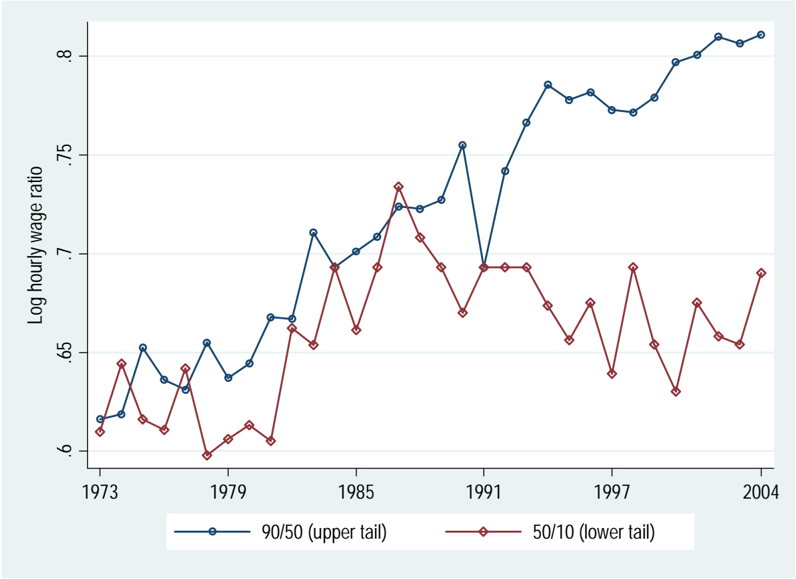
This paper analyzes a marked change in the evolution of the U.S. wage structure over the past fifteen years: divergent trends in upper-tail (90/50) and lower-tail (50/10) wage inequality. We document that wage inequality in the top half of distribution has displayed an unchecked and rather smooth secular rise for the last 25 years (since 1980). Wage inequality in the bottom half of the distribution also grew rapidly from 1979 to 1987, but it has ceased growing (and for some measures actually narrowed) since the late 1980s. Furthermore we find that occupational employment growth shifted from monotonically increasing in wages (education) in the 1980s to a pattern of more rapid growth in jobs at the top and bottom relative to the middles of the wage (education) distribution in the 1990s. We characterize these patterns as the "polarization" of the U.S. labor market, with employment polarizing into high-wage and low-wage jobs at the expense of middle-wage work. We show how a model of computerization in which computers most strongly complement the non-routine (abstract) cognitive tasks of high-wage jobs, directly substitute for the routine tasks found in many traditional middle-wage jobs, and may have little direct impact on non-routine manual tasks in relatively low-wage jobs can help explain the observed polarization of the U.S. labor market.
Overview
CoChat Summary
TL;DR
This paper documents that U.S. wage inequality diverged after the late 1980s: upper-tail inequality kept rising while lower-tail inequality stopped growing, and employment growth shifted from monotonic skill upgrading in the 1980s to polarization into high- and low-wage jobs in the 1990s. The authors argue that a model of computerization—complementing abstract tasks, substituting for routine tasks, and having little direct effect on non-routine manual tasks—can help explain these patterns.
Key findings
- From 1979 to 1987, upper-half (90/50) and lower-half (50/10) wage inequality rose similarly, expanding the 90-10 log wage differential by 21 log points; after 1987, upper-half inequality continued rising while the 50-10 differential contracted by 4 log points from 1987 to 2004, leaving only 4 log points of 90-10 growth since 1987.
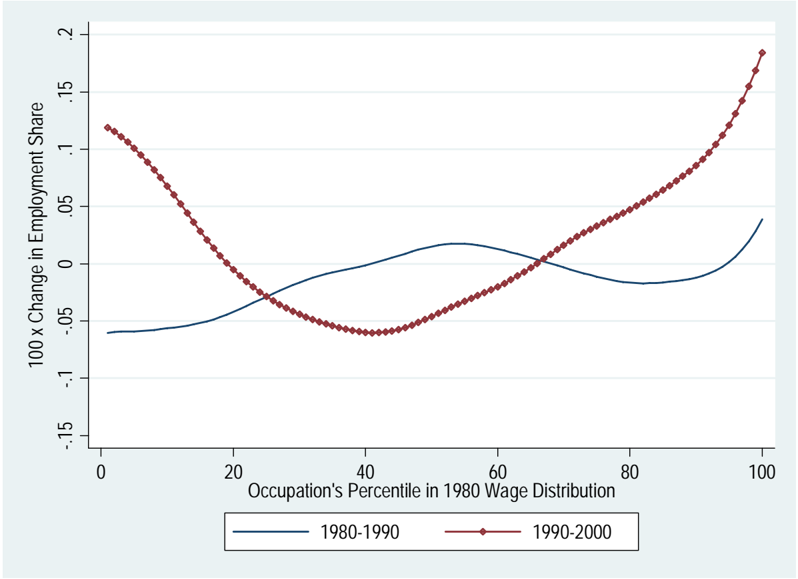
- Occupational employment growth changed from monotonically increasing in wages/education in the 1980s to polarized growth in the 1990s: employment grew more rapidly below the 25th and above the 65th percentiles of the occupational wage distribution and declined in the middle (25th to 65th percentiles).
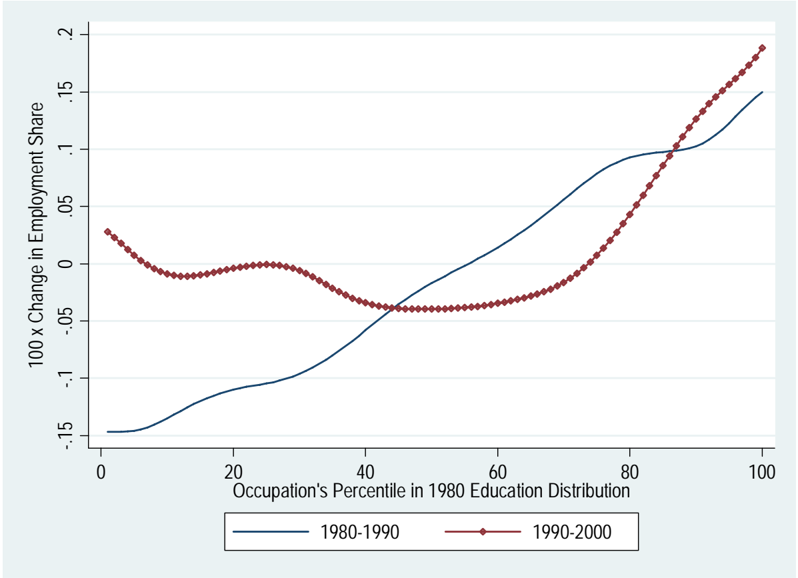
- Using 1980 occupational education percentiles, employment growth was near-monotonic in the 1980s but polarized in the 1990s, with more rapid growth at the bottom than the middle and the most rapid, diverging gains at the top.
- The authors find that quantity and price changes covary positively throughout the earnings distribution in both the 1980s and 1990s, suggesting labor demand shifts are central to explaining wage structure changes.
Methods
- The paper combines descriptive analysis of U.S. wage and employment data with a conceptual task-based model of computerization.
- Wage inequality trends are measured using Current Population Survey May samples for 1973–78 and Merged Outgoing Rotation Group samples for 1979–2004, focusing on 90/50 and 50/10 log hourly wage differentials.
- Employment polarization is analyzed using 1980, 1990, and 2000 Census Integrated Public Use Microsamples, ranking occupations by 1980 median hourly wage or average years of schooling and fitting locally weighted smoothing regressions of decadal employment-share growth on initial skill percentile.
Limitations
- Stated: the model assumes only two worker types, with college workers supplying abstract skill and high school workers substituting between routine and manual tasks; a more complete model would allow endogenous education responses, routine skills for college workers, abstract skills for high school workers, and heterogeneity in abstract skills among college workers.
- Stated: the “social norms” explanation for upper-tail skewness is intriguing but needs refinement to be directly testable, and the minimum wage explanation fits lower-tail inequality trends only to 1987.
- Evident: the paper is largely descriptive and theoretical rather than a causal test of computerization; the model’s predictions are used to interpret observed polarization, but the text does not report direct causal estimates linking computerization to the wage and employment changes.
Model-written summary. Check it against the paper before relying on it.
Integrity signals
Registry
Cites
Statistics
Figures
Verification
Claims the paper makes
0 Valid · 3 Not valid · 14 Not checked · 49 Own results and interpretations
A result the paper states — it cites no source for it, so there is none to check. The quote shows it is in the paper.
In the paper
“The net effect has been a slower growth of only 4 log points in the 90-10 log wage differential since 1987.”
plain- Asserted: passes — The authors put it forward as true.
- Checkable: passes — It can be checked against evidence.
- Load-bearing: passes — The paper’s conclusions depend on it.
- Based: passes — The paper gives a reason why it holds.
A result the paper reports from its own data — it cites no other source for it, so there is none to check. The quote shows it is in the paper.
In the paper
“Using this skill measure, we find near-monotonic (almost linear) increases in employment growth moving up the education distribution in the 1980s.”
plainstates an association- Asserted: passes — The authors put it forward as true.
- Checkable: passes — It can be checked against evidence.
- Load-bearing: unclear — It is unclear whether the paper’s conclusions depend on it.
- Based: passes — The paper gives a reason why it holds.
A result the paper reports from its own data — it cites no other source for it, so there is none to check. The quote shows it is in the paper.
In the paper
“We document that wage inequality in the top half of distribution has displayed an unchecked and rather smooth secular rise for the last 25 years (since 1980).”
- Also stated in: § ABSTRACT · plain
“wage inequality in the top half of the distribution has exhibited an unchecked secular rise for the last 25 years (since 1980)”
plain- Asserted: passes — The authors put it forward as true.
- Checkable: passes — It can be checked against evidence.
- Load-bearing: passes — The paper’s conclusions depend on it.
- Based: passes — The paper gives a reason why it holds.
- Also stated in: § ABSTRACT · plain
A result the paper reports from its own data — it cites no other source for it, so there is none to check. The quote shows it is in the paper.
In the paper
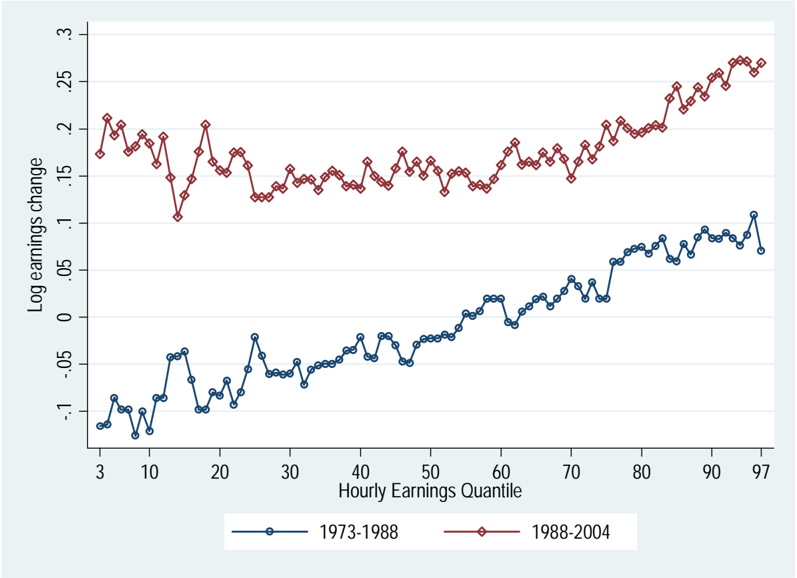
“The figure shows an almost linear spreading out of the entire wage distribution (from the 3 rd to 97 th percentile) in the first half of the sample (driven by changes in the 1980s).”
plainstates a cause- Asserted: passes — The authors put it forward as true.
- Checkable: passes — It can be checked against evidence.
- Load-bearing: passes — The paper’s conclusions depend on it.
- Based: passes — The paper gives a reason why it holds.
A result the paper reports from its own data — it cites no other source for it, so there is none to check. The quote shows it is in the paper.
In the paper
“The plot shows similar substantial increases in upper-half (90-50) and lower-half (50-10) wage inequality from 1979 to 1987, expanding the 90-10 log wage differential by 21 log points.”
plain- Asserted: passes — The authors put it forward as true.
- Checkable: passes — It can be checked against evidence.
- Load-bearing: passes — The paper’s conclusions depend on it.
- Based: passes — The paper gives a reason why it holds.
37 more claims
Create a free account to see all 66 claims and every source verdict.
- It may state two separate claims as one. 20
- Probably not a substantial claim. 5
- The quote only partly states this claim. 1
Claims other papers make about this one
Each is checked against this paper’s own text: does it say what the citing paper says it does?
The source backs part of the claim, not all of it — or backs it for a different population, condition or comparison.
In the citing paper
“Since the 1980s, the U.S. labor market has experienced declines in middle-skill, middle-income jobs in manufacturing and construction as a result of improvements in assembly line automation and the displacement of routine production jobs offshore, among other explanations (Acemoglu and Autor 2011; Autor, Katz, and Kearney 2006; Kalleberg 2009).”
From Beyond the Great Recession: Labor Market Polarization and Ongoing Fertility Decline in the United States (2019) · cites this paper as Autor, Katz, and Kearney 2006
Experimental — accuracy not yet measuredThe cited source says what the claim attributes to it.
In the citing paper
“Prior research on computer-based automation posited that routine work was most susceptible to replacement by computers (Autor et al., 2006; Acemoglu and Autor, 2011).”
From Large language models at work in China’s labor market (2025) · cites this paper as Autor et al., 2006
Citations
Cites
The Skill Content of Recent Technological Change: An Empirical Exploration
Autor, D. H., Levy, F., & Murnane, R. J. (2003) · The Quarterly Journal of Economics · doi:10.1162/003355303322552801 · Cited by 6,205
Self-citationIncome Inequality in the United States, 1913-1998
Piketty, T., & Saez, E. (2003) · The Quarterly Journal of Economics · doi:10.1162/00335530360535135 · Cited by 3,769
Lousy and Lovely Jobs: The Rising Polarization of Work in Britain
Goos, M., & Manning, A. (2007) · Review of Economics and Statistics · doi:10.1162/rest.89.1.118 · Cited by 2,285
Why Has CEO Pay Increased So Much?*
Gabaix, X., & Landier, A. (2008) · Quarterly Journal of Economics · doi:10.1162/qjec.2008.123.1.49 · Cited by 1,764
Skill‐Biased Technological Change and Rising Wage Inequality: Some Problems and Puzzles
Card, D., & DiNardo, J. E. (2002) · Journal of Labor Economics · doi:10.1086/342055 · Cited by 1,714
Technical Change, Job Tasks, and Rising Educational Demands: Looking outside the Wage Structure
Spitz‐Oener, A. (2006) · Journal of Labor Economics · doi:10.1086/499972 · Cited by 1,241
Changes in Unemployment and Wage Inequality: An Alternative Theory and Some Evidence
Acemoglu, D. (1999) · American Economic Review · doi:10.1257/aer.89.5.1259 · Cited by 634
Research works printed but not linked: 3
- Antràs Garicano, Quarterly Journal of Economics (forthcoming).
- Katz Lawrence F, 1999, North-Holland, 1463
- Lemieux Thomas, American Economic Review (forthcoming).
Cited by
Items 1,301–1,400 of 1,479
Inteligência Artificial: impactos sobre o mercado de trabalho e a desigualdade de renda
Meireles, T. D. O. (2022) · Digital Library of Theses and Dissertations (Universidade de São Paulo) · doi:10.11606/t.8.2022.tde-30032023-090638 · Cited by 2
Are Social Skills Helping Women in the Brazilian Labor Market?
Sulzbach, V. N., Stein, G., & Griebeler, M. D. C. (2023) · Brazilian Review of Econometrics · doi:10.12660/bre.v42n12022.84996
Gendered Labour Markets and Occupational Change in the Nordics. Who Wins and Who Loses?Preprint
Berglund, T., Svalund, J., Alasoini, T., et al. (2023) · SSRN Electronic Journal · doi:10.2139/ssrn.4610450
Market size and growth of blended finance in LAC, 2012-22
(2023) · Latin American economic outlook · doi:10.1787/ca7537f0-en
Productivity and innovation: FDI qualities indicators for selected LAC countries, 2019
(2023) · Latin American economic outlook · doi:10.1787/14f0f60e-en
Investment panorama in Latin America and the Caribbean: Challenges and opportunities
OECD, Economic Commission for Latin America and the Caribbean, America, C. D. B. O. L., & European Commission (2023) · Latin American economic outlook · doi:10.1787/6466973b-en
GSSS bond issuance in international markets, sectoral distribution, LAC
(2023) · Latin American economic outlook · doi:10.1787/d74156e1-en
Number of open social conflicts in LAC linked to environmental issues, by category, 2022
(2023) · Latin American economic outlook · doi:10.1787/6c54b97c-en
Positive perceptions of FDI have declined among LAC citizens
(2023) · Latin American economic outlook · doi:10.1787/20b13cfb-en
Financial instruments offered to MSMEs by DFIs in LAC, by type of financing and sector, 2023
(2023) · Latin American economic outlook · doi:10.1787/fcefa85d-en
Total investment as a percentage of GDP in LAC and selected regions, 1990-2022
(2023) · Latin American economic outlook · doi:10.1787/bd706ffd-en
To Inhibit or to Promote: How Do Robots Affect the Social Integration of Rural Migrants in China?Preprint
Li, Y., Tang, Y., & Feng, D. (2024) · SSRN Electronic Journal · doi:10.2139/ssrn.4680987
Labor Market Polarization and Student DebtPreprint
Korgaonkar, S., Loutskina, E., & Yannelis, C. (2024) · SSRN Electronic Journal · doi:10.2139/ssrn.4658803
MUDANÇA TECNOLÓGICA E POLARIZAÇÃO DO EMPREGO NO BRASIL
Rocha, G. R., & Vaz, D. V. (2023) · Revista da ABET · doi:10.61999/abet.1676-4439.2023v22n1.60448 · Cited by 4
(2023) · Presses de Sciences Po eBooks · doi:10.3917/scpo.colle.2023.01.0561
The Impact of Technology on Wages in Non-Standard Employment
Cebesoy, S., & Öztopçu, A. (2024) · Advances in business strategy and competitive advantage book series · doi:10.4018/979-8-3693-3669-4.ch001
Impact of the change to a job-type employment system on R&DPreprint
Ishii, T. (2024) · SSRN Electronic Journal · doi:10.2139/ssrn.4717191
Polarisation of Employment in Czechia and Neighbouring Countries
Náplava, R. (2024) · Emerald Group Publishing Limited eBooks · doi:10.1108/978-1-83753-840-920241013
Technology, routinization and wage inequality: gender differences in the case of Uruguay
López, S., & Sanromán, G. (2023) · IZA Journal of Development and Migration · doi:10.2478/izajodm-2023-0008
Heterogeneous Effects of Capital-Embodied Innovation on Labor MarketPreprint
Park, H., & Shim, Y. (2024) · SSRN Electronic Journal · doi:10.2139/ssrn.4788236
Technological Change and Entrepreneurial Activities: Evidence from ChinaPreprint
Cui, L., & Xu, Y. (2024) · SSRN Electronic Journal · doi:10.2139/ssrn.4808907
Varieties of occupational change in Europe after the great recession
Herrero, D. (2024) · Labour & Industry a journal of the social and economic relations of work · doi:10.1080/10301763.2024.2349283 · Cited by 1
Equalizing the Effects of Automation? The Role of Task Overlap for Job FindingPreprint
Dabed, D., Genz, S., & Rademakers, E. (2024) · SSRN Electronic Journal · doi:10.2139/ssrn.4816509
Dötsch, J. J. (2024) · Contributions to economics · doi:10.1007/978-3-031-53047-0_8
Pustovalova, A., & Vahter, P. (2024) · Social Science Research Network · doi:10.2139/ssrn.4781445
Robotization and High-Skill OccupationsPreprint
Parmentier, L. (2024) · SSRN Electronic Journal · doi:10.2139/ssrn.4837220
Horn, K. M., Pollakowski, H. O., Zabel, J., & Chance, J. (2024) · SSRN Electronic Journal · doi:10.2139/ssrn.4852572
Law-Abiding Immigrants: The Incarceration Gap Between Immigrants and the US-born, 1870-2020Preprint
Abramitzky, R., Boustan, L. P., Jácome, E., Pérez, S. T., & Torres, J. D. (2024) · SSRN Electronic Journal · doi:10.2139/ssrn.4878020 · Cited by 6
Labor Market Polarization and the Great Urban DivergencePreprint
Davis, D. R., Mengus, É., & Michalski, T. (2024) · SSRN Electronic Journal · doi:10.2139/ssrn.4879815
Artificial Intelligence, Tasks, Skills, and Wages: Worker-Level Evidence from GermanyPreprint
Koch, M. R., Engberg, E., Lodefalk, M., & Schroeder, S. (2024) · SSRN Electronic Journal · doi:10.2139/ssrn.4883794
Drivers behind the diverging gender patterns of wage inequalityPreprint
Oliver, X., & Sard, M. (2024) · Research Square · doi:10.21203/rs.3.rs-4593488/v1
Náplava, R. (2024) · Danube · doi:10.2478/danb-2024-0007 · Cited by 1
Park, J., Ro, Y. J., Cho, S., & Na, S. K. (2024) · SSRN Electronic Journal · doi:10.2139/ssrn.4888007
The Right to Work in Light of Encroaching Automation
Danielsson, A., & Abdel-Haq, M. K. (2024) · Advances in human and social aspects of technology book series · doi:10.4018/979-8-3693-1127-1.ch018 · Cited by 1
Enterprises performing big data analysis, 2016
(2017) · OECD Digital Economy Outlook · doi:10.1787/9789264276284-graph62-en
Akamai's average speed, Q1 2016
(2017) · OECD Digital Economy Outlook · doi:10.1787/9789264276284-graph47-en
Policies to promote digital applications and services
(2017) · OECD Digital Economy Outlook · doi:10.1787/9789264276284-graph15-en
(2017) · OECD Digital Economy Outlook · doi:10.1787/9789264276284-graph8-en
Fixed and mobile broadband subscriptions, by technology, OECD
(2017) · OECD Digital Economy Outlook · doi:10.1787/9789264276284-graph49-en
Evolution of the share of value added of the ICT sector
(2017) · OECD Digital Economy Outlook · doi:10.1787/9789264276284-graph21-en
(2017) · OECD Digital Economy Outlook · doi:10.1787/9789264276284-graph114-en
Policies to support ICT sector growth
(2017) · OECD Digital Economy Outlook · doi:10.1787/9789264276284-graph9-en
Open government data availability and accessibility, 2017
(2017) · OECD Digital Economy Outlook · doi:10.1787/9789264276284-graph96-en
Adoption of m-health programmes by type, 2015
(2017) · OECD Digital Economy Outlook · doi:10.1787/9789264276284-graph94-en
Workers using OPS at work every day, 2012
(2017) · OECD Digital Economy Outlook · doi:10.1787/9789264276284-graph85-en
World exports of ICT goods by ICT product category
(2017) · OECD Digital Economy Outlook · doi:10.1787/9789264276284-graph33-en
Individuals managing the use of their personal information over the Internet, 2016
(2017) · OECD Digital Economy Outlook · doi:10.1787/9789264276284-graph116-en
Enterprises having a formally defined ICT security policy by size, 2015
(2017) · OECD Digital Economy Outlook · doi:10.1787/9789264276284-graph123-en
ICT goods and services in manufacturing exports
(2017) · OECD Digital Economy Outlook · doi:10.1787/9789264276284-graph101-en
Bachmann, R., & Storm, E. (2024) · List Forum für Wirtschafts- und Finanzpolitik · doi:10.1007/s41025-024-00275-4
The Long-Term Rise and Geographic Concentration of Labor Market DetachmentPreprint
Abel, J. R., & Deitz, R. (2024) · SSRN Electronic Journal · doi:10.2139/ssrn.5035037
Impact of Industrial Robot Application on Labor Spatial MobilityPreprint
Wang, J., Xie, X., & Zeng, D. (2024) · Research Square · doi:10.21203/rs.3.rs-5240397/v1
AI Exposure without Labor Data: Measuring AI’s Impact through FirmsPreprint
Liu, J. (2024) · SSRN Electronic Journal · doi:10.2139/ssrn.4668083 · Cited by 1
Can We Be Happy Together? Robotisation and Subjective Well-Being of WorkersPreprint
Akay, A., Järnberg, L. A., & Savsin, S. (2024) · SSRN Electronic Journal · doi:10.2139/ssrn.5042036
Technological Disruption in the Labor MarketPreprint
Deming, D., Ong, C., & Summers, L. (2025) · SSRN Electronic Journal · doi:10.2139/ssrn.5083764
Computerization and the Decline of Unincorporated Self-Employment
Liu, Z., Lee, S., & Chih, Y. (2025) · Journal of Human Capital · doi:10.1086/735105
The Higher Education Wage Premium
Parr, T. (2025) · Oxford University Press eBooks · doi:10.1093/9780191883378.003.0011
Towards a Legal Right to Work from Home
Parr, T. (2025) · Oxford University Press eBooks · doi:10.1093/9780191883378.003.0010 · Cited by 1
Parr, T. (2025) · Oxford University Press eBooks · doi:10.1093/9780191883378.003.0009
Occupational Harms (and Benefits)
Parr, T. (2025) · Oxford University Press eBooks · doi:10.1093/9780191883378.003.0004
Parr, T. (2025) · Oxford University Press eBooks · doi:10.1093/9780191883378.003.0012
Parr, T. (2025) · Oxford University Press eBooks · doi:10.1093/9780191883378.003.0008
The Significance of Employment
Parr, T. (2025) · Oxford University Press eBooks · doi:10.1093/9780191883378.003.0007
Parr, T. (2025) · Oxford University Press eBooks · doi:10.1093/9780191883378.003.0001
Parr, T. (2025) · Oxford University Press eBooks · doi:10.1093/9780191883378.003.0003 · Cited by 1
Parr, T. (2025) · Oxford University Press eBooks · doi:10.1093/9780191883378.003.0005
Maurizio, R., Monsalvo, A. P., Catania, S., & Martínez, S. (2025) · Springer eBooks · doi:10.1007/978-3-031-76228-4_7 · Cited by 1
Dwyer, R. E. (2025) · Springer eBooks · doi:10.1007/978-3-031-76228-4_5
Fernández‐Macías, E., Hurley, J., & Pérez, S. T. (2025) · Springer eBooks · doi:10.1007/978-3-031-76228-4_3
Pérez, S. T., Hurley, J., Fernández‐Macías, E., & Staffa, E. (2025) · Springer eBooks · doi:10.1007/978-3-031-76228-4_4 · Cited by 1
Employment Structure Change and Wage Inequality in Urban China
Li, B., & Wu, B. (2023) · 经济学报. · doi:10.26599/cje.2023.9300309
Workers’ Task and Employer Mobility Over the Business CyclePreprint
Carrillo‐Tudela, C., Summerfield, F., & Visschers, L. (2025) · SSRN Electronic Journal · doi:10.2139/ssrn.5167701
The Origins and Evolution of Occupational Licensing in the United StatesPreprint
Carollo, N. A., Hicks, J., Karch, A., & Kleiner, M. M. (2025) · SSRN Electronic Journal · doi:10.2139/ssrn.5181316
How social security contributions reshape migration in a spatial equilibrium
Liu, W., Ma, S., & Li, C. (2025) · Applied Economics · doi:10.1080/00036846.2025.2477857
The New Skill Divide: Cognitive Growth, Physical Decline, and Flexibility in an Automated WorldPreprint
Gong, Q., Wang, Q., & Zhang, W. (2025) · Research Square · doi:10.21203/rs.3.rs-6296044/v1
Complexity and colocation of the college-educated: Sort of complements
Simon, C. J. (2025) · Regional Science and Urban Economics · doi:10.1016/j.regsciurbeco.2025.104105
Climate Change and Outdoor Jobs: The Rise of Adult Male DropoutsPreprint
Yoshida, M. (2025) · SSRN Electronic Journal · doi:10.2139/ssrn.5250267
Exploring the Impacts of Education Inequality on Income Inequality Among American States
Jiang, Y., & Yin, Y. (2025) · Review of Development Economics · doi:10.1111/rode.70008 · Cited by 3
Duc, N. P. (2025) · International Journal of Research In Commerce and Management Studies · doi:10.38193/ijrcms.2025.7329
Yang, J.-Y., & Yoon, J. (2025) · Econometric Reviews · doi:10.1080/07474938.2025.2529534
Environmental tax reform and firms’ human capital: evidence from China
Li, H., Sun, L., Sun, C., & Li, Z. (2025) · Environment Development and Sustainability · doi:10.1007/s10668-025-06547-z · Cited by 1
Lu, Y., Li, X., & Eller, C. C. (2025) · Sociology of Education · doi:10.1177/00380407251356275 · Cited by 2
Effects of global trade integration on skill polarization and wage disparity
Chen, S., Luo, F., Xiao, T., et al. (2025) · Humanities and Social Sciences Communications · doi:10.1057/s41599-025-05779-8
Fey, J. (2025) · Zeitschrift für Weiterbildungsforschung · doi:10.1007/s40955-025-00324-1 · Cited by 1
Essieku, R. (2025) · SSRN Electronic Journal · doi:10.2139/ssrn.5452997
Beyond Training: Worker Agency, Informal Learning, and CompetitionPreprint
Silliman, M., & Willén, A. (2025) · SSRN Electronic Journal · doi:10.2139/ssrn.5498922 · Cited by 2
McErlean, K. (2025) · Socius Sociological Research for a Dynamic World · doi:10.1177/23780231251372790 · Cited by 1
Tasks and the gender wage gap in China: 2002-2023Preprint
Ma, X., Han, J., & Li, S. (2025) · SSRN Electronic Journal · doi:10.2139/ssrn.5520026
Occupational Mediation of Intergenerational Income MobilityPreprint
Chatterjee, A., Han, Y., Singh, A., & Tanaka, S. (2025) · SSRN Electronic Journal · doi:10.2139/ssrn.5554379
Job quality in the Republic of Korea: Progress or decline?
Lee, S., & Green, F. (2025) · International Labour Review · doi:10.16995/ilr.18855 · Cited by 3
Peng, J., & Wei, Y. K. (2025) · Population Space and Place · doi:10.1002/psp.70122
Qualité de l’emploi en République de Corée: amélioration ou détérioration?
Lee, S., & Green, F. (2025) · Revue internationale du Travail · doi:10.16995/ilrf.18855
Calidad del empleo en la República de Corea. ¿Progreso o declive?
Lee, S., & Green, F. (2025) · Revista Internacional del Trabajo · doi:10.16995/ilrs.18855 · Cited by 1
Machin, S. J., & Reenen, J. M. V. (2008) · Palgrave Macmillan UK eBooks · doi:10.1007/978-1-349-58802-2_1804
Occupational Mediation of Intergenerational Income Mobility1Preprint
Chatterjee, A., Han, Y., Singh, A., & Tanaka, S. (2025) · SSRN Electronic Journal · doi:10.2139/ssrn.5738771
xu, L., Fu, Z., Xu, Y., & Zhou, Z. (2025) · Humanities and Social Sciences Communications · doi:10.1057/s41599-025-06073-3 · Cited by 2
Tasks and the wage gap between rural migrants and local urban workers: Evidence from ChinaPreprint
Ma, X., Han, J., & Li, S. (2025) · SSRN Electronic Journal · doi:10.2139/ssrn.5775128
Tian, M., Chen, X., Kang, Y., & Du, J. (2025) · SSRN Electronic Journal · doi:10.2139/ssrn.5784603
Li, R., Masron, T. A., & Hu, H. (2025) · Chinese Economy · doi:10.1080/10971475.2025.2588873
Economic Returns of the Occupational Education Experience Based on Two Missouri Community Colleges.
Parker, D. (2011) · IRL - University of Missouri, St. Louis (University of Missouri–St. Louis)
Metadata
- Authors
- Autor, D. H., Katz, L. F., & Kearney, M. S.
- Affiliations
- National Bureau of Economic Research (US)
- Brookings Institution (US)
- Venue
- American Economic Review
- Publisher
- American Economic Association
- Published
- 2006-04-01
- Volume
- 96
- Issue
- 2
- Pages
- 189-194
- ISSN
- 0002-8282 (ISSN-L)
- OpenAlex
- W3124544360
- Cited by
- 1,594
- References
- 4
- Citations by year
- 2026: 75 · 2025: 108 · 2024: 122 · 2023: 90 · 2022: 89 · 2021: 100 · 2020: 107 · 2019: 96 · 2018: 93 · 2017: 74 · 2016: 76 · 2015: 91 · 2014: 78 · 2013: 81 · 2012: 59
- FWCI
- 110.81
- Type
- journal article
- Language
- en
- Open access
- closed
- Locations
- American Economic Review (publishedVersion)
- RePEc: Research Papers in Economics (submittedVersion)
- Topics
- Social Sciences › Economics, Econometrics and Finance › Economics and Econometrics › Labor market dynamics and wage inequality
- Social Sciences › Economics, Econometrics and Finance › General Economics, Econometrics and Finance › Economic Theory and Policy
- Social Sciences › Sociology and Political Science › Income, Poverty, and Inequality
- Keywords
- labor market polarization, wage inequality, wage distribution, computerization, high-wage jobs, low-wage employment, United States labor market
About these checks
Registry, retraction, Cites and statistics results are computed, not judged, with one exception: a printed reference that no index lists is read once by a model before it counts as a citation error. Claims are extracted by a model and kept only when their quote appears verbatim in the text; each cited source is then checked, with a model’s help, for whether it says what the claim relies on. Those verdicts can be wrong — read the claim’s quote and the cited source before relying on one.
A language model drew the claims from the paper on 2026-10-12, under version 3 of the claim definition (model deepseek-v4.1-flash, prompt extract-v3).
A second model labelled each claim on 2026-10-12 (model jev-1.13-20260917, definition revision gold-guideline-v0.2).
Statistics and arithmetic are recomputed, not judged.
Confidence bands are shown only for fields calibrated on our annotated test set. None is calibrated yet, so no band is shown.
What counts as a claim ›How we measure confidence ›How we check this ›
Are you an author, or do you see a problem with this page? Request a review
Data sources
Bibliographic data: Semantic Scholar, OpenAlex, Crossref.
Contains information from the Semantic Scholar Academic Graph Datasets, made available under the ODC Attribution License (ODC-BY 1.0).
Semantic Scholar’s data is described in: Kinney, R., et al. (2023). The Semantic Scholar Open Data Platform. arXiv:2301.10140.
