

The Polarization of the U.S. Labor Market
The DOI matches its Crossref record; 7 of the 7 references it cites were found in a registry or an index; none of the 16 sources its claims cite is checked for support yet.
Abstract
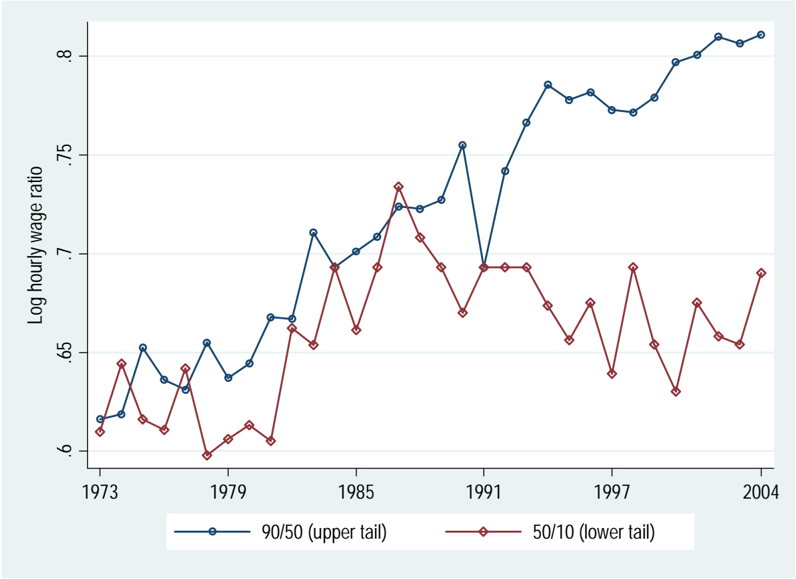
This paper analyzes a marked change in the evolution of the U.S. wage structure over the past fifteen years: divergent trends in upper-tail (90/50) and lower-tail (50/10) wage inequality. We document that wage inequality in the top half of distribution has displayed an unchecked and rather smooth secular rise for the last 25 years (since 1980). Wage inequality in the bottom half of the distribution also grew rapidly from 1979 to 1987, but it has ceased growing (and for some measures actually narrowed) since the late 1980s. Furthermore we find that occupational employment growth shifted from monotonically increasing in wages (education) in the 1980s to a pattern of more rapid growth in jobs at the top and bottom relative to the middles of the wage (education) distribution in the 1990s. We characterize these patterns as the "polarization" of the U.S. labor market, with employment polarizing into high-wage and low-wage jobs at the expense of middle-wage work. We show how a model of computerization in which computers most strongly complement the non-routine (abstract) cognitive tasks of high-wage jobs, directly substitute for the routine tasks found in many traditional middle-wage jobs, and may have little direct impact on non-routine manual tasks in relatively low-wage jobs can help explain the observed polarization of the U.S. labor market.
Overview
CoChat Summary
TL;DR
This paper documents that U.S. wage inequality diverged after the late 1980s: upper-tail inequality kept rising while lower-tail inequality stopped growing, and employment growth shifted from monotonic skill upgrading in the 1980s to polarization into high- and low-wage jobs in the 1990s. The authors argue that a model of computerization—complementing abstract tasks, substituting for routine tasks, and having little direct effect on non-routine manual tasks—can help explain these patterns.
Key findings
- From 1979 to 1987, upper-half (90/50) and lower-half (50/10) wage inequality rose similarly, expanding the 90-10 log wage differential by 21 log points; after 1987, upper-half inequality continued rising while the 50-10 differential contracted by 4 log points from 1987 to 2004, leaving only 4 log points of 90-10 growth since 1987.
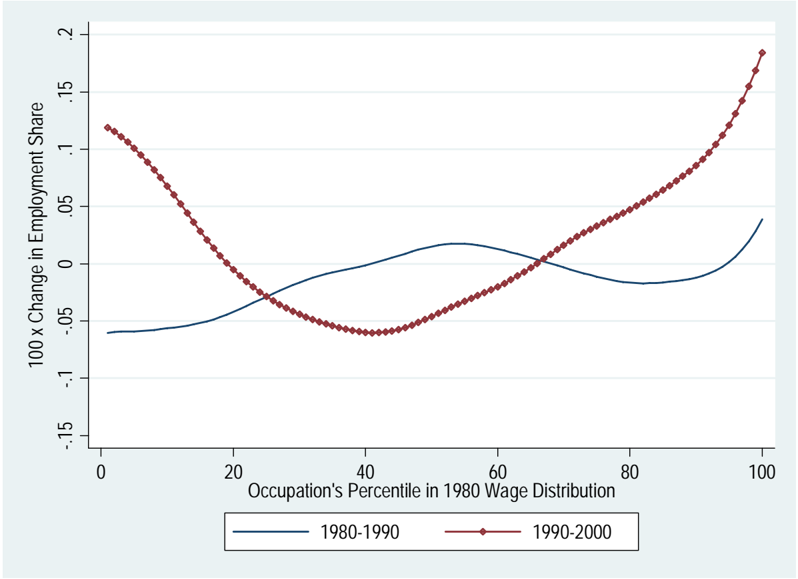
- Occupational employment growth changed from monotonically increasing in wages/education in the 1980s to polarized growth in the 1990s: employment grew more rapidly below the 25th and above the 65th percentiles of the occupational wage distribution and declined in the middle (25th to 65th percentiles).
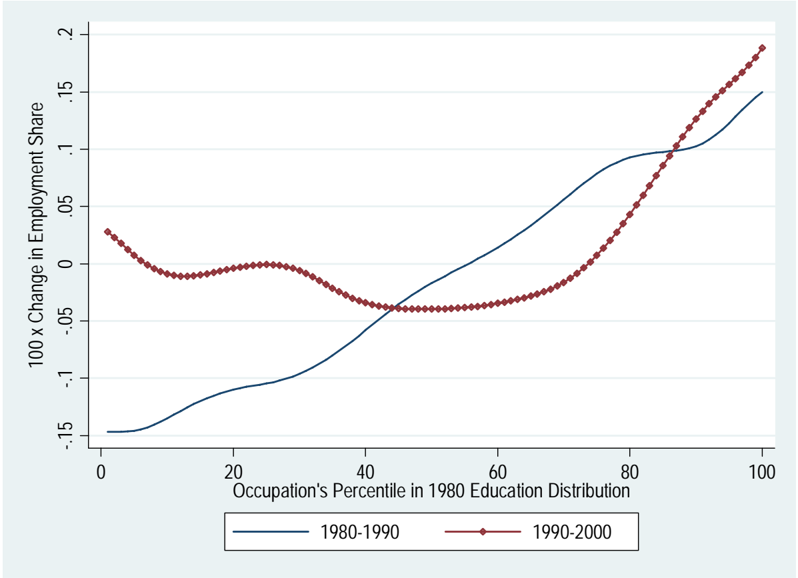
- Using 1980 occupational education percentiles, employment growth was near-monotonic in the 1980s but polarized in the 1990s, with more rapid growth at the bottom than the middle and the most rapid, diverging gains at the top.
- The authors find that quantity and price changes covary positively throughout the earnings distribution in both the 1980s and 1990s, suggesting labor demand shifts are central to explaining wage structure changes.
Methods
- The paper combines descriptive analysis of U.S. wage and employment data with a conceptual task-based model of computerization.
- Wage inequality trends are measured using Current Population Survey May samples for 1973–78 and Merged Outgoing Rotation Group samples for 1979–2004, focusing on 90/50 and 50/10 log hourly wage differentials.
- Employment polarization is analyzed using 1980, 1990, and 2000 Census Integrated Public Use Microsamples, ranking occupations by 1980 median hourly wage or average years of schooling and fitting locally weighted smoothing regressions of decadal employment-share growth on initial skill percentile.
Limitations
- Stated: the model assumes only two worker types, with college workers supplying abstract skill and high school workers substituting between routine and manual tasks; a more complete model would allow endogenous education responses, routine skills for college workers, abstract skills for high school workers, and heterogeneity in abstract skills among college workers.
- Stated: the “social norms” explanation for upper-tail skewness is intriguing but needs refinement to be directly testable, and the minimum wage explanation fits lower-tail inequality trends only to 1987.
- Evident: the paper is largely descriptive and theoretical rather than a causal test of computerization; the model’s predictions are used to interpret observed polarization, but the text does not report direct causal estimates linking computerization to the wage and employment changes.
Model-written summary. Check it against the paper before relying on it.
Integrity signals
Registry
Cites
Statistics
Figures
Verification
Claims the paper makes
0 Valid · 3 Not valid · 14 Not checked · 49 Own results and interpretations
A result the paper states — it cites no source for it, so there is none to check. The quote shows it is in the paper.
In the paper
“The net effect has been a slower growth of only 4 log points in the 90-10 log wage differential since 1987.”
plain- Asserted: passes — The authors put it forward as true.
- Checkable: passes — It can be checked against evidence.
- Load-bearing: passes — The paper’s conclusions depend on it.
- Based: passes — The paper gives a reason why it holds.
A result the paper reports from its own data — it cites no other source for it, so there is none to check. The quote shows it is in the paper.
In the paper
“Using this skill measure, we find near-monotonic (almost linear) increases in employment growth moving up the education distribution in the 1980s.”
plainstates an association- Asserted: passes — The authors put it forward as true.
- Checkable: passes — It can be checked against evidence.
- Load-bearing: unclear — It is unclear whether the paper’s conclusions depend on it.
- Based: passes — The paper gives a reason why it holds.
A result the paper reports from its own data — it cites no other source for it, so there is none to check. The quote shows it is in the paper.
In the paper
“We document that wage inequality in the top half of distribution has displayed an unchecked and rather smooth secular rise for the last 25 years (since 1980).”
- Also stated in: § ABSTRACT · plain
“wage inequality in the top half of the distribution has exhibited an unchecked secular rise for the last 25 years (since 1980)”
plain- Asserted: passes — The authors put it forward as true.
- Checkable: passes — It can be checked against evidence.
- Load-bearing: passes — The paper’s conclusions depend on it.
- Based: passes — The paper gives a reason why it holds.
- Also stated in: § ABSTRACT · plain
A result the paper reports from its own data — it cites no other source for it, so there is none to check. The quote shows it is in the paper.
In the paper
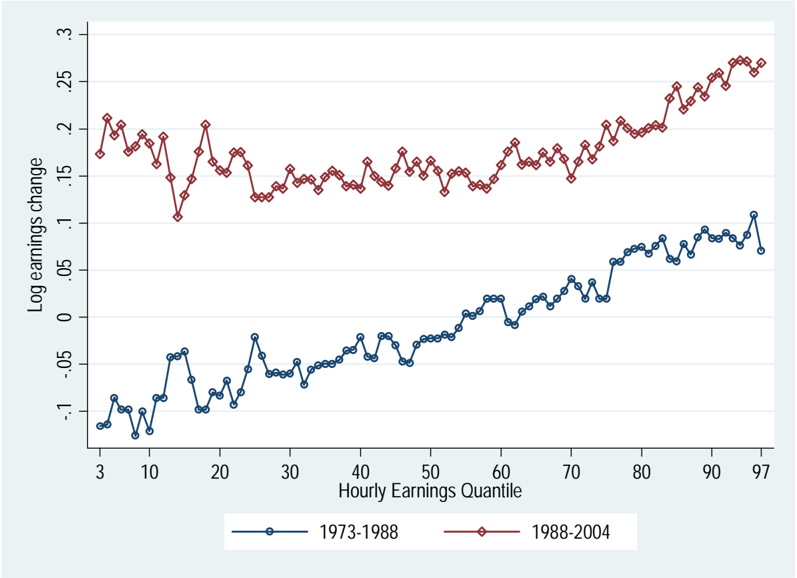
“The figure shows an almost linear spreading out of the entire wage distribution (from the 3 rd to 97 th percentile) in the first half of the sample (driven by changes in the 1980s).”
plainstates a cause- Asserted: passes — The authors put it forward as true.
- Checkable: passes — It can be checked against evidence.
- Load-bearing: passes — The paper’s conclusions depend on it.
- Based: passes — The paper gives a reason why it holds.
A result the paper reports from its own data — it cites no other source for it, so there is none to check. The quote shows it is in the paper.
In the paper
“The plot shows similar substantial increases in upper-half (90-50) and lower-half (50-10) wage inequality from 1979 to 1987, expanding the 90-10 log wage differential by 21 log points.”
plain- Asserted: passes — The authors put it forward as true.
- Checkable: passes — It can be checked against evidence.
- Load-bearing: passes — The paper’s conclusions depend on it.
- Based: passes — The paper gives a reason why it holds.
37 more claims
Create a free account to see all 66 claims and every source verdict.
- It may state two separate claims as one. 20
- Probably not a substantial claim. 5
- The quote only partly states this claim. 1
Claims other papers make about this one
Each is checked against this paper’s own text: does it say what the citing paper says it does?
The source backs part of the claim, not all of it — or backs it for a different population, condition or comparison.
In the citing paper
“Since the 1980s, the U.S. labor market has experienced declines in middle-skill, middle-income jobs in manufacturing and construction as a result of improvements in assembly line automation and the displacement of routine production jobs offshore, among other explanations (Acemoglu and Autor 2011; Autor, Katz, and Kearney 2006; Kalleberg 2009).”
From Beyond the Great Recession: Labor Market Polarization and Ongoing Fertility Decline in the United States (2019) · cites this paper as Autor, Katz, and Kearney 2006
Experimental — accuracy not yet measuredThe cited source says what the claim attributes to it.
In the citing paper
“Prior research on computer-based automation posited that routine work was most susceptible to replacement by computers (Autor et al., 2006; Acemoglu and Autor, 2011).”
From Large language models at work in China’s labor market (2025) · cites this paper as Autor et al., 2006
Citations
Cites
The Skill Content of Recent Technological Change: An Empirical Exploration
Autor, D. H., Levy, F., & Murnane, R. J. (2003) · The Quarterly Journal of Economics · doi:10.1162/003355303322552801 · Cited by 6,205
Self-citationIncome Inequality in the United States, 1913-1998
Piketty, T., & Saez, E. (2003) · The Quarterly Journal of Economics · doi:10.1162/00335530360535135 · Cited by 3,769
Lousy and Lovely Jobs: The Rising Polarization of Work in Britain
Goos, M., & Manning, A. (2007) · Review of Economics and Statistics · doi:10.1162/rest.89.1.118 · Cited by 2,285
Why Has CEO Pay Increased So Much?*
Gabaix, X., & Landier, A. (2008) · Quarterly Journal of Economics · doi:10.1162/qjec.2008.123.1.49 · Cited by 1,764
Skill‐Biased Technological Change and Rising Wage Inequality: Some Problems and Puzzles
Card, D., & DiNardo, J. E. (2002) · Journal of Labor Economics · doi:10.1086/342055 · Cited by 1,714
Technical Change, Job Tasks, and Rising Educational Demands: Looking outside the Wage Structure
Spitz‐Oener, A. (2006) · Journal of Labor Economics · doi:10.1086/499972 · Cited by 1,241
Changes in Unemployment and Wage Inequality: An Alternative Theory and Some Evidence
Acemoglu, D. (1999) · American Economic Review · doi:10.1257/aer.89.5.1259 · Cited by 634
Research works printed but not linked: 3
- Antràs Garicano, Quarterly Journal of Economics (forthcoming).
- Katz Lawrence F, 1999, North-Holland, 1463
- Lemieux Thomas, American Economic Review (forthcoming).
Cited by
Items 1,101–1,200 of 1,479
Recent changes in the nature of the distribution dynamics of the US county incomes
Park, S., & Shin, D. (2023) · Journal of Applied Econometrics · doi:10.1002/jae.3006 · Cited by 3
Is tightening immigration policy good for workers in the receiving economy?
Yakita, A. (2021) · Asia-Pacific Journal of Regional Science · doi:10.1007/s41685-021-00192-w · Cited by 1
What is the effect of labor displacement on management consultants?
Ribes, E. (2021) · SN Business & Economics · doi:10.1007/s43546-021-00049-6 · Cited by 1
Income-Inequality Relationship within U.S. Metropolitan Areas 1980—2016
Seifert, F. (2022) · Investigaciones Regionales - Journal of Regional Research · doi:10.38191/iirr-jorr.22.011 · Cited by 1
DIFERENÇAS SALARIAIS POR OCUPAÇÕES ENTRE HOMENS E MULHERES NO BRASIL
Castro, B. N. D., Staduto, J. A. R., & Kreter, A. C. (2022) · Gestão & Regionalidade · doi:10.13037/gr.vol38n114.7364 · Cited by 1
Restructuring the Greek Labor Market During the Last Two Economic Crises
Kanzola, A.-М. (2022) · The political economy of Greek growth up to 2030 · doi:10.1007/978-3-031-04938-5_8 · Cited by 2
Does Intelligence Improve the Total Factor Productivity of China’s Manufacturing Industry?
Qin, S., & Li, Y. (2025) · Asian Economics Letters · doi:10.46557/001c.39801 · Cited by 2
The Knowledge Content of the Greek Production Structure in the Aftermath of the Greek Crisis
Kanzola, A.-М. (2023) · Journal of the Knowledge Economy · doi:10.1007/s13132-022-01095-7 · Cited by 1
DİJİTALLEŞMENİN İŞ GÜCÜ PİYASALARINA ETKİSİ: AVRUPA BİRLİĞİ ÜZERİNE DİNAMİK PANEL VERİ ANALİZİ
Özışık, T., & Ülgen, G. (2023) · İktisat İşletme ve Uluslararası İlişkiler Dergisi · doi:10.58654/jebi.1221098 · Cited by 2
Hellier, J. (2023) · Economic studies in inequality, social exclusion and well-being · doi:10.1007/978-3-031-31256-4_2 · Cited by 1
Globalization and Inequality: The Facts
Hellier, J. (2023) · Economic studies in inequality, social exclusion and well-being · doi:10.1007/978-3-031-31256-4_1 · Cited by 2
How does the middle class vanish? The importance of redistribution targets
Nakajima, T. (2023) · Economic Analysis and Policy · doi:10.1016/j.eap.2023.06.033 · Cited by 1
Ribes, E. (2024) · Lecture notes in networks and systems · doi:10.1007/978-3-031-54053-0_27 · Cited by 1
Hue, T. T., Trinh, H. T., & Quynh, D. B. T. (2024) · Journal of Information & Knowledge Management · doi:10.1142/s0219649224500734 · Cited by 4
Franc, A. (2024) · Acta academica karviniensia · doi:10.25142/aak.2024.001 · Cited by 1
Income Inequality as a Barrier to Economic Growth
Angelov, I. (2024) · Advances in Social Science and Culture · doi:10.22158/assc.v6n3p1 · Cited by 3
Autor, D., & Deming, D. J. (2024) · Springer eBooks · doi:10.1007/978-3-031-52053-2_43 · Cited by 1
Self-citationUsing Relative Distribution Methods to Study Economic Polarization across Categories and Contexts
Cheng, S., Levine, A., & Martin-Caughey, A. (2024) · Sociological Methodology · doi:10.1177/00811750241260731 · Cited by 2
Demographic Winter, Economic Structure and Productivity in Japan
Dufrénot, G., Esposito, M., & Moreno-Galbis, E. (2025) · Springer proceedings in business and economics · doi:10.1007/978-3-032-04602-4_10 · Cited by 1
Jung, J. (2024) · Mathematics · doi:10.3390/math12213366 · Cited by 1
Labor Market Theory as a Tautology or Theoretical Construct? Toward a Marxist Labor Market Theory
Qian, Z. K., & Pun, N. (2025) · Critical Sociology · doi:10.1177/08969205251334111 · Cited by 4
Occupational dynamics and wage inequality in Europe
Orfao, G., Fernández‐Macías, E., & Malo, M. Á. (2025) · Structural Change and Economic Dynamics · doi:10.1016/j.strueco.2025.05.025 · Cited by 3
Agglomeration and skills: explaining regional wage disparities in Colombia
García-Suaza, A. F., & Londoño, D. (2025) · Regional Science Policy & Practice · doi:10.1016/j.rspp.2025.100220 · Cited by 2
Skill upgrading and wage gap: a decomposition analysis for Italian manufacturing firms
Iodice, I., & Tomasi, C. (2016) · Economia Politica · doi:10.1007/s40888-016-0031-5 · Cited by 4
Employment Growth and Labor Market Polarization in the United States and Texas
LoPalo, M., & Orrenius, P. M. (2015) · Palgrave Macmillan US eBooks · doi:10.1057/9781137530172_7 · Cited by 4
Education, Employability and Youth Employment
Walmsley, A. (2015) · Goodfellow Publishers Ltd eBooks · doi:10.23912/978-1-910158-36-4-3355 · Cited by 1
From Job Polarization to Wealth Inequality: A Quantitative Test of Routinization Hypothesis
Orak, M. (2013) · Cited by 3
The Role of Labor Demand Conditions in Wage Inequality Trends
Messina, J., & Silva, J. (2017) · World Bank, Washington, DC eBooks · doi:10.1596/978-1-4648-1039-8_ch4 · Cited by 1
Berg, A. J. (2018) · Evolutionary and Institutional Economics Review · doi:10.1007/s40844-018-0100-2 · Cited by 3
Skill Polarization and Inequality: Are They Real and Inevitable?
Paganetto, L., & Scandizzo, P. L. (2018) · Springer eBooks · doi:10.1007/978-3-319-97692-1_3 · Cited by 1
Polarization(s) in Labour Markets
Ducoudré, B., & Simonnet, V. (2019) · Travail et emploi · doi:10.4000/travailemploi.8909 · Cited by 3
OCCUPATIONAL SHIFTS IN POLAND TILL 2022 -TOWARDS LABOUR MARKET POLARISATION?
Arendt, Ł., & Gajdos, A. (2018) · JOURNAL OF EUROPEAN ECONOMY · doi:10.35774/jee2018.01.003 · Cited by 1
The expected time to cross a threshold and its determinants: a simple and flexible framework
Zsurkis, G., Nicolau, J., & Rodrigues, P. M. M. (2020) · Journal of Economic Dynamics and Control · doi:10.1016/j.jedc.2020.104047 · Cited by 1
Fontana, R., & Calò, E. D. (2022) · Living Standards of the Population in the Regions of Russia · doi:10.19181/lsprr.2022.18.3.4 · Cited by 2
Human Capital for Growth: Possible Steps Towards an Upgrade of the Italian Education SystemPreprint
Cipollone, P., Montanaro, P., & Sestito, P. (2012) · SSRN Electronic Journal · doi:10.2139/ssrn.2064717 · Cited by 1
Child Poverty: What Can Social Spending Explain in Europe?Preprint
Diris, R., Vandenbroucke, F., & Verbist, G. (2014) · SSRN Electronic Journal · doi:10.2139/ssrn.2509248 · Cited by 22
Which Factors Drive the Skill-Mix of Migrants in the Long-Run?Preprint
Beerli, A., & Indergand, R. (2014) · SSRN Electronic Journal · doi:10.2139/ssrn.2533091 · Cited by 3
Questions sans réponse sur l'augmentation des inégalités aux États-Unis
Gordon, R. J., Dew-Becker, I., & Cornilleau, G. (2007) · Revue de l'OFCE/La Revue de l'OFCE · doi:10.3917/reof.102.0417 · Cited by 3
Mechanization, Task Assignment, and InequalityPreprint
Yuki, K. (2014) · SSRN Electronic Journal · doi:10.2139/ssrn.2375379 · Cited by 1
Separating risk in education from heterogeneity: a semiparametric approach
Mazza, J., & van Ophem, H. (2010) · UvA-DARE (University of Amsterdam) · Cited by 2
What Has Happened to Middle-Class Earnings? Distributional Shifts in Earnings in Canada, 1970-2005*Preprint
Beach, C. M. (2014) · RePEc: Research Papers in Economics · Cited by 1
Nakabayashi, M. (2011) · SSRN Electronic Journal · doi:10.2139/ssrn.1825664 · Cited by 1
Technical Panel Report On Assumptions and Methods
Copy, P.-P. (2011) · Cited by 3
The impact of globalisation on the euro area macroeconomy
Anderton, R., & Hiebert, P. (2010) · Cambridge University Press eBooks · doi:10.1017/cbo9780511760594.003 · Cited by 1
Dougherty, S. M. (2013) · Harvard Educational Review · doi:10.17763/haer.83.4.325487n860755141 · Cited by 1
Market Income Inequality from Occupational ChoicePreprint
Medrano‐Adán, L., Fumás, V. S., & Sánchez-Asín, J. J. (2016) · SSRN Electronic Journal · doi:10.2139/ssrn.2740976 · Cited by 1
Patterns of Labour Market Entry of High-Skilled Workers in GermanyPreprint
Reinhold, M., & Thomsen, S. L. (2015) · RePEc: Research Papers in Economics · Cited by 6
The Market Economy with Mass ProductionPreprint
Mayer‐Foulkes, D., & Hafner, K. A. (2016) · SSRN Electronic Journal · doi:10.2139/ssrn.2770733 · Cited by 1
Intergenerational Mobility Under Education-Effort ComplementarityPreprint
Alonso‐Carrera, J., & Raurich, X. (2016) · SSRN Electronic Journal · doi:10.2139/ssrn.2845773 · Cited by 1
Our Current 'Secular Stagnation' as Expected by Jean Fourastié, 1949Preprint
Alcouffe, A., & Bris, D. L. (2016) · SSRN Electronic Journal · doi:10.2139/ssrn.2813159 · Cited by 1
The impact of technological change on jobs and workforce structures
Bezuidenhout, C. (2017) · UpSpace Institutional Repository (University of Pretoria) · Cited by 2
The Distribution of the Gender Wage GapPreprint
Bhalotra, S. R., & Sierra, M. F. (2018) · SSRN Electronic Journal · doi:10.2139/ssrn.3209737 · Cited by 1
Benefitting from globalisation and technological change in Australia
Sila, U., & Hemmings, P. (2019) · OECD Economics Department working papers · doi:10.1787/d36cddc4-en · Cited by 2
Répondre aux défis du marché du travail en Belgique
McGowan, M. A., Hijzen, A., Law, D., Salvatori, A., Sicari, P., & Thewissen, S. (2020) · OECD Economics Department working papers · doi:10.1787/cd98d0d9-fr · Cited by 3
Entering the Skilled Technical Workforce After College
Chen, X., & Rotermund, S. (2020) · doi:10.3768/rtipress.2020.rb.0024.2004 · Cited by 1
Changes in the wage structures in EU countries
Christopoulou, R., & Serrano, J. F. J. (2010) · Documentos de trabajo del Banco de España · Cited by 1
11. Labor- Market Regimes in U.S. Economic History
Rosenbloom, J. L., & Sundstrom, W. A. (2020) · Stanford University Press eBooks · doi:10.1515/9780804777629-013 · Cited by 1
Accounting for Big City Growth in Low Paid Occupations: Immigration and/or Service Class ConsumptionPreprint
Gordon, I. R., & Kaplanis, I. (2012) · SSRN Electronic Journal · doi:10.2139/ssrn.2051098 · Cited by 1
Differences in Job De-Routinization in OECD Countries: Evidence from PIAACPreprint
de la Rica, S., & Gortazar, L. (2015) · RePEc: Research Papers in Economics · Cited by 1
DECREASING WAGE INEQUALITY IN ITALY: THE ROLE OF SUPPLY AND DEMAND FOR EDUCATIONPreprint
Naticchioni, P., & Ricci, A. (2009) · RePEc: Research Papers in Economics · Cited by 2
Inside the Decline of the Labor Share: Technical Change, Market Power, and Structural ChangePreprint
Moreira, S. F. (2022) · SSRN Electronic Journal · doi:10.2139/ssrn.4049729 · Cited by 3
Can the Labor Demand Curve Explain Job Polarization?Preprint
Peichl, A., & Popp, M. (2022) · SSRN Electronic Journal · doi:10.2139/ssrn.4135924 · Cited by 2
Work Effort in the UK: Trends and ExplanationsPreprint
Giménez-Nadal, J. I., & Sevilla, A. (2022) · SSRN Electronic Journal · doi:10.2139/ssrn.4123769 · Cited by 1
Inference on counterfactual distributions
Melly, B., Fernández‐Val, I., & Chernozhukov, V. (2012) · doi:10.1920/wp.cem.2012.0512 · Cited by 1
Hidden Patterns of Inequality: The Heterogeneity in Parenting within Educational GroupsPreprint
Breinholt, A. (2023) · doi:10.31235/osf.io/sz2jq · Cited by 1
Robots and inequality in Latin America: whose wages improve when automation is imported?Preprint
Olarte, S. H., Galarraga, J., Torrent‐Sellens, J., & Aguirre, K. (2023) · Research Square · doi:10.21203/rs.3.rs-3575772/v1 · Cited by 1
Countries for Old Men: An Analysis of the Age Pay GapPreprint
Bianchi, N., & Paradisi, M. (2024) · SSRN Electronic Journal · doi:10.2139/ssrn.4794390 · Cited by 4
Kim, G., Merritt, C., & Peri, G. (2024) · SSRN Electronic Journal · doi:10.2139/ssrn.4851799 · Cited by 1
juyang, A., Yu, Y., Ge, L., et al. (2024) · SSRN Electronic Journal · doi:10.2139/ssrn.4868908 · Cited by 1
Robots and Inequality Between and Within OccupationsPreprint
Flores, R. R., Samaniego, R. M., & Yun, Z. (2024) · SSRN Electronic Journal · doi:10.2139/ssrn.4950966 · Cited by 1
The Long-Term Rise of Labor Market Detachment: Evidence from Local Labor Markets
Abel, J. R., & Deitz, R. (2024) · Staff reports · doi:10.59576/sr.1138 · Cited by 3
Workers’ Task and Employer Mobility over the Business CyclePreprint
Carrillo‐Tudela, C., Summerfield, F., & Visschers, L. (2025) · SSRN Electronic Journal · doi:10.2139/ssrn.5133190 · Cited by 1
The Risk of Automation and Occupational ChoicePreprint
Castex, G., Chow, E., & Dechter, E. K. (2025) · SSRN Electronic Journal · doi:10.2139/ssrn.5115690 · Cited by 1
The Economics of Bicycles for the MindPreprint
Agrawal, A., Gans, J. S., & Avi Goldfarb, B. (2025) · SSRN Electronic Journal · doi:10.2139/ssrn.5347891 · Cited by 1
AI Adoption and InequalityPreprint
Rockall, E., Tavares, M. M., & Pizzinelli, C. (2025) · SSRN Electronic Journal · doi:10.2139/ssrn.5638259 · Cited by 1
Protte, B. (2012) · RePEc: Research Papers in Economics · Cited by 1
Hui, J. S., Filipof, M. E., Lee, S., Corvite, S., Naseem, M., & Dillahunt, T. R. (2026) · CHI Conference on Human Factors in Computing Systems · doi:10.1145/3772318.3790914
Leistung und Zuschreibung in der Wissensgesellschaft
Rohrbach-Schmidt, D. (2010) · VS Verlag für Sozialwissenschaften eBooks · doi:10.1007/978-3-531-92472-4_11 · Cited by 1
Offshoring potential and employment dynamicsPreprint
Boockmann, B. (2014) · RePEc: Research Papers in Economics · Cited by 3
The effect of age structure on US income inequality, 1976 to 2007
Albrecht, S. G. (2008) · University Libraries (University of Maryland)
Information Technology and Labor Market Polarization in Europe
Naticchioni, P., & Ragusa, G. (2014) · Springer eBooks · doi:10.1007/978-3-319-05909-9_6
Can education reduce income disparities
Nurmi, S. (2011) · DigitalGeorgetown (Georgetown University Library)
Ghosh, P. K. (2014) · Syracuse University Libraries (Syracuse University)
The political economy of imprisonment: an analysis of local areas in the United States
Cumley, S. R. (2012) · doi:10.17077/etd.hi4zgyim · Cited by 1
Lozano, F. A. (2012) · SSRN Electronic Journal · doi:10.2139/ssrn.2066975
Structural Transformation and Labor Market Polarization: The Role of Productivity and Taxation
Bock, S. (2014) · HAL (Le Centre pour la Communication Scientifique Directe)
Lozano, F. A., & Sørensen, T. (2008) · SSRN Electronic Journal · doi:10.2139/ssrn.1136463
The Macroeconomic Role of Unemployment Compensation
Blumkin, T., Hadar, Y., & Yashiv, E. (2009) · London School of Economics and Political Science Research Online (London School of Economics and Political Science)
The Change in Job OpportunitiesPreprint
Olivieri, E. (2012) · SSRN Electronic Journal · doi:10.2139/ssrn.2045587
Attitudes Toward the Income Gap: Japan-U.S. ComparisonPreprint
Ohtake, F., & Takenaka, S. (2007) · SSRN Electronic Journal · doi:10.2139/ssrn.989688
Local Labour Markets and Theft: New Evidence from Canada
Summerfield, F. (2018) · Oxford Bulletin of Economics and Statistics · doi:10.1111/obes.12256
U.S. Income Inequality and Income Mobility in the 1980s and 1990sPreprint
Hungerford, T. L. (2008) · SSRN Electronic Journal · doi:10.2139/ssrn.1133076
A Note to Schooling in Development AccountingPreprint
Caselli, F., & Ciccone, A. (2012) · SSRN Electronic Journal · doi:10.2139/ssrn.2166162
How Big a Problem is U.S. Corporate Governance
Kaplan, S. (2007) · eScholarship (California Digital Library)
Compensation systems and earnings inequality
Jiang, L., & Yu, H.-C. (2013) · The Journal of Economic Inequality · doi:10.1007/s10888-012-9239-y
The Role of Gender In Intergenerational Transmissions of Education and Occupational Promotion
Wang, S. (2013) · Scholar Commons (University of South Carolina)
The Evolution of Labour Market Inequalities –– Introduction
Cappellari, L., & Staffolani, S. (2008) · Labour · doi:10.1111/j.1467-9914.2008.00418.x
Li, X., Munir, R., & Kilgore, A. (2015) · International Journal of Accounting and Financial Reporting · doi:10.5296/ijafr.v5i1.7198
Metadata
- Authors
- Autor, D. H., Katz, L. F., & Kearney, M. S.
- Affiliations
- National Bureau of Economic Research (US)
- Brookings Institution (US)
- Venue
- American Economic Review
- Publisher
- American Economic Association
- Published
- 2006-04-01
- Volume
- 96
- Issue
- 2
- Pages
- 189-194
- ISSN
- 0002-8282 (ISSN-L)
- OpenAlex
- W3124544360
- Cited by
- 1,594
- References
- 4
- Citations by year
- 2026: 75 · 2025: 108 · 2024: 122 · 2023: 90 · 2022: 89 · 2021: 100 · 2020: 107 · 2019: 96 · 2018: 93 · 2017: 74 · 2016: 76 · 2015: 91 · 2014: 78 · 2013: 81 · 2012: 59
- FWCI
- 110.81
- Type
- journal article
- Language
- en
- Open access
- closed
- Locations
- American Economic Review (publishedVersion)
- RePEc: Research Papers in Economics (submittedVersion)
- Topics
- Social Sciences › Economics, Econometrics and Finance › Economics and Econometrics › Labor market dynamics and wage inequality
- Social Sciences › Economics, Econometrics and Finance › General Economics, Econometrics and Finance › Economic Theory and Policy
- Social Sciences › Sociology and Political Science › Income, Poverty, and Inequality
- Keywords
- labor market polarization, wage inequality, wage distribution, computerization, high-wage jobs, low-wage employment, United States labor market
About these checks
Registry, retraction, Cites and statistics results are computed, not judged, with one exception: a printed reference that no index lists is read once by a model before it counts as a citation error. Claims are extracted by a model and kept only when their quote appears verbatim in the text; each cited source is then checked, with a model’s help, for whether it says what the claim relies on. Those verdicts can be wrong — read the claim’s quote and the cited source before relying on one.
A language model drew the claims from the paper on 2026-10-12, under version 3 of the claim definition (model deepseek-v4.1-flash, prompt extract-v3).
A second model labelled each claim on 2026-10-12 (model jev-1.13-20260917, definition revision gold-guideline-v0.2).
Statistics and arithmetic are recomputed, not judged.
Confidence bands are shown only for fields calibrated on our annotated test set. None is calibrated yet, so no band is shown.
What counts as a claim ›How we measure confidence ›How we check this ›
Are you an author, or do you see a problem with this page? Request a review
Data sources
Bibliographic data: Semantic Scholar, OpenAlex, Crossref.
Contains information from the Semantic Scholar Academic Graph Datasets, made available under the ODC Attribution License (ODC-BY 1.0).
Semantic Scholar’s data is described in: Kinney, R., et al. (2023). The Semantic Scholar Open Data Platform. arXiv:2301.10140.
