

The Polarization of the U.S. Labor Market
The DOI matches its Crossref record; 7 of the 7 references it cites were found in a registry or an index; none of the 16 sources its claims cite is checked for support yet.
Abstract
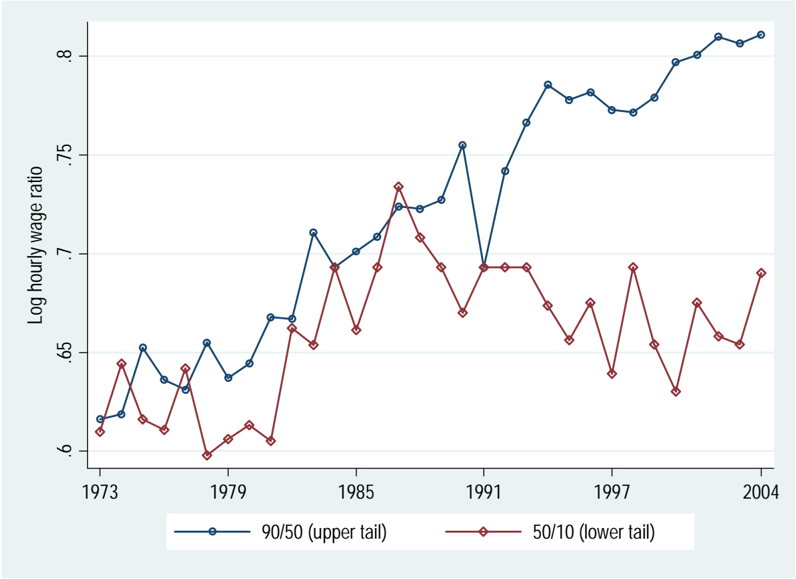
This paper analyzes a marked change in the evolution of the U.S. wage structure over the past fifteen years: divergent trends in upper-tail (90/50) and lower-tail (50/10) wage inequality. We document that wage inequality in the top half of distribution has displayed an unchecked and rather smooth secular rise for the last 25 years (since 1980). Wage inequality in the bottom half of the distribution also grew rapidly from 1979 to 1987, but it has ceased growing (and for some measures actually narrowed) since the late 1980s. Furthermore we find that occupational employment growth shifted from monotonically increasing in wages (education) in the 1980s to a pattern of more rapid growth in jobs at the top and bottom relative to the middles of the wage (education) distribution in the 1990s. We characterize these patterns as the "polarization" of the U.S. labor market, with employment polarizing into high-wage and low-wage jobs at the expense of middle-wage work. We show how a model of computerization in which computers most strongly complement the non-routine (abstract) cognitive tasks of high-wage jobs, directly substitute for the routine tasks found in many traditional middle-wage jobs, and may have little direct impact on non-routine manual tasks in relatively low-wage jobs can help explain the observed polarization of the U.S. labor market.
Overview
CoChat Summary
TL;DR
This paper documents that U.S. wage inequality diverged after the late 1980s: upper-tail inequality kept rising while lower-tail inequality stopped growing, and employment growth shifted from monotonic skill upgrading in the 1980s to polarization into high- and low-wage jobs in the 1990s. The authors argue that a model of computerization—complementing abstract tasks, substituting for routine tasks, and having little direct effect on non-routine manual tasks—can help explain these patterns.
Key findings
- From 1979 to 1987, upper-half (90/50) and lower-half (50/10) wage inequality rose similarly, expanding the 90-10 log wage differential by 21 log points; after 1987, upper-half inequality continued rising while the 50-10 differential contracted by 4 log points from 1987 to 2004, leaving only 4 log points of 90-10 growth since 1987.
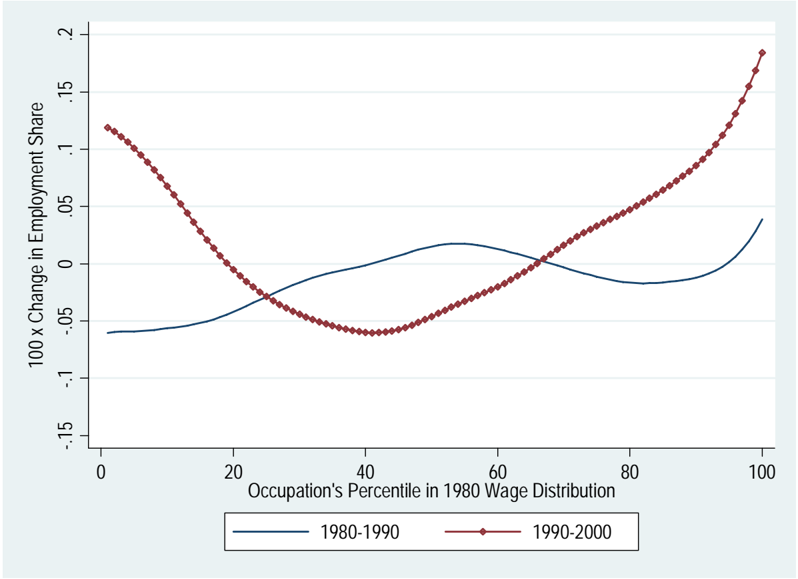
- Occupational employment growth changed from monotonically increasing in wages/education in the 1980s to polarized growth in the 1990s: employment grew more rapidly below the 25th and above the 65th percentiles of the occupational wage distribution and declined in the middle (25th to 65th percentiles).
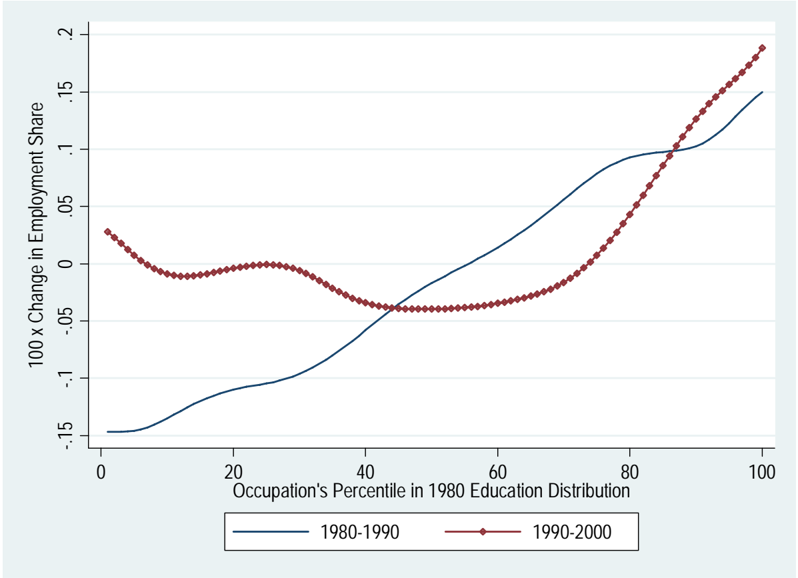
- Using 1980 occupational education percentiles, employment growth was near-monotonic in the 1980s but polarized in the 1990s, with more rapid growth at the bottom than the middle and the most rapid, diverging gains at the top.
- The authors find that quantity and price changes covary positively throughout the earnings distribution in both the 1980s and 1990s, suggesting labor demand shifts are central to explaining wage structure changes.
Methods
- The paper combines descriptive analysis of U.S. wage and employment data with a conceptual task-based model of computerization.
- Wage inequality trends are measured using Current Population Survey May samples for 1973–78 and Merged Outgoing Rotation Group samples for 1979–2004, focusing on 90/50 and 50/10 log hourly wage differentials.
- Employment polarization is analyzed using 1980, 1990, and 2000 Census Integrated Public Use Microsamples, ranking occupations by 1980 median hourly wage or average years of schooling and fitting locally weighted smoothing regressions of decadal employment-share growth on initial skill percentile.
Limitations
- Stated: the model assumes only two worker types, with college workers supplying abstract skill and high school workers substituting between routine and manual tasks; a more complete model would allow endogenous education responses, routine skills for college workers, abstract skills for high school workers, and heterogeneity in abstract skills among college workers.
- Stated: the “social norms” explanation for upper-tail skewness is intriguing but needs refinement to be directly testable, and the minimum wage explanation fits lower-tail inequality trends only to 1987.
- Evident: the paper is largely descriptive and theoretical rather than a causal test of computerization; the model’s predictions are used to interpret observed polarization, but the text does not report direct causal estimates linking computerization to the wage and employment changes.
Model-written summary. Check it against the paper before relying on it.
Integrity signals
Registry
Cites
Statistics
Figures
Verification
Claims the paper makes
0 Valid · 3 Not valid · 14 Not checked · 49 Own results and interpretations
A result the paper states — it cites no source for it, so there is none to check. The quote shows it is in the paper.
In the paper
“The net effect has been a slower growth of only 4 log points in the 90-10 log wage differential since 1987.”
plain- Asserted: passes — The authors put it forward as true.
- Checkable: passes — It can be checked against evidence.
- Load-bearing: passes — The paper’s conclusions depend on it.
- Based: passes — The paper gives a reason why it holds.
A result the paper reports from its own data — it cites no other source for it, so there is none to check. The quote shows it is in the paper.
In the paper
“Using this skill measure, we find near-monotonic (almost linear) increases in employment growth moving up the education distribution in the 1980s.”
plainstates an association- Asserted: passes — The authors put it forward as true.
- Checkable: passes — It can be checked against evidence.
- Load-bearing: unclear — It is unclear whether the paper’s conclusions depend on it.
- Based: passes — The paper gives a reason why it holds.
A result the paper reports from its own data — it cites no other source for it, so there is none to check. The quote shows it is in the paper.
In the paper
“We document that wage inequality in the top half of distribution has displayed an unchecked and rather smooth secular rise for the last 25 years (since 1980).”
- Also stated in: § ABSTRACT · plain
“wage inequality in the top half of the distribution has exhibited an unchecked secular rise for the last 25 years (since 1980)”
plain- Asserted: passes — The authors put it forward as true.
- Checkable: passes — It can be checked against evidence.
- Load-bearing: passes — The paper’s conclusions depend on it.
- Based: passes — The paper gives a reason why it holds.
- Also stated in: § ABSTRACT · plain
A result the paper reports from its own data — it cites no other source for it, so there is none to check. The quote shows it is in the paper.
In the paper
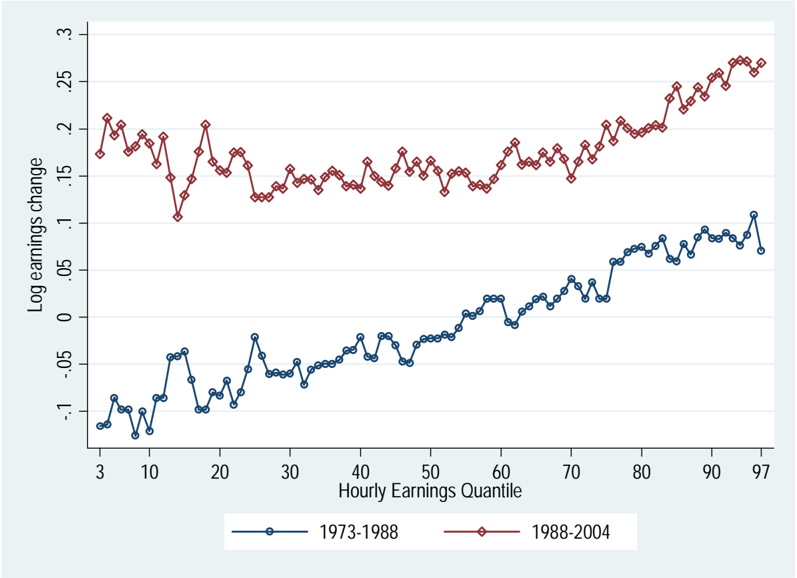
“The figure shows an almost linear spreading out of the entire wage distribution (from the 3 rd to 97 th percentile) in the first half of the sample (driven by changes in the 1980s).”
plainstates a cause- Asserted: passes — The authors put it forward as true.
- Checkable: passes — It can be checked against evidence.
- Load-bearing: passes — The paper’s conclusions depend on it.
- Based: passes — The paper gives a reason why it holds.
A result the paper reports from its own data — it cites no other source for it, so there is none to check. The quote shows it is in the paper.
In the paper
“The plot shows similar substantial increases in upper-half (90-50) and lower-half (50-10) wage inequality from 1979 to 1987, expanding the 90-10 log wage differential by 21 log points.”
plain- Asserted: passes — The authors put it forward as true.
- Checkable: passes — It can be checked against evidence.
- Load-bearing: passes — The paper’s conclusions depend on it.
- Based: passes — The paper gives a reason why it holds.
37 more claims
Create a free account to see all 66 claims and every source verdict.
- It may state two separate claims as one. 20
- Probably not a substantial claim. 5
- The quote only partly states this claim. 1
Claims other papers make about this one
Each is checked against this paper’s own text: does it say what the citing paper says it does?
The source backs part of the claim, not all of it — or backs it for a different population, condition or comparison.
In the citing paper
“Since the 1980s, the U.S. labor market has experienced declines in middle-skill, middle-income jobs in manufacturing and construction as a result of improvements in assembly line automation and the displacement of routine production jobs offshore, among other explanations (Acemoglu and Autor 2011; Autor, Katz, and Kearney 2006; Kalleberg 2009).”
From Beyond the Great Recession: Labor Market Polarization and Ongoing Fertility Decline in the United States (2019) · cites this paper as Autor, Katz, and Kearney 2006
Experimental — accuracy not yet measuredThe cited source says what the claim attributes to it.
In the citing paper
“Prior research on computer-based automation posited that routine work was most susceptible to replacement by computers (Autor et al., 2006; Acemoglu and Autor, 2011).”
From Large language models at work in China’s labor market (2025) · cites this paper as Autor et al., 2006
Citations
Cites
The Skill Content of Recent Technological Change: An Empirical Exploration
Autor, D. H., Levy, F., & Murnane, R. J. (2003) · The Quarterly Journal of Economics · doi:10.1162/003355303322552801 · Cited by 6,205
Self-citationIncome Inequality in the United States, 1913-1998
Piketty, T., & Saez, E. (2003) · The Quarterly Journal of Economics · doi:10.1162/00335530360535135 · Cited by 3,769
Lousy and Lovely Jobs: The Rising Polarization of Work in Britain
Goos, M., & Manning, A. (2007) · Review of Economics and Statistics · doi:10.1162/rest.89.1.118 · Cited by 2,285
Why Has CEO Pay Increased So Much?*
Gabaix, X., & Landier, A. (2008) · Quarterly Journal of Economics · doi:10.1162/qjec.2008.123.1.49 · Cited by 1,764
Skill‐Biased Technological Change and Rising Wage Inequality: Some Problems and Puzzles
Card, D., & DiNardo, J. E. (2002) · Journal of Labor Economics · doi:10.1086/342055 · Cited by 1,714
Technical Change, Job Tasks, and Rising Educational Demands: Looking outside the Wage Structure
Spitz‐Oener, A. (2006) · Journal of Labor Economics · doi:10.1086/499972 · Cited by 1,241
Changes in Unemployment and Wage Inequality: An Alternative Theory and Some Evidence
Acemoglu, D. (1999) · American Economic Review · doi:10.1257/aer.89.5.1259 · Cited by 634
Research works printed but not linked: 3
- Antràs Garicano, Quarterly Journal of Economics (forthcoming).
- Katz Lawrence F, 1999, North-Holland, 1463
- Lemieux Thomas, American Economic Review (forthcoming).
Cited by
Items 1,201–1,300 of 1,479
Kim, S. (2012) · Journal of Economic Research (JER) · doi:10.17256/jer.2012.17.2.002 · Cited by 1
Schneider, J., Seibert, H., & Wesling, M. (2011)
Essays in European integration and economic inequalities
Kadow, A. (2012) · Enlighten: Theses (The University of Glasgow)
International Trade and Polarization in the Labor MarketPreprint
Das, S. P. (2011) · SSRN Electronic Journal · doi:10.2139/ssrn.1974364
Essays on macroeconomic dynamics
Lee, D. (2010) · D-Scholarship@Pitt (University of Pittsburgh)
Bogliacino, F., & Lucchese, M. (2015) · SSRN Electronic Journal · doi:10.2139/ssrn.2577068
dynamics and human capital investment in the Japanese steel industry, 1930-1960s
Nakabayashi, M. (2011)
Economic Integration in a Risky Environment: Labor Market Participation and Education Decisions
Janeba, E., & Protte, B. (2012)
Kok, S. (2011)
The evolution of Wage Inequality in Post Communist Romania
Ardelean, T. (2007) · doi:10.60644/4376
Hierarchies: Using Organizations to Understand the Economy
Garicano, L., & Rossi‐Hansberg, E. (2015)
WHERE HAVE ALL THE EDUCATED WORKERS GONE? SERVICES AND WAGE INEQUALITY IN THREE
Mehta, A. S., & Camingue, S. F. (2013)
Four Essays in Unemployment, Wage Dynamics and Subjective Expectations.
Hudomiet, P. (2015) · Deep Blue (University of Michigan)
Parent, D. (2016) · L Actualité économique · doi:10.7202/1034736ar
Determinants of Wage and Earnings Inequality in the United States
Slavık, C., & Yazıcı, H. (2015) · Sabanci University
Occupational Mobility Across Years, Decades and a CenturyPreprint
Choi, S. (2014) · RePEc: Research Papers in Economics
Essays on human capital and labor market dynamics
Cairó, I. (2014) · Repositori digital de la UPF (Universitat Pompeu Fabra)
Employment Polarization in Spain Along the Cycle 1997-2012Preprint
Anghel, B., de la Rica, S., & Lacuesta, A. (2013) · SSRN Electronic Journal · doi:10.2139/ssrn.2370782 · Cited by 6
Essays in labor market economics
Herz, B. (2015) · Repositori digital de la UPF (Universitat Pompeu Fabra)
Transformational Leaders Wanted: Dallas Independent School District's Aspiring Principals Program.
Parvin, J. L. (2012) · UTA ResearchCommons (University of Texas Arlington)
Impacto del Internet en el ingreso laboral : análisis del lugar y manejo del Internet
López, M. (2015) · Repositorio Institucional E-DocUR (Universidad Del Rosario) · doi:10.48713/10336_11918
Essays on the Determinants of Changing Employment and Wage Structures
Fakultät, W. (2015)
Marelli, E. P., Sciulli, D., & Signorelli, M. (2014) · CyberLeninK (CyberLeninka)
Five Essays on the Interaction between Innovation and the Labor Market
Wachsen, E. (2012) · DepositOnce · doi:10.14279/depositonce-3287
Peloquin, B. D. (2016) · OpenBU (Boston University)
Weber, S., Luzzi, G. F., & Ramirez, J. V. (2015) · Revue française de pédagogie · doi:10.4000/rfp.4816
Tecnología, deslocalización y tareas definitorias de las ocupaciones en el Reino Unido
AKÇOMAK, S., Kok, S., & Rojas‐Romagosa, H. (2016) · Revista Internacional del Trabajo · doi:10.1111/ilrs.12016
Technologie, délocalisations et tâches constitutives des professions au Royaume‐Uni
AKÇOMAK, S., Kok, S., & Rojas‐Romagosa, H. (2016) · Revue internationale du Travail · doi:10.1111/ilrf.12016
Heterogeneous Job Polarization in the US
Lake, J., & Millimet, D. L. (2015)
Eberharter, V. V. (2016) · Emerald Group Publishing Limited eBooks · doi:10.1108/s1049-258520160000024014
Jobless Recovery and Structural Change: A VAR Approach
Chen, L.-H., & Cui, Z. (2017) · South Asian Journal of Macroeconomics and Public Finance · doi:10.1177/2277978717695145
Metropolitan Areas Residential Segregation, Spatial Mismatch and Economic Growth across US
Li, H., Campbell, H. S., & Fernandez, S. (2013)
A CAUTIONARY TALE FOR DIGITAL AGE TRANSITIONING: THE IMPEDING POLARIZATION EFFECTS
Iorgulescu, R. I., & Polimeni, J. M. (2016) · RePEc: Research Papers in Economics
Croce, G. (2017) · QUADERNI DI ECONOMIA DEL LAVORO · doi:10.3280/qua2016-106005
Scully, M. A., & Denis, G. V. (2017) · InTech eBooks · doi:10.5772/65668
Decomposing Gender Equality along the Wage Distribution in Vietnam during the Period 2002–14Preprint
Vu, T. M., & Yamada, H. (2017) · RePEc: Research Papers in Economics
Sociological Perspectives on Economic Inequality
Wilmers, N. (2017) · Cambridge University Press eBooks · doi:10.1017/9781316418376.024
Does Social Enterprise Provide a Decent Work to Women?
Kwag, S. (2013) · Management & Information Systems Review · doi:10.29214/damis.2013.32.4.003
Likely Impacts of Trends on the Feasibility and Desirability of Manufacturing-Led Development
Hallward-Driemeier, M. C., & Nayyar, G. (2017) · World Bank, Washington, DC eBooks · doi:10.1596/978-1-4648-1174-6_ch4
Explaining Job Polarization: The Role of Heterogeneity in Capital IntensityPreprint
Cheng, W. (2017) · RePEc: Research Papers in Economics
The New Nexus and the Emerging Trends in Global Employment and Specialization
Dowlah, C. (2018) · Springer eBooks · doi:10.1007/978-3-319-71105-8_8
Back Matter: Appendices A and B
Dutz, M. A., Almeida, R. K., & Packard, T. G. (2018) · World Bank, Washington, DC eBooks · doi:10.1596/978-1-4648-1222-4_bm
The Unintended Consequences of Globalization and Technological Progress
Cristadoro, R. (2018) · Financial and monetary policy studies · doi:10.1007/978-3-319-79075-6_5 · Cited by 1
Telegdy, Á. (2018) · Hitelintézeti szemle · doi:10.25201/hsz.17.3.528
Occupational Shortage and Labor Market Adjustments: A Theory of IslandsPreprint
Tan, J., & Zago, R. (2018) · SSRN Electronic Journal · doi:10.2139/ssrn.3190632
foo.castr: visualising the future AI workforce
Amador, J., Molina-Solana, M., & Kennedy, M. (2018) · Big Data Analytics · doi:10.1186/s41044-018-0034-z
The Elusive Promise of Productivity
Cusolito, A. P., & Maloney, W. F. (2018) · World Bank, Washington, DC eBooks · doi:10.1596/978-1-4648-1334-4_ch1
Student Test Performance and National Economies: Examining a Neoliberal Conjecture
Verdugo, R. R. (2015) · International Journal of Educational Reform · doi:10.1177/105678791502400105
Following (Not Quite) in Your Father's Footsteps: Task Followers and Labor Market Outcomes
Chen, L., Gordanier, J. M., & Ozturk, O. D. (2017) · Journal of Labor Research · doi:10.1007/s12122-019-9282-6 · Cited by 1
El contenido de tareas y la dinámica de las ocupaciones en España
Pérez, S. T. (2019) · Sociologia del trabajo/Sociología del trabajo · doi:10.5209/stra.63278 · Cited by 4
Medición y comprensión del comercio de tareas en el sector de los servicios
Chiquiar, D., Tobal, M., & Yslas, R. (2019) · Revue internationale du Travail · doi:10.1111/ilrf.12115
The Third Wave of Technological UnemploymentPreprint
D’Orlando, F. (2018) · SSRN Electronic Journal · doi:10.2139/ssrn.3187227
Barth, E., Cools, S., & Strøm, M. (2019) · Tidsskrift for samfunnsforskning · doi:10.18261/issn.1504-291x-2019-03-08
류기락 (2018) · Journal of Vocational Education & Training · doi:10.36907/krivet.2018.21.2.157
Zmiany w strukturze zawodowej w Polsce do 2022 roku — czy rynek pracy podąża w kierunku polaryzacji?
Arendt, Ł., & Gajdos, A. (2018) · Problemy Polityki Społecznej. Studia i Dyskusje · Cited by 8
Technological Unemployment and the Resurgence of Political EconomyPreprint
D’Orlando, F. (2019) · SSRN Electronic Journal · doi:10.2139/ssrn.3387402
Guo, L., Huo, K., & Libby, T. (2020) · SSRN Electronic Journal · doi:10.2139/ssrn.3576680
Technology Adoption, Household Uncertainty and Wealth InequalityPreprint
Bhardwaj, A., & Mukherjee, S. (2020) · SSRN Electronic Journal · doi:10.2139/ssrn.3701249
Competition, cost structure, and labour leverage: Evidence from the U.S. airline industryPreprint
Wagner, K. (2020) · RePEc: Research Papers in Economics
Automation and Job Polarization: On the Decline of Middling Occupations in EuropePreprint
Jerbashian, V. (2016) · SSRN Electronic Journal · doi:10.2139/ssrn.2875098
Automation and Job Polarization: On the Decline of Middling Occupations in EuropePreprint
Jerbashian, V. (2016) · SSRN Electronic Journal · doi:10.2139/ssrn.2845762 · Cited by 1
Cheap Thrills: the Price of Leisure and the Global Decline in Work HoursPreprint
Kopytov, A., Roussanov, N. L., & Taschereau-Dumouchel, M. (2020) · SSRN Electronic Journal · doi:10.2139/ssrn.3660312 · Cited by 1
International Trade and Polarization in the Labor Market
Das, S. P. (2012) · Economics · doi:10.5018/economics-ejournal.ja.2012-6 · Cited by 5
The Changing (Dis-)Utility of WorkPreprint
Kaplan, G., & Schulhofer‐Wohl, S. (2018) · SSRN Electronic Journal · doi:10.2139/ssrn.3203896 · Cited by 1
Which factors drive the skill-mix of migrants in the long-run?
Beerli, A., & Indergand, R. (2015) · Zurich Open Repository and Archive (University of Zurich) · doi:10.5167/uzh-110477 · Cited by 4
Kehrig, M. (2018) · SSRN Electronic Journal · doi:10.2139/ssrn.3142660
Informationswissenschaft in der Urbanistik
Stock, W. G., Barth, J., Fietkiewicz, K. J., Gremm, J., Hartmann, S., Henkel, M., Ilhan, A., Mainka, A., Meschede, C., & Peters, I. (2018) · Information - Wissenschaft & Praxis · doi:10.1515/iwp-2018-0006
ten Berge, J. B. (2021) · Utrecht University Repository (Utrecht University) · doi:10.33540/559 · Cited by 32
Ciccarelli, R. (2021) · Lecture notes in morphogenesis · doi:10.1007/978-3-030-70862-7_5
MUDANÇA TECNOLÓGICA E POLARIZAÇÃO DO EMPREGO NO BRASIL
Rocha, G. R., & Vaz, D. V. (2021) · doi:10.5151/v-enei-648
Jaggi, J. S., et al. (2021) · Digital Commons - USU (Utah State University) · doi:10.26076/cdd6-ee31
Changing the Pyramids: Broadband Access and the Reorganization of FirmsPreprint
Barbosa, A., Casagrande, D. L., Maier, P., & Trevisan, G. (2021) · SSRN Electronic Journal · doi:10.2139/ssrn.3866643
occupation2vec: A general approach to representing occupationsPreprint
Mühlbach, N. S. (2021) · arXiv (Cornell University) · Cited by 1
Robots, Jobs, and Optimal Fertility TimingPreprint
Costanzo, C. (2021) · SSRN Electronic Journal · doi:10.2139/ssrn.3964134
Competition, Cost Structure, and Labor Leverage: Evidence from the U.S. Airline IndustryPreprint
Wagner, K. (2020) · SSRN Electronic Journal · doi:10.2139/ssrn.3562128
Multi-dimensional Skills and Partial SpecializationPreprint
Liu, C. (2021) · SSRN Electronic Journal · doi:10.2139/ssrn.3832431
Job Destruction and Coordination Failures in Labor Turnover
Yoneda, K., & Minagawa, T. (2014) · Institutional Repositories DataBase (IRDB)
Innovation on Tools and the Rise of Skill PremiumPreprint
Park, H., & Shim, Y. (2021) · SSRN Electronic Journal · doi:10.2139/ssrn.3996417
The Fissured Welfare State: Care Work, Democracy, and Public-Private Governance
Winant, G. (2022) · Cambridge University Press eBooks · doi:10.1017/9781108885362.027
Labor and Democracy Sectoral Case Studies: Platform Workers, Higher Education, and the Care Industry
Cornell, Á. B., & Barenberg, M. (2022) · Cambridge University Press eBooks · doi:10.1017/9781108885362.024
Machin, S. J., & Reenen, J. M. V. (2018) · Palgrave Macmillan UK eBooks · doi:10.1057/978-1-349-95189-5_2001
Chaston, I. (2017) · Springer eBooks · doi:10.1007/978-3-319-45850-2_12
OECD (2019) · OECD eBooks · doi:10.1787/9789264312586-ko
The Power of Digital Transformation
(2019) · Advances in logistics, operations, and management science book series · doi:10.4018/978-1-7998-2036-9.ch002
Maselli, I., & Beblavý, M. (2014) · SSRN Electronic Journal · doi:10.2139/ssrn.2402711
Obrimah, O. A. (2021) · SSRN Electronic Journal · doi:10.2139/ssrn.3897346
African Americans in the U.S. Economy Since EmancipationPreprint
Sundstrom, W. A. (2011) · SSRN Electronic Journal · doi:10.2139/ssrn.1895596
Projetos Não Enquadrados: Uma análise do escopo do Programa BDMG/FAPEMIG Pró-Inovação
da Silva, G. A. F., & Rapini, M. S. (2022) · doi:10.5151/vi-enei-841
The effect of early automation on the wage distribution with endogenous occupational choices
Hidalgo-Pérez, M. A., & Molinari, B. (2022) · Economia Politica · doi:10.1007/s40888-022-00272-w · Cited by 1
Wage Polarization in the Context of the Czech Republic
Náplava, R. (2022) · Review of Economic Perspectives · doi:10.2478/revecp-2022-0005 · Cited by 2
Job Polarisation and Household BorrowingPreprint
Cantarella, M., & Kavonius, I. K. (2022) · SSRN Electronic Journal · doi:10.2139/ssrn.4170362
The Nature of Countercyclical Income RiskPreprint
Guvenen, F., Ozkan, S., & Song, J. G. (2012) · SSRN Electronic Journal · doi:10.2139/ssrn.2046642
Innovazione tecnologica e lavoro: automazione, occupazione e impatti socio-economici
Barani, A. (2023) · QUADERNI DI ECONOMIA DEL LAVORO · doi:10.3280/qua2021-114003
Metadata
- Authors
- Autor, D. H., Katz, L. F., & Kearney, M. S.
- Affiliations
- National Bureau of Economic Research (US)
- Brookings Institution (US)
- Venue
- American Economic Review
- Publisher
- American Economic Association
- Published
- 2006-04-01
- Volume
- 96
- Issue
- 2
- Pages
- 189-194
- ISSN
- 0002-8282 (ISSN-L)
- OpenAlex
- W3124544360
- Cited by
- 1,594
- References
- 4
- Citations by year
- 2026: 75 · 2025: 108 · 2024: 122 · 2023: 90 · 2022: 89 · 2021: 100 · 2020: 107 · 2019: 96 · 2018: 93 · 2017: 74 · 2016: 76 · 2015: 91 · 2014: 78 · 2013: 81 · 2012: 59
- FWCI
- 110.81
- Type
- journal article
- Language
- en
- Open access
- closed
- Locations
- American Economic Review (publishedVersion)
- RePEc: Research Papers in Economics (submittedVersion)
- Topics
- Social Sciences › Economics, Econometrics and Finance › Economics and Econometrics › Labor market dynamics and wage inequality
- Social Sciences › Economics, Econometrics and Finance › General Economics, Econometrics and Finance › Economic Theory and Policy
- Social Sciences › Sociology and Political Science › Income, Poverty, and Inequality
- Keywords
- labor market polarization, wage inequality, wage distribution, computerization, high-wage jobs, low-wage employment, United States labor market
About these checks
Registry, retraction, Cites and statistics results are computed, not judged, with one exception: a printed reference that no index lists is read once by a model before it counts as a citation error. Claims are extracted by a model and kept only when their quote appears verbatim in the text; each cited source is then checked, with a model’s help, for whether it says what the claim relies on. Those verdicts can be wrong — read the claim’s quote and the cited source before relying on one.
A language model drew the claims from the paper on 2026-10-12, under version 3 of the claim definition (model deepseek-v4.1-flash, prompt extract-v3).
A second model labelled each claim on 2026-10-12 (model jev-1.13-20260917, definition revision gold-guideline-v0.2).
Statistics and arithmetic are recomputed, not judged.
Confidence bands are shown only for fields calibrated on our annotated test set. None is calibrated yet, so no band is shown.
What counts as a claim ›How we measure confidence ›How we check this ›
Are you an author, or do you see a problem with this page? Request a review
Data sources
Bibliographic data: Semantic Scholar, OpenAlex, Crossref.
Contains information from the Semantic Scholar Academic Graph Datasets, made available under the ODC Attribution License (ODC-BY 1.0).
Semantic Scholar’s data is described in: Kinney, R., et al. (2023). The Semantic Scholar Open Data Platform. arXiv:2301.10140.
