

Trait-Associated SNPs Are More Likely to Be eQTLs: Annotation to Enhance Discovery from GWAS
Open accessThe DOI matches its Crossref record; 31 of the 31 references it cites were found in a registry or an index.
Abstract
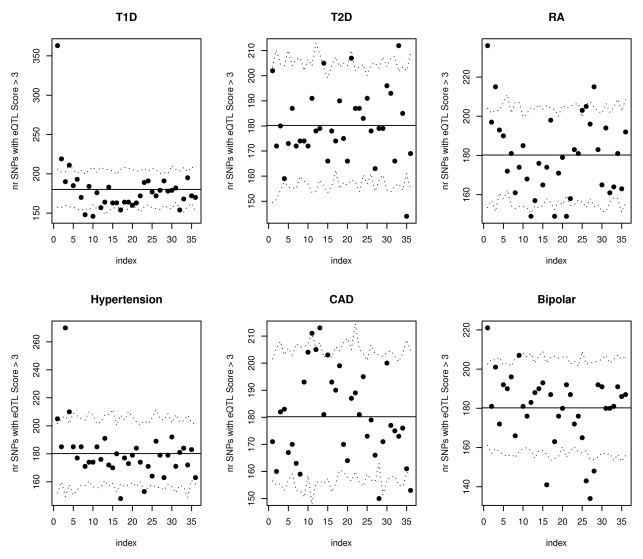
Although genome-wide association studies (GWAS) of complex traits have yielded more reproducible associations than had been discovered using any other approach, the loci characterized to date do not account for much of the heritability to such traits and, in general, have not led to improved understanding of the biology underlying complex phenotypes. Using a web site we developed to serve results of expression quantitative trait locus (eQTL) studies in lymphoblastoid cell lines from HapMap samples (http://www.scandb.org), we show that single nucleotide polymorphisms (SNPs) associated with complex traits (from http://www.genome.gov/gwastudies/) are significantly more likely to be eQTLs than minor-allele-frequency-matched SNPs chosen from high-throughput GWAS platforms. These findings are robust across a range of thresholds for establishing eQTLs (p-values from 10(-4)-10(-8)), and a broad spectrum of human complex traits. Analyses of GWAS data from the Wellcome Trust studies confirm that annotating SNPs with a score reflecting the strength of the evidence that the SNP is an eQTL can improve the ability to discover true associations and clarify the nature of the mechanism driving the associations. Our results showing that trait-associated SNPs are more likely to be eQTLs and that application of this information can enhance discovery of trait-associated SNPs for complex phenotypes raise the possibility that we can utilize this information both to increase the heritability explained by identifiable genetic factors and to gain a better understanding of the biology underlying complex traits.
Overview
The claims and statistics of this paper haven’t been checked yet.
Free: it reads the open-access text and checks the first 5 claims that cite a source we can check. Create a free account to check every claim.
Integrity signals
Registry
Cites
Statistics
Figures
Verification
Claims the paper makes
The claims and statistics of this paper haven’t been checked yet.
Free: it reads the open-access text and checks the first 5 claims that cite a source we can check. Create a free account to check every claim.
Claims other papers make about this one
Each is checked against this paper’s own text: does it say what the citing paper says it does?
The cited source says what the claim attributes to it.
In the citing paper
“Significant GWAS loci are enriched for e QTLs (Nicolae et al., 2010) and meQTLs (X. Zhang et al., 2014).”
From Integrative Analysis of Multi-omics Data for Discovery and Functional Studies of Complex Human Diseases (2016) · cites this paper as Nicolae et al., 2010
Self-check
Percentages, sums and reported differences re-computed from the paper’s own numbers.
The self-check needs the paper’s full text.
Citations
Cites
PLINK: a tool set for whole-genome association and population-based linkage analyses.
Purcell, S., Neale, B., Todd-Brown, K., Thomas, L., Ferreira, M. A. R., Bender, D., Maller, J., Sklar, P., de Bakker, P. I. W., Daly, M. J., et al. (2007) · The American Journal of Human Genetics · doi:10.1086/519795 · Cited by 34,089 · cited 1×
“We used the toolkit PLINK [31] to calculate frequencies.”
MethodGenome-wide association study of 14,000 cases of seven common diseases and 3,000 shared controls
The Wellcome Trust Case Control Consortium, Management Committee, Burton, P. R., Clayton, D. G., Cardon, L. R., Craddock, N., Deloukas, P., Duncanson, A., Kwiatkowski, D. P., McCarthy, M. I., et al. (2007) · Nature · doi:10.1038/nature05911 · Cited by 9,442
Finding the missing heritability of complex diseases
Manolio, T. A., Collins, F. S., Cox, N. J., Goldstein, D. B., Hindorff, L. A., Hunter, D. J., McCarthy, M. I., Ramos, E. M., Cardon, L. R., Chakravarti, A., et al. (2009) · Nature · doi:10.1038/nature08494 · Cited by 8,336 · cited 1×
“The failure to achieve this goal is made particularly acute by the recognition that the loci that have been successfully identified not only provide us with little insight into the genetic basis for the trait, but also account for little of the overall heritability [5].”
BackgroundSelf-citationHindorff, L. A., Sethupathy, P., Junkins, H. A., Ramos, E. M., Mehta, J. P., Collins, F. S., & Manolio, T. A. (2009) · Proceedings of the National Academy of Sciences · doi:10.1073/pnas.0903103106 · Cited by 4,013 · cited 1×
“Our results build on those of previous studies, particularly those of Schadt and colleagues [12–15] that focused on using transcriptome information to improve understanding of genetic signals, but the rapid accumulation of trait-associated SNPs through GWAS, coupled with the systematic efforts to catalog these variant…”
ResultGenome-wide association defines more than 30 distinct susceptibility loci for Crohn's disease
the NIDDK IBD Genetics Consortium, Barrett, J. C., the Belgian-French IBD Consortium, the Wellcome Trust Case Control Consortium, Hansoul, S., Nicolae, D. L., Cho, J. H., Duerr, R. H., Rioux, J. D., Brant, S. R., et al. (2008) · Nature Genetics · doi:10.1038/ng.175 · Cited by 2,593
Self-citationMAQC Consortium, Shi, L., Shi, L., Reid, L. H., Jones, W. D., Shippy, R., Warrington, J. A., Baker, S. C., Collins, P. J., de Longueville, F., et al. (2006) · Nature Biotechnology · doi:10.1038/nbt1239 · Cited by 2,126 · cited 1×
“) that they might be considered unreliable for genomic studies [24], while others highlight the reproducibility of results of transcriptome studies [25,26] and find that LCLs show little variability as a consequence of non-genetic”
ResultHampe, J., Franke, A., Rosenstiel, P., Till, A., Teuber, M., Huse, K., Albrecht, M., Mayr, G., De La Vega, F. M., Briggs, J., et al. (2007) · Nature Genetics · doi:10.1038/ng1954 · Cited by 1,897 · cited 1×
“For a few disorders, results of GWAS have highlighted biological contributing factors to disease that had not previously been recognized as central, such as the complement system in macular degeneration [1] or autophagy in Crohn’s disease [2–4].”
BackgroundGenome-wide association study of blood pressure and hypertension
Levy, D., Ehret, G. B., Rice, K., Verwoert, G. C., Launer, L. J., Dehghan, A., Glazer, N. L., Morrison, A. C., Johnson, A. D., Aspelund, T., et al. (2009) · Nature Genetics · doi:10.1038/ng.384 · Cited by 1,364 · cited 1×
“has enabled us to generalize the concept that information on eQTLs will have utility for understanding the genetic component to complex traits. Our primary observations – that SNPs reproducibly associated with complex human traits are more likely to be eQTLs – are novel, although perhaps not unexpected given that few…”
ResultGenetics of gene expression and its effect on disease
Emilsson, V., Thorleifsson, G., Zhang, B., Leonardson, A. S., Zink, F., Zhu, J., Carlson, S., Helgason, A., Walters, G. B., Gunnarsdottir, S., et al. (2008) · Nature · doi:10.1038/nature06758 · Cited by 1,296 · cited 1×
“studies have highlighted the potential sensitivity of eQTL studies to cell and tissue subtypes [15,19,20].”
BackgroundA General Test of Association for Quantitative Traits in Nuclear Families
Abecasis, G. R., Cardon, L. R., & Cookson, W. O. C. (2000) · The American Journal of Human Genetics · doi:10.1086/302698 · Cited by 1,126 · cited 1×
“Genome-wide association analyses of 13,080 transcript clusters (gene-level) with reliable expression and more than 2 million SNPs in the CEU or YRI populations were conducted using the Quantitative Trait Disequilibrium Test (QTDT) [30].”
Method
Research works printed but not linked: 1
- Hindorff LA Sethupathy P Junkins HA Ramos EM Mehta JP 2009 Potential etiologic and functional implications of genome-wide association loci for human diseases and traits. Proc Natl Acad Sci U S A 106 9362 9367 19474294 PMC2687147 · DOI · Paper page
Cited by
Items 101–200 of 1,003
Genome-wide association study of Tourette's syndrome
Scharf, J. M., Yu, D., Mathews, C. A., Neale, B. M., Stewart, S. E., Fagerness, J. A., Evans, P., Gamazon, E., Edlund, C. K., Service, S. K., et al. (2013) · Molecular Psychiatry · doi:10.1038/mp.2012.69 · Cited by 211
Self-citationChromatin three-dimensional interactions mediate genetic effects on gene expression
Delaneau, O., Zazhytska, M., Borel, C., Giannuzzi, G., Rey, G., Howald, C., Kumar, S., Ongen, H., Popadin, K., Marbach, D., et al. (2019) · Science · doi:10.1126/science.aat8266 · Cited by 217
McAllister, K., Mechanic, L. E., Amos, C., Aschard, H., Blair, I. A., Chatterjee, N., Conti, D., Gauderman, W. J., Hsu, L., Hutter, C. M., et al. (2017) · American Journal of Epidemiology · doi:10.1093/aje/kwx227 · Cited by 208
Innocenti, F., Cooper, G. M., Stanaway, I. B., Gamazon, E. R., Smith, J. D., Mirkov, S., Ramirez, J., Liu, W., Lin, Y. S., Moloney, C., et al. (2011) · PLoS Genetics · doi:10.1371/journal.pgen.1002078 · Cited by 204
Self-citationAfter GWAS: Searching for Genetic Risk for Schizophrenia and Bipolar Disorder
Gershon, E. S., Alliey-Rodriguez, N., & Liu, C. (2011) · American Journal of Psychiatry · doi:10.1176/appi.ajp.2010.10091340 · Cited by 198
“Subset analyses of GWAS data could be based on functional characterization of specific SNPs, such as their effects on gene expression (20) or DNA methylation, evolutionarily conserved regions of the genome, and pathway analyses that yield groups of genes with functional interactions.”
BackgroundCrowley, J. J., Zhabotynsky, V., Sun, W., Huang, S., Pakatci, I. K., Kim, Y., Wang, J. R., Morgan, A. P., Calaway, J. D., Aylor, D. L., et al. (2015) · Nature Genetics · doi:10.1038/ng.3222 · Cited by 202
Gene expression imputation across multiple brain regions provides insights into schizophrenia risk
CommonMind Consortium, Huckins, L. M., The Schizophrenia Working Group of the Psychiatric Genomics Consortium, iPSYCH-GEMS Schizophrenia Working Group, Dobbyn, A., Ruderfer, D. M., Hoffman, G., Wang, W., Pardiñas, A. F., Rajagopal, V. M., et al. (2019) · Nature Genetics · doi:10.1038/s41588-019-0364-4 · Cited by 188
Self-citationEstimating the causal tissues for complex traits and diseases
GTEx Consortium, Ongen, H., Brown, A. A., Delaneau, O., Panousis, N. I., Nica, A. C., & Dermitzakis, E. T. (2017) · Nature Genetics · doi:10.1038/ng.3981 · Cited by 198
Dissecting the regulatory architecture of gene expression QTLs
Gaffney, D. J., Veyrieras, J.-B., Degner, J. F., Pique-Regi, R., Pai, A. A., Crawford, G. E., Stephens, M., Gilad, Y., & Pritchard, J. K. (2012) · Genome Biology · doi:10.1186/gb-2012-13-1-r7 · Cited by 196
From expression QTLs to personalized transcriptomics
Montgomery, S. B., & Dermitzakis, E. T. (2011) · Nature Reviews Genetics · doi:10.1038/nrg2969 · Cited by 189
“Furthermore, recent studies have shown that the currently known GWA study signals are enriched for expression quantitative trait loci (eQTLs) in lymphoblastoid cell line”
BackgroundTakata, A., Matsumoto, N., & Kato, T. (2017) · Nature Communications · doi:10.1038/ncomms14519 · Cited by 197
“This observation is in agreement with the growing evidence that the majority of SNPs identified in GWAS contribute to the disease risks through their impact on gene regulatory functions 36,37 .”
Oliva, M., Demanelis, K., Lu, Y., Chernoff, M., Jasmine, F., Ahsan, H., Kibriya, M. G., Chen, L. S., & Pierce, B. L. (2023) · Nature Genetics · doi:10.1038/s41588-022-01248-z · Cited by 189
Zhang, Z., Luo, K., Zou, Z., Qiu, M., Tian, J., Sieh, L., Shi, H., Zou, Y., Wang, G., Morrison, J., et al. (2020) · Nature Genetics · doi:10.1038/s41588-020-0644-z · Cited by 188
Li, M. J., Liu, Z., Wang, P., Wong, M. P., Nelson, M. R., Kocher, J.-P. A., Yeager, M., Sham, P. C., Chanock, S. J., Xia, Z., et al. (2016) · Nucleic Acids Research · doi:10.1093/nar/gkv1317 · Cited by 187
“This result is consistent with previous studies that GWAS SNPs are enriched in functional elements (44), eQTL (45) and positive selection signal (46).”
ResultAssociation of Parkinson Disease with Structural and Regulatory Variants in the HLA Region
Wissemann, W. T., Hill-Burns, E. M., Zabetian, C. P., Factor, S. A., Patsopoulos, N., Hoglund, B., Holcomb, C., Donahue, R. J., Thomson, G., Erlich, H., et al. (2013) · The American Journal of Human Genetics · doi:10.1016/j.ajhg.2013.10.009 · Cited by 189
“(We will show that two of these classical associations are driven by SNPs.) er 7, 2013 Table 2.”
BackgroundInfluentialAutism spectrum disorders and autistic traits share genetics and biology
Bralten, J., van Hulzen, K. J., Martens, M. B., Galesloot, T. E., Arias Vasquez, A., Kiemeney, L. A., Buitelaar, J. K., Muntjewerff, J. W., Franke, B., & Poelmans, G. (2018) · Molecular Psychiatry · doi:10.1038/mp.2017.98 · Cited by 184
“39 As our genome-wide association analysis only included autosomal SNPs, 12 genes located on the X chromosome ( ARHGAP36 , DACH2 , DMD , GATA1 , JARID1C , MAMLD1 , MSN , PLXNB3 , RHFOX1 , RHFOX2 , SLC10A3 , USP9X ) were omitted before the gene-set analysis.”
Brown, C. D., Mangravite, L. M., & Engelhardt, B. E. (2013) · PLoS Genetics · doi:10.1371/journal.pgen.1003649 · Cited by 179
Ding, J., Gudjonsson, J. E., Liang, L., Stuart, P. E., Li, Y., Chen, W., Weichenthal, M., Ellinghaus, E., Franke, A., Cookson, W., et al. (2010) · The American Journal of Human Genetics · doi:10.1016/j.ajhg.2010.10.024 · Cited by 180
DNA methylation in lung cells is associated with asthma endotypes and genetic risk
Nicodemus-Johnson, J., Myers, R. A., Sakabe, N. J., Sobreira, D. R., Hogarth, D. K., Naureckas, E. T., Sperling, A. I., Solway, J., White, S. R., Nobrega, M. A., et al. (2016) · JCI Insight · doi:10.1172/jci.insight.90151 · Cited by 180
Self-citationTeruel, M., & Alarcón-Riquelme, M. E. (2016) · Journal of Autoimmunity · doi:10.1016/j.jaut.2016.08.001 · Cited by 177
Human Immunology through the Lens of Evolutionary Genetics
Quintana-Murci, L. (2019) · Cell · doi:10.1016/j.cell.2019.02.033 · Cited by 171
Aubourg, G., Rice, S. J., Bruce-Wootton, P., & Loughlin, J. (2022) · Osteoarthritis and Cartilage · doi:10.1016/j.joca.2021.03.002 · Cited by 159
Enhancing GTEx by bridging the gaps between genotype, gene expression, and disease
eGTEx Project (2017) · Nature Genetics · doi:10.1038/ng.3969 · Cited by 178
Hormozdiari, F., Gazal, S., van de Geijn, B., Finucane, H. K., Ju, C. J.-T., Loh, P.-R., Schoech, A., Reshef, Y., Liu, X., O’Connor, L., et al. (2018) · Nature Genetics · doi:10.1038/s41588-018-0148-2 · Cited by 179
“…aid in understanding the disease architecture: in particular, previous studies have shown that cis-eQTL are enriched in GWAS loci as well as genome-wide heritability of several diseases 5,6,19,20 , motivating further work on colocalization 21–23 and transcriptome-wide association studies 24–26 .”
Genetic Regulation of Adipose Gene Expression and Cardio-Metabolic Traits
Civelek, M., Wu, Y., Pan, C., Raulerson, C. K., Ko, A., He, A., Tilford, C., Saleem, N. K., Stančáková, A., Scott, L. J., et al. (2017) · The American Journal of Human Genetics · doi:10.1016/j.ajhg.2017.01.027 · Cited by 184
An eQTL Landscape of Kidney Tissue in Human Nephrotic Syndrome
Gillies, C. E., Putler, R., Menon, R., Otto, E., Yasutake, K., Nair, V., Hoover, P., Lieb, D., Li, S., Eddy, S., et al. (2018) · The American Journal of Human Genetics · doi:10.1016/j.ajhg.2018.07.004 · Cited by 173
From genome to function by studying eQTLs
Westra, H.-J., & Franke, L. (2014) · Biochimica et Biophysica Acta (BBA) - Molecular Basis of Disease · doi:10.1016/j.bbadis.2014.04.024 · Cited by 171
SNPsnap: a Web-based tool for identification and annotation of matched SNPs
Pers, T. H., Timshel, P., & Hirschhorn, J. N. (2015) · Bioinformatics · doi:10.1093/bioinformatics/btu655 · Cited by 176
Best, T., Li, D., Skol, A. D., Kirchhoff, T., Jackson, S. A., Yasui, Y., Bhatia, S., Strong, L. C., Domchek, S. M., Nathanson, K. L., et al. (2011) · Nature Medicine · doi:10.1038/nm.2407 · Cited by 168
A survey of the genetics of stomach, liver, and adipose gene expression from a morbidly obese cohort
Greenawalt, D. M., Dobrin, R., Chudin, E., Hatoum, I. J., Suver, C., Beaulaurier, J., Zhang, B., Castro, V., Zhu, J., Sieberts, S. K., et al. (2011) · Genome Research · doi:10.1101/gr.112821.110 · Cited by 165
“Both Nicolae et al. (2010) and Nica et al. (2010) have recently reported that GWAS SNPs for immune-related disorders, such as T1D and Crohn’s disease, are highly enriched for eQTLs identified from LCLs.”
BackgroundResultGamazon, E. R., Badner, J. A., Cheng, L., Zhang, C., Zhang, D., Cox, N. J., Gershon, E. S., Kelsoe, J. R., Greenwood, T. A., Nievergelt, C. M., et al. (2013) · Molecular Psychiatry · doi:10.1038/mp.2011.174 · Cited by 155
Self-citationRecent Genetics and Epigenetics Approaches to PTSD
Daskalakis, N. P., Rijal, C. M., King, C., Huckins, L. M., & Ressler, K. J. (2018) · Current Psychiatry Reports · doi:10.1007/s11920-018-0898-7 · Cited by 146
Large-scale transcriptome-wide association study identifies new prostate cancer risk regions
Mancuso, N., Gayther, S. A., Gusev, A., Zheng, W., Penney, K. L., Kote‐Jarai, Z., Eeles, R. A., Freedman, M. L., Haiman, C. A., Paşaniuc, B., et al. (2018) · Nature Communications · doi:10.1038/s41467-018-06302-1 · Cited by 171
The missing link between genetic association and regulatory function
Connally, N. J., Nazeen, S., Lee, D., Shi, H., Stamatoyannopoulos, J., Chun, S., Cotsapas, C., Cassa, C. A., & Sunyaev, S. R. (2022) · eLife · doi:10.7554/elife.74970 · Cited by 158
Genome-Wide Significant Loci: How Important Are They?
Björkegren, J. L. M., Kovacic, J. C., Dudley, J. T., & Schadt, E. E. (2015) · Journal of the American College of Cardiology · doi:10.1016/j.jacc.2014.12.033 · Cited by 141
Human Genetics of Addiction: New Insights and Future Directions
Hancock, D. B., Markunas, C. A., Bierut, L. J., & Johnson, E. O. (2018) · Current Psychiatry Reports · doi:10.1007/s11920-018-0873-3 · Cited by 138
The importance of p53 pathway genetics in inherited and somatic cancer genomes
Stracquadanio, G., Wang, X., Wallace, M. D., Grawenda, A. M., Zhang, P., Hewitt, J., Zerón-Medina-Cuairán, J., Castro-Giner, F., Tomlinson, I. P. M., Goding, C. R., et al. (2016) · Nature reviews. Cancer · doi:10.1038/nrc.2016.15 · Cited by 150
“Identifying which cancer-associated pathways frequently carry SNPs associated with differential cancer susceptibility could accelerate our biological understanding of the variants’ influence on cancer and the potential clinical utility of SNP biomarkers 12,13 .”
Power, false discovery rate and Winner’s Curse in eQTL studies
Huang, Q. Q., Ritchie, S. C., Brozynska, M., & Inouye, M. (2018) · Nucleic Acids Research · doi:10.1093/nar/gky780 · Cited by 141
“Integration of gene expression and genetic variation is a ubiquitous approach for uncovering genetic regulatory effects and their ramifications for pathways relevant to human diseases and traits (3–6), and indeed trait-associated SNPs have been found to be enriched for expression quantitative trait loci (eQTL) effects…”
Arloth, J., Bogdan, R., Weber, P., Frishman, G., Menke, A., Wagner, K. V., Balsevich, G., Schmidt, M. V., Karbalai, N., Czamara, D., et al. (2015) · Neuron · doi:10.1016/j.neuron.2015.05.034 · Cited by 142
“of using eQTLs and mQTLs from disease-relevant tissues (Gamazon et al., 2013; Nicolae et al., 2010).”
Naaijen, J., Bralten, J., Poelmans, G., The IMAGE consortium, Faraone, S., Asherson, P., Banaschewski, T., Buitelaar, J., Franke, B., P Ebstein, R., et al. (2017) · Translational Psychiatry · doi:10.1038/tp.2016.273 · Cited by 142
Discovery of active enhancers through bidirectional expression of short transcripts
Melgar, M. F., Collins, F. S., & Sethupathy, P. (2011) · Genome Biology · doi:10.1186/gb-2011-12-11-r113 · Cited by 141
“Recent large-scale human genetic studies have revealed that most complex disease-associated variants map to within non-coding genomic regions [5-7], providing additional impetus to expand current catalogs of gene regulatory elements and better understand cellular control of gene expression.”
BackgroundPorcu, E., Sadler, M. C., Lepik, K., Auwerx, C., Wood, A. R., Weihs, A., Sleiman, M. S. B., Ribeiro, D. M., Bandinelli, S., Tanaka, T., et al. (2021) · Nature Communications · doi:10.1038/s41467-021-25805-y · Cited by 154
Genetics of Migraine: Insights into the Molecular Basis of Migraine Disorders
Sutherland, H. G. E., & Griffiths, L. R. (2017) · Headache The Journal of Head and Face Pain · doi:10.1111/head.13053 · Cited by 150
Guo, H., Fortune, M. D., Burren, O. S., Schofield, E., Todd, J. A., & Wallace, C. (2015) · Human Molecular Genetics · doi:10.1093/hmg/ddv077 · Cited by 149
“Enrichment of disease-associated single-nucleotide polymorphisms (SNPs) amongst expression quantitative trait loci (eQTL) SNPs (1) indicates that a proportion of disease associations may bemediated through gene regulation.”
BackgroundSurvey of the Heritability and Sparse Architecture of Gene Expression Traits across Human Tissues
Wheeler, H. E., Shah, K. P., Brenner, J., Garcia, T., Aquino-Michaels, K., GTEx Consortium, Cox, N. J., Nicolae, D. L., & Im, H. K. (2016) · PLOS Genetics · doi:10.1371/journal.pgen.1006423 · Cited by 145
“374 For comparing to BSLMM PVE, we restricted the GCTA heritability estimates to be 375 within the [0,1] interval (constrained model, see Figures 3, 4 and 5).”
Self-citationMapping Rare and Common Causal Alleles for Complex Human Diseases
Raychaudhuri, S. (2011) · Cell · doi:10.1016/j.cell.2011.09.011 · Cited by 131
“It has been shown that common trait-associated variants have a significant overlap with eQTL, suggesting the possibility that many common disease variants act by altering transcript levels (Nicolae et al., 2010).”
BackgroundIntegrative genomic analysis of the human immune response to influenza vaccination
Franco, L. M., Bucasas, K. L., Wells, J. M., Niño, D., Wang, X., Zapata, G. E., Arden, N., Renwick, A., Yu, P., Quarles, J. M., et al. (2013) · eLife · doi:10.7554/elife.00299 · Cited by 132
“…by which they influence risk involves variation in transcriptional responses (Emilsson et al., 2008; Cookson et al., 2009; Naukkarinen et al., 2010; Nicolae et al., 2010; Rotival et al., 2011; Barreiro et al., 2012) Finally, integrative genomic studies in model organisms (Schadt et al., 2005; Amit…”
BackgroundNagpal, S., Meng, X., Epstein, M. P., Tsoi, L. C., Patrick, M. T., Gibson, G. C., Jager, P. L. D., Bennett, D. A., Wingo, A. P., Wingo, T. S., et al. (2019) · The American Journal of Human Genetics · doi:10.1016/j.ajhg.2019.05.018 · Cited by 160
Werling, D. M., Pochareddy, S., Choi, J., An, J.-Y., Sheppard, B., Peng, M., Li, Z., Dastmalchi, C., Santpere, G., Sousa, A. M. M., et al. (2020) · Cell Reports · doi:10.1016/j.celrep.2020.03.053 · Cited by 144
“To assess whether GWAS loci were enriched for eQTLs, as has been observed previously (Fromer et al., 2016; Nicolae et al., 2010), we used a permutation-based method that assessed expectation based on SNPs with similar LD structure, MAF, and gene density.”
MethodHernandez, D. G., Nalls, M. A., Moore, M., Chong, S., Dillman, A., Trabzuni, D., Gibbs, J. R., Ryten, M., Arepalli, S., Weale, M. E., et al. (2012) · Neurobiology of Disease · doi:10.1016/j.nbd.2012.03.020 · Cited by 134
Cis and Trans Effects of Human Genomic Variants on Gene Expression
Bryois, J., Buil, A., Evans, D. M., Kemp, J. P., Montgomery, S. B., Conrad, D. F., Ho, K. M., Ring, S., Hurles, M., Deloukas, P., et al. (2014) · PLoS Genetics · doi:10.1371/journal.pgen.1004461 · Cited by 132
Characterization of noncoding regulatory DNA in the human genome
Elkon, R., & Agami, R. (2017) · Nature Biotechnology · doi:10.1038/nbt.3863 · Cited by 148
Genetic and Modifiable Risk Factors Contributing to Cisplatin-induced Toxicities
Trendowski, M. R., Charif, O. E., Dinh, P. C., Travis, L. B., & Dolan, M. E. (2019) · Clinical Cancer Research · doi:10.1158/1078-0432.ccr-18-2244 · Cited by 141
“In fact, the majority (90%) of diseaseassociated variants identified from genome-wide association studies (GWAS) reside in intergenic regions associated with transcriptional regulatory mechanisms including expression quantitative trait loci (eQTL) known to influence gene expression (37, 38).”
BackgroundSelf-citationHukku, A., Pividori, M., Luca, F., Piqué-Regi, R., Im, H. K., & Wen, X. (2020) · The American Journal of Human Genetics · doi:10.1016/j.ajhg.2020.11.012 · Cited by 144
Integrated molecular landscape of Parkinson’s disease
Klemann, C. J. H. M., Martens, G. J. M., Sharma, M., Martens, M. B., Isacson, O., Gasser, T., Visser, J. E., & Poelmans, G. (2017) · npj Parkinson's Disease · doi:10.1038/s41531-017-0015-3 · Cited by 123
The genetic architecture of gene expression levels in wild baboons
Tung, J., Zhou, X., Alberts, S. C., Stephens, M., & Gilad, Y. (2015) · eLife · doi:10.7554/elife.04729 · Cited by 134
“The approach we used here provides a way to leverage these models for complementary genetic studies as well, especially if eQTL prove to be strongly enriched for sites associated with other traits, as in humans (Nicolae et al., 2010).”
MethodPleiotropy, epistasis and the genetic architecture of quantitative traits
Mackay, T. F. C., & Anholt, R. R. H. (2024) · Nature Reviews Genetics · doi:10.1038/s41576-024-00711-3 · Cited by 161
“…via effects on gene regulation is supported by human studies showing that SNPs associated with organismal quantitative traits are enriched for eQTLs 111–113 and deoxyribonuclease I (DNase I) hypersensitive sites 114 , and that SNPs in DNase I hypersensitivity sites 115 and other functional…”
Genetic basis of transcriptome diversity in Drosophila melanogaster
Huang, W., Carbone, M. A., Magwire, M. M., Peiffer, J. A., Lyman, R. F., Stone, E. A., Anholt, R. R. H., & Mackay, T. F. C. (2015) · Proceedings of the National Academy of Sciences · doi:10.1073/pnas.1519159112 · Cited by 135
“In particular, there is increasing evidence that QTLs associated with organismal phenotypes are more likely to be eQTLs than are other variants with similar allele frequencies in the genome (4).”
BackgroundA deep auto-encoder model for gene expression prediction
Xie, R., Wen, J., Quitadamo, A., Cheng, J., & Shi, X. (2017) · BMC Genomics · doi:10.1186/s12864-017-4226-0 · Cited by 118
“Interestingly, SNPs associated with diseases through genome-wide association studies (GWAS) studies, are enriched for eQTLs [32, 33].”
BackgroundRichards, A. L., Jones, L., Moskvina, V, Kirov, G., Gejman, P. V., Levinson, D. F., Sanders, A. R., Molecular Genetics of Schizophrenia Collaboration (MGS), International Schizophrenia Consortium (ISC), Purcell, S., et al. (2012) · Molecular Psychiatry · doi:10.1038/mp.2011.11 · Cited by 123
Genetics of gene expression in immunity to infection
Fairfax, B. P., & Knight, J. C. (2014) · Current Opinion in Immunology · doi:10.1016/j.coi.2014.07.001 · Cited by 121
“The intersection of eQTL and GWAS has been conducive to hypothesis generation regarding the identity of causative genes underlying disease associations [10].”
BackgroundAsthma Genetics in the Post-GWAS Era
Ober, C. (2016) · Annals of the American Thoracic Society · doi:10.1513/annalsats.201507-459mg · Cited by 136
Below, J. E., Gamazon, E. R., Morrison, J. V., Konkashbaev, A., Pluzhnikov, A., McKeigue, P. M., Parra, E. J., Elbein, S. C., Hallman, D. M., Nicolae, D. L., et al. (2011) · Diabetologia · doi:10.1007/s00125-011-2188-3 · Cited by 118
“Previous studies have identified enrichment of eQTLs in trait associated SNPs [30].”
Self-citationConnecting the CNTNAP2 Networks with Neurodevelopmental Disorders
Poot, M. (2015) · Molecular Syndromology · doi:10.1159/000371594 · Cited by 126
“These findings indicate that association of a gene with a disorder may also involve mechanisms that are not directly related to the protein-encoding part of the gene [Nicolae et al., 2010].”
BackgroundComprehensive analysis of gene expression in human retina and supporting tissues
Li, M., Jia, C., Kazmierkiewicz, K. L., Bowman, A. S., Tian, L., Liu, Y., Gupta, N. A., Gudiseva, H. V., Yee, S. S., Kim, M., et al. (2014) · Human Molecular Genetics · doi:10.1093/hmg/ddu114 · Cited by 115
“Current thinking is that these nucleotide variations are likely to have causal effects by influencing gene expression rather than affecting protein function (5).”
BackgroundGamazon, E. R., Huang, R. S., Cox, N. J., & Dolan, M. E. (2010) · Proceedings of the National Academy of Sciences · doi:10.1073/pnas.1001827107 · Cited by 114
“Metaanalysis (combined associations across GWASs) can be used to pool information from multiple GWASs to increase the chances of finding true positives (27).”
BackgroundInfluentialSelf-citationStatistical Testing of Shared Genetic Control for Potentially Related Traits
Wallace, C. (2013) · Genetic Epidemiology · doi:10.1002/gepi.21765 · Cited by 115
“Researchers are turning to eQTL data to interpret GWAS results by simply considering whether an eQTL SNP is associated with any disease [Nicolae et al., 2010], visually [Trynka et al.”
BackgroundLymphoblastoid Cell Lines in Pharmacogenomic Discovery and Clinical Translation
Wheeler, H. E., & Dolan, M. E. (2012) · Pharmacogenomics · doi:10.2217/pgs.11.121 · Cited by 115
Self-citationGenetic and molecular architecture of complex traits
Lappalainen, T., Li, Y., Ramachandran, S., & Gusev, A. (2024) · Cell · doi:10.1016/j.cell.2024.01.023 · Cited by 138
Morrow, J. D., Glass, K., Cho, M. H., Hersh, C. P., Pinto-Plata, V., Celli, B. R., Marchetti, N. T., Criner, G. J., Bueno, R., Washko, G. R., et al. (2018) · American Journal of Respiratory and Critical Care Medicine · doi:10.1164/rccm.201707-1434oc · Cited by 131
Leveraging gene-environment interactions and endotypes for asthma gene discovery
Bønnelykke, K., & Ober, C. (2016) · Journal of Allergy and Clinical Immunology · doi:10.1016/j.jaci.2016.01.006 · Cited by 114
A Dementia-Associated Risk Variant near TMEM106B Alters Chromatin Architecture and Gene Expression
Gallagher, M. D., Posavi, M., Huang, P., Unger, T. L., Berlyand, Y., Gruenewald, A. L., Chesi, A., Manduchi, E., Wells, A. D., Grant, S. F. A., et al. (2017) · The American Journal of Human Genetics · doi:10.1016/j.ajhg.2017.09.004 · Cited by 131
Genetic determinants of survival in progressive supranuclear palsy: a genome-wide association study
Jabbari, E., Koga, S., Valentino, R. R., Reynolds, R. H., Ferrari, R., Tan, M. M. X., Rowe, J. B., Dalgard, C. L., Scholz, S. W., Dickson, D. W., et al. (2021) · The Lancet Neurology · doi:10.1016/s1474-4422(20)30394-x · Cited by 111
Multhaup, M. L., Seldin, M. M., Jaffe, A. E., Lei, X., Kirchner, H., Mondal, P., Li, Y., Rodriguez, V., Drong, A., Hussain, M., et al. (2015) · Cell Metabolism · doi:10.1016/j.cmet.2014.12.014 · Cited by 111
“There are many approaches for and important applications of interrogating the association of functional and genetic elements 146 Cell Metabolism 21, 138–149, January 6, 2015 a2015 Elsevier In using GWAS summary statistics (ENCODE Project Consortium, 2012; Jostins et al., 2012; Nicolae et al., 2010), but our approach i…”
Zhu, Z., Wang, X., Li, X., Lin, Y., Shen, S., Liu, C.-L., Hobbs, B. D., Hasegawa, K., Liang, L., Boezen, H. M., et al. (2019) · Respiratory Research · doi:10.1186/s12931-019-1036-8 · Cited by 127
Grisanzio, C., Werner, L. L., Takeda, D. Y., Awoyemi, B., Pomerantz, M. M., Yamada, H., Sooriakumaran, P., Robinson, B. D., Leung, R. A., Schinzel, A. C., et al. (2012) · Proceedings of the National Academy of Sciences · doi:10.1073/pnas.1200853109 · Cited by 122
“In fact, recent data demonstrates that alleles discovered through GWAS are enriched for eQTLs (12).”
BackgroundAbraham, J., Guo, Q., Dorling, L., Tyrer, J. P., Ingle, S., Hardy, R. M., Vallier, A.-L., Hiller, L., Burns, R., Jones, L., et al. (2014) · Clinical Cancer Research · doi:10.1158/1078-0432.ccr-13-3232 · Cited by 118
Lessons Learned From GWAS of Asthma
Kim, K. W., & Ober, C. (2019) · Allergy Asthma and Immunology Research · doi:10.4168/aair.2019.11.2.170 · Cited by 110
Prediction of Causal Candidate Genes in Coronary Artery Disease Loci
Brænne, I., Civelek, M., Vilne, B., Di Narzo, A., Johnson, A. D., Zhao, Y., Reiz, B., Codoni, V., Webb, T. R., Foroughi Asl, H., et al. (2015) · Arteriosclerosis, Thrombosis, and Vascular Biology · doi:10.1161/atvbaha.115.306108 · Cited by 109
Genome-Wide Functional Analysis of the Cotton Transcriptome by Creating an Integrated EST Database
Xie, F., Sun, G., Stiller, J. W., & Zhang, B. (2011) · PLoS ONE · doi:10.1371/journal.pone.0026980 · Cited by 109
“. SNPs are considered to be the major genetic source of phenotypic variability that differentiates individuals within given species”
BackgroundA review of post-GWAS prioritization approaches
Hou, L., & Zhao, H. (2013) · Frontiers in Genetics · doi:10.3389/fgene.2013.00280 · Cited by 105
Morrow, J. D., Zhou, X., Lao, T., Jiang, Z., DeMeo, D. L., Cho, M. H., Qiu, W., Cloonan, S. M., Pinto-Plata, V., Celli, B., et al. (2017) · Scientific Reports · doi:10.1038/srep44232 · Cited by 122
Murphy, A., Chu, J.-H., Xu, M., Carey, V. J., Lazarus, R., Liu, A., Szefler, S. J., Strunk, R., DeMuth, K., Castro, M., et al. (2010) · Human Molecular Genetics · doi:10.1093/hmg/ddq392 · Cited by 105
Exploring regulation in tissues with eQTL networks
Fagny, M., Paulson, J. N., Kuijjer, M. L., Sonawane, A. R., Chen, C.-Y., Lopes-Ramos, C. M., Glass, K., Quackenbush, J., & Platig, J. (2017) · Proceedings of the National Academy of Sciences · doi:10.1073/pnas.1707375114 · Cited by 105
“Those single-nucleotide polymorphisms (SNPs) associated with complex traits are enriched for variants likely to affect gene expression, as measured by expression quantitative trait locus (eQTL) analysis (5), suggesting that they influence phenotypes through changes in gene regulation (6, 7).”
BackgroundThe International Visible Trait Genetics Consortium, Hysi, P. G., Valdes, A. M., Liu, F., Furlotte, N. A., Evans, D. M., Bataille, V., Visconti, A., Hemani, G., McMahon, G., et al. (2018) · Nature Genetics · doi:10.1038/s41588-018-0100-5 · Cited by 106
Dynamic Role of trans Regulation of Gene Expression in Relation to Complex Traits
Yao, C., Joehanes, R., Johnson, A. D., Huan, T., Liu, C., Freedman, J. E., Munson, P. J., Hill, D. E., Vidal, M., & Levy, D. (2017) · The American Journal of Human Genetics · doi:10.1016/j.ajhg.2017.02.003 · Cited by 106
Fransen, K., Visschedijk, M. C., van Sommeren, S., Fu, J. Y., Franke, L., Festen, E. A. M., Stokkers, P. C. F., van Bodegraven, A. A., Crusius, J. B. A., Hommes, D. W., et al. (2010) · Human Molecular Genetics · doi:10.1093/hmg/ddq264 · Cited by 107
“(14) found that SNPs associated with complex traits are more likely to be eQTLs and that, by using this information, the discovery of complex disease-associated genes can be enhanced.”
BackgroundGenetic control of the human brain proteome
Robins, C., Wingo, A. P., Fan, W., Duong, D. M., Meigs, J., Gerasimov, E. S., Dammer, E. B., Cutler, D. J., Jager, P. L. D., Bennett, D. A., et al. (2019) · doi:10.1101/816652 · Cited by 104
Integrating genetic and gene expression evidence into genome-wide association analysis of gene sets
Xiong, Q., Ancona, N., Hauser, E. R., Mukherjee, S., & Furey, T. S. (2012) · Genome Research · doi:10.1101/gr.124370.111 · Cited by 103
Zhu, X., & Stephens, M. (2018) · Nature Communications · doi:10.1038/s41467-018-06805-x · Cited by 109
“2b PTCH1, SFRP4, FLNB (59) Crohn’s disease Cluster 1a (DE) 15.”
BackgroundImmuno-Modulatory Effects of Intervertebral Disc Cells
Bermudez‐Lekerika, P., Crump, K. B., Tseranidou, S., Nüesch, A., Kanelis, E., Alminnawi, A., Baumgartner, L., Muñoz‐Moya, E., Compte, R., Gualdi, F., et al. (2022) · Frontiers in Cell and Developmental Biology · doi:10.3389/fcell.2022.924692 · Cited by 110
“Nicolae et al. (2010) demonstrated that common SNPs associated with complex diseases are significantly more likely to be eQTL, in comparison to rare SNPs acting on the phenotype by altering the expression of the gene rather than modifying the gene itself.”
BackgroundImpact of the X Chromosome and sex on regulatory variation
Kukurba, K. R., Parsana, P., Balliu, B., Smith, K. S., Zappala, Z., Knowles, D. A., Favé, M.-J., Davis, J. R., Li, X., Zhu, X., et al. (2016) · Genome Research · doi:10.1101/gr.197897.115 · Cited by 105
“Given the role of regulatory variation in determining disease risk (Nica et al. 2010; Nicolae et al. 2010), we asked if genetic variants identified through genomewide association studies have cumulatively different eQTL effects”
BackgroundHolmans, P. (2010) · Advances in genetics · doi:10.1016/b978-0-12-380862-2.00007-2 · Cited by 111
The Brisbane Systems Genetics Study: Genetical Genomics Meets Complex Trait Genetics
Powell, J. E., Henders, A. K., McRae, A. F., Caracella, A., Smith, S., Wright, M. J., Whitfield, J. B., Dermitzakis, E. T., Martin, N. G., Visscher, P. M., et al. (2012) · PLoS ONE · doi:10.1371/journal.pone.0035430 · Cited by 100
Type 1 diabetes genome‐wide association studies: not to be lost in translation
Pociot, F. (2017) · Clinical & Translational Immunology · doi:10.1038/cti.2017.51 · Cited by 112
Coeliac Disease Immunochip Consortium, Márquez, A., Rheumatoid Arthritis Consortium International for Immunochip (RACI), International Scleroderma Group, Type 1 Diabetes Genetics Consortium, Kerick, M., Zhernakova, A., Gutierrez-Achury, J., Chen, W.-M., Onengut-Gumuscu, S., et al. (2018) · Genome Medicine · doi:10.1186/s13073-018-0604-8 · Cited by 102
“Consistent with previous findings [28], functional annotation of these pleiotropic polymorphisms suggested that the majority of multi-disease signals affect disease risk by altering gene regulation.”
ResultReynolds, R. H., Botía, J., Nalls, M. A., International Parkinson’s Disease Genomics Consortium (IPDGC), Noyce, A. J., Nicolas, A., Cookson, M. R., Bandres-Ciga, S., Gibbs, J. R., Hernandez, D. G., et al. (2019) · npj Parkinson's Disease · doi:10.1038/s41531-019-0076-6 · Cited by 100
Relating human genetic variation to variation in drug responses
Madian, A. G., Wheeler, H. E., Jones, R. B., & Dolan, M. E. (2012) · Trends in Genetics · doi:10.1016/j.tig.2012.06.008 · Cited by 117
Self-citationSystematic identification of regulatory variants associated with cancer risk
Liu, S., Liu, Y., Zhang, Q., Wu, J., Liang, J., Yu, S., Wei, G.-H., White, K. P., & Wang, X. (2017) · Genome Biology · doi:10.1186/s13059-017-1322-z · Cited by 104
“Also, the GWAS SNPs are more likely to be in genomic loci associated with gene expression as identified by expression quantitative trait loci (eQTL) mapping [9, 10].”
BackgroundVockley, C. M., Guo, C., Majoros, W. H., Nodzenski, M., Scholtens, D. M., Hayes, M. G., Lowe, W. L., & Reddy, T. E. (2015) · Genome Research · doi:10.1101/gr.190090.115 · Cited by 99
“…are now several examples of noncoding genetic variants that alter the activity of regulatory elements and contribute substantially to complex traits and human diseases (Olansky et al. 1992; Nicolae et al. 2010; Maurano et al. 2012; Corradin et al. 2014; Stadhouders et al. 2014; Guo et al. 2015).”
Background
Metadata
- Authors
- Nicolae, D. L., Gamazon, E., Zhang, W., Duan, S., Dolan, M. E., & Cox, N. J.
- Affiliations
- University of Chicago (US)
- Corresponding author
- Cox, Nancy J.
- Venue
- PLoS Genetics
- Publisher
- Public Library of Science (PLoS)
- Published
- 2010-04-01
- Volume
- 6
- Issue
- 4
- Pages
- e1000888
- ISSN
- 1553-7390 (ISSN-L)
- 1553-7404
- PMC
- PMC2848547
- OpenAlex
- W2019983262
- Cited by
- 1,292
- References
- 31
- Citations by year
- 2026: 35 · 2025: 57 · 2024: 50 · 2023: 40 · 2022: 63 · 2021: 104 · 2020: 80 · 2019: 87 · 2018: 97 · 2017: 112 · 2016: 101 · 2015: 103 · 2014: 125 · 2013: 78 · 2012: 84
- FWCI
- 42.59
- Type
- journal article
- Language
- en
- Open access
- gold
- doi.org
- Locations
- PLoS Genetics (publishedVersion, cc-by)
- PubMed Central (publishedVersion, cc-by)
- PubMed (publishedVersion)
- Knowledge@UChicago (University of Chicago) (submittedVersion, cc-by-nc-nd)
- DOAJ (DOAJ: Directory of Open Access Journals) (submittedVersion, cc-by-sa)
- Figshare (submittedVersion, cc-by)
- University of Chicago (cc-by)
- Funders
- National Institutes of Health
- National Heart, Lung, and Blood Institute (U01HL084715)
- National Cancer Institute (P50CA125183)
- National Institute of General Medical Sciences (U01 GM61393, U01GM061393)
- National Institute of Diabetes and Digestive and Kidney Diseases (P60DK20595, P60DK020595)
- Topics
- Life Sciences › Biochemistry, Genetics and Molecular Biology › Genetics › Genetic Associations and Epidemiology
- Life Sciences › Biochemistry, Genetics and Molecular Biology › Genetics › Genetic Mapping and Diversity in Plants and Animals
- Life Sciences › Biochemistry, Genetics and Molecular Biology › Genetics › Genetic and phenotypic traits in livestock
- Keywords
- expression quantitative trait loci, single nucleotide polymorphisms, complex traits, genome-wide association study, SNP annotation, heritability, lymphoblastoid cell lines, gene expression
- MeSH terms
- Humans, Phenotype, Genome, Human, Polymorphism, Single Nucleotide, Quantitative Trait Loci, Genome-Wide Association Study
About these checks
Registry, retraction, Cites and statistics results are computed, not judged, with one exception: a printed reference that no index lists is read once by a model before it counts as a citation error. Claims are extracted by a model and kept only when their quote appears verbatim in the text; each cited source is then checked, with a model’s help, for whether it says what the claim relies on. Those verdicts can be wrong — read the claim’s quote and the cited source before relying on one.
Statistics and arithmetic are recomputed, not judged.
Confidence bands are shown only for fields calibrated on our annotated test set. None is calibrated yet, so no band is shown.
What counts as a claim ›How we measure confidence ›How we check this ›
Are you an author, or do you see a problem with this page? Request a review
Data sources
Bibliographic data: Semantic Scholar, OpenAlex, Crossref.
Contains information from the Semantic Scholar Academic Graph Datasets, made available under the ODC Attribution License (ODC-BY 1.0).
Semantic Scholar’s data is described in: Kinney, R., et al. (2023). The Semantic Scholar Open Data Platform. arXiv:2301.10140.
