

Effects on coronary heart disease of increasing polyunsaturated fat in place of saturated fat: a systematic review and meta-analysis of randomized controlled trials.
Open accessThe DOI matches its Crossref record; 49 of the 49 references it cites were found in a registry or an index.
Abstract
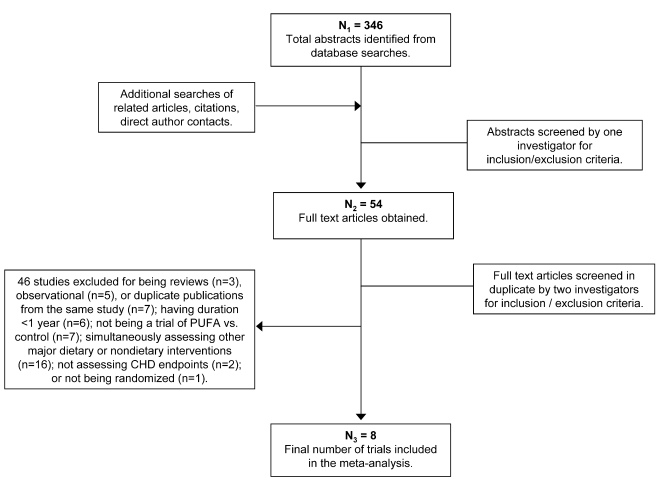
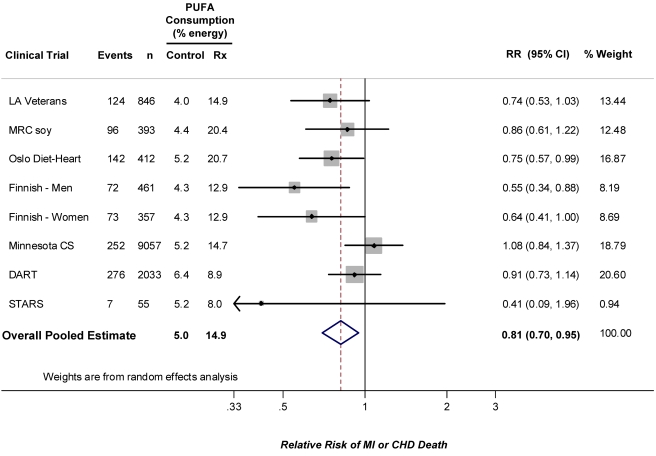
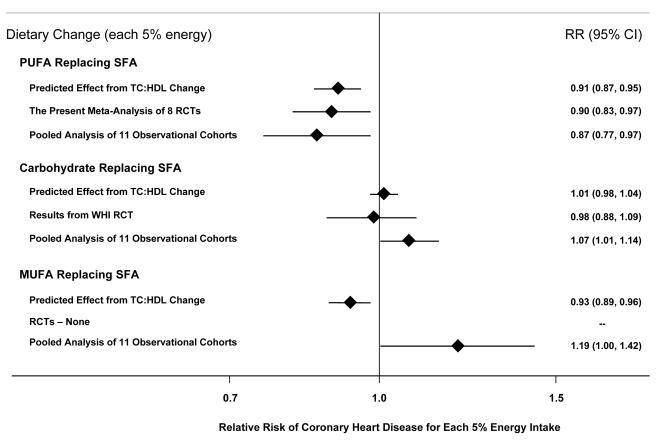
BACKGROUND: Reduced saturated fat (SFA) consumption is recommended to reduce coronary heart disease (CHD), but there is an absence of strong supporting evidence from randomized controlled trials (RCTs) of clinical CHD events and few guidelines focus on any specific replacement nutrient. Additionally, some public health groups recommend lowering or limiting polyunsaturated fat (PUFA) consumption, a major potential replacement for SFA. METHODS AND FINDINGS: We systematically investigated and quantified the effects of increased PUFA consumption, as a replacement for SFA, on CHD endpoints in RCTs. RCTs were identified by systematic searches of multiple online databases through June 2009, grey literature sources, hand-searching related articles and citations, and direct contacts with experts to identify potentially unpublished trials. Studies were included if they randomized participants to increased PUFA for at least 1 year without major concomitant interventions, had an appropriate control group, and reported incidence of CHD (myocardial infarction and/or cardiac death). Inclusions/exclusions were adjudicated and data were extracted independently and in duplicate by two investigators and included population characteristics, control and intervention diets, follow-up duration, types of events, risk ratios, and SEs. Pooled effects were calculated using inverse-variance-weighted random effects meta-analysis. From 346 identified abstracts, eight trials met inclusion criteria, totaling 13,614 participants with 1,042 CHD events. Average weighted PUFA consumption was 14.9% energy (range 8.0%-20.7%) in intervention groups versus 5.0% energy (range 4.0%-6.4%) in controls. The overall pooled risk reduction was 19% (RR = 0.81, 95% confidence interval [CI] 0.70-0.95, p = 0.008), corresponding to 10% reduced CHD risk (RR = 0.90, 95% CI = 0.83-0.97) for each 5% energy of increased PUFA, without evidence for statistical heterogeneity (Q-statistic p = 0.13; I(2) = 37%). Meta-regression identified study duration as an independent determinant of risk reduction (p = 0.017), with studies of longer duration showing greater benefits. CONCLUSIONS: These findings provide evidence that consuming PUFA in place of SFA reduces CHD events in RCTs. This suggests that rather than trying to lower PUFA consumption, a shift toward greater population PUFA consumption in place of SFA would significantly reduce rates of CHD. Please see later in the article for the Editors' Summary.
Overview
The claims and statistics of this paper haven’t been checked yet.
Free: it reads the open-access text and checks the first 5 claims that cite a source we can check. Create a free account to check every claim.
Integrity signals
Registry
Cites
Statistics
Figures
Verification
Claims the paper makes
The claims and statistics of this paper haven’t been checked yet.
Free: it reads the open-access text and checks the first 5 claims that cite a source we can check. Create a free account to check every claim.
Claims other papers make about this one
Each is checked against this paper’s own text: does it say what the citing paper says it does?
The cited source doesn’t support the claim as written.
In the citing paper
“In the presidential advisory of the AHA by Sacks et al. (27), the literature search strategy was not described, similarly to the study by Mozaffarian et al. (26)”
From Saturated Fat Restriction for Cardiovascular Disease Prevention: A Systematic Review and Meta-analysis of Randomized Controlled Trials (2025) · cites this paper as [26]
Checked by a reasoning model — may be wrong.
Experimental — accuracy not yet measuredThe source backs part of the claim, not all of it — or backs it for a different population, condition or comparison.
In the citing paper
“In order to get an overall estimate of the impact of dietary modifications on the CV risk, different meta-analyses have been performed, sometimes with inconsistent outcomes. 135,136”
From 2016 ESC/EAS Guidelines for the Management of Dyslipidaemias (2016) · cites this paper as [136]
Experimental — accuracy not yet measuredThe source backs part of the claim, not all of it — or backs it for a different population, condition or comparison.
In the citing paper
“For instance, total saturated fat, carbohydrate, and protein each appear relatively neutral for CHD; while effects of total monounsaturated fat remain uncertain (see below).21, 349”
From Dietary and Policy Priorities for Cardiovascular Disease, Diabetes, and Obesity: A Comprehensive Review (2016) · cites this paper as [349]
Experimental — accuracy not yet measuredThe source backs part of the claim, not all of it — or backs it for a different population, condition or comparison.
In the citing paper
“LA is also associated with significantly lower risk of CHD (Figure 7), whether in comparison to carbohydrate or saturated fat;350 and in meta-analysis of controlled clinical trials, consumption of n-6 rich vegetable oils, in place of animal fats, reduces CHD events (Figure 7).349”
From Dietary and Policy Priorities for Cardiovascular Disease, Diabetes, and Obesity: A Comprehensive Review (2016) · cites this paper as [349]
Experimental — accuracy not yet measuredThe source backs part of the claim, not all of it — or backs it for a different population, condition or comparison.
In the citing paper
“Notably, in these trials, the average intake of n-6 polyunsaturated fat was ~15% energy,349 higher than current guidelines that recommend up to 10-11% energy from polyunsaturated fat.370”
From Dietary and Policy Priorities for Cardiovascular Disease, Diabetes, and Obesity: A Comprehensive Review (2016) · cites this paper as [349]
Experimental — accuracy not yet measured
18 more claims about this paper
Create a free account to see every claim other papers make about this one.
Self-check
Percentages, sums and reported differences re-computed from the paper’s own numbers.
The self-check needs the paper’s full text.
Citations
Cites
Bias in meta-analysis detected by a simple, graphical test
Egger, M., Smith, G. D., Schneider, M., & Minder, C. (1997) · BMJ · doi:10.1136/bmj.315.7109.629 · Cited by 56,722 · cited 1×
“Potential for publication bias was assessed by visually inspecting a funnel plot of the treatment effect versus SE [30] and statistically using the Begg adjusted-rank correlation test [31].”
MethodMeta-analysis in clinical trials
DerSimonian, R., & Laird, N. (1986) · Controlled Clinical Trials · doi:10.1016/0197-2456(86)90046-2 · Cited by 39,552 · cited 3×
“Statistical Analysis The overall pooled effect was calculated using random effects meta-analysis, which accounts for heterogeneity in treatment effects among studies, using the methods of Dersimonian and Laird [28] with inverse-variance (SE) weighting.”
MethodOperating characteristics of a rank correlation test for publication bias
Begg, C. B., & Mazumdar, M. (1994) · Biometrics · doi:10.2307/2533446 · Cited by 16,955
Trumbo, P., Schlicker, S., Yates, A. A., & Poos, M. (2002) · Journal of the American Dietetic Association · doi:10.1016/s0002-8223(02)90346-9 · Cited by 5,993
Moher, D., Cook, D. J., Eastwood, S., Olkin, I., Rennie, D., & Stroup, D. F. (1999) · The Lancet · doi:10.1016/s0140-6736(99)04149-5 · Cited by 4,826
Moher, D., Pham, B., Jones, A., Cook, D. J., Jadad, A. R., Moher, M., Tugwell, P., & Klassen, T. P. (1998) · The Lancet · doi:10.1016/s0140-6736(98)01085-x · Cited by 3,560 · cited 2×
“We assessed study quality using the validated Jadad scale [27], which includes criteria relating to randomization, blinding, and withdrawals and dropouts that are together summed to generate an overall quality score between 0 and 5.”
BackgroundMethodSwinburn, B., Baba, N. H., Belhadj, M., Deurenberg‐Yap, M., Djazayery, A., Forrester, T., Galuska, D. A., Herman, S. T., James, W. P. T., Kabangu, J. R. M., et al. (2003) · World Health Organization eBooks · Cited by 3,453
Simopoulos, A. P. (2008) · Experimental Biology and Medicine · doi:10.3181/0711-mr-311 · Cited by 2,915 · cited 1×
“However, surprisingly, some scientists and organizations argue that consumption of n-6 PUFA, by far the predominant dietary PUFA, will actually increase CHD risk and have recommended reduced consumption [21–23], and the Institute of Medicine recommends only a relatively modest range of 5%–10% energy (%E) consumption f…”
BackgroundDanaei, G., Ding, E. L., Mozaffarian, D., Taylor, B., Rehm, J., Murray, C. J. L., & Ezzati, M. (2009) · PLoS Medicine · doi:10.1371/journal.pmed.1000058 · Cited by 2,860 · cited 1×
“need to be revisited, particularly as PUFA appears to be the primary evidence-based replacement for SFA. Finally, whereas on a population-level even a small shift from SFA to PUFA consumption would produce meaningful reductions in CHD risk, the relatively modest magnitude of plausible benefit (∼10% lower risk for 5%E…”
BackgroundSelf-citation
Cited by
Items 701–800 of 1,000
Major dietary lipids in nutrition and health
Márquez‐Ruiz, G., Velasco, J., & Holgado, F. (2023) · Advances in food and nutrition research · doi:10.1016/bs.afnr.2022.11.002 · Cited by 11
Aljahdali, B. A., Bajaber, A. S., Al-Nouri, D. M., Alkhalifah, A., Arzoo, S., & Alasmari, A. A. (2023) · Life · doi:10.3390/life13061336 · Cited by 9
“In addition, steatohepatitis developed, which appeared in the H and E staining and was used to study the histology of the liver [52].”
BackgroundMethodInfluentialBakry, I. A., Abouzid, M., Wei, W., Jin, J., El‐Sherif, D. M., Zhang, X., Yu, J., Wang, X., & Gohary, A. (2023) · Journal of Food Composition and Analysis · doi:10.1016/j.jfca.2023.105881 · Cited by 8
Guerra, I. M. S., Ferreira, H. B., Maurício, T., Pinho, M., Diogo, L. M., Moreira, S., Goracci, L., Bonciarelli, S., Melo, T., Domingues, P. M., et al. (2024) · Journal of Inherited Metabolic Disease · doi:10.1002/jimd.12718 · Cited by 9
Marçal, J. O., Oliveira, G. P., Geraldo, A., Lima, L. M. Z., Erasmus, S. W., & Faria, P. B. (2024) · Journal of Food Composition and Analysis · doi:10.1016/j.jfca.2024.106218 · Cited by 8
García‐Gómez, P., Moreno, D. A., Conesa, E., & Martínez‐Ballesta, M. D. C. (2024) · Horticulturae · doi:10.3390/horticulturae10090910 · Cited by 8
Soczynska, I., da Costa, B. R., O’Connor, D. L., Jenkins, D. J. A., Birken, C. S., Keown‐Stoneman, C. D. G., D’Hollander, C. J., Calleja, S., & Maguire, J. L. (2024) · Journal of Nutrition · doi:10.1016/j.tjnut.2024.09.010 · Cited by 15
Saturated fat in an evolutionary context
Garnås, E. (2025) · Lipids in Health and Disease · doi:10.1186/s12944-024-02399-0 · Cited by 13
“While certain studies have not found evidence of adverse cardiovascular effects [1–4], others do show unfavorable outcomes [123–126].”
The Type of Fat Ingested at Breakfast Influences the Plasma Lipid Profile of Postmenopausal Women
Morillas-Ruiz, J. M., Delgado-Alarcón, J. M., Rubio-Perez, J. M., & Otón, M. D. A. (2014) · BioMed Research International · doi:10.1155/2014/815915 · Cited by 8
Mohammadi, M., Khodarahmi, M., Kahroba, H., & Farhangi, M. A. (2020) · Eating and Weight Disorders - Studies on Anorexia Bulimia and Obesity · doi:10.1007/s40519-020-00855-1 · Cited by 8
“There is considerable evidence that saturated fat and cholesterol are frequently related to unfavorable health outcomes [57, 58].”
BackgroundHatami, E., Aghajani, M., Pourmasoumi, M., Haeri, F., Boozari, B., Nezamoleslami, S., Clark, C. C. T., Nezamoleslami, S., & Ghiasvand, R. (2022) · Nutrition Journal · doi:10.1186/s12937-022-00800-1 · Cited by 10
“Processed meats, such as sausages, have a high amount of fat (Often 50% by weight of sausage or more), SFA, and cholesterol [38].”
BackgroundÁcidos grasos poliinsaturados de cadena larga ω-3 y enfermedad cardiovascular
Rodrigo Valenzuela, B., Morales, G. I., Marcela González, A., Jessica Morales, P., Julio Sanhueza, C., & Alfonso Valenzuela, B. (2014) · Revista chilena de nutrición · doi:10.4067/s0717-75182014000300014 · Cited by 22
Effect of diet on vascular health
McEvoy, C. T., Neville, C. E., Temple, N. J., & Woodside, J. V. (2013) · Reviews in Clinical Gerontology · doi:10.1017/s0959259813000191 · Cited by 8
Effectiveness of Dietary Policies to Reduce Noncommunicable Diseases
Afshin, A., Micha, R., Webb, M., Capewell, S., Whitsel, L. P., Rubinstein, A. L., Prabhakaran, D., Suhrcke, M., & Mozaffarian, D. (2017) · Europe PMC (PubMed Central) · doi:10.1596/978-1-4648-0518-9/ch6 · Cited by 12
“…of this) additional direct effects on DM were included. f. Optimal consumption was based on increasing PUFA to 12%E as a replacement for SFA, in accordance with evidence that this specifi c nutrient replacement reduces risk (Jakobsen and others 2009; Mozaffarian, Micha, and Wallace 2010).”
MethodSelf-citationOil powders stabilized with soy protein used to prepare oil-in-fat dispersions
Tavernier, I., Heyman, B., der Meeren, P. V., Ruyssen, T., & Dewettinck, K. (2018) · Journal of Food Engineering · doi:10.1016/j.jfoodeng.2018.09.029 · Cited by 8
Zhao, T., Lei, S., Huang, L., Wang, Y., Wang, X., Zhou, P.-P., Xu, X., Zhang, L., Xu, L., & Yang, L. (2019) · International Journal of Environmental Research and Public Health · doi:10.3390/ijerph16050786 · Cited by 8
“This increases inflammatory signaling factors in atherosclerotic plaques, thereby increasing the risk of coronary artery disease [19,20,22].”
BackgroundDietary fat and alcohol in the prediction of indices of vascular health among young adults
Tisdel, D. M., Gadberry, J. J., Burke, S. L., Carlini, N. A., Fleenor, B. S., & Campbell, M. S. (2020) · Nutrition · doi:10.1016/j.nut.2020.111120 · Cited by 10
Fat, Sugar or Gut Microbiota in Reducing Cardiometabolic Risk: Does Diet Type Really Matter?
Nabrdalik, K., Krzyżak, K., Hajzler, W., Drożdż, K., Kwiendacz, H., Gumprecht, J., & Lip, G. Y. H. (2021) · Nutrients · doi:10.3390/nu13020639 · Cited by 9
“, (2010) [96] Meta-analysis, RCT 8/13614 Adults who increased PUFA for at least 1 year without major concomitant interventions PUFA vs.”
Tertsunen, H.-M., Hantunen, S., Tuomainen, T.-P., Salonen, J. T., & Virtanen, J. K. (2021) · British Journal Of Nutrition · doi:10.1017/s0007114521001227 · Cited by 12
Abdullah, M. M. H., Hughes, J., & Grafenauer, S. (2022) · Nutrients · doi:10.3390/nu14142912 · Cited by 11
“Although changes in diet would not be immediate in terms of disease reduction, periods of one to three years lag time could be expected before individual or population benefits would be realized [39].”
BackgroundMacronutrient advice for ischemic heart disease prevention
Jakobsen, M. U., & Overvad, K. (2010) · Current Opinion in Lipidology · doi:10.1097/mol.0b013e32834020a3 · Cited by 9
Thayer, L., Pimentel, D. C., Smith, J. C., Garcia, B. A., Sylvester, L. L., Kelly, T., Johnston, L. F., Ammerman, A. S., & Keyserling, T. C. (2016) · American Journal of Health Education · doi:10.1080/19325037.2016.1250688 · Cited by 9
“The overall goal of the intervention was to use local restaurants as a venue to provide patrons with evidence-informed information 9,11,32 on making healthful choices when dining out.”
Tamtaji, O. R., Borzabadi, S., Ghayour‐Mobarhan, M., Ferns, G. A., & Asemi, Z. (2018) · Journal of Cellular Biochemistry · doi:10.1002/jcb.27672 · Cited by 9
Association of Dietary, Circulating, and Supplement Fatty Acids With Coronary Risk
Liebman, B. F., Katan, M., & Jacobson, M. F. (2014) · Annals of Internal Medicine · doi:10.7326/l14-5018-4 · Cited by 8
Omega 6 fatty acids for the primary prevention of cardiovascular disease
Hartley, L., Clar, C., Flowers, N., Hooper, L., & Rees, K. (2014) · Cochrane Database of Systematic Reviews · doi:10.1002/14651858.cd011094 · Cited by 8
Plant-Based Diets and Cardiovascular Disease in Older Adults: An Integrative Literature Review
VanCleef, T. R., & Hutchens, A. (2024) · Biological Research For Nursing · doi:10.1177/10998004241268287 · Cited by 8
“This is not to say that cis -PUFAs and cis -MUFAs should be eaten in excess, but rather that harmful fats like SFAs should be replaced by them in the diet (Mozaffarian et al., 2010).”
Plasma Lipid Profile Among Perimenopausal Latvian Women in Relation to Dietary Habits
Aleksejeva, S., Meija, L., Zolovs, M., & Ciproviča, I. (2025) · Nutrients · doi:10.3390/nu17020243 · Cited by 7
Kaikkonen, J., Vilppo, T., Asikainen, J., Voutilainen, S., Kurl, S., & Salonen, J. T. (2013) · Annals of Medicine · doi:10.3109/07853890.2013.809915 · Cited by 10
Calabuig-Navarro, V., Jackson, K. G., Kemp, C. F., Leake, D. S., Walden, C. M., Lovegrove, J. A., & Minihane, A. M. (2017) · Scientific Reports · doi:10.1038/srep44119 · Cited by 8
Piernas, C., Tsiountsioura, M., Astbury, N. M., Madigan, C. D., Aveyard, P. N., & Jebb, S. A. (2019) · BMJ Open · doi:10.1136/bmjopen-2018-027035 · Cited by 7
Shafiee, M., Islam, N., Ramdath, D. D., & Vatanparast, H. (2022) · Nutrients · doi:10.3390/nu14061257 · Cited by 7
Nagasaki, Y., Kawai, E., Maruoka, S., Osumi, M., Tsukayama, I., Kawakami, Y., Takahashi, Y., Okazaki, Y., Miki, Y., Taketomi, Y., et al. (2022) · Biochemical and Biophysical Research Communications · doi:10.1016/j.bbrc.2022.09.051 · Cited by 8
Wilson, N. A., Villani, A. M., & Mantzioris, E. (2022) · British Journal Of Nutrition · doi:10.1017/s0007114522003798 · Cited by 9
Ghosh, R. N., Ray, A., Sharma, A., & Singhal, R. S. (2023) · Journal of Agriculture and Food Research · doi:10.1016/j.jafr.2023.100882 · Cited by 7
Food, nutrition, and related policy issues: Evidence-based policy and the credibility crisis
Krasovskaia, E., & Just, D. R. (2024) · Q Open · doi:10.1093/qopen/qoae013 · Cited by 11
Fallah, Z., Vasmehjani, A. A., Aghaei, S., Amiri, M., Raeisi‐Dehkordi, H., Moghtaderi, F., Zimorovat, A., Yazd, E. F., Madadizadeh, F., Khayyatzadeh, S. S., et al. (2024) · Scientific Reports · doi:10.1038/s41598-024-78294-6 · Cited by 8
Li, J., Xie, X., Chen, X., Xie, L., Luo, M., Yin, M., Liu, Y., Huang, W., Ai, Y., & He, J. (2024) · European Journal of Nutrition · doi:10.1007/s00394-024-03518-4 · Cited by 8
Tunca, Ç., Taş, A., & Demirtaş, S. (2025) · Vascular · doi:10.1177/17085381251330370 · Cited by 9
Øyri, L. K. L., Bogsrud, M. P., Kristiansen, A. L., Myhre, J. B., Retterstøl, K., Brekke, H. K., Gundersen, T. E., Andersen, L. F., & Holven, K. B. (2019) · Acta Paediatrica · doi:10.1111/apa.14936 · Cited by 7
Bowen‐Forbes, C. S., & Goldson-Barnaby, A. (2016) · Elsevier eBooks · doi:10.1016/b978-0-12-802104-0.00021-4 · Cited by 9
Menotti, A., & Puddu, P. E. (2024) · Hearts · doi:10.3390/hearts5020013 · Cited by 8
“This corresponded to a decline of 10% in CHD risk, and studies of longer durations showed more benefits [34].”
BackgroundLipidomics to Assess Omega 3 Bioactivity
Visioli, F. (2015) · Journal of Clinical Medicine · doi:10.3390/jcm4091753 · Cited by 9
“clearly indicates that MUFAs only mildly modify the HDL/LDL ratio, to an extent that should minimally influence cardiovascular risk [26].”
BackgroundNettleton, J. A., Koletzko, B. V., & Hornstra, G. (2011) · Annals of Nutrition and Metabolism · doi:10.1159/000324749 · Cited by 7
“that favorably affect the LDL:HDL cholesterol ratio, as supported by abundant evidence [ ,”
BackgroundControversies and discrepancies in the effect of dietary fat and cholesterol on cardiovascular risk
Leong, W., Ngiam, J. N., Tan, R., Lim, S. L., & Poh, K. K. (2021) · Singapore Medical Journal · doi:10.11622/smedj.2020065 · Cited by 8
“(35,60) However, when PUFA replaced SF, CVD risk was reduced.(61,62) Lower CVD risk might be attributed to not only SF reduction but also the increase in PUFA.”
BackgroundLocke, S., Falkenhain, K., Lowe, D. A., Lee, T., Singer, J., Weiss, E. J., & Little, J. P. (2020) · JMIR Research Protocols · doi:10.2196/19053 · Cited by 8
“Research has shown that substituting saturated fats with unsaturated fats can improve cardiovascular disease risk markers [24,25].”
BackgroundWhat should we advise MAFLD patients to eat and drink?
Machado, M. V. (2021) · Metabolism and Target Organ Damage · doi:10.20517/mtod.2021.11 · Cited by 8
Kim, H., Heo, J.-H., Lim, D. H., & Kim, Y. (2023) · Clinical Nutrition Research · doi:10.7762/cnr.2023.12.2.138 · Cited by 8
“The replacement of SFA intake with unsaturated fatty acid was associated with decreased risks of MetS [49] and coronary heart disease [52,53].”
BackgroundSchönbach, J.-K., Nusselder, W. J., & Lhachimi, S. K. (2019) · PLoS ONE · doi:10.1371/journal.pone.0218464 · Cited by 9
Yao, Y., Pek, S. X., Toh, D. W. K., Xia, X., & Kim, J. E. (2020) · International Journal of Food Sciences and Nutrition · doi:10.1080/09637486.2020.1744534 · Cited by 9
Dairy Fat: Perceptions and Realities
Lock, A. L., Givens, D. I., & Bauman, D. E. (2014) · Wiley eBooks · doi:10.1002/9781118635056.ch6 · Cited by 12
Dietary polyunsaturated fat intake in coronary heart disease risk
Virtanen, J. K. (2015) · Clinical Lipidology · doi:10.2217/clp.15.5 · Cited by 7
Valorisation of fish waste biomass through recovery of nutritional lipids and biogas
Mbatia, B. N. (2011) · Lund University Publications (Lund University) · Cited by 15
Dietary fats and breast cancer risk
Khaw, K. (2013) · BMJ · doi:10.1136/bmj.f4518 · Cited by 9
Rooney, M. L., O’Connor, A., Gollogly, C., Mills, A., Dunne, S., Chonnacháin, C. N., Timlin, M., Brodkorb, A., O’Callaghan, T. F., Magan, J. B., et al. (2025) · The Journal of Nutritional Biochemistry · doi:10.1016/j.jnutbio.2025.110004 · Cited by 7
Effectiveness of low-temperature storage on lipid nutritional quality of fish: a meta-analysis
Tan, K., Huang, L., Luo, C., Choong, K., Lim, L., Xu, P., & Cheong, K. (2025) · Aquaculture International · doi:10.1007/s10499-025-02131-4 · Cited by 6
“Saturated fatty acids (SFA), particularly palmitic acid (C16:0) and myristic acid (C14:0), are known to elevate low-density lipoprotein (LDL) cholesterol levels, thereby increasing the risk of coronary heart disease (Mozaffarian et al. 2010; Wrzosek et al. 2022).”
Calabrese, C., Giangrande, A., Quarta, E., Arduini, D., Acquaviva, M. I., Biandolino, F., Giandomenico, S., Pitarra, G., Prato, E., & Stabili, L. (2025) · Marine Pollution Bulletin · doi:10.1016/j.marpolbul.2025.118736 · Cited by 7
Sui, K., Yasrebi, A., Longoria, C. R., MacDonell, A. T., Jaffri, Z. H., Martinez, S. A., Fisher, S. E., Malonza, N., Jung, K., Tveter, K. M., et al. (2023) · Endocrinology · doi:10.1210/endocr/bqad001 · Cited by 7
Piernas, C., Lee, C., Hobson, A., Harmer, G., Payne, S., Noreik, M., & Jebb, S. A. (2023) · JMIR mhealth and uhealth · doi:10.2196/45854 · Cited by 6
Saturated Fats: Time to Assess Their Beneficial Role in a Healthful Diet
Lawrence, G. D. (2024) · Dietetics · doi:10.3390/dietetics3040033 · Cited by 7
Costa, D. M., Alvarenga, T. I. R. C., dos Santos, I. J., Dias, P. C. G., Alvarenga, F. A. P., Alves, N. G., & Garcia, I. F. F. (2025) · Agriculture · doi:10.3390/agriculture15020191 · Cited by 6
“This monounsaturated fatty acid is associated with increased insulin resistance [53].”
Nutrition and Cardiovascular Disease
Mozaffarian, D. (2012) · Elsevier eBooks · doi:10.1016/b978-1-4377-0398-6.00048-2 · Cited by 6
Self-citationAssociations between Serum Saturated Fatty Acids Content and Mortality in Dialysis Patients
Sikorska-Wiśniewska, M., Mika, A., Śledziński, T., & Chmielewski, M. S. (2022) · Journal of Clinical Medicine · doi:10.3390/jcm11175051 · Cited by 6
“For instance, a meta-analysis of eight clinical studies on replacing SFA with PUFA (combined n = 13,614 participants) estimated a CVD risk reduction of about 10% for each 5% energy replacement; an effect comparable to that predicted from the effects of the intervention on TC:HDL cholesterol ratio [18].”
BackgroundFarvid, M. S., Ding, M., Pan, A., Sun, Q., Chiuve, S. E., Steffen, L. M., Willett, W. C., & Hu, F. B. (2015) · Circulation · doi:10.1161/circulationaha.115.015526 · Cited by 6
The Optimal Male Health Diet and Dietary Supplement Program
Moyad, M. A. (2011) · Urologic Clinics of North America · doi:10.1016/j.ucl.2011.09.006 · Cited by 8
Afaghi, A., Kordi, A., & Sabzmakan, L. (2014) · Elsevier eBooks · doi:10.1016/b978-0-12-800093-9.00011-9 · Cited by 6
Acides grasoméga-6et maladies cardiovasculaires: Recommandations en matière d’apport alimentaire
Czernichow, S., Thomas, D., & Bruckert, É. (2011) · médecine/sciences · doi:10.1051/medsci/2011276013 · Cited by 11
“En termes de niveau de preuve pour les cliniciens − qui ne peut se baser que sur la physiopathologie − c’est bien la diminution des AGS au profit des AGPI qui doit être recommandée [29, 30].”
BackgroundHypertriglyceridemic waist: missing piece of the global cardiovascular risk assessment puzzle?
Arsenault, B. J., Després, J., & Boekholdt, S. M. (2011) · Clinical Lipidology · doi:10.2217/clp.11.51 · Cited by 6
Tennakoon, S., Kumar, B., & Meyer, H. E. (2013) · Asia Pacific Journal of Public Health · doi:10.1177/1010539513485973 · Cited by 7
Modifying Students’ Intentions to Eat Sustainably
McDonough, T., Plourde, H., & Hendrickson-Nelson, M. (2014) · The International Journal of Sustainability Education · doi:10.18848/2325-1212/cgp/v09i02/55300 · Cited by 7
The National Obesity Forum report is an opinion piece not a scientific review
Spiro, A., & Stanner, S. A. (2016) · Nutrition Bulletin · doi:10.1111/nbu.12219 · Cited by 6
Dairy foods reformulation by lower salt, sugar, and fat content
Antunes, A. E. C., Gallina, D. A., Rodrigues, V. C. D. C., & da Cunha, D. T. (2021) · Elsevier eBooks · doi:10.1016/b978-0-12-820478-8.00014-6 · Cited by 9
Ma, X. M., Wu, J., Li, Y. K., Liang, X. J., Casper, D. P., Ding, W., Wang, X. Q., Shi, A., Shi, X. L., Ma, L., et al. (2021) · Livestock Science · doi:10.1016/j.livsci.2021.104781 · Cited by 6
Triglycerides and Cardiovascular Disease : A Scientific Statement From the
Pennathur, S., Kris‐Etherton, P. M., Lennie, T. A., Levi, M., Mazzone, T., Ginsberg, H. N., Goldberg, A. C., Howard, W. J., Stone, N. J., Ballantyne, C. M., et al. (2011) · Cited by 6
Red Meat and Health: Evidence Regarding Red Meat, Health, and Chronic Disease Risk
Marsh, K. A., Saunders, A. V., & Zeuschner, C. L. (2016) · IGI Global eBooks · doi:10.4018/978-1-5225-0549-5.ch007 · Cited by 10
Shea Butter: An Opposite Replacement for Trans Fat in Margarine
Israel, M. O. (2015) · Journal of Nutrition & Food Sciences · doi:10.4172/2155-9600.s11-001 · Cited by 9
“Also, dietary saturated fatty as well as trans-unsaturated fatty acids increases the risks of cardiovascular diseases as they both raise levels of LDL cholesterol and lower levels of HDL cholesterol [26,27,32-34].”
BackgroundRosales, M. F. E., Ariza‐Ortega, J. A., Ramos-Cassellis, M. E., Castañeda-Antonio, D., Romo-Gómez, C., Díaz-Reyes, J., Ramírez‐Moreno, E., Alanís‐García, E., Cruz‐Cansino, N. D. S., Cabrera, G. B., et al. (2019) · European Food Research and Technology · doi:10.1007/s00217-019-03272-6 · Cited by 8
Larsen, S. V., Holven, K. B., Christensen, J. J., Flatberg, A., Rundblad, A., Leder, L., Blomhoff, R., Telle‐Hansen, V. H., Kolehmainen, M., Carlberg, C., et al. (2021) · Molecular Nutrition & Food Research · doi:10.1002/mnfr.202100633 · Cited by 7
Milk and butter. From the Neolithic to the current nutritional aspects
Caramia, G., Losi, G., Frega, N. G., Lercker, G., Cocchi, M., Gori, A., & Cerretani, L. (2012) · La Pediatria Medica e Chirurgica · doi:10.4081/pmc.2012.51 · Cited by 6
Assessing Indicators and Limits for a Sustainable Everyday Nutrition
Lukas, M., Rohn, H., Lettenmeier, M., Liedtke, C., Wirges, M., Wiesen, K., Schweißinger, J., & von Lenthe, C. (2016) · Aaltodoc (Aalto University) · doi:10.18461/pfsd.2016.1633 · Cited by 13
“A high intake of saturated fatty acids is responsible for a high cholesterol level, which can increase the risk of cardiovascular diseases (Mozaffarian et al. 2010; Skeaff and Miller 2009).”
BackgroundRos, E. (2020) · American Journal of Clinical Nutrition · doi:10.1093/ajcn/nqaa062 · Cited by 8
Kasprzak, M., Najgebauer‐Lejko, D., Pluta-Kubica, A., Turek, K., Domagała, J., & Czaja, T. P. (2025) · Journal of Dairy Science · doi:10.3168/jds.2025-26665 · Cited by 6
Adam, C. A., Popiołek-Kalisz, J., Akıncı, B., Manzi, G., Ullah, I., Beneki, E., Mitu, F., Baťalík, L., Ostojic, M., & Perone, F. (2025) · Journal of Clinical Medicine · doi:10.3390/jcm14217791 · Cited by 7
Ultra-processed foods, lifestyle management, and cardiovascular diseases
Guasti, L., Bonaccio, M., Abreu, A., Asteggiano, R., Bes‐Rastrollo, M., Christodorescu, R., de Gaetano, G., Ferrini, M., Marques-Vidal, P. M., Pathak, A., et al. (2026) · European Heart Journal · doi:10.1093/eurheartj/ehag226 · Cited by 7
“78 Saturated fats similarly elevate LDL-C by boosting hepatic cholesterol synthesis and reducing LDL clearance.”
Williams, L., Birch, J., Zakaria, R., Nguyen, H., Itsiopoulos, C., & Wright, P. (2024) · International Journal of Food Science & Technology · doi:10.1111/ijfs.17226 · Cited by 6
Predictive role of the dietary inflammatory index on stroke risk among hypertensive patients
Fan, J., Yang, Y., Yang, Y., Rui, D., Guo, S.-Q., Li, M., Wang, Y., Feng, Y., & Zhao, C. (2025) · Scientific Reports · doi:10.1038/s41598-025-96908-5 · Cited by 6
Nutrition recommendations and science: next parallel steps
Fogelholm, M. (2015) · Journal of the Science of Food and Agriculture · doi:10.1002/jsfa.7479 · Cited by 8
Plasma Fatty Acid Composition in Men over 50 in the USA and Japan
Takada, A., Shimizu, F., Ishii, Y., Ogawa, M., Takao, T., Koba, S., Carnethon, M. R., & Harris, W. S. (2018) · Food and Nutrition Sciences · doi:10.4236/fns.2018.96054 · Cited by 5
“Higher intakes of industrially-produced trans fatty acids (IP-TFA) [2] and of saturated fatty acids (SFAs) are associated with increased risk for CHD [3] [4], and higher intakes of both the ω6 (n − 6) polyunsaturated fatty acids (PUFAs) and the omega-3 PUFAs are associated with lower risk of CHD [5] [6].”
BackgroundComposition of Dietary Fatty Acids and Health Risks in Japanese Youths
Okuda, M., Fujiwara, A., & Sasaki, S. (2021) · Nutrients · doi:10.3390/nu13020426 · Cited by 6
“Moreover, in a meta-analysis among adults, the iso-caloric substitution of SFA for PUFAs decreased the incidence of cardiovascular disease [4].”
BackgroundMenta, R., Rosso, G., & Canzoneri, F. (2024) · Frontiers in Nutrition · doi:10.3389/fnut.2024.1379159 · Cited by 5
Antoniazzi, L., de Miranda, R. C., Rauber, F., Afonso, C., Santos, C., Lopes, C. M. M., Rodrigues, S., & Levy, R. B. (2024) · Nutrition Metabolism and Cardiovascular Diseases · doi:10.1016/j.numecd.2024.07.003 · Cited by 5
Regulating Hypothalamus Gene Expression in Food Intake: Dietary Composition or Calorie Density?
Jang, M., Park, S., Kim, Y.-W., Jung, S.-P., & Kim, J.-Y. (2017) · Diabetes & Metabolism Journal · doi:10.4093/dmj.2017.41.2.121 · Cited by 6
“Most studies have found that a diet low in saturated fat or diets in which saturated fat is partially replaced with polyunsaturated fat decreases the risks of cardiovascular diseases, diabetes, or death [5-7].”
BackgroundQualidade da dieta da equipe de enfermagem de um hospital filantrópico de Pelotas (RS)
da Silva, B. B. C., Domingues, J. G., & Bierhals, I. O. (2020) · Cadernos Saúde Coletiva · doi:10.1590/1414-462x202028010086 · Cited by 7
Torabi, P., Moraffah, F., Amini, M., Pourjabbar, Z., Kargar, S., & Hajimahmoodi, M. (2021) · Journal of Food Composition and Analysis · doi:10.1016/j.jfca.2021.104153 · Cited by 5
Worm, N., Weingärtner, O., Schulze, P. C., & Lechner, K. (2021) · Herz · doi:10.1007/s00059-021-05067-6 · Cited by 5
Elder, A. S., Coupland, J. N., Hopfer, H., & Elias, R. J. (2022) · LWT · doi:10.1016/j.lwt.2022.113637 · Cited by 5
Foster, R. H., & Wilson, N. (2013) · Australian and New Zealand Journal of Public Health · doi:10.1111/1753-6405.12080 · Cited by 5
“and Mozaffarian et al.(9) included the same eight RCTs of SFA/PUFA replacement; Skeaff et al.”
BackgroundMethodResultInfluentialLIPG SNPs, their haplotypes and gene-environment interactions on serum lipid levels
Yang, S., Yin, R., Miao, L., Zhou, Y.-G., Wu, J., & Zhang, Q. (2019) · Lipids in Health and Disease · doi:10.1186/s12944-018-0942-y · Cited by 5
Han, Y., Kang, D., & Lee, S. (2019) · Public Health Nutrition · doi:10.1017/s136898001900168x · Cited by 7
“Clinical trials using polyunsaturated fat to replace saturated fat have reduced the incidence of CVD, but use of carbohydrates to replace saturated fat did not decrease the incidence(17,18).”
BackgroundModerate quantity of lard mixed with sunflower oil attenuate lipid accumulation in mice
Yan, S., Li, X., Zhang, L., Zeng, Y., Liu, S., Liu, X., Zhou, H., Wen, L., & Wang, J. (2020) · Oil Crop Science · doi:10.1016/j.ocsci.2020.06.001 · Cited by 5
Maroufyan (2011) · AFRICAN JOURNAL OF BIOTECHNOLOGY · doi:10.5897/ajb10.1585 · Cited by 5
“Researchers showed that, saturated fatty acid (SFA) and cholestrol are closely correlated to occurrence of cardiovascular and heart diseases (Sacks and Katana, 2002; Mozaffarian et al., 2010).”
Background
Metadata
- Authors
- Mozaffarian, D., Micha, R., & Wallace, S.
- Affiliations
- Brigham and Women's Hospital (US)
- Harvard University (US)
- Corresponding author
- Mozaffarian, Dariush
- Venue
- PLoS Medicine
- Publisher
- Public Library of Science (PLoS)
- Published
- 2010-03-23
- Volume
- 7
- Issue
- 3
- Pages
- e1000252
- ISSN
- 1549-1277 (ISSN-L)
- 1549-1676
- PMC
- PMC2843598
- OpenAlex
- W2097226936
- Cited by
- 1,215
- References
- 49
- Citations by year
- 2026: 32 · 2025: 52 · 2024: 59 · 2023: 63 · 2022: 69 · 2021: 80 · 2020: 81 · 2019: 76 · 2018: 76 · 2017: 74 · 2016: 98 · 2015: 105 · 2014: 85 · 2013: 89 · 2012: 77
- FWCI
- 9.42
- Type
- journal article
- Language
- en
- Open access
- gold
- doi.org
- Locations
- PLoS Medicine (publishedVersion, cc-by)
- PubMed Central (publishedVersion, cc-by)
- PubMed (publishedVersion)
- RePEc: Research Papers in Economics (publishedVersion)
- Digital Access to Scholarship at Harvard (DASH) (Harvard University) (submittedVersion, cc-by)
- DOAJ (DOAJ: Directory of Open Access Journals) (submittedVersion, cc-by-sa)
- Figshare (submittedVersion, cc-by)
- Funders
- Bill and Melinda Gates Foundation
- Chicago Community Trust
- GlaxoSmithKline
- World Health Organization
- National Institutes of Health
- U.S. Food and Drug Administration
- National Heart, Lung, and Blood Institute (R01HL085710)
- Topics
- Health Sciences › Nursing › Nutrition and Dietetics › Fatty Acid Research and Health
- Health Sciences › Medicine › Public Health, Environmental and Occupational Health › Nutritional Studies and Diet
- Health Sciences › Medicine › Cardiology and Cardiovascular Medicine › Lipoproteins and Cardiovascular Health
- Keywords
- polyunsaturated fatty acids, saturated fat replacement, coronary artery disease, myocardial infarction, cardiovascular mortality, dietary fat, cardiovascular risk reduction, study duration, meta-regression, dietary intervention trials, omega-3 fatty acids, omega-6 fatty acids, dietary guidelines, publication bias
- MeSH terms
- Coronary Disease, Dietary Fats, Fatty Acids, Fatty Acids, Unsaturated, Feeding Behavior, Humans, Meta-Analysis as Topic, Randomized Controlled Trials as Topic
About these checks
Registry, retraction, Cites and statistics results are computed, not judged, with one exception: a printed reference that no index lists is read once by a model before it counts as a citation error. Claims are extracted by a model and kept only when their quote appears verbatim in the text; each cited source is then checked, with a model’s help, for whether it says what the claim relies on. Those verdicts can be wrong — read the claim’s quote and the cited source before relying on one.
Statistics and arithmetic are recomputed, not judged.
Confidence bands are shown only for fields calibrated on our annotated test set. None is calibrated yet, so no band is shown.
What counts as a claim ›How we measure confidence ›How we check this ›
Are you an author, or do you see a problem with this page? Request a review
Data sources
Bibliographic data: Semantic Scholar, OpenAlex, Crossref.
Contains information from the Semantic Scholar Academic Graph Datasets, made available under the ODC Attribution License (ODC-BY 1.0).
Semantic Scholar’s data is described in: Kinney, R., et al. (2023). The Semantic Scholar Open Data Platform. arXiv:2301.10140.
