

Inter-Brain Synchronization during Social Interaction
Open accessThe DOI matches its Crossref record; 67 of the 68 references it cites were found in a registry or an index.
Abstract
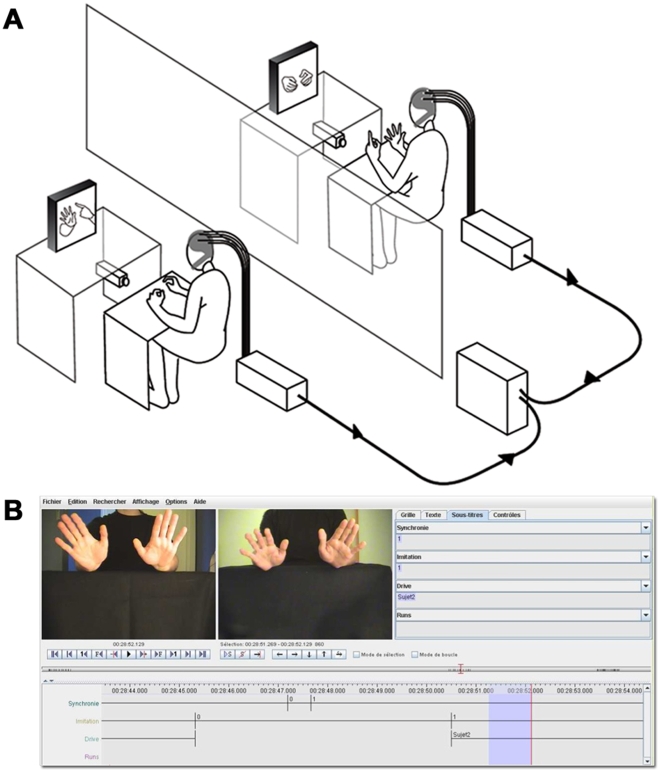
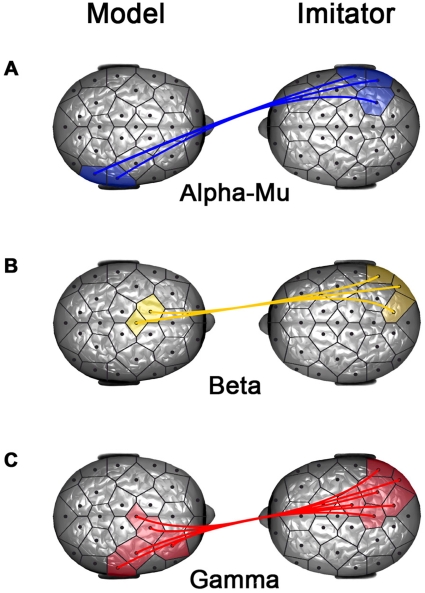
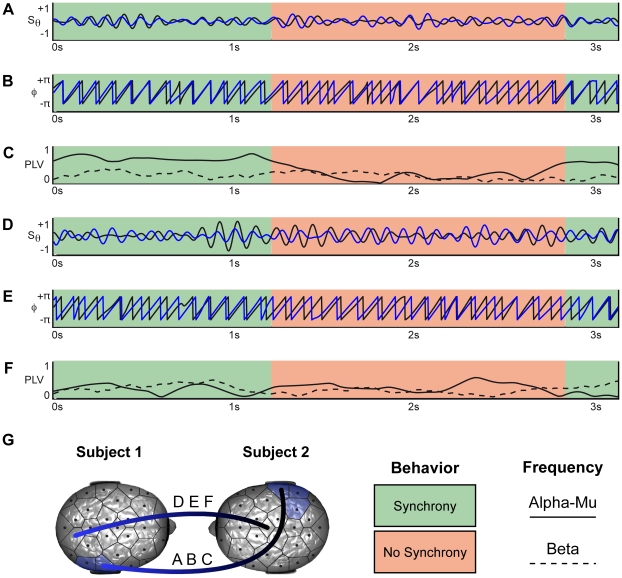
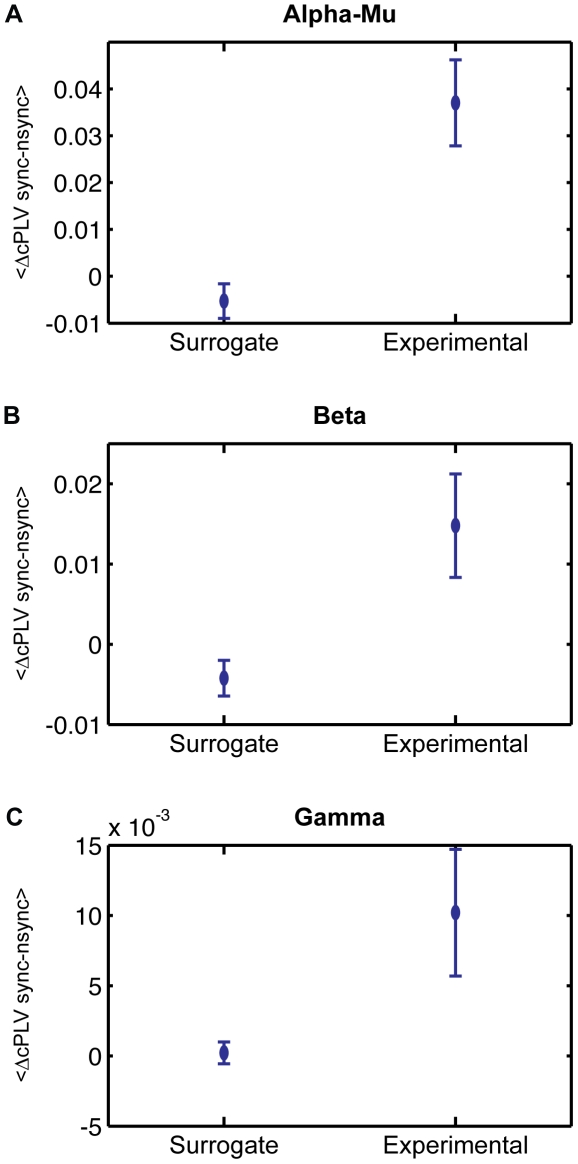
During social interaction, both participants are continuously active, each modifying their own actions in response to the continuously changing actions of the partner. This continuous mutual adaptation results in interactional synchrony to which both members contribute. Freely exchanging the role of imitator and model is a well-framed example of interactional synchrony resulting from a mutual behavioral negotiation. How the participants' brain activity underlies this process is currently a question that hyperscanning recordings allow us to explore. In particular, it remains largely unknown to what extent oscillatory synchronization could emerge between two brains during social interaction. To explore this issue, 18 participants paired as 9 dyads were recorded with dual-video and dual-EEG setups while they were engaged in spontaneous imitation of hand movements. We measured interactional synchrony and the turn-taking between model and imitator. We discovered by the use of nonlinear techniques that states of interactional synchrony correlate with the emergence of an interbrain synchronizing network in the alpha-mu band between the right centroparietal regions. These regions have been suggested to play a pivotal role in social interaction. Here, they acted symmetrically as key functional hubs in the interindividual brainweb. Additionally, neural synchronization became asymmetrical in the higher frequency bands possibly reflecting a top-down modulation of the roles of model and imitator in the ongoing interaction.
Overview
The claims and statistics of this paper haven’t been checked yet.
Free: it reads the open-access text and checks the first 5 claims that cite a source we can check. Create a free account to check every claim.
Integrity signals
Registry
Cites
Statistics
Figures

Verification
Claims the paper makes
The claims and statistics of this paper haven’t been checked yet.
Free: it reads the open-access text and checks the first 5 claims that cite a source we can check. Create a free account to check every claim.
Claims other papers make about this one
Each is checked against this paper’s own text: does it say what the citing paper says it does?
The check wasn’t confident either way, so it gives no verdict — never disputed.
In the citing paper
“The sample size was not determined a priori—each dataset's sample size was guided by prior work in their corresponding fields [38, 39, 40].”
From Interpersonal Synchronization of Autonomic Physiology via Mere Visual Contact (2026) · cites this paper as [38]
Experimental — accuracy not yet measured
Self-check
Percentages, sums and reported differences re-computed from the paper’s own numbers.
The self-check needs the paper’s full text.
Citations
Cites
A Mathematical Theory of Communication
Shannon, C. E. (1948) · Bell System Technical Journal · doi:10.1002/j.1538-7305.1948.tb01338.x · Cited by 88,486
The Mathematical Theory of Communication
Shannon, C. E., Weaver, W., & Wiener, N. (1950) · Physics Today · doi:10.1063/1.3067010 · Cited by 9,801
Nonparametric statistical testing of EEG- and MEG-data
Maris, E., & Oostenveld, R. (2007) · Journal of Neuroscience Methods · doi:10.1016/j.jneumeth.2007.03.024 · Cited by 8,496 · cited 1×
“Following previous studies [41,42], the resulting t-value matrices were then thresholded for absolute values larger than 2.”
The brainweb: phase synchronization and large-scale integration
Varela, F., Lachaux, J.-P., Rodriguez, E., & Martinerie, J. (2001) · Nature Reviews Neuroscience · doi:10.1038/35067550 · Cited by 4,761
Self-citationA mechanism for cognitive dynamics: neuronal communication through neuronal coherence.
Fries, P. (2005) · Trends in Cognitive Sciences · doi:10.1016/j.tics.2005.08.011 · Cited by 4,284 · cited 3×
“have been proposed as a key mechanism for information integration [28], temporal binding [51], flexible neuronal communication [34,52] and unified cognitive processes [45,53].”
InfluentialMeasuring phase synchrony in brain signals
Lachaux, J.-P., Rodriguez, E., Martinerie, J., & Varela, F. J. (1999) · Human Brain Mapping · doi:10.1002/(sici)1097-0193(1999)8:4<194::aid-hbm4>3.0.co;2-c · Cited by 3,798
Self-citationDynamic predictions: Oscillations and synchrony in top–down processing
Engel, A. K., Fries, P., & Singer, W. (2001) · Nature Reviews Neuroscience · doi:10.1038/35094565 · Cited by 3,454 · cited 1×
“Within one brain, synchronous neural oscillations have been previously observed in a range of processes such as conscious perception [44–46], working and long term memory [47,48], states of anticipation or attention [48,49] and empathy [50].”
Mathematical Theory of Communication
(2013) · Encyclopedia of Systems Biology · doi:10.1007/978-1-4419-9863-7_100015 · Cited by 3,290
Rizzolatti, G., & Arbib, M. A. (1998) · Trends in Neurosciences · doi:10.1016/s0166-2236(98)01260-0 · Cited by 2,858
Cortical mechanisms of human imitation
Iacoboni, M., Woods, R. P., Brass, M., Bekkering, H., Mazziotta, J. C., & Rizzolatti, G. (1999) · Science · doi:10.1126/science.286.5449.2526 · Cited by 2,683 · cited 1×
“Though imitation is commonly considered as a foundation for learning, socialization and communication [21,22], its use as a paradigm has been limited so far to test the direct matching hypothesis in an intraindividual perspective [23–27].”
Cited by
Items 901–963 of 963
Nagy, P., Béres, L., Tóth, B., Winkler, I., Barthel, B., & Háden, G. P. (2025) · NeuroImage · doi:10.1016/j.neuroimage.2025.121661 · Cited by 1
Theta and beta account for the two-impacted components of social influence on risk decision-makingPreprint
Lin, Y., Zhou, X., Wang, X., Li, Y., & Li, X. (2025) · bioRxiv (Cold Spring Harbor Laboratory) · doi:10.64898/2025.12.16.694560
“In contrast, real-time social interactions during observational learning had been shown to increase alpha-mu synchronization between observers and observees 46 .”
The Brainwave Interaction of Dual-Person Collaborative Tasks in a Virtual Reality Environmental Game
Huang, C.-J., Wang, C.-T., Lee, T.-M., & Lee, P.-L. (2025) · IEEE Access · doi:10.1109/access.2025.3620852
“Dumas et al. used EEG hyperscanning and observed alpha-band (9–14 Hz) inter-brain synchrony over the right centro-parietal region during communication [8], [9].”
InfluentialBrain-body dynamics are asymmetric and stable across cognitive states
Madsen, J., Silvan, A., Babadi, B., & Parra, L. C. (2026) · Imaging Neuroscience · doi:10.64898/2025.12.22.696055 · Cited by 1
Hendrikse, S. C. F., Jan Treur, A., & Koole, S. L. (2025) · Studies in systems, decision and control · doi:10.1007/978-3-031-99968-0_12
The Emergence of Multimodal Interpersonal Synchrony During Social Interaction: A Network Model
Hendrikse, S. C. F., Jan Treur, A., Wilderjans, T. F., Dikker, S., & Koole, S. L. (2025) · Studies in systems, decision and control · doi:10.1007/978-3-031-99968-0_3
Cheng, X., Liao, W., Cui, H., Pan, Y., & Hu, Y. (2026) · Learning and Instruction · doi:10.1016/j.learninstruc.2026.102320
Foundations of Social Decision-Making
Răţală, C. E., & Sanfey, A. G. (2026) · Springer eBooks · doi:10.1007/978-3-032-02925-6_5 · Cited by 1
Hinvest, N. S., & Taylor, N. (2026) · Frontiers in Psychology · doi:10.3389/fpsyg.2025.1710844
“Prior studies have reliably found that IBS increases during cooperative behavior, joint attention, and mutual engagement, particularly in tasks involving shared intentionality or affect (Czeszumski et al., 2020; Dumas et al., 2010; Koike et al., 2015; Valencia and Froese, 2020).”
The impact of language context on inter-brain synchrony in bilingual families
Papoutselou, E., Saravanan, N., Mai, G., Harrison, S. C., Sezer, H. D., & Hartley, D. E. H. (2026) · Frontiers in Cognition · doi:10.3389/fcogn.2025.1695132
A multibrain advantage for cooperative human behaviourPreprint
Moerel, D., Grootswagers, T., Quek, G. L., & Varlet, M. (2026) · bioRxiv (Cold Spring Harbor Laboratory) · doi:10.64898/2026.03.02.708977
“…neural and behavioural alignment in coordinated behaviours, supporting cooperation and collective performance (Coey et al., 2012; Dikker et al., 2017; Dumas et al., 2010, 2014; Garrod & Pickering, 2009; Konvalinka et al., 2011; Nalepka et al., 2019; Schilbach & Redcay, 2025; Tognoli et al., 2007).”
InfluentialHyperDance: Real-Time Vibrotactile Stimulation Feedback of Inter-Brain Connectivity in Partner Dance
Roque, T. R., Sun, R., Yi–Luen, E., & Leslie, G. A. (2026) · International Conference on Tangible, Embedded, and Embodied Interaction (TEI) · doi:10.1145/3731459.3773332
Makris, S., Langley, B., Page, R. M., Perris, E., Karkou, V., & Cazzato, V. (2026) · bioRxiv (Cold Spring Harbor Laboratory) · doi:10.64898/2026.03.05.707373
Liu, Y., Cheng, S., & Wang, J. (2026) · International Journal of Human-Computer Interaction · doi:10.1080/10447318.2026.2641708
Enhanced word learning and neural synchrony during children’s storytelling
Ilan, N. B., Shavit, H., Zohar, N., & Jaffe‐Dax, S. (2026) · npj Science of Learning · doi:10.1038/s41539-026-00417-7 · Cited by 1
“Such synchrony has not only been found in low-level perception regions but also in social cognition and higher-order regions, including the default mode network (DMN 34,35 ), attention networks 36 and extralinguistic networks 37,38 .”
Zavodova, E., Нагорнова, Ж. В., Zyryanov, N. A., & Shemyakina, N. V. (2025) · Human Physiology · doi:10.1134/s0362119725700781 · Cited by 1
Ménoret, M. (2013) · theses.fr (ABES) · doi:10.70675/c6faa90bzd06fz48e1z9f41z9da9f95220da · Cited by 1
Baquedano, C. (2017) · theses.fr (ABES) · doi:10.70675/4ba9a89dzcd76z4dfaza606zc99bc6d04328 · Cited by 1
Méthodes pour l'électroencéphalographie multi-sujet et application aux interfaces cerveau-ordinateur
Korczowski, L. (2018) · theses.fr (ABES) · doi:10.70675/38d2a12fz024fz4d84z8a8az0dc16b2cff6a · Cited by 2
Improving Motor Coordination in Human-Robot Interactions using Bio-inspired Controllers
Jouaiti, M. (2020) · theses.fr (ABES) · doi:10.70675/5a7e43b7z6959z48baz892ez6a94b977fdbe
Influence des traits sociaux des humains sur l'apprentissage développemental d'un robot
Guedjou, H. (2019) · theses.fr (ABES) · doi:10.70675/1d8b4f0bz60d5z4983za157z0e5460488503
Verdière, K. J. (2019) · theses.fr (ABES) · doi:10.70675/50277d0dz64c3z45d2z9f9dzf5f377a679d6 · Cited by 1
Contribution à l'optimisation de l'architecture de parcs d'hydroliennes
Fakhri, E. (2020) · theses.fr (ABES) · doi:10.70675/623c4231z16f3z4c9cza8eez6111375b3bfe
Douglas, C. L., Tremblay, A., & Newman, A. J. (2026) · Journal of Cognitive Neuroscience · doi:10.1162/jocn.a.2595
Tromp, J. G., Makrini, I. E., Trógolo, M., Muñoz, M. A., Sánchez-Barrera, M. B., Pacheco, J., & Castro, C. (2026) · Virtual Worlds · doi:10.3390/virtualworlds5020018
Müller, V. (2026) · Frontiers in Network Physiology · doi:10.3389/fnetp.2026.1776969 · Cited by 1
The Generative Posture Framework: A Unified Account of Postural Generation, Persistence, and ChangePreprint
Miller, S. (2026) · SSRN Electronic Journal · doi:10.2139/ssrn.6577078 · Cited by 1
Feldman, R., Schwartz, L., Shilo, C., Hayut, O., Apter-Levy, Y., Shimon-Raz, O., & Peleg, I. (2026) · Research Square · doi:10.21203/rs.3.rs-9335839/v1
MIME : Une méthode d’imitation multifonctionnelle évolutive pour la pensée sans langage
Nadel, J. (2026) · Enfance · doi:10.3917/enf2.261.0109
Self-citationHearing movement, seeing sound: multimodal predictive coding in pianist-dancer interaction
Cao, X., & Shi, X. (2026) · Frontiers in Psychology · doi:10.3389/fpsyg.2026.1820643
Language-Specific Tonal Features Drive Speaker–Listener Neural Synchronization
Hong, C., Teng, X., Li, Y., Hsu, S.-M., Tsao, F., Wong, P. C. M., & Feng, G. (2026) · Journal of Neuroscience · doi:10.1523/jneurosci.1929-25.2026 · Cited by 2
Zhu, Q. (2026) · Automation · doi:10.3390/automation7030078 · Cited by 1
Attenuated adaptive growth of interpersonal synchrony in autismPreprint
Kwon, J., & Kotani, H. (2026) · bioRxiv (Cold Spring Harbor Laboratory) · doi:10.64898/2026.06.02.729457
“It can be expressed across multiple modalities, including body movement, gesture, speech rhythm, and physiological activity (Cornejo et al., 2017; Delaherche et al., 2012; Dumas et al., 2010; Gordon et al., 2024; Hoehl et al., 2021).”
Ding, X., Dai, F., Gai, X., & Tang, Y. (2026) · Journal of Intelligence · doi:10.3390/jintelligence14060094
“However, since social activity and environmental exploration were not directly measured here, this interpretation remains hypothetical (Dumas et al., 2010; Tompson et al., 2020).”
Tanaka, S. (2026) · Neuroscience of Consciousness · doi:10.1093/nc/niag032
“Hyperscanning techniques, which enable the simultaneous recording of neural activity from two or more individuals during real-time interaction, have demonstrated that interbrain synchrony systematically correlates with the quality of interpersonal coordination ( Dumas et al .”
Interpersonal neural coordination tracks interaction quality during naturalistic conversation
Domínguez-Arriola, M. E., Lam, P. C. H., Pérez, A., & Pell, M. D. (2026) · NeuroImage · doi:10.1016/j.neuroimage.2026.122090 · Cited by 1
Dynamics of Connection of Electroencephalograms Patterns in a Computer Game
Zhukova, O. V., & Dick, O. E. (2026) · BIOPHYSICS · doi:10.1134/s0006350926700107
“…in [7] in the frontal and central areas of the cortex during coordination of finger movements (synchronous button pressing by subjects), and right-sided asymmetry (in the right central-parietal area) of synchronization in the alpha range was discovered in [8] under similar experimental conditions.”
Valenzuela, L., Cavallaro, R., Mangeng, A., Pérez-Arenas, X., Carollo, A., Esposito, G., Medel, V., & Soto, V. (2026) · NeuroImage · doi:10.1016/j.neuroimage.2026.122116
Alpha-Band EEG Dynamics During Naturalistic Storytelling Interaction in Older Adult–Caregiver DyadsPreprint
Khemthong, S., & Chatthong, W. (2026) · medRxiv · doi:10.64898/2026.07.09.26357345
Scent of a father: Paternal body odors boost interbrain synchrony
Endevelt–Shapira, Y., Schwartz, L., & Feldman, R. (2026) · Science Advances · doi:10.1126/sciadv.aed6110
“Inter-brain synchrony has been observed in the alpha frequency range between pairs engaged in spontaneous reciprocal imitation ( 70 ).”
EEG Alpha Modulation During Museum Storytelling in Older Dyads: An Occupational Engagement StudyPreprint
Khemthong, S., & Chatthong, W. (2026) · Research Square · doi:10.21203/rs.3.rs-10300580/v1
A PRISMA Systematic Review of Hyperscanning in Autism
Sarovic, D., Sohrabpour, A., Tosato, T., Dumas, G., & Khan, S. (2026) · Review Journal of Autism and Developmental Disorders · doi:10.1007/s40489-026-00579-5
Self-citationSiyu, C., Yang, M., Xu, C., & Liu, C. (2026) · Brain Sciences · doi:10.3390/brainsci16080809
Why Great Teams Perform Well: Inter-Brain Synchrony, Psychophysiological Alignment, and Team Flow
Michael, M., Valencia, E., Kotler, S., & Requejo, G. (2026) · Springer eBooks · doi:10.1007/978-3-032-21528-4_10
Liu, F., Yang, Y., Cao, Y., Chi, A., & He, X. (2026) · Frontiers in Psychology · doi:10.3389/fpsyg.2026.1752573
“Specifically, EEG alpha activity has been implicated in the regulation of cortical excitability (Sauseng et al., 2009), sensory gating, attentional resource allocation, and large-scale neural synchronization (Dumas et al., 2010).”
Baumann, N., & Friederichs, K. M. (2026) · Motivation and Emotion · doi:10.1007/s11031-026-10269-8
Moore, Z., Tasnim, N., Frank, R., Jones, C., Tripathi, V., Nobriga, G., Dhaveji, S., Gahagan, M., Purevtugs, J., Newpol, J., et al. (2026) · bioRxiv (Cold Spring Harbor Laboratory) · doi:10.64898/2026.08.31.748378
“Gamma inter-brain coupling has previously been observed during spontaneous imitation, alongside alpha-mu and beta(Dumas et al. , 2010), and linked to prosocial coordination — though it remains less examined and more debated, partly because its fast, transient dynamics resist a simple mapping onto…”
Comparing design students’ inter-brain synchrony between face-to-face and online collaborations
Wang, L., Wong, C. H. Y., Siu, K. W. M., Chau, B. K. H., Yuan, Z., Chang, L., & Shih, Y.-T. (2026) · Brain Structure and Function · doi:10.1007/s00429-026-03188-4
“Recent advances in “second-person neuroscience” offer a promising, objective alternative by measuring inter-brain synchrony (IBS) (Dumas et al. 2010; Czeszumski et al. 2020).”
Meng, R. (2026) · Lecture notes in computer science · doi:10.1007/978-3-032-38398-3_10
Leisman, G., & Melillo, R. J. (2026) · Journal of Integrative Neuroscience · doi:10.31083/jin54429 · Cited by 1
Respiration and individual differences shape behavioral and inter-brain synchronizationPreprint
Yi, W., & Palmėr, C. (2026) · bioRxiv (Cold Spring Harbor Laboratory) · doi:10.64898/2026.09.28.755199
“For each of the pairwise within-condition contrasts, paired t-statistics were evaluated using a cluster-based permutation method (7, 49–52), with 5,000 permutations across all 64 electrode pairs and four frequency bands (Delta, Theta, Alpha, and Beta) to minimize spatial selection bias and control…”
Li, B., Chen, Z., Sun, H., Jiang, X., Gu, J., Liang, C., Hu, S., & Li, K. (2026) · INTERNATIONAL CONFERENCE ON MULTIMODAL INTERACTION · doi:10.1145/3776574.3831182
“Most existing studies have focused primarily on feature extraction from single-person movements or facial expressions, while joint modeling of examiner-child dyadic interaction systems remains in its infancy[7].”
Miyata, K., Kamata, S., Shimizu, D., Takaoka, A., Clayton, M. R. L., & Kudo, K. (2026) · Acta Psychologica · doi:10.1016/j.actpsy.2026.107839
EEG signature in psychiatrist’s subjective experience: a pilot study
Videtta, G., Bondi, E., Colli, C., Enrico, G., Sperti, L., Pallagrosi, M., Fonzi, L., Barone, Y., Schiena, G., Maggioni, E., et al. (2026) · Frontiers in Psychiatry · doi:10.3389/fpsyt.2026.1933800
“In particular, hyperscanning paradigms, allowing simultaneous recording of neural activity from interacting individuals, have revealed patterns of inter-brain synchrony linked to empathy, affective attunement, and social cognition (19).”
Bai, Y., & Zhang, Q. (2026) · Brain Research · doi:10.1016/j.brainres.2026.150594
Inducing Interpersonal Closeness: Effects on Inter‐Brain Synchrony and Collaborative Performance
Fornari, L., Janssen, T. W. P., Davidesco, I., Krabbendam, L., & van Atteveldt, N. (2026) · Psychophysiology · doi:10.1111/psyp.70421
“Consistent with this interpretation, IBS has been linked to key components of collaborative interaction, including motor synchrony (Dumas et al. 2010; Koul et al. 2023; Y. Li et al. 2024), engagement (Rai et al. 2025), as well as predictive processes underlying speech and action (Dikker et al.…”
Leener, M. D., Sfeir, M., Galdiolo, S., & Rossignol, M. (2026) · Neuroscience & Biobehavioral Reviews · doi:10.1016/j.neubiorev.2026.107056
The question that wouldn’t die: A history of research on social interactions
Votinov, M. (2026) · Elsevier eBooks · doi:10.1016/b978-0-443-34080-2.00005-6
Metadata
- Authors
- Dumas, G., Nadel, J., Soussignan, R., Martinerie, J., & Garnero, L.
- Affiliations
- Centre National de la Recherche Scientifique (FR)
- Corresponding author
- Dumas, Guillaume
- Venue
- PLoS ONE
- Publisher
- Public Library of Science (PLoS)
- Published
- 2010-08-17
- Volume
- 5
- Issue
- 8
- Pages
- e12166
- ISSN
- 1932-6203 (ISSN-L)
- PMC
- PMC2923151
- OpenAlex
- W1986163111
- Cited by
- 966
- References
- 68
- Citations by year
- 2026: 73 · 2025: 80 · 2024: 68 · 2023: 55 · 2022: 78 · 2021: 106 · 2020: 127 · 2019: 53 · 2018: 54 · 2017: 57 · 2016: 42 · 2015: 31 · 2014: 54 · 2013: 35 · 2012: 33
- FWCI
- 38.29
- Type
- journal article
- Language
- en
- Open access
- gold
- doi.org
- Locations
- PLoS ONE (publishedVersion, cc-by)
- PubMed Central (publishedVersion, cc-by)
- PubMed (publishedVersion)
- HAL (submittedVersion, other-oa)
- HAL (submittedVersion)
- RePEc: Research Papers in Economics (submittedVersion)
- DOAJ (DOAJ: Directory of Open Access Journals) (submittedVersion, cc-by-sa)
- Topics
- Social Sciences › Psychology › Social Psychology › Action Observation and Synchronization
- Life Sciences › Neuroscience › Cognitive Neuroscience › Neural dynamics and brain function
- Life Sciences › Neuroscience › Cognitive Neuroscience › EEG and Brain-Computer Interfaces
- Keywords
- inter-brain synchrony, social interaction, interactional synchrony, spontaneous imitation, turn-taking, hyperscanning, top-down modulation, mirror neuron system
- MeSH terms
- Behavior, Brain, Electroencephalography, Female, Humans, Imitative Behavior, Interpersonal Relations, Male, Young Adult
About these checks
Registry, retraction, Cites and statistics results are computed, not judged, with one exception: a printed reference that no index lists is read once by a model before it counts as a citation error. Claims are extracted by a model and kept only when their quote appears verbatim in the text; each cited source is then checked, with a model’s help, for whether it says what the claim relies on. Those verdicts can be wrong — read the claim’s quote and the cited source before relying on one.
Statistics and arithmetic are recomputed, not judged.
Confidence bands are shown only for fields calibrated on our annotated test set. None is calibrated yet, so no band is shown.
What counts as a claim ›How we measure confidence ›How we check this ›
Are you an author, or do you see a problem with this page? Request a review
Data sources
Bibliographic data: Semantic Scholar, OpenAlex, Crossref.
Contains information from the Semantic Scholar Academic Graph Datasets, made available under the ODC Attribution License (ODC-BY 1.0).
Semantic Scholar’s data is described in: Kinney, R., et al. (2023). The Semantic Scholar Open Data Platform. arXiv:2301.10140.
