

Inter-Brain Synchronization during Social Interaction
Open accessThe DOI matches its Crossref record; 67 of the 68 references it cites were found in a registry or an index.
Abstract
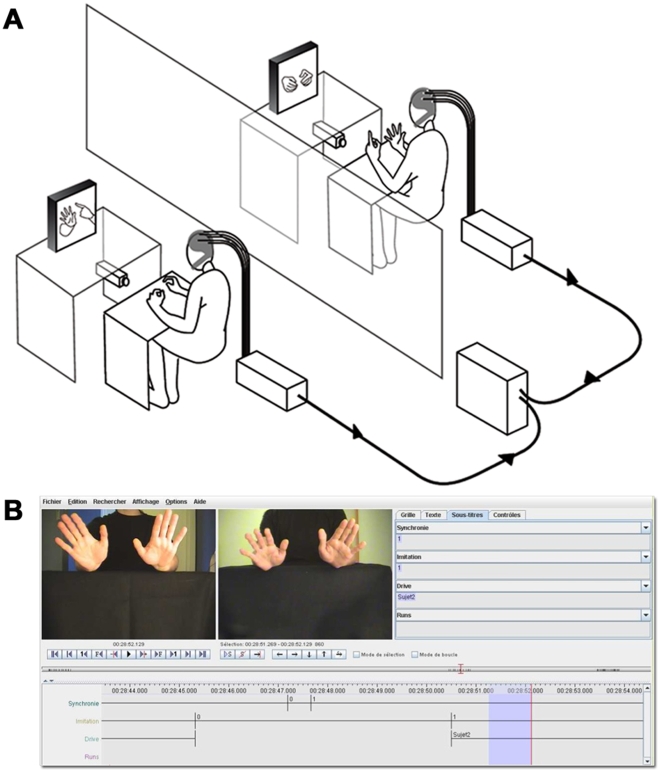
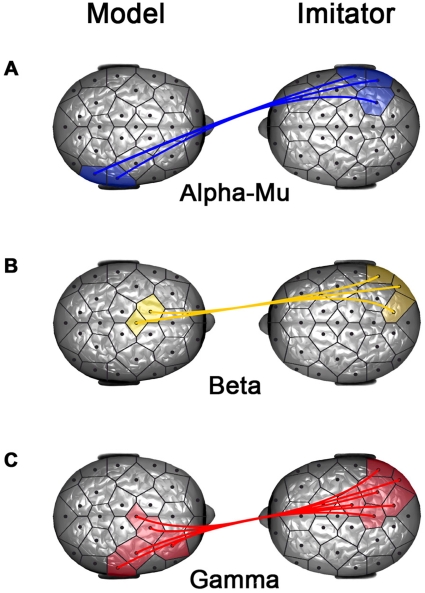
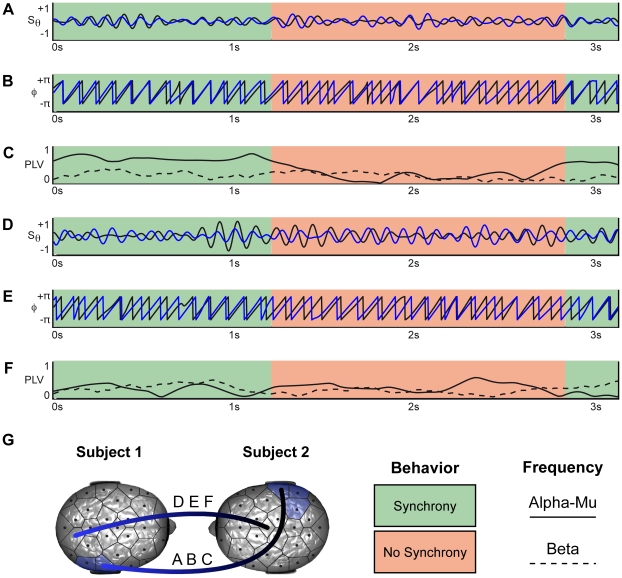
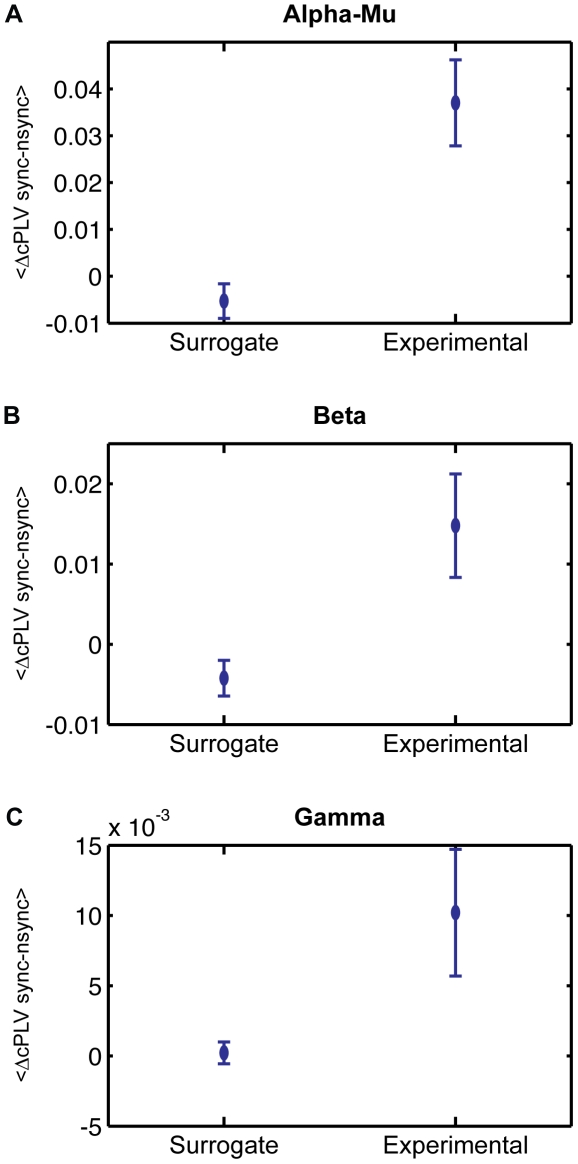
During social interaction, both participants are continuously active, each modifying their own actions in response to the continuously changing actions of the partner. This continuous mutual adaptation results in interactional synchrony to which both members contribute. Freely exchanging the role of imitator and model is a well-framed example of interactional synchrony resulting from a mutual behavioral negotiation. How the participants' brain activity underlies this process is currently a question that hyperscanning recordings allow us to explore. In particular, it remains largely unknown to what extent oscillatory synchronization could emerge between two brains during social interaction. To explore this issue, 18 participants paired as 9 dyads were recorded with dual-video and dual-EEG setups while they were engaged in spontaneous imitation of hand movements. We measured interactional synchrony and the turn-taking between model and imitator. We discovered by the use of nonlinear techniques that states of interactional synchrony correlate with the emergence of an interbrain synchronizing network in the alpha-mu band between the right centroparietal regions. These regions have been suggested to play a pivotal role in social interaction. Here, they acted symmetrically as key functional hubs in the interindividual brainweb. Additionally, neural synchronization became asymmetrical in the higher frequency bands possibly reflecting a top-down modulation of the roles of model and imitator in the ongoing interaction.
Overview
The claims and statistics of this paper haven’t been checked yet.
Free: it reads the open-access text and checks the first 5 claims that cite a source we can check. Create a free account to check every claim.
Integrity signals
Registry
Cites
Statistics
Figures

Verification
Claims the paper makes
The claims and statistics of this paper haven’t been checked yet.
Free: it reads the open-access text and checks the first 5 claims that cite a source we can check. Create a free account to check every claim.
Claims other papers make about this one
Each is checked against this paper’s own text: does it say what the citing paper says it does?
The check wasn’t confident either way, so it gives no verdict — never disputed.
In the citing paper
“The sample size was not determined a priori—each dataset's sample size was guided by prior work in their corresponding fields [38, 39, 40].”
From Interpersonal Synchronization of Autonomic Physiology via Mere Visual Contact (2026) · cites this paper as [38]
Experimental — accuracy not yet measured
Self-check
Percentages, sums and reported differences re-computed from the paper’s own numbers.
The self-check needs the paper’s full text.
Citations
Cites
A Mathematical Theory of Communication
Shannon, C. E. (1948) · Bell System Technical Journal · doi:10.1002/j.1538-7305.1948.tb01338.x · Cited by 88,486
The Mathematical Theory of Communication
Shannon, C. E., Weaver, W., & Wiener, N. (1950) · Physics Today · doi:10.1063/1.3067010 · Cited by 9,801
Nonparametric statistical testing of EEG- and MEG-data
Maris, E., & Oostenveld, R. (2007) · Journal of Neuroscience Methods · doi:10.1016/j.jneumeth.2007.03.024 · Cited by 8,496 · cited 1×
“Following previous studies [41,42], the resulting t-value matrices were then thresholded for absolute values larger than 2.”
The brainweb: phase synchronization and large-scale integration
Varela, F., Lachaux, J.-P., Rodriguez, E., & Martinerie, J. (2001) · Nature Reviews Neuroscience · doi:10.1038/35067550 · Cited by 4,761
Self-citationA mechanism for cognitive dynamics: neuronal communication through neuronal coherence.
Fries, P. (2005) · Trends in Cognitive Sciences · doi:10.1016/j.tics.2005.08.011 · Cited by 4,284 · cited 3×
“have been proposed as a key mechanism for information integration [28], temporal binding [51], flexible neuronal communication [34,52] and unified cognitive processes [45,53].”
InfluentialMeasuring phase synchrony in brain signals
Lachaux, J.-P., Rodriguez, E., Martinerie, J., & Varela, F. J. (1999) · Human Brain Mapping · doi:10.1002/(sici)1097-0193(1999)8:4<194::aid-hbm4>3.0.co;2-c · Cited by 3,798
Self-citationDynamic predictions: Oscillations and synchrony in top–down processing
Engel, A. K., Fries, P., & Singer, W. (2001) · Nature Reviews Neuroscience · doi:10.1038/35094565 · Cited by 3,454 · cited 1×
“Within one brain, synchronous neural oscillations have been previously observed in a range of processes such as conscious perception [44–46], working and long term memory [47,48], states of anticipation or attention [48,49] and empathy [50].”
Mathematical Theory of Communication
(2013) · Encyclopedia of Systems Biology · doi:10.1007/978-1-4419-9863-7_100015 · Cited by 3,290
Rizzolatti, G., & Arbib, M. A. (1998) · Trends in Neurosciences · doi:10.1016/s0166-2236(98)01260-0 · Cited by 2,858
Cortical mechanisms of human imitation
Iacoboni, M., Woods, R. P., Brass, M., Bekkering, H., Mazziotta, J. C., & Rizzolatti, G. (1999) · Science · doi:10.1126/science.286.5449.2526 · Cited by 2,683 · cited 1×
“Though imitation is commonly considered as a foundation for learning, socialization and communication [21,22], its use as a paradigm has been limited so far to test the direct matching hypothesis in an intraindividual perspective [23–27].”
Cited by
Items 801–900 of 963
Carpio, M. G., Chee, N., Swarna, M., & Clauss‐Ehlers, C. S. (2021) · Cambridge University Press eBooks · doi:10.1017/9781108678971.017 · Cited by 1
A Public Health Approach to Delinquency and Incarceration: A Case Study
Jensen, E., Fazio-Ruggiero, K., & Belsham, D. (2021) · Cambridge University Press eBooks · doi:10.1017/9781108678971.027
Thompson, C. M., Datchi, C. C., & Eure, L. (2021) · Cambridge University Press eBooks · doi:10.1017/9781108678971.018
Supporting Communities through Educational Access
Pasquerella, L. (2021) · Cambridge University Press eBooks · doi:10.1017/9781108678971.024 · Cited by 1
Stern, A., Wartman, E. C., Scott, M., & Hunter, S. J. (2021) · Cambridge University Press eBooks · doi:10.1017/9781108678971.030
(2021) · Dunod eBooks · doi:10.3917/dunod.nadel.2021.01.0226
Clauss‐Ehlers, C. S. (2021) · Cambridge University Press eBooks · doi:10.1017/9781108678971.036
Conducting Culturally Responsive Community Needs Assessments
Suzuki, L. A., Caso, T. J., West‐Olatunji, C. A., & Prendes-Lintel, M. (2021) · Cambridge University Press eBooks · doi:10.1017/9781108678971.009
Comprehensive Evaluation of a Rural School Mental Health Program
Hartley, S. N., Strompolis, M., Collins, C., Bradley, W. J., Collins, D., Bresnan, P. M., & Weist, M. D. (2021) · Cambridge University Press eBooks · doi:10.1017/9781108678971.010
Responding to Gaps in Research and Practice in Community Psychology
Graham, T. (2021) · Cambridge University Press eBooks · doi:10.1017/9781108678971.034
Jackson, M. A., & Waite, S. R. (2021) · Cambridge University Press eBooks · doi:10.1017/9781108678971.011
(2016) · Dunod eBooks · doi:10.3917/dunod.nadel.2016.01.0187
Oppenheimer, M. F., & Miller, E. W. (2021) · Cambridge University Press eBooks · doi:10.1017/9781108678971.028
Women and Leadership: Building Community
Baptiste, D. R., & Burch, K. (2021) · Cambridge University Press eBooks · doi:10.1017/9781108678971.014
LGBTQ+ Communities: Confronting Discrimination and Gaps in Community Supports
Garagiola, E. R., Hunter, S. J., Villarreal, M. A., Renfro, R. L., & Clauss‐Ehlers, C. S. (2021) · Cambridge University Press eBooks · doi:10.1017/9781108678971.032
How Social Coordination and Cooperation are Achieved
Kirmayer, L. J., Worthman, C. M., Kitayama, S., Lemelson, R., & Cummings, C. A. (2020) · Cambridge University Press eBooks · doi:10.1017/9781108695374.013
Kirmayer, L. J., Worthman, C. M., Kitayama, S., Lemelson, R., & Cummings, C. A. (2020) · Cambridge University Press eBooks · doi:10.1017/9781108695374.001
The Co-emergence of Culture, Mind, and Brain
Kirmayer, L. J., Worthman, C. M., Kitayama, S., Lemelson, R., & Cummings, C. A. (2020) · Cambridge University Press eBooks · doi:10.1017/9781108695374.004
Kirmayer, L. J., Worthman, C. M., Kitayama, S., Lemelson, R., & Cummings, C. A. (2020) · Cambridge University Press eBooks · doi:10.1017/9781108695374.008
(2020) · Cambridge University Press eBooks · doi:10.1017/9781108695374.017
A Neurodynamic Model of Inter-Brain Coupling in the Gamma BandPreprint
Moreau, Q., Adel, L., Douglas, C. L., Ranjbaran, G., & Dumas, G. (2022) · bioRxiv (Cold Spring Harbor Laboratory) · doi:10.1101/2022.04.08.487686
“However, inter-brain synchronizations in higher frequencies such as in the Gamma range [>30 Hz] have also been reported (Dumas et al., 2010; Kinreich et al., 2017; Mu et al., 2017; Barraza et al., 2020).”
BackgroundInfluentialSelf-citationWhere Is Meaning? Mind, Matter and Meaning
Thiopoulos, C. (2022) · IntechOpen eBooks · doi:10.5772/intechopen.100240
The Role of Reciprocity in Dynamic Interpersonal Coordination of Physiological RhythmsPreprint
Konvalinka, I., Sebanz, N., & Knoblich, G. (2022) · SSRN Electronic Journal · doi:10.2139/ssrn.4055017
Reis, J. (2022) · Springer eBooks · doi:10.1007/978-3-030-95782-7_10
Stevens, R. (2014) · Advances in information quality and management · doi:10.4018/978-1-4666-5888-2.ch555
Weissmark, M. S. (2020) · Oxford University Press eBooks · doi:10.1093/oso/9780190686345.003.0002
Weissmark, M. S. (2020) · Oxford University Press eBooks · doi:10.1093/oso/9780190686345.003.0004
Weber, A. (2016) · Biosemiotics/Biosemiotics. Bookseries · doi:10.1007/978-94-024-0832-4_9
Weissmark, M. S. (2020) · Oxford University Press eBooks · doi:10.1093/oso/9780190686345.003.0003
Kirmayer, L. J., Worthman, C. M., Kitayama, S., Lemelson, R., & Cummings, C. A. (2020) · Cambridge University Press eBooks · doi:10.1017/9781108695374.029
van Vugt, M. K., Moye, A., Pollock, J., Johnson, B., Bonn‐Miller, M. O., Gyatso, K., Thakchoe, J., Aadhentsang, T., Norbu, N., Lodroe, T., et al. (2018) · MindRxiv (OSF Preprints) · doi:10.31231/osf.io/5rhft
Weissmark, M. S. (2020) · Oxford University Press eBooks · doi:10.1093/oso/9780190686345.003.0010
耕彦, 小. (2019) · Journal of the Society of Biomechanisms · doi:10.3951/sobim.43.3_179
Cognition sociale et développement du soi
Fourneret, P., Mamimoué, É., & Savelon, S. V. (2022) · Elsevier eBooks · doi:10.1016/b978-2-294-77402-7.00015-1 · Cited by 1
Wallon et l’éphémère, face cachée du développement
Nadel, J. (2022) · Enfance · doi:10.3917/enf2.223.0323
Self-citationTrăușan-Matu, Ș. (2017) · Romanian Journal of Neurology · doi:10.37897/rjn.2017.s2.5
Synchronization of cooperative and competitive oscillators in dynamical network
Ling, X. G., Hua, B., Jing, X.-L., Guo, N., Li, L., Zhu, K., & Chen, J. (2022) · International Journal of Modern Physics C · doi:10.1142/s0129183123500584
Praszkier, R. (2022) · Springer eBooks · doi:10.1007/978-3-030-90913-0_227
How do circadian rhythms and neural synchrony shape networked cooperation?
Vasiliauskaitė, V., & Hausladen, C. I. (2023) · Frontiers in Physics · doi:10.3389/fphy.2023.1125270
“In cooperation dynamics, an ordered state would be a state where all individuals partake in the same decision to cooperate or to defect [10].”
BackgroundStevens, R. H., & Galloway, T. L. (2023) · Proceedings of the International Symposium on Human Factors and Ergonomics in Health Care · doi:10.1177/2327857923121012
Mondal, M. S., Chuko, F. W., Kappas, M., & Nagasa, M. D. (2023) · Research Square · doi:10.21203/rs.3.rs-3169310/v1
Offline EEG hyper-scanning using anonymous walk embeddings in tacit coordination games
Zuckerman, I., Mizrahi, D., & Laufer, I. (2023) · PLoS ONE · doi:10.1371/journal.pone.0288822
“, [1, 2, 27], our method relies only on the similarity in the networks’ spatial configuration without the need to consider specific electrode positions or frequency bands.”
MethodGroup Identity Enhances Inter-brain Synchronization in the Hold-Up ProblemPreprint
Hao, S., zhang, C., Xiaoqin, W., & Lu, L. (2023) · SSRN Electronic Journal · doi:10.2139/ssrn.4513752
Hari, R., & Puce, A. (2023) · Oxford University Press eBooks · doi:10.1093/med/9780197542187.003.0019
How Does the Modulating Caregiver Impact a Child’s Regulation?
Thomson-Link, S. (2023) · Springer eBooks · doi:10.1007/978-3-031-40320-0_6 · Cited by 1
Figli, genitori e curanti nella malattia: ruolo della genitorialità nella relazione terapeutica
Carbonella, S., Coniglio, M., Mistura, E. L., & Righi, O. (2023) · PNEI REVIEW · doi:10.3280/pnei2023-002004
The state of interbrain synchrony research across 20 years: A hyperscanning retrospectivePreprint
Wiggers, J., & Crafa, D. (2023) · PsyArXiv (OSF Preprints) · doi:10.31234/osf.io/5cb7f
The Impact of Different Forms of Verbal Interaction on Neural Synchronization in Romantic CouplesPreprint
Hu, S., Zhang, P., Gong, X., Liu, C., Lv, Z., & Hou, J. (2023) · PsyArXiv (OSF Preprints) · doi:10.31234/osf.io/dmquj · Cited by 1
Cognitive Properties of Behavioural Synchronization
Lamontagne, A., & Gaunet, F. (2023) · Springer eBooks · doi:10.1007/978-3-031-48449-0_4
Social Modulators of Behavioural Synchronization
Lamontagne, A., & Gaunet, F. (2023) · Springer eBooks · doi:10.1007/978-3-031-48449-0_6
Latent State Synchronization in Dyadic Partners using EEG
Gordon, S. M., King, K., & Rabin, A. (2023) · Conference proceedings/Conference proceedings - IEEE International Conference on Systems, Man, and Cybernetics · doi:10.1109/smc53992.2023.10394383
“This includes situations involving co-location of the participants and shared stimuli [6], co-location and physical interaction [5], and non-co-location but shared stimuli [7].”
BackgroundCommunal knowledge and brain function
Hemmatian, B. (2024) · Elsevier eBooks · doi:10.1016/b978-0-12-820480-1.00137-6
Weissmark, M. S. (2020) · Oxford University Press eBooks · doi:10.1093/oso/9780190686345.002.0007
Weissmark, M. S. (2020) · Oxford University Press eBooks · doi:10.1093/oso/9780190686345.002.0004
Weissmark, M. S. (2020) · Oxford University Press eBooks · doi:10.1093/oso/9780190686345.002.0015
Weissmark, M. S. (2020) · Oxford University Press eBooks · doi:10.1093/oso/9780190686345.002.0008
Weissmark, M. S. (2020) · Oxford University Press eBooks · doi:10.1093/oso/9780190686345.002.0003
Weissmark, M. S. (2020) · Oxford University Press eBooks · doi:10.1093/oso/9780190686345.002.0005
On Drifting Apart: Temporality and Space in the Dissolution of Relationships
Liu, S.-D., & Nasr, G. (2024) · Symbolic interaction · doi:10.1002/symb.712
Co-Presence, Connection and Co-Creation: Building Real-time Cross-person Neurofeedback Interactions
Wang, T., & Feng, X. (2024) · ACM SIGGRAPH Talks · doi:10.1145/3641233.3664334
“…data, particularly EEG signals, for enhancing emotional connections and collaborative performance, several studies suggest that sharing brainwave data with others can foster social connectedness, intuitive understanding, and empathy [Hassib et al., 2017][Yun et al., 2012][Dumas et al., 2010].”
Tipping Points to Transitions: PEA and NEA (Principles 2 and 3)
Boyatzis, R. E. (2024) · Oxford University Press eBooks · doi:10.1093/9780197765142.003.0003
Resonant Relationships Are the Context for Change (Principle 7)
Boyatzis, R. E. (2024) · Oxford University Press eBooks · doi:10.1093/9780197765142.003.0007
Dreams, Shared Vision, and Purpose as the Driver of Change (Principle 1)
Boyatzis, R. E. (2024) · Oxford University Press eBooks · doi:10.1093/9780197765142.003.0002
The Real Self: Who Am I? Who Are We? (Principle 4)
Boyatzis, R. E. (2024) · Oxford University Press eBooks · doi:10.1093/9780197765142.003.0004
The Quest for Sustained, Desired Change
Boyatzis, R. E. (2024) · Oxford University Press eBooks · doi:10.1093/9780197765142.003.0001
What Next? The Call to Study Change
Boyatzis, R. E. (2024) · Oxford University Press eBooks · doi:10.1093/9780197765142.003.0009
A Path to My/Our Dreams: Joyful Planning and Preparation (Principle 5)
Boyatzis, R. E. (2024) · Oxford University Press eBooks · doi:10.1093/9780197765142.003.0005
Exploring Possibilities: Experimenting and Practice to Mastery (Principle 6)
Boyatzis, R. E. (2024) · Oxford University Press eBooks · doi:10.1093/9780197765142.003.0006
Boyatzis, R. E. (2024) · Oxford University Press eBooks · doi:10.1093/9780197765142.005.0001
Leading Change at Multiple Levels (Principles 8, 9, and 10)
Boyatzis, R. E. (2024) · Oxford University Press eBooks · doi:10.1093/9780197765142.003.0008
Mentalisieren im Resonanzraum? Emotional-kognitive Entwicklung und inklusive Bildungsprozesse
Steffens, J. (2024) · Vandenhoeck & Ruprecht eBooks · doi:10.13109/9783666700170.133
Empathy Aligns Brains in SynchronyPreprint
Schwartz, L., Lévy, J., Shapira, Y., Salomonski, C., Hayut, O., Zagoory‐Sharon, O., & Feldman, R. (2024) · SSRN Electronic Journal · doi:10.2139/ssrn.4998552
Right brain-to-right brain psychoterapy
Schore, A. N. (2024) · SETTING · doi:10.3280/set2024-048002
Pan, F., Jia, T., Sun, J., Wang, A., Ji, L., & Li, C. (2024) · Annual International Conference of the IEEE Engineering in Medicine and Biology Society (EMBC) · doi:10.1109/embc53108.2024.10781569
“Research has demonstrated that the alpha band is engaged in interbrain synchronization during nonverbal social interaction, and it is considered the most robust band for brain-to-brain coupling [21, 38, 39].”
Uniform hyperscanning paradigm to study cooperation and competition
Nogueira-Islas, P. A., Olguín-Rodríguez, P. V., Tlahuext-Aca, H., & Müller, M. (2024) · MethodsX · doi:10.1016/j.mex.2024.103139
“Thus, one may suppose that information transfer between two subjects recruits the same mechanism, viz. the activation of specific hyper-brain networks [ 1 ].”
Imitation and the Generative Mind
Nadel, J. (2025) · Cambridge University Press eBooks · doi:10.1017/9781009425766.003
Self-citationImitation as a Synchronizer of Minds and Brains
Nadel, J. (2025) · Oxford University Press eBooks · doi:10.1093/oso/9780192865373.003.0017
Self-citationLanguage-specific Tonal Features Drive Speaker-Listener Neural SynchronizationPreprint
Feng, G., Chen, H., Teng, X., Li, Y., Hsu, S., Tsao, F., & Wong, P. C. M. (2025) · Research Square · doi:10.21203/rs.3.rs-6193510/v1 · Cited by 2
Demonstrating NeuResonance: Inter-brain Synchronization and Feedback Modalities in Collaboration
Dinh, J. N., Shrestha, S., Kim, Y.-J., Nishida, J., & Lee, M. (2025) · CHI Conference Extended Abstracts on Human Factors in Computing Systems (CHI EA) · doi:10.1145/3706599.3721276
“…during cooperative problem-solving and synchronized physical activities, including watching the same movie [1], performing coordinated gestures [10], playing musical instruments together [25, 34], engaging in online games [37], holding hands [12], solving puzzles [11], and typing passages…”
InfluentialPromoting social connectedness through multi-person neurofeedbackPreprint
Cheng, X., Zhang, R., Chen, P., Song, Z., Feng, C., Dikker, S., & Pan, Y. (2025) · bioRxiv (Cold Spring Harbor Laboratory) · doi:10.1101/2025.05.22.655644
Kim, H., Jun, S. C., & Nam, C. S. (2025) · Lecture notes in computer science · doi:10.1007/978-3-031-93724-8_2
A Two-Way Analysis of Brain Synchrony: Assessing Brain-Event Relationships Using Information Metrics
Morimoto, S., & Minagawa‐Kawai, Y. (2025) · IEEE Journal of Selected Topics in Quantum Electronics · doi:10.1109/jstqe.2025.3582203
“Althoughseveralquantificationmethodsexisttoexamine signalinteractions,mostfNIRSstudieshaveinvestigatedinter-brainsynchrony[5],[6],[7],[8].”
Loh, C. L., Zapata-Fonseca, L. I., James, M. M., Dumas, G., & Froese, T. (2025) · bioRxiv (Cold Spring Harbor Laboratory) · doi:10.1101/2025.06.18.660494
Self-citationNestor, T. (2026) · SSRN Electronic Journal · doi:10.2139/ssrn.5373371
The Role of Neural Synchronization in Social Interaction: Insights from a Collaborative EEG StudyPreprint
Mora, M. F., Martín, D. C., Serrano, J. I., & del Castillo, M. D. (2025) · Research Square · doi:10.21203/rs.3.rs-7139606/v1
Exploring cardiac physiological synchrony and its implications for stress and anxiety
Escobar, L. S., Robbins, M., Hwang, J., Jung, S.-M., & Park, D. J. (2025) · Ageing and Neurodegenerative Diseases · doi:10.20517/and.2025.14 · Cited by 1
Intersubject synchronization in the perception of a theatrical performance. Hyperscanning study
Nagornova, Z. V., Zavodova, E., & Shemyakina, N. V. (2025) · International Conference Neurotechnologies and Neurointerfaces (CNN) · doi:10.1109/cnn67635.2025.11177515
“…to determine the intersubject synchronization for each electrode pair between the two participants (i, k), using Formula (1): (1) where N is the number of samples considered in each epoch, and ϕ i and ϕ k are the phases of signal 1 (first subject) and 2 (second subject), respectively [6].”
Pollock, J., Pfeiffer, M., Sigelmier, G., & Miller, C. (2025) · Handbooks of sociology and social research · doi:10.1007/978-3-031-95615-7_6
Sano, M., Hirosawa, T., Soma, D., Kameya, M., Yuasa, K., Yasumoto, M., Osaka, Y., Yoshimura, Y., Shiota, Y., Tanaka, S., et al. (2025) · Frontiers in Psychiatry · doi:10.3389/fpsyt.2025.1634384
“Although alpha rhythms have been implicated in social coordination (5, 6) and broader information processing across thalamocortical and cortico-cortical pathways (7 – 10), studies on alpha “ power ” in ASD have shown inconsistent results, ranging from lower (11 – 13) or higher (14) alpha power to…”
Lai, S., Li, W., Amano, K., & Rekimoto, J. (2025) · Augmented Humans International Conference (AHs) · doi:10.1145/3745900.3746091
“This alignment is thought to reflect certain aspects of social interaction, such as interactional synchrony, the anticipation of others’ actions, and the co-regulation of turn-taking [8].”
Robledo, J.-P., Cross, I. R. M., Phillips, M., Kearney, J., & Taylor, J. R. (2026) · Neuroscience & Biobehavioral Reviews · doi:10.1016/j.neubiorev.2026.106826 · Cited by 1
The spread of mind: psychological contagion in theory and critique
Houran, J., Dagnall, N., Sapkota, R. P., & Lange, R. (2025) · Frontiers in Psychology · doi:10.3389/fpsyg.2025.1631927 · Cited by 5
“This meso-level alignment is driven chiefly by Mechanism 4: Attention synchronization and Mechanism 5: Interpersonal entrainment and is conferred social meaning by Mechanism 6: Social appraisal (Dumas et al., 2010; Parkinson, 2011; Hasson et al., 2012).”
Monti, M., Blandolino, G., Cuppini, C., & Astolfi, L. (2025) · Annual International Conference of the IEEE Engineering in Medicine and Biology Society (EMBC) · doi:10.1109/embc58623.2025.11251545
“Previous studies have demonstrated that tasks requiring dyads to coordinate visual attention are associated with heightened brain-to-brain synchrony [24], [25].”
Quantification of the spontaneous emergence of leader-follower dynamics in EEG hyperscanning data
Rinaldini, G., Puxeddu, M. G., Ciaramidaro, A., Vogel, P., Freitag, C. M., Siniatchkin, M., Toppi, J., & Astolfi, L. (2025) · Annual International Conference of the IEEE Engineering in Medicine and Biology Society (EMBC) · doi:10.1109/embc58623.2025.11254550
“These studies have explored leader-follower interactions across various tasks, such as musical collaboration [5], alternating finger tapping [6], gesture imitation [7] and conversation [8].”
Das, R., Pandey, P., Tripathi, B., Maurya, B., Mukherjee, A., & Mutsuddi, M. (2025) · bioRxiv (Cold Spring Harbor Laboratory) · doi:10.64898/2025.11.30.691381
SWR1C loss promotes longevity through tRNA-mediated proteostasisPreprint
Moreno‐Méndez, E., Meneses-Plascencia, J., Ulloa-Calzonzin, J., Salazar-Martinez, I., Balarezo-Cisneros, L. N., Sánchez‐Puig, N., Delneri, D., Oktaba, K., Funes, S., & DeLuna, A. (2025) · bioRxiv (Cold Spring Harbor Laboratory) · doi:10.64898/2025.12.05.692690 · Cited by 1
Mincewicz, W. (2025) · International Review of Sociology · doi:10.1080/03906701.2025.2600412
“Analysis of inter-brain synchronization represents an innovative methodological approach, allowing investigation of the neuronal correlates of social interactions such as cooperation, competition, or empathy (Babiloni & Astolfi, 2014; Czeszumski et al., 2020; Dumas et al., 2010).”
Contributions of nonhuman primate research to unraveling the social brain and its impairments
Gacoin, M., Jiang, H., Obliger-Debouche, M., Cléry, J. C., & Sliwa, J. (2025) · Revue de primatologie · doi:10.4000/15cqb · Cited by 1
What Is The Skill Of Teaching? A New Framework of Teachers’ Social Emotional Cognition
Rodríguez, V., & Mascio, B. (2018) · Emerald Group Publishing Limited eBooks · doi:10.1108/978-1-64113-109-420251008 · Cited by 12
Metadata
- Authors
- Dumas, G., Nadel, J., Soussignan, R., Martinerie, J., & Garnero, L.
- Affiliations
- Centre National de la Recherche Scientifique (FR)
- Corresponding author
- Dumas, Guillaume
- Venue
- PLoS ONE
- Publisher
- Public Library of Science (PLoS)
- Published
- 2010-08-17
- Volume
- 5
- Issue
- 8
- Pages
- e12166
- ISSN
- 1932-6203 (ISSN-L)
- PMC
- PMC2923151
- OpenAlex
- W1986163111
- Cited by
- 966
- References
- 68
- Citations by year
- 2026: 73 · 2025: 80 · 2024: 68 · 2023: 55 · 2022: 78 · 2021: 106 · 2020: 127 · 2019: 53 · 2018: 54 · 2017: 57 · 2016: 42 · 2015: 31 · 2014: 54 · 2013: 35 · 2012: 33
- FWCI
- 38.29
- Type
- journal article
- Language
- en
- Open access
- gold
- doi.org
- Locations
- PLoS ONE (publishedVersion, cc-by)
- PubMed Central (publishedVersion, cc-by)
- PubMed (publishedVersion)
- HAL (submittedVersion, other-oa)
- HAL (submittedVersion)
- RePEc: Research Papers in Economics (submittedVersion)
- DOAJ (DOAJ: Directory of Open Access Journals) (submittedVersion, cc-by-sa)
- Topics
- Social Sciences › Psychology › Social Psychology › Action Observation and Synchronization
- Life Sciences › Neuroscience › Cognitive Neuroscience › Neural dynamics and brain function
- Life Sciences › Neuroscience › Cognitive Neuroscience › EEG and Brain-Computer Interfaces
- Keywords
- inter-brain synchrony, social interaction, interactional synchrony, spontaneous imitation, turn-taking, hyperscanning, top-down modulation, mirror neuron system
- MeSH terms
- Behavior, Brain, Electroencephalography, Female, Humans, Imitative Behavior, Interpersonal Relations, Male, Young Adult
About these checks
Registry, retraction, Cites and statistics results are computed, not judged, with one exception: a printed reference that no index lists is read once by a model before it counts as a citation error. Claims are extracted by a model and kept only when their quote appears verbatim in the text; each cited source is then checked, with a model’s help, for whether it says what the claim relies on. Those verdicts can be wrong — read the claim’s quote and the cited source before relying on one.
Statistics and arithmetic are recomputed, not judged.
Confidence bands are shown only for fields calibrated on our annotated test set. None is calibrated yet, so no band is shown.
What counts as a claim ›How we measure confidence ›How we check this ›
Are you an author, or do you see a problem with this page? Request a review
Data sources
Bibliographic data: Semantic Scholar, OpenAlex, Crossref.
Contains information from the Semantic Scholar Academic Graph Datasets, made available under the ODC Attribution License (ODC-BY 1.0).
Semantic Scholar’s data is described in: Kinney, R., et al. (2023). The Semantic Scholar Open Data Platform. arXiv:2301.10140.
