

Inter-Brain Synchronization during Social Interaction
Open accessThe DOI matches its Crossref record; 67 of the 68 references it cites were found in a registry or an index.
Abstract
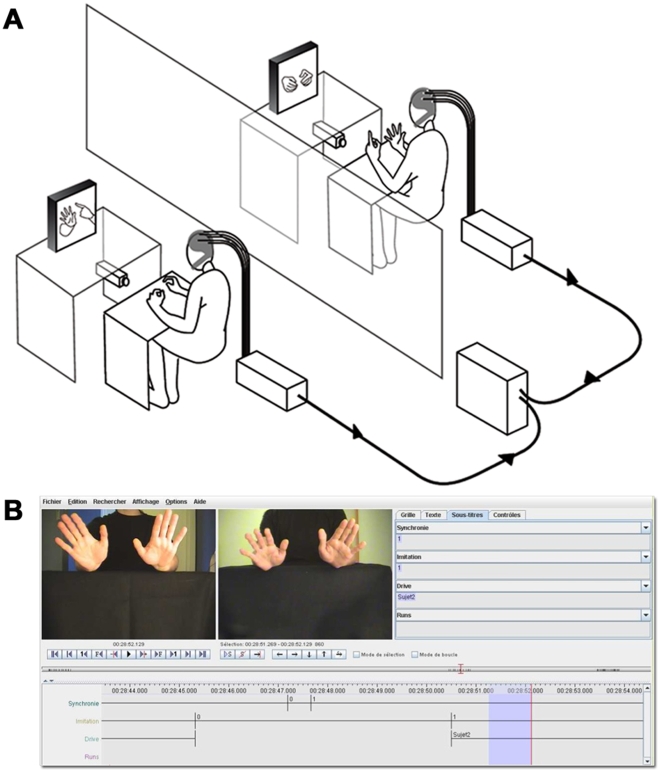
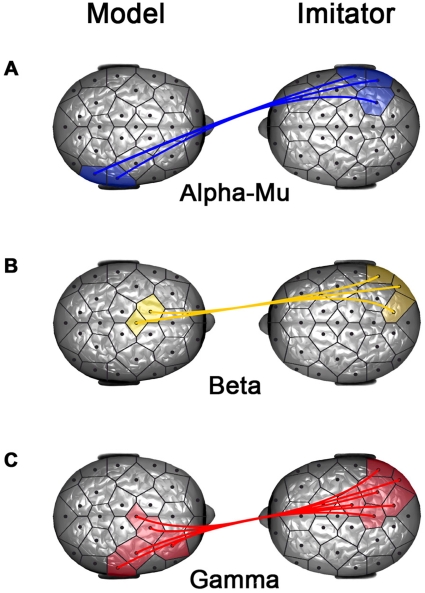
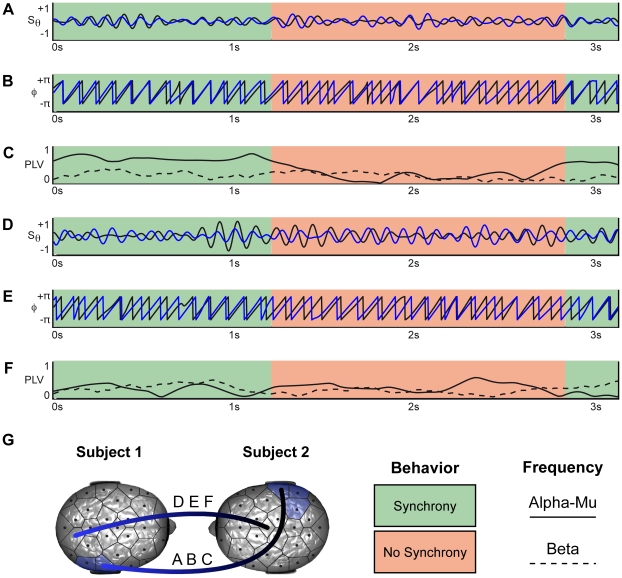
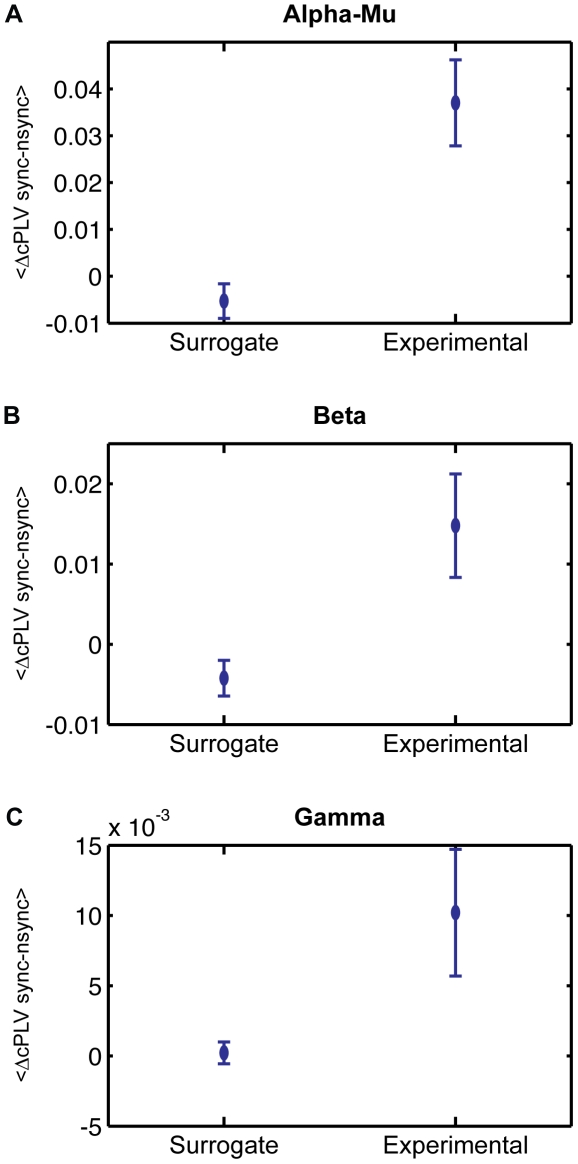
During social interaction, both participants are continuously active, each modifying their own actions in response to the continuously changing actions of the partner. This continuous mutual adaptation results in interactional synchrony to which both members contribute. Freely exchanging the role of imitator and model is a well-framed example of interactional synchrony resulting from a mutual behavioral negotiation. How the participants' brain activity underlies this process is currently a question that hyperscanning recordings allow us to explore. In particular, it remains largely unknown to what extent oscillatory synchronization could emerge between two brains during social interaction. To explore this issue, 18 participants paired as 9 dyads were recorded with dual-video and dual-EEG setups while they were engaged in spontaneous imitation of hand movements. We measured interactional synchrony and the turn-taking between model and imitator. We discovered by the use of nonlinear techniques that states of interactional synchrony correlate with the emergence of an interbrain synchronizing network in the alpha-mu band between the right centroparietal regions. These regions have been suggested to play a pivotal role in social interaction. Here, they acted symmetrically as key functional hubs in the interindividual brainweb. Additionally, neural synchronization became asymmetrical in the higher frequency bands possibly reflecting a top-down modulation of the roles of model and imitator in the ongoing interaction.
Overview
The claims and statistics of this paper haven’t been checked yet.
Free: it reads the open-access text and checks the first 5 claims that cite a source we can check. Create a free account to check every claim.
Integrity signals
Registry
Cites
Statistics
Figures

Verification
Claims the paper makes
The claims and statistics of this paper haven’t been checked yet.
Free: it reads the open-access text and checks the first 5 claims that cite a source we can check. Create a free account to check every claim.
Claims other papers make about this one
Each is checked against this paper’s own text: does it say what the citing paper says it does?
The check wasn’t confident either way, so it gives no verdict — never disputed.
In the citing paper
“The sample size was not determined a priori—each dataset's sample size was guided by prior work in their corresponding fields [38, 39, 40].”
From Interpersonal Synchronization of Autonomic Physiology via Mere Visual Contact (2026) · cites this paper as [38]
Experimental — accuracy not yet measured
Self-check
Percentages, sums and reported differences re-computed from the paper’s own numbers.
The self-check needs the paper’s full text.
Citations
Cites
A Mathematical Theory of Communication
Shannon, C. E. (1948) · Bell System Technical Journal · doi:10.1002/j.1538-7305.1948.tb01338.x · Cited by 88,486
The Mathematical Theory of Communication
Shannon, C. E., Weaver, W., & Wiener, N. (1950) · Physics Today · doi:10.1063/1.3067010 · Cited by 9,801
Nonparametric statistical testing of EEG- and MEG-data
Maris, E., & Oostenveld, R. (2007) · Journal of Neuroscience Methods · doi:10.1016/j.jneumeth.2007.03.024 · Cited by 8,496 · cited 1×
“Following previous studies [41,42], the resulting t-value matrices were then thresholded for absolute values larger than 2.”
The brainweb: phase synchronization and large-scale integration
Varela, F., Lachaux, J.-P., Rodriguez, E., & Martinerie, J. (2001) · Nature Reviews Neuroscience · doi:10.1038/35067550 · Cited by 4,761
Self-citationA mechanism for cognitive dynamics: neuronal communication through neuronal coherence.
Fries, P. (2005) · Trends in Cognitive Sciences · doi:10.1016/j.tics.2005.08.011 · Cited by 4,284 · cited 3×
“have been proposed as a key mechanism for information integration [28], temporal binding [51], flexible neuronal communication [34,52] and unified cognitive processes [45,53].”
InfluentialMeasuring phase synchrony in brain signals
Lachaux, J.-P., Rodriguez, E., Martinerie, J., & Varela, F. J. (1999) · Human Brain Mapping · doi:10.1002/(sici)1097-0193(1999)8:4<194::aid-hbm4>3.0.co;2-c · Cited by 3,798
Self-citationDynamic predictions: Oscillations and synchrony in top–down processing
Engel, A. K., Fries, P., & Singer, W. (2001) · Nature Reviews Neuroscience · doi:10.1038/35094565 · Cited by 3,454 · cited 1×
“Within one brain, synchronous neural oscillations have been previously observed in a range of processes such as conscious perception [44–46], working and long term memory [47,48], states of anticipation or attention [48,49] and empathy [50].”
Mathematical Theory of Communication
(2013) · Encyclopedia of Systems Biology · doi:10.1007/978-1-4419-9863-7_100015 · Cited by 3,290
Rizzolatti, G., & Arbib, M. A. (1998) · Trends in Neurosciences · doi:10.1016/s0166-2236(98)01260-0 · Cited by 2,858
Cortical mechanisms of human imitation
Iacoboni, M., Woods, R. P., Brass, M., Bekkering, H., Mazziotta, J. C., & Rizzolatti, G. (1999) · Science · doi:10.1126/science.286.5449.2526 · Cited by 2,683 · cited 1×
“Though imitation is commonly considered as a foundation for learning, socialization and communication [21,22], its use as a paradigm has been limited so far to test the direct matching hypothesis in an intraindividual perspective [23–27].”
Cited by
Items 701–800 of 963
Soares, R. D. S., & Sato, J. R. (2026) · Brain Structure and Function · doi:10.1007/s00429-026-03187-5 · Cited by 1
“A solid body of adult research shows increases in inter-brain coupling during cooperation (Shaw et al. 2023), verbal communication (Jiang et al. 2012), coordinated movement (Konvalinka and Roepstorff 2012), and shared attention (Dumas et al. 2010).”
Behavioral similarity likely drives interbrain neural synchrony
Hamilton, A. F. D. C., & Konvalinka, I. (2026) · Proceedings of the National Academy of Sciences · doi:10.1073/pnas.2621493123 · Cited by 1
“This has been established in previous work: behavioral synchrony drives neural synchrony (4, 5 ) and when participants coordinate the timing of button presses, intersubject neural alignment of alpha and beta ERD signals is observed across all participants producing this behavior, irrespective of…”
How Tasks Help Shape the Neurodynamic Rhythms and Organizations of Teams
Stevens, R. H., Galloway, T. L., Campbell, G. E., Berka, C., & Balthazard, P. A. (2013) · Lecture notes in computer science · doi:10.1007/978-3-642-39454-6_21 · Cited by 1
A Flow Szinkronizáció Kérdőív pszichometriai jellemzői: reliabilitás- és validitásvizsgálat
Magyaródi, T., & Oláh, A. (2016) · Mentálhigiéné és Pszichoszomatika · doi:10.1556/0406.17.2016.2.4 · Cited by 8
Neurophysiological Signals Processing
Borghini, G., Aricò, P., Flumeri, G. D., & Babiloni, F. (2017) · Biosystems & biorobotics · doi:10.1007/978-3-319-58598-7_6 · Cited by 2
Masking Stress with Misbehaviour:A Shanker Self-Reg® Lens
Hopkins, S., & Shepherd, E. (2017) · Reframed - A Journal of Self-Reg · doi:10.26690/sri20170704 · Cited by 1
Diversity and Ethnic Conflicts
Weissmark, M. S. (2020) · Oxford University Press eBooks · doi:10.1093/oso/9780190686345.003.0008 · Cited by 1
Social neuroscience: Pendekatan multi-level integratif dalam penelitian psikologi sosial
Lufityanto, G. (2020) · Jurnal Psikologi Sosial · doi:10.7454/jps.2020.11 · Cited by 2
Gelhardt, A. (2021) · Studia Universitatis Babeș-Bolyai Philosophia · doi:10.24193/subbphil.2021.2s.06 · Cited by 1
Defining Wellness across World Cultures
Alarcón, R. D. (2021) · Cambridge University Press eBooks · doi:10.1017/9781108678971.007 · Cited by 1
Clauss‐Ehlers, C. S. (2021) · Cambridge University Press eBooks · doi:10.1017/9781108678971.035 · Cited by 1
Community Impact of Social Media
Storck-Martinez, C., Lomaro, C., Koguc, G., & Clauss‐Ehlers, C. S. (2021) · Cambridge University Press eBooks · doi:10.1017/9781108678971.023 · Cited by 1
Embodied Collaboration in Small Groups
Williamson, K., & Sutton, J. D. (2014) · Palgrave Macmillan eBooks · doi:10.1057/9780230369580.0011 · Cited by 1
Notes on resonant and synchronized states in complex networks
Bartesaghi, P. (2023) · Chaos An Interdisciplinary Journal of Nonlinear Science · doi:10.1063/5.0134285 · Cited by 2
A calculus of probability or belief? Neural underpinnings of social decision-making in a card game
Chen, Y., Youk, S., Wang, P. T., Pinti, P., & Weber, R. (2023) · Neuropsychologia · doi:10.1016/j.neuropsychologia.2023.108635 · Cited by 2
From an Individual to an Intersubjective Perspective: Reflections for Foreign Language Acquisition
Maugeri, G. (2023) · International Journal of Linguistics · doi:10.5296/ijl.v15i5.21358 · Cited by 2
Social rhythm and implications on functionality of patients after stroke
da Fonsêca, R. D. R. G., de Melo, L. P., Fernandes, A. B. G. S., Campos, T. F., & Cavalcanti, F. A. D. C. (2024) · Chronobiology International · doi:10.1080/07420528.2024.2379573 · Cited by 2
“The study by Dumas et al. (2010) aimed to elucidate the interindividual neural mechanisms of human interaction and found that during communication between two individuals, both participants remained continually active using a motor task with hand movements, each modifying their actions in response…”
Lübbert, A., Sengelmann, M., Heimann, K. S., Schneider, T. R., Engel, A. K., & Göschl, F. (2024) · Scientific Reports · doi:10.1038/s41598-024-69678-9 · Cited by 2
“( B , left) Demonstration of the game control—a bimetal sensor attached to the index finger translated bending and stretching of the finger into ball movement on the screen.”
Nurturing Compassion in Higher Education: An Evolutionary Developmental Neuroscience Perspective
Ballieux, H. (2024) · Knowledge studies in higher education · doi:10.1007/978-3-031-67543-0_6 · Cited by 1
Mirror Neuron System and Social Cognition: Understanding Others by Embodiment
Ki, G. S. (2013) · Western Undergraduate Psychology Journal · Cited by 2
EEG Coherence Within Tutoring Dyads: A Novel Approach for Pedagogical Efficiency
Stone, B. T., Correa, K. A., Thor, N., & Johnson, R. (2015) · Lecture notes in computer science · doi:10.1007/978-3-319-20816-9_67 · Cited by 1
“While this study utilized MRI, EEG coherence across individuals has also been explored, and been found in both social interactions [21], and in decision making during card games [22].”
ResultSocial structures and communications in the world of microorganisms
Grechenko, T. N., Kharitonov, A. N., & Zhegallo, A. V. (2019) · Experimental Psychology (Russia) · doi:10.17759/exppsy.2019120409 · Cited by 236
Cities, Psychosis, and Social Defeat
Sayanvala, F., Bornstein, L., Choudhury, S., Shah, J. L., Weinstock, D., & Gold, I. (2020) · Cambridge University Press eBooks · doi:10.1017/9781108695374.025 · Cited by 1
Stout, D. (2020) · Cambridge University Press eBooks · doi:10.1017/9781108695374.005 · Cited by 1
Choudhury, S., & Berson, J. (2020) · Cambridge University Press eBooks · doi:10.1017/9781108695374.020 · Cited by 1
Mythic Imagination Today The Interpenetration of Mythology and Science
Marks-Tarlow, T. (2021) · Cited by 1
Gowanus Canal and Public Policy: Community Well-Being at a Superfund Site
Bingham, B., & Opotow, S. V. (2021) · Cambridge University Press eBooks · doi:10.1017/9781108678971.020 · Cited by 1
12 interventions en psychologie du développement
Nadel, J. (2019) · Dunod eBooks · doi:10.3917/dunod.brun.2019.03.0239 · Cited by 1
Self-citationCommunity Resilience: From Broken Windows to Busy Streets
Thulin, E. J., & Zimmerman, M. A. (2021) · Cambridge University Press eBooks · doi:10.1017/9781108678971.015 · Cited by 1
Clauss‐Ehlers, C. S. (2021) · Cambridge University Press eBooks · doi:10.1017/9781108678971.003 · Cited by 1
The world seems different in a social context: A neural network analysis of human experimental data
Tsfasman, M., Philippsen, A. K., Mazzola, C., Thill, S., Sciutti, A., & Nagai, Y. (2022) · PLoS ONE · doi:10.1371/journal.pone.0273643 · Cited by 1
“Nevertheless, the nature of behavioral changes induced by sociality and their underlying cognitive processes are still not well-understood [31, 32, 33, 34].”
BackgroundL’imitation, double physique et mental
Nadel, J. (2022) · Enfance · doi:10.3917/enf2.223.0367 · Cited by 1
Self-citationTeam Members Show Decreased Inter-brain Coupling When Resolving Uncertainty
Stevens, R. H., & Galloway, T. L. (2022) · Proceedings of the Human Factors and Ergonomics Society Annual Meeting · doi:10.1177/1071181322661081 · Cited by 1
Chabin, T., Gabriel, D., Comte, A., Haffen, É., Moulin, T., & Pazart, L. (2021) · bioRxiv (Cold Spring Harbor Laboratory) · doi:10.1101/2021.03.26.436975 · Cited by 1
“Among the vast number of studies that have investigated cerebral coupling using EEG in various domains [73, 21, 75, 18, 38, 33, 10] including the musical context [72, 52, 39, 4, 53], no studies have estimated the emotional cerebral coupling.”
BackgroundBrain Connectivity and Its Applications
Sanei, S., & Chambers, J. A. (2021) · Wiley eBooks · doi:10.1002/9781119386957.ch8 · Cited by 1
Inhibitory CCK+ basket synapse defects in mouse models of dystroglycanopathyPreprint
Jahncke, J. N., Miller, D. S., Krush, M., Schnell, E., & Wright, K. M. (2022) · bioRxiv (Cold Spring Harbor Laboratory) · doi:10.1101/2022.01.26.477791 · Cited by 1
The role of reciprocity in dynamic interpersonal coordination of physiological rhythmsPreprint
Konvalinka, I., Sebanz, N., & Knoblich, G. (2022) · doi:10.31234/osf.io/zh92u · Cited by 1
Cognition in eco, cognition in vitro - Mesure, explication, et contextualité en sciences cognitivesPreprint
GUÉNIN--CARLUT, A. (2020) · OSF Preprints (OSF Preprints) · doi:10.31219/osf.io/86cwf · Cited by 1
Konrad, K., Gerloff, C., Kohl, S. H., Mehler, D. M. A., Mehlem, L., Volbert, E. L., Komorek, M., Henn, A. T., Boecker, M., Weiß, E. O., et al. (2023) · doi:10.31234/osf.io/6szvw · Cited by 2
Liu, Y., Liu, Y., Zhang, M., & Wang, P. (2024) · Research Square · doi:10.21203/rs.3.rs-3957143/v1 · Cited by 3
A summary of intraspecific size variation for large odontocetesPreprint
McClure, J. (2024) · bioRxiv (Cold Spring Harbor Laboratory) · doi:10.1101/2024.09.05.610699 · Cited by 1
Adel, L., Moses, L., Irvine, E., Greenway, K. T., Dumas, G., & Lifshitz, M. (2024) · doi:10.31234/osf.io/g2yb7 · Cited by 1
Self-citationLi, Q., Dabranau, A., Kompatsiari, K., & Konvalinka, I. (2025) · bioRxiv (Cold Spring Harbor Laboratory) · doi:10.64898/2025.12.30.695445 · Cited by 3
“Inter-brain phase synchronization quantifies phase coupling between two individuals’ neural oscillations and has been observed during action coordination (Dumas et al., 2010; M¨uller et al., 2013; Gugnowska et al., 2022).”
Turchet, P. (2017) · theses.fr (ABES) · doi:10.70675/01b47943z6cefz4c0dz8f9cz44fe9e8a746d · Cited by 5
Le processus d’interaction comme attracteur dans la coordination temporelle entre les personnes
Laroche, J. (2013) · theses.fr (ABES) · doi:10.70675/a97fd79dz2d91z46aaza1b7zcc3117296f5b · Cited by 1
Interpersonal Synchronization of Autonomic Physiology via Mere Visual Contact
Koul, A., & Novembre, G. (2026) · Annals of the New York Academy of Sciences · doi:10.1111/nyas.70322 · Cited by 1
“The sample size was not determined a priori— each dataset’s sample size was guided by prior work in their corresponding fields [ 38–40 ].”
Sanei, S. (2013) · Wiley eBooks · doi:10.1002/9781118622162.ch8
The Neural Systems Involved in Motor Cognition and Social Contact
Hétu, S., & Jackson, P. L. (2012) · Palgrave Macmillan UK eBooks · doi:10.1057/9780230360792_9 · Cited by 1
Imitation and the Generative Mind
Nadel, J. (2014) · Communications in computer and information science · doi:10.1007/978-3-319-08855-6_10
Self-citationPfeiffer, U. J. (2013) · Kölner Universitäts PublikationsServer (Universität zu Köln)
La programmation neurolinguistique dans l’entretien psychiatrique
Ducasse, D., & Fond, G. B. (2014) · Soins Psychiatrie · doi:10.1016/j.spsy.2013.12.010
de Melo, A. T., & Alarcão, M. (2013) · Springer proceedings in complexity · doi:10.1007/978-3-319-00395-5_98
Aitken, K. J. (2016) · Behavioral and Brain Sciences · doi:10.1017/s0140525x15000977
Synchrony: Biometric Indication of Team Cognition
Fedele, M. (2016)
L'approche incarnée du développement: corps, communication et culture
Gratier, M., Esseily, R., & Bobin-Bègue, A. (2017) · doi:10.1016/b978-2-294-75466-1.00009-1
García-Vellisca, M. A. (2017) · UPM Digital Archive (Technical University of Madrid) · doi:10.20868/upm.thesis.48346
Interpersonal sensorimotor contingencies: Information-theoretic relevance of subjective experience
Trendafilov, D., Hwang, T., Schmitz, G. H., Effenberg, A. O., & Polani, D. (2018) · University of Hertfordshire Research Archive (University of Hertfordshire)
Social spread of positive facial signals: affiliative zygomatic synchrony in co-present individualsPreprint
Golland, Y., Mevorach, D., & Levit-binnun, N. (2018) · bioRxiv · doi:10.1101/484980
Commentary on Schermer’s review of ‘Ecology of the Brain’
Fuchs, T. A. E. (2018) · Group Analysis · doi:10.1177/0533316418816274
Mahmoodi, K. (2018) · University of North Texas Digital Library (University of North Texas) · doi:10.12794/metadc1248467
Knipschild, J., Verhagen-Schouten, S., & Amsterdam, V. P. (2019) · GGZ Vaktijdschrift · doi:10.31739/ggzv.2019.2.39
Minnis, H., Posserud, M.-B. R., Thompson, L. C., & Gillberg, C. (2020) · Research Ideas and Outcomes · doi:10.3897/rio.6.e48887
Az áramlat-élmény vizsgálata társas helyzetben
Magyaródi, T. (2016) · Eötvös Loránd Tudományegyetem · doi:10.15476/elte.2016.045 · Cited by 6
Weissmark, M. S. (2020) · Oxford University Press eBooks · doi:10.1093/oso/9780190686345.003.0007
Weissmark, M. S. (2020) · Oxford University Press eBooks · doi:10.1093/oso/9780190686345.003.0006
Weissmark, M. S. (2020) · Oxford University Press eBooks · doi:10.1093/oso/9780190686345.003.0001
Weissmark, M. S. (2020) · Oxford University Press eBooks · doi:10.1093/oso/9780190686345.003.0005 · Cited by 1
Weissmark, M. S. (2020) · Oxford University Press eBooks · doi:10.1093/oso/9780190686345.003.0009
Het lichaam in de therapiekamer: somatische resonantie en somatische tegenoverdracht
Nicolai, N. J. (2020) · Bohn Stafleu van Loghum eBooks · doi:10.1007/978-90-368-2499-6_10
Brhanie, T. W., Fava, C., & Jovanovski, A. (2020) · medRxiv · doi:10.1101/2020.08.27.20182535
Social Neuroscience in Global Mental Health: Case Study on Stigma Reduction in Nepal
Kohrt, B. A. (2020) · Cambridge University Press eBooks · doi:10.1017/9781108695374.024 · Cited by 3
Literary Analysis and Weak Theories
Moses, O. (2020) · Cambridge University Press eBooks · doi:10.1017/9781108695374.022
Experience-Dependent Plasticity in the Hippocampus
West, G. L., & Bohbot, V. D. (2020) · Cambridge University Press eBooks · doi:10.1017/9781108695374.019
What Place Does Synchronization Have in Relationships Between People?
Grondin, S. (2019) · Routledge eBooks · doi:10.4324/9781003001638-22
Synchronization of Electrical Oscillations in the Organization of Social Life of Microorganisms
Grechenko, T. N., Kharitonov, A. N., Zhegallo, A. V., Сумина, Е. Л., & Sumin, D. L. (2020) · Experimental Psychology (Russia) · doi:10.17759/exppsy.2020130310
Optimal Local Government and Public Service Provision
Drew, J. (2021) · Cambridge University Press eBooks · doi:10.1017/9781108678971.026 · Cited by 1
L’hyperscanning: o come comunicano i cervelli nelle organizzazioni?
Balconi, M., & Fronda, G. (2020) · Studi e ricerche · doi:10.7359/954-2020-bal4
Classification of Theory of Mind tasks and their computational modelsPreprint
Rusch, T., & Gläscher, J. P. (2019) · PsyArXiv (OSF Preprints) · doi:10.31234/osf.io/uf85z
On the role of parvalbumin interneurons in neuronal network activity in the prefrontal cortex
Guyon, N. (2021) · Figshare
Douglas, C. L. (2021) · DalSpace (Dalhousie University)
Brain mechanisms of parenting in co-parenting spouses and parent-child dyads
Azhari, N. A. (2021) · DR-NTU (Nanyang Technological University) · doi:10.32657/10356/152297
Praszkier, R. (2021) · Springer eBooks · doi:10.1007/978-3-319-98390-5_227-1
Where Do We Go from Here? Gaps and Opportunities for Community Psychology
Clauss‐Ehlers, C. S. (2021) · Cambridge University Press eBooks · doi:10.1017/9781108678971.033
Community Psychology in Action: Critical Themes and Areas of Application
(2021) · Cambridge University Press eBooks · doi:10.1017/9781108678971.013
Family Support Services at Ronald McDonald House Promotes Healing of Seriously Ill Children
Regas, S. J., Hernández, M., Bakaly, J. W., & Doonan, R. L. (2021) · Cambridge University Press eBooks · doi:10.1017/9781108678971.021
Thompson, K. V., & Benjamin, A. M. (2021) · Cambridge University Press eBooks · doi:10.1017/9781108678971.005
Building Community Resilience and Supporting Disaster Risk Reduction through Social Action Efforts
O’Sullivan, T. L. (2021) · Cambridge University Press eBooks · doi:10.1017/9781108678971.016
Sloan, R. (2021) · Cambridge University Press eBooks · doi:10.1017/9781108678971.001
Critical Language Ethnography as a Community-Centered Research Paradigm
Figueroa, A. M., & McConnochie, M. (2021) · Cambridge University Press eBooks · doi:10.1017/9781108678971.012
Foundational Concepts: Interdisciplinary, Culturally Responsive, and Contextual Approaches
Clauss‐Ehlers, C. S. (2021) · Cambridge University Press eBooks · doi:10.1017/9781108678971.002
Community Psychology and a Fresh Look at Faith Healing Camps: Experiences in Ghana
Ofori-Atta, A. L., Asafo, S. M., Obeng, K. M., & Rosenheck, R. A. (2021) · Cambridge University Press eBooks · doi:10.1017/9781108678971.022
Research, Assessment, and Program Evaluation: Ecological Considerations
Clauss‐Ehlers, C. S. (2021) · Cambridge University Press eBooks · doi:10.1017/9781108678971.008
Ethics and Community Psychology
O’Connor, P. A., Gillum, T. L., & Morse, G. S. (2021) · Cambridge University Press eBooks · doi:10.1017/9781108678971.006
Horváth, T. L., Hirsch, J., & Molnár, Z. (2022) · Elsevier eBooks · doi:10.1016/b978-0-12-818093-8.00008-2
Psychological Impact of Climate Change on Communities
Foley, Z., Storck-Martinez, C., Koguc, G., Carpio, M. G., Lomaro, C., & Clauss‐Ehlers, C. S. (2021) · Cambridge University Press eBooks · doi:10.1017/9781108678971.025
Hunter, S. J. (2021) · Cambridge University Press eBooks · doi:10.1017/9781108678971.019
Mental Health on College Campuses
Tugade, M. M., Tan, T. Y., Wachsmuth, L. S., & Bradley, E. H. (2021) · Cambridge University Press eBooks · doi:10.1017/9781108678971.031
Metadata
- Authors
- Dumas, G., Nadel, J., Soussignan, R., Martinerie, J., & Garnero, L.
- Affiliations
- Centre National de la Recherche Scientifique (FR)
- Corresponding author
- Dumas, Guillaume
- Venue
- PLoS ONE
- Publisher
- Public Library of Science (PLoS)
- Published
- 2010-08-17
- Volume
- 5
- Issue
- 8
- Pages
- e12166
- ISSN
- 1932-6203 (ISSN-L)
- PMC
- PMC2923151
- OpenAlex
- W1986163111
- Cited by
- 966
- References
- 68
- Citations by year
- 2026: 73 · 2025: 80 · 2024: 68 · 2023: 55 · 2022: 78 · 2021: 106 · 2020: 127 · 2019: 53 · 2018: 54 · 2017: 57 · 2016: 42 · 2015: 31 · 2014: 54 · 2013: 35 · 2012: 33
- FWCI
- 38.29
- Type
- journal article
- Language
- en
- Open access
- gold
- doi.org
- Locations
- PLoS ONE (publishedVersion, cc-by)
- PubMed Central (publishedVersion, cc-by)
- PubMed (publishedVersion)
- HAL (submittedVersion, other-oa)
- HAL (submittedVersion)
- RePEc: Research Papers in Economics (submittedVersion)
- DOAJ (DOAJ: Directory of Open Access Journals) (submittedVersion, cc-by-sa)
- Topics
- Social Sciences › Psychology › Social Psychology › Action Observation and Synchronization
- Life Sciences › Neuroscience › Cognitive Neuroscience › Neural dynamics and brain function
- Life Sciences › Neuroscience › Cognitive Neuroscience › EEG and Brain-Computer Interfaces
- Keywords
- inter-brain synchrony, social interaction, interactional synchrony, spontaneous imitation, turn-taking, hyperscanning, top-down modulation, mirror neuron system
- MeSH terms
- Behavior, Brain, Electroencephalography, Female, Humans, Imitative Behavior, Interpersonal Relations, Male, Young Adult
About these checks
Registry, retraction, Cites and statistics results are computed, not judged, with one exception: a printed reference that no index lists is read once by a model before it counts as a citation error. Claims are extracted by a model and kept only when their quote appears verbatim in the text; each cited source is then checked, with a model’s help, for whether it says what the claim relies on. Those verdicts can be wrong — read the claim’s quote and the cited source before relying on one.
Statistics and arithmetic are recomputed, not judged.
Confidence bands are shown only for fields calibrated on our annotated test set. None is calibrated yet, so no band is shown.
What counts as a claim ›How we measure confidence ›How we check this ›
Are you an author, or do you see a problem with this page? Request a review
Data sources
Bibliographic data: Semantic Scholar, OpenAlex, Crossref.
Contains information from the Semantic Scholar Academic Graph Datasets, made available under the ODC Attribution License (ODC-BY 1.0).
Semantic Scholar’s data is described in: Kinney, R., et al. (2023). The Semantic Scholar Open Data Platform. arXiv:2301.10140.
