

The DOI matches its Crossref record; 45 of the 46 references it cites were found in a registry or an index; none of the 40 sources its claims cite is checked for support yet.
Extending Body Space in Immersive Virtual Reality: A Very Long Arm Illusion
Open accessAbstract
Recent studies have shown that a fake body part can be incorporated into human body representation through synchronous multisensory stimulation on the fake and corresponding real body part - the most famous example being the Rubber Hand Illusion. However, the extent to which gross asymmetries in the fake body can be assimilated remains unknown. Participants experienced, through a head-tracked stereo head-mounted display a virtual body coincident with their real body. There were 5 conditions in a between-groups experiment, with 10 participants per condition. In all conditions there was visuo-motor congruence between the real and virtual dominant arm. In an Incongruent condition (I), where the virtual arm length was equal to the real length, there was visuo-tactile incongruence. In four Congruent conditions there was visuo-tactile congruence, but the virtual arm lengths were either equal to (C1), double (C2), triple (C3) or quadruple (C4) the real ones. Questionnaire scores and defensive withdrawal movements in response to a threat showed that the overall level of ownership was high in both C1 and I, and there was no significant difference between these conditions. Additionally, participants experienced ownership over the virtual arm up to three times the length of the real one, and less strongly at four times the length. The illusion did decline, however, with the length of the virtual arm. In the C2-C4 conditions although a measure of proprioceptive drift positively correlated with virtual arm length, there was no correlation between the drift and ownership of the virtual arm, suggesting different underlying mechanisms between ownership and drift. Overall, these findings extend and enrich previous results that multisensory and sensorimotor information can reconstruct our perception of the body shape, size and symmetry even when this is not consistent with normal body proportions.
Overview
AI snapshot
Written from the paper’s full text.
TL;DR
In an immersive virtual reality between-groups experiment, participants experienced ownership over a virtual arm elongated up to three times the real arm length, with the illusion declining at four times. Ownership and proprioceptive drift appeared to depend on different underlying mechanisms.
Key findings
- With no elongation, ownership was high in both congruent (C1) and visuo-tactile incongruent (I) conditions: Q3 median was 4/5 in both, P = 1.0000, while touch-referral Q1/Q2 were significantly higher in C1 (P = 0.0009 and P = 0.0001).
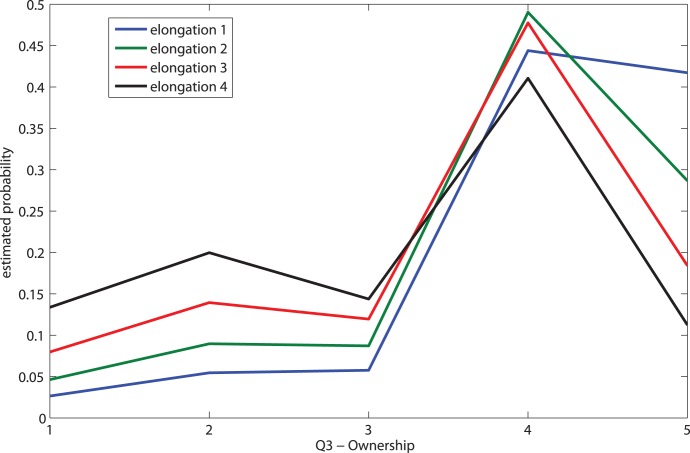
- Ownership declined with virtual arm elongation: ordered logistic regression of Q3 on elongation had a negative coefficient, P = 0.032; estimated probabilities of Q3 ≥ 4 were 0.86, 0.78, 0.66, and 0.52 for elongations 1–4, leaving about a 50% chance of high ownership at four times real length.
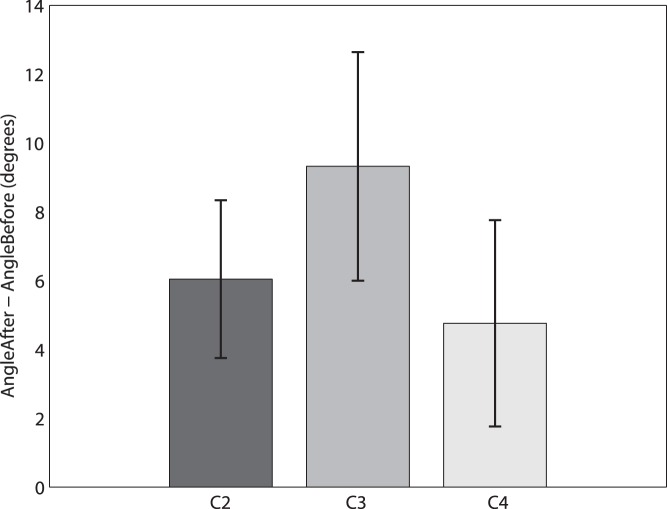
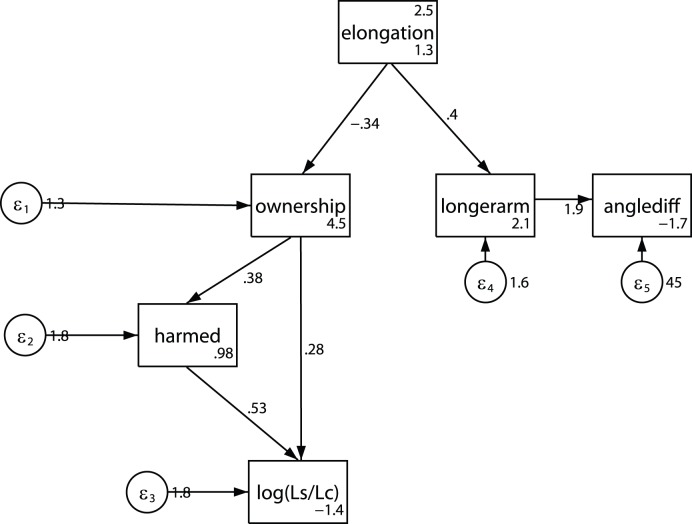
- Proprioceptive drift was positively associated with elongation (Spearman P = 0.03) and significant in C2 (P = 0.037) and C3 (P = 0.012) but not C4 (P = 0.169); drift did not correlate with ownership, and path analysis suggested different mechanisms.
- Defensive withdrawal movements to a falling virtual saw were greater during Saw Time than Control Time overall (combined P = 0.017), and hand movement dispersion was positively related to ownership and to feeling harmed.
Methods
- Fifty participants were assigned to 5 between-groups conditions (n = 10 each): Incongruent (I) and Congruent C1–C4, where the virtual dominant arm was 1, 2, 3, or 4 times the real arm length; mean real arm length was 53 ± 3 cm, giving average C2/C3/C4 lengths of 106, 159, and 212 cm.
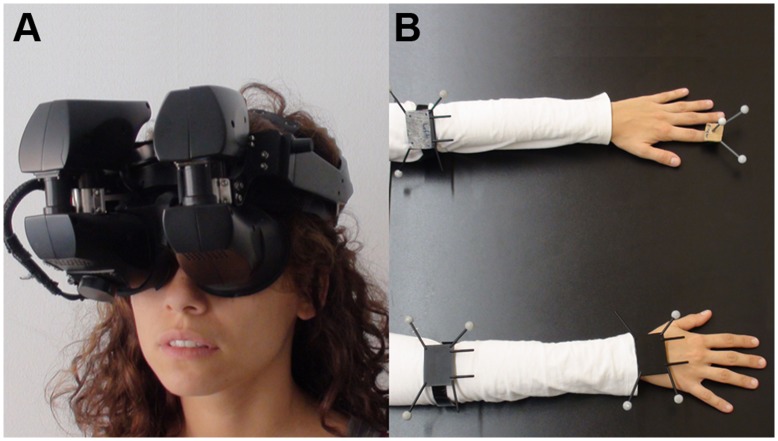
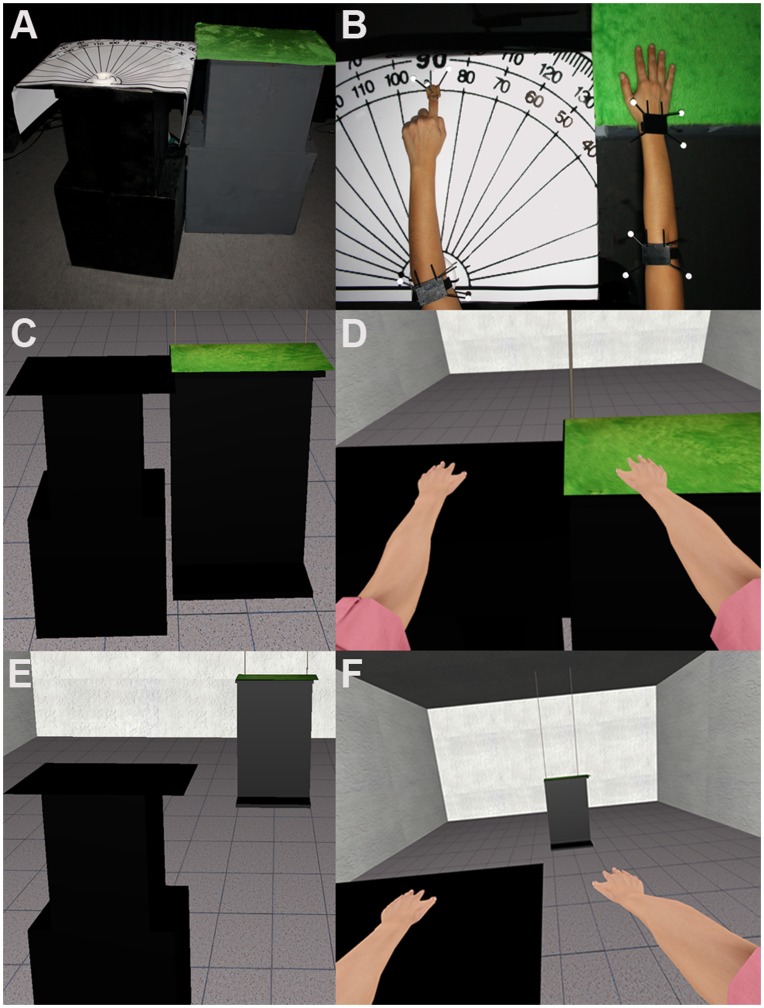
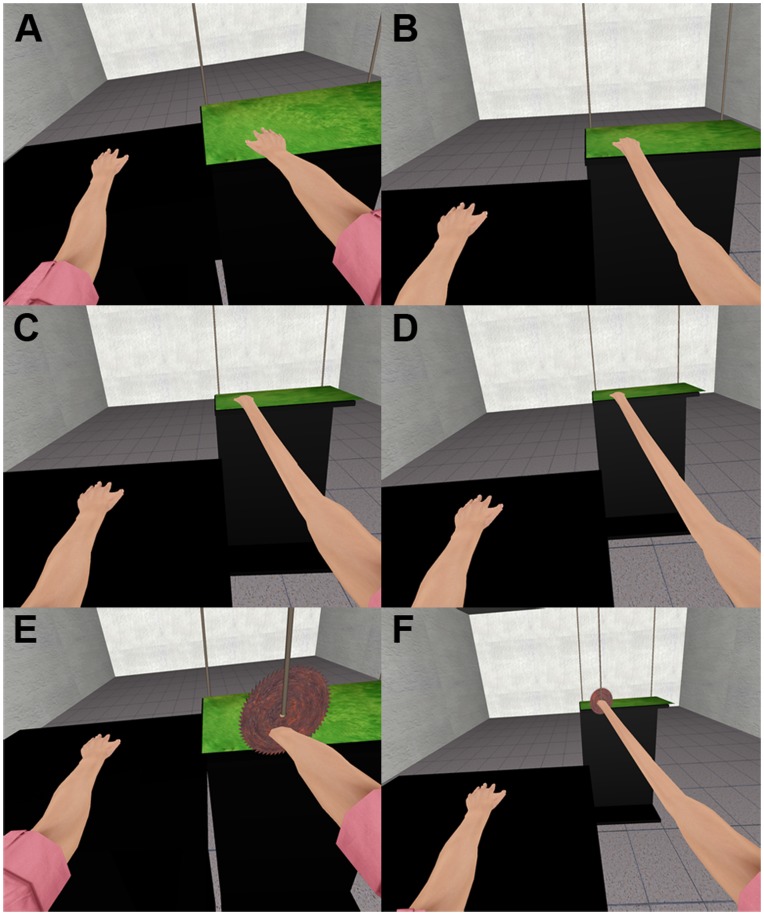
- Participants wore a stereo head-mounted display and saw a first-person virtual body; all conditions had visuo-motor congruence, while visuo-tactile congruence was present in C1–C4 but not I. Elongation occurred over 2 minutes while participants touched a physical box.
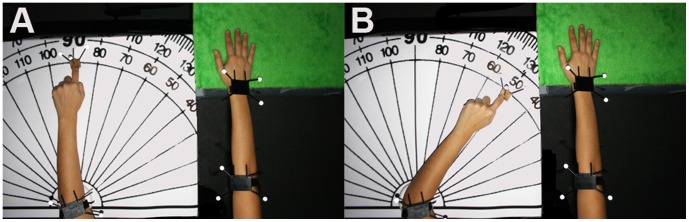
- Measures included a 7-item questionnaire (1–5 scale), proprioceptive drift via angle estimation before and after elongation for C2–C4, and hand-tracking dispersion before and during the virtual saw threat; analyses used nonparametric tests, ordered logistic regression, robust regression, and path analysis.
Limitations
- The paper states that defensive movements were small because participants were instructed to remain motionless, creating competition between staying still and avoiding the saw; the data likely reflect motor initiation rather than full execution for some participants.
- The paper states that in C4 the virtual hand was far from the body and visual precision/quality were poorer, and that spatial distance or limits on limb representation may contribute to the illusion decline; it also notes that richer multisensory stimulation may be needed for greater distortions.
- Evident from the text: each condition had only 10 participants, drift was not measured in C1 or I, and path analysis treated ordinal questionnaire variables as interval-scale, which the paper acknowledges is not strictly justified.
Model-written summary. Check it against the paper before relying on it.
Integrity signals
Registry
Cites
Statistics
Figures
Verification
Claims the paper makes
66 Own result · 29 Not checked yet · 26 Own interpretation · 4 No basis given
The paper states this without a source or data behind it here, so there is nothing to check it against. The quote shows it is in the paper.
In the paper
“In this paper we show that it is possible to quite dramatically alter body representation, by inducing an ownership illusion over one very long arm in a situation where the entire body has been replaced by a virtual body seen from a first person perspective position (1PP).”
§ Extending Body Space in Immersive Virtual Reality: A Very Long Arm Illusion > Introduction
hedgeddirect- Asserted: passes — The authors put it forward as true.
- Checkable: passes — It can be checked against evidence.
- Load-bearing: passes — The paper’s conclusions depend on it.
- Based: passes — The paper gives a reason why it holds.
A result the paper reports from its own data — it cites no other source for it, so there is none to check. The quote shows it is in the paper.
In the paper
“Table 3 gives the means and standard errors for and from which it is clear that there is no difference in the amount of hand movement between congruent and incongruent conditions.”
§ Extending Body Space in Immersive Virtual Reality: A Very Long Arm Illusion > Results > Comparison of Congruent and Incongruent Conditions with No Elongation
boosted- Asserted: passes — The authors put it forward as true.
- Checkable: passes — It can be checked against evidence.
- Load-bearing: unclear — It is unclear whether the paper’s conclusions depend on it.
- Based: passes — The paper gives a reason why it holds.
A result the paper reports from its own data — it cites no other source for it, so there is none to check. The quote shows it is in the paper.
In the paper
“and is significantly greater for C1 and C2”
§ Extending Body Space in Immersive Virtual Reality: A Very Long Arm Illusion > Results > The Effect of Elongation
plain- Asserted: passes — The authors put it forward as true.
- Checkable: passes — It can be checked against evidence.
- Load-bearing: passes — The paper’s conclusions depend on it.
- Based: passes — The paper gives a reason why it holds.
In the paper
“The regression fit is shown in Table 6, supporting the notion of a negative relationship between the virtual arm length and the hand movement dispersion.”
§ Extending Body Space in Immersive Virtual Reality: A Very Long Arm Illusion > Results > The Effect of Elongation
What the sources say
- Not checked yetcites [27] PW Holland, 1977, Robust regression using iteratively reweighted least-squares., Communications in Statistics-Theory and Methods source
hedgedcorrelational- Asserted: passes — The authors put it forward as true.
- Checkable: passes — It can be checked against evidence.
- Load-bearing: passes — The paper’s conclusions depend on it.
- Based: passes — The paper gives a reason why it holds.
A result the paper reports from its own data — it cites no other source for it, so there is none to check. The quote shows it is in the paper.
In the paper
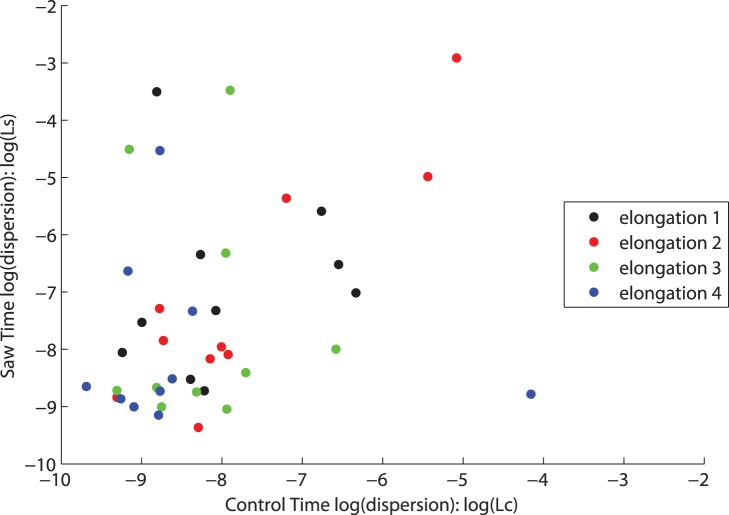
“We now show that the dispersion in Saw Time declines with elongation, taking into account the dispersion during the Control Time.”
§ Extending Body Space in Immersive Virtual Reality: A Very Long Arm Illusion > Results > The Effect of Elongation
plaindirect- Asserted: passes — The authors put it forward as true.
- Checkable: passes — It can be checked against evidence.
- Load-bearing: passes — The paper’s conclusions depend on it.
- Based: passes — The paper gives a reason why it holds.
A result the paper reports from its own data — it cites no other source for it, so there is none to check. The quote shows it is in the paper.
In the paper
“Moreover, the evidence suggests that there is still about a 50–50 chance of an arm up to four times the real length being subjectively incorporated”
- Also stated in: § The Effect of Elongation · hedged
“Nevertheless from Figure 5 the probability of a score of at least 4 at elongation 4 is estimated as about 50%.”
§ Extending Body Space in Immersive Virtual Reality: A Very Long Arm Illusion > Introduction
hedgedcorrelational- Asserted: passes — The authors put it forward as true.
- Checkable: passes — It can be checked against evidence.
- Load-bearing: passes — The paper’s conclusions depend on it.
- Based: passes — The paper gives a reason why it holds.
- Also stated in: § The Effect of Elongation · hedged
A result the paper reports from its own data — it cites no other source for it, so there is none to check. The quote shows it is in the paper.
In the paper
“The referral of touch questions Q1 and Q2 result in significantly higher responses in the congruent compared to the incongruent condition”
§ Extending Body Space in Immersive Virtual Reality: A Very Long Arm Illusion > Results > Comparison of Congruent and Incongruent Conditions with No Elongation
plaincorrelational- Asserted: passes — The authors put it forward as true.
- Checkable: passes — It can be checked against evidence.
- Load-bearing: passes — The paper’s conclusions depend on it.
- Based: passes — The paper gives a reason why it holds.
A result the paper reports from its own data — it cites no other source for it, so there is none to check. The quote shows it is in the paper.
In the paper
“However, it did not prove possible to find a fit with normally distributed residual errors.”
§ Extending Body Space in Immersive Virtual Reality: A Very Long Arm Illusion > Results > The Effect of Elongation
hedged- Asserted: passes — The authors put it forward as true.
- Checkable: passes — It can be checked against evidence.
- Load-bearing: passes — The paper’s conclusions depend on it.
- Based: passes — The paper gives a reason why it holds.
A result the paper reports from its own data — it cites no other source for it, so there is none to check. The quote shows it is in the paper.
In the paper
“The dispersion of the hand positions as measured by tracking (Eq. 1) was greater during the Saw Time than in the Control time under all elongation conditions except C4, as shown in Table 5”
§ Extending Body Space in Immersive Virtual Reality: A Very Long Arm Illusion > Results > The Effect of Elongation
plain- Asserted: passes — The authors put it forward as true.
- Checkable: passes — It can be checked against evidence.
- Load-bearing: unclear — It is unclear whether the paper’s conclusions depend on it.
- Based: passes — The paper gives a reason why it holds.
A result the paper reports from its own data — it cites no other source for it, so there is none to check. The quote shows it is in the paper.
In the paper
“there is no correlation of the angular drift with any of the questionnaire responses.”
§ Extending Body Space in Immersive Virtual Reality: A Very Long Arm Illusion > Results > The Effect of Elongation
plain- Asserted: passes — The authors put it forward as true.
- Checkable: passes — It can be checked against evidence.
- Load-bearing: unclear — It is unclear whether the paper’s conclusions depend on it.
- Based: passes — The paper gives a reason why it holds.
- It may state two separate claims as one. 29
- Probably not a substantial claim. 17
- The quote only partly states this claim. 2
A result the paper reports from its own data — it cites no other source for it, so there is none to check. The quote shows it is in the paper.
In the paper
“The estimated probabilities of the score being at least 4 are 0.86, 0.78, 0.66 and 0.52 respectively.”
§ Extending Body Space in Immersive Virtual Reality: A Very Long Arm Illusion > Results > The Effect of Elongation
hedgedcorrelational- Asserted: passes — The authors put it forward as true.
- Checkable: passes — It can be checked against evidence.
- Load-bearing: passes — The paper’s conclusions depend on it.
- Based: passes — The paper gives a reason why it holds.
It may state two separate claims as one.
A result the paper reports from its own data — it cites no other source for it, so there is none to check. The quote shows it is in the paper.
In the paper
“The median of these 30 angle estimates is 45.6°, and the median of the corresponding 30 standard errors is 0.76° with interquartile range 0.59°.”
§ Extending Body Space in Immersive Virtual Reality: A Very Long Arm Illusion > Results > The Effect of Elongation
plainn = 30- Asserted: passes — The authors put it forward as true.
- Checkable: passes — It can be checked against evidence.
- Load-bearing: passes — The paper’s conclusions depend on it.
- Based: passes — The paper gives a reason why it holds.
It may state two separate claims as one.
A result the paper reports from its own data — it cites no other source for it, so there is none to check. The quote shows it is in the paper.
In the paper
“The only other response that shows a trend is Q7 (the feeling of being harmed) where the median is greater in the congruent condition”
§ Extending Body Space in Immersive Virtual Reality: A Very Long Arm Illusion > Results > Comparison of Congruent and Incongruent Conditions with No Elongation
plaincorrelational- Asserted: passes — The authors put it forward as true.
- Checkable: passes — It can be checked against evidence.
- Load-bearing: fails — The paper’s conclusions may not depend on it.
- Based: passes — The paper gives a reason why it holds.
Probably not a substantial claim. The paper’s conclusions may not depend on it.
A result the paper reports from its own data — it cites no other source for it, so there is none to check. The quote shows it is in the paper.
In the paper
“For elongation 1 to 3 there are always at least 7 out of 10 participants with scores of at least 4. This declines to 4 out of 10 for elongation 4.”
§ Extending Body Space in Immersive Virtual Reality: A Very Long Arm Illusion > Results > The Effect of Elongation
plaincorrelationaln = 10- Asserted: passes — The authors put it forward as true.
- Checkable: passes — It can be checked against evidence.
- Load-bearing: passes — The paper’s conclusions depend on it.
- Based: passes — The paper gives a reason why it holds.
It may state two separate claims as one.
A result the paper reports from its own data — it cites no other source for it, so there is none to check. The quote shows it is in the paper.
In the paper
“The (two-sided) significance levels are for C2 P = 0.037, for C3 P = 0.012, and for C4 P = 0.169.”
- Also stated in: § The Effect of Elongation · plain
“AngleAfter is significantly greater than AngleBefore for C2 (P = 0.04) and C3 (P = 0.01) but not for C4 (P = 0.17), Wilcoxon matched-pairs signed-rank tests.”
§ Extending Body Space in Immersive Virtual Reality: A Very Long Arm Illusion > Results > The Effect of Elongation
plain- Asserted: passes — The authors put it forward as true.
- Checkable: passes — It can be checked against evidence.
- Load-bearing: passes — The paper’s conclusions depend on it.
- Based: passes — The paper gives a reason why it holds.
It may state two separate claims as one.
- Also stated in: § The Effect of Elongation · plain
A result the paper reports from its own data — it cites no other source for it, so there is none to check. The quote shows it is in the paper.
In the paper
“However, there is no difference in median scores for the ownership question, and the median scores are both high (4 out of a maximum of 5).”
§ Extending Body Space in Immersive Virtual Reality: A Very Long Arm Illusion > Results > Comparison of Congruent and Incongruent Conditions with No Elongation
plain- Asserted: passes — The authors put it forward as true.
- Checkable: passes — It can be checked against evidence.
- Load-bearing: unclear — It is unclear whether the paper’s conclusions depend on it.
- Based: passes — The paper gives a reason why it holds.
It may state two separate claims as one.
A result the paper reports from its own data — it cites no other source for it, so there is none to check. The quote shows it is in the paper.
In the paper
“and a defensive withdrawal movement evoked by a threat to the virtual arm near the distant hand position.”
§ Extending Body Space in Immersive Virtual Reality: A Very Long Arm Illusion > Introduction
plaincorrelational- Asserted: passes — The authors put it forward as true.
- Checkable: passes — It can be checked against evidence.
- Load-bearing: passes — The paper’s conclusions depend on it.
- Based: passes — The paper gives a reason why it holds.
The quote only partly states this claim.
A result the paper reports from its own data — it cites no other source for it, so there is none to check. The quote shows it is in the paper.
In the paper
“Questionnaire scores and defensive withdrawal movements in response to a threat showed that the overall level of ownership was high in both C1 and I, and there was no significant difference between these conditions.”
§ Extending Body Space in Immersive Virtual Reality: A Very Long Arm Illusion > Abstract
plainn = 10- Asserted: passes — The authors put it forward as true.
- Checkable: passes — It can be checked against evidence.
- Load-bearing: passes — The paper’s conclusions depend on it.
- Based: passes — The paper gives a reason why it holds.
It may state two separate claims as one.
A result the paper reports from its own data — it cites no other source for it, so there is none to check. The quote shows it is in the paper.
In the paper
“However, the mean Saw Time dispersion is greater than the mean Control Time dispersion for each group I and C1 separately (bearing in mind that the significance levels are two-tailed) and for the two groups combined.”
§ Extending Body Space in Immersive Virtual Reality: A Very Long Arm Illusion > Results > Comparison of Congruent and Incongruent Conditions with No Elongation
plain- Asserted: passes — The authors put it forward as true.
- Checkable: passes — It can be checked against evidence.
- Load-bearing: passes — The paper’s conclusions depend on it.
- Based: passes — The paper gives a reason why it holds.
It may state two separate claims as one.
A result the paper reports from its own data — it cites no other source for it, so there is none to check. The quote shows it is in the paper.
In the paper
“However, responses to Q1 and Q2 about touch referral were significantly different between the two conditions C1 and I showing that the participants had perceived the mismatch between seen and felt touch in I.”
§ Extending Body Space in Immersive Virtual Reality: A Very Long Arm Illusion > Discussion
plaindirect- Asserted: passes — The authors put it forward as true.
- Checkable: passes — It can be checked against evidence.
- Load-bearing: passes — The paper’s conclusions depend on it.
- Based: passes — The paper gives a reason why it holds.
It may state two separate claims as one.
A result the paper reports from its own data — it cites no other source for it, so there is none to check. The quote shows it is in the paper.
In the paper
“Regression analysis revealed that withdrawal movements were positively correlated with Q3 and Q7, validating the use of withdrawal movements to address ownership.”
§ Extending Body Space in Immersive Virtual Reality: A Very Long Arm Illusion > Discussion
plaincorrelational- Asserted: passes — The authors put it forward as true.
- Checkable: passes — It can be checked against evidence.
- Load-bearing: passes — The paper’s conclusions depend on it.
- Based: passes — The paper gives a reason why it holds.
It may state two separate claims as one.
The paper states this without a source or data behind it here, so there is nothing to check it against. The quote shows it is in the paper.
In the paper
“And indeed, all participants in the conditions with the long virtual arm perceived an elongation of the dominant virtual limb and not a distortion of visual space in the depth axis.”
§ Extending Body Space in Immersive Virtual Reality: A Very Long Arm Illusion > Discussion
plain- Asserted: passes — The authors put it forward as true.
- Checkable: passes — It can be checked against evidence.
- Load-bearing: passes — The paper’s conclusions depend on it.
- Based: passes — The paper gives a reason why it holds.
It may state two separate claims as one.
A result the paper reports from its own data — it cites no other source for it, so there is none to check. The quote shows it is in the paper.
In the paper
“A regression of on , ownership and shows a positive slope for ownership (P = 0.0058) but no significant effects for the other two variables.”
§ Extending Body Space in Immersive Virtual Reality: A Very Long Arm Illusion > Results > The Effect of Elongation
plaincorrelational- Asserted: passes — The authors put it forward as true.
- Checkable: passes — It can be checked against evidence.
- Load-bearing: unclear — It is unclear whether the paper’s conclusions depend on it.
- Based: passes — The paper gives a reason why it holds.
It may state two separate claims as one.
A result the paper reports from its own data — it cites no other source for it, so there is none to check. The quote shows it is in the paper.
In the paper
“However, a robust regression of on ownership and results in a highly significant positive slope for both variables (P<0.0005 in both cases).”
§ Extending Body Space in Immersive Virtual Reality: A Very Long Arm Illusion > Results > The Effect of Elongation
plaincorrelational- Asserted: passes — The authors put it forward as true.
- Checkable: passes — It can be checked against evidence.
- Load-bearing: passes — The paper’s conclusions depend on it.
- Based: passes — The paper gives a reason why it holds.
It may state two separate claims as one.
A result the paper reports from its own data — it cites no other source for it, so there is none to check. The quote shows it is in the paper.
In the paper
“It is positively related both to Q3 (ownership) and Q7 (harmed).”
§ Extending Body Space in Immersive Virtual Reality: A Very Long Arm Illusion > Results > The Effect of Elongation
plaincorrelational- Asserted: passes — The authors put it forward as true.
- Checkable: passes — It can be checked against evidence.
- Load-bearing: unclear — It is unclear whether the paper’s conclusions depend on it.
- Based: passes — The paper gives a reason why it holds.
It may state two separate claims as one.
A result the paper reports from its own data — it cites no other source for it, so there is none to check. The quote shows it is in the paper.
In the paper
“Additionally, proprioceptive drifts and the difference in the dispersion of movement data were significant in C2 and C3 but not in C4.”
§ Extending Body Space in Immersive Virtual Reality: A Very Long Arm Illusion > Discussion
plain- Asserted: passes — The authors put it forward as true.
- Checkable: passes — It can be checked against evidence.
- Load-bearing: passes — The paper’s conclusions depend on it.
- Based: passes — The paper gives a reason why it holds.
It may state two separate claims as one.
A result the paper reports from its own data — it cites no other source for it, so there is none to check. The quote shows it is in the paper.
In the paper
“Dropping the two non-significant terms results in a significant positive slope for ownership (P<0.01), but does not resolve the problem of the non-normality of the residual errors.”
§ Extending Body Space in Immersive Virtual Reality: A Very Long Arm Illusion > Results > The Effect of Elongation
plaincorrelational- Asserted: passes — The authors put it forward as true.
- Checkable: passes — It can be checked against evidence.
- Load-bearing: unclear — It is unclear whether the paper’s conclusions depend on it.
- Based: passes — The paper gives a reason why it holds.
It may state two separate claims as one.
A result the paper reports from its own data — it cites no other source for it, so there is none to check. The quote shows it is in the paper.
In the paper
“Questionnaire scores for ownership were high in condition C2 and C3 and less in C4.”
§ Extending Body Space in Immersive Virtual Reality: A Very Long Arm Illusion > Discussion
plain- Asserted: passes — The authors put it forward as true.
- Checkable: passes — It can be checked against evidence.
- Load-bearing: passes — The paper’s conclusions depend on it.
- Based: passes — The paper gives a reason why it holds.
It may state two separate claims as one.
A result the paper reports from its own data — it cites no other source for it, so there is none to check. The quote shows it is in the paper.
In the paper
“However, at virtual arm length equal to the real one the fitted value of ownership is 4 and at quadruple the size the value is 3.3.”
§ Extending Body Space in Immersive Virtual Reality: A Very Long Arm Illusion > Results > Putting It All Together
plainn = 40- Asserted: passes — The authors put it forward as true.
- Checkable: passes — It can be checked against evidence.
- Load-bearing: passes — The paper’s conclusions depend on it.
- Based: passes — The paper gives a reason why it holds.
It may state two separate claims as one.
A result the paper reports from its own data — it cites no other source for it, so there is none to check. The quote shows it is in the paper.
In the paper
“These sensations were reported in questionnaire results and observed through participants’ motor defensive reactions in response to a threat towards the virtual hand.”
§ Extending Body Space in Immersive Virtual Reality: A Very Long Arm Illusion > Discussion
plaincorrelational- Asserted: passes — The authors put it forward as true.
- Checkable: passes — It can be checked against evidence.
- Load-bearing: passes — The paper’s conclusions depend on it.
- Based: passes — The paper gives a reason why it holds.
It may state two separate claims as one.
A result the paper reports from its own data — it cites no other source for it, so there is none to check. The quote shows it is in the paper.
In the paper
“The case of harmed is more straightforward – there is a positive linear regression slope of on harmed (P<0.0001) with the residual errors satisfying normality (Shapiro Wilks P = 0.272)”
§ Extending Body Space in Immersive Virtual Reality: A Very Long Arm Illusion > Results > The Effect of Elongation
plaincorrelational- Asserted: passes — The authors put it forward as true.
- Checkable: passes — It can be checked against evidence.
- Load-bearing: unclear — It is unclear whether the paper’s conclusions depend on it.
- Based: passes — The paper gives a reason why it holds.
It may state two separate claims as one.
A result the paper reports from its own data — it cites no other source for it, so there is none to check. The quote shows it is in the paper.
In the paper
“The same was also true for withdrawal movements and elongation.”
§ Extending Body Space in Immersive Virtual Reality: A Very Long Arm Illusion > Discussion
plaincorrelational- Asserted: passes — The authors put it forward as true.
- Checkable: passes — It can be checked against evidence.
- Load-bearing: passes — The paper’s conclusions depend on it.
- Based: passes — The paper gives a reason why it holds.
The quote only partly states this claim.
The paper states this without a source or data behind it here, so there is nothing to check it against. The quote shows it is in the paper.
In the paper
“Here, during the elongation phase, each image of the virtual arm was different from the previous one inducing the sensations of having an arm that continuously extended but still moved synchronously with the real one and received congruent and synchronous tactile feedback in relation to a box that would not be reachable in reality.”
§ Extending Body Space in Immersive Virtual Reality: A Very Long Arm Illusion > Discussion
plaindirect- Asserted: passes — The authors put it forward as true.
- Checkable: passes — It can be checked against evidence.
- Load-bearing: passes — The paper’s conclusions depend on it.
- Based: passes — The paper gives a reason why it holds.
It may state two separate claims as one.
In the paper
“Furthermore, it has been proposed that the artificial body part should obey various morphological, anatomical and postural constraints (for a review see [6]) including the necessity for human body part resemblance.”
§ Extending Body Space in Immersive Virtual Reality: A Very Long Arm Illusion > Introduction
What the sources say
- Not checked yetcites [6] M Tsakiris, 2010, My body in the brain: a neurocognitive model of body-ownership., Neuropsychologia source
hedged- Asserted: fails — The authors may not put it forward as true.
- Checkable: passes — It can be checked against evidence.
- Load-bearing: fails — The paper’s conclusions may not depend on it.
- Based: passes — The paper gives a reason why it holds.
Probably not a substantial claim. The authors may not put it forward as true. The paper’s conclusions may not depend on it. It may state two separate claims as one.
In the paper
“Moreover, a recent study showed that it is possible to induce the illusion of having a very small or giant body using synchronous visuo-tacile stimulation on the visible dummy body seen from first person perspective and the unseen real body [20].”
§ Extending Body Space in Immersive Virtual Reality: A Very Long Arm Illusion > Introduction
What the sources say
- Not checked yetcites [20] B van der Hoort, 2011, Being Barbie: the size of one’s own body determines the perceived size of the world., PLoS One source
hedgeddirect- Asserted: passes — The authors put it forward as true.
- Checkable: passes — It can be checked against evidence.
- Load-bearing: passes — The paper’s conclusions depend on it.
- Based: passes — The paper gives a reason why it holds.
Probably not a substantial claim.
None of the sources cited for this claim have been checked yet.
In the paper
“Under this illusory perception, participants when asked to localize their real hand they are more likely to point closer to the rubber hand after the stimulation compared to before [7], [9].”
§ Extending Body Space in Immersive Virtual Reality: A Very Long Arm Illusion > Introduction
What the sources say
hedgedconditional- Asserted: passes — The authors put it forward as true.
- Checkable: passes — It can be checked against evidence.
- Load-bearing: fails — The paper’s conclusions may not depend on it.
- Based: passes — The paper gives a reason why it holds.
Probably not a substantial claim. The paper’s conclusions may not depend on it.
In the paper
“In [8] the RHI was induced using a fake hand 91 cm beyond the real one, although with a lesser intensity compared to when using a normal sized fake arm.”
§ Extending Body Space in Immersive Virtual Reality: A Very Long Arm Illusion > Introduction
What the sources say
- Not checked yetcites [8] KC Armel, 2003, Projecting sensations to external objects: evidence from skin conductance response., Proceedings of the Royal Society of London Series B-Biological Sciences source
plaindirect- Asserted: passes — The authors put it forward as true.
- Checkable: passes — It can be checked against evidence.
- Load-bearing: fails — The paper’s conclusions may not depend on it.
- Based: passes — The paper gives a reason why it holds.
Probably not a substantial claim. The paper’s conclusions may not depend on it. It may state two separate claims as one.
In the paper
“The difference between the participants’ estimations before and after the stimulation is called ‘proprioceptive drift’ and it is widely considered as a behavioral correlate of the ownership illusion, although a recent study [10] challenged the idea that there is a common underlying mechanism that connects drift with the subjective illusion of ownership.”
§ Extending Body Space in Immersive Virtual Reality: A Very Long Arm Illusion > Introduction
What the sources say
- Not checked yetcites [10] M Rohde, 2011, The Rubber Hand Illusion: Feeling of Ownership and Proprioceptive Drift Do Not Go Hand in Hand., PLoS ONE source
plaincorrelational- Asserted: passes — The authors put it forward as true.
- Checkable: passes — It can be checked against evidence.
- Load-bearing: fails — The paper’s conclusions may not depend on it.
- Based: passes — The paper gives a reason why it holds.
Probably not a substantial claim. The paper’s conclusions may not depend on it. It may state two separate claims as one.
None of the sources cited for this claim have been checked yet.
In the paper
“However, the extent to which gross asymmetries in the fake body can be assimilated remains unknown.”
§ Extending Body Space in Immersive Virtual Reality: A Very Long Arm Illusion > Abstract
What the sources say
- Not checked yetcites [8] KC Armel, 2003, Projecting sensations to external objects: evidence from skin conductance response., Proceedings of the Royal Society of London Series B-Biological Sciences source
- Not checked yetcites [22] F Pavani, 2007, The role of hand size in the fake-hand illusion paradigm., Perception source
- Not checked yetcites [23] M Schaefer, 2007, Morphing the body: illusory feeling of an elongated arm affects somatosensory homunculus., Neuroimage source
plain- Asserted: passes — The authors put it forward as true.
- Checkable: passes — It can be checked against evidence.
- Load-bearing: passes — The paper’s conclusions depend on it.
- Based: passes — The paper gives a reason why it holds.
Probably not a substantial claim.
In the paper
“Additionally it has been shown that it is possible to generate an illusion of ownership of a rubber hand that was 3 cm larger than the real hand [22].”
§ Extending Body Space in Immersive Virtual Reality: A Very Long Arm Illusion > Introduction
What the sources say
- Not checked yetcites [22] F Pavani, 2007, The role of hand size in the fake-hand illusion paradigm., Perception source
hedgeddirect- Asserted: passes — The authors put it forward as true.
- Checkable: passes — It can be checked against evidence.
- Load-bearing: fails — The paper’s conclusions may not depend on it.
- Based: passes — The paper gives a reason why it holds.
Probably not a substantial claim. The paper’s conclusions may not depend on it.
In the paper
“Similar methods were used to give normal sized men the illusion of ownership over a very fat virtual body, again seen from a first person perspective and with synchronous visuo-tactile and visuo-motor stimulation [21].”
§ Extending Body Space in Immersive Virtual Reality: A Very Long Arm Illusion > Introduction
What the sources say
- Not checked yetcites [21] JM Normand, 2011, Multisensory stimulation can induce an illusion of larger belly size in immersive virtual reality., PLoS One source
plaindirect- Asserted: passes — The authors put it forward as true.
- Checkable: passes — It can be checked against evidence.
- Load-bearing: fails — The paper’s conclusions may not depend on it.
- Based: passes — The paper gives a reason why it holds.
Probably not a substantial claim. The paper’s conclusions may not depend on it.
In the paper
“It has been proposed that body ownership results from combining two types of knowledge: prior information that is innate or gained from the life experience (e.g. the appearance of our own body), and current multisensory information [6].”
§ Extending Body Space in Immersive Virtual Reality: A Very Long Arm Illusion > Introduction
What the sources say
- Not checked yetcites [6] M Tsakiris, 2010, My body in the brain: a neurocognitive model of body-ownership., Neuropsychologia source
hedgeddirect- Asserted: passes — The authors put it forward as true.
- Checkable: passes — It can be checked against evidence.
- Load-bearing: passes — The paper’s conclusions depend on it.
- Based: passes — The paper gives a reason why it holds.
Probably not a substantial claim.
None of the sources cited for this claim have been checked yet.
In the paper
“Generally the induction of ownership illusions requires multisensory stimulation with the same spatiotemporal pattern on the real and fake body part [7], [14].”
§ Extending Body Space in Immersive Virtual Reality: A Very Long Arm Illusion > Introduction
What the sources say
plaindirect- Asserted: passes — The authors put it forward as true.
- Checkable: passes — It can be checked against evidence.
- Load-bearing: passes — The paper’s conclusions depend on it.
- Based: passes — The paper gives a reason why it holds.
Probably not a substantial claim.
In the paper
“However, the illusion of having a very long nose can be produced without such kinesthetic illusions. This occurs when a finger of a blindfold subject (S0) is manipulated by the experimenter to tap the nose of another subject (S1) who is sitting in front facing away from S0 while the experimenter simultaneously taps the nose of S0 [19].”
§ Extending Body Space in Immersive Virtual Reality: A Very Long Arm Illusion > Introduction
What the sources say
- Not checked yetcites [19] VS Ramachandran, 1998, The perception of phantom limbs. The D. O. Hebb lecture., Brain 121 (Pt source
plaindirect- Asserted: passes — The authors put it forward as true.
- Checkable: passes — It can be checked against evidence.
- Load-bearing: fails — The paper’s conclusions may not depend on it.
- Based: passes — The paper gives a reason why it holds.
Probably not a substantial claim. The paper’s conclusions may not depend on it.
In the paper
“Also simultaneous vibration on the biceps and triceps muscle tendons can induce the perception of a shrunken arm [18].”
§ Extending Body Space in Immersive Virtual Reality: A Very Long Arm Illusion > Introduction
What the sources say
- Not checked yetcites [18] MR Longo, 2009, Contraction of body representation induced by proprioceptive conflict., Current Biology source
plaindirect- Asserted: passes — The authors put it forward as true.
- Checkable: passes — It can be checked against evidence.
- Load-bearing: fails — The paper’s conclusions may not depend on it.
- Based: passes — The paper gives a reason why it holds.
Probably not a substantial claim. The paper’s conclusions may not depend on it.
A conclusion the paper draws from its own results — it cites no other source for it, so there is none to check. The quote shows it is in the paper.
In the paper
“It is clear that the probability is high for ownership to be scored at the highest level for equal length, but still at triple length the probability remains high, and only shows a decline at quadruple length.”
§ Extending Body Space in Immersive Virtual Reality: A Very Long Arm Illusion > Results > The Effect of Elongation
boostedcorrelational- Asserted: passes — The authors put it forward as true.
- Checkable: passes — It can be checked against evidence.
- Load-bearing: passes — The paper’s conclusions depend on it.
- Based: passes — The paper gives a reason why it holds.
It may state two separate claims as one.
In the paper
“Furthermore, it has been found that just seeing an artificial limb 20 cm longer and connected to the body could result in topographic reorganization of the primary somatosensory cortex [23].”
§ Extending Body Space in Immersive Virtual Reality: A Very Long Arm Illusion > Introduction
What the sources say
- Not checked yetcites [23] M Schaefer, 2007, Morphing the body: illusory feeling of an elongated arm affects somatosensory homunculus., Neuroimage source
hedgedconditional- Asserted: passes — The authors put it forward as true.
- Checkable: passes — It can be checked against evidence.
- Load-bearing: fails — The paper’s conclusions may not depend on it.
- Based: passes — The paper gives a reason why it holds.
Probably not a substantial claim. The paper’s conclusions may not depend on it.
A conclusion the paper draws from its own results — it cites no other source for it, so there is none to check. The quote shows it is in the paper.
In the paper
“These findings revealed that the body representation is flexible and that it is possible to feel ownership towards a transformed and very asymmetric body that contradicts all the notions one has about the human body.”
§ Extending Body Space in Immersive Virtual Reality: A Very Long Arm Illusion > Discussion
plain- Asserted: passes — The authors put it forward as true.
- Checkable: passes — It can be checked against evidence.
- Load-bearing: passes — The paper’s conclusions depend on it.
- Based: passes — The paper gives a reason why it holds.
It may state two separate claims as one.
None of the sources cited for this claim have been checked yet.
In the paper
“Secondly, neurophysiological studies on monkeys (for a review, see [34]) and behavioral studies in humans e.g. [35] have shown that the brain encodes personal space (i.e. the space occupied by our body) differently from the peripersonal space”
§ Extending Body Space in Immersive Virtual Reality: A Very Long Arm Illusion > Discussion
What the sources say
- Not checked yetcites [34] M Graziano, 2002, How the brain represents the body: insights from neurophysiology and psychology; Hommel WPaB, editor: Oxford: Oxford University Press).
- Not checked yetcites [35] PW Halligan, 2003, Spatial cognition: evidence from visual neglect., Trends in Cognitive Sciences source
boostedcorrelational- Asserted: passes — The authors put it forward as true.
- Checkable: passes — It can be checked against evidence.
- Load-bearing: passes — The paper’s conclusions depend on it.
- Based: passes — The paper gives a reason why it holds.
It may state two separate claims as one.
In the paper
“For example, in the study of [8] the intensity of the RHI was smaller when a distant fake arm was used (+91 cm) compared to a normal size fake arm as indicated by the questionnaire responses but not from skin conductance responses.”
§ Extending Body Space in Immersive Virtual Reality: A Very Long Arm Illusion > Discussion
What the sources say
- Not checked yetcites [8] KC Armel, 2003, Projecting sensations to external objects: evidence from skin conductance response., Proceedings of the Royal Society of London Series B-Biological Sciences source
hedgeddirect- Asserted: passes — The authors put it forward as true.
- Checkable: passes — It can be checked against evidence.
- Load-bearing: passes — The paper’s conclusions depend on it.
- Based: passes — The paper gives a reason why it holds.
It may state two separate claims as one.
In the paper
“and is thought to serve as a safety zone for the body, adapted to the body shape [41].”
§ Extending Body Space in Immersive Virtual Reality: A Very Long Arm Illusion > Discussion
What the sources say
- Not checked yetcites [41] MS Graziano, 2006, Parieto-frontal interactions, personal space, and defensive behavior., Neuropsychologia source
hedged- Asserted: passes — The authors put it forward as true.
- Checkable: passes — It can be checked against evidence.
- Load-bearing: passes — The paper’s conclusions depend on it.
- Based: passes — The paper gives a reason why it holds.
Probably not a substantial claim.
A conclusion the paper draws from its own results — it cites no other source for it, so there is none to check. The quote shows it is in the paper.
In the paper
“Proprioceptive drifts were found to be affected by elongation but only through the sensation that the real arm feels longer and not through ownership.”
§ Extending Body Space in Immersive Virtual Reality: A Very Long Arm Illusion > Discussion
plaindirect- Asserted: passes — The authors put it forward as true.
- Checkable: passes — It can be checked against evidence.
- Load-bearing: passes — The paper’s conclusions depend on it.
- Based: passes — The paper gives a reason why it holds.
It may state two separate claims as one.
A conclusion the paper draws from its own results — it cites no other source for it, so there is none to check. The quote shows it is in the paper.
In the paper
“These findings imply that the visual space was re-encoded in the virtual hand reference frames with a recalibration of the body segmental and postural configuration and a consequent update of the personal and peripersonal space under the perception of having a very long arm.”
§ Extending Body Space in Immersive Virtual Reality: A Very Long Arm Illusion > Discussion
plaindirect- Asserted: passes — The authors put it forward as true.
- Checkable: passes — It can be checked against evidence.
- Load-bearing: passes — The paper’s conclusions depend on it.
- Based: passes — The paper gives a reason why it holds.
It may state two separate claims as one.
In the paper
“Rapid changes in the primary somatosensory cortex (SI) due to visual exposure to a long artificial arm were found in the study of [23]”
§ Extending Body Space in Immersive Virtual Reality: A Very Long Arm Illusion > Discussion
What the sources say
- Not checked yetcites [23] M Schaefer, 2007, Morphing the body: illusory feeling of an elongated arm affects somatosensory homunculus., Neuroimage source
plaindirect- Asserted: passes — The authors put it forward as true.
- Checkable: passes — It can be checked against evidence.
- Load-bearing: fails — The paper’s conclusions may not depend on it.
- Based: passes — The paper gives a reason why it holds.
Probably not a substantial claim. The paper’s conclusions may not depend on it.
In the paper
“More interestingly, this modulation was significantly and positively correlated with the magnitude of the subjects’ sensations of having a long arm.”
§ Extending Body Space in Immersive Virtual Reality: A Very Long Arm Illusion > Discussion
What the sources say
- Not checked yetcites [23] M Schaefer, 2007, Morphing the body: illusory feeling of an elongated arm affects somatosensory homunculus., Neuroimage source
plaincorrelational- Asserted: passes — The authors put it forward as true.
- Checkable: passes — It can be checked against evidence.
- Load-bearing: fails — The paper’s conclusions may not depend on it.
- Based: passes — The paper gives a reason why it holds.
Probably not a substantial claim. The paper’s conclusions may not depend on it.
The authors state this as an assumption.
The angular drift is 0 at elongation 1 (when the arm is at the same length as the true arm there would be no angular displacement within random error).
“Although we did not measure angular drift in condition C1 (no elongation but with congruence) we assume that the angular drift is 0 at elongation 1 - that is, when the arm is at the same length as the true arm there would be no angular displacement within random error.”
The authors state this as an assumption.
The questionnaire variables can be treated as if they are on an interval scale for the path analysis.
“For this purpose we treat all of the questionnaire variables as if on an interval scale.”
Claims other papers make about this one
Each is checked against this paper’s own text: does it say what the citing paper says it does?
The cited source says what the claim attributes to it.
In the citing paper
“This illusion persists through radical transformations such as extensive elongation of the arm [51] or change in the virtual hand position [52] with respect to the real one.”
From Changing bodies changes minds: Owning another body affects social cognition (2015) · cites this paper as [51]
Self-check
Percentages, sums and reported differences re-computed from the paper’s own numbers.
Each contradiction between two passages listed here was confirmed by an independent check.
Rated major: it would touch a result — a value a result rests on, reported and recomputed p-values on opposite sides of the significance level, two passages that conflict with no sign which is right, or a cited work retracted before this paper was published.
In the paper
§ Extending Body Space in Immersive Virtual Reality: A Very Long Arm Illusion > Results > The Effect of Elongation
“and is significantly greater for C1 and C2, and significantly greater for all elongation conditions combined.”
§ Extending Body Space in Immersive Virtual Reality: A Very Long Arm Illusion > Results > The Effect of Elongation
“| C1 | .000580±.000198 | .00398±.00292 | 0.09 | | C2 | .00129±.000681 | .00681±.00533 | 0.07 |”
Rated major: it would touch a result — a value a result rests on, reported and recomputed p-values on opposite sides of the significance level, two passages that conflict with no sign which is right, or a cited work retracted before this paper was published.
In the paper
§ Extending Body Space in Immersive Virtual Reality: A Very Long Arm Illusion > Discussion
“Additionally, proprioceptive drifts and the difference in the dispersion of movement data were significant in C2 and C3 but not in C4.”
§ Extending Body Space in Immersive Virtual Reality: A Very Long Arm Illusion > Results > The Effect of Elongation
“| C3 | .000366±.000120 | .00449±.00312 | 0.72 |”
Rated minor: it would not touch a result — a value no result rests on, a p-value that stays on the same side of the significance level, or a conflict that is clerical, resolved elsewhere in the paper, or outside its own findings.
In the paper
“However, at virtual arm length equal to the real one the fitted value of ownership is 4 and at quadruple the size the value is 3.3.”
§ Extending Body Space in Immersive Virtual Reality: A Very Long Arm Illusion > Results > Putting It All Together
Reported 3.3 · recomputed 3.125
Rated minor: it would not touch a result — a value no result rests on, a p-value that stays on the same side of the significance level, or a conflict that is clerical, resolved elsewhere in the paper, or outside its own findings.
In the paper
§ Extending Body Space in Immersive Virtual Reality: A Very Long Arm Illusion > Results > The Effect of Elongation
“AngleDiff = AngleAfter - AngleBefore.”
§ Extending Body Space in Immersive Virtual Reality: A Very Long Arm Illusion > Results > Putting It All Together
“The variable longerarm is the response on Q6, and anglediff is AngleBefore-AngleAfter.”
Citations
Cites
Rubber hands ‘feel’ touch that eyes see
Botvinick, M., & Cohen, J. (1998) · Nature · doi:10.1038/35784 · Cited by 4,410
Philosophical conceptions of the self: implications for cognitive science.
Gallagher, S. (2000) · Trends in Cognitive Sciences · doi:10.1016/s1364-6613(99)01417-5 · Cited by 2,881
Robust regression using iteratively reweighted least-squares.
Holland, P. W., & Welsch, R. E. (1977) · Communications in Statistics - Theory and Methods · doi:10.1080/03610927708827533 · Cited by 2,115
Assessing proportionality in the proportional odds model for ordinal logistic regression.
Brant, R. (1990) · Biometrics · doi:10.2307/2532457 · Cited by 1,864
The rubber hand illusion revisited: visuotactile integration and self-attribution
Tsakiris, M., & Haggard, P. (2005) · Journal of Experimental Psychology: Human Perception and Performance · doi:10.1037/0096-1523.31.1.80 · Cited by 1,328
Maravita, A., & Iriki, A. (2004) · Trends in Cognitive Sciences · doi:10.1016/j.tics.2003.12.008 · Cited by 1,214
The perception of phantom limbs. The D. O. Hebb lecture
Ramachandran, V. (1998) · Brain · doi:10.1093/brain/121.9.1603 · Cited by 1,100
First person experience of body transfer in virtual reality
Slater, M., Spanlang, B., Sanchez-Vives, M. V., & Blanke, O. (2010) · PLoS ONE · doi:10.1371/journal.pone.0010564 · Cited by 1,090
Self-citationMy body in the brain: A neurocognitive model of body-ownership.
Tsakiris, M. (2010) · Neuropsychologia · doi:10.1016/j.neuropsychologia.2009.09.034 · Cited by 1,069
If I were you: Perceptual illusion of body swapping
Petkova, V. I., & Ehrsson, H. H. (2008) · PLoS ONE · doi:10.1371/journal.pone.0003832 · Cited by 953
Research works printed but not linked: 1
- M Graziano, 2002, How the brain represents the body: insights from neurophysiology and psychology; Hommel WPaB, editor: Oxford: Oxford University Press).
Cited by
Sorted by citations
Enhancing Our Lives with Immersive Virtual Reality
Slater, M., & Sanchez-Vives, M. V. (2016) · Frontiers in Robotics and AI · doi:10.3389/frobt.2016.00074 · Cited by 1,993
Self-citationPutting yourself in the skin of a black avatar reduces implicit racial bias
Peck, T. C., Seinfeld, S., Aglioti, S. M., & Slater, M. (2013) · Consciousness and Cognition · doi:10.1016/j.concog.2013.04.016 · Cited by 967
Self-citationBehavioral, Neural, and Computational Principles of Bodily Self-Consciousness
Blanke, O., Slater, M., & Serino, A. (2015) · Neuron · doi:10.1016/j.neuron.2015.09.029 · Cited by 698
Self-citationBanakou, D., Groten, R., & Slater, M. (2013) · Proceedings of the National Academy of Sciences · doi:10.1073/pnas.1306779110 · Cited by 695
Self-citationThe building blocks of the full body ownership illusion
Maselli, A., & Slater, M. (2013) · Frontiers in Human Neuroscience · doi:10.3389/fnhum.2013.00083 · Cited by 655
Self-citationKilteni, K., Maselli, A., Kording, K. P., & Slater, M. (2015) · Frontiers in Human Neuroscience · doi:10.3389/fnhum.2015.00141 · Cited by 549
Self-citationAvatar Embodiment. Towards a Standardized Questionnaire
González-Franco, M., & Peck, T. C. (2018) · Frontiers in Robotics and AI · doi:10.3389/frobt.2018.00074 · Cited by 564
Azmandian, M., Hancock, M., Benko, H., Ofek, E., & Wilson, A. D. (2016) · CHI Conference on Human Factors in Computing Systems · doi:10.1145/2858036.2858226 · Cited by 501
Virtual reality in cognitive and motor rehabilitation: facts, fiction and fallacies
Tieri, G., Morone, G., Paolucci, S., & Iosa, M. (2018) · Expert Review of Medical Devices · doi:10.1080/17434440.2018.1425613 · Cited by 483
The Ethics of Realism in Virtual and Augmented Reality
Slater, M., Gonzalez-Liencres, C., Haggard, P., Vinkers, C., Gregory-Clarke, R., Jelley, S., Watson, Z., Breen, G., Schwarz, R., Steptoe, W., et al. (2020) · Frontiers in Virtual Reality · doi:10.3389/frvir.2020.00001 · Cited by 410
Self-citationVirtual Superheroes: Using Superpowers in Virtual Reality to Encourage Prosocial Behavior
Rosenberg, R. S., Baughman, S., & Bailenson, J. N. (2013) · PLoS ONE · doi:10.1371/journal.pone.0055003 · Cited by 397
Changing bodies changes minds: Owning another body affects social cognition
Maister, L., Slater, M., Sanchez-Vives, M. V., & Tsakiris, M. (2015) · Trends in Cognitive Sciences · doi:10.1016/j.tics.2014.11.001 · Cited by 384
Self-citationThe role of interaction in virtual embodiment: Effects of the virtual hand representation
Argelaguet, F., Hoyet, L., Trico, M., & Lécuyer, A. (2016) · IEEE Conference on Virtual Reality and 3D User Interfaces (VR) · doi:10.1109/vr.2016.7504682 · Cited by 388
The Senses of Agency and Ownership: A Review
Braun, N., Debener, S., Spychała, N., Bongartz, E., Sörös, P., Müller, H., & Philipsen, A. (2018) · Frontiers in Psychology · doi:10.3389/fpsyg.2018.00535 · Cited by 367
Iwanaga, J., Loukas, M., Dumont, A. S., & Tubbs, R. S. (2020) · Clinical Anatomy · doi:10.1002/ca.23655 · Cited by 345
Drumming in Immersive Virtual Reality: The Body Shapes the Way We Play
Kilteni, K., Bergstrom, I., & Slater, M. (2013) · IEEE Transactions on Visualization and Computer Graphics · doi:10.1109/tvcg.2013.29 · Cited by 326
Self-citationBanakou, D., Kishore, S., & Slater, M. (2018) · Frontiers in Psychology · doi:10.3389/fpsyg.2018.00917 · Cited by 305
Self-citationKokkinara, E., & Slater, M. (2014) · Perception · doi:10.1068/p7545 · Cited by 300
Self-citationHow to Build an Embodiment Lab: Achieving Body Representation Illusions in Virtual Reality
Spanlang, B., Normand, J., Borland, D., Kilteni, K., Giannopoulos, E., Pomés, A., González-Franco, M., Pérez-Marcos, D., Arroyo-Palacios, J., Navarro, X., et al. (2014) · Frontiers in Robotics and AI · doi:10.3389/frobt.2014.00009 · Cited by 291
Self-citationHomuncular Flexibility in Virtual Reality
Won, A. S., Bailenson, J. N., Lee, J. H. M., & Lanier, J. (2015) · Journal of Computer-Mediated Communication · doi:10.1111/jcc4.12107 · Cited by 274
Immersive Virtual Reality and Virtual Embodiment for Pain Relief
Matamala-Gomez, M., Donegan, T., Bottiroli, S., Sandrini, G., Sanchez-Vives, M. V., & Tassorelli, C. (2019) · Frontiers in Human Neuroscience · doi:10.3389/fnhum.2019.00279 · Cited by 262
Self-citationVirtual Reality Body Swapping: A Tool for Modifying the Allocentric Memory of the Body
Serino, S., Pedroli, E., Keizer, A., Triberti, S., Dakanalis, A., Pallavicini, F., Chirico, A., & Riva, G. (2015) · Cyberpsychology Behavior and Social Networking · doi:10.1089/cyber.2015.0229 · Cited by 198
The Rocketbox Library and the Utility of Freely Available Rigged Avatars
González-Franco, M., Ofek, E., Pan, Y., Antley, A., Steed, A. J., Spanlang, B., Maselli, A., Banakou, D., Pelechano, N., Orts‐Escolano, S., et al. (2020) · Frontiers in Virtual Reality · doi:10.3389/frvir.2020.561558 · Cited by 203
Self-citationOwning an Overweight or Underweight Body: Distinguishing the Physical, Experienced and Virtual Body
Piryankova, I. V., Wong, H. Y., Linkenauger, S. A., Stinson, C., Longo, M. R., Bülthoff, H., & Mohler, B. J. (2014) · PLoS ONE · doi:10.1371/journal.pone.0103428 · Cited by 201
Coburn, J. Q., Freeman, I., & Salmon, J. L. (2017) · Journal of Computing and Information Science in Engineering · doi:10.1115/1.4036921 · Cited by 191
The Potential of Immersive Virtual Reality for Cognitive Training in Elderly
Bauer, A. C. M., & Andringa, G. (2020) · Gerontology · doi:10.1159/000509830 · Cited by 167
Wenk, N., Penalver-Andres, J. A., Buetler, K. A., Nef, T., Müri, R. M., & Marchal–Crespo, L. (2021) · Virtual Reality · doi:10.1007/s10055-021-00565-8 · Cited by 192
Multisensory processes in body ownership
Ehrsson, H. H. (2019) · Elsevier eBooks · doi:10.1016/b978-0-12-812492-5.00008-5 · Cited by 159
Accessible by Design: An Opportunity for Virtual Reality
Mott, M., Cutrell, E., Gonzalez Franco, M., Holz, C., Ofek, E., Stoakley, R., & Ringel Morris, M. (2019) · 2019 IEEE International Symposium on Mixed and Augmented Reality Adjunct (ISMAR-Adjunct) · doi:10.1109/ismar-adjunct.2019.00122 · Cited by 161
Tajadura‐Jiménez, A., Banakou, D., Bianchi‐Berthouze, N., & Slater, M. (2017) · Scientific Reports · doi:10.1038/s41598-017-09497-3 · Cited by 156
Self-citationJelić, A., Tieri, G., Matteis, F. D., Babiloni, F., & Vecchiato, G. (2016) · Frontiers in Psychology · doi:10.3389/fpsyg.2016.00481 · Cited by 169
The spatial distance rule in the moving and classical rubber hand illusions
Kalckert, A., & Ehrsson, H. H. (2014) · Consciousness and Cognition · doi:10.1016/j.concog.2014.08.022 · Cited by 140
Preston, C., & Ehrsson, H. H. (2014) · PLoS ONE · doi:10.1371/journal.pone.0085773 · Cited by 148
Linkenauger, S. A., Leyrer, M., Bülthoff, H., & Mohler, B. J. (2013) · PLoS ONE · doi:10.1371/journal.pone.0068594 · Cited by 145
A threat to a virtual hand elicits motor cortex activation
González-Franco, M., Peck, T. C., Rodríguez‐Fornells, A., & Slater, M. (2013) · Experimental Brain Research · doi:10.1007/s00221-013-3800-1 · Cited by 145
Self-citationBeing an Avatar “for Real”: A Survey on Virtual Embodiment in Augmented Reality
Genay, A., Lécuyer, A., & Hachet, M. (2021) · IEEE Transactions on Visualization and Computer Graphics · doi:10.1109/tvcg.2021.3099290 · Cited by 162
Transcending the self in immersive virtual reality
Slater, M., & Sanchez-Vives, M. V. (2014) · Computer · doi:10.1109/mc.2014.198 · Cited by 134
Self-citationVirtual Reality Educational Tool for Human Anatomy
Izard, S. G., Méndez, J. A. J., & Ruisoto, P. (2017) · Journal of Medical Systems · doi:10.1007/s10916-017-0723-6 · Cited by 134
Violating body movement semantics: Neural signatures of self-generated and external-generated errors
Padrão, G., González-Franco, M., Sanchez-Vives, M. V., Slater, M., & Rodríguez‐Fornells, A. (2015) · NeuroImage · doi:10.1016/j.neuroimage.2015.08.022 · Cited by 139
Self-citationKeizer, A., Smeets, M. A. M., Postma, A., Elburg, A. A. V., & Dijkerman, H. C. (2014) · Neuropsychologia · doi:10.1016/j.neuropsychologia.2014.07.003 · Cited by 135
What Color is My Arm? Changes in Skin Color of an Embodied Virtual Arm Modulates Pain Threshold
Martini, M., Pérez-Marcos, D., & Sanchez-Vives, M. V. (2013) · Frontiers in Human Neuroscience · doi:10.3389/fnhum.2013.00438 · Cited by 125
Self-citationRatan, R., & Dawson, M. E. (2015) · Communication Research · doi:10.1177/0093650215570652 · Cited by 123
Jeunet, C., Albert, L., Argelaguet, F., & Lécuyer, A. (2018) · IEEE Transactions on Visualization and Computer Graphics · doi:10.1109/tvcg.2018.2794598 · Cited by 134
Kondo, R., Sugimoto, M., Minamizawa, K., Hoshi, T., İnami, M., & Kitazaki, M. (2018) · Scientific Reports · doi:10.1038/s41598-018-25951-2 · Cited by 118
User Representations in Human-Computer Interaction
Seinfeld, S., Feuchtner, T., Maselli, A., & Müller, J. (2020) · Human-Computer Interaction · doi:10.1080/07370024.2020.1724790 · Cited by 129
Flexing Muscles in Virtual Reality: Effects of Avatars' Muscular Appearance on Physical Performance
Kocur, M., Kloss, M., Schwind, V., Wolff, C. G., & Henze, N. (2020) · Annual Symposium on Computer-Human Interaction in Play · doi:10.1145/3410404.3414261 · Cited by 117
Kokkinara, E., Slater, M., & López‐Moliner, J. (2015) · ACM Transactions on Applied Perception · doi:10.1145/2818998 · Cited by 107
Self-citationGutiérrez‐Maldonado, J., Wiederhold, B. K., & Riva, G. (2015) · Cyberpsychology Behavior and Social Networking · doi:10.1089/cyber.2015.0412 · Cited by 115
The sense of embodiment in Virtual Reality and its assessment methods
Guy, M., Normand, J., Jeunet, C., & Moreau, G. (2023) · Frontiers in Virtual Reality · doi:10.3389/frvir.2023.1141683 · Cited by 131
Self-citation“Wow! I Have Six Fingers!”: Would You Accept Structural Changes of Your Hand in VR?
Hoyet, L., Argelaguet, F., Nicole, C., & Lécuyer, A. (2016) · Frontiers in Robotics and AI · doi:10.3389/frobt.2016.00027 · Cited by 119
Mottelson, A., Muresan, A., Hornbæk, K., & Makransky, G. (2023) · ACM Transactions on Computer-Human Interaction · doi:10.1145/3590767 · Cited by 115
Modulation of pain threshold by virtual body ownership
Martini, M., Pérez-Marcos, D., & Sanchez-Vives, M. V. (2014) · European Journal of Pain · doi:10.1002/j.1532-2149.2014.00451.x · Cited by 102
Self-citationBody visual discontinuity affects feeling of ownership and skin conductance responses
Tieri, G., Tidoni, E., Pavone, E. F., & Aglioti, S. M. (2015) · Scientific Reports · doi:10.1038/srep17139 · Cited by 94
Virtual Body Ownership Illusions for Mental Health: A Narrative Review
Matamala-Gomez, M., Maselli, A., Malighetti, C., Realdon, O., Mantovani, F., & Riva, G. (2021) · Journal of Clinical Medicine · doi:10.3390/jcm10010139 · Cited by 107
Any “Body” There? Avatar Visibility Effects in a Virtual Reality Game
Lugrin, J.-L., Ertl, M., Krop, P., Klupfel, R., Stierstorfer, S., Weisz, B., Ruck, M., Schmitt, J., Schmidt, N., & Latoschik, M. E. (2018) · IEEE Conference on Virtual Reality and 3D User Interfaces (VR) · doi:10.1109/vr.2018.8446229 · Cited by 104
Braun, N., Thorne, J. D., Hildebrandt, H., & Debener, S. (2014) · PLoS ONE · doi:10.1371/journal.pone.0111967 · Cited by 110
Bekrater‐Bodmann, R., Foell, J., Diers, M., Kamping, S., Rance, M., Kirsch, P., Trojan, J., Fuchs, X., Bach, F., Çakmak, H. K., et al. (2014) · PLoS ONE · doi:10.1371/journal.pone.0087013 · Cited by 104
Liebers, J., Abdelaziz, M., Mecke, L., Saad, A., Auda, J., Gruenefeld, U., Alt, F., & Schneegaß, S. (2021) · CHI Conference on Human Factors in Computing Systems · doi:10.1145/3411764.3445528 · Cited by 107
Martini, M., Kilteni, K., Maselli, A., & Sanchez-Vives, M. V. (2015) · Scientific Reports · doi:10.1038/srep13948 · Cited by 95
Self-citationYu, K. K., Gorbachev, G., Eck, U., Pankratz, F., Navab, N., & Roth, D. (2021) · IEEE Transactions on Visualization and Computer Graphics · doi:10.1109/tvcg.2021.3106480 · Cited by 95
Preston, C., Kuper-Smith, B. J., & Ehrsson, H. H. (2015) · Scientific Reports · doi:10.1038/srep18345 · Cited by 103
Montaño-Murillo, R. A., Subramanian, S., & Martinez-Plasencia, D. (2017) · ACM Symposium on User Interface Software and Technology (UIST) · doi:10.1145/3126594.3126605 · Cited by 96
Gorisse, G., Olivier Christmann, C., Houzangbe, S., & Richir, S. (2019) · Frontiers in Robotics and AI · doi:10.3389/frobt.2019.00008 · Cited by 109
Virtual reality studies outside the laboratory
Mottelson, A., & Hornbæk, K. (2017) · ACM Symposium on Virtual Reality Software and Technology (VRST) · doi:10.1145/3139131.3139141 · Cited by 90
Juliano, J. M., Spicer, R. P., Vourvopoulos, A., Lefebvre, S., Jann, K., Ard, T. D., Santarnecchi, E., Krum, D. M., & Liew, S. (2020) · Sensors · doi:10.3390/s20041204 · Cited by 89
Ninja Hands: Using Many Hands to Improve Target Selection in VR
Schjerlund, J., Hornbæk, K., & Bergström, J. (2021) · CHI Conference on Human Factors in Computing Systems · doi:10.1145/3411764.3445759 · Cited by 96
Toward Enhanced Teleoperation Through Embodiment
Toet, A., Kuling, I. A., Krom, B. N., & van Erp, J. B. F. (2020) · Frontiers in Robotics and AI · doi:10.3389/frobt.2020.00014 · Cited by 92
No consistent cooling of the real hand in the rubber hand illusion
de Haan, A. M., van Stralen, H. E., Smit, M., Keizer, A., der Stigchel, S. V., & Dijkerman, H. C. (2017) · Acta Psychologica · doi:10.1016/j.actpsy.2017.07.003 · Cited by 88
Extending the Body for Interaction with Reality
Feuchtner, T., & Müller, J. (2017) · Proceedings of the 2017 CHI Conference on Human Factors in Computing Systems · doi:10.1145/3025453.3025689 · Cited by 85
Bergström, I., Kilteni, K., & Slater, M. (2016) · PLoS ONE · doi:10.1371/journal.pone.0148060 · Cited by 89
Self-citationThe relationship between virtual body ownership and temperature sensitivity
Llobera, J., Sanchez-Vives, M. V., & Slater, M. (2013) · Journal of The Royal Society Interface · doi:10.1098/rsif.2013.0300 · Cited by 81
Self-citationReducing risk and improving maternal perspective-taking and empathy using virtual embodiment
Hamilton-Giachritsis, C. E., Banakou, D., Quiroga, M. G., Giachritsis, C. D., & Slater, M. (2018) · Scientific Reports · doi:10.1038/s41598-018-21036-2 · Cited by 92
Self-citationGonzalez-Liencres, C., Zapata, L. E., Iruretagoyena, G., Seinfeld, S., Perez-Mendez, L., Arroyo-Palacios, J., Borland, D., Slater, M., & Sanchez-Vives, M. V. (2020) · Frontiers in Psychology · doi:10.3389/fpsyg.2020.00820 · Cited by 78
Self-citationVirtual arm׳s reach influences perceived distances but only after experience reaching
Linkenauger, S. A., Bülthoff, H., & Mohler, B. J. (2014) · Neuropsychologia · doi:10.1016/j.neuropsychologia.2014.10.034 · Cited by 80
Physiological and Perceptual Responses to Athletic Avatars while Cycling in Virtual Reality
Kocur, M., Habler, F., Schwind, V., Woźniak, P. W., Wolff, C. G., & Henze, N. (2021) · CHI Conference on Human Factors in Computing Systems · doi:10.1145/3411764.3445160 · Cited by 81
Feuchtner, T., & Müller, J. (2018) · ACM Symposium on User Interface Software and Technology (UIST) · doi:10.1145/3242587.3242594 · Cited by 75
Serino, A., Noel, J., Mange, R., Canzoneri, E., Pellencin, E., Bello‐Ruiz, J., Bernasconi, F., Blanke, O., & Herbelin, B. (2018) · Frontiers in ICT · doi:10.3389/fict.2017.00031 · Cited by 80
Friedman, D. A., Pizarro, R., Or-Berkers, K., Neyret, S., Pan, X., & Slater, M. (2014) · Frontiers in Psychology · doi:10.3389/fpsyg.2014.00943 · Cited by 72
Self-citationThe sense of agency in emerging technologies for human–computer integration: A review
Cornelio, P., Haggard, P., Hornbaek, K., Georgiou, O., Bergström, J., Subramanian, S., & Obrist, M. (2022) · Frontiers in Neuroscience · doi:10.3389/fnins.2022.949138 · Cited by 75
Abualadas, H. M., & Xu, L. (2022) · Clinical Anatomy · doi:10.1002/ca.23942 · Cited by 71
The sense of body ownership relaxes temporal constraints for multisensory integration
Maselli, A., Kilteni, K., López‐Moliner, J., & Slater, M. (2016) · Scientific Reports · doi:10.1038/srep30628 · Cited by 70
Self-citationThe Embodiment of Objects: Review, Analysis, and Future Directions
Schettler, A., Raja, V., & Anderson, M. L. (2019) · Frontiers in Neuroscience · doi:10.3389/fnins.2019.01332 · Cited by 78
Tieri, G., Gioia, A., Scandola, M., Pavone, E. F., & Aglioti, S. M. (2017) · European Journal of Neuroscience · doi:10.1111/ejn.13545 · Cited by 66
Visuomotor adaptation in head-mounted virtual reality versus conventional training
Anglin, J., Sugiyama, T., & Liew, S. (2017) · Scientific Reports · doi:10.1038/srep45469 · Cited by 68
The Onset Time of the Ownership Sensation in the Moving Rubber Hand Illusion
Kalckert, A., & Ehrsson, H. H. (2017) · Frontiers in Psychology · doi:10.3389/fpsyg.2017.00344 · Cited by 67
Tajadura‐Jiménez, A., Manos Tsakiris, A., Marquardt, T., & Bianchi‐Berthouze, N. (2015) · Frontiers in Psychology · doi:10.3389/fpsyg.2015.00689 · Cited by 66
The Illusion of Animal Body Ownership and Its Potential for Virtual Reality Games
Krekhov, A., Cmentowski, S., & Krüger, J. (2019) · IEEE Conference on Games (CoG) · doi:10.1109/cig.2019.8848005 · Cited by 69
Creem-Regehr, S. H., Stefanucci, J. K., & Thompson, W. B. (2015) · The Psychology of learning and motivation/The psychology of learning and motivation · doi:10.1016/bs.plm.2014.09.006 · Cited by 65
Visuomotor Adaptation Changes Stereoscopic Depth Perception and Tactile Discrimination
Volcic, R., Fantoni, C., Caudek, C., Assad, J. A., & Fulvio Domini, A. (2013) · Journal of Neuroscience · doi:10.1523/jneurosci.2936-13.2013 · Cited by 64
Krekhov, A., Cmentowski, S., Emmerich, K., & Krüger, J. (2019) · Annual Symposium on Computer-Human Interaction in Play · doi:10.1145/3311350.3347172 · Cited by 70
Beyond Being Real: A Sensorimotor Control Perspective on Interactions in Virtual Reality
Abtahi, P., Hough, S. Q., Landay, J. A., & Follmer, S. (2022) · CHI Conference on Human Factors in Computing Systems · doi:10.1145/3491102.3517706 · Cited by 68
Pritchard, S. C., Zopf, R., Polito, V., Kaplan, D. M., & Williams, M. (2016) · Frontiers in Psychology · doi:10.3389/fpsyg.2016.01649 · Cited by 68
Jones, B., Zhang, Y., Wong, P. N. Y., & Rintel, S. (2021) · Proceedings of the ACM on Human-Computer Interaction · doi:10.1145/3449133 · Cited by 60
Sensorimotor experience in virtual reality enhances sense of agency associated with an avatar
Kong, G., He, K., & Wei, K. (2017) · Consciousness and Cognition · doi:10.1016/j.concog.2017.04.018 · Cited by 62
Dewez, D., Hoyet, L., Lécuyer, A., & Argelaguet, F. (2021) · CHI Conference on Human Factors in Computing Systems · doi:10.1145/3411764.3445379 · Cited by 58
Kasahara, S., Konno, K., Owaki, R., Nishi, T., Takeshita, A., Ito, T., Kasuga, S., & Ushiba, J. (2017) · CHI Conference on Human Factors in Computing Systems · doi:10.1145/3025453.3025962 · Cited by 61
Individuals Prioritize the Reach Straightness and Hand Jerk of a Shared Avatar over Their Own
Hagiwara, T., Ganesh, G., Sugimoto, M., İnami, M., & Kitazaki, M. (2020) · iScience · doi:10.1016/j.isci.2020.101732 · Cited by 56
Drift and ownership toward a distant virtual body
Pomés, A., & Slater, M. (2013) · Frontiers in Human Neuroscience · doi:10.3389/fnhum.2013.00908 · Cited by 59
Self-citationde Gelder, B. (2016) · doi:10.1093/acprof:oso/9780195374346.001.0001 · Cited by 53
Bassolino, M., Franza, M., Bello‐Ruiz, J., Pinardi, M., Schmidlin, T., Stephan, M. A., Solcà, M., Serino, A., & Blanke, O. (2018) · European Journal of Neuroscience · doi:10.1111/ejn.13871 · Cited by 52
Metadata
- Authors
- Kilteni, K., Normand, J.-M., Sanchez-Vives, M. V., & Slater, M.
- Affiliations
- Universitat de Barcelona (ES)
- Consorci Institut D'Investigacions Biomediques August Pi I Sunyer (ES)
- Institució Catalana de Recerca i Estudis Avançats (ES)
- Corresponding author
- Slater, Mel
- Venue
- PLoS ONE
- Publisher
- Public Library of Science (PLoS)
- Published
- 2012-07-19
- Volume
- 7
- Issue
- 7
- Pages
- e40867
- ISSN
- 1932-6203 (ISSN-L)
- PMC
- PMC3400672
- OpenAlex
- W1965428772
- Semantic Scholar
- a6eb124caa6aafcd6bda8c6e524711b90aad993a
- Cited by
- 499
- References
- 46
- Citations by year
- 2026: 26 · 2025: 41 · 2024: 43 · 2023: 32 · 2022: 47 · 2021: 51 · 2020: 64 · 2019: 35 · 2018: 37 · 2017: 31 · 2016: 26 · 2015: 25 · 2014: 26 · 2013: 15
- FWCI
- 38.86
- Type
- journal article
- Language
- en
- Open access
- gold
- doi.org
- Locations
- PLoS ONE (publishedVersion, cc-by)
- Europe PMC (PubMed Central) (publishedVersion, cc-by)
- PubMed Central (publishedVersion, cc-by)
- PubMed (publishedVersion)
- RECERCAT (Consorci de Serveis Universitaris de Catalunya) (publishedVersion, other-oa)
- RePEc: Research Papers in Economics (submittedVersion)
- Dipòsit Digital de la Universitat de Barcelona (Universitat de Barcelona) (submittedVersion, cc-by)
- DOAJ (DOAJ: Directory of Open Access Journals) (submittedVersion, cc-by-sa)
- UCL Discovery (University College London) (submittedVersion)
- Figshare (submittedVersion, cc-by)
- Funders
- FP7 Ideas: European Research Council (227985)
- Topics
- Physical Sciences › Computer Science › Human-Computer Interaction › Virtual Reality Applications and Impacts
- Social Sciences › Psychology › Experimental and Cognitive Psychology › Multisensory perception and integration
- Social Sciences › Arts and Humanities › Philosophy › Free Will and Agency
- Keywords
- body ownership, multisensory integration, proprioception, rubber hand illusion, body image, body size perception, immersive virtual reality
About these checks
Registry, retraction, Cites and statistics results are computed, not judged, with one exception: a printed reference that no index lists is read once by a model before it counts as a citation error. Claims are extracted by a model and kept only when their quote appears verbatim in the text; each cited source is then checked, with a model’s help, for whether it says what the claim relies on. Those verdicts can be wrong — read the claim’s quote and the cited source before relying on one.
A language model drew the claims from the paper on 2026-10-09, under version 3 of the claim definition (model deepseek-v4.1-flash, prompt extract-v3).
A second model labelled each claim on 2026-10-09 (model jev-1.13-20260917, definition revision gold-guideline-v0.2).
Statistics and arithmetic are recomputed, not judged.
Confidence bands are shown only for fields calibrated on our annotated test set. None is calibrated yet, so no band is shown.
What counts as a claim ›How we measure confidence ›How we check this ›
Are you an author, or do you see a problem with this page? Request a review
