

The DOI matches its Crossref record; 63 of the 64 references it cites were found in a registry or an index; 5 of the 38 sources its claims cite were checked for support.
Applying Circuit Theory for Corridor Expansion and Management at Regional Scales: Tiling, Pinch Points, and Omnidirectional Connectivity
Open accessAbstract
Connectivity models are useful tools that improve the ability of researchers and managers to plan land use for conservation and preservation. Most connectivity models function in a point-to-point or patch-to-patch fashion, limiting their use for assessing connectivity over very large areas. In large or highly fragmented systems, there may be so many habitat patches of interest that assessing connectivity among all possible combinations is prohibitive. To overcome these conceptual and practical limitations, we hypothesized that minor adaptation of the Circuitscape model can allow the creation of omnidirectional connectivity maps illustrating flow paths and variations in the ease of travel across a large study area. We tested this hypothesis in a 24,300 km(2) study area centered on the Montérégie region near Montréal, Québec. We executed the circuit model in overlapping tiles covering the study region. Current was passed across the surface of each tile in orthogonal directions, and then the tiles were reassembled to create directional and omnidirectional maps of connectivity. The resulting mosaics provide a continuous view of connectivity in the entire study area at the full original resolution. We quantified differences between mosaics created using different tile and buffer sizes and developed a measure of the prominence of seams in mosaics formed with this approach. The mosaics clearly show variations in current flow driven by subtle aspects of landscape composition and configuration. Shown prominently in mosaics are pinch points, narrow corridors where organisms appear to be required to traverse when moving through the landscape. Using modest computational resources, these continuous, fine-scale maps of nearly unlimited size allow the identification of movement paths and barriers that affect connectivity. This effort develops a powerful new application of circuit models by pinpointing areas of importance for conservation, broadening the potential for addressing intriguing questions about resource use, animal distribution, and movement.
Overview
AI snapshot
Written from the paper’s full text.
TL;DR
The authors adapt Circuitscape to create omnidirectional connectivity mosaics over large regions by running circuit models in overlapping tiles and reassembling them. In a 24,300 km² Montérégie study area, larger tile and buffer sizes reduced seam prominence while mosaics remained broadly similar, revealing pinch points and current shadows useful for corridor planning.
Key findings
- Omnidirectional mosaics were produced by multiplying east-west and north-south directional current density mosaics; two oblique orientations and blending did not discernibly affect spatial patterns.
- Seam prominence decreased significantly with larger tile size (F = 62.77, DFn = 2, DFd = 78, p = 5.67E-17) and larger buffer size (F = 122.06, DFn = 3, DFd = 117, p = 7.06E-36); the interaction was not significant (p = 5.41E-02).
- Mosaics from different tile/buffer choices were quite similar per-pixel; the most similar to the best mosaic used 500×500 tiles with 200% buffer, or 1000×1000 tiles with 75%, 50%, or 100% buffer.
- High-resistance urban areas cast “current shadows,” forest current density varied substantially, and high current in non-forest areas indicated potential locations for corridor expansion.
Methods
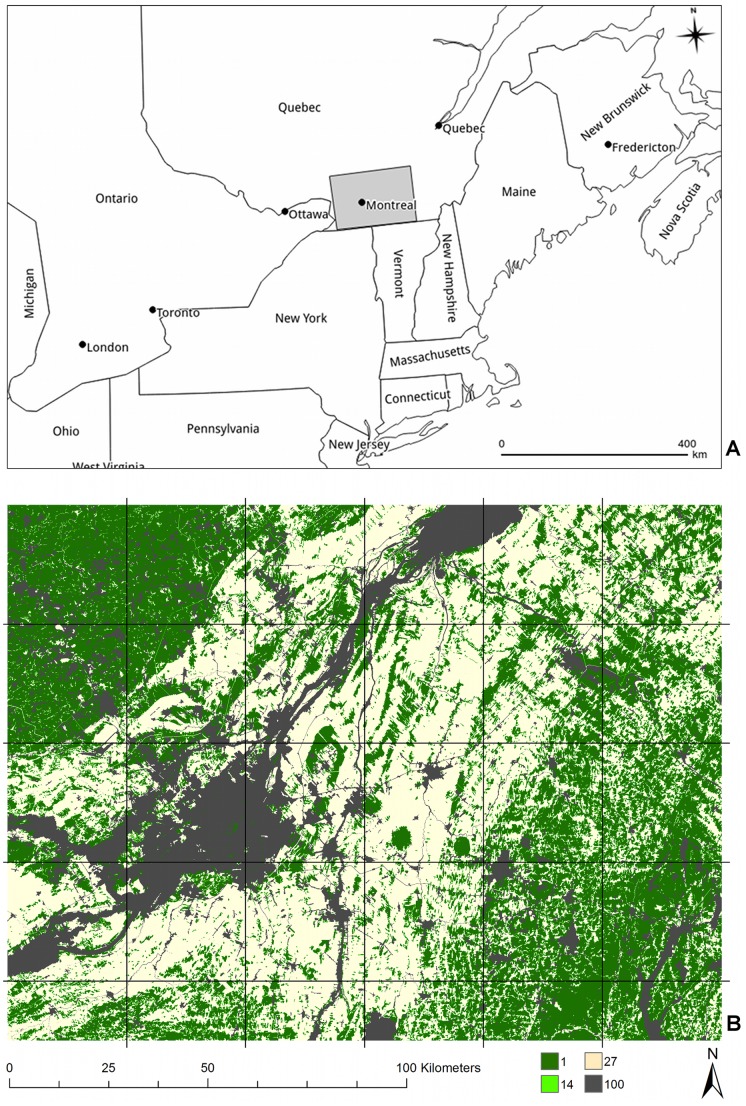
- Study area was 24,300 km² centered on the Montérégie near Montréal, Québec; 30 m SIEF land cover was reclassified into forest, vegetated forest edge, vegetated open areas, and non-vegetated open areas, with resistance values from Desrochers et al. for ovenbirds: 1, 14, 27, and 100.
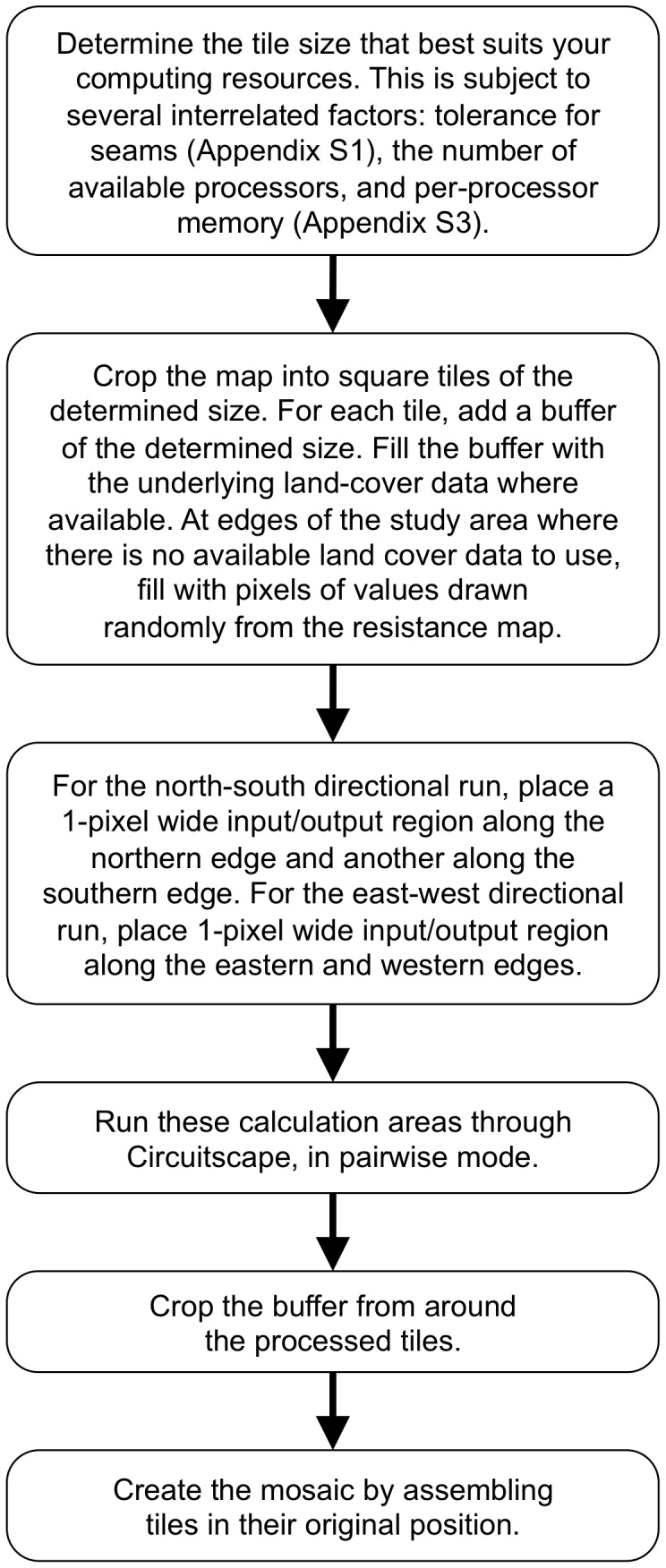
- Overlapping square tiles with buffers were processed in Circuitscape using pairwise runs with thin parallel strips on opposing sides for east-west/west-east and north-south/south-north directions; buffers were cropped, directional mosaics reassembled, and the two directional mosaics multiplied into an omnidirectional mosaic.
- A full 3 by 4 factorial design varied tile and buffer sizes; seam prominence was measured as Euclidean difference along seams, analyzed with two-way repeated-measures ANOVA, and mosaics were compared per-pixel after log10 transformation and stretching to 0–255.
Limitations
- Stated: a digital connectivity value does not imply certainty of where an organism will travel; it remains to be seen whether omnidirectional mosaics fit animal movement data at short time scales; and there are no clear guidelines for systematically determining pinch points or a reliable current threshold.
- Stated: processing 5000×5000-pixel calculation areas demanded substantial memory, and increasing buffer size or decreasing tile size increases processing cost, number of tiles, or both.
- Evident: resistance values are parameterized for one species (ovenbird) from translocation data, and this study does not validate the mosaics against movement observations; the Montérégie results are presented as an illustration rather than empirical validation.
Model-written summary. Check it against the paper before relying on it.
Integrity signals
Registry
Cites
Statistics
Figures
Verification
Claims the paper makes
26 Own result · 21 Own interpretation · 16 No basis given · 6 No full text of the sources · 3 Not checked yet · 3 Own method · 2 Supported so far · 2 Partly supported · 1 Supported · accuracy not yet measured
The cited sources support only part of this claim — read each source’s verdict below.
In the paper
“Biotic movements of genes, individuals, or populations through a network of forest patches may be critical for the maintenance of ecological and evolutionary processes across multiple spatial and temporal scales”
§ Applying Circuit Theory for Corridor Expansion and Management at Regional Scales: Tiling, Pinch Points, and Omnidirectional Connectivity > Introduction
What the sources say
- Not checked — no full text of the sourcecites [7] Bissonette JA (2007) Resource acquisition and animal response in dynamic landscapes: Keeping the books. In: Bissonette JA, Storch I, editors. Temporal Dimensions of Landscape Ecology: Wildlife Responses to Variable Resources. New York and Heidelberg: Springer-Verlag. 13–29. source
- Not checked — no full text of the sourcecites [8] K Johst, 2002, Metapopulation persistence in dynamic landscapes: the role of dispersal distance, Oikos source
- Partly supportedcites [9] MB McEachern, 2011, Bottlenecks and rescue effects in a fluctuating population of golden-mantled ground squirrels (Spermophilus lateralis), Conservation Genetics sourceExperimental — accuracy not yet measured
The Conclusions and conservation implications section says immigration and gene flow within a regional metapopulation are critical to long-term viability and that connectivity matters. But the Study site and species section describes squirrels occupying meadows and avoiding forests; the paper does not establish movement through a network of forest patches or maintenance of processes across multiple spatial and temporal scales. Page numbers were not available in our copy. (LLM, conf=0.87)
hedgedconditional- Asserted: passes — The authors put it forward as true.
- Checkable: passes — It can be checked against evidence.
- Load-bearing: passes — The paper’s conclusions depend on it.
- Based: passes — The paper gives a reason why it holds.
A result the paper reports from its own data — it cites no other source for it, so there is none to check. The quote shows it is in the paper.
In the paper
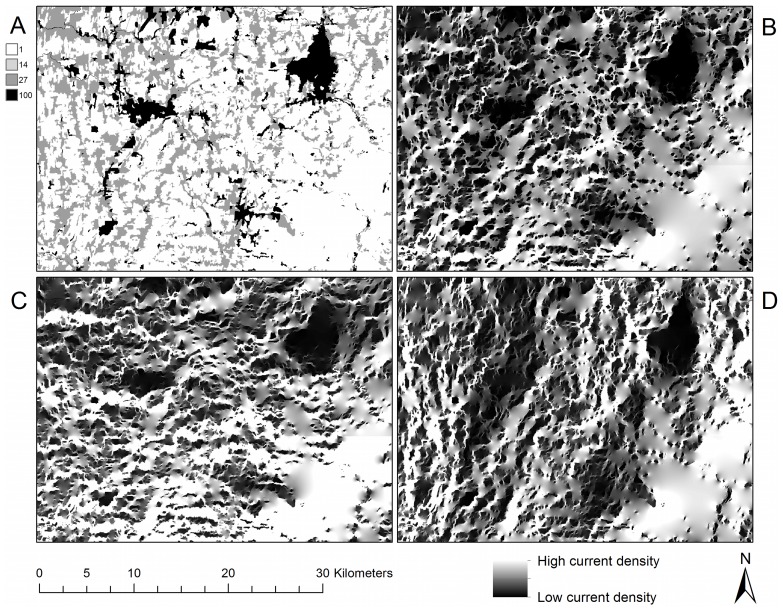
“The omnidirectional connectivity mosaic (Figure 4) illustrates the current flow, given the arrangement of land-cover resistance values, through each pixel of the map in multiple directions.”
§ Applying Circuit Theory for Corridor Expansion and Management at Regional Scales: Tiling, Pinch Points, and Omnidirectional Connectivity > Results > An Omnidirectional Estimate of Connectivity
plaindirect- Asserted: passes — The authors put it forward as true.
- Checkable: passes — It can be checked against evidence.
- Load-bearing: unclear — It is unclear whether the paper’s conclusions depend on it.
- Based: passes — The paper gives a reason why it holds.
A result the paper reports from its own data — it cites no other source for it, so there is none to check. The quote shows it is in the paper.
In the paper
“The choice of which orientation angle to use when creating tiles for the study area produced no discernable difference in the resulting current density mosaics (Appendix S2).”
§ Applying Circuit Theory for Corridor Expansion and Management at Regional Scales: Tiling, Pinch Points, and Omnidirectional Connectivity > Results > An Omnidirectional Estimate of Connectivity
plain- Asserted: passes — The authors put it forward as true.
- Checkable: passes — It can be checked against evidence.
- Load-bearing: unclear — It is unclear whether the paper’s conclusions depend on it.
- Based: passes — The paper gives a reason why it holds.
A result the paper reports from its own data — it cites no other source for it, so there is none to check. The quote shows it is in the paper.
In the paper
“Our prototype analysis produces a quantitative mapping of core habitat areas and possible movement pathways through the landscape.”
§ Applying Circuit Theory for Corridor Expansion and Management at Regional Scales: Tiling, Pinch Points, and Omnidirectional Connectivity > Discussion
plaindirect- Asserted: passes — The authors put it forward as true.
- Checkable: passes — It can be checked against evidence.
- Load-bearing: passes — The paper’s conclusions depend on it.
- Based: passes — The paper gives a reason why it holds.
A result the paper reports from its own data — it cites no other source for it, so there is none to check. The quote shows it is in the paper.
In the paper
“Using either of two other orientations, as well as incorporating the other orientations into a mosaic by blending it with tiling in the cardinal directions, did not discernibly affect the spatial patterns seen on the current density mosaic.”
§ Applying Circuit Theory for Corridor Expansion and Management at Regional Scales: Tiling, Pinch Points, and Omnidirectional Connectivity > Results > An Omnidirectional Estimate of Connectivity
plain- Asserted: passes — The authors put it forward as true.
- Checkable: passes — It can be checked against evidence.
- Load-bearing: passes — The paper’s conclusions depend on it.
- Based: passes — The paper gives a reason why it holds.
A result the paper reports from its own data — it cites no other source for it, so there is none to check. The quote shows it is in the paper.
In the paper
“Yet it is clear that current density also differs substantially within those forests.”
§ Applying Circuit Theory for Corridor Expansion and Management at Regional Scales: Tiling, Pinch Points, and Omnidirectional Connectivity > Results > Uneven Flow of Current in the Landscape
boosted- Asserted: passes — The authors put it forward as true.
- Checkable: passes — It can be checked against evidence.
- Load-bearing: passes — The paper’s conclusions depend on it.
- Based: passes — The paper gives a reason why it holds.
A result the paper reports from its own data — it cites no other source for it, so there is none to check. The quote shows it is in the paper.
In the paper
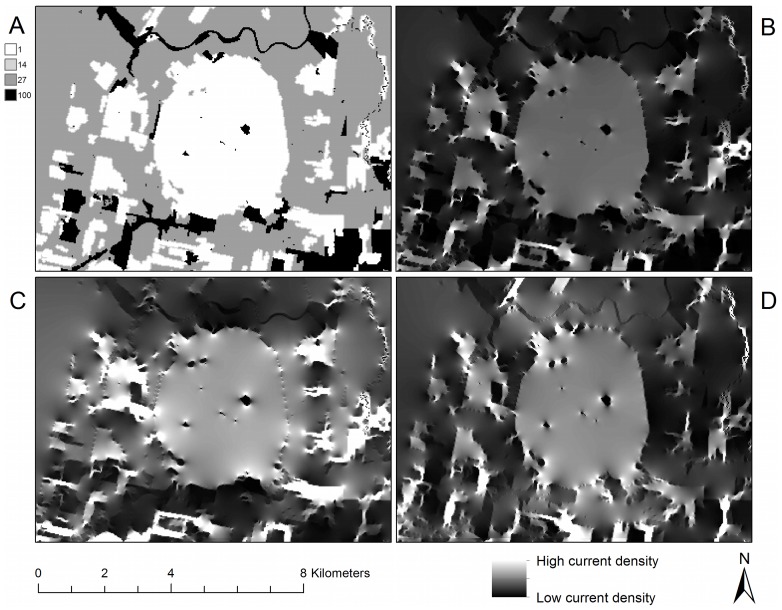
“The east-west directional mosaic illustrates several areas in the east-west direction where a substantial amount of current is forced to travel across non-forested areas (compare open areas west of the forested circular feature of Mount Yamaska in Figure 4a with Figure 4c).”
§ Applying Circuit Theory for Corridor Expansion and Management at Regional Scales: Tiling, Pinch Points, and Omnidirectional Connectivity > Results > An Omnidirectional Estimate of Connectivity
plaindirect- Asserted: passes — The authors put it forward as true.
- Checkable: passes — It can be checked against evidence.
- Load-bearing: unclear — It is unclear whether the paper’s conclusions depend on it.
- Based: passes — The paper gives a reason why it holds.
A result the paper reports from its own data — it cites no other source for it, so there is none to check. The quote shows it is in the paper.
In the paper
“there were very few detectable seams in the resulting mosaic.”
§ Applying Circuit Theory for Corridor Expansion and Management at Regional Scales: Tiling, Pinch Points, and Omnidirectional Connectivity > Discussion
plain- Asserted: passes — The authors put it forward as true.
- Checkable: passes — It can be checked against evidence.
- Load-bearing: unclear — It is unclear whether the paper’s conclusions depend on it.
- Based: passes — The paper gives a reason why it holds.
A result the paper reports from its own data — it cites no other source for it, so there is none to check. The quote shows it is in the paper.
In the paper
“Contiguous regions of high-resistance land cover types–here cities had the highest per-pixel resistance–produced a “current shadow” in complex shapes around the high-resistance pixels.”
§ Applying Circuit Theory for Corridor Expansion and Management at Regional Scales: Tiling, Pinch Points, and Omnidirectional Connectivity > Results > Shadow Effects in High-resistance Areas
plaindirect- Asserted: passes — The authors put it forward as true.
- Checkable: passes — It can be checked against evidence.
- Load-bearing: unclear — It is unclear whether the paper’s conclusions depend on it.
- Based: passes — The paper gives a reason why it holds.
The paper states this without a source or data behind it here, so there is nothing to check it against. The quote shows it is in the paper.
In the paper
“Following the approach we developed, it is possible to create omnidirectional connectivity mosaics representing very large areas.”
§ Applying Circuit Theory for Corridor Expansion and Management at Regional Scales: Tiling, Pinch Points, and Omnidirectional Connectivity > Conclusion
hedged- Asserted: passes — The authors put it forward as true.
- Checkable: passes — It can be checked against evidence.
- Load-bearing: passes — The paper’s conclusions depend on it.
- Based: passes — The paper gives a reason why it holds.
A result the paper reports from its own data — it cites no other source for it, so there is none to check. The quote shows it is in the paper.
In the paper
“Similarly, the north-south directional flow (Figure 5d) revealed a more substantial shadowing effect, for those obstacles (cities, in this case) that were wider in the dimension perpendicular to that of the modeled flow.”
§ Applying Circuit Theory for Corridor Expansion and Management at Regional Scales: Tiling, Pinch Points, and Omnidirectional Connectivity > Results > Shadow Effects in High-resistance Areas
plaincorrelational- Asserted: passes — The authors put it forward as true.
- Checkable: passes — It can be checked against evidence.
- Load-bearing: unclear — It is unclear whether the paper’s conclusions depend on it.
- Based: passes — The paper gives a reason why it holds.
The paper states this without a source or data behind it here, so there is nothing to check it against. The quote shows it is in the paper.
In the paper
“These avenues may include a combination of habitat coded as optimal and as sub-optimal.”
§ Applying Circuit Theory for Corridor Expansion and Management at Regional Scales: Tiling, Pinch Points, and Omnidirectional Connectivity > Discussion
hedged- Asserted: passes — The authors put it forward as true.
- Checkable: passes — It can be checked against evidence.
- Load-bearing: passes — The paper’s conclusions depend on it.
- Based: passes — The paper gives a reason why it holds.
The paper states this without a source or data behind it here, so there is nothing to check it against. The quote shows it is in the paper.
In the paper
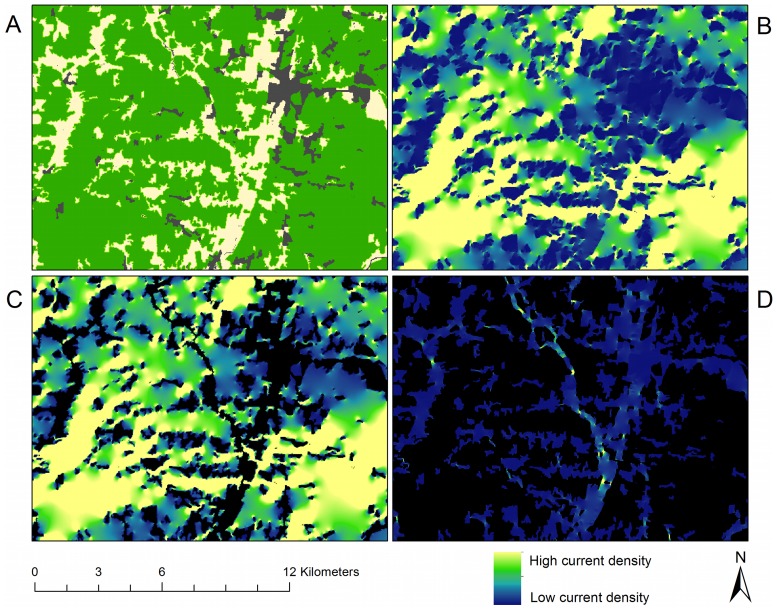
“In the north-south direction (Figure 4d), the current appears in paths that tend north and south.”
§ Applying Circuit Theory for Corridor Expansion and Management at Regional Scales: Tiling, Pinch Points, and Omnidirectional Connectivity > Results > An Omnidirectional Estimate of Connectivity
hedged- Asserted: passes — The authors put it forward as true.
- Checkable: passes — It can be checked against evidence.
- Load-bearing: unclear — It is unclear whether the paper’s conclusions depend on it.
- Based: passes — The paper gives a reason why it holds.
The paper states this without a source or data behind it here, so there is nothing to check it against. The quote shows it is in the paper.
In the paper
“Given enough memory and processor power, seam prominence can be decreased in predictable ways until seams are no longer a complicating factor in mosaic creation.”
§ Applying Circuit Theory for Corridor Expansion and Management at Regional Scales: Tiling, Pinch Points, and Omnidirectional Connectivity > Conclusion
plaindirect- Asserted: passes — The authors put it forward as true.
- Checkable: passes — It can be checked against evidence.
- Load-bearing: passes — The paper’s conclusions depend on it.
- Based: passes — The paper gives a reason why it holds.
A result the paper reports from its own data — it cites no other source for it, so there is none to check. The quote shows it is in the paper.
In the paper
“Like uneven flow in forests, non-forest current flow is not uniform, but rather favors those areas where land-cover composition and configuration force flow away from low-resistance forest pixels.”
§ Applying Circuit Theory for Corridor Expansion and Management at Regional Scales: Tiling, Pinch Points, and Omnidirectional Connectivity > Results > Uneven Flow of Current in the Landscape
plaindirect- Asserted: passes — The authors put it forward as true.
- Checkable: passes — It can be checked against evidence.
- Load-bearing: passes — The paper’s conclusions depend on it.
- Based: passes — The paper gives a reason why it holds.
A result the paper reports from its own data — it cites no other source for it, so there is none to check. The quote shows it is in the paper.
In the paper
“and four buffer sizes [F = 122.06, DFn = 3, DFd = 117, p = 7.06E-36*]”
§ Applying Circuit Theory for Corridor Expansion and Management at Regional Scales: Tiling, Pinch Points, and Omnidirectional Connectivity > Results > Mosaics of Current Density in the Montérégie
plaincorrelational- Asserted: passes — The authors put it forward as true.
- Checkable: passes — It can be checked against evidence.
- Load-bearing: passes — The paper’s conclusions depend on it.
- Based: passes — The paper gives a reason why it holds.
The paper states this without a source or data behind it here, so there is nothing to check it against. The quote shows it is in the paper.
In the paper
“The omnidirectional connectivity mosaic indicates that although per-pixel resistance values may be uniform for a given land cover type when stored in a GIS, differing configurations of land cover can strongly affect the estimated movement paths of organisms through these environments.”
§ Applying Circuit Theory for Corridor Expansion and Management at Regional Scales: Tiling, Pinch Points, and Omnidirectional Connectivity > Discussion
hedgeddirect- Asserted: passes — The authors put it forward as true.
- Checkable: passes — It can be checked against evidence.
- Load-bearing: passes — The paper’s conclusions depend on it.
- Based: passes — The paper gives a reason why it holds.
The paper states this without a source or data behind it here, so there is nothing to check it against. The quote shows it is in the paper.
In the paper
“our method creates connectivity mosaics of potentially immense size from tiles that retain their full initial spatial resolution.”
§ Applying Circuit Theory for Corridor Expansion and Management at Regional Scales: Tiling, Pinch Points, and Omnidirectional Connectivity > Discussion
plaindirect- Asserted: passes — The authors put it forward as true.
- Checkable: passes — It can be checked against evidence.
- Load-bearing: passes — The paper’s conclusions depend on it.
- Based: passes — The paper gives a reason why it holds.
The paper states this without a source or data behind it here, so there is nothing to check it against. The quote shows it is in the paper.
In the paper
“The north-south shadows of Figure 5d were still present in the omnidirectional connectivity mosaic (4b), though at a lesser intensity and different spatial structure.”
§ Applying Circuit Theory for Corridor Expansion and Management at Regional Scales: Tiling, Pinch Points, and Omnidirectional Connectivity > Results > Shadow Effects in High-resistance Areas
plain- Asserted: passes — The authors put it forward as true.
- Checkable: passes — It can be checked against evidence.
- Load-bearing: unclear — It is unclear whether the paper’s conclusions depend on it.
- Based: passes — The paper gives a reason why it holds.
The paper states this without a source or data behind it here, so there is nothing to check it against. The quote shows it is in the paper.
In the paper
“Produced from 30 tiles, the mosaic is clearly dominated by the characteristics of the amount and location of forest, as would be expected from the resistance values used.”
§ Applying Circuit Theory for Corridor Expansion and Management at Regional Scales: Tiling, Pinch Points, and Omnidirectional Connectivity > Results > Mosaics of Current Density in the Montérégie
boosteddirect- Asserted: passes — The authors put it forward as true.
- Checkable: passes — It can be checked against evidence.
- Load-bearing: unclear — It is unclear whether the paper’s conclusions depend on it.
- Based: passes — The paper gives a reason why it holds.
A result the paper reports from its own data — it cites no other source for it, so there is none to check. The quote shows it is in the paper.
In the paper
“In the east-west directional mosaic (Figure 4c), the landscape is configured in such a way that travel through the mountain’s forests is heavily favored.”
§ Applying Circuit Theory for Corridor Expansion and Management at Regional Scales: Tiling, Pinch Points, and Omnidirectional Connectivity > Results > An Omnidirectional Estimate of Connectivity
plaindirect- Asserted: passes — The authors put it forward as true.
- Checkable: passes — It can be checked against evidence.
- Load-bearing: unclear — It is unclear whether the paper’s conclusions depend on it.
- Based: passes — The paper gives a reason why it holds.
A result the paper reports from its own data — it cites no other source for it, so there is none to check. The quote shows it is in the paper.
In the paper
“There was no significant interaction between the factors (Figure S1 in Appendix S1).”
§ Applying Circuit Theory for Corridor Expansion and Management at Regional Scales: Tiling, Pinch Points, and Omnidirectional Connectivity > Results > Mosaics of Current Density in the Montérégie
plain- Asserted: passes — The authors put it forward as true.
- Checkable: passes — It can be checked against evidence.
- Load-bearing: unclear — It is unclear whether the paper’s conclusions depend on it.
- Based: passes — The paper gives a reason why it holds.
The paper states this without a source or data behind it here, so there is nothing to check it against. The quote shows it is in the paper.
In the paper
“The mosaics clearly show variations in current flow driven by subtle aspects of landscape composition and configuration.”
§ Applying Circuit Theory for Corridor Expansion and Management at Regional Scales: Tiling, Pinch Points, and Omnidirectional Connectivity > Abstract
boosteddirect- Asserted: passes — The authors put it forward as true.
- Checkable: passes — It can be checked against evidence.
- Load-bearing: passes — The paper’s conclusions depend on it.
- Based: passes — The paper gives a reason why it holds.
A result the paper reports from its own data — it cites no other source for it, so there is none to check. The quote shows it is in the paper.
In the paper
“There was a significant effect across three tile sizes [F = 62.77, DFn = 2, DFd = 78, p = 5.67E-17*]”
§ Applying Circuit Theory for Corridor Expansion and Management at Regional Scales: Tiling, Pinch Points, and Omnidirectional Connectivity > Results > Mosaics of Current Density in the Montérégie
plaincorrelational- Asserted: passes — The authors put it forward as true.
- Checkable: passes — It can be checked against evidence.
- Load-bearing: passes — The paper’s conclusions depend on it.
- Based: passes — The paper gives a reason why it holds.
A result the paper reports from its own data — it cites no other source for it, so there is none to check. The quote shows it is in the paper.
In the paper
“Current flows around obstacles of high resistance in favor of flow through low- and medium-resistance land cover types (Figure 4a), responding to the composition and configuration of the landscape.”
§ Applying Circuit Theory for Corridor Expansion and Management at Regional Scales: Tiling, Pinch Points, and Omnidirectional Connectivity > Results > An Omnidirectional Estimate of Connectivity
plaindirect- Asserted: passes — The authors put it forward as true.
- Checkable: passes — It can be checked against evidence.
- Load-bearing: passes — The paper’s conclusions depend on it.
- Based: passes — The paper gives a reason why it holds.
A result the paper reports from its own data — it cites no other source for it, so there is none to check. The quote shows it is in the paper.
In the paper
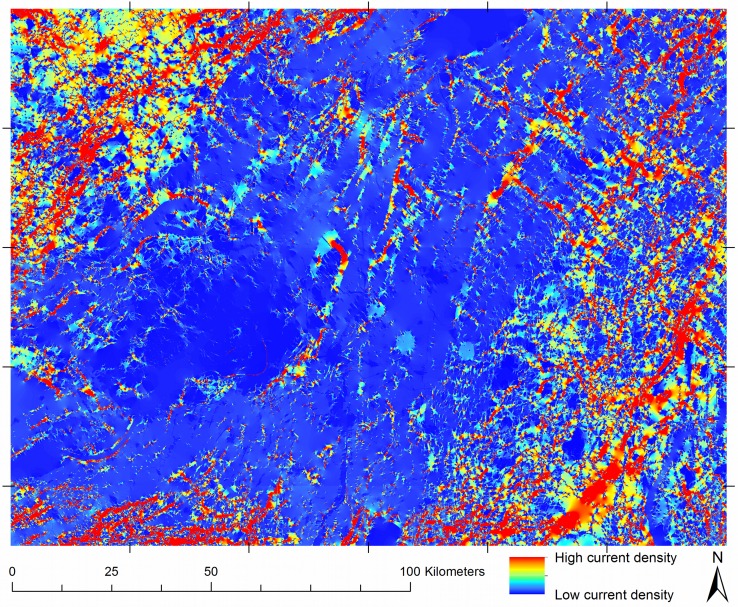
“Given the resistance settings of this illustration, forest pixels have, in general, high current density in the omnidirectional mosaic of the Montérégie (Figure 6).”
§ Applying Circuit Theory for Corridor Expansion and Management at Regional Scales: Tiling, Pinch Points, and Omnidirectional Connectivity > Results > Uneven Flow of Current in the Landscape
plaincorrelational- Asserted: passes — The authors put it forward as true.
- Checkable: passes — It can be checked against evidence.
- Load-bearing: unclear — It is unclear whether the paper’s conclusions depend on it.
- Based: passes — The paper gives a reason why it holds.
The paper states this without a source or data behind it here, so there is nothing to check it against. The quote shows it is in the paper.
In the paper
“The resulting mosaics provide a continuous view of connectivity in the entire study area at the full original resolution.”
§ Applying Circuit Theory for Corridor Expansion and Management at Regional Scales: Tiling, Pinch Points, and Omnidirectional Connectivity > Abstract
plain- Asserted: passes — The authors put it forward as true.
- Checkable: passes — It can be checked against evidence.
- Load-bearing: passes — The paper’s conclusions depend on it.
- Based: passes — The paper gives a reason why it holds.
A result the paper reports from its own data — it cites no other source for it, so there is none to check. The quote shows it is in the paper.
In the paper
“High-resistance areas produce important secondary effects in omnidirectional connectivity mosaics (Figure 5).”
§ Applying Circuit Theory for Corridor Expansion and Management at Regional Scales: Tiling, Pinch Points, and Omnidirectional Connectivity > Results > Shadow Effects in High-resistance Areas
plaindirect- Asserted: passes — The authors put it forward as true.
- Checkable: passes — It can be checked against evidence.
- Load-bearing: passes — The paper’s conclusions depend on it.
- Based: passes — The paper gives a reason why it holds.
A result the paper reports from its own data — it cites no other source for it, so there is none to check. The quote shows it is in the paper.
In the paper
“Given that the seam prominence could be precisely tuned with a combination of buffer size and tile size”
§ Applying Circuit Theory for Corridor Expansion and Management at Regional Scales: Tiling, Pinch Points, and Omnidirectional Connectivity > Results > Mosaics of Current Density in the Montérégie
hedgeddirect- Asserted: passes — The authors put it forward as true.
- Checkable: passes — It can be checked against evidence.
- Load-bearing: passes — The paper’s conclusions depend on it.
- Based: passes — The paper gives a reason why it holds.
A conclusion the paper draws from its own results — it cites no other source for it, so there is none to check. The quote shows it is in the paper.
In the paper
“This reveals clear variation in the expected use of the landscape, given the resistance parameters modeled here, by animals travelling in this direction.”
§ Applying Circuit Theory for Corridor Expansion and Management at Regional Scales: Tiling, Pinch Points, and Omnidirectional Connectivity > Results > An Omnidirectional Estimate of Connectivity
boostedcorrelational- Asserted: passes — The authors put it forward as true.
- Checkable: passes — It can be checked against evidence.
- Load-bearing: unclear — It is unclear whether the paper’s conclusions depend on it.
- Based: passes — The paper gives a reason why it holds.
A conclusion the paper draws from its own results — it cites no other source for it, so there is none to check. The quote shows it is in the paper.
In the paper
“For this reason, seam values in a given mosaic may approach zero, but are not expected to be zero.”
§ Applying Circuit Theory for Corridor Expansion and Management at Regional Scales: Tiling, Pinch Points, and Omnidirectional Connectivity > Methods > Mosaic Creation and Analysis
hedged- Asserted: passes — The authors put it forward as true.
- Checkable: passes — It can be checked against evidence.
- Load-bearing: unclear — It is unclear whether the paper’s conclusions depend on it.
- Based: passes — The paper gives a reason why it holds.
A conclusion the paper draws from its own results — it cites no other source for it, so there is none to check. The quote shows it is in the paper.
In the paper
“Outside forests (Figure 6d), areas of high current density indicate where the demand for access from one forest patch to another is so great that current jumps across open areas despite their high resistance.”
§ Applying Circuit Theory for Corridor Expansion and Management at Regional Scales: Tiling, Pinch Points, and Omnidirectional Connectivity > Results > Uneven Flow of Current in the Landscape
hedgeddirect- Asserted: passes — The authors put it forward as true.
- Checkable: passes — It can be checked against evidence.
- Load-bearing: passes — The paper’s conclusions depend on it.
- Based: passes — The paper gives a reason why it holds.
In the paper
“The ability to create an omnidirectional connectivity mosaic across a large area addresses the pressing challenge of producing “maps of areas important for connectivity” [52].”
§ Applying Circuit Theory for Corridor Expansion and Management at Regional Scales: Tiling, Pinch Points, and Omnidirectional Connectivity > Discussion
What the sources say
- Not checked — no full text of the sourcecites [52] P Beier, 2011, Toward best practices for developing regional connectivity maps, Conservation Biology source
plaindirect- Asserted: passes — The authors put it forward as true.
- Checkable: passes — It can be checked against evidence.
- Load-bearing: passes — The paper’s conclusions depend on it.
- Based: passes — The paper gives a reason why it holds.
A conclusion the paper draws from its own results — it cites no other source for it, so there is none to check. The quote shows it is in the paper.
In the paper
“Using modest computational resources, these continuous, fine-scale maps of nearly unlimited size allow the identification of movement paths and barriers that affect connectivity.”
§ Applying Circuit Theory for Corridor Expansion and Management at Regional Scales: Tiling, Pinch Points, and Omnidirectional Connectivity > Abstract
plaindirect- Asserted: passes — The authors put it forward as true.
- Checkable: passes — It can be checked against evidence.
- Load-bearing: passes — The paper’s conclusions depend on it.
- Based: passes — The paper gives a reason why it holds.
A conclusion the paper draws from its own results — it cites no other source for it, so there is none to check. The quote shows it is in the paper.
In the paper
“It substantially extends the reach of circuit theory’s application to landscapes by enabling a seamless, arbitrarily large omnidirectional connectivity map at the full resolution of the input land cover information.”
§ Applying Circuit Theory for Corridor Expansion and Management at Regional Scales: Tiling, Pinch Points, and Omnidirectional Connectivity > Discussion
plaindirect- Asserted: passes — The authors put it forward as true.
- Checkable: passes — It can be checked against evidence.
- Load-bearing: passes — The paper’s conclusions depend on it.
- Based: passes — The paper gives a reason why it holds.
A conclusion the paper draws from its own results — it cites no other source for it, so there is none to check. The quote shows it is in the paper.
In the paper
“Given a landscape’s patterns of land cover composition and configuration, not all habitat of a given land cover type is likely to present the same ease of movement for organisms.”
§ Applying Circuit Theory for Corridor Expansion and Management at Regional Scales: Tiling, Pinch Points, and Omnidirectional Connectivity > Discussion
hedgedconditional- Asserted: passes — The authors put it forward as true.
- Checkable: passes — It can be checked against evidence.
- Load-bearing: passes — The paper’s conclusions depend on it.
- Based: passes — The paper gives a reason why it holds.
A conclusion the paper draws from its own results — it cites no other source for it, so there is none to check. The quote shows it is in the paper.
In the paper
“This feature may increase the applicability of circuit-based connectivity analyses for organisms that interact with the landscape at fine spatial scales due to restricted mobility or habitat requirements.”
§ Applying Circuit Theory for Corridor Expansion and Management at Regional Scales: Tiling, Pinch Points, and Omnidirectional Connectivity > Discussion
hedgedconditional- Asserted: passes — The authors put it forward as true.
- Checkable: passes — It can be checked against evidence.
- Load-bearing: unclear — It is unclear whether the paper’s conclusions depend on it.
- Based: passes — The paper gives a reason why it holds.
A conclusion the paper draws from its own results — it cites no other source for it, so there is none to check. The quote shows it is in the paper.
In the paper
“The connectivity mosaic estimates that in general, forests located near urbanized areas are likely to be less frequently used for movement.”
§ Applying Circuit Theory for Corridor Expansion and Management at Regional Scales: Tiling, Pinch Points, and Omnidirectional Connectivity > Results > Mosaics of Current Density in the Montérégie
hedgedcorrelational- Asserted: passes — The authors put it forward as true.
- Checkable: passes — It can be checked against evidence.
- Load-bearing: unclear — It is unclear whether the paper’s conclusions depend on it.
- Based: passes — The paper gives a reason why it holds.
A conclusion the paper draws from its own results — it cites no other source for it, so there is none to check. The quote shows it is in the paper.
In the paper
“High current flow in non-forest areas corresponds to open areas that are not currently part of an entirely forested corridor, but which, according to the omnidirectional model, could form part of heavily traveled routes (Figure 6d).”
§ Applying Circuit Theory for Corridor Expansion and Management at Regional Scales: Tiling, Pinch Points, and Omnidirectional Connectivity > Results > Uneven Flow of Current in the Landscape
hedgedcorrelational- Asserted: passes — The authors put it forward as true.
- Checkable: passes — It can be checked against evidence.
- Load-bearing: passes — The paper’s conclusions depend on it.
- Based: passes — The paper gives a reason why it holds.
A conclusion the paper draws from its own results — it cites no other source for it, so there is none to check. The quote shows it is in the paper.
In the paper
“This appears to be driven by the city’s configuration: the wider (eastern) part of the city casts a bigger shadow.”
§ Applying Circuit Theory for Corridor Expansion and Management at Regional Scales: Tiling, Pinch Points, and Omnidirectional Connectivity > Results > Shadow Effects in High-resistance Areas
hedgeddirectSingle case- Asserted: passes — The authors put it forward as true.
- Checkable: passes — It can be checked against evidence.
- Load-bearing: unclear — It is unclear whether the paper’s conclusions depend on it.
- Based: passes — The paper gives a reason why it holds.
A conclusion the paper draws from its own results — it cites no other source for it, so there is none to check. The quote shows it is in the paper.
In the paper
“This confirmed our experience that north-south and east-west runs were sufficient to capture the spatial variation in current density without the need to incorporate a suite of other tiling angles.”
§ Applying Circuit Theory for Corridor Expansion and Management at Regional Scales: Tiling, Pinch Points, and Omnidirectional Connectivity > Results > An Omnidirectional Estimate of Connectivity
boosted- Asserted: passes — The authors put it forward as true.
- Checkable: passes — It can be checked against evidence.
- Load-bearing: passes — The paper’s conclusions depend on it.
- Based: passes — The paper gives a reason why it holds.
In the paper
“This can be due to barriers in the immediate area surrounding a given pixel [27] as well as more distant “shadow” effects viewed in this study.”
§ Applying Circuit Theory for Corridor Expansion and Management at Regional Scales: Tiling, Pinch Points, and Omnidirectional Connectivity > Discussion
What the sources say
- Not checked — no full text of the sourcecites [27] BH McRae, 2006, Isolation by resistance, Evolution source
plainconditional- Asserted: passes — The authors put it forward as true.
- Checkable: passes — It can be checked against evidence.
- Load-bearing: passes — The paper’s conclusions depend on it.
- Based: passes — The paper gives a reason why it holds.
None of the sources cited for this claim have been checked yet.
In the paper
“First, because its technical demands increase with the number of land-surface pixels being considered, circuit modeling runs are constrained to limited raster sizes: relatively small areas or large areas at coarsened spatial resolutions [31], [33], [36], [45], [46].”
§ Applying Circuit Theory for Corridor Expansion and Management at Regional Scales: Tiling, Pinch Points, and Omnidirectional Connectivity > Introduction
What the sources say
- Not checked yetcites [31] McRae BH, Shah VB (2009) Circuitscape user's guide. Santa Barbara: University of California. Available: http://circuitscape.org. Accessed 2012 February 15.
- Not checked — no full text of the sourcecites [33] JA Moore, 2011, Effects of the landscape on boreal toad gene flow: does the pattern-process relationship hold true across distinct landscapes at the northern range margin?, Molecular Ecology source
- Not checked — no full text of the sourcecites [36] AJ Shirk, 2010, Inferring landscape effects on gene flow: a new model selection framework, Molecular Ecology source
plaindirect- Asserted: passes — The authors put it forward as true.
- Checkable: passes — It can be checked against evidence.
- Load-bearing: passes — The paper’s conclusions depend on it.
- Based: passes — The paper gives a reason why it holds.
A conclusion the paper draws from its own results — it cites no other source for it, so there is none to check. The quote shows it is in the paper.
In the paper
“Avenues of high current density suggest that the organisms under study (given that the chosen resistance estimates adequately represent true movement characteristics) are likely to pass through them as they move through the landscape.”
§ Applying Circuit Theory for Corridor Expansion and Management at Regional Scales: Tiling, Pinch Points, and Omnidirectional Connectivity > Discussion
hedgedconditional- Asserted: passes — The authors put it forward as true.
- Checkable: passes — It can be checked against evidence.
- Load-bearing: passes — The paper’s conclusions depend on it.
- Based: passes — The paper gives a reason why it holds.
- The authors state this as an assumption: The chosen resistance estimates adequately represent true movement characteristics.
None of the sources cited for this claim have been checked yet.
In the paper
“Compared to the many methods that can be used to quantify the characteristics of a patch-based analysis represented with nodes and links [16] there is a paucity of strategies to analyze the results of continuous connectivity maps [60].”
§ Applying Circuit Theory for Corridor Expansion and Management at Regional Scales: Tiling, Pinch Points, and Omnidirectional Connectivity > Discussion
What the sources say
- Not checked — no full text of the sourcecites [16] B Rayfield, 2011, Connectivity for conservation: a framework to classify network measures, Ecology source
- Not checked yetcites [60] DA Rudnick, 2012, The role of landscape connectivity in planning and implementing conservation and restoration priorities, Issues in Ecology: Report Number 16, Fall
plain- Asserted: passes — The authors put it forward as true.
- Checkable: passes — It can be checked against evidence.
- Load-bearing: passes — The paper’s conclusions depend on it.
- Based: passes — The paper gives a reason why it holds.
A conclusion the paper draws from its own results — it cites no other source for it, so there is none to check. The quote shows it is in the paper.
In the paper
“Using the connectivity mosaic (Figure 6, Figure 7), potential locations for corridor expansion and priority management can be identified.”
§ Applying Circuit Theory for Corridor Expansion and Management at Regional Scales: Tiling, Pinch Points, and Omnidirectional Connectivity > Discussion
plaindirect- Asserted: passes — The authors put it forward as true.
- Checkable: passes — It can be checked against evidence.
- Load-bearing: passes — The paper’s conclusions depend on it.
- Based: passes — The paper gives a reason why it holds.
- Probably not a substantial claim. 19
- It may state two separate claims as one. 18
The sources with a verdict support this claim; the rest weren’t checked yet, have no full text we could read, or their verdicts aren’t rated yet.
In the paper
“animals are well known to dwell in or pass through non-optimal habitat [54], [55]”
§ Applying Circuit Theory for Corridor Expansion and Management at Regional Scales: Tiling, Pinch Points, and Omnidirectional Connectivity > Discussion
What the sources say
- Supportedcites [54] T Tscharntke, 2012, Landscape moderation of biodiversity patterns and processes - eight hypotheses, Biological Reviews source
The Introduction (page unavailable) says the matrix surrounding habitat fragments is usually not completely hostile and can provide resources that affect persistence and dispersal. The cross-habitat spillover section (page unavailable) describes organisms moving between natural and human-managed habitats, supporting the claim that animals can occupy or pass through less-suitable habitat. (LLM, conf=0.87)
- Not checked yetcites [55] P Beier, 1992, A checklist for evaluating impacts to wildlife movement corridors, Wildlife Society Bulletin
boosted- Asserted: passes — The authors put it forward as true.
- Checkable: passes — It can be checked against evidence.
- Load-bearing: passes — The paper’s conclusions depend on it.
- Based: passes — The paper gives a reason why it holds.
Probably not a substantial claim.
- Supported
Every source the paper cites for this claim was checked and supports it.
In the paper
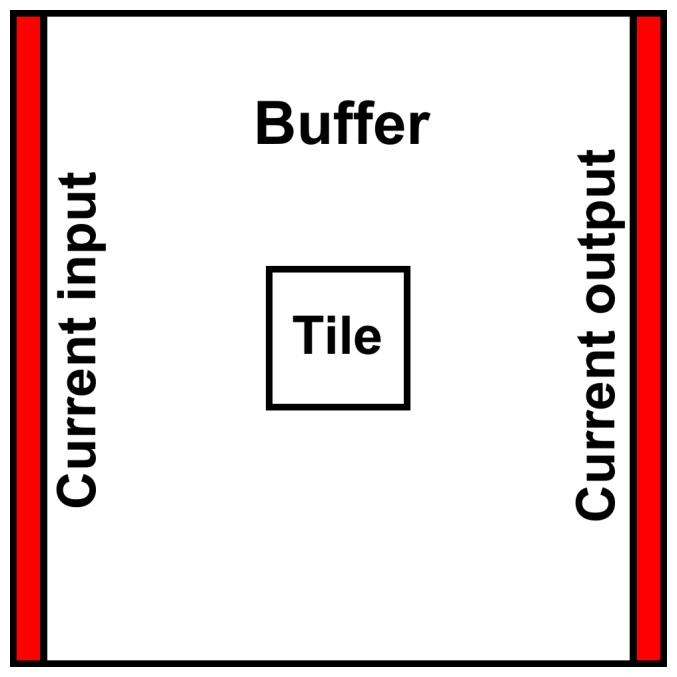
“To minimize border effects that could be formed by the tiling process [51], we created a buffer around each tile with the surrounding land cover data to form larger and overlapping calculation areas for processing in Circuitscape (Figure 2).”
§ Applying Circuit Theory for Corridor Expansion and Management at Regional Scales: Tiling, Pinch Points, and Omnidirectional Connectivity > Methods > Directional and Omnidirectional Connectivity with Circuitscape
What the sources say
- Supportedcites [51] EL Koen, 2010, The effect of map boundary on estimates of landscape resistance to animal movement, PLoS One source
The Results report that omitting a buffer overestimated landscape resistance relative to using a buffer of real data. The Discussion recommends buffers to reduce bias from map boundaries. The cited paper supports the rationale for buffering, while tiling describes the citing authors’ application of that rationale. (LLM, conf=0.91)
plaindirect- Asserted: passes — The authors put it forward as true.
- Checkable: passes — It can be checked against evidence.
- Load-bearing: passes — The paper’s conclusions depend on it.
- Based: passes — The paper gives a reason why it holds.
Probably not a substantial claim.
- Supported
The sources with a verdict support this claim; the rest weren’t checked yet, have no full text we could read, or their verdicts aren’t rated yet.
In the paper
“These strategies are in active development [57]–[59], and include the detection of barriers that impede movement [56].”
§ Applying Circuit Theory for Corridor Expansion and Management at Regional Scales: Tiling, Pinch Points, and Omnidirectional Connectivity > Discussion
What the sources say
- Not checked — no full text of the sourcecites [57] SA Cushman, 2012, Evaluating the sufficiency of protected lands for maintaining wildlife population connectivity in the U.S. northern Rocky Mountains, Diversity and Distributions source
- Not checked — no full text of the sourcecites [58] NE Heller, 2009, Biodiversity management in the face of climate change: A review of 22 years of recommendations, Biological Conservation source
- Not checked — no full text of the sourcecites [59] BW Compton, 2007, A resistant-kernel model of connectivity for amphibians that breed in vernal pools, Conservation Biology source
- Supportedcites [56] BH McRae, 2012, Where to restore ecological connectivity? Detecting barriers and quantifying restoration benefits, PLoS ONE source
The citation to this paper is attached to the detection of barriers, not to the separate statement that strategies are in active development. The Introduction defines barriers as landscape features that impede movement and describes detecting them as a restoration strategy. (LLM, conf=0.94)
plain- Asserted: passes — The authors put it forward as true.
- Checkable: passes — It can be checked against evidence.
- Load-bearing: fails — The paper’s conclusions may not depend on it.
- Based: passes — The paper gives a reason why it holds.
Probably not a substantial claim. The paper’s conclusions may not depend on it. It may state two separate claims as one.
The cited sources support only part of this claim — read each source’s verdict below.
In the paper
“It has already been demonstrated that across long time scales at which genetic mutations can be measured, resistance distance is strongly correlated to the differences between populations [28], [29], [42].”
§ Applying Circuit Theory for Corridor Expansion and Management at Regional Scales: Tiling, Pinch Points, and Omnidirectional Connectivity > Discussion
What the sources say
- Not checked — no full text of the sourcecites [28] BH McRae, 2008, Using circuit theory to model connectivity in ecology, evolution, and conservation, Ecology source
- Partly supportedcites [29] BH McRae, 2007, Circuit theory predicts gene flow in plant and animal populations, Proceedings of the National Academy of Sciences of the United States of America sourceExperimental — accuracy not yet measured
The Results tables report strong correlations between resistance distance and genetic differentiation in mahogany and wolverine populations (R² = 0.68–0.85 across the listed measures). The paper discusses gene flow over many generations, but does not establish the claim’s specific time-scale qualifier—that these are long time scales at which genetic mutations can be measured. (LLM, conf=0.85)
- Not checked — no full text of the sourcecites [42] SF Spear, 2010, Use of resistance surfaces for landscape genetic studies: considerations for parameterization and analysis, Molecular Ecology source
boostedcorrelational- Asserted: passes — The authors put it forward as true.
- Checkable: passes — It can be checked against evidence.
- Load-bearing: fails — The paper’s conclusions may not depend on it.
- Based: passes — The paper gives a reason why it holds.
Probably not a substantial claim. The paper’s conclusions may not depend on it.
The paper states this without a source or data behind it here, so there is nothing to check it against. The quote shows it is in the paper.
In the paper
“The omnidirectional connectivity mosaic (Figure 5b) both blends and enhances these shadowing effects in its representation of connectivity in all directions.”
§ Applying Circuit Theory for Corridor Expansion and Management at Regional Scales: Tiling, Pinch Points, and Omnidirectional Connectivity > Results > Shadow Effects in High-resistance Areas
plaindirect- Asserted: passes — The authors put it forward as true.
- Checkable: passes — It can be checked against evidence.
- Load-bearing: unclear — It is unclear whether the paper’s conclusions depend on it.
- Based: passes — The paper gives a reason why it holds.
It may state two separate claims as one.
A result the paper reports from its own data — it cites no other source for it, so there is none to check. The quote shows it is in the paper.
In the paper
“Using either a larger tile size or larger buffer to create the Circuitscape calculation area served to produce mosaics with less prominent seams.”
- Also stated in: § Discussion · plain
“Prominent seams, which in our opinion are detrimental to the assembly of these tiles into mosaics, can be greatly reduced by increasing the tile size or the buffer size used to create the Circuitscape calculation area.”
§ Applying Circuit Theory for Corridor Expansion and Management at Regional Scales: Tiling, Pinch Points, and Omnidirectional Connectivity > Results > Mosaics of Current Density in the Montérégie
plaindirect- Asserted: passes — The authors put it forward as true.
- Checkable: passes — It can be checked against evidence.
- Load-bearing: passes — The paper’s conclusions depend on it.
- Based: passes — The paper gives a reason why it holds.
It may state two separate claims as one.
- Also stated in: § Discussion · plain
The paper states this without a source or data behind it here, so there is nothing to check it against. The quote shows it is in the paper.
In the paper
“For example, in the city located in the northeast part of the image in the east-west directional flow (Figure 5c), the shadow is larger than the city itself and visible well beyond the city’s pixel limits.”
§ Applying Circuit Theory for Corridor Expansion and Management at Regional Scales: Tiling, Pinch Points, and Omnidirectional Connectivity > Results > Shadow Effects in High-resistance Areas
plainSingle case- Asserted: passes — The authors put it forward as true.
- Checkable: passes — It can be checked against evidence.
- Load-bearing: unclear — It is unclear whether the paper’s conclusions depend on it.
- Based: passes — The paper gives a reason why it holds.
It may state two separate claims as one.
A result the paper reports from its own data — it cites no other source for it, so there is none to check. The quote shows it is in the paper.
In the paper
“The choices of tile size and buffer size used to create the calculation area affected the prominence of seams in strongly predictable ways (Table 1).”
- Also stated in: § Conclusion · boosted
“Seam prominence is highly dependent on choices of tile size and buffer size.”
§ Applying Circuit Theory for Corridor Expansion and Management at Regional Scales: Tiling, Pinch Points, and Omnidirectional Connectivity > Results > Mosaics of Current Density in the Montérégie
boosteddirect- Asserted: passes — The authors put it forward as true.
- Checkable: passes — It can be checked against evidence.
- Load-bearing: passes — The paper’s conclusions depend on it.
- Based: passes — The paper gives a reason why it holds.
It may state two separate claims as one.
- Also stated in: § Conclusion · boosted
A result the paper reports from its own data — it cites no other source for it, so there is none to check. The quote shows it is in the paper.
In the paper
“The strength of each factor is of the same order of magnitude (Table 1), meaning that both factors can contribute substantially to reducing seam prominence.”
§ Applying Circuit Theory for Corridor Expansion and Management at Regional Scales: Tiling, Pinch Points, and Omnidirectional Connectivity > Results > Mosaics of Current Density in the Montérégie
plaindirect- Asserted: passes — The authors put it forward as true.
- Checkable: passes — It can be checked against evidence.
- Load-bearing: passes — The paper’s conclusions depend on it.
- Based: passes — The paper gives a reason why it holds.
It may state two separate claims as one.
The paper states this without a source or data behind it here, so there is nothing to check it against. The quote shows it is in the paper.
In the paper
“In general, current density is highest in forest pixels, indicating that given the resistance values and the spatial configuration of land covers in the study area, current flows through forest whenever possible.”
§ Applying Circuit Theory for Corridor Expansion and Management at Regional Scales: Tiling, Pinch Points, and Omnidirectional Connectivity > Results > Mosaics of Current Density in the Montérégie
hedgeddirect- Asserted: passes — The authors put it forward as true.
- Checkable: passes — It can be checked against evidence.
- Load-bearing: unclear — It is unclear whether the paper’s conclusions depend on it.
- Based: passes — The paper gives a reason why it holds.
It may state two separate claims as one.
The paper states this without a source or data behind it here, so there is nothing to check it against. The quote shows it is in the paper.
In the paper
“Shown prominently in mosaics are pinch points, narrow corridors where organisms appear to be required to traverse when moving through the landscape.”
§ Applying Circuit Theory for Corridor Expansion and Management at Regional Scales: Tiling, Pinch Points, and Omnidirectional Connectivity > Abstract
hedged- Asserted: passes — The authors put it forward as true.
- Checkable: passes — It can be checked against evidence.
- Load-bearing: passes — The paper’s conclusions depend on it.
- Based: passes — The paper gives a reason why it holds.
Probably not a substantial claim.
A result the paper reports from its own data — it cites no other source for it, so there is none to check. The quote shows it is in the paper.
In the paper
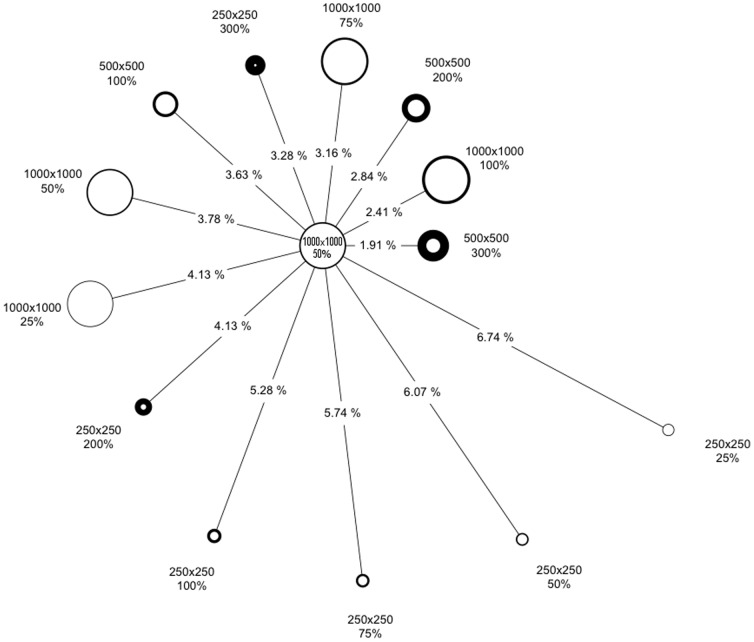
“the most similar results had the largest buffer sizes (500×500 tiles with a 200% buffer), the largest tile sizes (1000×1000 tiles with a 75% buffer, 1000×1000 tiles with a 50% buffer), or both (1000×1000 tiles with a 100% buffer).”
§ Applying Circuit Theory for Corridor Expansion and Management at Regional Scales: Tiling, Pinch Points, and Omnidirectional Connectivity > Results > Mosaics of Current Density in the Montérégie
plaincorrelational- Asserted: passes — The authors put it forward as true.
- Checkable: passes — It can be checked against evidence.
- Load-bearing: passes — The paper’s conclusions depend on it.
- Based: passes — The paper gives a reason why it holds.
It may state two separate claims as one.
A result the paper reports from its own data — it cites no other source for it, so there is none to check. The quote shows it is in the paper.
In the paper
“Although the processing in Circuitscape of calculation areas of 5000×5000 pixels demanded substantial memory (Appendix S3)”
§ Applying Circuit Theory for Corridor Expansion and Management at Regional Scales: Tiling, Pinch Points, and Omnidirectional Connectivity > Discussion
plaindirect- Asserted: passes — The authors put it forward as true.
- Checkable: passes — It can be checked against evidence.
- Load-bearing: fails — The paper’s conclusions may not depend on it.
- Based: passes — The paper gives a reason why it holds.
Probably not a substantial claim. The paper’s conclusions may not depend on it.
A result the paper reports from its own data — it cites no other source for it, so there is none to check. The quote shows it is in the paper.
In the paper
“Despite the substantial differences among tiling parameters, current density mosaics were quite similar, with the major differences among mosaics being the difference in seam prominence.”
- Also stated in: § Conclusion · plain
“Across a wide range of choices of tile sizes and buffer size when creating the Circuitscape computation areas, mosaics were nearly identical, with the identifiable differences among mosaics being the prominence of seams at tile junctures.”
§ Applying Circuit Theory for Corridor Expansion and Management at Regional Scales: Tiling, Pinch Points, and Omnidirectional Connectivity > Results > Mosaics of Current Density in the Montérégie
plain- Asserted: passes — The authors put it forward as true.
- Checkable: passes — It can be checked against evidence.
- Load-bearing: passes — The paper’s conclusions depend on it.
- Based: passes — The paper gives a reason why it holds.
It may state two separate claims as one.
- Also stated in: § Conclusion · plain
A result the paper reports from its own data — it cites no other source for it, so there is none to check. The quote shows it is in the paper.
In the paper
“Tracing along the eastern edge of the current density mosaic (Figure 6b) shows the uneven distribution of current passing through forests, which is particularly low in and around the area delineated by the outer edges of the high-resistance city.”
§ Applying Circuit Theory for Corridor Expansion and Management at Regional Scales: Tiling, Pinch Points, and Omnidirectional Connectivity > Results > Uneven Flow of Current in the Landscape
boostedcorrelational- Asserted: passes — The authors put it forward as true.
- Checkable: passes — It can be checked against evidence.
- Load-bearing: unclear — It is unclear whether the paper’s conclusions depend on it.
- Based: passes — The paper gives a reason why it holds.
It may state two separate claims as one.
The paper states this without a source or data behind it here, so there is nothing to check it against. The quote shows it is in the paper.
In the paper
“depending on the size of the tiles and buffers used to create the calculation area (Figure 2) for this method, seam lines between tiles may remain visible when a mosaic is assembled for a study area.”
§ Applying Circuit Theory for Corridor Expansion and Management at Regional Scales: Tiling, Pinch Points, and Omnidirectional Connectivity > Discussion
hedgedconditional- Asserted: passes — The authors put it forward as true.
- Checkable: passes — It can be checked against evidence.
- Load-bearing: fails — The paper’s conclusions may not depend on it.
- Based: passes — The paper gives a reason why it holds.
Probably not a substantial claim. The paper’s conclusions may not depend on it.
A result the paper reports from its own data — it cites no other source for it, so there is none to check. The quote shows it is in the paper.
In the paper
“Somewhat surprisingly, preliminary testing for this study indicated that two directional runs appeared to capture the meaningful spatial variability in current density; incorporating additional directions did not result in discernibly different mosaics.”
§ Applying Circuit Theory for Corridor Expansion and Management at Regional Scales: Tiling, Pinch Points, and Omnidirectional Connectivity > Discussion
hedged- Asserted: passes — The authors put it forward as true.
- Checkable: passes — It can be checked against evidence.
- Load-bearing: unclear — It is unclear whether the paper’s conclusions depend on it.
- Based: passes — The paper gives a reason why it holds.
It may state two separate claims as one.
A conclusion the paper draws from its own results — it cites no other source for it, so there is none to check. The quote shows it is in the paper.
In the paper
“The substantial variation in current density suggests that not all forest in this landscape is equally important for providing connectivity; rather, the Circuitscape algorithm indicates that a complex interplay of land-cover composition and configuration influences the contribution to landscape connectivity provided by a given area.”
§ Applying Circuit Theory for Corridor Expansion and Management at Regional Scales: Tiling, Pinch Points, and Omnidirectional Connectivity > Results > Uneven Flow of Current in the Landscape
hedgedcorrelational- Asserted: passes — The authors put it forward as true.
- Checkable: passes — It can be checked against evidence.
- Load-bearing: passes — The paper’s conclusions depend on it.
- Based: passes — The paper gives a reason why it holds.
It may state two separate claims as one.
In the paper
“An earlier report by Anderson et al. [47] outlined a tiling approach to produce a continuous map, based on circuit theory, of potential movement paths in multiple directions.”
§ Applying Circuit Theory for Corridor Expansion and Management at Regional Scales: Tiling, Pinch Points, and Omnidirectional Connectivity > Introduction
What the sources say
- Not checked yetcites Anderson et al. [47] Anderson MG, Clark Melissa, Olivero Sheldon, Arlene (2012) Resilient sites for terrestrial conservation in the northeast and mid-atlantic region. The Nature Conservancy. 168 p.
plain- Asserted: passes — The authors put it forward as true.
- Checkable: passes — It can be checked against evidence.
- Load-bearing: passes — The paper’s conclusions depend on it.
- Based: passes — The paper gives a reason why it holds.
Probably not a substantial claim.
A claim is checked only against the cited paper’s full text, never its abstract, and none is available for its sources.
In the paper
“Circuit theory connectivity models are generally seen to be robust to coarsening of input data [53], which can enable computation across very large areas at coarse pixel resolution [28], [57].”
§ Applying Circuit Theory for Corridor Expansion and Management at Regional Scales: Tiling, Pinch Points, and Omnidirectional Connectivity > Discussion
What the sources say
- Not checked — no full text of the sourcecites [53] SA Cushman, 2010, Scale dependent inference in landscape genetics, Landscape Ecology source
- Not checked — no full text of the sourcecites [28] BH McRae, 2008, Using circuit theory to model connectivity in ecology, evolution, and conservation, Ecology source
- Not checked — no full text of the sourcecites [57] SA Cushman, 2012, Evaluating the sufficiency of protected lands for maintaining wildlife population connectivity in the U.S. northern Rocky Mountains, Diversity and Distributions source
plaindirect- Asserted: passes — The authors put it forward as true.
- Checkable: passes — It can be checked against evidence.
- Load-bearing: fails — The paper’s conclusions may not depend on it.
- Based: passes — The paper gives a reason why it holds.
Probably not a substantial claim. The paper’s conclusions may not depend on it. It may state two separate claims as one.
A conclusion the paper draws from its own results — it cites no other source for it, so there is none to check. The quote shows it is in the paper.
In the paper
“We note that the digital designation of a given connectivity value does not imply certainty of where a given organism will travel.”
§ Applying Circuit Theory for Corridor Expansion and Management at Regional Scales: Tiling, Pinch Points, and Omnidirectional Connectivity > Discussion
plain- Asserted: passes — The authors put it forward as true.
- Checkable: passes — It can be checked against evidence.
- Load-bearing: fails — The paper’s conclusions may not depend on it.
- Based: passes — The paper gives a reason why it holds.
Probably not a substantial claim. The paper’s conclusions may not depend on it.
A claim is checked only against the cited paper’s full text, never its abstract, and none is available for its sources.
In the paper
“A large and growing number of studies employ network-based connectivity models, in which a landscape is represented as a set of high-quality habitat nodes, with links connecting pairs of nodes if movement is possible between them [12]–[17].”
§ Applying Circuit Theory for Corridor Expansion and Management at Regional Scales: Tiling, Pinch Points, and Omnidirectional Connectivity > Introduction
What the sources say
- Not checked — no full text of the sourcecites [12] DL Urban, 2009, Graph models of habitat mosaics, Ecology Letters source
- Not checked — no full text of the sourcecites [13] S Saura, 2010, A common currency for the different ways in which patches and links can contribute to habitat availability and connectivity in the landscape, Ecography source
- Not checked — no full text of the sourcecites [14] A Zetterberg, 2010, Making graph theory operational for landscape ecological assessments, planning, and design, Landscape and Urban Planning source
- Not checked — no full text of the sourcecites [15] P Galpern, 2011, Patch-based graphs of landscape connectivity: A guide to construction, analysis and application for conservation, Biological Conservation source
- Not checked — no full text of the sourcecites [16] B Rayfield, 2011, Connectivity for conservation: a framework to classify network measures, Ecology source
- Not checked — no full text of the sourcecites [17] M-J Fortin, 2012, Spatial statistics, spatial regression, and graph theory in ecology, Spatial Statistics source
plain- Asserted: passes — The authors put it forward as true.
- Checkable: passes — It can be checked against evidence.
- Load-bearing: fails — The paper’s conclusions may not depend on it.
- Based: passes — The paper gives a reason why it holds.
Probably not a substantial claim. The paper’s conclusions may not depend on it.
A claim is checked only against the cited paper’s full text, never its abstract, and none is available for its sources.
In the paper
“Network-based representations can be analyzed to derive meaningful connectivity statistics [22]–[25], though these are often dependent on an assumed graph-theoretic model (e.g., complete graph, minimum planar graph) [19] and are often computer resource-limited as larger areas are considered [26].”
§ Applying Circuit Theory for Corridor Expansion and Management at Regional Scales: Tiling, Pinch Points, and Omnidirectional Connectivity > Introduction
What the sources say
- Not checked — no full text of the sourcecites [22] JM Calabrese, 2004, A comparison-shopper's guide to connectivity metrics, Frontiers in Ecology and the Environment source
- Not checked — no full text of the sourcecites [23] P Kindlmann, 2008, Connectivity measures: a review, Landscape Ecology source
- Not checked — no full text of the sourcecites [24] B Rayfield, 2010, The sensitivity of least-cost habitat graphs to relative cost surface values, Landscape Ecology source
- Not checked — no full text of the sourcecites [25] RJ Dyer, 2004, Population Graphs: the graph theoretic shape of genetic structure, Molecular Ecology source
- Not checked — no full text of the sourcecites [19] Dale MRT, Fortin MJ (2010) From graphs to spatial graphs. In: Futuyma DJ, Shafer HB, Simberloff D, editors. Annual Review of Ecology, Evolution, and Systematics. Palo Alto: Annual Reviews. 21–38. source
- Not checked — no full text of the sourcecites [26] A Moilanen, 2011, On the limitations of graph-theoretic connectivity in spatial ecology and conservation, Journal of Applied Ecology source
plaincorrelational- Asserted: passes — The authors put it forward as true.
- Checkable: passes — It can be checked against evidence.
- Load-bearing: passes — The paper’s conclusions depend on it.
- Based: passes — The paper gives a reason why it holds.
It may state two separate claims as one.
What the paper did — it cites no source for this, so there is none to check. The quote shows it is in the paper.
In the paper
“To understand potential variation in the connectivity mosaic resulting from the choice of tile size and Circuitscape calculation area, we systematically varied these choices with a full 3 by 4 factorial design (Appendix S1).”
§ Applying Circuit Theory for Corridor Expansion and Management at Regional Scales: Tiling, Pinch Points, and Omnidirectional Connectivity > Methods > Mosaic Creation and Analysis
plain- Asserted: passes — The authors put it forward as true.
- Checkable: passes — It can be checked against evidence.
- Load-bearing: passes — The paper’s conclusions depend on it.
- Based: passes — The paper gives a reason why it holds.
Probably not a substantial claim.
A conclusion the paper draws from its own results — it cites no other source for it, so there is none to check. The quote shows it is in the paper.
In the paper
“Yet increasing the buffer size, or decreasing the tile size, has the effect of increasing either the processing cost of each tile, the number of tiles needed to cover a large area, or both.”
§ Applying Circuit Theory for Corridor Expansion and Management at Regional Scales: Tiling, Pinch Points, and Omnidirectional Connectivity > Discussion
plaindirect- Asserted: passes — The authors put it forward as true.
- Checkable: passes — It can be checked against evidence.
- Load-bearing: fails — The paper’s conclusions may not depend on it.
- Based: fails — The paper may give no reason why it holds.
Probably not a substantial claim. The paper’s conclusions may not depend on it. The paper may give no reason why it holds. It may state two separate claims as one.
A conclusion the paper draws from its own results — it cites no other source for it, so there is none to check. The quote shows it is in the paper.
In the paper
“Because current density varies across a landscape according to the underlying land use/land cover patterns, no two adjacent rows or columns have exactly identical current density values.”
§ Applying Circuit Theory for Corridor Expansion and Management at Regional Scales: Tiling, Pinch Points, and Omnidirectional Connectivity > Methods > Mosaic Creation and Analysis
plaindirect- Asserted: passes — The authors put it forward as true.
- Checkable: passes — It can be checked against evidence.
- Load-bearing: passes — The paper’s conclusions depend on it.
- Based: fails — The paper may give no reason why it holds.
Probably not a substantial claim. The paper may give no reason why it holds.
What the paper did — it cites no source for this, so there is none to check. The quote shows it is in the paper.
In the paper
“Mosaics were created without any smoothing or manipulations of current density values between the tiles.”
§ Applying Circuit Theory for Corridor Expansion and Management at Regional Scales: Tiling, Pinch Points, and Omnidirectional Connectivity > Methods > Mosaic Creation and Analysis
plain- Asserted: passes — The authors put it forward as true.
- Checkable: passes — It can be checked against evidence.
- Load-bearing: fails — The paper’s conclusions may not depend on it.
- Based: passes — The paper gives a reason why it holds.
Probably not a substantial claim. The paper’s conclusions may not depend on it.
The paper states this without a source or data behind it here, so there is nothing to check it against. The quote shows it is in the paper.
In the paper
“While this approach has been proven useful for estimating the resistance distance between particular areas or populations, it remains difficult to generalize from the point-to-point mode into maps showing landscape connectivity across large areas.”
§ Applying Circuit Theory for Corridor Expansion and Management at Regional Scales: Tiling, Pinch Points, and Omnidirectional Connectivity > Introduction
plain- Asserted: passes — The authors put it forward as true.
- Checkable: passes — It can be checked against evidence.
- Load-bearing: passes — The paper’s conclusions depend on it.
- Based: passes — The paper gives a reason why it holds.
It may state two separate claims as one.
What the paper did — it cites no source for this, so there is none to check. The quote shows it is in the paper.
In the paper
“To test the robustness of our omnidirectional connectivity mosaics, we produced current density mosaics using two other arbitrary oblique directions and explored similarity among the resulting mosaics.”
§ Applying Circuit Theory for Corridor Expansion and Management at Regional Scales: Tiling, Pinch Points, and Omnidirectional Connectivity > Methods > Directional and Omnidirectional Connectivity with Circuitscape
plain- Asserted: passes — The authors put it forward as true.
- Checkable: passes — It can be checked against evidence.
- Load-bearing: fails — The paper’s conclusions may not depend on it.
- Based: passes — The paper gives a reason why it holds.
Probably not a substantial claim. The paper’s conclusions may not depend on it.
A conclusion the paper draws from its own results — it cites no other source for it, so there is none to check. The quote shows it is in the paper.
In the paper
“The mosaics indicate high-flow regions that can be integral to landscape connectivity, and can be difficult to identify in non-circuit software or through point-to-point calculations of resistance distance.”
§ Applying Circuit Theory for Corridor Expansion and Management at Regional Scales: Tiling, Pinch Points, and Omnidirectional Connectivity > Discussion
hedgedcorrelational- Asserted: passes — The authors put it forward as true.
- Checkable: passes — It can be checked against evidence.
- Load-bearing: passes — The paper’s conclusions depend on it.
- Based: unclear — It is unclear why the paper says it holds.
It may state two separate claims as one.
A conclusion the paper draws from its own results — it cites no other source for it, so there is none to check. The quote shows it is in the paper.
In the paper
“Overall, the shadows of current flow cast by cities were linked not only to the size of the high-resistance areas, but also to their configuration and placement in the landscape.”
§ Applying Circuit Theory for Corridor Expansion and Management at Regional Scales: Tiling, Pinch Points, and Omnidirectional Connectivity > Results > Shadow Effects in High-resistance Areas
plaincorrelational- Asserted: passes — The authors put it forward as true.
- Checkable: passes — It can be checked against evidence.
- Load-bearing: passes — The paper’s conclusions depend on it.
- Based: passes — The paper gives a reason why it holds.
It may state two separate claims as one.
A conclusion the paper draws from its own results — it cites no other source for it, so there is none to check. The quote shows it is in the paper.
In the paper
“Especially prominent seams may not be rooted in real patterns of land-cover composition or configuration.”
§ Applying Circuit Theory for Corridor Expansion and Management at Regional Scales: Tiling, Pinch Points, and Omnidirectional Connectivity > Methods > Mosaic Creation and Analysis
hedged- Asserted: passes — The authors put it forward as true.
- Checkable: passes — It can be checked against evidence.
- Load-bearing: passes — The paper’s conclusions depend on it.
- Based: passes — The paper gives a reason why it holds.
Probably not a substantial claim.
A claim is checked only against the cited paper’s full text, never its abstract, and none is available for its sources.
In the paper
“Connectivity among forest patches can facilitate or constrain movements of abiotic and biotic components of forest ecosystems [5], [6].”
§ Applying Circuit Theory for Corridor Expansion and Management at Regional Scales: Tiling, Pinch Points, and Omnidirectional Connectivity > Introduction
What the sources say
- Not checked — no full text of the sourcecites [5] Forman RTT (1995) Land mosaics: the ecology of landscapes and regions. New YorkNew YorkUSA: Cambridge University Press. 656 p. source
- Not checked — no full text of the sourcecites [6] ME Soulé, 2004, The role of connectivity in Australian conservation, Pacific Conservation Biology source
plainconditional- Asserted: passes — The authors put it forward as true.
- Checkable: passes — It can be checked against evidence.
- Load-bearing: passes — The paper’s conclusions depend on it.
- Based: passes — The paper gives a reason why it holds.
Probably not a substantial claim.
A conclusion the paper draws from its own results — it cites no other source for it, so there is none to check. The quote shows it is in the paper.
In the paper
“The ability to create arbitrarily large mosaics providing a comprehensive view of connectivity should be of considerable use to researchers and practitioners working over broad spatial areas in a variety of different domains.”
§ Applying Circuit Theory for Corridor Expansion and Management at Regional Scales: Tiling, Pinch Points, and Omnidirectional Connectivity > Conclusion
hedged- Asserted: passes — The authors put it forward as true.
- Checkable: fails — It may be too vague to check against evidence.
- Load-bearing: passes — The paper’s conclusions depend on it.
- Based: passes — The paper gives a reason why it holds.
Probably not a substantial claim. It may be too vague to check against evidence.
The authors state this as an assumption.
The chosen resistance estimates adequately represent true movement characteristics.
“given that the chosen resistance estimates adequately represent true movement characteristics”
The paper relies on this without support.
There are currently no clear guidelines on how to systematically determine whether an area is a pinch point, or whether a single current value threshold might reliably identify pinch points across a large set of tiles.
“there are currently no clear guidelines on how one would systematically determine whether an area is a pinch point, or whether a single current value threshold might reliably identify pinch points across a large set of tiles.”
Claims other papers make about this one
Each is checked against this paper’s own text: does it say what the citing paper says it does?
The cited source says what the claim attributes to it.
In the citing paper
“‘Omnidirectional’ or ‘wall-to-wall’ approaches (e.g., Walpole et al. 2012; Koen et al. 2014; Pelletier et al. 2014; Anderson et al. 2016; McRae et al. 2016; Supporting Information) avoid the need to arbitrarily define and delineate discrete areas to connect (e.g., habitat cores or patches), revealing important areas for connectivity over continuous landscape gradients.”
From Circuit‐theory applications to connectivity science and conservation (2019) · cites this paper as Pelletier et al. 2014
The cited source says what the claim attributes to it.
In the citing paper
“It is possible to map even larger areas using a tiling approach (Pelletier et al. 2014).”
From Landscape connectivity for wildlife: development and validation of multispecies linkage maps (2014) · cites this paper as Pelletier et al. 2014
The cited source says what the claim attributes to it.
In the citing paper
“To find additional efficiency in computation time, and also address other modeling goals or bias issues, a number of studies have pursued 'wall-to-wall' or 'omnidirectional' applications of Circuitscape ( [47,50,73,178,179]).”
From Circuitscape in julia: empowering dynamic approaches to connectivity assessment (2021) · cites this paper as [47]
In the citing paper
“On the computation side, this shift in how Circuitscape is applied allows users to subdivide or”
From Circuitscape in julia: empowering dynamic approaches to connectivity assessment (2021) · cites this paper as [47]
Self-check
Percentages, sums and reported differences re-computed from the paper’s own numbers.
Each contradiction between two passages listed here was confirmed by an independent check.
Rated minor: it would not touch a result — a value no result rests on, a p-value that stays on the same side of the significance level, or a conflict that is clerical, resolved elsewhere in the paper, or outside its own findings.
In the paper
§ Applying Circuit Theory for Corridor Expansion and Management at Regional Scales: Tiling, Pinch Points, and Omnidirectional Connectivity > Results > Shadow Effects in High-resistance Areas
“The north-south shadows of Figure 5d were still present in the omnidirectional connectivity mosaic (4b), though at a lesser intensity and different spatial structure.”
§ Applying Circuit Theory for Corridor Expansion and Management at Regional Scales: Tiling, Pinch Points, and Omnidirectional Connectivity > Results > Shadow Effects in High-resistance Areas
“Figure: Figure 5 The effect of the configuration and composition of the landscape on current flow. Shadow effects of high-resistance areas in directional and omnidirectional connectivity mosaics for a region in the southeastern portion of the study area. Panel (a): Resistance map. Panel (b): Omnidirectional current density mosaic.”
Citations
Cites
Land mosaics: the ecology of landscapes and regions
(1996) · Choice Reviews Online · doi:10.5860/choice.33-6317 · Cited by 3,080
Land Mosaics: The Ecology of Landscapes and Regions
Forman, R. T. T., & Wilson, E. O. (1995) · doi:10.1017/9781107050327 · Cited by 2,386
USING CIRCUIT THEORY TO MODEL CONNECTIVITY IN ECOLOGY, EVOLUTION, AND CONSERVATION
McRae, B. H., Dickson, B. G., Keitt, T. H., & Shah, V. B. (2008) · Ecology · doi:10.1890/07-1861.1 · Cited by 2,244
Landscape moderation of biodiversity patterns and processes ‐ eight hypotheses
Tscharntke, T., Tylianakis, J. M., Rand, T. A., Didham, R. K., Fahrig, L., Batáry, P., Bengtsson, J., Clough, Y., Crist, T. O., Dormann, C. F., et al. (2012) · Biological Reviews · doi:10.1111/j.1469-185x.2011.00216.x · Cited by 2,134
Biodiversity management in the face of climate change: A review of 22 years of recommendations
Heller, N. E., & Zavaleta, E. S. (2009) · Biological Conservation · doi:10.1016/j.biocon.2008.10.006 · Cited by 1,510
McRae, B. H. (2006) · Evolution · doi:10.1111/j.0014-3820.2006.tb00500.x · Cited by 1,081
Circuit theory predicts gene flow in plant and animal populations
McRae, B. H., & Beier, P. (2007) · Proceedings of the National Academy of Sciences · doi:10.1073/pnas.0706568104 · Cited by 945
(2006) · Cambridge University Press eBooks · doi:10.1017/cbo9780511754821 · Cited by 937
McRae, B. H. (2006) · Evolution · doi:10.1554/05-321.1 · Cited by 900
SPEAR, S. F., BALKENHOL, N., FORTIN, M., MCRAE, B. H., & SCRIBNER, K. (2010) · Molecular Ecology · doi:10.1111/j.1365-294x.2010.04657.x · Cited by 598
Research works printed but not linked: 1
- DA Rudnick, 2012, The role of landscape connectivity in planning and implementing conservation and restoration priorities, Issues in Ecology: Report Number 16, Fall, 2012, 1
Cited by
Sorted by citations
Circuit‐theory applications to connectivity science and conservation
Dickson, B. G., Albano, C. M., Anantharaman, R., Beier, P., Fargione, J., Graves, T. A., Gray, M. E., Hall, K. R., Lawler, J. J., Leonard, P. B., et al. (2019) · Conservation Biology · doi:10.1111/cobi.13230 · Cited by 461
Albert, C. H., Rayfield, B., Dumitru, M., & Gonzalez, A. (2017) · Conservation Biology · doi:10.1111/cobi.12943 · Cited by 226
Self-citationLandscape connectivity for wildlife: development and validation of multispecies linkage maps
Koen, E. L., Bowman, J., Sadowski, C., & Walpole, A. A. (2014) · Methods in Ecology and Evolution · doi:10.1111/2041-210x.12197 · Cited by 293
An, Y., Liu, S., Sun, Y., Shi, F., & Beazley, R. E. (2020) · Landscape Ecology · doi:10.1007/s10980-020-01027-3 · Cited by 286
Connectivity metrics for conservation planning and monitoring
Keeley, A. T. H., Beier, P., & Jenness, J. S. (2021) · Biological Conservation · doi:10.1016/j.biocon.2021.109008 · Cited by 243
Metadata
- Authors
- Pelletier, D., Clark, M., Anderson, M. G., Rayfield, B., Wulder, M. A., & Cardille, J. A.
- Affiliations
- The Nature Conservancy (US)
- Venue
- PLOS One
- Publisher
- Public Library of Science (PLoS)
- Published
- 2014-01-30
- Volume
- 9
- Issue
- 1
- Pages
- e84135
- ISSN
- 1932-6203 (ISSN-L)
- PMC
- PMC3907452
- OpenAlex
- W2046535835
- Cited by
- 158
- References
- 64
- Citations by year
- 2026: 21 · 2025: 13 · 2024: 9 · 2023: 18 · 2022: 14 · 2021: 13 · 2020: 15 · 2019: 16 · 2018: 9 · 2017: 11 · 2016: 8 · 2015: 7 · 2014: 4
- FWCI
- 7.74
- Type
- journal article
- Language
- en
- Open access
- gold
- doi.org
- Licence
- Locations
- PLoS ONE (publishedVersion, cc-by)
- Europe PMC (PubMed Central) (publishedVersion, cc-by)
- PubMed Central (publishedVersion, cc-by)
- PubMed (publishedVersion)
- DOAJ (DOAJ: Directory of Open Access Journals) (submittedVersion, cc-by-sa)
- Figshare (submittedVersion, cc-by)
- Funders
- Science and Industry Endowment Fund
- Government of Canada
- U.S. Forest Service
- Canadian Space Agency
- Natural Resources Canada
- Canadian Forest Service
- Topics
- Physical Sciences › Environmental Science › Ecology › Wildlife-Road Interactions and Conservation
- Physical Sciences › Environmental Science › Global and Planetary Change › Land Use and Ecosystem Services
- Physical Sciences › Environmental Science › Ecology › Wildlife Ecology and Conservation
- Keywords
- Circuitscape, habitat connectivity, tiling, pinch points, landscape mosaic, habitat fragmentation, landscape composition and configuration, movement barriers, conservation planning
- MeSH terms
- Animals, Conservation of Natural Resources, Models, Theoretical, Quebec, Forestry, Ecosystem, Geographic Mapping, Plant Dispersal
About these checks
Registry, retraction, Cites and statistics results are computed, not judged, with one exception: a printed reference that no index lists is read once by a model before it counts as a citation error. Claims are extracted by a model and kept only when their quote appears verbatim in the text; each cited source is then checked, with a model’s help, for whether it says what the claim relies on. Those verdicts can be wrong — read the claim’s quote and the cited source before relying on one.
A language model drew the claims from the paper on 2026-11-08, under version 3 of the claim definition (model deepseek-v4.1-flash, prompt extract-v3).
A second model labelled each claim on 2026-11-08 (model jev-1.13-20260917, definition revision gold-guideline-v0.2).
Cited sources are checked with a language model’s help (gpt-6-sol).
Statistics and arithmetic are recomputed, not judged.
Confidence bands are shown only for fields calibrated on our annotated test set. None is calibrated yet, so no band is shown.
What counts as a claim ›How we measure confidence ›How we check this ›
Are you an author, or do you see a problem with this page? Request a review
