

The DOI matches its Crossref record; 47 of the 49 references it cites were found in a registry or an index; none of the 32 sources its claims cite is checked for support yet.
The Effects of Anti-Vaccine Conspiracy Theories on Vaccination Intentions
Open accessAbstract
The current studies investigated the potential impact of anti-vaccine conspiracy beliefs, and exposure to anti-vaccine conspiracy theories, on vaccination intentions. In Study 1, British parents completed a questionnaire measuring beliefs in anti-vaccine conspiracy theories and the likelihood that they would have a fictitious child vaccinated. Results revealed a significant negative relationship between anti-vaccine conspiracy beliefs and vaccination intentions. This effect was mediated by the perceived dangers of vaccines, and feelings of powerlessness, disillusionment and mistrust in authorities. In Study 2, participants were exposed to information that either supported or refuted anti-vaccine conspiracy theories, or a control condition. Results revealed that participants who had been exposed to material supporting anti-vaccine conspiracy theories showed less intention to vaccinate than those in the anti-conspiracy condition or controls. This effect was mediated by the same variables as in Study 1. These findings point to the potentially detrimental consequences of anti-vaccine conspiracy theories, and highlight their potential role in shaping health-related behaviors.
Overview
AI snapshot
Written from the paper’s full text.
TL;DR
Two studies show that anti-vaccine conspiracy beliefs and exposure to anti-vaccine conspiracy material are associated with lower intentions to vaccinate a fictitious child. These effects were mediated by perceived vaccine dangers, powerlessness, disillusionment, and mistrust in authorities.
Key findings
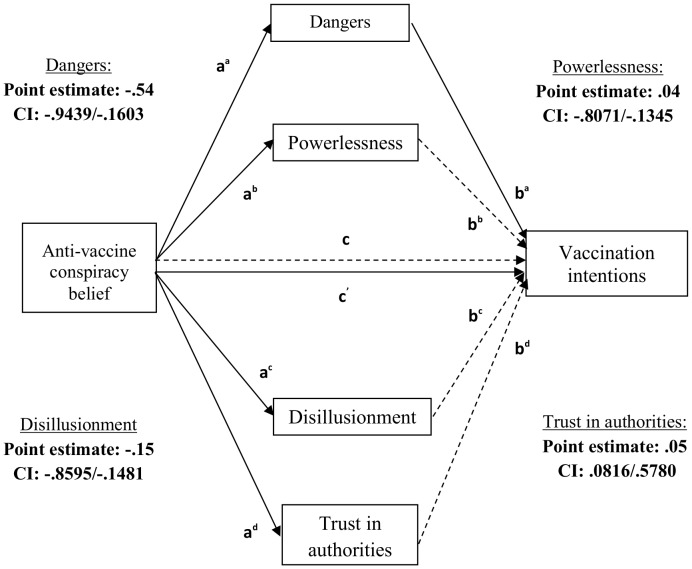
- In Study 1, anti-vaccine conspiracy beliefs significantly negatively predicted vaccination intentions, \(F(1, 87) = 15.97, p < .001, R^2 = .16, \beta = -.63\). Perceived dangers of vaccines, powerlessness, disillusionment, and trust in authorities each significantly mediated this relationship.
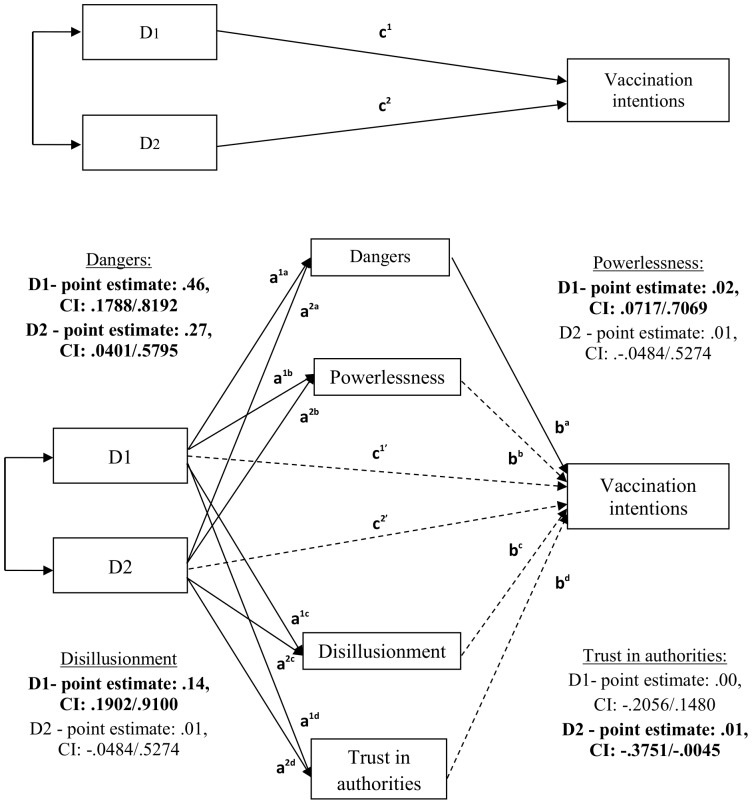
- In Study 2, vaccination intentions were significantly lower in the pro-conspiracy condition (\(M = 4.87, SD = 1.74\)) than in the anti-conspiracy condition (\(M = 5.69, SD = 1.31, p = .003\)) and the control condition (\(M = 5.47, SD = 1.50, p = .028\)), overall \(F(2, 185) = 4.81, p = .009, \eta^2 = .05\).
- The manipulation check showed higher endorsement of anti-vaccine conspiracy theories in the pro-conspiracy condition (\(M = 4.11, SD = 1.41\)) than the anti-conspiracy condition (\(M = 2.93, SD = 1.14, p < .001\)) and control condition (\(M = 3.56, SD = 1.21, p = .014\)).
- Perceived vaccine dangers consistently mediated the effects; powerlessness and disillusionment mediated the pro- versus anti-conspiracy difference, and trust in authorities mediated the pro-conspiracy versus control difference.
Methods
- Study 1 used a correlational online questionnaire with 89 British parents (\(80\) women, \(9\) men; \(M\) age \(= 38.06, SD = 9.25\)). Participants completed measures of anti-vaccine conspiracy beliefs, perceived dangers, powerlessness, disillusionment, trust in authorities, and intention to vaccinate a fictitious 8-month-old child against a made-up disease, dysomeria.
- Study 2 recruited 246 U.S. MTurk participants, with a final analyzed sample of 188 after screening exclusions. Participants were randomly assigned to pro-conspiracy, anti-conspiracy, or control information, then completed the same mediator measures and vaccination intention measure.
- Both studies used bootstrapping mediation analyses with 5000 bootstrap samples; Study 2 used ANOVA and indicator-coded mediation to compare the three conditions.
Limitations
- The paper states that effect sizes were small (e.g., \(\eta^2 = .05\) in Study 2), conspiracy endorsement was generally around or below the midpoint except in the pro-conspiracy condition (\(M = 4.11\)), the mediation pattern was less clear in Study 2, and findings relied on self-reported intentions for a fictional child and made-up disease rather than actual vaccination behavior.
- The paper notes that future research should examine larger samples, actual vaccination behavior, additional or isolated mediators, and geographical areas with dangerously low vaccination uptake.
- Evident from the text: Study 1 is correlational and cannot establish causality, and both studies use hypothetical vaccination scenarios, which may limit ecological validity.
Model-written summary. Check it against the paper before relying on it.
Integrity signals
Registry
Cites
Statistics
Figures
Verification
Claims the paper makes
37 Own result · 21 Not checked yet · 20 Own interpretation · 12 Own method
A result the paper reports from its own data — it cites no other source for it, so there is none to check. The quote shows it is in the paper.
In the paper
“Results revealed a significant negative relationship between anti-vaccine conspiracy beliefs and vaccination intentions.”
- Also stated in: § Results and Discussion · plain
“As predicted, regression analyses revealed that anti-vaccine conspiracy beliefs were a significant negative predictor of vaccination intentions, F(1, 87) = 15.97, p<.001, R2 = .16, β = −.63, t = − 3.10, p<. 001.”
- Also stated in: § Results and Discussion · plain
“Participants who endorsed anti-vaccine conspiracy theories to a greater extent indicated less intention to vaccinate.”
§ The Effects of Anti-Vaccine Conspiracy Theories on Vaccination Intentions > Abstract
plaincorrelational- Asserted: passes — The authors put it forward as true.
- Checkable: passes — It can be checked against evidence.
- Load-bearing: passes — The paper’s conclusions depend on it.
- Based: passes — The paper gives a reason why it holds.
- Also stated in: § Results and Discussion · plain
A result the paper reports from its own data — it cites no other source for it, so there is none to check. The quote shows it is in the paper.
In the paper
“As shown in Table 2, anti-vaccine conspiracy beliefs were a significant predictor of perceived dangers of vaccines, and feelings of powerlessness, disillusionment and trust in authorities, F(5, 83) = 120.37, p<.001, R2 = .58; F(5, 83) = 41.70, p<.001, R2 = .32; F(5, 83) = 74.43, p<.001, R2 = .46; F(5, 83) = 23.00, p<.001, R2 = .20, respectively.”
§ The Effects of Anti-Vaccine Conspiracy Theories on Vaccination Intentions > Study 1 > Results and Discussion
plaincorrelational- Asserted: passes — The authors put it forward as true.
- Checkable: passes — It can be checked against evidence.
- Load-bearing: passes — The paper’s conclusions depend on it.
- Based: passes — The paper gives a reason why it holds.
A result the paper reports from its own data — it cites no other source for it, so there is none to check. The quote shows it is in the paper.
In the paper
“Results revealed that participants who had been exposed to material supporting anti-vaccine conspiracy theories showed less intention to vaccinate than those in the anti-conspiracy condition or controls.”
§ The Effects of Anti-Vaccine Conspiracy Theories on Vaccination Intentions > Abstract
plaindirect- Asserted: passes — The authors put it forward as true.
- Checkable: passes — It can be checked against evidence.
- Load-bearing: passes — The paper’s conclusions depend on it.
- Based: passes — The paper gives a reason why it holds.
A result the paper reports from its own data — it cites no other source for it, so there is none to check. The quote shows it is in the paper.
In the paper
“This effect was mediated by the same variables as in Study 1.”
§ The Effects of Anti-Vaccine Conspiracy Theories on Vaccination Intentions > Abstract
plaindirect- Asserted: passes — The authors put it forward as true.
- Checkable: passes — It can be checked against evidence.
- Load-bearing: passes — The paper’s conclusions depend on it.
- Based: passes — The paper gives a reason why it holds.
A result the paper reports from its own data — it cites no other source for it, so there is none to check. The quote shows it is in the paper.
In the paper
“This effect was mediated by the perceived dangers of vaccines, and feelings of powerlessness, disillusionment and mistrust in authorities.”
- Also stated in: § Results and Discussion · hedged
“The multiple mediation analysis of the effect of anti-vaccine conspiracy beliefs on vaccination intentions indicated that perceived dangers of vaccines and feelings of powerlessness, disillusionment and trust in authorities (controlling for each other) were each significant mediators of this effect.”
- Also stated in: § Results and Discussion · plain
“When all factors were taken into account, each was a significant mediator of the relationship between anti-vaccine conspiracy beliefs and vaccination intentions.”
§ The Effects of Anti-Vaccine Conspiracy Theories on Vaccination Intentions > Abstract
plaincorrelational- Asserted: passes — The authors put it forward as true.
- Checkable: passes — It can be checked against evidence.
- Load-bearing: passes — The paper’s conclusions depend on it.
- Based: passes — The paper gives a reason why it holds.
- Also stated in: § Results and Discussion · hedged
A result the paper reports from its own data — it cites no other source for it, so there is none to check. The quote shows it is in the paper.
In the paper
“As shown in Table 2, anti-vaccine conspiracy beliefs were a significant predictor of perceived dangers of vaccines, and feelings of powerlessness, disillusionment and trust in authorities, F(5, 83) = 120.37, p<.001, R2 = .58; F(5, 83) = 41.70, p<.001, R2 = .32; F(5, 83) = 74.43, p<.001, R2 = .46; F(5, 83) = 23.00, p<.001, R2 = .20, respectively.”
§ The Effects of Anti-Vaccine Conspiracy Theories on Vaccination Intentions > Study 1 > Results and Discussion
plaincorrelational- Asserted: passes — The authors put it forward as true.
- Checkable: passes — It can be checked against evidence.
- Load-bearing: passes — The paper’s conclusions depend on it.
- Based: passes — The paper gives a reason why it holds.
A result the paper reports from its own data — it cites no other source for it, so there is none to check. The quote shows it is in the paper.
In the paper
“The results of this analysis therefore support the use of four separate mediators.”
§ The Effects of Anti-Vaccine Conspiracy Theories on Vaccination Intentions > Study 1 > Results and Discussion
plain- Asserted: passes — The authors put it forward as true.
- Checkable: passes — It can be checked against evidence.
- Load-bearing: passes — The paper’s conclusions depend on it.
- Based: passes — The paper gives a reason why it holds.
A result the paper reports from its own data — it cites no other source for it, so there is none to check. The quote shows it is in the paper.
In the paper
“Finally, results revealed no significant difference in trust in authorities between conditions, F(2, 185) = 2.32, p = .10, η2 = .03.”
§ The Effects of Anti-Vaccine Conspiracy Theories on Vaccination Intentions > Study 2 > Results and Discussion
plain- Asserted: passes — The authors put it forward as true.
- Checkable: passes — It can be checked against evidence.
- Load-bearing: unclear — It is unclear whether the paper’s conclusions depend on it.
- Based: passes — The paper gives a reason why it holds.
A result the paper reports from its own data — it cites no other source for it, so there is none to check. The quote shows it is in the paper.
In the paper
“Perceived dangers were higher in the pro-conspiracy condition (M = 4.00, SD = 1.46) than the anti-conspiracy condition (M = 2.97, SD = 1.42, p<.001) and the control condition (M = 2.39, SD = 1.71, p = .021).”
§ The Effects of Anti-Vaccine Conspiracy Theories on Vaccination Intentions > Study 2 > Results and Discussion
plain- Asserted: passes — The authors put it forward as true.
- Checkable: passes — It can be checked against evidence.
- Load-bearing: passes — The paper’s conclusions depend on it.
- Based: passes — The paper gives a reason why it holds.
- Probably not a substantial claim. 18
- It may state two separate claims as one. 9
- The quote only partly states this claim. 2
What the paper did — it cites no source for this, so there is none to check. The quote shows it is in the paper.
In the paper
“There were eight statements (e.g., “Vaccines lead to allergies”, α = .86)”
§ The Effects of Anti-Vaccine Conspiracy Theories on Vaccination Intentions > Study 1 > Methods
plain- Asserted: passes — The authors put it forward as true.
- Checkable: passes — It can be checked against evidence.
- Load-bearing: fails — The paper’s conclusions may not depend on it.
- Based: passes — The paper gives a reason why it holds.
Probably not a substantial claim. The paper’s conclusions may not depend on it.
What the paper did — it cites no source for this, so there is none to check. The quote shows it is in the paper.
In the paper
“Participants were asked to read the statements (e.g., “I feel that my actions will not stop the negative outcomes of immunizations”, α = .82)”
§ The Effects of Anti-Vaccine Conspiracy Theories on Vaccination Intentions > Study 1 > Methods
plain- Asserted: passes — The authors put it forward as true.
- Checkable: passes — It can be checked against evidence.
- Load-bearing: fails — The paper’s conclusions may not depend on it.
- Based: passes — The paper gives a reason why it holds.
Probably not a substantial claim. The paper’s conclusions may not depend on it.
What the paper did — it cites no source for this, so there is none to check. The quote shows it is in the paper.
In the paper
“consisted of four statements (e.g., “I am very disappointed with those who are involved in immunizations (e.g., the government, pharmaceutical companies)”, α = .89)”
§ The Effects of Anti-Vaccine Conspiracy Theories on Vaccination Intentions > Study 1 > Methods
plain- Asserted: passes — The authors put it forward as true.
- Checkable: passes — It can be checked against evidence.
- Load-bearing: fails — The paper’s conclusions may not depend on it.
- Based: passes — The paper gives a reason why it holds.
Probably not a substantial claim. The paper’s conclusions may not depend on it.
In the paper
“and also that feelings of political powerlessness mediate the relationship between exposure to conspiracy theories and voting intentions [22].”
§ The Effects of Anti-Vaccine Conspiracy Theories on Vaccination Intentions > Introduction
What the sources say
- Not checked yetcites [22] Jolley D, Douglas KM (2013) The social consequences of conspiracism: Exposure to conspiracy theories decreases the intention to engage in politics and to reduce one’s carbon footprint. Br J Psychol: in press. doi:10.1111/bjop.12018. source
plaindirect- Asserted: passes — The authors put it forward as true.
- Checkable: passes — It can be checked against evidence.
- Load-bearing: passes — The paper’s conclusions depend on it.
- Based: passes — The paper gives a reason why it holds.
Probably not a substantial claim.
In the paper
“Further, polls demonstrate that more than 20% of respondents endorse the idea that there is a link between childhood vaccines and autism [13].”
§ The Effects of Anti-Vaccine Conspiracy Theories on Vaccination Intentions > Introduction
What the sources say
- Not checked yetcites [13] Public Policy Polling (2013) Democrats and Republicans differ on conspiracy theory beliefs. Available: http://www.publicpolicypolling.com/pdf/2011/PPP_Release_National_ConspiracyTheories_040213.pdf. Accessed: 2013 Nov 27.
boosted- Asserted: passes — The authors put it forward as true.
- Checkable: passes — It can be checked against evidence.
- Load-bearing: fails — The paper’s conclusions may not depend on it.
- Based: passes — The paper gives a reason why it holds.
Probably not a substantial claim. The paper’s conclusions may not depend on it.
In the paper
“Previous research has demonstrated that exposure to conspiracy theories increases political disillusionment [22]”
§ The Effects of Anti-Vaccine Conspiracy Theories on Vaccination Intentions > Introduction
What the sources say
- Not checked yetcites [22] Jolley D, Douglas KM (2013) The social consequences of conspiracism: Exposure to conspiracy theories decreases the intention to engage in politics and to reduce one’s carbon footprint. Br J Psychol: in press. doi:10.1111/bjop.12018. source
boosteddirect- Asserted: passes — The authors put it forward as true.
- Checkable: passes — It can be checked against evidence.
- Load-bearing: passes — The paper’s conclusions depend on it.
- Based: passes — The paper gives a reason why it holds.
Probably not a substantial claim.
None of the sources cited for this claim have been checked yet.
In the paper
“Endorsement of these conspiracy theories amongst African Americans has been found to be associated with negative attitudes towards contraceptive behaviors, which may potentially expose people to the risk of unwanted pregnancies and sexually transmitted illnesses [23], [24], [25].”
§ The Effects of Anti-Vaccine Conspiracy Theories on Vaccination Intentions > Introduction
What the sources say
- Not checked yetcites [23] ST Bird, 2003, Birth control conspiracy beliefs, perceived discrimination, and contraception among African Americans, Journal of Health Psychology source
- Not checked yetcites [24] LM Bogart, 2006, Relationship of African Americans’ socio demographic characteristics to belief in conspiracies about HIV/AIDS and birth control, Journal of the National Medical Association
- Not checked yetcites [25] MA Hoyt, 2012, HIV/AIDS-related institutional mistrust among multiethnic men who have sex with men: Effects on HIV testing and risk behaviors, Health Psychology source
plaincorrelational- Asserted: passes — The authors put it forward as true.
- Checkable: passes — It can be checked against evidence.
- Load-bearing: fails — The paper’s conclusions may not depend on it.
- Based: passes — The paper gives a reason why it holds.
Probably not a substantial claim. The paper’s conclusions may not depend on it.
What the paper did — it cites no source for this, so there is none to check. The quote shows it is in the paper.
In the paper
“The order of measures was counterbalanced.”
§ The Effects of Anti-Vaccine Conspiracy Theories on Vaccination Intentions > Study 1 > Methods
plain- Asserted: passes — The authors put it forward as true.
- Checkable: passes — It can be checked against evidence.
- Load-bearing: fails — The paper’s conclusions may not depend on it.
- Based: passes — The paper gives a reason why it holds.
Probably not a substantial claim. The paper’s conclusions may not depend on it.
What the paper did — it cites no source for this, so there is none to check. The quote shows it is in the paper.
In the paper
“The study was approved by the Psychology Ethics Committee at the University of Kent and all participants provided their written, informed consent.”
§ The Effects of Anti-Vaccine Conspiracy Theories on Vaccination Intentions > Study 1 > Methods
plain- Asserted: passes — The authors put it forward as true.
- Checkable: passes — It can be checked against evidence.
- Load-bearing: fails — The paper’s conclusions may not depend on it.
- Based: passes — The paper gives a reason why it holds.
Probably not a substantial claim. The paper’s conclusions may not depend on it. It may state two separate claims as one.
What the paper did — it cites no source for this, so there is none to check. The quote shows it is in the paper.
In the paper
“There were two trust sources (corporations and government; Spearman-Brown Coefficient = .82)”
§ The Effects of Anti-Vaccine Conspiracy Theories on Vaccination Intentions > Study 1 > Methods
plain- Asserted: passes — The authors put it forward as true.
- Checkable: passes — It can be checked against evidence.
- Load-bearing: fails — The paper’s conclusions may not depend on it.
- Based: passes — The paper gives a reason why it holds.
Probably not a substantial claim. The paper’s conclusions may not depend on it. The quote only partly states this claim.
None of the sources cited for this claim have been checked yet.
In the paper
“Also, exposure to conspiracy theories has been found to have detrimental effects in other domains, such as reducing pro-environmental intentions and willingness to engage in politics [21], [22].”
§ The Effects of Anti-Vaccine Conspiracy Theories on Vaccination Intentions > Introduction
What the sources say
- Not checked yetcites [21] LD Butler, 1995, The psychological impact of viewing the film JFK: Emotions, beliefs and political behavioral intentions, Political Psychology source
- Not checked yetcites [22] Jolley D, Douglas KM (2013) The social consequences of conspiracism: Exposure to conspiracy theories decreases the intention to engage in politics and to reduce one’s carbon footprint. Br J Psychol: in press. doi:10.1111/bjop.12018. source
plaindirect- Asserted: passes — The authors put it forward as true.
- Checkable: passes — It can be checked against evidence.
- Load-bearing: fails — The paper’s conclusions may not depend on it.
- Based: passes — The paper gives a reason why it holds.
Probably not a substantial claim. The paper’s conclusions may not depend on it.
A conclusion the paper draws from its own results — it cites no other source for it, so there is none to check. The quote shows it is in the paper.
In the paper
“In Study 2, feelings of powerlessness and disillusionment mediated the difference between the pro- and anti-conspiracy conditions, and mistrust in authorities mediated the difference between the pro-conspiracy and control conditions.”
§ The Effects of Anti-Vaccine Conspiracy Theories on Vaccination Intentions > General Discussion
plaindirect- Asserted: passes — The authors put it forward as true.
- Checkable: passes — It can be checked against evidence.
- Load-bearing: passes — The paper’s conclusions depend on it.
- Based: passes — The paper gives a reason why it holds.
It may state two separate claims as one.
A conclusion the paper draws from its own results — it cites no other source for it, so there is none to check. The quote shows it is in the paper.
In the paper
“This means that the proportion of variance in vaccine intentions explained by exposure to conspiracy theories was quite modest and there are potentially many other factors that contribute to vaccine intentions.”
§ The Effects of Anti-Vaccine Conspiracy Theories on Vaccination Intentions > General Discussion
hedgedcorrelational- Asserted: passes — The authors put it forward as true.
- Checkable: passes — It can be checked against evidence.
- Load-bearing: passes — The paper’s conclusions depend on it.
- Based: passes — The paper gives a reason why it holds.
It may state two separate claims as one.
What the paper did — it cites no source for this, so there is none to check. The quote shows it is in the paper.
In the paper
“The final sample size used for data analysis was therefore 188 (112 women and 76 men, M age = 36.33, SD = 13.40).”
§ The Effects of Anti-Vaccine Conspiracy Theories on Vaccination Intentions > Study 2 > Methods
plainn = 188- Asserted: passes — The authors put it forward as true.
- Checkable: passes — It can be checked against evidence.
- Load-bearing: fails — The paper’s conclusions may not depend on it.
- Based: passes — The paper gives a reason why it holds.
Probably not a substantial claim. The paper’s conclusions may not depend on it.
A conclusion the paper draws from its own results — it cites no other source for it, so there is none to check. The quote shows it is in the paper.
In the paper
“Further, feelings of powerlessness and disillusionment mediated the difference between the pro- and anti-conspiracy conditions, and mistrust in authorities mediated the difference between the pro-conspiracy and control conditions.”
§ The Effects of Anti-Vaccine Conspiracy Theories on Vaccination Intentions > Study 2 > Results and Discussion
plaindirectn = 188- Asserted: passes — The authors put it forward as true.
- Checkable: passes — It can be checked against evidence.
- Load-bearing: passes — The paper’s conclusions depend on it.
- Based: passes — The paper gives a reason why it holds.
It may state two separate claims as one.
What the paper did — it cites no source for this, so there is none to check. The quote shows it is in the paper.
In the paper
“There were 60 participants in the pro-conspiracy condition, 62 in the anti-conspiracy condition, and 66 in the control condition.”
§ The Effects of Anti-Vaccine Conspiracy Theories on Vaccination Intentions > Study 2 > Methods
plainn = 60- Asserted: passes — The authors put it forward as true.
- Checkable: passes — It can be checked against evidence.
- Load-bearing: fails — The paper’s conclusions may not depend on it.
- Based: passes — The paper gives a reason why it holds.
Probably not a substantial claim. The paper’s conclusions may not depend on it. It may state two separate claims as one.
None of the sources cited for this claim have been checked yet.
In the paper
“As is well known, intentions do not always translate into behaviors [47], [48], [49].”
§ The Effects of Anti-Vaccine Conspiracy Theories on Vaccination Intentions > General Discussion
What the sources say
- Not checked yetcites [47] RT LaPiere, 1934, Attitudes vs. actions, Social Forces source
- Not checked yetcites [48] LS Linn, 1965, Verbal attitudes and overt behavior: A study of racial discrimination, Social Forces source
- Not checked yetcites [49] Sheeran P (2002) Intention-behavior relations: A conceptual and empirical review. In: Stroebe W, Hewstone M, editors. European Review of Social Psychology. Chichester, UK: Wiley. Vol. 12, 1–36. source
boosted- Asserted: passes — The authors put it forward as true.
- Checkable: passes — It can be checked against evidence.
- Load-bearing: passes — The paper’s conclusions depend on it.
- Based: passes — The paper gives a reason why it holds.
Probably not a substantial claim.
In the paper
“Similarly, different strategies for successful intervention may apply for people who hold strong anti-vaccine conspiracy beliefs than those who do not hold strong beliefs [44].”
§ The Effects of Anti-Vaccine Conspiracy Theories on Vaccination Intentions > General Discussion
What the sources say
- Not checked yetcites [44] CR Sunstein, 2009, Conspiracy theories: Causes and cures, J Polit Philos source
hedgedconditional- Asserted: passes — The authors put it forward as true.
- Checkable: fails — It may be too vague to check against evidence.
- Load-bearing: fails — The paper’s conclusions may not depend on it.
- Based: passes — The paper gives a reason why it holds.
Probably not a substantial claim. It may be too vague to check against evidence. The paper’s conclusions may not depend on it.
None of the sources cited for this claim have been checked yet.
In the paper
“Psychologists are learning more about the traits and characteristics associated with beliefs in conspiracy theories more generally, such as mistrust, anomie, political cynicism and Machiavellianism [8], [20], [31], [50]”
§ The Effects of Anti-Vaccine Conspiracy Theories on Vaccination Intentions > General Discussion
What the sources say
- Not checked yetcites [8] T Goertzel, 1994, Belief in conspiracy theories, Polit Psychol source
- Not checked yetcites [20] KM Douglas, 2008, The hidden impact of conspiracy theories: Perceived and actual influence of theories surrounding the death of Princess Diana, Br J Soc Psychol source
- Not checked yetcites [31] M Abalakina-Paap, 1999, Beliefs in conspiracies, Political Psychology source
plaincorrelational- Asserted: passes — The authors put it forward as true.
- Checkable: passes — It can be checked against evidence.
- Load-bearing: fails — The paper’s conclusions may not depend on it.
- Based: passes — The paper gives a reason why it holds.
Probably not a substantial claim. The paper’s conclusions may not depend on it.
A conclusion the paper draws from its own results — it cites no other source for it, so there is none to check. The quote shows it is in the paper.
In the paper
“Specifically, they appear to reduce vaccination intentions by inducing undue concern about the dangers of vaccines, and increasing powerlessness, disillusionment, and mistrust.”
§ The Effects of Anti-Vaccine Conspiracy Theories on Vaccination Intentions > General Discussion
hedgeddirect- Asserted: passes — The authors put it forward as true.
- Checkable: passes — It can be checked against evidence.
- Load-bearing: passes — The paper’s conclusions depend on it.
- Based: passes — The paper gives a reason why it holds.
It may state two separate claims as one.
A conclusion the paper draws from its own results — it cites no other source for it, so there is none to check. The quote shows it is in the paper.
In the paper
“Therefore, the participants were not strong endorsers of anti-vaccine conspiracy theories, meaning that different patterns of findings may emerge for those who do strongly endorse conspiracy theories.”
§ The Effects of Anti-Vaccine Conspiracy Theories on Vaccination Intentions > General Discussion
hedged- Asserted: passes — The authors put it forward as true.
- Checkable: passes — It can be checked against evidence.
- Load-bearing: unclear — It is unclear whether the paper’s conclusions depend on it.
- Based: passes — The paper gives a reason why it holds.
It may state two separate claims as one.
A conclusion the paper draws from its own results — it cites no other source for it, so there is none to check. The quote shows it is in the paper.
In the paper
“Therefore, overall, anti-vaccine conspiracy theories appear to introduce undue suspicion about vaccine safety, and increase feelings of powerlessness and disillusionment, whilst decreasing trust in authorities, which in turn introduce reluctance to vaccinate.”
§ The Effects of Anti-Vaccine Conspiracy Theories on Vaccination Intentions > General Discussion
hedgeddirect- Asserted: passes — The authors put it forward as true.
- Checkable: passes — It can be checked against evidence.
- Load-bearing: passes — The paper’s conclusions depend on it.
- Based: passes — The paper gives a reason why it holds.
It may state two separate claims as one.
What the paper did — it cites no source for this, so there is none to check. The quote shows it is in the paper.
In the paper
“Participants were randomly assigned to one of the three conditions.”
§ The Effects of Anti-Vaccine Conspiracy Theories on Vaccination Intentions > Study 2 > Methods
plain- Asserted: passes — The authors put it forward as true.
- Checkable: passes — It can be checked against evidence.
- Load-bearing: passes — The paper’s conclusions depend on it.
- Based: passes — The paper gives a reason why it holds.
Probably not a substantial claim.
What the paper did — it cites no source for this, so there is none to check. The quote shows it is in the paper.
In the paper
“The study was approved by the Psychology Ethics Committee at the University of Kent and all participants provided their written, informed consent.”
§ The Effects of Anti-Vaccine Conspiracy Theories on Vaccination Intentions > Study 1 > Methods
plain- Asserted: fails — The authors may not put it forward as true.
- Checkable: passes — It can be checked against evidence.
- Load-bearing: fails — The paper’s conclusions may not depend on it.
- Based: fails — The paper may give no reason why it holds.
Probably not a substantial claim. The authors may not put it forward as true. The paper’s conclusions may not depend on it. The paper may give no reason why it holds. It may state two separate claims as one. The quote only partly states this claim.
The paper relies on this without support.
The measured mediators (perceived vaccine dangers, powerlessness, disillusionment, and trust in authorities) are causally prior to and influence vaccination intentions, as required for the mediation analysis.
“Each of the candidate mediators was then examined in a test of mediation in order to explain the effect of the conspiracy conditions (pro-conspiracy versus anti-conspiracy, versus control) on vaccination intentions.”
Statistics recomputed
Every reported test result, recomputed from its test statistic and degrees of freedom. A result shows as not adding up only once an independent check has confirmed it.
- Consistentχ²(136) = 4544.44reported p < .001 · recomputed p < .001
“X 2 (136) = 4544.44, p < .001”
- ConsistentF(1, 87) = 15.97reported p < .001 · recomputed p < .001
“F(1, 87) = 15.97, p < .001”
- ConsistentF(5, 83) = 120.37reported p < .001 · recomputed p < .001
“F(5, 83) = 120.37, p < .001”
- ConsistentF(5, 83) = 41.7reported p < .001 · recomputed p < .001
“F(5, 83) = 41.70, p < .001”
- ConsistentF(5, 83) = 74.43reported p < .001 · recomputed p < .001
“F(5, 83) = 74.43, p < .001”
- ConsistentF(5, 83) = 23reported p < .001 · recomputed p < .001
“F(5, 83) = 23.00, p < .001”
- ConsistentF(2, 185) = 4.81reported p = .009 · recomputed p = .009
“F(2, 185) = 4.81, p = .009”
- ConsistentF(2, 185) = 7.61reported p = .001 · recomputed p < .001
“F(2, 185) = 7.61, p = .001”
- ConsistentF(2, 185) = 3.44reported p = .034 · recomputed p = .034
“F(2, 185) = 3.44, p = .034”
- ConsistentF(2, 185) = 7.46reported p = .001 · recomputed p < .001
“F(2, 185) = 7.46, p = .001”
- ConsistentF(2, 185) = 2.32reported p = .1 · recomputed p = .101
“F(2, 185) = 2.32, p = .10”
Self-check
Percentages, sums and reported differences re-computed from the paper’s own numbers.
Each contradiction between two passages listed here was confirmed by an independent check.
Rated minor: it would not touch a result — a value no result rests on, a p-value that stays on the same side of the significance level, or a conflict that is clerical, resolved elsewhere in the paper, or outside its own findings.
In the paper
§ The Effects of Anti-Vaccine Conspiracy Theories on Vaccination Intentions > Study 1 > Results and Discussion
“| (2) Immunisation intention | 5.63 (1.42) | −.40*** | – | −.49*** | .29** | −.36*** | .20¥ |”
§ The Effects of Anti-Vaccine Conspiracy Theories on Vaccination Intentions > Study 1 > Results and Discussion
“| (3) Dangers | 2.97 (1.37) | .76*** | −.48*** | – | .58*** | .60*** | −.48*** |”
Rated minor: it would not touch a result — a value no result rests on, a p-value that stays on the same side of the significance level, or a conflict that is clerical, resolved elsewhere in the paper, or outside its own findings.
In the paper
“F(1, 87) = 15.97, p<.001, R2 = .16, β = −.63, t = − 3.10, p<. 001.”
§ The Effects of Anti-Vaccine Conspiracy Theories on Vaccination Intentions > Study 1 > Results and Discussion
Reported 15.97 · recomputed 9.61
Rated minor: it would not touch a result — a value no result rests on, a p-value that stays on the same side of the significance level, or a conflict that is clerical, resolved elsewhere in the paper, or outside its own findings.
In the paper
§ The Effects of Anti-Vaccine Conspiracy Theories on Vaccination Intentions > Study 1 > Results and Discussion
“| (3) Dangers | 2.97 (1.37) | .76*** | −.48*** | – | .58*** | .60*** | −.48*** |”
§ The Effects of Anti-Vaccine Conspiracy Theories on Vaccination Intentions > Study 1 > Results and Discussion
“| (5) Disillusionment | 2.45 (1.40) | .68*** | −.36*** | .59*** | .59*** | – | −.41*** |”
Rated minor: it would not touch a result — a value no result rests on, a p-value that stays on the same side of the significance level, or a conflict that is clerical, resolved elsewhere in the paper, or outside its own findings.
In the paper
§ The Effects of Anti-Vaccine Conspiracy Theories on Vaccination Intentions > Study 1 > Results and Discussion
“β = −.63”
§ The Effects of Anti-Vaccine Conspiracy Theories on Vaccination Intentions > Study 1 > Results and Discussion
“| (1) Anti-vaccine conspiracy belief | 2.00 (.89) | – | −.40*** | .76*** | .57*** | .68*** | −.46*** |”
Rated minor: it would not touch a result — a value no result rests on, a p-value that stays on the same side of the significance level, or a conflict that is clerical, resolved elsewhere in the paper, or outside its own findings.
In the paper
§ The Effects of Anti-Vaccine Conspiracy Theories on Vaccination Intentions > Study 1 > Results and Discussion
“F(5, 83) = 120.37, p<.001, R2 = .58; F(5, 83) = 41.70, p<.001, R2 = .32; F(5, 83) = 74.43, p<.001, R2 = .46; F(5, 83) = 23.00, p<.001, R2 = .20, respectively.”
§ The Effects of Anti-Vaccine Conspiracy Theories on Vaccination Intentions > Study 1 > Results and Discussion
“Table: Table 2 Four separate regressions examining anti-conspiracy belief as predictor, and four mediator variables as criterions.”
Citations
Cites
Preacher, K. J., & Hayes, A. F. (2008) · Behavior Research Methods · doi:10.3758/brm.40.3.879 · Cited by 34,117 · cited 1×
“By repeating this process thousands of times, it builds an empirical approximation of the sampling distribution that constructs the confidence intervals [39].”
Amazon's Mechanical Turk: A New Source of Inexpensive, Yet High-Quality, Data?
Buhrmester, M., Kwang, T., & Gosling, S. D. (2011) · Perspectives on Psychological Science · doi:10.1177/1745691610393980 · Cited by 9,996
Beyond Baron and Kenny: Statistical Mediation Analysis in the New Millennium
Hayes, A. F. (2009) · Communication Monographs · doi:10.1080/03637750903310360 · Cited by 9,757 · cited 5×
“As argued by Hayes [40], an indirect effect is estimated as being significant if the confidence intervals do not contain a zero, as opposed to significance in the individual paths.”
InfluentialNew Environmental Theories: Toward a Coherent Theory of Environmentally Significant Behavior
Stern, P. C. (2000) · Journal of Social Issues · doi:10.1111/0022-4537.00175 · Cited by 8,682
A Second Generation Little Jiffy
Kaiser, H. F. (1970) · Psychometrika · doi:10.1007/bf02291817 · Cited by 4,855
Running experiments on Amazon Mechanical Turk
Paolacci, G., Chandler, J., & Ipeirotis, P. G. (2010) · Judgment and Decision Making · doi:10.1017/s1930297500002205 · Cited by 3,767
Intention—Behavior Relations: A Conceptual and Empirical Review
Sheeran, P. (2002) · European Review of Social Psychology · doi:10.1080/14792772143000003 · Cited by 3,688 · cited 1×
“As is well known, intentions do not always translate into behaviors [47], [48], [49].”
Statistical mediation analysis with a multicategorical independent variable
Hayes, A. F., & Preacher, K. J. (2014) · British Journal of Mathematical and Statistical Psychology · doi:10.1111/bmsp.12028 · Cited by 3,403 · cited 3×
“This was carried out using Hayes and Preacher’s [38] bootstrapping method for indirect effects, as in Study 1.”
Misinformation and Its Correction: Continued Influence and Successful Debiasing
Lewandowsky, S., Ecker, U. K. H., Seifert, C. M., Schwarz, N., & Cook, J. (2012) · Psychological Science in the Public Interest · doi:10.1177/1529100612451018 · Cited by 2,920
A Note on the Multiplying Factors for Various χ2 Approximations
Bartlett, M. S. (1954) · Journal of the Royal Statistical Society Series B (Statistical Methodology) · doi:10.1111/j.2517-6161.1954.tb00174.x · Cited by 2,168
Cited by
Sorted by citations
Items 901–1,000 of 1,000
Stevens, J. C. (2016) · UA Campus Repository (The University of Arizona) · Cited by 2
Existence of Differential Belief Profiles of COVID-19 Narratives: The Role of Trust in SciencePreprint
Agley, J. D., & Xiao, Y. (2020) · doi:10.21203/rs.3.rs-35919/v1 · Cited by 2
Science, health, and human rights
de Camargo, K. R. (2021) · Global Public Health · doi:10.1080/17441692.2021.1950800 · Cited by 2
“Often such misconceptions become full-fledged conspiracy theories (Jolley & Douglas, 2014, 2017), as a reaction to perceived existential threats and an attempt of making sense of complex, little-understood situations (van Prooijen, 2020), a defense from an increasingly incomprehensible…”
BackgroundSamayoa, J. A. G., Moore, C. A., Ruisch, B. C., Boggs, S. T., Ladanyi, J. T., & Fázio, R. H. (2021) · doi:10.31234/osf.io/jubpg · Cited by 2
Trujillo, K. L., & Motta, M. (2020) · doi:10.33774/apsa-2020-bbpld · Cited by 2
The antidepressant hoax: Conspiracy theories decrease health-seeking intentionsPreprint
Natoli, E., & Marques, M. D. (2020) · OSF Preprints (OSF Preprints) · doi:10.31219/osf.io/dq5e8 · Cited by 3
American Exceptionalism: Determinants of spreading COVID-19 misinformation online in five countriesPreprint
Pickup, M. A., Stecula, D. A., & van der Linden, C. (2021) · doi:10.31235/osf.io/z547j · Cited by 2
Quantifying public engagement with medical science, misinformation, and malinformationPreprint
Grimes, D. R., & Gorski, D. H. (2022) · doi:10.31219/osf.io/g4jwr · Cited by 2
Conspiracy Theories As A Component Of Populist RhetoricPreprint
Sawyer, P. S., & Kalaycı, Y. (2022) · SSRN Electronic Journal · doi:10.2139/ssrn.4121825 · Cited by 2
Yamaguchi, S., Oshima, H., & Tanihara, T. (2022) · SSRN Electronic Journal · doi:10.2139/ssrn.4135471 · Cited by 2
Battle of Polio eradication in the Western Pacific Region in the transition to COVID-19 endemicity
Mei, R., Kwok, S. L. L., Lau, E. H. Y., Lo, T. H. K., Wu, J. T. K., Lin, L. K., & Leung, K. S. M. (2023) · Journal of Infection · doi:10.1016/j.jinf.2023.02.026 · Cited by 1
Mudambi, M., Clark, J., Rhue, L. A., & Viswanathan, S. (2023) · SSRN Electronic Journal · doi:10.2139/ssrn.4653460 · Cited by 2
Nera, K., Mora, Y. L., Klein, P., Roblain, A., Oost, P. V., Terache, J., & Klein, O. (2022) · doi:10.31234/osf.io/qe5p4 · Cited by 2
Crenças em Teorias da Conspiração: uma aproximação desde a Psicologia Social
Rezende, A. T., Gouveia, V. V., & Moizéis, H. B. C. (2021) · Interação em Psicologia · doi:10.5380/riep.v25i1.61173 · Cited by 4
Responding to Questions from Parents with Vaccine Concerns
Macinotsh, J. L. B., Rowberry, C., Peterson, N. E., Luthy, K. E., & Beckstrand, R. L. (2021) · Journal of Pediatric Health Care · doi:10.1016/j.pedhc.2021.07.011 · Cited by 1
Conspiracy beliefs and social media: Addressing a systemic risk
Lebrun, M., Dumur-Laanila, H., Nielen, G., & Hernández-Escayola, P. (2024) · Open Research Europe · doi:10.12688/openreseurope.17043.1 · Cited by 1
“Research results outline that exposure to conspiracy beliefs reduce the intention to vote, participation into politics, trust in government services and institutions (Butler et al. , 1995; Einstein & Glick, 2015; Enders & Smallpage, 2019; Jolley & Douglas, 2014).”
Bill Gates, Impfungen und die New World Order. Verschwörungstheorien zu Covid-19 in sozialen Medien
Tschiggerl, M. (2024) · Medical humanities · doi:10.14361/9783839471975-014 · Cited by 1
Argument‐based intervention as a way to reduce covid‐19 unfounded beliefs and vaccination hesitancy
Teličák, P., Šrol, J., & Haľama, P. (2024) · Applied Cognitive Psychology · doi:10.1002/acp.4187 · Cited by 2
Teorias conspiratórias, redes digitais e crises epistêmica da democracia
Aggio, C. D. O. (2023) · Editora UFMG eBooks · doi:10.7476/9786588592335.0013 · Cited by 1
Liu, J., Pu, Y., & Zhang, T. H. (2025) · Political Psychology · doi:10.1111/pops.13079 · Cited by 1
“For example, understanding the efficacy and risks of vaccines could prevent people from irrational fear of vaccinations and increase willingness to be vaccinated (Jolley & Douglas, 2014).”
Empowering Future Engineers by Integrating Science Communication Into Undergraduate Labs
Cvetkovic, C., Jahnke, K., Miriyala, M., & Owen, B. (2024) · IEEE Frontiers in Education Conference (FIE) · doi:10.1109/fie61694.2024.10893522 · Cited by 1
“This increase in skepticism towards science has played a pivotal role in the rise of politically relevant issues such as anti-vaccine conspiracy theories [5], climate change denial [6], and an overarching belief that scientists may not be acting in the public’s best interest [4].”
Richard, J., Dubé, A., Jbilou, J., & Lachance‐Grzela, M. (2025) · Journal of Health Psychology · doi:10.1177/13591053251323502 · Cited by 1
Deconstructing Conspiracy Theories
Schneider, J., & Schmitt, J. B. (2025) · MedienPädagogik: Zeitschrift für Theorie und Praxis der Medienbildung · doi:10.21240/mpaed/59/2025.04.25.x
Beliefs and Attitudes of Hesitant Spaniards Towards COVID-19 Vaccines: “A Personal Decision”
Langbecker, A., & Catalán-Matamoros, D. (2025) · Healthcare · doi:10.3390/healthcare13101199 · Cited by 1
Magnus, K. D., Dammann, N., & Lüdecke, D. (2025) · PLoS ONE · doi:10.1371/journal.pone.0328045 · Cited by 1
“Numerous studies suggest that a lack of trust in vaccines is strongly associated with exposure to false information and conspiracy theories [26,27], the propagation and acceptance of which are typical among populists [28,29].”
Source awareness and vaccine attitudes: evaluation of a novel technique for combating disinformation
Rędzio, A. M., Izydorczak, K., Muniak, P., & Doliński, D. (2025) · Current Psychology · doi:10.1007/s12144-025-08418-2 · Cited by 1
“That is why simply correcting misinformation can be completely ineffective, especially for vaccination topics (Jolley & Douglas, 2014).”
Ingroup conspiratorial beliefs: Re-thinking racial/ethnic minority group conspiracy in the UK and US
Hanson, K., Vandrevala, T., Martinelli, C., & Rigoli, F. (2025) · Journal of Social and Political Psychology · doi:10.5964/jspp.16835 · Cited by 1
Antecedents and consequences of science-related conspiracy beliefs.
Douglas, K. M. (2025) · Current Opinion in Psychology · doi:10.1016/j.copsyc.2025.102191 · Cited by 2
Self-citationPjesivac, I., Klein, L., Zhao, W., Lu, X., & Yan, J. (2025) · Frontiers in Communication · doi:10.3389/fcomm.2025.1548575 · Cited by 1
Chiavenna, C., Leone, L. P., Pin, P., Cucciniello, M., & Melegaro, A. (2025) · Population Health Metrics · doi:10.1186/s12963-025-00437-2 · Cited by 1
Ma, Y., Lu, X., & Zhao, R. (2026) · Mass Communication & Society · doi:10.1080/15205436.2025.2596081 · Cited by 2
“…to engage in various behaviors such as rejecting information from experts (e.g., Uscinski et al., 2020), behaviors including vaccination, safer sex, and health-protective behaviors tied to COVID-19 (Allington et al., 2021; Dunn et al., 2017; Grebe & Nattrass, 2012; Jolley & Douglas, 2014).”
Ju, I., & Song, H. (2026) · Journal of Current Issues & Research in Advertising · doi:10.1080/10641734.2025.2612353 · Cited by 2
Marchlewska, M., & Adamczyk, D. (2026) · Psychological Inquiry · doi:10.1080/1047840x.2026.2650217 · Cited by 1
“…promote a hidden agenda aimed at undermining traditional values and social arrangements; Marchlewska et al., 2019), vaccination conspiracy beliefs (Jolley & Douglas, 2014a), climate change conspiracy beliefs (Jolley & Douglas, 2014b), and conspiracy beliefs related to presidential elections in…”
Sedlár, M., & Grežo, M. (2026) · Public Understanding of Science · doi:10.1177/09636625261452154 · Cited by 1
“Furthermore, previous research has also suggested that the relationship between conspiracy beliefs and WPMR may be indirect, operating through lower trust in medical authorities (Jolley and Douglas, 2014; Marques et al., 2024; Natoli and Marques, 2021).”
InfluentialDuarte, T. R. (2025) · Revista Brasileira de Estudos CTS · doi:10.67937/30861128.2025.18 · Cited by 1
Applications & critical reflections on the VANMaN taxonomy
Motta, M. (2020) · Social Science & Medicine · doi:10.1016/j.socscimed.2020.112850 · Cited by 1
AS NOVAS TECNOLOGIAS E A COVID-19: O REPENSAR DA CAPACITAÇÃO DOCENTE
Mendonça, A. A. D. S., & Franco, D. L. (2020) · doi:10.22533/at.ed.76020190811 · Cited by 1
Conversa Saudável: abordagens sobre novo coronavírus e saúde mental na rádio CBN João Pessoa
Mendes, P. M., & Mendes, L. A. D. C. (2021) · doi:10.29327/561168.1-3 · Cited by 1
Conspiracist and paranormal beliefs: A typology of non-reductive ideation
Dieckmann, N. F., & Hartman, R. O. (2022) · International Journal of Personality Psychology · doi:10.21827/ijpp.8.38006 · Cited by 3
“…& Oberauer, 2013; although see Dixon & Jones, 2015 for an alternate interpretation), counter-scientific beliefs about the safety of vaccines (Jolley & Douglas, 2014; Lewandowsky, Gignac, & Oberauer, 2013; Hartman, et al., 2017), and anticonventional medicine and anti-GMO food beliefs…”
BackgroundDo Greek University Students Trust Social Media Regarding Science Related Issues? The Covid-19 Case
Vranias, K., & Kyridis, A. (2022) · International Journal of Social Science Research · doi:10.5296/ijssr.v11i1.20259 · Cited by 1
Moreira, M. A. C., Moreira, J. G., Huziwara, J. C. D. A., Reis, K. C. D. P., & Lãczynski, L. O. D. O. (2023) · Boletim do Observatório Ambiental Alberto Ribeiro Lamego · doi:10.19180/2177-4560.v16n12022p112-137 · Cited by 1
Structural Exposition of Concern and Belief of COVID-19 Vaccination Knowledge in Ghana
Balogun, O. S., Olaleye, S. A., Mensah, F. A., Agjei, R. O., & Akingbade, T. J. (2023) · Advances in healthcare information systems and administration book series · doi:10.4018/978-1-6684-8103-5.ch008 · Cited by 1
Kusuma, A. N., Sansuwito, T. B., & Lusiani, M. (2023) · International Journal of Public Health Science (IJPHS) · doi:10.11591/ijphs.v12i2.21850 · Cited by 1
Mayer, A., & Ryder, S. (2023) · Socius Sociological Research for a Dynamic World · doi:10.1177/23780231231177154 · Cited by 1
“Conspiratorial beliefs can have undesirable social consequences such as reducing prosocial behavior and eroding trust in experts (Jolley and Douglas 2014; Pummerer 2022; Van Prooijen, Spadaro, and 1Michigan State University, East Lansing, MI, USA 2Colorado State University, Fort Collins, CO, USA…”
BackgroundSelf-Control and Belief in Conspiracy Theories
Heitkamp, A., & Mowen, T. J. (2023) · Social Currents · doi:10.1177/23294965231193382 · Cited by 1
“…health decisions (e.g., refusing contra-ceptives, vaccines, and other medicine; Thorburn and Bogart 2005), decreased political engagement (e.g., voting, making campaign contributions; Jolley and Douglas 2014), and decreased prosocial behaviors (e.g., donating, volunteering; van der Linden 2015).”
BackgroundPsychometric Evaluation of the Italian Version of the COVID-19 Vaccine Conspiracy Beliefs Scale
Pisanti, R., & Soraci, P. (2023) · European Journal of Psychology Open · doi:10.1024/2673-8627/a000046 · Cited by 1
“…including physical distancing (Bierwiaczonek etal., 2022 ;Imhoff&Lamberty, 2020 ),handwashing(Imh-off & Lamberty, 2020 ), and vaccine hesitancy (i.e., a delay intheacceptanceoreventherefusalofhavingavaccination despite its availability) (Bierwiaczonek et al., 2022 ; Jolley & Douglas, 2014 ).”
Internet Usage, YouTube, and Conspiracy-Mindedness in the United States
Olson, L. R. (2023) · Lingue Culture Mediazioni - Languages Cultures Mediation (LCM Journal) · doi:10.7358/lcm-2023-002-olsl · Cited by 1
The health costs of political identity: evidence from the US during the COVID-19 pandemic
Chopra, S., & Wydick, B. (2023) · Politics Groups and Identities · doi:10.1080/21565503.2023.2293118 · Cited by 1
“…belief in conspiracy theories, a mistrust in formal institutions generally, and in government-sourced information speci fi cally (Cowan, Mark, and Reich 2021; Goldberg and Richey 2020; Hornsey, Harris, and Fielding 2018; Jolley and Douglas 2014; Levin and Bradshaw 2022; Vermeule and Sunstein 2009).”
Using Behavioral Science for Infodemic Preparedness: The Case of Vaccination Misinformation
Schmid, P. (2023) · Policy Insights from the Behavioral and Brain Sciences · doi:10.1177/23727322231219684 · Cited by 2
“…research revealed that exposure to vaccination conspiracy theories increased individuals ’ anger (Featherstone & Zhang, 2020), decreased individuals ’ positive attitudes toward vaccination (Chen et al., 2021), and decreased individuals ’ intention to get vaccinated (Jolley & Douglas, 2014).”
BackgroundDon’t say it’s over: The perceived epidemic stage and COVID preventive behaviour
Эдуардовна, С. Я., Eritsyan, K. Y., Antonova, N. A., & Sharin, N. A. (2024) · Journal of Health Psychology · doi:10.1177/13591053231222338 · Cited by 1
“…empirical research has revealed that such misperceptions are associated with a reduced perception of health risks (e.g. Bridgman et al., 2020; Jolley and Douglas, 2014; Pickles et al., 2022) and engagement in precautions and protective behaviour (Roozenbeek et al., 2020; Somma et al., 2022).”
Kosić, A., Kenfack, C. S. K., & Dionisi, E. (2024) · Analyses of Social Issues and Public Policy · doi:10.1111/asap.12378 · Cited by 4
Impact of war on terror on conspiracy theory beliefs: implications for polio vaccination in Pakistan
Azhar, A., Malik, M. N., & Ullah, S. S. (2024) · Journal of Public Health · doi:10.1007/s10389-024-02199-x · Cited by 1
“Belief in various conspiracy theories, misconceptions, myths, and rumors plays a major role in driving vaccine hesitancy, refusal, and other anti-vaccine attitudes (Freeman et al. 2022; Goldberg and Richey 2020; Hornsey et al. 2018; Jolley and Douglas 2014; Khan et al. 2020a, b; Rahim et al. 2022).”
Bliesener, T., & Schüttler, H. (2024) · Forensische Psychiatrie Psychologie Kriminologie · doi:10.1007/s11757-024-00822-x · Cited by 1
COVID-19 Vaccine Hesitancy Among Healthcare Workers: A Phenomenological Study of Skepticism
Thampy, P., Sharma, S., Joshi, P., Raj, M. S., Rupani, A., Tyagi, S., & Joshi, A. (2024) · Cureus · doi:10.7759/cureus.58445 · Cited by 1
‘The benefits of the vaccine outweigh the risks… they say’
Riccioni, I., Bertolazzi, A., & Bongelli, R. (2024) · Language and Dialogue · doi:10.1075/ld.00173.ric · Cited by 2
How Should We Address Medical Conspiracy Theories? An Assessment of Strategies
Andrade, G., & Lugo-Ocando, J. (2024) · Canadian Journal of Bioethics · doi:10.7202/1112277ar · Cited by 1
“For example, in one relevant study, participants read pro-vaccine arguments, following which they exhibited higher intentions to vaccinate as compared to the participants who were given anti-vaccine arguments to read (86).”
Viscardi, L. H., Vilanova, F., Novaes, F. C., Michelin, L., & Costa, Â. B. (2024) · Ciência & Saúde Coletiva · doi:10.1590/1413-81232024299.00352023 · Cited by 1
“Studies have shown a strong association between anti-vaccine conspiracy beliefs and decreased vaccination intentions 10-12 .”
Aldriweesh, M. A., Shaheen, M. F., Aljahdali, G. L., & Alomar, A. O. (2024) · The Open Public Health Journal · doi:10.2174/0118749445323912240903185755 · Cited by 1
Eman, S., Jha, R. P., Safdar, M., Singh, M., Patel, P. D., & Javeria, U. (2024) · Health Information & Libraries Journal · doi:10.1111/hir.12549 · Cited by 1
Grimes, D. R. (2024) · Vaccine · doi:10.1016/j.vaccine.2024.126657 · Cited by 1
Abu-Ghosh, M., Saleh, D., Al-Haddad, J., Sabbah, L., Alnusairat, R., Barakat, M. M., & Sallam, M. (2025) · Vacunas · doi:10.1016/j.vacun.2024.11.003 · Cited by 1
“34, 35 This construct appears critical in the Middle East region where COVID-19 vaccination hesitancy was related to endorsing conspiracy beliefs.”
Predictors of online and offline activism in hybrid regime society – Serbian study
Pedović, I., Pejičić, M., & Đorić, S. (2025) · British Journal of Psychology · doi:10.1111/bjop.12772 · Cited by 1
Šrol, J., Čavojová, V., & Adamus, M. (2025) · Thinking & Reasoning · doi:10.1080/13546783.2025.2464962 · Cited by 2
“Recent years have brought about a surge of conspiracy theories (CTs)— improbable accounts used to explain important social and political events as being secretly orchestrated by powerful groups with malicious intent (e.g., Jolley & Douglas, 2014a).”
InfluentialWu, Y. (2025) · Journalism & Mass Communication Quarterly · doi:10.1177/10776990251316284 · Cited by 1
Turska–Kawa, A., & Pilch, I. (2025) · Communication Today · doi:10.34135/communicationtoday.2025.vol.16.no.1.8 · Cited by 1
de Gourville, D., Douglas, K. M., & Sutton, R. M. (2025) · British Journal of Psychology · doi:10.1111/bjop.70035 · Cited by 5
“…denial, and robustly related to a host of environmental attitudes and behaviours including decreased pro-environmental attitudes, behavioural intentions and policy support (Biddlestone et al., 2022; Chan et al., 2023; Haltinner & Sarathchandra, 2022; Jolley & Douglas, 2014a; van der Linden, 2015).”
InfluentialSelf-citationSubjective Decision-Making in Healthcare: The Case of Vaccinations
Taylor, S., Rizk, N., Quinn, F., Coll, R. K., McClune, W., & Taylor, N. (2018) · ResearchOnline at James Cook University (James Cook University) · Cited by 1
Conspiracy Theories for Journalists
(2018) · Oxford University Press eBooks · doi:10.1093/oso/9780190844073.003.0031 · Cited by 1
Linguistic Fingerprints of Pro-vaccination and Anti-vaccination Writings
Stachowicz, R. A. (2020) · Communications in computer and information science · doi:10.1007/978-3-030-46140-9_30 · Cited by 1
"Crisis, Conspiracy, and Community in Evangelical Climate Denial"
Ricker, A. (2020) · Journal of the Council for Research on Religion · doi:10.26443/jcreor.v2i1.39 · Cited by 1
Mayer, Á. (2021) · IME - Az egészségügyi vezetők szaklapja · doi:10.53020/ime-2021-108 · Cited by 1
Factors predicting compliance with the official COVID 19 health guidelines
Đorđević, J. M., Kljajić, D., & Đurić, Ž. (2021) · Socioloski pregled · doi:10.5937/socpreg55-32744 · Cited by 1
Siegmann, A. H. (2022) · SpringerBriefs in climate studies · doi:10.1007/978-3-030-85322-8 · Cited by 1
COVID-19 conspiracy beliefs among Romanian university students
Lup, O., & Mitrea, E. C. (2021) · Analele Universitatii din Bucuresti - Stiinte Politice · doi:10.54885/nwgi2184 · Cited by 2
Vaccination-Theme-Misinformation: A Pollution of Information During Covid-19 Pandemic in Indonesia
Astuti, S. I., Hidayah, N., & Suryani, C. (2022) · The European Proceedings of Social & Behavioural Sciences · doi:10.15405/epsbs.2022.01.02.3 · Cited by 1
“Some studies proved that vaccine misinformations greatly impact on vaccine intentions (Dharmastuti et al., 2020; Jolley & Douglas, 2014).”
BackgroundLe complotisme : maladie des mal-pensants ?
Arnal, C., Kolinsky, R., & Klein, O. (2022) · Cahiers de psychologie clinique · doi:10.3917/cpc.058.0111 · Cited by 1
Raziskovanje v vzgoji in izobraževanju: medsebojni vpliv raziskovanja in prakse
(2021) · Pedagoški inštitut eBooks · doi:10.32320/978-961-270-339-4 · Cited by 1
Discursos de ódio no contexto da desordem informacional: como resolver?
Forster, R., & de Carvalho, R. M. (2022) · Revista SOLETRAS · doi:10.12957/soletras.2022.64759
Comunicação de risco em saúde da covid-19 na difusão institucional na rede social digital Facebook
González, J. G., & Flores, P. A. L. (2021) · doi:10.29327/561168.1-9 · Cited by 1
Tanihara, T., & Yamaguchi, S. (2023) · Global Knowledge, Memory and Communication · doi:10.1108/gkmc-07-2022-0163 · Cited by 1
Going against the flow: Motivations of professionals with critical views on vaccination
Elisha, E., Guetzkow, J., Shir-Raz, Y., & Ronel, N. (2022) · Temida · doi:10.2298/tem2202155e · Cited by 1
“How can I keep quiet?” Motivations to participate in vaccination communication on Facebook
Rodin, P. (2022) · Communications · doi:10.1515/commun-2021-0081 · Cited by 1
Jach, Ł. (2022) · Current Issues in Personality Psychology · doi:10.5114/cipp.2021.111633 · Cited by 2
“Studies have shown that willingness to get vaccinated is related to positive attitudes towards medical authorities and science (Jolley & Douglas, 2014; Murphy et al., 2021; Pivetti et al., 2021) and to a higher level of perceived credibility of science (Hartman et al., 2017).”
BackgroundOn the fallibility of human memory for future actions
Pluviano, S. (2019) · ERA · Cited by 1
'Superbugs' and the 'Dirty Hospital': The Social Co-Production of Public Health Risks
Capurro, G. (2020) · Carleton University's Institutional Repository (MacOdrum Library, Carleton University) · doi:10.22215/etd/2020-14110 · Cited by 1
A Bayesian-Rational Framework for Conspiracy TheoriesPreprint
Doyle, G. (2021) · doi:10.31234/osf.io/fupq3 · Cited by 1
Infant Vaccination Does Not Predict Increased Infant Mortality Rate: Correcting Past MisinformationPreprint
Nysetvold, E., Mika, T., Elison, W. S., Garrett, D., Hunt, J., Tsuchiya, I., Brugger, S. W., Davis, M. F., Payne, S. H., & Bailey, E. G. (2021) · medRxiv · doi:10.1101/2021.09.03.21263082 · Cited by 2
“Exposure to anti-vaccine information can directly affect vaccine intentions(15), and exposure to misinformation is more widespread than ever with increased use of the internet and social media(5,16,17).”
BackgroundDamnjanović, K., Lep, Ž., & Ilić, S. (2021) · doi:10.31234/osf.io/f2b5w · Cited by 1
The HCT Index: A Typology and Index of Health Conspiracy Theories with examples of usePreprint
Stubbersfield, J., Widger, T., Russell, A., & Tehrani, J. J. (2019) · doi:10.31219/osf.io/k3ed6 · Cited by 1
How Was the Coronavirus Vaccine Accepted on Twitter?: An Analysis Using Big Data in JapanPreprint
Tanihara, T., & Yamaguchi, S. (2022) · SSRN Electronic Journal · doi:10.2139/ssrn.4142940 · Cited by 1
Vaccination intentions during COVID-19 emergency: Correlational research in Italy and SerbiaPreprint
di Napoli, F. (2022) · PsyArXiv (OSF Preprints) · doi:10.31234/osf.io/y4zer · Cited by 1
Zhang, L., Ward, T. E., Vashisht, H., & Boyle, D. O. (2022) · doi:10.31234/osf.io/nrqb8 · Cited by 1
Sallam, M., Kareem, N., & Alkurtas, M. (2023) · medRxiv · doi:10.1101/2023.12.06.23299628 · Cited by 1
Zhou, X., Pan, W., & Jiang, S. (2024) · doi:10.2196/preprints.60459 · Cited by 1
The Predictors of COVID-19 Vaccine Hesitancy among Turkish Cypriot ParentsPreprint
Varoglu, S., & Bayraktar, F. (2024) · Preprints.org · doi:10.20944/preprints202407.0716.v1
How to dissuade parents from believing in anti-vaxxer conspiracy theories
Cookson, D., Jolley, D., Dempsey, R. C., & Povey, R. C. (2021) · doi:10.64628/ab.7cqngc9tg · Cited by 1
Self-citationPapathanassopoulos, S., & Giannouli, I. (2025) · Encyclopedia · doi:10.3390/encyclopedia5040195 · Cited by 2
Vaccination: In Canada, many teenagers don’t need parental consent
Caulfield, T. (2019) · doi:10.64628/aam.4urfqmr5m · Cited by 1
Weaponized health communication: Twitter bots and Russian trolls amplify the vaccine debate
Broniatowski, D. A., Jamison, A. M., Qi, S., AlKulaib, L., Chen, T., Benton, A., Quinn, S. C., & Dredze, M. (2018) · American Journal of Public Health · doi:10.2105/ajph.2018.304567 · Cited by 1,149
Metadata
- Authors
- Jolley, D., & Douglas, K. M.
- Affiliations
- University of Kent (GB)
- Corresponding author
- Jolley, Daniel
- Douglas, Karen M.
- Venue
- PLoS ONE
- Publisher
- Public Library of Science (PLoS)
- Published
- 2014-02-20
- Volume
- 9
- Issue
- 2
- Pages
- e89177
- ISSN
- 1932-6203 (ISSN-L)
- PMC
- PMC3930676
- OpenAlex
- W2016520072
- Cited by
- 1,232
- References
- 49
- Citations by year
- 2026: 68 · 2025: 92 · 2024: 116 · 2023: 147 · 2022: 225 · 2021: 232 · 2020: 147 · 2019: 51 · 2018: 72 · 2017: 39 · 2016: 19 · 2015: 18 · 2014: 6
- FWCI
- 89.08
- Type
- journal article
- Language
- en
- Open access
- gold
- doi.org
- Locations
- PLoS ONE (publishedVersion, cc-by)
- Europe PMC (PubMed Central) (publishedVersion, cc-by)
- PubMed Central (publishedVersion, cc-by)
- PubMed (publishedVersion)
- Staffordshire Online Repository (Staffordshire University) (acceptedVersion)
- Northumbria Research Link (Northumbria University) (acceptedVersion)
- Kent Academic Repository (University of Kent) (submittedVersion)
- RePEc: Research Papers in Economics (submittedVersion)
- DOAJ (DOAJ: Directory of Open Access Journals) (submittedVersion, cc-by-sa)
- Lancaster EPrints (Lancaster University) (submittedVersion)
- Figshare (submittedVersion, cc-by)
- Repository@Nottingham (University of Nottingham) (submittedVersion, cc-by)
- Topics
- Social Sciences › Sociology and Political Science › Misinformation and Its Impacts
- Social Sciences › Health › Vaccine Coverage and Hesitancy
- Social Sciences › Sociology and Political Science › Risk Perception and Management
- Keywords
- vaccination intention, vaccine hesitancy, powerlessness, misinformation exposure, health behavior, parents
- MeSH terms
- Adult, Child, Preschool, Culture, Female, Humans, Health Knowledge, Attitudes, Practice, Male, Surveys and Questionnaires, Vaccination, Vaccines, Intention
About these checks
Registry, retraction, Cites and statistics results are computed, not judged, with one exception: a printed reference that no index lists is read once by a model before it counts as a citation error. Claims are extracted by a model and kept only when their quote appears verbatim in the text; each cited source is then checked, with a model’s help, for whether it says what the claim relies on. Those verdicts can be wrong — read the claim’s quote and the cited source before relying on one.
A language model drew the claims from the paper on 2026-10-09, under version 3 of the claim definition (model deepseek-v4.1-flash, prompt extract-v3).
A second model labelled each claim on 2026-10-09 (model jev-1.13-20260917, definition revision gold-guideline-v0.2).
Statistics and arithmetic are recomputed, not judged.
Confidence bands are shown only for fields calibrated on our annotated test set. None is calibrated yet, so no band is shown.
What counts as a claim ›How we measure confidence ›How we check this ›
Are you an author, or do you see a problem with this page? Request a review
