

The DOI matches its Crossref record; 47 of the 49 references it cites were found in a registry or an index; none of the 32 sources its claims cite is checked for support yet.
The Effects of Anti-Vaccine Conspiracy Theories on Vaccination Intentions
Open accessAbstract
The current studies investigated the potential impact of anti-vaccine conspiracy beliefs, and exposure to anti-vaccine conspiracy theories, on vaccination intentions. In Study 1, British parents completed a questionnaire measuring beliefs in anti-vaccine conspiracy theories and the likelihood that they would have a fictitious child vaccinated. Results revealed a significant negative relationship between anti-vaccine conspiracy beliefs and vaccination intentions. This effect was mediated by the perceived dangers of vaccines, and feelings of powerlessness, disillusionment and mistrust in authorities. In Study 2, participants were exposed to information that either supported or refuted anti-vaccine conspiracy theories, or a control condition. Results revealed that participants who had been exposed to material supporting anti-vaccine conspiracy theories showed less intention to vaccinate than those in the anti-conspiracy condition or controls. This effect was mediated by the same variables as in Study 1. These findings point to the potentially detrimental consequences of anti-vaccine conspiracy theories, and highlight their potential role in shaping health-related behaviors.
Overview
AI snapshot
Written from the paper’s full text.
TL;DR
Two studies show that anti-vaccine conspiracy beliefs and exposure to anti-vaccine conspiracy material are associated with lower intentions to vaccinate a fictitious child. These effects were mediated by perceived vaccine dangers, powerlessness, disillusionment, and mistrust in authorities.
Key findings
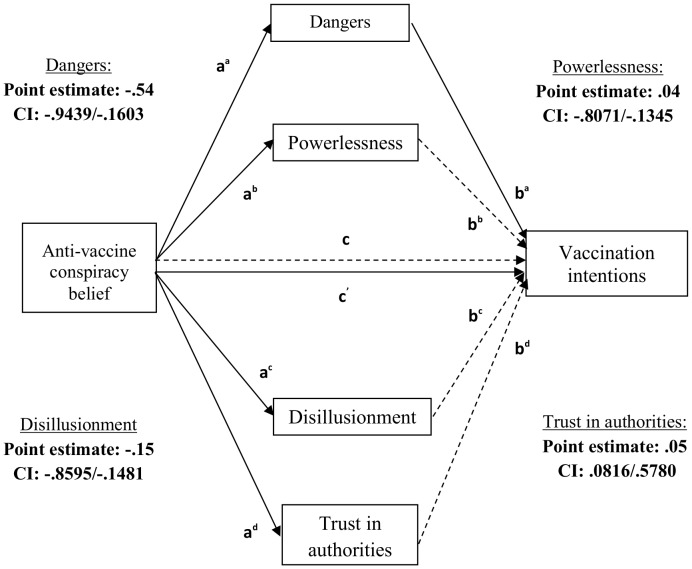
- In Study 1, anti-vaccine conspiracy beliefs significantly negatively predicted vaccination intentions, \(F(1, 87) = 15.97, p < .001, R^2 = .16, \beta = -.63\). Perceived dangers of vaccines, powerlessness, disillusionment, and trust in authorities each significantly mediated this relationship.
- In Study 2, vaccination intentions were significantly lower in the pro-conspiracy condition (\(M = 4.87, SD = 1.74\)) than in the anti-conspiracy condition (\(M = 5.69, SD = 1.31, p = .003\)) and the control condition (\(M = 5.47, SD = 1.50, p = .028\)), overall \(F(2, 185) = 4.81, p = .009, \eta^2 = .05\).
- The manipulation check showed higher endorsement of anti-vaccine conspiracy theories in the pro-conspiracy condition (\(M = 4.11, SD = 1.41\)) than the anti-conspiracy condition (\(M = 2.93, SD = 1.14, p < .001\)) and control condition (\(M = 3.56, SD = 1.21, p = .014\)).
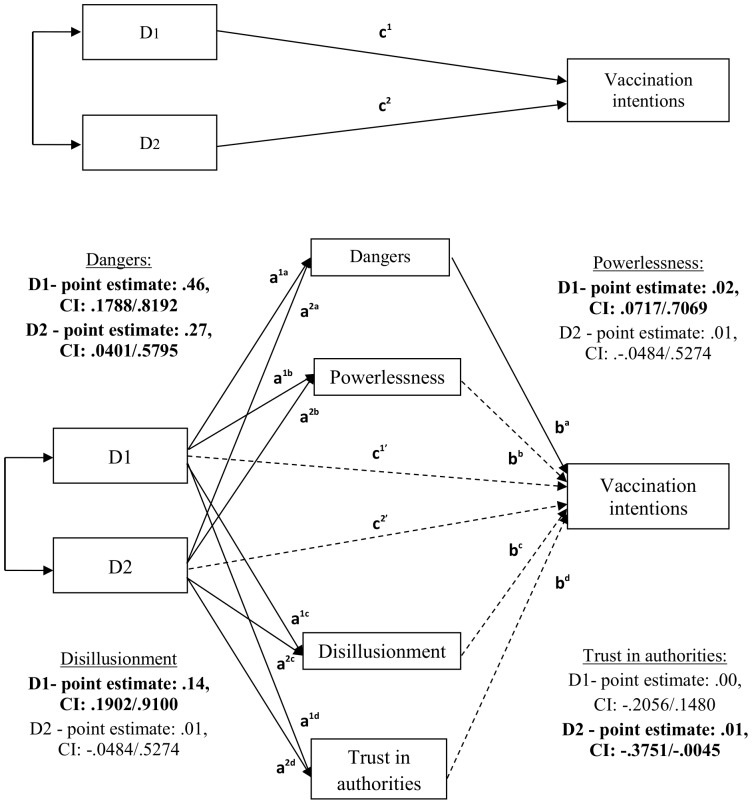
- Perceived vaccine dangers consistently mediated the effects; powerlessness and disillusionment mediated the pro- versus anti-conspiracy difference, and trust in authorities mediated the pro-conspiracy versus control difference.
Methods
- Study 1 used a correlational online questionnaire with 89 British parents (\(80\) women, \(9\) men; \(M\) age \(= 38.06, SD = 9.25\)). Participants completed measures of anti-vaccine conspiracy beliefs, perceived dangers, powerlessness, disillusionment, trust in authorities, and intention to vaccinate a fictitious 8-month-old child against a made-up disease, dysomeria.
- Study 2 recruited 246 U.S. MTurk participants, with a final analyzed sample of 188 after screening exclusions. Participants were randomly assigned to pro-conspiracy, anti-conspiracy, or control information, then completed the same mediator measures and vaccination intention measure.
- Both studies used bootstrapping mediation analyses with 5000 bootstrap samples; Study 2 used ANOVA and indicator-coded mediation to compare the three conditions.
Limitations
- The paper states that effect sizes were small (e.g., \(\eta^2 = .05\) in Study 2), conspiracy endorsement was generally around or below the midpoint except in the pro-conspiracy condition (\(M = 4.11\)), the mediation pattern was less clear in Study 2, and findings relied on self-reported intentions for a fictional child and made-up disease rather than actual vaccination behavior.
- The paper notes that future research should examine larger samples, actual vaccination behavior, additional or isolated mediators, and geographical areas with dangerously low vaccination uptake.
- Evident from the text: Study 1 is correlational and cannot establish causality, and both studies use hypothetical vaccination scenarios, which may limit ecological validity.
Model-written summary. Check it against the paper before relying on it.
Integrity signals
Registry
Cites
Statistics
Figures
Verification
Claims the paper makes
37 Own result · 21 Not checked yet · 20 Own interpretation · 12 Own method
A result the paper reports from its own data — it cites no other source for it, so there is none to check. The quote shows it is in the paper.
In the paper
“Results revealed a significant negative relationship between anti-vaccine conspiracy beliefs and vaccination intentions.”
- Also stated in: § Results and Discussion · plain
“As predicted, regression analyses revealed that anti-vaccine conspiracy beliefs were a significant negative predictor of vaccination intentions, F(1, 87) = 15.97, p<.001, R2 = .16, β = −.63, t = − 3.10, p<. 001.”
- Also stated in: § Results and Discussion · plain
“Participants who endorsed anti-vaccine conspiracy theories to a greater extent indicated less intention to vaccinate.”
§ The Effects of Anti-Vaccine Conspiracy Theories on Vaccination Intentions > Abstract
plaincorrelational- Asserted: passes — The authors put it forward as true.
- Checkable: passes — It can be checked against evidence.
- Load-bearing: passes — The paper’s conclusions depend on it.
- Based: passes — The paper gives a reason why it holds.
- Also stated in: § Results and Discussion · plain
A result the paper reports from its own data — it cites no other source for it, so there is none to check. The quote shows it is in the paper.
In the paper
“As shown in Table 2, anti-vaccine conspiracy beliefs were a significant predictor of perceived dangers of vaccines, and feelings of powerlessness, disillusionment and trust in authorities, F(5, 83) = 120.37, p<.001, R2 = .58; F(5, 83) = 41.70, p<.001, R2 = .32; F(5, 83) = 74.43, p<.001, R2 = .46; F(5, 83) = 23.00, p<.001, R2 = .20, respectively.”
§ The Effects of Anti-Vaccine Conspiracy Theories on Vaccination Intentions > Study 1 > Results and Discussion
plaincorrelational- Asserted: passes — The authors put it forward as true.
- Checkable: passes — It can be checked against evidence.
- Load-bearing: passes — The paper’s conclusions depend on it.
- Based: passes — The paper gives a reason why it holds.
A result the paper reports from its own data — it cites no other source for it, so there is none to check. The quote shows it is in the paper.
In the paper
“Results revealed that participants who had been exposed to material supporting anti-vaccine conspiracy theories showed less intention to vaccinate than those in the anti-conspiracy condition or controls.”
§ The Effects of Anti-Vaccine Conspiracy Theories on Vaccination Intentions > Abstract
plaindirect- Asserted: passes — The authors put it forward as true.
- Checkable: passes — It can be checked against evidence.
- Load-bearing: passes — The paper’s conclusions depend on it.
- Based: passes — The paper gives a reason why it holds.
A result the paper reports from its own data — it cites no other source for it, so there is none to check. The quote shows it is in the paper.
In the paper
“This effect was mediated by the same variables as in Study 1.”
§ The Effects of Anti-Vaccine Conspiracy Theories on Vaccination Intentions > Abstract
plaindirect- Asserted: passes — The authors put it forward as true.
- Checkable: passes — It can be checked against evidence.
- Load-bearing: passes — The paper’s conclusions depend on it.
- Based: passes — The paper gives a reason why it holds.
A result the paper reports from its own data — it cites no other source for it, so there is none to check. The quote shows it is in the paper.
In the paper
“This effect was mediated by the perceived dangers of vaccines, and feelings of powerlessness, disillusionment and mistrust in authorities.”
- Also stated in: § Results and Discussion · hedged
“The multiple mediation analysis of the effect of anti-vaccine conspiracy beliefs on vaccination intentions indicated that perceived dangers of vaccines and feelings of powerlessness, disillusionment and trust in authorities (controlling for each other) were each significant mediators of this effect.”
- Also stated in: § Results and Discussion · plain
“When all factors were taken into account, each was a significant mediator of the relationship between anti-vaccine conspiracy beliefs and vaccination intentions.”
§ The Effects of Anti-Vaccine Conspiracy Theories on Vaccination Intentions > Abstract
plaincorrelational- Asserted: passes — The authors put it forward as true.
- Checkable: passes — It can be checked against evidence.
- Load-bearing: passes — The paper’s conclusions depend on it.
- Based: passes — The paper gives a reason why it holds.
- Also stated in: § Results and Discussion · hedged
A result the paper reports from its own data — it cites no other source for it, so there is none to check. The quote shows it is in the paper.
In the paper
“As shown in Table 2, anti-vaccine conspiracy beliefs were a significant predictor of perceived dangers of vaccines, and feelings of powerlessness, disillusionment and trust in authorities, F(5, 83) = 120.37, p<.001, R2 = .58; F(5, 83) = 41.70, p<.001, R2 = .32; F(5, 83) = 74.43, p<.001, R2 = .46; F(5, 83) = 23.00, p<.001, R2 = .20, respectively.”
§ The Effects of Anti-Vaccine Conspiracy Theories on Vaccination Intentions > Study 1 > Results and Discussion
plaincorrelational- Asserted: passes — The authors put it forward as true.
- Checkable: passes — It can be checked against evidence.
- Load-bearing: passes — The paper’s conclusions depend on it.
- Based: passes — The paper gives a reason why it holds.
A result the paper reports from its own data — it cites no other source for it, so there is none to check. The quote shows it is in the paper.
In the paper
“The results of this analysis therefore support the use of four separate mediators.”
§ The Effects of Anti-Vaccine Conspiracy Theories on Vaccination Intentions > Study 1 > Results and Discussion
plain- Asserted: passes — The authors put it forward as true.
- Checkable: passes — It can be checked against evidence.
- Load-bearing: passes — The paper’s conclusions depend on it.
- Based: passes — The paper gives a reason why it holds.
A result the paper reports from its own data — it cites no other source for it, so there is none to check. The quote shows it is in the paper.
In the paper
“Finally, results revealed no significant difference in trust in authorities between conditions, F(2, 185) = 2.32, p = .10, η2 = .03.”
§ The Effects of Anti-Vaccine Conspiracy Theories on Vaccination Intentions > Study 2 > Results and Discussion
plain- Asserted: passes — The authors put it forward as true.
- Checkable: passes — It can be checked against evidence.
- Load-bearing: unclear — It is unclear whether the paper’s conclusions depend on it.
- Based: passes — The paper gives a reason why it holds.
A result the paper reports from its own data — it cites no other source for it, so there is none to check. The quote shows it is in the paper.
In the paper
“Perceived dangers were higher in the pro-conspiracy condition (M = 4.00, SD = 1.46) than the anti-conspiracy condition (M = 2.97, SD = 1.42, p<.001) and the control condition (M = 2.39, SD = 1.71, p = .021).”
§ The Effects of Anti-Vaccine Conspiracy Theories on Vaccination Intentions > Study 2 > Results and Discussion
plain- Asserted: passes — The authors put it forward as true.
- Checkable: passes — It can be checked against evidence.
- Load-bearing: passes — The paper’s conclusions depend on it.
- Based: passes — The paper gives a reason why it holds.
- Probably not a substantial claim. 18
- It may state two separate claims as one. 9
- The quote only partly states this claim. 2
What the paper did — it cites no source for this, so there is none to check. The quote shows it is in the paper.
In the paper
“There were eight statements (e.g., “Vaccines lead to allergies”, α = .86)”
§ The Effects of Anti-Vaccine Conspiracy Theories on Vaccination Intentions > Study 1 > Methods
plain- Asserted: passes — The authors put it forward as true.
- Checkable: passes — It can be checked against evidence.
- Load-bearing: fails — The paper’s conclusions may not depend on it.
- Based: passes — The paper gives a reason why it holds.
Probably not a substantial claim. The paper’s conclusions may not depend on it.
What the paper did — it cites no source for this, so there is none to check. The quote shows it is in the paper.
In the paper
“Participants were asked to read the statements (e.g., “I feel that my actions will not stop the negative outcomes of immunizations”, α = .82)”
§ The Effects of Anti-Vaccine Conspiracy Theories on Vaccination Intentions > Study 1 > Methods
plain- Asserted: passes — The authors put it forward as true.
- Checkable: passes — It can be checked against evidence.
- Load-bearing: fails — The paper’s conclusions may not depend on it.
- Based: passes — The paper gives a reason why it holds.
Probably not a substantial claim. The paper’s conclusions may not depend on it.
What the paper did — it cites no source for this, so there is none to check. The quote shows it is in the paper.
In the paper
“consisted of four statements (e.g., “I am very disappointed with those who are involved in immunizations (e.g., the government, pharmaceutical companies)”, α = .89)”
§ The Effects of Anti-Vaccine Conspiracy Theories on Vaccination Intentions > Study 1 > Methods
plain- Asserted: passes — The authors put it forward as true.
- Checkable: passes — It can be checked against evidence.
- Load-bearing: fails — The paper’s conclusions may not depend on it.
- Based: passes — The paper gives a reason why it holds.
Probably not a substantial claim. The paper’s conclusions may not depend on it.
In the paper
“and also that feelings of political powerlessness mediate the relationship between exposure to conspiracy theories and voting intentions [22].”
§ The Effects of Anti-Vaccine Conspiracy Theories on Vaccination Intentions > Introduction
What the sources say
- Not checked yetcites [22] Jolley D, Douglas KM (2013) The social consequences of conspiracism: Exposure to conspiracy theories decreases the intention to engage in politics and to reduce one’s carbon footprint. Br J Psychol: in press. doi:10.1111/bjop.12018. source
plaindirect- Asserted: passes — The authors put it forward as true.
- Checkable: passes — It can be checked against evidence.
- Load-bearing: passes — The paper’s conclusions depend on it.
- Based: passes — The paper gives a reason why it holds.
Probably not a substantial claim.
In the paper
“Further, polls demonstrate that more than 20% of respondents endorse the idea that there is a link between childhood vaccines and autism [13].”
§ The Effects of Anti-Vaccine Conspiracy Theories on Vaccination Intentions > Introduction
What the sources say
- Not checked yetcites [13] Public Policy Polling (2013) Democrats and Republicans differ on conspiracy theory beliefs. Available: http://www.publicpolicypolling.com/pdf/2011/PPP_Release_National_ConspiracyTheories_040213.pdf. Accessed: 2013 Nov 27.
boosted- Asserted: passes — The authors put it forward as true.
- Checkable: passes — It can be checked against evidence.
- Load-bearing: fails — The paper’s conclusions may not depend on it.
- Based: passes — The paper gives a reason why it holds.
Probably not a substantial claim. The paper’s conclusions may not depend on it.
In the paper
“Previous research has demonstrated that exposure to conspiracy theories increases political disillusionment [22]”
§ The Effects of Anti-Vaccine Conspiracy Theories on Vaccination Intentions > Introduction
What the sources say
- Not checked yetcites [22] Jolley D, Douglas KM (2013) The social consequences of conspiracism: Exposure to conspiracy theories decreases the intention to engage in politics and to reduce one’s carbon footprint. Br J Psychol: in press. doi:10.1111/bjop.12018. source
boosteddirect- Asserted: passes — The authors put it forward as true.
- Checkable: passes — It can be checked against evidence.
- Load-bearing: passes — The paper’s conclusions depend on it.
- Based: passes — The paper gives a reason why it holds.
Probably not a substantial claim.
None of the sources cited for this claim have been checked yet.
In the paper
“Endorsement of these conspiracy theories amongst African Americans has been found to be associated with negative attitudes towards contraceptive behaviors, which may potentially expose people to the risk of unwanted pregnancies and sexually transmitted illnesses [23], [24], [25].”
§ The Effects of Anti-Vaccine Conspiracy Theories on Vaccination Intentions > Introduction
What the sources say
- Not checked yetcites [23] ST Bird, 2003, Birth control conspiracy beliefs, perceived discrimination, and contraception among African Americans, Journal of Health Psychology source
- Not checked yetcites [24] LM Bogart, 2006, Relationship of African Americans’ socio demographic characteristics to belief in conspiracies about HIV/AIDS and birth control, Journal of the National Medical Association
- Not checked yetcites [25] MA Hoyt, 2012, HIV/AIDS-related institutional mistrust among multiethnic men who have sex with men: Effects on HIV testing and risk behaviors, Health Psychology source
plaincorrelational- Asserted: passes — The authors put it forward as true.
- Checkable: passes — It can be checked against evidence.
- Load-bearing: fails — The paper’s conclusions may not depend on it.
- Based: passes — The paper gives a reason why it holds.
Probably not a substantial claim. The paper’s conclusions may not depend on it.
What the paper did — it cites no source for this, so there is none to check. The quote shows it is in the paper.
In the paper
“The order of measures was counterbalanced.”
§ The Effects of Anti-Vaccine Conspiracy Theories on Vaccination Intentions > Study 1 > Methods
plain- Asserted: passes — The authors put it forward as true.
- Checkable: passes — It can be checked against evidence.
- Load-bearing: fails — The paper’s conclusions may not depend on it.
- Based: passes — The paper gives a reason why it holds.
Probably not a substantial claim. The paper’s conclusions may not depend on it.
What the paper did — it cites no source for this, so there is none to check. The quote shows it is in the paper.
In the paper
“The study was approved by the Psychology Ethics Committee at the University of Kent and all participants provided their written, informed consent.”
§ The Effects of Anti-Vaccine Conspiracy Theories on Vaccination Intentions > Study 1 > Methods
plain- Asserted: passes — The authors put it forward as true.
- Checkable: passes — It can be checked against evidence.
- Load-bearing: fails — The paper’s conclusions may not depend on it.
- Based: passes — The paper gives a reason why it holds.
Probably not a substantial claim. The paper’s conclusions may not depend on it. It may state two separate claims as one.
What the paper did — it cites no source for this, so there is none to check. The quote shows it is in the paper.
In the paper
“There were two trust sources (corporations and government; Spearman-Brown Coefficient = .82)”
§ The Effects of Anti-Vaccine Conspiracy Theories on Vaccination Intentions > Study 1 > Methods
plain- Asserted: passes — The authors put it forward as true.
- Checkable: passes — It can be checked against evidence.
- Load-bearing: fails — The paper’s conclusions may not depend on it.
- Based: passes — The paper gives a reason why it holds.
Probably not a substantial claim. The paper’s conclusions may not depend on it. The quote only partly states this claim.
None of the sources cited for this claim have been checked yet.
In the paper
“Also, exposure to conspiracy theories has been found to have detrimental effects in other domains, such as reducing pro-environmental intentions and willingness to engage in politics [21], [22].”
§ The Effects of Anti-Vaccine Conspiracy Theories on Vaccination Intentions > Introduction
What the sources say
- Not checked yetcites [21] LD Butler, 1995, The psychological impact of viewing the film JFK: Emotions, beliefs and political behavioral intentions, Political Psychology source
- Not checked yetcites [22] Jolley D, Douglas KM (2013) The social consequences of conspiracism: Exposure to conspiracy theories decreases the intention to engage in politics and to reduce one’s carbon footprint. Br J Psychol: in press. doi:10.1111/bjop.12018. source
plaindirect- Asserted: passes — The authors put it forward as true.
- Checkable: passes — It can be checked against evidence.
- Load-bearing: fails — The paper’s conclusions may not depend on it.
- Based: passes — The paper gives a reason why it holds.
Probably not a substantial claim. The paper’s conclusions may not depend on it.
A conclusion the paper draws from its own results — it cites no other source for it, so there is none to check. The quote shows it is in the paper.
In the paper
“In Study 2, feelings of powerlessness and disillusionment mediated the difference between the pro- and anti-conspiracy conditions, and mistrust in authorities mediated the difference between the pro-conspiracy and control conditions.”
§ The Effects of Anti-Vaccine Conspiracy Theories on Vaccination Intentions > General Discussion
plaindirect- Asserted: passes — The authors put it forward as true.
- Checkable: passes — It can be checked against evidence.
- Load-bearing: passes — The paper’s conclusions depend on it.
- Based: passes — The paper gives a reason why it holds.
It may state two separate claims as one.
A conclusion the paper draws from its own results — it cites no other source for it, so there is none to check. The quote shows it is in the paper.
In the paper
“This means that the proportion of variance in vaccine intentions explained by exposure to conspiracy theories was quite modest and there are potentially many other factors that contribute to vaccine intentions.”
§ The Effects of Anti-Vaccine Conspiracy Theories on Vaccination Intentions > General Discussion
hedgedcorrelational- Asserted: passes — The authors put it forward as true.
- Checkable: passes — It can be checked against evidence.
- Load-bearing: passes — The paper’s conclusions depend on it.
- Based: passes — The paper gives a reason why it holds.
It may state two separate claims as one.
What the paper did — it cites no source for this, so there is none to check. The quote shows it is in the paper.
In the paper
“The final sample size used for data analysis was therefore 188 (112 women and 76 men, M age = 36.33, SD = 13.40).”
§ The Effects of Anti-Vaccine Conspiracy Theories on Vaccination Intentions > Study 2 > Methods
plainn = 188- Asserted: passes — The authors put it forward as true.
- Checkable: passes — It can be checked against evidence.
- Load-bearing: fails — The paper’s conclusions may not depend on it.
- Based: passes — The paper gives a reason why it holds.
Probably not a substantial claim. The paper’s conclusions may not depend on it.
A conclusion the paper draws from its own results — it cites no other source for it, so there is none to check. The quote shows it is in the paper.
In the paper
“Further, feelings of powerlessness and disillusionment mediated the difference between the pro- and anti-conspiracy conditions, and mistrust in authorities mediated the difference between the pro-conspiracy and control conditions.”
§ The Effects of Anti-Vaccine Conspiracy Theories on Vaccination Intentions > Study 2 > Results and Discussion
plaindirectn = 188- Asserted: passes — The authors put it forward as true.
- Checkable: passes — It can be checked against evidence.
- Load-bearing: passes — The paper’s conclusions depend on it.
- Based: passes — The paper gives a reason why it holds.
It may state two separate claims as one.
What the paper did — it cites no source for this, so there is none to check. The quote shows it is in the paper.
In the paper
“There were 60 participants in the pro-conspiracy condition, 62 in the anti-conspiracy condition, and 66 in the control condition.”
§ The Effects of Anti-Vaccine Conspiracy Theories on Vaccination Intentions > Study 2 > Methods
plainn = 60- Asserted: passes — The authors put it forward as true.
- Checkable: passes — It can be checked against evidence.
- Load-bearing: fails — The paper’s conclusions may not depend on it.
- Based: passes — The paper gives a reason why it holds.
Probably not a substantial claim. The paper’s conclusions may not depend on it. It may state two separate claims as one.
None of the sources cited for this claim have been checked yet.
In the paper
“As is well known, intentions do not always translate into behaviors [47], [48], [49].”
§ The Effects of Anti-Vaccine Conspiracy Theories on Vaccination Intentions > General Discussion
What the sources say
- Not checked yetcites [47] RT LaPiere, 1934, Attitudes vs. actions, Social Forces source
- Not checked yetcites [48] LS Linn, 1965, Verbal attitudes and overt behavior: A study of racial discrimination, Social Forces source
- Not checked yetcites [49] Sheeran P (2002) Intention-behavior relations: A conceptual and empirical review. In: Stroebe W, Hewstone M, editors. European Review of Social Psychology. Chichester, UK: Wiley. Vol. 12, 1–36. source
boosted- Asserted: passes — The authors put it forward as true.
- Checkable: passes — It can be checked against evidence.
- Load-bearing: passes — The paper’s conclusions depend on it.
- Based: passes — The paper gives a reason why it holds.
Probably not a substantial claim.
In the paper
“Similarly, different strategies for successful intervention may apply for people who hold strong anti-vaccine conspiracy beliefs than those who do not hold strong beliefs [44].”
§ The Effects of Anti-Vaccine Conspiracy Theories on Vaccination Intentions > General Discussion
What the sources say
- Not checked yetcites [44] CR Sunstein, 2009, Conspiracy theories: Causes and cures, J Polit Philos source
hedgedconditional- Asserted: passes — The authors put it forward as true.
- Checkable: fails — It may be too vague to check against evidence.
- Load-bearing: fails — The paper’s conclusions may not depend on it.
- Based: passes — The paper gives a reason why it holds.
Probably not a substantial claim. It may be too vague to check against evidence. The paper’s conclusions may not depend on it.
None of the sources cited for this claim have been checked yet.
In the paper
“Psychologists are learning more about the traits and characteristics associated with beliefs in conspiracy theories more generally, such as mistrust, anomie, political cynicism and Machiavellianism [8], [20], [31], [50]”
§ The Effects of Anti-Vaccine Conspiracy Theories on Vaccination Intentions > General Discussion
What the sources say
- Not checked yetcites [8] T Goertzel, 1994, Belief in conspiracy theories, Polit Psychol source
- Not checked yetcites [20] KM Douglas, 2008, The hidden impact of conspiracy theories: Perceived and actual influence of theories surrounding the death of Princess Diana, Br J Soc Psychol source
- Not checked yetcites [31] M Abalakina-Paap, 1999, Beliefs in conspiracies, Political Psychology source
plaincorrelational- Asserted: passes — The authors put it forward as true.
- Checkable: passes — It can be checked against evidence.
- Load-bearing: fails — The paper’s conclusions may not depend on it.
- Based: passes — The paper gives a reason why it holds.
Probably not a substantial claim. The paper’s conclusions may not depend on it.
A conclusion the paper draws from its own results — it cites no other source for it, so there is none to check. The quote shows it is in the paper.
In the paper
“Specifically, they appear to reduce vaccination intentions by inducing undue concern about the dangers of vaccines, and increasing powerlessness, disillusionment, and mistrust.”
§ The Effects of Anti-Vaccine Conspiracy Theories on Vaccination Intentions > General Discussion
hedgeddirect- Asserted: passes — The authors put it forward as true.
- Checkable: passes — It can be checked against evidence.
- Load-bearing: passes — The paper’s conclusions depend on it.
- Based: passes — The paper gives a reason why it holds.
It may state two separate claims as one.
A conclusion the paper draws from its own results — it cites no other source for it, so there is none to check. The quote shows it is in the paper.
In the paper
“Therefore, the participants were not strong endorsers of anti-vaccine conspiracy theories, meaning that different patterns of findings may emerge for those who do strongly endorse conspiracy theories.”
§ The Effects of Anti-Vaccine Conspiracy Theories on Vaccination Intentions > General Discussion
hedged- Asserted: passes — The authors put it forward as true.
- Checkable: passes — It can be checked against evidence.
- Load-bearing: unclear — It is unclear whether the paper’s conclusions depend on it.
- Based: passes — The paper gives a reason why it holds.
It may state two separate claims as one.
A conclusion the paper draws from its own results — it cites no other source for it, so there is none to check. The quote shows it is in the paper.
In the paper
“Therefore, overall, anti-vaccine conspiracy theories appear to introduce undue suspicion about vaccine safety, and increase feelings of powerlessness and disillusionment, whilst decreasing trust in authorities, which in turn introduce reluctance to vaccinate.”
§ The Effects of Anti-Vaccine Conspiracy Theories on Vaccination Intentions > General Discussion
hedgeddirect- Asserted: passes — The authors put it forward as true.
- Checkable: passes — It can be checked against evidence.
- Load-bearing: passes — The paper’s conclusions depend on it.
- Based: passes — The paper gives a reason why it holds.
It may state two separate claims as one.
What the paper did — it cites no source for this, so there is none to check. The quote shows it is in the paper.
In the paper
“Participants were randomly assigned to one of the three conditions.”
§ The Effects of Anti-Vaccine Conspiracy Theories on Vaccination Intentions > Study 2 > Methods
plain- Asserted: passes — The authors put it forward as true.
- Checkable: passes — It can be checked against evidence.
- Load-bearing: passes — The paper’s conclusions depend on it.
- Based: passes — The paper gives a reason why it holds.
Probably not a substantial claim.
What the paper did — it cites no source for this, so there is none to check. The quote shows it is in the paper.
In the paper
“The study was approved by the Psychology Ethics Committee at the University of Kent and all participants provided their written, informed consent.”
§ The Effects of Anti-Vaccine Conspiracy Theories on Vaccination Intentions > Study 1 > Methods
plain- Asserted: fails — The authors may not put it forward as true.
- Checkable: passes — It can be checked against evidence.
- Load-bearing: fails — The paper’s conclusions may not depend on it.
- Based: fails — The paper may give no reason why it holds.
Probably not a substantial claim. The authors may not put it forward as true. The paper’s conclusions may not depend on it. The paper may give no reason why it holds. It may state two separate claims as one. The quote only partly states this claim.
The paper relies on this without support.
The measured mediators (perceived vaccine dangers, powerlessness, disillusionment, and trust in authorities) are causally prior to and influence vaccination intentions, as required for the mediation analysis.
“Each of the candidate mediators was then examined in a test of mediation in order to explain the effect of the conspiracy conditions (pro-conspiracy versus anti-conspiracy, versus control) on vaccination intentions.”
Statistics recomputed
Every reported test result, recomputed from its test statistic and degrees of freedom. A result shows as not adding up only once an independent check has confirmed it.
- Consistentχ²(136) = 4544.44reported p < .001 · recomputed p < .001
“X 2 (136) = 4544.44, p < .001”
- ConsistentF(1, 87) = 15.97reported p < .001 · recomputed p < .001
“F(1, 87) = 15.97, p < .001”
- ConsistentF(5, 83) = 120.37reported p < .001 · recomputed p < .001
“F(5, 83) = 120.37, p < .001”
- ConsistentF(5, 83) = 41.7reported p < .001 · recomputed p < .001
“F(5, 83) = 41.70, p < .001”
- ConsistentF(5, 83) = 74.43reported p < .001 · recomputed p < .001
“F(5, 83) = 74.43, p < .001”
- ConsistentF(5, 83) = 23reported p < .001 · recomputed p < .001
“F(5, 83) = 23.00, p < .001”
- ConsistentF(2, 185) = 4.81reported p = .009 · recomputed p = .009
“F(2, 185) = 4.81, p = .009”
- ConsistentF(2, 185) = 7.61reported p = .001 · recomputed p < .001
“F(2, 185) = 7.61, p = .001”
- ConsistentF(2, 185) = 3.44reported p = .034 · recomputed p = .034
“F(2, 185) = 3.44, p = .034”
- ConsistentF(2, 185) = 7.46reported p = .001 · recomputed p < .001
“F(2, 185) = 7.46, p = .001”
- ConsistentF(2, 185) = 2.32reported p = .1 · recomputed p = .101
“F(2, 185) = 2.32, p = .10”
Self-check
Percentages, sums and reported differences re-computed from the paper’s own numbers.
Each contradiction between two passages listed here was confirmed by an independent check.
Rated minor: it would not touch a result — a value no result rests on, a p-value that stays on the same side of the significance level, or a conflict that is clerical, resolved elsewhere in the paper, or outside its own findings.
In the paper
§ The Effects of Anti-Vaccine Conspiracy Theories on Vaccination Intentions > Study 1 > Results and Discussion
“| (2) Immunisation intention | 5.63 (1.42) | −.40*** | – | −.49*** | .29** | −.36*** | .20¥ |”
§ The Effects of Anti-Vaccine Conspiracy Theories on Vaccination Intentions > Study 1 > Results and Discussion
“| (3) Dangers | 2.97 (1.37) | .76*** | −.48*** | – | .58*** | .60*** | −.48*** |”
Rated minor: it would not touch a result — a value no result rests on, a p-value that stays on the same side of the significance level, or a conflict that is clerical, resolved elsewhere in the paper, or outside its own findings.
In the paper
“F(1, 87) = 15.97, p<.001, R2 = .16, β = −.63, t = − 3.10, p<. 001.”
§ The Effects of Anti-Vaccine Conspiracy Theories on Vaccination Intentions > Study 1 > Results and Discussion
Reported 15.97 · recomputed 9.61
Rated minor: it would not touch a result — a value no result rests on, a p-value that stays on the same side of the significance level, or a conflict that is clerical, resolved elsewhere in the paper, or outside its own findings.
In the paper
§ The Effects of Anti-Vaccine Conspiracy Theories on Vaccination Intentions > Study 1 > Results and Discussion
“| (3) Dangers | 2.97 (1.37) | .76*** | −.48*** | – | .58*** | .60*** | −.48*** |”
§ The Effects of Anti-Vaccine Conspiracy Theories on Vaccination Intentions > Study 1 > Results and Discussion
“| (5) Disillusionment | 2.45 (1.40) | .68*** | −.36*** | .59*** | .59*** | – | −.41*** |”
Rated minor: it would not touch a result — a value no result rests on, a p-value that stays on the same side of the significance level, or a conflict that is clerical, resolved elsewhere in the paper, or outside its own findings.
In the paper
§ The Effects of Anti-Vaccine Conspiracy Theories on Vaccination Intentions > Study 1 > Results and Discussion
“β = −.63”
§ The Effects of Anti-Vaccine Conspiracy Theories on Vaccination Intentions > Study 1 > Results and Discussion
“| (1) Anti-vaccine conspiracy belief | 2.00 (.89) | – | −.40*** | .76*** | .57*** | .68*** | −.46*** |”
Rated minor: it would not touch a result — a value no result rests on, a p-value that stays on the same side of the significance level, or a conflict that is clerical, resolved elsewhere in the paper, or outside its own findings.
In the paper
§ The Effects of Anti-Vaccine Conspiracy Theories on Vaccination Intentions > Study 1 > Results and Discussion
“F(5, 83) = 120.37, p<.001, R2 = .58; F(5, 83) = 41.70, p<.001, R2 = .32; F(5, 83) = 74.43, p<.001, R2 = .46; F(5, 83) = 23.00, p<.001, R2 = .20, respectively.”
§ The Effects of Anti-Vaccine Conspiracy Theories on Vaccination Intentions > Study 1 > Results and Discussion
“Table: Table 2 Four separate regressions examining anti-conspiracy belief as predictor, and four mediator variables as criterions.”
Citations
Cites
Preacher, K. J., & Hayes, A. F. (2008) · Behavior Research Methods · doi:10.3758/brm.40.3.879 · Cited by 34,117 · cited 1×
“By repeating this process thousands of times, it builds an empirical approximation of the sampling distribution that constructs the confidence intervals [39].”
Amazon's Mechanical Turk: A New Source of Inexpensive, Yet High-Quality, Data?
Buhrmester, M., Kwang, T., & Gosling, S. D. (2011) · Perspectives on Psychological Science · doi:10.1177/1745691610393980 · Cited by 9,996
Beyond Baron and Kenny: Statistical Mediation Analysis in the New Millennium
Hayes, A. F. (2009) · Communication Monographs · doi:10.1080/03637750903310360 · Cited by 9,757 · cited 5×
“As argued by Hayes [40], an indirect effect is estimated as being significant if the confidence intervals do not contain a zero, as opposed to significance in the individual paths.”
InfluentialNew Environmental Theories: Toward a Coherent Theory of Environmentally Significant Behavior
Stern, P. C. (2000) · Journal of Social Issues · doi:10.1111/0022-4537.00175 · Cited by 8,682
A Second Generation Little Jiffy
Kaiser, H. F. (1970) · Psychometrika · doi:10.1007/bf02291817 · Cited by 4,855
Running experiments on Amazon Mechanical Turk
Paolacci, G., Chandler, J., & Ipeirotis, P. G. (2010) · Judgment and Decision Making · doi:10.1017/s1930297500002205 · Cited by 3,767
Intention—Behavior Relations: A Conceptual and Empirical Review
Sheeran, P. (2002) · European Review of Social Psychology · doi:10.1080/14792772143000003 · Cited by 3,688 · cited 1×
“As is well known, intentions do not always translate into behaviors [47], [48], [49].”
Statistical mediation analysis with a multicategorical independent variable
Hayes, A. F., & Preacher, K. J. (2014) · British Journal of Mathematical and Statistical Psychology · doi:10.1111/bmsp.12028 · Cited by 3,403 · cited 3×
“This was carried out using Hayes and Preacher’s [38] bootstrapping method for indirect effects, as in Study 1.”
Misinformation and Its Correction: Continued Influence and Successful Debiasing
Lewandowsky, S., Ecker, U. K. H., Seifert, C. M., Schwarz, N., & Cook, J. (2012) · Psychological Science in the Public Interest · doi:10.1177/1529100612451018 · Cited by 2,920
A Note on the Multiplying Factors for Various χ2 Approximations
Bartlett, M. S. (1954) · Journal of the Royal Statistical Society Series B (Statistical Methodology) · doi:10.1111/j.2517-6161.1954.tb00174.x · Cited by 2,168
Cited by
Sorted by citations
Items 701–800 of 1,000
Herath, N. C., Kudagammana, T., Sanathchandra, T. T., Gamage, H. K., Razik, I. M., & Liynapathirana, V. (2018) · BMC Research Notes · doi:10.1186/s13104-018-3519-y · Cited by 6
“Exposure to anti vaccine movement is shown to be associated with a reduced intention for vaccination [8].”
Abullais, S. S., Arora, S., Alshahrani, M. S., Khan, A. A., Shahrani, W. A., Mahmood, S. E., Qahtani, S. A., Maqbool, M., Jameel, A. S., & Saluja, P. (2022) · Human Vaccines & Immunotherapeutics · doi:10.1080/21645515.2022.2095162 · Cited by 6
Candini, V., Brescianini, S., Chiarotti, F., Zarbo, C., Zamparini, M., Caserotti, M., Gavaruzzi, T., Girardi, P., Lotto, L., Tasso, A., et al. (2022) · Public Health · doi:10.1016/j.puhe.2022.11.005 · Cited by 8
Vaccine Conspiracy Beliefs Scale: Validation and Measurement Invariance in a Youth Sample
Jovanović, V., Lazić, M., Gavrilov‐Jerković, V., Zotović, M., & Obradović, V. (2023) · Evaluation & the Health Professions · doi:10.1177/01632787231170237 · Cited by 10
“Of the seven VCBS items, six were chosen from the pool of items used in a study conducted by Jolley and Douglas (2014), and one new item (Item 7: The government is trying to cover up the link between vaccines and autism ) was added.”
MethodDigital Technologies and COVID-19 Vaccine Acceptance: Evidence From France and South Africa
Wamba, S., Guthrie, C., Queiroz, M., & Twinomurinzi, H. (2023) · Journal of Global Information Management · doi:10.4018/jgim.333611 · Cited by 4
Remsö, A., & Renström, E. A. (2023) · Frontiers in Social Psychology · doi:10.3389/frsps.2023.1303157 · Cited by 5
Health scares: Tracing their nature, growth and spread
MacKrill, K., Witthöft, M., Wessely, S. C., & Petrie, K. J. (2023) · Clinical Psychology in Europe · doi:10.32872/cpe.12209 · Cited by 6
“There is evidence that the acceptance of conspiracy theories is associated with a shunning of vaccination (Jolley & Douglas, 2014) and lower adoption of recommended preventative actions against COVID-19 such as wearing a face mask (Romer & Jamieson, 2020).”
BackgroundPersonal rights over public Health: Anti-vaccine rhetoric in the Texas Legislature
Matthews, K. R. W., Lakshmanan, R., Kalakuntla, N., & Tallapragada, N. (2024) · Vaccine X · doi:10.1016/j.jvacx.2024.100468 · Cited by 6
“They have aligned themselves with far-right conservatives and the broader libertarian ideology that promotes limited government and mistrust of government institutions and modern medicine [11 – 13].”
Jolley, D., Mari, S., Schrader, T., & Cookson, D. (2024) · Violence Against Women · doi:10.1177/10778012241234892 · Cited by 6
“…can implicate a range of different groups, from scientists (e.g., climate change is a hoax because scientists fake their data to make a pro fi t, Jolley & Douglas, 2014) to people from minority groups (e.g., that Jewish people are involved in signi fi cant events such as 9/11; Jolley et al.,…”
Self-citationStefkovics, Á., Krekó, P., & Koltai, J. (2024) · Social Science & Medicine · doi:10.1016/j.socscimed.2024.117149 · Cited by 7
Predictors of third-person perceptions about media's influence on vaccination against COVID-19
Buturoiu, R., Vladu, L., Durach, F., & Dumitrache, A. C. (2021) · Kybernetes · doi:10.1108/k-10-2021-0975 · Cited by 6
Religion, conspiracy theory and consumer ethics: a moderated mediation analysis
Arli, D. I. (2022) · Marketing Intelligence & Planning · doi:10.1108/mip-03-2022-0111 · Cited by 6
Alqudah, M. A., Al-Shaikh, A. F., Hamouri, S., Haddad, H. K., AbuRashed, S., & Zureikat, Z. A. (2022) · Medicine · doi:10.1097/md.0000000000030836 · Cited by 6
Beck, S. J., Boldt, D., Dasch, H. K., Frescher, E., Hicketier, S., Hoffmann, K., Husemann, R., Kaul, S., Kustermann, J. N., Molitor, J., et al. (2020) · doi:10.23668/psycharchives.3149 · Cited by 6
Trujillo, K. L., & Motta, M. (2020) · doi:10.33774/apsa-2020-bbpld-v2 · Cited by 6
“5 thinking, disgust sensitivity, moral purity, sensitivity to blood and needles, and reactance, among others (Callaghan et al. 2019; Carpiano and Fitz 2017; Clifford and Wendell 2016; Hornsey et al. 2018; Jolley and Douglas 2014; Joslyn and Sylvester 2018; Lunz Trujillo et al. 2020).”
BackgroundTawat, M. (2021) · SSRN Electronic Journal · doi:10.2139/ssrn.3850603 · Cited by 6
The measurement and prediction of conspiracy beliefs
Rose, C. (2017) · doi:10.26686/wgtn.17060408 · Cited by 6
de Zavala, A. G., Bierwiaczonek, K., & Ciesielski, P. (2022) · doi:10.31234/osf.io/2rku3 · Cited by 6
The Language of Conspiracy Theories: Negative Emotions and Themes Facilitate Diffusion Online
Cosgrove, T. J., & Bahr, M. (2024) · SAGE Open · doi:10.1177/21582440241290413 · Cited by 5
“Due to the nature of the data collected, non-parametric tests were utilized, in accordance with previous research (Bessi, 2016; Jolley & Douglas, 2014).”
Dismantling the rhetoric of alternative medicine: Smokescreens, errors, conspiracies, and follies
Ernst, E., & Fasce, A. (2017) · Mètode: Revista de difusió de la investigació de la Universitat de Valencia · doi:10.7203/metode.8.10004 · Cited by 5
Scales, D. A., Hurth, L., Xi, W., Gorman, S. E., Radhakrishnan, M., Windham, S., Akunne, A., Florman, J., Leininger, L. J., & Gorman, J. M. (2023) · JMIR Infodemiology · doi:10.2196/50138 · Cited by 5
Alosta, M. R., Alsadi, M., Othman, E. H., Khalifeh, A. H., & Atiyeh, H. M. (2024) · Journal of Pediatric Nursing · doi:10.1016/j.pedn.2024.03.017 · Cited by 5
Manu, E., Douglas, M., Kushitor, M. K., Komesuor, J., Ampomah, M. A., & Opoku, N. O. (2024) · Tropical Diseases Travel Medicine and Vaccines · doi:10.1186/s40794-023-00214-9 · Cited by 5
“…theories regarding science, medicine, and health-related topics, if not promptly and effectively dealt with, can prompt people to eschew appropriate health-related behaviours such as the refusal of the COVID-19 vaccine by some intercity commercial drivers in the Volta region of Ghana [35].”
Mudambi, M., Clark, J. W., Rhue, L. A., & Viswanathan, S. (2024) · Production and Operations Management · doi:10.1177/10591478241283839 · Cited by 8
Do Stress, Depression, and Anxiety Lead to Beliefs in Conspiracy Theories?
Fox, N. D., Williams, M., & Hill, S. R. (2025) · Clinical psychological science : a journal of the Association for Psychological Science · doi:10.1177/21677026251370092 · Cited by 4
The Credulity of Conspiracy Theorists
Keeley, B. L. (2018) · Oxford University Press eBooks · doi:10.1093/oso/9780190844073.003.0029 · Cited by 5
Schneider, J. P., Schmitt, J. B., & Rieger, D. (2020) · Nomos Verlagsgesellschaft mbH & Co. KG eBooks · doi:10.5771/9783748901334-283 · Cited by 5
Osuagwu, U. L., Nwaeze, O., Ovenseri-Ogbomo, G. O., Oloruntoba, R., Ekpenyong, B. N., Mashige, K. P., Timothy, C. G., Ishaya, T., Langsi, R., Charwe, D. D., et al. (2021) · African Journal of Primary Health Care & Family Medicine · doi:10.4102/phcfm.v13i1.2795 · Cited by 5
Samara, M. T., Peppou, L. Ε., Giannouchos, T. V., Nimatoudis, I., Papageorgiou, C., Economou, M. P., & Souliotis, K. N. (2021) · Psychiatriki · doi:10.22365/jpsych.2021.044 · Cited by 5
Determinants of Belief – And Unbelief – In Climate Change
Leiser, D., & Wagner‐Egger, P. (2022) · SpringerBriefs in climate studies · doi:10.1007/978-3-030-85322-8_3 · Cited by 5
COVID-19 Conspiracy Beliefs and Vaccination Intentions among Social Media Users
Gemenis, K. (2022) · Statistics Politics and Policy · doi:10.1515/spp-2022-0005 · Cited by 6
Curiel, C. P., Domínguez-García, R., & Molpeceres, A. M. V. (2023) · Social Sciences · doi:10.3390/socsci12020085 · Cited by 5
Shahani, R., Asmi, F., Ma, J., Zawar, A., Rufai, O. H., Muhideen, S., Amosun, T. S., & Chu, J. (2023) · Digital Health · doi:10.1177/20552076231185430 · Cited by 6
“Vaccination conspiracy theories are among the diverse sets of beliefs that affect vaccination behavior.(34,35) In the case of COVID-19, HBM implies that the higher sense of exposure to misinformation and a greater degree of perceived risk can lead to belief in conspiracies.”
BackgroundCorbu, N., Bârgăoanu, A., Udrea, G., & Gavrilescu, M. (2023) · Social Science Information · doi:10.1177/05390184231205174 · Cited by 8
“We define conspiracy theories in line with Jolley and Douglas (2014) and conceive them as narratives that associate mysterious groups of people and secret plots with far-reaching events.”
BackgroundInfluentialRedes sociales y vacunación COVID-19: análisis del comportamiento de usuarios en España
Langbecker, A., & Catalán-Matamoros, D. (2023) · Perspectivas de la comunicación · doi:10.56754/0718-4867.2023.3306 · Cited by 5
Vaccine disinformation from medical professionals—a case for action from regulatory bodies?
Grimes, D. R., & Greenhalgh, T. (2024) · Journal of Evaluation in Clinical Practice · doi:10.1111/jep.13985 · Cited by 5
Dong, Y., Yang, X., Zhang, X. J., & Jiang, J. (2024) · British Journal of Social Psychology · doi:10.1111/bjso.12758 · Cited by 5
Fortuna, A. M. D., & Picione, R. D. L. (2024) · Rivista di Psicologia Clinica · doi:10.3280/rpc1-2024oa17985 · Cited by 5
Jabkowski, P., Domaradzki, J., & Baranowski, M. (2025) · Humanities and Social Sciences Communications · doi:10.1057/s41599-025-04781-4 · Cited by 5
“…might be challenging for non-specialists (particularly in terms of the practical implications for public health policies), and the selection of speci fi c variables or model speci fi cations could affect the outcomes, warranting cautious interpretation of the fi ndings (Jolley & Douglas, 2014).”
How Silencing of Dissent in Science Impacts Woman. The Gardasil® Story
Vernon, L. F. (2017) · Advances in Sexual Medicine · doi:10.4236/asm.2017.74015 · Cited by 5
“Published papers boldly labeling vaccine opponents as conspiracy theorist abound with titles such as: The Effects of Anti-Vaccine Conspiracy Theories on Vaccination Intentions [2] and Trump Needs Vaccine Experts, Not Conspiracy Theorists [3].”
Backgroundde Melo, L. W. S., Passos, M. M., & Salvi, R. F. (2020) · Revista Brasileira de Pesquisa em Educação em Ciências · doi:10.28976/1984-2686rbpec2020u275294 · Cited by 5
Us and the virus: understanding the COVID-19 pandemic through a social psychological lens
Rudert, S. C., Gleibs, I. H., Gollwitzer, M., Hajek, K. V., Harth, N. S., Häusser, J. A., Imhoff, R., & Schneider, D. (2021) · London School of Economics and Political Science Research Online (London School of Economics and Political Science) · Cited by 5
Statewide evaluation of COVID-19 vaccine hesitancy in Rhode Island
Rogers, B. G., Tao, J., Almonte, A. A., Toma, E., Nagel, K., Fain, R., Napoleon, S. C., Maynard, M. A., Murphy, M., Sarkar, I. N., et al. (2022) · PLoS ONE · doi:10.1371/journal.pone.0268587 · Cited by 5
“5–10 minutes) can be associated with an increased perception of vaccination risks and decreased behavioral intentions to obtain vaccinations [30, 31].”
BackgroundBieńkowski, C., Kowalczyk, M., Golik, A., Kacperczyk-Bartnik, J. P., Bartnik, P., Dobrowolska-Redo, A., Romejko-Wolniewicz, E., & Pokorska‐Śpiewak, M. (2022) · Ginekologia Polska · doi:10.5603/gp.a2022.0044 · Cited by 5
War of the Words. The Online Conversation about NATO in Romania: Communicators, Content, Communities
Sultănescu, D. C. (2022) · Romanian Journal of Communication and Public Relations · doi:10.21018/rjcpr.2022.1.338 · Cited by 7
When Believing in Divine Immanence Explains Vaccine Hesitancy: A Matter of Conspiracy Beliefs?
Ladini, R., & Vezzoni, C. (2022) · Politics and Governance · doi:10.17645/pag.v10i4.5766 · Cited by 5
“Conspiracies concerning big pharma are not new or unusual (Blaskiewicz, 2013; Jolley & Douglas, 2014), but in the pandemic situation they were instrumental in the relationship between conspiratorial ideation and nega‐ tive attitudes toward vaccination.”
BackgroundYoussef, D., Bleibel, L., & Abboud, E. (2023) · Journal of Pharmaceutical Policy and Practice · doi:10.1186/s40545-023-00580-x · Cited by 10
Dogruel, L., Kruschinski, S., Jost, P., & Jürgens, P. (2023) · Medien & Kommunikationswissenschaft · doi:10.5771/1615-634x-2023-3-4-230 · Cited by 8
The Conspiracy Theory Pyramid Scheme
Goertzel, T. G. (2018) · Oxford University Press eBooks · doi:10.1093/oso/9780190844073.003.0015 · Cited by 5
“Your Survey is Biased”: A Preliminary Investigation into Respondent Perceptions of Survey Bias
Mayer, A. (2019) · Survey Practice · doi:10.29115/sp-2019-0005 · Cited by 5
Spitz, A., Abu-Akel, A. M., & West, R. (2021) · International World Wide Web Conference (WWW) · doi:10.1145/3442381.3450019 · Cited by 6
“to serious societal problems, such as vaccine hesitancy [29], climate change denial [31], extremist political views [56], and prejudice [30, 32].”
BackgroundΤsantopoulos, G., Papageorgiou, A. C., & Karasmanaki, E. (2021) · Sustainability · doi:10.3390/su13095307 · Cited by 6
“For instance, individuals endorsing anti‐vaccine conspiracy theories can be less willing to vaccinate their children [23] putting at risk the health of their children and other people around them.”
BackgroundInfluentialVally, Z. (2021) · Mental Health Effects of COVID-19 · doi:10.1016/b978-0-12-824289-6.00001-5 · Cited by 5
Don’t Trust the Scientists! Rejecting the Scientific Consensus “Conspiracy”
Josh Pasek, B. (2018) · Oxford University Press eBooks · doi:10.1093/oso/9780190844073.003.0013 · Cited by 5
Agley, J. D., & Xiao, Y. (2020) · doi:10.21203/rs.3.rs-35919/v2 · Cited by 6
Priming Resistance to Persuasion decreases adherence to Conspiracy TheoriesPreprint
Bonetto, É., Adam‐Troian, J., Varet, F., Monaco, G. L., & Girandola, F. (2018) · doi:10.31234/osf.io/3dh59 · Cited by 6
Kamitz, L. C., Green, R., Rowden, C., Toribio‐Flórez, D., Biddlestone, M., & Douglas, K. M. (2025) · British Journal of Social Psychology · doi:10.1111/bjso.70033 · Cited by 5
“This aligns with research demonstrating the harmful consequences of conspiracy beliefs on health-related outcomes (Jolley & Douglas, 2014a).”
InfluentialSelf-citationStemming the Tide of Disinformation in Public Health
Derstroff, M., Härtling, V., Hölttä, W., Traub, M. H., van der Linden, L. A. P. J., & Thomas, J. C. (2023) · South Eastern European Journal of Public Health · doi:10.56801/seejph.vi.374 · Cited by 4
Polarization in the COVID‐19 pandemic: The impact of vaccination status and conspiracy theories
Willemsen, L., Serafini, C., Butler, J., Ergün, S., & van Prooijen, J. (2025) · Annals of the New York Academy of Sciences · doi:10.1111/nyas.15408 · Cited by 4
Pummerer, L., Winter, K., Sassenberg, K., & Fischer, H. (2025) · Journal of Cognitive Psychology · doi:10.1080/20445911.2025.2563541 · Cited by 4
“Vaccination conspiracy theory was measured with eight items (e.g. “Pharmaceutical companies, scientists and academics work together to cover up the dangers of vaccines”) from a scale by Jolley and Douglas (2014) .”
Rofieq, A., & Fauzi, A. (2022) · Jurnal Pendidikan IPA Indonesia · doi:10.15294/jpii.v11i2.35768 · Cited by 6
Üzüm, Ö., İnce, G., Eliaçık, K., Kanık, A., Elmali, F., & Helvacı, M. (2023) · Cureus · doi:10.7759/cureus.34218 · Cited by 4
“Unfortunately, people act with no evidence and several scientific studies expressed negative outcomes on immunization [18].”
BackgroundMotta, M. (2023) · Journal of Elections Public Opinion and Parties · doi:10.1080/17457289.2023.2168678 · Cited by 4
“Vaccine misinformation has been shown to motivate opposition to vaccination (Jolley and Douglas 2014), and is particularly common on the ideological right (e.g. Joslyn and Syl-vester 2019; Motta 2021b).”
BackgroundVaksineusikkerhet blant innvandrere under covid-19-pandemien – en kvalitativ studie
Sheikh, N. S., Winje, B. A., Gleditsch, R. N., Nordström, C., Vedaa, Ø., Kour, P., & Gele, A. A. (2023) · Tidsskrift for Den norske legeforening · doi:10.4045/tidsskr.22.0098 · Cited by 4
Conspiracy theories: why they are believed and how they can be challenged
Sebalo, I., Ball, L. J., Marsh, J. E., Morley, A. M., Richardson, B. H., Taylor, P. J., & Threadgold, E. (2023) · Journal of Cognitive Psychology · doi:10.1080/20445911.2023.2198064 · Cited by 4
“Continuing with the applicability theme, research addressing the relationship between the endorsement of conspiracy theories and subsequent intentions to act consistently with them is scarce (Imhoff & Lamberty, 2020; Jolley & Douglas, 2014, 2017).”
BackgroundCorrecting E-Cigarette Misinformation on Social Media: Responses from UAE Nationals Who Smoke
Li, K., & Shin, D. (2023) · Journal of Broadcasting & Electronic Media · doi:10.1080/08838151.2023.2201506 · Cited by 4
“Health misinformation is detrimental, as it can negatively impact people’s selection of effective treatments and their health-related behaviors (Jolley & Douglas, 2014).”
BackgroundYang, Z., Liao, D., & Jia, H. (2023) · GM crops & food · doi:10.1080/21645698.2023.2256929 · Cited by 4
Psychological entitlement and conspiracy beliefs: evidence from the COVID-19 pandemic
Neville, L., Fisk, G. M., & Ens, K. (2024) · Journal of Social Psychology · doi:10.1080/00224545.2023.2292626 · Cited by 4
“In the area of public health, research links conspiracy beliefs to fewer infectious disease prevention practices like vaccination (Jolley et al., 2014), handwashing, and social distancing (Oleksy et al., 2020).”
Moriarty, K. L., Oyenuga, R. O., Olafuyi, O., & Schwartz, D. A. (2024) · The Yale Journal of Biology and Medicine · doi:10.59249/lpoq5146 · Cited by 6
“This hesitancy has expanded to disapproval of other commonly accepted vaccines, such as the measles-mumps-rubella (MMR) vaccine, causing an increase in the incidence of childhood measles [12].”
BackgroundInfluentialTipaldo, G., Bruno, F., & Rocutto, S. (2022) · Cambio Rivista sulle Trasformazioni Sociali · doi:10.36253/cambio-12308 · Cited by 4
“…to have an impact on other epistemic controversies, such as those involving anti-immigration debates (Ylä-Anttila 2018), anti-vaccine beliefs (Jolley, Douglas 2014), The epistemic war in the Xylella fastidiosa epidemic in Italy anti-nuclear movements (Ho 2014), GMO opposition (Mintz 2017),…”
BackgroundAdamus, M., Mikušková, E. B., & Kohút, M. (2024) · Applied Psychology: Health and Well-Being · doi:10.1111/aphw.12570 · Cited by 4
“…conspiracy beliefs and conspiracy mentality as a general tendency to interpret events in a conspiratorial manner were all shown to be correlated with vaccination attitudes and intentions (Briones et al., 2012; Chen et al., 2021; Jolley & Douglas, 2014a; Kata, 2010; Lewandowsky et al., 2013).”
BackgroundDeng, Y., Wang, C. S., Cheng, G. D., Whitson, J., Dow, B. J., & Lee, A. Y. (2024) · British Journal of Social Psychology · doi:10.1111/bjso.12836 · Cited by 4
The social psychology of conspiracy theories: Key insights and future challenges
Douglas, K. M., & Sutton, R. M. (2025) · Advances in experimental social psychology · doi:10.1016/bs.aesp.2024.10.004 · Cited by 6
Self-citationInvestigating the link between sleep quality and belief in conspiracy theories
Jolley, D., Dinnick, I., Burgin, L., Ryan, S., Morgan-Finn, O., & Muncer, S. (2025) · Journal of Health Psychology · doi:10.1177/13591053251320598 · Cited by 4
“We know that belief in specific conspiracy theories makes people less amenable to other good health-related behaviours, such as vaccine uptake (e.g. Jolley and Douglas, 2014).”
Self-citationPummerer, L., Gkinopoulos, T., Douglas, K. M., Jolley, D., & Sassenberg, K. (2024) · Psychological Inquiry · doi:10.1080/1047840x.2024.2442906 · Cited by 8
“When people are confronted with a conspiracy theory, they subsequently tend to agree with it more than people who have not been exposed (Jolley & Douglas, 2014a, 2014b; Pummerer et al., 2022), even if they are not aware that their endorsement of the conspiracy theory has increased (Douglas &…”
InfluentialSelf-citationForan, A., Jetten, J., & Muldoon, O. T. (2025) · Vaccine · doi:10.1016/j.vaccine.2025.127086 · Cited by 5
Rivera, Y. M., Moran, M. B., & Smith, K. C. (2025) · Health Communication · doi:10.1080/10410236.2025.2498703 · Cited by 4
“While the 2020 COVID-19 pandemic illustrated the critical impact misinformation can have on public health, misinformation as a threat to public health has been long studied (Bode & Vraga, 2018; Chou et al., 2018; Jolley & Douglas, 2014; Kata, 2010; Tan et al., 2015).”
The evolution of meaning and the rise of religion and ideology
Rafiei, S. K. S., & Anar, M. A. (2025) · Discover Psychology · doi:10.1007/s44202-025-00442-4 · Cited by 9
“Secular alternatives such as awe-based civic rituals, participatory public art, or ecological traditions may serve as morally viable meaning architectures that fulfill the SES function while preserving ethical integrity [111, 167].”
Verschwörungstheorien – ganz normal und doch ein Problem
Spitzer, M. (2015) · Nervenheilkunde · doi:10.1055/s-0038-1627564 · Cited by 4
Diana Was Not Involved in the 9/11 Terrorist Attacks!
Wagner‐Egger, P., & Gygax, P. M. (2017) · Swiss Journal of Psychology · doi:10.1024/1421-0185/a000203 · Cited by 4
Connoway, K., Keal, H., van Lill, M., & Joubert, M. (2022) · Journal of Science Communication · doi:10.22323/2.21050204 · Cited by 4
Kim, J., Baek, J., Lee, J., & Kim, J. (2022) · American Behavioral Scientist · doi:10.1177/00027642221118283 · Cited by 3
Lee, T., Santillana, M., Lacasa-Mas, I., & Ashe, I. (2022) · International Journal of Public Opinion Research · doi:10.1093/ijpor/edac019 · Cited by 4
Dupuy-Zini, A., Audeh, B., Gérardin, C., Duclos, C., Gagneux‐Brunon, A., & Cédric Bousquet, B. (2023) · Journal of Medical Internet Research · doi:10.2196/37237 · Cited by 5
“Other studies have considered conspiracy theories as an element influencing the decision to get vaccinated [31].”
Do stress and anxiety lead to belief in conspiracy theories?
Fox, N., & Williams, M. N. (2023) · Routledge Open Research · doi:10.12688/routledgeopenres.17925.1 · Cited by 4
Self-transcendence values, vaccine hesitancy, and COVID-19 vaccination: some results from Italy
Pivetti, M., Paleari, F. G., Barni, D., Russo, C., & Battista, S. D. (2023) · Social Influence · doi:10.1080/15534510.2023.2261632 · Cited by 4
“Among the most studied factors, conspiracy beliefs have been associated with negative attitudes toward vaccinations (e.g., Hornsey et al., 2020; Jolley & Douglas, 2014; Tomljenovic et al., 2020).”
BackgroundFlexible imitation suppresses epidemics through better vaccination
Miyoshi, S., Jusup, M., & Holme, P. (2021) · Journal of Computational Social Science · doi:10.1007/s42001-021-00105-z · Cited by 6
The HCT Index: a typology and index of health conspiracy theories with examples of use
Stubbersfield, J., Widger, T., Russell, A., & Tehrani, J. J. (2021) · Wellcome Open Research · doi:10.12688/wellcomeopenres.16790.1 · Cited by 4
Lachance‐Grzela, M., Charbonneau, A., Jbilou, J., Dubé, A., & Richard, J. (2022) · Journal of Community Health · doi:10.1007/s10900-022-01093-5 · Cited by 4
Rossen, I. (2015) · UWA Profiles and Research Repository (UWA) · Cited by 4
Matsunaga, L. H., Pereira, J. J. D. S., de Oliveira, A. N., & Pedra, A. C. (2019) · Psicologia Revista · doi:10.23925/2594-3871.2019v28i2p253-271 · Cited by 4
Controversy Analysis and Detection
Dori-Hacohen, S. (2021) · ScholarWorks@UMassAmherst (University of Massachusetts Amherst) · doi:10.7275/10013812.0 · Cited by 4
Explanatory Virtues and Belief in Conspiracy TheoriesPreprint
Mirabile, P., & Horne, Z. (2019) · doi:10.31234/osf.io/5cu2g · Cited by 4
Partisan biases in social information usePreprint
Molleman, L., Gradassi, A., Sultan, M., & van den Bos, W. (2021) · doi:10.31234/osf.io/uctxa · Cited by 4
Čavojová, V., Šrol, J., & Mikušková, E. B. (2021) · PsyArXiv (OSF Preprints) · doi:10.31234/osf.io/xahdj · Cited by 4
Associations with Zika Knowledge and Conspiracy BeliefsPreprint
Scherer, A. M. (2019) · doi:10.31219/osf.io/qauf9 · Cited by 4
Conspiracy Theories: A Cultural Evolution Theory approachPreprint
Stubbersfield, J. (2021) · doi:10.31219/osf.io/hqkju · Cited by 4
Meuer, M., & Imhoff, R. (2020) · Journal of Experimental Social Psychology · doi:10.31234/osf.io/74ugt · Cited by 6
Conspiracy Worldviews and Political Violence: The Mediating Role of Satisfaction With DemocracyPreprint
Bonetto, É., Adam‐Troian, J., & Arciszewski, T. (2022) · doi:10.31234/osf.io/e83nx · Cited by 4
Metadata
- Authors
- Jolley, D., & Douglas, K. M.
- Affiliations
- University of Kent (GB)
- Corresponding author
- Jolley, Daniel
- Douglas, Karen M.
- Venue
- PLoS ONE
- Publisher
- Public Library of Science (PLoS)
- Published
- 2014-02-20
- Volume
- 9
- Issue
- 2
- Pages
- e89177
- ISSN
- 1932-6203 (ISSN-L)
- PMC
- PMC3930676
- OpenAlex
- W2016520072
- Cited by
- 1,232
- References
- 49
- Citations by year
- 2026: 68 · 2025: 92 · 2024: 116 · 2023: 147 · 2022: 225 · 2021: 232 · 2020: 147 · 2019: 51 · 2018: 72 · 2017: 39 · 2016: 19 · 2015: 18 · 2014: 6
- FWCI
- 89.08
- Type
- journal article
- Language
- en
- Open access
- gold
- doi.org
- Locations
- PLoS ONE (publishedVersion, cc-by)
- Europe PMC (PubMed Central) (publishedVersion, cc-by)
- PubMed Central (publishedVersion, cc-by)
- PubMed (publishedVersion)
- Staffordshire Online Repository (Staffordshire University) (acceptedVersion)
- Northumbria Research Link (Northumbria University) (acceptedVersion)
- Kent Academic Repository (University of Kent) (submittedVersion)
- RePEc: Research Papers in Economics (submittedVersion)
- DOAJ (DOAJ: Directory of Open Access Journals) (submittedVersion, cc-by-sa)
- Lancaster EPrints (Lancaster University) (submittedVersion)
- Figshare (submittedVersion, cc-by)
- Repository@Nottingham (University of Nottingham) (submittedVersion, cc-by)
- Topics
- Social Sciences › Sociology and Political Science › Misinformation and Its Impacts
- Social Sciences › Health › Vaccine Coverage and Hesitancy
- Social Sciences › Sociology and Political Science › Risk Perception and Management
- Keywords
- vaccination intention, vaccine hesitancy, powerlessness, misinformation exposure, health behavior, parents
- MeSH terms
- Adult, Child, Preschool, Culture, Female, Humans, Health Knowledge, Attitudes, Practice, Male, Surveys and Questionnaires, Vaccination, Vaccines, Intention
About these checks
Registry, retraction, Cites and statistics results are computed, not judged, with one exception: a printed reference that no index lists is read once by a model before it counts as a citation error. Claims are extracted by a model and kept only when their quote appears verbatim in the text; each cited source is then checked, with a model’s help, for whether it says what the claim relies on. Those verdicts can be wrong — read the claim’s quote and the cited source before relying on one.
A language model drew the claims from the paper on 2026-10-09, under version 3 of the claim definition (model deepseek-v4.1-flash, prompt extract-v3).
A second model labelled each claim on 2026-10-09 (model jev-1.13-20260917, definition revision gold-guideline-v0.2).
Statistics and arithmetic are recomputed, not judged.
Confidence bands are shown only for fields calibrated on our annotated test set. None is calibrated yet, so no band is shown.
What counts as a claim ›How we measure confidence ›How we check this ›
Are you an author, or do you see a problem with this page? Request a review
