

The DOI matches its Crossref record; 47 of the 49 references it cites were found in a registry or an index; none of the 32 sources its claims cite is checked for support yet.
The Effects of Anti-Vaccine Conspiracy Theories on Vaccination Intentions
Open accessAbstract
The current studies investigated the potential impact of anti-vaccine conspiracy beliefs, and exposure to anti-vaccine conspiracy theories, on vaccination intentions. In Study 1, British parents completed a questionnaire measuring beliefs in anti-vaccine conspiracy theories and the likelihood that they would have a fictitious child vaccinated. Results revealed a significant negative relationship between anti-vaccine conspiracy beliefs and vaccination intentions. This effect was mediated by the perceived dangers of vaccines, and feelings of powerlessness, disillusionment and mistrust in authorities. In Study 2, participants were exposed to information that either supported or refuted anti-vaccine conspiracy theories, or a control condition. Results revealed that participants who had been exposed to material supporting anti-vaccine conspiracy theories showed less intention to vaccinate than those in the anti-conspiracy condition or controls. This effect was mediated by the same variables as in Study 1. These findings point to the potentially detrimental consequences of anti-vaccine conspiracy theories, and highlight their potential role in shaping health-related behaviors.
Overview
AI snapshot
Written from the paper’s full text.
TL;DR
Two studies show that anti-vaccine conspiracy beliefs and exposure to anti-vaccine conspiracy material are associated with lower intentions to vaccinate a fictitious child. These effects were mediated by perceived vaccine dangers, powerlessness, disillusionment, and mistrust in authorities.
Key findings
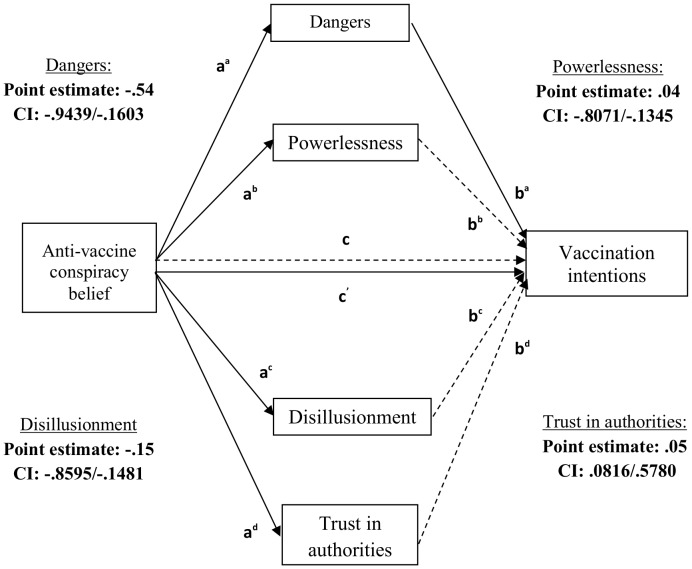
- In Study 1, anti-vaccine conspiracy beliefs significantly negatively predicted vaccination intentions, \(F(1, 87) = 15.97, p < .001, R^2 = .16, \beta = -.63\). Perceived dangers of vaccines, powerlessness, disillusionment, and trust in authorities each significantly mediated this relationship.
- In Study 2, vaccination intentions were significantly lower in the pro-conspiracy condition (\(M = 4.87, SD = 1.74\)) than in the anti-conspiracy condition (\(M = 5.69, SD = 1.31, p = .003\)) and the control condition (\(M = 5.47, SD = 1.50, p = .028\)), overall \(F(2, 185) = 4.81, p = .009, \eta^2 = .05\).
- The manipulation check showed higher endorsement of anti-vaccine conspiracy theories in the pro-conspiracy condition (\(M = 4.11, SD = 1.41\)) than the anti-conspiracy condition (\(M = 2.93, SD = 1.14, p < .001\)) and control condition (\(M = 3.56, SD = 1.21, p = .014\)).
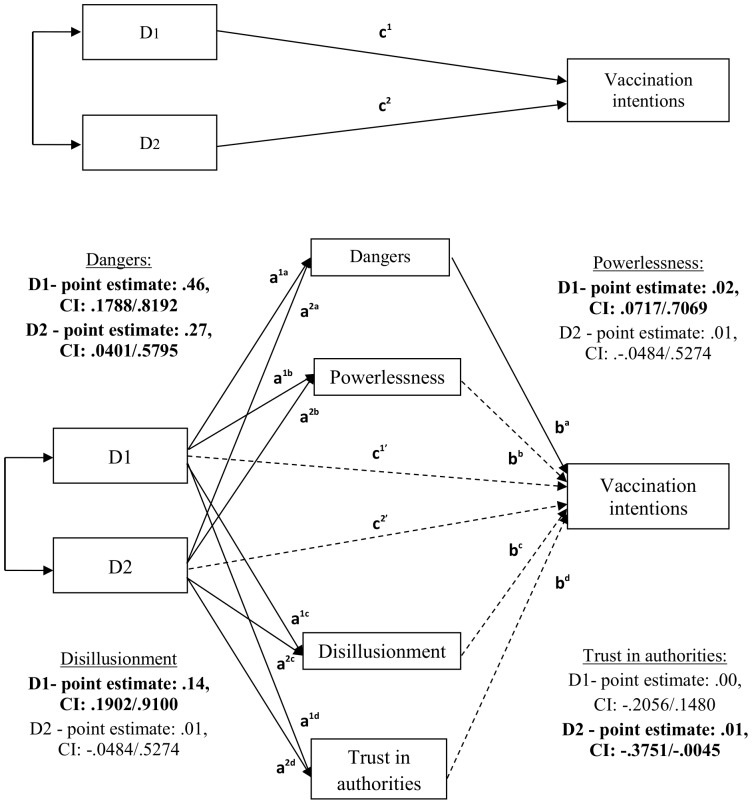
- Perceived vaccine dangers consistently mediated the effects; powerlessness and disillusionment mediated the pro- versus anti-conspiracy difference, and trust in authorities mediated the pro-conspiracy versus control difference.
Methods
- Study 1 used a correlational online questionnaire with 89 British parents (\(80\) women, \(9\) men; \(M\) age \(= 38.06, SD = 9.25\)). Participants completed measures of anti-vaccine conspiracy beliefs, perceived dangers, powerlessness, disillusionment, trust in authorities, and intention to vaccinate a fictitious 8-month-old child against a made-up disease, dysomeria.
- Study 2 recruited 246 U.S. MTurk participants, with a final analyzed sample of 188 after screening exclusions. Participants were randomly assigned to pro-conspiracy, anti-conspiracy, or control information, then completed the same mediator measures and vaccination intention measure.
- Both studies used bootstrapping mediation analyses with 5000 bootstrap samples; Study 2 used ANOVA and indicator-coded mediation to compare the three conditions.
Limitations
- The paper states that effect sizes were small (e.g., \(\eta^2 = .05\) in Study 2), conspiracy endorsement was generally around or below the midpoint except in the pro-conspiracy condition (\(M = 4.11\)), the mediation pattern was less clear in Study 2, and findings relied on self-reported intentions for a fictional child and made-up disease rather than actual vaccination behavior.
- The paper notes that future research should examine larger samples, actual vaccination behavior, additional or isolated mediators, and geographical areas with dangerously low vaccination uptake.
- Evident from the text: Study 1 is correlational and cannot establish causality, and both studies use hypothetical vaccination scenarios, which may limit ecological validity.
Model-written summary. Check it against the paper before relying on it.
Integrity signals
Registry
Cites
Statistics
Figures
Verification
Claims the paper makes
37 Own result · 21 Not checked yet · 20 Own interpretation · 12 Own method
A result the paper reports from its own data — it cites no other source for it, so there is none to check. The quote shows it is in the paper.
In the paper
“Results revealed a significant negative relationship between anti-vaccine conspiracy beliefs and vaccination intentions.”
- Also stated in: § Results and Discussion · plain
“As predicted, regression analyses revealed that anti-vaccine conspiracy beliefs were a significant negative predictor of vaccination intentions, F(1, 87) = 15.97, p<.001, R2 = .16, β = −.63, t = − 3.10, p<. 001.”
- Also stated in: § Results and Discussion · plain
“Participants who endorsed anti-vaccine conspiracy theories to a greater extent indicated less intention to vaccinate.”
§ The Effects of Anti-Vaccine Conspiracy Theories on Vaccination Intentions > Abstract
plaincorrelational- Asserted: passes — The authors put it forward as true.
- Checkable: passes — It can be checked against evidence.
- Load-bearing: passes — The paper’s conclusions depend on it.
- Based: passes — The paper gives a reason why it holds.
- Also stated in: § Results and Discussion · plain
A result the paper reports from its own data — it cites no other source for it, so there is none to check. The quote shows it is in the paper.
In the paper
“As shown in Table 2, anti-vaccine conspiracy beliefs were a significant predictor of perceived dangers of vaccines, and feelings of powerlessness, disillusionment and trust in authorities, F(5, 83) = 120.37, p<.001, R2 = .58; F(5, 83) = 41.70, p<.001, R2 = .32; F(5, 83) = 74.43, p<.001, R2 = .46; F(5, 83) = 23.00, p<.001, R2 = .20, respectively.”
§ The Effects of Anti-Vaccine Conspiracy Theories on Vaccination Intentions > Study 1 > Results and Discussion
plaincorrelational- Asserted: passes — The authors put it forward as true.
- Checkable: passes — It can be checked against evidence.
- Load-bearing: passes — The paper’s conclusions depend on it.
- Based: passes — The paper gives a reason why it holds.
A result the paper reports from its own data — it cites no other source for it, so there is none to check. The quote shows it is in the paper.
In the paper
“Results revealed that participants who had been exposed to material supporting anti-vaccine conspiracy theories showed less intention to vaccinate than those in the anti-conspiracy condition or controls.”
§ The Effects of Anti-Vaccine Conspiracy Theories on Vaccination Intentions > Abstract
plaindirect- Asserted: passes — The authors put it forward as true.
- Checkable: passes — It can be checked against evidence.
- Load-bearing: passes — The paper’s conclusions depend on it.
- Based: passes — The paper gives a reason why it holds.
A result the paper reports from its own data — it cites no other source for it, so there is none to check. The quote shows it is in the paper.
In the paper
“This effect was mediated by the same variables as in Study 1.”
§ The Effects of Anti-Vaccine Conspiracy Theories on Vaccination Intentions > Abstract
plaindirect- Asserted: passes — The authors put it forward as true.
- Checkable: passes — It can be checked against evidence.
- Load-bearing: passes — The paper’s conclusions depend on it.
- Based: passes — The paper gives a reason why it holds.
A result the paper reports from its own data — it cites no other source for it, so there is none to check. The quote shows it is in the paper.
In the paper
“This effect was mediated by the perceived dangers of vaccines, and feelings of powerlessness, disillusionment and mistrust in authorities.”
- Also stated in: § Results and Discussion · hedged
“The multiple mediation analysis of the effect of anti-vaccine conspiracy beliefs on vaccination intentions indicated that perceived dangers of vaccines and feelings of powerlessness, disillusionment and trust in authorities (controlling for each other) were each significant mediators of this effect.”
- Also stated in: § Results and Discussion · plain
“When all factors were taken into account, each was a significant mediator of the relationship between anti-vaccine conspiracy beliefs and vaccination intentions.”
§ The Effects of Anti-Vaccine Conspiracy Theories on Vaccination Intentions > Abstract
plaincorrelational- Asserted: passes — The authors put it forward as true.
- Checkable: passes — It can be checked against evidence.
- Load-bearing: passes — The paper’s conclusions depend on it.
- Based: passes — The paper gives a reason why it holds.
- Also stated in: § Results and Discussion · hedged
A result the paper reports from its own data — it cites no other source for it, so there is none to check. The quote shows it is in the paper.
In the paper
“As shown in Table 2, anti-vaccine conspiracy beliefs were a significant predictor of perceived dangers of vaccines, and feelings of powerlessness, disillusionment and trust in authorities, F(5, 83) = 120.37, p<.001, R2 = .58; F(5, 83) = 41.70, p<.001, R2 = .32; F(5, 83) = 74.43, p<.001, R2 = .46; F(5, 83) = 23.00, p<.001, R2 = .20, respectively.”
§ The Effects of Anti-Vaccine Conspiracy Theories on Vaccination Intentions > Study 1 > Results and Discussion
plaincorrelational- Asserted: passes — The authors put it forward as true.
- Checkable: passes — It can be checked against evidence.
- Load-bearing: passes — The paper’s conclusions depend on it.
- Based: passes — The paper gives a reason why it holds.
A result the paper reports from its own data — it cites no other source for it, so there is none to check. The quote shows it is in the paper.
In the paper
“The results of this analysis therefore support the use of four separate mediators.”
§ The Effects of Anti-Vaccine Conspiracy Theories on Vaccination Intentions > Study 1 > Results and Discussion
plain- Asserted: passes — The authors put it forward as true.
- Checkable: passes — It can be checked against evidence.
- Load-bearing: passes — The paper’s conclusions depend on it.
- Based: passes — The paper gives a reason why it holds.
A result the paper reports from its own data — it cites no other source for it, so there is none to check. The quote shows it is in the paper.
In the paper
“Finally, results revealed no significant difference in trust in authorities between conditions, F(2, 185) = 2.32, p = .10, η2 = .03.”
§ The Effects of Anti-Vaccine Conspiracy Theories on Vaccination Intentions > Study 2 > Results and Discussion
plain- Asserted: passes — The authors put it forward as true.
- Checkable: passes — It can be checked against evidence.
- Load-bearing: unclear — It is unclear whether the paper’s conclusions depend on it.
- Based: passes — The paper gives a reason why it holds.
A result the paper reports from its own data — it cites no other source for it, so there is none to check. The quote shows it is in the paper.
In the paper
“Perceived dangers were higher in the pro-conspiracy condition (M = 4.00, SD = 1.46) than the anti-conspiracy condition (M = 2.97, SD = 1.42, p<.001) and the control condition (M = 2.39, SD = 1.71, p = .021).”
§ The Effects of Anti-Vaccine Conspiracy Theories on Vaccination Intentions > Study 2 > Results and Discussion
plain- Asserted: passes — The authors put it forward as true.
- Checkable: passes — It can be checked against evidence.
- Load-bearing: passes — The paper’s conclusions depend on it.
- Based: passes — The paper gives a reason why it holds.
- Probably not a substantial claim. 18
- It may state two separate claims as one. 9
- The quote only partly states this claim. 2
What the paper did — it cites no source for this, so there is none to check. The quote shows it is in the paper.
In the paper
“There were eight statements (e.g., “Vaccines lead to allergies”, α = .86)”
§ The Effects of Anti-Vaccine Conspiracy Theories on Vaccination Intentions > Study 1 > Methods
plain- Asserted: passes — The authors put it forward as true.
- Checkable: passes — It can be checked against evidence.
- Load-bearing: fails — The paper’s conclusions may not depend on it.
- Based: passes — The paper gives a reason why it holds.
Probably not a substantial claim. The paper’s conclusions may not depend on it.
What the paper did — it cites no source for this, so there is none to check. The quote shows it is in the paper.
In the paper
“Participants were asked to read the statements (e.g., “I feel that my actions will not stop the negative outcomes of immunizations”, α = .82)”
§ The Effects of Anti-Vaccine Conspiracy Theories on Vaccination Intentions > Study 1 > Methods
plain- Asserted: passes — The authors put it forward as true.
- Checkable: passes — It can be checked against evidence.
- Load-bearing: fails — The paper’s conclusions may not depend on it.
- Based: passes — The paper gives a reason why it holds.
Probably not a substantial claim. The paper’s conclusions may not depend on it.
What the paper did — it cites no source for this, so there is none to check. The quote shows it is in the paper.
In the paper
“consisted of four statements (e.g., “I am very disappointed with those who are involved in immunizations (e.g., the government, pharmaceutical companies)”, α = .89)”
§ The Effects of Anti-Vaccine Conspiracy Theories on Vaccination Intentions > Study 1 > Methods
plain- Asserted: passes — The authors put it forward as true.
- Checkable: passes — It can be checked against evidence.
- Load-bearing: fails — The paper’s conclusions may not depend on it.
- Based: passes — The paper gives a reason why it holds.
Probably not a substantial claim. The paper’s conclusions may not depend on it.
In the paper
“and also that feelings of political powerlessness mediate the relationship between exposure to conspiracy theories and voting intentions [22].”
§ The Effects of Anti-Vaccine Conspiracy Theories on Vaccination Intentions > Introduction
What the sources say
- Not checked yetcites [22] Jolley D, Douglas KM (2013) The social consequences of conspiracism: Exposure to conspiracy theories decreases the intention to engage in politics and to reduce one’s carbon footprint. Br J Psychol: in press. doi:10.1111/bjop.12018. source
plaindirect- Asserted: passes — The authors put it forward as true.
- Checkable: passes — It can be checked against evidence.
- Load-bearing: passes — The paper’s conclusions depend on it.
- Based: passes — The paper gives a reason why it holds.
Probably not a substantial claim.
In the paper
“Further, polls demonstrate that more than 20% of respondents endorse the idea that there is a link between childhood vaccines and autism [13].”
§ The Effects of Anti-Vaccine Conspiracy Theories on Vaccination Intentions > Introduction
What the sources say
- Not checked yetcites [13] Public Policy Polling (2013) Democrats and Republicans differ on conspiracy theory beliefs. Available: http://www.publicpolicypolling.com/pdf/2011/PPP_Release_National_ConspiracyTheories_040213.pdf. Accessed: 2013 Nov 27.
boosted- Asserted: passes — The authors put it forward as true.
- Checkable: passes — It can be checked against evidence.
- Load-bearing: fails — The paper’s conclusions may not depend on it.
- Based: passes — The paper gives a reason why it holds.
Probably not a substantial claim. The paper’s conclusions may not depend on it.
In the paper
“Previous research has demonstrated that exposure to conspiracy theories increases political disillusionment [22]”
§ The Effects of Anti-Vaccine Conspiracy Theories on Vaccination Intentions > Introduction
What the sources say
- Not checked yetcites [22] Jolley D, Douglas KM (2013) The social consequences of conspiracism: Exposure to conspiracy theories decreases the intention to engage in politics and to reduce one’s carbon footprint. Br J Psychol: in press. doi:10.1111/bjop.12018. source
boosteddirect- Asserted: passes — The authors put it forward as true.
- Checkable: passes — It can be checked against evidence.
- Load-bearing: passes — The paper’s conclusions depend on it.
- Based: passes — The paper gives a reason why it holds.
Probably not a substantial claim.
None of the sources cited for this claim have been checked yet.
In the paper
“Endorsement of these conspiracy theories amongst African Americans has been found to be associated with negative attitudes towards contraceptive behaviors, which may potentially expose people to the risk of unwanted pregnancies and sexually transmitted illnesses [23], [24], [25].”
§ The Effects of Anti-Vaccine Conspiracy Theories on Vaccination Intentions > Introduction
What the sources say
- Not checked yetcites [23] ST Bird, 2003, Birth control conspiracy beliefs, perceived discrimination, and contraception among African Americans, Journal of Health Psychology source
- Not checked yetcites [24] LM Bogart, 2006, Relationship of African Americans’ socio demographic characteristics to belief in conspiracies about HIV/AIDS and birth control, Journal of the National Medical Association
- Not checked yetcites [25] MA Hoyt, 2012, HIV/AIDS-related institutional mistrust among multiethnic men who have sex with men: Effects on HIV testing and risk behaviors, Health Psychology source
plaincorrelational- Asserted: passes — The authors put it forward as true.
- Checkable: passes — It can be checked against evidence.
- Load-bearing: fails — The paper’s conclusions may not depend on it.
- Based: passes — The paper gives a reason why it holds.
Probably not a substantial claim. The paper’s conclusions may not depend on it.
What the paper did — it cites no source for this, so there is none to check. The quote shows it is in the paper.
In the paper
“The order of measures was counterbalanced.”
§ The Effects of Anti-Vaccine Conspiracy Theories on Vaccination Intentions > Study 1 > Methods
plain- Asserted: passes — The authors put it forward as true.
- Checkable: passes — It can be checked against evidence.
- Load-bearing: fails — The paper’s conclusions may not depend on it.
- Based: passes — The paper gives a reason why it holds.
Probably not a substantial claim. The paper’s conclusions may not depend on it.
What the paper did — it cites no source for this, so there is none to check. The quote shows it is in the paper.
In the paper
“The study was approved by the Psychology Ethics Committee at the University of Kent and all participants provided their written, informed consent.”
§ The Effects of Anti-Vaccine Conspiracy Theories on Vaccination Intentions > Study 1 > Methods
plain- Asserted: passes — The authors put it forward as true.
- Checkable: passes — It can be checked against evidence.
- Load-bearing: fails — The paper’s conclusions may not depend on it.
- Based: passes — The paper gives a reason why it holds.
Probably not a substantial claim. The paper’s conclusions may not depend on it. It may state two separate claims as one.
What the paper did — it cites no source for this, so there is none to check. The quote shows it is in the paper.
In the paper
“There were two trust sources (corporations and government; Spearman-Brown Coefficient = .82)”
§ The Effects of Anti-Vaccine Conspiracy Theories on Vaccination Intentions > Study 1 > Methods
plain- Asserted: passes — The authors put it forward as true.
- Checkable: passes — It can be checked against evidence.
- Load-bearing: fails — The paper’s conclusions may not depend on it.
- Based: passes — The paper gives a reason why it holds.
Probably not a substantial claim. The paper’s conclusions may not depend on it. The quote only partly states this claim.
None of the sources cited for this claim have been checked yet.
In the paper
“Also, exposure to conspiracy theories has been found to have detrimental effects in other domains, such as reducing pro-environmental intentions and willingness to engage in politics [21], [22].”
§ The Effects of Anti-Vaccine Conspiracy Theories on Vaccination Intentions > Introduction
What the sources say
- Not checked yetcites [21] LD Butler, 1995, The psychological impact of viewing the film JFK: Emotions, beliefs and political behavioral intentions, Political Psychology source
- Not checked yetcites [22] Jolley D, Douglas KM (2013) The social consequences of conspiracism: Exposure to conspiracy theories decreases the intention to engage in politics and to reduce one’s carbon footprint. Br J Psychol: in press. doi:10.1111/bjop.12018. source
plaindirect- Asserted: passes — The authors put it forward as true.
- Checkable: passes — It can be checked against evidence.
- Load-bearing: fails — The paper’s conclusions may not depend on it.
- Based: passes — The paper gives a reason why it holds.
Probably not a substantial claim. The paper’s conclusions may not depend on it.
A conclusion the paper draws from its own results — it cites no other source for it, so there is none to check. The quote shows it is in the paper.
In the paper
“In Study 2, feelings of powerlessness and disillusionment mediated the difference between the pro- and anti-conspiracy conditions, and mistrust in authorities mediated the difference between the pro-conspiracy and control conditions.”
§ The Effects of Anti-Vaccine Conspiracy Theories on Vaccination Intentions > General Discussion
plaindirect- Asserted: passes — The authors put it forward as true.
- Checkable: passes — It can be checked against evidence.
- Load-bearing: passes — The paper’s conclusions depend on it.
- Based: passes — The paper gives a reason why it holds.
It may state two separate claims as one.
A conclusion the paper draws from its own results — it cites no other source for it, so there is none to check. The quote shows it is in the paper.
In the paper
“This means that the proportion of variance in vaccine intentions explained by exposure to conspiracy theories was quite modest and there are potentially many other factors that contribute to vaccine intentions.”
§ The Effects of Anti-Vaccine Conspiracy Theories on Vaccination Intentions > General Discussion
hedgedcorrelational- Asserted: passes — The authors put it forward as true.
- Checkable: passes — It can be checked against evidence.
- Load-bearing: passes — The paper’s conclusions depend on it.
- Based: passes — The paper gives a reason why it holds.
It may state two separate claims as one.
What the paper did — it cites no source for this, so there is none to check. The quote shows it is in the paper.
In the paper
“The final sample size used for data analysis was therefore 188 (112 women and 76 men, M age = 36.33, SD = 13.40).”
§ The Effects of Anti-Vaccine Conspiracy Theories on Vaccination Intentions > Study 2 > Methods
plainn = 188- Asserted: passes — The authors put it forward as true.
- Checkable: passes — It can be checked against evidence.
- Load-bearing: fails — The paper’s conclusions may not depend on it.
- Based: passes — The paper gives a reason why it holds.
Probably not a substantial claim. The paper’s conclusions may not depend on it.
A conclusion the paper draws from its own results — it cites no other source for it, so there is none to check. The quote shows it is in the paper.
In the paper
“Further, feelings of powerlessness and disillusionment mediated the difference between the pro- and anti-conspiracy conditions, and mistrust in authorities mediated the difference between the pro-conspiracy and control conditions.”
§ The Effects of Anti-Vaccine Conspiracy Theories on Vaccination Intentions > Study 2 > Results and Discussion
plaindirectn = 188- Asserted: passes — The authors put it forward as true.
- Checkable: passes — It can be checked against evidence.
- Load-bearing: passes — The paper’s conclusions depend on it.
- Based: passes — The paper gives a reason why it holds.
It may state two separate claims as one.
What the paper did — it cites no source for this, so there is none to check. The quote shows it is in the paper.
In the paper
“There were 60 participants in the pro-conspiracy condition, 62 in the anti-conspiracy condition, and 66 in the control condition.”
§ The Effects of Anti-Vaccine Conspiracy Theories on Vaccination Intentions > Study 2 > Methods
plainn = 60- Asserted: passes — The authors put it forward as true.
- Checkable: passes — It can be checked against evidence.
- Load-bearing: fails — The paper’s conclusions may not depend on it.
- Based: passes — The paper gives a reason why it holds.
Probably not a substantial claim. The paper’s conclusions may not depend on it. It may state two separate claims as one.
None of the sources cited for this claim have been checked yet.
In the paper
“As is well known, intentions do not always translate into behaviors [47], [48], [49].”
§ The Effects of Anti-Vaccine Conspiracy Theories on Vaccination Intentions > General Discussion
What the sources say
- Not checked yetcites [47] RT LaPiere, 1934, Attitudes vs. actions, Social Forces source
- Not checked yetcites [48] LS Linn, 1965, Verbal attitudes and overt behavior: A study of racial discrimination, Social Forces source
- Not checked yetcites [49] Sheeran P (2002) Intention-behavior relations: A conceptual and empirical review. In: Stroebe W, Hewstone M, editors. European Review of Social Psychology. Chichester, UK: Wiley. Vol. 12, 1–36. source
boosted- Asserted: passes — The authors put it forward as true.
- Checkable: passes — It can be checked against evidence.
- Load-bearing: passes — The paper’s conclusions depend on it.
- Based: passes — The paper gives a reason why it holds.
Probably not a substantial claim.
In the paper
“Similarly, different strategies for successful intervention may apply for people who hold strong anti-vaccine conspiracy beliefs than those who do not hold strong beliefs [44].”
§ The Effects of Anti-Vaccine Conspiracy Theories on Vaccination Intentions > General Discussion
What the sources say
- Not checked yetcites [44] CR Sunstein, 2009, Conspiracy theories: Causes and cures, J Polit Philos source
hedgedconditional- Asserted: passes — The authors put it forward as true.
- Checkable: fails — It may be too vague to check against evidence.
- Load-bearing: fails — The paper’s conclusions may not depend on it.
- Based: passes — The paper gives a reason why it holds.
Probably not a substantial claim. It may be too vague to check against evidence. The paper’s conclusions may not depend on it.
None of the sources cited for this claim have been checked yet.
In the paper
“Psychologists are learning more about the traits and characteristics associated with beliefs in conspiracy theories more generally, such as mistrust, anomie, political cynicism and Machiavellianism [8], [20], [31], [50]”
§ The Effects of Anti-Vaccine Conspiracy Theories on Vaccination Intentions > General Discussion
What the sources say
- Not checked yetcites [8] T Goertzel, 1994, Belief in conspiracy theories, Polit Psychol source
- Not checked yetcites [20] KM Douglas, 2008, The hidden impact of conspiracy theories: Perceived and actual influence of theories surrounding the death of Princess Diana, Br J Soc Psychol source
- Not checked yetcites [31] M Abalakina-Paap, 1999, Beliefs in conspiracies, Political Psychology source
plaincorrelational- Asserted: passes — The authors put it forward as true.
- Checkable: passes — It can be checked against evidence.
- Load-bearing: fails — The paper’s conclusions may not depend on it.
- Based: passes — The paper gives a reason why it holds.
Probably not a substantial claim. The paper’s conclusions may not depend on it.
A conclusion the paper draws from its own results — it cites no other source for it, so there is none to check. The quote shows it is in the paper.
In the paper
“Specifically, they appear to reduce vaccination intentions by inducing undue concern about the dangers of vaccines, and increasing powerlessness, disillusionment, and mistrust.”
§ The Effects of Anti-Vaccine Conspiracy Theories on Vaccination Intentions > General Discussion
hedgeddirect- Asserted: passes — The authors put it forward as true.
- Checkable: passes — It can be checked against evidence.
- Load-bearing: passes — The paper’s conclusions depend on it.
- Based: passes — The paper gives a reason why it holds.
It may state two separate claims as one.
A conclusion the paper draws from its own results — it cites no other source for it, so there is none to check. The quote shows it is in the paper.
In the paper
“Therefore, the participants were not strong endorsers of anti-vaccine conspiracy theories, meaning that different patterns of findings may emerge for those who do strongly endorse conspiracy theories.”
§ The Effects of Anti-Vaccine Conspiracy Theories on Vaccination Intentions > General Discussion
hedged- Asserted: passes — The authors put it forward as true.
- Checkable: passes — It can be checked against evidence.
- Load-bearing: unclear — It is unclear whether the paper’s conclusions depend on it.
- Based: passes — The paper gives a reason why it holds.
It may state two separate claims as one.
A conclusion the paper draws from its own results — it cites no other source for it, so there is none to check. The quote shows it is in the paper.
In the paper
“Therefore, overall, anti-vaccine conspiracy theories appear to introduce undue suspicion about vaccine safety, and increase feelings of powerlessness and disillusionment, whilst decreasing trust in authorities, which in turn introduce reluctance to vaccinate.”
§ The Effects of Anti-Vaccine Conspiracy Theories on Vaccination Intentions > General Discussion
hedgeddirect- Asserted: passes — The authors put it forward as true.
- Checkable: passes — It can be checked against evidence.
- Load-bearing: passes — The paper’s conclusions depend on it.
- Based: passes — The paper gives a reason why it holds.
It may state two separate claims as one.
What the paper did — it cites no source for this, so there is none to check. The quote shows it is in the paper.
In the paper
“Participants were randomly assigned to one of the three conditions.”
§ The Effects of Anti-Vaccine Conspiracy Theories on Vaccination Intentions > Study 2 > Methods
plain- Asserted: passes — The authors put it forward as true.
- Checkable: passes — It can be checked against evidence.
- Load-bearing: passes — The paper’s conclusions depend on it.
- Based: passes — The paper gives a reason why it holds.
Probably not a substantial claim.
What the paper did — it cites no source for this, so there is none to check. The quote shows it is in the paper.
In the paper
“The study was approved by the Psychology Ethics Committee at the University of Kent and all participants provided their written, informed consent.”
§ The Effects of Anti-Vaccine Conspiracy Theories on Vaccination Intentions > Study 1 > Methods
plain- Asserted: fails — The authors may not put it forward as true.
- Checkable: passes — It can be checked against evidence.
- Load-bearing: fails — The paper’s conclusions may not depend on it.
- Based: fails — The paper may give no reason why it holds.
Probably not a substantial claim. The authors may not put it forward as true. The paper’s conclusions may not depend on it. The paper may give no reason why it holds. It may state two separate claims as one. The quote only partly states this claim.
The paper relies on this without support.
The measured mediators (perceived vaccine dangers, powerlessness, disillusionment, and trust in authorities) are causally prior to and influence vaccination intentions, as required for the mediation analysis.
“Each of the candidate mediators was then examined in a test of mediation in order to explain the effect of the conspiracy conditions (pro-conspiracy versus anti-conspiracy, versus control) on vaccination intentions.”
Statistics recomputed
Every reported test result, recomputed from its test statistic and degrees of freedom. A result shows as not adding up only once an independent check has confirmed it.
- Consistentχ²(136) = 4544.44reported p < .001 · recomputed p < .001
“X 2 (136) = 4544.44, p < .001”
- ConsistentF(1, 87) = 15.97reported p < .001 · recomputed p < .001
“F(1, 87) = 15.97, p < .001”
- ConsistentF(5, 83) = 120.37reported p < .001 · recomputed p < .001
“F(5, 83) = 120.37, p < .001”
- ConsistentF(5, 83) = 41.7reported p < .001 · recomputed p < .001
“F(5, 83) = 41.70, p < .001”
- ConsistentF(5, 83) = 74.43reported p < .001 · recomputed p < .001
“F(5, 83) = 74.43, p < .001”
- ConsistentF(5, 83) = 23reported p < .001 · recomputed p < .001
“F(5, 83) = 23.00, p < .001”
- ConsistentF(2, 185) = 4.81reported p = .009 · recomputed p = .009
“F(2, 185) = 4.81, p = .009”
- ConsistentF(2, 185) = 7.61reported p = .001 · recomputed p < .001
“F(2, 185) = 7.61, p = .001”
- ConsistentF(2, 185) = 3.44reported p = .034 · recomputed p = .034
“F(2, 185) = 3.44, p = .034”
- ConsistentF(2, 185) = 7.46reported p = .001 · recomputed p < .001
“F(2, 185) = 7.46, p = .001”
- ConsistentF(2, 185) = 2.32reported p = .1 · recomputed p = .101
“F(2, 185) = 2.32, p = .10”
Self-check
Percentages, sums and reported differences re-computed from the paper’s own numbers.
Each contradiction between two passages listed here was confirmed by an independent check.
Rated minor: it would not touch a result — a value no result rests on, a p-value that stays on the same side of the significance level, or a conflict that is clerical, resolved elsewhere in the paper, or outside its own findings.
In the paper
§ The Effects of Anti-Vaccine Conspiracy Theories on Vaccination Intentions > Study 1 > Results and Discussion
“| (2) Immunisation intention | 5.63 (1.42) | −.40*** | – | −.49*** | .29** | −.36*** | .20¥ |”
§ The Effects of Anti-Vaccine Conspiracy Theories on Vaccination Intentions > Study 1 > Results and Discussion
“| (3) Dangers | 2.97 (1.37) | .76*** | −.48*** | – | .58*** | .60*** | −.48*** |”
Rated minor: it would not touch a result — a value no result rests on, a p-value that stays on the same side of the significance level, or a conflict that is clerical, resolved elsewhere in the paper, or outside its own findings.
In the paper
“F(1, 87) = 15.97, p<.001, R2 = .16, β = −.63, t = − 3.10, p<. 001.”
§ The Effects of Anti-Vaccine Conspiracy Theories on Vaccination Intentions > Study 1 > Results and Discussion
Reported 15.97 · recomputed 9.61
Rated minor: it would not touch a result — a value no result rests on, a p-value that stays on the same side of the significance level, or a conflict that is clerical, resolved elsewhere in the paper, or outside its own findings.
In the paper
§ The Effects of Anti-Vaccine Conspiracy Theories on Vaccination Intentions > Study 1 > Results and Discussion
“| (3) Dangers | 2.97 (1.37) | .76*** | −.48*** | – | .58*** | .60*** | −.48*** |”
§ The Effects of Anti-Vaccine Conspiracy Theories on Vaccination Intentions > Study 1 > Results and Discussion
“| (5) Disillusionment | 2.45 (1.40) | .68*** | −.36*** | .59*** | .59*** | – | −.41*** |”
Rated minor: it would not touch a result — a value no result rests on, a p-value that stays on the same side of the significance level, or a conflict that is clerical, resolved elsewhere in the paper, or outside its own findings.
In the paper
§ The Effects of Anti-Vaccine Conspiracy Theories on Vaccination Intentions > Study 1 > Results and Discussion
“β = −.63”
§ The Effects of Anti-Vaccine Conspiracy Theories on Vaccination Intentions > Study 1 > Results and Discussion
“| (1) Anti-vaccine conspiracy belief | 2.00 (.89) | – | −.40*** | .76*** | .57*** | .68*** | −.46*** |”
Rated minor: it would not touch a result — a value no result rests on, a p-value that stays on the same side of the significance level, or a conflict that is clerical, resolved elsewhere in the paper, or outside its own findings.
In the paper
§ The Effects of Anti-Vaccine Conspiracy Theories on Vaccination Intentions > Study 1 > Results and Discussion
“F(5, 83) = 120.37, p<.001, R2 = .58; F(5, 83) = 41.70, p<.001, R2 = .32; F(5, 83) = 74.43, p<.001, R2 = .46; F(5, 83) = 23.00, p<.001, R2 = .20, respectively.”
§ The Effects of Anti-Vaccine Conspiracy Theories on Vaccination Intentions > Study 1 > Results and Discussion
“Table: Table 2 Four separate regressions examining anti-conspiracy belief as predictor, and four mediator variables as criterions.”
Citations
Cites
Preacher, K. J., & Hayes, A. F. (2008) · Behavior Research Methods · doi:10.3758/brm.40.3.879 · Cited by 34,117 · cited 1×
“By repeating this process thousands of times, it builds an empirical approximation of the sampling distribution that constructs the confidence intervals [39].”
Amazon's Mechanical Turk: A New Source of Inexpensive, Yet High-Quality, Data?
Buhrmester, M., Kwang, T., & Gosling, S. D. (2011) · Perspectives on Psychological Science · doi:10.1177/1745691610393980 · Cited by 9,996
Beyond Baron and Kenny: Statistical Mediation Analysis in the New Millennium
Hayes, A. F. (2009) · Communication Monographs · doi:10.1080/03637750903310360 · Cited by 9,757 · cited 5×
“As argued by Hayes [40], an indirect effect is estimated as being significant if the confidence intervals do not contain a zero, as opposed to significance in the individual paths.”
InfluentialNew Environmental Theories: Toward a Coherent Theory of Environmentally Significant Behavior
Stern, P. C. (2000) · Journal of Social Issues · doi:10.1111/0022-4537.00175 · Cited by 8,682
A Second Generation Little Jiffy
Kaiser, H. F. (1970) · Psychometrika · doi:10.1007/bf02291817 · Cited by 4,855
Running experiments on Amazon Mechanical Turk
Paolacci, G., Chandler, J., & Ipeirotis, P. G. (2010) · Judgment and Decision Making · doi:10.1017/s1930297500002205 · Cited by 3,767
Intention—Behavior Relations: A Conceptual and Empirical Review
Sheeran, P. (2002) · European Review of Social Psychology · doi:10.1080/14792772143000003 · Cited by 3,688 · cited 1×
“As is well known, intentions do not always translate into behaviors [47], [48], [49].”
Statistical mediation analysis with a multicategorical independent variable
Hayes, A. F., & Preacher, K. J. (2014) · British Journal of Mathematical and Statistical Psychology · doi:10.1111/bmsp.12028 · Cited by 3,403 · cited 3×
“This was carried out using Hayes and Preacher’s [38] bootstrapping method for indirect effects, as in Study 1.”
Misinformation and Its Correction: Continued Influence and Successful Debiasing
Lewandowsky, S., Ecker, U. K. H., Seifert, C. M., Schwarz, N., & Cook, J. (2012) · Psychological Science in the Public Interest · doi:10.1177/1529100612451018 · Cited by 2,920
A Note on the Multiplying Factors for Various χ2 Approximations
Bartlett, M. S. (1954) · Journal of the Royal Statistical Society Series B (Statistical Methodology) · doi:10.1111/j.2517-6161.1954.tb00174.x · Cited by 2,168
Cited by
Sorted by citations
Items 801–900 of 1,000
Bonanno, G., & Luca, M. D. (2024) · Social Indicators Research · doi:10.1007/s11205-024-03499-1 · Cited by 3
Dilling, M., Sorrentino, A., Brähler, E., Fegert, J. M., & Decker, O. (2025) · Analyses of Social Issues and Public Policy · doi:10.1111/asap.70009 · Cited by 3
The psychology of conspiracy mentality
Imhoff, R. (2025) · Advances in experimental social psychology · doi:10.1016/bs.aesp.2025.10.002 · Cited by 3
Yiğit, İ., Stoner, M. C. D., Muessig, K. E., Hightow-Weidman, L. B., & Henna Budhwani, P. (2026) · Vaccine · doi:10.1016/j.vaccine.2026.128253 · Cited by 3
Correlatos valorativos de crenças em teorias da conspiração
Rezende, A. T., Gouveia, V. V., do Nascimento, A. M., Vilar, R., & Oliveira, K. G. (2019) · Dialnet (Universidad de la Rioja) · Cited by 3
Zhao, S., Zhou, J., & Wang, T. (2023) · PLoS ONE · doi:10.1371/journal.pone.0294681 · Cited by 3
Field‐Springer, K., Striley, K. M., Byerly, J., Simmons, N., Ferrell, T., & Quigley, S. L. (2024) · Journal of Communications In Healthcare · doi:10.1080/17538068.2024.2320984 · Cited by 3
“During a major public health crisis, science and trans-parency must eclipse the state of uncertainty and con fl ict [2,24,25], therefore, the importance of scien-ti fi cally tested interventions should be prioritized in communication to the public.”
Unfounded beliefs, distress and powerlessness: A three‐wave longitudinal study
Mikušková, E. B., & Teličák, P. (2024) · Applied Psychology Health and Well-Being · doi:10.1111/aphw.12542 · Cited by 3
Identifying Psychological Predictors of SARS-CoV-2 Vaccination: A Machine Learning Study
Bronstein, M. V., Kummerfeld, E., MacDonald, A. W., & Vinogradov, S. (2022) · Vaccine · doi:10.1016/j.vaccine.2024.126198 · Cited by 4
Investigating Online Mis- and Disinformation in Cyprus: Trends and Challenges
Giomelakis, D., Constandinides, C., Noti, M., & Maniou, T. A. (2024) · Journalism and Media · doi:10.3390/journalmedia5040099 · Cited by 3
“In the fields of medicine and healthcare, disinforma-tion commonly centres around topics such as vaccination, smoking, and nutrition (Jolley and Douglas 2014; Albarracin et al. 2018; Wang et al. 2019).”
Delusion-proneness predicts COVID-19 vaccination behavior
Acar, K., Karagiannidou, A., Olsson, A., van Prooijen, J., Balter, L. J. T., Axelsson, J., Ingvar, M., Lebedev, A. V., & Petrović, P. (2024) · Frontiers in Psychiatry · doi:10.3389/fpsyt.2024.1450429 · Cited by 3
Advanced theory of mind predicts adolescents’ evaluation of source benevolence while reading
Dyoniziak, Y., Potocki, A., Burnel, M., Macedo-Rouet, M., & Rouet, J. (2025) · Computers in Human Behavior · doi:10.1016/j.chb.2024.108552 · Cited by 3
Sobieska, A., Hampel, M., Weidenspointner, R., Pauli, V., Pan, C., Jun, S.-M., & Gutsmiedl, P. (2025) · Health Communication · doi:10.1080/10410236.2025.2469936 · Cited by 3
“…that even brief exposure to conspiratorial content can have concerning effects, such as lower social and civic engagement and a greater likelihood of engaging in science rejection (Jolley & Douglas, 2014; Lewandowsky & Oberauer, 2016; Lewandowsky, Gignac, et al., 2013; van der Linden, 2015).”
Learning about Conspiracy Theories
Cullen, J. T. (2018) · Oxford University Press eBooks · doi:10.1093/oso/9780190844073.003.0009 · Cited by 4
Effects of emotion, emotional tolerance, and emotional processing on reasoning
Harvey, A. M., & Kisley, M. A. (2023) · Cognition & Emotion · doi:10.1080/02699931.2023.2228539 · Cited by 5
“Conspiratorial thinking can contribute to science denial, the general suspicion of well-accepted scientific ideas, such as climate change (Lewandowsky et al., 2013) and vaccination efficacy (Jolley & Douglas, 2014).”
Backgroundde Melo, L. W. S., Passos, M. M., & Salvi, R. F. (2020) · Revista Brasileira de Pesquisa em Educação em Ciências · doi:10.28976/1984-2686rbpec2020u295313 · Cited by 3
Factors determining intention to vaccinate against Covid-19: A developing nation perspective
Garg, R. J., Chhikara, R., Chhabra, S., & Bhardwaj, A. (2021) · Health Marketing Quarterly · doi:10.1080/07359683.2021.1987020 · Cited by 3
Fountoulakis, K. Ν. (2021) · Springer eBooks · doi:10.1007/978-3-030-86541-2_25 · Cited by 3
Buturoiu, R., Udrea, G., Dumitrache, A. C., & Corbu, N. (2021) · Central European Journal of Communication · doi:10.51480/1899-5101.14.2(29).3 · Cited by 3
Conspiracy Theory Belief and Conspiratorial Thinking
Farhart, C. E. (2022) · Cambridge University Press eBooks · doi:10.1017/9781108779104.036 · Cited by 3
Aaltonen, K., Niemelä, M., & Prix, I. (2022) · International Journal for Equity in Health · doi:10.1186/s12939-022-01631-6 · Cited by 3
Kim, N., Kim, J., Lee, H., & Perez, L. A. (2022) · Health Communication · doi:10.1080/10410236.2022.2054228 · Cited by 3
“With the guidance of prior works (Chen et al., 2021; Jolley & Douglas, 2014), we focus on the way individuals’ epistemic factors that are relevant to COVID-19 vaccination specifically affects the level of hesitancy to receive COVID-19 vaccinations.”
Muhvić, D., & Čulo, I. R. (2022) · Zbornik Pravnog fakulteta Sveučilišta u Rijeci · doi:10.30925/zpfsr.43.1.10 · Cited by 3
Remondi, C., Cirimele, F., Pastorelli, C., Gerbino, M., Gregori, F., Plata, M. G., & Zuffianò, A. (2022) · Current Research in Ecological and Social Psychology · doi:10.1016/j.cresp.2022.100069 · Cited by 3
Influence of fear on anti-vaccine conspiracy theories and behaviour against vaccination
Malas, O. (2023) · Revista de PSICOLOGÍA DE LA SALUD · doi:10.21134/pssa.v11i1.321 · Cited by 3
Ordóñez, M. S., Velasco, P. E. B., & Moraga, Á. L. R. (2023) · PubMed Central · Cited by 3
What characterize the rumors circulating on social media in Israel in the first wave of COVID-19?
Avikasis, H., Shalem-Rabinovich, A., Yehezkeli, Y., & Lev‐On, A. (2023) · Online Journal of Communication and Media Technologies · doi:10.30935/ojcmt/13681 · Cited by 3
Thakur, N., Cui, S., Patel, K. A., Azizi, N., Knieling, V., Han, C., Poon, A., & Shah, R. (2023) · Computation · doi:10.3390/computation11110234 · Cited by 3
Han, E., Weitzer, J., Birmann, B. M., Bertau, M., Zenk, L., Caniglia, G., Laubichler, M. D., Schernhammer, E. S., & Steiner, G. (2024) · SN Social Sciences · doi:10.1007/s43545-023-00790-9 · Cited by 3
“A 2014 study found that the feeling of powerlessness and refuge-seeking behavior in conspiracy thoughts may come as negative consequences of social and political disengagement (Jolley and Douglas 2014).”
Evil perceptions but not entertainment value appraisals relate to conspiracy beliefs
Harmon‐Jones, E., Szymaniak, K., Edgeworth, D., Sebban, G., & Harmon‐Jones, C. (2024) · Frontiers in Social Psychology · doi:10.3389/frsps.2024.1350584 · Cited by 3
It is all a conspiracy: Conspiracy theories about the COVID-19 pandemic and the war in Ukraine
Myslivec, J. (2024) · Ceskoslovenska psychologie · doi:10.51561/cspsych.68.2.111 · Cited by 3
Adinugroho, I., Stafford, T., & Bentall, R. P. (2024) · Vaccine · doi:10.1016/j.vaccine.2024.04.071 · Cited by 3
Watching for a snake in the grass: Objectification increases conspiracy beliefs.
Poon, K.-T., Chan, R. S. W., Lai, H.-S., Jiang, Y., & Teng, F. (2024) · British Journal of Social Psychology · doi:10.1111/bjso.12768 · Cited by 4
Sallam, M., Kareem, N., & Alkurtas, M. (2024) · Preventive Medicine Reports · doi:10.1016/j.pmedr.2024.102791 · Cited by 3
“Conspiracy theories and misinformation have the potential to deter individuals from getting vaccinated through reducing vaccine confidence (Ullah et al., 2021; Jolley and Douglas, 2014).”
BackgroundRates of Vaccination against COVID-19 in Psychiatric Outpatients
Cvjetković-Bošnjak, M., Kuljančić, D., Vejnović, A.-M., Hinić, D., Knežević, V., Ratković, D., Bosić, V., Vasic, V., Šakić, B., Segan, D., et al. (2024) · Journal of Personalized Medicine · doi:10.3390/jpm14070748 · Cited by 3
“…who suffered from different psychiatric illnesses had lower rates of vaccination than people in the general population [12,14,17,23], and that such patients were at greater risk of being infected by SARS-CoV-2 or had more severe clinical signs compared with the general population [20,23,24].”
BackgroundMehta, S., Ghezzi, D., Catalani, A., Vanzolini, T., & Ghezzi, P. (2021) · BMJ Open · doi:10.1136/bmjopen-2020-046364 · Cited by 3
Dijkstra, A. (2021) · Frontiers in Psychology · doi:10.3389/fpsyg.2021.740888 · Cited by 3
“Although mediation has been studied earlier to explain the effects of CT on health behaviours (e.g., Jolley and Douglas, 2014b), no earlier studies addressed a full model of the psychological mechanisms involved in the relation between CBc and the (indicators of) behaviours.”
BackgroundFiler, T. (2018) · Oxford University Press eBooks · doi:10.1093/oso/9780190844073.003.0027 · Cited by 3
An Analysis of Conspiracy Beliefs of Covid-19 Vaccination in Ghana
Baffoe, G. A., & Watson-Nortey, N. K. L. (2021) · Advances in Journalism and Communication · doi:10.4236/ajc.2021.94014 · Cited by 4
Variations and Arguments of Anti-Vaccine Movement Groups on Facebook
Widyaningrum, N., Trisnantoro, L., & Kurniawan, N. I. (2022) · KnE Social Sciences · doi:10.18502/kss.v7i5.10567 · Cited by 2
Security and Environmental Management in Africa
Ojakorotu, V. (2022) · IKENGA International Journal of Institute of African Studies · doi:10.53836/ijia/2022/23/3/introduction · Cited by 3
Social Media Surveillance and (Dis)Misinformation in the COVID ‐19 Pandemic
Spitzberg, B. H., Tsou, M., & Gawron, M. (2021) · Wiley eBooks · doi:10.1002/9781119751809.ch12 · Cited by 4
The Impact of Social Norms on Belief UpdatePreprint
Vlasceanu, M., & Coman, A. (2020) · doi:10.31234/osf.io/gsem6 · Cited by 3
“…destructive outcomes in all aspects of society, as concluded by numerous empirical articles linking false beliefs to decreased vaccination rates (Jolley & Douglas, 2014), increased climate change denial (Lewandowsky, Gignac, Oberauer, 2015), and increased intergroup prejudice (Jolley, Meleady,…”
BackgroundEvidence for a positive relationship between perceived stress and belief in conspiracy theoriesPreprint
Williams, M. N., Anderson, R. C., Fox, N., Skinner, C. M., & McMurtrie, B. L. (2022) · doi:10.31234/osf.io/gca56 · Cited by 3
Investigating the Impact of Anti-Vaccine News on SARS-CoV-2 Vaccine IntentionsPreprint
Bronstein, M. V., Kummerfeld, E., MacDonald, A. W., & Vinogradov, S. (2022) · SSRN Electronic Journal · doi:10.2139/ssrn.3936927 · Cited by 2
Spiritual skepticism? Heterogeneous science skepticism in the NetherlandsPreprint
Rutjens, B. T., & van der Lee, R. (2019) · doi:10.31234/osf.io/qt8aj · Cited by 3
Can Media Literacy Interventions Improve Fake News Discernment? A Meta-AnalysisPreprint
Lu, C. F., Hu, B., Bao, M.-M., Bi, C., & Ju, X. (2023) · SSRN Electronic Journal · doi:10.2139/ssrn.4377372 · Cited by 3
Holford, D. L., Schmid, P., Fasce, A., Garrison, A., Karlsson, L. C., Taubert, F., Verger, P., Lewandowsky, S., Fisher, H., Betsch, C., et al. (2023) · doi:10.31234/osf.io/j3526 · Cited by 3
Characterizing the Gendered Twitter Discussion of COVID-19 Hoax
Al‐Rawi, A., & Jamieson, K. (2022) · Health Communication · doi:10.1080/10410236.2022.2149112 · Cited by 2
“A wealth of research has identified the link between vaccine hesitancy and conspiracy beliefs (Jolley & Douglas, 2014; Nazlı et al., 2022), as well as an association with social media use where users may be exposed to “viral” misinformation (Jennings et al., 2021).”
BackgroundChlabicz, M., Nabożny, A., Koszelew, J., Łaguna, W., Szpakowicz, A., Sowa, P., Budny, W., Guziejko, K., Róg‐Makal, M., Pancewicz, S. A., et al. (2023) · Journal of Medical Internet Research · doi:10.2196/48130 · Cited by 5
“…movement had already propagated conspiracy theories, such as the notion that large pharmaceutical companies and other vested interests exaggerate vaccination benefits while concealing risks or dangers [19], the pandemic has heightened the phenomenon of skepticism toward immunization.”
Thought contagion? Conspiracy beliefs boost paranoid thoughts
Molenda, Z., Marchlewska, M., Karakula, A., Podsiadłowski, W., Rogoza, M., Bagrowska, P., & Szczepańska, D. (2024) · Applied Psychology Health and Well-Being · doi:10.1111/aphw.12577 · Cited by 3
Memon, F. Z., Jobarteh, M. L., Shah, K. H., Sinha, A. K., Patel, M., Patil, S., Heffernan, C., & Saxena, D. B. (2024) · Frontiers in Public Health · doi:10.3389/fpubh.2024.1417712 · Cited by 2
Egli, A., Lynn, T., Rosati, P., & Sinclair, G. (2025) · Online Information Review · doi:10.1108/oir-06-2024-0376 · Cited by 2
Jutzi, C., Möller, J., Klackl, J., Rosenzweig, T., Reiss, S., Franchina, V., & Jonas, E. (2025) · Journal of Applied Social Psychology · doi:10.1111/jasp.13087 · Cited by 2
COVID-19 vaccine conspiracy theories, discourses of liberty, and “the new normal” on social media
McGlashan, M., Clarke, I., Gee, M., Grieshofer, T., Kehoe, A., & Lawson, R. (2025) · Linguistics Vanguard · doi:10.1515/lingvan-2024-0121 · Cited by 2
“Studying the e ff ects of anti-vaccine conspiracy theories on intentions to vaccinate, Jolley and Douglas (2014: 6) have found that “ anti-vaccine conspiracy theories may have more than a trivial e ff ect on vaccination intentions ” and that “ anti-vaccine conspiracy theories appear tointroduce…”
Understanding RSV Vaccine Hesitancy: Exploring Decision-Making Pathways
Kim, N., Seo, J.-H., Yoon, D., & Kim, J. (2025) · Health Communication · doi:10.1080/10410236.2025.2504109 · Cited by 2
“Despite these distinctions, growing concern over these types of information stems primarily from their shared detrimental effects, which contribute to vaccination hesitancy (Cummings & Kong, 2019; Jolley et al., 2014; Lee et al., 2022; Ophir & Jamieson, 2018).”
InfluentialKim, S., Kim, K., & Kim, H. M. (2025) · Social Science & Medicine · doi:10.1016/j.socscimed.2025.118328 · Cited by 2
“These sentiments oppose preventive health measures, encourage potentially harmful behaviors, and often involve spreading inaccurate or misleading information (e.g., Hornik et al., 2022; Jolley & Douglas, 2014).”
Parlak, A. G., Gökçay, G., & Karacan, Y. (2025) · Public Health Nursing · doi:10.1111/phn.70030 · Cited by 2
“It is quite challenging to combat the misinformation within communities that are hesitant about vaccines (Hornsey et al. 2018; Jolley and Douglas 2014).”
“Make America Healthy Again” will make the world sicker
Grimes, D. R. (2025) · EMBO Reports · doi:10.1038/s44319-025-00639-7 · Cited by 2
“Exposure to anti-vaccine propaganda is a major factor for vaccine hesitancy (Jolley and Douglas, 2014), and the brunt of the explosion of measles cases in the USA this year hit the youngest hardest, with children dying from an illness declared eradicated in the States a mere 25 years ago (Hotez,…”
Lamot, M., Kirbiš, A., & Kerman, K. (2025) · Social Science & Medicine · doi:10.1016/j.socscimed.2025.118770 · Cited by 2
AlShurman, B. A., Majowicz, S. E., Grindrod, K., Goh, J., & Butt, Z. A. (2026) · Human Vaccines & Immunotherapeutics · doi:10.1080/21645515.2026.2621473 · Cited by 3
“53 Hence, they are less compliant with professional public health guidance, 54 and may exhibit deep-seated vaccine resistance rather than temporary hesitancy.”
Polio Beyond the Drop: Rethinking Vaccine Hesitancy in Urdu Tweets Beyond Western Behavioral Models
Awais, M. (2026) · Social Science Computer Review · doi:10.1177/08944393261426533 · Cited by 2
Language Without Propositions: Why Large Language Models Hallucinate
Mácha, J. (2026) · Philosophies · doi:10.3390/philosophies11020042 · Cited by 4
“However, there is a deep underlying philosophical problem, which can be formulated without reference to AI.”
Panerati, S., Pellegrini, V., Cristofaro, V. D., & Salvati, M. (2026) · Group Processes & Intergroup Relations · doi:10.1177/13684302261438633 · Cited by 2
“A particularly alarming consequence of these conspiratorial discourses is discrimination against disadvantaged groups in our society (Jolley & Douglas, 2014; Sutton & Douglas, 2020).”
COVID-19 pandemic and its effect on the church landscape in Zimbabwe
Baloyi, E., & Pali, K. J. (2022) · Pharos Journal of Theology · doi:10.46222/pharosjot.10339 · Cited by 2
Hudecek, M. F. C., Fischer, P., Gaube, S., & Lermer, E. (2022) · Journal of Open Psychology Data · doi:10.5334/jopd.64 · Cited by 2
Zwar, L., König, H., & Hajek, A. (2022) · Aging & Mental Health · doi:10.1080/13607863.2022.2102141 · Cited by 2
“More critical health behavior, such as being less likely to vaccinate (Jolley & Douglas, 2014) and more likely to use alternative medicine (Oliver & Wood, 2014) has been found before.”
BackgroundLi, X., Fu, P., & Li, M. (2022) · International Journal of Environmental Research and Public Health · doi:10.3390/ijerph191711140 · Cited by 4
Garrett, S. B., & Simon, M. A. (2022) · Health Equity · doi:10.1089/heq.2021.0168 · Cited by 2
Vaccine-related conspiracy and counter-conspiracy narratives. Silencing effects
Corbu, N., Buturoiu, R., Frunzaru, V., & Guiu, G. (2023) · Communications · doi:10.1515/commun-2022-0022 · Cited by 2
Herani, I., & Nadia, D. M. (2023) · Advances in Social Science, Education and Humanities Research/Advances in social science, education and humanities research · doi:10.2991/978-2-494069-49-7_90 · Cited by 2
Li, H., Li, P., & Chen, W. (2023) · Canadian Journal of Infectious Diseases and Medical Microbiology · doi:10.1155/2023/4941436 · Cited by 3
“On the contrary, misinformation narratives have serious consequences in terms of public health behavior and public safety [13], as well as decreased trust in governmental and health institutions [14].”
BackgroundVACCINE HESITANCY – FROM PARENTAL DISTRUST TO COVID-19 CONSPIRACIES
Jerković, H., & Šitum, M. (2023) · Psychiatria Danubina · doi:10.24869/psyd.2023.226 · Cited by 2
Online Foreign Propaganda Campaigns and Vaccine Misinformation: A Comparative Analysis
Walter, D., & Ophir, Y. (2023) · Springer eBooks · doi:10.1007/978-3-031-24490-2_6 · Cited by 2
Stubbersfield, J. (2023) · Oxford University Press eBooks · doi:10.1093/oxfordhb/9780198869252.013.72 · Cited by 5
Factors of early COVID ‐19 prevention policy engagement in France and in the United States
Lauby, F., & McKinley, C. J. (2023) · Politics & Policy · doi:10.1111/polp.12556 · Cited by 2
Populistisch und verschwörungstheoretisch?
Schmiege, J., Engelmann, I., & Luebke, S. M. (2023) · Publizistik · doi:10.1007/s11616-023-00819-2 · Cited by 2
Barazzetti, A., Milesi, S., & Negri, A. (2024) · International Journal of Environmental Research and Public Health · doi:10.3390/ijerph21030331 · Cited by 2
“In addition, previous research has shown that conspiracy theories can damage trust in authorities and institutions [16] and act as a barrier to health-protective behavior, including unwillingness to vaccinate [12,43,44].”
BackgroundOsuagwu, U. L., Agho, K. E., Ekpenyong, B. N., Mashige, K. P., & Ishaya, T. (2024) · doi:10.61588/vbox7053 · Cited by 2
Alike but not the same: Psychological profiles of COVID-19 vaccine skeptics
Voss, U., Schermelleh-Engel, K., Hauser, L., Holzmann, M., Fichtner, D., Seifert, S., Klimke, A., & Windmann, S. (2024) · Health Psychology Open · doi:10.1177/20551029241248757 · Cited by 2
“The second item “ Tiny devices are placed in COVID vaccines to track people ’ s movements ” was taken from Jolley and Douglas (2014) (Study 1, item 7).”
InfluentialIslam, A. F. M. M., Ahmed, K. T., Raihan, M. A., Ahmed, T., Hossain, M. S., Eshad, M. K. A., Mahmud, M. H., Shill, P. K., Islam, S., & Siraj, M. A. (2024) · PLOS mental health. · doi:10.1371/journal.pmen.0000014 · Cited by 2
Why do people doubt vaccines? Predictors of COVID-19 vaccine hesitancy in Turkey
Engin, C., & Akkoç, S. S. (2024) · Turkish Studies · doi:10.1080/14683849.2024.2383668 · Cited by 2
Promoters and Barriers of Vaccine Hesitancy
Duradoni, M., Tosti, A. E., Colombini, G., Masti, F., Licata, A. L., Zanobini, P., Materassi, L., & Guazzini, A. (2024) · Psychological Reports · doi:10.1177/00332941241302266 · Cited by 3
Disinformation for hire: A field experiment on unethical jobs in online labor markets
Cohn, A., & Stoop, J. (2024) · European Economic Review · doi:10.1016/j.euroecorev.2024.104936 · Cited by 2
Andrade, G. E., Abdelmonem, K. Y. A., Teir, H. J., Alqaderi, N., Elamin, A. B. A., & Bedewy, D. A. (2025) · BMC Psychology · doi:10.1186/s40359-025-02456-y · Cited by 2
“Additionally, access to accurate information and the ability to critically assess it can help counter misin-formation and conspiracy theories that often fuel vaccine hesitancy [8].”
Grimes, D., & Gorski, D. H. (2025) · Journal of Medical Internet Research · doi:10.2196/64679 · Cited by 2
“Even so, there is already ample evidence that mere exposure to antivaccine sentiment induces vaccine hesitancy [6].”
Samayoa, J. A. G., Moore, C. A., Ruisch, B. C., Ladanyi, J. T., & Fázio, R. H. (2025) · PLoS ONE · doi:10.1371/journal.pone.0319896 · Cited by 2
“Furthermore, parents who endorsed vaccine-related conspiracy theories to a greater extent were less likely to vaccinate their children [16, 17] and those who believed COVID-19 conspiracy theories were less likely to engage in health-protective behaviors [18].”
Can reflection mitigate COVID-19 vaccine conspiracy beliefs and hesitancy?
Bayrak, F., Kayatepe, E., Özman, N., Yılmaz, O., İşler, O., & Sarıbay, S. A. (2025) · Psychology and Health · doi:10.1080/08870446.2025.2491598 · Cited by 2
Amplifying doubt: How Russian trolls leveraged pandemic uncertainty for strategic gain
Markelov, M. (2025) · Bulletin of the Atomic Scientists · doi:10.1080/00963402.2025.2488676 · Cited by 2
“Rather than promoting a singular narrative, their messaging oscillated between amplifying legitimate concerns, dis-missing COVID as exaggerated, and framing it as a manufactured geopolitical tool (cf. Jolley and Douglas 2014).”
Fighting fire with fire: Prebunking with the use of a plausible meta‐conspiracy framing
Biddlestone, M., Green, R., Toribio-Flórez, D., de Gourville, D., Sutton, R. M., & Douglas, K. M. (2025) · British Journal of Psychology · doi:10.1111/bjop.70023 · Cited by 2
“Although previous research suggests conspiracy exposure or interventions can alter conspiracy beliefs (e.g. Jolley & Douglas, 2014a, 2014b), our findings indicate that fighting fire with fire may engage participants with strong prior suspicions differently.”
InfluentialSelf-citationFalsas Narrativas da Pandemia no Brasil: desinformação na página do Ministério da Saúde e checadores
Santana, G. P., & Simeão, E. L. M. S. (2021) · doi:10.29327/561168.1-5 · Cited by 2
Conspiracy beliefs about vaccination: Questionnaire validation
Угланова, И., Mikhaylova, A. M., Belskaya, T. V., & Getman, A. V. (2021) · Вестник Санкт-Петербургского университета. Серия 12. Социология · doi:10.21638/spbu12.2021.102 · Cited by 3
“Вера в медицинскую конспирологию является существенным предиктором негативного отношения к вакцинации [6].”
de Melo, L. W. S., Broietti, F. C. D., & Salvi, R. F. (2021) · Alexandria Revista de Educação em Ciência e Tecnologia · doi:10.5007/1982-5153.2021.e74309 · Cited by 2
Inoculating Students Against Conspiracy Theories: The Case of Covid-19
Bailin, S., & Battersby, M. (2022) · Argumentation library · doi:10.1007/978-3-030-91017-4_14 · Cited by 2
Evaluación psicométrica de una escala de creencias conspirativas para población peruana
Pomar, F. L. D., & Lira, B. (2022) · Persona · doi:10.26439/persona2022.n025(1).5870 · Cited by 2
“Tienden a desafiar recomendaciones médicas, como, por ejemplo, no adoptar medidas anticonceptivas (Ball, 2016; Ford et al., 2013), no vacunarse (Jolley & Douglas, 2014; Teovanovíc et al., 2021), confiar más en fuentes médicas alternativas (Oliver & Wood, 2014), así como no respetar la cuarentena,…”
BackgroundThe Impact of Social Media on COVID-19 Vaccine Hesitancy and Acceptance: Data Analytic Approach
Alsaid, M., & Hawamdeh, S. (2023) · Proceedings of the ALISE Annual Conference · doi:10.21900/j.alise.2022.1098 · Cited by 2
O conceito de teorias da conspiração em controvérsias sobre terraplanismo
de Melo, L. W. S., & de Oliveira, M. A. (2023) · Caderno Brasileiro de Ensino de Física · doi:10.5007/2175-7941.2023.e93087 · Cited by 2
On the motives of belief in conspiracy theories
Ivančík, R., & Nováková, D. (2023) · Journal of Entrepreneurship and Sustainability Issues · doi:10.9770/jesi.2023.11.2(8 · Cited by 2
Edge, R., & Isba, R. (2020) · JBI Evidence Synthesis · doi:10.11124/jbisrir-d-19-00280 · Cited by 2
Semantic regulation of anxiety expectations during the COVID-19 pandemic: conspiracy trends
Zakharova, N. V., Bonkalo, T. I., Bravve, L. V., Кalakov, A. M., Syunyakov, T., & Kovalchuk, D. F. (2020) · Health Care of the Russian Federation · doi:10.46563/0044-197x-2020-64-6-329-335 · Cited by 2
Metadata
- Authors
- Jolley, D., & Douglas, K. M.
- Affiliations
- University of Kent (GB)
- Corresponding author
- Jolley, Daniel
- Douglas, Karen M.
- Venue
- PLoS ONE
- Publisher
- Public Library of Science (PLoS)
- Published
- 2014-02-20
- Volume
- 9
- Issue
- 2
- Pages
- e89177
- ISSN
- 1932-6203 (ISSN-L)
- PMC
- PMC3930676
- OpenAlex
- W2016520072
- Cited by
- 1,232
- References
- 49
- Citations by year
- 2026: 68 · 2025: 92 · 2024: 116 · 2023: 147 · 2022: 225 · 2021: 232 · 2020: 147 · 2019: 51 · 2018: 72 · 2017: 39 · 2016: 19 · 2015: 18 · 2014: 6
- FWCI
- 89.08
- Type
- journal article
- Language
- en
- Open access
- gold
- doi.org
- Locations
- PLoS ONE (publishedVersion, cc-by)
- Europe PMC (PubMed Central) (publishedVersion, cc-by)
- PubMed Central (publishedVersion, cc-by)
- PubMed (publishedVersion)
- Staffordshire Online Repository (Staffordshire University) (acceptedVersion)
- Northumbria Research Link (Northumbria University) (acceptedVersion)
- Kent Academic Repository (University of Kent) (submittedVersion)
- RePEc: Research Papers in Economics (submittedVersion)
- DOAJ (DOAJ: Directory of Open Access Journals) (submittedVersion, cc-by-sa)
- Lancaster EPrints (Lancaster University) (submittedVersion)
- Figshare (submittedVersion, cc-by)
- Repository@Nottingham (University of Nottingham) (submittedVersion, cc-by)
- Topics
- Social Sciences › Sociology and Political Science › Misinformation and Its Impacts
- Social Sciences › Health › Vaccine Coverage and Hesitancy
- Social Sciences › Sociology and Political Science › Risk Perception and Management
- Keywords
- vaccination intention, vaccine hesitancy, powerlessness, misinformation exposure, health behavior, parents
- MeSH terms
- Adult, Child, Preschool, Culture, Female, Humans, Health Knowledge, Attitudes, Practice, Male, Surveys and Questionnaires, Vaccination, Vaccines, Intention
About these checks
Registry, retraction, Cites and statistics results are computed, not judged, with one exception: a printed reference that no index lists is read once by a model before it counts as a citation error. Claims are extracted by a model and kept only when their quote appears verbatim in the text; each cited source is then checked, with a model’s help, for whether it says what the claim relies on. Those verdicts can be wrong — read the claim’s quote and the cited source before relying on one.
A language model drew the claims from the paper on 2026-10-09, under version 3 of the claim definition (model deepseek-v4.1-flash, prompt extract-v3).
A second model labelled each claim on 2026-10-09 (model jev-1.13-20260917, definition revision gold-guideline-v0.2).
Statistics and arithmetic are recomputed, not judged.
Confidence bands are shown only for fields calibrated on our annotated test set. None is calibrated yet, so no band is shown.
What counts as a claim ›How we measure confidence ›How we check this ›
Are you an author, or do you see a problem with this page? Request a review
