

The DOI matches its Crossref record; 47 of the 49 references it cites were found in a registry or an index; none of the 32 sources its claims cite is checked for support yet.
The Effects of Anti-Vaccine Conspiracy Theories on Vaccination Intentions
Open accessAbstract
The current studies investigated the potential impact of anti-vaccine conspiracy beliefs, and exposure to anti-vaccine conspiracy theories, on vaccination intentions. In Study 1, British parents completed a questionnaire measuring beliefs in anti-vaccine conspiracy theories and the likelihood that they would have a fictitious child vaccinated. Results revealed a significant negative relationship between anti-vaccine conspiracy beliefs and vaccination intentions. This effect was mediated by the perceived dangers of vaccines, and feelings of powerlessness, disillusionment and mistrust in authorities. In Study 2, participants were exposed to information that either supported or refuted anti-vaccine conspiracy theories, or a control condition. Results revealed that participants who had been exposed to material supporting anti-vaccine conspiracy theories showed less intention to vaccinate than those in the anti-conspiracy condition or controls. This effect was mediated by the same variables as in Study 1. These findings point to the potentially detrimental consequences of anti-vaccine conspiracy theories, and highlight their potential role in shaping health-related behaviors.
Overview
AI snapshot
Written from the paper’s full text.
TL;DR
Two studies show that anti-vaccine conspiracy beliefs and exposure to anti-vaccine conspiracy material are associated with lower intentions to vaccinate a fictitious child. These effects were mediated by perceived vaccine dangers, powerlessness, disillusionment, and mistrust in authorities.
Key findings
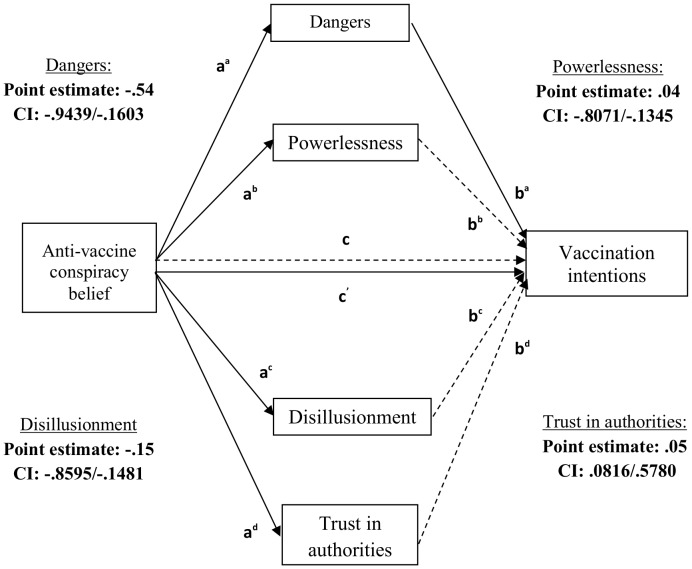
- In Study 1, anti-vaccine conspiracy beliefs significantly negatively predicted vaccination intentions, \(F(1, 87) = 15.97, p < .001, R^2 = .16, \beta = -.63\). Perceived dangers of vaccines, powerlessness, disillusionment, and trust in authorities each significantly mediated this relationship.
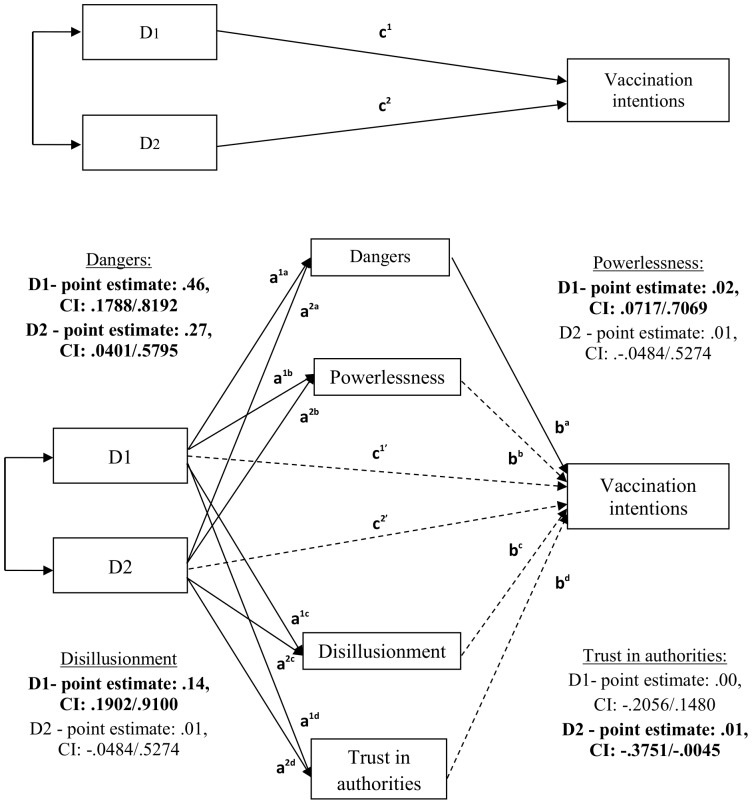
- In Study 2, vaccination intentions were significantly lower in the pro-conspiracy condition (\(M = 4.87, SD = 1.74\)) than in the anti-conspiracy condition (\(M = 5.69, SD = 1.31, p = .003\)) and the control condition (\(M = 5.47, SD = 1.50, p = .028\)), overall \(F(2, 185) = 4.81, p = .009, \eta^2 = .05\).
- The manipulation check showed higher endorsement of anti-vaccine conspiracy theories in the pro-conspiracy condition (\(M = 4.11, SD = 1.41\)) than the anti-conspiracy condition (\(M = 2.93, SD = 1.14, p < .001\)) and control condition (\(M = 3.56, SD = 1.21, p = .014\)).
- Perceived vaccine dangers consistently mediated the effects; powerlessness and disillusionment mediated the pro- versus anti-conspiracy difference, and trust in authorities mediated the pro-conspiracy versus control difference.
Methods
- Study 1 used a correlational online questionnaire with 89 British parents (\(80\) women, \(9\) men; \(M\) age \(= 38.06, SD = 9.25\)). Participants completed measures of anti-vaccine conspiracy beliefs, perceived dangers, powerlessness, disillusionment, trust in authorities, and intention to vaccinate a fictitious 8-month-old child against a made-up disease, dysomeria.
- Study 2 recruited 246 U.S. MTurk participants, with a final analyzed sample of 188 after screening exclusions. Participants were randomly assigned to pro-conspiracy, anti-conspiracy, or control information, then completed the same mediator measures and vaccination intention measure.
- Both studies used bootstrapping mediation analyses with 5000 bootstrap samples; Study 2 used ANOVA and indicator-coded mediation to compare the three conditions.
Limitations
- The paper states that effect sizes were small (e.g., \(\eta^2 = .05\) in Study 2), conspiracy endorsement was generally around or below the midpoint except in the pro-conspiracy condition (\(M = 4.11\)), the mediation pattern was less clear in Study 2, and findings relied on self-reported intentions for a fictional child and made-up disease rather than actual vaccination behavior.
- The paper notes that future research should examine larger samples, actual vaccination behavior, additional or isolated mediators, and geographical areas with dangerously low vaccination uptake.
- Evident from the text: Study 1 is correlational and cannot establish causality, and both studies use hypothetical vaccination scenarios, which may limit ecological validity.
Model-written summary. Check it against the paper before relying on it.
Integrity signals
Registry
Cites
Statistics
Figures
Verification
Claims the paper makes
37 Own result · 21 Not checked yet · 20 Own interpretation · 12 Own method
A result the paper reports from its own data — it cites no other source for it, so there is none to check. The quote shows it is in the paper.
In the paper
“Results revealed a significant negative relationship between anti-vaccine conspiracy beliefs and vaccination intentions.”
- Also stated in: § Results and Discussion · plain
“As predicted, regression analyses revealed that anti-vaccine conspiracy beliefs were a significant negative predictor of vaccination intentions, F(1, 87) = 15.97, p<.001, R2 = .16, β = −.63, t = − 3.10, p<. 001.”
- Also stated in: § Results and Discussion · plain
“Participants who endorsed anti-vaccine conspiracy theories to a greater extent indicated less intention to vaccinate.”
§ The Effects of Anti-Vaccine Conspiracy Theories on Vaccination Intentions > Abstract
plaincorrelational- Asserted: passes — The authors put it forward as true.
- Checkable: passes — It can be checked against evidence.
- Load-bearing: passes — The paper’s conclusions depend on it.
- Based: passes — The paper gives a reason why it holds.
- Also stated in: § Results and Discussion · plain
A result the paper reports from its own data — it cites no other source for it, so there is none to check. The quote shows it is in the paper.
In the paper
“As shown in Table 2, anti-vaccine conspiracy beliefs were a significant predictor of perceived dangers of vaccines, and feelings of powerlessness, disillusionment and trust in authorities, F(5, 83) = 120.37, p<.001, R2 = .58; F(5, 83) = 41.70, p<.001, R2 = .32; F(5, 83) = 74.43, p<.001, R2 = .46; F(5, 83) = 23.00, p<.001, R2 = .20, respectively.”
§ The Effects of Anti-Vaccine Conspiracy Theories on Vaccination Intentions > Study 1 > Results and Discussion
plaincorrelational- Asserted: passes — The authors put it forward as true.
- Checkable: passes — It can be checked against evidence.
- Load-bearing: passes — The paper’s conclusions depend on it.
- Based: passes — The paper gives a reason why it holds.
A result the paper reports from its own data — it cites no other source for it, so there is none to check. The quote shows it is in the paper.
In the paper
“Results revealed that participants who had been exposed to material supporting anti-vaccine conspiracy theories showed less intention to vaccinate than those in the anti-conspiracy condition or controls.”
§ The Effects of Anti-Vaccine Conspiracy Theories on Vaccination Intentions > Abstract
plaindirect- Asserted: passes — The authors put it forward as true.
- Checkable: passes — It can be checked against evidence.
- Load-bearing: passes — The paper’s conclusions depend on it.
- Based: passes — The paper gives a reason why it holds.
A result the paper reports from its own data — it cites no other source for it, so there is none to check. The quote shows it is in the paper.
In the paper
“This effect was mediated by the same variables as in Study 1.”
§ The Effects of Anti-Vaccine Conspiracy Theories on Vaccination Intentions > Abstract
plaindirect- Asserted: passes — The authors put it forward as true.
- Checkable: passes — It can be checked against evidence.
- Load-bearing: passes — The paper’s conclusions depend on it.
- Based: passes — The paper gives a reason why it holds.
A result the paper reports from its own data — it cites no other source for it, so there is none to check. The quote shows it is in the paper.
In the paper
“This effect was mediated by the perceived dangers of vaccines, and feelings of powerlessness, disillusionment and mistrust in authorities.”
- Also stated in: § Results and Discussion · hedged
“The multiple mediation analysis of the effect of anti-vaccine conspiracy beliefs on vaccination intentions indicated that perceived dangers of vaccines and feelings of powerlessness, disillusionment and trust in authorities (controlling for each other) were each significant mediators of this effect.”
- Also stated in: § Results and Discussion · plain
“When all factors were taken into account, each was a significant mediator of the relationship between anti-vaccine conspiracy beliefs and vaccination intentions.”
§ The Effects of Anti-Vaccine Conspiracy Theories on Vaccination Intentions > Abstract
plaincorrelational- Asserted: passes — The authors put it forward as true.
- Checkable: passes — It can be checked against evidence.
- Load-bearing: passes — The paper’s conclusions depend on it.
- Based: passes — The paper gives a reason why it holds.
- Also stated in: § Results and Discussion · hedged
A result the paper reports from its own data — it cites no other source for it, so there is none to check. The quote shows it is in the paper.
In the paper
“As shown in Table 2, anti-vaccine conspiracy beliefs were a significant predictor of perceived dangers of vaccines, and feelings of powerlessness, disillusionment and trust in authorities, F(5, 83) = 120.37, p<.001, R2 = .58; F(5, 83) = 41.70, p<.001, R2 = .32; F(5, 83) = 74.43, p<.001, R2 = .46; F(5, 83) = 23.00, p<.001, R2 = .20, respectively.”
§ The Effects of Anti-Vaccine Conspiracy Theories on Vaccination Intentions > Study 1 > Results and Discussion
plaincorrelational- Asserted: passes — The authors put it forward as true.
- Checkable: passes — It can be checked against evidence.
- Load-bearing: passes — The paper’s conclusions depend on it.
- Based: passes — The paper gives a reason why it holds.
A result the paper reports from its own data — it cites no other source for it, so there is none to check. The quote shows it is in the paper.
In the paper
“The results of this analysis therefore support the use of four separate mediators.”
§ The Effects of Anti-Vaccine Conspiracy Theories on Vaccination Intentions > Study 1 > Results and Discussion
plain- Asserted: passes — The authors put it forward as true.
- Checkable: passes — It can be checked against evidence.
- Load-bearing: passes — The paper’s conclusions depend on it.
- Based: passes — The paper gives a reason why it holds.
A result the paper reports from its own data — it cites no other source for it, so there is none to check. The quote shows it is in the paper.
In the paper
“Finally, results revealed no significant difference in trust in authorities between conditions, F(2, 185) = 2.32, p = .10, η2 = .03.”
§ The Effects of Anti-Vaccine Conspiracy Theories on Vaccination Intentions > Study 2 > Results and Discussion
plain- Asserted: passes — The authors put it forward as true.
- Checkable: passes — It can be checked against evidence.
- Load-bearing: unclear — It is unclear whether the paper’s conclusions depend on it.
- Based: passes — The paper gives a reason why it holds.
A result the paper reports from its own data — it cites no other source for it, so there is none to check. The quote shows it is in the paper.
In the paper
“Perceived dangers were higher in the pro-conspiracy condition (M = 4.00, SD = 1.46) than the anti-conspiracy condition (M = 2.97, SD = 1.42, p<.001) and the control condition (M = 2.39, SD = 1.71, p = .021).”
§ The Effects of Anti-Vaccine Conspiracy Theories on Vaccination Intentions > Study 2 > Results and Discussion
plain- Asserted: passes — The authors put it forward as true.
- Checkable: passes — It can be checked against evidence.
- Load-bearing: passes — The paper’s conclusions depend on it.
- Based: passes — The paper gives a reason why it holds.
- Probably not a substantial claim. 18
- It may state two separate claims as one. 9
- The quote only partly states this claim. 2
What the paper did — it cites no source for this, so there is none to check. The quote shows it is in the paper.
In the paper
“There were eight statements (e.g., “Vaccines lead to allergies”, α = .86)”
§ The Effects of Anti-Vaccine Conspiracy Theories on Vaccination Intentions > Study 1 > Methods
plain- Asserted: passes — The authors put it forward as true.
- Checkable: passes — It can be checked against evidence.
- Load-bearing: fails — The paper’s conclusions may not depend on it.
- Based: passes — The paper gives a reason why it holds.
Probably not a substantial claim. The paper’s conclusions may not depend on it.
What the paper did — it cites no source for this, so there is none to check. The quote shows it is in the paper.
In the paper
“Participants were asked to read the statements (e.g., “I feel that my actions will not stop the negative outcomes of immunizations”, α = .82)”
§ The Effects of Anti-Vaccine Conspiracy Theories on Vaccination Intentions > Study 1 > Methods
plain- Asserted: passes — The authors put it forward as true.
- Checkable: passes — It can be checked against evidence.
- Load-bearing: fails — The paper’s conclusions may not depend on it.
- Based: passes — The paper gives a reason why it holds.
Probably not a substantial claim. The paper’s conclusions may not depend on it.
What the paper did — it cites no source for this, so there is none to check. The quote shows it is in the paper.
In the paper
“consisted of four statements (e.g., “I am very disappointed with those who are involved in immunizations (e.g., the government, pharmaceutical companies)”, α = .89)”
§ The Effects of Anti-Vaccine Conspiracy Theories on Vaccination Intentions > Study 1 > Methods
plain- Asserted: passes — The authors put it forward as true.
- Checkable: passes — It can be checked against evidence.
- Load-bearing: fails — The paper’s conclusions may not depend on it.
- Based: passes — The paper gives a reason why it holds.
Probably not a substantial claim. The paper’s conclusions may not depend on it.
In the paper
“and also that feelings of political powerlessness mediate the relationship between exposure to conspiracy theories and voting intentions [22].”
§ The Effects of Anti-Vaccine Conspiracy Theories on Vaccination Intentions > Introduction
What the sources say
- Not checked yetcites [22] Jolley D, Douglas KM (2013) The social consequences of conspiracism: Exposure to conspiracy theories decreases the intention to engage in politics and to reduce one’s carbon footprint. Br J Psychol: in press. doi:10.1111/bjop.12018. source
plaindirect- Asserted: passes — The authors put it forward as true.
- Checkable: passes — It can be checked against evidence.
- Load-bearing: passes — The paper’s conclusions depend on it.
- Based: passes — The paper gives a reason why it holds.
Probably not a substantial claim.
In the paper
“Further, polls demonstrate that more than 20% of respondents endorse the idea that there is a link between childhood vaccines and autism [13].”
§ The Effects of Anti-Vaccine Conspiracy Theories on Vaccination Intentions > Introduction
What the sources say
- Not checked yetcites [13] Public Policy Polling (2013) Democrats and Republicans differ on conspiracy theory beliefs. Available: http://www.publicpolicypolling.com/pdf/2011/PPP_Release_National_ConspiracyTheories_040213.pdf. Accessed: 2013 Nov 27.
boosted- Asserted: passes — The authors put it forward as true.
- Checkable: passes — It can be checked against evidence.
- Load-bearing: fails — The paper’s conclusions may not depend on it.
- Based: passes — The paper gives a reason why it holds.
Probably not a substantial claim. The paper’s conclusions may not depend on it.
In the paper
“Previous research has demonstrated that exposure to conspiracy theories increases political disillusionment [22]”
§ The Effects of Anti-Vaccine Conspiracy Theories on Vaccination Intentions > Introduction
What the sources say
- Not checked yetcites [22] Jolley D, Douglas KM (2013) The social consequences of conspiracism: Exposure to conspiracy theories decreases the intention to engage in politics and to reduce one’s carbon footprint. Br J Psychol: in press. doi:10.1111/bjop.12018. source
boosteddirect- Asserted: passes — The authors put it forward as true.
- Checkable: passes — It can be checked against evidence.
- Load-bearing: passes — The paper’s conclusions depend on it.
- Based: passes — The paper gives a reason why it holds.
Probably not a substantial claim.
None of the sources cited for this claim have been checked yet.
In the paper
“Endorsement of these conspiracy theories amongst African Americans has been found to be associated with negative attitudes towards contraceptive behaviors, which may potentially expose people to the risk of unwanted pregnancies and sexually transmitted illnesses [23], [24], [25].”
§ The Effects of Anti-Vaccine Conspiracy Theories on Vaccination Intentions > Introduction
What the sources say
- Not checked yetcites [23] ST Bird, 2003, Birth control conspiracy beliefs, perceived discrimination, and contraception among African Americans, Journal of Health Psychology source
- Not checked yetcites [24] LM Bogart, 2006, Relationship of African Americans’ socio demographic characteristics to belief in conspiracies about HIV/AIDS and birth control, Journal of the National Medical Association
- Not checked yetcites [25] MA Hoyt, 2012, HIV/AIDS-related institutional mistrust among multiethnic men who have sex with men: Effects on HIV testing and risk behaviors, Health Psychology source
plaincorrelational- Asserted: passes — The authors put it forward as true.
- Checkable: passes — It can be checked against evidence.
- Load-bearing: fails — The paper’s conclusions may not depend on it.
- Based: passes — The paper gives a reason why it holds.
Probably not a substantial claim. The paper’s conclusions may not depend on it.
What the paper did — it cites no source for this, so there is none to check. The quote shows it is in the paper.
In the paper
“The order of measures was counterbalanced.”
§ The Effects of Anti-Vaccine Conspiracy Theories on Vaccination Intentions > Study 1 > Methods
plain- Asserted: passes — The authors put it forward as true.
- Checkable: passes — It can be checked against evidence.
- Load-bearing: fails — The paper’s conclusions may not depend on it.
- Based: passes — The paper gives a reason why it holds.
Probably not a substantial claim. The paper’s conclusions may not depend on it.
What the paper did — it cites no source for this, so there is none to check. The quote shows it is in the paper.
In the paper
“The study was approved by the Psychology Ethics Committee at the University of Kent and all participants provided their written, informed consent.”
§ The Effects of Anti-Vaccine Conspiracy Theories on Vaccination Intentions > Study 1 > Methods
plain- Asserted: passes — The authors put it forward as true.
- Checkable: passes — It can be checked against evidence.
- Load-bearing: fails — The paper’s conclusions may not depend on it.
- Based: passes — The paper gives a reason why it holds.
Probably not a substantial claim. The paper’s conclusions may not depend on it. It may state two separate claims as one.
What the paper did — it cites no source for this, so there is none to check. The quote shows it is in the paper.
In the paper
“There were two trust sources (corporations and government; Spearman-Brown Coefficient = .82)”
§ The Effects of Anti-Vaccine Conspiracy Theories on Vaccination Intentions > Study 1 > Methods
plain- Asserted: passes — The authors put it forward as true.
- Checkable: passes — It can be checked against evidence.
- Load-bearing: fails — The paper’s conclusions may not depend on it.
- Based: passes — The paper gives a reason why it holds.
Probably not a substantial claim. The paper’s conclusions may not depend on it. The quote only partly states this claim.
None of the sources cited for this claim have been checked yet.
In the paper
“Also, exposure to conspiracy theories has been found to have detrimental effects in other domains, such as reducing pro-environmental intentions and willingness to engage in politics [21], [22].”
§ The Effects of Anti-Vaccine Conspiracy Theories on Vaccination Intentions > Introduction
What the sources say
- Not checked yetcites [21] LD Butler, 1995, The psychological impact of viewing the film JFK: Emotions, beliefs and political behavioral intentions, Political Psychology source
- Not checked yetcites [22] Jolley D, Douglas KM (2013) The social consequences of conspiracism: Exposure to conspiracy theories decreases the intention to engage in politics and to reduce one’s carbon footprint. Br J Psychol: in press. doi:10.1111/bjop.12018. source
plaindirect- Asserted: passes — The authors put it forward as true.
- Checkable: passes — It can be checked against evidence.
- Load-bearing: fails — The paper’s conclusions may not depend on it.
- Based: passes — The paper gives a reason why it holds.
Probably not a substantial claim. The paper’s conclusions may not depend on it.
A conclusion the paper draws from its own results — it cites no other source for it, so there is none to check. The quote shows it is in the paper.
In the paper
“In Study 2, feelings of powerlessness and disillusionment mediated the difference between the pro- and anti-conspiracy conditions, and mistrust in authorities mediated the difference between the pro-conspiracy and control conditions.”
§ The Effects of Anti-Vaccine Conspiracy Theories on Vaccination Intentions > General Discussion
plaindirect- Asserted: passes — The authors put it forward as true.
- Checkable: passes — It can be checked against evidence.
- Load-bearing: passes — The paper’s conclusions depend on it.
- Based: passes — The paper gives a reason why it holds.
It may state two separate claims as one.
A conclusion the paper draws from its own results — it cites no other source for it, so there is none to check. The quote shows it is in the paper.
In the paper
“This means that the proportion of variance in vaccine intentions explained by exposure to conspiracy theories was quite modest and there are potentially many other factors that contribute to vaccine intentions.”
§ The Effects of Anti-Vaccine Conspiracy Theories on Vaccination Intentions > General Discussion
hedgedcorrelational- Asserted: passes — The authors put it forward as true.
- Checkable: passes — It can be checked against evidence.
- Load-bearing: passes — The paper’s conclusions depend on it.
- Based: passes — The paper gives a reason why it holds.
It may state two separate claims as one.
What the paper did — it cites no source for this, so there is none to check. The quote shows it is in the paper.
In the paper
“The final sample size used for data analysis was therefore 188 (112 women and 76 men, M age = 36.33, SD = 13.40).”
§ The Effects of Anti-Vaccine Conspiracy Theories on Vaccination Intentions > Study 2 > Methods
plainn = 188- Asserted: passes — The authors put it forward as true.
- Checkable: passes — It can be checked against evidence.
- Load-bearing: fails — The paper’s conclusions may not depend on it.
- Based: passes — The paper gives a reason why it holds.
Probably not a substantial claim. The paper’s conclusions may not depend on it.
A conclusion the paper draws from its own results — it cites no other source for it, so there is none to check. The quote shows it is in the paper.
In the paper
“Further, feelings of powerlessness and disillusionment mediated the difference between the pro- and anti-conspiracy conditions, and mistrust in authorities mediated the difference between the pro-conspiracy and control conditions.”
§ The Effects of Anti-Vaccine Conspiracy Theories on Vaccination Intentions > Study 2 > Results and Discussion
plaindirectn = 188- Asserted: passes — The authors put it forward as true.
- Checkable: passes — It can be checked against evidence.
- Load-bearing: passes — The paper’s conclusions depend on it.
- Based: passes — The paper gives a reason why it holds.
It may state two separate claims as one.
What the paper did — it cites no source for this, so there is none to check. The quote shows it is in the paper.
In the paper
“There were 60 participants in the pro-conspiracy condition, 62 in the anti-conspiracy condition, and 66 in the control condition.”
§ The Effects of Anti-Vaccine Conspiracy Theories on Vaccination Intentions > Study 2 > Methods
plainn = 60- Asserted: passes — The authors put it forward as true.
- Checkable: passes — It can be checked against evidence.
- Load-bearing: fails — The paper’s conclusions may not depend on it.
- Based: passes — The paper gives a reason why it holds.
Probably not a substantial claim. The paper’s conclusions may not depend on it. It may state two separate claims as one.
None of the sources cited for this claim have been checked yet.
In the paper
“As is well known, intentions do not always translate into behaviors [47], [48], [49].”
§ The Effects of Anti-Vaccine Conspiracy Theories on Vaccination Intentions > General Discussion
What the sources say
- Not checked yetcites [47] RT LaPiere, 1934, Attitudes vs. actions, Social Forces source
- Not checked yetcites [48] LS Linn, 1965, Verbal attitudes and overt behavior: A study of racial discrimination, Social Forces source
- Not checked yetcites [49] Sheeran P (2002) Intention-behavior relations: A conceptual and empirical review. In: Stroebe W, Hewstone M, editors. European Review of Social Psychology. Chichester, UK: Wiley. Vol. 12, 1–36. source
boosted- Asserted: passes — The authors put it forward as true.
- Checkable: passes — It can be checked against evidence.
- Load-bearing: passes — The paper’s conclusions depend on it.
- Based: passes — The paper gives a reason why it holds.
Probably not a substantial claim.
In the paper
“Similarly, different strategies for successful intervention may apply for people who hold strong anti-vaccine conspiracy beliefs than those who do not hold strong beliefs [44].”
§ The Effects of Anti-Vaccine Conspiracy Theories on Vaccination Intentions > General Discussion
What the sources say
- Not checked yetcites [44] CR Sunstein, 2009, Conspiracy theories: Causes and cures, J Polit Philos source
hedgedconditional- Asserted: passes — The authors put it forward as true.
- Checkable: fails — It may be too vague to check against evidence.
- Load-bearing: fails — The paper’s conclusions may not depend on it.
- Based: passes — The paper gives a reason why it holds.
Probably not a substantial claim. It may be too vague to check against evidence. The paper’s conclusions may not depend on it.
None of the sources cited for this claim have been checked yet.
In the paper
“Psychologists are learning more about the traits and characteristics associated with beliefs in conspiracy theories more generally, such as mistrust, anomie, political cynicism and Machiavellianism [8], [20], [31], [50]”
§ The Effects of Anti-Vaccine Conspiracy Theories on Vaccination Intentions > General Discussion
What the sources say
- Not checked yetcites [8] T Goertzel, 1994, Belief in conspiracy theories, Polit Psychol source
- Not checked yetcites [20] KM Douglas, 2008, The hidden impact of conspiracy theories: Perceived and actual influence of theories surrounding the death of Princess Diana, Br J Soc Psychol source
- Not checked yetcites [31] M Abalakina-Paap, 1999, Beliefs in conspiracies, Political Psychology source
plaincorrelational- Asserted: passes — The authors put it forward as true.
- Checkable: passes — It can be checked against evidence.
- Load-bearing: fails — The paper’s conclusions may not depend on it.
- Based: passes — The paper gives a reason why it holds.
Probably not a substantial claim. The paper’s conclusions may not depend on it.
A conclusion the paper draws from its own results — it cites no other source for it, so there is none to check. The quote shows it is in the paper.
In the paper
“Specifically, they appear to reduce vaccination intentions by inducing undue concern about the dangers of vaccines, and increasing powerlessness, disillusionment, and mistrust.”
§ The Effects of Anti-Vaccine Conspiracy Theories on Vaccination Intentions > General Discussion
hedgeddirect- Asserted: passes — The authors put it forward as true.
- Checkable: passes — It can be checked against evidence.
- Load-bearing: passes — The paper’s conclusions depend on it.
- Based: passes — The paper gives a reason why it holds.
It may state two separate claims as one.
A conclusion the paper draws from its own results — it cites no other source for it, so there is none to check. The quote shows it is in the paper.
In the paper
“Therefore, the participants were not strong endorsers of anti-vaccine conspiracy theories, meaning that different patterns of findings may emerge for those who do strongly endorse conspiracy theories.”
§ The Effects of Anti-Vaccine Conspiracy Theories on Vaccination Intentions > General Discussion
hedged- Asserted: passes — The authors put it forward as true.
- Checkable: passes — It can be checked against evidence.
- Load-bearing: unclear — It is unclear whether the paper’s conclusions depend on it.
- Based: passes — The paper gives a reason why it holds.
It may state two separate claims as one.
A conclusion the paper draws from its own results — it cites no other source for it, so there is none to check. The quote shows it is in the paper.
In the paper
“Therefore, overall, anti-vaccine conspiracy theories appear to introduce undue suspicion about vaccine safety, and increase feelings of powerlessness and disillusionment, whilst decreasing trust in authorities, which in turn introduce reluctance to vaccinate.”
§ The Effects of Anti-Vaccine Conspiracy Theories on Vaccination Intentions > General Discussion
hedgeddirect- Asserted: passes — The authors put it forward as true.
- Checkable: passes — It can be checked against evidence.
- Load-bearing: passes — The paper’s conclusions depend on it.
- Based: passes — The paper gives a reason why it holds.
It may state two separate claims as one.
What the paper did — it cites no source for this, so there is none to check. The quote shows it is in the paper.
In the paper
“Participants were randomly assigned to one of the three conditions.”
§ The Effects of Anti-Vaccine Conspiracy Theories on Vaccination Intentions > Study 2 > Methods
plain- Asserted: passes — The authors put it forward as true.
- Checkable: passes — It can be checked against evidence.
- Load-bearing: passes — The paper’s conclusions depend on it.
- Based: passes — The paper gives a reason why it holds.
Probably not a substantial claim.
What the paper did — it cites no source for this, so there is none to check. The quote shows it is in the paper.
In the paper
“The study was approved by the Psychology Ethics Committee at the University of Kent and all participants provided their written, informed consent.”
§ The Effects of Anti-Vaccine Conspiracy Theories on Vaccination Intentions > Study 1 > Methods
plain- Asserted: fails — The authors may not put it forward as true.
- Checkable: passes — It can be checked against evidence.
- Load-bearing: fails — The paper’s conclusions may not depend on it.
- Based: fails — The paper may give no reason why it holds.
Probably not a substantial claim. The authors may not put it forward as true. The paper’s conclusions may not depend on it. The paper may give no reason why it holds. It may state two separate claims as one. The quote only partly states this claim.
The paper relies on this without support.
The measured mediators (perceived vaccine dangers, powerlessness, disillusionment, and trust in authorities) are causally prior to and influence vaccination intentions, as required for the mediation analysis.
“Each of the candidate mediators was then examined in a test of mediation in order to explain the effect of the conspiracy conditions (pro-conspiracy versus anti-conspiracy, versus control) on vaccination intentions.”
Statistics recomputed
Every reported test result, recomputed from its test statistic and degrees of freedom. A result shows as not adding up only once an independent check has confirmed it.
- Consistentχ²(136) = 4544.44reported p < .001 · recomputed p < .001
“X 2 (136) = 4544.44, p < .001”
- ConsistentF(1, 87) = 15.97reported p < .001 · recomputed p < .001
“F(1, 87) = 15.97, p < .001”
- ConsistentF(5, 83) = 120.37reported p < .001 · recomputed p < .001
“F(5, 83) = 120.37, p < .001”
- ConsistentF(5, 83) = 41.7reported p < .001 · recomputed p < .001
“F(5, 83) = 41.70, p < .001”
- ConsistentF(5, 83) = 74.43reported p < .001 · recomputed p < .001
“F(5, 83) = 74.43, p < .001”
- ConsistentF(5, 83) = 23reported p < .001 · recomputed p < .001
“F(5, 83) = 23.00, p < .001”
- ConsistentF(2, 185) = 4.81reported p = .009 · recomputed p = .009
“F(2, 185) = 4.81, p = .009”
- ConsistentF(2, 185) = 7.61reported p = .001 · recomputed p < .001
“F(2, 185) = 7.61, p = .001”
- ConsistentF(2, 185) = 3.44reported p = .034 · recomputed p = .034
“F(2, 185) = 3.44, p = .034”
- ConsistentF(2, 185) = 7.46reported p = .001 · recomputed p < .001
“F(2, 185) = 7.46, p = .001”
- ConsistentF(2, 185) = 2.32reported p = .1 · recomputed p = .101
“F(2, 185) = 2.32, p = .10”
Self-check
Percentages, sums and reported differences re-computed from the paper’s own numbers.
Each contradiction between two passages listed here was confirmed by an independent check.
Rated minor: it would not touch a result — a value no result rests on, a p-value that stays on the same side of the significance level, or a conflict that is clerical, resolved elsewhere in the paper, or outside its own findings.
In the paper
§ The Effects of Anti-Vaccine Conspiracy Theories on Vaccination Intentions > Study 1 > Results and Discussion
“| (2) Immunisation intention | 5.63 (1.42) | −.40*** | – | −.49*** | .29** | −.36*** | .20¥ |”
§ The Effects of Anti-Vaccine Conspiracy Theories on Vaccination Intentions > Study 1 > Results and Discussion
“| (3) Dangers | 2.97 (1.37) | .76*** | −.48*** | – | .58*** | .60*** | −.48*** |”
Rated minor: it would not touch a result — a value no result rests on, a p-value that stays on the same side of the significance level, or a conflict that is clerical, resolved elsewhere in the paper, or outside its own findings.
In the paper
“F(1, 87) = 15.97, p<.001, R2 = .16, β = −.63, t = − 3.10, p<. 001.”
§ The Effects of Anti-Vaccine Conspiracy Theories on Vaccination Intentions > Study 1 > Results and Discussion
Reported 15.97 · recomputed 9.61
Rated minor: it would not touch a result — a value no result rests on, a p-value that stays on the same side of the significance level, or a conflict that is clerical, resolved elsewhere in the paper, or outside its own findings.
In the paper
§ The Effects of Anti-Vaccine Conspiracy Theories on Vaccination Intentions > Study 1 > Results and Discussion
“| (3) Dangers | 2.97 (1.37) | .76*** | −.48*** | – | .58*** | .60*** | −.48*** |”
§ The Effects of Anti-Vaccine Conspiracy Theories on Vaccination Intentions > Study 1 > Results and Discussion
“| (5) Disillusionment | 2.45 (1.40) | .68*** | −.36*** | .59*** | .59*** | – | −.41*** |”
Rated minor: it would not touch a result — a value no result rests on, a p-value that stays on the same side of the significance level, or a conflict that is clerical, resolved elsewhere in the paper, or outside its own findings.
In the paper
§ The Effects of Anti-Vaccine Conspiracy Theories on Vaccination Intentions > Study 1 > Results and Discussion
“β = −.63”
§ The Effects of Anti-Vaccine Conspiracy Theories on Vaccination Intentions > Study 1 > Results and Discussion
“| (1) Anti-vaccine conspiracy belief | 2.00 (.89) | – | −.40*** | .76*** | .57*** | .68*** | −.46*** |”
Rated minor: it would not touch a result — a value no result rests on, a p-value that stays on the same side of the significance level, or a conflict that is clerical, resolved elsewhere in the paper, or outside its own findings.
In the paper
§ The Effects of Anti-Vaccine Conspiracy Theories on Vaccination Intentions > Study 1 > Results and Discussion
“F(5, 83) = 120.37, p<.001, R2 = .58; F(5, 83) = 41.70, p<.001, R2 = .32; F(5, 83) = 74.43, p<.001, R2 = .46; F(5, 83) = 23.00, p<.001, R2 = .20, respectively.”
§ The Effects of Anti-Vaccine Conspiracy Theories on Vaccination Intentions > Study 1 > Results and Discussion
“Table: Table 2 Four separate regressions examining anti-conspiracy belief as predictor, and four mediator variables as criterions.”
Citations
Cites
Preacher, K. J., & Hayes, A. F. (2008) · Behavior Research Methods · doi:10.3758/brm.40.3.879 · Cited by 34,117 · cited 1×
“By repeating this process thousands of times, it builds an empirical approximation of the sampling distribution that constructs the confidence intervals [39].”
Amazon's Mechanical Turk: A New Source of Inexpensive, Yet High-Quality, Data?
Buhrmester, M., Kwang, T., & Gosling, S. D. (2011) · Perspectives on Psychological Science · doi:10.1177/1745691610393980 · Cited by 9,996
Beyond Baron and Kenny: Statistical Mediation Analysis in the New Millennium
Hayes, A. F. (2009) · Communication Monographs · doi:10.1080/03637750903310360 · Cited by 9,757 · cited 5×
“As argued by Hayes [40], an indirect effect is estimated as being significant if the confidence intervals do not contain a zero, as opposed to significance in the individual paths.”
InfluentialNew Environmental Theories: Toward a Coherent Theory of Environmentally Significant Behavior
Stern, P. C. (2000) · Journal of Social Issues · doi:10.1111/0022-4537.00175 · Cited by 8,682
A Second Generation Little Jiffy
Kaiser, H. F. (1970) · Psychometrika · doi:10.1007/bf02291817 · Cited by 4,855
Running experiments on Amazon Mechanical Turk
Paolacci, G., Chandler, J., & Ipeirotis, P. G. (2010) · Judgment and Decision Making · doi:10.1017/s1930297500002205 · Cited by 3,767
Intention—Behavior Relations: A Conceptual and Empirical Review
Sheeran, P. (2002) · European Review of Social Psychology · doi:10.1080/14792772143000003 · Cited by 3,688 · cited 1×
“As is well known, intentions do not always translate into behaviors [47], [48], [49].”
Statistical mediation analysis with a multicategorical independent variable
Hayes, A. F., & Preacher, K. J. (2014) · British Journal of Mathematical and Statistical Psychology · doi:10.1111/bmsp.12028 · Cited by 3,403 · cited 3×
“This was carried out using Hayes and Preacher’s [38] bootstrapping method for indirect effects, as in Study 1.”
Misinformation and Its Correction: Continued Influence and Successful Debiasing
Lewandowsky, S., Ecker, U. K. H., Seifert, C. M., Schwarz, N., & Cook, J. (2012) · Psychological Science in the Public Interest · doi:10.1177/1529100612451018 · Cited by 2,920
A Note on the Multiplying Factors for Various χ2 Approximations
Bartlett, M. S. (1954) · Journal of the Royal Statistical Society Series B (Statistical Methodology) · doi:10.1111/j.2517-6161.1954.tb00174.x · Cited by 2,168
Cited by
Sorted by citations
Items 601–700 of 1,000
Blagden, S., Newell, K., Ghazarians, N., Sulaiman, S., Tunn, L., Odumala, M., Isba, R., & Edge, R. (2022) · BMJ Open · doi:10.1136/bmjopen-2022-061749 · Cited by 9
You believe what?!: Relational closeness and belief relevance predict conspiracy belief tolerance
Okdie, B. M., Rempala, D. M., & Mustric, S. R. (2022) · Current Psychology · doi:10.1007/s12144-022-03891-5 · Cited by 9
Mang, V., Epstude, K., & Fennis, B. M. (2023) · Personality and Individual Differences · doi:10.1016/j.paid.2023.112481 · Cited by 11
The effect of scientific conspiracy theories on scepticism towards biotechnologies
Marques, M. D., Kerr, J. R., Stukas, A. A., & McLennan, J. (2024) · Public Understanding of Science · doi:10.1177/09636625241300896 · Cited by 9
“In one study, reading claims that climate change was an elaborate hoax, and that scientists are motivated to perpetuate the myth to obtain research funding, reduced reported intentions to reduce one’s carbon footprint (Jolley and Douglas, 2014b).”
InfluentialBelief in Science‐Related Conspiracy Theories
Littrell, S., Diekman, A. B., Seelig, M. I., Premaratne, K., Wuchty, S., Verdear, D., Klofstad, C., & Uscinski, J. E. (2025) · Journal of Social Issues · doi:10.1111/josi.70004 · Cited by 14
Verschwörungsmentalität und Antisemitismus
Imhoff, R. (2020) · Springer eBooks · doi:10.1007/978-3-658-31701-0_4 · Cited by 1
Fouogue, J. T., Noubom, M., Kenfack, B., Dongmo, N. T., Tabeu, M., Megozeu, L., Alima, J. M., Fogang, Y. F., Rim, L. C. A. N., Fouelifack, F. Y., et al. (2020) · PubMed Central · doi:10.11604/pamj.supp.2020.37.19.25688 · Cited by 9
COVID-19 vaccine hesitancy among pregnant women in an antenatal clinic in Durban, South Africa
Ashkir, S., Abel, T., Khaliq, O. P., & Moodley, J. (2023) · Southern African Journal of Infectious Diseases · doi:10.4102/sajid.v38i1.516 · Cited by 9
da Rosa, S. S., Barros, T. H. B., & Laipelt, R. D. C. F. (2023) · Reciis · doi:10.29397/reciis.v17i3.3774 · Cited by 9
Khalaf, M. A., & Shehata, A. M. K. (2023) · BMC Psychology · doi:10.1186/s40359-023-01425-7 · Cited by 9
Buczel, K. A., Siwiak, A., Szpitalak, M., & Polczyk, R. (2024) · Memory & Cognition · doi:10.3758/s13421-024-01520-z · Cited by 13
“…have been many successful attempts to use inoculation to reduce misinformation susceptibility (e.g., Banas & Miller, 2013; Cook et al., 2017, 2018; Jolley & Douglas, 2014; Roozenbeek & van der Linden, 2019; Roozenbeek et al., 2022; van der Linden et al., 2017; cf. Lewandowsky & van der Linden,…”
Poier, S., & Suchanek, M. (2024) · Journal of Public Health · doi:10.1007/s10389-024-02210-5 · Cited by 12
“…beliefs are negatively associated with all four COVID-19-related measures is in line with the pre-COVID results on similar issues as published by Oliver and Wood (2014a) and Jolley and Douglas (2014), suggesting that conspiracy beliefs negatively affect health decisions, confirming hypothesis H_02.”
'I Did it For the Money': Incentives, Rationalizations and Health
Gorin, M., & Schmidt, H. (2014) · Public Health Ethics · doi:10.1093/phe/phu034 · Cited by 9
Studying anti-vaccination behavior and attitudes: A systematic review of methods
Eritsyan, K. Y., Antonova, N. A., & Tsvetkova, L. (2017) · Psychology in Russia State of Art · doi:10.11621/pir.2017.0113 · Cited by 9
The Conspiratorial Style in Turkish Politics
Nefes, T. S. (2018) · Oxford University Press eBooks · doi:10.1093/oso/9780190844073.003.0026 · Cited by 9
Teorias da conspiração: significados em contexto brasileiro
Rezende, A. T., da Silva, F. M. D. S. M., Ribeiro, M. G. C., Loureto, G. D. L., Neta, O. F. D. S., & Gouveia, V. V. (2019) · Estudos de Psicologia (Campinas) · doi:10.1590/1982-0275201936e180010 · Cited by 12
Parent support for social media standards combatting vaccine misinformation
Spanos, K. E., Kraschnewski, J. L., Moss, J. L., Wong, A., & Calo, W. A. (2021) · Vaccine · doi:10.1016/j.vaccine.2021.01.005 · Cited by 9
Exposure to conspiracy theories in the lab
Balafoutas, L., Libman, A., Selamis, V., & Vollan, B. (2021) · Economic and Political Studies · doi:10.1080/20954816.2020.1818930 · Cited by 9
Exploring Psychological Factors for COVID-19 Vaccination Intention in Taiwan
Lo, S.-Y., Li, S. S., & Wu, T.-Y. (2021) · Vaccines · doi:10.3390/vaccines9070764 · Cited by 9
“This finding echoes previous studies that showed a negative effect of conspiracy belief on health-promoting behaviors [21,26,27,37], including COVID19 vaccination [22,23,25].”
ResultLermer, E., Hudecek, M. F. C., Gaube, S., Raue, M., & Batz, F. (2021) · Frontiers in Psychology · doi:10.3389/fpsyg.2021.769206 · Cited by 12
“Complex and alarming world events are often accompanied by the emergence of conspiracy theories (McCauley and Jacques, 1979; Leman and Cinnirella, 2007; Jolley and Douglas, 2014).”
BackgroundI need some answers, now!: Present time perspective is associated with holding conspiracy beliefs
Zajenkowski, M., Górniak, J., Wojnarowski, K., Sobol, M., & Jonason, P. K. (2022) · Personality and Individual Differences · doi:10.1016/j.paid.2022.111723 · Cited by 11
“Conspiratorial theories seem to play an important role in shaping the pandemic-related behaviors, especially less adherence to the restrictions (e.g. Freeman et al., 2020; Jolley & Douglas, 2014; Kowalski et al., 2020; Swami & Barron, 2021; Venea et al., 2022).”
State vs. anti-vaxxers: Analysis of Covid-19 echo chambers in Serbia
Bojić, L., Nikolić, N., & Tucaković, L. (2022) · Communications · doi:10.1515/commun-2021-0104 · Cited by 9
Machado, D. F. T., de Siqueira, A. F., Shimizu, N. R., & Gitahy, L. (2022) · Frontiers in Communication · doi:10.3389/fcomm.2022.1037432 · Cited by 12
“M&D can damage society in many ways (Lewandowsky et al., 2013; Jolley and Douglas, 2014).”
Access to HPV vaccination for boys in the United Kingdom
Prue, G., Grimes, D. R., Baker, P., & Lawler, M. (2018) · Medicine Access Point of Care · doi:10.1177/2399202618799691 · Cited by 9
Conspiracy Thinking, Tolerance, and Democracy
Smallpage, S. M. (2018) · Oxford University Press eBooks · doi:10.1093/oso/9780190844073.003.0012 · Cited by 9
Psychologia myślenia spiskowego
Grzesiak-Feldman, M. (2016) · Wydawnictwa Uniwersytetu Warszawskiego eBooks · doi:10.31338/uw.9788323522157 · Cited by 5
Stasik, A., & Jemielniak, D. (2021) · Journal of Risk Research · doi:10.1080/13669877.2020.1864008 · Cited by 9
Whitehead, M. L., Taylor, N., Gough, A., Chambers, D., Jessop, M., & Hyde, P. (2019) · Veterinary Record · doi:10.1136/vr.l4027 · Cited by 9
Investigating Beliefs in Anti-Vax Conspiracy Theories among Medical Students
Domaradzki, J., Jabkowski, P., & Walkowiak, D. (2024) · Vaccines · doi:10.3390/vaccines12040359 · Cited by 8
“The emergence of various conspiracy theories during the pandemic raises concerns, particularly due to documented evidence indicating their negative impact on vaccination intentions [43,73–75], even among healthcare workers [31–33 ,36, 37 ].”
BackgroundReasoning versus prior beliefs: The case of COVID ‐19 fake news
Čavojová, V., Lorko, M., & Šrol, J. (2024) · Applied Cognitive Psychology · doi:10.1002/acp.4194 · Cited by 9
Jolley, D., Shepherd, L., & Maughan, A. D. (2024) · Psychology and Health · doi:10.1080/08870446.2024.2381235 · Cited by 8
“A vaccine intention item was then completed (Jolley & Douglas, 2014), where participants were asked, ‘If you had the opportunity to vaccinate yourself against Flebilis-Potentia next week, what would you decide?’ with responses being on a 7-point scale (1 = definitely not vaccinate , 7 = definitely…”
InfluentialSelf-citationPanerati, S., & Salvati, M. (2025) · British Journal of Social Psychology · doi:10.1111/bjso.12866 · Cited by 8
Kay, C. S., & Slovic, P. (2025) · Assessment (Odessa, Fla.) · doi:10.1177/10731911251319933 · Cited by 7
“Research has suggested that those who believe in conspiracy theories are less likely to vote (Butler et al., 1995), vaccinate (Jolley & Douglas, 2014), and engage in behaviors intended to combat climate change (Van der Linden, 2015), as well as being more likely to harbor prejudicial beliefs (Kay,…”
Tang, R., Fang, Y., Sun, J., Bode, L., & Vraga, E. K. (2025) · Journalism & Mass Communication Quarterly · doi:10.1177/10776990251359660 · Cited by 8
“…behaviors, worsen negative attitudes toward stigmatized groups, experts, and institutions (Wang et al., 2022), negatively impact health beliefs (Tan et al., 2015), decrease risk perceptions of avoiding vaccination (Betsch et al., 2010), and reduce vaccination intentions (Jolley & Douglas, 2014).”
Malas, O., & Tolsá, M. D. (2022) · Clínica y Salud · doi:10.5093/clysa2022a11 · Cited by 8
Kouros, T., Papa, V., Ioannou, M., & Kapnisis, V. (2022) · Journal of Communication Inquiry · doi:10.1177/01968599221117235 · Cited by 8
Fake news mediate the relationship between sociopolitical factors and vaccination intent in Brazil
de Medeiros, P. M., & de Medeiros, P. M. (2022) · Health Promotion International · doi:10.1093/heapro/daac110 · Cited by 8
Ahmed, W., Ali, S., Waqas, H., Asghar, M., & Erum, N. (2023) · Global Social Welfare · doi:10.1007/s40609-023-00268-9 · Cited by 8
Aghajari, Z., Baumer, E. P. S., & DiFranzo, D. J. (2023) · CHI Conference on Human Factors in Computing Systems · doi:10.1145/3544548.3580946 · Cited by 9
“First, vaccination is a contentious topic, and there are many con-spiracy theories associated with this issue (e.g., harmful side effects of vaccines are hidden from the public, vaccines are pushed by pharmaceutical companies and government to make money) [63, 64].”
BackgroundKnežević, G., Lazarević, L. B., Mihić, L., Pejovic-Milovancevic, M. M., Terzić-Šupić, Z., Tošković, O., Vuković, O., Todorović, J., & Marić, N. P. (2023) · British Journal of Clinical Psychology · doi:10.1111/bjc.12431 · Cited by 11
Allington, D., Hirsh, D., & Katz, L. (2023) · Scientific Reports · doi:10.1038/s41598-023-41794-y · Cited by 10
Ma, H., Lee, E. W. J., Xie, L., Lee, H. H., Hui, K. H., Mo, P. K. H., & Xin, M. (2024) · Computers in Human Behavior · doi:10.1016/j.chb.2024.108243 · Cited by 8
Gundersen, A. B., van der Linden, S., Piasecki, J., Ryguła, R., Noworyta, K., & Kunst, J. R. (2024) · Journal of Social and Political Psychology · doi:10.5964/jspp.13385 · Cited by 9
“Consistent with this reasoning, feelings of powerlessness (Abalakina‐Paap et al., 1999; Jolley & Douglas, 2014) and deprived life-circumstances have been associated with increased conspiracy beliefs (van Prooijen, 2020).”
Kessler, E. D., Braasch, J. L. G., & Kardash, C. M. (2021) · Reading Psychology · doi:10.1080/02702711.2021.1888357 · Cited by 8
“Regarding the health topic of interest in the current work, individuals are using the Internet to locate, understand, and share information on childhood vaccinations much more than in the past (Jolley & Douglas, 2014).”
BackgroundInfluentialMoon, C., & Travaglino, G. A. (2021) · Journal of Pacific Rim Psychology · doi:10.1177/18344909211056855 · Cited by 12
“For example, research has demonstrated that a generalized conspiracy belief that powerful forces work secretly to dominate the world (Imhoff & Bruder, 2014) can weaken prosocial behavior (Imhoff et al., 2018; Jolley & Douglas, 2014a, 2014b).”
BackgroundZelič, Ž., Berič, M., & Grum, D. K. (2022) · Studia Psychologica · doi:10.31577/sp.2022.01.844 · Cited by 10
Hoecke, A. L. V., & Sanders, J. G. (2022) · Vaccines · doi:10.3390/vaccines10050720 · Cited by 8
Pickup, M. A., Stecula, D. A., & van der Linden, C. (2022) · Journal of Quantitative Description Digital Media · doi:10.51685/jqd.2022.024 · Cited by 8
COVID-19 Related Stresses, Conspiracy Beliefs, Uncertainty, and Non-adherence to Safety Guidelines
Barahmand, U., Mohamadpour, S., & Ahmad, R. H. S. (2022) · International Journal of Psychological Research · doi:10.21500/20112084.5367 · Cited by 6
“…effect of conspiracist beliefs about HIV/AIDS on the attitudes toward preventative guidelines and treatment adherence (Bogart et al., 2010) and the role of conspiracy theories regarding the dangers of childhood vaccinations in lower vaccination rates have been reported (Jolley & Douglas, 2014).”
BackgroundSun, Y., Hamedani, M. F., Javidi, G., Sheybani, E., & Hao, F. (2022) · Health Promotion International · doi:10.1093/heapro/daac157 · Cited by 10
Do Survey Questions Spread Conspiracy Beliefs?
Clifford, S., & Sullivan, B. W. (2023) · Journal of Experimental Political Science · doi:10.1017/xps.2023.1 · Cited by 8
“Scholars have documented a number of ill effects of conspiracy beliefs, including decreased intentions to get vaccinated (Jolley and Douglas 2014), decreased social distancing during the COVID-19 pandemic (Bierwiaczonek, Kunst, and Pich 2020), increased support for illegal behavior (Imhoff,…”
BackgroundCaycho‐Rodríguez, T., Tomás, J. M., Yupanqui-Lorenzo, D. E., Valencia, P. D., Carbajal‐León, C., Vilca, L. W., Ventura‐León, J., Paredes-Ángeles, R., Gallegos, W. L. A., Reyes-Bossio, M. A., et al. (2023) · Evaluation & the Health Professions · doi:10.1177/01632787231186621 · Cited by 8
“In this sense, the lower intention to vaccinate could be explained by the greater perception of the dangers related to conspiracy beliefs about vaccines, which outweigh the perceived bene fi ts (Jolley & Douglas, 2014).”
BackgroundThe Truth Is Around Here Somewhere
Bost, P. R. (2018) · Oxford University Press eBooks · doi:10.1093/oso/9780190844073.003.0018 · Cited by 8
Why the Powerful (in Weak States) Prefer Conspiracy Theories
Radnitz, S. (2018) · Oxford University Press eBooks · doi:10.1093/oso/9780190844073.003.0023 · Cited by 8
Salvador-Mata, B., & Cortiñas‐Rovira, S. (2020) · Social Work in Public Health · doi:10.1080/19371918.2020.1785983 · Cited by 8
“The use of pseudoscientific practices can put public health at risk, as demonstrated by anti-vaccination movements (Jolley & Douglas, 2014) and by deaths that could have been avoided if more conventional treatments had been administered.”
BackgroundYeung, M. W. L., & Yau, A. (2020) · Journal of Communications In Healthcare · doi:10.1080/17538068.2020.1809316 · Cited by 8
“people (see [48,49]), but how a chain of past health issues handled by the government might have affected the public views of vaccine effectiveness.”
BackgroundConspiracy Theories about Infectious Diseases: An Introduction
Hong, Y., Chan, H., & Douglas, K. M. (2021) · Journal of Pacific Rim Psychology · doi:10.1177/18344909211057657 · Cited by 9
“Likewise, previous research has also demonstrated the harmful effect of conspiracy beliefs on people’s attitudes and plans regarding vaccination (e.g., Hornsey et al., 2018; Jolley & Douglas, 2014).”
ResultSelf-citationJi, Y. (2021) · Journal of Health Communication · doi:10.1080/10810730.2021.2025174 · Cited by 8
“On the contrary, when people had negative emotional sentiments such as concerned or disappointed during vaccination communication, they were less likely to support vaccines (Jolley & Douglas, 2014).”
BackgroundAdam-Troian, J., Wagner-Egger, P., Motyl, M., Arciszewski, T., Imhoff, R., Zimmer, F., Klein, O., Babińska, M., Bangerter, A., Bilewicz, M., et al. (2020) · Political Psychology · doi:10.31234/osf.io/nzg7x · Cited by 75
“…have negative consequences such as a reduced willingness to vaccinate children (Jolley & Douglas, 2014a), to take action to mitigate climate change (Jolley & Douglas, 2014b), to endorse unwarranted beliefs such as creationism (Wagner-Egger, Delouvée, Gauvrit & Dieguez, 2018), and may even increase…”
BackgroundSelf-citationCelia, G., Lausi, G., Girelli, L., Cavicchiolo, E., Limone, P., Giannini, A. M., & Cozzolino, M. (2022) · Frontiers in Psychology · doi:10.3389/fpsyg.2022.939615 · Cited by 7
“Moreover, it has been shown that endorsement of a variety of unrelated conspiracy theories is associated with negative attitudes toward vaccination (Jolley and Douglas, 2014; Lewandowsky et al., 2015).”
BackgroundHolford, D. L., Schmid, P., Fasce, A., Garrison, A., Karlsson, L. C., Taubert, F., Verger, P., Lewandowsky, S., Fisher, H., Betsch, C., et al. (2024) · BMJ Public Health · doi:10.1136/bmjph-2023-000195 · Cited by 7
“…factors that consistently predict vaccine hesitancy, such as conspir-acist ideation (ie, the tendency to believe in conspiracy theories 35 37–40 ), distrust (eg, of healthcare systems 40–42 ) and reactance (ie, the tendency to push back against a perceived imposition 35 40 ), among others.”
LaCour, M., & Bell, Z. K. (2024) · Harvard Kennedy School Misinformation Review · doi:10.37016/mr-2020-148 · Cited by 7
The role of personality traits and online behavior in belief in fake news
Peter, E. L., Kwantes, P. J., D’Agata, M. T., & Vallikanthan, J. (2024) · Humanities and Social Sciences Communications · doi:10.1057/s41599-024-03573-6 · Cited by 7
“Further still, individuals who held more anti-vaccine conspiracy beliefs, and those who were exposed to anti-vaccine conspiracy theories, were less likely to report intentions to vaccinate their children than those who did not (Jolley and Douglas, 2014).”
Annandale, G., Kola, S., & Duke, É. (2025) · Human Vaccines & Immunotherapeutics · doi:10.1080/21645515.2025.2511350 · Cited by 7
“…factors influencing vaccination motivation, including right-relative to left-wing political affiliation, 13,14 endorsing conspiracy beliefs, 15,16 and the Big Five personality traits 17,18,19 Longitudinal data highlighted increased distrust of the UK Government between April 2020 and December…”
Ou, M., & Ho, S. S. (2025) · Health Communication · doi:10.1080/10410236.2025.2539462 · Cited by 7
“Most vaccine con-spiracy theories are inherently negative in nature, aiming to discourage vaccination by fostering fear, distrust, and skepticism toward medical and governmental institutions (Jolley et al., 2014).”
InfluentialGabay, G., & Tarabeih, M. (2022) · Public Understanding of Science · doi:10.1177/09636625211070500 · Cited by 7
“Distrust in medical institutions and in government may fuel rejection toward the COVID-19 vaccine echoing previous research (Jolley and Douglas, 2014).”
ResultHateftabar, F., Larson, H. J., & Hateftabar, V. (2022) · Journal of Global Health · doi:10.7189/jogh.12-05057 · Cited by 7
“…altruistic beliefs [11,39], the personality traits neuroticism and conscientiousness [40,41], health locus of control [11,42], subjective norms [43,44], personality trait agreeableness [11], cognitive reflection [45], and conspiracy perceptions [11,46], in some form, influence vaccine willingness.”
Individuals, Collectives, and Individuals in Collectives: The Ineliminable Role of Dependence
Hahn, U. (2023) · Perspectives on Psychological Science · doi:10.1177/17456916231198479 · Cited by 11
“…2016; Fishkin, 1991; Jost et al., 2022; Sunstein, 2018) to affecting debates on high-stakes issues such as climate change (Falkenberg et al., 2022; Guilbeault et al., 2018; Jasny et al., 2015) and vaccinations (Horne et al., 2015; Jolley & Douglas, 2014; Kata, 2012; Mønsted & Lehmann, 2022).”
BackgroundJolley, D., Paterson, J. L., & McNeill, A. R. (2023) · British Journal of Psychology · doi:10.1111/bjop.12690 · Cited by 7
“In fact, popular conspiracy theories allege that scientists are covering up the success of vaccines for profit (Jolley & Douglas, 2014) and that Jewish people have a controlling but secre-tive influence over world affairs (Jolley et al., 2020).”
BackgroundSelf-citationConspiracy Theory Belief: A Sane Response to an Insane World?
Pierre, J. M. (2023) · Review of Philosophy and Psychology · doi:10.1007/s13164-023-00716-7 · Cited by 8
Childhood immunization, vaccine hesitancy, and provaccination policy in high-income countries.
Thomsen, F. K. (2017) · Psychology Public Policy and Law · doi:10.1037/law0000126 · Cited by 7
Sulik, J., Efferson, C. M., & McKay, R. (2021) · Journal of Experimental Psychology General · doi:10.1037/xge0001044 · Cited by 7
Contribution of rationality to vaccine attitudes: Testing two hypotheses
Tomljenović, H., Bubić, A., & Erceg, N. (2021) · Journal of Behavioral Decision Making · doi:10.1002/bdm.2260 · Cited by 6
“Next, they completed several standardized instruments which included the Cognitive Reflection Test (CRT) (Toplak et al., 2011), Heuristics and Biases Tasks (Toplak et al., 2011), TTA-D Scale (Jolley & Douglas, 2014a), Affect Toward Vaccination (ATV) scale which was designed for the purpose of this study to represent t…”
BackgroundMethodResultInfluentialGupta, S., Watanabe, S., & Laurent, S. M. (2021) · PLoS ONE · doi:10.1371/journal.pone.0260380 · Cited by 7
“Anti-vaccine conspiracy beliefs [11] were assessed with seven items (e.”
BackgroundInfluentialGrimes, D. R. (2021) · BMJ Evidence-Based Medicine · doi:10.1136/bmjebm-2021-111773 · Cited by 7
Wright, D., & Rune, K. T. (2022) · Health Promotion Journal of Australia · doi:10.1002/hpja.612 · Cited by 8
Brügger, N. (2022) · Convergence The International Journal of Research into New Media Technologies · doi:10.1177/13548565221104989 · Cited by 10
“The relation between conspiracy theories and anti-vaccination beliefs is studied, among others, in Goldberg and Richey (2020) and in Jolley and Douglas (2014), and a recent contribution to the growing literature is Islam et al. (2021), who identi fi ed 637 rumours and conspiracy theories related to…”
Jagodics, B., & Szabó, É. (2022) · The Journal of Social Psychology · doi:10.1080/00224545.2022.2085074 · Cited by 7
“One possible factor behind the negative attitude toward vaccines is institutional mistrust, which fosters the spread of conspiracy theories (Jolley & Douglas, 2014).”
BackgroundDiscourses about Fake News, Conspiracies and Counterknowledge in Spain
Fernández‐García, B., & Salgado, S. (2022) · Western Journal of Communication · doi:10.1080/10570314.2022.2087896 · Cited by 8
Rosli, N., Johar, E. R., Rosli, N., & Hamid, N. F. A. (2022) · Frontiers in Psychology · doi:10.3389/fpsyg.2022.906914 · Cited by 8
“Consequently, they lose trust in the government and are highly likely to turn to conspiracy theories—which have in turn been proven to be negatively associated with vaccine acceptance (Jolley and Douglas, 2014; Earnshaw et al., 2020; El-Elimat et al., 2021).”
BackgroundGoing beyond simplicity: Using machine learning to predict belief in conspiracy theories
Brandenstein, N. (2022) · European Journal of Social Psychology · doi:10.1002/ejsp.2859 · Cited by 9
COVID-Related Misinformation Migration to BitChute and Odysee
Papadopoulou, O., Kartsounidou, E., & Papadopoulos, S. (2022) · Future Internet · doi:10.3390/fi14120350 · Cited by 8
THE SYSTEMATIC REVIEW OF EMPIRICAL RESEARCH OF FACTORS OF REFUSAL FROM VACCINATION
Antonova, N. A., & Yeritsyan, K. Y. (2018) · Hygiene and Sanitation · doi:10.18821/0016-9900-2018-97-7-664-670 · Cited by 7
Vaccine hesitancy and implications on childhood immunisation in Malaysia
Manaf, N. H. A., Omar, M. A., & Suib, F. H. (2021) · International Journal of Health Governance · doi:10.1108/ijhg-05-2021-0055 · Cited by 7
(2017) · OECD economic surveys. Austria · doi:10.1787/eco_surveys-aut-2017-graph59-en · Cited by 9
Zein, R. A., Ridlo, I. A., Arinda, M. F., & Rikardi, A. A. (2020) · doi:10.31234/osf.io/53qsk · Cited by 8
van Harreveld, F., & Rutjens, B. T. (2020) · doi:10.31234/osf.io/8nq47 · Cited by 7
COVID-19 Vaccines: Characterizing Misinformation Campaigns and Vaccine Hesitancy on TwitterPreprint
Sharma, K., Zhang, Y., & Liu, Y. (2021) · arXiv (Cornell University) · Cited by 7
Tomas, F., Nera, K., & Schöpfer, C. (2022) · doi:10.31219/osf.io/qgtzb · Cited by 7
Youssef, D., Abboud, E., & Bleibel, L. (2022) · Research Square · doi:10.21203/rs.3.rs-2020448/v1 · Cited by 7
Lee, N., Hong, Y., Kirkpatrick, C. E., Hu, S., Lee, S., & Hinnant, A. (2024) · Vaccine · doi:10.1016/j.vaccine.2024.04.001 · Cited by 6
Mantina, N. M., Ngaybe, M. G. B., Zeiders, K. H., Osman, K. M., Wilkinson‐Lee, A. M., Landor, A. M., & Hoyt, L. T. (2024) · PLoS ONE · doi:10.1371/journal.pone.0307479 · Cited by 6
Fake News Detection Model with Hybrid Features—News Text, Image, and Social Context
Lin, S., Hu, Y., Lee, P.-J., Zeng, Y.-H., Chang, C.-M., & Chang, H.-C. (2025) · Information Systems Frontiers · doi:10.1007/s10796-025-10589-z · Cited by 6
Zhou, X., Pan, W., & Jiang, S. (2025) · International Journal of Human-Computer Interaction · doi:10.1080/10447318.2025.2476705 · Cited by 9
“It often leads to the formation of health misperception, limiting effective treat-ment options and preventive behaviors (Gharpure et al., 2020; Jolley & Douglas, 2014; Larson et al., 2011).”
Cissé, B. M., Rosano, A., Griebler, R., Unim, B., Lorini, C., Bonaccorsi, G., Vrdelja, M., Fégueux, S., Mancini, J., & den Broucke, S. V. (2025) · Vaccine X · doi:10.1016/j.jvacx.2025.100671 · Cited by 7
Moral Narratives Around the Vaccination Debate on Facebook
Beiró, M. G., D'Ignazi, J., Bustos, V. P., Prado, M. F., & Kalimeri, K. (2023) · International World Wide Web Conference (WWW) · doi:10.1145/3543507.3583865 · Cited by 6
Alfasi, Y. (2023) · Journal of Social Psychology · doi:10.1080/00224545.2023.2286592 · Cited by 5
“Similarly, in a study among British parents, Jolley et al. (2014) found that parents who were exposed to information that supported vaccination-related conspiracy theories expressed weaker intentions to vaccinate their children, compared to participants who were exposed to information that refutes…”
Misperceptions, Depression, and Voting for Election Deniers in the United States
Baum, M., Druckman, J. N., Ognyanova, K., & Schulman, J. (2024) · International Journal of Public Opinion Research · doi:10.1093/ijpor/edae024 · Cited by 5
“…research shows that misperceptions relate to maladaptive attitudes and behaviors such as ignoring health advice (e.g., masking, vaccination) (Jolley & Douglas, 2014; Oliver & Wood, 2014b; Romer & Jamieson, 2020), dismissing environmental threats (van der Linden, 2015), displaying hostility…”
BackgroundFurlan, V. A., Chin, B. N., Menounos, M., & Anselmi, D. L. (2024) · Vaccines · doi:10.3390/vaccines12080853 · Cited by 7
How belief in conspiracy theories could harm sustainability
van Prooijen, J., Šrol, J., & Maglić, M. (2025) · Nature Human Behaviour · doi:10.1038/s41562-025-02243-0 · Cited by 6
“Experimentally exposing people to anti-vaccination conspiracy theories decreases their vaccination intentions 40,41 .”
Metadata
- Authors
- Jolley, D., & Douglas, K. M.
- Affiliations
- University of Kent (GB)
- Corresponding author
- Jolley, Daniel
- Douglas, Karen M.
- Venue
- PLoS ONE
- Publisher
- Public Library of Science (PLoS)
- Published
- 2014-02-20
- Volume
- 9
- Issue
- 2
- Pages
- e89177
- ISSN
- 1932-6203 (ISSN-L)
- PMC
- PMC3930676
- OpenAlex
- W2016520072
- Cited by
- 1,232
- References
- 49
- Citations by year
- 2026: 68 · 2025: 92 · 2024: 116 · 2023: 147 · 2022: 225 · 2021: 232 · 2020: 147 · 2019: 51 · 2018: 72 · 2017: 39 · 2016: 19 · 2015: 18 · 2014: 6
- FWCI
- 89.08
- Type
- journal article
- Language
- en
- Open access
- gold
- doi.org
- Locations
- PLoS ONE (publishedVersion, cc-by)
- Europe PMC (PubMed Central) (publishedVersion, cc-by)
- PubMed Central (publishedVersion, cc-by)
- PubMed (publishedVersion)
- Staffordshire Online Repository (Staffordshire University) (acceptedVersion)
- Northumbria Research Link (Northumbria University) (acceptedVersion)
- Kent Academic Repository (University of Kent) (submittedVersion)
- RePEc: Research Papers in Economics (submittedVersion)
- DOAJ (DOAJ: Directory of Open Access Journals) (submittedVersion, cc-by-sa)
- Lancaster EPrints (Lancaster University) (submittedVersion)
- Figshare (submittedVersion, cc-by)
- Repository@Nottingham (University of Nottingham) (submittedVersion, cc-by)
- Topics
- Social Sciences › Sociology and Political Science › Misinformation and Its Impacts
- Social Sciences › Health › Vaccine Coverage and Hesitancy
- Social Sciences › Sociology and Political Science › Risk Perception and Management
- Keywords
- vaccination intention, vaccine hesitancy, powerlessness, misinformation exposure, health behavior, parents
- MeSH terms
- Adult, Child, Preschool, Culture, Female, Humans, Health Knowledge, Attitudes, Practice, Male, Surveys and Questionnaires, Vaccination, Vaccines, Intention
About these checks
Registry, retraction, Cites and statistics results are computed, not judged, with one exception: a printed reference that no index lists is read once by a model before it counts as a citation error. Claims are extracted by a model and kept only when their quote appears verbatim in the text; each cited source is then checked, with a model’s help, for whether it says what the claim relies on. Those verdicts can be wrong — read the claim’s quote and the cited source before relying on one.
A language model drew the claims from the paper on 2026-10-09, under version 3 of the claim definition (model deepseek-v4.1-flash, prompt extract-v3).
A second model labelled each claim on 2026-10-09 (model jev-1.13-20260917, definition revision gold-guideline-v0.2).
Statistics and arithmetic are recomputed, not judged.
Confidence bands are shown only for fields calibrated on our annotated test set. None is calibrated yet, so no band is shown.
What counts as a claim ›How we measure confidence ›How we check this ›
Are you an author, or do you see a problem with this page? Request a review
