

The DOI matches its Crossref record; 47 of the 49 references it cites were found in a registry or an index; none of the 32 sources its claims cite is checked for support yet.
The Effects of Anti-Vaccine Conspiracy Theories on Vaccination Intentions
Open accessAbstract
The current studies investigated the potential impact of anti-vaccine conspiracy beliefs, and exposure to anti-vaccine conspiracy theories, on vaccination intentions. In Study 1, British parents completed a questionnaire measuring beliefs in anti-vaccine conspiracy theories and the likelihood that they would have a fictitious child vaccinated. Results revealed a significant negative relationship between anti-vaccine conspiracy beliefs and vaccination intentions. This effect was mediated by the perceived dangers of vaccines, and feelings of powerlessness, disillusionment and mistrust in authorities. In Study 2, participants were exposed to information that either supported or refuted anti-vaccine conspiracy theories, or a control condition. Results revealed that participants who had been exposed to material supporting anti-vaccine conspiracy theories showed less intention to vaccinate than those in the anti-conspiracy condition or controls. This effect was mediated by the same variables as in Study 1. These findings point to the potentially detrimental consequences of anti-vaccine conspiracy theories, and highlight their potential role in shaping health-related behaviors.
Overview
AI snapshot
Written from the paper’s full text.
TL;DR
Two studies show that anti-vaccine conspiracy beliefs and exposure to anti-vaccine conspiracy material are associated with lower intentions to vaccinate a fictitious child. These effects were mediated by perceived vaccine dangers, powerlessness, disillusionment, and mistrust in authorities.
Key findings
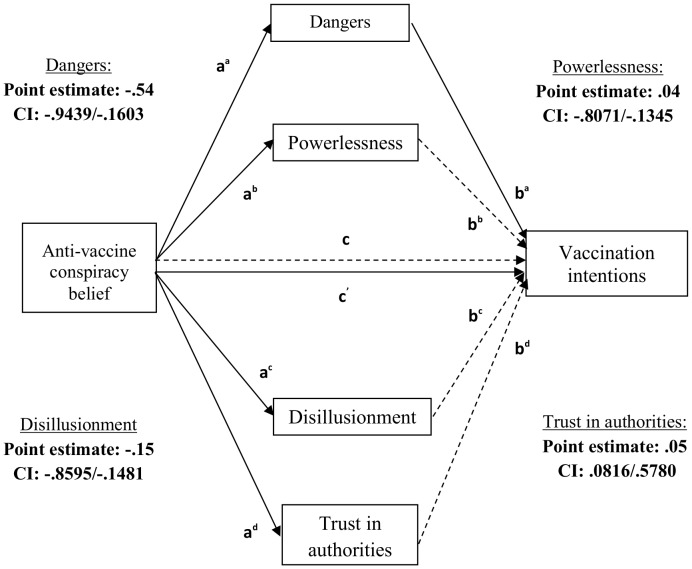
- In Study 1, anti-vaccine conspiracy beliefs significantly negatively predicted vaccination intentions, \(F(1, 87) = 15.97, p < .001, R^2 = .16, \beta = -.63\). Perceived dangers of vaccines, powerlessness, disillusionment, and trust in authorities each significantly mediated this relationship.
- In Study 2, vaccination intentions were significantly lower in the pro-conspiracy condition (\(M = 4.87, SD = 1.74\)) than in the anti-conspiracy condition (\(M = 5.69, SD = 1.31, p = .003\)) and the control condition (\(M = 5.47, SD = 1.50, p = .028\)), overall \(F(2, 185) = 4.81, p = .009, \eta^2 = .05\).
- The manipulation check showed higher endorsement of anti-vaccine conspiracy theories in the pro-conspiracy condition (\(M = 4.11, SD = 1.41\)) than the anti-conspiracy condition (\(M = 2.93, SD = 1.14, p < .001\)) and control condition (\(M = 3.56, SD = 1.21, p = .014\)).
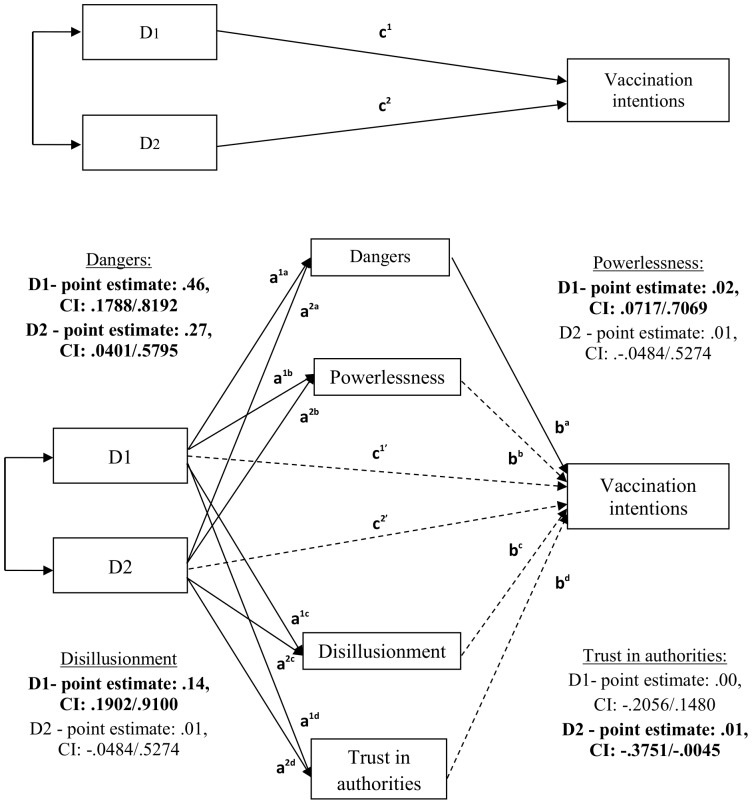
- Perceived vaccine dangers consistently mediated the effects; powerlessness and disillusionment mediated the pro- versus anti-conspiracy difference, and trust in authorities mediated the pro-conspiracy versus control difference.
Methods
- Study 1 used a correlational online questionnaire with 89 British parents (\(80\) women, \(9\) men; \(M\) age \(= 38.06, SD = 9.25\)). Participants completed measures of anti-vaccine conspiracy beliefs, perceived dangers, powerlessness, disillusionment, trust in authorities, and intention to vaccinate a fictitious 8-month-old child against a made-up disease, dysomeria.
- Study 2 recruited 246 U.S. MTurk participants, with a final analyzed sample of 188 after screening exclusions. Participants were randomly assigned to pro-conspiracy, anti-conspiracy, or control information, then completed the same mediator measures and vaccination intention measure.
- Both studies used bootstrapping mediation analyses with 5000 bootstrap samples; Study 2 used ANOVA and indicator-coded mediation to compare the three conditions.
Limitations
- The paper states that effect sizes were small (e.g., \(\eta^2 = .05\) in Study 2), conspiracy endorsement was generally around or below the midpoint except in the pro-conspiracy condition (\(M = 4.11\)), the mediation pattern was less clear in Study 2, and findings relied on self-reported intentions for a fictional child and made-up disease rather than actual vaccination behavior.
- The paper notes that future research should examine larger samples, actual vaccination behavior, additional or isolated mediators, and geographical areas with dangerously low vaccination uptake.
- Evident from the text: Study 1 is correlational and cannot establish causality, and both studies use hypothetical vaccination scenarios, which may limit ecological validity.
Model-written summary. Check it against the paper before relying on it.
Integrity signals
Registry
Cites
Statistics
Figures
Verification
Claims the paper makes
37 Own result · 21 Not checked yet · 20 Own interpretation · 12 Own method
A result the paper reports from its own data — it cites no other source for it, so there is none to check. The quote shows it is in the paper.
In the paper
“Results revealed a significant negative relationship between anti-vaccine conspiracy beliefs and vaccination intentions.”
- Also stated in: § Results and Discussion · plain
“As predicted, regression analyses revealed that anti-vaccine conspiracy beliefs were a significant negative predictor of vaccination intentions, F(1, 87) = 15.97, p<.001, R2 = .16, β = −.63, t = − 3.10, p<. 001.”
- Also stated in: § Results and Discussion · plain
“Participants who endorsed anti-vaccine conspiracy theories to a greater extent indicated less intention to vaccinate.”
§ The Effects of Anti-Vaccine Conspiracy Theories on Vaccination Intentions > Abstract
plaincorrelational- Asserted: passes — The authors put it forward as true.
- Checkable: passes — It can be checked against evidence.
- Load-bearing: passes — The paper’s conclusions depend on it.
- Based: passes — The paper gives a reason why it holds.
- Also stated in: § Results and Discussion · plain
A result the paper reports from its own data — it cites no other source for it, so there is none to check. The quote shows it is in the paper.
In the paper
“As shown in Table 2, anti-vaccine conspiracy beliefs were a significant predictor of perceived dangers of vaccines, and feelings of powerlessness, disillusionment and trust in authorities, F(5, 83) = 120.37, p<.001, R2 = .58; F(5, 83) = 41.70, p<.001, R2 = .32; F(5, 83) = 74.43, p<.001, R2 = .46; F(5, 83) = 23.00, p<.001, R2 = .20, respectively.”
§ The Effects of Anti-Vaccine Conspiracy Theories on Vaccination Intentions > Study 1 > Results and Discussion
plaincorrelational- Asserted: passes — The authors put it forward as true.
- Checkable: passes — It can be checked against evidence.
- Load-bearing: passes — The paper’s conclusions depend on it.
- Based: passes — The paper gives a reason why it holds.
A result the paper reports from its own data — it cites no other source for it, so there is none to check. The quote shows it is in the paper.
In the paper
“Results revealed that participants who had been exposed to material supporting anti-vaccine conspiracy theories showed less intention to vaccinate than those in the anti-conspiracy condition or controls.”
§ The Effects of Anti-Vaccine Conspiracy Theories on Vaccination Intentions > Abstract
plaindirect- Asserted: passes — The authors put it forward as true.
- Checkable: passes — It can be checked against evidence.
- Load-bearing: passes — The paper’s conclusions depend on it.
- Based: passes — The paper gives a reason why it holds.
A result the paper reports from its own data — it cites no other source for it, so there is none to check. The quote shows it is in the paper.
In the paper
“This effect was mediated by the same variables as in Study 1.”
§ The Effects of Anti-Vaccine Conspiracy Theories on Vaccination Intentions > Abstract
plaindirect- Asserted: passes — The authors put it forward as true.
- Checkable: passes — It can be checked against evidence.
- Load-bearing: passes — The paper’s conclusions depend on it.
- Based: passes — The paper gives a reason why it holds.
A result the paper reports from its own data — it cites no other source for it, so there is none to check. The quote shows it is in the paper.
In the paper
“This effect was mediated by the perceived dangers of vaccines, and feelings of powerlessness, disillusionment and mistrust in authorities.”
- Also stated in: § Results and Discussion · hedged
“The multiple mediation analysis of the effect of anti-vaccine conspiracy beliefs on vaccination intentions indicated that perceived dangers of vaccines and feelings of powerlessness, disillusionment and trust in authorities (controlling for each other) were each significant mediators of this effect.”
- Also stated in: § Results and Discussion · plain
“When all factors were taken into account, each was a significant mediator of the relationship between anti-vaccine conspiracy beliefs and vaccination intentions.”
§ The Effects of Anti-Vaccine Conspiracy Theories on Vaccination Intentions > Abstract
plaincorrelational- Asserted: passes — The authors put it forward as true.
- Checkable: passes — It can be checked against evidence.
- Load-bearing: passes — The paper’s conclusions depend on it.
- Based: passes — The paper gives a reason why it holds.
- Also stated in: § Results and Discussion · hedged
A result the paper reports from its own data — it cites no other source for it, so there is none to check. The quote shows it is in the paper.
In the paper
“As shown in Table 2, anti-vaccine conspiracy beliefs were a significant predictor of perceived dangers of vaccines, and feelings of powerlessness, disillusionment and trust in authorities, F(5, 83) = 120.37, p<.001, R2 = .58; F(5, 83) = 41.70, p<.001, R2 = .32; F(5, 83) = 74.43, p<.001, R2 = .46; F(5, 83) = 23.00, p<.001, R2 = .20, respectively.”
§ The Effects of Anti-Vaccine Conspiracy Theories on Vaccination Intentions > Study 1 > Results and Discussion
plaincorrelational- Asserted: passes — The authors put it forward as true.
- Checkable: passes — It can be checked against evidence.
- Load-bearing: passes — The paper’s conclusions depend on it.
- Based: passes — The paper gives a reason why it holds.
A result the paper reports from its own data — it cites no other source for it, so there is none to check. The quote shows it is in the paper.
In the paper
“The results of this analysis therefore support the use of four separate mediators.”
§ The Effects of Anti-Vaccine Conspiracy Theories on Vaccination Intentions > Study 1 > Results and Discussion
plain- Asserted: passes — The authors put it forward as true.
- Checkable: passes — It can be checked against evidence.
- Load-bearing: passes — The paper’s conclusions depend on it.
- Based: passes — The paper gives a reason why it holds.
A result the paper reports from its own data — it cites no other source for it, so there is none to check. The quote shows it is in the paper.
In the paper
“Finally, results revealed no significant difference in trust in authorities between conditions, F(2, 185) = 2.32, p = .10, η2 = .03.”
§ The Effects of Anti-Vaccine Conspiracy Theories on Vaccination Intentions > Study 2 > Results and Discussion
plain- Asserted: passes — The authors put it forward as true.
- Checkable: passes — It can be checked against evidence.
- Load-bearing: unclear — It is unclear whether the paper’s conclusions depend on it.
- Based: passes — The paper gives a reason why it holds.
A result the paper reports from its own data — it cites no other source for it, so there is none to check. The quote shows it is in the paper.
In the paper
“Perceived dangers were higher in the pro-conspiracy condition (M = 4.00, SD = 1.46) than the anti-conspiracy condition (M = 2.97, SD = 1.42, p<.001) and the control condition (M = 2.39, SD = 1.71, p = .021).”
§ The Effects of Anti-Vaccine Conspiracy Theories on Vaccination Intentions > Study 2 > Results and Discussion
plain- Asserted: passes — The authors put it forward as true.
- Checkable: passes — It can be checked against evidence.
- Load-bearing: passes — The paper’s conclusions depend on it.
- Based: passes — The paper gives a reason why it holds.
- Probably not a substantial claim. 18
- It may state two separate claims as one. 9
- The quote only partly states this claim. 2
What the paper did — it cites no source for this, so there is none to check. The quote shows it is in the paper.
In the paper
“There were eight statements (e.g., “Vaccines lead to allergies”, α = .86)”
§ The Effects of Anti-Vaccine Conspiracy Theories on Vaccination Intentions > Study 1 > Methods
plain- Asserted: passes — The authors put it forward as true.
- Checkable: passes — It can be checked against evidence.
- Load-bearing: fails — The paper’s conclusions may not depend on it.
- Based: passes — The paper gives a reason why it holds.
Probably not a substantial claim. The paper’s conclusions may not depend on it.
What the paper did — it cites no source for this, so there is none to check. The quote shows it is in the paper.
In the paper
“Participants were asked to read the statements (e.g., “I feel that my actions will not stop the negative outcomes of immunizations”, α = .82)”
§ The Effects of Anti-Vaccine Conspiracy Theories on Vaccination Intentions > Study 1 > Methods
plain- Asserted: passes — The authors put it forward as true.
- Checkable: passes — It can be checked against evidence.
- Load-bearing: fails — The paper’s conclusions may not depend on it.
- Based: passes — The paper gives a reason why it holds.
Probably not a substantial claim. The paper’s conclusions may not depend on it.
What the paper did — it cites no source for this, so there is none to check. The quote shows it is in the paper.
In the paper
“consisted of four statements (e.g., “I am very disappointed with those who are involved in immunizations (e.g., the government, pharmaceutical companies)”, α = .89)”
§ The Effects of Anti-Vaccine Conspiracy Theories on Vaccination Intentions > Study 1 > Methods
plain- Asserted: passes — The authors put it forward as true.
- Checkable: passes — It can be checked against evidence.
- Load-bearing: fails — The paper’s conclusions may not depend on it.
- Based: passes — The paper gives a reason why it holds.
Probably not a substantial claim. The paper’s conclusions may not depend on it.
In the paper
“and also that feelings of political powerlessness mediate the relationship between exposure to conspiracy theories and voting intentions [22].”
§ The Effects of Anti-Vaccine Conspiracy Theories on Vaccination Intentions > Introduction
What the sources say
- Not checked yetcites [22] Jolley D, Douglas KM (2013) The social consequences of conspiracism: Exposure to conspiracy theories decreases the intention to engage in politics and to reduce one’s carbon footprint. Br J Psychol: in press. doi:10.1111/bjop.12018. source
plaindirect- Asserted: passes — The authors put it forward as true.
- Checkable: passes — It can be checked against evidence.
- Load-bearing: passes — The paper’s conclusions depend on it.
- Based: passes — The paper gives a reason why it holds.
Probably not a substantial claim.
In the paper
“Further, polls demonstrate that more than 20% of respondents endorse the idea that there is a link between childhood vaccines and autism [13].”
§ The Effects of Anti-Vaccine Conspiracy Theories on Vaccination Intentions > Introduction
What the sources say
- Not checked yetcites [13] Public Policy Polling (2013) Democrats and Republicans differ on conspiracy theory beliefs. Available: http://www.publicpolicypolling.com/pdf/2011/PPP_Release_National_ConspiracyTheories_040213.pdf. Accessed: 2013 Nov 27.
boosted- Asserted: passes — The authors put it forward as true.
- Checkable: passes — It can be checked against evidence.
- Load-bearing: fails — The paper’s conclusions may not depend on it.
- Based: passes — The paper gives a reason why it holds.
Probably not a substantial claim. The paper’s conclusions may not depend on it.
In the paper
“Previous research has demonstrated that exposure to conspiracy theories increases political disillusionment [22]”
§ The Effects of Anti-Vaccine Conspiracy Theories on Vaccination Intentions > Introduction
What the sources say
- Not checked yetcites [22] Jolley D, Douglas KM (2013) The social consequences of conspiracism: Exposure to conspiracy theories decreases the intention to engage in politics and to reduce one’s carbon footprint. Br J Psychol: in press. doi:10.1111/bjop.12018. source
boosteddirect- Asserted: passes — The authors put it forward as true.
- Checkable: passes — It can be checked against evidence.
- Load-bearing: passes — The paper’s conclusions depend on it.
- Based: passes — The paper gives a reason why it holds.
Probably not a substantial claim.
None of the sources cited for this claim have been checked yet.
In the paper
“Endorsement of these conspiracy theories amongst African Americans has been found to be associated with negative attitudes towards contraceptive behaviors, which may potentially expose people to the risk of unwanted pregnancies and sexually transmitted illnesses [23], [24], [25].”
§ The Effects of Anti-Vaccine Conspiracy Theories on Vaccination Intentions > Introduction
What the sources say
- Not checked yetcites [23] ST Bird, 2003, Birth control conspiracy beliefs, perceived discrimination, and contraception among African Americans, Journal of Health Psychology source
- Not checked yetcites [24] LM Bogart, 2006, Relationship of African Americans’ socio demographic characteristics to belief in conspiracies about HIV/AIDS and birth control, Journal of the National Medical Association
- Not checked yetcites [25] MA Hoyt, 2012, HIV/AIDS-related institutional mistrust among multiethnic men who have sex with men: Effects on HIV testing and risk behaviors, Health Psychology source
plaincorrelational- Asserted: passes — The authors put it forward as true.
- Checkable: passes — It can be checked against evidence.
- Load-bearing: fails — The paper’s conclusions may not depend on it.
- Based: passes — The paper gives a reason why it holds.
Probably not a substantial claim. The paper’s conclusions may not depend on it.
What the paper did — it cites no source for this, so there is none to check. The quote shows it is in the paper.
In the paper
“The order of measures was counterbalanced.”
§ The Effects of Anti-Vaccine Conspiracy Theories on Vaccination Intentions > Study 1 > Methods
plain- Asserted: passes — The authors put it forward as true.
- Checkable: passes — It can be checked against evidence.
- Load-bearing: fails — The paper’s conclusions may not depend on it.
- Based: passes — The paper gives a reason why it holds.
Probably not a substantial claim. The paper’s conclusions may not depend on it.
What the paper did — it cites no source for this, so there is none to check. The quote shows it is in the paper.
In the paper
“The study was approved by the Psychology Ethics Committee at the University of Kent and all participants provided their written, informed consent.”
§ The Effects of Anti-Vaccine Conspiracy Theories on Vaccination Intentions > Study 1 > Methods
plain- Asserted: passes — The authors put it forward as true.
- Checkable: passes — It can be checked against evidence.
- Load-bearing: fails — The paper’s conclusions may not depend on it.
- Based: passes — The paper gives a reason why it holds.
Probably not a substantial claim. The paper’s conclusions may not depend on it. It may state two separate claims as one.
What the paper did — it cites no source for this, so there is none to check. The quote shows it is in the paper.
In the paper
“There were two trust sources (corporations and government; Spearman-Brown Coefficient = .82)”
§ The Effects of Anti-Vaccine Conspiracy Theories on Vaccination Intentions > Study 1 > Methods
plain- Asserted: passes — The authors put it forward as true.
- Checkable: passes — It can be checked against evidence.
- Load-bearing: fails — The paper’s conclusions may not depend on it.
- Based: passes — The paper gives a reason why it holds.
Probably not a substantial claim. The paper’s conclusions may not depend on it. The quote only partly states this claim.
None of the sources cited for this claim have been checked yet.
In the paper
“Also, exposure to conspiracy theories has been found to have detrimental effects in other domains, such as reducing pro-environmental intentions and willingness to engage in politics [21], [22].”
§ The Effects of Anti-Vaccine Conspiracy Theories on Vaccination Intentions > Introduction
What the sources say
- Not checked yetcites [21] LD Butler, 1995, The psychological impact of viewing the film JFK: Emotions, beliefs and political behavioral intentions, Political Psychology source
- Not checked yetcites [22] Jolley D, Douglas KM (2013) The social consequences of conspiracism: Exposure to conspiracy theories decreases the intention to engage in politics and to reduce one’s carbon footprint. Br J Psychol: in press. doi:10.1111/bjop.12018. source
plaindirect- Asserted: passes — The authors put it forward as true.
- Checkable: passes — It can be checked against evidence.
- Load-bearing: fails — The paper’s conclusions may not depend on it.
- Based: passes — The paper gives a reason why it holds.
Probably not a substantial claim. The paper’s conclusions may not depend on it.
A conclusion the paper draws from its own results — it cites no other source for it, so there is none to check. The quote shows it is in the paper.
In the paper
“In Study 2, feelings of powerlessness and disillusionment mediated the difference between the pro- and anti-conspiracy conditions, and mistrust in authorities mediated the difference between the pro-conspiracy and control conditions.”
§ The Effects of Anti-Vaccine Conspiracy Theories on Vaccination Intentions > General Discussion
plaindirect- Asserted: passes — The authors put it forward as true.
- Checkable: passes — It can be checked against evidence.
- Load-bearing: passes — The paper’s conclusions depend on it.
- Based: passes — The paper gives a reason why it holds.
It may state two separate claims as one.
A conclusion the paper draws from its own results — it cites no other source for it, so there is none to check. The quote shows it is in the paper.
In the paper
“This means that the proportion of variance in vaccine intentions explained by exposure to conspiracy theories was quite modest and there are potentially many other factors that contribute to vaccine intentions.”
§ The Effects of Anti-Vaccine Conspiracy Theories on Vaccination Intentions > General Discussion
hedgedcorrelational- Asserted: passes — The authors put it forward as true.
- Checkable: passes — It can be checked against evidence.
- Load-bearing: passes — The paper’s conclusions depend on it.
- Based: passes — The paper gives a reason why it holds.
It may state two separate claims as one.
What the paper did — it cites no source for this, so there is none to check. The quote shows it is in the paper.
In the paper
“The final sample size used for data analysis was therefore 188 (112 women and 76 men, M age = 36.33, SD = 13.40).”
§ The Effects of Anti-Vaccine Conspiracy Theories on Vaccination Intentions > Study 2 > Methods
plainn = 188- Asserted: passes — The authors put it forward as true.
- Checkable: passes — It can be checked against evidence.
- Load-bearing: fails — The paper’s conclusions may not depend on it.
- Based: passes — The paper gives a reason why it holds.
Probably not a substantial claim. The paper’s conclusions may not depend on it.
A conclusion the paper draws from its own results — it cites no other source for it, so there is none to check. The quote shows it is in the paper.
In the paper
“Further, feelings of powerlessness and disillusionment mediated the difference between the pro- and anti-conspiracy conditions, and mistrust in authorities mediated the difference between the pro-conspiracy and control conditions.”
§ The Effects of Anti-Vaccine Conspiracy Theories on Vaccination Intentions > Study 2 > Results and Discussion
plaindirectn = 188- Asserted: passes — The authors put it forward as true.
- Checkable: passes — It can be checked against evidence.
- Load-bearing: passes — The paper’s conclusions depend on it.
- Based: passes — The paper gives a reason why it holds.
It may state two separate claims as one.
What the paper did — it cites no source for this, so there is none to check. The quote shows it is in the paper.
In the paper
“There were 60 participants in the pro-conspiracy condition, 62 in the anti-conspiracy condition, and 66 in the control condition.”
§ The Effects of Anti-Vaccine Conspiracy Theories on Vaccination Intentions > Study 2 > Methods
plainn = 60- Asserted: passes — The authors put it forward as true.
- Checkable: passes — It can be checked against evidence.
- Load-bearing: fails — The paper’s conclusions may not depend on it.
- Based: passes — The paper gives a reason why it holds.
Probably not a substantial claim. The paper’s conclusions may not depend on it. It may state two separate claims as one.
None of the sources cited for this claim have been checked yet.
In the paper
“As is well known, intentions do not always translate into behaviors [47], [48], [49].”
§ The Effects of Anti-Vaccine Conspiracy Theories on Vaccination Intentions > General Discussion
What the sources say
- Not checked yetcites [47] RT LaPiere, 1934, Attitudes vs. actions, Social Forces source
- Not checked yetcites [48] LS Linn, 1965, Verbal attitudes and overt behavior: A study of racial discrimination, Social Forces source
- Not checked yetcites [49] Sheeran P (2002) Intention-behavior relations: A conceptual and empirical review. In: Stroebe W, Hewstone M, editors. European Review of Social Psychology. Chichester, UK: Wiley. Vol. 12, 1–36. source
boosted- Asserted: passes — The authors put it forward as true.
- Checkable: passes — It can be checked against evidence.
- Load-bearing: passes — The paper’s conclusions depend on it.
- Based: passes — The paper gives a reason why it holds.
Probably not a substantial claim.
In the paper
“Similarly, different strategies for successful intervention may apply for people who hold strong anti-vaccine conspiracy beliefs than those who do not hold strong beliefs [44].”
§ The Effects of Anti-Vaccine Conspiracy Theories on Vaccination Intentions > General Discussion
What the sources say
- Not checked yetcites [44] CR Sunstein, 2009, Conspiracy theories: Causes and cures, J Polit Philos source
hedgedconditional- Asserted: passes — The authors put it forward as true.
- Checkable: fails — It may be too vague to check against evidence.
- Load-bearing: fails — The paper’s conclusions may not depend on it.
- Based: passes — The paper gives a reason why it holds.
Probably not a substantial claim. It may be too vague to check against evidence. The paper’s conclusions may not depend on it.
None of the sources cited for this claim have been checked yet.
In the paper
“Psychologists are learning more about the traits and characteristics associated with beliefs in conspiracy theories more generally, such as mistrust, anomie, political cynicism and Machiavellianism [8], [20], [31], [50]”
§ The Effects of Anti-Vaccine Conspiracy Theories on Vaccination Intentions > General Discussion
What the sources say
- Not checked yetcites [8] T Goertzel, 1994, Belief in conspiracy theories, Polit Psychol source
- Not checked yetcites [20] KM Douglas, 2008, The hidden impact of conspiracy theories: Perceived and actual influence of theories surrounding the death of Princess Diana, Br J Soc Psychol source
- Not checked yetcites [31] M Abalakina-Paap, 1999, Beliefs in conspiracies, Political Psychology source
plaincorrelational- Asserted: passes — The authors put it forward as true.
- Checkable: passes — It can be checked against evidence.
- Load-bearing: fails — The paper’s conclusions may not depend on it.
- Based: passes — The paper gives a reason why it holds.
Probably not a substantial claim. The paper’s conclusions may not depend on it.
A conclusion the paper draws from its own results — it cites no other source for it, so there is none to check. The quote shows it is in the paper.
In the paper
“Specifically, they appear to reduce vaccination intentions by inducing undue concern about the dangers of vaccines, and increasing powerlessness, disillusionment, and mistrust.”
§ The Effects of Anti-Vaccine Conspiracy Theories on Vaccination Intentions > General Discussion
hedgeddirect- Asserted: passes — The authors put it forward as true.
- Checkable: passes — It can be checked against evidence.
- Load-bearing: passes — The paper’s conclusions depend on it.
- Based: passes — The paper gives a reason why it holds.
It may state two separate claims as one.
A conclusion the paper draws from its own results — it cites no other source for it, so there is none to check. The quote shows it is in the paper.
In the paper
“Therefore, the participants were not strong endorsers of anti-vaccine conspiracy theories, meaning that different patterns of findings may emerge for those who do strongly endorse conspiracy theories.”
§ The Effects of Anti-Vaccine Conspiracy Theories on Vaccination Intentions > General Discussion
hedged- Asserted: passes — The authors put it forward as true.
- Checkable: passes — It can be checked against evidence.
- Load-bearing: unclear — It is unclear whether the paper’s conclusions depend on it.
- Based: passes — The paper gives a reason why it holds.
It may state two separate claims as one.
A conclusion the paper draws from its own results — it cites no other source for it, so there is none to check. The quote shows it is in the paper.
In the paper
“Therefore, overall, anti-vaccine conspiracy theories appear to introduce undue suspicion about vaccine safety, and increase feelings of powerlessness and disillusionment, whilst decreasing trust in authorities, which in turn introduce reluctance to vaccinate.”
§ The Effects of Anti-Vaccine Conspiracy Theories on Vaccination Intentions > General Discussion
hedgeddirect- Asserted: passes — The authors put it forward as true.
- Checkable: passes — It can be checked against evidence.
- Load-bearing: passes — The paper’s conclusions depend on it.
- Based: passes — The paper gives a reason why it holds.
It may state two separate claims as one.
What the paper did — it cites no source for this, so there is none to check. The quote shows it is in the paper.
In the paper
“Participants were randomly assigned to one of the three conditions.”
§ The Effects of Anti-Vaccine Conspiracy Theories on Vaccination Intentions > Study 2 > Methods
plain- Asserted: passes — The authors put it forward as true.
- Checkable: passes — It can be checked against evidence.
- Load-bearing: passes — The paper’s conclusions depend on it.
- Based: passes — The paper gives a reason why it holds.
Probably not a substantial claim.
What the paper did — it cites no source for this, so there is none to check. The quote shows it is in the paper.
In the paper
“The study was approved by the Psychology Ethics Committee at the University of Kent and all participants provided their written, informed consent.”
§ The Effects of Anti-Vaccine Conspiracy Theories on Vaccination Intentions > Study 1 > Methods
plain- Asserted: fails — The authors may not put it forward as true.
- Checkable: passes — It can be checked against evidence.
- Load-bearing: fails — The paper’s conclusions may not depend on it.
- Based: fails — The paper may give no reason why it holds.
Probably not a substantial claim. The authors may not put it forward as true. The paper’s conclusions may not depend on it. The paper may give no reason why it holds. It may state two separate claims as one. The quote only partly states this claim.
The paper relies on this without support.
The measured mediators (perceived vaccine dangers, powerlessness, disillusionment, and trust in authorities) are causally prior to and influence vaccination intentions, as required for the mediation analysis.
“Each of the candidate mediators was then examined in a test of mediation in order to explain the effect of the conspiracy conditions (pro-conspiracy versus anti-conspiracy, versus control) on vaccination intentions.”
Statistics recomputed
Every reported test result, recomputed from its test statistic and degrees of freedom. A result shows as not adding up only once an independent check has confirmed it.
- Consistentχ²(136) = 4544.44reported p < .001 · recomputed p < .001
“X 2 (136) = 4544.44, p < .001”
- ConsistentF(1, 87) = 15.97reported p < .001 · recomputed p < .001
“F(1, 87) = 15.97, p < .001”
- ConsistentF(5, 83) = 120.37reported p < .001 · recomputed p < .001
“F(5, 83) = 120.37, p < .001”
- ConsistentF(5, 83) = 41.7reported p < .001 · recomputed p < .001
“F(5, 83) = 41.70, p < .001”
- ConsistentF(5, 83) = 74.43reported p < .001 · recomputed p < .001
“F(5, 83) = 74.43, p < .001”
- ConsistentF(5, 83) = 23reported p < .001 · recomputed p < .001
“F(5, 83) = 23.00, p < .001”
- ConsistentF(2, 185) = 4.81reported p = .009 · recomputed p = .009
“F(2, 185) = 4.81, p = .009”
- ConsistentF(2, 185) = 7.61reported p = .001 · recomputed p < .001
“F(2, 185) = 7.61, p = .001”
- ConsistentF(2, 185) = 3.44reported p = .034 · recomputed p = .034
“F(2, 185) = 3.44, p = .034”
- ConsistentF(2, 185) = 7.46reported p = .001 · recomputed p < .001
“F(2, 185) = 7.46, p = .001”
- ConsistentF(2, 185) = 2.32reported p = .1 · recomputed p = .101
“F(2, 185) = 2.32, p = .10”
Self-check
Percentages, sums and reported differences re-computed from the paper’s own numbers.
Each contradiction between two passages listed here was confirmed by an independent check.
Rated minor: it would not touch a result — a value no result rests on, a p-value that stays on the same side of the significance level, or a conflict that is clerical, resolved elsewhere in the paper, or outside its own findings.
In the paper
§ The Effects of Anti-Vaccine Conspiracy Theories on Vaccination Intentions > Study 1 > Results and Discussion
“| (2) Immunisation intention | 5.63 (1.42) | −.40*** | – | −.49*** | .29** | −.36*** | .20¥ |”
§ The Effects of Anti-Vaccine Conspiracy Theories on Vaccination Intentions > Study 1 > Results and Discussion
“| (3) Dangers | 2.97 (1.37) | .76*** | −.48*** | – | .58*** | .60*** | −.48*** |”
Rated minor: it would not touch a result — a value no result rests on, a p-value that stays on the same side of the significance level, or a conflict that is clerical, resolved elsewhere in the paper, or outside its own findings.
In the paper
“F(1, 87) = 15.97, p<.001, R2 = .16, β = −.63, t = − 3.10, p<. 001.”
§ The Effects of Anti-Vaccine Conspiracy Theories on Vaccination Intentions > Study 1 > Results and Discussion
Reported 15.97 · recomputed 9.61
Rated minor: it would not touch a result — a value no result rests on, a p-value that stays on the same side of the significance level, or a conflict that is clerical, resolved elsewhere in the paper, or outside its own findings.
In the paper
§ The Effects of Anti-Vaccine Conspiracy Theories on Vaccination Intentions > Study 1 > Results and Discussion
“| (3) Dangers | 2.97 (1.37) | .76*** | −.48*** | – | .58*** | .60*** | −.48*** |”
§ The Effects of Anti-Vaccine Conspiracy Theories on Vaccination Intentions > Study 1 > Results and Discussion
“| (5) Disillusionment | 2.45 (1.40) | .68*** | −.36*** | .59*** | .59*** | – | −.41*** |”
Rated minor: it would not touch a result — a value no result rests on, a p-value that stays on the same side of the significance level, or a conflict that is clerical, resolved elsewhere in the paper, or outside its own findings.
In the paper
§ The Effects of Anti-Vaccine Conspiracy Theories on Vaccination Intentions > Study 1 > Results and Discussion
“β = −.63”
§ The Effects of Anti-Vaccine Conspiracy Theories on Vaccination Intentions > Study 1 > Results and Discussion
“| (1) Anti-vaccine conspiracy belief | 2.00 (.89) | – | −.40*** | .76*** | .57*** | .68*** | −.46*** |”
Rated minor: it would not touch a result — a value no result rests on, a p-value that stays on the same side of the significance level, or a conflict that is clerical, resolved elsewhere in the paper, or outside its own findings.
In the paper
§ The Effects of Anti-Vaccine Conspiracy Theories on Vaccination Intentions > Study 1 > Results and Discussion
“F(5, 83) = 120.37, p<.001, R2 = .58; F(5, 83) = 41.70, p<.001, R2 = .32; F(5, 83) = 74.43, p<.001, R2 = .46; F(5, 83) = 23.00, p<.001, R2 = .20, respectively.”
§ The Effects of Anti-Vaccine Conspiracy Theories on Vaccination Intentions > Study 1 > Results and Discussion
“Table: Table 2 Four separate regressions examining anti-conspiracy belief as predictor, and four mediator variables as criterions.”
Citations
Cites
Preacher, K. J., & Hayes, A. F. (2008) · Behavior Research Methods · doi:10.3758/brm.40.3.879 · Cited by 34,117 · cited 1×
“By repeating this process thousands of times, it builds an empirical approximation of the sampling distribution that constructs the confidence intervals [39].”
Amazon's Mechanical Turk: A New Source of Inexpensive, Yet High-Quality, Data?
Buhrmester, M., Kwang, T., & Gosling, S. D. (2011) · Perspectives on Psychological Science · doi:10.1177/1745691610393980 · Cited by 9,996
Beyond Baron and Kenny: Statistical Mediation Analysis in the New Millennium
Hayes, A. F. (2009) · Communication Monographs · doi:10.1080/03637750903310360 · Cited by 9,757 · cited 5×
“As argued by Hayes [40], an indirect effect is estimated as being significant if the confidence intervals do not contain a zero, as opposed to significance in the individual paths.”
InfluentialNew Environmental Theories: Toward a Coherent Theory of Environmentally Significant Behavior
Stern, P. C. (2000) · Journal of Social Issues · doi:10.1111/0022-4537.00175 · Cited by 8,682
A Second Generation Little Jiffy
Kaiser, H. F. (1970) · Psychometrika · doi:10.1007/bf02291817 · Cited by 4,855
Running experiments on Amazon Mechanical Turk
Paolacci, G., Chandler, J., & Ipeirotis, P. G. (2010) · Judgment and Decision Making · doi:10.1017/s1930297500002205 · Cited by 3,767
Intention—Behavior Relations: A Conceptual and Empirical Review
Sheeran, P. (2002) · European Review of Social Psychology · doi:10.1080/14792772143000003 · Cited by 3,688 · cited 1×
“As is well known, intentions do not always translate into behaviors [47], [48], [49].”
Statistical mediation analysis with a multicategorical independent variable
Hayes, A. F., & Preacher, K. J. (2014) · British Journal of Mathematical and Statistical Psychology · doi:10.1111/bmsp.12028 · Cited by 3,403 · cited 3×
“This was carried out using Hayes and Preacher’s [38] bootstrapping method for indirect effects, as in Study 1.”
Misinformation and Its Correction: Continued Influence and Successful Debiasing
Lewandowsky, S., Ecker, U. K. H., Seifert, C. M., Schwarz, N., & Cook, J. (2012) · Psychological Science in the Public Interest · doi:10.1177/1529100612451018 · Cited by 2,920
A Note on the Multiplying Factors for Various χ2 Approximations
Bartlett, M. S. (1954) · Journal of the Royal Statistical Society Series B (Statistical Methodology) · doi:10.1111/j.2517-6161.1954.tb00174.x · Cited by 2,168
Cited by
Sorted by citations
Items 501–600 of 1,000
Lamot, M., & Kirbiš, A. (2024) · European Journal of Public Health · doi:10.1093/eurpub/ckae022 · Cited by 16
Sit, R. W. S., Lai, H. H. K., Dong, D., Wang, B., Wong, M. C. S., Chung, R. Y., & Wong, S. Y. S. (2022) · Journal of Geriatric Psychiatry and Neurology · doi:10.1177/08919887221078563 · Cited by 19
“For example, Jolley et al has found that the feelings of powerlessness mediated the relationship between conspiracy beliefs and lower vaccination intentions, which is likely to negatively influence people’s responses to the pandemic.(22) In Chinese societies, social engagement of older people involves lifelong commitm…”
BackgroundAtkinson, M., & DeWitt, D. (2018) · Oxford University Press eBooks · doi:10.1093/oso/9780190844073.003.0008 · Cited by 17
Wabnegger, A., Gremsl, A., & Schienle, A. (2021) · Applied Cognitive Psychology · doi:10.1002/acp.3860 · Cited by 15
“Another study found that belief in anti-vaccination conspiracy theories correlated negatively with the willingness to receive vaccinations (Jolley & Douglas, 2014).”
BackgroundThe Social Effects of COVID-19 Pandemics
ATAMAN, K. Y., Bozkurt, V., Göka, E., ILHAN, M. N., Yıldırım, N., Çiftçi, E., Liman, U., & Vuran, B. (2021) · Turkish Bulletin of Hygiene and Experimental Biology · doi:10.5505/turkhijyen.2021.83357 · Cited by 15
Fountoulakis, K. Ν., Apostolidou, M. K., Atsiova, M. B., Filippidou, A. K., Florou, A., Gousiou, D. S., Katsara, A. R., Mantzari, S. N., Padouva-Markoulaki, M., Papatriantafyllou, E. I., et al. (2021) · Acta Neuropsychiatrica · doi:10.1017/neu.2021.38 · Cited by 15
Salazar-Fernández, C., Baeza-Rivera, M. J., Manríquez-Robles, D., Salinas-Oñate, N., & Sallam, M. (2023) · Vaccines · doi:10.3390/vaccines11071150 · Cited by 19
“Thus, conspiracy beliefs are indirectly associated with vaccine acceptance, which can have a significant impact on public health by contributing to vaccine hesitancy and compromising safe population immunity [37,90,91].”
BackgroundEvil perceptions mediate the association between trait anger and generic conspiracy beliefs
Harmon‐Jones, E., & Szymaniak, K. (2023) · Personality and Individual Differences · doi:10.1016/j.paid.2023.112303 · Cited by 13
Fournier, V., & Varet, F. (2023) · British Journal of Health Psychology · doi:10.1111/bjhp.12702 · Cited by 17
Saleem, S. M., & Jan, S. S. (2024) · Frontiers in Public Health · doi:10.3389/fpubh.2023.1324330 · Cited by 15
Cordonier, L., & Cafiero, F. (2024) · Social Science Quarterly · doi:10.1111/ssqu.13374 · Cited by 13
McKenzie-McHarg, A. (2018) · Oxford University Press eBooks · doi:10.1093/oso/9780190844073.003.0004 · Cited by 18
Griffin, M., Jaiswal, J., & Stults, C. B. (2021) · Archives of Sexual Behavior · doi:10.1007/s10508-020-01900-x · Cited by 15
“…in light of widespread vaccine mistrust, hesitancy (Kestenbaum & Feemster, 2015) and refusal (Dredze, Broniatowski, Smith, & Hilyard, 2016), and more broadly, the anti-vaccination movement that has gained significant momentum in the U.S. (Dube, Vivion, & MacDonald, 2015; Jolley & Douglas, 2014).”
BackgroundIllusion of Truth: Analysing and Classifying COVID-19 Fake News in Brazilian Portuguese Language
Endo, P. T., Santos, G. L., Xavier, M. E. D. L., Campos, G. R. N., de Lima, L. C., da Silva, I. M. D., Egli, A., & Lynn, T. (2022) · Big Data and Cognitive Computing · doi:10.3390/bdcc6020036 · Cited by 16
“Anti-vaccination beliefs are further exacerbated by a general suspicion by members of the public in scientific knowledge and that researchers falsify experiment results regarding the harmful side effects of vaccines in order to present effectiveness [97].”
BackgroundCaycho‐Rodríguez, T., Valencia, P. D., Ventura‐León, J., Vilca, L. W., Carbajal‐León, C., Reyes-Bossio, M. A., White, M., Rojas-Jara, C., Polanco-Carrasco, R., Gallegos, M., et al. (2022) · Frontiers in Public Health · doi:10.3389/fpubh.2022.908720 · Cited by 17
“Thus, the perceived dangers associated with conspiracy beliefs about vaccines may outweigh the perceived benefits and reduce the intention to be vaccinated (31).”
BackgroundCountering vaccine hesitancy through medical expert endorsement
Ronzani, P., Panizza, F., Martini, C. M. C., Savadori, L., & Motterlini, M. (2022) · Vaccine · doi:10.1016/j.vaccine.2022.06.031 · Cited by 28
“Opposition to vaccines and beliefs in conspiracy theories [3,4], free-riding [5], misperception of risk [6,7], and safety concerns, can all affect people’s intent to receive a vaccine.”
BackgroundDow, B. J., Wang, C. S., & Whitson, J. (2022) · Journal of Experimental Social Psychology · doi:10.1016/j.jesp.2022.104403 · Cited by 14
Deprived, Radical, Alternatively Informed
Ziegele, M., Resing, M., Frehmann, K., Jackob, N., Jakobs, I., Quiring, O., Schemer, C., Schultz, T., & Viehmann, C. (2022) · European Journal of Health Communication · doi:10.47368/ejhc.2022.205 · Cited by 15
“Through a survey and experiment with British participants, Douglas and Jolley (2014) demonstrated that belief in anti-vaccine CT is related to lower intentions to have one’s child vaccinated.”
BackgroundAllen, J. D., Fu, Q. J., Nguyen, K. H., Rose, R., Silva, D., & Corlin, L. (2023) · Journal of Health Communication · doi:10.1080/10810730.2023.2172107 · Cited by 15
“…theories were less likely to say they would vaccinate their child(ren), a finding that has been consistently demonstrated in the context of vaccines for other (non-COVID-19) preventable illnesses (Callaghan, Motta, Sylvester, Lunz Trujillo, & Blackburn, 2019; Jolley, Douglas, & Tripp, 2014).”
Martire, K. A., Growns, B., Bali, A. S., Montgomery-Farrer, B., Summersby, S., & Younan, M. (2020) · Cognitive Research Principles and Implications · doi:10.1186/s41235-020-00264-z · Cited by 17
Media Marginalization of Racial Minorities
Orr, M., & Husting, G. (2018) · Oxford University Press eBooks · doi:10.1093/oso/9780190844073.003.0005 · Cited by 16
Salalι, G. D., & Uysal, M. S. (2021) · medRxiv · doi:10.1101/2021.07.09.21260228 · Cited by 15
Political context of the European vaccine debate on Twitter
Paoletti, G., Dall’Amico, L., Kalimeri, K., Lenti, J., Mejova, Y., Paolotti, D., Starnini, M., & Tizzani, M. (2024) · Scientific Reports · doi:10.1038/s41598-024-54863-7 · Cited by 14
On the Democratic Problem of Conspiracy Politics
Moore, A. (2018) · Oxford University Press eBooks · doi:10.1093/oso/9780190844073.003.0007 · Cited by 14
COVID-19: Belief in Conspiracy Theories and the Need for Quarantine
Егорова, М., Parshikova, O. V., Chertkova, Y. D., Staroverov, V. M., & Mitina, O. V. (2020) · Psychology in Russia State of Art · doi:10.11621/pir.2020.0401 · Cited by 14
Vandeberg, L., Meppelink, C. S., Sanders, J., & Fransen, M. L. (2022) · Frontiers in Psychology · doi:10.3389/fpsyg.2022.837346 · Cited by 15
Anxiety and covid-19 compliance behaviors in the UK: The moderating role of conspiratorial thinking
Copping, L. T. (2022) · Personality and Individual Differences · doi:10.1016/j.paid.2022.111604 · Cited by 15
Pluviano, S., Watt, C. A., Pompéia, S., Ekuni, R., & Sala, S. D. (2022) · Cognitive Processing · doi:10.1007/s10339-022-01093-2 · Cited by 17
“Parents who believe in anti-vaccine conspiracy theories are less likely to vaccinate their child (Jolley and Douglas 2014).”
BackgroundThinking false and slow: Implausible beliefs and the Cognitive Reflection Test
Martire, K. A., Robson, S. G., Drew, M., Nicholls, K., & Faasse, K. (2023) · Psychonomic Bulletin & Review · doi:10.3758/s13423-023-02321-2 · Cited by 18
“…to rate their level of belief on a scale from 0 (not at all) to 100 (definitely) on the following three highly implausible items: (1) Vaccines are harmful and this fact is covered up (Jolley & Douglas, 2014), (2) Global warming is a hoax (van der Linden, 2015), or (3) The earth is flat .”
BackgroundDealing with Conspiracy Theory Attributions
Martin, B. G. (2020) · Social Epistemology · doi:10.1080/02691728.2020.1748744 · Cited by 14
“Furthermore, belief in such conspiracies might be linked to vaccine hesitancy (Jolley and Douglas 2014; Kitta 2012).”
BackgroundPaludneviciene, R., Knight, T., Firl, G., Luttrell, K., Takayama, K., & Kushalnagar, P. (2021) · Journal of Medical Internet Research · doi:10.2196/21103 · Cited by 14
To resist or not to resist? Investigating the normative features of resistance to persuasion
Bonetto, É., Varet, F., & Adam‐Troian, J. (2019) · Journal of Theoretical Social Psychology · doi:10.1002/jts5.44 · Cited by 14
Klein, C., Clutton, P., & Dunn, A. G. (2018) · doi:10.31234/osf.io/8vesf · Cited by 14
Predictors of COVID-19 Vaccine Intention: Evidence from Chile, Mexico, and Colombia
Salazar-Fernández, C., Baeza-Rivera, M. J., Bustamante, M. V., Bautista, J. A. P., Navarro, R. M., & Pino, M. (2022) · Vaccines · doi:10.3390/vaccines10071129 · Cited by 15
Kraemer, T., Weiger, W. H., Trang, S. T.-N., & Trenz, M. (2022) · Journal of Product Innovation Management · doi:10.1111/jpim.12646 · Cited by 16
Du, Z., Xiao, Y., & Xu, J. (2022) · Frontiers in Psychology · doi:10.3389/fpsyg.2022.955541 · Cited by 13
“Extreme attitudes are associated with conspiracy theory beliefs when it comes to issues such as vaccination (Jolley and Douglas, 2014a) and climate change (Jolley and Douglas, 2014b).”
BackgroundBrush, G. J., Guo, X., Hunting, A., & Frethey‐Bentham, C. (2023) · Journal of Macromarketing · doi:10.1177/02761467231182300 · Cited by 18
“Skepticism has been found to have negative impacts on COVID stay-at-home orders (Brzezinski et al. 2020), and vaccine uptake (Jolley and Douglas 2014).”
BackgroundTian, Y. T., Liu, S., & Zhang, D. (2023) · Digital Health · doi:10.1177/20552076231219116 · Cited by 14
Emergence of simple and complex contagion dynamics from weighted belief networks
Aiyappa, R., Flammini, A., & Ahn, Y. (2024) · Science Advances · doi:10.1126/sciadv.adh4439 · Cited by 13
“It is at the heart of numerous social challenges that our society is facing ( 6 ), including the prevalence of false information ( 7 ), political polarization ( 8 , 9 ), climate change denial ( 10 ), and vaccine hesi-tancy ( 11 , 12 ).”
Wabnegger, A., Potthoff, J., & Schienle, A. (2024) · Applied Cognitive Psychology · doi:10.1002/acp.4198 · Cited by 13
The race Against Time to Save Human Lives During the COVID-19 With Vaccines: Global Evidence
Nguyen, P. V., Huynh, T. L. D., Ngo, V. M., & Nguyen, H. H. (2022) · Evaluation Review · doi:10.1177/0193841x221085352 · Cited by 13
“Furthermore, antivaccine conspiracy beliefs, which have been prominent since the beginning of the COVID-19 epidemic, are substantially linked to lower vaccination intentions (Jolley & Douglas, 2014).”
BackgroundCaroti, D., Adam‐Troian, J., & Arciszewski, T. (2022) · Applied Cognitive Psychology · doi:10.1002/acp.3969 · Cited by 14
Echoes through Time: Evolution of the Italian COVID-19 Vaccination Debate
Crupi, G., Mejova, Y., Tizzani, M., Paolotti, D., & Panisson, A. (2022) · Proceedings of the International AAAI Conference on Web and Social Media · doi:10.1609/icwsm.v16i1.19276 · Cited by 14
Mediation analysis of conspiratorial thinking and anti-expert sentiments on vaccine willingness.
Blackburn, A. M., Han, H., Gelpí, R., Stöckli, S., Jeftić, A., Ch’ng, B., Koszałkowska, K., Lacko, D., Milfont, T. L., Lee, Y., et al. (2023) · Health Psychology · doi:10.1037/hea0001268 · Cited by 13
Comparison of Nutrient Digestibility Between Adult and Aged Horses
Elzinga, S. E., Nielsen, B. D., Schott, H. C., Rapson, J., Robison, C. I., McCutcheon, J., Harris, P. A., & Geor, R. J. (2014) · Journal of Equine Veterinary Science · doi:10.1016/j.jevs.2014.06.021 · Cited by 15
“I Know Things They Don’t Know!” The Role of Need for Uniqueness in Belief in Conspiracy TheoriesPreprint
Lantian, A., Dominique Muller, B., Nurra, C., & Douglas, K. M. (2017) · doi:10.31234/osf.io/zm9a6 · Cited by 13
Self-citationUnderstanding the rise of vaccine refusal: perceptions, fears, and influences
Uğrak, U., Aksungur, A., Akyüz, S., Şen, H., & SEYHAN, F. (2025) · BMC Public Health · doi:10.1186/s12889-025-23754-5 · Cited by 12
“Jolley and Douglas [30] conducted two experimental studies in the United Kingdom (UK), showing that exposure to anti-vaccine conspiracy theories significantly reduced vaccination intention.”
Kazun, A., & Porshnev, A. (2021) · Monitoring obŝestvennogo mneniâ: èkonomičeskie i socialʹnye peremeny · doi:10.14515/monitoring.2021.6.1889 · Cited by 12
Gkinopoulos, T., Pagliaro, S., Pacilli, M. G., Bilewicz, M., Teresi, M., & Ballone, C. (2023) · European Journal of Social Psychology · doi:10.1002/ejsp.3002 · Cited by 14
Psychological Factors of Vaccination Intent among Healthcare Providers, Parents, and Laypeople
Damnjanović, K., Ilić, S., Kušić, M., Lazić, M., & Popovic, D. (2023) · Vaccines · doi:10.3390/vaccines11121816 · Cited by 12
“Our findings provide insights into the differences between the social roles of HPs, laypeople, and parents regarding immunization relative to factors’ roles (promotive, protective, risk, and vulnerability factors).”
BackgroundResultInfluentialZhang, B., Chen, L., & Moe, A. (2024) · Journal of Health Communication · doi:10.1080/10810730.2024.2385638 · Cited by 12
“Believing in such misinformation can hinder individuals from adopting proper health practices such as intention to get vaccinated (Jolley et al., 2014; Loomba et al., 2021).”
Combler le fossé. L’avenir des recherches sur les théories du complot
Bütter, M., Knight, P., & Albert, N. G. (2016) · Diogène · doi:10.3917/dio.249.0021 · Cited by 12
Vaccine hesitancy and religiosity in a sample of university students in Venezuela
Andrade, G. E. (2021) · Human Vaccines & Immunotherapeutics · doi:10.1080/21645515.2021.1981737 · Cited by 12
Lamberty, P. (2022) · Bundesgesundheitsblatt - Gesundheitsforschung - Gesundheitsschutz · doi:10.1007/s00103-022-03524-z · Cited by 12
Can vaccination intentions against COVID-19 be nudged?
Kantorowicz‐Reznichenko, E., Kantorowicz, J., & Wells, L. (2022) · Behavioural Public Policy · doi:10.1017/bpp.2022.20 · Cited by 12
“It may also be that these insights can help us in combatting misinformation and conspiracy theories (Jolley & Douglas, 2014).”
Caycho‐Rodríguez, T., Valencia, P. D., Vilca, L. W., Carbajal‐León, C., Vivanco-Vidal, A., Saroli-Araníbar, D., Reyes-Bossio, M. A., White, M., Rojas-Jara, C., Polanco-Carrasco, R., et al. (2022) · Trends in Psychology · doi:10.1007/s43076-022-00170-x · Cited by 14
“Previous studies have shown that these types of beliefs are a barrier to engaging in health protective behaviors, including vaccination (Eicher et al., 2014; Jolley & Douglas, 2014; Oliver & Wood, 2014).”
Background(Des)infodemia: lecciones de la crisis de la covid-19
Quian, A. (2023) · Revista de Ciencias de la Comunicación e Información · doi:10.35742/rcci.2023.28.e274 · Cited by 12
Küçükaydın, M. A., Seher, E. S. E. N., & Gürbüzer, S. (2023) · Applied Cognitive Psychology · doi:10.1002/acp.4120 · Cited by 12
Human papillomavirus (HPV) and influenza vaccine behavior among Muslim women in the United States
Hearld, K. R., & Henna Budhwani, P. (2019) · Health Care For Women International · doi:10.1080/07399332.2019.1623797 · Cited by 12
“Without question, vaccination is one of the most cost effective and lifesaving public health interventions globally; (Jolley & Douglas, 2014; Poland & Jacobson, 2001) nonetheless, vaccination rates vary significantly across nations and within minority groups particularly in the United States…”
BackgroundMethodInfluentialJiménez, Á. V., Mesoudi, A., & Tehrani, J. J. (2020) · PLoS ONE · doi:10.1371/journal.pone.0228898 · Cited by 12
“This spread of anti-vaccination messages affects people’s decisions regarding whether to vaccinate or not [15, 16].”
BackgroundManaging the COVID-19 pandemic: predictors of trust in institutions in Romania
Bârgăoanu, A., Corbu, N., Buturoiu, R., & Durach, F. (2021) · Kybernetes · doi:10.1108/k-12-2020-0913 · Cited by 10
Glenski, M., Ayton, E., Mendoza, J., & Volkova, S. (2019) · arXiv (Cornell University) · doi:10.48550/arxiv.1909.05838 · Cited by 15
Zwar, L., König, H., & Hajek, A. (2022) · Quality of Life Research · doi:10.1007/s11136-022-03177-0 · Cited by 10
“For example, more critical health behaviors, including lower compliance with vaccination (in general) and lower likeliness to get tested during the COVID-19 pandemic [39, 77, 78], could be prevented.”
BackgroundConspiracy Beliefs and Consumption: The Role of Scientific Literacy
Allred, N., & Bolton, L. E. (2024) · Journal of Consumer Research · doi:10.1093/jcr/ucae024 · Cited by 11
Schrader, T., Jolley, D., Jolley, R. P., & Krahenbuhl, S. (2024) · Group Processes & Intergroup Relations · doi:10.1177/13684302241247985 · Cited by 8
“Our minimum preregistered target sample size was 140 participants, determined by a power analysis with a power set at 0.8 and alpha of .05, using a medium effect size derived from previous research (e.g., Jolley & Douglas, 2014a, 2014b) and overrecruiting 10% anticipating participant dropouts.”
InfluentialSelf-citationEngaging with Conspiracy Believers
Douglas, K. M., Sutton, R. M., Biddlestone, M., Green, R., & Toribio‐Flórez, D. (2024) · Review of Philosophy and Psychology · doi:10.1007/s13164-024-00741-0 · Cited by 14
Self-citationOliver, M. A. (2020) · Journal of Business Ethics · doi:10.1007/s10551-020-04612-3 · Cited by 16
Varshney, D., & Vishwakarma, D. K. (2022) · Data & Knowledge Engineering · doi:10.1016/j.datak.2022.102103 · Cited by 11
Marchlewska, M., Szczepańska, D., Karakula, A., Molenda, Z., Rogoza, M., & Maison, D. A. (2022) · PLoS ONE · doi:10.1371/journal.pone.0272737 · Cited by 11
Validation of the Spanish Version of the Generic Conspiracist Beliefs Scale
Fasce, A., Avendaño, D., Dagnall, N., Denovan, A., & Escolà‐Gascón, Á. (2022) · The Spanish Journal of Psychology · doi:10.1017/sjp.2022.21 · Cited by 11
“Conspiracism can also express as science denial and manifest as anti-scientific forms of populism, which focus on issues such as climate change, vaccination, AIDS, and genetically modified organisms (e.g., Jolley & Douglas, 2014; Nattrass, 2013; Uscinski et al., 2017).”
BackgroundCasara, B. G. S., Martínez‐Conde, S., Doliński, D., Suitner, C., Genschow, O., Muniak, P., & Kulesza, W. M. (2022) · Social Psychological Bulletin · doi:10.32872/spb.7807 · Cited by 11
“…from experts (i.e., doctors, scientists) to non-experts (i.e., patients; Kata, 2012) and are negatively correlated with trust in general vaccination (Jolley & Douglas, 2014, 2017; Salvador Casara et al., 2019), and specifically with the intention to get vaccinated against COVID-19 (Bertin et al.,…”
BackgroundMaciuszek, J., Polak, M., Stasiuk, K., & Rosiński, J. (2023) · Vaccines · doi:10.3390/vaccines11020262 · Cited by 11
“One of the most widespread conspiracy theories about vaccination is that the real information about its effects and consequences is not available to the public, and the harmfulness of vaccines is hidden from the people, allowing pharmaceutical companies to get rich [15].”
BackgroundWang, Y., Thier, K., Ntiri, S. O., Quinn, S. C., Adebamowo, C., & Nan, X. (2023) · Health Communication · doi:10.1080/10410236.2023.2179711 · Cited by 12
“Similarly, Jolley and Douglas (2014) found that parents exposed to a message that supported conspiracy theories about MMR vaccines reported lower intentions to have a fictitious child vaccinated.”
BackgroundConspiracy Theories and Democratic Legitimacy
Mittendorf, W. (2023) · Social Epistemology · doi:10.1080/02691728.2023.2172700 · Cited by 11
“Second, in many cases, conspiracy theorists claim that their beliefs are true and act on those beliefs with real-world consequences (Jolley and Douglas 2014; Van Prooijen and Douglas 2018).”
BackgroundOnline health information seeking and Covid-19 vaccine hesitancy: Evidence from 50+ Europeans
Principe, F., & Weber, G. (2023) · Health Policy · doi:10.1016/j.healthpol.2023.104942 · Cited by 11
Braddock, K. H. (2020) · Cited by 11
Undermining Credibility: The Limited Influence of Online Comments to Vaccine-related News Stories
Dixon, G. (2020) · Journal of Health Communication · doi:10.1080/10810730.2020.1865485 · Cited by 11
“While much attention has been paid to the health effects of anti-vaccine comments (e.g., Dube et al., 2015; Jolley & Douglas, 2014; Quinn, 2018), recent work suggests they may play a broader role by fostering distrust in democratic institutions and encouraging self-censorship.”
BackgroundFuture directions of the National Institutes of Health Science of Behavior Change Program
Keller, C., Ferrer, R. A., King, R. B., & COLLIER, E. S. (2021) · Translational Behavioral Medicine · doi:10.1093/tbm/ibab029 · Cited by 12
“Conspiracy beliefs may also modulate intervention effectiveness [81, 82]; for example, one recent study demonstrates individuals high in conspiracy beliefs may be more likely to change their health beliefs in response to misinformation inoculation, whereas individuals low in conspiracy beliefs may not [83].”
BackgroundAnalytic Thinking and Political Orientation in the Corona Crisis
Maglić, M., Pavlovic, T. M., & Franc, R. (2021) · Frontiers in Psychology · doi:10.3389/fpsyg.2021.631800 · Cited by 10
“Although some conspiracies may turn out to be true, they generally lack evidential support and resist falsification (Sutton and Douglas, 2014).”
BackgroundAntecedents of Vaccine Hesitancy in WEIRD and East Asian Contexts
Courtney, D. S., & Bliuc, A. (2021) · Frontiers in Psychology · doi:10.3389/fpsyg.2021.747721 · Cited by 11
“Although vaccine hesitancy in WEIRD populations has been linked to misinformation such as the much debunked MMRautism link (Jolley and Douglas, 2014), Du et al.”
BackgroundImhoff, R., Dieterle, L., & Lamberty, P. (2019) · doi:10.31234/osf.io/v4pb9 · Cited by 7
Poon, K., Chan, R. S. W., Liang, J., & Li, L. M. W. (2023) · Social Science & Medicine · doi:10.1016/j.socscimed.2023.116384 · Cited by 10
Zhang, J., Wang, Y. J., Mouton, M., Zhang, J., & Shi, M. (2024) · Journal of Medical Internet Research · doi:10.2196/53375 · Cited by 10
Jheng, Y.-L., de Cruys, S. V., Brabandere, L. D., Maertens, K., & Poels, K. (2025) · Scientific Reports · doi:10.1038/s41598-025-98709-2 · Cited by 11
“Vaccine skepticism, often fueled by misinformation, poses a significant challenge for public health efforts by reducing vaccination acceptance 59,60 .”
Schmid, P., & Bauer, H. (2025) · Health Communication · doi:10.1080/10410236.2025.2536772 · Cited by 12
“For example, by the year 2002” (Jolley et al., 2014, p. 4).”
Nutrition considerations for the aged horse
Jarvis, N., Paradis, M. R., & Harris, P. A. (2017) · Equine Veterinary Education · doi:10.1111/eve.12749 · Cited by 14
Conspiracy Theories in U.S. History
Olmstead, K. S. (2018) · Oxford University Press eBooks · doi:10.1093/oso/9780190844073.003.0019 · Cited by 10
Russian Troll Vaccine Misinformation Dissemination on Twitter: The Role of Political Partisanship
Yan, K., Barbati, J. L., Duncan, K. L., Warner, E. L., & Rains, S. A. (2022) · Health Communication · doi:10.1080/10410236.2021.2021692 · Cited by 10
“Moreover, misinformation, which often takes a negative stance and employs anecdotal and anti-science arguments, has been shown to influence people’s perceptions and attitudes toward vaccination (Betsch et al., 2010; Jolley & Douglas, 2014; Nan et al., 2022).”
BackgroundInto the “New Normal”: The Ethical and Analytical Challenge Facing Public Health Post-COVID-19
Boas, H., & Davidovitch, N. (2022) · International Journal of Environmental Research and Public Health · doi:10.3390/ijerph19148385 · Cited by 10
“stem from the dissemination of conspiracy theories, although this is a more significant factor for those who refuse the vaccine for ideological reasons than for those who are hesitant about them [44].”
BackgroundBalcaen, P., Buts, C., du Bois, C., & Tkacheva, O. (2022) · Journal of Behavioral and Experimental Economics · doi:10.1016/j.socec.2022.101968 · Cited by 6
“…(2021) find that misinformation references to “scientists” had a greater negative impact on the willingness to vaccinate than other wordings, whereas Jolley and Douglas (2014) show that conspiracy theories had a negative impact on the intent to vaccinate, compared to the statement that refutes…”
BackgroundRahlf, L. (2023) · Studies in Conflict and Terrorism · doi:10.1080/1057610x.2023.2169894 · Cited by 11
“43 Moreover, the rhetorical style of conspiracy theories and especially the belief in the dictatorial aspirations of the German government during the Covid-19 pandemic sets an imperative for action and implies an urgency, as the present is seen as a crucial moment to expose the conspirator and join…”
Alternative beliefs in psychedelic drug users
Lebedev, A. V., Acar, K., Horntvedt, O., Cabrera, A. E., Simonsson, O., Osika, W., Ingvar, M., & Petrović, P. (2023) · Scientific Reports · doi:10.1038/s41598-023-42444-z · Cited by 10
Examining vaccine hesitancy among a diverse sample of Canadian adults
Burns, K. E., Dubé, È., Nascimento, H. G., & Meyer, S. B. (2023) · Vaccine · doi:10.1016/j.vaccine.2023.12.030 · Cited by 10
Are rules made to be broken? Conspiracy exposure promotes aggressive behavior
Poon, K., Chan, R. S. W., & Lai, H. (2023) · Political Psychology · doi:10.1111/pops.12947 · Cited by 11
Lewandowsky, S. (2018) · Oxford University Press eBooks · doi:10.1093/oso/9780190844073.003.0010 · Cited by 12
Investigating Memorization of Conspiracy Theories in Text Generation
Levy, S., Saxon, M., & Wang, W. Y. (2021) · Findings of the Association for Computational Linguistics: ACL (Findings of ACL) · doi:10.18653/v1/2021.findings-acl.416 · Cited by 18
“com/usnews/2019/aug/01/conspiracy-theories-fbi-qanon-extremism Discussions of a link between vaccinations and autism have been circulating for years (Jolley and Douglas, 2014a; Kata, 2010).”
Portuguese parental beliefs and attitudes towards vaccination
Fonseca, I., Pereira, A. I., & Barros, L. (2021) · Health Psychology and Behavioral Medicine · doi:10.1080/21642850.2021.1920948 · Cited by 10
“Conspiracy Beliefs were assessed through the Anti-Vaccine Conspiracy Theories Scale (Jolley & Douglas, 2014) that targets participants’ agreement with ideas conveyed by the conspiracy theories about vaccination most disseminated by the media and social networks ("People are deceived about vaccine’s…”
BackgroundMethodTo do or not to do? Technological and social factors affecting vaccine coverage
Orlandi, L. B., Zardini, A., Rossignoli, C., & Ricciardi, F. (2021) · Technological Forecasting and Social Change · doi:10.1016/j.techfore.2021.121283 · Cited by 10
“…and books have been employed as a channel for vaccine misinformation (Kata, 2012), but definitely, almost all the research about vaccine misinformation and vaccine attitudes are focused on the role played by social media (e.g., Bertin et al., 2020; Islam et al., 2020; Jolley & Douglas, 2014).”
The Societal Impacts of Covid-19: A Transnational Perspective
Bozkurt, V., Dawes, G. D., Gülerce, H., & Westenbroek, P. (2021) · Istanbul University Press eBooks · doi:10.26650/b/ss49.2021.006 · Cited by 19
Liu, T.-Y., Guan, T., & Yuan, R.-D. (2022) · Journal of Chinese Political Science · doi:10.1007/s11366-022-09832-0 · Cited by 10
“With the advent of an ‘age of conspiracism’, the harmfulness of conspira-torial narratives and mindsets on individuals’ mentalities, on social relations, and on democracy, has been widely researched by social psychologists and political scientists [e.g., 33, 53, 54, 104, 106].”
Background
Metadata
- Authors
- Jolley, D., & Douglas, K. M.
- Affiliations
- University of Kent (GB)
- Corresponding author
- Jolley, Daniel
- Douglas, Karen M.
- Venue
- PLoS ONE
- Publisher
- Public Library of Science (PLoS)
- Published
- 2014-02-20
- Volume
- 9
- Issue
- 2
- Pages
- e89177
- ISSN
- 1932-6203 (ISSN-L)
- PMC
- PMC3930676
- OpenAlex
- W2016520072
- Cited by
- 1,232
- References
- 49
- Citations by year
- 2026: 68 · 2025: 92 · 2024: 116 · 2023: 147 · 2022: 225 · 2021: 232 · 2020: 147 · 2019: 51 · 2018: 72 · 2017: 39 · 2016: 19 · 2015: 18 · 2014: 6
- FWCI
- 89.08
- Type
- journal article
- Language
- en
- Open access
- gold
- doi.org
- Locations
- PLoS ONE (publishedVersion, cc-by)
- Europe PMC (PubMed Central) (publishedVersion, cc-by)
- PubMed Central (publishedVersion, cc-by)
- PubMed (publishedVersion)
- Staffordshire Online Repository (Staffordshire University) (acceptedVersion)
- Northumbria Research Link (Northumbria University) (acceptedVersion)
- Kent Academic Repository (University of Kent) (submittedVersion)
- RePEc: Research Papers in Economics (submittedVersion)
- DOAJ (DOAJ: Directory of Open Access Journals) (submittedVersion, cc-by-sa)
- Lancaster EPrints (Lancaster University) (submittedVersion)
- Figshare (submittedVersion, cc-by)
- Repository@Nottingham (University of Nottingham) (submittedVersion, cc-by)
- Topics
- Social Sciences › Sociology and Political Science › Misinformation and Its Impacts
- Social Sciences › Health › Vaccine Coverage and Hesitancy
- Social Sciences › Sociology and Political Science › Risk Perception and Management
- Keywords
- vaccination intention, vaccine hesitancy, powerlessness, misinformation exposure, health behavior, parents
- MeSH terms
- Adult, Child, Preschool, Culture, Female, Humans, Health Knowledge, Attitudes, Practice, Male, Surveys and Questionnaires, Vaccination, Vaccines, Intention
About these checks
Registry, retraction, Cites and statistics results are computed, not judged, with one exception: a printed reference that no index lists is read once by a model before it counts as a citation error. Claims are extracted by a model and kept only when their quote appears verbatim in the text; each cited source is then checked, with a model’s help, for whether it says what the claim relies on. Those verdicts can be wrong — read the claim’s quote and the cited source before relying on one.
A language model drew the claims from the paper on 2026-10-09, under version 3 of the claim definition (model deepseek-v4.1-flash, prompt extract-v3).
A second model labelled each claim on 2026-10-09 (model jev-1.13-20260917, definition revision gold-guideline-v0.2).
Statistics and arithmetic are recomputed, not judged.
Confidence bands are shown only for fields calibrated on our annotated test set. None is calibrated yet, so no band is shown.
What counts as a claim ›How we measure confidence ›How we check this ›
Are you an author, or do you see a problem with this page? Request a review
