

Neutralizing misinformation through inoculation: Exposing misleading argumentation techniques reduces their influence
Open accessThe DOI matches its Crossref record; 78 of the 80 references it cites were found in a registry or an index.
Abstract
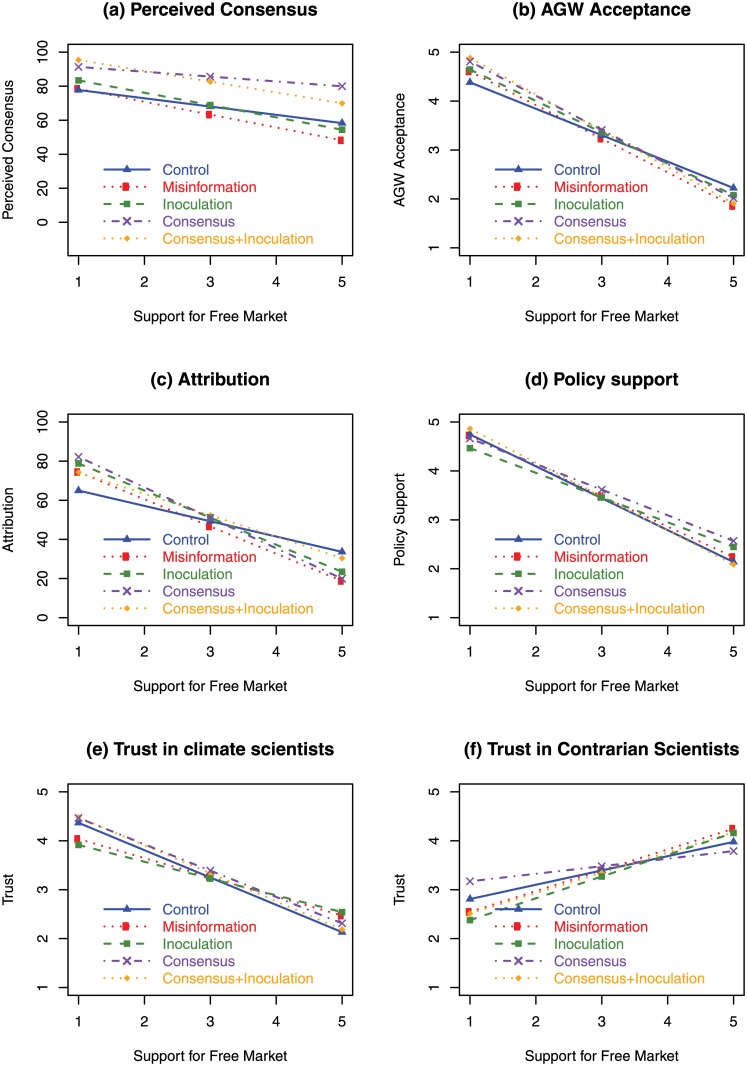
Misinformation can undermine a well-functioning democracy. For example, public misconceptions about climate change can lead to lowered acceptance of the reality of climate change and lowered support for mitigation policies. This study experimentally explored the impact of misinformation about climate change and tested several pre-emptive interventions designed to reduce the influence of misinformation. We found that false-balance media coverage (giving contrarian views equal voice with climate scientists) lowered perceived consensus overall, although the effect was greater among free-market supporters. Likewise, misinformation that confuses people about the level of scientific agreement regarding anthropogenic global warming (AGW) had a polarizing effect, with free-market supporters reducing their acceptance of AGW and those with low free-market support increasing their acceptance of AGW. However, we found that inoculating messages that (1) explain the flawed argumentation technique used in the misinformation or that (2) highlight the scientific consensus on climate change were effective in neutralizing those adverse effects of misinformation. We recommend that climate communication messages should take into account ways in which scientific content can be distorted, and include pre-emptive inoculation messages.
Overview
The claims and statistics of this paper haven’t been checked yet.
Free: it reads the open-access text and checks the first 5 claims that cite a source we can check. Create a free account to check every claim.
Integrity signals
Registry
Cites
Statistics
Figures

Verification
Claims the paper makes
The claims and statistics of this paper haven’t been checked yet.
Free: it reads the open-access text and checks the first 5 claims that cite a source we can check. Create a free account to check every claim.
Claims other papers make about this one
Each is checked against this paper’s own text: does it say what the citing paper says it does?
The check wasn’t confident either way, so it gives no verdict — never disputed.
In the citing paper
“Inoculation, while effective in preemptively refuting misinformation in specific domains (27–30), may not improve discernment when evaluating a diverse array of real-world news content.”
From A digital media literacy intervention increases discernment between mainstream and false news in the United States and India (2020) · cites this paper as [29]
Experimental — accuracy not yet measuredIn the citing paper
“focusing on the manipulation techniques and rhetorical strategies that underpin misinformation may significantly improve the potential scalability of inoculation interventions (17).”
From Psychological inoculation improves resilience against misinformation on social media (2022) · cites this paper as [17]
Self-check
Percentages, sums and reported differences re-computed from the paper’s own numbers.
The self-check needs the paper’s full text.
Citations
Cites
Maps of Bounded Rationality: Psychology for Behavioral Economics
Kahneman, D. (2003) · American Economic Review · doi:10.1257/000282803322655392 · Cited by 5,377
A Theory of Psychological Reactance
Torrance, E. P., & Brehm, J. W. (1968) · The American Journal of Psychology · doi:10.2307/1420824 · Cited by 4,759
Ohanian, R. (1990) · Journal of Advertising · doi:10.1080/00913367.1990.10673191 · Cited by 4,043 · cited 1×
“Five items measuring trust in climate scientists were adapted from Ohanian [55].”
BackgroundWhen Corrections Fail: The Persistence of Political Misperceptions
Nyhan, B., & Reifler, J. (2010) · Political Behavior · doi:10.1007/s11109-010-9112-2 · Cited by 3,173 · cited 1×
“For example, in one study, conservatives became more likely to believe that Iraq had weapons of mass destruction (WMDs) immediately before the war of 2003 after reading retractions clarifying that no WMDs existed at the time [11].”
BackgroundMisinformation and Its Correction: Continued Influence and Successful Debiasing
Lewandowsky, S., Ecker, U. K. H., Seifert, C. M., Schwarz, N., & Cook, J. (2012) · Psychological Science in the Public Interest · doi:10.1177/1529100612451018 · Cited by 2,920
Self-citationMcCright, A. M., & Dunlap, R. E. (2011) · The Sociological Quarterly · doi:10.1111/j.1533-8525.2011.01198.x · Cited by 2,340
The Scientific Consensus on Climate Change
Oreskes, N. (2004) · Science · doi:10.1126/science.1103618 · Cited by 1,814 · cited 1×
“Several studies have found nearly unanimous agreement among publishing climate 5 scientists that humans are causing global warming [22,23,24], and a similar pervasive consensus 6 exists in the scientific literature [25,26].”
BackgroundBalance as bias: global warming and the US prestige press
Boykoff, M. T., & Boykoff, J. M. (2004) · Global Environmental Change · doi:10.1016/j.gloenvcha.2003.10.001 · Cited by 1,699
Cultural cognition of scientific consensus.
Kahan, D. M., Jenkins‐Smith, H., & Braman, D. (2011) · Journal of Risk Research · doi:10.1080/13669877.2010.511246 · Cited by 1,686 · cited 1×
“Accordingly, climate change perceptions and attitudes have repeatedly been found to be strongly associated with political worldview [15,16,17,18].”
BackgroundConsensus on consensus: a synthesis of consensus estimates on human-caused global warming
Cook, J., Oreskes, N., Doran, P. T., Anderegg, W. R. L., Verheggen, B., Maibach, E. W., Carlton, J. S., Lewandowsky, S., Skuce, A. G., Green, S. A., et al. (2016) · Environmental Research Letters · doi:10.1088/1748-9326/11/4/048002 · Cited by 1,441
Self-citation
Cited by
Items 901–971 of 971
Pastors and the Honesty Crisis in Religion
Miller, C. B. (2026) · Oxford University Press eBooks · doi:10.1093/9780197840801.003.0008
Miller, C. B. (2026) · Oxford University Press eBooks · doi:10.1093/9780197840801.003.0002
Honesty Is a Lot More Interesting Than You Might Think
Miller, C. B. (2026) · Oxford University Press eBooks · doi:10.1093/9780197840801.003.0001
The Honesty Crisis Surrounding Deepfakes
Miller, C. (2026) · Oxford University Press eBooks · doi:10.1093/9780197840801.003.0003
Miller, C. B. (2026) · Oxford University Press eBooks · doi:10.1093/9780197840801.002.0005
Fame, Lying, and the Honesty Crisis for Celebrities
Miller, C. B. (2026) · Oxford University Press eBooks · doi:10.1093/9780197840801.003.0007
If Honesty Is Under Attack, Why Bother Trying to Protect It?
Miller, C. B. (2026) · Oxford University Press eBooks · doi:10.1093/9780197840801.003.0009
AI, Academic Cheating, and the Honesty Crisis in Education
Miller, C. (2026) · Oxford University Press eBooks · doi:10.1093/9780197840801.003.0005
Parzuchowski, M., & Białobrzeska, O. (2026) · Springer eBooks · doi:10.1007/978-3-032-18151-0_3
Young, N. W. G. (2026) · Translational Food Sciences · doi:10.1093/trfood/vxag011
Jang, E., Liao, M., Skurka, C., & de Zúñiga, H. G. (2026) · New Media & Society · doi:10.1177/14614448261438455
Identifying Flawed Reasoning in Contrarian Claims about Climate Change
Flack, R., Cook, J., Ellerton, P. J., Kinkead, D., Coan, T., Boussalis, C., Nanko, M. O., Gallant, A., & Dargaville, R. (2026) · Environmental Communication · doi:10.1080/17524032.2026.2663476 · Cited by 3
Self-citationTeklu, S. W., Abdelkawy, M. A. A., & Adel, W. (2026) · Complexity · doi:10.1155/cplx/8861194
Communicating expert consensus increases personal support for COVID-19 mitigation policiesPreprint
van der Linden, S., & Kerr, J. R. (2024) · OSF Preprints (OSF Preprints)
Reifler, J., Nyhan, B. J., Lyons, B. A., Montgomery, J., & Guess, A. (2023) · OSF Preprints (OSF Preprints)
Roozenbeek, J. (2026) · Psychological Inquiry · doi:10.1080/1047840x.2026.2650216
“Some researchers working on misin-formation have sought to understand both the persusasive-ness of different manipulation techniques, and the efficacy of interventions to counter the use of these techniques (Cook et al., 2017; Roozenbeek, van der Linden, et al., 2022; van der Linden et al., 2026).”
西村, 涼., Hirabayashi, M. M., & Yoshino, T. (2026) · IEEE Access · doi:10.1109/access.2026.3683733
Prestby, T. J., Jang, E., & Pacheco, A. (2026) · International Journal of Cartography · doi:10.1080/23729333.2026.2655716
Humor as a Tool for Communicating Climate Information and Navigating Misinformation
Yeo, S. K., Cacciatore, M. A., & McKasy, M. (2026) · Palgrave studies in education and the environment · doi:10.1007/978-3-032-14426-3_52
I Don’t Believe Misinformation, But I Might Share It: Inoculation Effects in Messenger Communication
Ancina, A., Zumbrägel, J., & Krämer, N. C. (2026) · Social Media + Society · doi:10.1177/20563051261449194
“This combination is expected to heighten perceived threat and prompt counterarguing, shifting processing from heuristic to more reflective evaluation (Cook et al., 2017).”
InfluentialResilience: Muting and Resisting Conspiracy Theories
Rao, H., & Greve, H. R. (2026) · Oxford University Press eBooks · doi:10.1093/9780197772324.003.0009
Topic Modeling and Word Embedding
Rao, H., & Greve, H. R. (2026) · Oxford University Press eBooks · doi:10.1093/9780197772324.005.0001
Linguistic Patterns in Online Conspiracy Theory
Rao, H., & Greve, H. R. (2026) · Oxford University Press eBooks · doi:10.1093/9780197772324.003.0001
Opportunities for Future Research
Rao, H., & Greve, H. R. (2026) · Oxford University Press eBooks · doi:10.1093/9780197772324.003.0010
Cultural Toolkit: Conspiracy Theorists as Echolocators
Rao, H., & Greve, H. R. (2026) · Oxford University Press eBooks · doi:10.1093/9780197772324.003.0005
From Mindsets and Algorithms to a Cultural Toolkit
Rao, H., & Greve, H. R. (2026) · Oxford University Press eBooks · doi:10.1093/9780197772324.003.0004
Why Do Online Conspiracy Theories Matter?
Rao, H., & Greve, H. R. (2026) · Oxford University Press eBooks · doi:10.1093/9780197772324.003.0002
Rao, H., & Greve, H. R. (2026) · Oxford University Press eBooks · doi:10.1093/9780197772324.002.0001
Online Conspiracy Theorizing as Conversational Coordination
Rao, H., & Greve, H. R. (2026) · Oxford University Press eBooks · doi:10.1093/9780197772324.003.0008
Fake News, Rumors, Folk Theories: A Neglect of Language
Rao, H., & Greve, H. R. (2026) · Oxford University Press eBooks · doi:10.1093/9780197772324.003.0003
Online Conspiracy Rabbit Hole as a Semantic Cascade
Rao, H., & Greve, H. R. (2026) · Oxford University Press eBooks · doi:10.1093/9780197772324.003.0006
Rao, H., & Greve, H. R. (2026) · Oxford University Press eBooks · doi:10.1093/9780197772324.002.0006
How We Studied Conspiracy Theories
Rao, H., & Greve, H. R. (2026) · Oxford University Press eBooks · doi:10.1093/9780197772324.005.0002
Rao, H., & Greve, H. R. (2026) · Oxford University Press eBooks · doi:10.1093/9780197772324.002.0007
Ctrl+Alt+Doubt: Decoding the Language of Online Conspiracy Talk
Rao, H., & Greve, H. R. (2026) · doi:10.1093/9780197772324.001.0001
Linguistic Signature of Superspreaders
Rao, H., & Greve, H. R. (2026) · Oxford University Press eBooks · doi:10.1093/9780197772324.003.0007
Vasiliadis, S. D., Cook, J., Nissan, K., Vidmar, S., Grobler, A. C., Cook, W., Hopkins, K., Lepage, C., Thomson, A., Danchin, M. H., et al. (2026) · Frontiers in Public Health · doi:10.3389/fpubh.2026.1768612
“Emerging evidence suggests that it is possible to psychologically ‘inoculate’ people against the misinformation belief (25, 26) through controlled exposure to real-world misinformation and explanation of how to identify it (27, 28).”
Self-citationLee, C. W., Wong, A., Yin, L., & Choi, Y. (2026) · medRxiv · doi:10.64898/2026.05.28.26354370
Bayramoğlu, Z., Candemir, S., & Doğan, H. G. (2026) · Tarım Ekonomisi Dergisi · doi:10.24181/tarekoder.1845483
Lande-Brenner, A., Ecker, U. K. H., & Mayo, R. (2026) · Scientific Reports · doi:10.1038/s41598-026-54720-9
Self-citationYou Can (Not) Play with Us: Conspiracy Theories, Media, and Ostracism
Baghumyan, A., Rohrbach, T., & Adam, S. (2026) · Group Processes & Intergroup Relations · doi:10.1177/13684302261460770
Teaching critical thinking through a lecture-performance: Analysis of a bimodal teaching format
Falque, R., Pondeville, S., & Romainville, M. (2026) · Thinking Skills and Creativity · doi:10.1016/j.tsc.2026.102302
When Experts Speak Too Often: How Frequent Authority Appeals Shape Public Climate Action Intentions
Liu, Z., & Yang, J. (2026) · Science Communication · doi:10.1177/10755470261459901
Biermann, K., & Taddicken, M. (2026) · Health Communication · doi:10.1080/10410236.2026.2699903
Misinformation in the Digital Age
Bechler, C. J., & Catapano, R. (2026) · Oxford University Press eBooks · doi:10.1093/9780197859063.003.0065
The Role of P4C Practices in Sustainability and Environmental Awareness Among Middle School Students
Güler, O., NUYAN, E., & HASANÇEBİ, A. (2026) · Elektronik Sosyal Bilimler Dergisi · doi:10.17755/esosder.1869127
Chan, H., Eom, K., Liu, P., & Tam, K. (2026) · British Journal of Psychology · doi:10.1111/bjop.70103
Silva, J. S., Custodio, C., & Alcantara, T. (2026) · Ação Midiática – Estudos em Comunicação Sociedade e Cultura · doi:10.5380/am.v31i1.101430
Alam, S. F. E., Elham, A., Qamar, M., & Ali, A. (2026) · The regional tribune. · doi:10.55737/trt/v-v.300
de Paula, C. P. A., Valle, F., & Salomão, A. (2025) · Tendências da Pesquisa Brasileira em Ciência da Informação · doi:10.59289/vpf4ss73
Noman, M., Alam, F., & Ali, R. (2026) · SN Computer Science · doi:10.1007/s42979-026-05260-6
AI-enabled health communication to address misinformation on social media: a mini review
Hu, Y. (2026) · Frontiers in Communication · doi:10.3389/fcomm.2026.1907956
Oliveira, M., Whiteman, G., Nugroho, N. K., Siwach, A., & Cavalheiro, G. G. H. (2026) · doi:10.5753/semish.2026.21813
“…• For Questions: The prompt instructs the model to answer concisely based on retrieved evidence. is misleading using football terminology (e.g., “this claim is offside with climate science”), the correct scientific understanding, and manipulation techniques identified by CARDS [Cook et al. 2017a].”
CONSPIR ED: A Dataset for Cognitive Traits of Conspiracy Theories and Large Language Model Safety
Bates, L., Glockner, M., Nakov, P., & Gurevych, I. (2026) · Transactions of the Association for Computational Linguistics · doi:10.1162/tacl.a.794 · Cited by 1
Implicit Philosophies of Science: Academics’ Divergent Views of Subjectivity in Scientific Practice
Ramlo, S. (2026) · Science & Education · doi:10.1007/s11191-026-00780-2
The Epistemic Authorization Filter: Windows, Gates, and Costs of Misinformation
Qadri, S. U. A. (2026) · Public humanities. · doi:10.1017/pub.2026.10197 · Cited by 1
Fang, Y., He, C., Hu, Y., & Tian, X. (2026) · Journal of Medical Internet Research · doi:10.2196/91516
“…substantial attention has been devoted to misinformation governance, including automated identification and monitoring systems [4,26], evaluations of corrective and debunking strategies [17, 18], and the mechanisms and temporal durability of prebunk-ing (inoculation) interventions [19,27].”
Science communication about contentious biology topics: why it frequently fails and how to fix it
Gibbens, B. B. (2026) · Journal of Microbiology and Biology Education · doi:10.1128/jmbe.00194-26
“Two important forms are confirmation bias, which protects prior beliefs by influencing how individuals interpret and weigh new information (20), and identity-protective cognition, which protects social belonging by leading people to accept or reject information based on whether it aligns with the…”
InfluentialUm panorama da produção científica brasileira sobre negacionismo e desinformação climática
Bertoli, J. M., Santos, B. R., da Silva, E. R., & Casarejos, F. (2026) · Desenvolvimento e Meio Ambiente · doi:10.5380/dma.v68i.100036
“Nesse con - texto, destacam-se ainda as contribuições de Cook et al. ( 2017 ), Lewandowsky et al. ( 2020 ) e Cook ( 2020 ) acerca das estratégias de conscientização sobre técnicas de desinformação e dos mecanismos eficazes para sua identificação e enfrentamento.”
Conrado, F., Garzón, K. T. P., & Baptista, J. P. (2026) · Social Sciences · doi:10.3390/socsci15090629
Kondratov, E., Gaete-Salgado, C., & Aira, T. (2026) · Journal of Information Policy · doi:10.5325/jinfopoli.16.2026.0014
Disinformation, Ideology, and Public Opinion in Central Europe
Hlatky, R. (2026) · Cambridge University Press eBooks · doi:10.1017/9781009616935
Shivers, B. N., & Wojdynski, B. W. (2026) · Social Media + Society · doi:10.1177/20563051261487526
“It is likely that the click-through warning did not elicit a feeling of freedom threat, which is an antecedent to reactance, although this contradicts past research where psychological reactance was proposed as a potential reason why a preemptive inoculation would work (Cook et al., 2017).”
Chen, L., Liu, X., & Fu, L. (2026) · Science Communication · doi:10.1177/10755470261489553
Moloisi, M. O., Onwubu, S. C., & Bidassey-Manilal, S. (2025) · African Journal of Inter/Multidisciplinary Studies · doi:10.51415/ajims.v8i1.2412
Uses of Behavioral Economics for Environmental Economists
Georganas, S., Velias, A., & Koundouri, P. (2026) · Oxford University Press eBooks · doi:10.1093/9780197851418.003.0975
From myth‐busting to inoculation: a worked example in flood safety communication
Compton, J. (2026) · Weather · doi:10.1002/wea.70152
Todorović, T., & Bregant, J. (2026) · European Journal for Philosophy of Science · doi:10.1007/s13194-026-00796-z
“We do not dispute the psy-chology-based prebunking developed by van der Linden, Roozenbeek, and others, including Cook et al.'s ( 2017 ) own work on identifying misleading techniques, which asks something quite different of the public; in fact, it aligns rather well with our proposal, as we…”
Ten Metrological Principles for Understanding and Countering Cognitive Warfare
Urekar, M. (2026) · International Conference on Electrical, Electronic and Computing Engineering (IcETRAN) · doi:10.1109/icetran71739.2026.11727696
“A formal program for recalibration must specify calibration intervals per instrument class, benchmark scenarios using synthetic ground-truth datasets, maximum permissible error and mandatory corrective action for identified unconformities [9], [14].”
Metadata
- Authors
- Cook, J., Lewandowsky, S., & Ecker, U. K. H.
- Affiliations
- George Mason University (US)
- The University of Western Australia (AU)
- Corresponding author
- Cook, John
- Lewandowsky, Stephan
- Ecker, Ullrich K. H.
- Venue
- PLOS ONE
- Publisher
- Public Library of Science (PLoS)
- Published
- 2017-05-05
- Volume
- 12
- Issue
- 5
- Pages
- e0175799
- ISSN
- 1932-6203 (ISSN-L)
- PMC
- PMC5419564
- OpenAlex
- W2610353045
- Cited by
- 971
- References
- 80
- Citations by year
- 2026: 120 · 2025: 124 · 2024: 110 · 2023: 129 · 2022: 135 · 2021: 116 · 2020: 130 · 2019: 59 · 2018: 29 · 2017: 19
- FWCI
- 165.41
- Type
- journal article
- Language
- en
- Open access
- gold
- doi.org
- Licence
- Locations
- PLoS ONE (publishedVersion, cc-by)
- PubMed Central (publishedVersion, cc-by)
- UWA Profiles and Research Repository (UWA) (publishedVersion, cc-by)
- PubMed (publishedVersion)
- RePEc: Research Papers in Economics (submittedVersion)
- DOAJ (DOAJ: Directory of Open Access Journals) (submittedVersion, cc-by-sa)
- Figshare (submittedVersion, cc-by)
- Bristol Research (University of Bristol) (submittedVersion, cc-by)
- Explore Bristol Research (submittedVersion, cc-by)
- George Mason University (cc-by)
- Funders
- Australian Research Council
- Royal Society
- Psychonomics Society
- Topics
- Social Sciences › Sociology and Political Science › Climate Change Communication and Perception
- Social Sciences › Sociology and Political Science › Misinformation and Its Impacts
- Social Sciences › Economics, Econometrics and Finance › Economics and Econometrics › Climate Change Policy and Economics
- Keywords
- misinformation, inoculation, climate change misinformation, false balance, scientific consensus, anthropogenic climate change, free market ideology, political polarization, argumentation techniques, climate change communication
- MeSH terms
- Information Services, Climate Change
About these checks
Registry, retraction, Cites and statistics results are computed, not judged, with one exception: a printed reference that no index lists is read once by a model before it counts as a citation error. Claims are extracted by a model and kept only when their quote appears verbatim in the text; each cited source is then checked, with a model’s help, for whether it says what the claim relies on. Those verdicts can be wrong — read the claim’s quote and the cited source before relying on one.
Statistics and arithmetic are recomputed, not judged.
Confidence bands are shown only for fields calibrated on our annotated test set. None is calibrated yet, so no band is shown.
What counts as a claim ›How we measure confidence ›How we check this ›
Are you an author, or do you see a problem with this page? Request a review
Data sources
Bibliographic data: Semantic Scholar, OpenAlex, Crossref.
Contains information from the Semantic Scholar Academic Graph Datasets, made available under the ODC Attribution License (ODC-BY 1.0).
Semantic Scholar’s data is described in: Kinney, R., et al. (2023). The Semantic Scholar Open Data Platform. arXiv:2301.10140.
