

Neutralizing misinformation through inoculation: Exposing misleading argumentation techniques reduces their influence
Open accessThe DOI matches its Crossref record; 78 of the 80 references it cites were found in a registry or an index.
Abstract
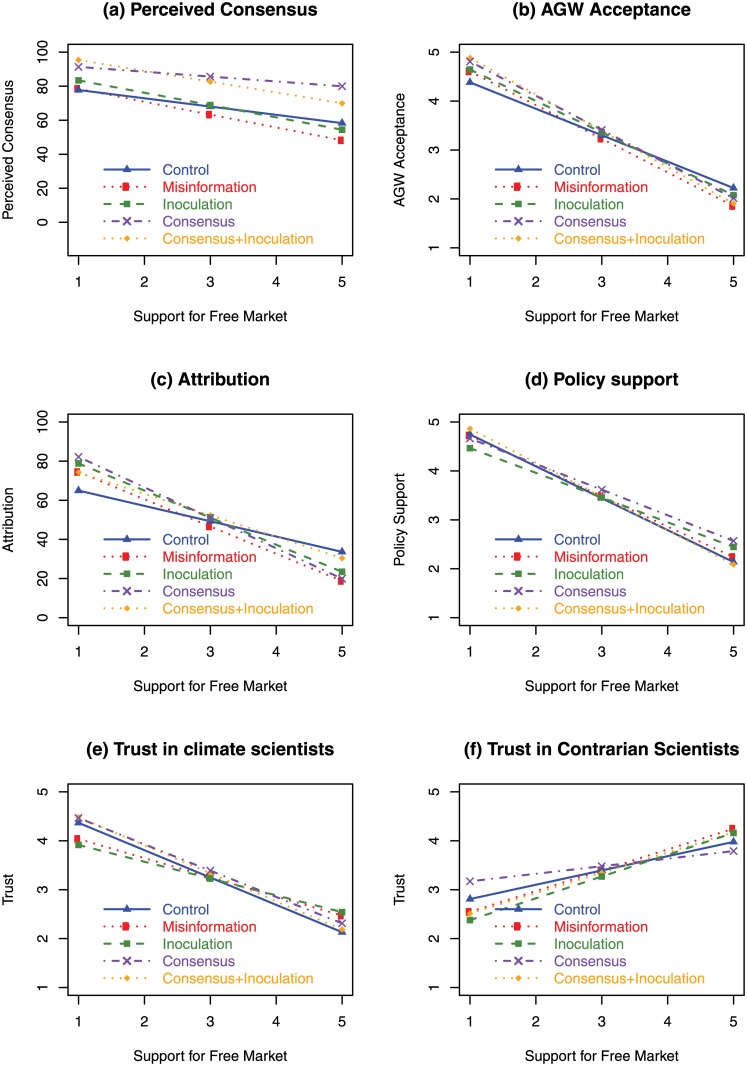
Misinformation can undermine a well-functioning democracy. For example, public misconceptions about climate change can lead to lowered acceptance of the reality of climate change and lowered support for mitigation policies. This study experimentally explored the impact of misinformation about climate change and tested several pre-emptive interventions designed to reduce the influence of misinformation. We found that false-balance media coverage (giving contrarian views equal voice with climate scientists) lowered perceived consensus overall, although the effect was greater among free-market supporters. Likewise, misinformation that confuses people about the level of scientific agreement regarding anthropogenic global warming (AGW) had a polarizing effect, with free-market supporters reducing their acceptance of AGW and those with low free-market support increasing their acceptance of AGW. However, we found that inoculating messages that (1) explain the flawed argumentation technique used in the misinformation or that (2) highlight the scientific consensus on climate change were effective in neutralizing those adverse effects of misinformation. We recommend that climate communication messages should take into account ways in which scientific content can be distorted, and include pre-emptive inoculation messages.
Overview
The claims and statistics of this paper haven’t been checked yet.
Free: it reads the open-access text and checks the first 5 claims that cite a source we can check. Create a free account to check every claim.
Integrity signals
Registry
Cites
Statistics
Figures

Verification
Claims the paper makes
The claims and statistics of this paper haven’t been checked yet.
Free: it reads the open-access text and checks the first 5 claims that cite a source we can check. Create a free account to check every claim.
Claims other papers make about this one
Each is checked against this paper’s own text: does it say what the citing paper says it does?
The check wasn’t confident either way, so it gives no verdict — never disputed.
In the citing paper
“Inoculation, while effective in preemptively refuting misinformation in specific domains (27–30), may not improve discernment when evaluating a diverse array of real-world news content.”
From A digital media literacy intervention increases discernment between mainstream and false news in the United States and India (2020) · cites this paper as [29]
Experimental — accuracy not yet measuredIn the citing paper
“focusing on the manipulation techniques and rhetorical strategies that underpin misinformation may significantly improve the potential scalability of inoculation interventions (17).”
From Psychological inoculation improves resilience against misinformation on social media (2022) · cites this paper as [17]
Self-check
Percentages, sums and reported differences re-computed from the paper’s own numbers.
The self-check needs the paper’s full text.
Citations
Cites
Maps of Bounded Rationality: Psychology for Behavioral Economics
Kahneman, D. (2003) · American Economic Review · doi:10.1257/000282803322655392 · Cited by 5,377
A Theory of Psychological Reactance
Torrance, E. P., & Brehm, J. W. (1968) · The American Journal of Psychology · doi:10.2307/1420824 · Cited by 4,759
Ohanian, R. (1990) · Journal of Advertising · doi:10.1080/00913367.1990.10673191 · Cited by 4,043 · cited 1×
“Five items measuring trust in climate scientists were adapted from Ohanian [55].”
BackgroundWhen Corrections Fail: The Persistence of Political Misperceptions
Nyhan, B., & Reifler, J. (2010) · Political Behavior · doi:10.1007/s11109-010-9112-2 · Cited by 3,173 · cited 1×
“For example, in one study, conservatives became more likely to believe that Iraq had weapons of mass destruction (WMDs) immediately before the war of 2003 after reading retractions clarifying that no WMDs existed at the time [11].”
BackgroundMisinformation and Its Correction: Continued Influence and Successful Debiasing
Lewandowsky, S., Ecker, U. K. H., Seifert, C. M., Schwarz, N., & Cook, J. (2012) · Psychological Science in the Public Interest · doi:10.1177/1529100612451018 · Cited by 2,920
Self-citationMcCright, A. M., & Dunlap, R. E. (2011) · The Sociological Quarterly · doi:10.1111/j.1533-8525.2011.01198.x · Cited by 2,340
The Scientific Consensus on Climate Change
Oreskes, N. (2004) · Science · doi:10.1126/science.1103618 · Cited by 1,814 · cited 1×
“Several studies have found nearly unanimous agreement among publishing climate 5 scientists that humans are causing global warming [22,23,24], and a similar pervasive consensus 6 exists in the scientific literature [25,26].”
BackgroundBalance as bias: global warming and the US prestige press
Boykoff, M. T., & Boykoff, J. M. (2004) · Global Environmental Change · doi:10.1016/j.gloenvcha.2003.10.001 · Cited by 1,699
Cultural cognition of scientific consensus.
Kahan, D. M., Jenkins‐Smith, H., & Braman, D. (2011) · Journal of Risk Research · doi:10.1080/13669877.2010.511246 · Cited by 1,686 · cited 1×
“Accordingly, climate change perceptions and attitudes have repeatedly been found to be strongly associated with political worldview [15,16,17,18].”
BackgroundConsensus on consensus: a synthesis of consensus estimates on human-caused global warming
Cook, J., Oreskes, N., Doran, P. T., Anderegg, W. R. L., Verheggen, B., Maibach, E. W., Carlton, J. S., Lewandowsky, S., Skuce, A. G., Green, S. A., et al. (2016) · Environmental Research Letters · doi:10.1088/1748-9326/11/4/048002 · Cited by 1,441
Self-citation
Cited by
Items 601–700 of 971
Combatting Conspiratorial Thinking with Controlled Argumentation Dialogue Environments
Fields, L., & Licato, J. (2022) · Argumentation library · doi:10.1007/978-3-030-91017-4_15 · Cited by 2
Impacts of Fake News and Conspiracy Theory
Burns, R. B. (2023) · Springer eBooks · doi:10.1007/978-981-99-1710-5_3 · Cited by 2
Naderer, B., Rieger, D., Schulze, H., & Rothut, S. (2023) · Journal of Children and Media · doi:10.1080/17482798.2023.2230311 · Cited by 3
“…been employed to increase awareness and knowledge about issues such as deliberate misinformation in advertising (Fernandes et al., 2020; Parguel et al., 2015; Schmuck et al., 2018) or mis-and disinformation in social media content (Cook et al., 2017; Roozenbeek et al., 2021; Tully et al., 2020).”
BackgroundMethodApplying Misinformation Interventions to Library Instruction and Outreach
Goodsett, M. (2023) · Journal of New Librarianship · doi:10.33011/newlibs/14/9 · Cited by 3
The Transformation of Digital Technology: Its Impact on Human Communication
Yustisia, I. R., Priyanti, D. D., Mulachelah, N. A., Kasim, A., Bidin, A., Illahi, A. K., Priyanti, D. D., Tamitiadini, D., Rakhmawati, F. Y., Oktaviani, F. H., et al. (2023) · doi:10.11594/futscipress39m · Cited by 6
Musi, E., O’Halloran, K. L., Carmi, E., & Yates, S. J. (2023) · Palgrave Studies in Intermediality · doi:10.1007/978-3-031-42064-1_11 · Cited by 3
Actual and Perceived Partisan Bias in Judgments of Political Misinformation as Lies
Reins, L. M., & Wiegmann, A. (2024) · Social Psychological and Personality Science · doi:10.1177/19485506231220702 · Cited by 3
“…the spread of misinformation has become a major threat to democratic societies: It can prevent fact-based debates, lead to public opinions being manipulated, and foster polarization and conflict among political groups (e.g., Cook et al., 2017; Loomba et al., 2021; Zimmermann & Kohring, 2020).”
Rieger, J., Yanchenko, K., Ruckdeschel, M., von Nordheim, G., Königslöw, K. K., & Wiedemann, G. (2024) · Studies in Communication and Media · doi:10.5771/2192-4007-2024-1-72 · Cited by 5
Towards a spectrum of dissent: A content analysis of Hawai‘i’s invasive species media
Cruz, J. G., & Johnson, M. F. (2024) · NeoBiota · doi:10.3897/neobiota.92.115766 · Cited by 8
Han, T., Snook, B., & Day, M. V. (2024) · Journal of Criminal Psychology · doi:10.1108/jcp-09-2024-0091 · Cited by 3
Shayegh, J., Baysu, G., & Turner, R. N. (2025) · Political Psychology · doi:10.1111/pops.13073 · Cited by 3
Spampatti, T., Brosch, T., Mumenthaler, C., & Hahnel, U. J. J. (2025) · British Journal of Psychology · doi:10.1111/bjop.70012 · Cited by 9
“…ad hoc disinformation, either selected from real disinformation but without theoretical justification (Green et al., 2022; Young et al., 2018), created anew by researchers (McCright et al., 2016), or presented without explanation (Chockalingam et al., 2021; Cook et al., 2017; Vraga et al., 2020).”
Demir, M. Ö., Demir, Z. G., Sümer, F., Şatır, Ç. K., Aydoğan, H., & Arslan, B. (2025) · Environmental Research Communications · doi:10.1088/2515-7620/adf497 · Cited by 1
Politricks: Teaching political tricks and discernment through active and passive tools
Hopkins, S.-A. M., Rayburn-Reeves, R. M., Lindemans, J. W., O’Gorrman, K. C., Vandewalker, I., Luebeck, C., & Sherlock, J. (2025) · PNAS Nexus · doi:10.1093/pnasnexus/pgaf245 · Cited by 2
“The spread and acceptance of climate change misinformation can lead to serious real-world consequences, as human activity itself drives climate change (14).”
Fighting fire with fire: Prebunking with the use of a plausible meta‐conspiracy framing
Biddlestone, M., Green, R., Toribio‐Flórez, D., de Gourville, D., Sutton, R. M., & Douglas, K. M. (2025) · British Journal of Psychology · doi:10.1111/bjop.70023 · Cited by 3
“In the standard prebunk condition, they first read a text adapted from Cook et al. (2017) explaining how fossil fuel industries and political groups spread misinformation to create false scientific debate and delay climate action.”
InfluentialInel, O., Đuričić, T., Kaur, H., Lex, E., & Tintarev, N. (2021) · Frontiers in Artificial Intelligence · doi:10.3389/frai.2021.712072 · Cited by 2
“In the classroom, pointing out fl awed argumentation techniques proved effective to reduce belief in false information (Cook et al., 2017).”
BackgroundClimate Change Misinformation Detection System
Saxena, S., & Nimala, K. (2022) · Advances in intelligent systems and computing · doi:10.1007/978-981-16-5652-1_34 · Cited by 2
Quality Conversations and Considerations on Reddit
van der Sluis, F., Faure, J., & Homnual, S. P. (2023) · Conference on Human Information Interaction and Retrieval · doi:10.1145/3576840.3578272 · Cited by 3
“ity considerations might already function as a form of inoculation by signalling readers to be careful [2].”
BackgroundFörderung eines kritischen Umgangs mit (Des-)Informationen durch aktive Inokulation und Debunking
Bernsteiner, A., Schubatzky, T., & Haagen‐Schützenhöfer, C. (2024) · Waxmann Verlag GmbH eBooks · doi:10.31244/9783830997962.26 · Cited by 2
Smith, T. C. (2024) · AIDS and Behavior · doi:10.1007/s10461-024-04528-3 · Cited by 2
Piltch-Loeb, R. N., Su, M., Hughes, B., Testa, M. A., Goldberg, B., Braddock, K. H., Miller‐Idriss, C., Maturo, V., & Savoia, E. (2021) · doi:10.2196/preprints.34116 · Cited by 2
Misinformation Analysis and Online Quality Theory (A Wittgensteinian Approach)Preprint
Omoregie, U. (2021) · SocArXiv (OSF Preprints) · doi:10.31235/osf.io/82swk · Cited by 4
Why do we argue about science? Exploring the psychological antecedents of rejection of science
Kerr, J. R. (2020) · Open Access Victoria University of Wellington | Te Herenga Waka (Figshare) · doi:10.26686/wgtn.17142374 · Cited by 2
Pereira, F. B., Bueno, N. S., Nunes, F., & Pavão, N. (2023) · Social Science Research Network · doi:10.2139/ssrn.4185949 · Cited by 16
“Similar results are observed in experimental assessments focusing on misinformation related to climate change (Cook et al. 2017; Lutzke et al. 2019) and genetically modified foods (Tully et al. 2020).”
Lees, J. M. (2022) · doi:10.31219/osf.io/xu6mh · Cited by 2
Inoculation Approaches to Science Misinformation Correction
Compton, J. (2024) · Wiley eBooks · doi:10.1002/9781394184972.ch12 · Cited by 3
Alshakhsi, S. A. A., Al‐Thani, D., Männikkö, N., & Ali, R. (2025) · SSRN Electronic Journal · doi:10.2139/ssrn.5075671 · Cited by 2
Inoculation Theory and the Communication of Scientific Findings
Burns, W. J., & Sellnow, T. L. (2026) · Wiley eBooks · doi:10.1002/9781394199372.ch31 · Cited by 2
Tang, R., Bode, L., & Vraga, E. K. (2026) · Health Communication · doi:10.1080/10410236.2025.2563665 · Cited by 2
“…to suggest that messages that alert people to the dangers of misinformation and provide accurate information that rebuts the misinformation can build audience resistance to later misinformation exposure (Cook et al., 2017; Lewandowsky & Linden, 2021; Schmid & Betsch, 2019; van der Linden, 2023).”
O'Hara, I. (2024) · Journal of New Librarianship · doi:10.33011/newlibs/17/12 · Cited by 2
“…include logical fallacies, trolling, employing fake experts, or astroturfing an algorithmically curated spaced with constant posts, reposts and likes of a specific piece of content to ensure it begins to dominate the conversation (Cook et. al., 2017; Lees et. al., 2023; Zerback et. al., 2021).”
BackgroundTouring the Worthiness of Tourist Guides in Malaysia Today
Mustafa, M. S. A., Azmi, E., Othman, Y. B., Malib, M. B. A., & Mahat, I. R. (2021) · International Journal of Academic Research in Business and Social Sciences · doi:10.6007/ijarbss/v11-i10/11494 · Cited by 1
Glimpsing Indonesia’s Social Media Discourse: What Goes on During the Covid-19 Infodemic
Ronny, R., Herdiansyah, H., & Panjaitan, B. S. P. (2023) · REiLA Journal of Research and Innovation in Language · doi:10.31849/reila.v5i3.13285 · Cited by 3
“This is in line with previous studies which argue that one of the most effective ways to reduce misinformation is through effective communication (Cook et al., 2017; Lovari, 2020; Moya-Salazar et al., 2021; Vraga & Bode, 2017).”
ResultKale, P. S. (2024) · International Journal for Research in Applied Science and Engineering Technology · doi:10.22214/ijraset.2024.59877 · Cited by 1
The influence and continued influence of misinformation: A review
Rapp, D. N., Holohan, J. A., & Withall, M. M. (2024) · Elsevier eBooks · doi:10.1016/b978-0-443-15754-7.00069-9 · Cited by 1
Noman, M. (2024) · International Conference on Behavioral, Economic, and Socio-Cultural Computing · doi:10.1109/besc64747.2024.10780680 · Cited by 2
Evading a Post-Truth World: Rorty’s Foundationless Philosophy for an Acculturating Education
Narayanan, M. (2025) · Studies in Philosophy and Education · doi:10.1007/s11217-024-09979-8 · Cited by 1
“Or , students could be “inoculated” against misinformation, where certain claims are “prebunked” by teaching students to recognize bias and common misinformation techniques (Cook et al. 2017).”
Edelsztein, V. C., Méndez, P. R., & Cormick, C. (2025) · Science & Education · doi:10.1007/s11191-024-00609-w · Cited by 1
“These efforts emphasize align both with previous inoculation research (Cook et al., 2017) and broader work on debunking and “technique rebuttal” (World Health Organization, 2016, p. 33).”
Quantitative Assessment of the Impact of Science Denial on Classroom Learning: A Multilevel Analysis
Ghosh, S. S. (2024) · The Clearing House A Journal of Educational Strategies Issues and Ideas · doi:10.1080/00098655.2025.2457083 · Cited by 1
“Studies have shown that students who are exposed to misinformation are more likely to develop misconceptions, which can persist despite formal education (Cook, Lewandowsky, and Ecker 2017).”
Zhang, B., & Pinto, J. (2025) · Communication Reports · doi:10.1080/08934215.2025.2465306 · Cited by 2
“…by informing individuals about the techniques and strategies used by misinformation to deceive others, which can help individuals develop resistance to it and be better equipped to recognize and reject similar misinformation in the future (Cook et al., 2017; van der Linden et al., 2017).”
InfluentialA Perda de um Mundo Comum: Desinformação, Pós-Verdade e Instabilidade Democrática
Bertoli, J. M., da Silva, E. R., Casarejos, F., & Rufin, C. R. (2025) · Organizações & Sociedade · doi:10.1590/1984-92302025v32n0002pt · Cited by 1
Lee, S. J. (2025) · Journal of Health Communication · doi:10.1080/10810730.2025.2514842 · Cited by 1
“This is similar to logic-based inoculation messages that highlight inaccurate argumentative tactics that are commonly used in misinformation (Banas et al., 2024; Cook et al., 2017; Van Der Linden et al., 2021; Vraga et al., 2019).”
Baltzi, T., Nikitaki, S., Galatsopoulou, F., Kostarella, I., Veglis, A. A., Vasilopoulos, V., Papaevagelou, D., & Skamnakis, A. (2025) · Machine Learning and Knowledge Extraction · doi:10.3390/make7020053 · Cited by 4
“12 Over-extraction [1,33,34] It is related to the excessive use of resources, particularly water and energy.”
InfluentialCoping with an antagonistic climate: Researchers' perspectives
Mendy, L., & Karlsson, M. (2025) · AMBIO · doi:10.1007/s13280-025-02203-y · Cited by 1
“The described antagonistic climate is largely due to actions by vested-interest actors in the form of disinfor-mation (Cook et al. 2017; Lewandowsky 2021; Supran et al. 2023) often disseminated through social media (Coan et al. 2021; Rojas et al. 2024) and problematic new media practices…”
Fernández, A. L., Trotta, Á. C., & Vázquez, A. (2025) · British Journal of Social Psychology · doi:10.1111/bjso.70000 · Cited by 3
Bel, M., Bauquier, C., Moulin, A., Coste, A., Coudon, T., & Jamain, L. (2025) · Pratiques Psychologiques · doi:10.1016/j.prps.2025.04.004 · Cited by 1
Kim, Y., & Lim, H. D. (2025) · Mass Communication & Society · doi:10.1080/15205436.2025.2534979 · Cited by 1
“…misinformation on social media is based on inoculation theory: employing pre-exposure to misinformation to reduce the influence of subsequent misinformation when it is encountered, because users recognize the flawed arguments and dismiss them as deceptive (Compton et al., 2021; Cook et al., 2017).”
Udry, J., & Barber, S. J. (2025) · Cognition · doi:10.1016/j.cognition.2025.106275 · Cited by 17
Noman, M., Alam, F., & Ali, R. (2025) · Lecture notes in computer science · doi:10.1007/978-3-032-06164-5_29 · Cited by 1
Han, X., Liao, K., Chen, Y., Jin, X., & Han, W. (2025) · Information Technology and People · doi:10.1108/itp-10-2024-1340 · Cited by 2
Fiammenghi, C., Ceretti, E., Covolo, L., Pelizzari, N., Taranto, M. A., Penna, L., Brunelli, L., Brusaferro, S., & Gelatti, U. (2025) · Human Vaccines & Immunotherapeutics · doi:10.1080/21645515.2025.2567680 · Cited by 2
“Public health authorities could benefit from a preemptive inoculation about such mechanisms, 7,20 which could help them better foresee their possible positive and negative outcomes when interacting with the press, acting as a kind of social vaccine.”
Lana-Blond, R., & García-Saiz, M. (2025) · The Spanish Journal of Psychology · doi:10.1017/sjp.2025.10010 · Cited by 1
Inoculation Theory in the Digital Age: Resilience Against Disinformation
Wiederhold, B. K. (2025) · Cyberpsychology Behavior and Social Networking · doi:10.1177/21522715251399256 · Cited by 1
Marcos-Vílchez, J. M., Velázquez, J. A. M., Arraztio-Cordoba, A., & Sánchez-Martín, M. (2025) · Humanities and Social Sciences Communications · doi:10.1057/s41599-025-06143-6 · Cited by 6
“Among these exclusions were several in fl uential contributions to the fi eld of countering mis-and disinformation, such as those by Cook et al. (2017, 2018, 2022), Puig et al. (2021), and Roozenbeek et al. (2023).”
Climate Views and Changing Public Perceptions of the Practice of Science
Safford, T. G., Whitmore, E. H., & Goodwin, S. H. (2025) · Social Science Quarterly · doi:10.1111/ssqu.70115 · Cited by 1
Unpacking environmental misinformation: a critical analysis of PragerU videos
Arenas, A., Boyce, L., & Vásquez, A. D. (2026) · Environmental Education Research · doi:10.1080/13504622.2025.2605218 · Cited by 1
“This combination of algorithmic visibility and institutional endorsement underscores why it is important to examine PragerU as a producer of environmental misinformation (Cook, Lewandowsky, and Ecker 2017; Lewandowsky, Ecker, and Cook 2017).”
Ma, Y., Lu, X., & Zhao, R. (2026) · Mass Communication & Society · doi:10.1080/15205436.2025.2596081 · Cited by 3
“In the science context, misinformation may appear when journalistic media attempts to balance coverage of contrarian viewpoints on controversial topics (Cook et al., 2017) or to overdramatize and distort scientific information (Thomas et al., 2018).”
Manipulating Minds: The Psychological Underpinnings of Misinformation
Delouvée, S., & Wagner‐Egger, P. (2026) · Springer eBooks · doi:10.1007/978-3-032-00480-2_3 · Cited by 1
Mason, C. E., & Rapp, D. N. (2026) · Applied Cognitive Psychology · doi:10.1002/acp.70166 · Cited by 1
Rohrbach, T., & Valli, C. (2026) · Journalism Studies · doi:10.1080/1461670x.2026.2623882 · Cited by 2
“Indeed, giving contrarian views equal voice can lead to “false balance media coverage” (see Cook, Lewandowsky, and Ecker 2017, 1), which may have harmful effects by elevating conspir-atorial arguments beyond their evidentiary status as speculation and creating the illusion of scientific or expert…”
Regulating misinformation online: permissible content moderation
Ganapini, M. B. (2026) · Inquiry · doi:10.1080/0020174x.2026.2624389 · Cited by 1
Lee, N., & Shafer, A. (2026) · Health Communication · doi:10.1080/10410236.2026.2636757 · Cited by 1
Large language model reveals an increase in climate contrarian speech in the United States Congress
Coan, T., Malla, R., Nanko, M. O., Kattrup, W., Roberts, J. T., Cook, J., & Boussalis, C. (2026) · Communications Sustainability · doi:10.1038/s44458-025-00029-z · Cited by 5
Self-citationMind Games: Decoding the Subconscious Triggers of Manipulation Using Consumer Neuroscience and AI
Iorga, A. M., Berceanu, D. C.-A., & Lepar, A. M. (2026) · Advances in computational intelligence and robotics book series · doi:10.4018/979-8-3373-1152-4.ch012 · Cited by 1
Kumar, S. (2026) · Eduphoria. · doi:10.59231/eduphoria/230463 · Cited by 1
McGrew, S., & Reynolds, E. C. (2026) · American Educational Research Journal · doi:10.3102/00028312261426323 · Cited by 5
“Lateral Reading: Evaluating Information in the Digital Age Among a wide range of approaches to combatting digital misinformation (e.g., Cook et al., 2017; Fazio et al., 2024; Lewandowsky et al., 2020), media organizations, academics, and digital media literacy organizations have begun recommending…”
Kuru, O. (2026) · Public Opinion Quarterly · doi:10.1093/poq/nfag006 · Cited by 1
Misinformation and polarisation as manifestations of social identity: a literature review
Zhi, Y., & Wang, J. (2026) · Journal of Information Communication and Ethics in Society · doi:10.1108/jices-07-2025-0195 · Cited by 2
The structural fingerprints of disinformation: a content-agnostic framework
Redaelli, S., Spitale, G., & Germani, F. (2026) · Ethics and Information Technology · doi:10.1007/s10676-025-09886-7 · Cited by 2
“The gamified interventions BadNews (Basol et al., 2020 ; Maertens et al., 2021 ; Roozenbeek & Linden, 2019a , 2019b ), GoViral!”
Amazeen, M. A., Krishna, A., & Su, C. C. (2026) · Science Communication · doi:10.1177/10755470261459850 · Cited by 2
Minimizing Misinformation Spread Through Targeted Prebunking in Social Networks
Furutani, S., Shibahara, T., Akiyama, M., & Aida, M. (2026) · IEEE Transactions on Network Science and Engineering · doi:10.1109/tnse.2026.3719287 · Cited by 1
Applications & critical reflections on the VANMaN taxonomy
Motta, M. (2020) · Social Science & Medicine · doi:10.1016/j.socscimed.2020.112850 · Cited by 2
Winds of Change: Engaging with Conflicting Perspectives in Renewable Energy
McCarthy, B., & Eagle, L. C. (2020) · Springer eBooks · doi:10.1007/978-981-15-8517-3_1 · Cited by 1
Hacking Artificial Intelligence (AI) Engines for Organised Crime and Inciting Chaos
Hassan, M., & Jahankhani, H. (2021) · Advanced sciences and technologies for security applications · doi:10.1007/978-3-030-72120-6_15 · Cited by 2
Groff, S. P. (2022) · Global Policy · doi:10.1111/1758-5899.13118 · Cited by 6
1. Pedagogikkens idé og oppdrag
Thuen, H. Ø. (2022) · Fagbokforlaget eBooks · doi:10.55669/oa010301 · Cited by 1
12. Undervisningsteknologi for læring eller effektivisering i høyere utdanning
Bjørgen, A. M., & Fritze, Y. (2022) · Fagbokforlaget eBooks · doi:10.55669/oa010312 · Cited by 1
McKenna, R. (2023) · Oxford University Press eBooks · doi:10.1093/oso/9780192888822.003.0005 · Cited by 1
Role of false news in discursive coherence and decision making
Salazar, A. S. C., Caramés, M. A., Larrosa, P. N. F., & Cevasco, J. (2023) · Salud Ciencia y Tecnología - Serie de Conferencias · doi:10.56294/sctconf2023123 · Cited by 2
CLASSIFICATION OF FAKE NEWS IN UKRAINE AND ABROAD
Kitsa, M. (2023) · State and Regions Series Social Communications · doi:10.32840/cpu2219-8741/2023.1(53).7 · Cited by 2
Misinformation in Open and Closed Online Platforms: Impacts and Countermeasures
Butler, L. H., & Ecker, U. K. H. (2023) · Mobile communication in Asia · doi:10.1007/978-94-024-2225-2_15 · Cited by 5
Self-citationReferencing in YouTube Knowledge Communication Videos
Kim, H., & Gática-Pérez, D. (2023) · ACM International Conference on Interactive Media Experiences · doi:10.1145/3573381.3596163 · Cited by 1
Reid, C. M. (2024) · Springer eBooks · doi:10.1007/978-3-031-49084-2_7 · Cited by 2
Contested Climate Justice – Challenged Democracy: International Perspectives
Marschner, N., Richter, C., Patz, J., Salheiser, A., & Verlag, C. (2024) · Campus Verlag eBooks · doi:10.12907/978-3-593-45820-5 · Cited by 3
Reasons to fight: preliminary results on motivations to combat fake news
Yu, W., & Yan, Q. (2024) · Information Research · doi:10.47989/ir292596 · Cited by 5
Belief-neutral Versus Belief-linked Knowledge as Predictors of Climate-change Opinions
Brown, A. R., & Hamilton, L. C. (2024) · SAGE Open · doi:10.1177/21582440241261806 · Cited by 1
“Challenging scientists’ objectivity has been a key strategy among political and media elites who seek to promote climate skepticism (Cook et al., 2017; Dunlap & McCright, 2015).”
Trening myślenia krytycznego w środowisku nowych mediów – trzy podejścia
Pokropek, M. (2024) · Kwartalnik Pedagogiczny · doi:10.31338/2657-6007.kp.2024-2.5
The moral dimension of epistemic practices in online environments
Nedeljković, A., & Pavličić, J. (2024) · Theoria Beograd · doi:10.2298/theo2404167n · Cited by 1
Disinformation and climate crisis: Challenges and proposals for the future
Rosa, R. M., & Sánchez-Torres, M. (2024) · Catalan Journal of Communication & Cultural Studies · doi:10.1386/cjcs_00107_7 · Cited by 1
The False Balance Effect: Exploring Partition Dependence as a Potential Explanation
Han, T., Snook, B., & Day, M. V. (2025) · Applied Cognitive Psychology · doi:10.1002/acp.70025 · Cited by 3
Šrol, J., Čavojová, V., & Adamus, M. (2025) · Thinking & Reasoning · doi:10.1080/13546783.2025.2464962 · Cited by 3
“More complex debunking strategies involve the correction of logical errors or rhetorical manipulation, often in addition to fact-checking (Cook et al., 2017; Schmid & Betsch, 2019).”
The Loss of a Common World: Disinformation, Post-Truth and Democratic Instability
Bertoli, J. M., da Silva, E. R., Casarejos, F., & Rufin, C. R. (2025) · Organizações & Sociedade · doi:10.1590/1984-92302025v32n0002en · Cited by 5
Violations of Argumentation Standards in Contemporary Debates on Health and Reproductive Rights
Radi, B., & Cormick, C. (2025) · Alternatives: Global, Local, Political · doi:10.1177/03043754251330396 · Cited by 1
“…on obtaining data about what works, what really functions in order to prevent some target population from adopting certain questionable beliefs (Banas & Miller, 2013; Compton & Pfau, 2008; Cook et al., 2017; Linden et al., 2017; Roozenbeek & van der Linden, 2019; van der Linden et al., 2020).”
How Attempting to Reduce Misconceptions in Psychology Reveals The Challenges of Change
Kowalski, P., & Taylor, A. (2019) · Emerald Group Publishing Limited eBooks · doi:10.1108/978-1-64113-853-620251016 · Cited by 3
Lejano, R. P., Nero, S. J., & Chua, M. C. B. (2020) · Oxford University Press eBooks · doi:10.1093/oso/9780197542101.003.0003 · Cited by 1
Social Media Management by Climate Change Organizations for Public Relations
Chawla, Y. (2020) · Springer eBooks · doi:10.1007/978-3-030-22759-3_70-1 · Cited by 1
Countering Foreign Interference in U.S. Elections
Posard, M. N., Reininger, H., & Helmus, T. C. (2021) · RAND Corporation eBooks · doi:10.7249/rra704-4 · Cited by 1
Persuasion and Intellectual Autonomy
McKenna, R. (2021) · Routledge eBooks · doi:10.4324/9781003003465-9 · Cited by 1
International Climate Cooperation and the Watershed of Policy Streams
Groff, S. P. (2022) · Journal of Comparative Policy Analysis Research and Practice · doi:10.1080/13876988.2021.2013104 · Cited by 1
“In extending the NPF, Crow and Lawlor (2016) argue that it helps “policy scholars understand the role of media actors within policy subsystems, the strategies that coalitions employ through media, and the influence of framing on policy outcomes” (p. 482).”
BackgroundInfluentialRepresentando al clima: ¿quiénes hablan sobre el cambio climático en el ciberespacio?
Muñoz-Pico, H. P. (2022) · SciComm Report · doi:10.32457/scr.v2i1.1692 · Cited by 2
Metadata
- Authors
- Cook, J., Lewandowsky, S., & Ecker, U. K. H.
- Affiliations
- George Mason University (US)
- The University of Western Australia (AU)
- Corresponding author
- Cook, John
- Lewandowsky, Stephan
- Ecker, Ullrich K. H.
- Venue
- PLOS ONE
- Publisher
- Public Library of Science (PLoS)
- Published
- 2017-05-05
- Volume
- 12
- Issue
- 5
- Pages
- e0175799
- ISSN
- 1932-6203 (ISSN-L)
- PMC
- PMC5419564
- OpenAlex
- W2610353045
- Cited by
- 971
- References
- 80
- Citations by year
- 2026: 120 · 2025: 124 · 2024: 110 · 2023: 129 · 2022: 135 · 2021: 116 · 2020: 130 · 2019: 59 · 2018: 29 · 2017: 19
- FWCI
- 165.41
- Type
- journal article
- Language
- en
- Open access
- gold
- doi.org
- Licence
- Locations
- PLoS ONE (publishedVersion, cc-by)
- PubMed Central (publishedVersion, cc-by)
- UWA Profiles and Research Repository (UWA) (publishedVersion, cc-by)
- PubMed (publishedVersion)
- RePEc: Research Papers in Economics (submittedVersion)
- DOAJ (DOAJ: Directory of Open Access Journals) (submittedVersion, cc-by-sa)
- Figshare (submittedVersion, cc-by)
- Bristol Research (University of Bristol) (submittedVersion, cc-by)
- Explore Bristol Research (submittedVersion, cc-by)
- George Mason University (cc-by)
- Funders
- Australian Research Council
- Royal Society
- Psychonomics Society
- Topics
- Social Sciences › Sociology and Political Science › Climate Change Communication and Perception
- Social Sciences › Sociology and Political Science › Misinformation and Its Impacts
- Social Sciences › Economics, Econometrics and Finance › Economics and Econometrics › Climate Change Policy and Economics
- Keywords
- misinformation, inoculation, climate change misinformation, false balance, scientific consensus, anthropogenic climate change, free market ideology, political polarization, argumentation techniques, climate change communication
- MeSH terms
- Information Services, Climate Change
About these checks
Registry, retraction, Cites and statistics results are computed, not judged, with one exception: a printed reference that no index lists is read once by a model before it counts as a citation error. Claims are extracted by a model and kept only when their quote appears verbatim in the text; each cited source is then checked, with a model’s help, for whether it says what the claim relies on. Those verdicts can be wrong — read the claim’s quote and the cited source before relying on one.
Statistics and arithmetic are recomputed, not judged.
Confidence bands are shown only for fields calibrated on our annotated test set. None is calibrated yet, so no band is shown.
What counts as a claim ›How we measure confidence ›How we check this ›
Are you an author, or do you see a problem with this page? Request a review
Data sources
Bibliographic data: Semantic Scholar, OpenAlex, Crossref.
Contains information from the Semantic Scholar Academic Graph Datasets, made available under the ODC Attribution License (ODC-BY 1.0).
Semantic Scholar’s data is described in: Kinney, R., et al. (2023). The Semantic Scholar Open Data Platform. arXiv:2301.10140.
