

Neutralizing misinformation through inoculation: Exposing misleading argumentation techniques reduces their influence
Open accessThe DOI matches its Crossref record; 78 of the 80 references it cites were found in a registry or an index.
Abstract
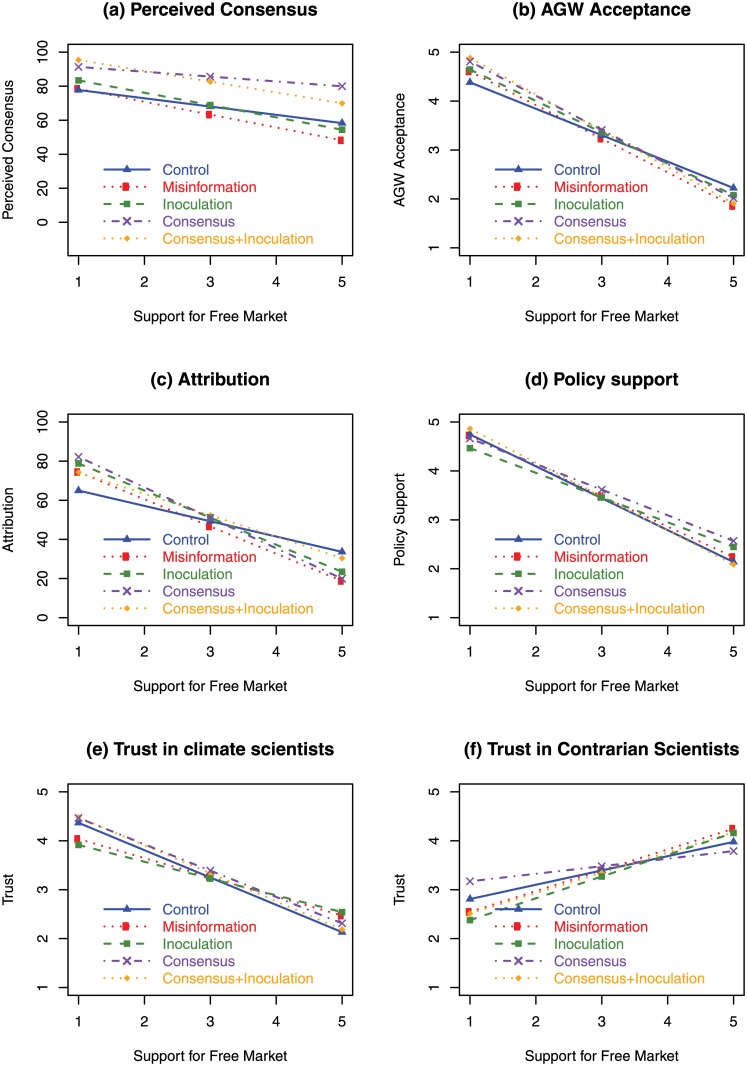
Misinformation can undermine a well-functioning democracy. For example, public misconceptions about climate change can lead to lowered acceptance of the reality of climate change and lowered support for mitigation policies. This study experimentally explored the impact of misinformation about climate change and tested several pre-emptive interventions designed to reduce the influence of misinformation. We found that false-balance media coverage (giving contrarian views equal voice with climate scientists) lowered perceived consensus overall, although the effect was greater among free-market supporters. Likewise, misinformation that confuses people about the level of scientific agreement regarding anthropogenic global warming (AGW) had a polarizing effect, with free-market supporters reducing their acceptance of AGW and those with low free-market support increasing their acceptance of AGW. However, we found that inoculating messages that (1) explain the flawed argumentation technique used in the misinformation or that (2) highlight the scientific consensus on climate change were effective in neutralizing those adverse effects of misinformation. We recommend that climate communication messages should take into account ways in which scientific content can be distorted, and include pre-emptive inoculation messages.
Overview
The claims and statistics of this paper haven’t been checked yet.
Free: it reads the open-access text and checks the first 5 claims that cite a source we can check. Create a free account to check every claim.
Integrity signals
Registry
Cites
Statistics
Figures

Verification
Claims the paper makes
The claims and statistics of this paper haven’t been checked yet.
Free: it reads the open-access text and checks the first 5 claims that cite a source we can check. Create a free account to check every claim.
Claims other papers make about this one
Each is checked against this paper’s own text: does it say what the citing paper says it does?
The check wasn’t confident either way, so it gives no verdict — never disputed.
In the citing paper
“Inoculation, while effective in preemptively refuting misinformation in specific domains (27–30), may not improve discernment when evaluating a diverse array of real-world news content.”
From A digital media literacy intervention increases discernment between mainstream and false news in the United States and India (2020) · cites this paper as [29]
Experimental — accuracy not yet measuredIn the citing paper
“focusing on the manipulation techniques and rhetorical strategies that underpin misinformation may significantly improve the potential scalability of inoculation interventions (17).”
From Psychological inoculation improves resilience against misinformation on social media (2022) · cites this paper as [17]
Self-check
Percentages, sums and reported differences re-computed from the paper’s own numbers.
The self-check needs the paper’s full text.
Citations
Cites
Maps of Bounded Rationality: Psychology for Behavioral Economics
Kahneman, D. (2003) · American Economic Review · doi:10.1257/000282803322655392 · Cited by 5,377
A Theory of Psychological Reactance
Torrance, E. P., & Brehm, J. W. (1968) · The American Journal of Psychology · doi:10.2307/1420824 · Cited by 4,759
Ohanian, R. (1990) · Journal of Advertising · doi:10.1080/00913367.1990.10673191 · Cited by 4,043 · cited 1×
“Five items measuring trust in climate scientists were adapted from Ohanian [55].”
BackgroundWhen Corrections Fail: The Persistence of Political Misperceptions
Nyhan, B., & Reifler, J. (2010) · Political Behavior · doi:10.1007/s11109-010-9112-2 · Cited by 3,173 · cited 1×
“For example, in one study, conservatives became more likely to believe that Iraq had weapons of mass destruction (WMDs) immediately before the war of 2003 after reading retractions clarifying that no WMDs existed at the time [11].”
BackgroundMisinformation and Its Correction: Continued Influence and Successful Debiasing
Lewandowsky, S., Ecker, U. K. H., Seifert, C. M., Schwarz, N., & Cook, J. (2012) · Psychological Science in the Public Interest · doi:10.1177/1529100612451018 · Cited by 2,920
Self-citationMcCright, A. M., & Dunlap, R. E. (2011) · The Sociological Quarterly · doi:10.1111/j.1533-8525.2011.01198.x · Cited by 2,340
The Scientific Consensus on Climate Change
Oreskes, N. (2004) · Science · doi:10.1126/science.1103618 · Cited by 1,814 · cited 1×
“Several studies have found nearly unanimous agreement among publishing climate 5 scientists that humans are causing global warming [22,23,24], and a similar pervasive consensus 6 exists in the scientific literature [25,26].”
BackgroundBalance as bias: global warming and the US prestige press
Boykoff, M. T., & Boykoff, J. M. (2004) · Global Environmental Change · doi:10.1016/j.gloenvcha.2003.10.001 · Cited by 1,699
Cultural cognition of scientific consensus.
Kahan, D. M., Jenkins‐Smith, H., & Braman, D. (2011) · Journal of Risk Research · doi:10.1080/13669877.2010.511246 · Cited by 1,686 · cited 1×
“Accordingly, climate change perceptions and attitudes have repeatedly been found to be strongly associated with political worldview [15,16,17,18].”
BackgroundConsensus on consensus: a synthesis of consensus estimates on human-caused global warming
Cook, J., Oreskes, N., Doran, P. T., Anderegg, W. R. L., Verheggen, B., Maibach, E. W., Carlton, J. S., Lewandowsky, S., Skuce, A. G., Green, S. A., et al. (2016) · Environmental Research Letters · doi:10.1088/1748-9326/11/4/048002 · Cited by 1,441
Self-citation
Cited by
Items 101–200 of 971
Farrell, J. (2019) · Environmental Research Letters · doi:10.1088/1748-9326/aaf939 · Cited by 125
Leveraging Social Science to Generate Lasting Engagement with Climate Change Solutions
Goldberg, M. H., Gustafson, A., & van der Linden, S. (2020) · One Earth · doi:10.1016/j.oneear.2020.08.011 · Cited by 119
Correction Experiences on Social Media During COVID-19
Bode, L., & Vraga, E. K. (2021) · Social Media + Society · doi:10.1177/20563051211008829 · Cited by 130
“1 This would include work on pre-bunking and inoculation, which tries to mitigate the impact of misinformation before it even occurs (Banas & Rains, 2010; Cook et al., 2017; van der Linden et al., 2017).”
BackgroundLuís, S., Vauclair, C., & Lima, M. L. (2017) · Environmental Science & Policy · doi:10.1016/j.envsci.2017.11.015 · Cited by 110
Changes in perceived scientific consensus shift beliefs about climate change and GM food safety
Kerr, J. R., & Wilson, M. (2018) · PLoS ONE · doi:10.1371/journal.pone.0200295 · Cited by 99
“This is a worthwhile endpoint in itself, as highlighted in recent studies investigating the effects of climate sceptic communications seeking to decrease public perception of scientific consensus [30,31].”
BackgroundInfluentialMisinformation and public opinion of science and health: Approaches, findings, and future directions
Cacciatore, M. A. (2021) · Proceedings of the National Academy of Sciences · doi:10.1073/pnas.1912437117 · Cited by 121
“Other work has explored factors like false-balance reporting and the use of “fake experts,” also with promising results (56, 57).”
BackgroundTechnique-based inoculation against real-world misinformation
Roozenbeek, J., Traberg, C. S., & van der Linden, S. (2022) · Royal Society Open Science · doi:10.1098/rsos.211719 · Cited by 126
Kim, S. C., Vraga, E. K., & Cook, J. (2020) · Health Communication · doi:10.1080/10410236.2020.1787933 · Cited by 121
“also expand the current literature on attention, credibility, and misinformation correction (Cook et al., 2017; Petty & Brinol, 2008; Vraga & Bode, 2018; Vraga et al., 2019).”
BackgroundResultInfluentialSelf-citationExperimental effects of climate messages vary geographically
Zhang, B., van der Linden, S., Mildenberger, M., Marlon, J. R., Howe, P. D., & Leiserowitz, A. (2018) · Nature Climate Change · doi:10.1038/s41558-018-0122-0 · Cited by 87
Assessing the Effect of 'Disputed' Warnings and Source Salience on Perceptions of Fake News AccuracyPreprint
Pennycook, G., & Rand, D. G. (2017) · SSRN Electronic Journal · doi:10.2139/ssrn.3035384 · Cited by 85
Vraga, E. K., Bode, L., & Tully, M. (2021) · Health Communication · doi:10.1080/10410236.2021.1910165 · Cited by 94
“Given that the use of “fake experts” is a prominent misinformation technique (Cook et al., 2017), news literacy efforts should consider ways to better alert and ward against this strategy.”
BackgroundJin, Y., van der Meer, T. G. L. A., Lee, Y.-I., & Lu, X. (2020) · Public Relations Review · doi:10.1016/j.pubrev.2020.101910 · Cited by 113
The Twitter origins and evolution of the COVID-19 “plandemic” conspiracy theory
Kearney, M. D., Chiang, S. C., & Massey, P. M. (2020) · Harvard Kennedy School Misinformation Review · doi:10.37016/mr-2020-42 · Cited by 83
“…health advocates and communications must address misinformation about the COVID-19 vaccine now and consider how to effectively use pre-bunking as a mitigation strategy for misinformation’s influence among the general public (Cook et al., 2017; Jolley & Douglas, 2017; Roozenbeek et al., 2020).”
BackgroundThe Psychology of Fake News: Accepting, Sharing, and Correcting Misinformation
Greifeneder, R., Jaffé, M. E., Newman, E. J., & Schwarz, N. (2020) · Routledge eBooks · doi:10.4324/9780429295379 · Cited by 188
Inoculating against COVID-19 vaccine misinformation
van der Linden, S., Dixon, G., Clarke, C. J., & Cook, J. (2021) · EClinicalMedicine · doi:10.1016/j.eclinm.2021.100772 · Cited by 86
“Research has used inoculation theory to combat misinformation on a range of polarizing topics including anti-vaccination conspiracies [5,7,8].”
BackgroundSelf-citationPsychological inoculation strategies to fight climate disinformation across 12 countries
Spampatti, T., Hahnel, U. J. J., Trutnevyte, E., & Brosch, T. (2023) · Nature Human Behaviour · doi:10.1038/s41562-023-01736-0 · Cited by 118
“As psychological inoculations are usually tested against a single dis-information statement, not multiple ones 38,65 , we exploratorily tested whether the psychological inoculations protected participants’ affect towards climate mitigation action against the influence of the very first climate…”
Roozenbeek, J., Maertens, R., McClanahan, W., & van der Linden, S. (2021) · Educational and Psychological Measurement · doi:10.1177/0013164420940378 · Cited by 80
“Although meta-analyses have supported the efficacy of inoculation interventions (Banas & Rains, 2010), only recently has research begun testing inoculation theory in the context of misinformation (Cook et al., 2017; Roozenbeek and van der Linden, 2018).”
MethodUnderstanding and countering climate science denial
Cook, J. (2017) · Journal and proceedings of the Royal Society of New South Wales · doi:10.5962/p.361798 · Cited by 89
“Third, misinformation has a polarizing effect, disproportionately influencing political conservatives (Cook et al., 2017; van der Linden et al., 2017).”
BackgroundInfluentialSelf-citationFinding the place of argumentation in science education: Epistemics and Whole Science
Allchin, D., & Zemplén, G. Á. (2020) · Science Education · doi:10.1002/sce.21589 · Cited by 109
NudgeCred: Supporting News Credibility Assessment on Social Media Through Nudges
Bhuiyan, M. M., Horning, M., Lee, S. W., & Mitra, T. (2021) · Proceedings of the ACM on Human-Computer Interaction · doi:10.1145/3479571 · Cited by 105
Counteracting Climate Science Politicization With Effective Frames and Imagery
Bolsen, T., Palm, R. I., & Kingsland, J. T. (2019) · Science Communication · doi:10.1177/1075547019834565 · Cited by 88
Amaar, A., Aljedaani, W., Rustam, F., Ullah, S., Rupapara, V., & Ludi, S. A. (2022) · Neural Processing Letters · doi:10.1007/s11063-021-10727-z · Cited by 101
Markowitz, E. M., & Guckian, M. L. (2018) · Elsevier eBooks · doi:10.1016/b978-0-12-813130-5.00003-5 · Cited by 114
Not ‘getting on the bandwagon’: When climate change is a matter of unconcern
Lucas, C. H., & Davison, A. (2018) · Environment and Planning E Nature and Space · doi:10.1177/2514848618818763 · Cited by 79
One Earth, Many Futures, No Destination
Hulme, M. (2020) · One Earth · doi:10.1016/j.oneear.2020.03.005 · Cited by 74
How Can Psychological Science Help Counter the Spread of Fake News?
van der Linden, S., Roozenbeek, J., Maertens, R., Basol, M., Kácha, O., Rathje, S., & Traberg, C. S. (2021) · The Spanish Journal of Psychology · doi:10.1017/sjp.2021.23 · Cited by 71
“…(unwanted) persuasion (for reviews, see Banas & Rains, 2010; Lewandowsky & van der Linden, 2021), including misinformation about climate change (Cook et al., 2017; van der Linden et al., 2017), conspiracy theories (Banas & Miller, 2013; Jolley & Douglas, 2017), and astroturfing by Russian bots…”
BackgroundWinter, K., Pummerer, L., Hornsey, M. J., & Sassenberg, K. (2021) · British Journal of Health Psychology · doi:10.1111/bjhp.12550 · Cited by 84
Germany’s decision to phase out coal by 2038 lags behind citizens’ timing preferences
Rinscheid, A., & Wüstenhagen, R. (2019) · Nature Energy · doi:10.1038/s41560-019-0460-9 · Cited by 85
Amazeen, M. A., Krishna, A., & Eschmann, R. (2022) · Science Communication · doi:10.1177/10755470221111558 · Cited by 72
“In other cases, however, prior attitudes regarding a topic were analyzed and inoculation messages were shown to be effective regardless of initial position (Cook et al., 2017; Ivanov et al., 2017; Wood, 2007; van der Linden et al., 2017).”
BackgroundInfluentialTrujillo, K. L., Motta, M., Callaghan, T., & Sylvester, S. M. (2020) · Political Research Quarterly · doi:10.1177/1065912920907695 · Cited by 70
“Other studies have found that emphasizing medical consensus (van der Linden, Clarke, and Maibach 2015) and exposing misleading argumentation (Cook, Lewandowsky, and Ecker 2017) reduce vaccine misinformation.”
BackgroundDemocratic Transparency in the Platform Society
Gorwa, R., & Ash, T. G. (2020) · Social Media and Democracy · doi:10.1017/9781108890960.013 · Cited by 64
Hameleers, M., Brosius, A., Marquart, F., Goldberg, A. C., van Elsas, E., & de Vreese, C. H. (2021) · Communication Research · doi:10.1177/0093650221997719 · Cited by 85
“Using our conceptualization, future research may investigate the specific (alternative) media diets of citizens with higher perceptions of mis- and/or disinformation—which may also guide the design and development of journalistic tools to induce media literacy (Cook et al., 2017) or correct mis- and disinformation (We…”
Misinformation and Its Correction
Wittenberg, C., & Berinsky, A. J. (2020) · Social Media and Democracy · doi:10.1017/9781108890960.009 · Cited by 58
Inoculating against the spread of Islamophobic and radical-Islamist disinformation
Lewandowsky, S., & Yesilada, M. (2021) · Cognitive Research: Principles and Implications · doi:10.1186/s41235-021-00323-z · Cited by 62
“Inoculation equips individuals with the ability to critically assess and refute misinformation by revealing the flaws in misleading communications before exposure (Cook et al., 2017).”
BackgroundInfluentialSelf-citationSocial and Cognitive Aspects of the Vulnerability to Political Misinformation
Pantazi, M., Hale, S. A., & Klein, O. (2021) · Political Psychology · doi:10.1111/pops.12797 · Cited by 93
Ten competencies for the science misinformation crisis
Allchin, D. (2023) · Science Education · doi:10.1002/sce.21746 · Cited by 62
Trémolière, B., & Djeriouat, H. (2021) · Journal of Environmental Psychology · doi:10.1016/j.jenvp.2021.101561 · Cited by 66
Schmid-Petri, H., & Bürger, M. (2021) · Public Understanding of Science · doi:10.1177/09636625211024550 · Cited by 70
“The use of fake experts, that is, “spokespeople who convey the impression of expertise without possessing any relevant scientific expertise” (Cook et al., 2017: 11), is a misinformation technique that is especially relevant in the context of science communication to create legitimacy.”
InfluentialRumor Acceptance during Public Health Crises: Testing the Emotional Congruence Hypothesis
Na, K., Garrett, R. K., & Slater, M. D. (2018) · Journal of Health Communication · doi:10.1080/10810730.2018.1527877 · Cited by 69
“Inoculation has been shown to be an effective way to address both risky health behaviors and misinformation (e.g., Cook, Lewandowsky, & Ecker, 2017; Parker, Ivanov, & Compton, 2012).”
How to Combat Health Misinformation: A Psychological Approach
Roozenbeek, J., & van der Linden, S. (2022) · American Journal of Health Promotion · doi:10.1177/08901171211070958 · Cited by 60
Agley, J., Xiao, Y., Thompson, E. E., Chen, X., & Golzarri-Arroyo, L. (2021) · Journal of Medical Internet Research · doi:10.2196/32425 · Cited by 60
“A promising additional approach is prebunking (eg, inoculation) to confer resistance to the potential influence of misinformation before it is encountered [29-31].”
MacFarlane, D., Hurlstone, M. J., & Ecker, U. K. H. (2020) · Social Science & Medicine · doi:10.1016/j.socscimed.2020.112790 · Cited by 68
Self-citationBoman, C. D., & Schneider, E. J. (2020) · Public Relations Review · doi:10.1016/j.pubrev.2020.102004 · Cited by 71
“Proactive strategies are not a new concept within crisis communication (e.g., Cook, Lewandowsky, & Ecker, 2017; Le, Teo, Pang, Li, & Goh, 2018; Wan & Pfua, 2004).”
BackgroundBoosting people’s ability to detect microtargeted advertising
Lorenz-Spreen, P., Geers, M., Pachur, T., Hertwig, R., Lewandowsky, S., & Herzog, S. M. (2021) · Scientific Reports · doi:10.1038/s41598-021-94796-z · Cited by 57
Self-citationGateway illusion or cultural cognition confusion?
van der Linden, S., Leiserowitz, A., & Maibach, E. W. (2017) · Journal of Science Communication · doi:10.22323/2.16050204 · Cited by 61
Ecker, U. K. H., Butler, L. H., Cook, J., Hurlstone, M. J., Kurz, T., & Lewandowsky, S. (2020) · Journal of Environmental Psychology · doi:10.1016/j.jenvp.2020.101464 · Cited by 59
Self-citationMourali, M., & Drake, C. (2022) · Journal of Medical Internet Research · doi:10.2196/34831 · Cited by 55
“Moreover, research on “prebunking” has shown that it is possible to inoculate individuals against misinformation before it is even encountered [41-43].”
BackgroundExposure to Scientific Consensus Does Not Cause Psychological Reactance
van der Linden, S., Maibach, E., & Leiserowitz, A. (2023) · Environmental Communication · doi:10.1080/17524032.2019.1617763 · Cited by 54
“…of conservatives, disbelievers, and those with low interest in environmental issues toward the scientific consensus (e.g. Brewer & McKnight, 2017; Cook et al., 2017; Lewandowsky et al., 2013; van der Linden, Leiserowitz, et al., 2015; van der Linden, Leiserowitz, & Maibach, 2018a, 2018b; van der…”
BackgroundOswald, S., Lewiński, M., Greco, S., & Villata, S. (2022) · Argumentation library · doi:10.1007/978-3-030-91017-4 · Cited by 64
Allchin, D. (2022) · Science & Education · doi:10.1007/s11191-021-00257-4 · Cited by 52
The role of anchoring in judgments about expert consensus
Goldberg, M. H., van der Linden, S., Ballew, M. T., Rosenthal, S. A., & Leiserowitz, A. (2019) · Journal of Applied Social Psychology · doi:10.1111/jasp.12576 · Cited by 53
Schmid-Petri, H. (2017) · Climatic Change · doi:10.1007/s10584-017-2112-z · Cited by 66
“Knowing more about the strategies that such actors employ can help us understand the underlying processes, and based on that knowledge, concrete counteractive measures can be designed to mitigate the effects of the arguments (Cook et al. 2017; van der Linden et al. 2017).”
BackgroundMethodImundo, M. N., & Rapp, D. N. (2022) · Journal of Applied Research in Memory and Cognition · doi:10.1016/j.jarmac.2021.10.002 · Cited by 50
Limited effects of exposure to fake news about climate change
Drummond, C., Siegrist, M., & Árvai, J. (2020) · Environmental Research Communications · doi:10.1088/2515-7620/abae77 · Cited by 50
“…prior research has found that warnings can succeed in reducing the effects of exposure to misinformationwhen they ‘inoculate’ participants against themisinformation by exposing participants toweak examples of themisinformation and then refuting them (van der Linden et al 2017, Cook et al 2017).”
BackgroundReview of social science research on the impact of countermeasures against influence operations
Courchesne, L., Ilhardt, J. G., & Shapiro, J. N. (2021) · Harvard Kennedy School Misinformation Review · doi:10.37016/mr-2020-79 · Cited by 65
“Numerous studies tested forms of inoculation, explaining the “flawed argumentation technique used in the misinformation” (Cook et al., 2017) or highlighting the scientific consensus surrounding climate change (Maertens et al.”
BackgroundMethodCounteracting climate denial: A systematic review
Mendy, L., Karlsson, M., & Lindvall, D. (2024) · Public Understanding of Science · doi:10.1177/09636625231223425 · Cited by 67
“Inoculation appears successful to reduce the effects of misinformation (Compton et al., 2021; Cook et al., 2017; Lewandowsky, 2021b).”
BackgroundInfluentialCommunicating the Scientific Consensus on Climate Change: Diverse Audiences and Effects Over Time
Goldberg, M. H., Gustafson, A., van der Linden, S., Rosenthal, S. A., & Leiserowitz, A. (2022) · Environment and Behavior · doi:10.1177/00139165221129539 · Cited by 46
“…(but smaller) downstream changes in beliefs about climate change and support for climate policy (Bolsen & Druckman, 2018; Brewer & McKnight, 2017; Cook et al., 2017; Goldberg, van der Linden, Ballew, Rosenthal, Gustafson, & Leiserowitz, 2019; Goldberg, van der Linden, Ballew, Rosenthal, &…”
BackgroundLateral reading and monetary incentives to spot disinformation about science
Panizza, F., Ronzani, P., Martini, C., Mattavelli, S., Morisseau, T., & Motterlini, M. (2022) · Scientific Reports · doi:10.1038/s41598-022-09168-y · Cited by 46
Is Social Media Spreading Misinformation on Exercise and Health in Brazil?
Marocolo, M., Meireles, A. A. F. D. M., de Souza, H. L. R., da Mota, G. R., Oranchuk, D. J., Arriel, R. A., & Leite, L. H. R. (2021) · International Journal of Environmental Research and Public Health · doi:10.3390/ijerph182211914 · Cited by 61
“The events mentioned above ultimately support misinformation dissemination as it reaches a large audience, generating apprehension due to its implications to the public [14].”
BackgroundNegotiating Climate Change in Crisis
Durand-Delacre, D., Bettini, G., Nash, S. L., Sterly, H., Gioli, G., Hut, E., Boas, I., Farbotko, C., Sakdapolrak, P., de Bruijn, M., et al. (2021) · Open Book Publishers · doi:10.11647/obp.0265 · Cited by 66
Hicks, A., McKinney, P., Inskip, C., Walton, G., & Lloyd, A. (2022) · Journal of Librarianship and Information Science · doi:10.1177/09610006221090677 · Cited by 69
Boosting Understanding and Identification of Scientific Consensus Can Help to Correct False Beliefs
van Stekelenburg, A., Schaap, G., Veling, H., & Buijzen, M. (2021) · Psychological Science · doi:10.1177/09567976211007788 · Cited by 49
“An example of boosting is when individuals are inoculated against the persuasive effect of misleading information by warning them of impending exposure to such misleading information and explaining to them how the misleading technique works (e.g., the use of fake experts; Cook et al., 2017).”
Velásquez, P., & Eger, M. A. (2022) · European Sociological Review · doi:10.1093/esr/jcab062 · Cited by 58
Piltch-Loeb, R., Su, M., Hughes, B., Testa, M., Goldberg, B., Braddock, K., Miller-Idriss, C., Maturo, V., & Savoia, E. (2022) · JMIR Public Health and Surveillance · doi:10.2196/34615 · Cited by 46
Empowering young people with climate and ocean science: Five strategies for adults to consider
Kelly, R., Elsler, L. G., Polejack, A., van der Linden, S., Tönnesson, K., Schoedinger, S. E., Santoro, F., Pecl, G. T., Palmgren, M. B., Mariani, P., et al. (2021) · One Earth · doi:10.1016/j.oneear.2022.07.007 · Cited by 56
Self-citationChowdhury, A. H., Kabir, K. H., Abdulai, A., & Alam, M. F. (2023) · Sustainability · doi:10.3390/su15064753 · Cited by 68
A preregistered replication of “Inoculating the public against misinformation about climate change”
Williams, M. N., & Bond, C. (2020) · Journal of Environmental Psychology · doi:10.1016/j.jenvp.2020.101456 · Cited by 48
Frau‐Meigs, D. (2022) · Digital Journalism · doi:10.1080/21670811.2022.2081863 · Cited by 64
“Such is the case with “inoculation” (Cook, Lewandowsky, and Ecker 2017; Roozenbeek and van der Linden 2020; Basol, Roozenbeek, and van der Linden 2020) and “prebunking” (Kahne, Hodgin, and Eidman-Aadahl 2016; McGrew et al. 2017).”
BackgroundHansson, S. O. (2018) · Climate Policy · doi:10.1080/14693062.2017.1415197 · Cited by 53
Understanding and neutralising covid-19 misinformation and disinformation
Wang, Y., Bye, J., Bales, K., Gurdasani, D., Mehta, A., Abba‐Aji, M., Stückler, D., & McKee, M. (2022) · BMJ · doi:10.1136/bmj-2022-070331 · Cited by 50
Schmid, P., Altay, S., & Scherer, L. D. (2023) · European Psychologist · doi:10.1027/1016-9040/a000494 · Cited by 52
Countering misinformation through psychological inoculation
van der Linden, S. (2023) · Advances in experimental social psychology · doi:10.1016/bs.aesp.2023.11.001 · Cited by 70
From Denial to the Culture Wars: A Study of Climate Misinformation on YouTube
de Nadal, L. (2024) · Environmental Communication · doi:10.1080/17524032.2024.2363861 · Cited by 52
“Beyond these essential efforts to debunk and “prebunk” (Cook et al., 2017) obstructionist arguments, achieving consensus requires understanding the social and cultural contexts that render climate misinformation appealing in the first place.”
Mazarr, M. J., Bauer, R., Casey, A., Heintz, S., & Matthews, L. J. (2019) · RAND Corporation eBooks · doi:10.7249/rr2714 · Cited by 74
Jeon, Y., Kim, B., Xiong, A., Lee, D., & Han, K. (2021) · Proceedings of the ACM on Human-Computer Interaction · doi:10.1145/3479859 · Cited by 56
“This indicates that heuristic decision-making could lead to motivated reasoning [44] that prioritizes an individual’s thoughts and beliefs and drives him or her into an echo chamber that can accelerate the dissemination of fake news or cause political polarization [14, 45].”
BackgroundPsychological Underpinnings of Misinformation Countermeasures: A Systematic Scoping Review
Ziemer, C., & Rothmund, T. (2024) · Journal of Media Psychology Theories Methods and Applications · doi:10.1027/1864-1105/a000407 · Cited by 68
Dunn, A. G., Surian, D., Dalmazzo, J., Rezazadegan, D., Steffens, M., Dyda, A., Leask, J., Coiera, E. W., Dey, A., & Mandl, K. D. (2020) · American Journal of Public Health · doi:10.2105/ajph.2020.305902 · Cited by 41
Nudge Versus Boost: Agency Dynamics Under Libertarian Paternalism
Hertwig, R., & Ryall, M. D. (2019) · The Economic Journal · doi:10.1093/ej/uez054 · Cited by 49
Goodfellow, L., Care, A., & Alfirević, Ž. (2020) · BJOG An International Journal of Obstetrics & Gynaecology · doi:10.1111/1471-0528.16544 · Cited by 38
Green, M., McShane, C. J., & Swinbourne, A. L. (2022) · Australian Journal of Psychology · doi:10.1080/00049530.2022.2113340 · Cited by 52
“One of the most common techniques used by climate denialists is to employ a fake expert (Cook et al., 2017; Diethelm & McKee, 2009).”
BackgroundMethodInfluentialA Framework for Understanding the Effects of Strategic Communication Campaigns
Goldberg, M. H., & Gustafson, A. (2022) · International Journal of Strategic Communication · doi:10.1080/1553118x.2022.2137674 · Cited by 51
“Thus, an important part of a strategic communication campaign to increase public acceptance of climate science should anticipate and counteract these restraining forces (e.g., Cook et al., 2017; Van der Linden et al., 2017).”
BackgroundPsychological booster shots targeting memory increase long-term resistance against misinformation
Maertens, R., Roozenbeek, J., Simons, J. S., Lewandowsky, S., Maturo, V., Goldberg, B., Xu, R., & van der Linden, S. (2025) · Nature Communications · doi:10.1038/s41467-025-57205-x · Cited by 92
Self-citationPsychological interventions countering misinformation in social media: A scoping review
Gwiaździński, P., Gundersen, A. B., Piksa, M., Krysińska, I., Kunst, J. R., Noworyta, K., Olejniuk, A., Morzy, M., Rygula, R., Wójtowicz, T., et al. (2023) · Frontiers in Psychiatry · doi:10.3389/fpsyt.2022.974782 · Cited by 37
“It is a kind of deliberate action aimed at improving the latent ability to spot misinformation techniques, as opposed to just individual instances of misinformation (18, 21, 26, 27).”
BackgroundPurnat, T. D., Nguyen, T., & Briand, S. C. (2023) · Springer eBooks · doi:10.1007/978-3-031-27789-4 · Cited by 69
Community acceptance of hydrogen power plant projects: The case of South Korea
Son, W., Lee, S. H., & Woo, J. (2023) · Renewable and Sustainable Energy Reviews · doi:10.1016/j.rser.2023.113778 · Cited by 39
Culture versus cognition is a false dilemma
van der Linden, S., Maibach, E. W., Cook, J., Leiserowitz, A., Ranney, M. A., Lewandowsky, S., Árvai, J., & Weber, E. U. (2017) · Nature Climate Change · doi:10.1038/nclimate3323 · Cited by 40
Self-citationBots and Computational Propaganda: Automation for Communication and Control
Woolley, S. (2020) · Cambridge University Press eBooks · doi:10.1017/9781108890960.006 · Cited by 59
Lewandowsky, S., Armaos, K., Bruns, H., Schmid, P., Holford, D. L., Hahn, U., Al‐Rawi, A., Sah, S., & Cook, J. (2022) · The Annals of the American Academy of Political and Social Science · doi:10.1177/00027162221084663 · Cited by 55
“…and (2) logic-based, which involves identifying misleading techniques rather than content. the logic-based approach can convey immunity across topics (Cook, Lewandowsky, and Ecker 2017) and is applicable without requiring detailed knowledge of the entire inventory of misleading talking points.”
BackgroundSelf-citationFacts and Where to Find Them: Empirical Research on Internet Platforms and Content Moderation
Keller, D., & Leerssen, P. (2020) · Cambridge University Press eBooks · doi:10.1017/9781108890960.011 · Cited by 62
Understanding and Countering Misinformation About Climate Change
Cook, J. (2021) · IGI Global eBooks · doi:10.4018/978-1-6684-3686-8.ch081 · Cited by 53
Self-citationUnderstanding responses to different types of conflicting information about cancer prevention
Iles, I. A., Gillman, A. S., O’Connor, L. E., Ferrer, R. A., & Klein, W. M. P. (2022) · Social Science & Medicine · doi:10.1016/j.socscimed.2022.115292 · Cited by 43
Do as the Romans do: On the authoritarian roots of pseudoscience
Fasce, A., Adrián‐Ventura, J., & Avendaño, D. (2020) · Public Understanding of Science · doi:10.1177/0963662520935078 · Cited by 44
“…it is important for science communication to deploy pedagogical strategies and inoculation messages to cope with disinformation within corrupted information architectures, making the public aware of how fake news, trolling and filter bubbles work (Cook et al., 2017; Lewandowsky et al., 2012, 2017).”
BackgroundThe effects of scientific messages and narratives about vaccination
Kuru, O., Stecula, D. A., Lu, H., Ophir, Y., Chan, M. S., Winneg, K., Jamieson, K. H., & Albarracín, D. (2021) · PLoS ONE · doi:10.1371/journal.pone.0248328 · Cited by 44
“…small convenience samples [12, 14, 23, 41], online convenience samples such as Amazon Mechanical Turk [42, 43], other online non-probability panels [37], or in few cases, probability samples of specialized populations (i.e., only parents, which would be not be an ideal sample when we focus on…”
BackgroundResultVoci, D., & Karmasin, M. (2023) · Journal of Communication Management · doi:10.1108/jcom-05-2022-0060 · Cited by 54
Amazeen, M. A. (2023) · Human Communication Research · doi:10.1093/hcr/hqad040 · Cited by 50
(IPCC), I. P. O. C. C. (2023) · Cambridge University Press eBooks · doi:10.1017/9781009325844.016 · Cited by 75
Spiegelhalter, D. J. (2017) · Journal of the Royal Statistical Society Series A (Statistics in Society) · doi:10.1111/rssa.12302 · Cited by 49
“…2017), studies show it is possible to protect pre-emptively (‘inoculate’) public attitudes about climate change against real world misinformation (van der Linden et al., 2017; Cook et al., 2017) and that good visualizations can improve ‘immunity to misleading anecdote’ (Fagerlin et al., 2005).”
BackgroundHealth misinformation: what it is, why people believe it, how to counter it
Nan, X., Thier, K., & Wang, Y. (2023) · Annals of the International Communication Association · doi:10.1080/23808985.2023.2225489 · Cited by 48
“Similarly, Cook et al. (2017, p. 1) conceptualize misinformation based on recipients ’ acceptance, de fi ning misinformation as ‘ information that people accept as true despite it being false.”
BackgroundInoculating Against Anti-Vaccination Conspiracies
Banas, J. A., Bessarabova, E., Penkauskas, M. C., & Talbert, N. (2023) · Health Communication · doi:10.1080/10410236.2023.2235733 · Cited by 40
“…et al., 1990; unfalsifiability, Zarefsky, 2014; mutually exclusive beliefs, Wood et al., 2012), logic-based inoculation treatments have been shown to be promising as a potential strategy to mitigate science misinformation that implicates conspiracy theory endorsement (Cook et al., 2017, 2018).”
InfluentialDoes Public Knowledge of Climate Change Really Matter in Australia?
Tranter, B. (2019) · Environmental Communication · doi:10.1080/17524032.2019.1696853 · Cited by 42
Metadata
- Authors
- Cook, J., Lewandowsky, S., & Ecker, U. K. H.
- Affiliations
- George Mason University (US)
- The University of Western Australia (AU)
- Corresponding author
- Cook, John
- Lewandowsky, Stephan
- Ecker, Ullrich K. H.
- Venue
- PLOS ONE
- Publisher
- Public Library of Science (PLoS)
- Published
- 2017-05-05
- Volume
- 12
- Issue
- 5
- Pages
- e0175799
- ISSN
- 1932-6203 (ISSN-L)
- PMC
- PMC5419564
- OpenAlex
- W2610353045
- Cited by
- 971
- References
- 80
- Citations by year
- 2026: 120 · 2025: 124 · 2024: 110 · 2023: 129 · 2022: 135 · 2021: 116 · 2020: 130 · 2019: 59 · 2018: 29 · 2017: 19
- FWCI
- 165.41
- Type
- journal article
- Language
- en
- Open access
- gold
- doi.org
- Licence
- Locations
- PLoS ONE (publishedVersion, cc-by)
- PubMed Central (publishedVersion, cc-by)
- UWA Profiles and Research Repository (UWA) (publishedVersion, cc-by)
- PubMed (publishedVersion)
- RePEc: Research Papers in Economics (submittedVersion)
- DOAJ (DOAJ: Directory of Open Access Journals) (submittedVersion, cc-by-sa)
- Figshare (submittedVersion, cc-by)
- Bristol Research (University of Bristol) (submittedVersion, cc-by)
- Explore Bristol Research (submittedVersion, cc-by)
- George Mason University (cc-by)
- Funders
- Australian Research Council
- Royal Society
- Psychonomics Society
- Topics
- Social Sciences › Sociology and Political Science › Climate Change Communication and Perception
- Social Sciences › Sociology and Political Science › Misinformation and Its Impacts
- Social Sciences › Economics, Econometrics and Finance › Economics and Econometrics › Climate Change Policy and Economics
- Keywords
- misinformation, inoculation, climate change misinformation, false balance, scientific consensus, anthropogenic climate change, free market ideology, political polarization, argumentation techniques, climate change communication
- MeSH terms
- Information Services, Climate Change
About these checks
Registry, retraction, Cites and statistics results are computed, not judged, with one exception: a printed reference that no index lists is read once by a model before it counts as a citation error. Claims are extracted by a model and kept only when their quote appears verbatim in the text; each cited source is then checked, with a model’s help, for whether it says what the claim relies on. Those verdicts can be wrong — read the claim’s quote and the cited source before relying on one.
Statistics and arithmetic are recomputed, not judged.
Confidence bands are shown only for fields calibrated on our annotated test set. None is calibrated yet, so no band is shown.
What counts as a claim ›How we measure confidence ›How we check this ›
Are you an author, or do you see a problem with this page? Request a review
Data sources
Bibliographic data: Semantic Scholar, OpenAlex, Crossref.
Contains information from the Semantic Scholar Academic Graph Datasets, made available under the ODC Attribution License (ODC-BY 1.0).
Semantic Scholar’s data is described in: Kinney, R., et al. (2023). The Semantic Scholar Open Data Platform. arXiv:2301.10140.
