

Neutralizing misinformation through inoculation: Exposing misleading argumentation techniques reduces their influence
Open accessThe DOI matches its Crossref record; 78 of the 80 references it cites were found in a registry or an index.
Abstract
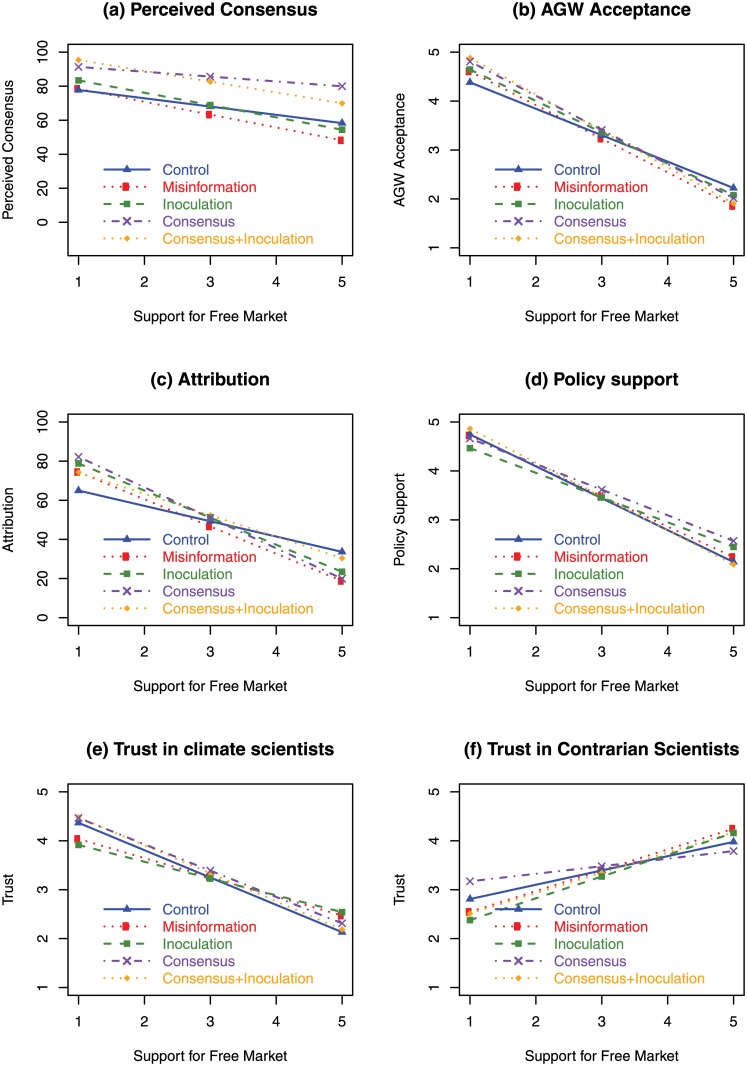
Misinformation can undermine a well-functioning democracy. For example, public misconceptions about climate change can lead to lowered acceptance of the reality of climate change and lowered support for mitigation policies. This study experimentally explored the impact of misinformation about climate change and tested several pre-emptive interventions designed to reduce the influence of misinformation. We found that false-balance media coverage (giving contrarian views equal voice with climate scientists) lowered perceived consensus overall, although the effect was greater among free-market supporters. Likewise, misinformation that confuses people about the level of scientific agreement regarding anthropogenic global warming (AGW) had a polarizing effect, with free-market supporters reducing their acceptance of AGW and those with low free-market support increasing their acceptance of AGW. However, we found that inoculating messages that (1) explain the flawed argumentation technique used in the misinformation or that (2) highlight the scientific consensus on climate change were effective in neutralizing those adverse effects of misinformation. We recommend that climate communication messages should take into account ways in which scientific content can be distorted, and include pre-emptive inoculation messages.
Overview
The claims and statistics of this paper haven’t been checked yet.
Free: it reads the open-access text and checks the first 5 claims that cite a source we can check. Create a free account to check every claim.
Integrity signals
Registry
Cites
Statistics
Figures

Verification
Claims the paper makes
The claims and statistics of this paper haven’t been checked yet.
Free: it reads the open-access text and checks the first 5 claims that cite a source we can check. Create a free account to check every claim.
Claims other papers make about this one
Each is checked against this paper’s own text: does it say what the citing paper says it does?
The check wasn’t confident either way, so it gives no verdict — never disputed.
In the citing paper
“Inoculation, while effective in preemptively refuting misinformation in specific domains (27–30), may not improve discernment when evaluating a diverse array of real-world news content.”
From A digital media literacy intervention increases discernment between mainstream and false news in the United States and India (2020) · cites this paper as [29]
Experimental — accuracy not yet measuredIn the citing paper
“focusing on the manipulation techniques and rhetorical strategies that underpin misinformation may significantly improve the potential scalability of inoculation interventions (17).”
From Psychological inoculation improves resilience against misinformation on social media (2022) · cites this paper as [17]
Self-check
Percentages, sums and reported differences re-computed from the paper’s own numbers.
The self-check needs the paper’s full text.
Citations
Cites
Maps of Bounded Rationality: Psychology for Behavioral Economics
Kahneman, D. (2003) · American Economic Review · doi:10.1257/000282803322655392 · Cited by 5,377
A Theory of Psychological Reactance
Torrance, E. P., & Brehm, J. W. (1968) · The American Journal of Psychology · doi:10.2307/1420824 · Cited by 4,759
Ohanian, R. (1990) · Journal of Advertising · doi:10.1080/00913367.1990.10673191 · Cited by 4,043 · cited 1×
“Five items measuring trust in climate scientists were adapted from Ohanian [55].”
BackgroundWhen Corrections Fail: The Persistence of Political Misperceptions
Nyhan, B., & Reifler, J. (2010) · Political Behavior · doi:10.1007/s11109-010-9112-2 · Cited by 3,173 · cited 1×
“For example, in one study, conservatives became more likely to believe that Iraq had weapons of mass destruction (WMDs) immediately before the war of 2003 after reading retractions clarifying that no WMDs existed at the time [11].”
BackgroundMisinformation and Its Correction: Continued Influence and Successful Debiasing
Lewandowsky, S., Ecker, U. K. H., Seifert, C. M., Schwarz, N., & Cook, J. (2012) · Psychological Science in the Public Interest · doi:10.1177/1529100612451018 · Cited by 2,920
Self-citationMcCright, A. M., & Dunlap, R. E. (2011) · The Sociological Quarterly · doi:10.1111/j.1533-8525.2011.01198.x · Cited by 2,340
The Scientific Consensus on Climate Change
Oreskes, N. (2004) · Science · doi:10.1126/science.1103618 · Cited by 1,814 · cited 1×
“Several studies have found nearly unanimous agreement among publishing climate 5 scientists that humans are causing global warming [22,23,24], and a similar pervasive consensus 6 exists in the scientific literature [25,26].”
BackgroundBalance as bias: global warming and the US prestige press
Boykoff, M. T., & Boykoff, J. M. (2004) · Global Environmental Change · doi:10.1016/j.gloenvcha.2003.10.001 · Cited by 1,699
Cultural cognition of scientific consensus.
Kahan, D. M., Jenkins‐Smith, H., & Braman, D. (2011) · Journal of Risk Research · doi:10.1080/13669877.2010.511246 · Cited by 1,686 · cited 1×
“Accordingly, climate change perceptions and attitudes have repeatedly been found to be strongly associated with political worldview [15,16,17,18].”
BackgroundConsensus on consensus: a synthesis of consensus estimates on human-caused global warming
Cook, J., Oreskes, N., Doran, P. T., Anderegg, W. R. L., Verheggen, B., Maibach, E. W., Carlton, J. S., Lewandowsky, S., Skuce, A. G., Green, S. A., et al. (2016) · Environmental Research Letters · doi:10.1088/1748-9326/11/4/048002 · Cited by 1,441
Self-citation
Cited by
Items 301–400 of 971
Countering Superintelligence Misinformation
Baum, S. D. (2018) · Information · doi:10.3390/info9100244 · Cited by 21
“Inoculation messages can include why a piece of misinformation is incorrect as well as why it is being spread [71].”
BackgroundRisking the earth Part 2: Power politics and structural reform of the IPCC and UNFCCC
Lucas, A. R. (2020) · Climate Risk Management · doi:10.1016/j.crm.2020.100260 · Cited by 24
Exploring factors that mitigate the continued influence of misinformation
Kan, I. P., Pizzonia, K. L., Drummey, A. B., & Mikkelsen, E. J. V. (2021) · Cognitive Research Principles and Implications · doi:10.1186/s41235-021-00335-9 · Cited by 30
“A multitude of factors have been explored, including the timing of correction (e.g., Cook et al., 2017; Ecker et al., 2010; Ithisuphalap et al., 2020), prior encounters of misinformation (e.g., ; Ecker et al., 2017 ; Pennycook et al., 2018), prior beliefs (e.g., Ecker & Ang, 2019; Swire…”
BackgroundSpaccatini, F., Richetin, J., Riva, P., Pancani, L., Ariccio, S., & Sacchi, S. (2022) · International Journal of Disaster Risk Reduction · doi:10.1016/j.ijdrr.2022.103024 · Cited by 21
Janney, B., Zummo, L., & Lohani, M. (2024) · Interdisciplinary Journal of Environmental and Science Education · doi:10.29333/ijese/14657 · Cited by 18
“Well-designed instruction can enhance students ’ understanding of climate science, the nature of science, and the sociocultural facets of changing climates (Cantell et al., 2019; Cook et al., 2017; Hornsey et al., 2016).”
BackgroundSchubatzky, T., & Haagen‐Schützenhöfer, C. (2022) · Education Sciences · doi:10.3390/educsci12080566 · Cited by 23
Infertility: A common target of antivaccine misinformation campaigns
Smith, T. C., & Gorski, D. H. (2024) · Vaccine · doi:10.1016/j.vaccine.2024.01.043 · Cited by 21
Fighting fake news on social media: a comparative evaluation of digital literacy interventions
Alon, A. T., Rahimi, I. D., & Tahar, H. (2024) · Current Psychology · doi:10.1007/s12144-024-05668-4 · Cited by 27
“Inoculation interventions have been shown to reduce the persuasiveness of misinformation by warning of misinformation and correcting specific false claims or identifying tactics used to promote it (e.g., Cook et al., 2017; van der Linden et al., 2017; Roozenbeek et al., 2022).”
Combatting Climate Disinformation: Comparing the Effectiveness of Correction Placement and Type
Christner, C., Merz, P., Barkela, B., Jungkunst, H. F., & von Sikorski, C. (2024) · Environmental Communication · doi:10.1080/17524032.2024.2316757 · Cited by 22
“Furthermore, logic-focused corrections may have the advantage of empowering people to uncover other disinformation using similar misleading techniques (Cook et al., 2017; Schmid & Betsch, 2019).”
Mitchell, S. S. D. (2019) · Canadian Journal of Communication · doi:10.22230/cjc.2019v44n2a3329 · Cited by 22
Brinson, N. H. (2022) · Frontiers in Communication · doi:10.3389/fcomm.2021.760847 · Cited by 20
“This technique has been empirically shown to generate large-scale resistance against fake news related to climate change (Cook et al., 2017; Van der Linden et al., 2017) and COVID-19 (Van der Linden et al.”
MethodIncorporating Psychological Science Into Policy Making: The Case of Misinformation
Kozyreva, A., Smillie, L., & Lewandowsky, S. (2023) · European Psychologist · doi:10.1027/1016-9040/a000493 · Cited by 20
“…et al., 2020 ) and lateral reading (Breakstone et al., 2021 ; Wineburg et al., 2022 ), inoculating people against manipulation (Basol et al., 2020 ; Cook et al., 2017 ; Lewandowsky & van der Linden, 2021 ; Roozenbeek & van der Linden, 2019 ), and implementing design choices that slow the process…”
BackgroundSelf-citationPersuasion And Epistemic Paternalism
McKenna, R. (2020) · Rowman & Littlefield Publishers eBooks · doi:10.5040/9798881810580.ch-006 · Cited by 25
Psychological Booster Shots Targeting Memory Increase Long-Term Resistance Against MisinformationPreprint
Maertens, R., Roozenbeek, J., Simons, J. S., Lewandowsky, S., Maturo, V., Goldberg, B., Xu, R., & van der Linden, S. (2023) · doi:10.31234/osf.io/6r9as · Cited by 16
Self-citationVirtual lab coats: The effects of verified source information on social media post credibility
Geels, J., Graßl, P., Schraffenberger, H., Tanis, M., & Kleemans, M. (2024) · PLoS ONE · doi:10.1371/journal.pone.0302323 · Cited by 27
Fake News Propagation and Mitigation Techniques: A Survey
Saxena, A., Saxena, P., & Reddy, H. (2021) · Smart innovation, systems and technologies · doi:10.1007/978-981-16-3398-0_16 · Cited by 22
Covolo, L., Guana, M., Bonaccorsi, G., Brunelli, L., Castaldi, S., Donno, A. D., Mereu, A., Verani, M., & Gelatti, U. (2022) · International Journal of Environmental Research and Public Health · doi:10.3390/ijerph19084745 · Cited by 24
“To this purpose, an approach based on neutralizing misinformation before it occurs through the explanation of argumentation techniques used in the misinformation has been shown to be effective [51].”
MethodAndreotta, M., Boschetti, F., Farrell, S., Paris, C. L., Walker, I. A., & Hurlstone, M. J. (2022) · Climatic Change · doi:10.1007/s10584-022-03437-5 · Cited by 27
Bakir, V., & McStay, A. (2022) · Springer eBooks · doi:10.1007/978-3-031-13551-4 · Cited by 37
Lee, E., & Jang, J.-W. (2023) · Digital Journalism · doi:10.1080/21670811.2022.2163413 · Cited by 22
“Extending previous research on the effectiveness of specific approaches (e.g. Cook, Lewandowsky, and Ecker 2017; Clayton et al. 2020; Guess et al. 2020), we tested how heightened accessibility of misinformation might moderate (a) the extent to which partisans engage in biased processing and sharing…”
BackgroundMethodLearning about informal fallacies and the detection of fake news: An experimental intervention
Hruschka, T. M. J., & Appel, M. (2023) · PLoS ONE · doi:10.1371/journal.pone.0283238 · Cited by 30
“48 [47], we performed a power analysis for d = .”
MethodMason, A. M., Compton, J., Tice, E., Peterson, B., Lewis, I., Glenn, T., & Combs, T. (2023) · Communication Reports · doi:10.1080/08934215.2023.2256803 · Cited by 17
“…have conferred resistance to influence in the contexts of health communication (e.g., Richards & Banas, 2015), science communication (e.g., Cook et al., 2017), public relations (e.g., Mikolon et al., 2015), and politics (e.g., Pfau & Burgoon, 1988), among others (for reviews, see Compton…”
BackgroundA framework for promoting online prosocial behavior via digital interventions
Grüning, D. J., Kamin, J., Panizza, F., Katsaros, M., & Lorenz-Spreen, P. (2024) · Communications Psychology · doi:10.1038/s44271-023-00052-7 · Cited by 32
Communication and Deliberation for Environmental Governance
Erbaugh, J. T., Chang, C. H., Masuda, Y. J., & Ribot, J. (2024) · Annual Review of Environment and Resources · doi:10.1146/annurev-environ-112321-082450 · Cited by 32
Noman, M., Gurgun, S., Phalp, K. T., & Ali, R. (2024) · Humanities and Social Sciences Communications · doi:10.1057/s41599-024-03524-1 · Cited by 18
“These include inoculating individuals against mis-information (Cook et al. 2017), automating the process of detecting and correcting it (Chora ś et al. 2021; Vicari and Komendatova, 2023), and enabling social media users to rectify false information (Bode and Vraga, 2017; Kligler-Vilenchik, 2022).”
Countering misinformation: Strategies, challenges, and uncertainties
Peter, C., & Koch, T. (2019) · Studies in Communication and Media · doi:10.5771/2192-4007-2019-4-431 · Cited by 17
“One avenue of research has looked at the effects of what has been labeled “inoculation” or “pre-bunking” (Cook et al., 2017; Compton & Pfau, 2005).”
BackgroundCountering vaccine hesitancy through medical expert endorsement
Ronzani, P., Panizza, F., Martini, C. M. C., Savadori, L., & Motterlini, M. (2022) · Vaccine · doi:10.1016/j.vaccine.2022.06.031 · Cited by 31
“Our results are in line with others showing a positive effect of debunking on correcting misinformation [57,58] especially when health agencies were used as a source of information compared to social peers [59].”
ResultBanchero, P., Rector, T. A., & VanBallenberghe, J. (2020) · Journal of Geoscience Education · doi:10.1080/10899995.2020.1768003 · Cited by 21
“…Kodiak Island renewable energy solution Bieniek-Tobasco et al. (2019) Use inoculation theory Addresses misinformation about polar bear populations Cook et al. (2017); van der Linden et al. (2017) Integrate climate change into narratives about topics of interest Talks about climate change in the…”
BackgroundA Meta-Analysis Synthesizing the Effects of Three Uncertainty Types in Science Communication
Zaifu, G., Liu, K., & Chen, M. (2025) · Science Communication · doi:10.1177/10755470251314129 · Cited by 15
“For instance, some investigations suggest that communicating uncertainty yields adverse outcomes, such as increased scientific misperceptions (Cook et al., 2017), reduced trust in scientists (Han et al., 2018; Hinnant et al., 2023), and decreased support intention (Chang, 2015).”
Fake News, False Beliefs, and the Fallible Art of Knowledge Maintenance
Gelfert, A. (2021) · Oxford University Press eBooks · doi:10.1093/oso/9780198863977.003.0015 · Cited by 18
Mena, P. (2021) · Journalism · doi:10.1177/14648849211028762 · Cited by 20
“Misinformation has been understood as ‘information that people accept as true despite it being false’ (Cook et al., 2017: 1).”
BackgroundInfluentialBelova, N., Krause, M., & Siemens, C. (2022) · Education Sciences · doi:10.3390/educsci12090603 · Cited by 25
Skipper, Y., Jolley, D., & Reddington, J. (2023) · British Journal of Developmental Psychology · doi:10.1111/bjdp.12456 · Cited by 19
Do fossil fuel firms reframe online climate and sustainability communication? A data-driven analysis
Debnath, R., Ebanks, D., Mohaddes, K., Roulet, T. J., & Alvarez, R. M. (2023) · npj Climate Action · doi:10.1038/s44168-023-00086-x · Cited by 20
The animal agriculture industry’s obstruction of campaigns promoting individual climate action
Loy, L., & Jacquet, J. (2025) · Climate Policy · doi:10.1080/14693062.2025.2460603 · Cited by 14
“…(i.e., diet does in fact matter to one’s climate impacts) and high-lighting the scientific consensus on dietary change as an effective and immediately feasible way to address the climate crisis may help ‘inoculate’ the public against the adverse effects of industry opposition (Cook et al., 2017).”
Hasell, A., Lyons, B. A., Tallapragada, M., & Jamieson, K. H. (2020) · Environmental Communication · doi:10.1080/17524032.2020.1746377 · Cited by 17
Finding a vaccine for misinformation
Vaidyanathan, G. (2020) · Proceedings of the National Academy of Sciences · doi:10.1073/pnas.2013249117 · Cited by 15
Schuman, C. E., Stofer, K. A., Anthony, L., Neff, H., Chang, P., Soni, N., Darrow, A., Luc, A., Morales, A., Alexandre, J., et al. (2020) · Research in Science Education · doi:10.1007/s11165-020-09951-9 · Cited by 14
Cyber-echoes of climate crisis: Unraveling anthropogenic climate change narratives on social media
Elroy, O., Komendantova, N., & Yosipof, A. (2024) · Current Research in Environmental Sustainability · doi:10.1016/j.crsust.2024.100256 · Cited by 20
“Experiments show that the 97% heuristics are more likely to accept the existence of human-caused climate change and, in turn, to support policy interventions than those who are not (Cook et al., 2017; Lew-andowsky et al., 2013).”
BackgroundVivion, M., Trottier, V., Bouhêlier, É., Goupil‐Sormany, I., & Diallo, T. (2024) · JMIR Research Protocols · doi:10.2196/59345 · Cited by 24
Prike, T., Holloway, J., & Ecker, U. K. H. (2024) · advances.in/psychology · doi:10.56296/aip00025 · Cited by 16
Self-citationLu, X., & Jin, Y. (2024) · Public Relations Review · doi:10.1016/j.pubrev.2024.102514 · Cited by 24
Public support for more ambitious climate policies: Empirical evidence from Germany
Goerg, S. J., Pondorfer, A., & Stöhr, V. (2025) · Ecological Economics · doi:10.1016/j.ecolecon.2025.108538 · Cited by 18
Clarke, R. M., Paterson, P., & Sirota, M. (2019) · Vaccine · doi:10.1016/j.vaccine.2019.04.008 · Cited by 13
Views of the Highway: Infrastructure Reality, Perceptions, and Politics
Fogg, L., Hamilton, L. C., & Santini‐Bell, E. (2020) · SAGE Open · doi:10.1177/2158244020963609 · Cited by 14
“An effective strategy supplies not just basic information, but also counterarguments against widespread misinformation (Cook et al. 2017; van der Linden et al., 2017).”
BackgroundHow do we raise media bias awareness effectively? Effects of visualizations to communicate bias
Spinde, T., Jeggle, C., Haupt, M., Gaissmaier, W., & Giese, H. (2022) · PLoS ONE · doi:10.1371/journal.pone.0266204 · Cited by 25
“For instance, visualizations may generally help to raise media bias awareness and lead to a more balanced news intake by warning people of potential biases [22], highlighting individual instances of bias [19], or facilitating the comparison of contents [2, 23].”
BackgroundMethodThe technology behind fake news
Fernández, P. (2017) · Library Hi Tech News · doi:10.1108/lhtn-07-2017-0054 · Cited by 13
“…about the scientific consensus or information about the general strategies used in misinformation campaigns, it made a significant positive difference in how they interpreted subsequent information even when it taps into their preexisting identities (Cook et al., 2017; van der Linden et al., 2017).”
BackgroundMeasles, magic and misidentifications: a defence of the two-factor theory of delusions
McKay, R. (2019) · Cognitive Neuropsychiatry · doi:10.1080/13546805.2019.1607273 · Cited by 14
I Reason Who I am? Identity Salience Manipulation to Reduce Motivated Reasoning in News Consumption
Wischnewski, M., & Krämer, N. C. (2020) · International Conference on Social Media and Society (SMSociety) · doi:10.1145/3400806.3400824 · Cited by 15
“Many of these investigate misinformation corrections [8] and the acceptance of these corrections [25], but also inoculation strategies [6] and media literacy interventions [34].”
BackgroundChisita, C. T., & Ngulube, P. (2022) · Jàmbá Journal of Disaster Risk Studies · doi:10.4102/jamba.v14i1.1197 · Cited by 15
Automatic Cognitive Processes and Youth Substance Use: Risks and Prevention
Krank, M. D., & Robinson, J. M. (2017) · Current Addiction Reports · doi:10.1007/s40429-017-0168-5 · Cited by 14
Athey, S. C., Cersosimo, M., Koutout, K., & Li, Z. (2023) · SSRN Electronic Journal · doi:10.2139/ssrn.4489759 · Cited by 15
Continued Influence of Misinformation and the Information Disorder
Tay, L. Q., & Ecker, U. K. H. (2025) · The Remaking of Memory in the Age of the Internet and Social Media · doi:10.1093/oso/9780197661260.003.0009 · Cited by 12
Self-citationJenkins, M. D., & Gomez, D. M. (2022) · The International Journal of Press/Politics · doi:10.1177/19401612221111997 · Cited by 14
“Cook et al. (2017) fi nd that audiences can be “ inoculated ” against the uncertainty inducing effects of false balance by warning audiences of the threat of misinformation and refuting the arguments associated with these falsehoods before discussing them.”
Background7. Ideal og realitet i spesialundervisninga
Haug, P. (2022) · Fagbokforlaget eBooks · doi:10.55669/oa010307 · Cited by 12
Futterleib, H., Thomm, E., & Bauer, J. (2022) · Frontiers in Education · doi:10.3389/feduc.2022.1006766 · Cited by 14
“Such techniques of inoculation, related refutation, and debunking have been found effective in other contexts and can be adopted by teacher educators (Kendeou et al., 2014; Cook et al., 2017; Lewandowsky and van der Linden, 2021; Pieschl et al., 2021).”
BackgroundYoungsters and Main Information Source in The Pandemic Era
Safitri, R. (2023) · doi:10.11594/futscipress227 · Cited by 11
Viblio: Introducing Credibility Signals and Citations to Video-Sharing Platforms
Hughes, E. M., Wang, R., Juneja, P., Li, T. W., Mitra, T., & Zhang, A. X. (2024) · CHI Conference on Human Factors in Computing Systems · doi:10.1145/3613904.3642490 · Cited by 19
“…targeting online content, including message-based approaches conveying the detrimental consequences of misinformation [34], incorporation of warning messages [33, 68], inoculation messages [39], and debunking of false information through fact-checks and corrective messages [20, 24, 25, 51].”
BackgroundCombating Fake News Using Implementation Intentions
Armeen, I., Niswanger, R., & Tian, C. (2024) · Information Systems Frontiers · doi:10.1007/s10796-024-10502-0 · Cited by 20
“Inoculation interventions aim to reduce susceptibility to fake news by exposing them to small amounts of misin-formation (Roozenbeek et al., 2020 , Van der Linden et al., 2017, Cook et al., 2017 ).”
Information Integrity about Climate Science: A Systematic Review
(IPIE), I. P. O. T. I. E., Elbeyi, S. E., Jensen, K. B., Aronczyk, M., Asuka, J., Ceylan, G., Cook, J., Erdélyi, G., Ford, H., Milani, C. R. S., et al. (2025) · doi:10.61452/btzp3426 · Cited by 27
Self-citationZucker, A. A., Noyce, P. E., & McCullough, A. (2020) · The Science Teacher · doi:10.2505/4/tst20_087_05_24 · Cited by 12
Irving, D., Clark, R. W. A., Lewandowsky, S., & Allen, P. (2022) · Journal of Experimental Psychology Applied · doi:10.1037/xap0000408 · Cited by 18
Self-citationMirzabeigi, M., Torabi, M., & Jowkar, T. (2023) · Library Hi Tech · doi:10.1108/lht-03-2022-0150 · Cited by 17
Humanitarian Communication in a Post-Truth World
Bunce, M. (2019) · Journal of Humanitarian Affairs · doi:10.7227/jha.007 · Cited by 12
“The news media has historically played an important (albeit imperfect) role in supporting the response to humanitarian emergencies: by providing surveillance and early warning, raising awareness and monitoring the treatment of citizens (Cottle and Cooper, 2015: 4). If audiences do not trust the news media to provide r…”
BackgroundHow cultural evolution can inform the science of science communication—and vice versa
Bendixen, T. (2020) · Humanities and Social Sciences Communications · doi:10.1057/s41599-020-00634-4 · Cited by 14
(2021) · doi:10.31234/osf.io/ar96c · Cited by 12
Psychological Underpinnings of Disinformation Countermeasures: A Systematic Scoping ReviewPreprint
Ziemer, C., & Rothmund, T. (2022) · doi:10.31234/osf.io/scq5v · Cited by 12
Pennycook, G., Berinsky, A. J., Bhargava, P., Lin, H., Cole, R., Goldberg, B., Lewandowsky, S., & Rand, D. G. (2023) · doi:10.31234/osf.io/5a9xq · Cited by 12
Self-citationHarper, T., Tomkinson, S., & Attwell, K. (2022) · Journal of Health Communication · doi:10.1080/10810730.2022.2136307 · Cited by 11
Tu, F. (2024) · Journal of Communication · doi:10.1093/joc/jqae007 · Cited by 15
Climate Change Misinformation in the United States: An Actor–Network Analysis
Magar, N. T., Thapa, B. J., & Li, Y. (2024) · Journalism and Media · doi:10.3390/journalmedia5020040 · Cited by 18
Engaging with Conspiracy Believers
Douglas, K. M., Sutton, R. M., Biddlestone, M., Green, R., & Toribio‐Flórez, D. (2024) · Review of Philosophy and Psychology · doi:10.1007/s13164-024-00741-0 · Cited by 20
Bessarabova, E., Banas, J. A., Reinikainen, H., Talbert, N., Luoma-aho, V., & Tsetsura, K. (2024) · Frontiers in Psychology · doi:10.3389/fpsyg.2024.1416722 · Cited by 7
“…including reduced trust in democratic processes (Banas and Bessarabova, 2023), diminished scientific confidence regarding climate change (Cook et al., 2017; van der Linden et al., 2017), and doubts about the safety of vaccines (Kata, 2010; Banas et al., 2023; Bessarabova and Banas,…”
BackgroundCárdenas, I. C. (2024) · Environmental Science & Policy · doi:10.1016/j.envsci.2024.103912 · Cited by 13
Redaelli, S., Germani, F., Spitale, G., Biller‐Andorno, N., Brown, J., & Glöckler, S. (2025) · Frontiers in Education · doi:10.3389/feduc.2025.1577692 · Cited by 59
Carey, J. M., Fogarty, B. J., Gehrke, M., Nyhan, B. J., & Reifler, J. (2025) · Science Advances · doi:10.1126/sciadv.adv3758 · Cited by 16
“Studies have found that inoculation helps reduce misperceptions ( 21 , 29 , 31 ), but others suggest that its effects may be limited ( 32 – 34 ).”
The Online Misinformation Susceptibility Scale: Development and Initial Validation
Katsiroumpa, A., Moisoglou, I., Μangoulia, P., Konstantakopoulou, O., Gallos, P., Tsiachri, M., & Galanis, P. (2025) · Healthcare · doi:10.3390/healthcare13172252 · Cited by 18
Xu, Q., Song, Y., Yu, N., & Chen, S. (2020) · Public Understanding of Science · doi:10.1177/0963662520966745 · Cited by 14
Kobayashi, K. (2019) · Social Influence · doi:10.1080/15534510.2019.1650105 · Cited by 12
Heated Discussion: Strategies for Communicating Climate Change in a Polarized Era
Merzdorf, J. V., Pfeiffer, L. J., & Forbes, B. (2019) · Journal of Applied Communications · doi:10.4148/1051-0834.2269 · Cited by 18
Misinformation Correction across Social Media Platforms
Zhao, W. (2019) · International Conference on Computational Science and Computational Intelligence (CSCI) · doi:10.1109/csci49370.2019.00256 · Cited by 13
“Previous research shows that consensus messaging that highlights the scientific consensus is effective in combating misinformation [4].”
BackgroundInfluentialMacFarlane, D., Hurlstone, M. J., & Ecker, U. K. H. (2020) · Psychology and Health · doi:10.1080/08870446.2020.1774056 · Cited by 13
“Future research should investigate whether repeated exposure to contingency information and/or more explicit exposure of logical fallacies (Cook et al., 2017) could help consumers to be more vigilant in seeking critical clinical information when making judgments about the efficacy of novel health remedies.”
BackgroundSelf-citationMarcellino, W., Helmus, T. C., Kerrigan, J., Reininger, H., Karimov, R. I., & Lawrence, R. A. (2021) · RAND Corporation eBooks · doi:10.7249/rr-a676-1 · Cited by 19
Climate news articles lack basic climate science
Romps, D. M., & Retzinger, J. P. (2019) · Environmental Research Communications · doi:10.1088/2515-7620/ab37dd · Cited by 15
Defining Health MisinformationPreprint
Wang, Y., Thier, K., & Nan, X. (2022) · doi:10.31234/osf.io/jt9f7 · Cited by 11
Droog, E., Vermeulen, I., van Huijstee, D., Harutyunyan, D., Tejedor, S., & Pulido, C. (2024) · doi:10.31219/osf.io/ypmur · Cited by 11
Lyubykh, Z., Barclay, L. J., Fortin, M., Bashshur, M. R., & Khakhar, M. (2022) · Research in Organizational Behavior · doi:10.1016/j.riob.2022.100177 · Cited by 12
Executive function and the continued influence of misinformation: A latent-variable analysis
McIlhiney, P., Gignac, G. E., Ecker, U. K. H., Kennedy, B. L., & Weinborn, M. (2023) · PLoS ONE · doi:10.1371/journal.pone.0283951 · Cited by 17
Self-citationEpistemic Health, Epistemic Immunity and Epistemic Inoculation
Piovarchy, A., & Siskind, S. (2023) · Philosophical Studies · doi:10.1007/s11098-023-01993-9 · Cited by 12
“Inoculation has been shown to be effective regarding beliefs on many matters, including topics within public health (Maibach & Parrott, 1995; Niederdeppe et al., 2015), political campaigning (Burgoon et al., 1987) and climate change (Cook et al., 2017; van der Linden et al., 2017).”
BackgroundCombatting conspiracies in the classroom: Teacher strategies and perceived outcomes
Jerome, L., Kisby, B., & McKay, S. E. (2024) · British Educational Research Journal · doi:10.1002/berj.3955 · Cited by 15
Brocca, N., Masia, V., & Garassino, D. (2024) · Language Teaching Research · doi:10.1177/13621688241235019 · Cited by 22
“Still others, such as source control or inoculation, i.e. exposing people to a refuted version of the misleading message beforehand, are effective against misleading arguments (Cook et al., 2017; Hämäläinen et al., 2023), but require a significant amount of prior knowledge, effort and time.”
Uncertainty and inoculation: Instilling resistance to anti-vaccination conspiracy propaganda
Bessarabova, E., & Banas, J. A. (2024) · Communication Quarterly · doi:10.1080/01463373.2024.2368124 · Cited by 12
“…2010; Compton, 2013), and it has more recently been applied to inhibit conspiracy theories like the 9/11 Truth movement (Banas & Miller, 2013), climate change (Cook et al., 2017), and other types of misinformation (e.g., Basol et al., 2021; Compton et al., 2021; Roozenbeek & van der Linden, 2019).”
Curnock, M., Nembhard, D., Smith, R., Sambrook, K., Hobman, E. V., Mankad, A., PERT, P. L., & Chamberland, E. (2024) · PLoS ONE · doi:10.1371/journal.pone.0308252 · Cited by 14
“Such research should be useful in counter-communications to inoculate the public against its corrosive effects (e.g. as reported by Cook and others [136,137]).”
BackgroundLearning to Evaluate (Mis)information in an Online Game: Strategies Matter!
Barzilai, S., & Stadtler, M. (2024) · Computers & Education · doi:10.1016/j.compedu.2024.105210 · Cited by 22
Teacher Education in the Age of Digitality: Conclusions From a Design‐Based Research Project
Bernsteiner, A., Haagen‐Schützenhöfer, C., & Schubatzky, T. (2025) · European Journal of Education · doi:10.1111/ejed.12904 · Cited by 24
“As part of our course design, we implemented active inoculation (Lewandowsky, Ecker, and Cook 2017) and logic-based debunk-ing (Cook, Lewandowsky, and Ecker 2017) at two occasions with PSTs, adapting the methods tested by Schubatzky and Haagen-Schützenhöfer (2022) in the context of climate change…”
Biddlestone, M., Roozenbeek, J., Suiter, J., Culloty, E., & van der Linden, S. (2025) · Political Psychology · doi:10.1111/pops.70015 · Cited by 17
“For example, Cook et al. (2017) found that prebunk-ing the flawed argumentation techniques of false-balance (presenting niche contrarian views on scientific subjects) and giving a false sense of debate (distorting the fact that there is an overwhelming scientific consensus on a subject) reduced…”
Fake News and Social Media Censorship: Examining the Librarian Role
Adetayo, A. J. (2021) · Advances in educational technologies and instructional design book series · doi:10.4018/978-1-7998-6474-5.ch004 · Cited by 11
Information discernment and the psychophysiological effects of misinformation
Walton, G., Pointon, M., Barker, J. B., Turner, M. J., & Wilkinson, A. J. (2021) · Global Knowledge, Memory and Communication · doi:10.1108/gkmc-03-2021-0052 · Cited by 15
Persily, N., & Tucker, J. A. (2020) · Cambridge University Press eBooks · doi:10.1017/9781108890960.002 · Cited by 11
Metadata
- Authors
- Cook, J., Lewandowsky, S., & Ecker, U. K. H.
- Affiliations
- George Mason University (US)
- The University of Western Australia (AU)
- Corresponding author
- Cook, John
- Lewandowsky, Stephan
- Ecker, Ullrich K. H.
- Venue
- PLOS ONE
- Publisher
- Public Library of Science (PLoS)
- Published
- 2017-05-05
- Volume
- 12
- Issue
- 5
- Pages
- e0175799
- ISSN
- 1932-6203 (ISSN-L)
- PMC
- PMC5419564
- OpenAlex
- W2610353045
- Cited by
- 971
- References
- 80
- Citations by year
- 2026: 120 · 2025: 124 · 2024: 110 · 2023: 129 · 2022: 135 · 2021: 116 · 2020: 130 · 2019: 59 · 2018: 29 · 2017: 19
- FWCI
- 165.41
- Type
- journal article
- Language
- en
- Open access
- gold
- doi.org
- Licence
- Locations
- PLoS ONE (publishedVersion, cc-by)
- PubMed Central (publishedVersion, cc-by)
- UWA Profiles and Research Repository (UWA) (publishedVersion, cc-by)
- PubMed (publishedVersion)
- RePEc: Research Papers in Economics (submittedVersion)
- DOAJ (DOAJ: Directory of Open Access Journals) (submittedVersion, cc-by-sa)
- Figshare (submittedVersion, cc-by)
- Bristol Research (University of Bristol) (submittedVersion, cc-by)
- Explore Bristol Research (submittedVersion, cc-by)
- George Mason University (cc-by)
- Funders
- Australian Research Council
- Royal Society
- Psychonomics Society
- Topics
- Social Sciences › Sociology and Political Science › Climate Change Communication and Perception
- Social Sciences › Sociology and Political Science › Misinformation and Its Impacts
- Social Sciences › Economics, Econometrics and Finance › Economics and Econometrics › Climate Change Policy and Economics
- Keywords
- misinformation, inoculation, climate change misinformation, false balance, scientific consensus, anthropogenic climate change, free market ideology, political polarization, argumentation techniques, climate change communication
- MeSH terms
- Information Services, Climate Change
About these checks
Registry, retraction, Cites and statistics results are computed, not judged, with one exception: a printed reference that no index lists is read once by a model before it counts as a citation error. Claims are extracted by a model and kept only when their quote appears verbatim in the text; each cited source is then checked, with a model’s help, for whether it says what the claim relies on. Those verdicts can be wrong — read the claim’s quote and the cited source before relying on one.
Statistics and arithmetic are recomputed, not judged.
Confidence bands are shown only for fields calibrated on our annotated test set. None is calibrated yet, so no band is shown.
What counts as a claim ›How we measure confidence ›How we check this ›
Are you an author, or do you see a problem with this page? Request a review
Data sources
Bibliographic data: Semantic Scholar, OpenAlex, Crossref.
Contains information from the Semantic Scholar Academic Graph Datasets, made available under the ODC Attribution License (ODC-BY 1.0).
Semantic Scholar’s data is described in: Kinney, R., et al. (2023). The Semantic Scholar Open Data Platform. arXiv:2301.10140.
