

Neutralizing misinformation through inoculation: Exposing misleading argumentation techniques reduces their influence
Open accessThe DOI matches its Crossref record; 78 of the 80 references it cites were found in a registry or an index.
Abstract
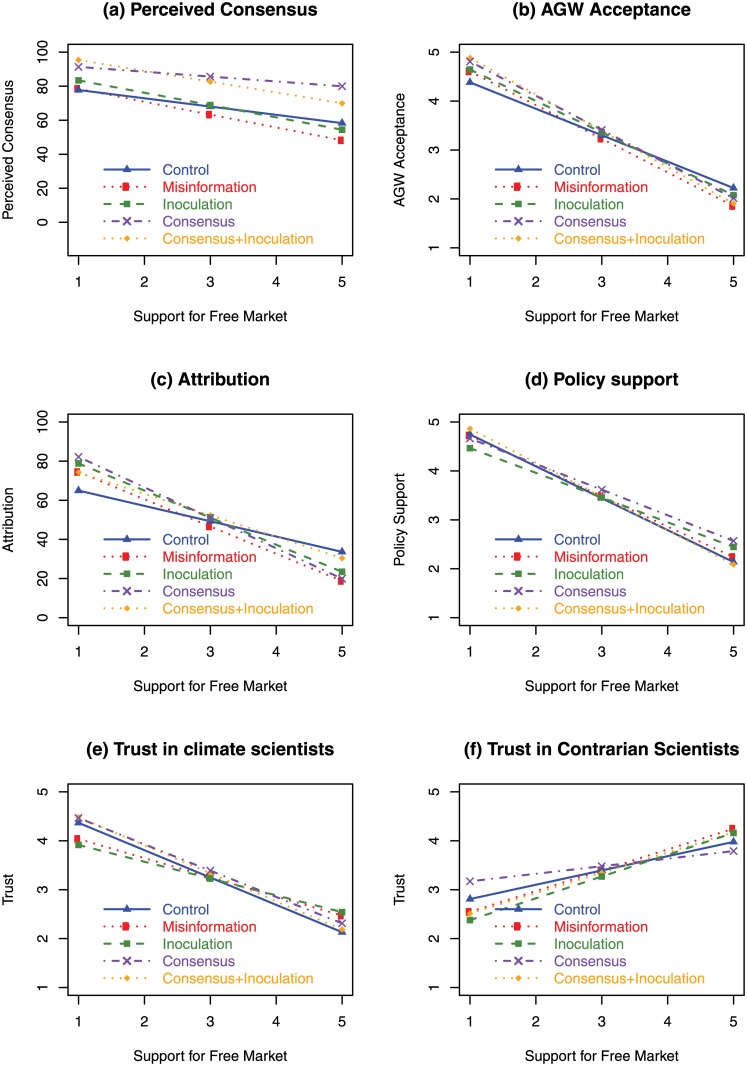
Misinformation can undermine a well-functioning democracy. For example, public misconceptions about climate change can lead to lowered acceptance of the reality of climate change and lowered support for mitigation policies. This study experimentally explored the impact of misinformation about climate change and tested several pre-emptive interventions designed to reduce the influence of misinformation. We found that false-balance media coverage (giving contrarian views equal voice with climate scientists) lowered perceived consensus overall, although the effect was greater among free-market supporters. Likewise, misinformation that confuses people about the level of scientific agreement regarding anthropogenic global warming (AGW) had a polarizing effect, with free-market supporters reducing their acceptance of AGW and those with low free-market support increasing their acceptance of AGW. However, we found that inoculating messages that (1) explain the flawed argumentation technique used in the misinformation or that (2) highlight the scientific consensus on climate change were effective in neutralizing those adverse effects of misinformation. We recommend that climate communication messages should take into account ways in which scientific content can be distorted, and include pre-emptive inoculation messages.
Overview
The claims and statistics of this paper haven’t been checked yet.
Free: it reads the open-access text and checks the first 5 claims that cite a source we can check. Create a free account to check every claim.
Integrity signals
Registry
Cites
Statistics
Figures

Verification
Claims the paper makes
The claims and statistics of this paper haven’t been checked yet.
Free: it reads the open-access text and checks the first 5 claims that cite a source we can check. Create a free account to check every claim.
Claims other papers make about this one
Each is checked against this paper’s own text: does it say what the citing paper says it does?
The check wasn’t confident either way, so it gives no verdict — never disputed.
In the citing paper
“Inoculation, while effective in preemptively refuting misinformation in specific domains (27–30), may not improve discernment when evaluating a diverse array of real-world news content.”
From A digital media literacy intervention increases discernment between mainstream and false news in the United States and India (2020) · cites this paper as [29]
Experimental — accuracy not yet measuredIn the citing paper
“focusing on the manipulation techniques and rhetorical strategies that underpin misinformation may significantly improve the potential scalability of inoculation interventions (17).”
From Psychological inoculation improves resilience against misinformation on social media (2022) · cites this paper as [17]
Self-check
Percentages, sums and reported differences re-computed from the paper’s own numbers.
The self-check needs the paper’s full text.
Citations
Cites
Maps of Bounded Rationality: Psychology for Behavioral Economics
Kahneman, D. (2003) · American Economic Review · doi:10.1257/000282803322655392 · Cited by 5,377
A Theory of Psychological Reactance
Torrance, E. P., & Brehm, J. W. (1968) · The American Journal of Psychology · doi:10.2307/1420824 · Cited by 4,759
Ohanian, R. (1990) · Journal of Advertising · doi:10.1080/00913367.1990.10673191 · Cited by 4,043 · cited 1×
“Five items measuring trust in climate scientists were adapted from Ohanian [55].”
BackgroundWhen Corrections Fail: The Persistence of Political Misperceptions
Nyhan, B., & Reifler, J. (2010) · Political Behavior · doi:10.1007/s11109-010-9112-2 · Cited by 3,173 · cited 1×
“For example, in one study, conservatives became more likely to believe that Iraq had weapons of mass destruction (WMDs) immediately before the war of 2003 after reading retractions clarifying that no WMDs existed at the time [11].”
BackgroundMisinformation and Its Correction: Continued Influence and Successful Debiasing
Lewandowsky, S., Ecker, U. K. H., Seifert, C. M., Schwarz, N., & Cook, J. (2012) · Psychological Science in the Public Interest · doi:10.1177/1529100612451018 · Cited by 2,920
Self-citationMcCright, A. M., & Dunlap, R. E. (2011) · The Sociological Quarterly · doi:10.1111/j.1533-8525.2011.01198.x · Cited by 2,340
The Scientific Consensus on Climate Change
Oreskes, N. (2004) · Science · doi:10.1126/science.1103618 · Cited by 1,814 · cited 1×
“Several studies have found nearly unanimous agreement among publishing climate 5 scientists that humans are causing global warming [22,23,24], and a similar pervasive consensus 6 exists in the scientific literature [25,26].”
BackgroundBalance as bias: global warming and the US prestige press
Boykoff, M. T., & Boykoff, J. M. (2004) · Global Environmental Change · doi:10.1016/j.gloenvcha.2003.10.001 · Cited by 1,699
Cultural cognition of scientific consensus.
Kahan, D. M., Jenkins‐Smith, H., & Braman, D. (2011) · Journal of Risk Research · doi:10.1080/13669877.2010.511246 · Cited by 1,686 · cited 1×
“Accordingly, climate change perceptions and attitudes have repeatedly been found to be strongly associated with political worldview [15,16,17,18].”
BackgroundConsensus on consensus: a synthesis of consensus estimates on human-caused global warming
Cook, J., Oreskes, N., Doran, P. T., Anderegg, W. R. L., Verheggen, B., Maibach, E. W., Carlton, J. S., Lewandowsky, S., Skuce, A. G., Green, S. A., et al. (2016) · Environmental Research Letters · doi:10.1088/1748-9326/11/4/048002 · Cited by 1,441
Self-citation
Cited by
Items 801–900 of 971
Schicker, S., & Ehrenmüller, J. (2023) · AUC PHILOLOGICA · doi:10.14712/24646830.2023.7
Pushkar, K., Sahu, R., Kapoor, S., Kaushik, S. K., Teli, P. T., Bobdey, S., & Yadav, A. K. (2023) · Indian Journal of Community and Family Medicine · doi:10.4103/ijcfm.ijcfm_26_22
Tope, O.-O. F., S.S., I., & Ukawuilulu, J. O. (2023) · World Journal of Advanced Research and Reviews · doi:10.30574/wjarr.2023.19.1.1485
O'Connell, M. (2023) · OSF Preprints (OSF Preprints) · doi:10.31219/osf.io/hdae5
Fallacies in Sustainability: a Systematic Review
de Lima, L. R., Freire, F. D. S., & da Silva, N. O. (2023) · Revista de Gestão Social e Ambiental · doi:10.24857/rgsa.v17n10-036 · Cited by 1
“Peer-reviewed articles and full texts will be considered Identify studies by research in the topic field (n = 1047)”
BackgroundInfluentialWho Seeks and Shares Fact-Checking Information? Within the Context of COVID-19 in South Korea
Seo, J., & Lee, J. Y. (2023) · Libri · doi:10.1515/libri-2023-0028
Leadership Communication in Crisis: Study of COVID- 19 Pandemic at National and Local Level
Oktaviani, F. H., Laturrakhmi, Y. F., & Kriyantono, R. (2023) · doi:10.11594/futscipress224
Public Relation Campaign on Social Media
Wardasari, N. (2023) · doi:10.11594/futscipress225 · Cited by 2
Illahi, A. K. (2023) · doi:10.11594/futscipress233 · Cited by 1
Countering Misinformation on Indonesian Digital Media Through Islamic Perspective
Rakhmawati, F. Y., & Destrity, N. A. (2023) · doi:10.11594/futscipress228 · Cited by 1
Online Media Activism and Political Participation of Urban Young Adults in Indonesia
Adila, I., Yustisia, I. R., & Avicenna, F. (2023) · doi:10.11594/futscipress226 · Cited by 2
Educational Messages to Combat COVID-19 Misinformation on Instagram
Destrity, N. A. (2023) · doi:10.11594/futscipress231
Strategic News Framing in Government Policy: Editors Perspectives in Malaysia
Kasim, A., Ahmad, M., Bidin, A., Adhrianti, L., & Zaki, N. M. (2023) · doi:10.11594/futscipress229
Tamitiadini, D. (2023) · doi:10.11594/futscipress232 · Cited by 3
Media Activism, Cultural Industry and Political Criticism Propaganda
Firmantoro, V. (2023) · doi:10.11594/futscipress230
Fake News and the COVID-19 Pandemic
van der Linden, S., & Roozenbeek, J. (2023) · Oxford University Press eBooks · doi:10.1093/oso/9780197615133.003.0036
Pavličić, J. (2023) · Theoria Beograd · doi:10.2298/theo2304033p
(2023) · Journal of Trial and Error · doi:10.36850/i3.1
Protecting democracy from disinformation: Implications for a model of communication
Sánchez, L., & Baselga, S. V. (2023) · Empedocles European Journal for the Philosophy of Communication · doi:10.1386/ejpc_00050_1 · Cited by 4
Contradicting potential climate misinformation during televised debates
Nielsen, S. B. (2024) · Pragmatics and Society · doi:10.1075/ps.23011.bec
Buczel, K. A., Siwiak, A., Kękuś, M., & Szpitalak, M. (2024) · OSF Preprints (OSF Preprints) · doi:10.31219/osf.io/hs2yb
The impact of information disorder on deliberative process
Klein, G. (2023) · Textual & Visual Media · doi:10.56418/txt.17.2.2023.2 · Cited by 2
Developing digital health literacy amidst the Covid-19 infodemic
Maglie, R. B., & Groicher, M. (2024) · Translation and Translanguaging in Multilingual Contexts · doi:10.1075/ttmc.00128.mag
Climate Change and Climate Technologies: Public Perceptions and Communication Challenges
Bertka, C. M. (2024) · Zygon® · doi:10.16995/zygon.11131
“He and others argue that understanding the consensus among scientists is a gateway to accepting climate change and its cause (Cook et al. 2017).”
BackgroundSenthilkumaran, A., Velautham, L., & Ranney, M. A. (2023) · Proceedings. · doi:10.22318/icls2023.259798
Chulluncuy, E. T. H., Monge, F. S., & Alvarado-Yepez, A. J. (2024) · Revista Argentina de Ciencias del Comportamiento ( RACC ) · doi:10.32348/1852.4206.v16.n1.44596
Fact or Fable: Your Guide to Fighting Misinformation
Katinka Dijkstra, B., Mollenbrok, A. S. D., Nguyen, G. T. Q., & Cijntje, G. E. (2024) · Frontiers for Young Minds · doi:10.3389/frym.2024.1272036
Climate Security and the Military
van Fenema, P. C., Beeres, R. J. M., Bertrand, R., de Rooij, J. P., Schijvenaars, G., Haitsma, S., & Hardeman, E. (2024) · Leiden University Press eBooks · doi:10.24415/9789087284381 · Cited by 2
Proposing a practical taxonomy of misinformation for intervention designPreprint
Enestrom, M. C., McKee, T. J., Pilat, D., & Krastev, S. (2024) · PsyArXiv (OSF Preprints) · doi:10.31234/osf.io/scwxv · Cited by 3
Political Advertising, Persuasion, and False News
Eddington, S. J. (2024) · Springer eBooks · doi:10.1007/978-3-031-56537-3_4
Lejano, R. P., Nero, S. J., & Chua, M. E. (2020) · Oxford University Press eBooks · doi:10.1093/oso/9780197542101.002.0007
Lejano, R. P., Nero, S. J., & Chua, M. E. (2020) · Oxford University Press eBooks · doi:10.1093/oso/9780197542101.002.0003
Lejano, R. P., Nero, S. J., & Chua, M. C. B. (2020) · Oxford University Press eBooks · doi:10.1093/oso/9780197542101.002.0005
List of articles analyzed for Chapter 3
Lejano, R. P., Nero, S. J., & Chua, M. C. B. (2020) · Oxford University Press eBooks · doi:10.1093/oso/9780197542101.005.0001
Sus: Modifying Among Us for Misinformation Discernment
Wells, G., Romhányi, Á., & Klaes, A. A. (2024) · International Conference on the Foundations of Digital Games (FDG) · doi:10.1145/3649921.3656990 · Cited by 2
Cormick, C., & Edelsztein, V. C. (2024) · Principia an international journal of epistemology · doi:10.5007/1808-1711.2024.e93904
“Even those authors who aim at “inoculating” the public against science denialism before it is exposed to its influence (Cook et al. 2017; Lewandowsky and van der Linden 2021; van der Linden et al. 2017) strive to counter such forms of misinformation rationally.”
BackgroundCase Study 5: The Inner Anti-hero and Eco-anxiety: A Student Movie from Sweden
Ahlin, O. (2024) · Springer eBooks · doi:10.1007/978-3-031-58708-5_19
Persuasion, Resistance, and Online Misinformation During Crisis
Geegan, S. A., Ivanov, B., & Parker, K. A. (2024) · Wiley eBooks · doi:10.1002/9781394184972.ch4 · Cited by 1
Tune-Attention Model: Designing Cybernetics Intervention for Information Sharing Behavior
Amin, Z., Ali, N. M., & Zinaida, R. S. (2024) · International Conference on Electronic and Electrical Engineering and Intelligent System (ICE3IS) · doi:10.1109/ice3is62977.2024.10775858
A Framework for Analysing Disinformation Narratives: Ukrainian Refugees in Bulgaria
Kiely, K. P., & Gargova, S. (2024) · Cybernetics and Information Technologies · doi:10.2478/cait-2024-0043 · Cited by 1
An evidence-accumulating drift–diffusion model of competing information spread on networks
Corsin, J., Zino, L., & Ye, M. (2025) · Chaos Solitons & Fractals · doi:10.1016/j.chaos.2024.115935
“Initially formalised in cognitive psychology [30], this phenomenon has since been extensively studied, with a focus on possible causes as well as mitigation strategies — both qualitative [31, 32] and quantitative [33].”
Argument refutation training as explanation for the mechanism of resistance in inoculation theory
Averbeck, J. M., Dey, S., Okor, F., Hill, B., & Ezeobi, C. (2025) · Argumentation and Advocacy · doi:10.1080/10511431.2025.2456891 · Cited by 1
“Cook, Lewandowsky, and Ecker (2017) utilized a misinformation intervention in which they inoculated individuals against “fake experts” on global warming.”
Denial versus reality of climate change
Jylhä, K. M. (2024) · Elsevier eBooks · doi:10.1016/b978-0-443-14082-2.00069-7
Bacchi, A. D. (2025) · International Journal of Health Education · doi:10.17267/2594-7907ijeh.2025.e5998
Farias, D. B. L. (2025) · Oxford University Press eBooks · doi:10.1093/oxfordhb/9780197762097.013.0040
Communicative Roles of Scientists in Intertwining Online Public Arenas: An Analytical Framework
Biermann, K. (2025) · Springer eBooks · doi:10.1007/978-981-96-1289-5_6
Fake news sharing and correction driven by COVID-19 prosociality
Ku, K. Y. L., Lu, Y., Zhou, Y., & Song, Y. (2025) · Journal of Applied Journalism & Media Studies · doi:10.1386/ajms_00175_1
Buczel, K. A., Siwiak, A., Kękuś, M., & Szpitalak, M. (2025) · Quarterly Journal of Experimental Psychology · doi:10.1177/17470218251336232 · Cited by 2
“Many successful efforts have applied inoculation strategies to reduce susceptibility to misinformation (e.g. Banas & Miller, 2013; Buczel et al., 2022; Cook et al., 2017; Jolley & Douglas, 2014; Roozenbeek & van der Linden, 2019; van der Linden et al., 2017; cf. Lewandowsky & van der Linden, 2021).”
Self-Inoculating Against MisinformationPreprint
Tanimura, S. (2025) · SSRN Electronic Journal · doi:10.2139/ssrn.5166958
Rico-Gutierrez, L. M., Garrido-Guillen, J. E., & García-Amezquita, L. E. (2025) · IEEE Global Engineering Education Conference (EDUCON) · doi:10.1109/educon62633.2025.11016363 · Cited by 2
Malachynskyi, N. (2025) · Scientific notes of the Institute of Journalism · doi:10.17721/2522-1272.2025.86.15
Disinformation From Within and Brandolini’s Law: A Call to Time-Consuming Action
Husser, C. S. (2025) · AJPM Focus · doi:10.1016/j.focus.2025.100389
Sánchez-Zavala, A., Avendaño, D., Durón-Ramos, M. F., Martínez-Vázquez, A., & Fasce, A. (2025) · Environment and Behavior · doi:10.1177/00139165251359472
“For climate change denialism, the dimension of “anthropogenic global warming acceptance” from Cook et al. (2017) was used.”
Fore! Does forewarning inoculate people against the false balance effect?
Han, T., Snook, B., & Day, M. V. (2025) · Legal and Criminological Psychology · doi:10.1111/lcrp.70004
“…with previous findings that inoculation offers limited additional benefit when consensus information (i.e. WOE) is already presented; for example, Cook et al. (2017) found that combining consensus information with an inoculation message (forewarning) before balanced messages results in similar…”
InfluentialSpiridonova, T., Stavrova, O., & van Beest, I. (2025) · Journal of Experimental Social Psychology · doi:10.1016/j.jesp.2025.104806 · Cited by 1
Zhang, B., Pinto, J., Prado, P., & Patterson, R. (2025) · Emerald Group Publishing Limited eBooks · doi:10.1108/978-1-83797-811-320251007
We have the vaccine for climate disinformation – let’s use it
Lewandowsky, S., & Hunter, J. R. (2020) · doi:10.64628/aa.wnt3xdqe7
Self-citationFacts versus feelings isn’t the way to think about communicating science
Cook, J., & van der Linden, S. (2017) · doi:10.64628/aai.w7t945uq6
Self-citationImmunizing intelligence: toward bias-aware algorithmic systems
Shin, D. (2025) · Elsevier eBooks · doi:10.1016/b978-0-443-16104-9.00005-1
Limited Impact of Interventions for Climate Belief: A Systematic Review Assessing Risk of Bias
Cardoso, N. D. O., de Oliveira, T. M., Massarani, L., Tagliapietra, K. D. R., & Machado, W. D. L. (2025) · Trends in Psychology · doi:10.1007/s43076-025-00485-5
Scientific Disinformation: A Transnational Public Problem
Pereira, F. H., & Domingo, D. (2025) · Canadian Journal of Communication · doi:10.3138/cjc-2025-0002
Gans, R. (2025) · SAGE Open · doi:10.1177/21582440251375922
“Inoculative messages have been demonstrated to be effective when administered in the absence of or before such attacks, that is, ‘‘pre-bunking’’ (Cook et al., 2017) but also to be effective when administered as a ‘‘debunking’’ repair or support strategy after such attacks (Dillingham & Ivanov,…”
Understanding the Dynamics of Misinformation and Disinformation: A Comprehensive Review
Bharti, V., Chitra, & Agarwal, S. (2025) · BENTHAM SCIENCE PUBLISHERS eBooks · doi:10.2174/9798898810030125040007 · Cited by 1
Prevention or Cure? The Joint Effects of Prebunking and Debunking on Electric-Vehicle AdoptionPreprint
Gambin, A., Munzel, A., & Goala, G. N. A. (2025) · SSRN Electronic Journal · doi:10.2139/ssrn.5573992
Invisible Waste: Information Pollution and Circular Economy Policy
Shouman, L. (2025) · IGI Global eBooks · doi:10.4018/979-8-3373-3852-1.ch006
Chen, L., Han, H., Li, D., & Fu, L. (2025) · Science Communication · doi:10.1177/10755470251378361 · Cited by 1
Leveraging inoculation theory to combat the spread of health misinformation
Gratale, S. K., Mercincavage, M., Joy, M., & Wackowski, O. A. (2025) · Behavioral Science & Policy · doi:10.1177/23794607251384736 · Cited by 1
“…Our findings support and extend prior tests of inoculation theory showing the effectiveness of using inoculation strategies to combat political and science-related misinformation 41,43,58 and also to inspire more global source skepticism that engenders continued resistance to suggestive marketing.”
Lee, S. Y., Seo, Y., & Moon, M. C. (2025) · Journal of Consumer Behaviour · doi:10.1002/cb.70075 · Cited by 2
Developing and Validating the Susceptibility to Pseudoscience Scale
Thome, E. K., & Finn, P. (2025) · American Journal of Speech-Language Pathology · doi:10.1044/2025_ajslp-25-00166
Understanding the mechanisms of infodemics: Equation-based vs. agent-based models
Berceanu, C., Bertolotti, F., Arshad, N., & Pătraşcu, M. (2025) · PLoS ONE · doi:10.1371/journal.pone.0338614
“Broader protection against different types of misleading tactics is offered by addressing the logical fallacies common in disinformation [104] or by challenging the plausibility of the misinformation or the credibility of its source.”
Additional file 1 of Correction format has a limited role when debunking misinformation
Swire‐Thompson, B., Cook, J., Butler, L. H., Sanderson, J. A., Lewandowsky, S., & Ecker, U. K. H. (2021) · Figshare · doi:10.6084/m9.figshare.17704552
Self-citationLewandowsky, S., & Yesilada, M. (2021) · Figshare · doi:10.6084/m9.figshare.15568200
Self-citationvan der Linden, S. (2025) · Apollo (University of Cambridge) · doi:10.17863/cam.120930
TrueAI: An AI-Enhanced Intervention to Prevent Fake News Spread Among older adults on Social Media
Zhou, L., Guan, X., & Liu, P. (2025) · ACM Conference on Computer Supported Cooperative Work (CSCW) · doi:10.1145/3715070.3749243
Baselga, S. V., Sosa, L. M., & Rodríguez, N. (2025) · Journal of Nationalism Memory & Language Politics · doi:10.2478/jnmlp-2025-0006
“Examples include polarization, emotional provocation, identity impersonation, disqualification of opponents, use of false expert opinions, and false balance between opposing opinions (Cook et al. 2017; Roozenbeek and van der Linden 2019; Wang 2020).”
Persuasive Inoculation Message Design Features
Ivanov, B., & Dillingham, L. L. (2026) · Wiley eBooks · doi:10.1002/9781394199372.ch8
Public Relations and Corporate Image
Geegan, S. A., Jaffe, D. E., & George, A. M. (2026) · Wiley eBooks · doi:10.1002/9781394199372.ch18
Inoculation Theory and the Media
Amissah, A. A., Sesenu, F., & Parker, K. A. (2026) · Wiley eBooks · doi:10.1002/9781394199372.ch25
Gori, P. (2026) · Springer eBooks · doi:10.1007/978-3-032-00480-2_17
Bruno, N., Santis, A. D., & Moriggi, S. (2025) · Media Education · doi:10.36253/me-18373
“As highlighted above, the educational architecture of the training drew inspiration from recent reinterpreta-tions of prebunking strategies (Cook et al., 2017; Ecker et al., 2022), adapted for educational contexts by Bruno and Moriggi (2023).”
Li, Y. (2026) · Journal of Applied Communication Research · doi:10.1080/00909882.2025.2573952
“Correcting cherished remedies or politicized claims can backfire by threatening identity or autonomy (Lewandowsky et al., 2017).”
Durón-Ramos, M. F., Collado, S., Corral-Verdugo, V., & Sánchez-Zavala, A. (2026) · PsyEcology Bilingual Journal of Environmental Psychology · doi:10.1177/21711976251414818
“Para evaluar la NCC se utilizó la escala de ‘aceptación del calentamiento global antropogénico’ de Cook et al. (2017), ins-trumento traducido por Fasce et al. (2021), que ha sido validado y utilizado en un país de habla his-pana como España.”
Inoculation theory as a design approach to game-based misinformation interventions: a review
Henderson, N., & Pallett, H. (2026) · Popular Communication · doi:10.1080/15405702.2026.2619473 · Cited by 2
“To further the scalability of inoculation theory, scholars have more recently sought to inoculate against persuasion techniques observed in misinformation, rather than (fallacious) arguments on a single issue (Cook et al., 2017; Lim & Ki, 2007; Roozenbeek & van der Linden, 2018, 2019).”
I Don't Remember: Measuring the Frequency and Impact of Source Recall in Misinformation Correction
Bode, L., & Vraga, E. K. (2026) · Newhouse Impact Journal · doi:10.14305/jn.29960819.2026.3.1.5
On Meta-Expertise, Dissent and Epistemic Trespassing: A Reply to Neil Levy
Duc, D. V., Hiernaux, Q., & Sartenaer, O. (2026) · Erkenntnis · doi:10.1007/s10670-026-01078-z
Who should fight the spread of fake news?
Riazi, D., & Livan, G. (2026) · Physica A Statistical Mechanics and its Applications · doi:10.1016/j.physa.2026.131396 · Cited by 2
Whose Line is it Anyway? Linguistic Attribution of Misinformation from Mainstream and Fringe LLMs
Kim, H. K., Garg, A., Kim, H., Joo, E., & Skumanich, A. (2025) · IEEE International Conference on Big Data (BigData) · doi:10.1109/bigdata66926.2025.11402634
“Reply with only ’A’ or ’B’. rhetorical tactic of fake expertise observed in human-generated misinformation [33], [39], where authoritative references are invoked to lend credibility to false claims.”
Silva, H. M. (2025) · Revista Pan-Amazônica de Saúde · doi:10.5123/s2176-6223202501803
Judging the Believability of Social Media Misinformation: Source and Message Distinctiveness
Ward, V., Rowe, T., Georgieva, M., Flanagan, L., Duderstadt, T., Connor, J. R., Abaya, R., Huntsinger, J. R., Forestal, J., Abuhamad, M., et al. (2026) · Psychological Reports · doi:10.1177/00332941261438080 · Cited by 1
Rofiqi, R., Fikri, I. F., & Sugianto, H. (2026) · Argumentation and Advocacy · doi:10.1080/10511431.2026.2646003
Cameron, D., Grage, L., Hennessy, T. W., Cheng, A., Quinn, M., Wyck, R. V., Meyer, J. A., Garcia, G., Mapaye, J. C., & Cueva, K. (2026) · BMC Public Health · doi:10.1186/s12889-026-26611-1
“The design was informed by several evidence-based strategies to insulate/inoculate against health misinformation [13–15, 29– 32 ], as well as A key element of the training also included the opportunity for participants to engage in role plays of realistic scenarios where they may encounter common…”
Quantifying the impact of Skeptical Science rebuttals in reducing climate misperceptions
Cook, J., Winkler, B., Maessen, C. J. H. M., Lubitz, T., Bostrom, D., & Nuccitelli, D. (2026) · Geoscience Communication · doi:10.5194/gc-9-145-2026 · Cited by 2
“…a psychological framework for reducing the influence of misinformation in a way that overcomes some of the cultural barriers such as political ideology (Cook et al., 2017a) This underscores the importance of incorporating fallacy explanations in rebut-tals, and measuring their effectiveness in…”
InfluentialSelf-citationFake News and the Honesty Crisis in Politics
Miller, C. (2026) · Oxford University Press eBooks · doi:10.1093/9780197840801.003.0006
Online Infidelity and the Honesty Crisis in Relationships
Miller, C. B. (2026) · Oxford University Press eBooks · doi:10.1093/9780197840801.003.0004
Metadata
- Authors
- Cook, J., Lewandowsky, S., & Ecker, U. K. H.
- Affiliations
- George Mason University (US)
- The University of Western Australia (AU)
- Corresponding author
- Cook, John
- Lewandowsky, Stephan
- Ecker, Ullrich K. H.
- Venue
- PLOS ONE
- Publisher
- Public Library of Science (PLoS)
- Published
- 2017-05-05
- Volume
- 12
- Issue
- 5
- Pages
- e0175799
- ISSN
- 1932-6203 (ISSN-L)
- PMC
- PMC5419564
- OpenAlex
- W2610353045
- Cited by
- 971
- References
- 80
- Citations by year
- 2026: 120 · 2025: 124 · 2024: 110 · 2023: 129 · 2022: 135 · 2021: 116 · 2020: 130 · 2019: 59 · 2018: 29 · 2017: 19
- FWCI
- 165.41
- Type
- journal article
- Language
- en
- Open access
- gold
- doi.org
- Licence
- Locations
- PLoS ONE (publishedVersion, cc-by)
- PubMed Central (publishedVersion, cc-by)
- UWA Profiles and Research Repository (UWA) (publishedVersion, cc-by)
- PubMed (publishedVersion)
- RePEc: Research Papers in Economics (submittedVersion)
- DOAJ (DOAJ: Directory of Open Access Journals) (submittedVersion, cc-by-sa)
- Figshare (submittedVersion, cc-by)
- Bristol Research (University of Bristol) (submittedVersion, cc-by)
- Explore Bristol Research (submittedVersion, cc-by)
- George Mason University (cc-by)
- Funders
- Australian Research Council
- Royal Society
- Psychonomics Society
- Topics
- Social Sciences › Sociology and Political Science › Climate Change Communication and Perception
- Social Sciences › Sociology and Political Science › Misinformation and Its Impacts
- Social Sciences › Economics, Econometrics and Finance › Economics and Econometrics › Climate Change Policy and Economics
- Keywords
- misinformation, inoculation, climate change misinformation, false balance, scientific consensus, anthropogenic climate change, free market ideology, political polarization, argumentation techniques, climate change communication
- MeSH terms
- Information Services, Climate Change
About these checks
Registry, retraction, Cites and statistics results are computed, not judged, with one exception: a printed reference that no index lists is read once by a model before it counts as a citation error. Claims are extracted by a model and kept only when their quote appears verbatim in the text; each cited source is then checked, with a model’s help, for whether it says what the claim relies on. Those verdicts can be wrong — read the claim’s quote and the cited source before relying on one.
Statistics and arithmetic are recomputed, not judged.
Confidence bands are shown only for fields calibrated on our annotated test set. None is calibrated yet, so no band is shown.
What counts as a claim ›How we measure confidence ›How we check this ›
Are you an author, or do you see a problem with this page? Request a review
Data sources
Bibliographic data: Semantic Scholar, OpenAlex, Crossref.
Contains information from the Semantic Scholar Academic Graph Datasets, made available under the ODC Attribution License (ODC-BY 1.0).
Semantic Scholar’s data is described in: Kinney, R., et al. (2023). The Semantic Scholar Open Data Platform. arXiv:2301.10140.
