

Neutralizing misinformation through inoculation: Exposing misleading argumentation techniques reduces their influence
Open accessThe DOI matches its Crossref record; 78 of the 80 references it cites were found in a registry or an index.
Abstract
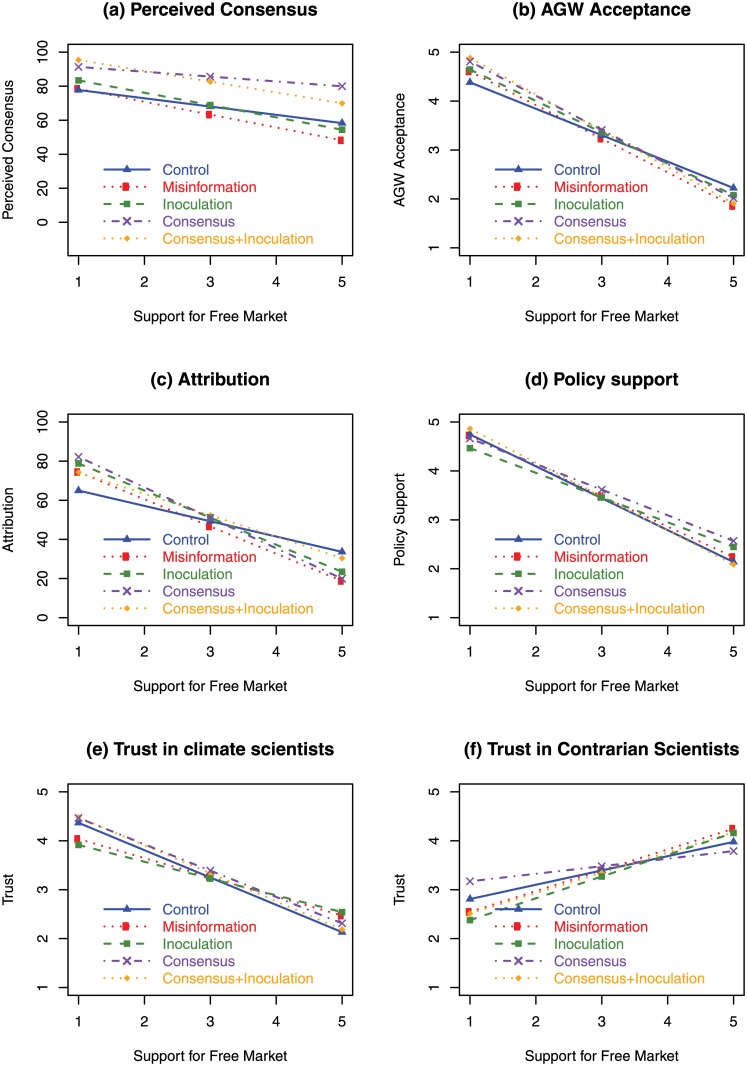
Misinformation can undermine a well-functioning democracy. For example, public misconceptions about climate change can lead to lowered acceptance of the reality of climate change and lowered support for mitigation policies. This study experimentally explored the impact of misinformation about climate change and tested several pre-emptive interventions designed to reduce the influence of misinformation. We found that false-balance media coverage (giving contrarian views equal voice with climate scientists) lowered perceived consensus overall, although the effect was greater among free-market supporters. Likewise, misinformation that confuses people about the level of scientific agreement regarding anthropogenic global warming (AGW) had a polarizing effect, with free-market supporters reducing their acceptance of AGW and those with low free-market support increasing their acceptance of AGW. However, we found that inoculating messages that (1) explain the flawed argumentation technique used in the misinformation or that (2) highlight the scientific consensus on climate change were effective in neutralizing those adverse effects of misinformation. We recommend that climate communication messages should take into account ways in which scientific content can be distorted, and include pre-emptive inoculation messages.
Overview
The claims and statistics of this paper haven’t been checked yet.
Free: it reads the open-access text and checks the first 5 claims that cite a source we can check. Create a free account to check every claim.
Integrity signals
Registry
Cites
Statistics
Figures

Verification
Claims the paper makes
The claims and statistics of this paper haven’t been checked yet.
Free: it reads the open-access text and checks the first 5 claims that cite a source we can check. Create a free account to check every claim.
Claims other papers make about this one
Each is checked against this paper’s own text: does it say what the citing paper says it does?
The check wasn’t confident either way, so it gives no verdict — never disputed.
In the citing paper
“Inoculation, while effective in preemptively refuting misinformation in specific domains (27–30), may not improve discernment when evaluating a diverse array of real-world news content.”
From A digital media literacy intervention increases discernment between mainstream and false news in the United States and India (2020) · cites this paper as [29]
Experimental — accuracy not yet measuredIn the citing paper
“focusing on the manipulation techniques and rhetorical strategies that underpin misinformation may significantly improve the potential scalability of inoculation interventions (17).”
From Psychological inoculation improves resilience against misinformation on social media (2022) · cites this paper as [17]
Self-check
Percentages, sums and reported differences re-computed from the paper’s own numbers.
The self-check needs the paper’s full text.
Citations
Cites
Maps of Bounded Rationality: Psychology for Behavioral Economics
Kahneman, D. (2003) · American Economic Review · doi:10.1257/000282803322655392 · Cited by 5,377
A Theory of Psychological Reactance
Torrance, E. P., & Brehm, J. W. (1968) · The American Journal of Psychology · doi:10.2307/1420824 · Cited by 4,759
Ohanian, R. (1990) · Journal of Advertising · doi:10.1080/00913367.1990.10673191 · Cited by 4,043 · cited 1×
“Five items measuring trust in climate scientists were adapted from Ohanian [55].”
BackgroundWhen Corrections Fail: The Persistence of Political Misperceptions
Nyhan, B., & Reifler, J. (2010) · Political Behavior · doi:10.1007/s11109-010-9112-2 · Cited by 3,173 · cited 1×
“For example, in one study, conservatives became more likely to believe that Iraq had weapons of mass destruction (WMDs) immediately before the war of 2003 after reading retractions clarifying that no WMDs existed at the time [11].”
BackgroundMisinformation and Its Correction: Continued Influence and Successful Debiasing
Lewandowsky, S., Ecker, U. K. H., Seifert, C. M., Schwarz, N., & Cook, J. (2012) · Psychological Science in the Public Interest · doi:10.1177/1529100612451018 · Cited by 2,920
Self-citationMcCright, A. M., & Dunlap, R. E. (2011) · The Sociological Quarterly · doi:10.1111/j.1533-8525.2011.01198.x · Cited by 2,340
The Scientific Consensus on Climate Change
Oreskes, N. (2004) · Science · doi:10.1126/science.1103618 · Cited by 1,814 · cited 1×
“Several studies have found nearly unanimous agreement among publishing climate 5 scientists that humans are causing global warming [22,23,24], and a similar pervasive consensus 6 exists in the scientific literature [25,26].”
BackgroundBalance as bias: global warming and the US prestige press
Boykoff, M. T., & Boykoff, J. M. (2004) · Global Environmental Change · doi:10.1016/j.gloenvcha.2003.10.001 · Cited by 1,699
Cultural cognition of scientific consensus.
Kahan, D. M., Jenkins‐Smith, H., & Braman, D. (2011) · Journal of Risk Research · doi:10.1080/13669877.2010.511246 · Cited by 1,686 · cited 1×
“Accordingly, climate change perceptions and attitudes have repeatedly been found to be strongly associated with political worldview [15,16,17,18].”
BackgroundConsensus on consensus: a synthesis of consensus estimates on human-caused global warming
Cook, J., Oreskes, N., Doran, P. T., Anderegg, W. R. L., Verheggen, B., Maibach, E. W., Carlton, J. S., Lewandowsky, S., Skuce, A. G., Green, S. A., et al. (2016) · Environmental Research Letters · doi:10.1088/1748-9326/11/4/048002 · Cited by 1,441
Self-citation
Cited by
Items 501–600 of 971
Fake News and Information Professionals’ Codes of Ethics
Bóte-Vericad, J.-J. (2020) · Telos Revista de Estudios Interdisciplinarios en Ciencias Sociales · doi:10.36390/telos223.07 · Cited by 6
Attention-Based Design and Selective Exposure Amid COVID-19 Misinformation Sharing
Amin, Z., Ali, N. M., & Smeaton, A. F. (2021) · Lecture notes in computer science · doi:10.1007/978-3-030-78468-3_34 · Cited by 7
McIlhiney, P., Gignac, G. E., Weinborn, M., & Ecker, U. K. H. (2021) · Quarterly Journal of Experimental Psychology · doi:10.1177/17470218211048986 · Cited by 10
“In fact, it has already been demonstrated that educationfocused interventions can be effective (e.g., Basol et al., 2020; Bonetto et al., 2018; Cook, 2017; Cook et al., 2014, 2017; Maertens et al., 2020; Osborne, 2010; Roozenbeek & van der Linden, 2019; van der Linden et al., 2017).”
BackgroundSelf-citationCredible narrators and misinformed readers
Houghton, K. J., Poirier, R. C., & Klin, C. M. (2022) · Memory & Cognition · doi:10.3758/s13421-022-01368-1 · Cited by 10
Belova, N., & Krause, M. (2023) · Chemistry Education Research and Practice · doi:10.1039/d2rp00191h · Cited by 8
Key Concepts and Definitions in Infodemic Management
Ishizumi, A., & Yau, B. (2023) · Springer eBooks · doi:10.1007/978-3-031-27789-4_2 · Cited by 7
Markowitz, S. (2023) · New Perspectives · doi:10.1177/2336825x231206718 · Cited by 7
“…that forewarning recipients about the tactics of climate change deniers and/or providing them correct information about the scienti fi c consensus on the issue substantially reduced false beliefs compared to those without this pre-bunking training (Cook et al., 2017; Van der Linden et al., 2017).”
BackgroundMatthews, K. R. W., Lowe, S. J., & Master, Z. (2024) · Cytotherapy · doi:10.1016/j.jcyt.2024.01.002 · Cited by 5
Unbundling Digital Media Literacy Tips: Results from Two Experiments
Guess, A. M., McGregor, S. C., Pennycook, G., & Rand, D. G. (2026) · Political Behavior · doi:10.1007/s11109-026-10165-4 · Cited by 7
Orosz, G., Faragó, L., Paskuj, B., Rakovics, Z., Sam-Mine, D., Audemard, G., Modeliar, M. S., & Krekó, P. (2024) · Scientific Reports · doi:10.1038/s41598-024-61232-x · Cited by 9
Expert opinion in mental disorder: Why is acceptance of the COVID-19 vaccines so problematic?
Gorman, J. M., Scales, D. A., & Gorman, S. E. (2021) · Personalized Medicine in Psychiatry · doi:10.1016/j.pmip.2021.100072 · Cited by 5
“[13,14].”
Counteracting Misinformation in Quotidian Settings
Rohman, A. (2021) · Lecture notes in computer science · doi:10.1007/978-3-030-71305-8_11 · Cited by 7
Rethinking the Infodemic: Social Media and Offline Action in the COVID-19 Pandemic
Heyerdahl, L. W., Lana, B., & Giles‐Vernick, T. (2021) · Economics, law, and institutions in Asia Pacific · doi:10.1007/978-981-16-5727-6_4 · Cited by 6
“( Compton et al. 2016; Cook et al. 2017; Lewandowsky and Van Der Linden 2021).”
Béchard, B., Kimmerle, J., Lawarée, J., Bédard, P.-O., Straus, S. E., & Ouimet, M. (2022) · International Journal of Environmental Research and Public Health · doi:10.3390/ijerph19106234 · Cited by 7
“This finding is consistent with experiments showing that consensus uncertainty backlashes toward the promoted intervention [60,61].”
ResultSILVA, K. M. F. D. C. E., & Presser, N. H. (2023) · Em Questão · doi:10.19132/1808-5245.29.124379 · Cited by 8
Sheng, A. Y., Gottlieb, M. A., Bautista, J. R., Trueger, N. S., Westafer, L. M., & Gisondi, M. A. (2023) · AEM Education and Training · doi:10.1002/aet2.10877 · Cited by 7
Sánchez, L., Baselga, S. V., & Faure‐Carvallo, A. (2024) · Revista Latina de Comunicación Social · doi:10.4185/rlcs-2024-2268 · Cited by 10
“Nuestra estructura cognitiva es tal que predomina el razonamiento motivado, aquel que está al servicio de los juicios iniciales que formulamos a partir de las emociones (Haidt, 2021, 2006, 2012; Cook et al ., 2017; Strong, 2017; McDermott, 2019).”
BackgroundMoreland, H. R., Santo, E. M. D., & MacDonald, B. H. (2021) · FACETS · doi:10.1139/facets-2020-0109 · Cited by 7
Gateway Illusion or Cultural Cognition Confusion?Preprint
van der Linden, S., Leiserowitz, A., & Maibach, E. W. (2018) · SSRN Electronic Journal · doi:10.2139/ssrn.3094256 · Cited by 7
Managing Science Communication in a Pandemic
(2021) · doi:10.1002/9781119751809.ch1 · Cited by 5
Panizza, F., Ronzani, P., Mattavelli, S., Morisseau, T., Martini, C., & Motterlini, M. (2021) · Research Square · doi:10.21203/rs.3.rs-952649/v1 · Cited by 5
“These include debunking, the 31 systematic correction of false claims after they have been seen or heard [9, 10], 32 pre-bunking, preventive measures before exposure to disinformation [5, 11], nudging, 33 interventions affecting users’ choices without limiting their freedom of choice [12], and 34”
BackgroundOrosz, G., Faragó, L., Paskuj, B., & Krekó, P. (2022) · Research Square · doi:10.21203/rs.3.rs-2159993/v1 · Cited by 6
Social Media Misinformation About Extreme Weather Events and Climate Change
Wright, K. B. (2022) · Wiley eBooks · doi:10.1002/9781119751847.ch9 · Cited by 6
Missed Risk and Crisis Communication Opportunities During the COVID‐19 Pandemic
Liu, B. F., & Baur, C. (2025) · Wiley eBooks · doi:10.1002/9781394180844.ch13 · Cited by 5
Fake News and True News Assessment: The Persuasive Effect of Discursive Evidence in Judging Veracity
Baiyere, A., Bauer, J., Constantiou, I., & Hardt, D. (2025) · MIS Quarterly · doi:10.25300/misq/2024/17542 · Cited by 5
Törnberg, A., & Törnberg, P. (2025) · Environmental Politics · doi:10.1080/09644016.2025.2557684 · Cited by 15
“This paper contributes to the growing literature on climate communication, misinformation, and denialism (Dunlap and McCright 2015, Cook et al .”
Jones, C., & Bergen, B. K. (2026) · Artificial Intelligence Review · doi:10.1007/s10462-026-11517-6 · Cited by 63
Vaino, K., Korfiatis, K., Сергеевна, А. А., Попов, О., Valdmann, A., & Orru, H. (2026) · Science & Education · doi:10.1007/s11191-026-00736-6 · Cited by 6
Countering Violent Extremism in the U.S. Military
Helmus, T. C., Byrne, H., & Mallory, C. K. (2021) · RAND Corporation eBooks · doi:10.7249/rra1226-1 · Cited by 4
The Effects of Corrective Strategies on Romantic Belief Endorsement
Moore, M. M., Green, M. C., Ophir, Y., & Wang, H. (2023) · Communication Research · doi:10.1177/00936502221138428 · Cited by 6
“Forewarning individuals about future attempts at persuasion is most effective when combined with a rationale against the message, thus correcting the belief rather than simply highlighting incorrect information (Cook et al., 2017).”
BackgroundEndorsement of scientific inquiry promotes better evaluation of climate policy evidence
Hughes, J. E., Sauer, J. D., Drummond, A., Brumby, L. E., & Palmer, M. A. (2023) · Climatic Change · doi:10.1007/s10584-023-03535-y · Cited by 7
Spampatti, T., Brosch, T., Trutnevyte, E., & Hahnel, U. J. J. (2023) · Collabra Psychology · doi:10.1525/collabra.98755 · Cited by 5
Análisis del movimiento antivacunas en Twitter: una perspectiva latinoamericana
Edelsztein, V. C., & Cormick, C. (2023) · Journal of Science Communication América Latina · doi:10.22323/3.06020209 · Cited by 5
Relationship Between Resilience and School Culture with Psychological Well-Being of School Teachers
Zin, N. I. M., Zainudin, Z. N., & Sulong, R. M. (2023) · International Journal of Academic Research in Business and Social Sciences · doi:10.6007/ijarbss/v13-i12/20381 · Cited by 8
Zerback, T., & Schneiders, P. (2024) · Journalism · doi:10.1177/14648849231226030 · Cited by 8
“In its mistaken form, balance suggests an erroneous equivalence of the argumentative quality of dissenting viewpoints, disconnecting popular from scienti fi c discourse (Cook et al., 2017).”
Journalism for the Climate and Biodiversity Crises
Mocatta, G. (2024) · Springer eBooks · doi:10.1007/978-3-031-49084-2_14 · Cited by 9
The Relationship Between News Coverage of COVID-19 Misinformation and Online Search Behavior
Douglas-Durham, E., Tan, A. S. L., Emmons, K. M., & Viswanath, K. (2024) · Health Communication · doi:10.1080/10410236.2024.2395155 · Cited by 6
“For example, inoculating messages that highlight scientific consensus or expose the flawed arguments of those peddling misinformation have been effective in reducing belief in misinformation (Cook et al., 2017; Traberg et al., 2022).”
Inoculation reduces social media engagement with affectively polarized content in the UK and US
Smith, F., Simchon, A., Holford, D. L., & Lewandowsky, S. (2025) · Communications Psychology · doi:10.1038/s44271-025-00189-7 · Cited by 7
Self-citationThe Gateway Belief Model: A pre-registered large-scale replication in China
Zeng, Z., van Prooijen, J., Guo, Y., & van der Linden, S. (2025) · Journal of Environmental Psychology · doi:10.1016/j.jenvp.2025.102542 · Cited by 4
Sosyal Medyada Dijital Dezenformasyon: İletişim Başkanlığı Filistin Özel Bülteni Üzerine Bir Analiz
Yıldız, İ. (2025) · Ahi Evran Üniversitesi Sosyal Bilimler Enstitüsü Dergisi · doi:10.31592/aeusbed.1595546 · Cited by 5
Using authentic science in climate change education
Jordan, R., Sorensen, A. E., Shwom, R., Robinson, J. M., Isenhour, C., Gray, S., Nucci, M. L., & Ebert‐May, D. (2018) · Applied Environmental Education & Communication · doi:10.1080/1533015x.2018.1431162 · Cited by 5
“A recent study (Cook et al., 2017) focused on what messages could “inoculate” against misperceptions and thus decrease susceptibility.”
BackgroundRecognizing the Role of Psychological Science in Improving Online Spaces
Fazio, L. K. (2020) · Gothic.net · doi:10.1177/1529100620972100 · Cited by 3
A Pilot Study Investigating STEM Learners’ Ability to Decipher AI-generated Video
Shu, D., Doss, C., Mondschein, J., Kopecky, D., Fitton-Kane, V. A., Bush, L. B., & Tucker, C. S. (2021) · ASEE Annual Conference & Exposition · doi:10.18260/1-2--36601 · Cited by 6
“Exposure to and belief in the authenticity of misinformation, have been shown to implant false memories of previous events [22], foster doubts about scientific consensus [23], and convince individuals of the veracity of conspiracy theories [24].”
BackgroundOvercoming Knowledge Resistance: A Systematic Review of Experimental Studies
Ingre, M., Lindholm, T., & Strömbäck, J. (2022) · Routledge eBooks · doi:10.4324/9781003111474-14 · Cited by 4
The Problem of Misinformation and Disinformation Online
Rubin, V. L. (2022) · Springer eBooks · doi:10.1007/978-3-030-95656-1_1 · Cited by 5
Stagnaro, M. N., Pink, S. L., Rand, D. G., & Willer, R. (2023) · Harvard Kennedy School Misinformation Review · doi:10.37016/mr-2020-128 · Cited by 9
“This ineffectiveness stands in contrast to other interventions — such as fact checks (Cook et al., 2017; Lewandowsky et al., 2020; Pennycook et al., 2020; Persily & Tucker, 2020; Wittenberg & Berinsky, 2020), digital literacy tips (Guess et al., 2020), deliberation manipulations (Bago et al.,…”
ResultTorrico, D. V., Lera, M. H., & Puente, V. G. (2024) · Zer - Revista de Estudios de Comunicación · doi:10.1387/zer.25929 · Cited by 11
“Pese al acuerdo unánime entre la comunidad científica, el debate público en torno a la crisis climática presenta cada vez una mayor división, bien por la polari-zación ideológica (Cook et al., 2017) o por el distanciamiento psicológico frente al problema (Corner et al., 2015).”
BackgroundSocio-Life Science and the COVID-19 Outbreak: Public Health and Public Policy
Yano, M., Matsuda, F., Sakuntabhai, A., & Hirota, S. (2021) · Economics, law, and institutions in Asia Pacific · doi:10.1007/978-981-16-5727-6 · Cited by 8
Southwell, B. G., & Boudewyns, V. (2018) · doi:10.3768/rtipress.2018.cp.0008.1812 · Cited by 5
Correction after misinformation: Does engagement in media multitasking affect attitude adjustment?
Szumowska, E., Czarnek, G., Dragon, P., & keersmaecker, J. D. (2020) · Comprehensive Results in Social Psychology · doi:10.1080/23743603.2021.1884495 · Cited by 5
Johnson, S. S. (2022) · American Journal of Health Promotion · doi:10.1177/08901171211070957a · Cited by 11
Trémolière, B., & Djeriouat, H. (2020) · PsyArXiv (OSF Preprints) · doi:10.31234/osf.io/vp8k6 · Cited by 4
Ocean Science Diplomacy. The All-Atlantic Ocean Research Alliance case
Polejack, A. (2022) · doi:10.21677/phd220702 · Cited by 5
Inoculation Against Misinformation
Maertens, R., Roozenbeek, J., & van der Linden, S. (2026) · Wiley eBooks · doi:10.1002/9781394199372.ch22 · Cited by 5
Verma, A. K., Sharma, A., Sharma, A. K., Prakash, A., & Das, A. (2023) · Journal of Content Community and Communication · doi:10.31620/jccc.06.23/03 · Cited by 6
Understandings of neutrality and its origins in young Austrian adults
Phillips, R., Prinz, W. H., & Straub, G. C. (2025) · European Politics and Society · doi:10.1080/23745118.2025.2482947 · Cited by 4
“For example, research highlights that factual, nuanced and deep understandings of realities can make individuals less likely to accept new information uncritically, as existing knowledge allows to evaluate and integrate new information more e ff ectively (Cook et al., 2017; Lewandowsky et al., 2012).”
Black Summer arson: Examining the impact of climate misinformation and corrections on reasoning
Spearing, E. R., Newman, E. J., Walker, I. A., Cook, J., Kurz, T., & Ecker, U. K. H. (2025) · Journal of Environmental Psychology · doi:10.1016/j.jenvp.2025.102842 · Cited by 4
Self-citationvan Eck, C. W., Hameleers, M., & van der Goot, E. S. (2025) · Communication Theory · doi:10.1093/ct/qtaf033 · Cited by 4
Inoculation Strategies for Misinformation Resistance: A Multidimensional Intervention Approach
Yang, Y., Hu, W., Zhou, J., & Xiang, H. (2025) · International Journal of Human-Computer Interaction · doi:10.1080/10447318.2025.2607550 · Cited by 4
Race, intelligence and genetics: colonialism in the era of neurotechnology
Pyrrho, M. (2026) · Frontiers in Public Health · doi:10.3389/fpubh.2025.1737069 · Cited by 4
“Broadening or narrowing scope, changing focus, claiming that those who point out ethical risks are detrimental to human welfare, all of which is functional to avoid debating and addressing ethical challenges (44).”
Selva, G. L., Monacis, L., & van der Linden, S. (2026) · Journal of Environmental Psychology · doi:10.1016/j.jenvp.2026.103029 · Cited by 6
Graulich, N., Arnold, J. C., Sorge, S., & Kubsch, M. (2024) · Waxmann Verlag GmbH eBooks · doi:10.31244/9783830997962 · Cited by 10
Nudging punishment against sharing of fake news
Meiske, B., Álvarez-Benjumea, A., Andrighetto, G., & di Sorrentino, E. P. (2024) · European Economic Review · doi:10.1016/j.euroecorev.2024.104795 · Cited by 11
Confronting Fake News Through Collective Intelligence in Adolescents
Salinas, A. C., Saso, C. E., Íñiguez‐Berrozpe, T., & Bautista, P. (2024) · International Journal of Human-Computer Interaction · doi:10.1080/10447318.2024.2405567 · Cited by 9
“…has had varying degrees of negative consequences, from confusion over what is true and what is not (Rapp & Salovich, 2018), to driving people to dangerous behavior based on false information (Kim & Tandoc, 2022), and disbelief regarding scientifically proven facts and phenomena (Cook et al., 2017).”
Inoculating Against Moral Disengagement Creates Ethical Adherence for Narcissism
Jones, D. N., Beekun, R. I., Schermer, J. A., MacDonald, K. B., & Compton, J. (2024) · Personality and Social Psychology Bulletin · doi:10.1177/01461672241276562 · Cited by 4
“…applied to political communication (e.g., Pfau & Burgoon, 1988; see Compton & Ivanov, 2013, for a review), health communication (e.g., Wong & Harrison, 2014; see Compton et al., 2016, for a review), science communication (e.g., Cook et al., 2017; see Compton et al., 2021, for a review), and more.”
Lu, Z., Li, P., Wang, W., & Yin, M. (2025) · CHI Conference on Human Factors in Computing Systems · doi:10.1145/3706598.3713871 · Cited by 7
“For instance, platforms may share expert consensus on a topic to “inoculate” the public against false information [10, 20, 120, 120], and systems have been developed to help center users’ engagement with information around credibility [44].”
Machine Learning-powered Job Offer Verification
Vigneshwaran, N., Vijayaraj, A., Murugan, V., Jebakumar, J., Mageshkumar, N., & Megavannan, R. (2025) · International Conference on Data Science, Agents & Artificial Intelligence (ICDSAAI) · doi:10.1109/icdsaai65575.2025.11011776 · Cited by 3
“Cook, Lewandowsky, and Ecker [7] advanced the field by proposing inoculation strategies to neutralize misinformation, emphasizing the exposure of misleading argumentation techniques.”
Zhang, B., & Schmierbach, M. (2025) · Journal of Science Communication · doi:10.22323/jcom.1502 · Cited by 4
The complexity of misinformation extends beyond virus and warfare analogies
Frischlich, L., Olsson, H., Roy, A., Schulze, H., Rhodes, S., & Mansheim, A. S. (2025) · npj Complexity · doi:10.1038/s44260-025-00053-z · Cited by 9
Garnier, S., & Moussaïd, M. (2022) · Collective Intelligence · doi:10.1177/26339137221133400 · Cited by 10
“For instance, a short message teaching people the manipulation techniques commonly used to spread most false information can considerably reduce the impact of climate change misinformation (Cook et al., 2017).”
BackgroundDavidović, J. (2022) · CM Communication and Media · doi:10.5937/cm17-34211 · Cited by 8
Social Media Harms as a Trilemma: Asymmetry, Algorithms, and Audacious Design Choices
Cheong, M. (2022) · IEEE International Symposium on Technology and Society (ISTAS) · doi:10.1109/istas55053.2022.10227099 · Cited by 7
Let's call! Using the phone to increase vaccine acceptance
Armand, A., Fracchia, M., & Vicente, P. C. (2023) · Health Economics · doi:10.1002/hec.4760 · Cited by 4
“…communication strategies based on the theory of psychological inoculation have successfully promoted resistance to false or misleading messages by exposing individuals to weakened versions of those messages in advance (McGuire, 1964; Miller et al., 2013; Cook, Lewandowsky, and Ecker, 2017).”
A Mild Approach to Prebunking Health Misinformation in Social Media: Digital Nudging
Li, X., Liu, M., Lian, J., Zhu, Q., & Song, X. (2023) · Proceedings of the Association for Information Science and Technology · doi:10.1002/pra2.938 · Cited by 5
“Besides, previous studies mainly center on the design of prebunking information content (Cook et al., 2017), disregarding the impact of external features of the technological environment like social media.”
BackgroundSchirrmacher, B., & Mousavi, N. (2023) · Palgrave Studies in Intermediality · doi:10.1007/978-3-031-42064-1 · Cited by 4
How Epistemic Beliefs about Climate Change Predict Climate Change Conspiracy Beliefs
Nöth, L., & Zander, L. (2025) · Frontiers in Psychology · doi:10.3389/fpsyg.2025.1523143 · Cited by 5
Science education in the age of misinformation
Gerges, E. (2025) · Frontiers in Education · doi:10.3389/feduc.2025.1615769 · Cited by 14
Promouvoir la résilience vaccinale à l’ère de l’information numérique
MacDonald, N. E., & Dubé, È. (2020) · Relevé des maladies transmissibles au Canada · doi:10.14745/ccdr.v46i01a04f · Cited by 4
“Comme indiqué précédemment, il peut s’avérer utile d’informer les gens sur les tactiques anti-vaccination dans des forums publics (20,21).”
BackgroundThe absence of a media literacy toolbox: working towards an evaluation tool
Yakub, G., Knight, S., Kitto, K., & Fray, P. (2020) · Communication Research and Practice · doi:10.1080/22041451.2020.1802844 · Cited by 4
Ngwainmbi, E. K. (2020) · Communication Society and Media · doi:10.22158/csm.v3n3p47 · Cited by 3
Quando a Fake News acelera o Antropoceno: o caso da Floresta Amazônica (2018-2021)
Calbino, D. (2022) · Liinc em Revista · doi:10.18617/liinc.v18i1.5927 · Cited by 13
Olaseni, A. O., & Olley, B. O. (2022) · Basic and Applied Social Psychology · doi:10.1080/01973533.2022.2090840 · Cited by 3
“The study of Cook et al. (2017) purposed to experimentally explore the impact of misinformation about climate change and tested several preemptive interventions designed to reduce the influence of misinformation.”
BackgroundScannell, D., Desens, L., Day, D. S., & Tra, Y. (2022) · Medical Research Archives · doi:10.18103/mra.v10i5.2822 · Cited by 3
McKenna, R. (2023) · Oxford University Press eBooks · doi:10.1093/oso/9780192888822.003.0002 · Cited by 3
Johnston, E. L. (2018) · Journal and proceedings of the Royal Society of New South Wales · doi:10.5962/p.361820 · Cited by 3
Science Communication and Inoculation
Ivanov, B., & Parker, K. A. (2021) · Wiley eBooks · doi:10.1002/9781119751809.ch13 · Cited by 6
Lateral reading and monetary incentives to sort out scientific (dis)informationPreprint
Panizza, F., Ronzani, P., Mattavelli, S., Morisseau, T., Martini, C., & Motterlini, M. (2021) · PsyArXiv (OSF Preprints) · doi:10.31234/osf.io/vuqd3 · Cited by 2
Climate misinformation is rife on social media – and poised to get worse
Hopke, J. E. (2025) · The Conversation · doi:10.64628/aai.uhgerfk7v · Cited by 3
The Physician’s Role in Countering Medical Misinformation Through Advocacy
Henry, T. L., & Olakunle, O. E. (2024) · Population Health Management · doi:10.1089/pop.2024.0031 · Cited by 2
Young people’s perceptions of climate change in Africa: A scoping review
Kulanga, S. G., Masao, C. A., Kafanabo, E. J., & Skovdal, M. (2025) · Global Studies of Childhood · doi:10.1177/20436106251349848 · Cited by 4
“According to Cook et al. (2017), misinformation concerning the established scientific consensus regarding climate change results in a division of opinions and attitudes toward the phenomenon.”
Zain, A., Wen, T. J., & Ittefaq, M. (2025) · Cogent Social Sciences · doi:10.1080/23311886.2025.2559860 · Cited by 5
“Consequently, misinformed audiences may make decisions leading to unfavorable outcomes, including shaping government policies (Cook, 2022; Cook et al., 2017; lewandowsky et al., 2017).”
Khan, M., & Shekar, M. C. (2025) · Digital Policy Regulation and Governance · doi:10.1108/dprg-04-2025-0088 · Cited by 2
Testing the impact of fallacies and contrarian claims in climate change misinformation
Lieu, R., Hayes, O. R., & Cook, J. (2025) · British Journal of Psychology · doi:10.1111/bjop.70049 · Cited by 3
Self-citationCarlsson, N. F. (2025) · Journal of Documentation · doi:10.1108/jd-09-2025-0276 · Cited by 9
“Moreover, inoculation research suggests that pre-exposing youth to common meme tropes (emotional hooks, conspiratorial framing) “vaccinates” them against uncritical sharing (Cook et al ., 2017; Iaia, 2023).”
Countering the forgetting of novel health information with ‘social boosting’
Krishna, V., & Christakis, N. A. (2026) · SSM - Population Health · doi:10.1016/j.ssmph.2026.101902 · Cited by 2
“Despite the importance of people being well-informed, repeated exposure to low-quality or false information can lead to its acceptance, even if it is harmful — a phenomenon known as the “ illusion of truth ” (Cook et al., 2017; Hassan & Barber, 2021; Pennycook et al., 2018).”
Wang, R., Lei, Z., & Xiao, L. (2026) · International Journal of Information Management · doi:10.1016/j.ijinfomgt.2026.103049 · Cited by 5
Loughnan, D., van Stekelenburg, A., Pouwels, J. L., Fransen, M. L., & Kleemans, M. (2026) · Communication Research · doi:10.1177/00936502251411467 · Cited by 3
“In recent years, inoculation research has incorporated technique-based inoculation (also termed logic-based; Banas & Miller, 2013; Compton et al., 2021; Cook et al., 2017; Lewandowsky & van der Linden, 2021).”
Cook, J., Njomo, D. W., Aura, C., Wamalwa, B., Abeyesekera, S., Ssanyu, J. N., Kabwijamu, L., Ofire, M., Lepage, C., Thomson, A., et al. (2025) · Pan African Medical Journal · doi:10.11604/pamj.supp.2025.51.1.48540 · Cited by 2
Self-citationRenbiao, Y., & Cao, G. (2026) · Computers in Human Behavior · doi:10.1016/j.chb.2026.109031 · Cited by 3
Roșu, M.-M., Cosmoiu, A., Ianole-Călin, R., & Podină, I. (2021) · Current Psychology · doi:10.1007/s12144-021-02427-7 · Cited by 3
Metadata
- Authors
- Cook, J., Lewandowsky, S., & Ecker, U. K. H.
- Affiliations
- George Mason University (US)
- The University of Western Australia (AU)
- Corresponding author
- Cook, John
- Lewandowsky, Stephan
- Ecker, Ullrich K. H.
- Venue
- PLOS ONE
- Publisher
- Public Library of Science (PLoS)
- Published
- 2017-05-05
- Volume
- 12
- Issue
- 5
- Pages
- e0175799
- ISSN
- 1932-6203 (ISSN-L)
- PMC
- PMC5419564
- OpenAlex
- W2610353045
- Cited by
- 971
- References
- 80
- Citations by year
- 2026: 120 · 2025: 124 · 2024: 110 · 2023: 129 · 2022: 135 · 2021: 116 · 2020: 130 · 2019: 59 · 2018: 29 · 2017: 19
- FWCI
- 165.41
- Type
- journal article
- Language
- en
- Open access
- gold
- doi.org
- Licence
- Locations
- PLoS ONE (publishedVersion, cc-by)
- PubMed Central (publishedVersion, cc-by)
- UWA Profiles and Research Repository (UWA) (publishedVersion, cc-by)
- PubMed (publishedVersion)
- RePEc: Research Papers in Economics (submittedVersion)
- DOAJ (DOAJ: Directory of Open Access Journals) (submittedVersion, cc-by-sa)
- Figshare (submittedVersion, cc-by)
- Bristol Research (University of Bristol) (submittedVersion, cc-by)
- Explore Bristol Research (submittedVersion, cc-by)
- George Mason University (cc-by)
- Funders
- Australian Research Council
- Royal Society
- Psychonomics Society
- Topics
- Social Sciences › Sociology and Political Science › Climate Change Communication and Perception
- Social Sciences › Sociology and Political Science › Misinformation and Its Impacts
- Social Sciences › Economics, Econometrics and Finance › Economics and Econometrics › Climate Change Policy and Economics
- Keywords
- misinformation, inoculation, climate change misinformation, false balance, scientific consensus, anthropogenic climate change, free market ideology, political polarization, argumentation techniques, climate change communication
- MeSH terms
- Information Services, Climate Change
About these checks
Registry, retraction, Cites and statistics results are computed, not judged, with one exception: a printed reference that no index lists is read once by a model before it counts as a citation error. Claims are extracted by a model and kept only when their quote appears verbatim in the text; each cited source is then checked, with a model’s help, for whether it says what the claim relies on. Those verdicts can be wrong — read the claim’s quote and the cited source before relying on one.
Statistics and arithmetic are recomputed, not judged.
Confidence bands are shown only for fields calibrated on our annotated test set. None is calibrated yet, so no band is shown.
What counts as a claim ›How we measure confidence ›How we check this ›
Are you an author, or do you see a problem with this page? Request a review
Data sources
Bibliographic data: Semantic Scholar, OpenAlex, Crossref.
Contains information from the Semantic Scholar Academic Graph Datasets, made available under the ODC Attribution License (ODC-BY 1.0).
Semantic Scholar’s data is described in: Kinney, R., et al. (2023). The Semantic Scholar Open Data Platform. arXiv:2301.10140.
