

Neutralizing misinformation through inoculation: Exposing misleading argumentation techniques reduces their influence
Open accessThe DOI matches its Crossref record; 78 of the 80 references it cites were found in a registry or an index.
Abstract
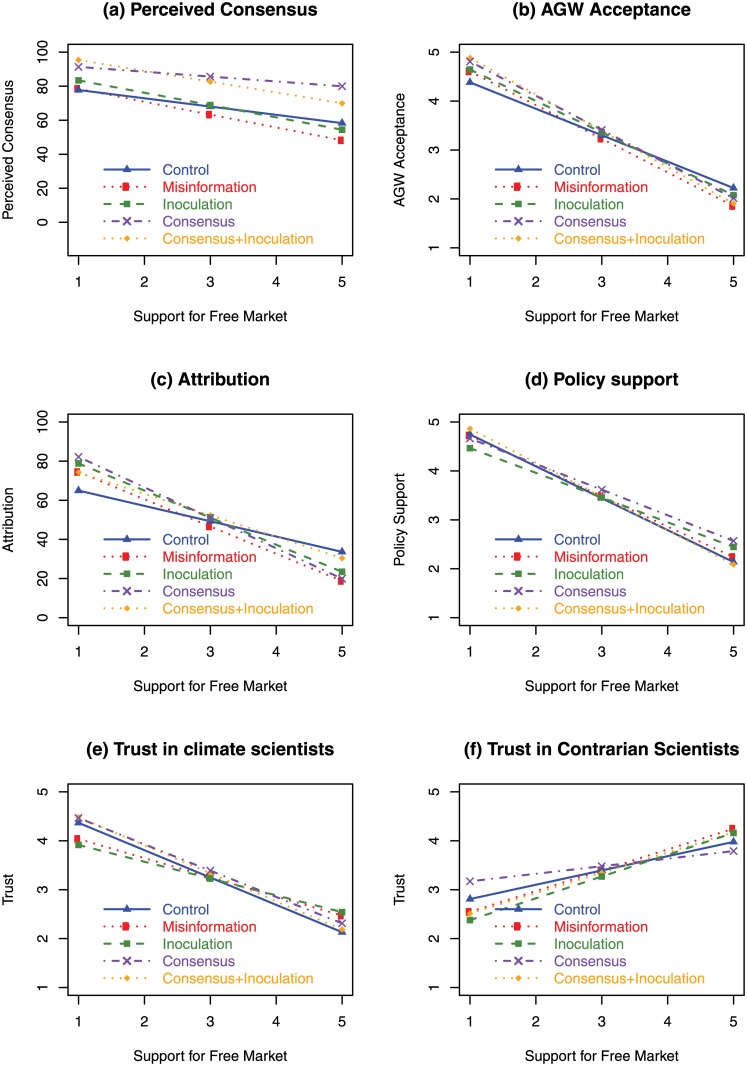
Misinformation can undermine a well-functioning democracy. For example, public misconceptions about climate change can lead to lowered acceptance of the reality of climate change and lowered support for mitigation policies. This study experimentally explored the impact of misinformation about climate change and tested several pre-emptive interventions designed to reduce the influence of misinformation. We found that false-balance media coverage (giving contrarian views equal voice with climate scientists) lowered perceived consensus overall, although the effect was greater among free-market supporters. Likewise, misinformation that confuses people about the level of scientific agreement regarding anthropogenic global warming (AGW) had a polarizing effect, with free-market supporters reducing their acceptance of AGW and those with low free-market support increasing their acceptance of AGW. However, we found that inoculating messages that (1) explain the flawed argumentation technique used in the misinformation or that (2) highlight the scientific consensus on climate change were effective in neutralizing those adverse effects of misinformation. We recommend that climate communication messages should take into account ways in which scientific content can be distorted, and include pre-emptive inoculation messages.
Overview
The claims and statistics of this paper haven’t been checked yet.
Free: it reads the open-access text and checks the first 5 claims that cite a source we can check. Create a free account to check every claim.
Integrity signals
Registry
Cites
Statistics
Figures

Verification
Claims the paper makes
The claims and statistics of this paper haven’t been checked yet.
Free: it reads the open-access text and checks the first 5 claims that cite a source we can check. Create a free account to check every claim.
Claims other papers make about this one
Each is checked against this paper’s own text: does it say what the citing paper says it does?
The check wasn’t confident either way, so it gives no verdict — never disputed.
In the citing paper
“Inoculation, while effective in preemptively refuting misinformation in specific domains (27–30), may not improve discernment when evaluating a diverse array of real-world news content.”
From A digital media literacy intervention increases discernment between mainstream and false news in the United States and India (2020) · cites this paper as [29]
Experimental — accuracy not yet measuredIn the citing paper
“focusing on the manipulation techniques and rhetorical strategies that underpin misinformation may significantly improve the potential scalability of inoculation interventions (17).”
From Psychological inoculation improves resilience against misinformation on social media (2022) · cites this paper as [17]
Self-check
Percentages, sums and reported differences re-computed from the paper’s own numbers.
The self-check needs the paper’s full text.
Citations
Cites
Maps of Bounded Rationality: Psychology for Behavioral Economics
Kahneman, D. (2003) · American Economic Review · doi:10.1257/000282803322655392 · Cited by 5,377
A Theory of Psychological Reactance
Torrance, E. P., & Brehm, J. W. (1968) · The American Journal of Psychology · doi:10.2307/1420824 · Cited by 4,759
Ohanian, R. (1990) · Journal of Advertising · doi:10.1080/00913367.1990.10673191 · Cited by 4,043 · cited 1×
“Five items measuring trust in climate scientists were adapted from Ohanian [55].”
BackgroundWhen Corrections Fail: The Persistence of Political Misperceptions
Nyhan, B., & Reifler, J. (2010) · Political Behavior · doi:10.1007/s11109-010-9112-2 · Cited by 3,173 · cited 1×
“For example, in one study, conservatives became more likely to believe that Iraq had weapons of mass destruction (WMDs) immediately before the war of 2003 after reading retractions clarifying that no WMDs existed at the time [11].”
BackgroundMisinformation and Its Correction: Continued Influence and Successful Debiasing
Lewandowsky, S., Ecker, U. K. H., Seifert, C. M., Schwarz, N., & Cook, J. (2012) · Psychological Science in the Public Interest · doi:10.1177/1529100612451018 · Cited by 2,920
Self-citationMcCright, A. M., & Dunlap, R. E. (2011) · The Sociological Quarterly · doi:10.1111/j.1533-8525.2011.01198.x · Cited by 2,340
The Scientific Consensus on Climate Change
Oreskes, N. (2004) · Science · doi:10.1126/science.1103618 · Cited by 1,814 · cited 1×
“Several studies have found nearly unanimous agreement among publishing climate 5 scientists that humans are causing global warming [22,23,24], and a similar pervasive consensus 6 exists in the scientific literature [25,26].”
BackgroundBalance as bias: global warming and the US prestige press
Boykoff, M. T., & Boykoff, J. M. (2004) · Global Environmental Change · doi:10.1016/j.gloenvcha.2003.10.001 · Cited by 1,699
Cultural cognition of scientific consensus.
Kahan, D. M., Jenkins‐Smith, H., & Braman, D. (2011) · Journal of Risk Research · doi:10.1080/13669877.2010.511246 · Cited by 1,686 · cited 1×
“Accordingly, climate change perceptions and attitudes have repeatedly been found to be strongly associated with political worldview [15,16,17,18].”
BackgroundConsensus on consensus: a synthesis of consensus estimates on human-caused global warming
Cook, J., Oreskes, N., Doran, P. T., Anderegg, W. R. L., Verheggen, B., Maibach, E. W., Carlton, J. S., Lewandowsky, S., Skuce, A. G., Green, S. A., et al. (2016) · Environmental Research Letters · doi:10.1088/1748-9326/11/4/048002 · Cited by 1,441
Self-citation
Cited by
Items 201–300 of 971
Musi, E., Carmi, E., Reed, C., Yates, S., & O’Halloran, K. (2023) · Social Media + Society · doi:10.1177/20563051221150407 · Cited by 34
“…has shown that instructing against misleading rhetorical strategies is a highly efficient way to boost people’s resilience against fake news (Cook et al., 2017) and that content features such as degree of novelty and emotional reactions of recipients are key factors in making fake news…”
BackgroundZerback, T., & Toepfl, F. (2021) · Political Psychology · doi:10.1111/pops.12767 · Cited by 57
The future of behavioral insights: on the importance of socially situated nudges
van der Linden, S. (2018) · Behavioural Public Policy · doi:10.1017/bpp.2018.22 · Cited by 38
“…that through warnings and ‘cognitive rehearsal’ (i.e., pre-emptively debunking a falsehood), attitudinal resistance can be conferred (Banas & Rains, 2010; Niederdeppe et al., 2015) and politicization can be counteracted (Bolsen & Druckman, 2015; Cook et al., 2017; van der Linden et al., 2017a).”
BackgroundCombating Information Attacks in the Age of the Internet: New Challenges for Cognitive Engineering
Endsley, M. R. (2018) · Human Factors The Journal of the Human Factors and Ergonomics Society · doi:10.1177/0018720818807357 · Cited by 41
Liberty and the pursuit of science denial
Lewandowsky, S. (2021) · Current Opinion in Behavioral Sciences · doi:10.1016/j.cobeha.2021.02.024 · Cited by 50
Self-citationNot all clicks are equal: detecting engagement with digital content
Zhou, Y., Calder, B. J., Malthouse, E. C., & Hessary, Y. K. (2021) · Journal of Media Business Studies · doi:10.1080/16522354.2021.1924558 · Cited by 45
“Clickstream data records the URL of every click that individual users make on a media website (Cook et al., 2017).”
BackgroundGarcía-Marín, D. (2021) · Doxa Comunicación Revista interdisciplinar de estudios de comunicación y ciencias sociales · doi:10.31921/doxacom.n33a854 · Cited by 40
A call to think broadly about information literacy.
Marsh, E. J., & Yang, B. W. (2017) · Journal of Applied Research in Memory and Cognition · doi:10.1016/j.jarmac.2017.09.012 · Cited by 38
Democratic Creative Destruction? The Effect of a Changing Media Landscape on Democracy
Nielsen, R. K., & Fletcher, R. (2020) · Cambridge University Press eBooks · doi:10.1017/9781108890960.008 · Cited by 63
Science Denial: A Narrative Review and Recommendations for Future Research and Practice
Jylhä, K. M., Stanley, S. K., Ojala, M., & Clarke, E. J. R. (2022) · European Psychologist · doi:10.1027/1016-9040/a000487 · Cited by 56
Lees, J. M., Banas, J. A., Linvill, D. L., Meirick, P. C., & Warren, P. L. (2023) · PNAS Nexus · doi:10.1093/pnasnexus/pgad094 · Cited by 66
“Bad News builds on previous research aimed at teaching the faulty logic behind conspiracy theories (16, 17), as well as using inoculation to expose deceptive argumentation tactics (18).”
Science through a tribal lens: A group-based account of polarization over scientific facts
Fasce, A., Adrián‐Ventura, J., Lewandowsky, S., & van der Linden, S. (2021) · Group Processes & Intergroup Relations · doi:10.1177/13684302211050323 · Cited by 38
“As a well-established theory in social psychology, ITT has been used to explain and predict a wide range of group-based phenomena such as intercultural attitudes, stigmatization, and political campaigns (Croucher, 2017; Stephan & Stephan, 2017).”
MethodSelf-citationWhy rebuttals may not work: the psychology of misinformation
Ecker, U. K. H. (2017) · Media Asia · doi:10.1080/01296612.2017.1384145 · Cited by 45
Self-citationPilditch, T. D., Roozenbeek, J., Madsen, J. K., & van der Linden, S. (2022) · Royal Society Open Science · doi:10.1098/rsos.211953 · Cited by 54
Bruns, H., Dessart, F. J., Krawczyk, M. W., Lewandowsky, S., Pantazi, M., Pennycook, G., Schmid, P., & Smillie, L. (2024) · Scientific Reports · doi:10.1038/s41598-024-71599-6 · Cited by 53
“Prebunks, on the other hand, proactively warn individuals about misinformation before exposure, refute often-used erroneous arguments and explain strategies commonly used in spreading false information 13–22 .”
BackgroundSelf-citationPlatforms, Politics, and the Crisis of Democracy: Connective Action and the Rise of Illiberalism
Bennett, W. L., & Livingston, S. G. (2025) · Perspectives on Politics · doi:10.1017/s1537592724002123 · Cited by 56
“For example, studies have tested the e ff ectiveness of “ prebunking ” factually unsound claims (Cook, Lewandowsky, and Ecker 2017; Guess et al. 2020; Roozenbeek et al. 2022).”
Bibliometric analysis of fake news indexed in Web of Science and Scopus (2001-2020)
Patra, R. K., Pandey, N., & Sudarsan, D. (2022) · Global Knowledge, Memory and Communication · doi:10.1108/gkmc-11-2021-0177 · Cited by 37
Maertens, R., Götz, F. M., Golino, H., Roozenbeek, J., Schneider, C. R., Kyrychenko, Y., Kerr, J. R., Stieger, S., McClanahan, W. P., Drabot, K., et al. (2021) · doi:10.31234/osf.io/gk68h · Cited by 31
Correction format has a limited role when debunking misinformation
Swire-Thompson, B., Cook, J., Butler, L., Sanderson, J., Lewandowsky, S., & Ecker, U. K. H. (2021) · doi:10.31234/osf.io/gwxe4 · Cited by 4
Self-citationMotivated numeracy and active reasoning in a Western European sample
Connor, P. R., Sullivan, E., Alfano, M., & Tintarev, N. (2020) · Behavioural Public Policy · doi:10.1017/bpp.2020.32 · Cited by 30
“Teaching such active reasoning skills and pointing out awed argumentation techniques used by providers of misinformation has also been shown to be eective to reduce belief in false information [Cook et al. 2017]. The results suggested a slight increase in item acceptance. Other work introduced a light-weight but eecti…”
InfluentialIles, I. A., Gillman, A. S., Platter, H. N., Ferrer, R. A., & Klein, W. M. P. (2021) · Science Communication · doi:10.1177/10755470211048480 · Cited by 33
“Women were asked to what extent they believed scientists were in agreement that mammography is the best tool for breast cancer screening, adapted from Cook et al. (2017) (M=5.19; SD=1.55).”
BackgroundInfluentialMartel, C., & Rand, D. G. (2023) · doi:10.31234/osf.io/48p2a · Cited by 30
Biddlestone, M., Roozenbeek, J., & van der Linden, S. (2022) · Applied Cognitive Psychology · doi:10.1002/acp.4025 · Cited by 39
Disruption, Self-Presentation, and Defensive Tactics at the Threshold of Learning
Gillespie, A. (2020) · Review of General Psychology · doi:10.1177/1089268020914258 · Cited by 39
“Research has already shown that bringing visibility to rhetorical tactics reduces the persuasiveness of science denialism arguments (Cook et al., 2017; Schmid & Betsch, 2019).”
BackgroundCreating Chaos Online: Disinformation and Subverted Post-Publics
Zelenkauskaitė, A. (2021) · University of Michigan Press eBooks · doi:10.3998/mpub.12237294 · Cited by 43
Weeks, R., Cooper, L., Sangha, P., Sedoc, J., White, S., Toledo, A., Gretz, S., Lahav, D., Martin, N., Michel, A. E., et al. (2022) · Journal of Medical Internet Research · doi:10.2196/38418 · Cited by 33
“Social media–related studies have used similar framing to “inoculate” audiences against misinformation, but this approach was not well-received in our study in the context of a chatbot [63,64].”
BackgroundDiddi, P., & Wei, L. (2022) · Public Relations Review · doi:10.1016/j.pubrev.2022.102206 · Cited by 37
Letting the gorilla emerge from the mist: Getting past post-truth.
Lewandowsky, S., Cook, J., & Ecker, U. K. H. (2017) · Journal of Applied Research in Memory and Cognition · doi:10.1016/j.jarmac.2017.11.002 · Cited by 39
Self-citationHarker-Schuch, I., Lade, S. J., Mills, F. P., & Colvin, R. M. (2020) · AMBIO · doi:10.1007/s13280-020-01356-2 · Cited by 35
Refuting Spurious COVID-19 Treatment Claims Reduces Demand and Misinformation Sharing
MacFarlane, D., Tay, L. Q., Hurlstone, M. J., & Ecker, U. K. H. (2020) · Journal of Applied Research in Memory and Cognition · doi:10.1016/j.jarmac.2020.12.005 · Cited by 68
Self-citationSafford, T. G., Whitmore, E., & Hamilton, L. C. (2019) · Environmental Sociology · doi:10.1080/23251042.2019.1696008 · Cited by 31
“…response, those threatened by these actions have misrepresented the nature of scientific practice and encouraged the public to question scientists’ credibility (Cook, Lewandowsky, and Ecker 2017; Gauchat 2012; Hmielowski et al. 2014; Leiserowitz et al. 2013; Lewandowsky, Oberauer, and Gignac 2013).”
Backgroundvan der Linden, S., Albarracín, D., Fazio, L. K., Freelon, D., Roozenbeek, J., Swire‐Thompson, B., & Bavel, J. J. V. (2023) · PsycEXTRA Dataset · doi:10.1037/e506432023-001 · Cited by 34
Fake News and Propaganda: A Critical Discourse Research Perspective
Vamanu, I. (2019) · Open Information Science · doi:10.1515/opis-2019-0014 · Cited by 38
Arcos, R., Barrio, M. G., Arribas, C. M., & Cardarilli, M. (2022) · Open Research Europe · doi:10.12688/openreseurope.14088.1 · Cited by 40
Self-assessed understanding of climate change
Hamilton, L. C. (2018) · Climatic Change · doi:10.1007/s10584-018-2305-0 · Cited by 32
Comparative Media Regulation in the United States and Europe
Fukuyama, F., & Grotto, A. (2020) · Cambridge University Press eBooks · doi:10.1017/9781108890960.010 · Cited by 42
Inoculation theory and public relations
Compton, J., Wigley, S., & Samoilenko, S. (2021) · Public Relations Review · doi:10.1016/j.pubrev.2021.102116 · Cited by 22
Bolsen, T., Palm, R. I., & Kingsland, J. T. (2021) · Environmental Communication · doi:10.1080/17524032.2021.1991967 · Cited by 31
“Many empirical studies have investigated and found support for the GBM’s core theoretical mechanisms (e.g. Cook et al., 2017; Goldberg et al., 2019; Lewandowsky et al., 2013; van der Linden et al., 2015); however, the impact of scientific consensus information on climate change can be reduced when…”
BackgroundDebunking health myths on the internet: the persuasive effect of (visual) online communication
Kessler, S. H., & Bachmann, E. (2022) · Journal of Public Health · doi:10.1007/s10389-022-01694-3 · Cited by 34
“However, regardless of how the misinformed beliefs were built, they are relatively stable in recipients’ cognitive/mental model, quite resistant to persuasive corrective messages and thus difficult to eliminate (Cook et al. 2017; Ecker et al. 2011; Lewandowsky et al. 2012; Swire and Ecker 2018).”
BackgroundInfluentialGamified Inoculation Against Misinformation in India: A Randomized Control Trial
Harjani, T., Basol, M., Roozenbeek, J., & van der Linden, S. (2023) · Journal of Trial and Error · doi:10.36850/e12 · Cited by 40
“This strategy has demonstrated fairly consistent success (Basol et al., 2020; Cook et al., 2017; Roozenbeek & van der Linden, 2019) including long-term efficacy, provided inoculated individuals are given short reminders or “booster shots” of the lessons learned (Maertens et al.”
BackgroundA prosocial fake news intervention with durable effects
Orosz, G., Paskuj, B., Faragó, L., & Krekó, P. (2023) · Scientific Reports · doi:10.1038/s41598-023-30867-7 · Cited by 24
Combating Fake News on Social Media: A Framework, Review, and Future Opportunities
Nasery, M., Turel, O., & Yuan, Y. (2023) · Communications of the Association for Information Systems · doi:10.17705/1cais.05335 · Cited by 42
Response by Cook to “Beyond Counting Climate Consensus”
Cook, J. (2017) · Environmental Communication · doi:10.1080/17524032.2017.1377095 · Cited by 26
“ments as general as “some politically motivated groups use misleading tactics to try to convince the public that there is a lot of disagreement among scientists,” have been shown to be effective in neutralizing the influence of misinformation (Cook et al., 2017; van der Linden, Leiserowitz, et al., 2017).”
BackgroundSelf-citationCommunicating expert consensus increases personal support for COVID‐19 mitigation policies
Kerr, J. R., & van der Linden, S. (2021) · Journal of Applied Social Psychology · doi:10.1111/jasp.12827 · Cited by 25
“Recent work on inoculation— warning individuals of disinformation strategies before exposure to misleading information— offers some hope for effective pre- bunking of efforts to undermine the scientific consensus (Cook et al., 2017; Lewandowsky & van der Linden, 2021).”
BackgroundCharacterizing the semantic features of climate change misinformation on Chinese social media
Chu, J., Zhu, Y., & Ji, J. (2023) · Public Understanding of Science · doi:10.1177/09636625231166542 · Cited by 33
“In general, climate change misinformation is associated with beliefs and attitudes toward climate change and could be classified as denialism, skepticism, contrarianism, and alarmism (Brisman, 2012; Cook et al., 2017; Dunlap, 2013; Risbey, 2008).”
Neylan, J., Biddlestone, M., Roozenbeek, J., & van der Linden, S. (2023) · Scientific Reports · doi:10.1038/s41598-023-43885-2 · Cited by 41
Online Political Advertising in the United States
Fowler, E. F., Franz, M. M., & Ridout, T. N. (2020) · Cambridge University Press eBooks · doi:10.1017/9781108890960.007 · Cited by 42
Dixon, G., Hmielowski, J. D., & Ma, Y. (2019) · Environmental Communication · doi:10.1080/17524032.2019.1671472 · Cited by 30
Processing of misinformation as motivational and cognitive biases
Zhou, Y., & Shen, L. (2024) · Frontiers in Psychology · doi:10.3389/fpsyg.2024.1430953 · Cited by 43
Bowles, J., Croke, K. G., Larreguy, H., Liu, S., & Marshall, J. (2025) · American Political Science Review · doi:10.1017/s0003055424001394 · Cited by 40
“…that have helped to combat misinfor-mation relating to polarizing issues in the Global North cangeneralizetoGlobalSouthcontexts,andthusadvance existingscholarshiponlimitingmisinformation ’ spotential foradverseeffects(Blairetal.2024;Cook,Lewandowsky, andEcker2017;Nyhan2020;Walteretal.2020).”
Balancing Emotion and Reason to Develop Critical Thinking About Popularized Neurosciences
Lombard, F., Schneider, D., Merminod, M., & Weiss, L. (2020) · Science & Education · doi:10.1007/s11191-020-00154-2 · Cited by 36
Harris, M., Martin, M., Yazidjoglou, A., Ford, L., Lucas, R. M., Newman, E. J., & Banks, E. (2022) · Nicotine & Tobacco Research · doi:10.1093/ntr/ntac055 · Cited by 28
“39,40 This “prebunking” teaches people about the “go-to” tactics of those intending to insert doubt or persuade and has been effective in helping people to identify when those tactics appear in information they encounter.”
Examining the persuasion process of narrative fear appeals on health misinformation correction
Chen, L., & Tang, H. (2022) · Information Communication & Society · doi:10.1080/1369118x.2022.2128849 · Cited by 31
“Prebunking focuses on pre-emptive intervention and applies inoculation to prevent people from being misinformed (e.g., Cook et al., 2017; Dai et al., 2021; Lewandowsky & Van Der Linden, 2021).”
BackgroundRefuting misinformation: Examining theoretical underpinnings of refutational interventions
Amazeen, M. A., & Krishna, A. (2023) · Current Opinion in Psychology · doi:10.1016/j.copsyc.2023.101774 · Cited by 26
Misinformation interventions decay rapidly without an immediate posttest
Capewell, G., Maertens, R., Remshard, M., van der Linden, S., Compton, J., Lewandowsky, S., & Roozenbeek, J. (2024) · Journal of Applied Social Psychology · doi:10.1111/jasp.13049 · Cited by 36
Self-citationNan, X., Wang, Y., & Thier, K. (2022) · doi:10.31234/osf.io/x48qs · Cited by 24
Combatting Climate Change Misinformation: Current Strategies and Future Directions
Chen, L. (2024) · Environmental Communication · doi:10.1080/17524032.2023.2299756 · Cited by 30
“Furthermore, climate informatic has diminished climate literacy (Ranney & Clark, 2016), and has had a polarizing e ff ect on the public, disproportionately impacting political conservatives (Cook et al., 2017).”
BackgroundConspiracy Theories in the Classroom: Problems and Potential Solutions
Dyrendal, A., & Jolley, D. (2020) · Religions · doi:10.3390/rel11100494 · Cited by 27
“Recent studies on combating climate change misinformation and “fake news” yield an approximation of what we are looking for (Cook et al. 2017; Van der Linden and Roozenbeek 2020): learning general strategies for both good thinking and reliable conclusions, and for how one can identify unreliable,…”
Brannon, L., Gold, L. H., Magee, J., & Walton, G. (2021) · Journalism Practice · doi:10.1080/17512786.2021.1991439 · Cited by 33
“…gamification of linear and immersive journalism formats would align with inoculation techniques and potentially reduce the impact of climate change misinformation Basol, Roozenbeek, and van der Linden (2020); Lewandowsky and Hunter (2020); and Cook, Lewandowsky, and Ecker (2017) (RQ2 and RQ3).”
BackgroundMethodInfluentialVaccination against misinformation: The inoculation technique reduces the continued influence effect
Buczel, K. A., Szyszka, P. D., Siwiak, A., Szpitalak, M., & Polczyk, R. (2022) · PLoS ONE · doi:10.1371/journal.pone.0267463 · Cited by 29
“For example, Cook et al. [75] used inoculation against misinformation which was introduced in the form of a false balance, where two different positions on a given issue are disproportionately supported (e.g. a scientific consensus of climate scientists vs a single scientist disagreeing with it),…”
Debriefing works: Successful retraction of misinformation following a fake news study
Greene, C. M., & Murphy, G. (2023) · PLoS ONE · doi:10.1371/journal.pone.0280295 · Cited by 24
Vraga, E. K., & Bode, L. (2017) · Journal of Applied Research in Memory and Cognition · doi:10.1016/j.jarmac.2017.09.008 · Cited by 31
Schmid, P., Schwarzer, M., & Betsch, C. (2020) · Journal of Cognition · doi:10.5334/joc.125 · Cited by 33
“The results are consistent with an increasing body of evidence showing that using prior information as a prebunking is an effective strategy against damage from misinformation (Cook et al., 2017; Roozenbeek & van der Linden, 2019).”
ResultKruse, J., Voss, S., Easter, J., Kent-Schneider, I. J., Menke, L., Owens, D., Roberts, K., & Woodward, L. (2024) · Journal of Research in Science Teaching · doi:10.1002/tea.21972 · Cited by 29
The Power of Narrative: Climate Skepticism and the Deconstruction of Science
Lejano, R. P., & Nero, S. J. (2020) · doi:10.1093/oso/9780197542101.001.0001 · Cited by 37
Conclusion: The Challenges and Opportunities for Social Media Research
Persily, N., & Tucker, J. A. (2020) · Cambridge University Press eBooks · doi:10.1017/9781108890960.014 · Cited by 24
Multisolving Innovations For Climate And Health: Message Framing To Achieve Broad Public Support
Dearing, J. W., & Lapinski, M. K. (2020) · Health Affairs · doi:10.1377/hlthaff.2020.01170 · Cited by 24
Inoculation & Greenwashing: Defending Against Misleading Sustainability Messaging
Bingaman, J., Kipkoech, G., & Crowley, J. P. (2022) · Communication Reports · doi:10.1080/08934215.2022.2048877 · Cited by 25
“…across several applicable contexts including advertising (Burgoon et al., 1995), public relations (Compton et al., 2021), marketing (Lessne & Didow, 1987), corporate image (Parker & Ivanov, 2011), and specifically, environmentalism (Cook et al., 2018, 2017; Van der Linden et al., 2017).”
BackgroundResultInfluentialNegacionismo climático e desinformação online: uma revisão de escopo
Santini, R. M., & Barros, C. E. (2022) · Liinc em Revista · doi:10.18617/liinc.v18i1.5948 · Cited by 93
Pereira, F. B., Bueno, N., Nunes, F., & Pavão, N. D. C. (2023) · Journal of Experimental Political Science · doi:10.1017/xps.2023.11 · Cited by 28
Look it up: Online search reduces the problematic effects of exposures to inaccuracies
Donovan, A. M., & Rapp, D. N. (2020) · Memory & Cognition · doi:10.3758/s13421-020-01047-z · Cited by 28
Using a News Article to Convey Climate Science Consensus Information
Rode, J. B., Iqbal, S., Butler, B. J., & Ditto, P. H. (2021) · Science Communication · doi:10.1177/10755470211027235 · Cited by 18
“…have more belief in global warming and support for action (e.g., Bolsen & Druckman, 2018; Brewer & McKnight, 2017), other experiments (or other dependent variables within the same studies) do not find any effects on downstream climate change beliefs (e.g., Cook et al., 2017; Dixon et al., 2017).”
BackgroundSiebert, J., & Siebert, J. U. (2023) · PLoS ONE · doi:10.1371/journal.pone.0282202 · Cited by 37
“Ecker et al. [9] showed that specific up-front warnings explaining the CIE are more effective than general warnings (such as that the information is sometimes not double-checked before the release) in reducing the continued influence of information after retraction.”
BackgroundInfluentialLeveraging cognitive consistency to nudge conservative climate change beliefs
Gehlbach, H., Robinson, C. D., & Vriesema, C. C. (2018) · Journal of Environmental Psychology · doi:10.1016/j.jenvp.2018.12.004 · Cited by 39
Borah, P., Kim, S. C., Xiao, X., & Lee, D. K. L. (2021) · Atlantic Journal of Communication · doi:10.1080/15456870.2021.1912046 · Cited by 25
“Thus, building upon prior misinformation correction literature (e.g., Bode & Vraga, 2015, 2018; Cook et al., 2017; Vraga et al., 2019), we conducted a two-condition experiment under the guidance of loss- vs. gain-framing.”
BackgroundMethodInfluentialXiao, X., & Su, Y. (2021) · Journal of Health Communication · doi:10.1080/10810730.2021.1950873 · Cited by 27
“Cook et al. (2017) further suggested that messages explicating flawed arguments in misinformation and emphasizing truthful information were “effective in neutralizing . . . adverse effects of misinformation” (p. 1).”
BackgroundThe effects of misinformation on COVID-19 vaccine hesitancy in Bangladesh
Mahmud, M. R., Reza, R. B., & Ahmed, S. M. Z. (2021) · Global Knowledge, Memory and Communication · doi:10.1108/gkmc-05-2021-0080 · Cited by 21
König, L. M., Altenmüller, M. S., Fick, J., Crusius, J., Genschow, O., & Sauerland, M. (2024) · Zeitschrift für Psychologie · doi:10.1027/2151-2604/a000572 · Cited by 45
How Do HCI Researchers Study Cognitive Biases? A Scoping Review
Boonprakong, N., Tag, B., Gonçalves, J., & Dingler, T. (2025) · CHI Conference on Human Factors in Computing Systems · doi:10.1145/3706598.3713450 · Cited by 40
“This also includes education and psychological innoculation [40] that build people’s resilience to fast and error-prone thinking.”
Mean rating difference scores are poor measures of discernment: The role of response criteria
Higham, P. A., Modirrousta-Galian, A., & Seabrooke, T. (2023) · Current Opinion in Psychology · doi:10.1016/j.copsyc.2023.101785 · Cited by 29
Cognitive complexity increases climate change belief
Chen, L., & Unsworth, K. L. (2019) · Journal of Environmental Psychology · doi:10.1016/j.jenvp.2019.101316 · Cited by 24
Inoculation Theory as a Strategic Tool
Ivanov, B., Parker, K. A., & Dillingham, L. L. (2020) · Wiley eBooks · doi:10.1002/9781119399926.ch1 · Cited by 26
Enhancing Public Resistance to “Fake News”
Mayorga, M. W., Hester, E. B., Helsel, E. M., Ivanov, B., Sellnow, T. L., Slovic, P., Burns, W. J., & Frakes, D. (2020) · Wiley eBooks · doi:10.1002/9781119399926.ch12 · Cited by 24
Kuru, O. (2024) · Journal of Communication · doi:10.1093/joc/jqae032 · Cited by 28
A technocognitive approach to detecting fallacies in climate misinformation
Zanartu, F., Cook, J., Wagner, M., & García, J. (2024) · Scientific Reports · doi:10.1038/s41598-024-76139-w · Cited by 27
Self-citationTea Party Health Narratives and Belief Polarization: the Journey to Killing Grandma
Haltinner, K., & Sarathchandra, D. (2017) · AIMS Public Health · doi:10.3934/publichealth.2017.6.557 · Cited by 20
Thought as a determinant of political opinion
Sloman, S. A., & Rabb, N. (2019) · Cognition · doi:10.1016/j.cognition.2019.02.014 · Cited by 23
Countering AI-generated misinformation with pre-emptive source discreditation and debunking
Spearing, E. R., Gile, C. I., Fogwill, A. L., Prike, T., Swire‐Thompson, B., Lewandowsky, S., & Ecker, U. K. H. (2025) · Royal Society Open Science · doi:10.1098/rsos.242148 · Cited by 42
Self-citationThe new denial: climate solution misinformation on social media
Nicolosi, E., Medina, R., Brewer, S., Vorkink, M., & Allred, A. (2025) · Global Sustainability · doi:10.1017/sus.2025.10016 · Cited by 36
“…explored include those made before exposure to mis-information, such as education about climate change and critical thinking techniques, and inoculation (exposure warnings, proactive supply of correct information) (e.g., Lutzke et al, 2019; Cook et al, 2017; van der Linden et al., 2017).”
Prebunking Against Misinformation in the Modern Digital Age
Traberg, C. S., Harjani, T., Basol, M., Biddlestone, M., Maertens, R., Roozenbeek, J., & van der Linden, S. (2023) · Springer eBooks · doi:10.1007/978-3-031-27789-4_8 · Cited by 33
Promoting immunization resiliency in the digital information age
MacDonald, N. E., & Dubé, È. (2020) · Canada Communicable Disease Report · doi:10.14745/ccdr.v46i01a04 · Cited by 26
“As noted above, it can be useful to alert others to anti-vaccination tactics in public forums (20,21).”
BackgroundMarino, G., & Iannelli, L. (2023) · Frontiers in Sociology · doi:10.3389/fsoc.2023.1174161 · Cited by 28
“According to our analysis, only four of these experimental and survey studies suggest that problematic information is an antecedent of political polarization (Borella and Rossinelli, 2017; Cook et al., 2017; Rottweiler and Gill, 2020; Zimmermann and Kohring, 2020).”
BackgroundTo What Extent Have Conspiracy Theories Undermined COVID-19: Strategic Narratives?
Drinkwater, K. G., Dagnall, N., Denovan, A., & Walsh, R. S. (2021) · Frontiers in Communication · doi:10.3389/fcomm.2021.576198 · Cited by 16
Lee, S. J., Lee, C., & Hwang, H. (2022) · Health Communication · doi:10.1080/10410236.2022.2125119 · Cited by 19
“This is consistent with previous research that finds that conservatives are in general more susceptible to misinformation compared to lib-erals (Lewandowsky et al., 2017; Pennycook & Rand, 2019; Sterling et al., 2016), and research that shows a tendency for conservatives to believe COVID-19…”
BackgroundResultInfluentialBernsteiner, A., Schubatzky, T., & Haagen‐Schützenhöfer, C. (2023) · Sustainability · doi:10.3390/su15108161 · Cited by 26
El periodismo especializado ante el obstruccionismo climático. El caso de Maldito Clima
Castrillo, C. F., & Rosa, R. M. (2023) · Revista Mediterránea de Comunicación · doi:10.14198/medcom.24101 · Cited by 25
Mitigating Health and Science Misinformation: A Scoping Review of Literature from 2017 to 2022
Heley, K. M., Chou, W. S., D’Angelo, H. M., Senft, N., Muro, A., Rohde, J. A., & Gaysynsky, A. (2024) · Health Communication · doi:10.1080/10410236.2024.2332817 · Cited by 25
“While no main effects of inoculation were found, Cook et al. (2017) showed that the inoculation message neutralized the polarizing effect of misinformation.”
InfluentialRojas, C. R., Algra-Maschio, F., Andrejevic, M., Coan, T., Cook, J., & Li, Y.-F. (2024) · Communications Earth & Environment · doi:10.1038/s43247-024-01573-7 · Cited by 34
Self-citationDon’t believe them! Reducing misinformation influence through source discreditation
Ecker, U. K. H., Prike, T., Paver, A. B., Scott, R. J., & Swire‐Thompson, B. (2024) · Cognitive Research Principles and Implications · doi:10.1186/s41235-024-00581-7 · Cited by 31
“…to important domains such as health, politics, or science, it can be harmful at a societal level (Bennett & Livingston, 2018; Bursztyn et al., 2020; Lewandowsky et al., 2017, 2023, 2024; Loomba et al., 2021; Poland & Spier, 2010; Simonov et al., 2022; Swire-Thompson & Lazer, 2020; Tay et al.,…”
BackgroundSelf-citationInoculation and accuracy prompting increase accuracy discernment in combination but not alone
Pennycook, G., Berinsky, A. J., Bhargava, P., Lin, H., Cole, R., Goldberg, B., Lewandowsky, S., & Rand, D. G. (2024) · Nature Human Behaviour · doi:10.1038/s41562-024-02023-2 · Cited by 47
Self-citation
Metadata
- Authors
- Cook, J., Lewandowsky, S., & Ecker, U. K. H.
- Affiliations
- George Mason University (US)
- The University of Western Australia (AU)
- Corresponding author
- Cook, John
- Lewandowsky, Stephan
- Ecker, Ullrich K. H.
- Venue
- PLOS ONE
- Publisher
- Public Library of Science (PLoS)
- Published
- 2017-05-05
- Volume
- 12
- Issue
- 5
- Pages
- e0175799
- ISSN
- 1932-6203 (ISSN-L)
- PMC
- PMC5419564
- OpenAlex
- W2610353045
- Cited by
- 971
- References
- 80
- Citations by year
- 2026: 120 · 2025: 124 · 2024: 110 · 2023: 129 · 2022: 135 · 2021: 116 · 2020: 130 · 2019: 59 · 2018: 29 · 2017: 19
- FWCI
- 165.41
- Type
- journal article
- Language
- en
- Open access
- gold
- doi.org
- Licence
- Locations
- PLoS ONE (publishedVersion, cc-by)
- PubMed Central (publishedVersion, cc-by)
- UWA Profiles and Research Repository (UWA) (publishedVersion, cc-by)
- PubMed (publishedVersion)
- RePEc: Research Papers in Economics (submittedVersion)
- DOAJ (DOAJ: Directory of Open Access Journals) (submittedVersion, cc-by-sa)
- Figshare (submittedVersion, cc-by)
- Bristol Research (University of Bristol) (submittedVersion, cc-by)
- Explore Bristol Research (submittedVersion, cc-by)
- George Mason University (cc-by)
- Funders
- Australian Research Council
- Royal Society
- Psychonomics Society
- Topics
- Social Sciences › Sociology and Political Science › Climate Change Communication and Perception
- Social Sciences › Sociology and Political Science › Misinformation and Its Impacts
- Social Sciences › Economics, Econometrics and Finance › Economics and Econometrics › Climate Change Policy and Economics
- Keywords
- misinformation, inoculation, climate change misinformation, false balance, scientific consensus, anthropogenic climate change, free market ideology, political polarization, argumentation techniques, climate change communication
- MeSH terms
- Information Services, Climate Change
About these checks
Registry, retraction, Cites and statistics results are computed, not judged, with one exception: a printed reference that no index lists is read once by a model before it counts as a citation error. Claims are extracted by a model and kept only when their quote appears verbatim in the text; each cited source is then checked, with a model’s help, for whether it says what the claim relies on. Those verdicts can be wrong — read the claim’s quote and the cited source before relying on one.
Statistics and arithmetic are recomputed, not judged.
Confidence bands are shown only for fields calibrated on our annotated test set. None is calibrated yet, so no band is shown.
What counts as a claim ›How we measure confidence ›How we check this ›
Are you an author, or do you see a problem with this page? Request a review
Data sources
Bibliographic data: Semantic Scholar, OpenAlex, Crossref.
Contains information from the Semantic Scholar Academic Graph Datasets, made available under the ODC Attribution License (ODC-BY 1.0).
Semantic Scholar’s data is described in: Kinney, R., et al. (2023). The Semantic Scholar Open Data Platform. arXiv:2301.10140.
