

Neutralizing misinformation through inoculation: Exposing misleading argumentation techniques reduces their influence
Open accessThe DOI matches its Crossref record; 78 of the 80 references it cites were found in a registry or an index.
Abstract
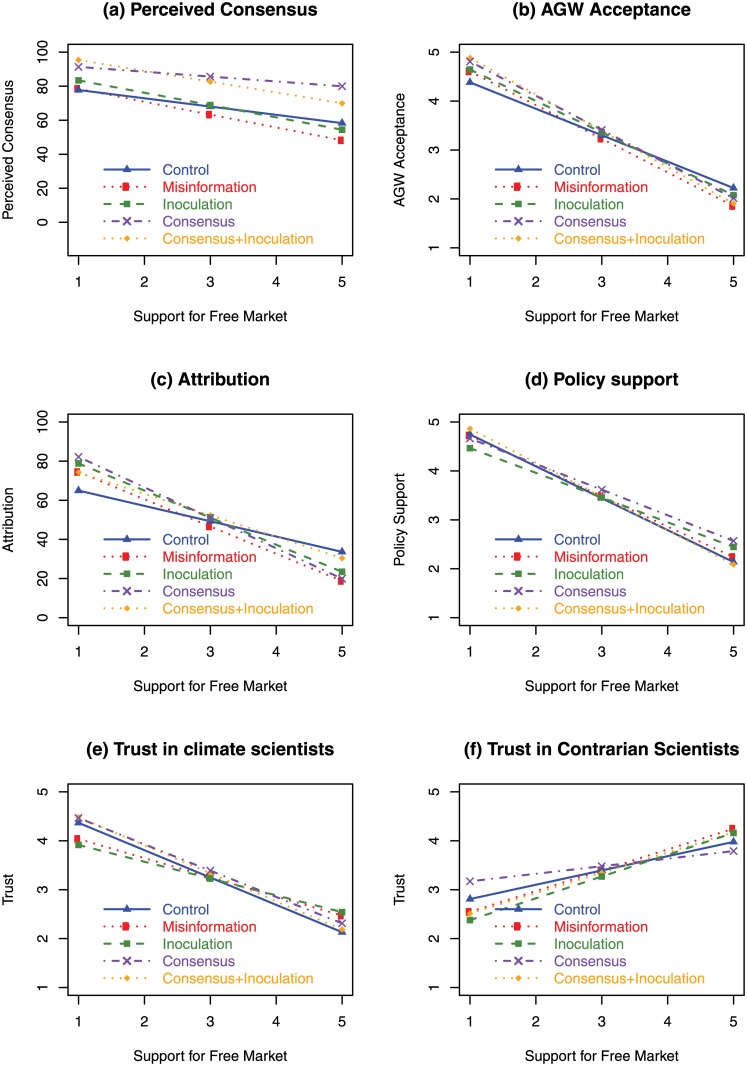
Misinformation can undermine a well-functioning democracy. For example, public misconceptions about climate change can lead to lowered acceptance of the reality of climate change and lowered support for mitigation policies. This study experimentally explored the impact of misinformation about climate change and tested several pre-emptive interventions designed to reduce the influence of misinformation. We found that false-balance media coverage (giving contrarian views equal voice with climate scientists) lowered perceived consensus overall, although the effect was greater among free-market supporters. Likewise, misinformation that confuses people about the level of scientific agreement regarding anthropogenic global warming (AGW) had a polarizing effect, with free-market supporters reducing their acceptance of AGW and those with low free-market support increasing their acceptance of AGW. However, we found that inoculating messages that (1) explain the flawed argumentation technique used in the misinformation or that (2) highlight the scientific consensus on climate change were effective in neutralizing those adverse effects of misinformation. We recommend that climate communication messages should take into account ways in which scientific content can be distorted, and include pre-emptive inoculation messages.
Overview
The claims and statistics of this paper haven’t been checked yet.
Free: it reads the open-access text and checks the first 5 claims that cite a source we can check. Create a free account to check every claim.
Integrity signals
Registry
Cites
Statistics
Figures

Verification
Claims the paper makes
The claims and statistics of this paper haven’t been checked yet.
Free: it reads the open-access text and checks the first 5 claims that cite a source we can check. Create a free account to check every claim.
Claims other papers make about this one
Each is checked against this paper’s own text: does it say what the citing paper says it does?
The check wasn’t confident either way, so it gives no verdict — never disputed.
In the citing paper
“Inoculation, while effective in preemptively refuting misinformation in specific domains (27–30), may not improve discernment when evaluating a diverse array of real-world news content.”
From A digital media literacy intervention increases discernment between mainstream and false news in the United States and India (2020) · cites this paper as [29]
Experimental — accuracy not yet measuredIn the citing paper
“focusing on the manipulation techniques and rhetorical strategies that underpin misinformation may significantly improve the potential scalability of inoculation interventions (17).”
From Psychological inoculation improves resilience against misinformation on social media (2022) · cites this paper as [17]
Self-check
Percentages, sums and reported differences re-computed from the paper’s own numbers.
The self-check needs the paper’s full text.
Citations
Cites
Maps of Bounded Rationality: Psychology for Behavioral Economics
Kahneman, D. (2003) · American Economic Review · doi:10.1257/000282803322655392 · Cited by 5,377
A Theory of Psychological Reactance
Torrance, E. P., & Brehm, J. W. (1968) · The American Journal of Psychology · doi:10.2307/1420824 · Cited by 4,759
Ohanian, R. (1990) · Journal of Advertising · doi:10.1080/00913367.1990.10673191 · Cited by 4,043 · cited 1×
“Five items measuring trust in climate scientists were adapted from Ohanian [55].”
BackgroundWhen Corrections Fail: The Persistence of Political Misperceptions
Nyhan, B., & Reifler, J. (2010) · Political Behavior · doi:10.1007/s11109-010-9112-2 · Cited by 3,173 · cited 1×
“For example, in one study, conservatives became more likely to believe that Iraq had weapons of mass destruction (WMDs) immediately before the war of 2003 after reading retractions clarifying that no WMDs existed at the time [11].”
BackgroundMisinformation and Its Correction: Continued Influence and Successful Debiasing
Lewandowsky, S., Ecker, U. K. H., Seifert, C. M., Schwarz, N., & Cook, J. (2012) · Psychological Science in the Public Interest · doi:10.1177/1529100612451018 · Cited by 2,920
Self-citationMcCright, A. M., & Dunlap, R. E. (2011) · The Sociological Quarterly · doi:10.1111/j.1533-8525.2011.01198.x · Cited by 2,340
The Scientific Consensus on Climate Change
Oreskes, N. (2004) · Science · doi:10.1126/science.1103618 · Cited by 1,814 · cited 1×
“Several studies have found nearly unanimous agreement among publishing climate 5 scientists that humans are causing global warming [22,23,24], and a similar pervasive consensus 6 exists in the scientific literature [25,26].”
BackgroundBalance as bias: global warming and the US prestige press
Boykoff, M. T., & Boykoff, J. M. (2004) · Global Environmental Change · doi:10.1016/j.gloenvcha.2003.10.001 · Cited by 1,699
Cultural cognition of scientific consensus.
Kahan, D. M., Jenkins‐Smith, H., & Braman, D. (2011) · Journal of Risk Research · doi:10.1080/13669877.2010.511246 · Cited by 1,686 · cited 1×
“Accordingly, climate change perceptions and attitudes have repeatedly been found to be strongly associated with political worldview [15,16,17,18].”
BackgroundConsensus on consensus: a synthesis of consensus estimates on human-caused global warming
Cook, J., Oreskes, N., Doran, P. T., Anderegg, W. R. L., Verheggen, B., Maibach, E. W., Carlton, J. S., Lewandowsky, S., Skuce, A. G., Green, S. A., et al. (2016) · Environmental Research Letters · doi:10.1088/1748-9326/11/4/048002 · Cited by 1,441
Self-citation
Cited by
Items 701–800 of 971
Combating Misinformation in the Open Access Era
Shakeri, S., & Hawamdeh, S. (2022) · Advances in knowledge acquisition, transfer, and management book series/Advances in knowledge acquisition, transfer and management book series · doi:10.4018/978-1-7998-9805-4.ch011 · Cited by 2
Social Media Management by Climate Change Organizations for Public Relations
Chawla, Y. (2021) · Springer eBooks · doi:10.1007/978-3-030-57281-5_70 · Cited by 1
Matos, J. C. M., & Jacintho, E. M. S. B. (2022) · InCID Revista de Ciência da Informação e Documentação · doi:10.11606/issn.2178-2075.v13i1p216-235 · Cited by 1
14. Endringer i pedagogikkfaget etter tusenårsskiftet
Imsen, G. (2022) · Fagbokforlaget eBooks · doi:10.55669/oa010314 · Cited by 1
5. Utdanningens normalitetstradisjoner
Hausstätter, R. S. (2022) · Fagbokforlaget eBooks · doi:10.55669/oa010305 · Cited by 1
Glustein, J. I., Borón, I., Saveika, C., Pinto, C. C., Falcón, M. D. L. Á., Sirolli, H., Larrandart, S., Ostertag, C., Jatar, L., Mordiero, J., et al. (2023) · Salud Ciencia y Tecnología - Serie de Conferencias · doi:10.56294/sctconf2023135 · Cited by 1
Desordem Informativa no Contexto da Pandemia de Covid-19
Klein, G. (2023) · Interações: Sociedade e as novas modernidades · doi:10.31211/interacoes.n44.2023.a3
Veletsianos, G., Houlden, S., Hodson, J., Gosse, C. E., Thompson, C. P., & O’Meara, V. (2022) · Journal of Applied Instructional Design · doi:10.59668/423.10365 · Cited by 1
FYTing with Science: Ideological Differences on the Nature and Origin of TruthPreprint
Stein, R., Swan, A. B., & Sarraf, M. (2018) · SSRN Electronic Journal · doi:10.2139/ssrn.3326111 · Cited by 1
Multitasking and correction of false informationPreprint
Szumowska, E., Czarnek, G., Dragon, P., & keersmaecker, J. D. (2021) · PsyArXiv (OSF Preprints) · doi:10.31234/osf.io/w5v4z · Cited by 1
Spreading Misinformation on Exercise and Health: Analysis of Instagram´s ProfilesPreprint
Marocolo, M., Meireles, A. A. F. D. M., de Souza, H. L. R., da Mota, G. R., Arriel, R. A., & Leite, L. H. R. (2021) · Research Square · doi:10.21203/rs.3.rs-310913/v1 · Cited by 1
Enhancing Catastrophic Event Preparedness and Response
Ivanov, B., Dillingham, L. L., Hester, E. B., & Parker, K. A. (2022) · Wiley eBooks · doi:10.1002/9781119751847.ch4 · Cited by 3
Inoculation reduces social media engagement with affectively polarized content in the UK and USPreprint
Smith, F., Simchon, A., Holford, D. L., & Lewandowsky, S. (2023) · doi:10.31234/osf.io/rk28e · Cited by 1
Self-citationKim, S. C., Vraga, E. K., Cook, J., & Carver, S. (2024) · Wiley eBooks · doi:10.1002/9781394184972.ch11 · Cited by 1
Self-citationSamoilenko, S. A. (2024) · Wiley eBooks · doi:10.1002/9781394184972.ch5 · Cited by 2
Tackling COVID disinformation with empathy and conversation
Lewandowsky, S., & Schmid, P. (2021) · doi:10.64628/ab.vu5pwkrv9 · Cited by 1
Self-citationInoculation theory: Using misinformation to fight misinformation
Cook, J. (2017) · The Conversation · doi:10.64628/aai.vnqhk4sfq · Cited by 3
Self-citationDeepfakes in Subversive Strategic Communication
Samoilenko, S. A., & Suvorova, I. (2025) · Wiley eBooks · doi:10.1002/9781394275434.ch11 · Cited by 2
Inoculation Theory and Counterarguing
Banas, J. A., & Bessarabova, E. (2026) · Wiley eBooks · doi:10.1002/9781394199372.ch3 · Cited by 3
Dillingham, L. L. (2026) · Wiley eBooks · doi:10.1002/9781394199372.ch13 · Cited by 1
Beyond Threat and Counterarguing
Wigley, S. L., & Haigh, M. M. (2026) · Wiley eBooks · doi:10.1002/9781394199372.ch5 · Cited by 1
Inoculation Theory and Public Policy
Liu, J., Xu, Y., & Niederdeppe, J. (2026) · Wiley eBooks · doi:10.1002/9781394199372.ch32 · Cited by 2
Inoculation Theory at the Intersection of Disasters and Catastrophes
Gilbert, C., Lachlan, K. A., & Spence, P. R. (2026) · Wiley eBooks · doi:10.1002/9781394199372.ch23 · Cited by 1
I want to (dis)believe: political ideology and misinformation in the marketplace
Peixoto, F. V. (2019) · Americanae (AECID Library)
Samoilenko, S. A. (2019) · International Transdisciplinary Scientific and Practical WEB-Conference "Connect-Universum" · doi:10.17223/9785946218597/32
“The study by Cook, Lewandowsky, and Ecker (2017) explored the impact of misinformation about climate change and tested several preemptive interventions designed to reduce the influence of misinformation.”
BackgroundWays of Learning, Ways of Knowing
Boykoff, M. (2019) · Cambridge University Press eBooks · doi:10.1017/9781108164047.005
The Social Function of News and (Mis)Information Use
Toff, B. (2022) · Oxford University Press eBooks · doi:10.1093/oso/9780197578384.003.0004
Preface: Creativity, Collaboration, Confrontation
Boykoff, M. (2019) · Cambridge University Press eBooks · doi:10.1017/9781108164047.001
The Social Construction of Climate Science
Lejano, R. P., Nero, S. J., & Chua, M. C. B. (2020) · Oxford University Press eBooks · doi:10.1093/oso/9780197542101.003.0006
Unpacking the Genetic Metanarrative
Lejano, R. P., Nero, S. J., & Chua, M. C. B. (2020) · Oxford University Press eBooks · doi:10.1093/oso/9780197542101.003.0005
Ideological Narratives and beyond in a Post-Truth World
Lejano, R. P., Nero, S. J., & Chua, M. C. B. (2020) · Oxford University Press eBooks · doi:10.1093/oso/9780197542101.003.0007
Lejano, R. P., Nero, S. J., & Chua, M. C. B. (2020) · Oxford University Press eBooks · doi:10.1093/oso/9780197542101.003.0004
Lejano, R. P., Nero, S. J., & Chua, M. C. B. (2020) · Oxford University Press eBooks · doi:10.1093/oso/9780197542101.003.0002 · Cited by 2
Attention and misinformation sharing on social mediaPreprint
Amin, Z., Ali, N. M., & Smeaton, A. F. (2020) · arXiv (Cornell University) · doi:10.48550/arxiv.2012.12593
“This approach and its positive influence on the field of Human-Computer Interaction (HCI) needs to be achieved in developing a system, and this is in accordance with the results of the research suggested by research (Vosoughi et al., 2018; Bakshy et al., 2009; Cook et al., 2017) which encourage other approaches to the…”
BackgroundResultSchillinger and Ramírez Respond
Schillinger, D., & Ramírez, A. S. (2021) · American Journal of Public Health · doi:10.2105/ajph.2020.306058
Boykoff, M. (2019) · Cambridge University Press eBooks · doi:10.1017/9781108164047.004
Kumpu, V. (2021) · Media & viestintä · doi:10.23983/mv.107304 · Cited by 8
Boykoff, M. (2019) · Cambridge University Press eBooks · doi:10.1017/9781108164047.002
Suárez-Ruíz, E. J. (2021) · Estudios sobre el Mensaje Periodístico · doi:10.5209/esmp.69888 · Cited by 2
“Por ejemplo, más allá de la aparente omnipresencia de la posverdad, estudios recientes afirman que existen estrategias efectivas a la hora de favorecer en los consumidores de noticias ciertas habilidades críticas (p. ej., Cook et al, 2017; Roozenbeek & van der Linden 2018, 2019).”
BackgroundIt’s Not You, It’s Me … Well It’s Actually Us
Boykoff, M. (2019) · Cambridge University Press eBooks · doi:10.1017/9781108164047.006
Academic Climate Advocacy and Activism
Boykoff, M. (2019) · Cambridge University Press eBooks · doi:10.1017/9781108164047.007
Boykoff, M. (2019) · Cambridge University Press eBooks · doi:10.1017/9781108164047.003
Boykoff, M. (2019) · Cambridge University Press eBooks · doi:10.1017/9781108164047.009
Jardine, E. (2021) · Journal of Cyber Policy · doi:10.1080/23738871.2021.1953557 · Cited by 1
Fact checkers fail to overcome partisan divides in two of the world’s largest democraciesPreprint
Ray, R., Bhalla, S., & Taneja, H. (2021) · Research Square · doi:10.21203/rs.3.rs-1004012/v1
“In addition to fact checking initiatives and identification of misinformation at the source, intervention strategies like inoculation and media literacy have also been found to be effective to varying degrees (Cook et al., 2017; Guess et al., 2020, Porter & Wood,2021).”
BackgroundHealth MisinformationPreprint
Nan, X., Wang, Y., & Thier, K. (2021) · doi:10.31219/osf.io/uzbc7
Argyris, Y. A., Kim, Y., & Song, W. O. (2020) · doi:10.2196/preprints.24970
Some Approaches in Online Misinformation AnalysisPreprint
Omoregie, U. (2021) · doi:10.31235/osf.io/95btr
Pushkar, K., Kapoor, S., Teli, P. T., Sahu, R., Bobdey, S., & Kaushik, S. K. (2022) · International Journal of Community Medicine and Public Health · doi:10.18203/2394-6040.ijcmph20220227
Persily, N., & Tucker, J. A. (2020) · Cambridge University Press eBooks · doi:10.1017/9781108890960.001
Boykoff, M. (2019) · Cambridge University Press eBooks · doi:10.1017/9781108164047.012
Boykoff, M. (2019) · Cambridge University Press eBooks · doi:10.1017/9781108164047.008
Boykoff, M. (2019) · Cambridge University Press eBooks · doi:10.1017/9781108164047.011
Boykoff, M. (2019) · Cambridge University Press eBooks · doi:10.1017/9781108164047.010
Contemporary Challenges to Democracy
(2022) · Cambridge University Press eBooks · doi:10.1017/9781108779104.025
Motta, M., & Benegal, S. D. (2022) · doi:10.31235/osf.io/v9egn
Advancing the Study of Misinformation Correction Through Conjoint ExperimentationPreprint
Motta, M. (2022) · SocArXiv (OSF Preprints) · doi:10.31235/osf.io/8hnyg · Cited by 2
Enfrentamento à Desinformação no Ambiente Digital: Um Estudo das Abordagens Descritas na Literatura
Silva, M. M., & Cendón, B. V. (2022) · Revista FSA · doi:10.12819/2022.19.3.3
Beliefs and climate change skepticism in French peoplePreprint
Krause, E., Weiss, K., & Trémolière, B. (2022) · PsyArXiv (OSF Preprints) · doi:10.31234/osf.io/hvwmk · Cited by 1
Persily, N., & Tucker, J. A. (2020) · Cambridge University Press eBooks · doi:10.1017/9781108890960.015
Making the ‘Harm Principle’ Central to Approaches Against Information DisorderPreprint
Omoregie, U. (2021) · SocArXiv (OSF Preprints) · doi:10.31235/osf.io/m4a2z
Lejano, R. P., Nero, S. J., & Chua, M. E. (2020) · Oxford University Press eBooks · doi:10.1093/oso/9780197542101.003.0001
Symonds, M. E. (2019) · Faculty Opinions – Post-Publication Peer Review of the Biomedical Literature · doi:10.3410/f.735896006.793560964
Scientist perspectives toward the status and management of gray wolves in the western United States
Crooks, K. R., Gonzalez, M. N., & Ghasemi, B. (2022) · Conservation Science and Practice · doi:10.1111/csp2.12728 · Cited by 1
“The extent of scientific agreement also can influence public opinion about, and support for, conservation initiatives (Cook et al., 2017; Lewandowsky et al., 2013).”
BackgroundPan, W., & Hu, T.-Y. (2022) · doi:10.31234/osf.io/suy2q
Responsiveness to Evidence: A Political Cognition Approach 1
Rabb, N., Kossowska, M., Wood, T., Schulte, D., Vourloumis, S., & Jarke, H. (2022) · Routledge eBooks · doi:10.4324/9781003111474-7 · Cited by 1
Do Statistical Rules Interfere with Political Beliefs?Preprint
Ghasemi, O., Roberts, A., & Handley, S. J. (2022) · OSF Preprints (OSF Preprints) · doi:10.31219/osf.io/pkdgq
6. Spesialpedagogen – i samfunnets knutepunkt og skjæringsfelt?
Nordtug, B., & Steinnes, J. (2022) · Fagbokforlaget eBooks · doi:10.55669/oa010306
17. Hvem bestemmer hva livet er – de som lever det eller de som bestemmer?
Sævi, T. (2022) · Fagbokforlaget eBooks · doi:10.55669/oa010317
4. Hva skal man med spesialpedagogikken?
Simonsen, E. (2022) · Fagbokforlaget eBooks · doi:10.55669/oa010304
16. Paradigmekrig – den omstridde kombinasjonsforskinga
Skaar, Ø. O. (2022) · Fagbokforlaget eBooks · doi:10.55669/oa010316
11. Den refleksive erfaringens magi
Røisehagen, A., & Tvete, I. (2022) · Fagbokforlaget eBooks · doi:10.55669/oa010311
15. Objektivitet som epistemisk norm i pedagogisk forskning
Kvernbekk, T. (2022) · Fagbokforlaget eBooks · doi:10.55669/oa010315
Fritze, Y., Haugsbakk, G., & Nordkvelle, Y. (2022) · Fagbokforlaget eBooks · doi:10.55669/oa010313
8. Dialog i møte med konspirasjonsteorier, fake news og alternative fakta
Monsen, L. (2022) · Fagbokforlaget eBooks · doi:10.55669/oa010308
2. Lekens instrumentelle verdi
Skundberg, Ø. (2022) · Fagbokforlaget eBooks · doi:10.55669/oa010302
Thuen, H. Ø. (2022) · Fagbokforlaget eBooks · doi:10.55669/oa010310
9. Opprørsånd i Lillehammer-pedagogikken
Myklestad, S. (2022) · Fagbokforlaget eBooks · doi:10.55669/oa010309
3. Barndom som kilde til motstandsdyktighet
Ilje-Lien, J. (2022) · Fagbokforlaget eBooks · doi:10.55669/oa010303
许, 成. (2022) · Advances in Applied Mathematics · doi:10.12677/aam.2022.118613
Bolstering the Value of Learning About Climate Science
Gehlbach, H. (2019) · American Educational Research Association Annual Meeting (AERA) · doi:10.3102/1429175
Typology and Governance of Information Disorder Related to COVID-19 in China
Liu, Y., & Zhu, L. (2022) · Springer eBooks · doi:10.1007/978-981-19-5787-1_7
Defending the Civic Body from False Information Online
Bakir, V., & McStay, A. (2022) · Springer eBooks · doi:10.1007/978-3-031-13551-4_8
Inoculation Theory as Rhetorical Strategy in The Evidence at Large (1805)
Compton, J. (2022) · Western Journal of Communication · doi:10.1080/10570314.2022.2153616
Implementing Campus-level Programming: Pathways for Online Civic Engagement
McGowan-Kirsch, A. M. (2022) · Journal of the Scholarship of Teaching and Learning · doi:10.14434/josotl.v22i4.32846 · Cited by 1
Lyubykh, Z., Barclay, L. J., Fortin, M., Bashshur, M. R., & Khakhar, M. (2022) · Research in Organizational Behavior · doi:10.1016/j.riob.2023.100183 · Cited by 1
Creating Safe Communication Spaces Amidst the Disinformation Quandary
Chua, Y. T., & Khan, R. E. (2023) · Sustainable development goals series · doi:10.1007/978-3-031-19142-8_8 · Cited by 1
Anderson and Goldman on Identifying Experts
McKenna, R. (2023) · Oxford University Press eBooks · doi:10.1093/oso/9780192888822.003.0003
McKenna, R. (2023) · Oxford University Press eBooks · doi:10.1093/oso/9780192888822.003.0004
What Is Non-Ideal Epistemology?
McKenna, R. (2023) · Oxford University Press eBooks · doi:10.1093/oso/9780192888822.003.0001
McKenna, R. (2023) · Oxford University Press eBooks · doi:10.1093/oso/9780192888822.002.0006
McKenna, R. (2023) · Oxford University Press eBooks · doi:10.1093/oso/9780192888822.002.0003
McKenna, R. (2023) · Oxford University Press eBooks · doi:10.1093/oso/9780192888822.003.0006
Liberatory Virtue and Vice Epistemology
McKenna, R. (2023) · Oxford University Press eBooks · doi:10.1093/oso/9780192888822.003.0007
McKenna, R. (2023) · Oxford University Press eBooks · doi:10.1093/oso/9780192888822.002.0004
McKenna, R. (2023) · Oxford University Press eBooks · doi:10.1093/oso/9780192888822.003.0008
Metadata
- Authors
- Cook, J., Lewandowsky, S., & Ecker, U. K. H.
- Affiliations
- George Mason University (US)
- The University of Western Australia (AU)
- Corresponding author
- Cook, John
- Lewandowsky, Stephan
- Ecker, Ullrich K. H.
- Venue
- PLOS ONE
- Publisher
- Public Library of Science (PLoS)
- Published
- 2017-05-05
- Volume
- 12
- Issue
- 5
- Pages
- e0175799
- ISSN
- 1932-6203 (ISSN-L)
- PMC
- PMC5419564
- OpenAlex
- W2610353045
- Cited by
- 971
- References
- 80
- Citations by year
- 2026: 120 · 2025: 124 · 2024: 110 · 2023: 129 · 2022: 135 · 2021: 116 · 2020: 130 · 2019: 59 · 2018: 29 · 2017: 19
- FWCI
- 165.41
- Type
- journal article
- Language
- en
- Open access
- gold
- doi.org
- Licence
- Locations
- PLoS ONE (publishedVersion, cc-by)
- PubMed Central (publishedVersion, cc-by)
- UWA Profiles and Research Repository (UWA) (publishedVersion, cc-by)
- PubMed (publishedVersion)
- RePEc: Research Papers in Economics (submittedVersion)
- DOAJ (DOAJ: Directory of Open Access Journals) (submittedVersion, cc-by-sa)
- Figshare (submittedVersion, cc-by)
- Bristol Research (University of Bristol) (submittedVersion, cc-by)
- Explore Bristol Research (submittedVersion, cc-by)
- George Mason University (cc-by)
- Funders
- Australian Research Council
- Royal Society
- Psychonomics Society
- Topics
- Social Sciences › Sociology and Political Science › Climate Change Communication and Perception
- Social Sciences › Sociology and Political Science › Misinformation and Its Impacts
- Social Sciences › Economics, Econometrics and Finance › Economics and Econometrics › Climate Change Policy and Economics
- Keywords
- misinformation, inoculation, climate change misinformation, false balance, scientific consensus, anthropogenic climate change, free market ideology, political polarization, argumentation techniques, climate change communication
- MeSH terms
- Information Services, Climate Change
About these checks
Registry, retraction, Cites and statistics results are computed, not judged, with one exception: a printed reference that no index lists is read once by a model before it counts as a citation error. Claims are extracted by a model and kept only when their quote appears verbatim in the text; each cited source is then checked, with a model’s help, for whether it says what the claim relies on. Those verdicts can be wrong — read the claim’s quote and the cited source before relying on one.
Statistics and arithmetic are recomputed, not judged.
Confidence bands are shown only for fields calibrated on our annotated test set. None is calibrated yet, so no band is shown.
What counts as a claim ›How we measure confidence ›How we check this ›
Are you an author, or do you see a problem with this page? Request a review
Data sources
Bibliographic data: Semantic Scholar, OpenAlex, Crossref.
Contains information from the Semantic Scholar Academic Graph Datasets, made available under the ODC Attribution License (ODC-BY 1.0).
Semantic Scholar’s data is described in: Kinney, R., et al. (2023). The Semantic Scholar Open Data Platform. arXiv:2301.10140.
