

Neutralizing misinformation through inoculation: Exposing misleading argumentation techniques reduces their influence
Open accessThe DOI matches its Crossref record; 78 of the 80 references it cites were found in a registry or an index.
Abstract
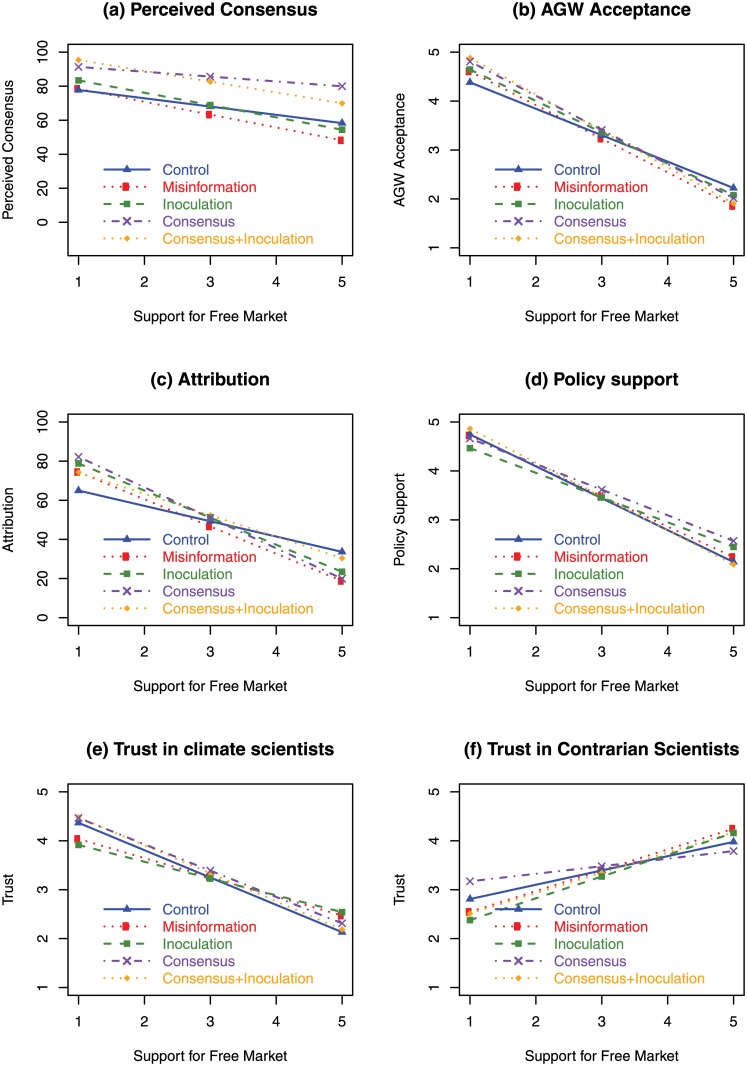
Misinformation can undermine a well-functioning democracy. For example, public misconceptions about climate change can lead to lowered acceptance of the reality of climate change and lowered support for mitigation policies. This study experimentally explored the impact of misinformation about climate change and tested several pre-emptive interventions designed to reduce the influence of misinformation. We found that false-balance media coverage (giving contrarian views equal voice with climate scientists) lowered perceived consensus overall, although the effect was greater among free-market supporters. Likewise, misinformation that confuses people about the level of scientific agreement regarding anthropogenic global warming (AGW) had a polarizing effect, with free-market supporters reducing their acceptance of AGW and those with low free-market support increasing their acceptance of AGW. However, we found that inoculating messages that (1) explain the flawed argumentation technique used in the misinformation or that (2) highlight the scientific consensus on climate change were effective in neutralizing those adverse effects of misinformation. We recommend that climate communication messages should take into account ways in which scientific content can be distorted, and include pre-emptive inoculation messages.
Overview
The claims and statistics of this paper haven’t been checked yet.
Free: it reads the open-access text and checks the first 5 claims that cite a source we can check. Create a free account to check every claim.
Integrity signals
Registry
Cites
Statistics
Figures

Verification
Claims the paper makes
The claims and statistics of this paper haven’t been checked yet.
Free: it reads the open-access text and checks the first 5 claims that cite a source we can check. Create a free account to check every claim.
Claims other papers make about this one
Each is checked against this paper’s own text: does it say what the citing paper says it does?
The check wasn’t confident either way, so it gives no verdict — never disputed.
In the citing paper
“Inoculation, while effective in preemptively refuting misinformation in specific domains (27–30), may not improve discernment when evaluating a diverse array of real-world news content.”
From A digital media literacy intervention increases discernment between mainstream and false news in the United States and India (2020) · cites this paper as [29]
Experimental — accuracy not yet measuredIn the citing paper
“focusing on the manipulation techniques and rhetorical strategies that underpin misinformation may significantly improve the potential scalability of inoculation interventions (17).”
From Psychological inoculation improves resilience against misinformation on social media (2022) · cites this paper as [17]
Self-check
Percentages, sums and reported differences re-computed from the paper’s own numbers.
The self-check needs the paper’s full text.
Citations
Cites
Maps of Bounded Rationality: Psychology for Behavioral Economics
Kahneman, D. (2003) · American Economic Review · doi:10.1257/000282803322655392 · Cited by 5,377
A Theory of Psychological Reactance
Torrance, E. P., & Brehm, J. W. (1968) · The American Journal of Psychology · doi:10.2307/1420824 · Cited by 4,759
Ohanian, R. (1990) · Journal of Advertising · doi:10.1080/00913367.1990.10673191 · Cited by 4,043 · cited 1×
“Five items measuring trust in climate scientists were adapted from Ohanian [55].”
BackgroundWhen Corrections Fail: The Persistence of Political Misperceptions
Nyhan, B., & Reifler, J. (2010) · Political Behavior · doi:10.1007/s11109-010-9112-2 · Cited by 3,173 · cited 1×
“For example, in one study, conservatives became more likely to believe that Iraq had weapons of mass destruction (WMDs) immediately before the war of 2003 after reading retractions clarifying that no WMDs existed at the time [11].”
BackgroundMisinformation and Its Correction: Continued Influence and Successful Debiasing
Lewandowsky, S., Ecker, U. K. H., Seifert, C. M., Schwarz, N., & Cook, J. (2012) · Psychological Science in the Public Interest · doi:10.1177/1529100612451018 · Cited by 2,920
Self-citationMcCright, A. M., & Dunlap, R. E. (2011) · The Sociological Quarterly · doi:10.1111/j.1533-8525.2011.01198.x · Cited by 2,340
The Scientific Consensus on Climate Change
Oreskes, N. (2004) · Science · doi:10.1126/science.1103618 · Cited by 1,814 · cited 1×
“Several studies have found nearly unanimous agreement among publishing climate 5 scientists that humans are causing global warming [22,23,24], and a similar pervasive consensus 6 exists in the scientific literature [25,26].”
BackgroundBalance as bias: global warming and the US prestige press
Boykoff, M. T., & Boykoff, J. M. (2004) · Global Environmental Change · doi:10.1016/j.gloenvcha.2003.10.001 · Cited by 1,699
Cultural cognition of scientific consensus.
Kahan, D. M., Jenkins‐Smith, H., & Braman, D. (2011) · Journal of Risk Research · doi:10.1080/13669877.2010.511246 · Cited by 1,686 · cited 1×
“Accordingly, climate change perceptions and attitudes have repeatedly been found to be strongly associated with political worldview [15,16,17,18].”
BackgroundConsensus on consensus: a synthesis of consensus estimates on human-caused global warming
Cook, J., Oreskes, N., Doran, P. T., Anderegg, W. R. L., Verheggen, B., Maibach, E. W., Carlton, J. S., Lewandowsky, S., Skuce, A. G., Green, S. A., et al. (2016) · Environmental Research Letters · doi:10.1088/1748-9326/11/4/048002 · Cited by 1,441
Self-citation
Cited by
Items 401–500 of 971
Underwood, T., Hopkins, K. L., Sommers, T., Howell, C., Boehman, N., Dockery, M., Dubé, È., Dhaliwal, B. K., Kazi, A. M., Limaye, R. J., et al. (2023) · BMC Proceedings · doi:10.1186/s12919-023-00280-z · Cited by 10
“…refers to the concept that exposing people to a weakened form of misinformation builds up their “mental antibodies”, providing immunity to misinformation over time, so they are more able to identify misinformation when encountered in the real world, and less likely to be misled [43].”
BackgroundXu, Q., Chen, S., & Safarnejad, L. (2020) · Health Communication · doi:10.1080/10410236.2020.1773705 · Cited by 13
“Unlike previous research that focuses on message or source strategies to refute misinformation (Bode & Vraga, 2018; Cook et al., 2017; van der Meer & Jin, 2019), this study aims to understand misinformation dissemination on social media through a network approach.”
BackgroundResultByrne, J., Marston, A., & Grace, M. M. (2022) · Journal of Biological Education · doi:10.1080/00219266.2021.2020874 · Cited by 12
“However, Cook et al. (2017) have shown that interventions based on inoculation theory to explain flawed arguments about misinformation about climate change or highlighting the scientific consensus for anthropogenic global warming was effective in counteracting misinformation.”
BackgroundAI model GPT-3 (dis)informs us better than humans
Spitale, G., Biller‐Andorno, N., & Germani, F. (2023) · Zurich Open Repository and Archive (University of Zurich) · doi:10.48550/arxiv.2301.11924 · Cited by 10
Digitally Scaffolding Debate in the Classroom
Holzer, A., Tintarev, N., Bendahan, S., Kocher, B., Greenup, S., & Gillet, D. (2018) · CHI Conference Extended Abstracts on Human Factors in Computing Systems (CHI EA) · doi:10.1145/3170427.3188499 · Cited by 10
“Teaching critical thinking skills and pointing out flawed argumentation techniques used by providers of misinformation has been shown to be effective to reduce belief in false information [2].”
BackgroundPolarity Analysis of Editorial Articles towards Fake News Detection
Samonte, M. J. C. (2018) · International Conference on Internet and E-Business (ICIEB) · doi:10.1145/3230348.3230354 · Cited by 17
“There are several techniques in correcting misinformation that are helpful [32], [33], but they suggest to use basic tools.”
Metacognitive Inoculation Reduces the Persuasiveness of Sarcastic Attack Messages
Clyne, L., Fellers, M., & Richards, A. (2020) · Communication Reports · doi:10.1080/08934215.2020.1755876 · Cited by 4
“Cook et al. (2017) tested whether preemptively informing participants about how a logical fallacy typically is perceived would make its use in an attack message less effective.”
BackgroundMusi, E., Federico, L., & Riotta, G. (2022) · AI & Society · doi:10.1007/s00146-022-01583-z · Cited by 16
“As already pointed out in a study about climate change-related misinformation (Cook et al. 2017), explaining flawed argumentation techniques has a positive .”
BackgroundVentsel, A., Hansson, S., Rickberg, M., & Madisson, M.-L. (2023) · Armed Forces & Society · doi:10.1177/0095327x231163265 · Cited by 28
“The effectiveness of this approach has been explained through the inoculation theory (Cook et al., 2017; Roozenbeek & van der Linden, 2019a, 2019b, 2020; van der Linden et al., 2017) which was developed by psychologist William J. McGuire in the 1960s (see McGuire, 1964).”
Barman, D., & Conlan, O. (2024) · ACM Conference on Hypertext and Social Media (HT) · doi:10.1145/3648188.3675125 · Cited by 14
“Researchers commonly use text manipulations to passively present the relevant context to participants [11, 16].”
How can the veterinary profession tackle social media misinformation?
Moran, R. E., & Knesl, O. (2025) · Journal of the American Veterinary Medical Association · doi:10.2460/javma.24.10.0665 · Cited by 15
Aroke, O. M., Esmaeili, B., & Kim, S. C. (2021) · Sustainability · doi:10.3390/su132111927 · Cited by 12
McGowan-Kirsch, A. M., & Quinlivan, G. V. (2023) · Communication Teacher · doi:10.1080/17404622.2023.2271548 · Cited by 17
“SIFT teaches people how to identify logical fl aws in argumentation and spot fake news campaigns (Cook et al., 2017).”
BackgroundBuczel, K. A., Siwiak, A., Szpitalak, M., & Polczyk, R. (2024) · Memory & Cognition · doi:10.3758/s13421-024-01520-z · Cited by 18
“…should be directed towards improving inoculation interventions, which have been found to be highly effective in reducing reliance on misinformation (Banas & Miller, 2013; Buczel et al., 2022; Cook et al., 2017; Roozenbeek & van der Linden, 2019; Tay et al., 2022; van der Linden et al., 2017).”
Influential(2018) · The American Biology Teacher · doi:10.1525/abt.2018.80.8.631 · Cited by 9
“” When individuals become aware of the strategies used to spread misinformation, they are better able to recognize it and neutralize its effect (Cook et al., 2017).”
Look Who’s Watching: Platform Labels and User Engagement on State-Backed Media Outlets
Bradshaw, S., Elswah, M., & Perini, A. (2023) · American Behavioral Scientist · doi:10.1177/00027642231175639 · Cited by 14
“These labels aim to inoculate users by exposing them to weakened, refutational, or corrected arguments, which can help refute malicious or conspiratorial information (Cook et al., 2017; Lim & Ki, 2007; Van der Linden et al., 2017; Nassetta & Gross, 2020; Pfau et al., 1997).”
Mapping the field of misinformation correction and its effects: A review of four decades of research
Qinyu, E., Sakura, O., & Li, G. (2021) · Social Science Information · doi:10.1177/05390184211053759 · Cited by 12
“Mounting evidence demonstrates that the prevalence of misinformation can have significant societal consequences (Cook et al., 2017).”
BackgroundPark, D., Lee, H., & Jeong, S. (2022) · American Behavioral Scientist · doi:10.1177/00027642221118287 · Cited by 12
“Previous research on misinformation focused on climate change and environmental issues (e.g., Cook et al., 2017; Mann & Toles, 2016).”
The trouble with the supply-side model of science
Орескес, Н. (2022) · Proceedings of the Indian National Science Academy · doi:10.1007/s43538-022-00121-1 · Cited by 9
Crowdsourced Detection of Emotionally Manipulative Language
Huffaker, J. S., Kummerfeld, J. K., Lasecki, W. S., & Ackerman, M. S. (2020) · CHI Conference on Human Factors in Computing Systems · doi:10.1145/3313831.3376375 · Cited by 20
Information: a missing component in understanding and mitigating social epidemics
Magarey, R. D., & Trexler, C. M. (2020) · Humanities and Social Sciences Communications · doi:10.1057/s41599-020-00620-w · Cited by 11
Computer-assisted detection and classification of misinformation about climate changePreprint
Coan, T., Boussalis, C., Cook, J., & Nanko, M. O. (2021) · SocArXiv (OSF Preprints) · doi:10.31235/osf.io/crxfm · Cited by 9
Self-citationKönig, L. M., Altenmüller, M. S., Fick, J., Crusius, J., Genschow, O., & Sauerland, M. (2023) · doi:10.31234/osf.io/cwbrs · Cited by 9
Tandoc, E. C., & Seet, S. K. (2023) · Estudios sobre el Mensaje Periodístico · doi:10.5209/esmp.88599 · Cited by 16
Stewart, A. J., Arechar, A. A., Rand, D. G., & Plotkin, J. B. (2024) · Proceedings of the National Academy of Sciences · doi:10.1073/pnas.2315195121 · Cited by 43
Danielson, R., Heddy, B. C., Ramazan, O., Jin, G., Gill, K. S., & Berry, D. N. (2024) · Journal of Research in Science Teaching · doi:10.1002/tea.21963 · Cited by 12
Persistence of Misinformation: Biased Cognitive Processing and Polarization
Zhou, Y., & Shen, L. (2025) · Cambridge University Press eBooks · doi:10.1017/9781009397339 · Cited by 8
van Antwerpen, N., Green, E., Sturman, D., & Searston, R. A. (2025) · Scientific Reports · doi:10.1038/s41598-025-96333-8 · Cited by 16
Rode, J. B., Remshard, M., Groot, L. J., & van der Linden, S. (2025) · Current Opinion in Behavioral Sciences · doi:10.1016/j.cobeha.2025.101521 · Cited by 15
“In addition, scientific consensus messaging remains important in light of orchestrated disinformation campaigns that seek to cast doubt on the scientific consensus [6,7,56].”
Tang, R., Fang, Y., Sun, J., Bode, L., & Vraga, E. K. (2025) · Journalism & Mass Communication Quarterly · doi:10.1177/10776990251359660 · Cited by 12
“Several empirical studies have provided evidence for the success of prebunking across some contentious scientific and health domains (Cook et al., 2017; Lu et al., 2023; Roozenbeek et al., 2022).”
Motivating Personal Climate Action through a Safety and Health Risk Management Framework
Mullins-Jaime, C., & Wachter, J. K. (2022) · International Journal of Environmental Research and Public Health · doi:10.3390/ijerph20010007 · Cited by 11
Richardson, L., Thaker, J. J., & Holmes, D. (2023) · Scientific Reports · doi:10.1038/s41598-022-26959-5 · Cited by 14
Inoculation hesitancy: an exploration of challenges in scaling inoculation theory
Johnson, A., & Madsen, J. K. (2024) · Royal Society Open Science · doi:10.1098/rsos.231711 · Cited by 15
Kuru, O., Josh Pasek, B., & Traugott, M. W. (2020) · Mass Communication & Society · doi:10.1080/15205436.2020.1774780 · Cited by 11
Rajabi, A., Gunaratne, C., Mantzaris, A. V., & Garibay, I. I. (2020) · Lecture notes in computer science · doi:10.1007/978-3-030-61255-9_13 · Cited by 8
It's Time to Confront Fake News and Rumors on Social Media: A Bibliometric Study Based on VOSviewer
Ding, Y., Wang, Y.-J., & Wang, Y.-Q. (2021) · 2021 IEEE 4th International Conference on Computer and Communication Engineering Technology (CCET) · doi:10.1109/ccet52649.2021.9544276 · Cited by 7
Political Psychology and the Climate Crisis
Geiger, N., Gruszczynski, M., & Swim, J. K. (2022) · Cambridge University Press eBooks · doi:10.1017/9781108779104.037 · Cited by 13
Calibration of scientific reasoning ability
Otten, C. D., & Fischhoff, B. (2022) · Journal of Behavioral Decision Making · doi:10.1002/bdm.2306 · Cited by 9
Rędzio, A. M., Izydorczak, K., Muniak, P., Kulesza, W. M., & Doliński, D. (2023) · Acta Psychologica · doi:10.1016/j.actpsy.2023.103930 · Cited by 13
Challenges for sustainability: misperceptions and misleading advice
Moxnes, E. (2023) · System Dynamics Review · doi:10.1002/sdr.1733 · Cited by 10
Allchin, D. (2020) · The American Biology Teacher · doi:10.1525/abt.2020.82.8.535 · Cited by 8
Health MisinformationPreprint
Nan, X., Wang, Y., & Thier, K. (2020) · PsyArXiv (OSF Preprints) · doi:10.31234/osf.io/6mrgv · Cited by 9
Lewandowsky, S., & van der Linden, S. (2022) · Psychological Science in the Public Interest · doi:10.1177/15291006221114132 · Cited by 9
“, 2018), and it has been shown to at least partially neutralize misinformation and conspiracy theories about climate change being a hoax (Bolsen et al., 2021; Cook et al., 2017; van der Linden et al., 2017).”
BackgroundSelf-citationSpampatti, T., Brosch, T., Trutnevyte, E., & Hahnel, U. J. J. (2024) · Journal of Experimental Social Psychology · doi:10.1016/j.jesp.2024.104656 · Cited by 11
van Erkel, P. F. A., Aelst, P. V., Nieuwenborgh, J. V., de Vreese, C. H., Hameleers, M., & Hopmann, D. N. (2024) · The International Journal of Press/Politics · doi:10.1177/19401612241279534 · Cited by 10
“In its purest form, inoculation refers to the process where people are exposed to a weak and refuted form of a (false) message to induce a form of resistance to more persuasive versions of that same misinformation (Cook et al. 2017).”
Zarzosa, J., & Ruvalcaba, C. (2025) · Journal of Marketing Education · doi:10.1177/02734753251319559 · Cited by 15
“Cook et al. (2017) also found misinformation could be countered with logic-based inoculation, specifically by inoculating with information on misleading techniques.”
Amazeen, M. A., Sovacool, B. K., Krishna, A., Debnath, R., & Wells, C. (2025) · npj Climate Action · doi:10.1038/s44168-025-00209-6 · Cited by 10
“Althoughsomerecentresearchhasraiseddoubtabouttheeffectiveness of inoculation strategies 35 , the preponderance of evidence over the decades has shown that prebunking is widely effective across a variety of topics – including climate disinformation – and across varying cultures 36 – 38 .”
Adam, S., Rohrbach, T., Keller, F., Makhortykh, M., de León, E., Valli, C., Baghumyan, A., & Sydorova, M. (2025) · Journal of Communication · doi:10.1093/joc/jqaf033 · Cited by 10
Droog, E., Vermeulen, I., van Huijstee, D., Harutyunyan, D., Tejedor, S., & Pulido, C. (2025) · Communication Research · doi:10.1177/00936502251363705 · Cited by 24
“…corrected before or after exposure by a correction that (1) explains fallacious reasoning in the misinformation (i.e., a logic-based correction; J. Cook et al., 2017; Ecker et al., 2022), or (2) undermines the credibility of its source (i.e., a source-based correction; Ecker et al., 2022; Hughes…”
A registered report megastudy on the persuasiveness of the most-cited climate messages
Voelkel, J. G., Ashokkumar, A., Abeles, A. T., Crawford, J. T., Fuller, K., Redekopp, C., Bongiorno, R., Campbell, T. H., Ecker, U. K. H., Feinberg, M., et al. (2026) · Nature Climate Change · doi:10.1038/s41558-025-02536-2 · Cited by 15
“All panels show unstandardized regression coefficients and 95% confidence intervals for the effects of the 10 treatments and the pooled combination of all treatments, relative to the control condition, based on preregistered regression models (Supplementary Tables 18–21).”
InfluentialSelf-citationRenouard, A., & Mazabraud, Y. (2018) · npj Science of Learning · doi:10.1038/s41539-018-0026-9 · Cited by 11
“This can constitute a real obstacle to the development of citizens’ scientific literacy and accelerate the perpetuation of alternative conceptions.(22,24,63) Studying the specific media habits of students is therefore essential.”
BackgroundWong, C. M. L., & Wu, Y. (2023) · Journal of Risk Research · doi:10.1080/13669877.2023.2249909 · Cited by 10
“Cook, Lewandowsky, and Ecker (2017), for example, used a counter-information approach to see if it could reduce the influence of two misleading strategies – ‘false balance’ reporting and deliberate attempts to manufacture doubt about scientific consensus.”
BackgroundSwim, J. K., Geiger, N., & Guerriero, J. G. (2021) · Thinking & Reasoning · doi:10.1080/13546783.2021.1957710 · Cited by 8
“Attention to the science in persuasive messages could help inoculate people against these arguments (Cook et al., 2017).”
Background8 Disinformation about Migration: An age‐old Issue with New Tech Dimensions
Culloty, E., Suiter, J., Viriri, I., & Creta, S. (2022) · World Migration Report · doi:10.1002/wom3.29 · Cited by 12
Design Principles for an Educational Intervention Into Online Vaccine Misinformation
Veletsianos, G., Houlden, S., Reid, D., Hodson, J., & Thompson, C. P. (2022) · TechTrends · doi:10.1007/s11528-022-00755-4 · Cited by 7
“For instance, some recommendations put forward have been fact-checking programs (Nieminen & Rapeli, 2019), information literacy development (Hameleers, 2020), and “pre-bunking” strategies (Cook et al., 2017).”
BackgroundOrchestration of perspectives in televised climate change debates
Nielsen, S. B. (2022) · Discourse & Society · doi:10.1177/09579265221117015 · Cited by 10
Moral Messaging: Testing a Framing Technique during a Pandemic
Misiak, M., Curry, O. S., & Tureček, P. (2023) · Basic and Applied Social Psychology · doi:10.1080/01973533.2023.2174868 · Cited by 9
“…communication can also potentially influence other aspects of psychological functioning, like attitudes (for example, support for certain policies; Hurlstone et al., 2014), emotional response (Bilandzic et al., 2017), or knowledge (for example, it can neutralize misinformation; Cook et al., 2017).”
Background“Imbecilization” in the disinformation society: what can information literacy do about it?
Righetto, G. G., Muriel-Torrado, E., & Vitorino, E. V. (2021) · Investigación Bibliotecológica Archivonomía Bibliotecología e Información · doi:10.22201/iibi.24488321xe.2021.87.58310 · Cited by 14
Commentary: Using Critical Thinking to Counter Misinformation
Zucker, A. A. (2019) · Science Scope · doi:10.2505/4/ss19_042_08_6 · Cited by 7
Boosting people’s ability to detect microtargeted advertisingPreprint
Lorenz-Spreen, P., Geers, M., Pachur, T., Hertwig, R., Lewandowsky, S., & Herzog, S. M. (2020) · PsyArXiv (OSF Preprints) · doi:10.31234/osf.io/ea28z · Cited by 7
Self-citationReducing Misinformation When Motivated to Consume: Experimental Evidence from Côte d’IvoirePreprint
Gottlieb, J., Adida, C. L., & Moussa, R. K. (2022) · OSF Preprints (OSF Preprints) · doi:10.31219/osf.io/6x4wy · Cited by 9
Consumers’ online brand-related misinformation engagement: a weapons of influence perspective
Hollebeek, L. D., Parts, O., Urbonavičius, S., Riisalu, R., Adomavičiūtė, K., & Jansson, J. (2024) · Journal of Strategic Marketing · doi:10.1080/0965254x.2024.2380657 · Cited by 10
“…negative online brand-related misinformation engagement is suggested to encompass consumers’ repudiating, thwarting, and oppositional engagement (Saren, 2009; Cook et al., 2017), which emerge in direct contrast to their respective positive counterparts, thus extending the existing literature.”
Verhalle, P., & Loos, E. F. (2025) · Societies · doi:10.3390/soc15060155 · Cited by 8
“…manipulation techniques, to measure “participants’ ability to recognize manipulation techniques in social media content (Cook & Lewandowsky, 2017 [13]); their confidence in their ability to recognize these techniques (Basol et al., 2020) [14]; their ability to distinguish trustworthy from…”
Chowdhury, A. H., Kabir, K. H., Khan, N. A., & Gow, G. A. (2025) · Sustainable Futures · doi:10.1016/j.sftr.2025.101093 · Cited by 11
Cognition and Conspiracy Theories
Мусолфф, А. (2025) · Cambridge University Press eBooks · doi:10.1017/9781009660662 · Cited by 6
Liu, G., Lin, Y.-C., & Yeh, T. (2023) · International Journal of Environmental Research and Public Health · doi:10.3390/ijerph20032676 · Cited by 6
“If they have the chance to practice defending their beliefs, they will more likely gain immunity to fake information from social media in the future [59].”
BackgroundInoculating Adolescents Against Climate Change Misinformation
Schubatzky, T., & Haagen‐Schützenhöfer, C. (2023) · Contributions from science education research · doi:10.1007/978-3-031-32225-9_17 · Cited by 13
Developing a Critical Response to Ad Hominem Attacks Against Climate Science
Samoilenko, S. A., & Cook, J. (2024) · American Behavioral Scientist · doi:10.1177/00027642241240352 · Cited by 11
“For example, Cook et al. (2017) tested several pre-emptive interventions designed to reduce the influence of climate misinformation.”
Self-citationNews Ninja: Gamified Annotation of Linguistic Bias in Online News
Hinterreiter, S., Spinde, T., Oberdörfer, S., Echizen, I., & Latoschik, M. E. (2024) · Proceedings of the ACM on Human-Computer Interaction · doi:10.1145/3677092 · Cited by 9
“Stop the steal”: misinformation correction and misperceptions about election fraud
Borah, P., González-González, P., & de Zúñiga, H. G. (2025) · Online Information Review · doi:10.1108/oir-08-2024-0512 · Cited by 9
More than just information: what does the public want to know about climate change?
Murunga, M., Pecl, G. T., Ogier, E. M., Leith, P., Macleod, C. K., Kelly, R., Corney, S. P., van Putten, I. E., Mossop, D., Cullen‐Knox, C., et al. (2022) · Ecology and Society · doi:10.5751/es-13147-270214 · Cited by 10
“Although there are specific strategies proposed in the literature to evaluate and address the issue of misinformation, such as giving people information before exposure to fake news and exposing denialists through fact-checking and corrections, it is not enough (Cook et al. 2017).”
BackgroundLiu, J., Reif-Stice, C. E., & Getz, B. (2022) · Online Media and Global Communication · doi:10.1515/omgc-2022-0033 · Cited by 6
COVID-19 Misinformation: A Potent Co-Factor in the COVID-19 Pandemic
Aiyer, I., Shaik, L., Kashyap, R., & Surani, S. (2022) · Cureus · doi:10.7759/cureus.30026 · Cited by 7
Breakstone, J., McGrew, S., & Smith, M. D. (2024) · Harvard Kennedy School Misinformation Review · doi:10.37016/mr-2020-133 · Cited by 15
“…2021; Pennycook, Epstein, et al., 2021), evaluate fictional sources (Roozenbeek & van der Linden, 2019), respond to multiple-choice questions (Roozenbeek et al., 2022), e valuate static versions of online sources (Cook et al., 2017), and evaluate “ web-like” documents (Macedo-Rouet et al., 2019).”
BackgroundO’Mahony, C., Murphy, G., & Linehan, C. (2024) · advances.in/psychology · doi:10.56296/aip00030 · Cited by 7
Hwang, T. (2017) · Cambridge University Press eBooks · doi:10.1017/9781108890960.012 · Cited by 13
Communicating the climate emergency: imagination, emotion, action
Guenther, G. (2020) · Edward Elgar Publishing eBooks · doi:10.4337/9781800371781.00071 · Cited by 6
Efek Twitter di Masa Pandemi COVID-19 pada Sikap dan Perilaku
Rihhadatul'aisyi, N., Muthmainnah, S., Zahra, H. P., Putri, T. W., & Febrian, F. T. (2021) · Jurnal Ilmu Komunikasi · doi:10.31315/jik.v19i2.4178 · Cited by 10
“Informasi yang salah atau menyesatkan disebut juga sebagai disinformasi (Cook et al., 2017; Zhang et al., 2018).”
Political and Social Drivers of COVID-19 Prevention and Climate Change Behaviors and Attitudes
Latkin, C. A., Hendrickson, Z. M., Dayton, L., & Bonneau, H. (2023) · Climate · doi:10.3390/cli11030053 · Cited by 8
“Some have advocated for more intentional use of persuasion and rhetoric to address science denialism by first identifying the rhetoric used to discredit science and improving communication about the meaning of scientific research [75].”
Motta, M., & Benegal, S. (2023) · Public Understanding of Science · doi:10.1177/09636625231167735 · Cited by 6
“In such contexts, scientific trust plays an important role in making people more likely to continue relying on scientific sources for information rather than trusting non-experts or co-partisans (Cook et al., 2017).”
BackgroundChallenges Kenyan Television Journalists Face in Spotting Fake News
John, K., Nyamboga, E. N., & Nguri, M. (2020) · Journal of Development and Communication Studies · doi:10.4314/jdcs.v7i1-2.4 · Cited by 7
Toxic Theisms? New Strategies for Prebunking Religious Belief-Behaviour Complexes
Shults, F. L. (2020) · Journal of Cognitive Historiography · doi:10.1558/jch.38074 · Cited by 8
Refuting Spurious COVID-19 Treatment Claims Reduces Demand and Misinformation SharingPreprint
MacFarlane, D., Tay, L. Q., Hurlstone, M. J., & Ecker, U. K. H. (2020) · PsyArXiv (OSF Preprints) · doi:10.31234/osf.io/q3mkd · Cited by 5
Self-citationInfluencing Climate Change Attitudes in the United States: A Systematic Review and Meta-AnalysisPreprint
Rode, J. B., Dent, A. L., Benedict, C. N., Brosnahan, D., Martinez, R. L., & Ditto, P. H. (2020) · OSF Preprints (OSF Preprints) · doi:10.31219/osf.io/bjen5 · Cited by 11
The Need to Focus More on Climate Change Communication and Incorporate More Systems Approaches
Lee, B. Y., Pavilonis, B., John, D. C., Heneghan, J. L., Bartsch, S. M., & Kavouras, I. G. (2024) · Journal of Health Communication · doi:10.1080/10810730.2024.2361566 · Cited by 6
“Providing correct information on climate change is key to preparing target population groups and individuals to recognize, disregard, and even argue against misinformation (Cook et al., 2017).”
BackgroundHassoun, A., Borenstein, G., Osborn, K., McAuliffe, J., & Goldberg, B. (2024) · New Media & Society · doi:10.1177/14614448241255379 · Cited by 26
“' Fernanda (48, BR) read about Russian disinformation tactics (Figure 7) and accused Bolsonaro’s political opponents of using them—but vehemently asserted that she never had.”
Lin, L., Ortega, D. L., & Sun, J. (2024) · Applied Economic Perspectives and Policy · doi:10.1002/aepp.13487 · Cited by 6
“For example, revealing the “ fake experts ” technique in a public health context also inoculated information recipients in a climate change context (Cook et al., 2017).”
Does the Story Matter? Applying Narrative Theory to an Educational Misinformation Escape Room Game
Devasia, N., Zhao, R., & Lee, J. H. (2025) · CHI Conference on Human Factors in Computing Systems · doi:10.1145/3706598.3713131 · Cited by 14
“It exposes people to the tactics and flawed argumentation used to spread misinformation in order to ‘immu-nize’ them against similar attempts faced in the future [18, 73].”
Malhotra, A., Evans, N., Gao, J. P., Du, J. T., & Zheng, C. S.-M. (2025) · Journal of the Association for Information Science and Technology · doi:10.1002/asi.25016 · Cited by 11
Alshakhsi, S. A. A., Al‐Thani, D., Männikkö, N., & Ali, R. (2025) · Annals of the New York Academy of Sciences · doi:10.1111/nyas.70011 · Cited by 9
“109 Such an approach likely helped them recognize PSMU and its symptoms on a more general level and actively resist various related scenarios.”
Logemann, H. T., Rode, J. B., Maertens, R., & van der Linden, S. (2025) · British Journal of Psychology · doi:10.1111/bjop.70022 · Cited by 16
“More promising results were found when participants received an inoculation message along with the consensus message, indicating that inoculating against misinformation may be a more effective intervention (Cook et al., 2017; Maertens et al., 2020; van der Linden et al., 2017).”
Group membership biases children’s evaluation of evidence
Confer, J. A., Champ, A. M., Amir, D., Schleihauf, H., & Engelmann, J. M. (2025) · Nature Communications · doi:10.1038/s41467-025-66085-0 · Cited by 6
Vu, C. B., Cummings, J. J., & Park, D. Y. (2026) · Computers and Education Open · doi:10.1016/j.caeo.2026.100335 · Cited by 13
Scales, D. A., Hurth, L., Xi, W., Gorman, S. E., Radhakrishnan, M., Windham, S., Akunne, A., Florman, J., Leininger, L. J., & Gorman, J. M. (2023) · JMIR Infodemiology · doi:10.2196/50138 · Cited by 6
Scientists’ behaviour towards information disorder: A systematic review
Revez, J. M. R., & Corujo, L. (2024) · Journal of Information Science · doi:10.1177/01655515241244460 · Cited by 9
Pan, W., & Hu, T.-Y. (2024) · The Journal of Social Psychology · doi:10.1080/00224545.2024.2363366 · Cited by 5
“In the post-truth era (Lewandowsky et al., 2017), repeated exposure enhances people’s familiarity with the misinformation, and in turn precipitates people’s susceptibility to misinformation (Ecker et al., 2022; van der Linden, 2022).”
Mapping the Mpox discourse: A network and sentiment analysis
Kusuma, I. Y., Visnyovszki, Á., & Bahar, M. A. (2024) · Exploratory Research in Clinical and Social Pharmacy · doi:10.1016/j.rcsop.2024.100521 · Cited by 5
“55,56 Another research indicated that providing positive information, such as newly approved medicines and experimental therapies, could help create positive feelings.”
BackgroundMattioni, M. (2024) · Topoi · doi:10.1007/s11245-024-10107-x · Cited by 6
“28 Lastly, a solution of this kind would permit to concretise the idea of ‘pre-bunking’ put forward by Cook et al. (2017), which is in fact based on the hypothesis that the influence of misinformation can be neutralised through explicit preventive warnings as well as through the preventive exposure…”
Ramos, R., Vaz, P. M. F., & Rodrigues, M. J. (2025) · Psychology International · doi:10.3390/psycholint7010006 · Cited by 11
A Highway for Disinformation? The Alarming Exodus of Scientists from Twitter/X and its Consequences
Smadja, D. M., & Sonnac, N. (2025) · Stem Cell Reviews and Reports · doi:10.1007/s12015-025-10864-1 · Cited by 5
“Filter bubbles and viral mechanisms continue to amplify disinformation, making it increasingly challenging to curb its influence [ 4, 8].”
Metadata
- Authors
- Cook, J., Lewandowsky, S., & Ecker, U. K. H.
- Affiliations
- George Mason University (US)
- The University of Western Australia (AU)
- Corresponding author
- Cook, John
- Lewandowsky, Stephan
- Ecker, Ullrich K. H.
- Venue
- PLOS ONE
- Publisher
- Public Library of Science (PLoS)
- Published
- 2017-05-05
- Volume
- 12
- Issue
- 5
- Pages
- e0175799
- ISSN
- 1932-6203 (ISSN-L)
- PMC
- PMC5419564
- OpenAlex
- W2610353045
- Cited by
- 971
- References
- 80
- Citations by year
- 2026: 120 · 2025: 124 · 2024: 110 · 2023: 129 · 2022: 135 · 2021: 116 · 2020: 130 · 2019: 59 · 2018: 29 · 2017: 19
- FWCI
- 165.41
- Type
- journal article
- Language
- en
- Open access
- gold
- doi.org
- Licence
- Locations
- PLoS ONE (publishedVersion, cc-by)
- PubMed Central (publishedVersion, cc-by)
- UWA Profiles and Research Repository (UWA) (publishedVersion, cc-by)
- PubMed (publishedVersion)
- RePEc: Research Papers in Economics (submittedVersion)
- DOAJ (DOAJ: Directory of Open Access Journals) (submittedVersion, cc-by-sa)
- Figshare (submittedVersion, cc-by)
- Bristol Research (University of Bristol) (submittedVersion, cc-by)
- Explore Bristol Research (submittedVersion, cc-by)
- George Mason University (cc-by)
- Funders
- Australian Research Council
- Royal Society
- Psychonomics Society
- Topics
- Social Sciences › Sociology and Political Science › Climate Change Communication and Perception
- Social Sciences › Sociology and Political Science › Misinformation and Its Impacts
- Social Sciences › Economics, Econometrics and Finance › Economics and Econometrics › Climate Change Policy and Economics
- Keywords
- misinformation, inoculation, climate change misinformation, false balance, scientific consensus, anthropogenic climate change, free market ideology, political polarization, argumentation techniques, climate change communication
- MeSH terms
- Information Services, Climate Change
About these checks
Registry, retraction, Cites and statistics results are computed, not judged, with one exception: a printed reference that no index lists is read once by a model before it counts as a citation error. Claims are extracted by a model and kept only when their quote appears verbatim in the text; each cited source is then checked, with a model’s help, for whether it says what the claim relies on. Those verdicts can be wrong — read the claim’s quote and the cited source before relying on one.
Statistics and arithmetic are recomputed, not judged.
Confidence bands are shown only for fields calibrated on our annotated test set. None is calibrated yet, so no band is shown.
What counts as a claim ›How we measure confidence ›How we check this ›
Are you an author, or do you see a problem with this page? Request a review
Data sources
Bibliographic data: Semantic Scholar, OpenAlex, Crossref.
Contains information from the Semantic Scholar Academic Graph Datasets, made available under the ODC Attribution License (ODC-BY 1.0).
Semantic Scholar’s data is described in: Kinney, R., et al. (2023). The Semantic Scholar Open Data Platform. arXiv:2301.10140.
