

The DOI matches its Crossref record; 34 of the 34 references it cites were found in a registry or an index.
Sucralose Affects Glycemic and Hormonal Responses to an Oral Glucose Load
Open accessAbstract
OBJECTIVE: Nonnutritive sweeteners (NNS), such as sucralose, have been reported to have metabolic effects in animal models. However, the relevance of these findings to human subjects is not clear. We evaluated the acute effects of sucralose ingestion on the metabolic response to an oral glucose load in obese subjects. RESEARCH DESIGN AND METHODS: Seventeen obese subjects (BMI 42.3 ± 1.6 kg/m(2)) who did not use NNS and were insulin sensitive (based on a homeostasis model assessment of insulin resistance score ≤ 2.6) underwent a 5-h modified oral glucose tolerance test on two separate occasions preceded by consuming either sucralose (experimental condition) or water (control condition) 10 min before the glucose load in a randomized crossover design. Indices of β-cell function, insulin sensitivity (SI), and insulin clearance rates were estimated by using minimal models of glucose, insulin, and C-peptide kinetics. RESULTS: Compared with the control condition, sucralose ingestion caused 1) a greater incremental increase in peak plasma glucose concentrations (4.2 ± 0.2 vs. 4.8 ± 0.3 mmol/L; P = 0.03), 2) a 20 ± 8% greater incremental increase in insulin area under the curve (AUC) (P < 0.03), 3) a 22 ± 7% greater peak insulin secretion rate (P < 0.02), 4) a 7 ± 4% decrease in insulin clearance (P = 0.04), and 5) a 23 ± 20% decrease in SI (P = 0.01). There were no significant differences between conditions in active glucagon-like peptide 1, glucose-dependent insulinotropic polypeptide, glucagon incremental AUC, or indices of the sensitivity of the β-cell response to glucose. CONCLUSIONS: These data demonstrate that sucralose affects the glycemic and insulin responses to an oral glucose load in obese people who do not normally consume NNS.
Overview
The claims and statistics of this paper haven’t been checked yet.
Run the check — free, no account needed. It reads the open-access text and checks the sources it cites.
Integrity signals
Registry
Cites
Statistics
Figures
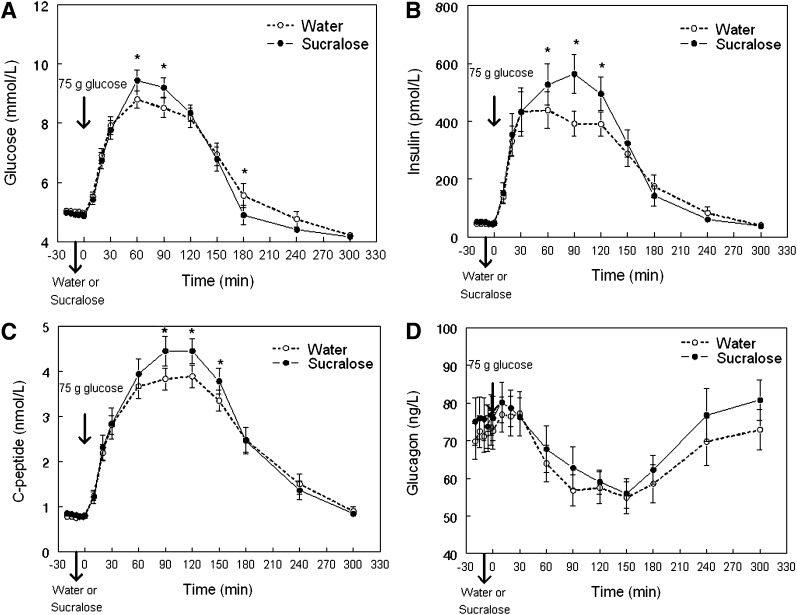
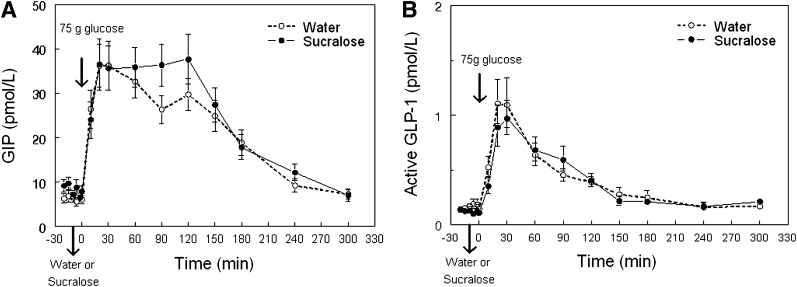
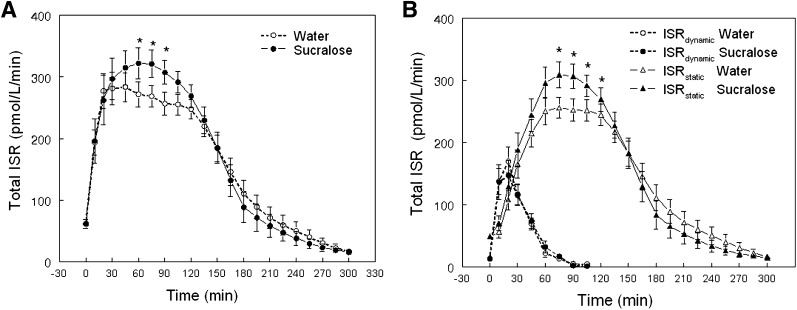
Verification
Claims the paper makes
The claims and statistics of this paper haven’t been checked yet.
Run the check — free, no account needed. It reads the open-access text and checks the sources it cites.
Claims other papers make about this one
Each is checked against this paper’s own text: does it say what the citing paper says it does?
The source backs part of the claim, not all of it — or backs it for a different population, condition or comparison.
In the citing paper
“Indeed, such curves suggest that during an OGTT glucagon may increase in some time periods, though slightly, whereas C-peptide (as well as insulin) is not decreasing as one would expect, thus indicating that in those periods the relationship between insulin action and glucagon variations is lost.”
From Mathematical Model of Glucagon Kinetics for the Assessment of Insulin-Mediated Glucagon Inhibition During an Oral Glucose Tolerance Test (2021) · cites this paper as [31]
Experimental — accuracy not yet measuredThe source backs part of the claim, not all of it — or backs it for a different population, condition or comparison.
In the citing paper
“surprisingly, insulin secretion values, as assessed in study (31) were similarly not related to glucagon.”
From Mathematical Model of Glucagon Kinetics for the Assessment of Insulin-Mediated Glucagon Inhibition During an Oral Glucose Tolerance Test (2021) · cites this paper as [31]
Experimental — accuracy not yet measuredThe cited source says what the claim attributes to it.
In the citing paper
“Model validation on mean experimental data reported by Pepino et al. (31) provided the best fit shown in Figure 2 and the parameter estimates (with related CIs) reported in Table 1 .”
From Mathematical Model of Glucagon Kinetics for the Assessment of Insulin-Mediated Glucagon Inhibition During an Oral Glucose Tolerance Test (2021) · cites this paper as [31]
The cited source says what the claim attributes to it.
In the citing paper
“KGLUCA | 0.005 | -0.002–0.013”
From Mathematical Model of Glucagon Kinetics for the Assessment of Insulin-Mediated Glucagon Inhibition During an Oral Glucose Tolerance Test (2021) · cites this paper as [31]
The cited source says what the claim attributes to it.
In the citing paper
“KΔCPREM | 0.155 | 0.119–0.191”
From Mathematical Model of Glucagon Kinetics for the Assessment of Insulin-Mediated Glucagon Inhibition During an Oral Glucose Tolerance Test (2021) · cites this paper as [31]
The cited source says what the claim attributes to it.
In the citing paper
“in linear regression analysis over the average data of the analyzed population in study (31), we verified that C-peptide time samples were significantly inversely related to those of glucagon, whereas those of insulin (as well as those of glucose) were not.”
From Mathematical Model of Glucagon Kinetics for the Assessment of Insulin-Mediated Glucagon Inhibition During an Oral Glucose Tolerance Test (2021) · cites this paper as [31]
Self-check
Percentages, sums and reported differences re-computed from the paper’s own numbers.
The self-check needs the paper’s full text.
Citations
Cites
Gut-expressed gustducin and taste receptors regulate secretion of glucagon-like peptide-1.
Jang, H.-J., Kokrashvili, Z., Theodorakis, M. J., Carlson, O. D., Kim, B.-J., Zhou, J., Kim, H. H., Xu, X., Chan, S. L., Juhaszova, M., et al. (2007) · Proceedings of the National Academy of Sciences · doi:10.1073/pnas.0706890104 · Cited by 995 · cited 4×
“Second, NNS-induced activation of gut sweet taste receptors in isolated duodenal L cells and pancreatic b-cells triggers the secretion of glucagon-like peptide 1 (GLP-1) (4,5) and insulin (6– 9), respectively.”
BackgroundInfluentialT1R3 and gustducin in gut sense sugars to regulate expression of Na + -glucose cotransporter 1
Margolskee, R. F., Dyer, J., Kokrashvili, Z., Salmon, K. S. H., Ilegems, E., Daly, K., Maillet, E. L., Ninomiya, Y., Mosinger, B., & Shirazi-Beechey, S. P. (2007) · Proceedings of the National Academy of Sciences · doi:10.1073/pnas.0706678104 · Cited by 882
Effects of arterial versus venous sampling on analysis of glucose kinetics in man
McGuire, E. A., Helderman, J. H., Tobin, J. D., Andres, R., & Berman, M. D. (1976) · Journal of Applied Physiology · doi:10.1152/jappl.1976.41.4.565 · Cited by 704
Ascaso, J. F., Pardo, S., Real, J. T., Lorente, R. I., Priego, A., & Carmena, R. (2003) · Diabetes Care · doi:10.2337/diacare.26.12.3320 · Cited by 490
Sweet taste receptors in rat small intestine stimulate glucose absorption through apical GLUT2
Mace, O. J., Affleck, J. A., Patel, N., & Kellett, G. L. (2007) · The Journal of Physiology · doi:10.1113/jphysiol.2007.130906 · Cited by 453
The Use of Areas Under Curves in Diabetes Research
Allison, D. B., Paultre, F., Maggio, C. A., Mezitis, N. H. E., & Pi-Sunyer, X. (1995) · Diabetes Care · doi:10.2337/diacare.18.2.245 · Cited by 398
Oral Glucose Tolerance Test Minimal Model Indexes of β-Cell Function and Insulin Sensitivity
Breda, E., Cavaghan, M. K., Toffolo, G., Polonsky, K. S., & Cobelli, C. (2001) · Diabetes · doi:10.2337/diabetes.50.1.150 · Cited by 320
Nakagawa, Y. S., Nagasawa, M., Yamada, S., Hara, A., Mogami, H., Nikolaev, V. O., Lohse, M. J., Shigemura, N., Ninomiya, Y., & Kojima, I. (2009) · PLoS ONE · doi:10.1371/journal.pone.0005106 · Cited by 308
Nonnutritive Sweeteners: Current Use and Health Perspectives
Gardner, C. D., Wylie‐Rosett, J., Gidding, S. S., Steffen, L. M., Johnson, R. K., Reader, D., & Lichtenstein, A. H. (2012) · Circulation · doi:10.1161/cir.0b013e31825c42ee · Cited by 308
Corkey, B. E. (2011) · Diabetes · doi:10.2337/db11-1483 · Cited by 295
Cited by
Sorted by citations
Srour, B., Fezeu, L. K., Kesse-Guyot, E., Allès, B., Méjean, C., Andrianasolo, R. M., Chazelas, E., Deschasaux, M., Hercberg, S., Galan, P., et al. (2019) · BMJ · doi:10.1136/bmj.l1451 · Cited by 955
Metabolic effects of non-nutritive sweeteners
Pepino, M. Y. (2015) · Physiology & Behavior · doi:10.1016/j.physbeh.2015.06.024 · Cited by 285
Self-citationBauer, P. V., Duca, F. A., Waise, T. M. Z., Rasmussen, B. A., Abraham, M. A., Dranse, H. J., Puri, A., O’Brien, C. A., & Lam, T. K. T. (2018) · Cell Metabolism · doi:10.1016/j.cmet.2017.09.019 · Cited by 265
Non-caloric artificial sweeteners and the microbiome: findings and challenges
Suez, J., Korem, T., Zilberman-Schapira, G., Segal, E., & Elinav, E. (2015) · Gut Microbes · doi:10.1080/19490976.2015.1017700 · Cited by 217
The Association Between Artificial Sweeteners and Obesity
Pearlman, M. Y., Obert, J., & Casey, L. C. (2017) · Current Gastroenterology Reports · doi:10.1007/s11894-017-0602-9 · Cited by 221
The macronutrients, appetite, and energy intake
Carreiro, A. L., Dhillon, J., Gordon, S., Higgins, K. A., Jacobs, A. G., McArthur, B. M., Redan, B. W., Rivera, R. L., Schmidt, L. R., & Mattes, R. D. (2016) · Annual Review of Nutrition · doi:10.1146/annurev-nutr-121415-112624 · Cited by 159
Sucralose, A Synthetic Organochlorine Sweetener: Overview Of Biological Issues
Schiffman, S. S., & Rother, K. I. (2013) · Journal of Toxicology and Environmental Health Part B · doi:10.1080/10937404.2013.842523 · Cited by 189
The Impact of Artificial Sweeteners on Body Weight Control and Glucose Homeostasis
Pang, M. D., Goossens, G. H., & Blaak, E. E. (2021) · Frontiers in Nutrition · doi:10.3389/fnut.2020.598340 · Cited by 180
Critical review of the current literature on the safety of sucralose
Magnuson, B. A., Roberts, A. S., & Nestmann, E. R. (2017) · Food and Chemical Toxicology · doi:10.1016/j.fct.2017.05.047 · Cited by 170
Novotny, J. A., Baer, D. J., Khoo, C., Gebauer, S. K., & Charron, C. S. (2015) · Journal of Nutrition · doi:10.3945/jn.114.203190 · Cited by 163
Dalenberg, J. R., Patel, B. P., Denis, R., Veldhuizen, M. G., Nakamura, Y., Vinke, P. C., Luquet, S. H., & Small, D. M. (2020) · Cell Metabolism · doi:10.1016/j.cmet.2020.01.014 · Cited by 163
Tey, S. L., Salleh, N. B., Henry, C. J., & Forde, C. G. (2016) · International Journal of Obesity · doi:10.1038/ijo.2016.225 · Cited by 145
Nonnutritive sweeteners in weight management and chronic disease: a review
Sylvetsky, A. C., & Rother, K. I. (2018) · Obesity · doi:10.1002/oby.22139 · Cited by 143
The metabolic role of vagal afferent innervation
Waise, T. M. Z., Dranse, H. J., & Lam, T. K. T. (2018) · Nature Reviews Gastroenterology & Hepatology · doi:10.1038/s41575-018-0062-1 · Cited by 140
Physiological mechanisms by which non-nutritive sweeteners may impact body weight and metabolism
Burke, M. V., & Small, D. M. (2015) · Physiology & Behavior · doi:10.1016/j.physbeh.2015.05.036 · Cited by 132
Temizkan, Ş., Deyneli, O., Yasar, M., Arpa, M., Güneş, M., Yazıcı, D., Sirikci, O., Haklar, G., İmeryüz, N., & Yavuz, D. G. (2014) · European Journal of Clinical Nutrition · doi:10.1038/ejcn.2014.208 · Cited by 121
Romo-Romo, A., Aguilar-Salinas, C. A., Brito-Córdova, G. X., Díaz, R. A. G., Valentín, D. V., & Almeda‐Valdés, P. (2016) · PLoS ONE · doi:10.1371/journal.pone.0161264 · Cited by 118
Sucralose Promotes Food Intake through NPY and a Neuronal Fasting Response
Wang, Q., Lin, Y. Q., Zhang, L., Wilson, Y. A., Oyston, L. J., Cotterell, J., Qi, Y., Khuong, T. M., Bakhshi, N., Planchenault, Y., et al. (2016) · Cell Metabolism · doi:10.1016/j.cmet.2016.06.010 · Cited by 121
Non-Nutritive Sweeteners and their Role in the Gastrointestinal Tract
Brown, R. J., & Rother, K. I. (2012) · The Journal of Clinical Endocrinology & Metabolism · doi:10.1210/jc.2012-1475 · Cited by 110
The Effect of Artificial Sweeteners Use on Sweet Taste Perception and Weight Loss Efficacy: A Review
Wilk, K., Korytek, W., Pelczyńska, M., Moszak, M., & Bogdański, P. (2022) · Nutrients · doi:10.3390/nu14061261 · Cited by 114
Dehalogenases: From Improved Performance to Potential Microbial Dehalogenation Applications
Ang, T. F., Maiangwa, J., Salleh, A. B., Normi, Y. M., & Leow, T. C. (2018) · Molecules · doi:10.3390/molecules23051100 · Cited by 112
Artificial sweeteners as a sugar substitute: Are they really safe?
Sharma, A. K., Amarnath, S., Thulasimani, M., & Ramaswamy, S. (2016) · Indian Journal of Pharmacology · doi:10.4103/0253-7613.182888 · Cited by 109
Sorption and biodegradation of artificial sweeteners in activated sludge processes
Trần, N. H., Gan, J., Nguyen, V. T., Chen, H., You, L., Duarah, A., Zhang, L., & Gin, K. Y. (2015) · Bioresource Technology · doi:10.1016/j.biortech.2015.08.083 · Cited by 101
Lertrit, A., Srimachai, S., Saetung, S., Chanprasertyothin, S., Chailurkit, L., Areevut, C., Katekao, P., Ongphiphadhanakul, B., & Sriphrapradang, C. (2018) · Nutrition · doi:10.1016/j.nut.2018.04.001 · Cited by 95
Sucralose decreases insulin sensitivity in healthy subjects: a randomized controlled trial
Romo-Romo, A., Aguilar-Salinas, C. A., Brito-Córdova, G. X., Gómez-Díaz, R. A., & Almeda‐Valdés, P. (2018) · American Journal of Clinical Nutrition · doi:10.1093/ajcn/nqy152 · Cited by 100
Hormonal responses to non-nutritive sweeteners in water and diet soda
Sylvetsky, A. C., Brown, R. J., Blau, J. E., Walter, M. F., & Rother, K. I. (2016) · Nutrition & Metabolism · doi:10.1186/s12986-016-0129-3 · Cited by 100
Rare mono- and disaccharides as healthy alternative for traditional sugars and sweeteners?
van Laar, A., Grootaert, C., & Camp, J. V. (2020) · Critical Reviews in Food Science and Nutrition · doi:10.1080/10408398.2020.1743966 · Cited by 96
How non-nutritive sweeteners influence hormones and health
Rother, K. I., Conway, E. M., & Sylvetsky, A. C. (2018) · Trends in Endocrinology & Metabolism · doi:10.1016/j.tem.2018.04.010 · Cited by 85
Onaolapo, A. Y., & Onaolapo, O. J. (2018) · Pathophysiology · doi:10.1016/j.pathophys.2018.04.002 · Cited by 102
Sánchez‐Tapia, M., Miller, A. W., Granados‐Portillo, O., Tovar, A. R., & Torres, N. (2020) · Gut Microbes · doi:10.1080/19490976.2020.1801301 · Cited by 91
An application of Pavlovian principles to the problems of obesity and cognitive decline
Davidson, T. L., Sample, C. H., & Swithers, S. E. (2013) · Neurobiology of Learning and Memory · doi:10.1016/j.nlm.2013.07.014 · Cited by 89
Hirahatake, K. M., Jacobs, D. R., Shikany, J. M., Jiang, L., Wong, N. D., Steffen, L. M., & Odegaard, A. (2019) · American Journal of Clinical Nutrition · doi:10.1093/ajcn/nqz154 · Cited by 87
Neto, H. A. P., Ausina, P., Gomez, L. S., Leandro, J. G. B., Zancan, P., & Sola‐Penna, M. (2017) · Frontiers in Immunology · doi:10.3389/fimmu.2017.01478 · Cited by 81
Ecotoxicity and environmental fates of newly recognized contaminants-artificial sweeteners: A review
Luo, J., Zhang, Q., Cao, M. Y., Wu, L., Cao, J., Fang, F., Li, C., Xue, Z., & Feng, Q. (2018) · The Science of The Total Environment · doi:10.1016/j.scitotenv.2018.10.445 · Cited by 74
Serra‐Majem, L., Raposo, A., Bartrina, J. A., Varela‐Moreiras, G., Logue, C., Laviada‐Molina, H., Socolovsky, S., Pérez‐Rodrigo, C., Aldrete-Velasco, J. A., Sierra, E. M., et al. (2018) · Nutrients · doi:10.3390/nu10070818 · Cited by 71
Grotz, V. L., Pi-Sunyer, X., Porte, D., Roberts, A., & Richard Trout, J. (2017) · Regulatory Toxicology and Pharmacology · doi:10.1016/j.yrtph.2017.05.011 · Cited by 68
Sugar Reduction in Dairy Food: An Overview with Flavoured Milk as an Example
Mahato, D. K., Keast, R., Liem, D. G., Russell, C. G., Cicerale, S., & Gamlath, S. (2020) · Foods · doi:10.3390/foods9101400 · Cited by 76
Saucedo-Vence, K., Elizalde‐Velázquez, A., Dublán‐García, O., Galar‐Martínez, M., Islas‐Flores, H., SanJuan‐Reyes, N., García-Medina, S., Hernández‐Navarro, M. D., & Gómez‐Oliván, L. M. (2016) · The Science of The Total Environment · doi:10.1016/j.scitotenv.2016.09.230 · Cited by 64
Sambra, V., López‐Arana, S., Cáceres, P., Abrigo, K., Collinao, J., Espinoza, A., Valenzuela, S., Carvajal, B., Prado, G., Peralta, R., et al. (2020) · Frontiers in Nutrition · doi:10.3389/fnut.2020.00068 · Cited by 63
Do non-nutritive sweeteners influence acute glucose homeostasis in humans? A systematic review
Tucker, R. M., & Tan, S. (2017) · Physiology & Behavior · doi:10.1016/j.physbeh.2017.09.016 · Cited by 68
Dhillon, J., Lee, J. Y., & Mattes, R. D. (2017) · Physiology & Behavior · doi:10.1016/j.physbeh.2017.09.009 · Cited by 62
Effect of sucralose and aspartame on glucose metabolism and gut hormones
Ahmad, S. Y., Friel, J. K., & MacKay, D. (2019) · Nutrition Reviews · doi:10.1093/nutrit/nuz099 · Cited by 65
What Parents Think about Giving Nonnutritive Sweeteners to Their Children: A Pilot Study
Sylvetsky, A. C., Greenberg, M. J., Zhao, X., & Rother, K. I. (2014) · International Journal of Pediatrics · doi:10.1155/2014/819872 · Cited by 64
O'Connor, D., Pang, M. D., Castelnuovo, G., Finlayson, G., Blaak, E. E., Gibbons, C., Navas‐Carretero, S., Almiron‐Roig, E., Harrold, J. A., Raben, A., et al. (2020) · Food & Function · doi:10.1039/d0fo02424d · Cited by 62
Zhang, R., Noronha, J. C., Khan, T. A., McGlynn, N. D., Back, S., Grant, S., Kendall, C. W. C., & Sievenpiper, J. L. (2023) · Nutrients · doi:10.3390/nu15041050 · Cited by 66
Higgins, K., Considine, R. V., & Mattes, R. D. (2018) · Journal of Nutrition · doi:10.1093/jn/nxy021 · Cited by 57
Smith, K., Azari, E. K., LaMoia, T. E., Hussain, T., Vargova, V., Károlyi, K., Veldhuis, P. P., Arnoletti, J. P., de la Fuente, S. G., Pratley, R. E., et al. (2018) · Molecular Metabolism · doi:10.1016/j.molmet.2018.08.009 · Cited by 61
Li, D., O'Brien, J. W., Tscharke, B. J., Choi, P. M., Ahmed, F., Thompson, J., Mueller, J. F., Sun, H., & Thomas, K. V. (2020) · The Science of The Total Environment · doi:10.1016/j.scitotenv.2020.142438 · Cited by 57
Consumption of non-nutritive sweeteners during pregnancy
Palatnik, A., Moosreiner, A., & Stichelen, S. O.-V. (2020) · American Journal of Obstetrics and Gynecology · doi:10.1016/j.ajog.2020.03.034 · Cited by 57
Relationship between Ultra-Processed Food Consumption and Risk of Diabetes Mellitus: A Mini-Review
Almarshad, M. I., Algonaiman, R., Alharbi, H. F., Almujaydil, M. S., & Barakat, H. (2022) · Nutrients · doi:10.3390/nu14122366 · Cited by 67
Rosales-Gómez, C., Martínez‐Carrillo, B. E., Reséndiz‐Albor, A. A., Ramírez‐Durán, N., Valdés‐Ramos, R., Mondragón-Velásquez, T., & Escoto‐Herrera, J. A. (2018) · BioMed Research International · doi:10.1155/2018/1345282 · Cited by 55
National wastewater reconnaissance of artificial sweetener consumption and emission in Australia
Li, D., O'Brien, J. W., Tscharke, B. J., Choi, P. M., Zheng, Q., Ahmed, F., Thompson, J., Li, J., Mueller, J. F., Sun, H., et al. (2020) · Environment International · doi:10.1016/j.envint.2020.105963 · Cited by 55
Ultraprocessed Food Consumption and Cardiometabolic Risk Factors in Children
Khoury, N., Martínez, M. Á., Garcidueñas-Fimbres, T. E., Pastor‐Villaescusa, B., Leis, R., Heras-Delgado, S. D. L., Miguel‐Berges, M. L., Navas‐Carretero, S., Portolés, O., Pérez‐Vega, K. A., et al. (2024) · JAMA Network Open · doi:10.1001/jamanetworkopen.2024.11852 · Cited by 61
Ahmad, S. Y., Friel, J. K., & MacKay, D. (2019) · Applied Physiology, Nutrition, and Metabolism · doi:10.1139/apnm-2019-0359 · Cited by 56
Schiano, C., Grimaldi, V., Scognamiglio, M., Costa, D., Soricelli, A., Nicoletti, G. F., & Claudio Napoli, A. (2021) · Food Research International · doi:10.1016/j.foodres.2021.110220 · Cited by 60
Shearer, J., & Swithers, S. E. (2016) · Reviews in Endocrine and Metabolic Disorders · doi:10.1007/s11154-016-9372-1 · Cited by 52
Bueno-Hernández, N., Esquivel‐Velázquez, M., Alcántara-Suárez, R., Gómez-Arauz, A. Y., Espinosa-Flores, A. J., León-Barrera, K. L., Mendoza-Martínez, V. M., Medina, G. A. S., León-Hernández, M., Ruíz-Barranco, A., et al. (2020) · Nutrition Journal · doi:10.1186/s12937-020-00549-5 · Cited by 53
Gardener, H. E., Moon, Y. P., Rundek, T., Elkind, M. S. V., & Sacco, R. L. (2018) · Current Developments in Nutrition · doi:10.1093/cdn/nzy008 · Cited by 52
Screening of organic micropollutants in raw and drinking water in the Yangtze River Delta, China
Ren, H., Tröger, R., Ahrens, L., Wiberg, K., & Yin, D. (2020) · Environmental Sciences Europe · doi:10.1186/s12302-020-00342-5 · Cited by 50
Khan, S. A., Hussain, D., Abbasi, N., & Khan, T. A. (2021) · Chemosphere · doi:10.1016/j.chemosphere.2021.133232 · Cited by 46
Non-Nutritive Sweeteners and Obesity
Fernstrom, J. D. (2014) · Annual Review of Food Science and Technology · doi:10.1146/annurev-food-022814-015635 · Cited by 45
Non-nutritive Sweeteners and Their Associations with Obesity and Type 2 Diabetes
Walbolt, J., & Koh, Y. (2020) · Journal of Obesity & Metabolic Syndrome · doi:10.7570/jomes19079 · Cited by 48
Effect of artificial sweeteners on insulin resistance among type-2 diabetes mellitus patients
Nagpure, S., Mathur, K., Agrawal, R. K., & Deshpande, D. (2020) · Journal of Family Medicine and Primary Care · doi:10.4103/jfmpc.jfmpc_329_19 · Cited by 43
Perszyk, E. E., Hutelin, Z., Trinh, J., Kanyamibwa, A., Fromm, S. P., Davis, X. S., Wall, K. M., Flack, K. D., DiFeliceantonio, A. G., & Small, D. M. (2021) · Nutrients · doi:10.3390/nu13041203 · Cited by 41
Ma, L., Liu, Y., Xu, J., Sun, H., Chen, H., Yao, Y., Zhang, P., Shen, F., & Alder, A. C. (2017) · The Science of The Total Environment · doi:10.1016/j.scitotenv.2017.06.027 · Cited by 43
Non-nutritive sweeteners and their impacts on the gut microbiome and host physiology
Richardson, I., & Frese, S. A. (2022) · Frontiers in Nutrition · doi:10.3389/fnut.2022.988144 · Cited by 49
Schiffman, S. S., Scholl, E. H., Furey, T. S., & Nagle, H. T. (2023) · Journal of Toxicology and Environmental Health Part B · doi:10.1080/10937404.2023.2213903 · Cited by 46
Dietary intakes of six intense sweeteners by Irish adults
Buffini, M., Goscinny, S., Loco, J. V., Nugent, A. P., Walton, J., Flynn, A., Gibney, M. J., & McNulty, B. A. (2017) · Food Additives & Contaminants Part A · doi:10.1080/19440049.2017.1411619 · Cited by 41
Martínez, X., Zapata, Y., Pinto, V., Cornejo, C., Elbers, M., van der Graaf, M., Villarroel, L. A., Hodgson, M. I., Rigotti, A., & Echeverría, G. (2020) · Nutrients · doi:10.3390/nu12061594 · Cited by 42
Gut mechanisms linking intestinal sweet sensing to glycemic control
Kreuch, D., Keating, D. J., Wu, T., Horowitz, M., Rayner, C. K., & Young, R. L. (2018) · Frontiers in Endocrinology · doi:10.3389/fendo.2018.00741 · Cited by 40
“A negative impact of LCS on acute glycemic control has also been shown in obese individuals, where a sucralose preload consumed in advance of an oral glucose tolerance test augmented blood glucose levels over the following 5 h substantially, when compared to water or no preload (103).”
BackgroundOverduin, J., Collet, T., Medic, N., Henning, E., Keogh, J. M., Forsyth, F., Stephenson, C., Kanning, M. W., Ruijschop, R. M. A. J., Farooqi, I. S., et al. (2016) · Appetite · doi:10.1016/j.appet.2016.09.009 · Cited by 40
Chan, C. B., Hashemi, Z., & Subhan, F. B. (2017) · Applied Physiology, Nutrition, and Metabolism · doi:10.1139/apnm-2016-0705 · Cited by 39
Intense Sweeteners, Taste Receptors and the Gut Microbiome: A Metabolic Health Perspective
Turner, A., Veysey, M. J., Keely, S., Scarlett, C. J., Lucock, M. D., & Beckett, E. (2020) · International Journal of Environmental Research and Public Health · doi:10.3390/ijerph17114094 · Cited by 39
Greyling, A., Appleton, K. M., Raben, A., & Mela, D. J. (2020) · American Journal of Clinical Nutrition · doi:10.1093/ajcn/nqaa167 · Cited by 54
Yunker, A. G., Patel, R., & Page, K. A. (2020) · Current Nutrition Reports · doi:10.1007/s13668-020-00323-3 · Cited by 38
Sylvetsky, A. C., Blau, J. E., & Rother, K. I. (2016) · Reviews in Endocrine and Metabolic Disorders · doi:10.1007/s11154-016-9344-5 · Cited by 39
Sylvetsky, A. C., Sen, S., Merkel, P., Dore, F. J., Stern, D., Henry, C. J., Cai, H., Walter, P. J., Crandall, K. A., Rother, K. I., et al. (2020) · Molecular Nutrition & Food Research · doi:10.1002/mnfr.201901166 · Cited by 37
Risdon, S., Battault, S., Romo-Romo, A., Roustit, M., Briand, L. V., Meyer, G., Almeda‐Valdés, P., & Walther, G. (2021) · Advances in Nutrition · doi:10.1093/advances/nmaa185 · Cited by 41
Shum, B. J., & Georgia, S. K. (2021) · Frontiers in Endocrinology · doi:10.3389/fendo.2021.625415 · Cited by 40
Zeng, L., Gao, J., Cui, Y., Wang, Z., Zhao, Y., Yuan, Y., Xu, H., & Fu, X. (2023) · Journal of Hazardous Materials · doi:10.1016/j.jhazmat.2023.132581 · Cited by 34
Bonnet, F., Tavenard, A., Esvan, M., Laviolle, B., Viltard, M., Lepicard, E. M., & Lainé, F. (2018) · Journal of Nutrition · doi:10.1093/jn/nxy100 · Cited by 36
Aguayo-Guerrero, J. A., Méndez-García, L. A., Solleiro-Villavicencio, H., Viurcos-Sanabria, R., & Escobedo, G. (2024) · Life · doi:10.3390/life14030323 · Cited by 34
Chichger, H., Cleasby, M. E., Srai, S. K., Unwin, R. J., Debnam, E. S., & Marks, J. (2016) · Experimental Physiology · doi:10.1113/ep085670 · Cited by 34
Nichol, A. D., Salamé, C., Rother, K. I., & Pepino, M. Y. (2019) · Nutrients · doi:10.3390/nu12010029 · Cited by 34
Li, M., & Shi, Z. (2022) · Nutrients · doi:10.3390/nu14204241 · Cited by 35
Revisited: Assessing the in vivo data on low/no-calorie sweeteners and the gut microbiota
Schiffman, S. S., & Nagle, H. T. (2019) · Food and Chemical Toxicology · doi:10.1016/j.fct.2019.110692 · Cited by 31
Low-calorie sweeteners in food and food supplements on the Italian market
Janvier, S., Goscinny, S., Donne, C. L., & Loco, J. V. (2015) · Food Additives and Contaminants Part B · doi:10.1080/19393210.2015.1094829 · Cited by 31
Investigation of ozonation kinetics and transformation products of sucralose
Hu, R., Zhang, L., & Hu, J. (2017) · The Science of The Total Environment · doi:10.1016/j.scitotenv.2017.06.033 · Cited by 33
Romo-Romo, A., Aguilar-Salinas, C. A., Gómez-Díaz, R. A., Brito-Córdova, G. X., Gómez‐Velasco, D., López-Rocha, M. J., & Almeda‐Valdés, P. (2017) · Revista de investigaci�n Cl�nica · doi:10.24875/ric.17002141 · Cited by 30
Type 1 Taste Receptors in Taste and Metabolism
Kochem, M. (2017) · Annals of Nutrition and Metabolism · doi:10.1159/000478760 · Cited by 28
Morettini, M., Burattini, L., Göbl, C., Pacini, G., Ahrén, B., & Tura, A. (2021) · Frontiers in Endocrinology · doi:10.3389/fendo.2021.611147 · Cited by 27
“, sign of the derivative between two time samples equal to that of the reference curves (31)].”
BackgroundMethodInfluentialUltra-Processed Foods and Excess Heart Age Among U.S. Adults
Yang, Q., Zhang, Z., Steele, E. M., Moore, L. V., & Jackson, S. L. (2020) · American Journal of Preventive Medicine · doi:10.1016/j.amepre.2020.06.013 · Cited by 30
Polychlorinated dibenzo-p-dioxins and dibenzofurans formed from sucralose at high temperatures
Dong, S., Liu, G., Hu, J., & Zheng, M. (2013) · Scientific Reports · doi:10.1038/srep02946 · Cited by 27
Clofibrate inhibits the umami-savory taste of glutamate
Kochem, M., & Breslin, P. A. S. (2017) · PLoS ONE · doi:10.1371/journal.pone.0172534 · Cited by 26
Alsunni, A. A. (2020) · International Journal of General Medicine · doi:10.2147/ijgm.s274760 · Cited by 26
Almiron‐Roig, E., Navas‐Carretero, S., Castelnuovo, G., Kjølbæk, L., Romo‐Hualde, A., Normand, M., Maloney, N. G., Hardman, C. A., Hodgkins, C. E., Moshoyiannis, H., et al. (2023) · Appetite · doi:10.1016/j.appet.2023.106515 · Cited by 29
Azari, E. K., Smith, K. R., Yi, F., Osborne, T. F., Bizzotto, R., Mari, A., Pratley, R. E., & Kyriazis, G. A. (2017) · American Journal of Clinical Nutrition · doi:10.3945/ajcn.116.146001 · Cited by 26
Solomi, L., Rees, G. A., & Redfern, K. M. (2019) · International Journal of Food Sciences and Nutrition · doi:10.1080/09637486.2019.1585418 · Cited by 25
Non-nutritive Sweeteners and Glycaemic Control
Kim, Y., Keogh, J. B., & Clifton, P. M. (2019) · Current Atherosclerosis Reports · doi:10.1007/s11883-019-0814-6 · Cited by 30
Aguayo-Guerrero, J. A., Méndez-García, L. A., Manjarrez‐Reyna, A. N., Esquivel‐Velázquez, M., León‐Cabrera, S., Meléndez, G., Zambrano, E., Ramos-Martı́nez, E., Fragoso, J. M., Briones-Garduño, J. C., et al. (2023) · Biomedicines · doi:10.3390/biomedicines11030650 · Cited by 24
Metadata
- Authors
- Pepino, M. Y., Tiemann, C. D., Patterson, B. W., Wice, B. M., & Klein, S.
- Affiliations
- Washington University in St. Louis (US)
- Center for Human Nutrition, Washington University School of Medicine, St. Louis, Missouri
- Corresponding author
- Klein, Samuel
- Venue
- Diabetes Care
- Publisher
- American Diabetes Association
- Published
- 2013-08-13
- Volume
- 36
- Issue
- 9
- Pages
- 2530-2535
- ISSN
- 0149-5992 (ISSN-L)
- 1935-5548
- PMC
- PMC3747933
- OpenAlex
- W2111548886
- Cited by
- 253
- References
- 34
- Citations by year
- 2026: 19 · 2025: 17 · 2024: 23 · 2023: 17 · 2022: 16 · 2021: 15 · 2020: 36 · 2019: 17 · 2018: 26 · 2017: 25 · 2016: 17 · 2015: 12 · 2014: 6 · 2013: 6
- FWCI
- 12.63
- Type
- journal article
- Language
- en
- Open access
- hybrid
- doi.org
- Licence
- Locations
- Diabetes Care (publishedVersion, cc-by-nc-nd)
- Europe PMC (PubMed Central) (publishedVersion, cc-by-nc-nd)
- PubMed Central (publishedVersion, cc-by-nc-nd)
- PubMed (publishedVersion)
- Funders
- National Institutes of Health (KL2TR000450, UL1TR000448, DK56341, TR000448)
- National Institute of Diabetes and Digestive and Kidney Diseases (DK37948, DK56341, DK088126, R01DK088126, R01DK037948, P30DK056341, P30DK020579)
- National Center for Advancing Translational Sciences
- Topics
- Health Sciences › Nursing › Nutrition and Dietetics › Biochemical Analysis and Sensing Techniques
- Health Sciences › Medicine › Endocrinology, Diabetes and Metabolism › Diet, Metabolism, and Disease
- Health Sciences › Medicine › Endocrinology, Diabetes and Metabolism › Pancreatic function and diabetes
- Keywords
- sucralose, artificial sweeteners, oral glucose tolerance, glycemic response, insulin secretion, insulin sensitivity, insulin clearance, beta-cell function, obesity, glucagon-like peptide-1, glucose-dependent insulinotropic polypeptide, glucagon, insulin resistance
- MeSH terms
- Adult, Blood Glucose, Female, Glucose Tolerance Test, Humans, Insulin, Male, Obesity, Sucrose, Cross-Over Studies
About these checks
Registry, retraction, Cites and statistics results are computed, not judged, with one exception: a printed reference that no index lists is read once by a model before it counts as a citation error. Claims are extracted by a model and kept only when their quote appears verbatim in the text; each cited source is then checked, with a model’s help, for whether it says what the claim relies on. Those verdicts can be wrong — read the claim’s quote and the cited source before relying on one.
Statistics and arithmetic are recomputed, not judged.
Confidence bands are shown only for fields calibrated on our annotated test set. None is calibrated yet, so no band is shown.
What counts as a claim ›How we measure confidence ›How we check this ›
Are you an author, or do you see a problem with this page? Request a review
