

Simulation-Based Learning in Higher Education: A Meta-Analysis
Open accessThe DOI matches its Crossref record; 172 of the 173 references it cites were found in a registry or an index; 3 of the 59 sources its claims cite were checked for support.
Abstract
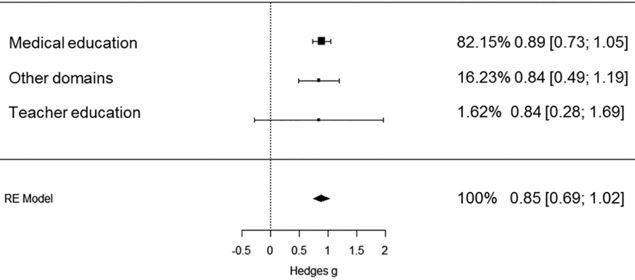
Simulation-based learning offers a wide range of opportunities to practice complex skills in higher education and to implement different types of scaffolding to facilitate effective learning. This meta-analysis includes 145 empirical studies and investigates the effectiveness of different scaffolding types and technology in simulation-based learning environments to facilitate complex skills. The simulations had a large positive overall effect: g = 0.85, SE = 0.08; CIs [0.69, 1.02]. Technology use and scaffolding had positive effects on learning. Learners with high prior knowledge benefited more from reflection phases; learners with low prior knowledge learned better when supported by examples. Findings were robust across different higher education domains (e.g., medical and teacher education, management). We conclude that (1) simulations are among the most effective means to facilitate learning of complex skills across domains and (2) different scaffolding types can facilitate simulation-based learning during different phases of the development of knowledge and skills.
Overview
CoChat Summary
TL;DR
This meta-analysis of 145 studies (10,532 participants) finds that simulation-based learning in higher education has a large positive overall effect on complex skills (g = 0.85, 95% CI [0.69, 1.02]). Effects vary by simulation features and prior knowledge, with examples/prompts helping lower-prior-knowledge learners and reflection phases helping higher-prior-knowledge learners.
Key findings
- Overall effect: g = 0.85, SE = 0.08, 95% CI [0.69, 1.02], N = 145 studies, 10,532 participants; heterogeneity was high: Q(409) = 4213.93, p < .0001, τ² = 1.2, I² = 95.86%.
- By complex skill: technical performance g = 1.06 (SE = 0.15), general problem solving g = 0.88 (SE = 0.11), diagnosing g = 0.82 (SE = 0.21), management g = 0.72 (SE = 0.30), teamwork g = 0.50 (SE = 0.08), communication g = 0.44 (SE = 0.15).
- Simulation features: live model g = 2.27 (N = 3), mixed g = 1.56, mannequin g = 0.96, virtual object g = 0.75, role play g = 0.63, document g = 0.31; technology: simulator g = 1.07, virtual reality g = 0.85, screen-based g = 0.68, no technology g = 0.74; high authenticity g = 0.86 vs low g = 0.58; duration: <1 hr g = 0.65, hours g = 0.81, days g = 0.80, >1 month g = 1.31 (N = 4).
- Scaffolding × prior knowledge: examples helped low-education learners (g = 1.15 vs high-education g = 0.56); prompts helped unfamiliar contexts (g = 0.85 vs no prompts g = 0.63) but not familiar contexts (g = 0.33 vs no prompts g = 0.96); reflection phases helped postgraduate learners (g = 1.10 vs no reflection g = 0.86) but not graduate/undergraduate learners (g = 0.52 vs no reflection g = 0.81).
Methods
- Meta-analysis of 145 empirical studies (from 128 articles, 1979–2018) yielding 409 effect estimates and 10,532 participants; searched PsycINFO, PsycARTICLES, ERIC, and MEDLINE through April 2018; included experimental/quasi-experimental or within-subject pre-post studies with a control condition and objective measures of complex skills.
- Coded moderators included simulation type, technology use, duration, authenticity, scaffolding (examples, prompts, reflection phases), knowledge convey, prior knowledge (familiarity of context, level of education), complex skill type, domain, study design, and publication type.
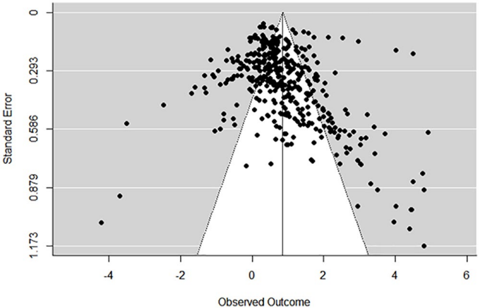
- Used Hedges’ g, random-effects models, robust variance estimation for correlated effects, pretest adjustment when available, heterogeneity Q/I², and publication-bias checks (Egger’s test, trim and fill); metaregression on control variables.
Limitations
- Stated: the focus is on complex skills involving interaction with people, so findings do not straightforwardly generalize to STEM domains such as science, mathematics, engineering, or informatics; a large proportion of findings come from medical education, so caution is needed for other domains, especially regarding technology, simulation type, outcome measures, and moderators.
- Stated: many primary studies gave little treatment description, insufficient for coding some moderators or finer distinctions; many implemented multiple instructional support measures, making specific effects hard to determine; the scaffolding framework may omit other supports such as feedback or fading/adding instruction; combinations could only be partially investigated; prior knowledge operationalization had drawbacks and explained only 4% of heterogeneity; implementation quality was assumed similar; large unexplained heterogeneity requires caution.
- Evident from the text: heterogeneity was very high (I² = 95.86%, τ² = 1.2), and several moderator estimates rest on very small numbers (e.g., live model N = 3, all scaffolding types N = 2, duration >1 month N = 4), so subgroup effects are unstable; presence/absence comparisons for examples, prompts, and reflections often did not reach significance.
Model-written summary. Check it against the paper before relying on it.
Integrity signals
Registry
Cites
Statistics
Figures

Verification
Claims the paper makes
1 Valid · 3 Not valid · 48 Not checked · 181 Own results and interpretations
At least one cited source doesn’t support this claim or points to a different paper, and none confirmed it — see the verdicts below.
In the paper
“However, they only focused on comparing simulations with a duration of more than 1 day with simulations of less than 1 day.”
§ Simulation-Based Learning in Higher Education: A Meta-Analysis > Simulations in Educational Contexts
What the sources say
- Disputedcites Cook et al., 2013 matched to “Technology-Enhanced Simulation to Assess Health Professionals: A Systematic Review of Validity Evidence, Research Methods, and Reporting Quality” (2013) sourceExperimental — accuracy not yet measured
Our copy of Cook et al. (2013) contains no duration contrast whatsoever: searches for 'simulation duration more than one day versus less than one day' and related phrasings returned only the study-coding tables. Those tables (sections 'List of all included studies, sorted by year of publication, with validity evidence and QUADAS-2 ratings (N=417 except for QUADAS-2)', pp. 17, 21, 23, 27, 32-35, and the parallel full-citation list, pp. 4-14) show the review's actual focus: charting validity evidence (content/response/process, internal structure, relations to other variables, consequences, reliability), methodological quality (MERSQI, selection/flow indices, RoB indices, QUADAS-2) and reporting across 417 technology-enhanced simulation assessment studies spanning many topics and instruments. That is contrary to the claim that the review 'only focused on comparing simulations with a duration of more than 1 day with simulations of less than 1 day'. Our copy is truncated at the end, but the retrieved structure of the review already contradicts the characterization; no alternative source for the duration comparison is named in our copy. (LLM, conf=0.72)
Checked by a reasoning model — may be wrong.
plain- Asserted: passes — The authors put it forward as true.
- Checkable: passes — It can be checked against evidence.
- Load-bearing: passes — The paper’s conclusions depend on it.
- Based: passes — The paper gives a reason why it holds.
- Disputed
The cited sources that could be checked couldn’t confirm or dispute this claim.
In the paper
“In their meta-analysis, Cook et al. (2013) provided supportive evidence of the effectiveness of distributed and repetitive practice (effects above .60)in the acquisition of complex skills in medical education.”
§ Simulation-Based Learning in Higher Education: A Meta-Analysis > Simulations in Educational Contexts
What the sources say
- Could not verifycites Cook et al., 2013 matched to “Technology-Enhanced Simulation to Assess Health Professionals: A Systematic Review of Validity Evidence, Research Methods, and Reporting Quality” (2013) sourceExperimental — accuracy not yet measured
Our copy of Cook et al. (2013) contains only the appendix material — the 'List of all included studies, sorted by year of publication, with full journal citation' (pp. 2-16) and the parallel table 'with validity evidence and QUADAS-2 ratings (N=417)' (pp. 20-35), which catalogue simulation-based ASSESSMENT validation studies with MERSQI scores, not pooled effects. Searches for 'distributed and repetitive practice', 'meta-analysis', 'effect size / Hedges g / random-effects', 'learning principles / repetition', and the paper's objective returned no narrative text at all, so nothing in our copy reports an effectiveness meta-analysis or effect magnitudes above .60. The copy is also flagged truncated, so the results/discussion where such a finding would appear may be missing; absence here is not evidence of a contrary statement, and no alternative source is named in the passages we hold. (LLM, conf=0.68)
plainstates a cause- Asserted: passes — The authors put it forward as true.
- Checkable: passes — It can be checked against evidence.
- Load-bearing: unclear — It is unclear whether the paper’s conclusions depend on it.
- Based: passes — The paper gives a reason why it holds.
- Could not verify
The cited sources support only part of this claim — read each source’s verdict below.
In the paper
“All these scaffolding measures were found to be beneficial for developing diagnostic competences (Chernikova et al., 2019).”
§ Simulation-Based Learning in Higher Education: A Meta-Analysis > Added Value of Instructional Support
What the sources say
- Partly supportedcites Chernikova et al., 2019 matched to “Facilitating Diagnostic Competences in Higher Education—a Meta-Analysis in Medical and Teacher Education” (2020) sourceExperimental — accuracy not yet measured
The meta-analysis does state broadly that all scaffolding types help ('as long as learners are able to practice problem-solving, all of the different types of scaffolding are beneficial', Theoretical Significance; echoed in Summary and Conclusion: roles, prompts and reflection phases 'have clear positive effects', with 'no indication for different effect sizes of different types of scaffolding'). But the claim drops the source's binding condition — the benefit holds only where learners' own problem-solving is preserved — and the source's results are not uniformly significant: in Effect of Scaffolding, settings with vs. without examples 'did not reach statistical significance' (Q(1,35)=2.85, p=.06), and Limitations warns that 'conclusions about the effectiveness of each scaffolding type should be made with caution'. So the flat 'all these scaffolding measures were found to be beneficial' overstates an explicitly conditional and hedged finding. (LLM, conf=0.72)
plainstates a cause- Asserted: passes — The authors put it forward as true.
- Checkable: passes — It can be checked against evidence.
- Load-bearing: passes — The paper’s conclusions depend on it.
- Based: passes — The paper gives a reason why it holds.
- Partly supported
A result the paper reports from its own data — it cites no other source for it, so there is none to check. The quote shows it is in the paper.
In the paper
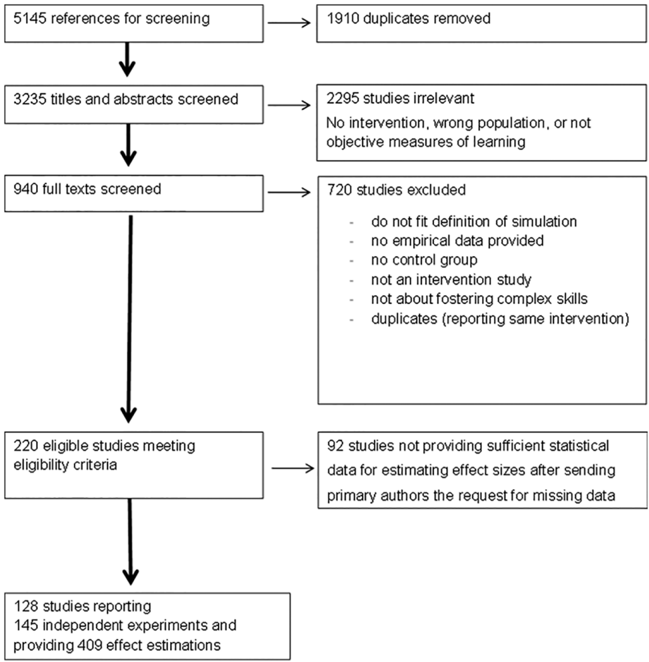
“The 145 eligible studies (from 128 articles published in the period 1979-2018) provided 409 effect estimations (Figure 1).”
§ Simulation-Based Learning in Higher Education: A Meta-Analysis > Results of Literature Search
plainn = 10,532- Asserted: passes — The authors put it forward as true.
- Checkable: passes — It can be checked against evidence.
- Load-bearing: passes — The paper’s conclusions depend on it.
- Based: passes — The paper gives a reason why it holds.
A result the paper reports from its own data — it cites no other source for it, so there is none to check. The quote shows it is in the paper.
In the paper
“The most frequent combinations of instructional support measures were knowledge convey together with examples (82 effects), knowledge convey with reflection phases (62 effects), and examples with reflection phases (43 effects).”
§ Simulation-Based Learning in Higher Education: A Meta-Analysis > Results of Literature Search
plain- Asserted: passes — The authors put it forward as true.
- Checkable: passes — It can be checked against evidence.
- Load-bearing: unclear — It is unclear whether the paper’s conclusions depend on it.
- Based: passes — The paper gives a reason why it holds.
120 more claims
Create a free account to see all 233 claims and to verify the 44 references still open.
- It may state two separate claims as one. 61
- Probably not a substantial claim. 61
Claims other papers make about this one
Each is checked against this paper’s own text: does it say what the citing paper says it does?
In the citing paper
“Chernikova and colleagues have demonstrated in a meta-analysis that simulations of professional situations, such as interactions in a classroom for teachers, can be a beneficial tool during teacher training as they expose teachers to authentic problems in their fields51.”
From On opportunities and challenges of large multimodal foundation models in education (2025) · cites this paper as [51]
In the citing paper
“Meta-analytic findings indicate that simulations are among the most effective means to facilitate the learning of complex skills across domains, with technology-based and scaffolded simulations showing robust positive effects on learning outcomes [11].”
In the citing paper
“While several earlier reviews have examined the general benefits of simulation in nursing education [17], few have focused specifically on its role in bridging the theory–practice gap.”
From The impact of clinical simulation on bridging the theory–practice gap in nursing education: a systematic review (2025) · cites this paper as [17]
In the citing paper
“High-fidelity simulations were particularly associated with enhanced clinical judgment and decision-making accuracy [17, 29, 30].”
From The impact of clinical simulation on bridging the theory–practice gap in nursing education: a systematic review (2025) · cites this paper as [17]
In the citing paper
“These findings are supported by meta-analytic evidence from Chernikova et al., who concluded that simulation-based learning substantially improves decision-making and problem-solving skills in higher education, especially when paired with active learning strategies and structured debriefing [17].”
From The impact of clinical simulation on bridging the theory–practice gap in nursing education: a systematic review (2025) · cites this paper as [17]
Statistics recomputed
Every reported test result, recomputed from its test statistic and degrees of freedom. A result shows as not adding up only once an independent check has confirmed it.
- ConsistentQ(409) = 4213.93reported p < .0001 · recomputed p < .001
“Q (409) = 4213.93,p < .0001”
Self-check
Percentages, sums and reported differences re-computed from the paper’s own numbers.
Each contradiction between two passages listed here was confirmed by an independent check.
Rated major: it would touch a result — a value a result rests on, reported and recomputed p-values on opposite sides of the significance level, two passages that conflict with no sign which is right, or a cited work retracted before this paper was published.
In the paper
§ Simulation-Based Learning in Higher Education: A Meta-Analysis > Discussion
“However, the effects are greater if learners are unfamiliar with the context and the task.”
§ Simulation-Based Learning in Higher Education: A Meta-Analysis > Prior Professional Knowledge
“learners showed a lower increase of complex skills in an unfamiliar context (g = 0.67, SE = 0.10) than in a familiar context (g = 0.83, SE = 0.13)”
Rated minor: it would not touch a result — a value no result rests on, a p-value that stays on the same side of the significance level, or a conflict that is clerical, resolved elsewhere in the paper, or outside its own findings.
In the paper
§ Simulation-Based Learning in Higher Education: A Meta-Analysis > Results of Literature Search
“Most studies focused on general problem solving (51) or the technical performance of a particular complex procedure (56); the other outcomes were communication skills (24), diagnosing (18), managing critical situations (18), and collaboration and teamwork (5).”
§ Simulation-Based Learning in Higher Education: A Meta-Analysis > Conclusion
“2,493 (27) 0.46 91.03% | 911 (18) 0.76 92.02% | 6,010 (58) 0.47 91.23% | 2,543 (21) 1.04 97.15% | 810 (5) 0.03 66.07% | 2,933 (63) 1.25 91.10%”
Rated minor: it would not touch a result — a value no result rests on, a p-value that stays on the same side of the significance level, or a conflict that is clerical, resolved elsewhere in the paper, or outside its own findings.
In the paper
“(2) prompts as the only scaffolding method (N = 11)”
§ Simulation-Based Learning in Higher Education: A Meta-Analysis > Level of Education as an Indicator of Prior Knowledge and Experience
Reported 11 · recomputed 12
Rated minor: it would not touch a result — a value no result rests on, a p-value that stays on the same side of the significance level, or a conflict that is clerical, resolved elsewhere in the paper, or outside its own findings.
In the paper
§ Simulation-Based Learning in Higher Education: A Meta-Analysis > Discussion
“Despite these differences, simulations had effects that can be categorized as large positive effects for all but one type of skill.The exception is teamwork, where the meta-analysis found a medium positive effect only.”
§ Simulation-Based Learning in Higher Education: A Meta-Analysis > Overall Effect of Simulation-Based Learning on Complex Skills (Research Question 1)
“Communication and collaboration skills (teamwork) are only moderately facilitated by simulation-based learning (g = 0.44, SE = 0.15, and g = 0.50, SE = 0.08, respectively)”
Rated minor: it would not touch a result — a value no result rests on, a p-value that stays on the same side of the significance level, or a conflict that is clerical, resolved elsewhere in the paper, or outside its own findings.
In the paper
§ Simulation-Based Learning in Higher Education: A Meta-Analysis > Level of Education as an Indicator of Prior Knowledge and Experience
“however, introducing prompts was related to higher learning outcomes in the high-level group.”
§ Simulation-Based Learning in Higher Education: A Meta-Analysis > Level of Education as an Indicator of Prior Knowledge and Experience
“Similarly, introducing prompts for a high (postgraduate learners and practitioners) level (g = 0.50, SE = 0.36) was not beneficial for learning compared with simulations without prompts (g = 0.91, SE = 0.11).”
Citations
Cites
Measuring inconsistency in meta-analyses
Higgins, J. P. T., Thompson, S. G., Deeks, J. J., & Altman, D. G. (2003) · BMJ · doi:10.1136/bmj.327.7414.557 · Cited by 63,139 · cited 1×
“The thresholds suggested by Higgins et al. (2003) were used to interpret the I 2 (25% for low heterogeneity, 50% for medium, 75% for high heterogeneity).”
MethodBorenstein, M., Hedges, L. V., Higgins, J. P. T., & Rothstein, H. R. (2009) · doi:10.1002/9780470743386 · Cited by 14,225
Hattie, J., & Timperley, H. (2007) · Review of Educational Research · doi:10.3102/003465430298487 · Cited by 12,905
THE ROLE OF TUTORING IN PROBLEM SOLVING *
Wood, D., Bruner, J. S., & Ross, G. (1976) · Journal of Child Psychology and Psychiatry · doi:10.1111/j.1469-7610.1976.tb00381.x · Cited by 8,851 · cited 1×
“Scaffolding enables a learner to solve problems through modifying tasks and reducing possible pathways, and through hints helping the learner to coordinate the steps in problem solving or interaction (Quintana et al., 2004), by taking over some elements of learning material (Wood et al., 1976).”
BackgroundKirschner, P. A., Sweller, J., & Clark, R. E. (2006) · Educational Psychologist · doi:10.1207/s15326985ep4102_1 · Cited by 7,776 · cited 2×
“…suggesting that including simulations in a later phase of a higher education program after students already know theoretical concepts is promising in order to not overwhelm learners and block too much of their cognitive capacity for solving a problem in a simulation (e.g., Kirschner et al., 2006).”
BackgroundFunnel plots for detecting bias in meta-analysis
Sterne, J. A. C., & Egger, M. (2001) · Journal of Clinical Epidemiology · doi:10.1016/s0895-4356(01)00377-8 · Cited by 3,779 · cited 1×
“We have a relatively small sample of empirical studies and apply a range of techniques to identify possible biases (Egger’s test, trim and fill) and improve the generalizability of the results (Sterne & Egger, 2001).”
MethodEducational Psychology: A Cognitive View
Gagné, R. M., Ausubel, D. P., & Gagné, R. M. (1969) · American Educational Research Journal · doi:10.3102/00028312006002287 · Cited by 3,302
Educational Psychology: A Cognitive View
Gagné, R. M., Ausubel, D. P., & Gagne, R. M. (1969) · American Educational Research Journal · doi:10.2307/1161899 · Cited by 3,278
HMELO-SILVER, C. E., DUNCAN, R. G., & CHINN, C. A. (2007) · Educational Psychologist · doi:10.1080/00461520701263368 · Cited by 2,641 · cited 1×
“…problems, especially in early stages of expertise development, should be accompanied by scaffolding to maximize learning and avoid cognitive overload, distraction, or focusing on superficial features of a situation (see the discussions of Hmelo-Silver et al., 2007; Kirschner et al., 2006).”
BackgroundReflection and reflective practice in health professions education: a systematic review
Mann, K., Gordon, J., & MacLeod, A. (2009) · Advances in Health Sciences Education · doi:10.1007/s10459-007-9090-2 · Cited by 2,175 · cited 1×
“Reflection phases, on the other hand, allow learners to think about goals, analyze their own performance, and plan further steps (e.g., Mann et al., 2009), but they do not provide much guidance during the problem solving.”
Background
Research works printed but not linked: 4
- Funke, J. (Ed.). (2006). Denken und Problemlösen (pp. 375-446).
- Henninger, M., & Mandl, H. (2000). Vom Wissen zum Handeln-ein Ansatz zur Förderung kommunikativen Handelns [From knowledge to action-An approach for fostering communicative behavior]. In H. Mandl & J. Gerstenmaier (Eds.), Die Kluft zwischen Wissen und Handeln (pp. 197-219).
- Raven, J. (2000). Psychometrics, cognitive ability, and occupational performance. Review of Psychology, 7(1-2), 51-74.
- Veritas Health Innovation. (2019). Covidence systematic review software (online ver- sion) [Computer software]. https://www.covidence.org
Cited by
Items 501–600 of 1,412
Johnkutty, M., Kuperstein, H., Koroma, F., Chen, J., Mattson, J., & Ahmad, S. (2025) · Medical Education Online · doi:10.1080/10872981.2025.2528355 · Cited by 3
“Additionally, we sought to conduct simulations in settings with greater applicability to real clinical scenarios to maximize learners’ motivation to participate in simulations [8].”
Bahar, F. F., & Balaman, U. (2025) · European Journal of Teacher Education · doi:10.1080/02619768.2025.2545865 · Cited by 3
Rehearsing for teaching: Theoretical and empirical approaches to a practice-based teacher education
Biesta, G., Haukanes, S., Lindstøl, F., Myklebust, H., Åsland, I. G., Traa, L. K., Koløy, K., Litlabø, L. A., Christiansen, I. G., Sømme, T. K., et al. (2025) · Fagbokforlaget eBooks · doi:10.55669/oa6005 · Cited by 3
Kwan, C. C.-Y., Weir, K. A., Fong, R., Pereira, V. J., & Law, T. K. T. (2025) · BMC Medical Education · doi:10.1186/s12909-025-07721-7 · Cited by 3
Levin, O. (2025) · Technology Pedagogy and Education · doi:10.1080/1475939x.2025.2553582 · Cited by 4
“Despite differences in simulation type, the goal across all methods remains the same: to provide experiential learning by simulating a professional conflict and discussing the experience in a debriefing process (Chernikova et al., 2020).”
InfluentialSujarwo, S., Santosa, T. A., Happy, N., Safira, I., Hiola, S. F., Manahor, A., & Rasyid, F. B. S. (2025) · IJORER International Journal of Recent Educational Research · doi:10.46245/ijorer.v6i4.871 · Cited by 5
“Both approaches support the development of 4C skills (critical thinking, creativity, collaboration, communication) essential to student success in the 21st century (Fitria et al., 2024; Chernikova et al., 2020; (l-Kamzari & Alias, 2025).”
Utilizing ATLS® Trauma Management Protocols: the gold standard for safe and effective care
Dogjani, A., Selmani, E., Zaimi, E., Haxhirexha, K., Biberaj, P., Lenjani, B. Z., Subashi, K., Hasmuca, I., Zogaj, E., Blloshmi, A., et al. (2025) · Family Medicine & Primary Care Review · doi:10.5114/fmpcr.2025.153095 · Cited by 3
Sutarja, D. F., Sudarsono, B., & Ghozali, F. A. (2025) · Bulletin of Pedagogical Research · doi:10.51278/bpr.v5i2.2041 · Cited by 3
“An EV-KIT is an educational tool designed to simulate electric vehicle systems in a simple yet comprehensive way (Chernikova et al., 2020; Curiel-Ramirez et al., 2022).”
ProtectTech: a ChatGPT generated scenario activity to foster student decision-making capability
Allison, J. (2025) · Journal of Further and Higher Education · doi:10.1080/0309877x.2025.2583091 · Cited by 3
“This paper supports the assertion that how students in higher education should have opportunities for engaging and applied learning experiences (Chernikova et al. 2020; England, Nagel, and Salter 2020; Omiya and Kadobayashi 2019), as many benefits were obtained.”
Ильинична, Д. С. (2025) · Russian Journal of Education and Psychology · doi:10.12731/2658-4034-2025-16-3-748 · Cited by 3
Dai, C., & Ke, F. (2026) · Educational Technology Research and Development · doi:10.1007/s11423-026-10592-4 · Cited by 7
“Based on prior meta-analyses in similar contexts and comparable target populations (Chernikova et al., 2020; Dai et al., 2024a, 2024b), we used an expected effect size of f 2 = 0.43 , which falls within the medium-to-large range (Cohen, 1992).”
InfluentialInclusive Instructional Design Through Digital Pedagogies and Active Learning Approaches
Manojkumar, R., Srinivas, T. A. S., & Venkanna, M. (2026) · IGI Global eBooks · doi:10.4018/979-8-3373-5188-9.ch006 · Cited by 3
Developing behavioral project management competencies – the generation footprint
Kužet, I., Todorovic, M. L., Manojlović, M., Ding, R., Kovačević, I., & Obradovic, V. L. (2026) · International Journal of Managing Projects in Business · doi:10.1108/ijmpb-06-2025-0227 · Cited by 3
Rexhäuser, D., Radkowitsch, A., Richters, C., Glogger‐Frey, I., Vogel, D., Meier, J., & Abele, S. (2026) · International Journal of Computer-Supported Collaborative Learning · doi:10.1007/s11412-026-09468-9 · Cited by 4
A systematic review and meta-analysis of educational games for the intervention of school bullying
Zhang, L., Zhang, B., & Shang, J. (2026) · Acta Psychologica · doi:10.1016/j.actpsy.2026.106963 · Cited by 4
Pre-registration nursing students’ experiences with debriefing in simulation: A scoping review
Alnazawi, A., Malone, M. J., & Raleigh, M. (2026) · Nurse Education in Practice · doi:10.1016/j.nepr.2026.104853 · Cited by 3
Building Teacher Learning Theory and Research in the Era of Student-Centered Instructional Reforms
Walsh, M. E. (2021) · D-Scholarship@Pitt (University of Pittsburgh) · Cited by 3
Rivera‐Ortega, U., Hernández-Montero, P., & Hugo-Teutli (2023) · Physics Education · doi:10.1088/1361-6552/acbf1c · Cited by 3
“Nowadays, educational resources are very important tools used in academic environments to facilitate and assist with the learning/teaching process [1].”
Las pruebas saber pro, un desafío a la educación en Colombia
Medina, J. E. C., Pineda, D. F. P., & Suárez, S. J. L. (2023) · Saber ciencia y libertad · doi:10.18041/2382-3240/saber.2023v18n1.10116 · Cited by 3
The bounds of meta-analytics and an alternative method
Shanmugam, R., Tabatabai, M., Wilus, D. M., & Singh, K. P. (2024) · Epidemiology and Health · doi:10.4178/epih.e2024016 · Cited by 3
“The reader is referred to Boren-stein et al. [8] for the role of the Higgins score in relation to the heterogeneity of the sampled populations in meta-analyses and to Chernikova et al. [32] and Blumenfeld [33] for a discussion of simulation-based learning meta-analysis.”
BackgroundDias, J. M., Abraham, M. S., Subu, M. A., Al‐Yateem, N., & Ahmed, F. R. (2024) · International Journal of Nursing Education · doi:10.37506/qnt6qx32 · Cited by 3
POSER: an oPen sOurce Simulation platform for tEaching and tRaining underwater photogrammetry
Menna, F., McAvoy, S., Nocerino, E., Tanduo, B., Giuseffi, L., Calantropio, A., Chiabrando, F., Losè, L. T., Lingua, A. M., Sandin, S. A., et al. (2024) · The international archives of the photogrammetry, remote sensing and spatial information sciences/International archives of the photogrammetry, remote sensing and spatial information sciences · doi:10.5194/isprs-archives-xlviii-2-2024-265-2024 · Cited by 3
“Simulation-based learning is generally understood to have significant positive effects on acquiring new complex skills (Chernikova 2020).”
BackgroundAnalyzing Teachers’ Diagnostic and Intervention Processes in Debugging Using Video Vignettes
Wachter, H., & Michaeli, T. (2024) · Lecture notes in computer science · doi:10.1007/978-3-031-73474-8_13 · Cited by 6
“Therefore, the development of diagnostic and intervention skills plays a central role in successful teaching and should be fostered in teacher education [4].”
BackgroundHealthcare simulation—Past, Present, and Future
Nicolau, A., Berger‐Estilita, J., van Meurs, W. L., Lopes, V., Lazarovici, M., & Granja, C. (2024) · Porto Biomedical Journal · doi:10.1097/j.pbj.0000000000000270 · Cited by 3
Zuckerman, D., Yablon, Y. B., & Iluz, S. (2024) · Education Sciences · doi:10.3390/educsci14111265 · Cited by 5
Sungkono, S., Makrufardi, F., Azizah, A. F. N., & Ekaputra, F. (2024) · Journal of Education and Health Promotion · doi:10.4103/jehp.jehp_1721_23 · Cited by 3
Shah, M., Tan, Y., Eagan, B. R., Chabalowski, B. D., & Chen, Y. (2025) · International Conference on Learning Analytics and Knowledge (LAK) · doi:10.1145/3706468.3706512 · Cited by 3
“A recent meta-analysis underscores the efficacy of simulation-based learning in developing a wide array of professional skills across various fields, including medical education [1].”
Davies, A. J., & McCarthy, C. A. (2025) · Policing A Journal of Policy and Practice · doi:10.1093/police/paaf007 · Cited by 3
Wahl, A. M., Giskeødegård, M. F., & Sellberg, C. (2025) · International Journal of Training and Development · doi:10.1111/ijtd.12364 · Cited by 3
Elizondo-García, M. E., Lara-Prieto, V., García‐García, R., Benavides-García, I. G., & Membrillo‐Hernández, J. (2025) · IEEE Global Engineering Education Conference (EDUCON) · doi:10.1109/educon62633.2025.11016569 · Cited by 3
“Addressing these deficiencies requires educational strategies that emphasize challenge-based learning, which fosters critical thinking and active problem-solving skills while connecting theoretical concepts to real-world applications [2], [3].”
Ekse, E. B., Giskeødegård, M. F., Sellberg, C., & Wahl, A. M. (2025) · Discover Education · doi:10.1007/s44217-025-00664-7 · Cited by 3
“One recognized approach in this regard is simulation-based training, which enables educators to prepare and assess students in controlled, risk-free environments [22–24].”
Janeczko, J. M., Lehmkuhl, A., Junker, R., Zucker, V., Meschede, N., & Holodynski, M. (2025) · Educational Technology Research and Development · doi:10.1007/s11423-025-10546-2 · Cited by 9
McLean, A. L., Kubon, S., Schwarz, F., & Senft, C. (2025) · Journal of surgical education · doi:10.1016/j.jsurg.2025.103637 · Cited by 3
Hodwitz, K., Rambihar, S., Nesbitt, G., Tekian, A. S., & Brydges, R. (2025) · Advances in Simulation · doi:10.1186/s41077-025-00375-x · Cited by 3
“Researchers could study how best to tailor the assessment stimulus (i.e., simulator views and requirements), available educational supports (e.g., worked examples) [5], and rater processes (e.g., feedback specificity and type) [31] to each trainee’s level of prior knowledge.”
Wismaningrum, P., & Acetylena, S. (2025) · Jurnal Intelek Insan Cendikia · Cited by 5
Qi, X., He, R., Wen, B., Li, Q., & Wu, H. (2021) · PeerJ · doi:10.7717/peerj.11104 · Cited by 3
Evaluation of mountain rescuers’ (non-)technical skills during simulated resuscitation
Hanus, S. A., Jossberger, H., & Gruber, H. G. (2021) · Studies In Educational Evaluation · doi:10.1016/j.stueduc.2021.101122 · Cited by 3
The Effect of Fundamental Motor Skills Program on the Character of Kindergarten Students
Pranoto, N. W., Chaeroni, A., Susanto, N., & Ayubi, N. (2021) · International Journal of Research Publications · doi:10.47119/ijrp1009111220212585 · Cited by 3
An Introduction to Simulation Training Through the Lens of Experience and Activity Analysis
Flandin, S., Vidal-Gomel, C., & Ortega, R. B. (2022) · Professional and practice-based learning · doi:10.1007/978-3-030-89567-9_1 · Cited by 4
Simulations as Collaborative Learning Systems to Enhance Student Performance in Higher Education
Mukazi, F. M. (2022) · Advances in educational technologies and instructional design book series · doi:10.4018/978-1-6684-2468-1.ch020 · Cited by 6
Application of Computer-Based Simulation Teaching Combined with PBL in Colorectal Tumor Hemorrhage
Zhang, Y., Hu, J., Li, L., & Zhao, Y. (2022) · Emergency Medicine International · doi:10.1155/2022/1251388 · Cited by 3
“PBL encourages students to learn actively, and the most obvious advantage of PBL compared with traditional lecture method is that it emphasizes and encourages students to learn actively, encourages students to broaden their ideas and learn creatively, and requires the integration and convergence of basic and clinical…”
BackgroundRetractedSimulering av truende situasjoner kan gi tryggere sykepleierstudenter
Nag, T. H., Sortvik, W. M., Andersen, K., Pettersen, N., & Nordvik, Ø. (2022) · Sykepleien Forskning · doi:10.4220/sykepleiens.2022.90552 · Cited by 3
Lehrkräftebildung in der Hochschule
Gröschner, A., & de Zordo, L. (2022) · Springer eBooks · doi:10.1007/978-3-658-24729-4_58 · Cited by 10
Seko, Y., Malik, A., Lau, P. H., Neri, D., & Courtnage, A. (2023) · Innovations in Education and Teaching International · doi:10.1080/14703297.2023.2197872 · Cited by 3
“LAS has grown in its importance in fields that involve human-to-human interactions, such as medicine, nursing, counselling, and teacher education, to prepare learners for real-life situations (Chernikova et al., 2020).”
BackgroundInfluences of the effective use of a computer simulation on learning in physical science
Hamamous, A., & Benjelloun, N. (2023) · International Journal of Evaluation and Research in Education (IJERE) · doi:10.11591/ijere.v12i3.24170 · Cited by 3
Business Computer Simulations and its Role in Educational Processes from the Students’ Perspective
Binsztok, A., Butryn, B., Hołowińska, K., Owoc, M. L., & Sobińska, M. (2023) · Procedia Computer Science · doi:10.1016/j.procs.2023.10.396 · Cited by 3
Rahmaniar, R., Wahyuni, S. F., & Hariyanto, E. (2023) · Jurnal SOLMA · doi:10.22236/solma.v12i1.11105 · Cited by 3
Review Study on the Adaptive and Personalized Intelligent Tutoring Systems in E-learning
Hadbi, A. E., Hachem, E.-K., Bourray, H., Rziki, M. H., & Oubalahcen, H. (2024) · Lecture notes in networks and systems · doi:10.1007/978-3-031-54288-6_5 · Cited by 6
Doppelter Praxistransfer in der Lehrkräftebildung für berufliche Schulen
:null (2024) · Waxmann Verlag GmbH eBooks · doi:10.31244/9783830997979 · Cited by 4
Ahmad, A. I., & Wrahatnolo, T. (2024) · EDUKATIF JURNAL ILMU PENDIDIKAN · doi:10.31004/edukatif.v6i2.6429 · Cited by 3
“Perkiraan praktik ini dapat diwujudkan di pendidikan dengan simulasi, yang memungkinkan siswa menggunakan masalah otentik dan juga menciptakan lingkungan belajar untuk berlatih dan memfasilitasi perolehan keterampilan target kompleks (Chernikova et al. , 2020).”
BackgroundGuest, H. A., & Miller, C. L. (2024) · Nursing Education Perspectives · doi:10.1097/01.nep.0000000000001313 · Cited by 3
Pedagogías de la práctica en acción para la formación docente
Müller, M., & Gaete, J. (2024) · Pensamiento Educativo Revista de Investigación Educacional Latinoamericana · doi:10.7764/pel.61.2.2024.1 · Cited by 7
Simulations and Complex Thinking in Logistics Education: A Qualitative Needs Analysis from Experts
Rodés, V., Pacheco-Velazquez, E. A., Mayer, L. M. R., & Bester, A. (2024) · Interaction design & architecture(s)/ID&A Interaction design & architecture(s) · doi:10.55612/s-5002-063-009 · Cited by 3
Augmented Virtuality Training for Special Education Teachers
Antoni, V., Maurer, F., Cesari, O., Eichhorn, C., & Vilhjálmsson, H. H. (2022) · IEEE International Symposium on Mixed and Augmented Reality Adjunct (ISMAR-Adjunct) · doi:10.1109/ismar-adjunct57072.2022.00072 · Cited by 3
“To tackle the shortage of experts on the subject, computer simulations are suggested for training [7].”
BackgroundHe, W., Lu, J., Zheng, W., Zhang, X., Yu, Z., Shen, L., & Zhang, D. (2022) · Journal of Healthcare Engineering · doi:10.1155/2022/8163546 · Cited by 3
RetractedZou, P., Wu, Y., & Zhang, J. (2022) · Occupational Therapy International · doi:10.1155/2022/7982808 · Cited by 3
“However, the premise of the comparison of di ff erences between groups is that the scale has measurement equivalence, which is the only way to ensure that the comparison between groups has authenticity and validity [16].”
BackgroundRetractedSommerhoff, D., Leuders, T., & Praetorius, A. (2022) · Journal für Mathematik-Didaktik · doi:10.1007/s13138-022-00205-x · Cited by 4
“Zum Beispiel stellen Chernikova et al. (2020a) einen Zusammenhang zwischen Vorwissen und der Effektivität verschiedener Formen der Unterstützung her.”
BackgroundChernikova, O., Jansen, T., Sailer, M., & Greiff, S. (2024) · Learning and Individual Differences · doi:10.1016/j.lindif.2024.102468 · Cited by 3
Self-citationAlharbi, A., Mullen, R., McClure, J., & Miller, W. H. (2024) · Research Square · doi:10.21203/rs.3.rs-5372326/v1 · Cited by 3
Mapping the Landscape: Simulation Centers in Portugal
Silva, B. M., Norte, G., Lito, P., & Garcia, P. (2024) · Cureus · doi:10.7759/cureus.56278 · Cited by 2
“There is already extensive research demonstrating the value of simulation in pre-and post-graduate health sciences education, both for technical and non-technical skill development [3].”
BackgroundSimulation Exercises in Police Education, Why and How? A Teacher's Perspective
Sjöberg, D. (2024) · International Journal for Research in Vocational Education and Training · doi:10.13152/ijrvet.11.3.6 · Cited by 4
“Chernikova et al. (2020) discuss the potential added value of support, and state that teachers, by taking over some elements, can support the learner "(…) to solve problems through modifying tasks and reducing possible pathways, and through hints helping the learner to coordinate the steps in…”
BackgroundInfluentialA Simulation-Based Approach to Teach Interaction Effects in Postgraduate Biostatistics Courses
Orsini, N., Thiesmeier, R., & Båge, K. (2024) · Journal of Statistics and Data Science Education · doi:10.1080/26939169.2024.2394536 · Cited by 3
“Simulation-based learning is popular in a variety of fields, shown by a growing body of literature highlighting the potential and effectiveness of teaching with simulations (Novak 2014; Tintle et al. 2018; Chernikova et al. 2020).”
Illingworth, S. (2025) · Routledge eBooks · doi:10.4324/9781003500056 · Cited by 2
Rater Training and Assessment of Student Clinical Judgment: An Experimental Inquiry
Halliday, D. A., & Patterson, B. J. (2025) · Nursing Education Perspectives · doi:10.1097/01.nep.0000000000001399 · Cited by 2
Development of a Logistics Simulator for Education and Training in Industry 4.0
Pacheco-Velazquez, E. A., Castelblanco, A. X. R., & Ramirez-Echeverri, S. (2025) · IEEE World Engineering Education Conference (EDUNINE) · doi:10.1109/edunine62377.2025.10981387 · Cited by 2
“Reference [17] also recognize simulators as secure environments for experimental learning.”
Sartipi, M., Aminafshar, A., Pakzad, A., Shafiei, M., Farahmandnia, H., & Tavan, A. (2025) · Frontiers in Public Health · doi:10.3389/fpubh.2025.1511932 · Cited by 2
“…between different levels, defining detailed job descriptions for each level, appropriate age composition in management teams (using the knowledge of older people and the energy of younger people) and improving decision-making skills in crises can help to improve performance of EOCs (47–50).”
Methodological Approaches to Measuring Self-Efficacy Among Social Work Students in Online Education
Lee, S. R., Flaherty, H. B., Henshaw, L. A., Auerbach, C., & Whitney, K. (2025) · Research on Social Work Practice · doi:10.1177/10497315251342201 · Cited by 2
“…since evolved, extending beyond traditional classroom role plays to online learning environments and other disciplines such as nursing and medicine (Ahmad, 2020; Asakura & Bogo, 2021; Chernikova et al., 2020; Gates & Brown, 2017; Haider et al., 2024; Hallinger & Wang, 2019; Taplay et al., 2015).”
Nezhad, M. H., Castro, F. E. V., Mak, E., Haas, P. J., Allessio, D., Osterweil, L. J., Rasul, I., Conboy, H. M., & Arroyo, I. (2025) · Lecture notes in computer science · doi:10.1007/978-3-031-98414-3_10 · Cited by 2
Impact of Cross-Disciplinary Project-Based Learning Approach on Students’ High Order Thinking Skills
Chatıla, H., & Malaeb, M. (2025) · International Journal of Research in Education and Science · doi:10.46328/ijres.1321 · Cited by 2
Allan, H. T., & O’Driscoll, M. (2025) · Journal of Advanced Nursing · doi:10.1111/jan.70163 · Cited by 3
“…simulation as a way to supplement learning for procedural training (Morgan 2006), to develop clinical reasoning (Cant and Cooper 2014), decision-making skills (Stayt 2012; Jackson et al. 2024), critical thinking (Chernikova et al. 2020) and situation awareness (Priambodo et al. 2022).”
Rehfeld, D. M., Kugler, A., DeMeyer, P., Holst, R., Hall, E., Rexroat, C., & Pelczarski, K. M. (2025) · The Clinical Teacher · doi:10.1111/tct.70196 · Cited by 2
Wondmagegn, A., Mengesha, M., & Eshetu, F. (2025) · World Journal on Educational Technology Current Issues · doi:10.18844/wjet.v17i2.9524 · Cited by 2
Zooming in and out: multidimensional coordination work through simulation-based training
Ekse, E. B., Giskeødegård, M. F., Sellberg, C., & Wahl, A. M. (2025) · Studies in Continuing Education · doi:10.1080/0158037x.2025.2550289 · Cited by 2
Kumar, A. (2025) · Journal of Higher Education Policy And Leadership Studies · doi:10.61882/johepal.6.2.24 · Cited by 4
Handarkho, Y. D., Indriasari, T. D., Yohanes Sigit Purnomo, W. P., Dewi, F. K. S., Palangan, C. Y., Citrayasa, V., Sidhawara, A. G. P., & Herlina, H. (2025) · Journal of information and organizational sciences · doi:10.31341/jios.49.2.6 · Cited by 2
“The second group employs learning and cognitive theories to show that well-designed scaffolding and realistic interfaces promote competence, self-efficacy, and satisfaction (Hung et al., 2021; Chernikova et al., 2020; Wong et al., 2022).”
Malandraki, J. B., Bryan, J. L., Wetzel, D., Schaser, A. J., Craig, B. Α., & Malandraki, G. A. (2025) · Teaching and Learning in Communication Sciences & Disorders · doi:10.61403/2689-6443.1376 · Cited by 2
A Modular Framework for Cybersecurity Laboratory Design in Higher Education
Burton, S. L. (2025) · Laboratories · doi:10.3390/laboratories2040021 · Cited by 2
“These adaptations reflect the flexibility and resilience necessary in operational learning environments and underline the need for reliable infrastructure planning [22,25].”
Israelashvili, J., Iluz, S., Hollombe, S., & Yablon, Y. B. (2025) · Interactive Learning Environments · doi:10.1080/10494820.2025.2569774 · Cited by 2
“When these situational conditions are met, simulations enhance both subject matter understanding (e.g. diagnostic competencies) and technical (e.g. motor) skills (see meta-analyses by Chernikova et al., 2020 and by Cho & Kim, 2024).”
Culturally Responsive Simulations for Developing Arab Teachers' Social-Emotional Competencies
Ahmad, H. A., Nahhas, E. A. H., & Zoabi, K. (2025) · Journal of Ethnic and Cultural Studies · doi:10.29333/ejecs/2324 · Cited by 2
“A meta-analysis by Chernikova et al. (2020) found that simulations are particularly effective for developing complex competencies in higher education, including emotional awareness, interpersonal skills, and decision-making abilities.”
Lebert, A., & Vilarroya, Ó. (2025) · npj Science of Learning · doi:10.1038/s41539-025-00380-9 · Cited by 2
“SBLhasbeenwidelyappliedinspecialized fi eldssuchasscience,technology, engineering, and mathematics (STEM) and medical education to develop procedural skills, communication abilities, decision-making, and the application of theoretical knowledge in controlled environments 3,4 .”
Akdemir, B., & Karaaslan, D. (2025) · International Journal of Developmental Disabilities · doi:10.1080/20473869.2025.2589987 · Cited by 2
Colthup, R. A., Johnson, G. N., Jenkins, R. J., & Runacres, J. (2025) · BMJ Open · doi:10.1136/bmjopen-2025-101052 · Cited by 2
“27 Whereas formative assessments focus on support and improvement, in contrast, summative assessments have the high stakes of course progression, registration, continued professional development and recertification attached.”
Driving simulators in police education—resistance and transformation
Ingrell, J., & Mellgren, C. (2025) · Policing A Journal of Policy and Practice · doi:10.1093/police/paaf057 · Cited by 2
Drummond, M., Cronshaw, S., & Pickles, M. (2026) · The International Journal of Management Education · doi:10.1016/j.ijme.2026.101439 · Cited by 2
Zaenab, S., Chamisijatin, L., Sukarsono, S., & Fatmawati, D. (2025) · Research and Development in Education (RaDEn) · doi:10.22219/raden.v5i2.42884 · Cited by 2
Tobunggu, A., Mansyur, J., Napitupulu, N. D., & Nurjannah, N. (2025) · JPFT (Jurnal Pendidikan Fisika Tadulako Online) · doi:10.22487/jpft.v13i2.4750 · Cited by 3
Ferlatte, O., Gareau, E., Lee, K., Wassef, K., Oliffe, J. L., Kia, H., & Dumville, B. (2026) · Journal of Medical Internet Research · doi:10.2196/81572 · Cited by 2
“Interactive elements like role-plays, simulations, and real-time feedback are frequently cited as best practices in the education literature and are particularly effective in improving skill retention and building confidence [107-109].”
Damayanti, D., Werdiningsih, R., Nurkholik, N., Sulandjari, R., & Ulfa, F. N. (2026) · Annusfy Journal of Multidisciplinary Research · doi:10.65065/bsa93b27 · Cited by 2
“Metode simulasi dipilih karena dinilai efektif untuk meningkatkan pemahaman peserta mengenai tata kelola koperasi dan hak serta kewajiban anggota (Chernikova et al., 2020).”
When and How Digitally Enhanced Experimentation Promotes Conceptual Change
Merkel, R., Loibl, K., Reinhold, F., & Leuders, T. (2026) · Digital Experiences in Mathematics Education · doi:10.1007/s40751-025-00189-6 · Cited by 2
“Furthermore, studies in mathematics learning frequently indicate that variations in context can have different effects on learning outcomes (Chernikova et al., 2020; Supply et al., 2023).”
Metformin Reduces Inflammatory Markers Through AMPK Activation in Type 2 Diabetes Patients
Al-din, K. H. S. S. (2025) · Academia Open · doi:10.21070/acopen.10.2025.13015 · Cited by 2
E-MOTE: A Conceptual Framework for Emotion-Aware Teacher Training Integrating FACS, AI and VR
D'Acri, R. P., Demarco, F., & Soranzo, A. (2026) · Vision · doi:10.3390/vision10010005 · Cited by 2
“Meta-analytic evidence demonstrates that simulation-based learning can significantly support higher-order cognitive and professional skills in higher education, particularly when simulations are structured around feedback, reflection, and iterative practice [18].”
Almasre, M. (2026) · IEEE Access · doi:10.1109/access.2026.3656206 · Cited by 2
“Tools like the NTS when used with task-based learning and constructively aligned with learning outcomes can greatly enhance educational outcomes, improve students’ performance especially in relation to the acquisition of skills, and heighten their engagement as well as satisfaction [26], [27].”
Pindar, J. K., Belton, P., Griffin, M., Hancock, A., Limones, L., Self, K. G., & Schmidt, E. K. (2025) · Journal of Occupational Therapy Education · doi:10.26681/jote.2025.090412 · Cited by 2
Do students learn from second chances?: Benefits of a “Redo” in simulation based learning
Opall, B. S., & Lauver, K. J. (2026) · The International Journal of Management Education · doi:10.1016/j.ijme.2026.101382 · Cited by 3
Domann, M., Richters, C., Witti, M. J., & Stadler, M. J. (2026) · JMIR Medical Education · doi:10.2196/87605 · Cited by 2
“Computer-based simulations in particular provide dynamic representations of clinical scenarios and have demonstrated benefits for decision-making and procedural learning in higher education [7,9-12].”
Self-citationRuffin, M. A., Beier, M. E., Wu, F. Y., Voss, N. M., Javalagi, A. A., & Kell, H. J. (2026) · Journal of Intelligence · doi:10.3390/jintelligence14040059 · Cited by 2
“…experiences such as structured peer coaching, client projects, or role play simulations to complement typical MIT OpenCourseWare offerings, while perceptual and influence skills can often be cultivated within existing course structures (Chernikova et al., 2020; De Haan & Nilsson, 2023).”
Butera, M., & Mukamwambali, C. (2026) · Discover Education · doi:10.1007/s44217-026-01405-0 · Cited by 3
“According to [2], the use of simulation is the best way to make learning complicated abilities across domains easier using simulation.”
Cederwall, C., Sjöstedt, V., Jildenstål, P. K., Amorøe, T. N., Sjöberg, C., Naredi, S., & Ringdal, M. (2026) · Clinical Simulation in Nursing · doi:10.1016/j.ecns.2026.101984 · Cited by 2
Kucheriavyi, O. H., & Semerikov, S. O. (2026) · International Journal of Educational Research Open · doi:10.1016/j.ijedro.2026.100577 · Cited by 2
Cecil, J., Kokje, E., Kleine, A., Schaffernak, I., Vogel, L., Angerer, S., Lermer, E., & Gaube, S. (2026) · BMC Medical Education · doi:10.1186/s12909-026-09917-x · Cited by 2
“Research shows that effective simulation-based learning depends not only on the technology itself but also on robust pedagogical framing, including pre-briefings, case-specific orientation, and structured debriefings [17, 73].”
Metadata
- Authors
- Chernikova, O., Heitzmann, N., Stadler, M., Holzberger, D., Seidel, T., & Fischer, F.
- Affiliations
- Ludwig-Maximilians-Universität München (DE)
- Technical University of Munich (DE)
- Venue
- Review of Educational Research
- Published
- 2020-06-15
- Volume
- 90
- Issue
- 4
- Pages
- 499-541
- ISSN
- 0034-6543 (ISSN-L)
- 1935-1046
- OpenAlex
- W3039587732
- Semantic Scholar
- af60f6e1157bbec85ef6f0012608e01e0a6bd6a9
- Cited by
- 1,072
- References
- 171
- Citations by year
- 2026: 206 · 2025: 267 · 2024: 214 · 2023: 174 · 2022: 129 · 2021: 69 · 2020: 10
- FWCI
- 32.44
- Type
- journal article
- Language
- en
- Open access
- hybrid
- doi.org
- Locations
- Review of Educational Research (publishedVersion, cc-by)
- Open access LMU (Ludwid Maxmilian's Universitat Munchen) (submittedVersion, cc-by)
- mediaTUM – the media and publications repository of the Technical University Munich (Technical University Munich) (submittedVersion, other-oa)
- mediaTUM – the media and publications repository of the Technical University Munich (Technical University Munich) (submittedVersion)
- Funders
- Deutsche Forschungsgemeinschaft (DFG 2385)
- Topics
- Social Sciences › Education › Innovative Teaching Methodologies in Social Sciences
- Social Sciences › Education › Simulation-Based Education in Healthcare
- Social Sciences › Psychology › Developmental and Educational Psychology › Innovative Teaching and Learning Methods
- Keywords
- simulation-based training, scaffolding, complex skills, higher education, prior knowledge, reflection, examples, educational technology, medical education, teacher professional development, management education
About these checks
Registry, retraction, Cites and statistics results are computed, not judged, with one exception: a printed reference that no index lists is read once by a model before it counts as a citation error. Claims are extracted by a model and kept only when their quote appears verbatim in the text; each cited source is then checked, with a model’s help, for whether it says what the claim relies on. Those verdicts can be wrong — read the claim’s quote and the cited source before relying on one.
The claim verdicts this report counts are experimental: their accuracy is not yet measured.
A language model drew the claims from the paper on 2026-11-16, under version 3 of the claim definition (model deepseek-v4.1-flash, prompt extract-v3).
A second model labelled each claim on 2026-11-16 (model jev-1.13-20260917, definition revision gold-guideline-v0.2).
Cited sources are checked with a language model’s help (qwen3.8-omni-flash).
Statistics and arithmetic are recomputed, not judged.
Confidence bands are shown only for fields calibrated on our annotated test set. None is calibrated yet, so no band is shown.
What counts as a claim ›How we measure confidence ›How we check this ›
Are you an author, or do you see a problem with this page? Request a review
Data sources
Bibliographic data: Semantic Scholar, OpenAlex, Crossref.
Contains information from the Semantic Scholar Academic Graph Datasets, made available under the ODC Attribution License (ODC-BY 1.0).
Semantic Scholar’s data is described in: Kinney, R., et al. (2023). The Semantic Scholar Open Data Platform. arXiv:2301.10140.
