

Simulation-Based Learning in Higher Education: A Meta-Analysis
Open accessThe DOI matches its Crossref record; 172 of the 173 references it cites were found in a registry or an index; 3 of the 59 sources its claims cite were checked for support.
Abstract
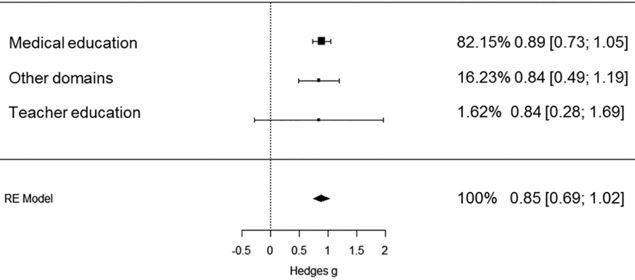
Simulation-based learning offers a wide range of opportunities to practice complex skills in higher education and to implement different types of scaffolding to facilitate effective learning. This meta-analysis includes 145 empirical studies and investigates the effectiveness of different scaffolding types and technology in simulation-based learning environments to facilitate complex skills. The simulations had a large positive overall effect: g = 0.85, SE = 0.08; CIs [0.69, 1.02]. Technology use and scaffolding had positive effects on learning. Learners with high prior knowledge benefited more from reflection phases; learners with low prior knowledge learned better when supported by examples. Findings were robust across different higher education domains (e.g., medical and teacher education, management). We conclude that (1) simulations are among the most effective means to facilitate learning of complex skills across domains and (2) different scaffolding types can facilitate simulation-based learning during different phases of the development of knowledge and skills.
Overview
CoChat Summary
TL;DR
This meta-analysis of 145 studies (10,532 participants) finds that simulation-based learning in higher education has a large positive overall effect on complex skills (g = 0.85, 95% CI [0.69, 1.02]). Effects vary by simulation features and prior knowledge, with examples/prompts helping lower-prior-knowledge learners and reflection phases helping higher-prior-knowledge learners.
Key findings
- Overall effect: g = 0.85, SE = 0.08, 95% CI [0.69, 1.02], N = 145 studies, 10,532 participants; heterogeneity was high: Q(409) = 4213.93, p < .0001, τ² = 1.2, I² = 95.86%.
- By complex skill: technical performance g = 1.06 (SE = 0.15), general problem solving g = 0.88 (SE = 0.11), diagnosing g = 0.82 (SE = 0.21), management g = 0.72 (SE = 0.30), teamwork g = 0.50 (SE = 0.08), communication g = 0.44 (SE = 0.15).
- Simulation features: live model g = 2.27 (N = 3), mixed g = 1.56, mannequin g = 0.96, virtual object g = 0.75, role play g = 0.63, document g = 0.31; technology: simulator g = 1.07, virtual reality g = 0.85, screen-based g = 0.68, no technology g = 0.74; high authenticity g = 0.86 vs low g = 0.58; duration: <1 hr g = 0.65, hours g = 0.81, days g = 0.80, >1 month g = 1.31 (N = 4).
- Scaffolding × prior knowledge: examples helped low-education learners (g = 1.15 vs high-education g = 0.56); prompts helped unfamiliar contexts (g = 0.85 vs no prompts g = 0.63) but not familiar contexts (g = 0.33 vs no prompts g = 0.96); reflection phases helped postgraduate learners (g = 1.10 vs no reflection g = 0.86) but not graduate/undergraduate learners (g = 0.52 vs no reflection g = 0.81).
Methods
- Meta-analysis of 145 empirical studies (from 128 articles, 1979–2018) yielding 409 effect estimates and 10,532 participants; searched PsycINFO, PsycARTICLES, ERIC, and MEDLINE through April 2018; included experimental/quasi-experimental or within-subject pre-post studies with a control condition and objective measures of complex skills.
- Coded moderators included simulation type, technology use, duration, authenticity, scaffolding (examples, prompts, reflection phases), knowledge convey, prior knowledge (familiarity of context, level of education), complex skill type, domain, study design, and publication type.
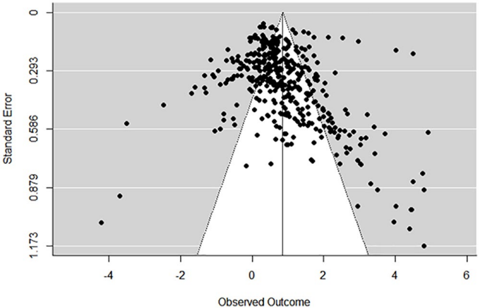
- Used Hedges’ g, random-effects models, robust variance estimation for correlated effects, pretest adjustment when available, heterogeneity Q/I², and publication-bias checks (Egger’s test, trim and fill); metaregression on control variables.
Limitations
- Stated: the focus is on complex skills involving interaction with people, so findings do not straightforwardly generalize to STEM domains such as science, mathematics, engineering, or informatics; a large proportion of findings come from medical education, so caution is needed for other domains, especially regarding technology, simulation type, outcome measures, and moderators.
- Stated: many primary studies gave little treatment description, insufficient for coding some moderators or finer distinctions; many implemented multiple instructional support measures, making specific effects hard to determine; the scaffolding framework may omit other supports such as feedback or fading/adding instruction; combinations could only be partially investigated; prior knowledge operationalization had drawbacks and explained only 4% of heterogeneity; implementation quality was assumed similar; large unexplained heterogeneity requires caution.
- Evident from the text: heterogeneity was very high (I² = 95.86%, τ² = 1.2), and several moderator estimates rest on very small numbers (e.g., live model N = 3, all scaffolding types N = 2, duration >1 month N = 4), so subgroup effects are unstable; presence/absence comparisons for examples, prompts, and reflections often did not reach significance.
Model-written summary. Check it against the paper before relying on it.
Integrity signals
Registry
Cites
Statistics
Figures

Verification
Claims the paper makes
1 Valid · 3 Not valid · 48 Not checked · 181 Own results and interpretations
At least one cited source doesn’t support this claim or points to a different paper, and none confirmed it — see the verdicts below.
In the paper
“However, they only focused on comparing simulations with a duration of more than 1 day with simulations of less than 1 day.”
§ Simulation-Based Learning in Higher Education: A Meta-Analysis > Simulations in Educational Contexts
What the sources say
- Disputedcites Cook et al., 2013 matched to “Technology-Enhanced Simulation to Assess Health Professionals: A Systematic Review of Validity Evidence, Research Methods, and Reporting Quality” (2013) sourceExperimental — accuracy not yet measured
Our copy of Cook et al. (2013) contains no duration contrast whatsoever: searches for 'simulation duration more than one day versus less than one day' and related phrasings returned only the study-coding tables. Those tables (sections 'List of all included studies, sorted by year of publication, with validity evidence and QUADAS-2 ratings (N=417 except for QUADAS-2)', pp. 17, 21, 23, 27, 32-35, and the parallel full-citation list, pp. 4-14) show the review's actual focus: charting validity evidence (content/response/process, internal structure, relations to other variables, consequences, reliability), methodological quality (MERSQI, selection/flow indices, RoB indices, QUADAS-2) and reporting across 417 technology-enhanced simulation assessment studies spanning many topics and instruments. That is contrary to the claim that the review 'only focused on comparing simulations with a duration of more than 1 day with simulations of less than 1 day'. Our copy is truncated at the end, but the retrieved structure of the review already contradicts the characterization; no alternative source for the duration comparison is named in our copy. (LLM, conf=0.72)
Checked by a reasoning model — may be wrong.
plain- Asserted: passes — The authors put it forward as true.
- Checkable: passes — It can be checked against evidence.
- Load-bearing: passes — The paper’s conclusions depend on it.
- Based: passes — The paper gives a reason why it holds.
- Disputed
The cited sources that could be checked couldn’t confirm or dispute this claim.
In the paper
“In their meta-analysis, Cook et al. (2013) provided supportive evidence of the effectiveness of distributed and repetitive practice (effects above .60)in the acquisition of complex skills in medical education.”
§ Simulation-Based Learning in Higher Education: A Meta-Analysis > Simulations in Educational Contexts
What the sources say
- Could not verifycites Cook et al., 2013 matched to “Technology-Enhanced Simulation to Assess Health Professionals: A Systematic Review of Validity Evidence, Research Methods, and Reporting Quality” (2013) sourceExperimental — accuracy not yet measured
Our copy of Cook et al. (2013) contains only the appendix material — the 'List of all included studies, sorted by year of publication, with full journal citation' (pp. 2-16) and the parallel table 'with validity evidence and QUADAS-2 ratings (N=417)' (pp. 20-35), which catalogue simulation-based ASSESSMENT validation studies with MERSQI scores, not pooled effects. Searches for 'distributed and repetitive practice', 'meta-analysis', 'effect size / Hedges g / random-effects', 'learning principles / repetition', and the paper's objective returned no narrative text at all, so nothing in our copy reports an effectiveness meta-analysis or effect magnitudes above .60. The copy is also flagged truncated, so the results/discussion where such a finding would appear may be missing; absence here is not evidence of a contrary statement, and no alternative source is named in the passages we hold. (LLM, conf=0.68)
plainstates a cause- Asserted: passes — The authors put it forward as true.
- Checkable: passes — It can be checked against evidence.
- Load-bearing: unclear — It is unclear whether the paper’s conclusions depend on it.
- Based: passes — The paper gives a reason why it holds.
- Could not verify
The cited sources support only part of this claim — read each source’s verdict below.
In the paper
“All these scaffolding measures were found to be beneficial for developing diagnostic competences (Chernikova et al., 2019).”
§ Simulation-Based Learning in Higher Education: A Meta-Analysis > Added Value of Instructional Support
What the sources say
- Partly supportedcites Chernikova et al., 2019 matched to “Facilitating Diagnostic Competences in Higher Education—a Meta-Analysis in Medical and Teacher Education” (2020) sourceExperimental — accuracy not yet measured
The meta-analysis does state broadly that all scaffolding types help ('as long as learners are able to practice problem-solving, all of the different types of scaffolding are beneficial', Theoretical Significance; echoed in Summary and Conclusion: roles, prompts and reflection phases 'have clear positive effects', with 'no indication for different effect sizes of different types of scaffolding'). But the claim drops the source's binding condition — the benefit holds only where learners' own problem-solving is preserved — and the source's results are not uniformly significant: in Effect of Scaffolding, settings with vs. without examples 'did not reach statistical significance' (Q(1,35)=2.85, p=.06), and Limitations warns that 'conclusions about the effectiveness of each scaffolding type should be made with caution'. So the flat 'all these scaffolding measures were found to be beneficial' overstates an explicitly conditional and hedged finding. (LLM, conf=0.72)
plainstates a cause- Asserted: passes — The authors put it forward as true.
- Checkable: passes — It can be checked against evidence.
- Load-bearing: passes — The paper’s conclusions depend on it.
- Based: passes — The paper gives a reason why it holds.
- Partly supported
A result the paper reports from its own data — it cites no other source for it, so there is none to check. The quote shows it is in the paper.
In the paper
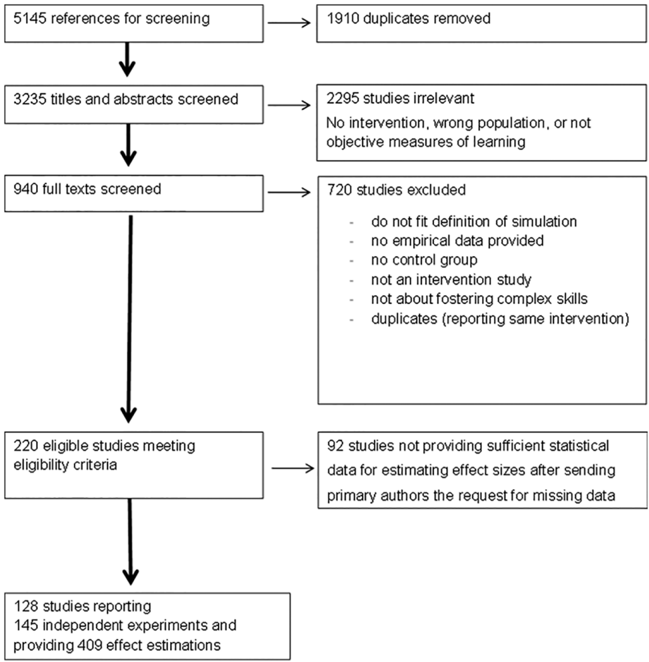
“The 145 eligible studies (from 128 articles published in the period 1979-2018) provided 409 effect estimations (Figure 1).”
§ Simulation-Based Learning in Higher Education: A Meta-Analysis > Results of Literature Search
plainn = 10,532- Asserted: passes — The authors put it forward as true.
- Checkable: passes — It can be checked against evidence.
- Load-bearing: passes — The paper’s conclusions depend on it.
- Based: passes — The paper gives a reason why it holds.
A result the paper reports from its own data — it cites no other source for it, so there is none to check. The quote shows it is in the paper.
In the paper
“The most frequent combinations of instructional support measures were knowledge convey together with examples (82 effects), knowledge convey with reflection phases (62 effects), and examples with reflection phases (43 effects).”
§ Simulation-Based Learning in Higher Education: A Meta-Analysis > Results of Literature Search
plain- Asserted: passes — The authors put it forward as true.
- Checkable: passes — It can be checked against evidence.
- Load-bearing: unclear — It is unclear whether the paper’s conclusions depend on it.
- Based: passes — The paper gives a reason why it holds.
120 more claims
Create a free account to see all 233 claims and to verify the 44 references still open.
- It may state two separate claims as one. 61
- Probably not a substantial claim. 61
Claims other papers make about this one
Each is checked against this paper’s own text: does it say what the citing paper says it does?
In the citing paper
“Chernikova and colleagues have demonstrated in a meta-analysis that simulations of professional situations, such as interactions in a classroom for teachers, can be a beneficial tool during teacher training as they expose teachers to authentic problems in their fields51.”
From On opportunities and challenges of large multimodal foundation models in education (2025) · cites this paper as [51]
In the citing paper
“Meta-analytic findings indicate that simulations are among the most effective means to facilitate the learning of complex skills across domains, with technology-based and scaffolded simulations showing robust positive effects on learning outcomes [11].”
In the citing paper
“While several earlier reviews have examined the general benefits of simulation in nursing education [17], few have focused specifically on its role in bridging the theory–practice gap.”
From The impact of clinical simulation on bridging the theory–practice gap in nursing education: a systematic review (2025) · cites this paper as [17]
In the citing paper
“High-fidelity simulations were particularly associated with enhanced clinical judgment and decision-making accuracy [17, 29, 30].”
From The impact of clinical simulation on bridging the theory–practice gap in nursing education: a systematic review (2025) · cites this paper as [17]
In the citing paper
“These findings are supported by meta-analytic evidence from Chernikova et al., who concluded that simulation-based learning substantially improves decision-making and problem-solving skills in higher education, especially when paired with active learning strategies and structured debriefing [17].”
From The impact of clinical simulation on bridging the theory–practice gap in nursing education: a systematic review (2025) · cites this paper as [17]
Statistics recomputed
Every reported test result, recomputed from its test statistic and degrees of freedom. A result shows as not adding up only once an independent check has confirmed it.
- ConsistentQ(409) = 4213.93reported p < .0001 · recomputed p < .001
“Q (409) = 4213.93,p < .0001”
Self-check
Percentages, sums and reported differences re-computed from the paper’s own numbers.
Each contradiction between two passages listed here was confirmed by an independent check.
Rated major: it would touch a result — a value a result rests on, reported and recomputed p-values on opposite sides of the significance level, two passages that conflict with no sign which is right, or a cited work retracted before this paper was published.
In the paper
§ Simulation-Based Learning in Higher Education: A Meta-Analysis > Discussion
“However, the effects are greater if learners are unfamiliar with the context and the task.”
§ Simulation-Based Learning in Higher Education: A Meta-Analysis > Prior Professional Knowledge
“learners showed a lower increase of complex skills in an unfamiliar context (g = 0.67, SE = 0.10) than in a familiar context (g = 0.83, SE = 0.13)”
Rated minor: it would not touch a result — a value no result rests on, a p-value that stays on the same side of the significance level, or a conflict that is clerical, resolved elsewhere in the paper, or outside its own findings.
In the paper
§ Simulation-Based Learning in Higher Education: A Meta-Analysis > Results of Literature Search
“Most studies focused on general problem solving (51) or the technical performance of a particular complex procedure (56); the other outcomes were communication skills (24), diagnosing (18), managing critical situations (18), and collaboration and teamwork (5).”
§ Simulation-Based Learning in Higher Education: A Meta-Analysis > Conclusion
“2,493 (27) 0.46 91.03% | 911 (18) 0.76 92.02% | 6,010 (58) 0.47 91.23% | 2,543 (21) 1.04 97.15% | 810 (5) 0.03 66.07% | 2,933 (63) 1.25 91.10%”
Rated minor: it would not touch a result — a value no result rests on, a p-value that stays on the same side of the significance level, or a conflict that is clerical, resolved elsewhere in the paper, or outside its own findings.
In the paper
“(2) prompts as the only scaffolding method (N = 11)”
§ Simulation-Based Learning in Higher Education: A Meta-Analysis > Level of Education as an Indicator of Prior Knowledge and Experience
Reported 11 · recomputed 12
Rated minor: it would not touch a result — a value no result rests on, a p-value that stays on the same side of the significance level, or a conflict that is clerical, resolved elsewhere in the paper, or outside its own findings.
In the paper
§ Simulation-Based Learning in Higher Education: A Meta-Analysis > Discussion
“Despite these differences, simulations had effects that can be categorized as large positive effects for all but one type of skill.The exception is teamwork, where the meta-analysis found a medium positive effect only.”
§ Simulation-Based Learning in Higher Education: A Meta-Analysis > Overall Effect of Simulation-Based Learning on Complex Skills (Research Question 1)
“Communication and collaboration skills (teamwork) are only moderately facilitated by simulation-based learning (g = 0.44, SE = 0.15, and g = 0.50, SE = 0.08, respectively)”
Rated minor: it would not touch a result — a value no result rests on, a p-value that stays on the same side of the significance level, or a conflict that is clerical, resolved elsewhere in the paper, or outside its own findings.
In the paper
§ Simulation-Based Learning in Higher Education: A Meta-Analysis > Level of Education as an Indicator of Prior Knowledge and Experience
“however, introducing prompts was related to higher learning outcomes in the high-level group.”
§ Simulation-Based Learning in Higher Education: A Meta-Analysis > Level of Education as an Indicator of Prior Knowledge and Experience
“Similarly, introducing prompts for a high (postgraduate learners and practitioners) level (g = 0.50, SE = 0.36) was not beneficial for learning compared with simulations without prompts (g = 0.91, SE = 0.11).”
Citations
Cites
Measuring inconsistency in meta-analyses
Higgins, J. P. T., Thompson, S. G., Deeks, J. J., & Altman, D. G. (2003) · BMJ · doi:10.1136/bmj.327.7414.557 · Cited by 63,139 · cited 1×
“The thresholds suggested by Higgins et al. (2003) were used to interpret the I 2 (25% for low heterogeneity, 50% for medium, 75% for high heterogeneity).”
MethodBorenstein, M., Hedges, L. V., Higgins, J. P. T., & Rothstein, H. R. (2009) · doi:10.1002/9780470743386 · Cited by 14,225
Hattie, J., & Timperley, H. (2007) · Review of Educational Research · doi:10.3102/003465430298487 · Cited by 12,905
THE ROLE OF TUTORING IN PROBLEM SOLVING *
Wood, D., Bruner, J. S., & Ross, G. (1976) · Journal of Child Psychology and Psychiatry · doi:10.1111/j.1469-7610.1976.tb00381.x · Cited by 8,851 · cited 1×
“Scaffolding enables a learner to solve problems through modifying tasks and reducing possible pathways, and through hints helping the learner to coordinate the steps in problem solving or interaction (Quintana et al., 2004), by taking over some elements of learning material (Wood et al., 1976).”
BackgroundKirschner, P. A., Sweller, J., & Clark, R. E. (2006) · Educational Psychologist · doi:10.1207/s15326985ep4102_1 · Cited by 7,776 · cited 2×
“…suggesting that including simulations in a later phase of a higher education program after students already know theoretical concepts is promising in order to not overwhelm learners and block too much of their cognitive capacity for solving a problem in a simulation (e.g., Kirschner et al., 2006).”
BackgroundFunnel plots for detecting bias in meta-analysis
Sterne, J. A. C., & Egger, M. (2001) · Journal of Clinical Epidemiology · doi:10.1016/s0895-4356(01)00377-8 · Cited by 3,779 · cited 1×
“We have a relatively small sample of empirical studies and apply a range of techniques to identify possible biases (Egger’s test, trim and fill) and improve the generalizability of the results (Sterne & Egger, 2001).”
MethodEducational Psychology: A Cognitive View
Gagné, R. M., Ausubel, D. P., & Gagné, R. M. (1969) · American Educational Research Journal · doi:10.3102/00028312006002287 · Cited by 3,302
Educational Psychology: A Cognitive View
Gagné, R. M., Ausubel, D. P., & Gagne, R. M. (1969) · American Educational Research Journal · doi:10.2307/1161899 · Cited by 3,278
HMELO-SILVER, C. E., DUNCAN, R. G., & CHINN, C. A. (2007) · Educational Psychologist · doi:10.1080/00461520701263368 · Cited by 2,641 · cited 1×
“…problems, especially in early stages of expertise development, should be accompanied by scaffolding to maximize learning and avoid cognitive overload, distraction, or focusing on superficial features of a situation (see the discussions of Hmelo-Silver et al., 2007; Kirschner et al., 2006).”
BackgroundReflection and reflective practice in health professions education: a systematic review
Mann, K., Gordon, J., & MacLeod, A. (2009) · Advances in Health Sciences Education · doi:10.1007/s10459-007-9090-2 · Cited by 2,175 · cited 1×
“Reflection phases, on the other hand, allow learners to think about goals, analyze their own performance, and plan further steps (e.g., Mann et al., 2009), but they do not provide much guidance during the problem solving.”
Background
Research works printed but not linked: 4
- Funke, J. (Ed.). (2006). Denken und Problemlösen (pp. 375-446).
- Henninger, M., & Mandl, H. (2000). Vom Wissen zum Handeln-ein Ansatz zur Förderung kommunikativen Handelns [From knowledge to action-An approach for fostering communicative behavior]. In H. Mandl & J. Gerstenmaier (Eds.), Die Kluft zwischen Wissen und Handeln (pp. 197-219).
- Raven, J. (2000). Psychometrics, cognitive ability, and occupational performance. Review of Psychology, 7(1-2), 51-74.
- Veritas Health Innovation. (2019). Covidence systematic review software (online ver- sion) [Computer software]. https://www.covidence.org
Cited by
Items 901–1,000 of 1,412
Propuesta de una herramienta para la enseñanza-aprendizaje de la semiología neurológica del neonato
Mansilla-Rosas, S. P. (2024) · South Florida Journal of Development · doi:10.46932/sfjdv5n2-040
Chernikova, O., Heitzmann, N., Stadler, M. J., Holzberger, D., Seidel, T., & Fischer, F. (2023) · Proceedings. · doi:10.22318/icls2023.403402
Self-citationSimulação realística e gamificação em primeiros socorros para o curso de Fisioterapia
Girardi, T. D. A., & Marcos, L. (2024) · International Journal of Health Education · doi:10.17267/2594-7907ijeh.2024.e5415
From Local to Globe: The Representation of Local Culture in An Undergraduate EFL Students’ Textbook
Humairoh, M. F. N., & Riska, H. K. (2022) · Journal of Language Intelligence and Culture · doi:10.35719/jlic.v4i2.113
Building a confident, diverse workforce through simulation for medical support workers
Patel, A., Khan, Z., Wiltshire, M., Needleman, S. J., Collier, S., Ho, C., & Burns, A. P. (2023) · Future Healthcare Journal · doi:10.7861/fhj.10-3-s56
Students' Perception of Simulation in the Practical Course of Veterinary Physiology Laboratory
Taherianfard, M., Abdolahi, N., & Ahmadijokani, S. (2024) · International and National Conference on E-Learning and E-Teaching (ICeLeT) · doi:10.1109/icelet62507.2024.10493092
“Chernikova et al., [13] conclude that (1) simulations were among the most effective means to facilitate learning of complex skills across domains and (2) different scaffolding types can facilitate simulation-based learning during different phases of the development of knowledge and skills.”
BackgroundPereira, L. M., Mallela, J. L., Carroll, A. J., Washburn, J. J., & Robiner, W. N. (2024) · Journal of Clinical Psychology in Medical Settings · doi:10.1007/s10880-024-10015-7
“Simulation training is increasingly used in higher education (Chernikova et al., 2020) to teach medical and health professional trainees to effectively provide healthcare in vivo.”
Integration of Simulation Based Education in Nursing and Midwifery Education
Bista, A. P. (2022) · Journal of Nursing Education of Nepal · doi:10.62143/fyp6h172
Financial Literacy Simulation in Managerial Finance: Signing Up for a Mock 401(k)
Fredrickson, J. (2024) · Journal of Accounting and Finance · doi:10.33423/jaf.v24i1.6925
“As an instructional tool, simulations are an effective learning activity as they engage students in a simplified version of a real-world practice drawing upon what they already know while advancing further inquiry (Chernikova et al., 2020).”
BackgroundAddressing Challenges in Half-Year Higher Education Study Programs
Erman, N., & Rojko, K. (2024) · Education and human development · doi:10.5772/intechopen.1005484
Mustafidah, R., Fadly, W., & Rochmah, E. Y. (2024) · AL-TANZIM JURNAL MANAJEMEN PENDIDIKAN ISLAM · doi:10.33650/al-tanzim.v8i1.6726
“Higher Education explores, maximizes, and develops students' abilities (Chernikova et al., 2020).”
BackgroundMeeting Abstracts for the Society for Simulation in Europe 2024
(2024) · Advances in Simulation · doi:10.1186/s41077-024-00287-2
Wargaming in Information Warfare Training: A Study of Finnish Officials
Saari, D., Grahn, H., Häkkinen, T., Hautala, M., Vesterinen, O., & Moilanen, P. (2024) · European Conference on Cyber Warfare and Security · doi:10.34190/eccws.23.1.2291
“Simulations encompassing such experiential methods are considered highly effective for facilitating the learning of complex skills (Chernikova et al.,2020).”
BackgroundResultRebueno, M. C. D. R., Vitug, P. Z., & Macindo, J. R. B. (2024) · Teaching and learning in nursing · doi:10.1016/j.teln.2024.06.006
Mariyono, D. (2024) · International Journal of Religion · doi:10.61707/qa3bf585
“Globally, simulation studies in higher education, particularly in the United States, are gaining attention for innovative pedagogical practices across various disciplines (Chernikova et al., 2020; Hallinger & Wang, 2020a, 2020b; J. Lu et al., 2014).”
BackgroundSupporting graduate students’ skills with simulated experiences in a professional foundation course
Baron, K. A., Norton, M. N., Leggett-Fife, D., & Trump, K. R. (2024) · Journal of Nursing Education and Practice · doi:10.5430/jnep.v14n11p14
Using Simulation-Based Assessment for Event Management Students
Wilson, O., Hargarter, A., & Rensburg, B. V. (2024) · Journal of Ethics in Higher Education · doi:10.26034/fr.jehe.2024.5971 · Cited by 1
Meleg, Á. (2024) · CUB Ph.D. Dissertations (Corvinus University of Budapest) · doi:10.14267/phd.2024040
Simulations for Learning in Complex Scenarios: Students’ Most Valued Elements
Pacheco-Velazquez, E. A., & Rodés, V. (2024) · Lecture notes in educational technology · doi:10.1007/978-981-97-1814-6_3
Robotic Kinematics Learning Guidance Based on Game Engine Simulation
Saivichit, K., & Aphiratsakun, N. (2024) · International STEM Education Conference (iSTEM-Ed) · doi:10.1109/istem-ed62750.2024.10663147
“Simulation offers a similar learning experience to practical lab with the relationships enhanced and shown more explicitly [5].”
BackgroundOmotayo, O. O., Taiwo, O. G., & Oluwadamila, B. E. (2023) · Kardan Journal of Economics and Manangement Sciences · doi:10.31841/kjems.2023.150
Conversations about death and dying: A co-created workshop for healthcare students
Rees, A., Rushe, E., Smith, B., & Hogg, J. (2024) · Developing Academic Practice · doi:10.3828/dap.2024.15
БОЛАШАҚ БАСТАУЫШ СЫНЫП МҰҒАЛІМДЕРІНІҢ КОММУНИКАТИВТІК МӘДЕНИЕТІН ҚАЛЫПТАСТЫРУДЫҢ ҒЫЛЫМИ АСПЕКТІЛЕРІ
Изтлеуова, С. Ш., Bakhtiyarova, G. R., & Bodykova, I. N. (2024) · Журнал серии «Педагогические науки» · doi:10.48371/peds.2024.74.3.007
Investigaciones en salud y desarrollo humano sustentable
(2024) · Qartuppi eBooks · doi:10.29410/qtp.24.08 · Cited by 1
Anatomy of Educational Innovations Based on Learning by Discovery in Higher Education
Ruisoto, P., Contador, I., Quintero-Ponce, E., López, J. C., Álvarez, B., Cacho, R., & Fernández‐Calvo, B. (2024) · Papeles del Psicólogo - Psychologist Papers · doi:10.23923/pap.psicol.3044 · Cited by 1
Laili, F., Sahlan, M., & Saihan, M. (2024) · EDUCARE Journal of Primary Education · doi:10.35719/educare.v5i1.144
(2024) · Frontiers research topics · doi:10.3389/978-2-8325-5531-6
Molik, M. (2024) · Cureus · doi:10.7759/cureus.72647
“This value is supported by existing literature, as evidenced by a meta-analysis performed by Chernikova et al. in 2020, which recognized SBE as one of the most effective methods for improving the acquisition of complex skills [24].”
ResultSimulando un proceso judicial: cuando lo analógico prevalece
Uranga, I. L., & Azcona-Uribe, L. (2024) · Jornadas sobre Innovación Docente en Arquitectura (JIDA) · doi:10.5821/jida.2024.13208
David, Davis, J., Lewis, L., Oliver, C., Fajar, M., & Pratama, G. D. (2024) · Procedia Computer Science · doi:10.1016/j.procs.2024.10.258
Virtual modelling as a didactic tool in the professional training of future engineers
Usmanov, S., & Abdurakhmanov, Z. (2024) · AIP conference proceedings · doi:10.1063/5.0242475
ENHANCING STUDENTS’ LEARNING OUTCOMES IN CLASSICAL CRYPTOGRAPHY THROUGH INTERACTIVE 3D SIMULATIONS
Novayani, W., & Alhuda, I. (2024) · Jurnal Komputer Terapan · doi:10.35143/jkt.v10i2.6446
RIPSim - Um Simulador para o Protocolo de Roteamento RIP
Silva, H. W. D. (2024) · Anais do ... Simpósio Brasileiro de Informática na Educação/Anais do Simpósio Brasileiro de Informática na Educação · doi:10.5753/sbie.2024.244034
“Enquanto [Chernikova et al 2020] realiza uma meta-análise dos vários aspectos do SBL aplicados ao ensino superior de maneira geral, mais recentemente [Asadi et al 2024] realizou uma revisão sistemática e uma análise bibliométrica sobre o SBL no ensino específico de redes de computadores em cursos…”
Fink, M. C., Walter, L., Eska, B., & Ertl, B. (2024) · EdArXiv (OSF Preprints) · doi:10.35542/osf.io/ckd9e · Cited by 1
El Proyecto SIMULA: Fomentando Habilidades Prácticas en Profesionales del Futuro
García‐Marco, E., Padrón, I., Eff‐Darwich, A., Ardèvol‐Abreu, A., Barroso, J. G., & Delgado, N. (2024) · Congreso de Innovación Educativa y Docencia en Red (IN-RED) · doi:10.4995/inred2024.2024.18516
Possibilities of using simulation strategy in training teaching staff
Seyidova, G. (2025) · THE TIDINGS of the Baltic State Fishing Fleet Academy Psychological and pedagogical sciences (Theory and methods of professional education) · doi:10.46845/2071-5331-2024-4-70-81-84
Braitenberg Vehicle Simulator: Visualizing the Classic Thought Experiment
Tao, D., & Bang, L. (2024) · Artificial Intelligence x Humanities, Education, and Art (AIxHEART) · doi:10.1109/aixheart62327.2024.00013
Khoo, L. J., Yatim, M. H. M., & Seng, W. Y. (2024) · The International journal of Multimedia & Its Applications · doi:10.5121/ijma.2024.16601
Docksou, N. F., MEKONDION, N., & DAGUÉ, A. (2024) · LAKISA Revue des Sciences de l’Éducation · doi:10.55595/lakisa.v4i8.190 · Cited by 1
KOMPLEXNOSŤ VZDELÁVANIA ŠTUDENTOV TECHNICKÝCH UNIVERZÍT VÝUČBOU EKONOMICKÝCH PREDMETOV
Červeňová, Ľ. (2024) · MANEKO · doi:10.61544/mnk/hfac4177
Aliu, J., & Aigbavboa, C. O. (2025) · Springer eBooks · doi:10.1007/978-981-97-9034-0_3
Kibiwott, D., Sum, A. M., & Kang'ethe, S. (2024) · East African Journal of Nursing · doi:10.58460/eajn.v2i01.94
The Integration of Simulation-Based Learning in Healthcare Education: Outcomes and Challenges
Sahoo, S., Singh, S., & RenukaJyothi, S. (2022) · Health Leadership and Quality of Life · doi:10.56294/hl2022108
Huszák, L., Kauppinen, A., Saßmannshausen, S. P., Sobolieva, T., & Steger, T. (2025) · Nomos Verlagsgesellschaft mbH & Co. KG eBooks · doi:10.5771/9783748949602
Simulation-Based Learning: Integrating ERP Systems in Business Education at Coimbra Business School
Sousa, A., & Nunes, R. (2025) · The Barcelona Conference on Education official conference proceedings · doi:10.22492/issn.2435-9467.2024.32
“Studies show that well-designed simulations can significantly enhance student performance in complex tasks (Chernikova et al., 2020; Urquidi Martín & Tamarit Aznar, 2017).”
Simulating Real IT Project Life for Students: The StudyTalk Case Study
Pakosch, A., Allerkamp, D., & Koschel, A. (2025) · ACM Technical Symposium on Computer Science Education (SIGCSE) · doi:10.1145/3641555.3705249
“Essays such as [1, 4, 6] show a variety of ways to practice complex skills in higher education.”
Basher, M., Mohamed, S., Begum, A., Zidoun, Y., & Houni, A. E. (2025) · Research Square · doi:10.21203/rs.3.rs-6022596/v1 · Cited by 1
Mahfud, M., Hartono, H., Subijanto, A. A., & Anantanyu, S. (2025) · Narra J · doi:10.52225/narra.v5i1.1488
“Furthermore, gender dynamics were carefully considered to align with cultural norms in nurse-patient interactions, enhancing the cultural relevance and acceptance of the training [9].”
Hussein, A. A. (2025) · Lecture notes in networks and systems · doi:10.1007/978-3-031-82377-0_6 · Cited by 1
Advancing Translator Education and Pedagogy in the Evolving Linguistic Landscape
Mahmoudi-Dehaki, M., & Nasr-Esfahani, N. (2025) · IGI Global eBooks · doi:10.4018/979-8-3693-6463-5.ch003
A Multimedia Approach to Medical Skill Training
Ribeiro, J. C., Fernandes, N. F. M. L., Barbosa, T. P., & da Conceição, H. C. F. (2025) · Advances in medical education, research, and ethics (AMERE) book series · doi:10.4018/979-8-3373-1127-2.ch004
Acquisition of experimental chemistry skills with the use of virtual laboratory simulations
Allen-Baume, V. (2025) · International Journal for Innovation Education and Research · doi:10.31686/ijier.vol13.iss1.4225
The Effectiveness of Online Learning Platforms in Healthcare Education: A Meta-Analysis
Panda, A. K., & Parashar, M. (2022) · Health Leadership and Quality of Life · doi:10.56294/hl2022116
Tao, Y. E., & Hu, B. A. (2025) · IEEE Conference on Virtual Reality and 3D User Interfaces Abstracts and Workshops (VRW) · doi:10.1109/vrw66409.2025.00229
“Preliminary work in simulation-based learning [5] shows that immersive role-play can enhance empathy, strategic thinking, and motivational commitment to long-term objectives.”
Mejías, M. E. D. V. (2025) · International Journal of Advanced Corporate Learning (iJAC) · doi:10.3991/ijac.v18i3.53557
Hirani, S., Ladak, L. A., Sabeen, A., Kurji, Z., & Noorani, S. (2025) · Research Square · doi:10.21203/rs.3.rs-6241378/v1
Karnjuš, I., Martinović, K., Renko, J., & Pucer, P. (2025) · doi:10.26493/978-961-293-467-5.17
Dumaguing, A. G., & Alava, W. G. (2025) · doi:10.38124/ijisrt/25may1775
Lyimo, P., Mbua, F. M., & Ogoti, E. O. (2025) · American Journal of Education and Information Technology · doi:10.11648/j.ajeit.20250901.16
To Innovate Again: Reassessing Students' Strategic Decision-Making in a Simulated Environment
Akhmadi, S., & Tsakalerou, M. (2025) · IEEE Global Engineering Education Conference (EDUCON) · doi:10.1109/educon62633.2025.11016481
Global Workplace Learning and Professional Development (Experiential Learning)
Salem, A. A. M. S. (2025) · IGI Global eBooks · doi:10.4018/979-8-3693-3338-9.ch011
In situ-simulering i praksis i psykisk helsearbeid gir sykepleiestudentene nye muligheter for læring
Lysfjord, E. M., & Sætertrø, O. (2025) · Tidsskrift for psykisk helsearbeid · doi:10.18261/tph.22.3.5
Kasparski, R., & Hemi, M. E. (2023) · Rav-Gvanim A Journal of Teacher Research and Dialogue · doi:10.33496/rav202324.283308
Rizky, R., Maulana, F., Ustafiano, B., & Yunefri, Y. (2025) · Journal of Vocational Education Studies · doi:10.12928/joves.v8i1.11210
Enhancing unlicensed assistive personnel’s skills in de-escalating workplace violence
Robinson, L. C., & Porter, M. T. (2025) · Advancing Medical-Surgical Nursing · doi:10.1016/j.amsn.2025.100006
Kopp, V., Wershofen, B., & Fischer, M. R. (2025) · Springer Reference Pflege, Therapie, Gesundheit · doi:10.1007/978-3-662-65420-0_25-1
Désiron, J. C., Wolfensberger, A., Clack, L., & Petko, D. (2025) · Interactive Learning Environments · doi:10.1080/10494820.2025.2521332
“Meta-analyses on simulation-based learning have shown this approach to be effective especially in higher education (e.g. Chernikova et al., 2020).”
Rathi, S., Harun, N., Din, A. Z. B., Sadikin, Z., & Nasir, M. A. S. (2024) · Malaysia Journal of Invention and Innovation · doi:10.64382/mjii.v3i5.131
Stead, A. L., Tinsley, J., Srikant, D., Mandulak, K. C., Evanitz, E., & Aragonez, A. (2024) · Evidence-Based Communication Assessment and Intervention · doi:10.1080/17489539.2025.2523792
“Allowing students opportunities to practice integrating knowledge and skills across courses has been repeatedly shown to increase both confidence and competence (Chernikova et al., 2020).”
Zamri, M. N., Zaki, M. R. M., Nazri, N. Z. M., Suhaimi, A. A. M., Rasak, N. T. S., Masri, H. M., & Suhaimi, M. H. (2025) · International Journal of Modern Education · doi:10.35631/ijmoe.725060 · Cited by 3
Yorat, E., Özbek, N. S., & Sarıbulut, L. (2025) · International Scientific Conference on Information, Communication and Energy Systems and Technologies (ICEST) · doi:10.1109/icest66328.2025.11098432
“This environment helps students to grasp complex theoretical information and to improve their problem solving and decision-making abilities [10], [11].”
Labeling Disagreements: Illuminating the Classification of Mathematics Teacher Questions
Bywater, J. P., Lilly, S., & Chiu, J. L. (2025) · Lecture notes in computer science · doi:10.1007/978-3-031-98417-4_4
Damped Vibration Simulation Based on Coding Block Using Scratch Programming
Taufiq, M., Kaniawati, I., Liliasari, L., Samsudin, A., & Sumitra, I. D. (2024) · International Conference on Informatics Engineering, Science & Technology (INCITEST) · doi:10.1109/incitest64888.2024.11121458
“Recently, simulation-assisted lectures based on block coding programming have emerged as a reliable alternative [21, 22].”
6. Teacher-in-role and talk moves in the subject English
Traa, L. K. (2025) · Fagbokforlaget eBooks · doi:10.55669/oa600506
Jonik, S., Brosche, T., Favreau, M., Haidet, P., & Cherin, N. G. (2025) · Journal of Medical Education and Curricular Development · doi:10.1177/23821205251370796
Simulations with actors prepare journalism students to interview trauma survivors
Pearson, M. (2024) · The Conversation · doi:10.64628/aam.x333rkqt4
Fink, M. C., Walter, L., Eska, B., & Ertl, B. (2025) · Lecture notes in computer science · doi:10.1007/978-3-032-03873-9_2 · Cited by 3
Pama, K. E., Fordan, J. I., & Balcorsa, V. (2025) · International Journal of Multidisciplinary Educational Research and Innovation · doi:10.64637/631259 · Cited by 1
“Interactive simulations and games generally lead to higher cognitive gains compared to conventional instructional strategies, especially when students navigate the programs themselves (Chernikova et al., 2020; Wieman et al., 2008).”
Aranga, R. (2025) · American Journal of Education and Technology · doi:10.54536/ajet.v4i3.4646
“– S14 This observation agrees with the findings of Chernikova et al .”
Browning, J. (2025) · The Pinnacle A Journal by Scholar-Practitioners · doi:10.61643/c20928
Fast, I., & Vedder‐Weiss, D. (2025) · European Journal of Teacher Education · doi:10.1080/02619768.2025.2559704 · Cited by 1
Influence of Animation on Pre-Nursery School Children Learning Outcome in Osun State
Okeke, C. I. O., & Ajadi, O. T. (2025) · Journal Of Education And Teaching Learning (JETL) · doi:10.51178/jetl.v7i3.2583
“Chernikova, et al. (2020) informed that, animation teaches moral, social, and ethical qualities in addition to motivating children.”
Using a Health Equity Simulation as a Teaching Tool in Social Work and Public Health Courses
Smith, T., Samuel, S., Brown, M. R., Player, G., Watkins, T. L., Pitner, R., & Hitchcock, L. I. (2025) · Routledge eBooks · doi:10.1080/28376811.2025.2563584
Milouk, F. Z., Atmani, Z. E., Mramel, M., Masmoudi, S., El-Mouhdi, K., Dahmani, F., Amrani, J. E., Mahla, T., Azami, E., Merabti, A., et al. (2025) · Nursing Forum · doi:10.1155/nuf/8316539
“Tis contradicts a previous study suggesting a positive correlation between task complexity and learner satisfaction [44].”
Simulations for police learning: an opportunity for standardised simulation design
Whitcombe, D., Pepper, I., Baty, P., Bullen, E., Davies, A., Jessop, S., Vickery, J., & Whistance, R. (2025) · Policing A Journal of Policy and Practice · doi:10.1093/police/paaf018
Yu, B., Qiao, H., & Shan, Y. (2025) · Applied Mathematics and Nonlinear Sciences · doi:10.2478/amns-2025-1003
Hindriana, A. F., Merdekios, B., Setiawati, I., Handayani, H., & Pratami, A. R. (2025) · EDUSAINS · doi:10.15408/es.v17i1.45268
Leveraging Active Learning to Close the Gender Gap in Business Education in the United Kingdom (UK)
Akakpo, A. (2025) · IGI Global eBooks · doi:10.4018/979-8-3373-1464-8.ch011 · Cited by 1
Thielgen, M. M., & Schade, S. (2025) · Springer eBooks · doi:10.1007/978-3-658-48196-4_18
Chung, E. Y.-H. (2025) · British Journal of Occupational Therapy · doi:10.1177/03080226251377580
“This use of simulation in teaching and learning enhances students’ comprehension by offering immersive experiences that closely replicate the complexities and nuances of real-world practice (Chernikova et al., 2020).”
Agent-Based Social Simulation for Education: Some Initial Design Considerations
Anzola, D. (2025) · Springer proceedings in complexity · doi:10.1007/978-3-031-91782-0_1
Asis, Y. C. D. D., & Alava, W. G. (2025) · doi:10.38124/ijisrt/25oct1280
Kopp, V., Wershofen, B., & Fischer, M. R. (2025) · Springer Reference Pflege, Therapie, Gesundheit · doi:10.1007/978-3-662-65435-4_25
Forsbrand, M., Christiansen, L., & Gatzouras, V. J. (2025) · INQUIRY The Journal of Health Care Organization Provision and Financing · doi:10.1177/00469580251392452
“38 As this has not yet been thoroughly proven, 24 this could be an interesting topic for future research.”
Harnessing Project-Based and Experiential Learning for Competency-Driven Education
Ramaila, S. M. (2025) · IGI Global eBooks · doi:10.4018/979-8-3373-3566-7.ch004 · Cited by 4
Simulation-based E-communication as a Reflective Learning Tool for Nursing Students
Hæsum, L. K. E., & Klit, M. Ø. (2025) · Proceedings for the European Conference on Reflective Practice-based Learning 2025 · doi:10.54337/ecrpl25-10925
“This approach allows learners to apply theoretical knowledge and develop critical thinking without the risk of harm to patients (Chernikova et al., 2020).”
Manohar, M., Selvaraj, P., Selvaraj, P., Jeyaraman, N., Muthu, S., & Jeyaraman, M. (2025) · World Journal of Orthopedics · doi:10.5312/wjo.v16.i11.110251
Kron, S., Sommerhoff, D., Stürmer, K., & Ufer, S. (2025) · Springer eBooks · doi:10.1007/978-3-662-71898-8_6 · Cited by 1
Liu, H., Shimada, A., Minematsu, T., & Yin, C. (2025) · Interactive Learning Environments · doi:10.1080/10494820.2025.2591862 · Cited by 1
“Together, these components demonstrate how technology, when intentionally integrated with pedagogy, facilitates a deeper conceptual understanding and practical competence (Chernikova et al., 2020; Yang et al., 2024).”
Yunus, Y., Wibowo, T. W., Suwito, D., Saputra, C. S., & Pambudi, R. G. (2025) · TEM Journal · doi:10.18421/tem144-09
Metadata
- Authors
- Chernikova, O., Heitzmann, N., Stadler, M., Holzberger, D., Seidel, T., & Fischer, F.
- Affiliations
- Ludwig-Maximilians-Universität München (DE)
- Technical University of Munich (DE)
- Venue
- Review of Educational Research
- Published
- 2020-06-15
- Volume
- 90
- Issue
- 4
- Pages
- 499-541
- ISSN
- 0034-6543 (ISSN-L)
- 1935-1046
- OpenAlex
- W3039587732
- Semantic Scholar
- af60f6e1157bbec85ef6f0012608e01e0a6bd6a9
- Cited by
- 1,072
- References
- 171
- Citations by year
- 2026: 206 · 2025: 267 · 2024: 214 · 2023: 174 · 2022: 129 · 2021: 69 · 2020: 10
- FWCI
- 32.44
- Type
- journal article
- Language
- en
- Open access
- hybrid
- doi.org
- Locations
- Review of Educational Research (publishedVersion, cc-by)
- Open access LMU (Ludwid Maxmilian's Universitat Munchen) (submittedVersion, cc-by)
- mediaTUM – the media and publications repository of the Technical University Munich (Technical University Munich) (submittedVersion, other-oa)
- mediaTUM – the media and publications repository of the Technical University Munich (Technical University Munich) (submittedVersion)
- Funders
- Deutsche Forschungsgemeinschaft (DFG 2385)
- Topics
- Social Sciences › Education › Innovative Teaching Methodologies in Social Sciences
- Social Sciences › Education › Simulation-Based Education in Healthcare
- Social Sciences › Psychology › Developmental and Educational Psychology › Innovative Teaching and Learning Methods
- Keywords
- simulation-based training, scaffolding, complex skills, higher education, prior knowledge, reflection, examples, educational technology, medical education, teacher professional development, management education
About these checks
Registry, retraction, Cites and statistics results are computed, not judged, with one exception: a printed reference that no index lists is read once by a model before it counts as a citation error. Claims are extracted by a model and kept only when their quote appears verbatim in the text; each cited source is then checked, with a model’s help, for whether it says what the claim relies on. Those verdicts can be wrong — read the claim’s quote and the cited source before relying on one.
The claim verdicts this report counts are experimental: their accuracy is not yet measured.
A language model drew the claims from the paper on 2026-11-16, under version 3 of the claim definition (model deepseek-v4.1-flash, prompt extract-v3).
A second model labelled each claim on 2026-11-16 (model jev-1.13-20260917, definition revision gold-guideline-v0.2).
Cited sources are checked with a language model’s help (qwen3.8-omni-flash).
Statistics and arithmetic are recomputed, not judged.
Confidence bands are shown only for fields calibrated on our annotated test set. None is calibrated yet, so no band is shown.
What counts as a claim ›How we measure confidence ›How we check this ›
Are you an author, or do you see a problem with this page? Request a review
Data sources
Bibliographic data: Semantic Scholar, OpenAlex, Crossref.
Contains information from the Semantic Scholar Academic Graph Datasets, made available under the ODC Attribution License (ODC-BY 1.0).
Semantic Scholar’s data is described in: Kinney, R., et al. (2023). The Semantic Scholar Open Data Platform. arXiv:2301.10140.
