

The DOI matches its Crossref record; 47 of the 49 references it cites were found in a registry or an index.
Beliefs in conspiracy theories and the need for cognitive closure
Open accessAbstract
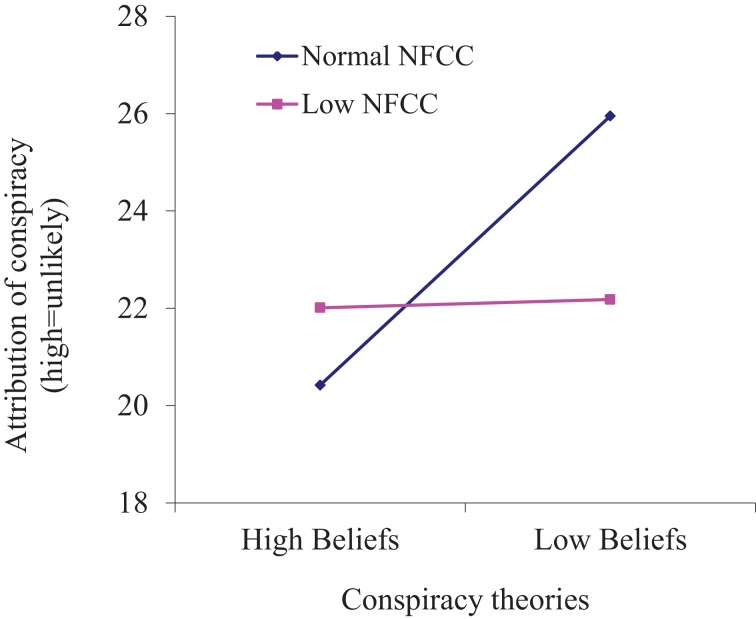
An important component of conspiracy theories is how they influence, and are influenced by, the evaluation of potential evidence. Some individuals may be more open minded regarding certain explanations for events whereas others may seek closure and thus cut off a conspiracy explanation. Two studies examined the relationship between the need for cognitive closure (NFCC), levels of belief in real world conspiracy theories, and the attribution of conspiracy theories to explain events. A first, small (N = 30) and preliminary study found no relationship between NFCC and beliefs in conspiracy theories, suggesting that both advocates and opponents of conspiracy explanations do not differ on this dimension. A second study (N = 86) revealed that evidence for and against conspiracy theories had an influence on attributions of the likelihood of a conspiracy to explain a novel event. Specifically, after reading evidence individuals with high levels of belief in conspiracy theories tended to rate a conspiracy explanation as more likely whereas those with low levels of belief rated it as less likely. However, when the need for cognitive closure (NFCC) was experimentally lowered the effects of prior beliefs in conspiracy theories diminished.
Overview
The claims and statistics of this paper haven’t been checked yet.
Run the check — free, no account needed. It reads the open-access text and checks the sources it cites.
Integrity signals
Registry
Cites
Statistics
Figures
Verification
Claims the paper makes
The claims and statistics of this paper haven’t been checked yet.
Run the check — free, no account needed. It reads the open-access text and checks the sources it cites.
Claims other papers make about this one
Each is checked against this paper’s own text: does it say what the citing paper says it does?
The cited source says what the claim attributes to it.
In the citing paper
“It also appears to be stronger when events are especially large in scale or significant and leave people dissatisfied with mundane, small-scale explanations (Leman & Cinnirella, 2013).”
From The Psychology of Conspiracy Theories (2017) · cites this paper as Leman & Cinnirella, 2013
Self-check
Percentages, sums and reported differences re-computed from the paper’s own numbers.
The self-check needs the paper’s full text.
Citations
Cites
A Theory of Cognitive Dissonance
Festinger, L. (1957) · doi:10.1515/9781503620766 · Cited by 24,241
A Theory of Cognitive Dissonance
Morvan, C., & O’Connor, A. (2017) · Macat Library eBooks · doi:10.4324/9781912282432 · Cited by 18,284
Book Review: The Psychology of Attitudes
Chakravarti, D., Eagly, A. H., & Chaiken, S. (1997) · Journal of Marketing Research · doi:10.2307/3151869 · Cited by 7,173
(2023) · doi:10.1126/science · Cited by 6,063
Lord, C. G., Ross, L., & Lepper, M. R. (1979) · Journal of Personality and Social Psychology · doi:10.1037/0022-3514.37.11.2098 · Cited by 4,583
TRUST AND DISTRUST IN ORGANIZATIONS: Emerging Perspectives, Enduring Questions
Kramer, R. M. (1999) · Annual Review of Psychology · doi:10.1146/annurev.psych.50.1.569 · Cited by 3,415
Rempel, J. K., Holmes, J. G., & Zanna, M. P. (1985) · Journal of Personality and Social Psychology · doi:10.1037/0022-3514.49.1.95 · Cited by 3,146 · cited 1×
“No exclusion variables were employed.”
Individual differences in need for cognitive closure.
Webster, D. M., & Kruglanski, A. W. (1994) · Journal of Personality and Social Psychology · doi:10.1037/0022-3514.67.6.1049 · Cited by 2,494
Confirmation, disconfirmation, and information in hypothesis testing
Klayman, J., & Ha, Y.-W. (1987) · Psychological Review · doi:10.1037/0033-295x.94.2.211 · Cited by 2,094
Eagly, A. H. 1., & Chaiken, S. (n.d.) · Cited by 1,929
Enemies of freedom: understanding right-wing authoritarianism
(1989) · Choice Reviews Online · doi:10.5860/choice.26-3934 · Cited by 1,558
Lacking control increases illusory pattern perception
Whitson, J. A., & Galinsky, A. D. (2008) · Science · doi:10.1126/science.1159845 · Cited by 1,119
Goertzel, T. (1994) · Political Psychology · doi:10.2307/3791630 · Cited by 1,094 · cited 9×
“…of London, UK Reviewed by: Robert Brotherton, University of London, UK Adrian Furnham, University College London, UK *Correspondence: Patrick J. Leman, Department of Psychology, Royal Holloway, University of London, Senate House, Malet Street, London WC1E 7HU, UK e-mail:…”
BackgroundResultInfluentialBruder, M., Haffke, P., Neave, N., Nouripanah, N., & Imhoff, R. (2013) · Frontiers in Psychology · doi:10.3389/fpsyg.2013.00225 · Cited by 1,049 · cited 1×
“Among other factors, a sense of powerlessness and anomie—an inability to affect change and feelings of insignificance within society—have been found to correlate positively with high levels of beliefs in conspiracy theories (Hamsher et al., 1968; Whitson and Galinsky, 2008; Bruder et al., 2013).”
Background(2016) · doi:10.3389/fpsyg · Cited by 801
Motivated resistance and openness to persuasion in the presence or absence of prior information.
Kruglanski, A. W., Webster, D. M., & Klem, A. M. (1993) · Journal of Personality and Social Psychology · doi:10.1037//0022-3514.65.5.861 · Cited by 739
Dead and Alive: Beliefs in Contradictory Conspiracy Theories
Wood, M. J., Douglas, K. M., & Sutton, R. M. (2012) · Social Psychological and Personality Science · doi:10.1177/1948550611434786 · Cited by 660
Abalakina‐Paap, M., Stephan, W. G., Craig, T., & Gregory, W. L. (1999) · Political Psychology · doi:10.1111/0162-895x.00160 · Cited by 589
Swami, V., Coles, R., Stieger, S., Pietschnig, J., Furnham, A., Rehim, S., & Voracek, M. (2011) · British Journal of Psychology · doi:10.1111/j.2044-8295.2010.02004.x · Cited by 502
Motivated resistance and openness to persuasion in the presence or absence of prior information.
Kruglanski, A. W., Webster, D. M., & Klem, A. M. (1993) · Journal of Personality and Social Psychology · doi:10.1037/0022-3514.65.5.861 · Cited by 502
Swami, V. (2012) · Frontiers in Psychology · doi:10.3389/fpsyg.2012.00280 · Cited by 337
Conspiracy Theories and Conspiracy Theorizing
Clarke, S. (2002) · Philosophy of the Social Sciences · doi:10.1177/004931032002001 · Cited by 303
Crocker, J., Luhtanen, R., Broadnax, S., & Blaine, B. E. (1999) · Personality and Social Psychology Bulletin · doi:10.1177/01461672992511003 · Cited by 283
Douglas, K. M., & Sutton, R. M. (2008) · The Journal of Social Psychology · doi:10.3200/socp.148.2.210-222 · Cited by 247 · cited 1×
“Not only are beliefs in conspiracy theories widespread and on the increase (e.g., Goertzel, 1994; Swami et al., 2011), they are also prone to a third person effect whereby we feel others believe in conspiracy theories more than we do (Douglas and Sutton, 2008).”
Background‘Trust no one’: Modernization, paranoia and conspiracy culture
Aupers, S. (2012) · European Journal of Communication · doi:10.1177/0267323111433566 · Cited by 235
Conspiracy: How the Paranoid Style Flourishes and Where It Comes From
Fukuyama, F., & Pıpes, D. (1998) · Foreign Affairs · doi:10.2307/20048795 · Cited by 232
Newheiser, A., Farias, M., & Tausch, N. (2011) · Personality and Individual Differences · doi:10.1016/j.paid.2011.08.011 · Cited by 191
Effects of Epistemic Motivations on the Use of Accessible Constructs in Social Judgment
Ford, T. E., & Kruglanski, A. W. (1995) · Personality and Social Psychology Bulletin · doi:10.1177/0146167295219009 · Cited by 191
Dreu, C. K. W. D., Koole, S. L., & Oldersma, F. L. (1999) · Personality and Social Psychology Bulletin · doi:10.1177/0146167299025003007 · Cited by 189
Grada, E. D., Kruglanski, A. W., Mannetti, L., & Pierro, A. (1999) · Journal of Experimental Social Psychology · doi:10.1006/jesp.1999.1376 · Cited by 169
McHoskey, J. W. (1995) · Basic and Applied Social Psychology · doi:10.1207/s15324834basp1703_7 · Cited by 158
Interpersonal trust, internal-external control, and the Warren Commission report.
Hamsher, J. H., Geller, J. D., & Rotter, J. B. (1968) · Journal of Personality and Social Psychology · doi:10.1037/h0025900 · Cited by 156
J. Leman, P., & Cinnirella, M. (2007) · Social Psychological Review · doi:10.53841/bpsspr.2007.9.2.18 · Cited by 138 · cited 5×
“…beliefs also have profound importance in a society where conspiracy accounts are implicated in erroneous interpretations of important events (Leman and Cinnirella, 2007), may be associated with mistrust of political and social institutions (Kramer, 1999), and affect behavior such as the…”
BackgroundResultInfluentialSelf-citationChanging Conceptions of Conspiracy
(1987) · Springer eBooks · doi:10.1007/978-1-4612-4618-3 · Cited by 133
A TEST OF THE GRAPEVINE: AN EMPIRICAL EXAMINATION OF CONSPIRACY THEORIES AMONG AFRICAN AMERICANS
Parsons, S. (1999) · Sociological Spectrum · doi:10.1080/027321799280235 · Cited by 112
The truth is out there: belief in conspiracy theories
Swami, V., & Coles, R. L. (2010) · WestminsterResearch (University of Westminster) · Cited by 108
Need for Closure, Jumping to Conclusions, and Decisiveness in Delusion-Prone Individuals
McKay, R., Langdon, R. A., & Coltheart, M. (2006) · The Journal of Nervous and Mental Disease · doi:10.1097/01.nmd.0000221353.44132.25 · Cited by 107
Thorburn Bird, S., & Bogart, L. M. (2003) · Journal of Health Psychology · doi:10.1177/1359105303008002669 · Cited by 82 · cited 2×
“…and Cinnirella, 2007), may be associated with mistrust of political and social institutions (Kramer, 1999), and affect behavior such as the decision whether to pursue health care (Bird and Bogart, 2003; Tickner et al., 2010) or cooperate with the criminal justice system (Parsons et al., 1999).”
BackgroundThe Authoritarianism-Rebellion Scale: A Balanced F Scale with Left-Wing Reversals
Kohn, P. M. (1972) · Sociometry · doi:10.2307/2786557 · Cited by 75
Individual Differences in Argument Scrutiny as Motivated by Need for Cognitive Closure
Klein, C. T. F., & Webster, D. M. (2000) · Basic and Applied Social Psychology · doi:10.1207/s15324834basp2202_5 · Cited by 73
Jumping to delusions? Paranoia, probabilistic reasoning, and need for closure
McKay, R., Langdon, R. A., & Coltheart, M. (2007) · Cognitive Neuropsychiatry · doi:10.1080/13546800701203769 · Cited by 53
Case Closed: Lee Harvey Oswald and the Assassination of JFK
Kates, D. B., Klein, V. J., & Posner, G. L. (1995) · American Journal of Legal History · doi:10.2307/845752 · Cited by 36
Leman, P. J. (2007) · The New Scientist · doi:10.1016/s0262-4079(07)61774-6 · Cited by 31
Self-citationTickner, S., Leman, P. J., & Woodcock, A. J. (2010) · Vaccine · doi:10.1016/j.vaccine.2010.02.083 · Cited by 29
Self-citationToward a Definitive Alienation Scale
Ray, J. J. (1982) · The Journal of Psychology · doi:10.1080/00223980.1982.9923536 · Cited by 27
Harrison, A., & Thomas, J. M. (1997) · Systems Research and Behavioral Science · doi:10.1002/(sici)1099-1743(199703)14:2 · Cited by 26
Case Closed: Lee Harvey Oswald and the Assassination of JFK.
Wrone, D. R., & Posner, G. L. (1995) · The Journal of Southern History · doi:10.2307/2211420 · Cited by 13
Research works printed but not linked: 1
- Fiske S. T. Taylor S. E. (1991). Social Cognition. New York, NY: McGraw-Hill
Cited by
Sorted by citations
Understanding Conspiracy Theories
Douglas, K. M., Uscinski, J. E., Sutton, R. M., Cichocka, A., Nefes, T., Ang, C. S., & Deravi, F. (2019) · Political Psychology · doi:10.1111/pops.12568 · Cited by 1,511
The Psychology of Conspiracy Theories
Douglas, K. M., Sutton, R. M., & Cichocka, A. (2017) · Current Directions in Psychological Science · doi:10.1177/0963721417718261 · Cited by 1,316
“It also appears to be stronger when events are especially large in scale or significant and leave people dissatisfied with mundane, small-scale explanations (Leman & Cinnirella, 2013).”
BackgroundAnalytic thinking reduces belief in conspiracy theories
Swami, V., Voracek, M., Stieger, S., Tran, U. S., & Furnham, A. (2014) · Cognition · doi:10.1016/j.cognition.2014.08.006 · Cited by 726
Science vs Conspiracy: Collective Narratives in the Age of Misinformation
Bessi, A., Coletto, M., Davidescu, G. A., Scala, A., Caldarelli, G., & Quattrociocchi, W. (2015) · PLOS ONE · doi:10.1371/journal.pone.0118093 · Cited by 645
Social Media, Echo Chambers, and Political Polarization
Barberá, P. (2020) · Social Media and Democracy · doi:10.1017/9781108890960.004 · Cited by 373
Metadata
- Authors
- Leman, P. J., & Cinnirella, M.
- Affiliations
- Royal Holloway University of London (GB)
- Corresponding author
- Leman, Patrick J.
- Venue
- Frontiers in Psychology
- Publisher
- Frontiers Media SA
- Published
- 2013
- Volume
- 4
- Pages
- 378-378
- ISSN
- 1664-1078 (ISSN-L)
- PMC
- PMC3694217
- OpenAlex
- W2061321207
- Cited by
- 237
- References
- 49
- Citations by year
- 2026: 9 · 2025: 26 · 2024: 32 · 2023: 13 · 2022: 28 · 2021: 18 · 2020: 38 · 2019: 7 · 2018: 42 · 2017: 9 · 2016: 6 · 2015: 5 · 2014: 2 · 2013: 1
- FWCI
- 14.45
- Type
- journal article
- Language
- en
- Open access
- gold
- doi.org
- Licence
- cc-by
- Locations
- Frontiers in Psychology (publishedVersion, cc-by)
- Europe PMC (PubMed Central) (publishedVersion, cc-by)
- PubMed Central (publishedVersion, cc-by)
- PubMed (publishedVersion)
- DOAJ (DOAJ: Directory of Open Access Journals) (submittedVersion, cc-by-sa)
- Topics
- Social Sciences › Sociology and Political Science › Misinformation and Its Impacts
- Social Sciences › Psychology › Social Psychology › Paranormal Experiences and Beliefs
- Social Sciences › Sociology and Political Science › Social and Intergroup Psychology
- Keywords
- conspiracy theories, need for cognitive closure, conspiracy beliefs, evidence evaluation, prior beliefs, belief updating, openness to experience
About these checks
Registry, retraction, Cites and statistics results are computed, not judged, with one exception: a printed reference that no index lists is read once by a model before it counts as a citation error. Claims are extracted by a model and kept only when their quote appears verbatim in the text; each cited source is then checked, with a model’s help, for whether it says what the claim relies on. Those verdicts can be wrong — read the claim’s quote and the cited source before relying on one.
Statistics and arithmetic are recomputed, not judged.
Confidence bands are shown only for fields calibrated on our annotated test set. None is calibrated yet, so no band is shown.
What counts as a claim ›How we measure confidence ›How we check this ›
Are you an author, or do you see a problem with this page? Request a review
