

Who Reaches the Consumer? A Network Analysis of Market Reach Factors of Slovakia's Short Food Supply Chains
Open accessThe DOI matches its Crossref record; 63 of the 63 references it cites were found in a registry or an index; 62 of the 160 sources its claims cite were checked for support.
Abstract
The aim of this study is to identify the factors that shape the ability of producers in short food supply chains in Slovakia to utilize different types of distribution channels and to penetrate higher-demand markets. The analysis was based on a database compiled from a public SFSC platform, comprising 986 agri-food producers, 1434 points of sale, and 1908 producer–point of sale ties. The data were analyzed as a two-mode network using ERGM models. The results show that most producers remain tied to local direct sales, while access to more demanding channels and distant markets is concentrated among a small group of actors. The study shows that the functioning of SFSCs in Slovakia is strongly shaped by producer size, value added, and the form of production organization. Organic certification emerges as a key tool of product differentiation that enhances ability to access distant and urban markets, although its importance in a post-socialist context is highly dependent on market characteristics. Family farms are selectively able to supply distant markets, while cooperatives, despite their expected association with commodity-oriented production, are able to overcome capacity and logistical barriers within SFSCs, indicating the emergence of new collaborative structures and business models.
Overview
CoChat Summary
TL;DR
This study uses a two-mode network of 986 Slovak agri-food producers, 1,434 points of sale, and 1,908 producer–POS ties to identify factors shaping SFSC channel use and access to higher-demand markets. It finds most producers remain tied to local direct sales, while distant/urban market access is concentrated among a small group and is shaped by producer size, value added, organizational form, and organic certification.
Key findings
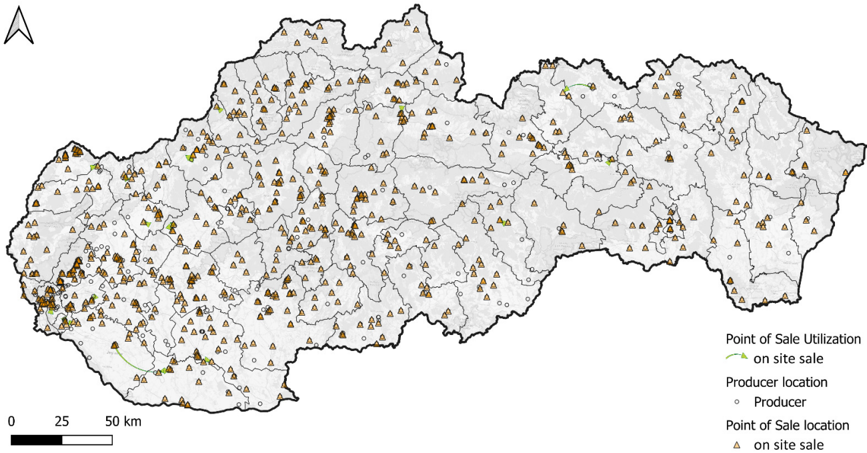
- Most producers remain tied to local direct sales: on-site sales were used by approximately 74.75% of producers, while specialized stores were used by only about 6.8% and local retail chains by only 4.46%. In the comprehensive network, producers used on average approximately 3.87 points of sale, but the lower half relied on two or fewer channels, and intermediated options remained inaccessible to roughly 95% of them.
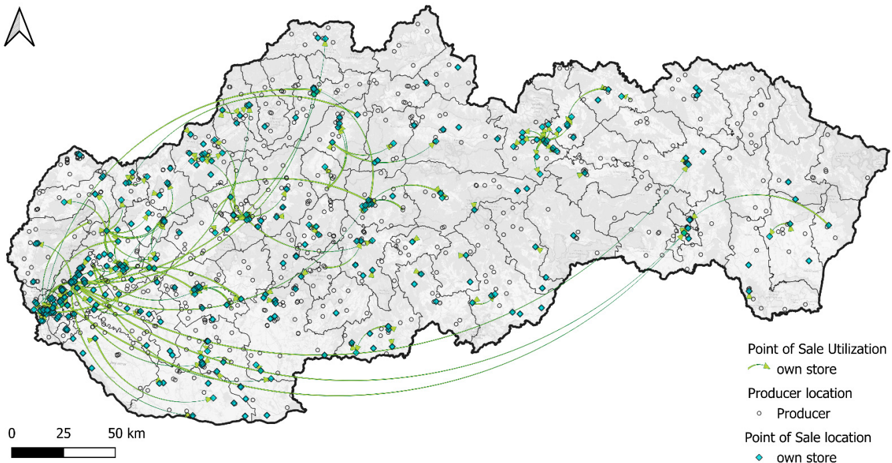
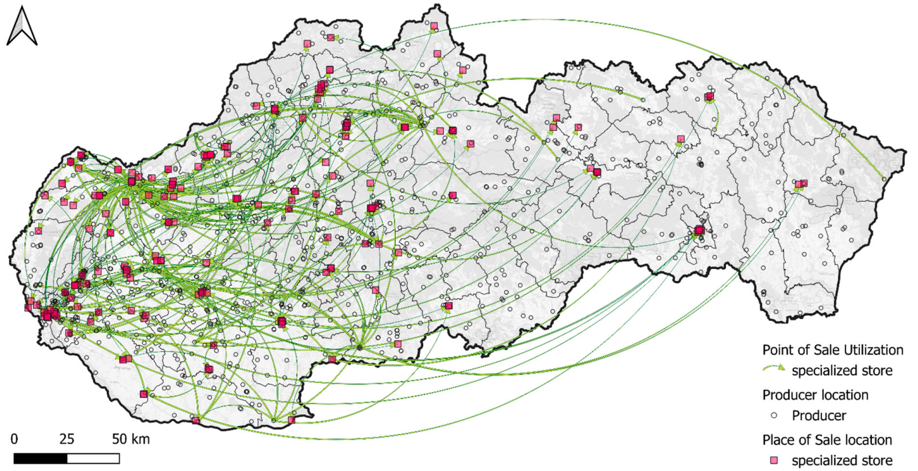
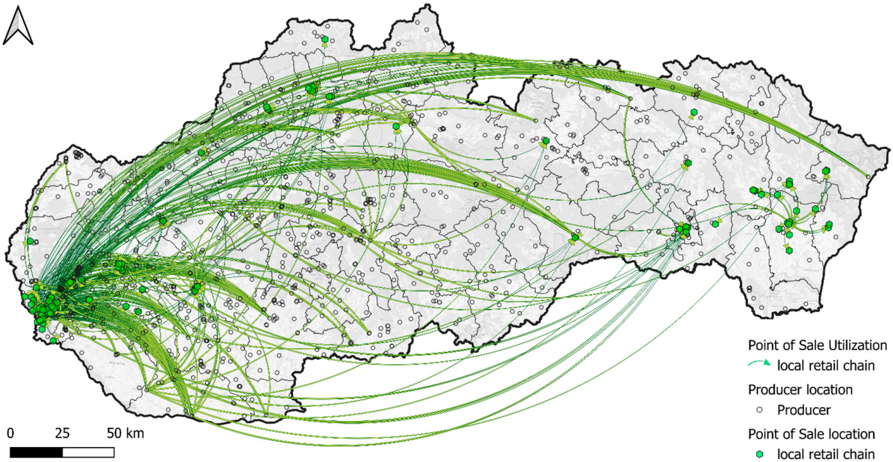
- Distances differed sharply by channel: mean distance was about 40 min in the comprehensive network, about 15 min for own stores, about 54 min for specialized stores, and about 93 min for local retail chains. Intermediated channels showed long-distance ties oriented toward urban hubs, especially the capital city.
- ERGM results confirmed H2a, H4a/H4b, H5a/H5b, H6a/H6b, and H7a/H7b; H1a was not formally confirmed, though Model 5 showed larger enterprises had a significantly higher tendency to use points of sale in general. H1b, H2b, H3a, and H3b were not confirmed.
- Organic certification emerged as a key differentiation tool enhancing access to distant and urban markets; family farms supplied fewer points of sale overall but were selectively able to supply distant markets; cooperatives, despite expected commodity orientation, were able to overcome capacity and logistical barriers and serve distant and core urban markets.
Methods
- Data came from lokalnytrh.sk, described as Slovakia’s largest online platform for local agri-food producers, with extraction in March 2025 and data accumulated between 2017 and 2025. From 995 producers, 9 were excluded, yielding 986 producers, 1,434 points of sale, and 1,908 producer–POS ties; missing firm size and years of operation were supplemented from public registers, 29 producers (2.94%) had year of establishment imputed using the median, and free-text sales locations were manually verified and geocoded, contributing to 25.1% of the final POS dataset.
- The data were analyzed as a two-mode, undirected network with producers and points of sale as nodes and producer use of a POS as edges. Four subnetworks were created for on-site sale, own store, specialized store, and local retail chain, plus a comprehensive network.
- Six ERGM models were estimated using MCMC MLE in R with the statnet package; structural terms included edges, gw1degree, and gw2degree, with node-level, edge-level, and interaction terms for distance and POS population density in Model 6. Network-level indicators included density, mean and median degree, isolate rates, and distances; goodness-of-fit compared observed networks with 1,000 simulations.
Limitations
- Stated: the dataset covered only selected physical direct and intermediated channels and excluded farmers’ markets, online sales, HoReCa, and other institutional channels; control variables could not fully capture unobserved channels. It provided only a “snapshot” of producer–POS relationships accumulated over multiple years and only a sample of producers, with businesses under 10 employees and producers from eastern Slovakia underrepresented; micro-producers were likely underrepresented due to legal restrictions, informal or semi-formal participation, and lower digital skills among older farmers. The data also did not allow qualitative assessment of internal governance and operational processes, mainly within family farms and cooperatives.
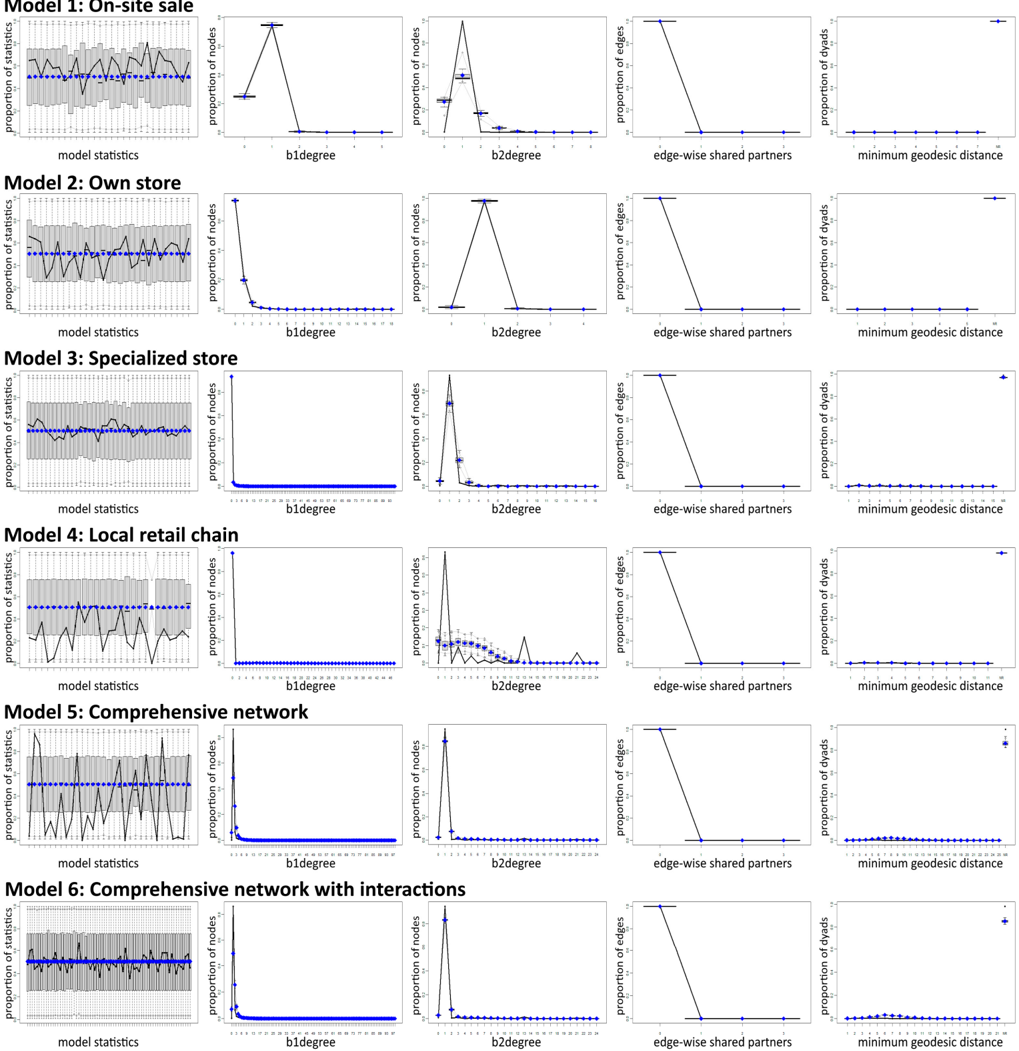
- Evident from the text: the sample was skewed toward western Slovakia and differed from the overall population of agricultural enterprises, with small producers slightly underrepresented and medium-sized and large enterprises overrepresented. Some models had limited ability to reproduce the extreme ends of the POS degree distribution, particularly Model 4’s upper tail and the b2degree statistic in Models 1 and 4, and some variables were excluded due to no observations or convergence problems.
Model-written summary. Check it against the paper before relying on it.
Integrity signals
Registry
Cites
Statistics
Figures
Verification
Claims the paper makes
33 Valid · 1 Not valid · 22 Not checked · 207 Own results and interpretations
The cited sources support only part of this claim — read each source’s verdict below.
In the paper
“Market reach is therefore a key dimension of SFSC performance [5][6][7].”
§ Who Reaches the Consumer? A Network Analysis of Market Reach Factors of Slovakia's Short Food Supply Chains > 1. Introduction
What the sources say
- Supportedcites [5] 5. Keech, D.; Milford, A.B.; Gillund, F.; Reed, M. Strategies and Business Models used by Short-Chain Food Enterprises Marketing in Oslo (Norway) and Bristol (UK). Eur. Countrys. 2023, 15, 149-166. [CrossRef] source
The Abstract describes securing customers, marketing barriers and financial viability as central concerns for SFSCs in Oslo and Bristol. The Barriers and opportunities section identifies inadequate sales and the need for better-targeted sales channels, supporting market reach as a key aspect of their performance. Page numbers were not provided in our copy. (LLM, conf=0.87)
- Partly supportedcites [6] 6. Sroka, W.; Pölling, B.; Mergenthaler, M. City adjustments as the main factor of success of urban and peri-urban farms-empirical evidence from the Ruhr metropolis. NJAS Wagening. J. Life Sci. 2019, 89, 1-13. [CrossRef] sourceExperimental — accuracy not yet measured
The Conclusion (section 6; page unavailable) says distance from the market is significant for Ruhr farms using direct sales, and that convenient locations lead to more frequent sales. This supports the importance of customer access, but the paper assesses farm success rather than defining market reach as a dimension of short food supply chain performance generally. (LLM, conf=0.83)
- Supportedcites [7] 7. Yacamán Ochoa, C.; Matarán Ruiz, A.; Mata Olmo, R.; Macías Figueroa, Á.; Torres Rodríguez, A. Peri-Urban Organic Agriculture and Short Food Supply Chains as Drivers for Strengthening City/Region Food Systems-Two Case Studies in Andalucía, Spain. Land 2020, 9, 177. [CrossRef] source
The Literature Review (p. 3) says SFSCs need to scale up volumes sold to reach more consumers. This supports market reach as an important dimension of their performance, although the paper does not use that exact term. (LLM, conf=0.87)
plain- Asserted: passes — The authors put it forward as true.
- Checkable: passes — It can be checked against evidence.
- Load-bearing: passes — The paper’s conclusions depend on it.
- Based: passes — The paper gives a reason why it holds.
- Supported
The cited sources support only part of this claim — read each source’s verdict below.
In the paper
“Proximity to an urban center constitutes a significant competitive advantage for producers, for example, by utilizing direct contact with customers, strong customer relationships, and optimized logistics [6,[32][33][34].”
§ Who Reaches the Consumer? A Network Analysis of Market Reach Factors of Slovakia's Short Food Supply Chains > 1.2. SFSCs and Access to Markets
What the sources say
- Partly supportedcites [6] 6. Sroka, W.; Pölling, B.; Mergenthaler, M. City adjustments as the main factor of success of urban and peri-urban farms-empirical evidence from the Ruhr metropolis. NJAS Wagening. J. Life Sci. 2019, 89, 1-13. [CrossRef] sourceExperimental — accuracy not yet measured
The Conclusion says proximity to customers can improve sales and strengthen relationships, but it also says urban location can be an advantage or a threat: it becomes an asset when farms use suitable strategies, chiefly tourism services and direct sales. The Discussion likewise finds success depends on both location and city-adjusted strategies. The unqualified claim that proximity is a competitive advantage overstates this conditional finding; the paper discusses customers’ travel costs rather than producers’ optimized logistics. (LLM, conf=0.88)
- Not checked — no full text of the sourcecites [32] 32. Pölling, B.; Mergenthaler, M.; Lorleberg, W. Professional urban agriculture and its characteristic business models in Metropolis Ruhr, Germany. Land Use Policy 2016, 58, 366-379. [CrossRef] source
- Partly supportedcites [33] 33. Wang, M.; Kumar, V.; Ruan, X.; Saad, M.; Garza-Reyes, J.A.; Kumar, A. Sustainability Concerns on Consumers' Attitude towards Short Food Supply Chains: An Empirical Investigation. Oper. Manag. Res. 2022, 15, 76-92. [CrossRef] sourceExperimental — accuracy not yet measured
The Methodology (Location of study; page unavailable) says Xinxiang’s mixed urban-rural geography is convenient for short food supply chains. The Results and discussion (Descriptive statistics; page unavailable) says shoppers value nearby venues, and the SFSCs and sustainability section says direct interactions can help farmers retain profits otherwise shared with intermediaries. These passages support aspects of the proposed advantage, but they do not establish that proximity to an urban center is a significant competitive advantage for producers or that it optimizes logistics. (LLM, conf=0.78)
plainstates a cause- Asserted: passes — The authors put it forward as true.
- Checkable: passes — It can be checked against evidence.
- Load-bearing: unclear — It is unclear whether the paper’s conclusions depend on it.
- Based: passes — The paper gives a reason why it holds.
- Partly supported
The cited sources support only part of this claim — read each source’s verdict below.
In the paper
“Farms located near urban areas, when applying an appropriate strategy, have a substantially higher chance of success [5,6,28,35], and SFSC initiatives in these locations are more active [6,7].”
§ Who Reaches the Consumer? A Network Analysis of Market Reach Factors of Slovakia's Short Food Supply Chains > 1.2. SFSCs and Access to Markets
What the sources say
- Partly supportedcites [5] 5. Keech, D.; Milford, A.B.; Gillund, F.; Reed, M. Strategies and Business Models used by Short-Chain Food Enterprises Marketing in Oslo (Norway) and Bristol (UK). Eur. Countrys. 2023, 15, 149-166. [CrossRef] sourceExperimental — accuracy not yet measured
The Introduction and section 2 describe cities as offering farmers marketing opportunities and discuss strategies adapted to urban markets. They do not establish that farms near cities have a substantially higher chance of success when using an appropriate strategy; the Barriers and opportunities section also describes challenges to profitability. (LLM, conf=0.86)
- Supportedcites [6] 6. Sroka, W.; Pölling, B.; Mergenthaler, M. City adjustments as the main factor of success of urban and peri-urban farms-empirical evidence from the Ruhr metropolis. NJAS Wagening. J. Life Sci. 2019, 89, 1-13. [CrossRef] source
The Discussion reports that strategies oriented toward urban customers increase the probability of farm success, while emphasizing that their effectiveness also depends on location and other factors. The Conclusion likewise says that densely populated locations become an asset when farms use appropriate strategies, especially tourism services and direct sales. No page numbers are provided in the supplied passages. (LLM, conf=0.92)
- Could not verifycites [28] 28. Gonzalez-Azcarate, M.; Macein, J.L.C.; Bardaji, I. Why buying directly from producers is a valuable choice? Expanding the scope of short food supply chains in Spain. Sustain. Prod. Consum. 2021, 26, 911-920. [CrossRef] sourceExperimental — accuracy not yet measured
Our copy of González-Azcárate et al. (2021) is a consumer-side survey of three Spanish samples (active SFSC, potential SFSC, general public) examining market niches (4.1), food-choice attributes (4.2) and drivers/barriers of buying directly from producers (4.3); nowhere does it relate a farm's proximity to urban areas to its chance of success. The only urban/rural content is the observation in 4.3 that 'the disconnection between rural areas and urban areas... cause that consumers and producers do not know each other' and that neighbourhood grocery shopping is more convenient — a barrier statement, not a location-advantage finding. Peri-urban and big-city works (e.g. Mancha Cáceres & Ramírez García 2018; Del Valle & Abella 2017) appear only in the reference list, unquoted in the text. Searches for 'farms near urban areas / success', 'peri-urban proximity to cities', and 'farm viability location strategy' returned no passage supporting or contradicting the claim, so the point cannot be judged from this source. (LLM, conf=0.72)
- Not checked — no full text of the sourcecites [35] 35. Corsi, A.; Barbera, F.; Dansero, E.; Peano, C. (Eds.) Alternative Food Networks: An Interdisciplinary Assessment; Palgrave Macmillan Cham: London, UK, 2018; pp. 163-243. source
plainstates a possible cause- Asserted: passes — The authors put it forward as true.
- Checkable: passes — It can be checked against evidence.
- Load-bearing: unclear — It is unclear whether the paper’s conclusions depend on it.
- Based: passes — The paper gives a reason why it holds.
- Partly supported
The cited sources support only part of this claim — read each source’s verdict below.
In the paper
“Producers engaged in processing and the production of higher-value-added products more frequently use SFSC channels that may involve a single intermediary, allowing them to reach a broader market [18,27,57].”
§ Who Reaches the Consumer? A Network Analysis of Market Reach Factors of Slovakia's Short Food Supply Chains > https://doi.org/10.3390/agriculture16060649
What the sources say
- Partly supportedcites [18] 18. Varecha, L.; Laginová, L.; Jarábková, J. Short Food Supply Chains in Slovakia: Motivations and Barriers for Foodservice Establishments. Sustainability 2025, 17, 1107. [CrossRef] sourceExperimental — accuracy not yet measured
Section 1.1 (Introduction; page unavailable) identifies sales through an intermediary as a type of short food supply chain and describes spatially extended sales in locations distant from the producer. It does not say that producers who process food or make higher-value-added products use those channels more frequently, or that an intermediary enables those producers to reach a broader market. (LLM, conf=0.83)
- Partly supportedcites [27] 27. Renkema-Singh, M.; Hilletofth, P. Investigating capabilities of intermediaries in short food supply chains: A resource-based view. Agric. Food Econ. 2025, 13, 79. [CrossRef] sourceExperimental — accuracy not yet measured
In “Short food supply chains and competitive advantage” (page unavailable), the paper says that proximate and spatially extended SFSCs usually involve an intermediary. “Intermediaries in SFSCs” (page unavailable) says intermediaries can help smaller producers reach larger markets. It does not say that producers making processed or higher-value-added products use these channels more frequently, or establish a limit of one intermediary. (LLM, conf=0.86)
- Not matchedcites [57] 57. Troján, S.; Kacz, K.; Miklósné Varga, A. Producers in short food supply chains and the role of local farmers' markets in sales. Rev. Agric. Rural Dev. 2023, 12, 75-82. [CrossRef]
We searched by its title and found no matching paper.
hedgedstates an association- Asserted: passes — The authors put it forward as true.
- Checkable: passes — It can be checked against evidence.
- Load-bearing: unclear — It is unclear whether the paper’s conclusions depend on it.
- Based: passes — The paper gives a reason why it holds.
- Partly supported
The cited sources support only part of this claim — read each source’s verdict below.
In the paper
“This supports the argument that channel choice reflects adaptive strategies rather than fixed structural positions [6].”
§ Who Reaches the Consumer? A Network Analysis of Market Reach Factors of Slovakia's Short Food Supply Chains > 1.2. SFSCs and Access to Markets
What the sources say
- Partly supportedcites [6] 6. Sroka, W.; Pölling, B.; Mergenthaler, M. City adjustments as the main factor of success of urban and peri-urban farms-empirical evidence from the Ruhr metropolis. NJAS Wagening. J. Life Sci. 2019, 89, 1-13. [CrossRef] sourceExperimental — accuracy not yet measured
Section 2.2 describes shortening distribution channels as a farm adjustment activity, and the Discussion identifies sales through short channels as an element of strategy. The paper does not establish that channel choice is independent of structural position; its conceptual framework says strategy depends on farm resources and the external environment. No page numbers were available in our copy. (LLM, conf=0.84)
plainstates a cause- Asserted: passes — The authors put it forward as true.
- Checkable: passes — It can be checked against evidence.
- Load-bearing: unclear — It is unclear whether the paper’s conclusions depend on it.
- Based: passes — The paper gives a reason why it holds.
- Partly supported
130 more claims · 6 with their cited sources checked
Create a free account to see all 263 claims and to verify the 62 references still open.
- Probably not a substantial claim. 42
- It may state two separate claims as one. 99
- The quote only partly states this claim. 4
Citations
Cites
Renting, H., Marsden, T. K., & Banks, J. (2003) · Environment and Planning A: Economy and Space · doi:10.1068/a3510 · Cited by 1,985 · cited 5×
“Definitions of short food supply chains typically rely on the geographical distance between production and consumers or on the limited number of intermediaries, as actors may be close regardless of physical distance [4].”
InfluentialFood Supply Chain Approaches: Exploring their Role in Rural Development
Marsden, T., Banks, J., & Bristow, G. (2000) · Sociologia Ruralis · doi:10.1111/1467-9523.00158 · Cited by 1,210 · cited 2×
“Focusing on value creation and meaning in producer–consumer relationships, an early SFSC typology by Marsden et al. [24] and Renting et al. [4] classifies SFSCs based on organizational structure and quality definition and conventions.”
Handcock, M. S., Hunter, D. R., Butts, C. T., Goodreau, S. M., & Morris, M. (2008) · Journal of Statistical Software · doi:10.18637/jss.v024.i01 · Cited by 926 · cited 1×
“Network objects were constructed and analyzed in R using the statnet package [65].”
Exponential Random Graph Models for Social Networks: Theory, Methods, and Applications
(2012) · Cambridge University Press eBooks · doi:10.1017/cbo9780511894701 · Cited by 840
Goodness of Fit of Social Network Models
Hunter, D. R., Goodreau, S. M., & Handcock, M. S. (2008) · Journal of the American Statistical Association · doi:10.1198/016214507000000446 · Cited by 689 · cited 2×
“…network (a realization of X ), g(x) is a vector of model statistics for the network, θ is the corresponding covariate coefficients, p is the number of terms in the model, and k( θ ) is the sum of the numerator over all networks with the same node set as x , serving as a normalizing constant [67].”
Berti, G., & Mulligan, C. (2016) · Sustainability · doi:10.3390/su8070616 · Cited by 403 · cited 1×
“Food hubs, producer cooperatives, and hybrid intermediary organizations facilitate aggregation, standardization, and market negotiation, enabling small producers to access retail and institutional buyers [2,27,38].”
Measuring the Economic, Environmental, and Social Sustainability of Short Food Supply Chains
Malak-Rawlikowska, A., Majewski, E., Wąs, A., Borgen, S. O., Csillag, P., Donati, M., Freeman, R., Hoàng, V., Lecoeur, J.-L., Mancini, M. C., et al. (2019) · Sustainability · doi:10.3390/su11154004 · Cited by 279 · cited 2×
“Studies confirm that producers allocate output across DTC and DTR channels [21,29], implying different capacities for reaching beyond local consumer bases and the ability to access larger and more distant markets.”
The logistics of the short food supply chain: A literature review
Paciarotti, C., & Torregiani, F. (2021) · Sustainable Production and Consumption · doi:10.1016/j.spc.2020.10.002 · Cited by 262 · cited 1×
“Proximity to an urban center constitutes a significant competitive advantage for producers, for example, by utilizing direct contact with customers, strong customer relationships, and optimized logistics [6,32–34].”
Short Food Supply Chains (SFSC) as Local and Sustainable Systems
Jarzębowski, S., Bourlakis, M., & Bezat-Jarzębowska, A. (2020) · Sustainability · doi:10.3390/su12114715 · Cited by 220
Chiffoleau, Y., & Dourian, T. (2020) · Sustainability · doi:10.3390/su12239831 · Cited by 212 · cited 3×
“Organizational capacity and accumulated market experience play a mediating role [2,31,39].”
Statistical Network Analysis for Analyzing Policy Networks
Robins, G. L., Lewis, J. M., & Wang, P. (2012) · Policy Studies Journal · doi:10.1111/j.1541-0072.2012.00458.x · Cited by 169 · cited 1×
“Moreover, the use of conventional logistic regression for relational data is not recommended, as such models fail to account for interdependencies between observations, thereby violating the assumption of independence [64].”
Jia, F., Shahzadi, G., Bourlakis, M., & John, A. (2024) · Journal of Cleaner Production · doi:10.1016/j.jclepro.2023.140364 · Cited by 119 · cited 8×
“Newer reviews stress that SFSCs should be understood less as a single model and more as a spectrum of market arrangements combining proximity, governance, and value attribution [1,3,21,22,27,28].”
InfluentialProfessional urban agriculture and its characteristic business models in Metropolis Ruhr, Germany
Pölling, B., Mergenthaler, M., & Lorleberg, W. (2016) · Land Use Policy · doi:10.1016/j.landusepol.2016.05.036 · Cited by 93
Issues and Challenges in Short Food Supply Chains: A Systematic Literature Review
Bayir, B., Charles, A., Sekhari, A., & Ouzrout, Y. (2022) · Sustainability · doi:10.3390/su14053029 · Cited by 85 · cited 9×
“Newer reviews stress that SFSCs should be understood less as a single model and more as a spectrum of market arrangements combining proximity, governance, and value attribution [1,3,21,22,27,28].”
InfluentialShort food supply chains for local food: a difficult path
Rucabado-Palomar, T., & Cuéllar-Padilla, M. (2020) · Renewable Agriculture and Food Systems · doi:10.1017/s174217051800039x · Cited by 82
Wang, M., Kumar, V., Ruan, X., Saad, M., Garza-Reyes, J. A., & Kumar, A. (2022) · Operations Management Research · doi:10.1007/s12063-021-00188-x · Cited by 80 · cited 1×
“In addition to general transaction costs, they face the challenge of bridging long distances, buyer requirements regarding volume and quality, and the lack of physical infrastructure for logistics and storage [7–11, 25, 33].”
González-Azcárate, M., Cruz Maceín, J. L., & Bardají, I. (2021) · Sustainable Production and Consumption · doi:10.1016/j.spc.2021.01.003 · Cited by 77
Kovacs, I., & Keresztes, E. R. (2022) · Sustainability · doi:10.3390/su14074338 · Cited by 76 · cited 1×
“One of the key value-based product differentiation strategies employed is organic certification [23,26,48,49], reflecting growing demand for higher-quality, safer, healthier, and more ethical products [47,50].”
Benedek, Z., Fertő, I., & Molnár, A. (2018) · Agriculture and Human Values · doi:10.1007/s10460-017-9834-4 · Cited by 71 · cited 8×
“Beginning producers face higher entry barriers, particularly in intermediated channels requiring formal contracts and consistent supply [35,44].”
InfluentialAlternative Food Networks: An Interdisciplinary Assessment
(2018) · doi:10.1007/978-3-319-90409-2 · Cited by 61
POST‐SOCIALIST FARMERS’ COOPERATIVES IN CENTRAL AND EASTERN EUROPE
HAGEDORN, K. (2014) · Annals of Public and Cooperative Economics · doi:10.1111/apce.12051 · Cited by 59 · cited 7×
“They retain a relatively dominant position and typically manage large areas of land, focusing on commodity production and supplying processors or wholesalers [14,15,45].”
InfluentialShort food supply chain: Characteristics of a family farm
Aguiar, L. D. C., DelGrossi, M. E., & Thomé¹, K. M. (2018) · Ciência Rural · doi:10.1590/0103-8478cr20170775 · Cited by 59 · cited 3×
“A family farm designation can also serve as a foundation for value-based marketing [52,55].”
Short food supply chains: the link between participation and farmers' competencies
Charatsari, C., Kitsios, F., & Lioutas, E. D. (2020) · Renewable Agriculture and Food Systems · doi:10.1017/s1742170519000309 · Cited by 58 · cited 2×
“Participation in SFSC requires new competencies, as producers take on tasks related to logistics, sales, and marketing [42,43].”
statnet: Software Tools for the Statistical Analysis of Network Data
Handcock, M. S., Hunter, D. R., Butts, C. T., Goodreau, S. M., Krivitsky, P. N., Bender‐deMoll, S., & Morris, M. (2008) · doi:10.32614/cran.package.statnet · Cited by 49
Yacamán Ochoa, C., Matarán Ruiz, A., Mata Olmo, R., Macías Figueroa, Á., & Torres Rodríguez, A. (2020) · Land · doi:10.3390/land9060177 · Cited by 47 · cited 4×
“Large urban markets provide an environment where this goal can be effectively achieved, as they offer a high concentration of customers with greater purchasing power and a demand for diverse, high-quality products often reflecting environmental awareness or ethical concerns [5–7].”
InfluentialHorská, E., Petriľák, M., Šedík, P., & Nagyová, Ľ. (2020) · Sustainability · doi:10.3390/su12208499 · Cited by 36 · cited 5×
“This finding may reflect another layer of structural constraints commonly identified in post-socialist contexts [17–19 Hypotheses H4a and H4b are confirmed, as organic producers are generally able to use and supply SFSC points of sale more intensively and are also capable of supplying major markets.”
InfluentialStoeva, S., Van Gompel, R., Van den Bossche, L., Rogge, E., Slavova, P., Grivins, M., & Mileiko, I. (2024) · Agricultural and Food Economics · doi:10.1186/s40100-024-00344-4 · Cited by 32 · cited 10×
“Organizational capacity and accumulated market experience play a mediating role [2,31,39].”
InfluentialSmoluk-Sikorska, J., Śmiglak-Krajewska, M., Rojík, S., & Fulnečková, P. R. (2023) · Agriculture · doi:10.3390/agriculture14010017 · Cited by 31 · cited 3×
“Although certification represents only one of several quality signals [11], the credibility of organic production is associated with higher consumer willingness to pay and the ability to capture price premiums [23,51,52].”
Unpacking Proximity for Sustainability in Short Food Supply Chains
León‐Bravo, V., Borrello, B., Ciccullo, F., & Caniato, F. F. A. (2024) · Business Strategy and the Environment · doi:10.1002/bse.4079 · Cited by 29
Aubert, M., & Enjolras, G. (2016) · International Journal of Agricultural Resources, Governance and Ecology · doi:10.1504/ijarge.2016.076932 · Cited by 28
Certifications in short food supply chains in the region of Madrid. Part of the alternative?
González-Azcárate, M., Cruz-Maceín, J. L., & Bardají, I. (2022) · Ecological Economics · doi:10.1016/j.ecolecon.2022.107387 · Cited by 27
Sciortino, C., Giamporcaro, G., Sgroi, F., & Modica, F. (2025) · Agricultural and Food Economics · doi:10.1186/s40100-025-00420-3 · Cited by 23 · cited 1×
“The social, environmental, and landscape functions of SFSCs depend on their economic viability [6,30].”
Hyland, J., Henchion, M. M., Olomo, O., Attard, J., & Gaffey, J. (2024) · British Food Journal · doi:10.1108/bfj-01-2023-0058 · Cited by 22 · cited 1×
“One of the key value-based product differentiation strategies employed is organic certification [23,26,48,49], reflecting growing demand for higher-quality, safer, healthier, and more ethical products [47,50].”
Sroka, W., Pölling, B., & Mergenthaler, M. (2019) · NJAS: Wageningen Journal of Life Sciences · doi:10.1016/j.njas.2019.04.005 · Cited by 19 · cited 6×
“This supports the argument that channel choice reflects adaptive strategies rather than fixed structural positions [6].”
InfluentialThe work of farmers in short food supply chains: Systematic literature review and research agenda
Dupé, P., Dedieu, B., Gasselin, P., & Ollivier, G. (2025) · PLoS ONE · doi:10.1371/journal.pone.0314175 · Cited by 18 · cited 1×
“Participation in SFSC requires new competencies, as producers take on tasks related to logistics, sales, and marketing [42,43].”
Determinants of consumer behavior in short food supply chains: a systematic literature review
Herzig, J., & Zander, K. (2025) · Agricultural and Food Economics · doi:10.1186/s40100-025-00370-w · Cited by 18
Short Food Supply Chains and Small Farms—Evidence from Slovakia
Floriš, N., Schwarcz, P., Schwarczová, L., & Munk, M. (2022) · Sustainability · doi:10.3390/su14052728 · Cited by 16 · cited 6×
“In the post-socialist context, this finding points to structural conditions frequently emphasized in the literature [11,14,16,46], which argue that small producers remain constrained by a long-term limited access to capital, low production capacity, and weak growth opportunities.”
InfluentialThe Significance of Short Food Supply Chains: Trends and Bottlenecks from the SKIN Thematic Network
Hyland, J., Crehan, P., Colantuono, F., & Macken-Walsh, Á. (2019) · Studies in Agricultural Economics · doi:10.7896/j.1904 · Cited by 16
Jiří, P., Ondřej, K., Jiří, H., & Michal, L. (2022) · Land Use Policy · doi:10.1016/j.landusepol.2022.106046 · Cited by 11
Keech, D., Milford, A. B., Gillund, F., & Reed, M. (2023) · European Countryside · doi:10.2478/euco-2023-0008 · Cited by 10 · cited 8×
“Nevertheless, diversification also raises coordination complexity and may reinforce dependence on intermediated channels [5,21,44].”
InfluentialOleksiuk, A., & Rull Quesada, K. (2023) · Central European Management Journal · doi:10.1108/cemj-12-2022-0254 · Cited by 10 · cited 10×
“In the post-socialist context, this finding points to structural conditions frequently emphasized in the literature [11,14,16,46], which argue that small producers remain constrained by a long-term limited access to capital, low production capacity, and weak growth opportunities.”
InfluentialFarmers’ markets or the supermarket? Channel selection in small farming businesses
Cortes, J. D., Jackson, J. E., & Cortes, A. F. (2024) · New England Journal of Entrepreneurship · doi:10.1108/neje-07-2022-0045 · Cited by 9 · cited 4×
“Smaller producers tend to rely on direct channels due to limited production volumes and capital constraints, whereas larger producers are structurally better positioned to supply intermediated channels, utilizing higher efficiency in terms of sales volume [2,23,27,40].”
InfluentialShort Food Supply Chains in Slovakia: Motivations and Barriers for Foodservice Establishments
Varecha, L., Laginová, L., & Jarábková, J. (2025) · Sustainability · doi:10.3390/su17031107 · Cited by 7 · cited 3×
“Small producers face an acute lack of logistical infrastructure, high distribution costs, and strict regulatory and hygiene standards [13,17,18].”
Self-citationTrust and the Clean Food Imaginaries: An Analysis of a Short Food Supply Chain from Romania
Delibas, H. I. (2021) · Universität Kassel · doi:10.17170/kobra-202102163258 · Cited by 7 · cited 7×
“The literature documents a significant effect of certification on market penetration, driven by increased consumer trust and higher perceived product value, and shows that it facilitates access to specialized markets [23,44,52] and, in some contexts, to international markets [53].”
InfluentialNsamzinshuti, A., Janjevic, M., Rigo, N., & Ndiaye, A. B. (2018) · Operations Research/Computer Science Interfaces Series · doi:10.1007/978-3-319-62917-9_7 · Cited by 7
Regional Determinants of the Development of Short Food Supply Chains in Poland
Raftowicz, M., & Korabiewski, B. (2025) · Sustainability · doi:10.3390/su17219772 · Cited by 6 · cited 6×
“Organizational capacity and accumulated market experience play a mediating role [2,31,39].”
InfluentialInvestigating capabilities of intermediaries in short food supply chains: A resource-based view
Renkema-Singh, M., & Hilletofth, P. (2025) · Agricultural and Food Economics · doi:10.1186/s40100-025-00432-z · Cited by 6
Harriet, K., Ernst-August, N., & Johnny, M. (2019) · Journal of Development and Agricultural Economics · doi:10.5897/jdae2019.1067 · Cited by 5
Teuber, R., & Jensen, J. D. (2021) · British Food Journal · doi:10.1108/bfj-10-2020-0898 · Cited by 5 · cited 3×
“Organic producers are frequently documented as relying on direct sales channels [41,44,54].”
Buy Domestic? Emerging Food Nationalism in Slovakia
Najdený, R., Križan, F., Gurňák, D., & Bilková, K. (2022) · Tijdschrift voor Economische en Sociale Geografie · doi:10.1111/tesg.12517 · Cited by 5
Pasqualotto, C., & De Menezes, D. C. (2023) · Revista de Gestão e Secretariado (Management and Administrative Professional Review) · doi:10.7769/gesec.v14i11.3034 · Cited by 3 · cited 3×
“This likely reflects a selective group of family farms emphasizing quality, reputation, and stable buyer relationships, which corresponds with the literature on value-based marketing [3,23,26,56].”
Kociszewski, K., Krupowicz, J., Graczyk, A., Sobocińska, M., & Mazurek-Łopacińska, K. (2024) · Economics and Environment · doi:10.34659/eis.2024.88.1.698 · Cited by 3 · cited 2×
“Organic producers are frequently documented as relying on direct sales channels [41,44,54].”
Food Hub or Not Yet? Exploring the Food Hub Milieu in Czechia
Smutná, Z., & Hruška, V. (2024) · European Countryside · doi:10.2478/euco-2024-0012 · Cited by 3
Developing a local food business model and innovation framework: a systematic literature review
Fobbe, L., & Hilletofth, P. (2025) · Frontiers in Sustainable Food Systems · doi:10.3389/fsufs.2025.1703973 · Cited by 3 · cited 4×
“Furthermore, by employing a network-based modeling framework, it responds to the need for analytical approaches capable of capturing complex producer–market relations [1,3,21].”
InfluentialKrižan, F., Bilková, K., Novotná, M., Kunc, J., & Hencelová, P. (2023) · Moravian Geographical Reports · doi:10.2478/mgr-2023-0017 · Cited by 3
Covid Crisis Experiences of Hungarian Small Family Farms Engaged in Multifunctional Agriculture
Ujj, A., Pércsi, K. N., Bazsik, I., Harkányi, A., & Jancsovszka, P. (2023) · European Countryside · doi:10.2478/euco-2023-0025 · Cited by 2 · cited 4×
“This finding supports previous research emphasizing the importance of social capital and experience in participation in SFSCs [31,39,42,47].”
InfluentialOrganic certification: Challenges and benefits for producers
Baldin, A. M. (2022) · Revista Sistemática · doi:10.56238/rcsv6n2-005 · Cited by 2
Development of the Legal Regulation of the Cooperative in Slovakia
Ilková, Z., Lazíková, Z., Bandlerová, A., & Lazíková, J. (2019) · EU agrarian Law · doi:10.2478/eual-2019-0007 · Cited by 1
Prefer local over organic? Dilemma of Czech organic consumers within social discourse on Organic 3.0
Urban, J., & Husák, J. (2022) · Journal of Central European Agriculture · doi:10.5513/jcea01/23.1.3297 · Cited by 1
Gerhart, J., & Howard, P. (2023) · Journal of Agriculture, Food Systems, and Community Development · doi:10.5304/jafscd.2023.124.003 · Cited by 1 · cited 4×
“These include spatial distance, logistical constraints, limited infrastructure, and buyer requirements regarding volume, consistency, and quality [8–10].”
InfluentialShort food supply chain: characteristics of a family farm
Aguiar, L. C., Delgrossi, M. E., & Thomé, K. M. (2018) · Figshare · doi:10.6084/m9.figshare.6318374
Profitability and risk of crop and livestock production in Slovak farms
Tóth, M., Rábek, T., Boháčiková, A., Holúbek, I., Tóth, M., Rábek, T., Boháčiková, A., & Holúbek, I. (2017) · Unknown · doi:10.22004/ag.econ.272122
LAGINOVA, L., JARABKOVA, J., & VARECHA, L. (2024) · University of Presov · doi:10.5281/zenodo.19630669
Self-citation
Research works printed but not linked: 3
- 46. Tisenkopfsa, T.; Kováchb, I.; Lošt'ákc, M.; Š ūmanea, S. Rebuilding and Failing Collectivity: Specific Challenges for Collective Farmers Marketing Initiatives in Post-Socialist Countries. Int. J. Sociol. Agric. Food 2011, 18, 70-88. [CrossRef]
- 57. Troján, S.; Kacz, K.; Miklósné Varga, A. Producers in short food supply chains and the role of local farmers' markets in sales. Rev. Agric. Rural Dev. 2023, 12, 75-82. [CrossRef]
- 66. Borgatti, S.P.; Everett, M.G.; Johnson, J.C. Analyzing Social Networks; Sage: Thousand Oaks, CA, USA, 2018; pp. 34-296.
Metadata
- Authors
- Varecha, L., Jarábková, J., & Hrivnák, M.
- Affiliations
- Faculty of European Studies and Regional Development, Institute of Sustainable Regional and Local Development, Slovak University of Agriculture in Nitra, Tr. A Hlinku 2, 949 76 Nitra, Slovakia
- Slovak University of Agriculture in Nitra (SK)
- Venue
- Agriculture
- Publisher
- MDPI AG
- Published
- 2026-03-12
- Volume
- 16
- Issue
- 6
- Pages
- 649
- ISSN
- 2077-0472 (ISSN-L)
- OpenAlex
- W7135031000
- Semantic Scholar
- d37ff40f90d408b6ef54cbfc998f33680f678ac3
- Cited by
- 0
- References
- 53
- FWCI
- 0.00
- Type
- journal article
- Language
- en
- Open access
- gold
- doi.org
- Licence
- Locations
- Agriculture (publishedVersion, cc-by)
- DOAJ (DOAJ: Directory of Open Access Journals) (submittedVersion, cc-by-sa)
- Funders
- Grant Agency of the Slovak University of Agriculture (21-GA-SPU-2024)
- Slovakia’s recovery and resilience plan (09I03-03-V05-00018—Early Stage Grants at SUA in Nitra)
- Topics
- Life Sciences › Agricultural and Biological Sciences › Plant Science › Organic Food and Agriculture
- Social Sciences › Business, Management and Accounting › Strategy and Management › Cooperative Studies and Economics
- Social Sciences › Business, Management and Accounting › Strategy and Management › Global trade, sustainability, and social impact
- Keywords
- short food supply chains, market reach, distribution channels, organic certification, family farms, agricultural cooperatives, value added, post-communist transition, Slovakia, urban markets, business models
About these checks
Registry, retraction, Cites and statistics results are computed, not judged, with one exception: a printed reference that no index lists is read once by a model before it counts as a citation error. Claims are extracted by a model and kept only when their quote appears verbatim in the text; each cited source is then checked, with a model’s help, for whether it says what the claim relies on. Those verdicts can be wrong — read the claim’s quote and the cited source before relying on one.
The claim verdicts this report counts are experimental: their accuracy is not yet measured.
A language model drew the claims from the paper on 2026-10-10, under version 3 of the claim definition (model deepseek-v4.1-flash, prompt extract-v3).
A second model labelled each claim on 2026-10-10 (model jev-1.13-20260917, definition revision gold-guideline-v0.2).
Cited sources are checked with a language model’s help (gpt-6-sol and qwen3.8-omni-flash).
Statistics and arithmetic are recomputed, not judged.
Confidence bands are shown only for fields calibrated on our annotated test set. None is calibrated yet, so no band is shown.
What counts as a claim ›How we measure confidence ›How we check this ›
Are you an author, or do you see a problem with this page? Request a review
Data sources
Bibliographic data: Semantic Scholar, OpenAlex, Crossref.
Contains information from the Semantic Scholar Academic Graph Datasets, made available under the ODC Attribution License (ODC-BY 1.0).
Semantic Scholar’s data is described in: Kinney, R., et al. (2023). The Semantic Scholar Open Data Platform. arXiv:2301.10140.
