

The DOI matches its Crossref record; 267 of the 280 references it cites were found in a registry or an index; 87 of the 148 sources its claims cite were checked for support.
Effects of Environmental and Operational Conditions on Structural Health Monitoring and Non-Destructive Testing: A Systematic Review
Open accessAbstract
The development of Structural Health Monitoring (SHM) and Non-Destructive Testing (NDT) techniques has rapidly evolved and matured over the past few decades. Advances in sensor technology have facilitated deploying SHM systems for large-scale structures and local NDT of structural members. Although both methods have been successfully applied to identify structural damage in various systems, Environmental and Operational Condition (EOC) variations can influence sensor measurements and mask damage signatures in the structural response. EOCs include environmental conditions, such as temperature, humidity, and wind, as well as operational conditions, such as mass loading, vibration, and boundary conditions. The effect of EOCs can significantly undermine the reliability and robustness of damage assessment technologies and limit their performance. Thus, successful SHM and NDT systems can compensate for changing EOCs. This paper provides a state-of-the-art review of the effects of EOCs on SHM and NDT systems. It presents recent developments in advanced sensing technology, signal processing, and analysis techniques that aim to eliminate the masking effect of EOC variations and increase the damage sensitivity and performance of SHM and NDT systems. The paper concludes with current research challenges, trends, and recommendations for future research directions.
Overview
AI snapshot
Written from the paper’s full text.
TL;DR
This review synthesizes how environmental and operational condition (EOC) variations—temperature, humidity, wind, mass loading, and boundary conditions—affect structural health monitoring (SHM) and non-destructive testing (NDT), often masking damage signatures and reducing reliability. It surveys sensing technologies and data-analysis methods for EOC compensation and identifies future research needs, especially for combined EOC effects and non-temperature factors.
Key findings
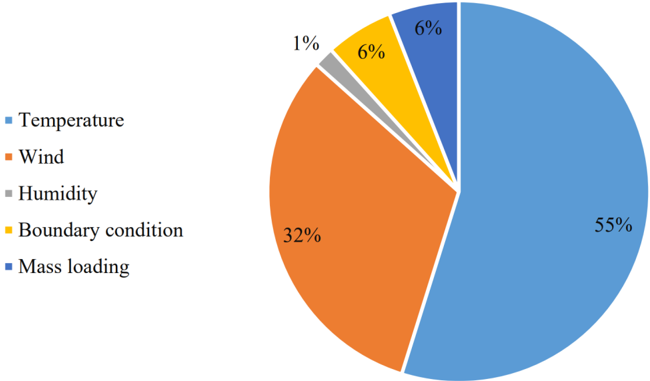
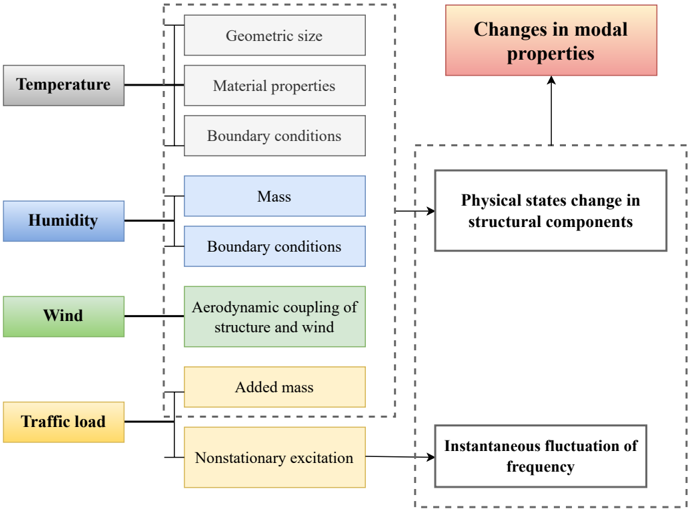
- EOCs can alter structural responses and sensor readings enough to mask damage or cause false damage identifications; temperature is the most widely studied EOC, affecting stiffness, boundary conditions, natural frequencies, mode shapes, damping, and sensor signals such as electromechanical admittance and impedance.
- A comparative analysis using a weigh-in-motion roadway scale on a steel bridge reported that thermal stresses are significantly more influential than stresses induced by traffic.
- Wind affects long-span bridges by influencing aerodynamic coupling, modal parameters, and response amplitude; high winds make modal parameter identification difficult and uncertain, and wind-induced vibrations can cause flutter or buffet when they contribute more energy than damping.
- Mass loading from traffic decreases natural frequencies; short-span bridges are significantly more affected by traffic-induced mass variations than by environmental stiffness changes, while for middle-to-long-span bridges traffic-induced natural frequency variations are insignificant. Humidity had limited effects on modal parameters of a 600 m supertall building monitored over two years and five typhoons.
Methods
- Design: state-of-the-art/systematic review of the effects of EOCs on SHM and NDT systems, covering sensing technologies, signal processing, and data-analysis techniques for EOC compensation.
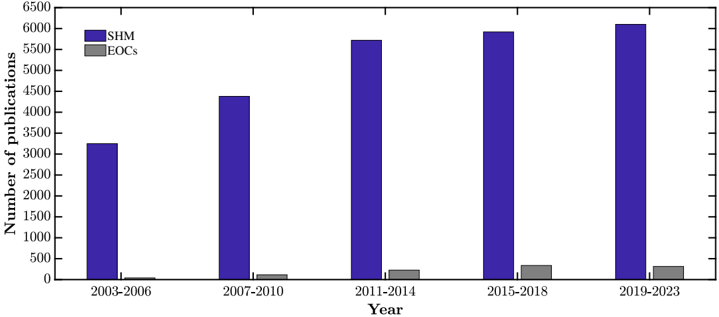
- Data: published literature; the paper reports that a Google Scholar search on “structural health monitoring” completed in March 2023 found over 20,000 papers published in the last two decades, and it summarizes studies in tables on numerical methods, EOC effects, NDT approaches, and data-analysis algorithms.
- Analysis: narrative synthesis with summary tables; no formal meta-analysis or PRISMA-style systematic search protocol is described in the text.
Limitations
- Stated: most compensation techniques focus on temperature, while other EOCs such as traffic and wind are unavoidable but less addressed; moisture and applied loads have not been adequately examined in practice; baseline-free methods can be affected by EOC variations; AI/ML approaches require better input datasets; and only minor work has addressed combined effects of multiple EOC factors.
- Evident: despite the title “systematic review,” the text does not report inclusion/exclusion criteria, a reproducible search strategy, or quality appraisal of included studies.
- Evident: many findings are drawn from individual case studies or laboratory experiments, and the paper notes challenges such as lack of standardization and dependence on material properties, which may limit generalizability.
Model-written summary. Check it against the paper before relying on it.
Integrity signals
Registry
Cites
Statistics
Figures
Verification
Claims the paper makes
37 No full text of the sources · 35 Own interpretation · 28 Supported · 25 Partly supported · 25 No basis given · 24 Couldn’t confirm · 1 Supported so far · 1 Sources not found · 1 Not checked yet · accuracy not yet measured
The cited sources support only part of this claim — read each source’s verdict below.
In the paper
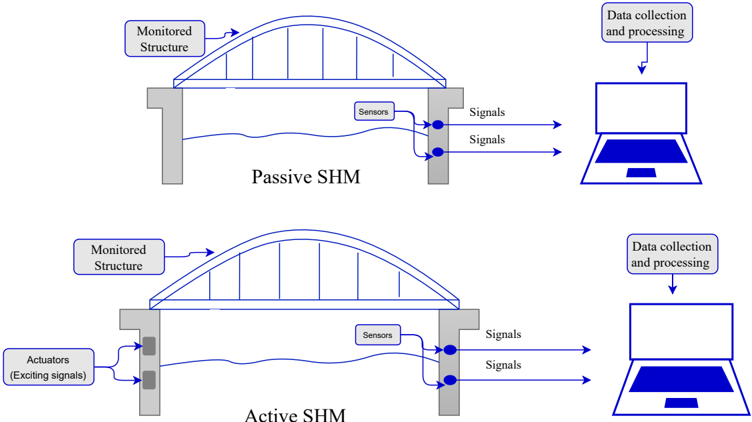
“On the other hand, active SHM enables the direct and targeted detection and evaluation of structural damage resulting in more reliable and accurate health assessment.”
§ Effects of Environmental and Operational Conditions on Structural Health Monitoring and Non-Destructive Testing: A Systematic Review > 1. Introduction
What the sources say
- Partly supportedcites [58] Hassani, S., Mousavi, M., and Gandomi, A.H. (2022). Structural Health Monitoring in Composite Structures: A Comprehensive Review. Sensors, 22. sourceExperimental — accuracy not yet measured
Section 6, “Smart Structures” (page not specified), describes actuator-and-sensor systems that induce vibrations, measure the response, and analyze it to identify and characterize damage. That supports the detection and evaluation part of the claim, but the copy does not establish that active SHM produces more reliable or accurate health assessments. (LLM, conf=0.83)
- Partly supportedcites [59] Amer, 2022, Statistical guided-waves-based structural health monitoring via stochastic non-parametric time series models, Struct. Health Monit. sourceExperimental — accuracy not yet measured
The Introduction (p. 3) describes active-sensing guided-wave SHM methods for detecting and quantifying damage. But the Abstract (p. 1) attributes accurate, robust detection to this paper’s proposed statistical framework, while noting limitations in existing approaches. The source does not establish that active SHM generally produces more reliable and accurate health assessments. (LLM, conf=0.86)
- Partly supportedcites [60] Feng, T., and Aliabadi, M. (2021). Structural Integrity Assessment of Composites Plates with Embedded PZT Transducers for Structural Health Monitoring. Materials, 14. sourceExperimental — accuracy not yet measured
The Introduction describes SHM as providing real-time damage detection, and §3.1 says the electro-mechanical impedance method can evaluate local damage severity. These passages support detection and targeted evaluation, but do not establish that active SHM produces a more reliable or accurate health assessment. (LLM, conf=0.84)
plaindirect- Asserted: passes — The authors put it forward as true.
- Checkable: passes — It can be checked against evidence.
- Load-bearing: unclear — It is unclear whether the paper’s conclusions depend on it.
- Based: passes — The paper gives a reason why it holds.
- Partly supported
The cited sources that could be checked couldn’t confirm or dispute this claim.
In the paper
“By integrating multiple techniques, additional parameters can be evaluated and added to the measurement process, which in turn enhances accuracy [112,113].”
§ Effects of Environmental and Operational Conditions on Structural Health Monitoring and Non-Destructive Testing: A Systematic Review > Electromagnetic
What the sources say
- Could not verifycites [112] Tayeh, B., Hadzima-Nyarko, M., Riad, M.Y.R., and Hafez, R.D.A. (2023). Behavior of Ultra-High-Performance Concrete with Hybrid Synthetic Fiber Waste Exposed to Elevated Temperatures. Buildings, 13. sourceExperimental — accuracy not yet measured
Section 2.3.1 describes using ultrasonic pulse velocity to estimate damage and residual compressive strength, and the Abstract lists several measurements. Neither passage says that integrating multiple NDT techniques adds parameters or improves accuracy; searches for that proposition found no supporting passage in our copy. (LLM, conf=0.75)
- Not checked — no full text of the sourcecites [113] Dackermann, 2016, A comparative study of using static and ultrasonic material testing methods to determine the anisotropic material properties of wood, Constr. Build. Mater. source
plaindirect- Asserted: passes — The authors put it forward as true.
- Checkable: passes — It can be checked against evidence.
- Load-bearing: unclear — It is unclear whether the paper’s conclusions depend on it.
- Based: passes — The paper gives a reason why it holds.
- Could not verify
The cited sources support only part of this claim — read each source’s verdict below.
In the paper
“Due to the absorption of moisture, material properties can be altered, potentially leading to false damage features and incorrect damage identifications [125].”
§ Effects of Environmental and Operational Conditions on Structural Health Monitoring and Non-Destructive Testing: A Systematic Review > Electromagnetic
What the sources say
- Partly supportedcites [125] Bremer, 2016, Fibre optic sensors for the structural health monitoring of building structures, Procedia Technol. sourceExperimental — accuracy not yet measured
Sections 2.1 and 2.2 describe sensor materials swelling when exposed to water and the resulting changes in optical readings. They do not say that moisture alters the structural material’s properties or produces false damage features or incorrect damage identifications. No page numbers are available in our copy. (LLM, conf=0.76)
hedgedconditional- Asserted: passes — The authors put it forward as true.
- Checkable: passes — It can be checked against evidence.
- Load-bearing: passes — The paper’s conclusions depend on it.
- Based: passes — The paper gives a reason why it holds.
- Partly supported
The cited sources support only part of this claim — read each source’s verdict below.
In the paper
“Temperature and structural responses are strongly correlated [149,150].”
§ Effects of Environmental and Operational Conditions on Structural Health Monitoring and Non-Destructive Testing: A Systematic Review > 2.1. Temperature
What the sources say
- Supportedcites [149] Antunes, R.A., Cortez, N.E., Gianesini, B.M., and Vieira Filho, J. (2019). Modeling, simulation, experimentation, and compensation of temperature effect in impedance-based SHM systems applied to steel pipes. Sensors, 19. source
Section 4.4 reports that resonance-peak frequencies shift approximately linearly with temperature and that impedance amplitudes also change approximately linearly. These measured responses of the steel-pipe system support the claimed strong relationship, although the paper does not give a correlation coefficient. (LLM, conf=0.86)
- Partly supportedcites [150] Chen, Y., and Xue, X. (2018). Advances in the structural health monitoring of bridges using piezoelectric transducers. Sensors, 18. sourceExperimental — accuracy not yet measured
Section 4.4, “Compensating Temperature Effects” (page not provided), says bridge dynamic characteristics are temperature-dependent and that temperature-related changes can mask changes caused by damage. This supports a relationship between temperature and structural responses, but the paper does not establish that they are strongly correlated. (LLM, conf=0.84)
boostedcorrelational- Asserted: passes — The authors put it forward as true.
- Checkable: passes — It can be checked against evidence.
- Load-bearing: passes — The paper’s conclusions depend on it.
- Based: passes — The paper gives a reason why it holds.
- Supported
The cited sources support only part of this claim — read each source’s verdict below.
In the paper
“Studies found that high wind conditions have a complex effect on dynamic structural properties [129,175-177].”
§ Effects of Environmental and Operational Conditions on Structural Health Monitoring and Non-Destructive Testing: A Systematic Review > 2.2. Wind
What the sources say
- Partly supportedcites [129] Kolios, 2016, Structural health monitoring of offshore wind turbines: A review through the Statistical Pattern Recognition Paradigm, Renew. Sustain. Energy Rev. sourceExperimental — accuracy not yet measured
Section 3.2 (page unavailable) says variations in environmental and operational conditions affect structural dynamic behavior and can alter measured properties. Section 2.2.4 (page unavailable) also describes uncertainty from wind and wave loading, but the copy does not specifically establish the effect of high wind conditions on dynamic structural properties. (LLM, conf=0.84)
- Not checked — no full text of the sourcecites [175] Li, 2016, State-of-the-art in structural health monitoring of large and complex civil infrastructures, J. Civ. Struct. Health Monit. source
- Not matchedcites [176] Xu, Y.L., and Xia, Y. (2019). Structural Health Monitoring of Long-Span Suspension Bridges, CRC Press.
Couldn’t be matched to a paper in Crossref, so it can’t be checked.
- Partly supportedcites [177] Chen, Z., Zhou, X., Wang, X., Dong, L., and Qian, Y. (2017). Deployment of a smart structural health monitoring system for long-span arch bridges: A review and a case study. Sensors, 17. sourceExperimental — accuracy not yet measured
Section 2.2 describes complex wind-induced vibrations in long-span bridges, including buffeting, vortex shedding and flutter. Section 3.4 says high wind speeds can make measured wind speed non-stationary, but it does not establish how high winds affect the bridge’s dynamic structural properties. No page numbers are available in our copy. (LLM, conf=0.79)
plaincorrelational- Asserted: passes — The authors put it forward as true.
- Checkable: passes — It can be checked against evidence.
- Load-bearing: unclear — It is unclear whether the paper’s conclusions depend on it.
- Based: passes — The paper gives a reason why it holds.
- Partly supported
The cited sources support only part of this claim — read each source’s verdict below.
In the paper
“Mass loadings, such as traffic, can introduce challenges to SHM techniques as another operational variable.Several papers on SHM have studied the effects of mass loading on the measured signals from SHM systems [127,128].”
§ Effects of Environmental and Operational Conditions on Structural Health Monitoring and Non-Destructive Testing: A Systematic Review > Electromagnetic
What the sources say
- Partly supportedcites [127] Schommer, 2017, Model updating for structural health monitoring using static and dynamic measurements, Procedia Eng. sourceExperimental — accuracy not yet measured
Section 3.1 (p. 4) describes traffic-like mass loads applied to the beam, and Section 3.3 (p. 5) reports differences in measured deflection between loaded and unloaded states. This supports the point that mass loading affects SHM measurements, but the paper uses controlled loading as part of its tests; it does not characterize traffic loading as an operational variable that challenges SHM techniques. (LLM, conf=0.82)
- Not checked — no full text of the sourcecites [128] Dackermann, 2013, Identification of member connectivity and mass changes on a two-storey framed structure using frequency response functions and artificial neural networks, J. Sound Vib. source
plainconditional- Asserted: passes — The authors put it forward as true.
- Checkable: passes — It can be checked against evidence.
- Load-bearing: unclear — It is unclear whether the paper’s conclusions depend on it.
- Based: passes — The paper gives a reason why it holds.
- Partly supported
Every source the paper cites for this claim was checked and supports it.
In the paper
“This approach was shown to be adequately practical in bridge studies under fluctuating wind conditions.”
§ Effects of Environmental and Operational Conditions on Structural Health Monitoring and Non-Destructive Testing: A Systematic Review > 2.2. Wind
What the sources say
- Supportedcites [184] Zhu, L., McCrum, D., Sweeney, C., and Keenahan, J. (2023). Full-scale computational fluid dynamics study on wind condition of the long-span Queensferry Crossing Bridge. J. Civ. Struct. Health Monit., 1–18. source
The Abstract reports that the simulated fluctuating wind field closely matched field-data characteristics and that the CFD modelling approach had good potential for practical bridge aerodynamic studies. This supports the citing sentence's paraphrase. (LLM, conf=0.92)
plain- Asserted: passes — The authors put it forward as true.
- Checkable: passes — It can be checked against evidence.
- Load-bearing: unclear — It is unclear whether the paper’s conclusions depend on it.
- Based: passes — The paper gives a reason why it holds.
- Supported
Every source the paper cites for this claim was checked and supports it.
In the paper
“The practicality of performing non-contact video measurements was demonstrated by the researchers for structural damage detection.”
§ Effects of Environmental and Operational Conditions on Structural Health Monitoring and Non-Destructive Testing: A Systematic Review > 2.4. Mass Loading
What the sources say
- Supportedcites [207] Sarrafi, 2018, Vibration-based damage detection in wind turbine blades using Phase-based Motion Estimation and motion magnification, J. Sound Vib. source
The Abstract (p. 1) explicitly says the blade experiment demonstrates the feasibility of non-contact video measurements for realistic structural damage detection. The Conclusion (p. 20) likewise reports that the video-based approach detected damage in a wind turbine blade. (LLM, conf=0.94)
boosted- Asserted: passes — The authors put it forward as true.
- Checkable: passes — It can be checked against evidence.
- Load-bearing: unclear — It is unclear whether the paper’s conclusions depend on it.
- Based: passes — The paper gives a reason why it holds.
- Supported
The cited sources that could be checked couldn’t confirm or dispute this claim.
In the paper
“| Material conductivity | + | • | + | • | • | - | • | • | • |”
§ Effects of Environmental and Operational Conditions on Structural Health Monitoring and Non-Destructive Testing: A Systematic Review > -
What the sources say
- Could not verifycites [58] Hassani, S., Mousavi, M., and Gandomi, A.H. (2022). Structural Health Monitoring in Composite Structures: A Comprehensive Review. Sensors, 22. sourceExperimental — accuracy not yet measured
Section 2.2 says mechanical load and electromagnetic radiation have relatively moderate effects on composite conductivity, but does not say this about delamination. Section 2.1 discusses delamination as a failure mechanism without addressing its effect on conductivity. The claim cannot be verified from the passages in our copy. (LLM, conf=0.72)
plaincorrelational- Asserted: passes — The authors put it forward as true.
- Checkable: passes — It can be checked against evidence.
- Load-bearing: unclear — It is unclear whether the paper’s conclusions depend on it.
- Based: passes — The paper gives a reason why it holds.
- Could not verify
The cited sources that could be checked couldn’t confirm or dispute this claim.
In the paper
“| Boundary formation | + | - | - | + | - | • | - | - | - |”
§ Effects of Environmental and Operational Conditions on Structural Health Monitoring and Non-Destructive Testing: A Systematic Review > -
What the sources say
- Could not verifycites [58] Hassani, S., Mousavi, M., and Gandomi, A.H. (2022). Structural Health Monitoring in Composite Structures: A Comprehensive Review. Sensors, 22. sourceExperimental — accuracy not yet measured
The Introduction identifies matrix cracking as a composite failure mechanism, while Section 2.2 says boundary formation is least influenced by temperature and humidity. Neither passage states how matrix cracking affects boundary formation. Searches for the Table 3 row and for a matrix-crack–boundary-formation relationship did not find that comparison in our copy. (LLM, conf=0.70)
plain- Asserted: passes — The authors put it forward as true.
- Checkable: passes — It can be checked against evidence.
- Load-bearing: unclear — It is unclear whether the paper’s conclusions depend on it.
- Based: passes — The paper gives a reason why it holds.
- Could not verify
- It may state two separate claims as one. 28
- Probably not a substantial claim. 73
- The quote only partly states this claim. 5
The cited sources support only part of this claim — read each source’s verdict below.
In the paper
“While passive methods can be successful for specific applications, they lack accuracy, and damage might stay undetected [56,57].”
§ Effects of Environmental and Operational Conditions on Structural Health Monitoring and Non-Destructive Testing: A Systematic Review > 1. Introduction
What the sources say
- Not checked — no full text of the sourcecites [56] Lackner, 2011, Passive structural control of offshore wind turbines, Wind Energy source
- Partly supportedcites [57] Capineri, L., and Bulletti, A. (2021). Ultrasonic guided-waves sensors and integrated structural health monitoring systems for impact detection and localization: A review. Sensors, 21. sourceExperimental — accuracy not yet measured
Section 3 describes passive piezoelectric sensing as a common method for detecting impacts, supporting its use in a specific application. Sections 2.4 and 4.2 discuss sources of impact-localization error and ways to improve accuracy, but do not say passive methods generally lack accuracy. The paper distinguishes passive impact detection from active damage evaluation; it does not establish that damage might remain undetected by passive methods. (LLM, conf=0.78)
hedged- Asserted: passes — The authors put it forward as true.
- Checkable: passes — It can be checked against evidence.
- Load-bearing: unclear — It is unclear whether the paper’s conclusions depend on it.
- Based: passes — The paper gives a reason why it holds.
It may state two separate claims as one.
The cited sources support only part of this claim — read each source’s verdict below.
In the paper
“They found that wind conditions like wind speed and turbulence affect turbine vibration levels.”
§ Effects of Environmental and Operational Conditions on Structural Health Monitoring and Non-Destructive Testing: A Systematic Review > 2.2. Wind
What the sources say
- Partly supportedcites [180] Weijtjens, 2017, Vibration based structural health monitoring of the substructures of five offshore wind turbines, Procedia Eng. sourceExperimental — accuracy not yet measured
Section 2.1, “Wake effects,” reports that turbulent air in turbine wakes increases vibration levels, supporting the turbulence part of the claim. The passages on wake effects and operating conditions do not establish an effect of wind speed on vibration levels; rotational speed is not the same measure. (LLM, conf=0.85)
plaindirect- Asserted: passes — The authors put it forward as true.
- Checkable: passes — It can be checked against evidence.
- Load-bearing: fails — The paper’s conclusions may not depend on it.
- Based: passes — The paper gives a reason why it holds.
Probably not a substantial claim. The paper’s conclusions may not depend on it.
- Partly supported
The cited sources support only part of this claim — read each source’s verdict below.
In the paper
“Offshore structures are known to be adversely affected by marine growth.The roughened surfaces can increase the drag coefficient of the structure.Moreover, this phenomenon causes changing mass loads to the structures.Therefore, this challenge should be considered in SHM systems of marine structures [129].”
§ Effects of Environmental and Operational Conditions on Structural Health Monitoring and Non-Destructive Testing: A Systematic Review > Electromagnetic
What the sources say
- Partly supportedcites [129] Kolios, 2016, Structural health monitoring of offshore wind turbines: A review through the Statistical Pattern Recognition Paradigm, Renew. Sustain. Energy Rev. sourceExperimental — accuracy not yet measured
Section 2.1, “History and evolution” (page unavailable), identifies changing mass caused by marine growth as a practical difficulty in monitoring offshore platforms. The passages found do not say that marine growth roughens surfaces or increases drag coefficient, so those attributed effects are unsupported by our copy. (LLM, conf=0.86)
boosteddirect- Asserted: passes — The authors put it forward as true.
- Checkable: passes — It can be checked against evidence.
- Load-bearing: unclear — It is unclear whether the paper’s conclusions depend on it.
- Based: passes — The paper gives a reason why it holds.
It may state two separate claims as one.
- Partly supported
Every source the paper cites for this claim was checked and supports it.
In the paper
“The film provided durable and reliable performance in withstanding the variable harsh humidity and temperature.”
§ Effects of Environmental and Operational Conditions on Structural Health Monitoring and Non-Destructive Testing: A Systematic Review > 2.3. Humidity
What the sources say
- Supportedcites [193] Bekas, D.G., Sharif-Khodaei, Z., and Aliabadi, M.F. (2018). An innovative diagnostic film for structural health monitoring of metallic and composite structures. Sensors, 18. source
The Abstract describes the lightweight diagnostic film and reports that it remained durable and reliable under harsh environmental test conditions. Section 3.4 specifically reports negligible changes in sensor response after temperature and humidity exposure. Page numbers were not supplied. (LLM, conf=0.93)
plain- Asserted: passes — The authors put it forward as true.
- Checkable: passes — It can be checked against evidence.
- Load-bearing: fails — The paper’s conclusions may not depend on it.
- Based: passes — The paper gives a reason why it holds.
Probably not a substantial claim. The paper’s conclusions may not depend on it.
- Supported
Every source the paper cites for this claim was checked and supports it.
In the paper
“This approach enabled accounting for the uncertainty in the monitored responses.”
§ Effects of Environmental and Operational Conditions on Structural Health Monitoring and Non-Destructive Testing: A Systematic Review > Li et al.
What the sources say
- Supportedcites [186] Wang, 2022, Bayesian probabilistic assessment of occupant comfort of high-rise structures based on structural health monitoring data, Mech. Syst. Signal Process. source
The Abstract says the Bayesian regression model characterizes wind-induced acceleration responses using structural health monitoring data and accounts for uncertainty in the monitored responses. The Introduction likewise says the Bayesian approach accommodates uncertainty in the monitoring data. (LLM, conf=0.94)
plaindirect- Asserted: passes — The authors put it forward as true.
- Checkable: passes — It can be checked against evidence.
- Load-bearing: fails — The paper’s conclusions may not depend on it.
- Based: passes — The paper gives a reason why it holds.
Probably not a substantial claim. The paper’s conclusions may not depend on it.
- Supported
Every source the paper cites for this claim was checked and supports it.
In the paper
“This method is capable of eliminating temperature and humidity effects.”
§ Effects of Environmental and Operational Conditions on Structural Health Monitoring and Non-Destructive Testing: A Systematic Review > 2.3. Humidity
What the sources say
- Supportedcites [195] He, X., Tan, G., Chu, W., Zhang, S., and Wei, X. (2022). Reliability Assessment Method for Simply Supported Bridge Based on Structural Health Monitoring of Frequency with Temperature and Humidity Effect Eliminated. Sustainability, 14. source
The Introduction describes the proposed bridge reliability assessment method as eliminating temperature and humidity effects. Section 3.4 explains how those effects are removed from measured modal frequency, and the Conclusions state that the resulting reliability variations are independent of temperature and humidity. (LLM, conf=0.94)
plaindirect- Asserted: passes — The authors put it forward as true.
- Checkable: passes — It can be checked against evidence.
- Load-bearing: fails — The paper’s conclusions may not depend on it.
- Based: passes — The paper gives a reason why it holds.
Probably not a substantial claim. The paper’s conclusions may not depend on it.
- Supported
Every source the paper cites for this claim was checked and supports it.
In the paper
“The simulated varying wind condition satisfied the characteristic of field data.”
§ Effects of Environmental and Operational Conditions on Structural Health Monitoring and Non-Destructive Testing: A Systematic Review > 2.2. Wind
What the sources say
- Supportedcites [184] Zhu, L., McCrum, D., Sweeney, C., and Keenahan, J. (2023). Full-scale computational fluid dynamics study on wind condition of the long-span Queensferry Crossing Bridge. J. Civ. Struct. Health Monit., 1–18. source
Section 4.1.1 reports that simulated wind velocities followed a similar trend to the field data and that wind-velocity fluctuations were reasonably well captured by CFD. This supports the claim that the simulated varying wind conditions reflected characteristics of the field data. (LLM, conf=0.90)
plain- Asserted: passes — The authors put it forward as true.
- Checkable: passes — It can be checked against evidence.
- Load-bearing: fails — The paper’s conclusions may not depend on it.
- Based: passes — The paper gives a reason why it holds.
Probably not a substantial claim. The paper’s conclusions may not depend on it.
- Supported
The cited sources support only part of this claim — read each source’s verdict below.
In the paper
“The technique is beneficial for pattern recognition and can be used for regression analysis [242-244].”
§ Effects of Environmental and Operational Conditions on Structural Health Monitoring and Non-Destructive Testing: A Systematic Review > 4. Data Analysis for EOC Compensation
What the sources say
- Supportedcites [242] Yang, Y., Sun, W., and Su, G. (2022). A Novel Support-Vector-Machine-Based Grasshopper Optimization Algorithm for Structural Reliability Analysis. Buildings, 12. source
Section 2.2 (SVM) says SVM originated in pattern recognition and lists recognition and classification applications. It also explicitly distinguishes support vector regression from support vector classification, supporting its use for regression analysis. (LLM, conf=0.92)
- Not checked — no full text of the sourcecites [243] Lei, 2022, Structural damage identification method based on vibration statistical indicators and support vector machine, Adv. Struct. Eng. source
- Partly supportedcites [244] Dackermann, U., Yu, Y., Niederleithinger, E., Li, J., and Wiggenhauser, H. (2017). Condition assessment of foundation piles and utility poles based on guided wave propagation using a network of tactile transducers and support vector machines. Sensors, 17. sourceExperimental — accuracy not yet measured
Section 5 describes using SVM to classify pole-damage patterns, and Section 6 reports strong classification results. The paper does not discuss using SVM for regression analysis; searches for “regression analysis” and “support vector regression” found no supporting passage. Page numbers were not available in our copy. (LLM, conf=0.86)
plain- Asserted: passes — The authors put it forward as true.
- Checkable: passes — It can be checked against evidence.
- Load-bearing: fails — The paper’s conclusions may not depend on it.
- Based: passes — The paper gives a reason why it holds.
Probably not a substantial claim. The paper’s conclusions may not depend on it. It may state two separate claims as one.
- Supported
The sources with a verdict support this claim; the rest weren’t checked yet, have no full text we could read, or their verdicts aren’t rated yet.
In the paper
“They can interpret signals or images to analyze, inspect, and examine material integrity [248-250].”
§ Effects of Environmental and Operational Conditions on Structural Health Monitoring and Non-Destructive Testing: A Systematic Review > 4. Data Analysis for EOC Compensation
What the sources say
- Not matchedcites [248] Furuya, 2019, Imagification technology and deep learning accelerating defect detection in non-destructive testing for wind turbine blades, Fujitsu Sci. Tech. J.
Couldn’t be matched to a paper in Crossref, so it can’t be checked.
- Not checked — no full text of the sourcecites [249] Yu, 2019, Wavelet packet energy–based damage identification of wood utility poles using support vector machine multi-classifier and evidence theory, Struct. Health Monit. source
- Supportedcites [250] Kot, P., Muradov, M., Gkantou, M., Kamaris, G.S., Hashim, K., and Yeboah, D. (2021). Recent advancements in non-destructive testing techniques for structural health monitoring. Appl. Sci., 11. source
Section 8.1 describes machine learning applied to acoustic-emission signals to predict crack patterns. Section 4 describes a deep convolutional neural network processing images to extract cracks automatically. Together, these examples support the claim that ML can interpret signals or images to assess material integrity; page numbers were not supplied. (LLM, conf=0.90)
plaindirect- Asserted: passes — The authors put it forward as true.
- Checkable: passes — It can be checked against evidence.
- Load-bearing: fails — The paper’s conclusions may not depend on it.
- Based: passes — The paper gives a reason why it holds.
Probably not a substantial claim. The paper’s conclusions may not depend on it.
- Not matched
The cited sources support only part of this claim — read each source’s verdict below.
In the paper
“The program is typically used to simulate a nonlinear PCA process and solve problems related to feature extraction, pattern recognition, and dimensionality reduction [261,262].”
§ Effects of Environmental and Operational Conditions on Structural Health Monitoring and Non-Destructive Testing: A Systematic Review > 4. Data Analysis for EOC Compensation
What the sources say
- Partly supportedcites [261] Guerrisi, G., Del Frate, F., and Schiavon, G. (2022). Satellite On-Board Change Detection via Auto-Associative Neural Networks. Remote Sens., 14. sourceExperimental — accuracy not yet measured
The Introduction (page not supplied) says AANNs have been used for dimensionality reduction and feature extraction from remote-sensing images. The Conclusions describe this paper's use of extracted features for change detection. Our copy does not describe AANNs as simulating nonlinear PCA or identify pattern recognition as an application. (LLM, conf=0.86)
- Partly supportedcites [262] Entezami, A., De Michele, C., Arslan, A.N., and Behkamal, B. (2022). Detection of partially structural collapse using long-term small displacement data from satellite images. Sensors, 22. sourceExperimental — accuracy not yet measured
Section 2.2.1 (page not provided) describes the auto-associative neural network as mapping feature samples through a nonlinear function into a lower-dimensional space, supporting the dimensionality-reduction aspect. The paper also uses it for feature normalization, but does not describe pattern recognition as an AANN application or state that AANN is typically used to simulate nonlinear PCA; nonlinear PCA appears in a cited reference’s title. (LLM, conf=0.83)
plaindirect- Asserted: passes — The authors put it forward as true.
- Checkable: passes — It can be checked against evidence.
- Load-bearing: fails — The paper’s conclusions may not depend on it.
- Based: passes — The paper gives a reason why it holds.
Probably not a substantial claim. The paper’s conclusions may not depend on it. It may state two separate claims as one.
- Partly supported
The cited sources support only part of this claim — read each source’s verdict below.
In the paper
“Using historical data, it approximates the nonlinear function between inputs and outputs with high accuracy [245-247].”
§ Effects of Environmental and Operational Conditions on Structural Health Monitoring and Non-Destructive Testing: A Systematic Review > 4. Data Analysis for EOC Compensation
What the sources say
- Not checked — no full text of the sourcecites [245] Ding, 2022, Simultaneous identification of structural damage and nonlinear hysteresis parameters by an evolutionary algorithm-based artificial neural network, Int. J. Non-Linear Mech. source
- Partly supportedcites [246] Albahri, 2022, Hybrid artificial neural network and structural equation modelling techniques: A survey, Complex Intell. Syst. sourceExperimental — accuracy not yet measured
The Introduction (page unavailable) says ANN captures nonlinear correlations among variables and provides more accurate results. It does not specifically say that ANN approximates an input–output function using historical data, or establish the unqualified claim of high accuracy. (LLM, conf=0.83)
- Supportedcites [247] Dackermann, 2010, Dynamic-based damage identification using neural network ensembles and damage index method, Adv. Struct. Eng. source
Section 3 describes ANNs as nonlinear functions mapping inputs to outputs and says they can represent any function with arbitrary accuracy, given enough neurons. Section 6.4 describes training the network on input samples, supporting the claim that it learns from data. (LLM, conf=0.91)
plaindirect- Asserted: passes — The authors put it forward as true.
- Checkable: passes — It can be checked against evidence.
- Load-bearing: fails — The paper’s conclusions may not depend on it.
- Based: passes — The paper gives a reason why it holds.
Probably not a substantial claim. The paper’s conclusions may not depend on it.
Every source the paper cites for this claim was checked and supports it.
In the paper
“Damage-detection strategies for health monitoring can be categorized into model-based and data-based methods [264].”
§ Effects of Environmental and Operational Conditions on Structural Health Monitoring and Non-Destructive Testing: A Systematic Review > 4. Data Analysis for EOC Compensation
What the sources say
- Supportedcites [264] Moallemi, A., Burrello, A., Brunelli, D., and Benini, L. (2021, January 17–20). Model-based vs. data-driven approaches for anomaly detection in structural health monitoring: A case study. Proceedings of the 2021 IEEE International Instrumentation and Measurement Technology Conference (I2MTC), Scotland, UK. source
The paper describes structural health monitoring as detecting damage or deterioration in the Introduction & Related Works (page unavailable). It then compares model-based and data-driven approaches as two approaches to anomaly detection in its bridge-monitoring case study (page unavailable), supporting the citing sentence’s broad categorization. (LLM, conf=0.90)
plain- Asserted: passes — The authors put it forward as true.
- Checkable: passes — It can be checked against evidence.
- Load-bearing: fails — The paper’s conclusions may not depend on it.
- Based: passes — The paper gives a reason why it holds.
Probably not a substantial claim. The paper’s conclusions may not depend on it.
- Supported
Every source the paper cites for this claim was checked and supports it.
In the paper
“AANN is an ANN structure with the same input and output layer.”
§ Effects of Environmental and Operational Conditions on Structural Health Monitoring and Non-Destructive Testing: A Systematic Review > 4. Data Analysis for EOC Compensation
What the sources say
- Supportedcites [261] Guerrisi, G., Del Frate, F., and Schiavon, G. (2022). Satellite On-Board Change Detection via Auto-Associative Neural Networks. Remote Sens., 14. source
The Introduction describes AANNs as symmetrical networks trained to map each input vector to itself. Section 2.5 specifies 1024 units in both the input and output layers, supporting the claim that the layers have the same size. (LLM, conf=0.92)
- Supportedcites [262] Entezami, A., De Michele, C., Arslan, A.N., and Behkamal, B. (2022). Detection of partially structural collapse using long-term small displacement data from satellite images. Sensors, 22. source
Section 2.2.1 describes the auto-associative neural network as an ANN with an input layer and an output layer. It says the output reconstructs the inputs and has the same dimension as the input layer. Thus, “same” is supported as referring to their dimensions, not to the layers being literally identical. (LLM, conf=0.91)
plain- Asserted: passes — The authors put it forward as true.
- Checkable: passes — It can be checked against evidence.
- Load-bearing: fails — The paper’s conclusions may not depend on it.
- Based: passes — The paper gives a reason why it holds.
Probably not a substantial claim. The paper’s conclusions may not depend on it.
- Supported
The cited sources support only part of this claim — read each source’s verdict below.
In the paper
“Swarm intelligent algorithms are widely used for structural optimization and compensating for EOCs.”
§ Effects of Environmental and Operational Conditions on Structural Health Monitoring and Non-Destructive Testing: A Systematic Review > 4. Data Analysis for EOC Compensation
What the sources say
- Partly supportedcites [237] Luo, J., Huang, M., and Lei, Y. (2022). Temperature Effect on Vibration Properties and Vibration-Based Damage Identification of Bridge Structures: A Literature Review. Buildings, 12. sourceExperimental — accuracy not yet measured
The Optimization Tools section surveys numerous swarm-based methods for structural damage identification, including particle swarm and cuckoo search, and describes applications that account for ambient temperature. The cited review supports their use in this setting, but its passages address temperature effects rather than compensation for environmental and operational conditions (EOCs) generally. (LLM, conf=0.82)
- Partly supportedcites [238] Hassani, S., and Dackermann, U. (2023). A Systematic Review of Optimization Algorithms for Structural Health Monitoring and Optimal Sensor Placement. Sensors, 23. sourceExperimental — accuracy not yet measured
Section 4.1 describes swarm-based algorithms used for structural health monitoring and optimal sensor placement, supporting their use in structural optimization problems. Section 2.3 lists compensation for EOC changes as a sensor characteristic, but does not connect that compensation to swarm-intelligence algorithms. The claim that those algorithms are used to compensate for EOCs is therefore unsupported by this copy. (LLM, conf=0.84)
boosted- Asserted: passes — The authors put it forward as true.
- Checkable: passes — It can be checked against evidence.
- Load-bearing: unclear — It is unclear whether the paper’s conclusions depend on it.
- Based: passes — The paper gives a reason why it holds.
It may state two separate claims as one.
- Partly supported
The cited sources that could be checked couldn’t confirm or dispute this claim.
In the paper
“| Mass | - | - | - | - | - | + | + | - | - |”
§ Effects of Environmental and Operational Conditions on Structural Health Monitoring and Non-Destructive Testing: A Systematic Review > -
What the sources say
- Could not verifycites [58] Hassani, S., Mousavi, M., and Gandomi, A.H. (2022). Structural Health Monitoring in Composite Structures: A Comprehensive Review. Sensors, 22. sourceExperimental — accuracy not yet measured
Section 2.2 says fiber cracks strongly affect stiffness and moisture strongly affects mass, but it does not state how fiber cracks affect mass. Searches for the Table 3 mass–fiber-crack entry did not retrieve that relationship from our copy. (LLM, conf=0.72)
plain- Asserted: passes — The authors put it forward as true.
- Checkable: passes — It can be checked against evidence.
- Load-bearing: fails — The paper’s conclusions may not depend on it.
- Based: passes — The paper gives a reason why it holds.
Probably not a substantial claim. The paper’s conclusions may not depend on it.
- Could not verify
Every source the paper cites for this claim was checked and supports it.
In the paper
“| Mass | - | - | - | - | - | + | + | - | - |”
§ Effects of Environmental and Operational Conditions on Structural Health Monitoring and Non-Destructive Testing: A Systematic Review > -
What the sources say
- Supportedcites [58] Hassani, S., Mousavi, M., and Gandomi, A.H. (2022). Structural Health Monitoring in Composite Structures: A Comprehensive Review. Sensors, 22. source
The Introduction identifies delamination as a damage mechanism in composite structures. Section 3.2 states that mass is the least sensitive structural property to damage, supporting the claim that delamination has a weak influence on mass. (LLM, conf=0.85)
plain- Asserted: passes — The authors put it forward as true.
- Checkable: passes — It can be checked against evidence.
- Load-bearing: fails — The paper’s conclusions may not depend on it.
- Based: passes — The paper gives a reason why it holds.
Probably not a substantial claim. The paper’s conclusions may not depend on it.
- Supported
Every source the paper cites for this claim was checked and supports it.
In the paper
“| Boundary formation | + | - | - | + | - | • | - | - | - |”
§ Effects of Environmental and Operational Conditions on Structural Health Monitoring and Non-Destructive Testing: A Systematic Review > -
What the sources say
- Supportedcites [58] Hassani, S., Mousavi, M., and Gandomi, A.H. (2022). Structural Health Monitoring in Composite Structures: A Comprehensive Review. Sensors, 22. source
Section 2.2 says mechanical load has a negligible impact on composite properties other than conductivity, which supports describing its influence on boundary formation as weak. The same passage separately says boundary formation is least influenced by temperature and humidity. (LLM, conf=0.87)
plaindirect- Asserted: passes — The authors put it forward as true.
- Checkable: passes — It can be checked against evidence.
- Load-bearing: unclear — It is unclear whether the paper’s conclusions depend on it.
- Based: passes — The paper gives a reason why it holds.
The quote only partly states this claim.
- Supported
The cited sources that could be checked couldn’t confirm or dispute this claim.
In the paper
“| Boundary formation | + | - | - | + | - | • | - | - | - |”
§ Effects of Environmental and Operational Conditions on Structural Health Monitoring and Non-Destructive Testing: A Systematic Review > -
What the sources say
- Could not verifycites [58] Hassani, S., Mousavi, M., and Gandomi, A.H. (2022). Structural Health Monitoring in Composite Structures: A Comprehensive Review. Sensors, 22. sourceExperimental — accuracy not yet measured
Section 2.2 says boundary formation is least influenced by temperature and humidity, but does not state how fiber cracks affect it. A search for “boundary formation” found no passage in our copy establishing the claimed weak influence of fiber cracks. (LLM, conf=0.70)
plaindirect- Asserted: passes — The authors put it forward as true.
- Checkable: passes — It can be checked against evidence.
- Load-bearing: fails — The paper’s conclusions may not depend on it.
- Based: passes — The paper gives a reason why it holds.
Probably not a substantial claim. The paper’s conclusions may not depend on it.
- Could not verify
The cited sources support only part of this claim — read each source’s verdict below.
In the paper
“| Mass | - | - | - | - | - | + | + | - | - |”
§ Effects of Environmental and Operational Conditions on Structural Health Monitoring and Non-Destructive Testing: A Systematic Review > -
What the sources say
- Partly supportedcites [58] Hassani, S., Mousavi, M., and Gandomi, A.H. (2022). Structural Health Monitoring in Composite Structures: A Comprehensive Review. Sensors, 22. sourceExperimental — accuracy not yet measured
Section 3.2 says mass is the least sensitive structural property to damage, and the Introduction identifies matrix cracking as a damage mechanism. The copy does not specifically establish how strongly matrix cracks affect mass, so the claim is more specific than the evidence. (LLM, conf=0.82)
plain- Asserted: passes — The authors put it forward as true.
- Checkable: passes — It can be checked against evidence.
- Load-bearing: fails — The paper’s conclusions may not depend on it.
- Based: passes — The paper gives a reason why it holds.
Probably not a substantial claim. The paper’s conclusions may not depend on it.
- Partly supported
Every source the paper cites for this claim was checked and supports it.
In the paper
“• | automatability, | |”
§ Effects of Environmental and Operational Conditions on Structural Health Monitoring and Non-Destructive Testing: A Systematic Review > -
What the sources say
- Supportedcites [141] Hassani, S., and Dackermann, U. (2023). A Systematic Review of Advanced Sensor Technologies for Non-Destructive Testing and Structural Health Monitoring. Sensors, 23. source
Section 4.4, “Sensing Systems for SHM” (page not specified), describes automation technologies as enabling UAV-based sensing applications. It also describes wireless sensors that collect, process, and transmit measurements through onboard components, supporting the broad claim that advanced sensing systems can be automated. (LLM, conf=0.84)
plain- Asserted: passes — The authors put it forward as true.
- Checkable: passes — It can be checked against evidence.
- Load-bearing: fails — The paper’s conclusions may not depend on it.
- Based: passes — The paper gives a reason why it holds.
Probably not a substantial claim. The paper’s conclusions may not depend on it.
- Supported
The cited sources support only part of this claim — read each source’s verdict below.
In the paper
“• | less labor intensivity, | |”
§ Effects of Environmental and Operational Conditions on Structural Health Monitoring and Non-Destructive Testing: A Systematic Review > -
What the sources say
- Partly supportedcites [141] Hassani, S., and Dackermann, U. (2023). A Systematic Review of Advanced Sensor Technologies for Non-Destructive Testing and Structural Health Monitoring. Sensors, 23. sourceExperimental — accuracy not yet measured
Section 4.4 says wireless sensing avoids labor-intensive cabling and UAV sensors reduce logistics and working hours. These examples support lower labor demands for particular advanced sensing systems, but the review does not establish that advanced sensing systems are generally less labor intensive. (LLM, conf=0.83)
plaindirect- Asserted: passes — The authors put it forward as true.
- Checkable: passes — It can be checked against evidence.
- Load-bearing: fails — The paper’s conclusions may not depend on it.
- Based: passes — The paper gives a reason why it holds.
Probably not a substantial claim. The paper’s conclusions may not depend on it.
- Partly supported
The cited sources support only part of this claim — read each source’s verdict below.
In the paper
“• | more cost-effectiveness. | |”
§ Effects of Environmental and Operational Conditions on Structural Health Monitoring and Non-Destructive Testing: A Systematic Review > -
What the sources say
- Partly supportedcites [141] Hassani, S., and Dackermann, U. (2023). A Systematic Review of Advanced Sensor Technologies for Non-Destructive Testing and Structural Health Monitoring. Sensors, 23. sourceExperimental — accuracy not yet measured
Section 3.3 says advances in ultrasonic sensor technology have produced more cost-effective sensors, and Section 4.4 says wireless sensing avoids cost-intensive cabling. These examples support a cost benefit for particular technologies, but not the unqualified claim that advanced sensing systems generally are more cost-effective. (LLM, conf=0.84)
plain- Asserted: passes — The authors put it forward as true.
- Checkable: passes — It can be checked against evidence.
- Load-bearing: fails — The paper’s conclusions may not depend on it.
- Based: passes — The paper gives a reason why it holds.
Probably not a substantial claim. The paper’s conclusions may not depend on it.
- Partly supported
The cited sources support only part of this claim — read each source’s verdict below.
In the paper
“| | | -Fiber optic sensors |”
- Also stated in: § - · plain
“| Temperature | -Temperature sensors | |”
- Also stated in: § - · plain
“| | | -Thermocouples |”
§ Effects of Environmental and Operational Conditions on Structural Health Monitoring and Non-Destructive Testing: A Systematic Review > -
What the sources say
- Partly supportedcites [141] Hassani, S., and Dackermann, U. (2023). A Systematic Review of Advanced Sensor Technologies for Non-Destructive Testing and Structural Health Monitoring. Sensors, 23. sourceExperimental — accuracy not yet measured
Section 4.4.13, “Temperature Sensors” (page unavailable), identifies thermocouples and fiber optic sensors among the sensors used to measure temperature for SHM. It does not identify barometers as temperature-monitoring sensors, so that item is unsupported. (LLM, conf=0.88)
plain- Asserted: passes — The authors put it forward as true.
- Checkable: passes — It can be checked against evidence.
- Load-bearing: fails — The paper’s conclusions may not depend on it.
- Based: passes — The paper gives a reason why it holds.
Probably not a substantial claim. The paper’s conclusions may not depend on it. It may state two separate claims as one. The quote only partly states this claim.
- Also stated in: § - · plain
The cited sources support only part of this claim — read each source’s verdict below.
In the paper
“| Wind | -Hygrometers -Ultrasonic and propeller anemometers | |”
- Also stated in: § - · plain
“| | | -Visibility and precipitation sensors |”
§ Effects of Environmental and Operational Conditions on Structural Health Monitoring and Non-Destructive Testing: A Systematic Review > -
What the sources say
- Partly supportedcites [141] Hassani, S., and Dackermann, U. (2023). A Systematic Review of Advanced Sensor Technologies for Non-Destructive Testing and Structural Health Monitoring. Sensors, 23. sourceExperimental — accuracy not yet measured
Section 4.2 identifies wind as an environmental factor relevant to SHM and says Table 15 lists sensors for measuring such conditions. Section 4.4.1 also identifies wind as an ambient property measured in SHM. The retrieved passages do not identify hygrometers, ultrasonic or propeller anemometers, or visibility and precipitation sensors as wind-monitoring devices. (LLM, conf=0.82)
plain- Asserted: passes — The authors put it forward as true.
- Checkable: passes — It can be checked against evidence.
- Load-bearing: fails — The paper’s conclusions may not depend on it.
- Based: passes — The paper gives a reason why it holds.
Probably not a substantial claim. The paper’s conclusions may not depend on it. It may state two separate claims as one. The quote only partly states this claim.
- Also stated in: § - · plain
Every source the paper cites for this claim was checked and supports it.
In the paper
“• | capability for remote sensing, | |”
§ Effects of Environmental and Operational Conditions on Structural Health Monitoring and Non-Destructive Testing: A Systematic Review > -
What the sources say
- Supportedcites [141] Hassani, S., and Dackermann, U. (2023). A Systematic Review of Advanced Sensor Technologies for Non-Destructive Testing and Structural Health Monitoring. Sensors, 23. source
Section 4.4 describes next-generation systems as non-contact monitoring systems and says UAV-mounted sensors can monitor structures, including inaccessible areas. This supports the attributed capability for remote sensing. (LLM, conf=0.90)
plain- Asserted: passes — The authors put it forward as true.
- Checkable: passes — It can be checked against evidence.
- Load-bearing: fails — The paper’s conclusions may not depend on it.
- Based: passes — The paper gives a reason why it holds.
Probably not a substantial claim. The paper’s conclusions may not depend on it.
- Supported
The cited sources that could be checked couldn’t confirm or dispute this claim.
In the paper
“| Highway traffic | -Dynamic weigh-in-motion stations | |”
- Also stated in: § - · plain
“| | | -High-definition video cameras |”
§ Effects of Environmental and Operational Conditions on Structural Health Monitoring and Non-Destructive Testing: A Systematic Review > -
What the sources say
- Could not verifycites [141] Hassani, S., and Dackermann, U. (2023). A Systematic Review of Advanced Sensor Technologies for Non-Destructive Testing and Structural Health Monitoring. Sensors, 23. sourceExperimental — accuracy not yet measured
Section 4.2 discusses how traffic loading affects structures, and Section 4.4 describes SHM sensors generally. Neither passage says highway traffic is monitored by dynamic weigh-in-motion stations; searches for “weigh-in-motion” and “WIM” found no such passage in our copy. (LLM, conf=0.70)
plain- Asserted: passes — The authors put it forward as true.
- Checkable: passes — It can be checked against evidence.
- Load-bearing: fails — The paper’s conclusions may not depend on it.
- Based: fails — The paper may give no reason why it holds.
Probably not a substantial claim. The paper’s conclusions may not depend on it. The paper may give no reason why it holds. It may state two separate claims as one. The quote only partly states this claim.
- Also stated in: § - · plain
The cited sources support only part of this claim — read each source’s verdict below.
In the paper
“• | more accuracy and reliability, | |”
§ Effects of Environmental and Operational Conditions on Structural Health Monitoring and Non-Destructive Testing: A Systematic Review > -
What the sources say
- Partly supportedcites [141] Hassani, S., and Dackermann, U. (2023). A Systematic Review of Advanced Sensor Technologies for Non-Destructive Testing and Structural Health Monitoring. Sensors, 23. sourceExperimental — accuracy not yet measured
Section 3.3 reports improved accuracy for ultrasonic sensors, while Section 4.4 describes improved reliability for sensor networks and vision-based sensors. These examples support the general direction of the claim, but the review does not establish that advanced sensing systems as a whole have both greater accuracy and greater reliability; it also notes accuracy limitations for vision-based sensors. (LLM, conf=0.82)
plain- Asserted: passes — The authors put it forward as true.
- Checkable: passes — It can be checked against evidence.
- Load-bearing: fails — The paper’s conclusions may not depend on it.
- Based: passes — The paper gives a reason why it holds.
Probably not a substantial claim. The paper’s conclusions may not depend on it. It may state two separate claims as one.
- Partly supported
The cited sources that could be checked couldn’t confirm or dispute this claim.
In the paper
“• | less sensitivity to EOC variations, | |”
§ Effects of Environmental and Operational Conditions on Structural Health Monitoring and Non-Destructive Testing: A Systematic Review > -
What the sources say
- Could not verifycites [141] Hassani, S., and Dackermann, U. (2023). A Systematic Review of Advanced Sensor Technologies for Non-Destructive Testing and Structural Health Monitoring. Sensors, 23. sourceExperimental — accuracy not yet measured
Section 4.2 describes sensitivity to EOC variations as a significant challenge for SHM systems and says EOC-robust sensors would be advantageous. Section 4.4 says independence from environmental and operational variations is an ideal, but does not establish that advanced sensing systems have less sensitivity to those variations. (LLM, conf=0.72)
plain- Asserted: passes — The authors put it forward as true.
- Checkable: passes — It can be checked against evidence.
- Load-bearing: fails — The paper’s conclusions may not depend on it.
- Based: passes — The paper gives a reason why it holds.
Probably not a substantial claim. The paper’s conclusions may not depend on it.
- Could not verify
Every source the paper cites for this claim was checked and supports it.
In the paper
“• | suitability for continuous monitoring, | |”
§ Effects of Environmental and Operational Conditions on Structural Health Monitoring and Non-Destructive Testing: A Systematic Review > -
What the sources say
- Supportedcites [141] Hassani, S., and Dackermann, U. (2023). A Systematic Review of Advanced Sensor Technologies for Non-Destructive Testing and Structural Health Monitoring. Sensors, 23. source
Section 4, “SHM Systems,” says these systems should be able to assess a structure continuously and identifies the sensory system as a typical component. Section 4.4 discusses advanced sensing techniques used in SHM. The supplied passages do not give page numbers. (LLM, conf=0.87)
plain- Asserted: passes — The authors put it forward as true.
- Checkable: passes — It can be checked against evidence.
- Load-bearing: fails — The paper’s conclusions may not depend on it.
- Based: passes — The paper gives a reason why it holds.
Probably not a substantial claim. The paper’s conclusions may not depend on it.
- Supported
The cited sources support only part of this claim — read each source’s verdict below.
In the paper
“| Railway traffic | -Static/dynamic strain gauges -High-definition video cameras | |”
- Also stated in: § - · plain
“| | | -Static/dynamic strain gauges |”
§ Effects of Environmental and Operational Conditions on Structural Health Monitoring and Non-Destructive Testing: A Systematic Review > -
What the sources say
- Partly supportedcites [141] Hassani, S., and Dackermann, U. (2023). A Systematic Review of Advanced Sensor Technologies for Non-Destructive Testing and Structural Health Monitoring. Sensors, 23. sourceExperimental — accuracy not yet measured
Section 4.4 (page unavailable) identifies strain gauges and vision-based cameras as SHM sensors, and Section 4 says SHM can be applied to railway tracks. The passages do not say that railway traffic is monitored with static/dynamic strain gauges and high-definition video cameras specifically. (LLM, conf=0.82)
plain- Asserted: passes — The authors put it forward as true.
- Checkable: passes — It can be checked against evidence.
- Load-bearing: fails — The paper’s conclusions may not depend on it.
- Based: passes — The paper gives a reason why it holds.
Probably not a substantial claim. The paper’s conclusions may not depend on it.
- Also stated in: § - · plain
Every source the paper cites for this claim was checked and supports it.
In the paper
“| Material stiffness | • | • | + | • | + | - | + | - | - |”
§ Effects of Environmental and Operational Conditions on Structural Health Monitoring and Non-Destructive Testing: A Systematic Review > -
What the sources say
- Supportedcites [58] Hassani, S., Mousavi, M., and Gandomi, A.H. (2022). Structural Health Monitoring in Composite Structures: A Comprehensive Review. Sensors, 22. source
Section 2.2, “Environmental Variations Effects” (page not available), says mechanical load has a negligible impact on composite properties other than conductivity. This supports describing its influence on material stiffness as weak. (LLM, conf=0.90)
plaindirect- Asserted: passes — The authors put it forward as true.
- Checkable: passes — It can be checked against evidence.
- Load-bearing: unclear — It is unclear whether the paper’s conclusions depend on it.
- Based: passes — The paper gives a reason why it holds.
The quote only partly states this claim.
- Supported
A conclusion the paper draws from its own results — it cites no other source for it, so there is none to check. The quote shows it is in the paper.
In the paper
“Thus, successful SHM and NDT systems can compensate for changing EOCs.”
§ Effects of Environmental and Operational Conditions on Structural Health Monitoring and Non-Destructive Testing: A Systematic Review > Abstract
plaindirect- Asserted: passes — The authors put it forward as true.
- Checkable: passes — It can be checked against evidence.
- Load-bearing: passes — The paper’s conclusions depend on it.
- Based: fails — The paper may give no reason why it holds.
Probably not a substantial claim. The paper may give no reason why it holds.
A conclusion the paper draws from its own results — it cites no other source for it, so there is none to check. The quote shows it is in the paper.
In the paper
“Although both methods have been successfully applied to identify structural damage in various systems, Environmental and Operational Condition (EOC) variations can influence sensor measurements and mask damage signatures in the structural response.”
- Also stated in: § Electromagnetic · plain
“EOCs can mask the signature of damage in the structural responses in both passive and active assessment techniques.”
§ Effects of Environmental and Operational Conditions on Structural Health Monitoring and Non-Destructive Testing: A Systematic Review > Abstract
plainconditional- Asserted: passes — The authors put it forward as true.
- Checkable: passes — It can be checked against evidence.
- Load-bearing: passes — The paper’s conclusions depend on it.
- Based: passes — The paper gives a reason why it holds.
It may state two separate claims as one.
- Also stated in: § Electromagnetic · plain
A conclusion the paper draws from its own results — it cites no other source for it, so there is none to check. The quote shows it is in the paper.
In the paper
“By overlooking these influences, damage detection accuracy may be affected and lead to unreliable conclusions.”
§ Effects of Environmental and Operational Conditions on Structural Health Monitoring and Non-Destructive Testing: A Systematic Review > Electromagnetic
hedgeddirect- Asserted: passes — The authors put it forward as true.
- Checkable: passes — It can be checked against evidence.
- Load-bearing: passes — The paper’s conclusions depend on it.
- Based: passes — The paper gives a reason why it holds.
It may state two separate claims as one.
A conclusion the paper draws from its own results — it cites no other source for it, so there is none to check. The quote shows it is in the paper.
In the paper
“These loadings influence the aerodynamic coupling between the structure and wind, modal parameters, and response amplitude.”
§ Effects of Environmental and Operational Conditions on Structural Health Monitoring and Non-Destructive Testing: A Systematic Review > 2.2. Wind
plaindirect- Asserted: passes — The authors put it forward as true.
- Checkable: passes — It can be checked against evidence.
- Load-bearing: fails — The paper’s conclusions may not depend on it.
- Based: passes — The paper gives a reason why it holds.
Probably not a substantial claim. The paper’s conclusions may not depend on it. It may state two separate claims as one.
- Rests on an assumption: Bridge systems with long spans are particularly susceptible to wind loads, and high winds can significantly affect these structures.
In the paper
“It was reported that thermal stresses are significantly more influential than stresses induced by traffic [131].”
§ Effects of Environmental and Operational Conditions on Structural Health Monitoring and Non-Destructive Testing: A Systematic Review > Electromagnetic
What the sources say
- Not checked — no full text of the sourcecites [131] Helmicki, A., Hunt, V., Shell, M., Lenett, M., Turer, A., Dalal, V., and Aktan, A. (1999, January 8–10). Multidimensional performance monitoring of a recently constructed steel-stringer bridge. Proceedings of the 2nd International Workshop on Structural Health Monitoring, Stanford, CA, USA.
plaindirect- Asserted: passes — The authors put it forward as true.
- Checkable: passes — It can be checked against evidence.
- Load-bearing: fails — The paper’s conclusions may not depend on it.
- Based: passes — The paper gives a reason why it holds.
Probably not a substantial claim. The paper’s conclusions may not depend on it.
In the paper
“As outlined above, varying EOCs have a significant effect on damage signatures and have been recognized by the research community as a major concern for the reliability and accuracy of current SHM systems [140].”
§ Effects of Environmental and Operational Conditions on Structural Health Monitoring and Non-Destructive Testing: A Systematic Review > 2. Effects of Varying EOCs in SHM
What the sources say
- Not checked — no full text of the sourcecites [140] Chen, H.P. (2018). Structural Health Monitoring of Large Civil Engineering Structures, John Wiley & Sons. source
plaindirect- Asserted: passes — The authors put it forward as true.
- Checkable: passes — It can be checked against evidence.
- Load-bearing: passes — The paper’s conclusions depend on it.
- Based: passes — The paper gives a reason why it holds.
It may state two separate claims as one.
A conclusion the paper draws from its own results — it cites no other source for it, so there is none to check. The quote shows it is in the paper.
In the paper
“Civil structures under EOCs often exhibit inherent non-stationary dynamic responses, and quasi-static signals can obscure any shifts in the measured structural response due to damage.”
§ Effects of Environmental and Operational Conditions on Structural Health Monitoring and Non-Destructive Testing: A Systematic Review > 2. Effects of Varying EOCs in SHM
plaindirect- Asserted: passes — The authors put it forward as true.
- Checkable: passes — It can be checked against evidence.
- Load-bearing: passes — The paper’s conclusions depend on it.
- Based: passes — The paper gives a reason why it holds.
It may state two separate claims as one.
A conclusion the paper draws from its own results — it cites no other source for it, so there is none to check. The quote shows it is in the paper.
In the paper
“EOCs can influence various material and structural properties, such as stiffness and boundary conditions, as well as vibration characteristics, including natural frequencies, mode shapes, and damping.”
§ Effects of Environmental and Operational Conditions on Structural Health Monitoring and Non-Destructive Testing: A Systematic Review > Electromagnetic
plaindirect- Asserted: passes — The authors put it forward as true.
- Checkable: passes — It can be checked against evidence.
- Load-bearing: passes — The paper’s conclusions depend on it.
- Based: fails — The paper may give no reason why it holds.
Probably not a substantial claim. The paper may give no reason why it holds. It may state two separate claims as one.
In the paper
“The proposed technique can eliminate the effects of humidity and temperature on structural responses.”
§ Effects of Environmental and Operational Conditions on Structural Health Monitoring and Non-Destructive Testing: A Systematic Review > 2.3. Humidity
What the sources say
- Not checked — no full text of the sourcecites [194] He, 2019, Frequency modification of continuous beam bridge based on co-integration analysis considering the effect of temperature and humidity, Struct. Health Monit. source
plaindirect- Asserted: passes — The authors put it forward as true.
- Checkable: passes — It can be checked against evidence.
- Load-bearing: fails — The paper’s conclusions may not depend on it.
- Based: passes — The paper gives a reason why it holds.
Probably not a substantial claim. The paper’s conclusions may not depend on it.
A conclusion the paper draws from its own results — it cites no other source for it, so there is none to check. The quote shows it is in the paper.
In the paper
“Temperature affects material and vibration properties in several ways, including solar radiation, day-night alternations, and seasonal shifts.”
§ Effects of Environmental and Operational Conditions on Structural Health Monitoring and Non-Destructive Testing: A Systematic Review > Electromagnetic
plaindirect- Asserted: passes — The authors put it forward as true.
- Checkable: passes — It can be checked against evidence.
- Load-bearing: fails — The paper’s conclusions may not depend on it.
- Based: passes — The paper gives a reason why it holds.
Probably not a substantial claim. The paper’s conclusions may not depend on it.
A conclusion the paper draws from its own results — it cites no other source for it, so there is none to check. The quote shows it is in the paper.
In the paper
“Under the same damage scenarios, temperature variations can increase the severity of structural damage.”
§ Effects of Environmental and Operational Conditions on Structural Health Monitoring and Non-Destructive Testing: A Systematic Review > 2.1. Temperature
plainconditional- Asserted: passes — The authors put it forward as true.
- Checkable: passes — It can be checked against evidence.
- Load-bearing: fails — The paper’s conclusions may not depend on it.
- Based: fails — The paper may give no reason why it holds.
Probably not a substantial claim. The paper’s conclusions may not depend on it. The paper may give no reason why it holds.
In the paper
“They proposed a data-driven algorithm for wind-excited structures based on the long-term monitoring data of this structure.”
§ Effects of Environmental and Operational Conditions on Structural Health Monitoring and Non-Destructive Testing: A Systematic Review > Li et al.
What the sources say
- Not checked — no full text of the sourcecites [187] Tsai, L.W., and Alipour, A. (2023). Structural health monitoring and fatigue life reliability assessment of a flexible structure in extreme wind. J. Civ. Struct. Health Monit., 1–15. source
plainSingle case- Asserted: passes — The authors put it forward as true.
- Checkable: passes — It can be checked against evidence.
- Load-bearing: fails — The paper’s conclusions may not depend on it.
- Based: passes — The paper gives a reason why it holds.
Probably not a substantial claim. The paper’s conclusions may not depend on it.
A conclusion the paper draws from its own results — it cites no other source for it, so there is none to check. The quote shows it is in the paper.
In the paper
“This is due to its effects on the stiffness of elements and their potential impact on a system's material properties and boundary conditions.”
§ Effects of Environmental and Operational Conditions on Structural Health Monitoring and Non-Destructive Testing: A Systematic Review > 2.1. Temperature
plainconditional- Asserted: passes — The authors put it forward as true.
- Checkable: passes — It can be checked against evidence.
- Load-bearing: passes — The paper’s conclusions depend on it.
- Based: passes — The paper gives a reason why it holds.
It may state two separate claims as one.
In the paper
“The authors indicated that ambient humidity has limited effects on the modal parameters of the structure.”
§ Effects of Environmental and Operational Conditions on Structural Health Monitoring and Non-Destructive Testing: A Systematic Review > 2.3. Humidity
What the sources say
- Not checked — no full text of the sourcecites [114] Zhou, 2023, Investigation of modal parameters of a 600-m-tall skyscraper based on two-year-long structural health monitoring data and five typhoons measurements, Eng. Struct. source
hedgedSingle case- Asserted: passes — The authors put it forward as true.
- Checkable: passes — It can be checked against evidence.
- Load-bearing: fails — The paper’s conclusions may not depend on it.
- Based: passes — The paper gives a reason why it holds.
Probably not a substantial claim. The paper’s conclusions may not depend on it.
A conclusion the paper draws from its own results — it cites no other source for it, so there is none to check. The quote shows it is in the paper.
In the paper
“In general, in high winds, it is difficult to accurately identify a bridge's modal parameters, and their estimates are subject to a substantial degree of uncertainty.”
§ Effects of Environmental and Operational Conditions on Structural Health Monitoring and Non-Destructive Testing: A Systematic Review > 2.2. Wind
plainconditional- Asserted: passes — The authors put it forward as true.
- Checkable: passes — It can be checked against evidence.
- Load-bearing: unclear — It is unclear whether the paper’s conclusions depend on it.
- Based: passes — The paper gives a reason why it holds.
It may state two separate claims as one.
In the paper
“According to the study, the recommended approach is practical for wind resistance design; however, displacement responses were slightly higher than actual responses.”
§ Effects of Environmental and Operational Conditions on Structural Health Monitoring and Non-Destructive Testing: A Systematic Review > 2.2. Wind
What the sources say
- Not checked — no full text of the sourcecites [181] Li, 2022, Wind-induced response monitoring of large-span air-supported membrane structure coal-shed under the influence of typhoons, Thin-Walled Struct. source
plaindirect- Asserted: passes — The authors put it forward as true.
- Checkable: passes — It can be checked against evidence.
- Load-bearing: fails — The paper’s conclusions may not depend on it.
- Based: passes — The paper gives a reason why it holds.
Probably not a substantial claim. The paper’s conclusions may not depend on it. It may state two separate claims as one.
In the paper
“They reported that the equivalent static wind load technique based on the fundamentals of maximum displacement equivalence could be used to calculate wind-induced displacement responses.”
§ Effects of Environmental and Operational Conditions on Structural Health Monitoring and Non-Destructive Testing: A Systematic Review > 2.2. Wind
What the sources say
- Not checked — no full text of the sourcecites [181] Li, 2022, Wind-induced response monitoring of large-span air-supported membrane structure coal-shed under the influence of typhoons, Thin-Walled Struct. source
hedgeddirect- Asserted: passes — The authors put it forward as true.
- Checkable: passes — It can be checked against evidence.
- Load-bearing: fails — The paper’s conclusions may not depend on it.
- Based: passes — The paper gives a reason why it holds.
Probably not a substantial claim. The paper’s conclusions may not depend on it.
A claim is checked only against the cited paper’s full text, never its abstract, and none is available for its sources.
In the paper
“VMD is a time-frequency analysis strategy for analyzing non-stationary and nonlinear signals based on decomposing the original signal into several sets of intrinsic mode functions (IMF) [53,263].”
§ Effects of Environmental and Operational Conditions on Structural Health Monitoring and Non-Destructive Testing: A Systematic Review > 4. Data Analysis for EOC Compensation
What the sources say
- Not checked — no full text of the sourcecites [53] Hassani, 2022, Damage detection of composite laminate structures using VMD of FRF contaminated by high percentage of noise, Compos. Struct. source
- Not checked — no full text of the sourcecites [263] Ji, 2022, Structural performance degradation identification of offshore wind turbines based on variational mode decomposition with a Grey Wolf Optimizer algorithm, Ocean Eng. source
plain- Asserted: passes — The authors put it forward as true.
- Checkable: passes — It can be checked against evidence.
- Load-bearing: fails — The paper’s conclusions may not depend on it.
- Based: passes — The paper gives a reason why it holds.
Probably not a substantial claim. The paper’s conclusions may not depend on it.
A claim is checked only against the cited paper’s full text, never its abstract, and none is available for its sources.
In the paper
“A linear relationship exists between temperature and structural response.”
§ Effects of Environmental and Operational Conditions on Structural Health Monitoring and Non-Destructive Testing: A Systematic Review > 4. Data Analysis for EOC Compensation
What the sources say
- Not checked — no full text of the sourcecites [255] Vieira, 2022, Insights on the impact of structural health monitoring systems on the operation and maintenance of offshore wind support structures, Struct. Saf. source
- Not checked — no full text of the sourcecites [256] Li, 2022, A new dam structural response estimation paradigm powered by deep learning and transfer learning techniques, Struct. Health Monit. source
plaincorrelational- Asserted: passes — The authors put it forward as true.
- Checkable: passes — It can be checked against evidence.
- Load-bearing: fails — The paper’s conclusions may not depend on it.
- Based: passes — The paper gives a reason why it holds.
Probably not a substantial claim. The paper’s conclusions may not depend on it.
The paper states this without a source or data behind it here, so there is nothing to check it against. The quote shows it is in the paper.
In the paper
“Detecting damage requires sensor data that are sensitive to the damage to provide a direct correlation to the health of the structure.”
§ Effects of Environmental and Operational Conditions on Structural Health Monitoring and Non-Destructive Testing: A Systematic Review > 3. Sensing Technologies
plaindirect- Asserted: passes — The authors put it forward as true.
- Checkable: passes — It can be checked against evidence.
- Load-bearing: fails — The paper’s conclusions may not depend on it.
- Based: fails — The paper may give no reason why it holds.
Probably not a substantial claim. The paper’s conclusions may not depend on it. The paper may give no reason why it holds.
In the paper
“According to the results, bridge vibration was the primary contributing factor to the vertical vehicle vibration”
§ Effects of Environmental and Operational Conditions on Structural Health Monitoring and Non-Destructive Testing: A Systematic Review > 2.4. Mass Loading
What the sources say
- Not checked — no full text of the sourcecites [206] Wang, 2019, A monitoring-based approach for evaluating dynamic responses of riding vehicle on long-span bridge under strong winds, Eng. Struct. source
plaindirect- Asserted: passes — The authors put it forward as true.
- Checkable: passes — It can be checked against evidence.
- Load-bearing: fails — The paper’s conclusions may not depend on it.
- Based: passes — The paper gives a reason why it holds.
Probably not a substantial claim. The paper’s conclusions may not depend on it.
The paper states this without a source or data behind it here, so there is nothing to check it against. The quote shows it is in the paper.
In the paper
“Next-generation measurement technology for SHM has grown in response to the need for automated and efficient sensing systems.”
§ Effects of Environmental and Operational Conditions on Structural Health Monitoring and Non-Destructive Testing: A Systematic Review > 3. Sensing Technologies
plaindirect- Asserted: passes — The authors put it forward as true.
- Checkable: passes — It can be checked against evidence.
- Load-bearing: fails — The paper’s conclusions may not depend on it.
- Based: fails — The paper may give no reason why it holds.
Probably not a substantial claim. The paper’s conclusions may not depend on it. The paper may give no reason why it holds.
The paper states this without a source or data behind it here, so there is nothing to check it against. The quote shows it is in the paper.
In the paper
“One of the main challenges is the high cost and complexity of these sensing technologies rendering them difficult to implement on a large scale.”
§ Effects of Environmental and Operational Conditions on Structural Health Monitoring and Non-Destructive Testing: A Systematic Review > 3. Sensing Technologies
plaindirect- Asserted: passes — The authors put it forward as true.
- Checkable: passes — It can be checked against evidence.
- Load-bearing: fails — The paper’s conclusions may not depend on it.
- Based: passes — The paper gives a reason why it holds.
Probably not a substantial claim. The paper’s conclusions may not depend on it.
A claim is checked only against the cited paper’s full text, never its abstract, and none is available for its sources.
In the paper
“GA provides an effective solution to both constrained and unconstrained optimization problems by mimicking the process of biological evolution through natural selection.”
§ Effects of Environmental and Operational Conditions on Structural Health Monitoring and Non-Destructive Testing: A Systematic Review > 4. Data Analysis for EOC Compensation
What the sources say
- Not checked — no full text of the sourcecites [251] Ismail, 2021, Optimizing the placement of piezoelectric wafers on closed sections using a genetic algorithm–Towards application in structural health monitoring, Ultrasonics source
- Not checked — no full text of the sourcecites [252] Hassan, 2020, Failure prediction in self-sensing nanocomposites via genetic algorithm-enabled piezoresistive inversion, Struct. Health Monit. source
plaindirect- Asserted: passes — The authors put it forward as true.
- Checkable: passes — It can be checked against evidence.
- Load-bearing: fails — The paper’s conclusions may not depend on it.
- Based: passes — The paper gives a reason why it holds.
Probably not a substantial claim. The paper’s conclusions may not depend on it.
A conclusion the paper draws from its own results — it cites no other source for it, so there is none to check. The quote shows it is in the paper.
In the paper
“While mass loading can decrease the natural frequencies of a structure, cold temperatures can have an elevating effect.”
§ Effects of Environmental and Operational Conditions on Structural Health Monitoring and Non-Destructive Testing: A Systematic Review > 2.4. Mass Loading
plaindirect- Asserted: passes — The authors put it forward as true.
- Checkable: passes — It can be checked against evidence.
- Load-bearing: fails — The paper’s conclusions may not depend on it.
- Based: fails — The paper may give no reason why it holds.
Probably not a substantial claim. The paper’s conclusions may not depend on it. The paper may give no reason why it holds. It may state two separate claims as one.
The paper states this without a source or data behind it here, so there is nothing to check it against. The quote shows it is in the paper.
In the paper
“As compared to conventional methods, advanced sensing techniques rely on emerging technologies based on multi-physics and include more complex system setups and data analysis methodologies”
§ Effects of Environmental and Operational Conditions on Structural Health Monitoring and Non-Destructive Testing: A Systematic Review > 3. Sensing Technologies
plaincorrelational- Asserted: passes — The authors put it forward as true.
- Checkable: passes — It can be checked against evidence.
- Load-bearing: fails — The paper’s conclusions may not depend on it.
- Based: passes — The paper gives a reason why it holds.
Probably not a substantial claim. The paper’s conclusions may not depend on it. It may state two separate claims as one.
The paper states this without a source or data behind it here, so there is nothing to check it against. The quote shows it is in the paper.
In the paper
“As another example, high humidity can affect the structure's weight and response to wind loads.”
§ Effects of Environmental and Operational Conditions on Structural Health Monitoring and Non-Destructive Testing: A Systematic Review > 2.4. Mass Loading
plaindirect- Asserted: passes — The authors put it forward as true.
- Checkable: passes — It can be checked against evidence.
- Load-bearing: fails — The paper’s conclusions may not depend on it.
- Based: fails — The paper may give no reason why it holds.
Probably not a substantial claim. The paper’s conclusions may not depend on it. The paper may give no reason why it holds. It may state two separate claims as one.
The paper states this without a source or data behind it here, so there is nothing to check it against. The quote shows it is in the paper.
In the paper
“Another challenge is the lack of standardization in sensing techniques, which makes it difficult to compare and evaluate different technologies.”
§ Effects of Environmental and Operational Conditions on Structural Health Monitoring and Non-Destructive Testing: A Systematic Review > 3. Sensing Technologies
plaindirect- Asserted: passes — The authors put it forward as true.
- Checkable: passes — It can be checked against evidence.
- Load-bearing: fails — The paper’s conclusions may not depend on it.
- Based: passes — The paper gives a reason why it holds.
Probably not a substantial claim. The paper’s conclusions may not depend on it.
The paper states this without a source or data behind it here, so there is nothing to check it against. The quote shows it is in the paper.
In the paper
“In model-based approaches, damage detection techniques are based on initial physics models of a structure.”
§ Effects of Environmental and Operational Conditions on Structural Health Monitoring and Non-Destructive Testing: A Systematic Review > 4. Data Analysis for EOC Compensation
plain- Asserted: passes — The authors put it forward as true.
- Checkable: passes — It can be checked against evidence.
- Load-bearing: fails — The paper’s conclusions may not depend on it.
- Based: passes — The paper gives a reason why it holds.
Probably not a substantial claim. The paper’s conclusions may not depend on it.
A claim is checked only against the cited paper’s full text, never its abstract, and none is available for its sources.
In the paper
“These sensors are already widely applied in several areas due to their benefits, such as small size, corrosion resistance, high precision, flexibility, lightweight, and anti-electromagnetic interference property [214,215].”
§ Effects of Environmental and Operational Conditions on Structural Health Monitoring and Non-Destructive Testing: A Systematic Review > 3. Sensing Technologies
What the sources say
- Not checked — no full text of the sourcecites [214] Min, 2021, Optical fiber sensing for marine environment and marine structural health monitoring: A review, Opt. Laser Technol. source
- Not checked — no full text of the sourcecites [215] Sivasuriyan, 2021, Development of smart sensing technology approaches in structural health monitoring of bridge structures, Adv. Mater. Sci. Eng. source
plaindirect- Asserted: passes — The authors put it forward as true.
- Checkable: passes — It can be checked against evidence.
- Load-bearing: fails — The paper’s conclusions may not depend on it.
- Based: passes — The paper gives a reason why it holds.
Probably not a substantial claim. The paper’s conclusions may not depend on it.
A conclusion the paper draws from its own results — it cites no other source for it, so there is none to check. The quote shows it is in the paper.
In the paper
“Most studies focus on evaluating the effect of EOC on long-term structural condition monitoring, and likewise, the developed techniques are primarily designed for monitoring large-scale structures over a long period.”
§ Effects of Environmental and Operational Conditions on Structural Health Monitoring and Non-Destructive Testing: A Systematic Review > 2.4. Mass Loading
plain- Asserted: passes — The authors put it forward as true.
- Checkable: passes — It can be checked against evidence.
- Load-bearing: fails — The paper’s conclusions may not depend on it.
- Based: passes — The paper gives a reason why it holds.
Probably not a substantial claim. The paper’s conclusions may not depend on it. It may state two separate claims as one.
The paper states this without a source or data behind it here, so there is nothing to check it against. The quote shows it is in the paper.
In the paper
“The development of next-generation sensing techniques as a result of recent advancements in sensing and robotic technology is outperforming conventional and advanced sensors.”
§ Effects of Environmental and Operational Conditions on Structural Health Monitoring and Non-Destructive Testing: A Systematic Review > 3. Sensing Technologies
plaindirect- Asserted: passes — The authors put it forward as true.
- Checkable: passes — It can be checked against evidence.
- Load-bearing: fails — The paper’s conclusions may not depend on it.
- Based: fails — The paper may give no reason why it holds.
Probably not a substantial claim. The paper’s conclusions may not depend on it. The paper may give no reason why it holds.
The paper states this without a source or data behind it here, so there is nothing to check it against. The quote shows it is in the paper.
In the paper
“Wind can cause structural vibrations, which can impact the accuracy of the sensors and can lead to false systems estimations.”
§ Effects of Environmental and Operational Conditions on Structural Health Monitoring and Non-Destructive Testing: A Systematic Review > 2.4. Mass Loading
plaindirect- Asserted: passes — The authors put it forward as true.
- Checkable: passes — It can be checked against evidence.
- Load-bearing: passes — The paper’s conclusions depend on it.
- Based: fails — The paper may give no reason why it holds.
Probably not a substantial claim. The paper may give no reason why it holds. It may state two separate claims as one.
In the paper
“while wind forces and bridge vibration were the dominant factors contributing to the lateral and torsional vibration of the vehicle, respectively.”
§ Effects of Environmental and Operational Conditions on Structural Health Monitoring and Non-Destructive Testing: A Systematic Review > 2.4. Mass Loading
What the sources say
- Not checked — no full text of the sourcecites [206] Wang, 2019, A monitoring-based approach for evaluating dynamic responses of riding vehicle on long-span bridge under strong winds, Eng. Struct. source
plaindirect- Asserted: passes — The authors put it forward as true.
- Checkable: passes — It can be checked against evidence.
- Load-bearing: fails — The paper’s conclusions may not depend on it.
- Based: passes — The paper gives a reason why it holds.
Probably not a substantial claim. The paper’s conclusions may not depend on it. It may state two separate claims as one.
In the paper
“It was found that nonlinear PCA and kernel Gaussian PCA can improve the chance of detecting damage and reduce false negative damage detection.”
§ Effects of Environmental and Operational Conditions on Structural Health Monitoring and Non-Destructive Testing: A Systematic Review > 2.4. Mass Loading
What the sources say
- Not checked — no full text of the sourcecites [205] Rahim, S. (2018). Investigating the Effect of Variable Mass Loading in Structural Health Monitoring from a Machine Learning Perspective. [Ph.D. Thesis, University of Sheffield].
plaindirect- Asserted: passes — The authors put it forward as true.
- Checkable: passes — It can be checked against evidence.
- Load-bearing: passes — The paper’s conclusions depend on it.
- Based: passes — The paper gives a reason why it holds.
Probably not a substantial claim. It may state two separate claims as one.
A claim is checked only against the cited paper’s full text, never its abstract, and none is available for its sources.
In the paper
“As a multivariate statistical analysis technique, PCA can reduce the data dimension.”
§ Effects of Environmental and Operational Conditions on Structural Health Monitoring and Non-Destructive Testing: A Systematic Review > 4. Data Analysis for EOC Compensation
What the sources say
- Not checked — no full text of the sourcecites [257] Cunha, 2012, Vibration based structural health monitoring of an arch bridge: From automated OMA to damage detection, Mech. Syst. Signal Process. source
- Not checked — no full text of the sourcecites [258] Cao, 2022, Robust damage localization in plate-type structures by using an enhanced robust principal component analysis and data fusion technique, Mech. Syst. Signal Process. source
plaindirect- Asserted: passes — The authors put it forward as true.
- Checkable: passes — It can be checked against evidence.
- Load-bearing: fails — The paper’s conclusions may not depend on it.
- Based: passes — The paper gives a reason why it holds.
Probably not a substantial claim. The paper’s conclusions may not depend on it.
The paper states this without a source or data behind it here, so there is nothing to check it against. The quote shows it is in the paper.
In the paper
“Humidity and mass-loading effects can induce changes in the structure's weight due to loading and unloading, resulting in changes in the sensors' reading and the SHM system's reliability.”
§ Effects of Environmental and Operational Conditions on Structural Health Monitoring and Non-Destructive Testing: A Systematic Review > 2.4. Mass Loading
plaindirect- Asserted: passes — The authors put it forward as true.
- Checkable: passes — It can be checked against evidence.
- Load-bearing: passes — The paper’s conclusions depend on it.
- Based: fails — The paper may give no reason why it holds.
Probably not a substantial claim. The paper may give no reason why it holds.
The paper states this without a source or data behind it here, so there is nothing to check it against. The quote shows it is in the paper.
In the paper
“Additionally, some advanced sensing technologies require calibration and elaborate maintenance work, which can be time-consuming and expensive.”
§ Effects of Environmental and Operational Conditions on Structural Health Monitoring and Non-Destructive Testing: A Systematic Review > 3. Sensing Technologies
plain- Asserted: passes — The authors put it forward as true.
- Checkable: passes — It can be checked against evidence.
- Load-bearing: fails — The paper’s conclusions may not depend on it.
- Based: passes — The paper gives a reason why it holds.
Probably not a substantial claim. The paper’s conclusions may not depend on it. It may state two separate claims as one.
The paper states this without a source or data behind it here, so there is nothing to check it against. The quote shows it is in the paper.
In the paper
“Data-based techniques, on the other hand, are based on structural measurements.”
§ Effects of Environmental and Operational Conditions on Structural Health Monitoring and Non-Destructive Testing: A Systematic Review > 4. Data Analysis for EOC Compensation
plain- Asserted: passes — The authors put it forward as true.
- Checkable: passes — It can be checked against evidence.
- Load-bearing: fails — The paper’s conclusions may not depend on it.
- Based: passes — The paper gives a reason why it holds.
Probably not a substantial claim. The paper’s conclusions may not depend on it.
A conclusion the paper draws from its own results — it cites no other source for it, so there is none to check. The quote shows it is in the paper.
In the paper
“A sensor that is robust to variations in EOCs can be of significant advantage in accurately and reliably detecting damage in structures.”
§ Effects of Environmental and Operational Conditions on Structural Health Monitoring and Non-Destructive Testing: A Systematic Review > 3. Sensing Technologies
plainconditional- Asserted: passes — The authors put it forward as true.
- Checkable: passes — It can be checked against evidence.
- Load-bearing: fails — The paper’s conclusions may not depend on it.
- Based: passes — The paper gives a reason why it holds.
Probably not a substantial claim. The paper’s conclusions may not depend on it.
The paper states this without a source or data behind it here, so there is nothing to check it against. The quote shows it is in the paper.
In the paper
“For instance, temperature variations can result in structural expansion or contraction, leading to changes in the structure's mechanical characteristics, such as natural frequency and mode shapes.”
§ Effects of Environmental and Operational Conditions on Structural Health Monitoring and Non-Destructive Testing: A Systematic Review > 2.4. Mass Loading
plaindirect- Asserted: passes — The authors put it forward as true.
- Checkable: passes — It can be checked against evidence.
- Load-bearing: passes — The paper’s conclusions depend on it.
- Based: passes — The paper gives a reason why it holds.
Probably not a substantial claim.
In the paper
“AI techniques, including deep learning, are operated to detect hidden patterns in large data sets [236].”
§ Effects of Environmental and Operational Conditions on Structural Health Monitoring and Non-Destructive Testing: A Systematic Review > 4. Data Analysis for EOC Compensation
What the sources say
- Not checked — no full text of the sourcecites [236] Olson, 2007, Data mining in business services, Serv. Bus. source
plaindirect- Asserted: passes — The authors put it forward as true.
- Checkable: passes — It can be checked against evidence.
- Load-bearing: fails — The paper’s conclusions may not depend on it.
- Based: passes — The paper gives a reason why it holds.
Probably not a substantial claim. The paper’s conclusions may not depend on it.
The paper states this without a source or data behind it here, so there is nothing to check it against. The quote shows it is in the paper.
In the paper
“It has also been argued that sensors can render misleading data when affected by EOC changes.”
§ Effects of Environmental and Operational Conditions on Structural Health Monitoring and Non-Destructive Testing: A Systematic Review > 2.4. Mass Loading
plainconditional- Asserted: passes — The authors put it forward as true.
- Checkable: passes — It can be checked against evidence.
- Load-bearing: passes — The paper’s conclusions depend on it.
- Based: passes — The paper gives a reason why it holds.
Probably not a substantial claim.
The paper states this without a source or data behind it here, so there is nothing to check it against. The quote shows it is in the paper.
In the paper
“Furthermore, the performance of these sensors can be affected by the structure's material properties, making it challenging to apply the same technology to different types of systems.”
§ Effects of Environmental and Operational Conditions on Structural Health Monitoring and Non-Destructive Testing: A Systematic Review > 3. Sensing Technologies
plaindirect- Asserted: passes — The authors put it forward as true.
- Checkable: passes — It can be checked against evidence.
- Load-bearing: fails — The paper’s conclusions may not depend on it.
- Based: fails — The paper may give no reason why it holds.
Probably not a substantial claim. The paper’s conclusions may not depend on it. The paper may give no reason why it holds. It may state two separate claims as one.
A claim is checked only against the cited paper’s full text, never its abstract, and none is available for its sources.
In the paper
“By discovering different combinations of values, these algorithms assist in improving fitness functions in combinatorial and numerical optimization problems [259,260].”
§ Effects of Environmental and Operational Conditions on Structural Health Monitoring and Non-Destructive Testing: A Systematic Review > 4. Data Analysis for EOC Compensation
What the sources say
- Not checked — no full text of the sourcecites [259] Das, 2021, Performance of swarm intelligence based chaotic meta-heuristic algorithms in civil structural health monitoring, Measurement source
- Not checked — no full text of the sourcecites [260] Jiang, 2022, Structural deformation prediction model based on extreme learning machine algorithm and particle swarm optimization, Struct. Health Monit. source
plaindirect- Asserted: passes — The authors put it forward as true.
- Checkable: passes — It can be checked against evidence.
- Load-bearing: fails — The paper’s conclusions may not depend on it.
- Based: passes — The paper gives a reason why it holds.
Probably not a substantial claim. The paper’s conclusions may not depend on it.
A conclusion the paper draws from its own results — it cites no other source for it, so there is none to check. The quote shows it is in the paper.
In the paper
“ML has shown promise in addressing the drawbacks associated with current NDT methods.”
§ Effects of Environmental and Operational Conditions on Structural Health Monitoring and Non-Destructive Testing: A Systematic Review > -
plainconditional- Asserted: passes — The authors put it forward as true.
- Checkable: passes — It can be checked against evidence.
- Load-bearing: fails — The paper’s conclusions may not depend on it.
- Based: fails — The paper may give no reason why it holds.
Probably not a substantial claim. The paper’s conclusions may not depend on it. The paper may give no reason why it holds.
A conclusion the paper draws from its own results — it cites no other source for it, so there is none to check. The quote shows it is in the paper.
In the paper
“With the applications of AI, ML, and Deep Learning (DL) algorithms, more advanced damage detection techniques have been proposed to tackle the effects of EOC variations on SHM and NDT methods.”
§ Effects of Environmental and Operational Conditions on Structural Health Monitoring and Non-Destructive Testing: A Systematic Review > -
plaindirect- Asserted: passes — The authors put it forward as true.
- Checkable: passes — It can be checked against evidence.
- Load-bearing: fails — The paper’s conclusions may not depend on it.
- Based: passes — The paper gives a reason why it holds.
Probably not a substantial claim. The paper’s conclusions may not depend on it.
The paper states this without a source or data behind it here, so there is nothing to check it against. The quote shows it is in the paper.
In the paper
“On the other hand, most of these techniques rely upon a predictive model whose prediction error is taken as a damage-sensitive feature.”
§ Effects of Environmental and Operational Conditions on Structural Health Monitoring and Non-Destructive Testing: A Systematic Review > [278] Vibration-based Model-based
plain- Asserted: passes — The authors put it forward as true.
- Checkable: passes — It can be checked against evidence.
- Load-bearing: fails — The paper’s conclusions may not depend on it.
- Based: passes — The paper gives a reason why it holds.
Probably not a substantial claim. The paper’s conclusions may not depend on it.
A conclusion the paper draws from its own results — it cites no other source for it, so there is none to check. The quote shows it is in the paper.
In the paper
“Most researchers have developed compensation techniques and strategies for temperature effects.”
§ Effects of Environmental and Operational Conditions on Structural Health Monitoring and Non-Destructive Testing: A Systematic Review > -
plain- Asserted: passes — The authors put it forward as true.
- Checkable: passes — It can be checked against evidence.
- Load-bearing: passes — The paper’s conclusions depend on it.
- Based: fails — The paper may give no reason why it holds.
Probably not a substantial claim. The paper may give no reason why it holds.
The paper states this without a source or data behind it here, so there is nothing to check it against. The quote shows it is in the paper.
In the paper
“Nevertheless, addressing the limitations of the input dataset is required for training and algorithm accuracy.”
§ Effects of Environmental and Operational Conditions on Structural Health Monitoring and Non-Destructive Testing: A Systematic Review > -
plaindirect- Asserted: passes — The authors put it forward as true.
- Checkable: fails — It may be too vague to check against evidence.
- Load-bearing: fails — The paper’s conclusions may not depend on it.
- Based: fails — The paper may give no reason why it holds.
Probably not a substantial claim. It may be too vague to check against evidence. The paper’s conclusions may not depend on it. The paper may give no reason why it holds.
A conclusion the paper draws from its own results — it cites no other source for it, so there is none to check. The quote shows it is in the paper.
In the paper
“SHM methods have not been adequately examined in practice for the effects of moisture and applied loads.”
§ Effects of Environmental and Operational Conditions on Structural Health Monitoring and Non-Destructive Testing: A Systematic Review > -
plain- Asserted: passes — The authors put it forward as true.
- Checkable: passes — It can be checked against evidence.
- Load-bearing: passes — The paper’s conclusions depend on it.
- Based: fails — The paper may give no reason why it holds.
Probably not a substantial claim. The paper may give no reason why it holds.
The paper states this without a source or data behind it here, so there is nothing to check it against. The quote shows it is in the paper.
In the paper
“The second method is based on temperature-induced responses and can apply the excitation by temperature in structure identification.”
§ Effects of Environmental and Operational Conditions on Structural Health Monitoring and Non-Destructive Testing: A Systematic Review > 4. Data Analysis for EOC Compensation
plaindirect- Asserted: passes — The authors put it forward as true.
- Checkable: passes — It can be checked against evidence.
- Load-bearing: fails — The paper’s conclusions may not depend on it.
- Based: passes — The paper gives a reason why it holds.
Probably not a substantial claim. The paper’s conclusions may not depend on it.
The paper states this without a source or data behind it here, so there is nothing to check it against. The quote shows it is in the paper.
In the paper
“Furthermore, the nonlinear relationship between structural characteristics and temperature responses can cause model uncertainty.”
§ Effects of Environmental and Operational Conditions on Structural Health Monitoring and Non-Destructive Testing: A Systematic Review > 4. Data Analysis for EOC Compensation
plaindirect- Asserted: passes — The authors put it forward as true.
- Checkable: passes — It can be checked against evidence.
- Load-bearing: fails — The paper’s conclusions may not depend on it.
- Based: passes — The paper gives a reason why it holds.
Probably not a substantial claim. The paper’s conclusions may not depend on it.
The paper states this without a source or data behind it here, so there is nothing to check it against. The quote shows it is in the paper.
In the paper
“This method can efficiently analyze the results of other factors, such as traffic load; it may, however, lead to the loss of critical information.”
§ Effects of Environmental and Operational Conditions on Structural Health Monitoring and Non-Destructive Testing: A Systematic Review > 4. Data Analysis for EOC Compensation
hedgedconditional- Asserted: passes — The authors put it forward as true.
- Checkable: passes — It can be checked against evidence.
- Load-bearing: unclear — It is unclear whether the paper’s conclusions depend on it.
- Based: passes — The paper gives a reason why it holds.
It may state two separate claims as one.
The paper relies on this without support.
Structures are simultaneously exposed to different EOCs.
“Generally, structures are simultaneously exposed to different EOCs.”
The paper relies on this without support.
Bridge systems with long spans are particularly susceptible to wind loads, and high winds can significantly affect these structures.
“Bridge systems with long spans are particularly susceptible to wind loads, and as such, high winds can significantly affect these structures.”
The paper relies on this without support.
During strong winds or typhoons, wind-induced vibrations contribute more energy to a system than damping, causing it to flutter or buffet.
“During strong winds or typhoons, wind-induced vibrations contribute more energy to a system than damping, causing it to flutter or buffet.”
The paper relies on this without support.
Effects of variations in humidity can be reflected in changes in boundary conditions and structural mass.
“Effects of variations in humidity can be reflected in changes in boundary conditions and structural mass.”
The paper relies on this without support.
As moisture content increases, structural frequencies tend to be reduced.
“A slow process of changes occurs as the moisture content increases, and the structural frequencies tend to be reduced as a consequence.”
The paper relies on this without support.
Historical data on which a static threshold is usually based might not cover the entire spectrum of EOC changes over the monitored period.
“This is mainly because historical data, on which a static threshold is usually based, might not cover the entire spectrum of EOC changes over the monitored period.”
The paper relies on this without support.
Effects of other EOC variations, such as traffic or wind loads, are unavoidable in SHM systems.
“However, in actual practice, the effects of other EOC variations, such as traffic or wind loads, are unavoidable in SHM systems.”
Self-check
Percentages, sums and reported differences re-computed from the paper’s own numbers.
Each contradiction between two passages listed here was confirmed by an independent check.
Rated minor: it would not touch a result — a value no result rests on, a p-value that stays on the same side of the significance level, or a conflict that is clerical, resolved elsewhere in the paper, or outside its own findings.
In the paper
§ Effects of Environmental and Operational Conditions on Structural Health Monitoring and Non-Destructive Testing: A Systematic Review > 1. Introduction
“the Boundary Element Method [80], and the Spectral Finite Element Method [81].”
§ Effects of Environmental and Operational Conditions on Structural Health Monitoring and Non-Destructive Testing: A Systematic Review > References
“80. He, J.H. A coupling method of a homotopy technique and a perturbation technique for non-linear problems. Int. J. Non-Linear Mech. 2000, 35, 37-43.”
Rated minor: it would not touch a result — a value no result rests on, a p-value that stays on the same side of the significance level, or a conflict that is clerical, resolved elsewhere in the paper, or outside its own findings.
In the paper
§ Effects of Environmental and Operational Conditions on Structural Health Monitoring and Non-Destructive Testing: A Systematic Review > Numerical Method Some of the Application(s) Refs.
“Finite Difference Techniques -Simulating Lamb wave propagation through Single Lap Joints. -Validating the behavior of 3D Photonic Crystals for SHM. [82] [83]”
§ Effects of Environmental and Operational Conditions on Structural Health Monitoring and Non-Destructive Testing: A Systematic Review > References
“82. Ostachowicz, W.M. Damage detection of structures using spectral finite element method. Comput. Struct. 2008, 86, 454-462.”
Cited works that were retracted
Works this paper cites that were later retracted, from the retraction notices publishers deposit. Major when the notice came out before this paper was published.
A note, not an issue: for example, a cited work that was retracted only after this paper was published, which its authors could not have known.
In the paper
“Sivasuriyan, 2021, Development of smart sensing technology approaches in structural health monitoring of bridge structures, Adv. Mater. Sci. Eng., 2021, 2615029, 10.1155/2021/2615029”
Cited work 10.1155/2021/2615029 · retracted 2023-12-29 · notice 10.1155/2023/9803564 · this paper published 2023-03-30
Citations
Cites
1 retracted
Sivasuriyan, A., Vijayan, D. S., LeemaRose, A., Revathy, J., Gayathri Monicka, S., Adithya, U. R., & Jebasingh Daniel, J. (2021) · Advances in Materials Science and Engineering · doi:10.1155/2021/2615029 · Cited by 29
RetractedSaintenoy, A., Friedt, J. M., Booth, A. D., et al. (2004) · Institution of Engineering and Technology eBooks · doi:10.1049/pbra015e · Cited by 1,900
A coupling method of a homotopy technique and a perturbation technique for non-linear problems
He, J. (2000) · International Journal of Non-Linear Mechanics · doi:10.1016/s0020-7462(98)00085-7 · Cited by 1,812
Avcı, O., Abdeljaber, O., Serkan Kiranyaz, B., Hussein, M. F. M., Gabbouj, M., & Inman, D. J. (2020) · Mechanical Systems and Signal Processing · doi:10.1016/j.ymssp.2020.107077 · Cited by 1,543
Effects of environmental and operational variability on structural health monitoring
Sohn, H. (2007) · Philosophical Transactions of the Royal Society A Mathematical Physical and Engineering Sciences · doi:10.1098/rsta.2006.1935 · Cited by 883
Magalhães, F., Cunha, A., & Caetano, E. (2012) · Mechanical Systems and Signal Processing · doi:10.1016/j.ymssp.2011.06.011 · Cited by 655
Bao, Y., Tang, Z., Li, H., & Zhang, Y. (2018) · Structural Health Monitoring · doi:10.1177/1475921718757405 · Cited by 650
Abdeljaber, O., Avci, O., Kiranyaz, M. S., Boashash, B., Sodano, H., & Inman, D. J. (2018) · Neurocomputing · doi:10.1016/j.neucom.2017.09.069 · Cited by 521
Goyal, D., & Pabla, B. S. (2016) · Archives of Computational Methods in Engineering · doi:10.1007/s11831-015-9145-0 · Cited by 508
Hassani, S., & Dackermann, U. (2023) · Sensors · doi:10.3390/s23042204 · Cited by 492
Self-citation
Research works printed but not linked: 13
- Hassani, S., Mousavi, M., and Sharif-Khodaei, Z. (2022). The Rise of Smart Cities, Elsevier.
- Sabatino, S., and Frangopol, D.M. (2016). Life-Cycle of Engineering Systems, CRC Press.
- Giurgiutiu, V. (2020). Polymer Composites in the Aerospace Industry, Elsevier.
- Bianchi, S., Biondini, F., Rosati, G., Anghileri, M., Capacci, L., Cazzulani, G., and Benedetti, L. (2021). Proceedings of the International Conference of the European Association on Quality Control of Bridges and Structures, Springer.
- Zienkiewicz, O.C., and Taylor, R.L. (2005). The Finite Element Method for Solid and Structural Mechanics, Elsevier.
- Aliabadi, M.H. (2002). The Boundary Element Method, Volume 2: Applications in Solids and Structures, John Wiley & Sons.
- Rose Enid Teresa, A., Stella, S., Goutham Priya, M., Gajalakshmi, P., and Revathy, J. (2022). Advances in Construction Materials and Sustainable Environment, Springer.
- Xu, Y.L., and Xia, Y. (2019). Structural Health Monitoring of Long-Span Suspension Bridges, CRC Press.
- Adhreena, M., and Hafizi, Z. (2022). Technological Advancement in Instrumentation & Human Engineering: Selected Papers from ICMER 2021, Springer.
- Pal, B.P. (2006). Guided Wave Optical Components and Devices, Academic Press.
- Gowshikan, A., Kariyawasam, K., Xu, X., Kechavarzi, C., de Battista, N., Ferdinando, N., Acikgoz, S., Gunawardana, N., and Ranasinghe, M. (2022). Proceedings of the 12th International Conference on Structural Engineering and Construction Management: Proceedings of the ICSECM 2021, Springer.
- Neri, G. (2023). Proceedings of the AISEM Annual Conference on Sensors and Microsystems, Springer.
- Furuya, 2019, Imagification technology and deep learning accelerating defect detection in non-destructive testing for wind turbine blades, Fujitsu Sci. Tech. J., 55, 23
Cited by
Sorted by citations
A systematic review of data fusion techniques for optimized structural health monitoring
Hassani, S., Dackermann, U., Mousavi, M., & Li, J. (2023) · Information Fusion · doi:10.1016/j.inffus.2023.102136 · Cited by 169
Self-citationAssessment, repair, and retrofitting of masonry structures: A comprehensive review
Keshmiry, A., Hassani, S., Dackermann, U., & Li, J. (2024) · Construction and Building Materials · doi:10.1016/j.conbuildmat.2024.137380 · Cited by 139
Self-citationA review on structural health monitoring: past to present
Katam, R., Pasupuleti, V. D. K., & Kalapatapu, P. (2023) · Innovative Infrastructure Solutions · doi:10.1007/s41062-023-01217-3 · Cited by 105
Siahkouhi, M., Rashidi, M., MASHIRI, F. R., et al. (2024) · Measurement · doi:10.1016/j.measurement.2024.116543 · Cited by 42
Aktan, E., Bartoli, I., Glišić, B., et al. (2024) · Infrastructures · doi:10.3390/infrastructures9020030 · Cited by 38
Metadata
- Authors
- Keshmiry, A., Hassani, S., Mousavi, M., & Dackermann, U.
- Affiliations
- University of Shahrood (IR)
- UNSW Sydney (AU)
- University of Technology Sydney (AU)
- Corresponding author
- Dackermann, Ulrike
- Venue
- Buildings
- Publisher
- MDPI AG
- Published
- 2023-03-30
- Volume
- 13
- Issue
- 4
- Pages
- 918
- ISSN
- 2075-5309 (ISSN-L)
- OpenAlex
- W4362465927
- Cited by
- 117
- References
- 280
- Citations by year
- 2026: 35 · 2025: 57 · 2024: 20 · 2023: 5
- FWCI
- 2.13
- Type
- journal article
- Language
- en
- Open access
- gold
- doi.org
- Licence
- Locations
- Buildings (publishedVersion, cc-by)
- OPUS - Open Publications of UTS Scholars (University of Technology Sydney) (submittedVersion, other-oa)
- DOAJ (DOAJ: Directory of Open Access Journals) (submittedVersion, cc-by-sa)
- Topics
- Physical Sciences › Engineering › Civil and Structural Engineering › Structural Health Monitoring Techniques
- Physical Sciences › Engineering › Mechanics of Materials › Ultrasonics and Acoustic Wave Propagation
- Physical Sciences › Engineering › Civil and Structural Engineering › Structural Engineering and Materials Analysis
- Keywords
- structural health monitoring, non-destructive testing, environmental and operational conditions, damage detection, sensor technology, signal processing, temperature effects, humidity, wind effects, vibration, mass loading, boundary conditions, damage sensitivity
About these checks
Registry, retraction, Cites and statistics results are computed, not judged, with one exception: a printed reference that no index lists is read once by a model before it counts as a citation error. Claims are extracted by a model and kept only when their quote appears verbatim in the text; each cited source is then checked, with a model’s help, for whether it says what the claim relies on. Those verdicts can be wrong — read the claim’s quote and the cited source before relying on one.
A language model drew the claims from the paper on 2026-10-09, under version 3 of the claim definition (model deepseek-v4.1-flash, prompt extract-v3).
A second model labelled each claim on 2026-10-09 (model jev-1.13-20260917, definition revision gold-guideline-v0.2).
Cited sources are checked with a language model’s help (gpt-6-sol).
Statistics and arithmetic are recomputed, not judged.
Confidence bands are shown only for fields calibrated on our annotated test set. None is calibrated yet, so no band is shown.
What counts as a claim ›How we measure confidence ›How we check this ›
Are you an author, or do you see a problem with this page? Request a review
