

ChatGPT Utility in Healthcare Education, Research, and Practice: Systematic Review on the Promising Perspectives and Valid Concerns
Open accessPublished version of a preprint
The DOI matches its Crossref record; 116 of the 117 references it cites were found in a registry or an index; 110 of the 179 sources its claims cite were checked for support.
Abstract
ChatGPT is an artificial intelligence-powered chatbot. This systematic review synthesised the evidence regarding its application in healthcare education, research, and practice. ChatGPT shows remarkable utilities in summarizing research, translating materials, serving as a virtual tutor, drafting case scenarios, and automating administrative workflows. However, concerns regarding incorrect outputs (hallucinations), lack of analytical depth, risk of plagiarism, and algorithmic bias remain significant across the literature.
Overview
CoChat Summary
TL;DR
This systematic review of 60 records found that ChatGPT was cited as beneficial in 51/60 (85.0%) records for healthcare education, research, and practice, while concerns were raised in 58/60 (96.7%) records. The author concludes that ChatGPT has promising applications but requires cautious, guideline-driven use, and does not currently qualify for scientific authorship under ICMJE/COPE guidelines.
Key findings
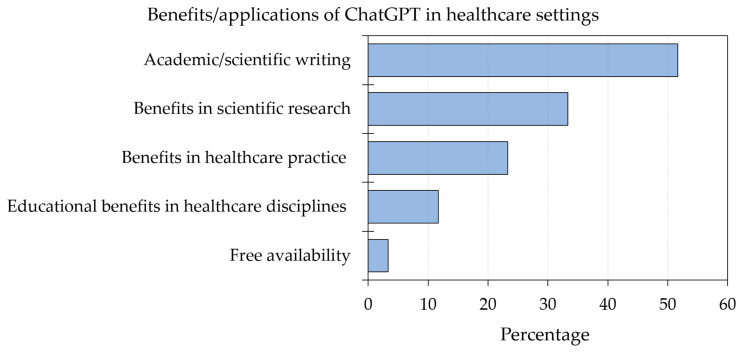
- Benefits were most frequently cited for academic/scientific writing (31 records, 51.7%), followed by scientific research (20, 33.3%), healthcare practice (14, 23.3%), healthcare education (7, 11.7%), and being a free package (2, 3.3%).
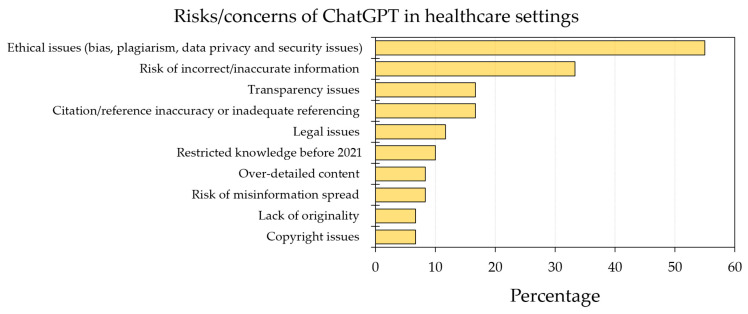
- Ethical concerns were the most common risk category (33 records, 55.0%), including risk of bias (18, 30.0%) and plagiarism (14, 23.3%); incorrect/inaccurate information was cited in 20 records (33.3%), citation/reference inaccuracy in 10 (16.7%), and transparency issues in 10 (16.7%).
- Other reported concerns included legal issues (7, 11.7%), restricted knowledge before 2021 (6, 10.0%), misinformation spread (5, 8.3%), over-detailed content (5, 8.3%), copyright issues (4, 6.7%), and lack of originality (4, 6.7%).
- The review states that ChatGPT does not qualify as an author under current ICMJE/COPE guidelines unless those guidelines are revised, and calls for stakeholder-developed ethics guidance for responsible LLM use in healthcare and academia.
Methods
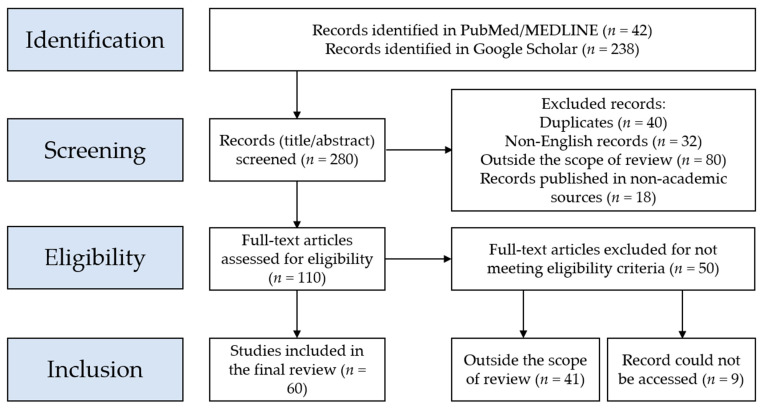
- Systematic review conducted according to PRISMA guidelines, searching PubMed/MEDLINE and Google Scholar for English records on ChatGPT in healthcare practice/research, healthcare education, or academic writing; searches concluded on 16 February 2023.
- PubMed/MEDLINE yielded 42 records and Google Scholar yielded 238 records, totaling 280 records; after duplicate removal (n = 40), non-English exclusion (n = 32), out-of-scope exclusion (n = 80), non-academic source exclusion (n = 18), full-text screening exclusions (n = 41), and inaccessible full texts (n = 9), 60 records were included.
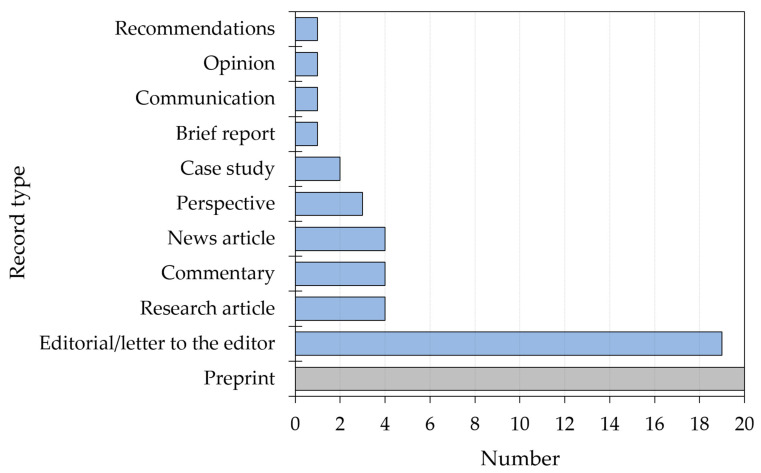
- Each included record was searched for record type, listed benefits/applications, listed risks/concerns, and main conclusions/recommendations regarding ChatGPT in healthcare education, practice, or scientific research/academic writing.
Limitations
- The paper states that included records had variable quality, non-English exclusion may have caused selection bias, inaccessible records may have led to missing relevant data, preprints were not peer reviewed, the literature is growing rapidly with the search ending 16 February 2023, and screening/interpretation was performed by a single author.
- Evident from the text: the review reports descriptive counts of mentions across heterogeneous record types rather than a formal meta-analysis or independent risk-of-bias assessment.
Model-written summary. Check it against the paper before relying on it.
Integrity signals
Registry
Cites
Statistics
Figures
Verification
Claims the paper makes
53 Valid · 1 Not valid · 6 Not checked · 37 Own results and interpretations
Every source the paper cites for this claim was checked and supports it.
In the paper
“This comes in light of the ability of ChatGPT to generate incorrect content that appears plausible from a scientific point of view [81].”
§ ChatGPT Utility in Healthcare Education, Research, and Practice: Systematic Review on the Promising Perspectives and Valid Concerns > 4. Discussion > 4.2. Limitations of ChatGPT Use in Scientific Research
What the sources say
- Supportedcites [81] Cascella M. Montomoli J. Bellini V. Bignami E. Evaluating the Feasibility of ChatGPT in Healthcare: An Analysis of Multiple Clinical and Research Scenarios J. Med. Syst. 2023 47 33 10.1007/s10916-023-01925-4 36869927 PMC9985086 source
In “Reasoning About Public Health Topics,” the paper says ChatGPT can produce believable answers that may be incorrect or nonsensical. In “Possible Misuse of GPT in Medicine and Research,” it describes a scientific abstract that appeared reliable and simulated statistical outputs that could seem plausible to readers. Together, these passages support the claim. (LLM, conf=0.94)
plain- Asserted: passes — The authors put it forward as true.
- Checkable: passes — It can be checked against evidence.
- Load-bearing: passes — The paper’s conclusions depend on it.
- Based: passes — The paper gives a reason why it holds.
- Supported
The sources with a verdict support this claim; the rest weren’t checked yet, have no full text we could read, or their verdicts aren’t rated yet.
In the paper
“This comes in light of the fact that authorship entails legal obligations that are not met by ChatGPT [43,48].”
§ ChatGPT Utility in Healthcare Education, Research, and Practice: Systematic Review on the Promising Perspectives and Valid Concerns > 4. Discussion > 4.2. Limitations of ChatGPT Use in Scientific Research
What the sources say
- Supportedcites [43] Zielinski C. Winker M. Aggarwal R. Ferris L. Heinemann M. Lapeña J. Pai S. Ing E. Citrome L. Chatbots, ChatGPT, and Scholarly Manuscripts WAME Recommendations on ChatGPT and Chatbots in Relation to Scholarly Publications Maced J. Med. Sci. 2023 11 83 86 10.3889/oamjms.2023.11502 37615142 source
The Introduction (p. 2) says chatbots are not legal entities, cannot be held legally liable, and that listing ChatGPT as an author may not be legally defensible. The WAME Recommendations (p. 2) add that chatbots cannot take responsibility for a paper or have the legal standing to sign a statement. (LLM, conf=0.93)
- Not checked — no full text of the sourcecites [48] Liebrenz M. Schleifer R. Buadze A. Bhugra D. Smith A. Generating scholarly content with ChatGPT: Ethical challenges for medical publishing Lancet Digit. Health 2023 5 e105 e106 10.1016/S2589-7500(23)00019-5 36754725 source
plain- Asserted: passes — The authors put it forward as true.
- Checkable: passes — It can be checked against evidence.
- Load-bearing: passes — The paper’s conclusions depend on it.
- Based: passes — The paper gives a reason why it holds.
- Supported
The cited sources support only part of this claim — read each source’s verdict below.
In the paper
“On one hand, ChatGPT, among other LLMs, can be beneficial in conversational and writing tasks, assisting to increase the efficiency and accuracy of the required output [11].”
§ ChatGPT Utility in Healthcare Education, Research, and Practice: Systematic Review on the Promising Perspectives and Valid Concerns > 1. Introduction
What the sources say
- Partly supportedcites [11] Deng J. Lin Y. The Benefits and Challenges of ChatGPT: An Overview Front. Comput. Intell. Syst. 2023 2 81 83 10.54097/fcis.v2i2.4465 sourceExperimental — accuracy not yet measured
Sections 4.1 (Increased Efficiency) and 4.2 (Improved Accuracy) say ChatGPT can make conversations more efficient and generate more accurate responses. The paper does not establish those benefits for writing tasks or for other LLMs, so the broader claim is only partially supported. (LLM, conf=0.88)
plainstates a cause- Asserted: passes — The authors put it forward as true.
- Checkable: passes — It can be checked against evidence.
- Load-bearing: unclear — It is unclear whether the paper’s conclusions depend on it.
- Based: passes — The paper gives a reason why it holds.
- Partly supported
The cited sources support only part of this claim — read each source’s verdict below.
In the paper
“Importantly, the concept of ChatGPT hallucination could be risky if the generated content is not thoroughly evaluated by researchers and health providers with proper expertise [37,56,73,77,79].”
§ ChatGPT Utility in Healthcare Education, Research, and Practice: Systematic Review on the Promising Perspectives and Valid Concerns > 4. Discussion > 4.2. Limitations of ChatGPT Use in Scientific Research
What the sources say
- Not checked — no full text of the sourcecites [37] Shen Y. Heacock L. Elias J. Hentel K.D. Reig B. Shih G. Moy L. ChatGPT and Other Large Language Models Are Double-edged Swords Radiology 2023 230163 10.1148/radiol.230163 36700838 source
- Partly supportedcites [56] Huh S. Are ChatGPT’s knowledge and interpretation ability comparable to those of medical students in Korea for taking a parasitology examination?: A descriptive study J. Educ. Eval. Health Prof. 2023 20 1 10.3352/jeehp.2023.20.1 36627845 PMC9905868 sourceExperimental — accuracy not yet measured
The Background says medical students must evaluate the accuracy of AI-generated medical information before creating reliable information for patients and the public. The Interpretation also reports that some ChatGPT explanations contained incorrect information. These passages support the need for scrutiny, but the paper does not specifically discuss hallucination or evaluation by researchers and health providers. (LLM, conf=0.84)
- Partly supportedcites [73] Duong D. Solomon B.D. Analysis of large-language model versus human performance for genetics questions medRxiv 2023 Preprint 10.1101/2023.01.27.23285115 PMC10999420 37246194 sourceExperimental — accuracy not yet measured
The Discussion (p. 6) says ChatGPT can give plausible explanations for incorrect answers and that its correctness requires additional verification, which is concerning in medical or other high-stakes settings. This supports the risk and need for evaluation, but the paper does not specify that researchers and health providers with proper expertise must perform it. (LLM, conf=0.83)
- Supportedcites [77] Jeblick K. Schachtner B. Dexl J. Mittermeier A. Stüber A.T. Topalis J. Weber T. Wesp P. Sabel B. Ricke J. ChatGPT Makes Medicine Easy to Swallow: An Exploratory Case Study on Simplified Radiology Reports arXiv 2022 10.48550/arxiv.2212.14882 2212.14882 PMC11126432 37794249 source
The Results (Free-text analysis) identify a ChatGPT hallucination that radiologists judged potentially harmful to a patient. The Key Points state that minimizing harm requires supervision by medical experts, supporting the claim’s warning about unevaluated medical content. (LLM, conf=0.90)
- Partly supportedcites [79] Lin Z. Why and how to embrace AI such as ChatGPT in your academic life PsyArXiv 2023 Preprint 10.31234/osf.io/sdx3j PMC10445029 37621662 sourceExperimental — accuracy not yet measured
The “Limitations of generative AI” section says ChatGPT may fabricate facts and false citations (“hallucination”) and urges users to critically evaluate and verify its responses, particularly when reliability is critical. It does not specifically say that researchers and health providers with proper expertise must evaluate the content; that part is more specific than the source. (LLM, conf=0.84)
hedgedstates a possible cause- Asserted: passes — The authors put it forward as true.
- Checkable: passes — It can be checked against evidence.
- Load-bearing: passes — The paper’s conclusions depend on it.
- Based: passes — The paper gives a reason why it holds.
- Rests on an assumption not shown here.
The sources with a verdict support this claim; the rest weren’t checked yet, have no full text we could read, or their verdicts aren’t rated yet.
In the paper
“This is particularly relevant for researchers who are non-native English speakers [23,25,63].”
§ ChatGPT Utility in Healthcare Education, Research, and Practice: Systematic Review on the Promising Perspectives and Valid Concerns > 4. Discussion > 4.1. Benefits of ChatGPT in Scientific Research
What the sources say
- Supportedcites [23] Chen T.J. ChatGPT and Other Artificial Intelligence Applications Speed up Scientific Writing Available online: https://journals.lww.com/jcma/Citation/9900/ChatGPT_and_other_artificial_intelligence.174.aspx (accessed on 16 February 2023) PMC12755446 36791246 source
In the main text (page not provided), Chen says many scientists who are not native English speakers struggle to write in English and describes AI translation and writing tools as ways to overcome that barrier. This supports the claim that language assistance in scientific writing is particularly relevant to those researchers. (LLM, conf=0.91)
- Not checked — no full text of the sourcecites [25] Kitamura F.C. ChatGPT Is Shaping the Future of Medical Writing but Still Requires Human Judgment Radiology 2023 230171 10.1148/radiol.230171 36728749 source
- Supportedcites [63] Gao C.A. Howard F.M. Markov N.S. Dyer E.C. Ramesh S. Luo Y. Pearson A.T. Comparing scientific abstracts generated by ChatGPT to original abstracts using an artificial intelligence output detector, plagiarism detector, and blinded human reviewers bioRxiv 2022 10.1101/2022.12.23.521610 source
The Discussion/Abstract section of our copy states directly that the technology 'could be used by scientists publishing in a language that is not their native language, to improve equity,' alongside the point that generated text 'may help alleviate the burden of writing' and that LLMs are 'a powerful tool to create readable scientific abstracts.' That covers the attributed content — AI-assisted language improvement being especially pertinent for non-native-English researchers — with the source's own hedge ('could be used') slightly weaker than the citing sentence's flat 'is particularly relevant.' No passage in our copy contradicts it. (LLM, conf=0.82)
plainstates an association- Asserted: passes — The authors put it forward as true.
- Checkable: passes — It can be checked against evidence.
- Load-bearing: unclear — It is unclear whether the paper’s conclusions depend on it.
- Based: passes — The paper gives a reason why it holds.
- Supported
42 more claims · 23 with their cited sources checked
Create a free account to see all 97 claims and to verify the 16 references still open.
- Probably not a substantial claim. 31
- It may state two separate claims as one. 27
Claims other papers make about this one
Each is checked against this paper’s own text: does it say what the citing paper says it does?
The source backs part of the claim, not all of it — or backs it for a different population, condition or comparison.
In the citing paper
“The reliance on ChatGPT may result in hindering the development of the skills needed to interpret and respond to social cues, which should be considered in health care education [9,91].”
From Assessing Health Students' Attitudes and Usage of ChatGPT in Jordan: Validation Study (2023) · cites this paper as [9]
Experimental — accuracy not yet measuredThe source backs part of the claim, not all of it — or backs it for a different population, condition or comparison.
In the citing paper
“A recent surge in the use of ChatGPT, in particular for mental health, is emergent for providing crucial personalized advice without clinical explanation, which can hurt user's safety, and thus trust (Sallam, 2023).”
From A review of the explainability and safety of conversational agents for mental health to identify avenues for improvement (2023) · cites this paper as Sallam, 2023
Experimental — accuracy not yet measuredThe source backs part of the claim, not all of it — or backs it for a different population, condition or comparison.
In the citing paper
“ChatGPT plays a crucial role in pandemic management by aiding in the swift and accurate dissemination of critical information.”
From A Systematic Review and Meta-Analysis of Artificial Intelligence Tools in Medicine and Healthcare: Applications, Considerations, Limitations, Motivation and Challenges (2024) · cites this paper as [6]
Experimental — accuracy not yet measuredThe source backs part of the claim, not all of it — or backs it for a different population, condition or comparison.
In the citing paper
“Its natural language processing capabilities enable it to generate coherent responses, making it a valuable tool for healthcare organisations.”
From A Systematic Review and Meta-Analysis of Artificial Intelligence Tools in Medicine and Healthcare: Applications, Considerations, Limitations, Motivation and Challenges (2024) · cites this paper as [6]
Experimental — accuracy not yet measuredThe source backs part of the claim, not all of it — or backs it for a different population, condition or comparison.
In the citing paper
“Specific advantages include its ability to provide rapid updates, preventive measures, and medical guidelines to the public.”
From A Systematic Review and Meta-Analysis of Artificial Intelligence Tools in Medicine and Healthcare: Applications, Considerations, Limitations, Motivation and Challenges (2024) · cites this paper as [6]
Experimental — accuracy not yet measured
31 more claims about this paper
Create a free account to see every claim other papers make about this one.
Citations
Cites
Preferred Reporting Items for Systematic Reviews and Meta-Analyses: the PRISMA statement
Moher, D., Liberati, A., Tetzlaff, J., Altman, D. G., & for the PRISMA Group (2009) · BMJ · doi:10.1136/bmj.b2535 · Cited by 83,823
Preferred Reporting Items for Systematic Reviews and Meta-Analyses: The PRISMA Statement
Moher, D., Liberati, A., Tetzlaff, J., Altman, D. G., & The PRISMA Group (2009) · PLoS Medicine · doi:10.1371/journal.pmed.1000097 · Cited by 64,042 · cited 1×
“The current systematic review was conducted according to the Preferred Reporting Items for Systematic Reviews and Meta-Analyses (PRIMSA) guidelines [21].”
Language Models are Few-Shot Learners
Brown, T. B., Mann, B., Ryder, N., Subbiah, M., Kaplan, J., Dhariwal, P., Neelakantan, A., Shyam, P., Sastry, G., Askell, A., et al. (2020) · arXiv · doi:10.48550/arxiv.2005.14165 · Cited by 23,372 · cited 3×
“The GPT architecture utilizes a neural network to process natural language, thus generating responses based on the context of input text [7].”
BackgroundWang, G., Ma, R., Qiao, G., Wada, K., Aizawa, Y., & Satoh, T. (2015) · Integrative Medicine International · doi:10.1159/000368408 · Cited by 18,657
Kaugeranna, R., Kaugeranna, E., & Aion, (. S. 4. 6. (2023) · DROPS (Schloss Dagstuhl – Leibniz Center for Informatics) · doi:10.4230/lipics.giscience.2023.43 · Cited by 13,690
Machine learning: Trends, perspectives, and prospects
Jordan, M. I., & Mitchell, T. M. (2015) · Science · doi:10.1126/science.aaa8415 · Cited by 9,955
Kung, T. H., Cheatham, M., Medenilla, A., Sillos, C., De Leon, L., Elepaño, C., Madriaga, M., Aggabao, R., Diaz-Candido, G., Maningo, J., et al. (2023) · PLOS Digital Health · doi:10.1371/journal.pdig.0000198 · Cited by 4,115 · cited 2×
“[59] An article showing the ChatGPT raised accuracy which enabled passing the USMLE Accuracy with high concordance and insight; it can facilitate patient communication; improved personalized medicine ChatGPT has a promising potential in medical education; future studies are recommended to consider non-biased approach…”
BackgroundKung, T. H., Cheatham, M., ChatGPT, Medenilla, A., Sillos, C., De Leon, L., Elepaño, C., Madriaga, M., Aggabao, R., Diaz-Candido, G., et al. (2022) · doi:10.1101/2022.12.19.22283643 · Cited by 4,115
Rajpurkar, P., Chen, E., Banerjee, O., & Topol, E. J. (2022) · Nature Medicine · doi:10.1038/s41591-021-01614-0 · Cited by 3,212 · cited 1×
“The promising utility of AI in health care has been outlined previously with possible benefits in personalized medicine, drug discovery, and the analysis of large datasets aside from the potential applications to improve diagnosis and clinical decisions [17,18].”
BackgroundChatting and cheating: Ensuring academic integrity in the era of ChatGPT
Cotton, D. R. E., Cotton, P. A., & Shipway, J. R. (2024) · Innovations in Education and Teaching International · doi:10.1080/14703297.2023.2190148 · Cited by 3,087 · cited 1×
“[62] An EdArXiv 2 preprint on the academic integrity in ChatGPT era Risk of plagiarism; academic dishonesty Careful thinking of educational assessment tools”
Background
Cited by
Items 1,401–1,500 of 3,096
Ata, A. M., Aras, B., Taşdelen, Ö. Y., Çelik, C., & Çulha, C. (2024) · Physical & Occupational Therapy In Pediatrics · doi:10.1080/01942638.2024.2316178 · Cited by 8
“It has been also used in patient information, in addition to health care education, research, and clinical practice (Sallam, 2023).”
Consumers' Drivers of Generative Pre-Trained Transformer (GPT) Conversational Bot Adoption
Fares, O. H., Zhu, Q., Lee, S. H., & Aversa, J. M. (2024) · Advances in hospitality, tourism and the services industry (AHTSI) book series · doi:10.4018/979-8-3693-1239-1.ch005 · Cited by 8
A Road Map of Prompt Engineering for ChatGPT in Healthcare: A Perspective Study
Abhari, S., Fatahi, S., Saragadam, A., Chumachenko, D., & Morita, P. P. (2024) · Studies in health technology and informatics · doi:10.3233/shti240578 · Cited by 12
The importance of using Artificial Intelligence in nursing
Alba‐Leonel, A., Papaqui-Alba, S., Argueta, M. Á. G. M., Sánchez-Ahedo, R., & Papaqui-Hernández, J. (2024) · Salud Ciencia y Tecnología · doi:10.56294/saludcyt20251003 · Cited by 7
Stage, M. A., Creamer, M. M., & Ruben, M. A. (2024) · PEC Innovation · doi:10.1016/j.pecinn.2024.100371 · Cited by 11
Karataş, Ö., Demirci, S., Pota, K., & Tuna, S. (2025) · Journal of Clinical Medicine · doi:10.3390/jcm14051747 · Cited by 8
“For example, for ChatGPT version 3.5, deviations decreased from 19.6% to 17.3%, while for version 4.0, this rate reduced from 27.7% to 3.4% [19].”
InfluentialYou, Q., Li, X., Shi, L., Rao, Z., & Hu, W.-L. (2025) · Journal of Renal Nutrition · doi:10.1053/j.jrn.2025.02.008 · Cited by 12
Akrimi, S., Schwensfeier, L., Düking, P., Kreutz, T., & Brinkmann, C. K. (2025) · Sports · doi:10.3390/sports13040092 · Cited by 14
“However, ChatGPT has received mixed reactions within academia and the broader scientific community, reflecting an ongoing debate about the benefits and risks associated with AI technology [7].”
Gallo, M. L., Moriconi, M., & Phé, V. (2025) · Minerva Urology and Nephrology · doi:10.23736/s2724-6051.25.06195-6 · Cited by 7
Knowledge-embedded large language models for emergency triage
Shen, Q., Zhang, X., Ren, H., Guo, Q., & Zhang, Y. (2025) · Knowledge-Based Systems · doi:10.1016/j.knosys.2025.113431 · Cited by 17
Rosteck, N., Striegl, J., & Loitsch, C. (2025) · CHI Conference Extended Abstracts on Human Factors in Computing Systems (CHI EA) · doi:10.1145/3706599.3720043 · Cited by 14
“…advancements in natural language generation through Large Language Models (LLMs) [11], great potential can be seen in streamlining healthcare practice [26], but the use of LLM services in healthcare also raises concerns related to false information, reproduction of biases, and data privacy [20].”
Diagnostic accuracy of ChatGPT-4 in orthopedic oncology: a comparative study with residents
Baker, H. P., Aggarwal, S., Kalidoss, S., Hess, M., Haydon, R. C., & Strelzow, J. (2025) · The Knee · doi:10.1016/j.knee.2025.04.004 · Cited by 10
Alkhayat, D. S., Alsubaiyi, H. N., Alharbi, Y. A., Alkahtani, L. M., Akhwan, A. M., & Alharbi, A. A. (2025) · Journal of Medical Education and Curricular Development · doi:10.1177/23821205251340129 · Cited by 8
Anatomy exam model for the circulatory and respiratory systems using GPT-4: a medical school study
ORHA, A. T., Karamus, N. F., & Çolak, T. (2025) · Surgical and Radiologic Anatomy · doi:10.1007/s00276-025-03667-z · Cited by 11
Isaradech, N., Riedel, A., Sirikul, W., Kreuzthaler, M., & Schulz, S. (2025) · Artificial Intelligence in Medicine · doi:10.1016/j.artmed.2025.103165 · Cited by 14
Assessing DeepSeek-R1 for Clinical Decision Support in Multidisciplinary Laboratory Medicine
Li, Q., Zhan, L., & Cai, X. (2025) · Journal of Multidisciplinary Healthcare · doi:10.2147/jmdh.s538253 · Cited by 9
Ratnam, K. K. Y. (2025) · Digital Health · doi:10.1177/20552076251362070 · Cited by 22
Kozan, K., Hur, J., Kim, I., & Barrett, A. J. (2025) · Education Sciences · doi:10.3390/educsci15091133 · Cited by 17
Feyijimi, T. R., Aliu, J., Oke, A. E., & Aghimien, D. O. (2025) · Computers · doi:10.3390/computers14090366 · Cited by 13
“• Simulating Abductive Reasoning: LLMs can simulate abductive reasoning to infer plausible explanations or methodologies, thereby aiding research discovery [15,110,124–130].”
Sezer, B., & Okutan, A. E. (2025) · BMC Oral Health · doi:10.1186/s12903-025-06791-9 · Cited by 16
“It was soon followed by more advanced versions that achieved widespread adoption due to their improved language capabilities [2, 3].”
Guo, L., Zhang, S., Chen, H., Li, Y., Liu, Y., Liu, W., Wang, Q., Tang, Z., Jiang, P., & Wang, J. (2025) · Visual Computing for Industry Biomedicine and Art · doi:10.1186/s42492-025-00201-1 · Cited by 8
How AI Is Transforming Medical Education: Bibliometric Analysis
Wang, Y., Chang, C., Shi, W., Liu, H., Huang, X., & Jiao, Y. (2025) · JMIR Medical Education · doi:10.2196/75911 · Cited by 9
“This integration not only addresses the challenges posed by the sheer volume and complexity of medical knowledge but can also offer personalized learning experiences tailored to individual students’ needs and abilities [1].”
A Case Study of Sustainable Development in Hospitals in Thailand Using ChatGPT
Siripipatthanakul, S., Chaiprakarn, S., Rungsiyanont, S., & Phuangsuwan, P. (2025) · IGI Global eBooks · doi:10.4018/979-8-3693-9800-5.ch001 · Cited by 7
Reinhardt, A., Matthes, J., Hodzic, S., Kaňková, J., Bojić, L., Maindal, H., Paraschiv, C., & Ryom, K. (2025) · Health Communication · doi:10.1080/10410236.2025.2601265 · Cited by 11
“On the one hand, AI-generated health information (AI-HI) offers numerous advantages: it is generally free of charge, available in multiple languages, and can tailor the tone and complexity of its responses to meet individual needs (Sallam, 2023).”
Yijun, W. A. N. G., Luan, Y., Cheng, S., Hao, M., Tan, W., Hu, R., Yao, Z., Wang, J., & Wu, J. (2026) · Hypertension Research · doi:10.1038/s41440-025-02481-9 · Cited by 11
Karagöz, B., Bayrak, H. Ç., & Keçeci, T. (2026) · Journal of the American Podiatric Medical Association · doi:10.3390/japma116030033 · Cited by 12
“However, numerous previous studies have reported questionable reliability regarding online health information [5,10,11], raising concerns that similar issues may also apply to AI-generated content.”
Stroke care in the ChatGPT era: Potential use in early symptom recognition
Au, S. C. L., & Lam, W. Y. (2023) · Journal of Acute Disease · doi:10.4103/2221-6189.379278 · Cited by 7
Opening scientific knowledge to debunk myths and lies in human nutrition
Capocasa, M., & Venier, D. (2023) · European Journal of Nutrition · doi:10.1007/s00394-023-03228-3 · Cited by 7
“However, the use of this application also poses several risks, such as the dissemination of misinformation and incorrect content that seems plausible from a scientific point of view [22].”
BackgroundLi, Y., & Zhang, Y. (2023) · International Conference on Advanced Electronic Materials, Computers and Software Engineering (AEMCSE) · doi:10.1117/12.3004527 · Cited by 11
“Usage context refers to the fact that users can improve their perception of the usefulness and ease of use of the technology in specific scenarios and specific environments of ChatGPT, and thus increase their willingness to use it [10].”
BackgroundYıldız, M. S., & Alper, A. (2023) · Journal of Consumer Health on the Internet · doi:10.1080/15398285.2023.2240652 · Cited by 9
AI-supported insulin dosing for type 2 diabetes
Davis, G. M., Shao, H., & Pasquel, F. J. (2023) · Nature Medicine · doi:10.1038/s41591-023-02573-4 · Cited by 7
ENHANCING PRAGMATIC KNOWLEDGE WITH CHATGPT: BENEFITS AND CONSIDERATIONS
Puri, A. D., & Baskara, F. R. (2023) · Prosiding Konferensi Linguistik Tahunan Atma Jaya (KOLITA) · doi:10.25170/kolita.21.4828 · Cited by 9
“One of the best things about ChatGPT is that it can generate responses in different styles and registers based on your requirements (Sallam, 2023).”
BackgroundMorita, P. P., Abhari, S., & Kaur, J. (2023) · International Journal of Health Policy and Management · doi:10.34172/ijhpm.2023.8131 · Cited by 10
Evaluating AI performance in answering questions related to thoracic anatomy
Mavrych, V., & Bolgova, O. (2023) · MOJ Anatomy & Physiology · doi:10.15406/mojap.2023.10.00339 · Cited by 7
Stošić, L. V., & Janković, A. V. (2023) · Pravo - teorija i praksa · doi:10.5937/ptp2304058s · Cited by 13
Fostier, J., Leemans, E., Meeussen, L., Wulleman, A., Doren, S. V., Coninck, D. D., & Toelen, J. (2024) · Future · doi:10.3390/future2010003 · Cited by 8
“Its immense potential is apparent in various applications, such as chatbots, customer service, education, research, and even healthcare [3–6].”
BackgroundREVOLUTIONIZING DRUG DELIVERY INNOVATION: LEVERAGING AI-DRIVEN CHATBOTS FOR ENHANCED EFFICIENCY
Malkawi, R. (2024) · International Journal of Applied Pharmaceutics · doi:10.22159/ijap.2024v16i2.50182 · Cited by 15
“To illustrate the real-world impact of ChatGPT in drug delivery, we present two compelling case studies [19].”
MethodHan, Z., Battaglia, F., & Terlecky, S. R. (2024) · The Innovation Medicine · doi:10.59717/j.xinn-med.2024.100065 · Cited by 7
D’Souza, R. F., Mathew, M., Palatty, P. L., & Surapaneni, K. M. (2024) · International Journal of Ethics Education · doi:10.1007/s40889-024-00190-4 · Cited by 8
“The ability to instantly query and receive feedback on ethical queries allows for a deeper understanding and reinforcement of bioethical principles (Sallam 2023; Barnhart et al. 2023).”
Using ChatGPT for the Development of Critical Thinking in Youth: Example of Inequality Proof
Drushlyak, M. G., Лукашова, Т., Sabadosh, Y., Melnikov, I., & Семеніхіна, О. В. (2024) · International Convention on Information and Communication Technology, Electronics and Microelectronics · doi:10.1109/mipro60963.2024.10569759 · Cited by 17
“…learning among adult learners [23]; the problems of using AI in geographical education were investigated [24]; summarized the experience of using ChatGPT in medical education in general and for personalization of training, and development of critical and problem thinking of medical workers [25].”
MethodGPT-based chatbot tools are still unreliable in the management of prosthetic joint infections
Bortoli, M., Fiore, M., Tedeschi, S., Oliveira, V. C. C., de Sousa, R. J. G., Bruschi, A., Campanacci, D. A., Viale, P., PAOLIS, M. D., & Sambri, A. (2024) · MUSCULOSKELETAL SURGERY · doi:10.1007/s12306-024-00846-w · Cited by 11
“In the contemporary healthcare landscape, the integration of AI has emerged as a transformative force, poised to revolutionize various aspects of medical research and clinical practice [3].”
Examining the applicability of the Protection of Personal Information Act in AI-driven environments
Mbonye, V., Moodley, M., & Nyika, F. D. (2024) · South African journal of information management · doi:10.4102/sajim.v26i1.1808 · Cited by 21
“These concerns include losing control over personally identifiable information, unauthorised data access, consent issues, and potential biases (Bharadiya 2023; Bleier, Goldfarb & Tucker 2020; Sallam 2023; Shah et al. 2020).”
ChatGPT and Large Language Models in Healthcare; a Bibliometrics Analysis and Review
Mosavi, A. H., Imre, F., & Hùng, V. T. (2024) · IEEE International Conference on Computational Cybernetics (ICCC) · doi:10.1109/iccc62278.2024.10582937 · Cited by 11
Adaptive Intelligence Revolutionizing Learning and Sustainability in Higher Education
Chigbu, B. I., Umejesi, I., & Makapela, S. L. (2024) · Advances in higher education and professional development book series · doi:10.4018/979-8-3693-3559-8.ch006 · Cited by 12
Prompt Pattern Engineering for Test Question Mapping Using ChatGPT: A Cross-Sectional Study
Babin, J. L., Raber, H., & Mattingly, T. J. (2024) · American Journal of Pharmaceutical Education · doi:10.1016/j.ajpe.2024.101266 · Cited by 8
Huwiler, J., Oechslin, L., Biaggi, P., Tanner, F. C., & Wyss, C. A. (2024) · Swiss Medical Weekly · doi:10.57187/s.3547 · Cited by 9
“…resulting in academic dis-honesty [17] and the limitations discussed below, there is clear positive potential of chatbots in medical education [3]: Artificial intelligence can identify flaws in medical education [18], can contribute to tailoring education based on the needs of the student…”
BackgroundAdvancements of AI in healthcare: a comprehensive review of ChatGPT’s applications and challenges
Ali, S., Aslam, A., Tahir, Z., Ashraf, B., & Tanweer, A. (2024) · Journal of the Pakistan Medical Association · doi:10.47391/jpma.11173 · Cited by 9
Watch out for errors! factors related to ChatGPT skepticism: a cognitive perspective
Zhang, M., Ye, J., & Yang, X. (2025) · Interactive Learning Environments · doi:10.1080/10494820.2025.2454448 · Cited by 10
“However, data source issues in Generative Artificial Intelligence (GenAI) like ChatGPT may engender the possibility of distorting scientific facts and spreading false information (Kidd & Birhane, 2023; UNESCO, 2023; van Dis et al., 2023), which is called hallucination (Sallam, 2023).”
del Norte, U., Pérez, A., McClain, S. K., del Norte, U., Narváez, A. R., del Norte, U., Rosado, N., del Norte, U., Trigos-Carrillo, L., del Norte, U., et al. (2025) · Íkala Revista de Lenguaje y Cultura · doi:10.17533/udea.ikala.355878 · Cited by 21
Demir, S. (2025) · Journal Français d Ophtalmologie · doi:10.1016/j.jfo.2025.104468 · Cited by 7
Inteligencia artificial en educación superior: revisión integrativa de la literatura
Perdomo, B., & Martínez, Ó. G. (2025) · Cuadernos de Investigación Educativa · doi:10.18861/cied.2025.16.2.4034 · Cited by 34
Analysis of ChatGPT as a Question-Answering Tool
Pichappan, P., Krishnamurthy, M., & Vijayakumar, P. (2023) · Journal of Digital Information Management · doi:10.6025/jdim/2023/21/2/50-61 · Cited by 8
Kaliyadan, F., & Seetharam, K. (2023) · Indian Dermatology Online Journal · doi:10.4103/idoj.idoj_344_23 · Cited by 11
“[7] • Secretarial support in dermatology clinics: Chat GPT can generate patient reports, discharge summaries, possible integration with electronic health records for patient scheduling, writing clinic letters/referral letters, generating prescription templates, drug interaction analysis, audits, patient pattern analys…”
BackgroundCan ChatGPT assist with the initial triage? A case study of stroke in young females
Rosen, S., & Saban, M. (2023) · International Emergency Nursing · doi:10.1016/j.ienj.2023.101340 · Cited by 7
Obstacles and Resistance to Organizational Change in the New Post-COVID-19 Environment
Brown, B. A., & Heitner, K. L. (2023) · Advances in human resources management and organizational development book series · doi:10.4018/979-8-3693-0235-4.ch008 · Cited by 7
Leave no one behind: the role of digital health literacy
Kayser, L., & Phanareth, K. (2023) · European Respiratory Society eBooks · doi:10.1183/2312508x.10001023 · Cited by 18
Skalidis, I., Kachrimanidis, I., Koliastasis, L., Arangalage, D., Antiochos, P., Maurizi, N., Müller, O., Fournier, S., Hamilos, M. I., & Skalidis, E. I. (2023) · Future Cardiology · doi:10.2217/fca-2023-0106 · Cited by 7
Assessing ChatGPT's use of person-first language in healthcare conversations
Hackl, E. V. (2024) · Discover Artificial Intelligence · doi:10.1007/s44163-023-00099-9 · Cited by 10
The future of oral cancer care: Integrating ChatGPT into clinical practice
Ahmed, S. K. (2024) · Oral Oncology Reports · doi:10.1016/j.oor.2024.100317 · Cited by 7
Chatbots vs andrologists: Testing 25 clinical cases
Perrot, O., Schirmann, A., Vidart, A., Guillot‐Tantay, C., Izard, V., Lebrét, T., Boillot, B., Mesnard, B., Lebacle, C. M., & Madec, F.-X. (2024) · The French Journal of Urology · doi:10.1016/j.fjurol.2024.102636 · Cited by 9
Guirguis, P. G., Youssef, M. P., Punreddy, A., Botros, M., Raiford, M. E., & McDowell, S. (2024) · Clinical Orthopaedics and Related Research · doi:10.1097/corr.0000000000003263 · Cited by 10
“5 [15, 32, 37, 43, 47, 55].”
The Acceptable Text Similarity Level in Manuscripts Submitted to Scientific Journals
Habibzadeh, F. (2023) · Journal of Korean Medical Science · doi:10.3346/jkms.2023.38.e240 · Cited by 9
Azizoğlu, M., & Okur, M. H. (2023) · Research Square · doi:10.21203/rs.3.rs-3018641/v1 · Cited by 8
Pathak, A. (2023) · SSRN Electronic Journal · doi:10.2139/ssrn.4499278 · Cited by 10
The Role of Large Language Models in Medical Education: Applications and Implications (Preprint)Preprint
Safranek, C. W., Sidamon‐Eristoff, A. E., Gilson, A., & Chartash, D. (2023) · doi:10.2196/preprints.50945 · Cited by 7
Diagnostic Accuracy of GPT Multimodal Analysis on USMLE Questions Including Text and VisualsPreprint
Sorin, V., Glicksberg, B. S., Barash, Y., Konen, E., Nadkarni, G. N., & Klang, E. (2023) · medRxiv · doi:10.1101/2023.10.29.23297733 · Cited by 6
Güneş, Y. C., & Cesur, T. (2024) · medRxiv · doi:10.1101/2024.01.18.24301495 · Cited by 7
Patient Centric Summarization of Radiology Findings using Large Language ModelsPreprint
Tariq, A., Fathizadeh, S., Ramaswamy, G., Trivedi, S., Urooj, A., Tan, N., Stib, M. T., Patel, B. N., & Banerjee, I. (2024) · medRxiv · doi:10.1101/2024.02.01.24302145 · Cited by 15
Bane and boon of hallucinations in context of generative AIPreprint
Patel, H. (2024) · doi:10.36227/techrxiv.171198062.20183635/v1 · Cited by 13
ChatGPT in pharmacy practice: disruptive or destructive innovation? A scoping review
Lima, T. D. M., Bonafé, M., Baby, A. R., & Visacri, M. B. (2024) · Scientia Pharmaceutica · doi:10.3390/scipharm92040058 · Cited by 6
“…clinical and educational support, such as answering frequent basic questions, reviewing concepts, taking examinations for higher education students [9–12], as well as assisting researchers in scientific writing, supporting them in generating ideas, and improving the writing of their articles…”
Lifelong Learning of Large Language Model Based Agents: A Roadmap
Zheng, J., Shi, C., Cai, X., Li, Q., Zhang, D., Li, C., Yu, D., & Ma, Q. (2026) · IEEE Transactions on Pattern Analysis and Machine Intelligence · doi:10.1109/tpami.2025.3650546 · Cited by 7
“Restrictions apply. safety-critical domains such as healthcare [186] or autonomous systems.”
Al-Alami, S. (2024) · Journal of Language Teaching and Research · doi:10.17507/jltr.1504.01 · Cited by 17
GPT for Pediatric Stroke Research: A Pilot Study
Fiedler, A. K., Zhang, K., Lal, T., Jiang, X., & Fraser, S. (2024) · Pediatric Neurology · doi:10.1016/j.pediatrneurol.2024.07.001 · Cited by 7
Bruyère, O., Demonceau, C., & Kergoat, M. (2024) · Journal of the American Medical Directors Association · doi:10.1016/j.jamda.2024.105155 · Cited by 6
Jairoun, A. A., Al‐Hemyari, S. S., Shahwan, M. J., Alnuaimi, G. R. H., Ibrahim, N. A., & Jaber, A. A. S. (2024) · Exploratory Research in Clinical and Social Pharmacy · doi:10.1016/j.rcsop.2024.100518 · Cited by 14
Artificial intelligence in academic writing: a detailed examination
Scott-Herring, M. (2024) · International Journal of Nursing Education Scholarship · doi:10.1515/ijnes-2024-0050 · Cited by 6
Isop, W. A. (2025) · Frontiers in Artificial Intelligence · doi:10.3389/frai.2024.1377938 · Cited by 17
“. generative AI technologies, developed by OpenAI (Baidoo-Anu and Owusu Ansah, 2023; Kasneci et al., 2023; Sallam, 2023) and Hugging Face (Syal, 2020), have become widely accessible, profoundly affecting teaching and learning.”
Pastrak, M., Kajitani, S., Goodings, A. J., Drewek, A., Lafree, A., & Murphy, A. (2025) · JMIR AI · doi:10.2196/67696 · Cited by 8
“This evolution underscores the potential of AI to become an increasingly valuable asset in educational settings [6,19], offering up-to-date knowledge and adaptive learning paths on balance with a general cautious optimism among medical professionals [32].”
Herbert, D. N., Westendorf, J., Farmer, M., & Reeder, B. (2025) · Journal of Studies on Alcohol and Drugs · doi:10.15288/jsad.24-00319 · Cited by 7
Charming or chilling? A comprehensive review of ChatGPT’s in education sector
Bhaskar, P., & Tiwari, C. K. (2025) · International Journal of Information and Learning Technology · doi:10.1108/ijilt-05-2024-0097 · Cited by 9
Talay, L., Lagesen, L., Yip, A., Vickers, M., & Ahuja, N. K. (2025) · Healthcare · doi:10.3390/healthcare13060647 · Cited by 11
“While there has been general consensus around the utility of LLMs within a narrow healthcare scope, many experts have expressed concerns about their capability to convey empathy in patient consultations [18,24,27], which various studies have supported [28,29].”
Coleman, S., Lynch, C., Worlikar, H., Kelly, E., Loveys, K., Simpkin, A. J., Walsh, J. C., Broadbent, E., Finucane, F. M., & O'Keeffe, D. T. (2025) · JMIR Diabetes · doi:10.2196/63503 · Cited by 7
“Hallucinating models can spread misinformation and private medical data may be misused [16].”
Fu, L., Zhou, Q., Jin, M., & Wu, W. (2025) · Environmental chemistry and safety · doi:10.26599/ecs.2025.9600002 · Cited by 7
Rouck, R. D., Wille, E., Gilbert, A., & Vermeersch, N. (2025) · International Journal of Emergency Medicine · doi:10.1186/s12245-025-00885-5 · Cited by 12
“The use of LLMs in healthcare shows great promise, yet concerns about ethics, transparency, and reliability remain [57].”
Ragab, M., Ashary, E. B., Kateb, F., Hakeem, A., Mosli, R., Albogami, N., & Nooh, S. A. (2025) · Alexandria Engineering Journal · doi:10.1016/j.aej.2025.04.071 · Cited by 7
Enhancing Online Learning Through Multi-Agent Debates for CS University Students
Du, J., Xu, G., Liu, W., Zhou, D., & Liu, F. (2025) · Applied Sciences · doi:10.3390/app15115877 · Cited by 12
“The advent of LLMs, such as Generative Pre-trained Transformer 4 (GPT-4) [8], has provided significant technological advancements in various educational activities, including engineering education [9], language teaching and learning [10], and personalized learning [11].”
Solmonovich, R. L., Kouba, I., Lee, J. Y., Demertzis, K. H., & Blitz, M. J. (2025) · PLoS ONE · doi:10.1371/journal.pone.0320749 · Cited by 12
“…advantages for LLMs in the medical field include improved scientific writing, [5] documentation, [1,6,7] dataset analysis, drafting papers, language review, and personalized learning, [5] offering the potential to enhance medical education, clinical decision-making, research, and patient care.”
Kotsis, K. Τ. (2025) · European Journal of Contemporary Education and E-Learning · doi:10.59324/ejceel.2025.3(3).14 · Cited by 12
Alsanie, I., Qannam, A., Bello, I. O., & Khurram, S. A. (2025) · Journal of Oral Pathology and Medicine · doi:10.1111/jop.70002 · Cited by 11
Azmir, S. M., & Atikuzzaman, M. (2025) · The Electronic Library · doi:10.1108/el-01-2025-0038 · Cited by 11
Albahri, O. S., Alsalem, M. A., Albahri, A. S., Mahmoud, M. A., Alzubaidi, L., Alamoodi, A. H., & Sharaf, I. M. (2025) · International Journal of Intelligent Systems · doi:10.1155/int/2376097 · Cited by 7
Nguyen, D.-N., Tong, R. K., & Dinh, N. (2025) · Digital Discovery · doi:10.1039/d5dd00306g · Cited by 12
Mudenda, S., Mufwambi, W., Mwale, R. S., Kathewera, B. S., & Lubanga, A. F. (2025) · BMC Medical Education · doi:10.1186/s12909-025-07833-0 · Cited by 16
“On the other hand, the integration of generative AI into educational systems is not devoid of challenges [3, 8].”
Abortion AI: Toward an equity-centered research agenda for AI and abortion
Friend, J., Brindis, C. D., & Upadhyay, U. D. (2025) · Contraception · doi:10.1016/j.contraception.2025.111241 · Cited by 9
Parenti, S. I., Tsiotas, G., Maglioni, A., Lamberti, G., Fiordelli, A., Rossi, D., Bononi, L., & Bonetti, G. A. (2025) · Diagnostics · doi:10.3390/diagnostics15202615 · Cited by 8
“However, a recent systematic review emphasizes the critical need for further research to assess LLM content reliability and its clinical impact, given the inherent risk of generating inaccurate information [7].”
Vivekanantha, P., Cohen, D., Slawaska‐Eng, D., Nagai, K., Tarchala, M., Matache, B. A., Hiemstra, L. A., Longstaffe, R., Lesniak, B. P., Meena, A., et al. (2025) · BMC Musculoskeletal Disorders · doi:10.1186/s12891-025-09227-1 · Cited by 9
“Artificial intelligence (AI) has become increasingly popular over the past few years [1].”
Mudenda, S. (2025) · Creative Education · doi:10.4236/ce.2025.1611112 · Cited by 13
Cassell, K., Ologunowa, A., Rastegar-Mojarad, M., Chun, B., Huang, Y.-L., Wang, D., & Cossrow, N. (2025) · Frontiers in Artificial Intelligence · doi:10.3389/frai.2025.1662202 · Cited by 15
“Within the last 2 years, however, there has been extensive interest in the use of generative large language models (LLMs), which are more versatile and accessible than previous generations of AI tools (Lu et al., 2024; O’Connor et al., 2024; Sallam, 2023).”
Confidential LLM Inference: Performance and Cost Across CPU and GPU TEEs
Chrapek, M., Copik, M., Mettaz, E., & Hoefler, T. (2025) · IEEE International Symposium on Workload Characterization · doi:10.1109/iiswc66894.2025.00017 · Cited by 30
Berşe, S., Akça, K., Dіrgar, E., & Ağar, A. (2025) · International Journal of Nursing Practice · doi:10.1111/ijn.70083 · Cited by 10
Metadata
- Authors
- Sallam, M.
- Affiliations
- University of Jordan (JO)
- Corresponding author
- Sallam, Malik
- ORCID
- Sallam, Malik
- Venue
- Healthcare
- Publisher
- MDPI AG
- Published
- 2023-03-19
- Volume
- 11
- Issue
- 6
- Pages
- 887
- ISSN
- 2227-9032 (ISSN-L)
- PMC
- PMC10048148
- OpenAlex
- W4327946446
- Semantic Scholar
- dfdf7ff01aa6f691831e663fd29bc71890be39e2
- Cited by
- 3,126
- References
- 114
- Citations by year
- 2026: 561 · 2025: 839 · 2024: 1052 · 2023: 669
- FWCI
- 36.67
- Type
- journal article
- Language
- en
- Open access
- gold
- doi.org
- Licence
- Locations
- Healthcare (publishedVersion, cc-by)
- medRxiv (acceptedVersion, cc-by-nc-nd)
- Preprints.org (acceptedVersion, cc-by)
- PubMed Central (publishedVersion, cc-by)
- PubMed (publishedVersion)
- Topics
- Health Sciences › Medicine › Health Informatics › Artificial Intelligence in Healthcare and Education
- Physical Sciences › Computer Science › Artificial Intelligence › Artificial Intelligence Applications
- Social Sciences › Education › Artificial Intelligence in Education
- Keywords
- ChatGPT, large language models, artificial intelligence in healthcare, healthcare education, health care research, clinical practice, scientific writing, research equity, drug discovery, personalized medicine, health literacy, plagiarism, hallucinations, authorship criteria, AI ethics, infodemic
About these checks
Registry, retraction, Cites and statistics results are computed, not judged, with one exception: a printed reference that no index lists is read once by a model before it counts as a citation error. Claims are extracted by a model and kept only when their quote appears verbatim in the text; each cited source is then checked, with a model’s help, for whether it says what the claim relies on. Those verdicts can be wrong — read the claim’s quote and the cited source before relying on one.
The claim verdicts this report counts are experimental: their accuracy is not yet measured.
A language model drew the claims from the paper on 2026-10-10, under version 3 of the claim definition (model deepseek-v4.1-flash, prompt extract-v3).
A second model labelled each claim on 2026-10-10 (model jev-1.13-20260917, definition revision gold-guideline-v0.2).
Cited sources are checked with a language model’s help (gpt-6-sol and qwen3.8-omni-flash).
Statistics and arithmetic are recomputed, not judged.
Confidence bands are shown only for fields calibrated on our annotated test set. None is calibrated yet, so no band is shown.
What counts as a claim ›How we measure confidence ›How we check this ›
Are you an author, or do you see a problem with this page? Request a review
Data sources
Bibliographic data: Semantic Scholar, OpenAlex, Crossref.
Contains information from the Semantic Scholar Academic Graph Datasets, made available under the ODC Attribution License (ODC-BY 1.0).
Semantic Scholar’s data is described in: Kinney, R., et al. (2023). The Semantic Scholar Open Data Platform. arXiv:2301.10140.
