

ChatGPT Utility in Healthcare Education, Research, and Practice: Systematic Review on the Promising Perspectives and Valid Concerns
Open accessPublished version of a preprint
The DOI matches its Crossref record; 116 of the 117 references it cites were found in a registry or an index; 110 of the 179 sources its claims cite were checked for support.
Abstract
ChatGPT is an artificial intelligence-powered chatbot. This systematic review synthesised the evidence regarding its application in healthcare education, research, and practice. ChatGPT shows remarkable utilities in summarizing research, translating materials, serving as a virtual tutor, drafting case scenarios, and automating administrative workflows. However, concerns regarding incorrect outputs (hallucinations), lack of analytical depth, risk of plagiarism, and algorithmic bias remain significant across the literature.
Overview
CoChat Summary
TL;DR
This systematic review of 60 records found that ChatGPT was cited as beneficial in 51/60 (85.0%) records for healthcare education, research, and practice, while concerns were raised in 58/60 (96.7%) records. The author concludes that ChatGPT has promising applications but requires cautious, guideline-driven use, and does not currently qualify for scientific authorship under ICMJE/COPE guidelines.
Key findings
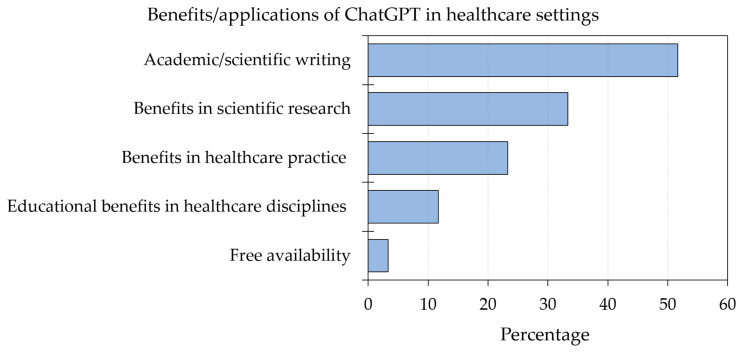
- Benefits were most frequently cited for academic/scientific writing (31 records, 51.7%), followed by scientific research (20, 33.3%), healthcare practice (14, 23.3%), healthcare education (7, 11.7%), and being a free package (2, 3.3%).
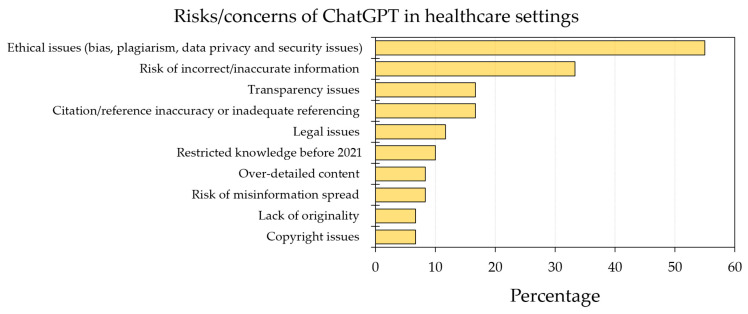
- Ethical concerns were the most common risk category (33 records, 55.0%), including risk of bias (18, 30.0%) and plagiarism (14, 23.3%); incorrect/inaccurate information was cited in 20 records (33.3%), citation/reference inaccuracy in 10 (16.7%), and transparency issues in 10 (16.7%).
- Other reported concerns included legal issues (7, 11.7%), restricted knowledge before 2021 (6, 10.0%), misinformation spread (5, 8.3%), over-detailed content (5, 8.3%), copyright issues (4, 6.7%), and lack of originality (4, 6.7%).
- The review states that ChatGPT does not qualify as an author under current ICMJE/COPE guidelines unless those guidelines are revised, and calls for stakeholder-developed ethics guidance for responsible LLM use in healthcare and academia.
Methods
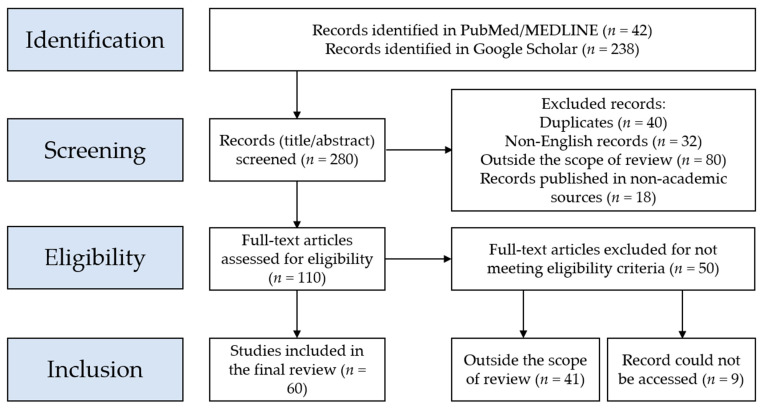
- Systematic review conducted according to PRISMA guidelines, searching PubMed/MEDLINE and Google Scholar for English records on ChatGPT in healthcare practice/research, healthcare education, or academic writing; searches concluded on 16 February 2023.
- PubMed/MEDLINE yielded 42 records and Google Scholar yielded 238 records, totaling 280 records; after duplicate removal (n = 40), non-English exclusion (n = 32), out-of-scope exclusion (n = 80), non-academic source exclusion (n = 18), full-text screening exclusions (n = 41), and inaccessible full texts (n = 9), 60 records were included.
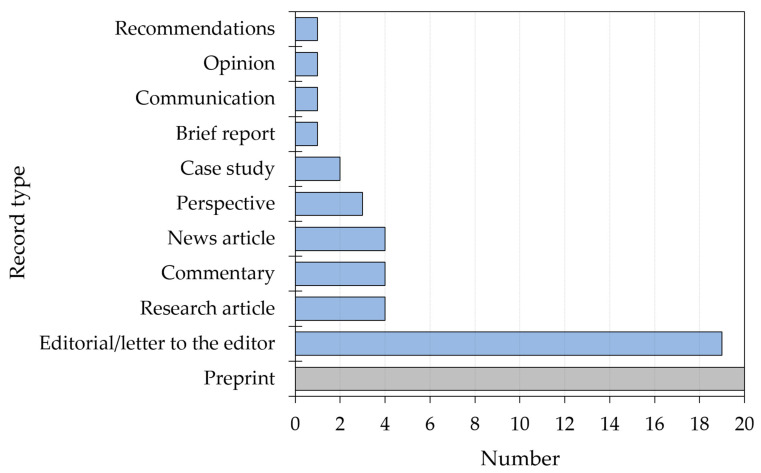
- Each included record was searched for record type, listed benefits/applications, listed risks/concerns, and main conclusions/recommendations regarding ChatGPT in healthcare education, practice, or scientific research/academic writing.
Limitations
- The paper states that included records had variable quality, non-English exclusion may have caused selection bias, inaccessible records may have led to missing relevant data, preprints were not peer reviewed, the literature is growing rapidly with the search ending 16 February 2023, and screening/interpretation was performed by a single author.
- Evident from the text: the review reports descriptive counts of mentions across heterogeneous record types rather than a formal meta-analysis or independent risk-of-bias assessment.
Model-written summary. Check it against the paper before relying on it.
Integrity signals
Registry
Cites
Statistics
Figures
Verification
Claims the paper makes
53 Valid · 1 Not valid · 6 Not checked · 37 Own results and interpretations
Every source the paper cites for this claim was checked and supports it.
In the paper
“This comes in light of the ability of ChatGPT to generate incorrect content that appears plausible from a scientific point of view [81].”
§ ChatGPT Utility in Healthcare Education, Research, and Practice: Systematic Review on the Promising Perspectives and Valid Concerns > 4. Discussion > 4.2. Limitations of ChatGPT Use in Scientific Research
What the sources say
- Supportedcites [81] Cascella M. Montomoli J. Bellini V. Bignami E. Evaluating the Feasibility of ChatGPT in Healthcare: An Analysis of Multiple Clinical and Research Scenarios J. Med. Syst. 2023 47 33 10.1007/s10916-023-01925-4 36869927 PMC9985086 source
In “Reasoning About Public Health Topics,” the paper says ChatGPT can produce believable answers that may be incorrect or nonsensical. In “Possible Misuse of GPT in Medicine and Research,” it describes a scientific abstract that appeared reliable and simulated statistical outputs that could seem plausible to readers. Together, these passages support the claim. (LLM, conf=0.94)
plain- Asserted: passes — The authors put it forward as true.
- Checkable: passes — It can be checked against evidence.
- Load-bearing: passes — The paper’s conclusions depend on it.
- Based: passes — The paper gives a reason why it holds.
- Supported
The sources with a verdict support this claim; the rest weren’t checked yet, have no full text we could read, or their verdicts aren’t rated yet.
In the paper
“This comes in light of the fact that authorship entails legal obligations that are not met by ChatGPT [43,48].”
§ ChatGPT Utility in Healthcare Education, Research, and Practice: Systematic Review on the Promising Perspectives and Valid Concerns > 4. Discussion > 4.2. Limitations of ChatGPT Use in Scientific Research
What the sources say
- Supportedcites [43] Zielinski C. Winker M. Aggarwal R. Ferris L. Heinemann M. Lapeña J. Pai S. Ing E. Citrome L. Chatbots, ChatGPT, and Scholarly Manuscripts WAME Recommendations on ChatGPT and Chatbots in Relation to Scholarly Publications Maced J. Med. Sci. 2023 11 83 86 10.3889/oamjms.2023.11502 37615142 source
The Introduction (p. 2) says chatbots are not legal entities, cannot be held legally liable, and that listing ChatGPT as an author may not be legally defensible. The WAME Recommendations (p. 2) add that chatbots cannot take responsibility for a paper or have the legal standing to sign a statement. (LLM, conf=0.93)
- Not checked — no full text of the sourcecites [48] Liebrenz M. Schleifer R. Buadze A. Bhugra D. Smith A. Generating scholarly content with ChatGPT: Ethical challenges for medical publishing Lancet Digit. Health 2023 5 e105 e106 10.1016/S2589-7500(23)00019-5 36754725 source
plain- Asserted: passes — The authors put it forward as true.
- Checkable: passes — It can be checked against evidence.
- Load-bearing: passes — The paper’s conclusions depend on it.
- Based: passes — The paper gives a reason why it holds.
- Supported
The cited sources support only part of this claim — read each source’s verdict below.
In the paper
“On one hand, ChatGPT, among other LLMs, can be beneficial in conversational and writing tasks, assisting to increase the efficiency and accuracy of the required output [11].”
§ ChatGPT Utility in Healthcare Education, Research, and Practice: Systematic Review on the Promising Perspectives and Valid Concerns > 1. Introduction
What the sources say
- Partly supportedcites [11] Deng J. Lin Y. The Benefits and Challenges of ChatGPT: An Overview Front. Comput. Intell. Syst. 2023 2 81 83 10.54097/fcis.v2i2.4465 sourceExperimental — accuracy not yet measured
Sections 4.1 (Increased Efficiency) and 4.2 (Improved Accuracy) say ChatGPT can make conversations more efficient and generate more accurate responses. The paper does not establish those benefits for writing tasks or for other LLMs, so the broader claim is only partially supported. (LLM, conf=0.88)
plainstates a cause- Asserted: passes — The authors put it forward as true.
- Checkable: passes — It can be checked against evidence.
- Load-bearing: unclear — It is unclear whether the paper’s conclusions depend on it.
- Based: passes — The paper gives a reason why it holds.
- Partly supported
The cited sources support only part of this claim — read each source’s verdict below.
In the paper
“Importantly, the concept of ChatGPT hallucination could be risky if the generated content is not thoroughly evaluated by researchers and health providers with proper expertise [37,56,73,77,79].”
§ ChatGPT Utility in Healthcare Education, Research, and Practice: Systematic Review on the Promising Perspectives and Valid Concerns > 4. Discussion > 4.2. Limitations of ChatGPT Use in Scientific Research
What the sources say
- Not checked — no full text of the sourcecites [37] Shen Y. Heacock L. Elias J. Hentel K.D. Reig B. Shih G. Moy L. ChatGPT and Other Large Language Models Are Double-edged Swords Radiology 2023 230163 10.1148/radiol.230163 36700838 source
- Partly supportedcites [56] Huh S. Are ChatGPT’s knowledge and interpretation ability comparable to those of medical students in Korea for taking a parasitology examination?: A descriptive study J. Educ. Eval. Health Prof. 2023 20 1 10.3352/jeehp.2023.20.1 36627845 PMC9905868 sourceExperimental — accuracy not yet measured
The Background says medical students must evaluate the accuracy of AI-generated medical information before creating reliable information for patients and the public. The Interpretation also reports that some ChatGPT explanations contained incorrect information. These passages support the need for scrutiny, but the paper does not specifically discuss hallucination or evaluation by researchers and health providers. (LLM, conf=0.84)
- Partly supportedcites [73] Duong D. Solomon B.D. Analysis of large-language model versus human performance for genetics questions medRxiv 2023 Preprint 10.1101/2023.01.27.23285115 PMC10999420 37246194 sourceExperimental — accuracy not yet measured
The Discussion (p. 6) says ChatGPT can give plausible explanations for incorrect answers and that its correctness requires additional verification, which is concerning in medical or other high-stakes settings. This supports the risk and need for evaluation, but the paper does not specify that researchers and health providers with proper expertise must perform it. (LLM, conf=0.83)
- Supportedcites [77] Jeblick K. Schachtner B. Dexl J. Mittermeier A. Stüber A.T. Topalis J. Weber T. Wesp P. Sabel B. Ricke J. ChatGPT Makes Medicine Easy to Swallow: An Exploratory Case Study on Simplified Radiology Reports arXiv 2022 10.48550/arxiv.2212.14882 2212.14882 PMC11126432 37794249 source
The Results (Free-text analysis) identify a ChatGPT hallucination that radiologists judged potentially harmful to a patient. The Key Points state that minimizing harm requires supervision by medical experts, supporting the claim’s warning about unevaluated medical content. (LLM, conf=0.90)
- Partly supportedcites [79] Lin Z. Why and how to embrace AI such as ChatGPT in your academic life PsyArXiv 2023 Preprint 10.31234/osf.io/sdx3j PMC10445029 37621662 sourceExperimental — accuracy not yet measured
The “Limitations of generative AI” section says ChatGPT may fabricate facts and false citations (“hallucination”) and urges users to critically evaluate and verify its responses, particularly when reliability is critical. It does not specifically say that researchers and health providers with proper expertise must evaluate the content; that part is more specific than the source. (LLM, conf=0.84)
hedgedstates a possible cause- Asserted: passes — The authors put it forward as true.
- Checkable: passes — It can be checked against evidence.
- Load-bearing: passes — The paper’s conclusions depend on it.
- Based: passes — The paper gives a reason why it holds.
- Rests on an assumption not shown here.
The sources with a verdict support this claim; the rest weren’t checked yet, have no full text we could read, or their verdicts aren’t rated yet.
In the paper
“This is particularly relevant for researchers who are non-native English speakers [23,25,63].”
§ ChatGPT Utility in Healthcare Education, Research, and Practice: Systematic Review on the Promising Perspectives and Valid Concerns > 4. Discussion > 4.1. Benefits of ChatGPT in Scientific Research
What the sources say
- Supportedcites [23] Chen T.J. ChatGPT and Other Artificial Intelligence Applications Speed up Scientific Writing Available online: https://journals.lww.com/jcma/Citation/9900/ChatGPT_and_other_artificial_intelligence.174.aspx (accessed on 16 February 2023) PMC12755446 36791246 source
In the main text (page not provided), Chen says many scientists who are not native English speakers struggle to write in English and describes AI translation and writing tools as ways to overcome that barrier. This supports the claim that language assistance in scientific writing is particularly relevant to those researchers. (LLM, conf=0.91)
- Not checked — no full text of the sourcecites [25] Kitamura F.C. ChatGPT Is Shaping the Future of Medical Writing but Still Requires Human Judgment Radiology 2023 230171 10.1148/radiol.230171 36728749 source
- Supportedcites [63] Gao C.A. Howard F.M. Markov N.S. Dyer E.C. Ramesh S. Luo Y. Pearson A.T. Comparing scientific abstracts generated by ChatGPT to original abstracts using an artificial intelligence output detector, plagiarism detector, and blinded human reviewers bioRxiv 2022 10.1101/2022.12.23.521610 source
The Discussion/Abstract section of our copy states directly that the technology 'could be used by scientists publishing in a language that is not their native language, to improve equity,' alongside the point that generated text 'may help alleviate the burden of writing' and that LLMs are 'a powerful tool to create readable scientific abstracts.' That covers the attributed content — AI-assisted language improvement being especially pertinent for non-native-English researchers — with the source's own hedge ('could be used') slightly weaker than the citing sentence's flat 'is particularly relevant.' No passage in our copy contradicts it. (LLM, conf=0.82)
plainstates an association- Asserted: passes — The authors put it forward as true.
- Checkable: passes — It can be checked against evidence.
- Load-bearing: unclear — It is unclear whether the paper’s conclusions depend on it.
- Based: passes — The paper gives a reason why it holds.
- Supported
42 more claims · 23 with their cited sources checked
Create a free account to see all 97 claims and to verify the 16 references still open.
- Probably not a substantial claim. 31
- It may state two separate claims as one. 27
Claims other papers make about this one
Each is checked against this paper’s own text: does it say what the citing paper says it does?
The source backs part of the claim, not all of it — or backs it for a different population, condition or comparison.
In the citing paper
“The reliance on ChatGPT may result in hindering the development of the skills needed to interpret and respond to social cues, which should be considered in health care education [9,91].”
From Assessing Health Students' Attitudes and Usage of ChatGPT in Jordan: Validation Study (2023) · cites this paper as [9]
Experimental — accuracy not yet measuredThe source backs part of the claim, not all of it — or backs it for a different population, condition or comparison.
In the citing paper
“A recent surge in the use of ChatGPT, in particular for mental health, is emergent for providing crucial personalized advice without clinical explanation, which can hurt user's safety, and thus trust (Sallam, 2023).”
From A review of the explainability and safety of conversational agents for mental health to identify avenues for improvement (2023) · cites this paper as Sallam, 2023
Experimental — accuracy not yet measuredThe source backs part of the claim, not all of it — or backs it for a different population, condition or comparison.
In the citing paper
“ChatGPT plays a crucial role in pandemic management by aiding in the swift and accurate dissemination of critical information.”
From A Systematic Review and Meta-Analysis of Artificial Intelligence Tools in Medicine and Healthcare: Applications, Considerations, Limitations, Motivation and Challenges (2024) · cites this paper as [6]
Experimental — accuracy not yet measuredThe source backs part of the claim, not all of it — or backs it for a different population, condition or comparison.
In the citing paper
“Its natural language processing capabilities enable it to generate coherent responses, making it a valuable tool for healthcare organisations.”
From A Systematic Review and Meta-Analysis of Artificial Intelligence Tools in Medicine and Healthcare: Applications, Considerations, Limitations, Motivation and Challenges (2024) · cites this paper as [6]
Experimental — accuracy not yet measuredThe source backs part of the claim, not all of it — or backs it for a different population, condition or comparison.
In the citing paper
“Specific advantages include its ability to provide rapid updates, preventive measures, and medical guidelines to the public.”
From A Systematic Review and Meta-Analysis of Artificial Intelligence Tools in Medicine and Healthcare: Applications, Considerations, Limitations, Motivation and Challenges (2024) · cites this paper as [6]
Experimental — accuracy not yet measured
31 more claims about this paper
Create a free account to see every claim other papers make about this one.
Citations
Cites
Preferred Reporting Items for Systematic Reviews and Meta-Analyses: the PRISMA statement
Moher, D., Liberati, A., Tetzlaff, J., Altman, D. G., & for the PRISMA Group (2009) · BMJ · doi:10.1136/bmj.b2535 · Cited by 83,823
Preferred Reporting Items for Systematic Reviews and Meta-Analyses: The PRISMA Statement
Moher, D., Liberati, A., Tetzlaff, J., Altman, D. G., & The PRISMA Group (2009) · PLoS Medicine · doi:10.1371/journal.pmed.1000097 · Cited by 64,042 · cited 1×
“The current systematic review was conducted according to the Preferred Reporting Items for Systematic Reviews and Meta-Analyses (PRIMSA) guidelines [21].”
Language Models are Few-Shot Learners
Brown, T. B., Mann, B., Ryder, N., Subbiah, M., Kaplan, J., Dhariwal, P., Neelakantan, A., Shyam, P., Sastry, G., Askell, A., et al. (2020) · arXiv · doi:10.48550/arxiv.2005.14165 · Cited by 23,372 · cited 3×
“The GPT architecture utilizes a neural network to process natural language, thus generating responses based on the context of input text [7].”
BackgroundWang, G., Ma, R., Qiao, G., Wada, K., Aizawa, Y., & Satoh, T. (2015) · Integrative Medicine International · doi:10.1159/000368408 · Cited by 18,657
Kaugeranna, R., Kaugeranna, E., & Aion, (. S. 4. 6. (2023) · DROPS (Schloss Dagstuhl – Leibniz Center for Informatics) · doi:10.4230/lipics.giscience.2023.43 · Cited by 13,690
Machine learning: Trends, perspectives, and prospects
Jordan, M. I., & Mitchell, T. M. (2015) · Science · doi:10.1126/science.aaa8415 · Cited by 9,955
Kung, T. H., Cheatham, M., Medenilla, A., Sillos, C., De Leon, L., Elepaño, C., Madriaga, M., Aggabao, R., Diaz-Candido, G., Maningo, J., et al. (2023) · PLOS Digital Health · doi:10.1371/journal.pdig.0000198 · Cited by 4,115 · cited 2×
“[59] An article showing the ChatGPT raised accuracy which enabled passing the USMLE Accuracy with high concordance and insight; it can facilitate patient communication; improved personalized medicine ChatGPT has a promising potential in medical education; future studies are recommended to consider non-biased approach…”
BackgroundKung, T. H., Cheatham, M., ChatGPT, Medenilla, A., Sillos, C., De Leon, L., Elepaño, C., Madriaga, M., Aggabao, R., Diaz-Candido, G., et al. (2022) · doi:10.1101/2022.12.19.22283643 · Cited by 4,115
Rajpurkar, P., Chen, E., Banerjee, O., & Topol, E. J. (2022) · Nature Medicine · doi:10.1038/s41591-021-01614-0 · Cited by 3,212 · cited 1×
“The promising utility of AI in health care has been outlined previously with possible benefits in personalized medicine, drug discovery, and the analysis of large datasets aside from the potential applications to improve diagnosis and clinical decisions [17,18].”
BackgroundChatting and cheating: Ensuring academic integrity in the era of ChatGPT
Cotton, D. R. E., Cotton, P. A., & Shipway, J. R. (2024) · Innovations in Education and Teaching International · doi:10.1080/14703297.2023.2190148 · Cited by 3,087 · cited 1×
“[62] An EdArXiv 2 preprint on the academic integrity in ChatGPT era Risk of plagiarism; academic dishonesty Careful thinking of educational assessment tools”
Background
Cited by
Items 1,801–1,900 of 3,096
Exploring educators’ perspectives on ChatGPT integration in engineering and management education
Bhaskar, P., Khan, M., & Bhaskar, P. (2025) · Journal of Information Communication and Ethics in Society · doi:10.1108/jices-04-2025-0088 · Cited by 8
MERA: Medical Electronic Records Assistant
Ibrahim, A., Khalili, A., Arabi, M., Sattar, A. H. M. S., Hosseini, A., & Serag, A. (2025) · Machine Learning and Knowledge Extraction · doi:10.3390/make7030073 · Cited by 8
İbas, M., DURSUN, S., Paksoy, M., Öçal, R., & Karataş, E. (2025) · Acta Oto-Laryngologica · doi:10.1080/00016489.2025.2541612 · Cited by 5
“This study’s conclusions are also in line with the broader perspectives summarized in recent systematic reviews by Sallam [13] and Li et al. [14], which outlined both the promising applications and valid concerns regarding the integration of ChatGPT in healthcare education, clinical practice and…”
Umman, V., Tosun, B., Uygur, A., & Emre, S. (2025) · Transplantation Proceedings · doi:10.1016/j.transproceed.2025.07.001 · Cited by 7
Wang, X., Liu, B., & Li, X. (2025) · Journal of Information Science · doi:10.1177/01655515251362399 · Cited by 4
Is ChatGPT a Reliable Source of Information about Dental Bleaching Treatment?
Tonga, G. (2025) · Selcuk Dental Journal · doi:10.15311/selcukdentj.1554003 · Cited by 3
The application and challenges of ChatGPT in laboratory medicine
Niu, Z., Kuang, X., Chen, J., Cai, X., & Zhang, P. (2025) · Advances in Laboratory Medicine / Avances en Medicina de Laboratorio · doi:10.1515/almed-2025-0080 · Cited by 4
Intention to use ChatGPT among law educators in Saudi Arabia
Sarabdeen, J. (2025) · Frontiers in Education · doi:10.3389/feduc.2025.1631413 · Cited by 4
Can artificial intelligence models provide reliable medical counselling to fertility patients?
Alcalay, I., Weissman, A., Herman, H. G., Tsafrir, A., Friedman, M., Weiner, E., Orvieto, R., Polyzos, N. P., Dahan, M. H., Polyakov, A., et al. (2025) · Reproductive BioMedicine Online · doi:10.1016/j.rbmo.2025.105237 · Cited by 5
A review on recent advancements of ChatGPT and datafication in healthcare applications
Jagatheesaperumal, S. K., Pandiyarajan, A., Prabadevi, B., Deepa, N., Barreto, A. G., & de Albuquerque, V. H. C. (2025) · Computers in Biology and Medicine · doi:10.1016/j.compbiomed.2025.110885 · Cited by 6
Göküş, Ş., & Yılmaz, Z. (2025) · Dinbilimleri Akademik Araştırma Dergisi · doi:10.33415/daad.1688342 · Cited by 4
Dymm, B., & Khalid, A. (2025) · Seminars in Neurology · doi:10.1055/a-2713-6622 · Cited by 6
“28 Addressing these issues requires establishing clear ethical guidelines and governance structures to ensure AI is used responsibly and equitably.”
Demir, G., Sevri, M., Hacıosmanoğlu, C. D., Büyüktaşkın, D., & Özaslan, A. (2025) · Gazi Medical Journal · doi:10.12996/gmj.2025.4451 · Cited by 6
Yaylaci, S., Demirdel, S., Deniz, M. E., & Yapici, D. (2025) · American Journal of Health Promotion · doi:10.1177/08901171251391599 · Cited by 4
ChatGPT: how to use it and the pitfalls/cautions in academia
Lee, J. (2025) · Annals of Pediatric Endocrinology & Metabolism · doi:10.6065/apem.2550028.014 · Cited by 5
“This technology showed remarkable natural language processing (NLP) capabilities and contextual understanding, with potential impli cations for clinical practice, medical education, and healthcare service [3,5].”
The Challenge of Academic Integrity in the Age of Generative Artificial Intelligence
Huang, C., Alhur, A. A., Azam, M., & Naeem, S. B. (2025) · Libri · doi:10.1515/libri-2025-0024 · Cited by 14
“To maximize the bene fi ts of GenAI while maintaining educational standards, scope, and relevance, it is essential to integrate these tools after careful consideration, taking into account both the opportunities and challenges presented by GenAI (Sallam 2023).”
Integrating clinical guidelines with large language models for improved sepsis mortality prediction
Zhao, Z., An, B., Zhang, T., Zhu, R., Fan, Z., & Wang, G. (2025) · Health Informatics Journal · doi:10.1177/14604582251387649 · Cited by 6
“18 21 However, current research predominantly relies on pretrained LLMs through simple prompting methods, lacking explicit incorporation of clinical expertise and guideline-based knowledge through supervised fi ne-tuning (SFT).”
OptiChat: Bridging Optimization Models and Practitioners with Large Language Models
Chen, H., Constante‐Flores, G. E., Mantri, K. S. I., Kompalli, S. M., Ahluwalia, A. S., & Li, C. (2025) · INFORMS Journal on Data Science · doi:10.1287/ijds.2025.0074 · Cited by 18
Garcia, E., Adam, M. K., Dow, E. R., Minaker, S. A., Scarboro, S. D., Storey, P. P., Wood, E. H., Abousy, M., Wykoff, C. C., & Al-khersan, H. (2025) · Journal of VitreoRetinal Diseases · doi:10.1177/24741264251381990 · Cited by 3
Nuccetelli, F., Gabellone, V., Marsano, F., Giovanetti, F., Dri, P., Valetto, M. R., & Prato, R. (2025) · European Journal of Public Health · doi:10.1093/eurpub/ckaf189 · Cited by 8
Recent Advances and Future Directions of Artificial Intelligence in Glaucoma Management
Tang, W., Hang, Y., Zhang, J., & Dang, Y. (2025) · The Open Ophthalmology Journal · doi:10.2174/0118743641430437251130165439 · Cited by 5
Yao, F., Zhu, D., Lin, H., Miao, C., Lin, Q., Li, T., Zhuang, Y., Bian, S., Yang, Y., Lin, J. J., et al. (2025) · Prostate Cancer and Prostatic Diseases · doi:10.1038/s41391-025-01063-7 · Cited by 4
“Larger prospective, multicenter studies are required to con fi rm their robustness, improve generalizability, and support future clinical use.”
Balcı, M. F., Akdemir, C., & Yıldırım, F. (2025) · Cukurova Anestezi ve Cerrahi Bilimler Dergisi · doi:10.36516/jocass.1753846 · Cited by 3
Kumar, V., Mann, N. S., & Sharma, K. (2025) · Australian Endodontic Journal · doi:10.1111/aej.70046 · Cited by 5
Virvou, M. K., Tsihrintzis, G. A., & Alepis, E. (2025) · International Conference on Information, Intelligence, Systems & Applications (IISA) · doi:10.1109/iisa66859.2025.11309835 · Cited by 8
“A systematic review highlighted ChatGPT's promising applications in healthcare education, research, and practice, while also cautioning against risks like misinformation and hallucinations [69].”
Faneli, A. C., Scherer, R., Muralidhar, R., Guerreiro-Filho, M., Beniz, L. A. F., Vilasboas-Campos, V., da Costa, D. R., Jammal, A. A., & Medeiros, F. A. (2026) · JMIR AI · doi:10.2196/72101 · Cited by 3
Ruggiano, N., Sahoo, S., Brashear, A., Nwatu, U. L., Brunson, A., Noh, H., Cole, H. S., McKinney, R., Suarez, C. V. F., Brown, E. L., et al. (2026) · JMIR Medical Education · doi:10.2196/83085 · Cited by 5
“In a systematic review of the health education literature, Sallam [23] found that ChatGPT had the potential for creating tailored educational content and communication skill development for students that provides immediate feedback.”
Thiru, S. S., Aksu, N. E., Chiang, M., Gallagher, D. O., Furlong, M., Prevou, E. R., & Khanna, A. J. (2026) · JMIR Medical Education · doi:10.2196/82885 · Cited by 4
“Artificial intelligence (AI) refers to the ability of digital systems to perform tasks traditionally requiring human intelligence, such as pattern recognition, problem-solving, and decision-making [1-3].”
Beyond ChatGPT: a review of the use of AI tools in biological education
Cotton, P. A., & Cotton, D. (2026) · Journal of Biological Education · doi:10.1080/00219266.2026.2628797 · Cited by 8
Artificial Intelligence and Academic-Based Writing Pedagogy
Oyenuga, M. O. (2026) · Advances in computational intelligence and robotics book series · doi:10.4018/979-8-3373-5601-3.ch001 · Cited by 5
Mercan, N., Eravşar, E., Ergin, M., Çatal, T., Çiftçi, S., & Akkaya, M. (2026) · BMC Musculoskeletal Disorders · doi:10.1186/s12891-026-09731-y · Cited by 4
“It has rapidly become widespread across a wide range of applications, including healthcare [16, 17].”
Xue, J., Wang, S., Yang, J., Guo, X., Shen, J., & Wang, Q. (2026) · JMIR Formative Research · doi:10.2196/90673 · Cited by 3
Combining AI with urban resilience planning: A bibliometric analysis of literature
Praharaj, S. (2026) · City and Environment Interactions · doi:10.1016/j.cacint.2026.100342 · Cited by 7
Faculty perceptions of generative AI in Azerbaijani higher education
Ismayil, Z., Jafarov, A., Adil, G., Soltanova, A. E., Mansimova, K. G., Alishanova, A., Gundogdu, S., Hasanova, N., Aliyev, S. T., Ahmadov, H., et al. (2026) · European Journal of STEM Education · doi:10.20897/ejsteme/18310 · Cited by 14
“It has been shown that AI models such as ChatGPT may provide high-quality answers in any field, which brings up questions of assessment validity, academic integrity, and skills development (Sallam, 2023).”
Zhang, Y., & Soares, D. J. (2026) · Plastic & Reconstructive Surgery Global Open · doi:10.1097/gox.0000000000007676 · Cited by 3
Ethical dimensions of artificial intelligence integration into dental practice
Narad, C., Sharda, K., & Aasdhir, S. S. (2026) · The Journal of the American Dental Association · doi:10.1016/j.adaj.2026.02.004 · Cited by 6
Paslı, B., & Beşer, C. G. (2026) · Anatomical Sciences Education · doi:10.1002/ase.70255 · Cited by 5
The Study of Evolution and Application Related to the Chat-GPT
Li, Y. (2023) · Highlights in Science Engineering and Technology · doi:10.54097/hset.v57i.9999 · Cited by 6
“The applications of Chat-GPT are diverse and far-reaching [11-14], ranging from enhancing communication in the workplace to improving machine translation and generating creative writing.”
BackgroundArtificial intelligence utility for drug development: ChatGPT and beyond
Gurwitz, D., & Shomron, N. (2023) · Drug Development Research · doi:10.1002/ddr.22121 · Cited by 5
The Genie Is Out of the Bottle: What ChatGPT Can and Cannot Do for Medical Professionals
Morales-Ramirez, P., Mishek, H., & Dasgupta, A. (2023) · Obstetrics and Gynecology · doi:10.1097/aog.0000000000005446 · Cited by 4
“27 Considering these concerns, a researcher ’ s expertise and ethical standards are still necessary.”
BackgroundAutomatic Topic Label Generation using Conversational Models
Ramón-Ferrer, V., Badenes-Olmedo, C., & Corcho, Ó. (2023) · International Conference on Knowledge Capture · doi:10.1145/3587259.3627574 · Cited by 6
“…given the social impact and the apparent potential it presents, as it has proven to be a very powerful tool which not only has the ability to hold a conversation, but can also carry out tasks of another nature, such as efficient analysis of datasets or code generation for health care research [36].”
BackgroundWalking a Tightrope – Evaluating Large Language Models in High-Risk Domains
Hung, C.-C., Rim, W. B., Frost, L., Bruckner, L., & Lawrence, C. (2023) · GenBench Workshop on Generalisation (Benchmarking) in NLP (GenBench) · doi:10.18653/v1/2023.genbench-1.8 · Cited by 27
The NCSBN 2024 Environmental Scan: Every Moment Matters, Realizing Lasting Impact
National Council of State Boards of Nursing (2024) · Journal of Nursing Regulation · doi:10.1016/s2155-8256(23)00127-8 · Cited by 3
Santana, L. A. D. M., Gonçalo, R. I. C., Floresta, L. G., et al. (2024) · Oral Oncology · doi:10.1016/j.oraloncology.2024.106685 · Cited by 3
Balasanjeevi, G., & Surapaneni, K. M. (2024) · Respiratory Medicine and Research · doi:10.1016/j.resmer.2024.101091 · Cited by 9
Alleviating Elderly’s Medical Communication Issue with Personalized LLM-Generated Short-Form Video
Zhuang, N., Ma, Z., Zhou, Y., Li, X., Wang, P., Huang, Z., Zhai, S., & Ying, F. (2024) · Frontiers in artificial intelligence and applications · doi:10.3233/faia240078 · Cited by 3
Research on confusing responses based on ChatGPT
Xiong, H. (2024) · Applied and Computational Engineering · doi:10.54254/2755-2721/57/20241315 · Cited by 3
Kim, Y. I., Kim, K. H., Oh, H.-J., Seo, Y., Kwon, S. M., Sung, K. S., Chong, K., & Lee, M. H. (2024) · World Neurosurgery · doi:10.1016/j.wneu.2024.05.023 · Cited by 6
Zhou, Z., Gan, W., Xie, J., Guo, Z., & Zhang, Z. (2024) · International Journal of Surgery · doi:10.1097/js9.0000000000001613 · Cited by 4
“The standardized usage policies, accountability systems for AI software, and traceability functions for historical usage records often lag behind the development and iteration of the software [4] .”
BackgroundPOTENTIAL CONTRIBUTION OF ChatGPT® TO LEARNING ABOUT SEPTIC SHOCK IN INTENSIVE CARE
Sasso, G. T. M. D., Lanzoni, G. M. D. M., Alvarez, A. G., Barra, D. C. C., & Barbosa, S. D. F. F. (2024) · Texto & Contexto - Enfermagem · doi:10.1590/1980-265x-tce-2023-0184en · Cited by 7
ТЕХНОЛОГІЇ ШТУЧНОГО ІНТЕЛЕКТУ ЯК СКЛАДОВА ЦИФРОВОЇ КОМПЕТЕНТНОСТІ МАЙБУТНІХ ЛІКАРІВ
Матвієнко, М. М. (2024) · Medicina ta farmacìâ: osvìtnì diskursi. · doi:10.32782/eddiscourses/2024-1-4 · Cited by 4
Evangelista, I. R. S., Bandala, A. A., Culaba, A. B., Concepcion, R., & Dadios, E. P. (2023) · IEEE International Conference on Humanoid, Nanotechnology, Information Technology, Communication and Control, Environment, and Management (HNICEM) · doi:10.1109/hnicem60674.2023.10589020 · Cited by 5
“In 2022, OpenAI, a private research agency focusing on developing AI systems, launched ChatGPT, a conversation AI based on large language model (LLM) [21].”
BackgroundAközlü, Z., & Erkut, Z. (2024) · Indian Journal of Medical and Paediatric Oncology · doi:10.1055/s-0044-1788701 · Cited by 5
Mensah, P. B., Quao, N. S. A., Dagadu, S., Mensah, J. K., Darkwah, J. D., & Clinician, P. E. G. (2024) · IEEE International Conference on Healthcare Informatics (ICHI) · doi:10.1109/ichi61247.2024.00093 · Cited by 13
“…delivery when they are incorporated in various capacities such as: in automation of administrative tasks, clinical decision support tools, virtual health assistants, screening tools, health trackers, clinical language translation tools, medical research and health education tools [4][5][6][7].”
Ethical Considerations for Generative AI in Social Science Research
Brown, B. A., & Heitner, K. L. (2024) · Advances in computational intelligence and robotics book series · doi:10.4018/979-8-3693-8557-9.ch006 · Cited by 4
Kochis, M. A., Parsons, M. Q., Rothman, D., PETRUSA, E. R., & Phitayakorn, R. (2024) · Global Surgical Education - Journal of the Association for Surgical Education · doi:10.1007/s44186-024-00292-z · Cited by 5
“Furthermore, there is worry that overreliance on AI may degrade critical thinking and problem solving, which are essential elements of physician training [10, 11].”
Daungsupawong, H., & Wiwanitkit, V. (2024) · Formosan Journal of Surgery · doi:10.1097/fs9.0000000000000177 · Cited by 2
A Comprehensive Examination of ChatGPT's Contribution to the Healthcare Sector and Hepatology
Kumari, K., Pahuja, S. K., & Kumar, K. S. (2024) · Digestive Diseases and Sciences · doi:10.1007/s10620-024-08659-4 · Cited by 3
Zare, S., Vafaeian, S., Amini, M., Farhadi, K., Vali, M., & Golestani, A. (2024) · Scientific Reports · doi:10.1038/s41598-024-79335-w · Cited by 7
“These LLMs perform as proficient learning models, absorbing knowledge and applying it to a wide range of tasks, such as determining the best course of action for a patient or deciphering intricate medical concepts 19,20 .”
Shapiro, J. S., Lyakhovitsky, A., Freud, T., Pavlotsky, F., Khamaysi, Z., Valdman‐Grinshpoun, Y., Dodiuk‐Gad, R. P., Goldberg, I., Ingber, A., Kaplan, B., et al. (2025) · Acta Dermato Venereologica · doi:10.2340/actadv.v105.41208 · Cited by 4
ChatGPT, Python, and Microsoft Excel
Sbampato, K., de Arruda, H. H., & Silva, É. R. (2025) · Journal of the Medical Library Association JMLA · doi:10.5195/jmla.2025.2065 · Cited by 3
Odhabi, H. I., & Abi-Raad, M. (2025) · Communications in computer and information science · doi:10.1007/978-3-031-79086-7_4 · Cited by 4
Roussel, S., & Ochoa, M. (2025) · Alsic · doi:10.4000/13cv6 · Cited by 11
Malkawi, R. (2025) · Research Journal of Pharmacy and Technology · doi:10.52711/0974-360x.2025.00325 · Cited by 7
Algarni, A. D. (2025) · Scientific Reports · doi:10.1038/s41598-025-01518-w · Cited by 6
Zhang, Z., Scroggins, J. K., Harkins, S., Hulchafo, I. I., Moen, H., Tadiello, M., Barcelona, V., & Topaz, M. (2025) · Nursing Outlook · doi:10.1016/j.outlook.2025.102472 · Cited by 4
Zhou, J., & Zhang, H. (2025) · Education and Information Technologies · doi:10.1007/s10639-025-13679-2 · Cited by 8
“Meanwhile, Sallam's research points out that regarding ethics, copyright, risk of bias, plagiarism, factual errors, misquotes and cybersecurity, the use of AI chatbots should be taken with a high degree of caution (Sallam, 2023).”
Paediatric rare diseases: Can large language models assist off‐label prescribing?
Flamigni, A., Zamagni, G., Paternuosto, G., & Arbo, A. (2025) · British Journal of Clinical Pharmacology · doi:10.1002/bcp.70168 · Cited by 4
“21,22,27 32 The aim of the present study was to evaluate the effectiveness of different LLMs in assisting human evaluation.”
Ng, J. Q. X., Chua, J. Y. X., Choolani, M. A., Li, S. W. L., Foo, L. F., Pereira, T. L., & Shorey, S. (2025) · Nurse Education in Practice · doi:10.1016/j.nepr.2025.104488 · Cited by 7
Seth, I., Marcaccini, G., Lim, B., Novo, J., Bacchi, S., Cuomo, R., Ross, R. J., & Rozen, W. M. (2025) · Informatics · doi:10.3390/informatics12030086 · Cited by 5
“Such shortcomings raised important questions regarding AI-generated content’s reliability and academic utility [3–5].”
GETgene-AI: a framework for prioritizing actionable cancer drug targets
Gu, A., & Chen, J. Y. (2025) · Frontiers in Systems Biology · doi:10.3389/fsysb.2025.1649758 · Cited by 6
“Concurrently, AI-driven literature review (e.g., GPT-4) automates the synthesis of preclinical and clinical evidence, identifying targets with mechanistic and translational relevance (Liu et al., 2021; Oniani et al., 2024; Sallam, 2023; Tripathi et al., 2024).”
Authorial Integrity in the Age of Artificial Intelligence: A Scientific Autobiography
Colenda, C. C. (2025) · American Journal of Geriatric Psychiatry · doi:10.1016/j.jagp.2025.10.004 · Cited by 4
Birkun, A. A. (2023) · Prehospital and Disaster Medicine · doi:10.1017/s1049023x23006258 · Cited by 3
A Systematic Review of Research on ChatGPT: The User Perspective
Guan, C., Ding, D., Gupta, P., Hung, Y.-C., & Jiang, Z. (2023) · Advances in digital crime, forensics, and cyber terrorism book series · doi:10.4018/978-1-6684-8422-7.ch007 · Cited by 6
Using ChatGPT and other LLMs in Professional Environments
Alaswad, S., Kalganova, T., & S. Awad, W. (2023) · Information Sciences Letters · doi:10.18576/isl/120916 · Cited by 6
Vitorino, L. M., & Júnior, G. H. Y. (2023) · Revista Brasileira de Enfermagem · doi:10.1590/0034-7167.2023760301pt · Cited by 3
Text generative artificial intelligence tools for clinical applications: scope and concerns
Singh, A. V., & Singh, A. (2023) · Irish Journal of Medical Science (1971 -) · doi:10.1007/s11845-023-03537-w · Cited by 2
“Moreover, approval of ethical credibility and plagiarism are crucial limitations [5].”
ChatGPT: The Silent Partner in Healthcare
Margam, R. (2023) · The Review of Contemporary Scientific and Academic Studies · doi:10.55454/rcsas.3.10.2023.005 · Cited by 2
Alabdullah, T. T. Y. (2023) · MARGINAL JOURNAL OF MANAGEMENT ACCOUNTING GENERAL FINANCE AND INTERNATIONAL ECONOMIC ISSUES · doi:10.55047/marginal.v3i1.835 · Cited by 3
“…effectively communicating the benefits of information sharing, and addressing faculty apprehensions are crucial measures to take. c. Intellectual Property and Ownership: Ownership related to intellectual property can present intricate challenges within an academic context (Sallam, 2023).”
BackgroundChatGPT in medicine: Opportunity and challenges
Sanaei, M., Ravari, M. S., & Abolghasemi, H. (2023) · Iranian Journal of Blood and Cancer · doi:10.61186/ijbc.15.3.60 · Cited by 5
ChatGPT, a powerful language model and its potential uses in bioinformatics
Bhardwaj, S., & Hasija, Y. (2023) · International Conference on Computing, Communication and Networking Technologies (ICCCNT) · doi:10.1109/icccnt56998.2023.10308320 · Cited by 5
“[ 43], [44] The inability of ChatGPT to handle specific types of data is one of its significant drawbacks in bioinformatics.”
BackgroundAvello, D., & Estrada-Palavecino, L. (2023) · Cadernos Brasileiros de Terapia Ocupacional · doi:10.1590/2526-8910.ctoen271035343 · Cited by 8
“Existen varios estudios que han también han explorado el uso de ChatGPT en las prácticas sanitarias apoyando decisiones médicas y mejorando la gestión administrativa de dispositivos de salud (Cascella et al., 2023; Sallam, 2023).”
BackgroundInfluentialCurriculum Theorising in the Era of the Fourth Industrial Revolution
Fomunyam, K. G. (2023) · African Journal of Inter/Multidisciplinary Studies · doi:10.51415/ajims.v5i1.1320 · Cited by 5
Potential functions of artificial intelligence chatbot ChatGPT in health management: Scoping review
Yıldız, M. S., & Alper, A. (2023) · Turkish Bulletin of Hygiene and Experimental Biology · doi:10.5505/turkhijyen.2023.78370 · Cited by 4
Integrating ChatGPT into English Language Teaching and Learning: Strengths and Weaknesses
Juan, W., Qing, S., Yunus, M. M., & Rafiq, K. R. M. (2023) · International Journal of Academic Research in Business and Social Sciences · doi:10.6007/ijarbss/v13-i12/20251 · Cited by 14
Can Large Language Models Support Medical Facilitation Work? A Speculative Analysis
Abdulhamid, N. G., Ochieng, M., Bali, K., Ankrah, E. A., Karusala, N., Ronen, K., & O’Neill, J. (2023) · African Human Computer Interaction Conference (AfriCHI) · doi:10.1145/3628096.3628752 · Cited by 8
“Guidelines for using LLMs and CAs in healthcare are also discussed [2, 55, 72].”
MethodChatGPT: An Artificial Intelligence-Based Approach to Enhance Medical Applications
Chaddad, A., He, C., & Jiang, Y. (2023) · IEEE International Conference on Bioinformatics and Bioengineering (BIBE) · doi:10.1109/bibe60311.2023.00078 · Cited by 3
Financial Text Sentiment Analysis Based on ChatGPT—Taking the Real Estate Industry as an Example
Lin, J., Chen, Q., Li, S., Li, B., & Yen, J. (2024) · Communications in computer and information science · doi:10.1007/978-981-97-0837-6_13 · Cited by 4
Rabie, D. R. M. (2023) · العلوم التربوية · doi:10.21608/ssj.2023.344574 · Cited by 3
Role of C hat GPT in Academia: Dental Students’ Perspectives
Shrivastava, P. K., Uppal, S., Kumar, G., & Jha, P. (2024) · Primary Dental Journal · doi:10.1177/20501684241230191 · Cited by 3
Intersection of Artificial Intelligence and Medical Education (Student Abstract)
Wu, K. P., & Tsang, P. C. (2024) · Proceedings of the AAAI Conference on Artificial Intelligence · doi:10.1609/aaai.v38i21.30525 · Cited by 3
Allan, P. D., Knight, M., Evans, R., & Narayanan, A. (2024) · ANZ Journal of Surgery · doi:10.1111/ans.19000 · Cited by 3
Tran, T. (2024) · Technology in Language Teaching & Learning · doi:10.29140/tltl.v6n1.1104 · Cited by 8
Sasso, G. T. M. D., Lanzoni, G. M. D. M., Alvarez, A. G., Barra, D. C. C., & Barbosa, S. D. F. F. (2024) · Texto & Contexto - Enfermagem · doi:10.1590/1980-265x-tce-2023-0184pt · Cited by 3
Zhao, T., Chance, R., Buckhalter, C., & Wang, G. C. (2024) · EPiC series in built environment · doi:10.29007/4d7m · Cited by 8
Bibliometric Analysis of Global Research on Scientific Writing
Maral, M. (2024) · DESIDOC Journal of Library & Information Technology · doi:10.14429/djlit.44.3.19534 · Cited by 6
The gendered nature of AI: Men and masculinities through the lens of ChatGPT and GPT4
Walther, A., Logoz, F., & Eggenberger, L. (2024) · Computers in Human Behavior Artificial Humans · doi:10.1016/j.chbah.2024.100076 · Cited by 11
Advancing scientific writing with artificial intelligence: expanding the research toolkit
Atkinson, A. G., Lia, H., & Navarro, S. M. (2024) · Global Surgical Education - Journal of the Association for Surgical Education · doi:10.1007/s44186-024-00271-4 · Cited by 6
“Plagiarism is a commonly cited concern when using generative AI in scientific writing, though many generative AI outputs pass plagiarism checks [21, 22].”
Kodali, R. K., Upreti, Y. P., & Boppana, L. (2023) · IEEE International Conference on Humanoid, Nanotechnology, Information Technology, Communication and Control, Environment, and Management (HNICEM) · doi:10.1109/hnicem60674.2023.10589199 · Cited by 6
“The AI Progress investigates the possibilities and obstacles presented by ChatGPT, particularly in sectors such as healthcare [3] and education [5].”
Feng, Z. (2024) · Advances in Economics Management and Political Sciences · doi:10.54254/2754-1169/90/20241947 · Cited by 5
Metadata
- Authors
- Sallam, M.
- Affiliations
- University of Jordan (JO)
- Corresponding author
- Sallam, Malik
- ORCID
- Sallam, Malik
- Venue
- Healthcare
- Publisher
- MDPI AG
- Published
- 2023-03-19
- Volume
- 11
- Issue
- 6
- Pages
- 887
- ISSN
- 2227-9032 (ISSN-L)
- PMC
- PMC10048148
- OpenAlex
- W4327946446
- Semantic Scholar
- dfdf7ff01aa6f691831e663fd29bc71890be39e2
- Cited by
- 3,126
- References
- 114
- Citations by year
- 2026: 561 · 2025: 839 · 2024: 1052 · 2023: 669
- FWCI
- 36.67
- Type
- journal article
- Language
- en
- Open access
- gold
- doi.org
- Licence
- Locations
- Healthcare (publishedVersion, cc-by)
- medRxiv (acceptedVersion, cc-by-nc-nd)
- Preprints.org (acceptedVersion, cc-by)
- PubMed Central (publishedVersion, cc-by)
- PubMed (publishedVersion)
- Topics
- Health Sciences › Medicine › Health Informatics › Artificial Intelligence in Healthcare and Education
- Physical Sciences › Computer Science › Artificial Intelligence › Artificial Intelligence Applications
- Social Sciences › Education › Artificial Intelligence in Education
- Keywords
- ChatGPT, large language models, artificial intelligence in healthcare, healthcare education, health care research, clinical practice, scientific writing, research equity, drug discovery, personalized medicine, health literacy, plagiarism, hallucinations, authorship criteria, AI ethics, infodemic
About these checks
Registry, retraction, Cites and statistics results are computed, not judged, with one exception: a printed reference that no index lists is read once by a model before it counts as a citation error. Claims are extracted by a model and kept only when their quote appears verbatim in the text; each cited source is then checked, with a model’s help, for whether it says what the claim relies on. Those verdicts can be wrong — read the claim’s quote and the cited source before relying on one.
The claim verdicts this report counts are experimental: their accuracy is not yet measured.
A language model drew the claims from the paper on 2026-10-10, under version 3 of the claim definition (model deepseek-v4.1-flash, prompt extract-v3).
A second model labelled each claim on 2026-10-10 (model jev-1.13-20260917, definition revision gold-guideline-v0.2).
Cited sources are checked with a language model’s help (gpt-6-sol and qwen3.8-omni-flash).
Statistics and arithmetic are recomputed, not judged.
Confidence bands are shown only for fields calibrated on our annotated test set. None is calibrated yet, so no band is shown.
What counts as a claim ›How we measure confidence ›How we check this ›
Are you an author, or do you see a problem with this page? Request a review
Data sources
Bibliographic data: Semantic Scholar, OpenAlex, Crossref.
Contains information from the Semantic Scholar Academic Graph Datasets, made available under the ODC Attribution License (ODC-BY 1.0).
Semantic Scholar’s data is described in: Kinney, R., et al. (2023). The Semantic Scholar Open Data Platform. arXiv:2301.10140.
