

ChatGPT Utility in Healthcare Education, Research, and Practice: Systematic Review on the Promising Perspectives and Valid Concerns
Open accessPublished version of a preprint
The DOI matches its Crossref record; 116 of the 117 references it cites were found in a registry or an index; 110 of the 179 sources its claims cite were checked for support.
Abstract
ChatGPT is an artificial intelligence-powered chatbot. This systematic review synthesised the evidence regarding its application in healthcare education, research, and practice. ChatGPT shows remarkable utilities in summarizing research, translating materials, serving as a virtual tutor, drafting case scenarios, and automating administrative workflows. However, concerns regarding incorrect outputs (hallucinations), lack of analytical depth, risk of plagiarism, and algorithmic bias remain significant across the literature.
Overview
CoChat Summary
TL;DR
This systematic review of 60 records found that ChatGPT was cited as beneficial in 51/60 (85.0%) records for healthcare education, research, and practice, while concerns were raised in 58/60 (96.7%) records. The author concludes that ChatGPT has promising applications but requires cautious, guideline-driven use, and does not currently qualify for scientific authorship under ICMJE/COPE guidelines.
Key findings
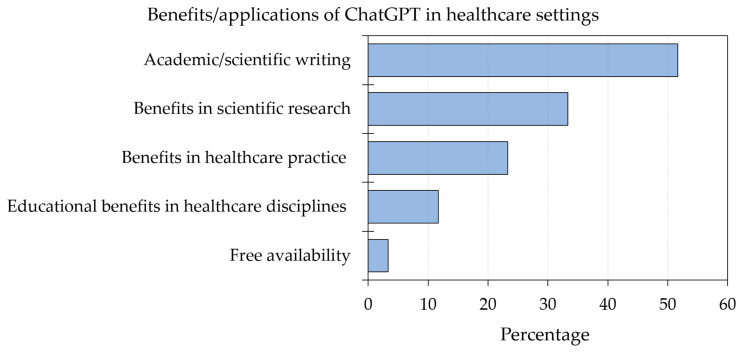
- Benefits were most frequently cited for academic/scientific writing (31 records, 51.7%), followed by scientific research (20, 33.3%), healthcare practice (14, 23.3%), healthcare education (7, 11.7%), and being a free package (2, 3.3%).
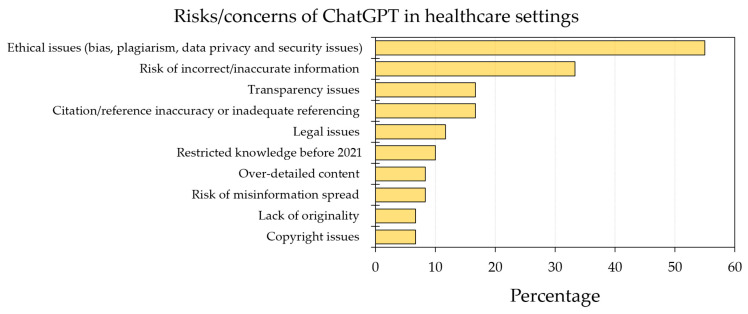
- Ethical concerns were the most common risk category (33 records, 55.0%), including risk of bias (18, 30.0%) and plagiarism (14, 23.3%); incorrect/inaccurate information was cited in 20 records (33.3%), citation/reference inaccuracy in 10 (16.7%), and transparency issues in 10 (16.7%).
- Other reported concerns included legal issues (7, 11.7%), restricted knowledge before 2021 (6, 10.0%), misinformation spread (5, 8.3%), over-detailed content (5, 8.3%), copyright issues (4, 6.7%), and lack of originality (4, 6.7%).
- The review states that ChatGPT does not qualify as an author under current ICMJE/COPE guidelines unless those guidelines are revised, and calls for stakeholder-developed ethics guidance for responsible LLM use in healthcare and academia.
Methods
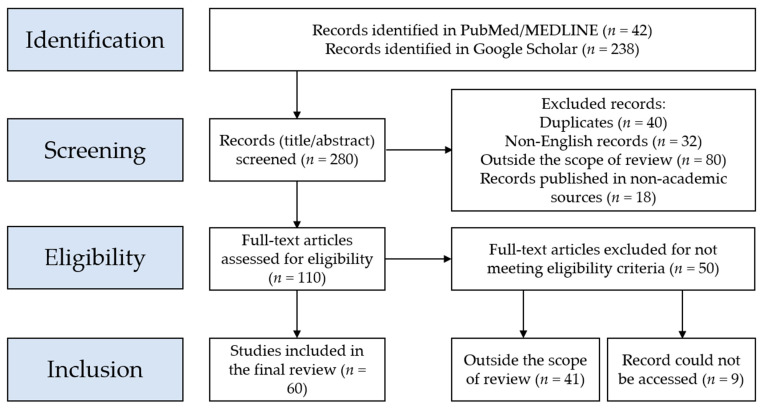
- Systematic review conducted according to PRISMA guidelines, searching PubMed/MEDLINE and Google Scholar for English records on ChatGPT in healthcare practice/research, healthcare education, or academic writing; searches concluded on 16 February 2023.
- PubMed/MEDLINE yielded 42 records and Google Scholar yielded 238 records, totaling 280 records; after duplicate removal (n = 40), non-English exclusion (n = 32), out-of-scope exclusion (n = 80), non-academic source exclusion (n = 18), full-text screening exclusions (n = 41), and inaccessible full texts (n = 9), 60 records were included.
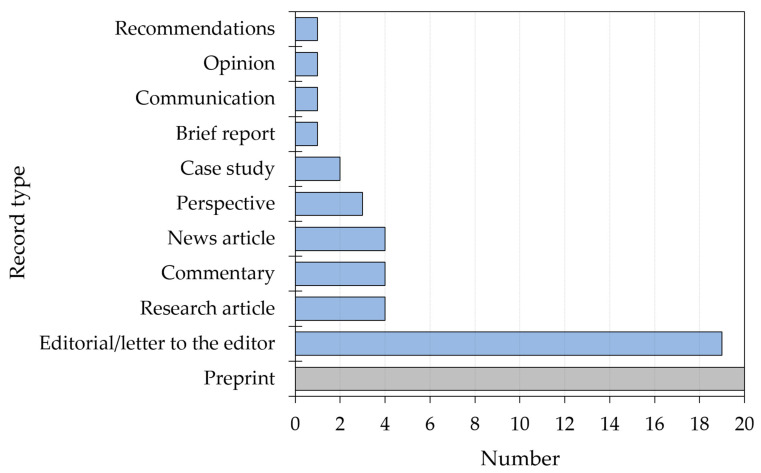
- Each included record was searched for record type, listed benefits/applications, listed risks/concerns, and main conclusions/recommendations regarding ChatGPT in healthcare education, practice, or scientific research/academic writing.
Limitations
- The paper states that included records had variable quality, non-English exclusion may have caused selection bias, inaccessible records may have led to missing relevant data, preprints were not peer reviewed, the literature is growing rapidly with the search ending 16 February 2023, and screening/interpretation was performed by a single author.
- Evident from the text: the review reports descriptive counts of mentions across heterogeneous record types rather than a formal meta-analysis or independent risk-of-bias assessment.
Model-written summary. Check it against the paper before relying on it.
Integrity signals
Registry
Cites
Statistics
Figures
Verification
Claims the paper makes
53 Valid · 1 Not valid · 6 Not checked · 37 Own results and interpretations
Every source the paper cites for this claim was checked and supports it.
In the paper
“This comes in light of the ability of ChatGPT to generate incorrect content that appears plausible from a scientific point of view [81].”
§ ChatGPT Utility in Healthcare Education, Research, and Practice: Systematic Review on the Promising Perspectives and Valid Concerns > 4. Discussion > 4.2. Limitations of ChatGPT Use in Scientific Research
What the sources say
- Supportedcites [81] Cascella M. Montomoli J. Bellini V. Bignami E. Evaluating the Feasibility of ChatGPT in Healthcare: An Analysis of Multiple Clinical and Research Scenarios J. Med. Syst. 2023 47 33 10.1007/s10916-023-01925-4 36869927 PMC9985086 source
In “Reasoning About Public Health Topics,” the paper says ChatGPT can produce believable answers that may be incorrect or nonsensical. In “Possible Misuse of GPT in Medicine and Research,” it describes a scientific abstract that appeared reliable and simulated statistical outputs that could seem plausible to readers. Together, these passages support the claim. (LLM, conf=0.94)
plain- Asserted: passes — The authors put it forward as true.
- Checkable: passes — It can be checked against evidence.
- Load-bearing: passes — The paper’s conclusions depend on it.
- Based: passes — The paper gives a reason why it holds.
- Supported
The sources with a verdict support this claim; the rest weren’t checked yet, have no full text we could read, or their verdicts aren’t rated yet.
In the paper
“This comes in light of the fact that authorship entails legal obligations that are not met by ChatGPT [43,48].”
§ ChatGPT Utility in Healthcare Education, Research, and Practice: Systematic Review on the Promising Perspectives and Valid Concerns > 4. Discussion > 4.2. Limitations of ChatGPT Use in Scientific Research
What the sources say
- Supportedcites [43] Zielinski C. Winker M. Aggarwal R. Ferris L. Heinemann M. Lapeña J. Pai S. Ing E. Citrome L. Chatbots, ChatGPT, and Scholarly Manuscripts WAME Recommendations on ChatGPT and Chatbots in Relation to Scholarly Publications Maced J. Med. Sci. 2023 11 83 86 10.3889/oamjms.2023.11502 37615142 source
The Introduction (p. 2) says chatbots are not legal entities, cannot be held legally liable, and that listing ChatGPT as an author may not be legally defensible. The WAME Recommendations (p. 2) add that chatbots cannot take responsibility for a paper or have the legal standing to sign a statement. (LLM, conf=0.93)
- Not checked — no full text of the sourcecites [48] Liebrenz M. Schleifer R. Buadze A. Bhugra D. Smith A. Generating scholarly content with ChatGPT: Ethical challenges for medical publishing Lancet Digit. Health 2023 5 e105 e106 10.1016/S2589-7500(23)00019-5 36754725 source
plain- Asserted: passes — The authors put it forward as true.
- Checkable: passes — It can be checked against evidence.
- Load-bearing: passes — The paper’s conclusions depend on it.
- Based: passes — The paper gives a reason why it holds.
- Supported
The cited sources support only part of this claim — read each source’s verdict below.
In the paper
“On one hand, ChatGPT, among other LLMs, can be beneficial in conversational and writing tasks, assisting to increase the efficiency and accuracy of the required output [11].”
§ ChatGPT Utility in Healthcare Education, Research, and Practice: Systematic Review on the Promising Perspectives and Valid Concerns > 1. Introduction
What the sources say
- Partly supportedcites [11] Deng J. Lin Y. The Benefits and Challenges of ChatGPT: An Overview Front. Comput. Intell. Syst. 2023 2 81 83 10.54097/fcis.v2i2.4465 sourceExperimental — accuracy not yet measured
Sections 4.1 (Increased Efficiency) and 4.2 (Improved Accuracy) say ChatGPT can make conversations more efficient and generate more accurate responses. The paper does not establish those benefits for writing tasks or for other LLMs, so the broader claim is only partially supported. (LLM, conf=0.88)
plainstates a cause- Asserted: passes — The authors put it forward as true.
- Checkable: passes — It can be checked against evidence.
- Load-bearing: unclear — It is unclear whether the paper’s conclusions depend on it.
- Based: passes — The paper gives a reason why it holds.
- Partly supported
The cited sources support only part of this claim — read each source’s verdict below.
In the paper
“Importantly, the concept of ChatGPT hallucination could be risky if the generated content is not thoroughly evaluated by researchers and health providers with proper expertise [37,56,73,77,79].”
§ ChatGPT Utility in Healthcare Education, Research, and Practice: Systematic Review on the Promising Perspectives and Valid Concerns > 4. Discussion > 4.2. Limitations of ChatGPT Use in Scientific Research
What the sources say
- Not checked — no full text of the sourcecites [37] Shen Y. Heacock L. Elias J. Hentel K.D. Reig B. Shih G. Moy L. ChatGPT and Other Large Language Models Are Double-edged Swords Radiology 2023 230163 10.1148/radiol.230163 36700838 source
- Partly supportedcites [56] Huh S. Are ChatGPT’s knowledge and interpretation ability comparable to those of medical students in Korea for taking a parasitology examination?: A descriptive study J. Educ. Eval. Health Prof. 2023 20 1 10.3352/jeehp.2023.20.1 36627845 PMC9905868 sourceExperimental — accuracy not yet measured
The Background says medical students must evaluate the accuracy of AI-generated medical information before creating reliable information for patients and the public. The Interpretation also reports that some ChatGPT explanations contained incorrect information. These passages support the need for scrutiny, but the paper does not specifically discuss hallucination or evaluation by researchers and health providers. (LLM, conf=0.84)
- Partly supportedcites [73] Duong D. Solomon B.D. Analysis of large-language model versus human performance for genetics questions medRxiv 2023 Preprint 10.1101/2023.01.27.23285115 PMC10999420 37246194 sourceExperimental — accuracy not yet measured
The Discussion (p. 6) says ChatGPT can give plausible explanations for incorrect answers and that its correctness requires additional verification, which is concerning in medical or other high-stakes settings. This supports the risk and need for evaluation, but the paper does not specify that researchers and health providers with proper expertise must perform it. (LLM, conf=0.83)
- Supportedcites [77] Jeblick K. Schachtner B. Dexl J. Mittermeier A. Stüber A.T. Topalis J. Weber T. Wesp P. Sabel B. Ricke J. ChatGPT Makes Medicine Easy to Swallow: An Exploratory Case Study on Simplified Radiology Reports arXiv 2022 10.48550/arxiv.2212.14882 2212.14882 PMC11126432 37794249 source
The Results (Free-text analysis) identify a ChatGPT hallucination that radiologists judged potentially harmful to a patient. The Key Points state that minimizing harm requires supervision by medical experts, supporting the claim’s warning about unevaluated medical content. (LLM, conf=0.90)
- Partly supportedcites [79] Lin Z. Why and how to embrace AI such as ChatGPT in your academic life PsyArXiv 2023 Preprint 10.31234/osf.io/sdx3j PMC10445029 37621662 sourceExperimental — accuracy not yet measured
The “Limitations of generative AI” section says ChatGPT may fabricate facts and false citations (“hallucination”) and urges users to critically evaluate and verify its responses, particularly when reliability is critical. It does not specifically say that researchers and health providers with proper expertise must evaluate the content; that part is more specific than the source. (LLM, conf=0.84)
hedgedstates a possible cause- Asserted: passes — The authors put it forward as true.
- Checkable: passes — It can be checked against evidence.
- Load-bearing: passes — The paper’s conclusions depend on it.
- Based: passes — The paper gives a reason why it holds.
- Rests on an assumption not shown here.
The sources with a verdict support this claim; the rest weren’t checked yet, have no full text we could read, or their verdicts aren’t rated yet.
In the paper
“This is particularly relevant for researchers who are non-native English speakers [23,25,63].”
§ ChatGPT Utility in Healthcare Education, Research, and Practice: Systematic Review on the Promising Perspectives and Valid Concerns > 4. Discussion > 4.1. Benefits of ChatGPT in Scientific Research
What the sources say
- Supportedcites [23] Chen T.J. ChatGPT and Other Artificial Intelligence Applications Speed up Scientific Writing Available online: https://journals.lww.com/jcma/Citation/9900/ChatGPT_and_other_artificial_intelligence.174.aspx (accessed on 16 February 2023) PMC12755446 36791246 source
In the main text (page not provided), Chen says many scientists who are not native English speakers struggle to write in English and describes AI translation and writing tools as ways to overcome that barrier. This supports the claim that language assistance in scientific writing is particularly relevant to those researchers. (LLM, conf=0.91)
- Not checked — no full text of the sourcecites [25] Kitamura F.C. ChatGPT Is Shaping the Future of Medical Writing but Still Requires Human Judgment Radiology 2023 230171 10.1148/radiol.230171 36728749 source
- Supportedcites [63] Gao C.A. Howard F.M. Markov N.S. Dyer E.C. Ramesh S. Luo Y. Pearson A.T. Comparing scientific abstracts generated by ChatGPT to original abstracts using an artificial intelligence output detector, plagiarism detector, and blinded human reviewers bioRxiv 2022 10.1101/2022.12.23.521610 source
The Discussion/Abstract section of our copy states directly that the technology 'could be used by scientists publishing in a language that is not their native language, to improve equity,' alongside the point that generated text 'may help alleviate the burden of writing' and that LLMs are 'a powerful tool to create readable scientific abstracts.' That covers the attributed content — AI-assisted language improvement being especially pertinent for non-native-English researchers — with the source's own hedge ('could be used') slightly weaker than the citing sentence's flat 'is particularly relevant.' No passage in our copy contradicts it. (LLM, conf=0.82)
plainstates an association- Asserted: passes — The authors put it forward as true.
- Checkable: passes — It can be checked against evidence.
- Load-bearing: unclear — It is unclear whether the paper’s conclusions depend on it.
- Based: passes — The paper gives a reason why it holds.
- Supported
42 more claims · 23 with their cited sources checked
Create a free account to see all 97 claims and to verify the 16 references still open.
- Probably not a substantial claim. 31
- It may state two separate claims as one. 27
Claims other papers make about this one
Each is checked against this paper’s own text: does it say what the citing paper says it does?
The source backs part of the claim, not all of it — or backs it for a different population, condition or comparison.
In the citing paper
“The reliance on ChatGPT may result in hindering the development of the skills needed to interpret and respond to social cues, which should be considered in health care education [9,91].”
From Assessing Health Students' Attitudes and Usage of ChatGPT in Jordan: Validation Study (2023) · cites this paper as [9]
Experimental — accuracy not yet measuredThe source backs part of the claim, not all of it — or backs it for a different population, condition or comparison.
In the citing paper
“A recent surge in the use of ChatGPT, in particular for mental health, is emergent for providing crucial personalized advice without clinical explanation, which can hurt user's safety, and thus trust (Sallam, 2023).”
From A review of the explainability and safety of conversational agents for mental health to identify avenues for improvement (2023) · cites this paper as Sallam, 2023
Experimental — accuracy not yet measuredThe source backs part of the claim, not all of it — or backs it for a different population, condition or comparison.
In the citing paper
“ChatGPT plays a crucial role in pandemic management by aiding in the swift and accurate dissemination of critical information.”
From A Systematic Review and Meta-Analysis of Artificial Intelligence Tools in Medicine and Healthcare: Applications, Considerations, Limitations, Motivation and Challenges (2024) · cites this paper as [6]
Experimental — accuracy not yet measuredThe source backs part of the claim, not all of it — or backs it for a different population, condition or comparison.
In the citing paper
“Its natural language processing capabilities enable it to generate coherent responses, making it a valuable tool for healthcare organisations.”
From A Systematic Review and Meta-Analysis of Artificial Intelligence Tools in Medicine and Healthcare: Applications, Considerations, Limitations, Motivation and Challenges (2024) · cites this paper as [6]
Experimental — accuracy not yet measuredThe source backs part of the claim, not all of it — or backs it for a different population, condition or comparison.
In the citing paper
“Specific advantages include its ability to provide rapid updates, preventive measures, and medical guidelines to the public.”
From A Systematic Review and Meta-Analysis of Artificial Intelligence Tools in Medicine and Healthcare: Applications, Considerations, Limitations, Motivation and Challenges (2024) · cites this paper as [6]
Experimental — accuracy not yet measured
31 more claims about this paper
Create a free account to see every claim other papers make about this one.
Citations
Cites
Preferred Reporting Items for Systematic Reviews and Meta-Analyses: the PRISMA statement
Moher, D., Liberati, A., Tetzlaff, J., Altman, D. G., & for the PRISMA Group (2009) · BMJ · doi:10.1136/bmj.b2535 · Cited by 83,823
Preferred Reporting Items for Systematic Reviews and Meta-Analyses: The PRISMA Statement
Moher, D., Liberati, A., Tetzlaff, J., Altman, D. G., & The PRISMA Group (2009) · PLoS Medicine · doi:10.1371/journal.pmed.1000097 · Cited by 64,042 · cited 1×
“The current systematic review was conducted according to the Preferred Reporting Items for Systematic Reviews and Meta-Analyses (PRIMSA) guidelines [21].”
Language Models are Few-Shot Learners
Brown, T. B., Mann, B., Ryder, N., Subbiah, M., Kaplan, J., Dhariwal, P., Neelakantan, A., Shyam, P., Sastry, G., Askell, A., et al. (2020) · arXiv · doi:10.48550/arxiv.2005.14165 · Cited by 23,372 · cited 3×
“The GPT architecture utilizes a neural network to process natural language, thus generating responses based on the context of input text [7].”
BackgroundWang, G., Ma, R., Qiao, G., Wada, K., Aizawa, Y., & Satoh, T. (2015) · Integrative Medicine International · doi:10.1159/000368408 · Cited by 18,657
Kaugeranna, R., Kaugeranna, E., & Aion, (. S. 4. 6. (2023) · DROPS (Schloss Dagstuhl – Leibniz Center for Informatics) · doi:10.4230/lipics.giscience.2023.43 · Cited by 13,690
Machine learning: Trends, perspectives, and prospects
Jordan, M. I., & Mitchell, T. M. (2015) · Science · doi:10.1126/science.aaa8415 · Cited by 9,955
Kung, T. H., Cheatham, M., Medenilla, A., Sillos, C., De Leon, L., Elepaño, C., Madriaga, M., Aggabao, R., Diaz-Candido, G., Maningo, J., et al. (2023) · PLOS Digital Health · doi:10.1371/journal.pdig.0000198 · Cited by 4,115 · cited 2×
“[59] An article showing the ChatGPT raised accuracy which enabled passing the USMLE Accuracy with high concordance and insight; it can facilitate patient communication; improved personalized medicine ChatGPT has a promising potential in medical education; future studies are recommended to consider non-biased approach…”
BackgroundKung, T. H., Cheatham, M., ChatGPT, Medenilla, A., Sillos, C., De Leon, L., Elepaño, C., Madriaga, M., Aggabao, R., Diaz-Candido, G., et al. (2022) · doi:10.1101/2022.12.19.22283643 · Cited by 4,115
Rajpurkar, P., Chen, E., Banerjee, O., & Topol, E. J. (2022) · Nature Medicine · doi:10.1038/s41591-021-01614-0 · Cited by 3,212 · cited 1×
“The promising utility of AI in health care has been outlined previously with possible benefits in personalized medicine, drug discovery, and the analysis of large datasets aside from the potential applications to improve diagnosis and clinical decisions [17,18].”
BackgroundChatting and cheating: Ensuring academic integrity in the era of ChatGPT
Cotton, D. R. E., Cotton, P. A., & Shipway, J. R. (2024) · Innovations in Education and Teaching International · doi:10.1080/14703297.2023.2190148 · Cited by 3,087 · cited 1×
“[62] An EdArXiv 2 preprint on the academic integrity in ChatGPT era Risk of plagiarism; academic dishonesty Careful thinking of educational assessment tools”
Background
Cited by
Items 1,701–1,800 of 3,096
Natural language processing tools for non-clinical healthcare management
Dominguez, C., Garcia, R., & Mayol, J. M. (2023) · Journal of Healthcare Quality Research · doi:10.1016/j.jhqr.2023.09.006 · Cited by 4
Han, Y., Hou, J., & Sun, Y. (2023) · 2023 IEEE International Conference on Computing (ICOCO) · doi:10.1109/icoco59262.2023.10397642 · Cited by 5
“[25] summarizes the potential benefits of ChatGPT in healthcare education, practice, and research.”
BackgroundMethodInformation Literacy in the Artificial Intelligence Sphere
Molopa, S. T., Mothopeng, O., Zulu, M., Kgasi, E. M., Mila-Ndenge, N., Ndlovu, N. S., Barends, C. J. M., Xesi, X., & Levi, Y. (2024) · Advances in library and information science (ALIS) book series · doi:10.4018/979-8-3693-1143-1.ch006 · Cited by 4
Dissecting Through the Literature: A Review of the Critical Appraisal Process
Almutairi, R., Alsarraf, A., Alkandari, D., Ashkanani, H. K. A. H. A., & AlBazali, A. A. (2024) · Cureus · doi:10.7759/cureus.59658 · Cited by 24
“AI technologies, including machine learning algorithms and natural language processing tools, are being utilized in academia and research to enhance the examination of scientific publications [33].”
BackgroundViewpoint: Hybrid Intelligence Supports Application Development for Diabetes Lifestyle Management
Dudzik, B., van der Waa, J., Chen, P., Dobbe, R., de Troya, I. M. D. R., Bakker, R. M., de Boer, M., Smit, Q. T. S., Dell’Anna, D., Erdogan, E., et al. (2024) · Journal of Artificial Intelligence Research · doi:10.1613/jair.1.15916 · Cited by 9
Miao, J., Thongprayoon, C., Valencia, O. A. G., Craici, I. M., & Cheungpasitporn, W. (2024) · JMIR Medical Education · doi:10.2196/57157 · Cited by 5
Matalon, J., Spurzem, A., Ahsan, S., White, E., Kothari, R., & Varma, M. (2024) · Frontiers in Artificial Intelligence · doi:10.3389/frai.2024.1477535 · Cited by 6
“…Nature and groups like the International Committee of Medical Journal Editors and the Committee on Publication Ethics currently do not accept AI models as satisfying authorship criteria due to the lack of accountability for AI-generated work (Sallam, 2023; Committee on Publication Ethics, 2023).”
Artificial Intelligence in Oncology
Jeziorski, K., & Olszewski, R. (2024) · Applied Sciences · doi:10.3390/app15010269 · Cited by 5
Ok, F., Karip, B., & Korkmaz, F. T. (2025) · European Journal of Therapeutics · doi:10.58600/eurjther2611 · Cited by 6
“This shift requires consideration of the appropriate integration of these technologies [7,8].”
Yang, A., Reid, M. W., Nguyen, A. M., et al. (2025) · Journal of Pediatric Ophthalmology & Strabismus · doi:10.3928/01913913-20250404-01 · Cited by 4
The Usability of Neurological Occupational Therapy Case Studies Generated by ChatGPT
Lee, S.-A., & Park, J. (2025) · Healthcare · doi:10.3390/healthcare13111341 · Cited by 8
“However, limited exposure to real patients and reliance on a small pool of expert-developed cases present significant challenges [20].”
Use of ChatGPT as a study and teaching complementary tool in the medical course
Carvalho, M. R. D., Greco, M. E., & de Souza, D. M. (2025) · Educação e Pesquisa · doi:10.1590/s1678-4634202551288875en · Cited by 8
Zhong, T.-Y., Zhao, W., Zhang, Y.-T., Pan, Y., Dong, P., Jiang, Z., Jiang, H.-Q., Zhou, Y.-F., Kui, X.-Y., Shang, Y.-L., et al. (2025) · IEEE Transactions on Biomedical Engineering · doi:10.1109/tbme.2025.3597325 · Cited by 8
“However, the integration of advanced LLMs [37], [38], [39], e.g., ChatGPT [40] and GPT-4 [41], cannot adapt to the environment and demands of various hospitals, such as the health insurance portability and accountability act regulations [35], privacy concerns, and the necessity for the…”
AI’s Accuracy in Extracting Learning Experiences From Clinical Practice Logs: Observational Study
Kondo, T., & Nishigori, H. (2025) · JMIR Medical Education · doi:10.2196/68697 · Cited by 4
“Among AI technologies, large language models (LLMs) have gained attention in medical education because of their extensive pretraining on large datasets, allowing them to handle various situations, including multilingual support, with minimal adjustment [12].”
Performance of o1 pro and GPT-4 in Self-Assessment Questions for Nephrology Board Renewal
Noda, R., Yuasa, C., Kitano, F., Ichikawa, D., & Shibagaki, Y. (2025) · Frontiers in Medicine · doi:10.3389/fmed.2025.1702668 · Cited by 8
“This progress has expanded their potential use across healthcare, from medical education and clinical practice to research support (2–6).”
The imperative of a radiology AI deployment registry and the potential of ChatGPT
Meşe, İ. (2023) · Clinical Radiology · doi:10.1016/j.crad.2023.04.001 · Cited by 3
ChatGPT in the health sciences: pause and ponder
Dalvi, A. P. R., Dias, R. M., & Junger, W. L. (2023) · Environmental Health · doi:10.1186/s12940-023-01014-6 · Cited by 4
ChatGPT’nin sağlık alanındaki potansiyel kullanımına ilişkin çıkarımlar
Dökme, S. (2023) · Business And Management Studies An International Journal · doi:10.15295/bmij.v11i3.2264 · Cited by 6
ChatGPT: Hilfe bei der medizinethischen Entscheidungsfindung?
Schmidt, K. W., & Lechner, F. (2023) · Die Innere Medizin · doi:10.1007/s00108-023-01601-2 · Cited by 4
Content validity of men's u-21 soccer physical test
Adii, Y., Guntoro, T. S., Sutoro, S., et al. (2023) · Jurnal Keolahragaan · doi:10.21831/jk.v11i2.62723 · Cited by 4
“Content validation testing has drawbacks, namely too subjective and has not been proven with several other variables (Sallam, 2023).”
BackgroundEquity, autonomy, and the ethical risks and opportunities of generalist medical AI
Sass, R. (2023) · AI and Ethics · doi:10.1007/s43681-023-00380-8 · Cited by 5
“In particular, such models are vulnerable to “hallucinations,” or the presentation of fictitious and invented information as factual, with no recognition of its fictitiousness [15, 16].”
ChatGPT for Generating Questions and Assessments based on Accreditations
Aboalela, R. (2023) · International Conference on Artificial Intelligence, Soft Computing and Applications (AIAPP) · doi:10.5121/csit.2023.132207 · Cited by 8
Evaluating the Precision of ChatGPT Artificial Intelligence in Emergency Differential Diagnosis
Altamimi, A., Aldughaim, A., Alotaibi, S. A., Alrehaili, J. A., Bakir, M. A., & Al-Muhainy, A. (2024) · The Journal of Medicine Law & Public Health · doi:10.52609/jmlph.v4i1.113 · Cited by 5
A Systematic Review of the Potential Influencing Factors for ChatGPT-Assisted Education
Xu, C. (2024) · International Journal of Technology-Enhanced Education · doi:10.4018/ijtee.339189 · Cited by 10
“When using ChatGPT as a tool in health care education, the findings underlined the necessity of evaluating risk perceptions, usefulness, convenience of use, attitudes toward technology, and behavioral aspects (Sallam et al., 2023).”
BackgroundMethodInfluentialPears, M., Poussa, C., & Konstantinidis, S. T. (2024) · Lecture notes in networks and systems · doi:10.1007/978-3-031-56075-0_10 · Cited by 7
Adarkwah, M. A., Islam, A. Y. M. A., Schneider, K., Luckin, R., Thomas, M., & Spector, J. M. (2024) · International Journal of Human-Computer Interaction · doi:10.1080/10447318.2024.2364140 · Cited by 7
Singh, S., Prasad, P., Joshi, K., Singh, J., Garg, N., & Jain, K. (2024) · Cancer Research Statistics and Treatment · doi:10.4103/crst.crst_330_23 · Cited by 4
Accuracy of ChatGPT3.5 in answering clinical questions on guidelines for severe acute pancreatitis
Qiu, J., Luo, L., & Zhou, Y. (2024) · BMC Gastroenterology · doi:10.1186/s12876-024-03348-y · Cited by 5
“ChatGPT, a rapidly emerging large language model (LLM) that utilizes artificial intelligence, has the potential to be an effective tool for patient education in healthcare [4].”
BackgroundLi, J., Gu, W., Ota, K., & Hasegawa, S. (2024) · SN Computer Science · doi:10.1007/s42979-024-03130-7 · Cited by 5
“The potential uses of LLM in research Jinghong Li and Shinobu Hasegawa have contributed equally to this work. activities could be promising, as long as we actively consider and address any valid concerns associated with them [7].”
Taşkaldıran, I., Önder, Ç. E., Gökbulut, P., Koç, G., & Kuşkonmaz, Ş. M. (2024) · Digital Health · doi:10.1177/20552076241278692 · Cited by 5
Tsai, C., Hsu, J. S., Chen, P., & Wu, C. (2024) · Expert Review of Molecular Diagnostics · doi:10.1080/14737159.2024.2396866 · Cited by 6
“Despite ongoing concerns [200,201], the advancement of medical AI, including LLMs, offers promising avenues for personalized medicine in HHI, particularly in diagnosis, prognosis, counseling, and research.”
Effectiveness of ChatGPT 4.0 in Telemedicine-Based Management of Metastatic Prostate Carcinoma
Dal, E., Srivastava, A., Chigarira, B., Chehade, C. H., Thomas, V. M., Fortuna, G. G., Garg, D., Ji, R., Gebrael, G., Agarwal, N., et al. (2024) · Diagnostics · doi:10.3390/diagnostics14171899 · Cited by 5
“Research by Sallam [10] has shown that ChatGPT can greatly enhance the efficiency of clinical documentation, automating routine tasks and aiding in medical decision-making processes.”
BackgroundProceedings of the 2024 Transplant AI Symposium
Naimimohasses, S., Keshavjee, S. H., Wang, B., Brudno, M., Sidhu, A., & Bhat, M. (2024) · Frontiers in Transplantation · doi:10.3389/frtra.2024.1399324 · Cited by 7
“The prospective bene fi ts have been shown to extend to all aspects of healthcare, including medical education, research, development, and even healthcare organization, in which it has been shown to improve work fl ow and resource utilization, reducing costs and medical errors (7, 12, 13).”
BackgroundExploring the reform of pharmacology curriculum based on ChatGPT
Zhang, X., Gao, Y., Shao, Y., Wang, J., Li, Y., Li, S., & Han, M. (2024) · Applied Mathematics and Nonlinear Sciences · doi:10.2478/amns-2024-2636 · Cited by 5
Suitability of ChatGPT as a Source of Patient Information for Screening Mammography
Spuur, K. M., Currie, G. M., Al‐Mousa, D. S., & Pape, R. (2024) · Health Promotion Practice · doi:10.1177/15248399241285060 · Cited by 6
“In health care practice, concerns have also been raised about the data sets applied in ChatGPT training (Deng & Lin, 2023; Sallam, 2023).”
Navigating ChatGPT's alignment with expert consensus on pediatric OSA management
Howard, E. C., Carnino, J. M., Chong, N. Y. K., & Levi, J. R. (2024) · International Journal of Pediatric Otorhinolaryngology · doi:10.1016/j.ijporl.2024.112131 · Cited by 5
Can ChatGPT provide quality information about fever in children?
Özdemir, E., & İpekten, F. (2024) · Journal of Paediatrics and Child Health · doi:10.1111/jpc.16710 · Cited by 9
Miskiewicz, M., Perez, M., Capotosto, S., Ling, K., Hance, F., Komatsu, D. E., & Wang, E. D. (2024) · Cureus · doi:10.7759/cureus.72833 · Cited by 8
Han, J. Y. (2024) · Obstetrics & Gynecology Science · doi:10.5468/ogs.24231 · Cited by 7
Perspectives on the use of ChatGPT in academic publications
Kardeş, G., & Oran, N. T. (2024) · Science and Public Policy · doi:10.1093/scipol/scae079 · Cited by 4
Maio, J. L. D., Kabalaki, I., Moshtael, S., & Tejax, M. A. (2024) · PS Political Science & Politics · doi:10.1017/s1049096524000799 · Cited by 7
Mugu, V. K., Carr, B. M., Olson, M. C., Schupbach, J. C., Eguia, F. A., Schmitz, J. J., & Khandelwal, A. (2024) · Ultrasound Quarterly · doi:10.1097/ruq.0000000000000699 · Cited by 5
Evaluating LLMs for Diagnosis Summarization
Santos, J., dos Santos, H. D. P., Ulbrich, A. H. D. P. S., Faccio, D., Tabalipa, F. D. O., Nogueira, R. F., & Costa, M. M. (2024) · Annual International Conference of the IEEE Engineering in Medicine and Biology Society (EMBC) · doi:10.1109/embc53108.2024.10782231 · Cited by 7
“LLMs hold the potential to enhance accuracy, efficiency, and patient outcomes, thereby alleviating the burden for healthcare professionals [8].”
Šumak, B., Pušnik, M., Kožuh, I., Šorgo, A., & Brdnik, S. (2025) · Applied Sciences · doi:10.3390/app15020631 · Cited by 10
Evaluating a large language model’s ability to answer clinicians’ requests for evidence summaries
Blasingame, M. N., Koonce, T. Y., Williams, A. M., Giuse, D. A., Su, J., Krump, P. A., & Giuse, N. B. (2025) · Journal of the Medical Library Association JMLA · doi:10.5195/jmla.2025.1985 · Cited by 16
“Significant limitations have also been observed, including introduction of both minor and major errors via hallucination or misinterpretation [17,21,22], lack of up-to-date information [23], and limited domain-specific content knowledge [24].”
BackgroundAhmed, A. E., Fatani, D. R., Vargas, J. M., AlMutlak, M., Helayel, H. B., Fairaq, R., & Alabdulhadi, H. (2025) · Cureus · doi:10.7759/cureus.78069 · Cited by 10
“Some studies reported positive attitudes, with physicians appreciating the tool for its ability to improve the efficiency of certain tasks, such as patient documentation, communication, and information retrieval [8].”
Generative artificial intelligence ChatGPT in clinical nutrition — Advances and challenges
Román, D. D. L. (2025) · Nutrición Hospitalaria · doi:10.20960/nh.05692 · Cited by 9
Weicken, E., Mittermaier, M., Hoeren, T., Kliesch, J., Wiegand, T., Witzenrath, M., Ballhausen, M., Karagiannidis, C., Sander, L. E., & Gröschel, M. I. (2025) · Die Innere Medizin · doi:10.1007/s00108-025-01861-0 · Cited by 4
Karnan, N., Nair, S., Fidai, F. F., Gurrala, S. V., Salim, J., & Gomma, A. (2025) · Cureus · doi:10.7759/cureus.81993 · Cited by 6
“%) in the information it generated [18].”
Riedel, M., Meyer, B., Kfuri‐Rubens, R., Riedel, C., Amann, N., Kiechle, M. B., & Riedel, F. (2025) · Acta Obstetricia Et Gynecologica Scandinavica · doi:10.1111/aogs.15123 · Cited by 4
Weuthen, F. A., Otte, N., Krabbe, H., Kraus, T., & Krabbe, J. (2025) · JMIR Formative Research · doi:10.2196/63857 · Cited by 10
“Nevertheless, the clinical application is currently viewed with a degree of skepticism, as ChatGPT, especially in the earlier versions 2 and 3, demonstrated a marked tendency to “confabulate,” to fabricate statements and even references [2].”
Alsakaker, A. A., Alfayez, J. S., Alsalamah, J. A., Alzughibi, L. S., Anaam, M. S., Dixon, D. L., Khan, R. A., & Alhomoud, I. S. (2025) · Currents in Pharmacy Teaching and Learning · doi:10.1016/j.cptl.2025.102382 · Cited by 12
Basalelah, L., Caldas, L. M., Crawford, A. N., Wijesinghe, D. S., & Donohoe, K. L. (2025) · American Journal of Pharmaceutical Education · doi:10.1016/j.ajpe.2025.101436 · Cited by 6
Diagnostic Performance of ChatGPT-4o in Detecting Hip Fractures on Pelvic X-rays
Erdem, T. E., Kırılmaz, A., & Kekeç, A. F. (2025) · Cureus · doi:10.7759/cureus.86654 · Cited by 9
Kizito, S. (2023) · Medical Education Online · doi:10.1080/10872981.2023.2246781 · Cited by 4
“Its potential application in HIV care has been recognized as a significant breakthrough and is expected to enhance healthcare quality globally [7].”
BackgroundRekreasyon Tutkunları için ChatGPT: Gelecekte Ne Bekleniyor?
GENÇ, N. (2023) · Sportive · doi:10.53025/sportive.1309495 · Cited by 7
Role of chat-generative pre-trained transformer (ChatGPT) in anaesthesia: Merits and pitfalls
Reddy, A., Patel, S. G., Barik, A. K., & Gowda, P. K. (2023) · Indian Journal of Anaesthesia · doi:10.4103/ija.ija_504_23 · Cited by 5
“[5] Artificial intelligence can only assist and complement an experienced anaesthesiologist, and thorough human supervision of Chat-GPT is a must.”
BackgroundInayat, H., McDonald, H. M., & Bursztyn, L. L. C. D. (2023) · Canadian Journal of Ophthalmology · doi:10.1016/j.jcjo.2023.09.011 · Cited by 4
Braga, V. (2023) · Journal of Engineering Science · doi:10.52326/jes.utm.2023.30(3).07 · Cited by 7
Liu, X., Vatn, J., Yin, S., & Maithani, V. (2023) · Annual Conference of the IEEE Industrial Electronics Society (IECON) · doi:10.1109/iecon51785.2023.10311736 · Cited by 10
“…Proficiency [8]...making it a valuable tool across various domains such as Healthcare and Medicine (medical diagnosis and treatment recommendations [9], medical education [10]), Business and Finance (market analysis and forecasting [11], fraud detection [12]), Education and Training (test…”
MethodManyengo, P. R. (2024) · JOURNAL OF ISSUES AND PRACTICE IN EDUCATION · doi:10.61538/jipe.v15i2.1392 · Cited by 12
“Specifically, the use of ChatGPT was listed in some sources as a tool that has the potential of plagiarism, lack of integrity and over-reliance on ChatGPT (Lund et al., 2023; Sallam, 2023; Hosseini et al., 2023; Gottlieb, 2023; Rahimi et al., 2023; Mijwil et al., 2023; Sok, 2023).”
BackgroundMethodMeşe, İ., Kuzan, B. N., & Kuzan, T. Y. (2024) · Anatolian Current Medical Journal · doi:10.38053/acmj.1367414 · Cited by 5
Chances and Challenges of ChatGPT and Similar Models for Education in M&S
Tolk, A., Barry, P., Loper, M. L., Rabadi, G., Scherer, W. T., & Yılmaz, L. (2023) · Winter Simulation Conference · doi:10.1109/wsc60868.2023.10408241 · Cited by 4
“• Ensuring Ethical and Responsible Use of LLMs: Addressing potential biases in the training data, providing transparency in the decision-making process, and ensuring data privacy are key ethical considerations when using LLMs (Sallam 2023).”
BackgroundAhmad, A., Jabbar, S., Akram, S., Paul, A., Raza, U., & Alshuqayran, N. M. (2024) · Computers, materials & continua/Computers, materials & continua (Print) · doi:10.32604/cmc.2024.045385 · Cited by 4
Adapting to the AI Era: Higher Education's Opportunities and Challenges with ChatGPT
Lin, Y. L. (2024) · Lecture Notes in Education Psychology and Public Media · doi:10.54254/2753-7048/40/20240734 · Cited by 10
Favara, G., Barchitta, M., Maugeri, A., Lio, R. M. S., & Agodi, A. (2024) · Informatics · doi:10.3390/informatics11020013 · Cited by 8
“Kizito and colleagues denoted the potential opportunities of ChatGPT in enhancing the care and management of people living with HIV, providing a resource for patients seeking information about antiretroviral therapy (ART) [2,30,34].”
BackgroundRapport 24-03. Systèmes d’IA générative en santé : enjeux et perspectives
Nordlinger, B., Kirchner, C., & de Fresnoye, O. (2024) · Bulletin de l Académie Nationale de Médecine · doi:10.1016/j.banm.2024.03.005 · Cited by 17
Koester, S. W., Catapano, J. S., Hartke, J. N., Rudy, R. F., Cole, T. S., Naik, A., Winkler, E. A., Graffeo, C. S., Srinivasan, V. M., Jadhav, A. P., et al. (2024) · Journal of NeuroInterventional Surgery · doi:10.1136/jnis-2024-021480 · Cited by 4
“7 The current emphasis on expediting more physician tasks unrelated to patient care, such as publishing, could over-shadow potential for uses for ChatGPT that are not as dependent on specialized and nuanced interpretation of medical literature.”
BackgroundXian, W., Chen, G., Arya, V., & Chui, K. T. (2024) · International Journal on Semantic Web and Information Systems · doi:10.4018/ijswis.344037 · Cited by 4
Establishing vocabulary tests as a benchmark for evaluating large language models
Martínez, G., Conde, J., Merino-Gómez, E., Margaretto, B. B., Hernández, J. A., Reviriego, P., & Brysbaert, M. (2024) · PLoS ONE · doi:10.1371/journal.pone.0308259 · Cited by 10
“…these LLMs are the huge size of their training datasets and number of model parameters, their ability to learn different languages (including programming languages) and perform a wide range of tasks such as generating text in genres, translating, answering questions and summarizing (Sallam 2023).”
Letter to the Editor: Could ChatGPT Improve Knowledge in Surgery?
Tel, A., Parodi, P. C., Robiony, M., Zanotti, B., & Zingaretti, N. (2023) · Annals of Surgical Oncology · doi:10.1245/s10434-023-13518-z · Cited by 5
Prompt Engineering in Medical EducationPreprint
Heston, T. F., & Khun, C. (2023) · Preprints.org · doi:10.20944/preprints202307.0813.v1 · Cited by 4
Ghafoor, S., & Yahya, A. (2023) · Research Square · doi:10.21203/rs.3.rs-3152561/v1 · Cited by 4
Song, H., Xia, Y., Luo, Z., et al. (2023) · Research Square · doi:10.21203/rs.3.rs-3293294/v1 · Cited by 4
Chatgpt: The Catalyst for Teacher-Student Rapport and Grit Development in L2 ClassPreprint
Ghafouri, M. R. (2023) · SSRN Electronic Journal · doi:10.2139/ssrn.4573454 · Cited by 4
Proceedings of The ACM Collective Intelligence Conference
(2023) · doi:10.1145/3582269 · Cited by 5
Sallam, M. (2023) · doi:10.2196/preprints.55085 · Cited by 6
Self-citationPerformance of GPT-4V(ision) in Ophthalmology: Use of Images in Clinical QuestionsPreprint
Tomita, K., Nishida, T., Kitaguchi, Y., Miyake, M., & Kitazawa, K. (2024) · medRxiv · doi:10.1101/2024.01.26.24301802 · Cited by 4
IllusionX: An LLM-powered mixed reality personal companionPreprint
Yousri, R., Essam, Z., Kareem, Y., Sherief, Y., Gamil, S., & Safwat, S. (2024) · doi:10.36227/techrxiv.170775603.33253596/v1 · Cited by 14
Histoire et perspectives de l’intelligence artificielle
Benani, A. (2024) · médecine/sciences · doi:10.1051/medsci/2024022 · Cited by 6
Tripathi, S., Sukumaran, R., Dheer, S., & Cook, T. S. (2024) · SSRN Electronic Journal · doi:10.2139/ssrn.4785683 · Cited by 5
Gpt-4 Passes Most of the 297 Written Polish Board Certification ExaminationsPreprint
Pokrywka, J., Gorzelańczyk, E. J., & Kaczmarek, J. I. (2024) · SSRN Electronic Journal · doi:10.2139/ssrn.4861528 · Cited by 14
Large language models management of complex medication regimens: a case-based evaluationPreprint
Xu, S. X., Most, A. K., Chase, A. M., Hedrick, T., Murray, B., Keats, K. R., Smith, S., Barreto, E. F., Liu, T., & Sikora, A. N. (2024) · medRxiv · doi:10.1101/2024.07.03.24309889 · Cited by 4
Transformative Effects of Smarter Chatbots
Reddy, C. K. K., Reddy, P. S., Pilly, A., & Doss, S. (2024) · Wiley eBooks · doi:10.1002/9781394234028.ch18 · Cited by 5
Privacy Laws and Leak of Financial Data in the Era of Generative AI
Ojha, N. K., & Thakur, S. (2025) · doi:10.1002/9781394271078.ch14 · Cited by 4
Nyaaba, M., Min, S., Apam, M. A., Acheampong, K. O., Dwamena, E., & Zhaı, X. (2025) · SSRN Electronic Journal · doi:10.2139/ssrn.5174910 · Cited by 24
Svoboda, I., & Lande, D. (2024) · arXiv · doi:10.48550/arxiv.2402.07404 · Cited by 4
Exploring Student Perspectives on ChatGPT in Higher Education
Shard, Vaidya, P., Koul, S., Arora, A., Sonia, & Jain, P. (2024) · 2024 3rd Edition of IEEE Delhi Section Flagship Conference (DELCON) · doi:10.1109/delcon64804.2024.10866660 · Cited by 3
“My kid has autism”: An interesting conversation with ChatGPT
Hassona, Y. M., & Alqaisi, D. (2024) · Special Care in Dentistry · doi:10.1111/scd.12983 · Cited by 5
Kerkütlüoğlu, M., Kaya, E., & Gökmen, R. (2024) · Cureus · doi:10.7759/cureus.71472 · Cited by 7
Abidin, Z., Phusavat, K., Arifudin, R., & Sugiharti, E. (2024) · International Conference on Informatics and Computing (ICIC) · doi:10.1109/icic64337.2024.10956977 · Cited by 3
“Prior research has demonstrated that in certain situations, ChatGPT might occasionally produce erroneous output, including references, citations, mathematical expressions, or scientific conclusions [10], [11].”
Performance of ChatGPT in dentistry: a cross-sectional, multi-specialty and multi-centric study
Shrivastava, P. K., Rai, A., Injety, R. J., Singh, S., Jain, A. R., Mahuli, A. V., Parushetti, A. D., Sharma, A., Sivakumar, A., Narang, B., et al. (2025) · Brazilian journal of oral sciences/Brazilian Journal of Oral Sciences · doi:10.20396/bjos.v24i00.8674954 · Cited by 14
A bibliometric analysis of large language model-based AI chatbots in surgery
Wang, Z., Zhou, H., & Song, T. (2025) · Annals of Medicine and Surgery · doi:10.1097/ms9.0000000000003234 · Cited by 3
“Further studies indicate ChatGPT’s ability to provide personalized learning experiences, overcome language barriers, and enhance academic and medical writing productivity [ 31 ] .”
Guo, A., Canagasingham, A., Rasiah, K., Chalasani, V., Mundy, J. A., & Chung, A. S. J. (2025) · ANZ Journal of Surgery · doi:10.1111/ans.70186 · Cited by 5
“Multiple studies have demonstrated the beneficial role of ChatGPT in improving patient health literacy by providing easily accessible and understandable health information to the general public [4–6].”
Muoka, C. G., Ewurum, O., Godwin, G. U., Nwoke-Udeka, I., Nnedimma, A. V., & Moneke, I. I. (2025) · International Journal of Research in Medical Sciences · doi:10.18203/2320-6012.ijrms20251617 · Cited by 5
XGraphRAG: Interactive Visual Analysis for Graph-based Retrieval-Augmented Generation
Wang, K., Pan, B., Feng, Y., Wu, Y., Chen, J., Zhu, M., & Chen, W. (2025) · IEEE Pacific Visualization Conference (PacificVis) · doi:10.1109/pacificvis64226.2025.00005 · Cited by 9
“Large Language Models (LLMs) have rapidly gained prominence in recent years, demonstrating significant value and potential across various sectors such as industry [35,36], healthcare [1,26,34], science [2,38], and Finance [40,42].”
Exploring Teachers’ Beliefs About ChatGPT in Arts Education
Kladaki, M., Κώστας, Α., & Alexopoulos, P. (2025) · Education Sciences · doi:10.3390/educsci15070795 · Cited by 9
Bommanavar, S., & Prabhu, V. D. (2025) · Journal of Oral and Maxillofacial Pathology · doi:10.4103/jomfp.jomfp_270_24 · Cited by 3
“A wide range of perspectives on use of Chat GPT with greater uncertainty and its acceptability was documented 2023 Sallam [28] An SLR was conducted to evaluate the limitations and concerns regarding Chat GPT as LLMs in healthcare research and education.”
Milicevic, F., Ghandour, M. A., Khasawneh, M. Y., Ghasemi, A. R., Zuabi, A. A., Smajic, S., Mahmoud, M. A., Kabir, K., & Mert, Ü. (2025) · Journal of Clinical Medicine · doi:10.3390/jcm14144996 · Cited by 4
“Among all models tested, ChatGPT-4o was the most consistently accurate and comprehensive, with Gemini a close second [21].”
BOLATLI, G., Birişçi, S., & Bolatlı, Z. (2025) · Clinical Anatomy · doi:10.1002/ca.70008 · Cited by 10
“ChatGPT, which has recently been used in various fields, including education (Sarker 2022), has been claimed to cause paradigm shifts in health sciences education (Sallam 2023).”
Metadata
- Authors
- Sallam, M.
- Affiliations
- University of Jordan (JO)
- Corresponding author
- Sallam, Malik
- ORCID
- Sallam, Malik
- Venue
- Healthcare
- Publisher
- MDPI AG
- Published
- 2023-03-19
- Volume
- 11
- Issue
- 6
- Pages
- 887
- ISSN
- 2227-9032 (ISSN-L)
- PMC
- PMC10048148
- OpenAlex
- W4327946446
- Semantic Scholar
- dfdf7ff01aa6f691831e663fd29bc71890be39e2
- Cited by
- 3,126
- References
- 114
- Citations by year
- 2026: 561 · 2025: 839 · 2024: 1052 · 2023: 669
- FWCI
- 36.67
- Type
- journal article
- Language
- en
- Open access
- gold
- doi.org
- Licence
- Locations
- Healthcare (publishedVersion, cc-by)
- medRxiv (acceptedVersion, cc-by-nc-nd)
- Preprints.org (acceptedVersion, cc-by)
- PubMed Central (publishedVersion, cc-by)
- PubMed (publishedVersion)
- Topics
- Health Sciences › Medicine › Health Informatics › Artificial Intelligence in Healthcare and Education
- Physical Sciences › Computer Science › Artificial Intelligence › Artificial Intelligence Applications
- Social Sciences › Education › Artificial Intelligence in Education
- Keywords
- ChatGPT, large language models, artificial intelligence in healthcare, healthcare education, health care research, clinical practice, scientific writing, research equity, drug discovery, personalized medicine, health literacy, plagiarism, hallucinations, authorship criteria, AI ethics, infodemic
About these checks
Registry, retraction, Cites and statistics results are computed, not judged, with one exception: a printed reference that no index lists is read once by a model before it counts as a citation error. Claims are extracted by a model and kept only when their quote appears verbatim in the text; each cited source is then checked, with a model’s help, for whether it says what the claim relies on. Those verdicts can be wrong — read the claim’s quote and the cited source before relying on one.
The claim verdicts this report counts are experimental: their accuracy is not yet measured.
A language model drew the claims from the paper on 2026-10-10, under version 3 of the claim definition (model deepseek-v4.1-flash, prompt extract-v3).
A second model labelled each claim on 2026-10-10 (model jev-1.13-20260917, definition revision gold-guideline-v0.2).
Cited sources are checked with a language model’s help (gpt-6-sol and qwen3.8-omni-flash).
Statistics and arithmetic are recomputed, not judged.
Confidence bands are shown only for fields calibrated on our annotated test set. None is calibrated yet, so no band is shown.
What counts as a claim ›How we measure confidence ›How we check this ›
Are you an author, or do you see a problem with this page? Request a review
Data sources
Bibliographic data: Semantic Scholar, OpenAlex, Crossref.
Contains information from the Semantic Scholar Academic Graph Datasets, made available under the ODC Attribution License (ODC-BY 1.0).
Semantic Scholar’s data is described in: Kinney, R., et al. (2023). The Semantic Scholar Open Data Platform. arXiv:2301.10140.
