

ChatGPT Utility in Healthcare Education, Research, and Practice: Systematic Review on the Promising Perspectives and Valid Concerns
Open accessPublished version of a preprint
The DOI matches its Crossref record; 116 of the 117 references it cites were found in a registry or an index; 110 of the 179 sources its claims cite were checked for support.
Abstract
ChatGPT is an artificial intelligence-powered chatbot. This systematic review synthesised the evidence regarding its application in healthcare education, research, and practice. ChatGPT shows remarkable utilities in summarizing research, translating materials, serving as a virtual tutor, drafting case scenarios, and automating administrative workflows. However, concerns regarding incorrect outputs (hallucinations), lack of analytical depth, risk of plagiarism, and algorithmic bias remain significant across the literature.
Overview
CoChat Summary
TL;DR
This systematic review of 60 records found that ChatGPT was cited as beneficial in 51/60 (85.0%) records for healthcare education, research, and practice, while concerns were raised in 58/60 (96.7%) records. The author concludes that ChatGPT has promising applications but requires cautious, guideline-driven use, and does not currently qualify for scientific authorship under ICMJE/COPE guidelines.
Key findings
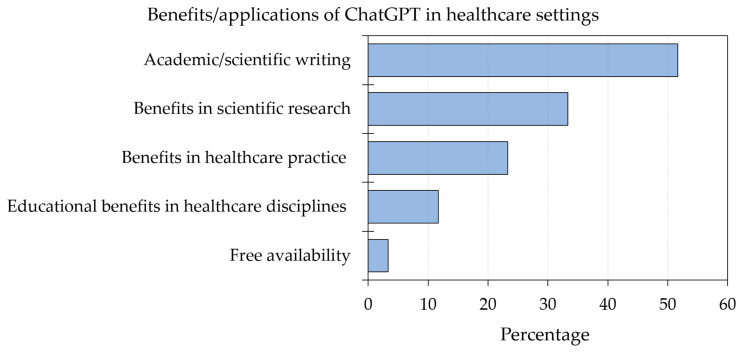
- Benefits were most frequently cited for academic/scientific writing (31 records, 51.7%), followed by scientific research (20, 33.3%), healthcare practice (14, 23.3%), healthcare education (7, 11.7%), and being a free package (2, 3.3%).
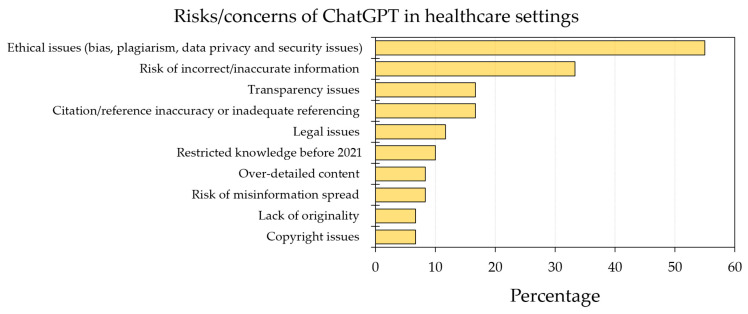
- Ethical concerns were the most common risk category (33 records, 55.0%), including risk of bias (18, 30.0%) and plagiarism (14, 23.3%); incorrect/inaccurate information was cited in 20 records (33.3%), citation/reference inaccuracy in 10 (16.7%), and transparency issues in 10 (16.7%).
- Other reported concerns included legal issues (7, 11.7%), restricted knowledge before 2021 (6, 10.0%), misinformation spread (5, 8.3%), over-detailed content (5, 8.3%), copyright issues (4, 6.7%), and lack of originality (4, 6.7%).
- The review states that ChatGPT does not qualify as an author under current ICMJE/COPE guidelines unless those guidelines are revised, and calls for stakeholder-developed ethics guidance for responsible LLM use in healthcare and academia.
Methods
- Systematic review conducted according to PRISMA guidelines, searching PubMed/MEDLINE and Google Scholar for English records on ChatGPT in healthcare practice/research, healthcare education, or academic writing; searches concluded on 16 February 2023.
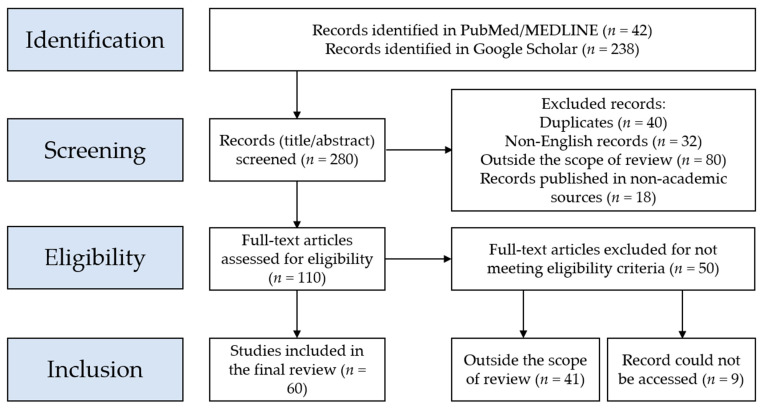
- PubMed/MEDLINE yielded 42 records and Google Scholar yielded 238 records, totaling 280 records; after duplicate removal (n = 40), non-English exclusion (n = 32), out-of-scope exclusion (n = 80), non-academic source exclusion (n = 18), full-text screening exclusions (n = 41), and inaccessible full texts (n = 9), 60 records were included.
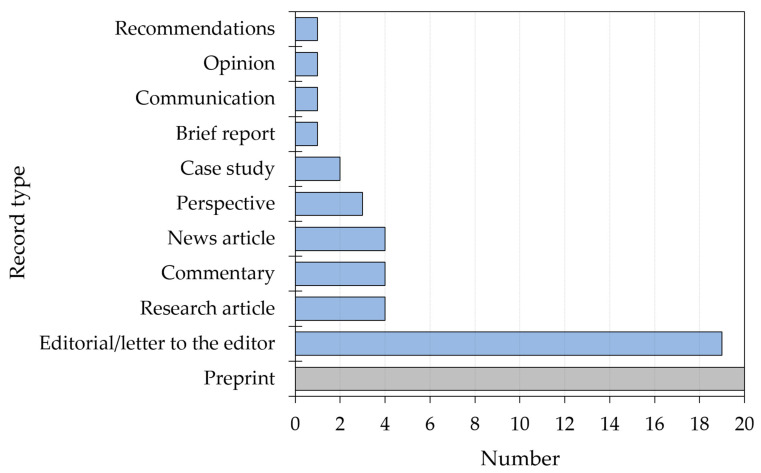
- Each included record was searched for record type, listed benefits/applications, listed risks/concerns, and main conclusions/recommendations regarding ChatGPT in healthcare education, practice, or scientific research/academic writing.
Limitations
- The paper states that included records had variable quality, non-English exclusion may have caused selection bias, inaccessible records may have led to missing relevant data, preprints were not peer reviewed, the literature is growing rapidly with the search ending 16 February 2023, and screening/interpretation was performed by a single author.
- Evident from the text: the review reports descriptive counts of mentions across heterogeneous record types rather than a formal meta-analysis or independent risk-of-bias assessment.
Model-written summary. Check it against the paper before relying on it.
Integrity signals
Registry
Cites
Statistics
Figures
Verification
Claims the paper makes
53 Valid · 1 Not valid · 6 Not checked · 37 Own results and interpretations
Every source the paper cites for this claim was checked and supports it.
In the paper
“This comes in light of the ability of ChatGPT to generate incorrect content that appears plausible from a scientific point of view [81].”
§ ChatGPT Utility in Healthcare Education, Research, and Practice: Systematic Review on the Promising Perspectives and Valid Concerns > 4. Discussion > 4.2. Limitations of ChatGPT Use in Scientific Research
What the sources say
- Supportedcites [81] Cascella M. Montomoli J. Bellini V. Bignami E. Evaluating the Feasibility of ChatGPT in Healthcare: An Analysis of Multiple Clinical and Research Scenarios J. Med. Syst. 2023 47 33 10.1007/s10916-023-01925-4 36869927 PMC9985086 source
In “Reasoning About Public Health Topics,” the paper says ChatGPT can produce believable answers that may be incorrect or nonsensical. In “Possible Misuse of GPT in Medicine and Research,” it describes a scientific abstract that appeared reliable and simulated statistical outputs that could seem plausible to readers. Together, these passages support the claim. (LLM, conf=0.94)
plain- Asserted: passes — The authors put it forward as true.
- Checkable: passes — It can be checked against evidence.
- Load-bearing: passes — The paper’s conclusions depend on it.
- Based: passes — The paper gives a reason why it holds.
- Supported
The sources with a verdict support this claim; the rest weren’t checked yet, have no full text we could read, or their verdicts aren’t rated yet.
In the paper
“This comes in light of the fact that authorship entails legal obligations that are not met by ChatGPT [43,48].”
§ ChatGPT Utility in Healthcare Education, Research, and Practice: Systematic Review on the Promising Perspectives and Valid Concerns > 4. Discussion > 4.2. Limitations of ChatGPT Use in Scientific Research
What the sources say
- Supportedcites [43] Zielinski C. Winker M. Aggarwal R. Ferris L. Heinemann M. Lapeña J. Pai S. Ing E. Citrome L. Chatbots, ChatGPT, and Scholarly Manuscripts WAME Recommendations on ChatGPT and Chatbots in Relation to Scholarly Publications Maced J. Med. Sci. 2023 11 83 86 10.3889/oamjms.2023.11502 37615142 source
The Introduction (p. 2) says chatbots are not legal entities, cannot be held legally liable, and that listing ChatGPT as an author may not be legally defensible. The WAME Recommendations (p. 2) add that chatbots cannot take responsibility for a paper or have the legal standing to sign a statement. (LLM, conf=0.93)
- Not checked — no full text of the sourcecites [48] Liebrenz M. Schleifer R. Buadze A. Bhugra D. Smith A. Generating scholarly content with ChatGPT: Ethical challenges for medical publishing Lancet Digit. Health 2023 5 e105 e106 10.1016/S2589-7500(23)00019-5 36754725 source
plain- Asserted: passes — The authors put it forward as true.
- Checkable: passes — It can be checked against evidence.
- Load-bearing: passes — The paper’s conclusions depend on it.
- Based: passes — The paper gives a reason why it holds.
- Supported
The cited sources support only part of this claim — read each source’s verdict below.
In the paper
“On one hand, ChatGPT, among other LLMs, can be beneficial in conversational and writing tasks, assisting to increase the efficiency and accuracy of the required output [11].”
§ ChatGPT Utility in Healthcare Education, Research, and Practice: Systematic Review on the Promising Perspectives and Valid Concerns > 1. Introduction
What the sources say
- Partly supportedcites [11] Deng J. Lin Y. The Benefits and Challenges of ChatGPT: An Overview Front. Comput. Intell. Syst. 2023 2 81 83 10.54097/fcis.v2i2.4465 sourceExperimental — accuracy not yet measured
Sections 4.1 (Increased Efficiency) and 4.2 (Improved Accuracy) say ChatGPT can make conversations more efficient and generate more accurate responses. The paper does not establish those benefits for writing tasks or for other LLMs, so the broader claim is only partially supported. (LLM, conf=0.88)
plainstates a cause- Asserted: passes — The authors put it forward as true.
- Checkable: passes — It can be checked against evidence.
- Load-bearing: unclear — It is unclear whether the paper’s conclusions depend on it.
- Based: passes — The paper gives a reason why it holds.
- Partly supported
The cited sources support only part of this claim — read each source’s verdict below.
In the paper
“Importantly, the concept of ChatGPT hallucination could be risky if the generated content is not thoroughly evaluated by researchers and health providers with proper expertise [37,56,73,77,79].”
§ ChatGPT Utility in Healthcare Education, Research, and Practice: Systematic Review on the Promising Perspectives and Valid Concerns > 4. Discussion > 4.2. Limitations of ChatGPT Use in Scientific Research
What the sources say
- Not checked — no full text of the sourcecites [37] Shen Y. Heacock L. Elias J. Hentel K.D. Reig B. Shih G. Moy L. ChatGPT and Other Large Language Models Are Double-edged Swords Radiology 2023 230163 10.1148/radiol.230163 36700838 source
- Partly supportedcites [56] Huh S. Are ChatGPT’s knowledge and interpretation ability comparable to those of medical students in Korea for taking a parasitology examination?: A descriptive study J. Educ. Eval. Health Prof. 2023 20 1 10.3352/jeehp.2023.20.1 36627845 PMC9905868 sourceExperimental — accuracy not yet measured
The Background says medical students must evaluate the accuracy of AI-generated medical information before creating reliable information for patients and the public. The Interpretation also reports that some ChatGPT explanations contained incorrect information. These passages support the need for scrutiny, but the paper does not specifically discuss hallucination or evaluation by researchers and health providers. (LLM, conf=0.84)
- Partly supportedcites [73] Duong D. Solomon B.D. Analysis of large-language model versus human performance for genetics questions medRxiv 2023 Preprint 10.1101/2023.01.27.23285115 PMC10999420 37246194 sourceExperimental — accuracy not yet measured
The Discussion (p. 6) says ChatGPT can give plausible explanations for incorrect answers and that its correctness requires additional verification, which is concerning in medical or other high-stakes settings. This supports the risk and need for evaluation, but the paper does not specify that researchers and health providers with proper expertise must perform it. (LLM, conf=0.83)
- Supportedcites [77] Jeblick K. Schachtner B. Dexl J. Mittermeier A. Stüber A.T. Topalis J. Weber T. Wesp P. Sabel B. Ricke J. ChatGPT Makes Medicine Easy to Swallow: An Exploratory Case Study on Simplified Radiology Reports arXiv 2022 10.48550/arxiv.2212.14882 2212.14882 PMC11126432 37794249 source
The Results (Free-text analysis) identify a ChatGPT hallucination that radiologists judged potentially harmful to a patient. The Key Points state that minimizing harm requires supervision by medical experts, supporting the claim’s warning about unevaluated medical content. (LLM, conf=0.90)
- Partly supportedcites [79] Lin Z. Why and how to embrace AI such as ChatGPT in your academic life PsyArXiv 2023 Preprint 10.31234/osf.io/sdx3j PMC10445029 37621662 sourceExperimental — accuracy not yet measured
The “Limitations of generative AI” section says ChatGPT may fabricate facts and false citations (“hallucination”) and urges users to critically evaluate and verify its responses, particularly when reliability is critical. It does not specifically say that researchers and health providers with proper expertise must evaluate the content; that part is more specific than the source. (LLM, conf=0.84)
hedgedstates a possible cause- Asserted: passes — The authors put it forward as true.
- Checkable: passes — It can be checked against evidence.
- Load-bearing: passes — The paper’s conclusions depend on it.
- Based: passes — The paper gives a reason why it holds.
- Rests on an assumption not shown here.
The sources with a verdict support this claim; the rest weren’t checked yet, have no full text we could read, or their verdicts aren’t rated yet.
In the paper
“This is particularly relevant for researchers who are non-native English speakers [23,25,63].”
§ ChatGPT Utility in Healthcare Education, Research, and Practice: Systematic Review on the Promising Perspectives and Valid Concerns > 4. Discussion > 4.1. Benefits of ChatGPT in Scientific Research
What the sources say
- Supportedcites [23] Chen T.J. ChatGPT and Other Artificial Intelligence Applications Speed up Scientific Writing Available online: https://journals.lww.com/jcma/Citation/9900/ChatGPT_and_other_artificial_intelligence.174.aspx (accessed on 16 February 2023) PMC12755446 36791246 source
In the main text (page not provided), Chen says many scientists who are not native English speakers struggle to write in English and describes AI translation and writing tools as ways to overcome that barrier. This supports the claim that language assistance in scientific writing is particularly relevant to those researchers. (LLM, conf=0.91)
- Not checked — no full text of the sourcecites [25] Kitamura F.C. ChatGPT Is Shaping the Future of Medical Writing but Still Requires Human Judgment Radiology 2023 230171 10.1148/radiol.230171 36728749 source
- Supportedcites [63] Gao C.A. Howard F.M. Markov N.S. Dyer E.C. Ramesh S. Luo Y. Pearson A.T. Comparing scientific abstracts generated by ChatGPT to original abstracts using an artificial intelligence output detector, plagiarism detector, and blinded human reviewers bioRxiv 2022 10.1101/2022.12.23.521610 source
The Discussion/Abstract section of our copy states directly that the technology 'could be used by scientists publishing in a language that is not their native language, to improve equity,' alongside the point that generated text 'may help alleviate the burden of writing' and that LLMs are 'a powerful tool to create readable scientific abstracts.' That covers the attributed content — AI-assisted language improvement being especially pertinent for non-native-English researchers — with the source's own hedge ('could be used') slightly weaker than the citing sentence's flat 'is particularly relevant.' No passage in our copy contradicts it. (LLM, conf=0.82)
plainstates an association- Asserted: passes — The authors put it forward as true.
- Checkable: passes — It can be checked against evidence.
- Load-bearing: unclear — It is unclear whether the paper’s conclusions depend on it.
- Based: passes — The paper gives a reason why it holds.
- Supported
42 more claims · 23 with their cited sources checked
Create a free account to see all 97 claims and to verify the 16 references still open.
- Probably not a substantial claim. 31
- It may state two separate claims as one. 27
Claims other papers make about this one
Each is checked against this paper’s own text: does it say what the citing paper says it does?
The source backs part of the claim, not all of it — or backs it for a different population, condition or comparison.
In the citing paper
“The reliance on ChatGPT may result in hindering the development of the skills needed to interpret and respond to social cues, which should be considered in health care education [9,91].”
From Assessing Health Students' Attitudes and Usage of ChatGPT in Jordan: Validation Study (2023) · cites this paper as [9]
Experimental — accuracy not yet measuredThe source backs part of the claim, not all of it — or backs it for a different population, condition or comparison.
In the citing paper
“A recent surge in the use of ChatGPT, in particular for mental health, is emergent for providing crucial personalized advice without clinical explanation, which can hurt user's safety, and thus trust (Sallam, 2023).”
From A review of the explainability and safety of conversational agents for mental health to identify avenues for improvement (2023) · cites this paper as Sallam, 2023
Experimental — accuracy not yet measuredThe source backs part of the claim, not all of it — or backs it for a different population, condition or comparison.
In the citing paper
“ChatGPT plays a crucial role in pandemic management by aiding in the swift and accurate dissemination of critical information.”
From A Systematic Review and Meta-Analysis of Artificial Intelligence Tools in Medicine and Healthcare: Applications, Considerations, Limitations, Motivation and Challenges (2024) · cites this paper as [6]
Experimental — accuracy not yet measuredThe source backs part of the claim, not all of it — or backs it for a different population, condition or comparison.
In the citing paper
“Its natural language processing capabilities enable it to generate coherent responses, making it a valuable tool for healthcare organisations.”
From A Systematic Review and Meta-Analysis of Artificial Intelligence Tools in Medicine and Healthcare: Applications, Considerations, Limitations, Motivation and Challenges (2024) · cites this paper as [6]
Experimental — accuracy not yet measuredThe source backs part of the claim, not all of it — or backs it for a different population, condition or comparison.
In the citing paper
“Specific advantages include its ability to provide rapid updates, preventive measures, and medical guidelines to the public.”
From A Systematic Review and Meta-Analysis of Artificial Intelligence Tools in Medicine and Healthcare: Applications, Considerations, Limitations, Motivation and Challenges (2024) · cites this paper as [6]
Experimental — accuracy not yet measured
31 more claims about this paper
Create a free account to see every claim other papers make about this one.
Citations
Cites
Preferred Reporting Items for Systematic Reviews and Meta-Analyses: the PRISMA statement
Moher, D., Liberati, A., Tetzlaff, J., Altman, D. G., & for the PRISMA Group (2009) · BMJ · doi:10.1136/bmj.b2535 · Cited by 83,823
Preferred Reporting Items for Systematic Reviews and Meta-Analyses: The PRISMA Statement
Moher, D., Liberati, A., Tetzlaff, J., Altman, D. G., & The PRISMA Group (2009) · PLoS Medicine · doi:10.1371/journal.pmed.1000097 · Cited by 64,042 · cited 1×
“The current systematic review was conducted according to the Preferred Reporting Items for Systematic Reviews and Meta-Analyses (PRIMSA) guidelines [21].”
Language Models are Few-Shot Learners
Brown, T. B., Mann, B., Ryder, N., Subbiah, M., Kaplan, J., Dhariwal, P., Neelakantan, A., Shyam, P., Sastry, G., Askell, A., et al. (2020) · arXiv · doi:10.48550/arxiv.2005.14165 · Cited by 23,372 · cited 3×
“The GPT architecture utilizes a neural network to process natural language, thus generating responses based on the context of input text [7].”
BackgroundWang, G., Ma, R., Qiao, G., Wada, K., Aizawa, Y., & Satoh, T. (2015) · Integrative Medicine International · doi:10.1159/000368408 · Cited by 18,657
Kaugeranna, R., Kaugeranna, E., & Aion, (. S. 4. 6. (2023) · DROPS (Schloss Dagstuhl – Leibniz Center for Informatics) · doi:10.4230/lipics.giscience.2023.43 · Cited by 13,690
Machine learning: Trends, perspectives, and prospects
Jordan, M. I., & Mitchell, T. M. (2015) · Science · doi:10.1126/science.aaa8415 · Cited by 9,955
Kung, T. H., Cheatham, M., Medenilla, A., Sillos, C., De Leon, L., Elepaño, C., Madriaga, M., Aggabao, R., Diaz-Candido, G., Maningo, J., et al. (2023) · PLOS Digital Health · doi:10.1371/journal.pdig.0000198 · Cited by 4,115 · cited 2×
“[59] An article showing the ChatGPT raised accuracy which enabled passing the USMLE Accuracy with high concordance and insight; it can facilitate patient communication; improved personalized medicine ChatGPT has a promising potential in medical education; future studies are recommended to consider non-biased approach…”
BackgroundKung, T. H., Cheatham, M., ChatGPT, Medenilla, A., Sillos, C., De Leon, L., Elepaño, C., Madriaga, M., Aggabao, R., Diaz-Candido, G., et al. (2022) · doi:10.1101/2022.12.19.22283643 · Cited by 4,115
Rajpurkar, P., Chen, E., Banerjee, O., & Topol, E. J. (2022) · Nature Medicine · doi:10.1038/s41591-021-01614-0 · Cited by 3,212 · cited 1×
“The promising utility of AI in health care has been outlined previously with possible benefits in personalized medicine, drug discovery, and the analysis of large datasets aside from the potential applications to improve diagnosis and clinical decisions [17,18].”
BackgroundChatting and cheating: Ensuring academic integrity in the era of ChatGPT
Cotton, D. R. E., Cotton, P. A., & Shipway, J. R. (2024) · Innovations in Education and Teaching International · doi:10.1080/14703297.2023.2190148 · Cited by 3,087 · cited 1×
“[62] An EdArXiv 2 preprint on the academic integrity in ChatGPT era Risk of plagiarism; academic dishonesty Careful thinking of educational assessment tools”
Background
Cited by
Items 801–900 of 3,095
Suwała, S., Szulc, P., Guzowski, C., Kaminska, B. A., Dorobiała, J., Wojciechowska, K., Berska, M., Kubicka, O., Kosturkiewicz, O., Kosztulska, B., et al. (2024) · SAGE Open Medicine · doi:10.1177/20503121241257777 · Cited by 28
“34 It is interesting to mention the courteousness exhibited by AI and its prospective utilization in routine clinical practice—it has been demonstrated that in 79% of cases, patients perceived ChatGPT’s responses to their urgent medical inquiries as being more empathetic and comprehensive when…”
BackgroundEvaluating The Role of ChatGPT as a Study Aid in Medical Education in Surgery
Araji, T., & Brooks, A. D. (2024) · Journal of surgical education · doi:10.1016/j.jsurg.2024.01.014 · Cited by 25
Widen the debate: What is the academic community’s perception on ChatGPT?
Jiang, Y., Xie, L., Lin, G., & Mo, F. (2024) · Education and Information Technologies · doi:10.1007/s10639-024-12677-0 · Cited by 21
Alqudah, A. A., Aleshawi, A. J., Baker, M., Alnajjar, Z., Ayasrah, I., Ta’ani, Y., Salkhadi, M. A. A., & Aljawarneh, S. (2024) · Medicine · doi:10.1097/md.0000000000039120 · Cited by 27
“[2] ChatGPT is an AI-based language model developed to generate human-like text responses mimicking a conversation, making it suitable for various aspects of life.”
BackgroundPractical Applications of Large Language Models for Health Care Professionals and Scientists
Reis, F., Lenz, C., Gossen, M., Volk, H., & Drzeniek, N. M. (2024) · JMIR Medical Informatics · doi:10.2196/58478 · Cited by 24
“Subsequently, the generated material must be thoroughly checked for content accuracy and appropriate references to mitigate the risk of hallucinations or plagiarism [18,19].”
BackgroundOn Multimodal Emotion Recognition for Human-Chatbot Interaction in the Wild
Kovačević, N., Holz, C., Groß, M. H., & Wampfler, R. (2024) · INTERNATIONAL CONFERENCE ON MULTIMODAL INTERACTION · doi:10.1145/3678957.3685759 · Cited by 26
“…conversation, conversations with virtual agents are becoming more ubiquitous in a large number of real-world scenarios such as personal assistance [3], customer service [25], and video games [43], and are about to enter more challenging applications in education [1, 9] and health care [36, 53].”
Artificial Intelligence Chatbot as Perceived by Nursing Students: A Qualitative Study
Gunawan, J., Aungsuroch, Y., Marzilli, C., Nazliansyah, N., Chaerani, E., & Montayre, J. (2024) · SAGE Open · doi:10.1177/21582440241303453 · Cited by 33
Asy’ari, M., & Шаров, С. (2024) · International Journal of Essential Competencies in Education · doi:10.36312/ijece.v3i2.2424 · Cited by 68
“Several s tudies highlight ChatGPT’s potential in creating personalized learning experiences, tailoring content to individual learning styles, and improving outcomes across diverse educational contexts (Bai et al., 2023; Sallam, 2023; Xie et al., 2019).”
A Brief Review on Benchmarking for Large Language Models Evaluation in Healthcare
Cilar, L., Chen, H., Chen, A., Topaz, M., Tam, W., Bian, J., & Štiglic, G. (2025) · Wiley Interdisciplinary Reviews Data Mining and Knowledge Discovery · doi:10.1002/widm.70010 · Cited by 40
“This contrasts with mistakes in finance or legal industries, which primarily result in financial losses or inefficiencies (Sallam 2023).”
Retrieval-Augmented Generation with Large Language Models in Radiology: From Theory to Practice
Fink, A., Rau, A., Reisert, M., Bamberg, F., & Russe, M. F. (2025) · Radiology Artificial Intelligence · doi:10.1148/ryai.240790 · Cited by 39
Beyaz, S., Özgözen, A. L., Turgut, N., & Ölke, H. C. (2025) · Future Science OA · doi:10.1080/20565623.2025.2540742 · Cited by 32
“Although not specifically designed for medical use, studies have shown that chatGPt possesses medical knowledge sufficient to pass board-level exams in various specialties and can provide postoperative patient responses with accuracy comparable to expert physicians [14].”
ChatGPT: a pioneering approach to complex prenatal differential diagnosis
Suhag, A., Kidd, J., McGath, M., Rajesh, R., Gelfinbein, J., Cacace, N., Monteleone, B., & Chavez, M. R. (2023) · American Journal of Obstetrics & Gynecology MFM · doi:10.1016/j.ajogmf.2023.101029 · Cited by 23
Abu Khurma, O., Ali, N., & Hashem, R. (2023) · International Journal of Emerging Technologies in Learning (iJET) · doi:10.3991/ijet.v18i14.40935 · Cited by 21
Does Google’s Bard Chatbot perform better than ChatGPT on the European hand surgery exam?
Goetsch, T., Dabbagh, A., & Liverneaux, P. A. (2023) · International Orthopaedics · doi:10.1007/s00264-023-06034-y · Cited by 24
“In medicine, chatbots are used in particular for prevention, therapeutic education, therapeutics and care monitoring [2, 3].”
Enhancing Uncertainty-Based Hallucination Detection with Stronger Focus
Zhang, T., Qiu, L., Guo, Q., Deng, C., Zhang, Y., Zhang, Z., Zhou, C., Wang, X., & Fu, L. (2023) · Conference on Empirical Methods in Natural Language Processing (EMNLP) · doi:10.18653/v1/2023.emnlp-main.58 · Cited by 160
Evaluation of a chat GPT generated patient information leaflet about laparoscopic cholecystectomy
Lockie, E., & Choi, J. (2023) · ANZ Journal of Surgery · doi:10.1111/ans.18834 · Cited by 26
ChatGPT between opportunities and challenges: an empirical study in Italy
Pasca, M. G., & Arcese, G. (2024) · The TQM Journal · doi:10.1108/tqm-08-2023-0268 · Cited by 32
Tracking ChatGPT Research: Insights From the Literature and the Web
Mubin, O., Alnajjar, F., Trabelsi, Z., Ali, L., Parambil, M. M. A., & Zou, Z. (2024) · IEEE Access · doi:10.1109/access.2024.3356584 · Cited by 26
“As clarified in Sallam’s paper [73], the employment of Chat-GPT holds the potential for advancements in medical and scientific domains.”
BackgroundNajjar, R. (2024) · Biomedical engineering · doi:10.5772/intechopen.114142 · Cited by 37
Use of ChatGPT in Urology and its Relevance in Clinical Practice: Is it useful?
Braga, A. V. N. M., Nunes, N. C., Santos, E. N., Veiga, M. L., Braga, A. A. N. M., de Abreu, G. E., de Bessa, J., Braga, L. H., Kirsch, A. J., & Barroso, U. (2024) · International braz j urol · doi:10.1590/s1677-5538.ibju.2023.0570 · Cited by 30
“Numerous cardiology and oncology approaches have demonstrated the utility of AI, particularly in identifying and classifying disease phenotypes and improving predictive outcome models by incorporating unstructured data (9-12).”
BackgroundDubin, J. A., Bains, S. S., DeRogatis, M. J., Moore, M. C., Hameed, D., Mont, M. A., Nace, J., & Delanois, R. E. (2024) · The Journal of Arthroplasty · doi:10.1016/j.arth.2024.04.020 · Cited by 24
Isiaku, L., Kwala, A. F., Sambo, K. U., & Isiaku, H. H. (2024) · Journal of University Teaching and Learning Practice · doi:10.53761/7egat807 · Cited by 21
“For instance, Sallam (2023) demonstrated that the ChatGPT can enhance scientific writing skills among healthcare students and provide personalised learning experiences.”
BackgroundChatGPT in early childhood STEM education: Can it be an innovative tool to overcome challenges?
Uğraş, H., & Uğraş, M. (2024) · Education and Information Technologies · doi:10.1007/s10639-024-12960-0 · Cited by 33
Online Patient Education in Obstructive Sleep Apnea: ChatGPT versus Google Search
Parenti, S. I., Bartolucci, M. L., Biondi, E., Maglioni, A., Corazza, G., Gracco, A. L. T., & Bonetti, G. A. (2024) · Healthcare · doi:10.3390/healthcare12171781 · Cited by 21
“In the context of AI, a hallucination refers to a confident response generated by an AI model that lacks justification based on its training data and, consequently, is not grounded in reality or empirical evidence [16].”
Backgroundİş, E. E., & Menekşeoğlu, A. K. (2024) · Clinical Rheumatology · doi:10.1007/s10067-024-07154-5 · Cited by 31
Proof of Concept of ChatGPT as a Virtual Tutor
Cain, J. J., & Rajan, A. S. (2024) · American Journal of Pharmaceutical Education · doi:10.1016/j.ajpe.2024.101333 · Cited by 32
Teaching English and Artificial Intelligence: EFL Teachers’ Perceptions and Use of ChatGPTPreprint
Dilzhan, B. (2024) · EdArXiv (OSF Preprints) · doi:10.35542/osf.io/fwy92 · Cited by 40
Arbel, Y., Gimmon, Y., & Shmueli, L. (2025) · Physical Therapy · doi:10.1093/ptj/pzaf010 · Cited by 21
“26 Likewise, instead of sifting through every necessary article or available data, ChatGPT and Google Gemini can diminish the workload by retrieving only the most relevant information, providing that the user ensures that the uploaded data is up-to-date and is precise when prompting the AI.”
ChatGPT and Cybersecurity: Risk Knocking the Door
Elsadig, M. A. (2023) · Journal of Internet Services and Information Security · doi:10.58346/jisis.2024.i1.001 · Cited by 30
Belaldavar, C., & Angadi, P. V. (2024) · Annals of dental specialty · doi:10.51847/e49ika828d · Cited by 25
Reading Turchioe, M., Kisselev, S., Van Bulck, L., & Bakken, S. (2024) · Applied Clinical Informatics · doi:10.1055/a-2373-3151 · Cited by 20
Zahid, I. A., Joudar, S. S., Albahri, A. S., Albahri, O. S., Alamoodi, A. H., Santamaría, J., & Alzubaidi, L. (2024) · Intelligent Systems with Applications · doi:10.1016/j.iswa.2024.200431 · Cited by 38
Sun, L., & Zhou, L. (2024) · Education and Information Technologies · doi:10.1007/s10639-024-13236-3 · Cited by 40
Social Influence, Personal Views, and Behavioral Intention in ChatGPT Adoption
Bali, S., Suwandi, E., Chen, T.-C., Lin, C.-S., & Liu, M.-C. (2024) · Journal of Computer Information Systems · doi:10.1080/08874417.2024.2441758 · Cited by 31
Ozkan, E., Tekin, A., Ozkan, M. C., Cabrera, D., Niven, A. S., & Dong, Y. (2025) · JMIR Medical Education · doi:10.2196/58801 · Cited by 36
“Many studies have shown that up to 96.7% of users are concerned about ethical and legal obstacles [3,18], particularly plagiarism [21-23], and copyright issues [3,18].”
InfluentialTemel, M. H., Erden, Y., & Bağcıer, F. (2025) · The Knee · doi:10.1016/j.knee.2025.04.008 · Cited by 25
A Testing Framework for AI Linguistic Systems (testFAILS)
Kumar, Y., Morreale, P. A., Sorial, P., Delgado, J., Li, J. J., & Martins, P. (2023) · Electronics · doi:10.3390/electronics12143095 · Cited by 20
Expanding horizons and navigating challenges for enhanced clinical workflows: ChatGPT in urology
Talyshinskii, A., Naik, N., Hameed, B. M. Z., Zhanbyrbekuly, U., Khairli, G., Гулиев, Б. Г., Juilebø-Jones, P., Tzelves, L. I., & Somani, B. K. (2023) · Frontiers in Surgery · doi:10.3389/fsurg.2023.1257191 · Cited by 24
“ChatGPT, developed by Open AI in San Francisco, CA, USA, is a widely accepted generative AI representative (5, 6).”
BackgroundMou, C., Liang, A., Hu, C., Meng, F., Han, B., & Xu, F. (2023) · Animals · doi:10.3390/ani13203168 · Cited by 31
“For instance, chatGPT utilizes mega-data and computational resources to generate human-like responses and has been used in the healthcare industry [76].”
MethodSurapaneni, K. M. (2023) · JMIR Medical Education · doi:10.2196/47191 · Cited by 19
“Recently, ChatGPT had also cleared the United States Medical Licensing Examination (USMLE) with an acceptable score, thus reinforcing the usability of such AI models to enhance medical education [6,7].”
MethodBLESS: Benchmarking Large Language Models on Sentence Simplification
Kew, T., Chi, A., Vásquez-Rodríguez, L., Agrawal, S., Aumiller, D., Alva-Manchego, F. E., & Shardlow, M. (2023) · Conference on Empirical Methods in Natural Language Processing (EMNLP) · doi:10.18653/v1/2023.emnlp-main.821 · Cited by 107
Babu, C. V. S., & Akshara, P. M. (2023) · Advances in computational intelligence and robotics book series · doi:10.4018/979-8-3693-0502-7.ch011 · Cited by 36
Implementation of Chatbot Technology in Health Care: Protocol for a Bibliometric Analysis
Ni, Z., Peng, M. L., Balakrishnan, V., Tee, V., Azwa, I., Saifi, R. A., Nelson, L. E., Vlahov, D., & Altice, F. L. (2024) · JMIR Research Protocols · doi:10.2196/54349 · Cited by 27
“For example, ChatGPT, an AI chatbot developed by OpenAI, has sparked numerous discussions within the health care industry regarding the impact of AI chatbots on human health [13,14,33-38].”
Yang, F., Yan, D., & Wang, Z. (2024) · Journal of bone oncology · doi:10.1016/j.jbo.2024.100525 · Cited by 24
“The advanced AI model ChatGPT, built on the foundation of the GPT series, possesses the ability to understand and generate human-like text [4].”
BackgroundBerry, C. E., Fazilat, A. Z., Lavin, C. V., Lintel, H. A., Cole, N. A., Stingl, C. S., Valencia, C., Morgan, A. G., Momeni, A., & Wan, D. C. (2024) · Journal of Reconstructive Microsurgery · doi:10.1055/a-2273-4163 · Cited by 23
Lim, B., Seth, I., Xie, Y., Kenney, P. S., Cuomo, R., & Rozen, W. M. (2024) · Aesthetic Plastic Surgery · doi:10.1007/s00266-024-03952-z · Cited by 24
Large Language Models for Clinical Text Cleansing Enhance Medical Concept Normalization
Abdulnazar, A., Roller, R., Schulz, S., & Kreuzthaler, M. (2024) · IEEE Access · doi:10.1109/access.2024.3472500 · Cited by 35
“Privacy breaches, legal disputes, interpretability challenges, and misinformation are also concerns [51].”
BackgroundMing, C. T. Y., Rojas-Carabali, W. A., Cifuentes‐González, C., Agrawal, R., Thorne, J. E., Tuğal-Tutkun, İ., Nguyen, Q. D., Gupta, V., de‐la‐Torre, A., & Agrawal, R. V. (2023) · Ocular Immunology and Inflammation · doi:10.1080/09273948.2023.2242462 · Cited by 26
Mixed methods assessment of the influence of demographics on medical advice of ChatGPT
Andreadis, K., Newman, D. R., Twan, C., Shunk, A., Mann, D. M., & Stevens, E. R. (2024) · Journal of the American Medical Informatics Association · doi:10.1093/jamia/ocae086 · Cited by 20
Xu, T., & Jumaat, N. F. (2024) · International Journal of Interactive Mobile Technologies (iJIM) · doi:10.3991/ijim.v18i15.49219 · Cited by 19
Multimodal Artificial Intelligence in Medicine
Judge, C. S., Krewer, F., O'Donnell, M. J., Kiely, L., Sexton, D. J., Taylor, G. W., Skorburg, J. A., & Tripp, B. (2024) · Kidney360 · doi:10.34067/kid.0000000000000556 · Cited by 28
Prompt engineering with ChatGPT3.5 and GPT4 to improve patient education on retinal diseases
Jung, H., Oh, J., Stephenson, K. A. J., Joe, A. W., & Mammo, Z. N. (2024) · Canadian Journal of Ophthalmology · doi:10.1016/j.jcjo.2024.08.010 · Cited by 24
Sreedhar, R., Chang, L., Gangopadhyaya, A., Shiels, P. W., Loza, J., Chi, E., Gabel, E., & Park, Y. S. (2024) · Journal of General Internal Medicine · doi:10.1007/s11606-024-09050-9 · Cited by 31
“38 Bias in AI algorithms affecting the feedback, and student and faculty acceptance of LLM in grading are other factors that should be considered.”
Chauhan, A., Khaliq, F., & Nayak, K. R. (2025) · International Journal of Artificial Intelligence in Education · doi:10.1007/s40593-025-00471-z · Cited by 33
A survey on biomedical automatic text summarization with large language models
Huang, Z., Chen, X., Wang, Y., Huang, J., & Zhao, X. (2025) · Information Processing & Management · doi:10.1016/j.ipm.2025.104216 · Cited by 27
Evaluation of large language models within GenAI in qualitative research
Mehta, S. D., Paul, S., Awiti, E., Young, S., Zulaika, G., Otieno, F., Phillips‐Howard, P. A., Mason, L., & Bhaumik, R. (2025) · Scientific Reports · doi:10.1038/s41598-025-18969-w · Cited by 36
ChatGPT Knows Your Attacks: Synthesizing Attack Trees Using LLMs
Gadyatskaya, O., & Papuc, D. (2023) · Communications in computer and information science · doi:10.1007/978-981-99-7969-1_18 · Cited by 33
Alhajahjeh, A. A., & Nazha, A. (2023) · Current Hematologic Malignancy Reports · doi:10.1007/s11899-023-00716-5 · Cited by 22
“These algorithms are the backbone of recent advances in AI that include large language models such as ChatGPT [19, 21, 22 • , 23].”
Assessment of Artificial Intelligence Performance on the Otolaryngology Residency In‐Service Exam
Mahajan, A., Shabet, C., Smith, J. D., Rudy, S. F., Kupfer, R. A., & Bohm, L. A. (2023) · OTO Open · doi:10.1002/oto2.98 · Cited by 23
Gritti, M. N., AlTurki, H., Farid, P., & Morgan, C. T. (2024) · Pediatric Cardiology · doi:10.1007/s00246-023-03385-6 · Cited by 22
“One possibility for this is that there is a difference between the two versions in how it processes the input, leading to the different answers, similar to how it has been shown that slight variations to a question may lead to different responses [18].”
Path-BigBird: An AI-Driven Transformer Approach to Classification of Cancer Pathology Reports
Chandrashekar, M., Lyngaas, I., Hanson, H. A., Gao, S. B., Wu, X., & Gounley, J. P. (2024) · JCO Clinical Cancer Informatics · doi:10.1200/cci.23.00148 · Cited by 28
“24,25 We show that transformer models perform better than our previously published HiSAN model on the fi ve pathology information extraction tasks.”
MethodChatGPT in Brazilian K-12 science education
Monteiro, F. F., Souza, P. V. S., da Silva, M. C., Maia, J. R., da Silva, W. F., & Girardi, D. (2024) · Frontiers in Education · doi:10.3389/feduc.2024.1321547 · Cited by 42
Nakajima, N., Fujimori, T., Furuya, M., Kanie, Y., Imai, H., Kita, K., Uemura, K., & Okada, S. (2024) · Cureus · doi:10.7759/cureus.56402 · Cited by 28
“This refers to AI generating incorrect or unsubstantiated information as if it were factual, a significant concern with large language models [26,27].”
BackgroundGroeneveld, S., Noon, G. B., den Ouden, M. E. M., van Os‐Medendorp, H., van Gemert‐Pijnen, J. E. W. C., Verdaasdonk, R. M., & Morita, P. P. (2024) · JMIR Nursing · doi:10.2196/56474 · Cited by 24
“The added value of AI in health care is evident in various aspects, including the enhancement of health care research equity and versatility, the streamlining of workflows in health care practice, and the personalization of learning within health care education [18].”
BackgroundBibliometric analysis of ChatGPT in medicine
Gande, S., Gould, M. B., & Ganti, L. (2024) · International Journal of Emergency Medicine · doi:10.1186/s12245-024-00624-2 · Cited by 26
“The most cited article (121 citations) was “ChatGPT utility in healthcare education, research, and practice: Systematic review on the promising perspectives and valid concerns,” published in March 2023 [4].”
BackgroundXu, D., Zhao, J., Liu, R., Dai, Y., Sun, K., Wong, P. C. H., Ming, S. L. S., Wearn, K. L., Wang, J., Xie, S., et al. (2024) · Rheumatology · doi:10.1093/rheumatology/keae238 · Cited by 20
Tsai, C.-Y., Hsieh, S.-J., Huang, H.-H., Deng, J., Huang, Y., & Cheng, P. (2024) · World Journal of Urology · doi:10.1007/s00345-024-04957-8 · Cited by 24
“Despite not being specifically tailored for medical use, ChatGPT has shown potential for applications in providing patient information and enhancing medical education [3, 4].”
Vij, O., Calver, H., Myall, N., Dey, M., & Kouranloo, K. (2024) · PLoS ONE · doi:10.1371/journal.pone.0307372 · Cited by 25
“Indeed, many papers express concerns regarding factual inaccuracies and spread of misinformation that could occur with widespread use of LLMs such as ChatGPT [54].”
BackgroundHu, X., Niemann, M., Kienzle, A., Braun, K. F., Back, D. A., Gwinner, C., Renz, N., Stoeckle, U., Trampuž, A., & Meller, S. (2024) · Digital Health · doi:10.1177/20552076241272620 · Cited by 32
“70 The chatbot has a very powerful ability to search for information and synthesise and summarise it in a way that is accurate to the question being answered.”
BackgroundCan large language models be sensitive to culture suicide risk assessment?
Levkovich, I., Shinan‐Altman, S., & Elyoseph, Z. (2024) · Journal of Cultural Cognitive Science · doi:10.1007/s41809-024-00151-9 · Cited by 26
“Nevertheless, adoption of ChatGPT requires careful evaluation due to limitations and costs (Sallam, 2023; Tal et al., 2023a, b).”
Bibliometric Analysis on ChatGPT Research with CiteSpace
Nan, D., Zhao, X., Chen, C., Sun, S., Lee, K. R., & Kim, J. H. (2025) · Information · doi:10.3390/info16010038 · Cited by 30
Carchiolo, V., & Malgeri, M. (2025) · Future Internet · doi:10.3390/fi17020076 · Cited by 27
“[6] examined the use of LLM s in medical education, ref.”
Sallam, M., Al‐Farajat, A., & Egger, J. (2024) · Jordan Medical Journal · doi:10.35516/jmj.v58i1.2285 · Cited by 21
Self-citationOpportunities, Challenges, Strategies, and Reforms for ChatGPT in Higher Education
Xie, X., & Ding, S. (2023) · 2023 International Conference on Educational Knowledge and Informatization (EKI) · doi:10.1109/eki61071.2023.00010 · Cited by 18
Exploring the Current Applications and Effectiveness of ChatGPT in Nursing: An Integrative Review
Luo, Y., Miao, Y., Zhao, Y., Li, J., & Wu, Y. X. (2024) · Journal of Advanced Nursing · doi:10.1111/jan.16628 · Cited by 25
Large Language Model Evaluation Criteria Framework in Healthcare: Fuzzy MCDM Approach
Alabool, H. M. (2025) · SN Computer Science · doi:10.1007/s42979-024-03533-6 · Cited by 23
“This explains the reasons for the tremendous increase in the use of LLMs within several application domains such as healthcare [2–4], education [5–7], engineering [8–10], social science [11, 12], and business and finance [13–15], sales and marketing [16–18].”
Albalawi, F., Khanagar, S. B., Iyer, K., Alhazmi, N., Alayyash, A., Alhazmi, A. S., Awawdeh, M. A., & Singh, O. G. (2025) · Applied Sciences · doi:10.3390/app15020893 · Cited by 23
Comparing Large Language Model AI and Human-Generated Coaching Messages for Behavioral Weight Loss
Huang, Z., Berry, M. P., Chwyl, C., Hsieh, G., Wei, J., & Forman, E. M. (2025) · Journal of Technology in Behavioral Science · doi:10.1007/s41347-025-00491-5 · Cited by 27
“Given ChatGPT’s ability to easily produce intricate messages with clinical nuance based on natural language inputs from patients or clinicians, it might generate personalized weight loss treatment messages without incurring extra tuning and development costs.”
Tong, L., Niu, Y., Zhou, L., Jin, S., Wang, Y., & Xiao, Q. (2025) · International Journal of Nursing Sciences · doi:10.1016/j.ijnss.2025.04.010 · Cited by 26
“A previous study has also con fi rmed that the signi fi cance of GAI ’ s empowerment of scienti fi c research and rational use can signi fi cantly improve the ef fi ciency of scienti fi c research [33].”
A review of ChatGPT in medical education: exploring advantages and limitations
Cheng, Y., & Zhu, L. (2025) · International Journal of Surgery · doi:10.1097/js9.0000000000002505 · Cited by 29
Falling Behind and Getting Ahead: Student Use of Generative AI in Education
Kuzminov, Y. I., Kruchinskaia, E. V., Gruzdev, I., & Naumov, A. (2025) · Высшее образование в России · doi:10.31992/0869-3617-2025-34-6-9-35 · Cited by 44
Tbaishat, D. M., & Elfadel, M. W. (2025) · BMC Medical Education · doi:10.1186/s12909-025-08462-3 · Cited by 37
“Exacerbating these challenges is the lack of standardised evaluation frameworks and the limited empirical evidence on the educational outcomes of AI interventions [12, 23].”
InfluentialZhu, Y., Jiang, H., & Zhong, L. (2026) · European Journal of Education · doi:10.1111/ejed.70462 · Cited by 30
“Vertigo, likely peripheral”: the dizzying rise of ChatGPT
Chee, J., Kwa, E. D., & Goh, X. (2023) · European Archives of Oto-Rhino-Laryngology · doi:10.1007/s00405-023-08135-1 · Cited by 20
“A recent systemic review has also flagged up concerns with lack of scientific accuracy, the limited updated knowledge, and the lack of ability to critically discuss results [6].”
BackgroundRoBERTa-Assisted Outcome Prediction in Ovarian Cancer Cytoreductive Surgery Using Operative Notes
Laios, A., Kalampokis, E., Mamalis, M. E., Tarabanis, C., Nugent, D., Thangavelu, A., Theophilou, G., & Jong, D. D. (2023) · Cancer Control · doi:10.1177/10732748231209892 · Cited by 22
Seaba, V. (2023) · OALib · doi:10.4236/oalib.1110763 · Cited by 23
ChatGPT in Language Education: Perceptions of Teachers - A Beneficial Tool or Potential Threat?
Widianingtyas, N., Mukti, T. W. P., & Silalahi, R. M. P. (2023) · Voices of English Language Education Society · doi:10.29408/veles.v7i2.20326 · Cited by 44
“Sallam (2023) adds that the concerns regarding ChatGPT include ethical, copyright, transparency, and legal issues, the risk of bias, plagiarism, lack of originality, inaccurate information, limited knowledge, incorrect citations, cybersecurity issues, and the risk of infodemics.”
BackgroundEvaluating ChatGPT on Orbital and Oculofacial Disorders: Accuracy and Readability Insights
Balas, M., Janic, A., Daigle, P., Nijhawan, N., Hussain, A., Gill, H., Luna, G. M. L., Belliveau, M. J., Crawford, S. A., Arjmand, P., et al. (2023) · Ophthalmic Plastic and Reconstructive Surgery · doi:10.1097/iop.0000000000002552 · Cited by 21
Becoming adaptive experts in an era of rapid advances in generative artificial intelligence
Hess, B., Cupido, N., Ross, S., & Kvern, B. L. (2023) · Medical Teacher · doi:10.1080/0142159x.2023.2289844 · Cited by 27
“…iteration has the potential to provide misleading/incorrect information (or ‘hallucinations’) and biased information based on the algorithms created or texts used for its training (Boscardin et al. 2023; Garg et al. 2023; Han et al. 2023; Johnson 2023; Preiksaitis and Rose 2023; Sallam 2023).”
MethodAmin, K., Doshi, R. H., & Forman, H. P. (2023) · Healthcare · doi:10.1016/j.hjdsi.2023.100731 · Cited by 19
ChatGPT en Educación Superior: explorando sus potencialidades y sus limitaciones
Galli, M. G., & Kanobel, M. C. (2023) · Revista Educación Superior y Sociedad (ESS) · doi:10.54674/ess.v35i2.815 · Cited by 48
AI and Human Reasoning: Qualitative Research in the Age of Large Language Models
Bano, M., Zowghi, D., & Whittle, J. (2024) · AI Ethics Journal · doi:10.47289/aiej20240122 · Cited by 35
Role and challenges of ChatGPT and similar generative artificial intelligence in arts and humanities
Rane, N., & Choudhary, S. (2024) · Studies in Humanities and Education · doi:10.48185/she.v5i1.999 · Cited by 59
A Review of the Chat GBT Technology Role in Marketing Research
Alghizzawi, M. (2024) · Studies in big data · doi:10.1007/978-3-031-52280-2_31 · Cited by 21
Exploring the use of ChatGPT/GPT-4 for patient follow-up after oral surgeries
Cai, Y., Zhao, R., Zhao, H., Li, Y., & Gou, L. (2024) · International Journal of Oral and Maxillofacial Surgery · doi:10.1016/j.ijom.2024.04.002 · Cited by 22
Evaluating Chat Generative Pre-trained Transformer Responses to Common Pediatric In-toeing Questions
Amaral, J. Z., Schultz, R. J., Martin, B. M., Taylor, T. N., Touban, B. M., McGraw-Heinrich, J. A., McKay, S. D., Rosenfeld, S. B., & Smith, B. G. (2024) · Journal of Pediatric Orthopaedics · doi:10.1097/bpo.0000000000002695 · Cited by 19
“…pre-trained transformer (ChatGPT), an arti fi cial intelligence (AI) – driven chatbot developed by OpenAI, 1 has garnered widespread attention within the health care sector for its versatility, 2,3 which can signi fi cantly reshape how patients seek information and interact with health care.”
Calle, P., Shao, R., Liu, Y., Hébert, E. T., Kendzor, D. E., Neil, J. M., Businelle, M. S., & Pan, C. (2024) · CHI Conference on Human Factors in Computing Systems · doi:10.1145/3613904.3641965 · Cited by 28
Murtaza, M., Cheng, C., Fard, M., & Zeleznikow, J. (2024) · International Journal of Artificial Intelligence in Education · doi:10.1007/s40593-024-00407-z · Cited by 32
“…Aleven et al., 2023; Biswas, 2023; Colabianchi et al., 2022; Du et al., 2023; Dwivedi et al., 2023 ; Fauzi et al., 2023; Firat, 2023; Nick, 2023; Sallam, 2023 ; Smutny & Schreiberova, 2020; Susnjak, 2023; Yuan, 2023; Zhou et al., 2021) have evidenced the potential of Large Language Models…”
Polat, E., Polat, Y. B., Şentürk, E., Doğan, R., Yenigün, A., Tuğrul, S., Eren, S. B., Aksoy, F., & Özturan, O. (2024) · International Journal of Pediatric Otorhinolaryngology · doi:10.1016/j.ijporl.2024.111998 · Cited by 21
Chan, P. S.-F., Fang, Y., Cheung, D. H., Zhang, Q., Sun, F., Mo, P. K. H., & Wang, Z. J. (2024) · Applied Psychology Health and Well-Being · doi:10.1111/aphw.12564 · Cited by 24
Metadata
- Authors
- Sallam, M.
- Affiliations
- University of Jordan (JO)
- Corresponding author
- Sallam, Malik
- ORCID
- Sallam, Malik
- Venue
- Healthcare
- Publisher
- MDPI AG
- Published
- 2023-03-19
- Volume
- 11
- Issue
- 6
- Pages
- 887
- ISSN
- 2227-9032 (ISSN-L)
- PMC
- PMC10048148
- OpenAlex
- W4327946446
- Semantic Scholar
- dfdf7ff01aa6f691831e663fd29bc71890be39e2
- Cited by
- 3,126
- References
- 114
- Citations by year
- 2026: 561 · 2025: 839 · 2024: 1052 · 2023: 669
- FWCI
- 36.67
- Type
- journal article
- Language
- en
- Open access
- gold
- doi.org
- Licence
- Locations
- Healthcare (publishedVersion, cc-by)
- medRxiv (acceptedVersion, cc-by-nc-nd)
- Preprints.org (acceptedVersion, cc-by)
- PubMed Central (publishedVersion, cc-by)
- PubMed (publishedVersion)
- Topics
- Health Sciences › Medicine › Health Informatics › Artificial Intelligence in Healthcare and Education
- Physical Sciences › Computer Science › Artificial Intelligence › Artificial Intelligence Applications
- Social Sciences › Education › Artificial Intelligence in Education
- Keywords
- ChatGPT, large language models, artificial intelligence in healthcare, healthcare education, health care research, clinical practice, scientific writing, research equity, drug discovery, personalized medicine, health literacy, plagiarism, hallucinations, authorship criteria, AI ethics, infodemic
About these checks
Registry, retraction, Cites and statistics results are computed, not judged, with one exception: a printed reference that no index lists is read once by a model before it counts as a citation error. Claims are extracted by a model and kept only when their quote appears verbatim in the text; each cited source is then checked, with a model’s help, for whether it says what the claim relies on. Those verdicts can be wrong — read the claim’s quote and the cited source before relying on one.
The claim verdicts this report counts are experimental: their accuracy is not yet measured.
A language model drew the claims from the paper on 2026-10-10, under version 3 of the claim definition (model deepseek-v4.1-flash, prompt extract-v3).
A second model labelled each claim on 2026-10-10 (model jev-1.13-20260917, definition revision gold-guideline-v0.2).
Cited sources are checked with a language model’s help (gpt-6-sol and qwen3.8-omni-flash).
Statistics and arithmetic are recomputed, not judged.
Confidence bands are shown only for fields calibrated on our annotated test set. None is calibrated yet, so no band is shown.
What counts as a claim ›How we measure confidence ›How we check this ›
Are you an author, or do you see a problem with this page? Request a review
Data sources
Bibliographic data: Semantic Scholar, OpenAlex, Crossref.
Contains information from the Semantic Scholar Academic Graph Datasets, made available under the ODC Attribution License (ODC-BY 1.0).
Semantic Scholar’s data is described in: Kinney, R., et al. (2023). The Semantic Scholar Open Data Platform. arXiv:2301.10140.
