

ChatGPT Utility in Healthcare Education, Research, and Practice: Systematic Review on the Promising Perspectives and Valid Concerns
Open accessPublished version of a preprint
The DOI matches its Crossref record; 116 of the 117 references it cites were found in a registry or an index; 110 of the 179 sources its claims cite were checked for support.
Abstract
ChatGPT is an artificial intelligence-powered chatbot. This systematic review synthesised the evidence regarding its application in healthcare education, research, and practice. ChatGPT shows remarkable utilities in summarizing research, translating materials, serving as a virtual tutor, drafting case scenarios, and automating administrative workflows. However, concerns regarding incorrect outputs (hallucinations), lack of analytical depth, risk of plagiarism, and algorithmic bias remain significant across the literature.
Overview
CoChat Summary
TL;DR
This systematic review of 60 records found that ChatGPT was cited as beneficial in 51/60 (85.0%) records for healthcare education, research, and practice, while concerns were raised in 58/60 (96.7%) records. The author concludes that ChatGPT has promising applications but requires cautious, guideline-driven use, and does not currently qualify for scientific authorship under ICMJE/COPE guidelines.
Key findings
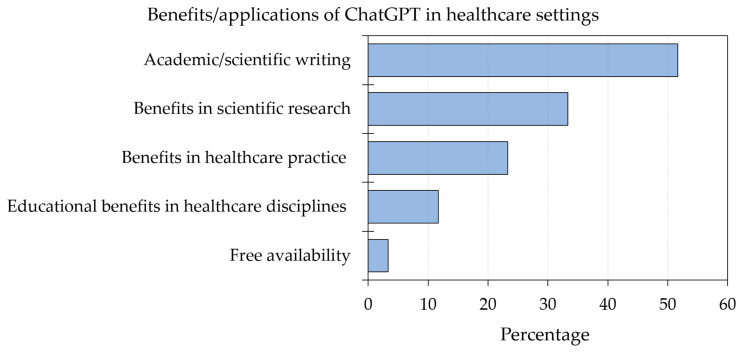
- Benefits were most frequently cited for academic/scientific writing (31 records, 51.7%), followed by scientific research (20, 33.3%), healthcare practice (14, 23.3%), healthcare education (7, 11.7%), and being a free package (2, 3.3%).
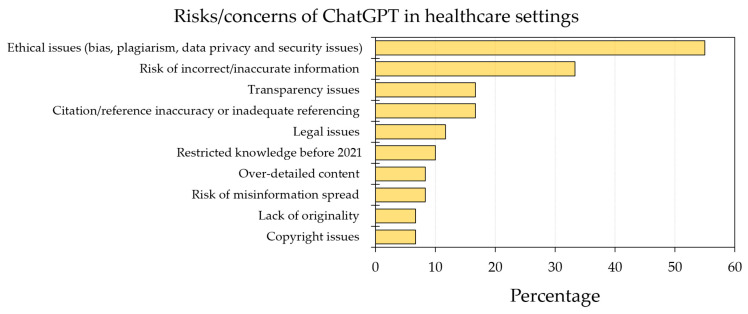
- Ethical concerns were the most common risk category (33 records, 55.0%), including risk of bias (18, 30.0%) and plagiarism (14, 23.3%); incorrect/inaccurate information was cited in 20 records (33.3%), citation/reference inaccuracy in 10 (16.7%), and transparency issues in 10 (16.7%).
- Other reported concerns included legal issues (7, 11.7%), restricted knowledge before 2021 (6, 10.0%), misinformation spread (5, 8.3%), over-detailed content (5, 8.3%), copyright issues (4, 6.7%), and lack of originality (4, 6.7%).
- The review states that ChatGPT does not qualify as an author under current ICMJE/COPE guidelines unless those guidelines are revised, and calls for stakeholder-developed ethics guidance for responsible LLM use in healthcare and academia.
Methods
- Systematic review conducted according to PRISMA guidelines, searching PubMed/MEDLINE and Google Scholar for English records on ChatGPT in healthcare practice/research, healthcare education, or academic writing; searches concluded on 16 February 2023.
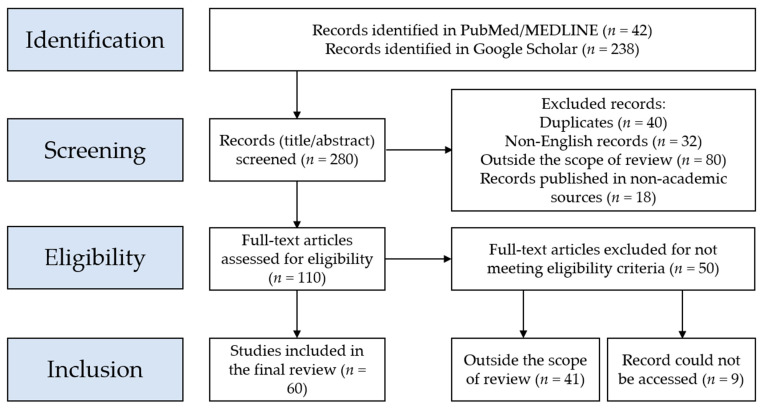
- PubMed/MEDLINE yielded 42 records and Google Scholar yielded 238 records, totaling 280 records; after duplicate removal (n = 40), non-English exclusion (n = 32), out-of-scope exclusion (n = 80), non-academic source exclusion (n = 18), full-text screening exclusions (n = 41), and inaccessible full texts (n = 9), 60 records were included.
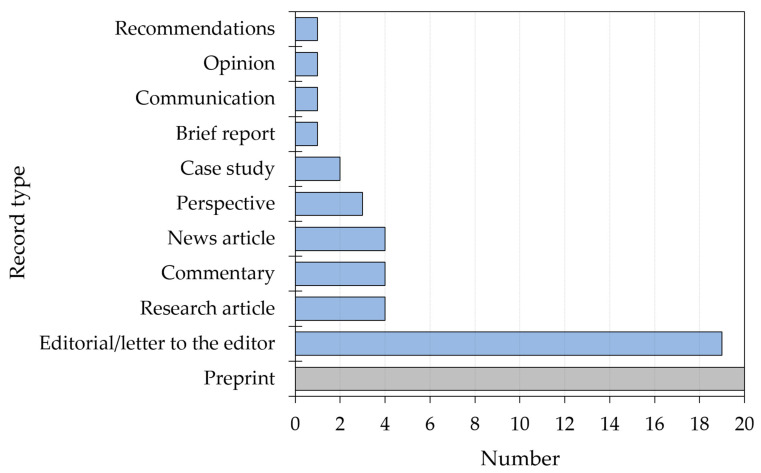
- Each included record was searched for record type, listed benefits/applications, listed risks/concerns, and main conclusions/recommendations regarding ChatGPT in healthcare education, practice, or scientific research/academic writing.
Limitations
- The paper states that included records had variable quality, non-English exclusion may have caused selection bias, inaccessible records may have led to missing relevant data, preprints were not peer reviewed, the literature is growing rapidly with the search ending 16 February 2023, and screening/interpretation was performed by a single author.
- Evident from the text: the review reports descriptive counts of mentions across heterogeneous record types rather than a formal meta-analysis or independent risk-of-bias assessment.
Model-written summary. Check it against the paper before relying on it.
Integrity signals
Registry
Cites
Statistics
Figures
Verification
Claims the paper makes
53 Valid · 1 Not valid · 6 Not checked · 37 Own results and interpretations
Every source the paper cites for this claim was checked and supports it.
In the paper
“This comes in light of the ability of ChatGPT to generate incorrect content that appears plausible from a scientific point of view [81].”
§ ChatGPT Utility in Healthcare Education, Research, and Practice: Systematic Review on the Promising Perspectives and Valid Concerns > 4. Discussion > 4.2. Limitations of ChatGPT Use in Scientific Research
What the sources say
- Supportedcites [81] Cascella M. Montomoli J. Bellini V. Bignami E. Evaluating the Feasibility of ChatGPT in Healthcare: An Analysis of Multiple Clinical and Research Scenarios J. Med. Syst. 2023 47 33 10.1007/s10916-023-01925-4 36869927 PMC9985086 source
In “Reasoning About Public Health Topics,” the paper says ChatGPT can produce believable answers that may be incorrect or nonsensical. In “Possible Misuse of GPT in Medicine and Research,” it describes a scientific abstract that appeared reliable and simulated statistical outputs that could seem plausible to readers. Together, these passages support the claim. (LLM, conf=0.94)
plain- Asserted: passes — The authors put it forward as true.
- Checkable: passes — It can be checked against evidence.
- Load-bearing: passes — The paper’s conclusions depend on it.
- Based: passes — The paper gives a reason why it holds.
- Supported
The sources with a verdict support this claim; the rest weren’t checked yet, have no full text we could read, or their verdicts aren’t rated yet.
In the paper
“This comes in light of the fact that authorship entails legal obligations that are not met by ChatGPT [43,48].”
§ ChatGPT Utility in Healthcare Education, Research, and Practice: Systematic Review on the Promising Perspectives and Valid Concerns > 4. Discussion > 4.2. Limitations of ChatGPT Use in Scientific Research
What the sources say
- Supportedcites [43] Zielinski C. Winker M. Aggarwal R. Ferris L. Heinemann M. Lapeña J. Pai S. Ing E. Citrome L. Chatbots, ChatGPT, and Scholarly Manuscripts WAME Recommendations on ChatGPT and Chatbots in Relation to Scholarly Publications Maced J. Med. Sci. 2023 11 83 86 10.3889/oamjms.2023.11502 37615142 source
The Introduction (p. 2) says chatbots are not legal entities, cannot be held legally liable, and that listing ChatGPT as an author may not be legally defensible. The WAME Recommendations (p. 2) add that chatbots cannot take responsibility for a paper or have the legal standing to sign a statement. (LLM, conf=0.93)
- Not checked — no full text of the sourcecites [48] Liebrenz M. Schleifer R. Buadze A. Bhugra D. Smith A. Generating scholarly content with ChatGPT: Ethical challenges for medical publishing Lancet Digit. Health 2023 5 e105 e106 10.1016/S2589-7500(23)00019-5 36754725 source
plain- Asserted: passes — The authors put it forward as true.
- Checkable: passes — It can be checked against evidence.
- Load-bearing: passes — The paper’s conclusions depend on it.
- Based: passes — The paper gives a reason why it holds.
- Supported
The cited sources support only part of this claim — read each source’s verdict below.
In the paper
“On one hand, ChatGPT, among other LLMs, can be beneficial in conversational and writing tasks, assisting to increase the efficiency and accuracy of the required output [11].”
§ ChatGPT Utility in Healthcare Education, Research, and Practice: Systematic Review on the Promising Perspectives and Valid Concerns > 1. Introduction
What the sources say
- Partly supportedcites [11] Deng J. Lin Y. The Benefits and Challenges of ChatGPT: An Overview Front. Comput. Intell. Syst. 2023 2 81 83 10.54097/fcis.v2i2.4465 sourceExperimental — accuracy not yet measured
Sections 4.1 (Increased Efficiency) and 4.2 (Improved Accuracy) say ChatGPT can make conversations more efficient and generate more accurate responses. The paper does not establish those benefits for writing tasks or for other LLMs, so the broader claim is only partially supported. (LLM, conf=0.88)
plainstates a cause- Asserted: passes — The authors put it forward as true.
- Checkable: passes — It can be checked against evidence.
- Load-bearing: unclear — It is unclear whether the paper’s conclusions depend on it.
- Based: passes — The paper gives a reason why it holds.
- Partly supported
The cited sources support only part of this claim — read each source’s verdict below.
In the paper
“Importantly, the concept of ChatGPT hallucination could be risky if the generated content is not thoroughly evaluated by researchers and health providers with proper expertise [37,56,73,77,79].”
§ ChatGPT Utility in Healthcare Education, Research, and Practice: Systematic Review on the Promising Perspectives and Valid Concerns > 4. Discussion > 4.2. Limitations of ChatGPT Use in Scientific Research
What the sources say
- Not checked — no full text of the sourcecites [37] Shen Y. Heacock L. Elias J. Hentel K.D. Reig B. Shih G. Moy L. ChatGPT and Other Large Language Models Are Double-edged Swords Radiology 2023 230163 10.1148/radiol.230163 36700838 source
- Partly supportedcites [56] Huh S. Are ChatGPT’s knowledge and interpretation ability comparable to those of medical students in Korea for taking a parasitology examination?: A descriptive study J. Educ. Eval. Health Prof. 2023 20 1 10.3352/jeehp.2023.20.1 36627845 PMC9905868 sourceExperimental — accuracy not yet measured
The Background says medical students must evaluate the accuracy of AI-generated medical information before creating reliable information for patients and the public. The Interpretation also reports that some ChatGPT explanations contained incorrect information. These passages support the need for scrutiny, but the paper does not specifically discuss hallucination or evaluation by researchers and health providers. (LLM, conf=0.84)
- Partly supportedcites [73] Duong D. Solomon B.D. Analysis of large-language model versus human performance for genetics questions medRxiv 2023 Preprint 10.1101/2023.01.27.23285115 PMC10999420 37246194 sourceExperimental — accuracy not yet measured
The Discussion (p. 6) says ChatGPT can give plausible explanations for incorrect answers and that its correctness requires additional verification, which is concerning in medical or other high-stakes settings. This supports the risk and need for evaluation, but the paper does not specify that researchers and health providers with proper expertise must perform it. (LLM, conf=0.83)
- Supportedcites [77] Jeblick K. Schachtner B. Dexl J. Mittermeier A. Stüber A.T. Topalis J. Weber T. Wesp P. Sabel B. Ricke J. ChatGPT Makes Medicine Easy to Swallow: An Exploratory Case Study on Simplified Radiology Reports arXiv 2022 10.48550/arxiv.2212.14882 2212.14882 PMC11126432 37794249 source
The Results (Free-text analysis) identify a ChatGPT hallucination that radiologists judged potentially harmful to a patient. The Key Points state that minimizing harm requires supervision by medical experts, supporting the claim’s warning about unevaluated medical content. (LLM, conf=0.90)
- Partly supportedcites [79] Lin Z. Why and how to embrace AI such as ChatGPT in your academic life PsyArXiv 2023 Preprint 10.31234/osf.io/sdx3j PMC10445029 37621662 sourceExperimental — accuracy not yet measured
The “Limitations of generative AI” section says ChatGPT may fabricate facts and false citations (“hallucination”) and urges users to critically evaluate and verify its responses, particularly when reliability is critical. It does not specifically say that researchers and health providers with proper expertise must evaluate the content; that part is more specific than the source. (LLM, conf=0.84)
hedgedstates a possible cause- Asserted: passes — The authors put it forward as true.
- Checkable: passes — It can be checked against evidence.
- Load-bearing: passes — The paper’s conclusions depend on it.
- Based: passes — The paper gives a reason why it holds.
- Rests on an assumption not shown here.
The sources with a verdict support this claim; the rest weren’t checked yet, have no full text we could read, or their verdicts aren’t rated yet.
In the paper
“This is particularly relevant for researchers who are non-native English speakers [23,25,63].”
§ ChatGPT Utility in Healthcare Education, Research, and Practice: Systematic Review on the Promising Perspectives and Valid Concerns > 4. Discussion > 4.1. Benefits of ChatGPT in Scientific Research
What the sources say
- Supportedcites [23] Chen T.J. ChatGPT and Other Artificial Intelligence Applications Speed up Scientific Writing Available online: https://journals.lww.com/jcma/Citation/9900/ChatGPT_and_other_artificial_intelligence.174.aspx (accessed on 16 February 2023) PMC12755446 36791246 source
In the main text (page not provided), Chen says many scientists who are not native English speakers struggle to write in English and describes AI translation and writing tools as ways to overcome that barrier. This supports the claim that language assistance in scientific writing is particularly relevant to those researchers. (LLM, conf=0.91)
- Not checked — no full text of the sourcecites [25] Kitamura F.C. ChatGPT Is Shaping the Future of Medical Writing but Still Requires Human Judgment Radiology 2023 230171 10.1148/radiol.230171 36728749 source
- Supportedcites [63] Gao C.A. Howard F.M. Markov N.S. Dyer E.C. Ramesh S. Luo Y. Pearson A.T. Comparing scientific abstracts generated by ChatGPT to original abstracts using an artificial intelligence output detector, plagiarism detector, and blinded human reviewers bioRxiv 2022 10.1101/2022.12.23.521610 source
The Discussion/Abstract section of our copy states directly that the technology 'could be used by scientists publishing in a language that is not their native language, to improve equity,' alongside the point that generated text 'may help alleviate the burden of writing' and that LLMs are 'a powerful tool to create readable scientific abstracts.' That covers the attributed content — AI-assisted language improvement being especially pertinent for non-native-English researchers — with the source's own hedge ('could be used') slightly weaker than the citing sentence's flat 'is particularly relevant.' No passage in our copy contradicts it. (LLM, conf=0.82)
plainstates an association- Asserted: passes — The authors put it forward as true.
- Checkable: passes — It can be checked against evidence.
- Load-bearing: unclear — It is unclear whether the paper’s conclusions depend on it.
- Based: passes — The paper gives a reason why it holds.
- Supported
42 more claims · 23 with their cited sources checked
Create a free account to see all 97 claims and to verify the 16 references still open.
- Probably not a substantial claim. 31
- It may state two separate claims as one. 27
Claims other papers make about this one
Each is checked against this paper’s own text: does it say what the citing paper says it does?
The source backs part of the claim, not all of it — or backs it for a different population, condition or comparison.
In the citing paper
“The reliance on ChatGPT may result in hindering the development of the skills needed to interpret and respond to social cues, which should be considered in health care education [9,91].”
From Assessing Health Students' Attitudes and Usage of ChatGPT in Jordan: Validation Study (2023) · cites this paper as [9]
Experimental — accuracy not yet measuredThe source backs part of the claim, not all of it — or backs it for a different population, condition or comparison.
In the citing paper
“A recent surge in the use of ChatGPT, in particular for mental health, is emergent for providing crucial personalized advice without clinical explanation, which can hurt user's safety, and thus trust (Sallam, 2023).”
From A review of the explainability and safety of conversational agents for mental health to identify avenues for improvement (2023) · cites this paper as Sallam, 2023
Experimental — accuracy not yet measuredThe source backs part of the claim, not all of it — or backs it for a different population, condition or comparison.
In the citing paper
“ChatGPT plays a crucial role in pandemic management by aiding in the swift and accurate dissemination of critical information.”
From A Systematic Review and Meta-Analysis of Artificial Intelligence Tools in Medicine and Healthcare: Applications, Considerations, Limitations, Motivation and Challenges (2024) · cites this paper as [6]
Experimental — accuracy not yet measuredThe source backs part of the claim, not all of it — or backs it for a different population, condition or comparison.
In the citing paper
“Its natural language processing capabilities enable it to generate coherent responses, making it a valuable tool for healthcare organisations.”
From A Systematic Review and Meta-Analysis of Artificial Intelligence Tools in Medicine and Healthcare: Applications, Considerations, Limitations, Motivation and Challenges (2024) · cites this paper as [6]
Experimental — accuracy not yet measuredThe source backs part of the claim, not all of it — or backs it for a different population, condition or comparison.
In the citing paper
“Specific advantages include its ability to provide rapid updates, preventive measures, and medical guidelines to the public.”
From A Systematic Review and Meta-Analysis of Artificial Intelligence Tools in Medicine and Healthcare: Applications, Considerations, Limitations, Motivation and Challenges (2024) · cites this paper as [6]
Experimental — accuracy not yet measured
31 more claims about this paper
Create a free account to see every claim other papers make about this one.
Citations
Cites
Preferred Reporting Items for Systematic Reviews and Meta-Analyses: the PRISMA statement
Moher, D., Liberati, A., Tetzlaff, J., Altman, D. G., & for the PRISMA Group (2009) · BMJ · doi:10.1136/bmj.b2535 · Cited by 83,823
Preferred Reporting Items for Systematic Reviews and Meta-Analyses: The PRISMA Statement
Moher, D., Liberati, A., Tetzlaff, J., Altman, D. G., & The PRISMA Group (2009) · PLoS Medicine · doi:10.1371/journal.pmed.1000097 · Cited by 64,042 · cited 1×
“The current systematic review was conducted according to the Preferred Reporting Items for Systematic Reviews and Meta-Analyses (PRIMSA) guidelines [21].”
Language Models are Few-Shot Learners
Brown, T. B., Mann, B., Ryder, N., Subbiah, M., Kaplan, J., Dhariwal, P., Neelakantan, A., Shyam, P., Sastry, G., Askell, A., et al. (2020) · arXiv · doi:10.48550/arxiv.2005.14165 · Cited by 23,372 · cited 3×
“The GPT architecture utilizes a neural network to process natural language, thus generating responses based on the context of input text [7].”
BackgroundWang, G., Ma, R., Qiao, G., Wada, K., Aizawa, Y., & Satoh, T. (2015) · Integrative Medicine International · doi:10.1159/000368408 · Cited by 18,657
Kaugeranna, R., Kaugeranna, E., & Aion, (. S. 4. 6. (2023) · DROPS (Schloss Dagstuhl – Leibniz Center for Informatics) · doi:10.4230/lipics.giscience.2023.43 · Cited by 13,690
Machine learning: Trends, perspectives, and prospects
Jordan, M. I., & Mitchell, T. M. (2015) · Science · doi:10.1126/science.aaa8415 · Cited by 9,955
Kung, T. H., Cheatham, M., Medenilla, A., Sillos, C., De Leon, L., Elepaño, C., Madriaga, M., Aggabao, R., Diaz-Candido, G., Maningo, J., et al. (2023) · PLOS Digital Health · doi:10.1371/journal.pdig.0000198 · Cited by 4,115 · cited 2×
“[59] An article showing the ChatGPT raised accuracy which enabled passing the USMLE Accuracy with high concordance and insight; it can facilitate patient communication; improved personalized medicine ChatGPT has a promising potential in medical education; future studies are recommended to consider non-biased approach…”
BackgroundKung, T. H., Cheatham, M., ChatGPT, Medenilla, A., Sillos, C., De Leon, L., Elepaño, C., Madriaga, M., Aggabao, R., Diaz-Candido, G., et al. (2022) · doi:10.1101/2022.12.19.22283643 · Cited by 4,115
Rajpurkar, P., Chen, E., Banerjee, O., & Topol, E. J. (2022) · Nature Medicine · doi:10.1038/s41591-021-01614-0 · Cited by 3,212 · cited 1×
“The promising utility of AI in health care has been outlined previously with possible benefits in personalized medicine, drug discovery, and the analysis of large datasets aside from the potential applications to improve diagnosis and clinical decisions [17,18].”
BackgroundChatting and cheating: Ensuring academic integrity in the era of ChatGPT
Cotton, D. R. E., Cotton, P. A., & Shipway, J. R. (2024) · Innovations in Education and Teaching International · doi:10.1080/14703297.2023.2190148 · Cited by 3,087 · cited 1×
“[62] An EdArXiv 2 preprint on the academic integrity in ChatGPT era Risk of plagiarism; academic dishonesty Careful thinking of educational assessment tools”
Background
Cited by
Items 301–400 of 3,095
Thüs, D., Malone, S., & Brünken, R. (2024) · Frontiers in Psychology · doi:10.3389/fpsyg.2024.1474892 · Cited by 66
Annamalai, N., Bervell, B., Mireku, D. O., & Andoh, R. P. K. (2024) · Computers and Education Artificial Intelligence · doi:10.1016/j.caeai.2024.100346 · Cited by 153
Shiferaw, M. W., Zheng, T., Winter, A., Mike, L. A., & Chan, L.-N. (2024) · BMC Medical Informatics and Decision Making · doi:10.1186/s12911-024-02824-5 · Cited by 66
Guo, S., Liu, D., Fang, X., Meng, Y. G., Zhou, Z.-Z., Li, J., Li, M., Luo, L. Q., Li, H.-L., Cai, X.-Y., et al. (2025) · International Journal of Surgery · doi:10.1097/js9.0000000000003668 · Cited by 165
A Critical Review of ChatGPT as a Potential Substitute for Diabetes Educators
Sharma, S., Pajai, S., Prasad, R., Wanjari, M. B., Munjewar, P. K., Sharma, R., & Pathade, A. (2023) · Cureus · doi:10.7759/cureus.38380 · Cited by 64
“It is important to weigh the potential risks and benefits of ChatGPT-based diabetes education and take steps to mitigate any potential harm [25,26].”
BackgroundApplication of ChatGPT in Higher Education and Research – A Futuristic Analysis
Aithal, P. S., & Aithal, S. (2023) · International Journal of Applied Engineering and Management Letters · doi:10.47992/ijaeml.2581.7000.0193 · Cited by 94
(2023) · International Research Journal of Modernization in Engineering Technology and Science · doi:10.56726/irjmets45212 · Cited by 74
Zaleski, A. L., Berkowsky, R. S., Craig, K. J. T., & Pescatello, L. S. (2024) · JMIR Medical Education · doi:10.2196/51308 · Cited by 95
“…ChatGPT has demonstrated remarkable capabilities including diagnosis support, streamlining clinical workflows, reducing documentation burden, improving patient education understandability and experience [22-25], and, most recently, passing the United States Medical Licensing Examination [26].”
BackgroundAnh, V. T. K., & Nguyen, H. T. T. (2024) · Journal of University Teaching and Learning Practice · doi:10.53761/fr1rkj58 · Cited by 173
“Sallam (2023) indicates some advantages of ChatGPT in healthcare education including developing academic research papers, utilizing healthcare research, personalizing learning, and boosting critical thinking.”
BackgroundYoussef, E., Medhat, M., Abdellatif, S., & Al Malek, M. (2024) · Computers and Education Artificial Intelligence · doi:10.1016/j.caeai.2024.100316 · Cited by 65
Applying ChatGPT in public health: a SWOT and PESTLE analysis
Morita, P. P., Abhari, S., Kaur, J., Lotto, M., Miranda, P. A. D. S. E. S., & Oetomo, A. (2023) · Frontiers in Public Health · doi:10.3389/fpubh.2023.1225861 · Cited by 69
Unveiling the Dark Side of ChatGPT: Exploring Cyberattacks and Enhancing User Awareness
Alawida, M., Abu Shawar, B., Abiodun, O. I., Mehmood, A., Omolara, A. E., & Al Hwaitat, A. K. (2024) · Information · doi:10.3390/info15010027 · Cited by 64
Shrestha, N., Shen, Z., Zaidat, B., Duey, A. H., Tang, J. E., Ahmed, W., Hoang, T., Restrepo Mejia, M., Rajjoub, R., Markowitz, J. S., et al. (2024) · Spine · doi:10.1097/brs.0000000000004915 · Cited by 64
“4,7 Furthermore, there is a potential risk that models like these can perpetuate biases and inaccuracies in the data they are trained on.”
BackgroundCan deepseek and ChatGPT be used in the diagnosis of oral pathologies?
Kaygisiz, Ö. F., & Teke, M. T. (2025) · BMC Oral Health · doi:10.1186/s12903-025-06034-x · Cited by 82
“Moreover, the references of the given information may not be correct [29].”
Ng, J. Y., Maduranayagam, S. G., Suthakar, N., Li, A., Lokker, C., Iorio, A., Haynes, R. B., & Moher, D. (2025) · The Lancet Digital Health · doi:10.1016/s2589-7500(24)00202-4 · Cited by 64
Coşkun, Ö., Kıyak, Y. S., & Budakoğlu, I. İ. (2025) · Medical Teacher · doi:10.1080/0142159x.2024.2327477 · Cited by 64
“However, none of the studies evaluated the psychometric characteristics of multiple-choice items generated by using ChatGPT in health professions education (Sallam 2023), and none has studied implementation of clinical vignettes in an authentic educational setting.”
Sumbal, A., Sumbal, R., & Amir, A. (2024) · Journal of Medical Education and Curricular Development · doi:10.1177/23821205241238641 · Cited by 63
“15,22 This means that ChatGPT has limited knowledge regarding information present on visual diagrams.”
BackgroundAssessing the accuracy of ChatGPT references in head and neck and ENT disciplines
Frosolini, A., Franz, L., Benedetti, S., Vaira, L. A., de Filippis, C., Gennaro, P., Marioni, G., & Gabriele, G. (2023) · European Archives of Oto-Rhino-Laryngology · doi:10.1007/s00405-023-08205-4 · Cited by 63
“The tendency of ChatGPT to provide erroneous/inexistent scientific reference had been already reported in the form of case reports [8, 9] and was listed among the possible risks in a systematic review regarding perspectives and concerns of AI in healthcare education, research, and practice [5].”
BackgroundCoşkun, B. N., Yağız, B., Ocakoğlu, G., Dalkılıç, E., & Pehlivan, Y. (2023) · Rheumatology International · doi:10.1007/s00296-023-05473-5 · Cited by 73
“Their efficacy in medicine has been examined in various capacities, from problem-solving to patient education, yielding diverse results [13].”
Sallam, M., Barakat, M., & Sallam, M. (2023) · Cureus · doi:10.7759/cureus.49373 · Cited by 63
Self-citationPolyportis, A., & Pahos, N. (2024) · Humanities and Social Sciences Communications · doi:10.1057/s41599-023-02464-6 · Cited by 64
The Role and Potential Contributions of the Artificial Intelligence Language Model ChatGPT
Berşe, S., Akça, K., Dirgar, E., & Kaplan Serin, E. (2024) · Annals of Biomedical Engineering · doi:10.1007/s10439-023-03296-w · Cited by 63
Gianola, S., Bargeri, S., Castellini, G., Cook, C., Palese, A., Pillastrini, P., Salvalaggio, S., Turolla, A., & Rossettini, G. (2024) · Journal of Orthopaedic & Sports Physical Therapy · doi:10.2519/jospt.2024.12151 · Cited by 62
Ethical Use of Artificial Intelligence for Scientific Writing: Current Trends
Chetwynd, E. (2024) · Journal of Human Lactation · doi:10.1177/08903344241235160 · Cited by 62
“AI does not have the same creative potential, so the output received might limit the possibility for higher-level thinking (Sallam, 2023).”
BackgroundGöktaş, P., Karakaya, G., Kalyoncu, A. F., & Damadoğlu, E. (2023) · The Journal of Allergy and Clinical Immunology In Practice · doi:10.1016/j.jaip.2023.05.042 · Cited by 74
Chen, J., Zhuo, Z., & Lin, J. (2023) · Sustainability · doi:10.3390/su152416928 · Cited by 61
Assessing the visual appeal of real/AI-generated food images
Califano, G., & Spence, C. J. (2024) · Food Quality and Preference · doi:10.1016/j.foodqual.2024.105149 · Cited by 83
Lubbe, A., Marais, E., & Kruger, D. (2025) · Education and Information Technologies · doi:10.1007/s10639-025-13476-x · Cited by 61
Durmuş Sarıkahya, S., Özbay, Ö., Torpuş, K., Usta, G., & Çınar Özbay, S. (2025) · Nurse Education Today · doi:10.1016/j.nedt.2025.106755 · Cited by 60
Scheschenja, M., Viniol, S., Bastian, M. B., Wessendorf, J., König, A. M., & Mahnken, A. H. (2024) · CardioVascular and Interventional Radiology · doi:10.1007/s00270-023-03563-2 · Cited by 60
“Still a common limitation of these LLMs is the risk of inaccurate information and so called ‘‘hallucinations,’’ which are outputs that are fabricated or not based on factual training data [4, 5].”
The transition from genomics to phenomics in personalized population health
Yurkovich, J. T., Evans, S. J., Rappaport, N., Boore, J. L., Lovejoy, J. C., Price, N. D., & Hood, L. (2023) · Nature Reviews Genetics · doi:10.1038/s41576-023-00674-x · Cited by 82
“Unfortunately, there are still great obstacles to overcome with respect to the accuracy and verifiability of such methods 119 , including regulatory oversight 120 , but there is great promise in their ability to aid medical practitioners in providing personalized care at scale 121 .”
Vowels, L. M., Francois-Walcott, R. R. R., & Darwiche, J. (2024) · Computers in Human Behavior: Artificial Humans · doi:10.1016/j.chbah.2024.100078 · Cited by 59
Dhanvijay, A. K. D., Pinjar, M. J., Dhokane, N., Sorte, S. R., Kumari, A., & Mondal, H. (2023) · Cureus · doi:10.7759/cureus.42972 · Cited by 59
“In the context of medical education and practice, the ability of LLMs to provide accurate and contextually relevant responses holds significant promise [2].”
BackgroundThe Impact of ChatGPT on Learning Motivation: A Study Based on Self-Determination Theory
Zhou, L., & Li, J. (2023) · Education Science and Management · doi:10.56578/esm010103 · Cited by 117
Li, Y., Li, J., He, J., & Tao, C. (2024) · PLoS ONE · doi:10.1371/journal.pone.0300919 · Cited by 73
“The GPT family has multiple versions: The GPT-2 model, with 1.5 billion parameters, is capable of generating extensive sequences of text while adapting to the style and content of arbitrary inputs [45].”
BackgroundInfluentialKim, J., Leonte, K. G., Chen, M. L., Torous, J. B., Linos, E., Pinto, A., & Rodriguez, C. I. (2024) · npj Digital Medicine · doi:10.1038/s41746-024-01181-x · Cited by 60
“Moreover, their ability in advanced clinical reasoning holds promise in assisting in a physician ’ s diagnosis and treatment planning 5 – 7 .”
Mavrych, V., Ganguly, P. K., & Bolgova, O. (2024) · Clinical Anatomy · doi:10.1002/ca.24244 · Cited by 73
“Rather, they can be potent adjunct tools, to be adopted widely in healthcare and medicine (Lee et al., 2023; Sallam, 2023).”
Large Language Models in Medical Diagnostics: Scoping Review With Bibliometric Analysis
Su, H., Sun, Y., Li, R., Zhang, A., Yang, Y., Xiao, F., Duan, Z., Chen, J., Hu, Q., Yang, T., et al. (2025) · Journal of Medical Internet Research · doi:10.2196/72062 · Cited by 81
“Current scoping reviews on LLMs are predominantly conceptual and focused mainly on the entire area of biomedical health [10], highlighting an urgent need for a targeted, domain-specific review to guide future research directions [4,11,12].”
Exploring the frontiers of LLMs in psychological applications: a comprehensive review
Ke, L., Tong, S., Cheng, P., & Peng, K. (2025) · Artificial Intelligence Review · doi:10.1007/s10462-025-11297-5 · Cited by 148
ChatGPT in Medical Education: A Precursor for Automation Bias?
Nguyen, T. (2024) · JMIR Medical Education · doi:10.2196/50174 · Cited by 59
“ChatGPT’s hallucinations are results that are seemingly feasible but do not actually exist [1,16].”
BackgroundInfluentialRadiology-GPT: A Large Language Model for Radiology
Liu, Z., Zhong, A., Li, Y., Yang, L., Ju, C., Wu, Z., Ma, C., Shu, P., Chen, C., Kim, S., et al. (2023) · arXiv · doi:10.48550/arxiv.2306.08666 · Cited by 59
ChatGPT in Medical Education and Research: A Boon or a Bane?
Jeyaraman, M., K, S. P., Jeyaraman, N., Nallakumarasamy, A., Yadav, S., & Bondili, S. K. (2023) · Cureus · doi:10.7759/cureus.44316 · Cited by 58
“· Personalized learning [15]: ChatGPT can be used to create virtual tutors or assistants who can assist students with their homework and ask questions.”
BackgroundRossettini, G., Cook, C., Palese, A., Pillastrini, P., & Turolla, A. (2023) · Journal of Orthopaedic & Sports Physical Therapy · doi:10.2519/jospt.2023.12000 · Cited by 58
Improving radiology workflow using ChatGPT and artificial intelligence
Mese, I., Taslicay, C. A., & Sivrioglu, A. K. (2023) · Clinical Imaging · doi:10.1016/j.clinimag.2023.109993 · Cited by 58
Jo, H., & Park, D.-H. (2023) · International Journal of Human-Computer Interaction · doi:10.1080/10447318.2023.2278283 · Cited by 97
“A notable innovation in this realm is the emergence of ChatGPT, a sophisticated language model developed and trained by OpenAI, which is gaining substantial traction in various contexts (King, 2023; Lund & Wang, 2023; Sallam, 2023).”
Xie, Z., Wu, X., & Xie, Y. (2024) · Journal of Computer Assisted Learning · doi:10.1111/jcal.13032 · Cited by 76
ChatGPT versus a customized AI chatbot (Anatbuddy) for anatomy education: A comparative pilot study
Arun, G., Perumal, V., Urias, F. P. J. B., Ler, Y. E., Tan, B. W. T., Vallabhajosyula, R., Tan, E., Ng, O., Ng, K. B., & Mogali, S. R. (2024) · Anatomical Sciences Education · doi:10.1002/ase.2502 · Cited by 58
“Many educators, including those in healthcare education, 29–31 have since explored their usability in teaching and learning.”
Rane, N. L., Choudhary, S., & Rane, J. (2023) · SSRN Electronic Journal · doi:10.2139/ssrn.4645601 · Cited by 78
How trustworthy is ChatGPT? The case of bibliometric analyses
Farhat, F., Sohail, S. S., & Madsen, D. Ø. (2023) · Cogent Engineering · doi:10.1080/23311916.2023.2222988 · Cited by 56
Ajlouni, A. O., Almahaireh, A. S., & Whaba, F. A.-A. (2023) · International Journal of Emerging Technologies in Learning (iJET) · doi:10.3991/ijet.v18i20.42075 · Cited by 57
Inteligencia artificial generativa y educación: Un análisis desde múltiples perspectivas
García‐Peñalvo, F. J. (2024) · Education in the Knowledge Society (EKS) · doi:10.14201/eks.31942 · Cited by 213
Generative AI as source of change of knowledge management paradigm
Kaczorowska–Spychalska, D., Kotula, N., Mazurek, G., & Sułkowski, Ł. (2024) · Human Technology · doi:10.14254/1795-6889.2024.20-1.7 · Cited by 100
Göktaş, P. (2024) · Journal of Decision System · doi:10.1080/12460125.2024.2410042 · Cited by 80
Artificial General Intelligence for Medical Imaging Analysis
Li, X., Zhao, L., Zhang, L., Wu, Z., Liu, Z., Jiang, H., Cao, C., Xu, S., Li, Y., Dai, H., et al. (2024) · IEEE Reviews in Biomedical Engineering · doi:10.1109/rbme.2024.3493775 · Cited by 117
“While LLMs like Chat-GPT and its successors have demonstrated proficiency in general medical knowledge [41], they might encounter challenges when performing domain-specific tasks due to a deficiency in specialized knowledge [42], [43] and generate erroneous content.”
Raiaan, M. A. K., Mukta, M. S. H., Fatema, K., et al. (2023) · doi:10.36227/techrxiv.24171183 · Cited by 57
Using artificial intelligence to create diverse and inclusive medical case vignettes for education
Bakkum, M. J., Hartjes, M. G., Piët, J. D., Donker, E. M., Likic, R., Sanz, E., de Ponti, F., Verdonk, P., Richir, M. C., van Agtmael, M. A., et al. (2024) · British Journal of Clinical Pharmacology · doi:10.1111/bcp.15977 · Cited by 56
“10 This innovative approach aims to utilize an AI-powered chatbot (OpenAI ChatGPT) to randomize patient characteristics in a manner that ensures broad inclusivity and maintains ethnical and biological appropriateness.”
MethodGravina, A. G., Pellegrino, R., Cipullo, M., Palladino, G., Imperio, G., Ventura, A., Auletta, S., Ciamarra, P., & Federico, A. (2024) · World Journal of Gastroenterology · doi:10.3748/wjg.v30.i1.17 · Cited by 56
ChatGPT in Hydrology and Earth Sciences: Opportunities, Prospects, and Concerns
Foroumandi, E., Moradkhani, H., Sánchez‐Vila, X., Singha, K., Castelletti, A. F., & Destouni, G. (2023) · Water Resources Research · doi:10.1029/2023wr036288 · Cited by 66
“…apprehension surrounding ethical considerations and the ability to distinguish between writings produced by AI and those generated by humans, as well as the potential for plagiarism in articles created by the model (Marchandot et al., 2023; Sallam, 2023; Stokel-Walker & Van Noorden, 2023).”
BackgroundUtility of artificial intelligence‐based large language models in ophthalmic care
Biswas, S., Davies, L. N., Sheppard, A. L., Logan, N. S., & Wolffsohn, J. S. (2024) · Ophthalmic and Physiological Optics · doi:10.1111/opo.13284 · Cited by 73
“22,26,61 Assessing the practical application of LLMs in a real-world clinical setting is essential before they can be deployed clinically.”
BackgroundResultInfluentialKim, Y., Lee, J., Kim, S., Park, J., & Kim, J. (2024) · Proceedings of the 29th International Conference on Intelligent User Interfaces · doi:10.1145/3640543.3645148 · Cited by 55
Sarno, L. D., Caroselli, A., Tonin, G., Graglia, B., Pansini, V., Causio, F. A., Gatto, A., & Chiaretti, A. (2024) · Biomedicines · doi:10.3390/biomedicines12061220 · Cited by 67
“A 2023 systematic review has evaluated its utility in several fields such as data analysis, literature review, scientific writing, medical record storage and management, up to generating diagnoses and management plans[47].”
Assessing the performance of AI chatbots in answering patients' common questions about low back pain
Scaff, S. P. S., dos Reis, F. J. J., Ferreira, G. E., Jacob, M. F., & Saragiotto, B. T. (2024) · Annals of the Rheumatic Diseases · doi:10.1136/ard-2024-226202 · Cited by 71
Suppadungsuk, S., Thongprayoon, C., Krisanapan, P., Tangpanithandee, S., Garcia Valencia, O., Miao, J., Mekraksakit, P., Kashani, K., & Cheungpasitporn, W. (2023) · Journal of Clinical Medicine · doi:10.3390/jcm12175550 · Cited by 56
“Similar concerns have been raised in previous studies regarding the plausibility of references provided by ChatGPT [12,20,29,36,37].”
BackgroundResultNgo, T. T. A., Tran, T. T., An, G. K., & Nguyen, P. T. (2024) · IEEE Transactions on Learning Technologies · doi:10.1109/tlt.2024.3383773 · Cited by 56
“Furthermore, ChatGPT has been examined across various disciplines, particularly in recent research in the fields of medical education by Sallam [32], Sallam et al. [33], and Cooper [34], as well as science education by Folkes [35].”
BackgroundNavigating Generative AI (ChatGPT) in Higher Education: Opportunities and Challenges
Wang, T. (2023) · Lecture Notes in Educational Technology · doi:10.1007/978-981-99-5961-7_28 · Cited by 56
Watters, C., & Lemański, M. K. (2023) · Frontiers in Big Data · doi:10.3389/fdata.2023.1224976 · Cited by 71
“Its potential applications range from customer service chatbots to virtual assistants in healthcare settings (Sallam, 2023).”
BackgroundLarge language models for science and medicine
Telenti, A., Auli, M., Hie, B. L., Maher, C., Saria, S., & Ioannidis, J. P. A. (2024) · European Journal of Clinical Investigation · doi:10.1111/eci.14183 · Cited by 54
“LLMs can generate incorrect citations 59 and may even enhance Matthew effects, 60 where some more visible work (not necessarily more accurate) gets further cited and propagated—sometimes at the expense of less visible but perhaps more correct work.”
BackgroundCapability of GPT-4V(ision) in the Japanese National Medical Licensing Examination: Evaluation Study
Nakao, T., Miki, S., Nakamura, Y., Kikuchi, T., Nomura, Y., Hanaoka, S., Yoshikawa, T., & Abe, O. (2024) · JMIR Medical Education · doi:10.2196/54393 · Cited by 55
“ChatGPT may serve as a valuable teaching assistant in medical education; however, the inaccuracies in its responses are a significant concern [5,7].”
BackgroundZhang, S., Liau, Z. Q. G., Tan, K. L. M., & Chua, W. L. (2024) · Knee Surgery and Related Research · doi:10.1186/s43019-024-00218-5 · Cited by 67
“Being an AI chatbot that is adaptive and readily accessible, ChatGPT is well suited in providing personalized information and medical advice to patients [28, 29].”
BackgroundHadi, M. U., tashi, Q. A., Qureshi, R., Shah, A., muneer, A., Irfan, M., Zafar, A., Shaikh, M. B., Akhtar, N., Wu, J., et al. (2023) · doi:10.36227/techrxiv.23589741.v3 · Cited by 53
Abdallah, N., Katmah, R., Khalaf, K., & Jelinek, H. F. (2025) · Social Sciences & Humanities Open · doi:10.1016/j.ssaho.2025.101866 · Cited by 55
Watari, T., Takagi, S., Sakaguchi, K., Nishizaki, Y., Shimizu, T., Yamamoto, Y., & Tokuda, Y. (2023) · JMIR Medical Education · doi:10.2196/52202 · Cited by 54
“On March 14, 2023, OpenAI introduced the latest iteration of LLMs, GPT-4 [7,8].”
ChatGPT hallucinating: can it get any more humanlike?
Siontis, K. C., Attia, Z. I., Asirvatham, S. J., & Friedman, P. A. (2023) · European Heart Journal · doi:10.1093/eurheartj/ehad766 · Cited by 90
Akutay, S., Yüceler Kaçmaz, H., & Kahraman, H. (2024) · Nurse Education in Practice · doi:10.1016/j.nepr.2024.104142 · Cited by 54
Strika, Z., Petković, K., Likić, R., & Batenburg, R. S. (2024) · Postgraduate Medical Journal · doi:10.1093/postmj/qgae122 · Cited by 72
Saleh, Z. T., Rababa, M., Elshatarat, R. A., Alharbi, M., Alhumaidi, B. N., Al-Za'areer, M. S., Jarrad, R. A., niarat, T. F. A., Almagharbeh, W. T., Al‐Sayaghi, K. M., et al. (2025) · BMC Nursing · doi:10.1186/s12912-025-03082-0 · Cited by 83
“These AI chatbots can facilitate immediate access to information and enable self-assessment, promoting student engagement and independent learning [3, 15, 17, 18].”
Artificial intelligence and health literacy—proceed with caution
Nutbeam, D. (2023) · Health Literacy and Communication Open · doi:10.1080/28355245.2023.2263355 · Cited by 75
Tool or Tyrant: Guiding and Guarding Generative Artificial Intelligence Use in Nursing Education
Lane, S. H., Haley, T., & Brackney, D. E. (2024) · Creative Nursing · doi:10.1177/10784535241247094 · Cited by 52
“Our SWOT analysis fi ndings are consistent with the current published literature in nursing education and higher education that demonstrated the useful bene fi ts of generative AI for students including tutoring, translating, the development of critical thinking and clinical judgment in safe practice environments, and p…”
BackgroundInfluentialSaihi, A., Ben‐Daya, M., & Hariga, M. A. (2024) · Education and Information Technologies · doi:10.1007/s10639-024-13023-0 · Cited by 75
Parums, D. V. (2023) · Medical Science Monitor · doi:10.12659/msm.941209 · Cited by 86
Kim, J., Wang, K., Weng, C., & Liu, C. (2024) · The American Journal of Human Genetics · doi:10.1016/j.ajhg.2024.08.010 · Cited by 53
García-Alonso, E. M., León-Mejía, A. C., Sánchez-Cabrero, R., & Guzmán-Ordaz, R. (2024) · Behavioral Sciences · doi:10.3390/bs14070612 · Cited by 53
“It also improves virtual and visual learning in health-related studies [33–38].”
BackgroundLiu, X., Wu, J., Shao, A., Shen, W., Ye, P., Wang, Y., Ye, J., Jin, K., & Yang, J. (2024) · Journal of Medical Internet Research · doi:10.2196/51926 · Cited by 52
“Inference ability [24-26]: the total reasoning steps, the number of reasoning errors, and the incompleteness of the inference process.”
ChatGPT in Plastic and Reconstructive Surgery
Sharma, S. C., Ramchandani, J. P., Thakker, A., & Lahiri, A. (2023) · Indian Journal of Plastic Surgery · doi:10.1055/s-0043-1771514 · Cited by 52
“13 However, the review also found several limitations with the chatbot including the frequent use of super fi cial, inaccurate,or incorrectcontent and its inabilitytoproduce accurate or suf fi cient references when creating literature.”
BackgroundMejia, M. R., Arroyave, J. S., Saturno, M., Ndjonko, L. C. M., Zaidat, B., Rajjoub, R., Ahmed, W., Zapolsky, I., & Cho, S. K. (2024) · Neurospine · doi:10.14245/ns.2347052.526 · Cited by 52
“20 The review emphasized the need for cautious adoption of ChatGPT in healthcare, highlighting its potential to induce paradigm shifts in the field but also the necessity of addressing its limitations.”
BackgroundLarge Language Models in Biomedical and Health Informatics: A Review with Bibliometric Analysis
Yu, H., Fan, L., Li, L., Zhou, J., Ma, Z., Xian, L., Hua, W., He, S., Jin, M., Zhang, Y., et al. (2024) · Journal of Healthcare Informatics Research · doi:10.1007/s41666-024-00171-8 · Cited by 102
Assessing the Impact of ChatGPT in Dermatology: A Comprehensive Rapid Review
Göktaş, P., & Grzybowski, A. E. (2024) · Journal of Clinical Medicine · doi:10.3390/jcm13195909 · Cited by 60
“Transparency and the clear disclosure of AI-generated content are crucial to maintaining the integrity of medical practice and ensuring that patients remain informed and involved in their care decisions [57].”
BackgroundSahu, P. K., Benjamin, L. A., Singh Aswal, G., & Williams-Persad, A. (2023) · Postgraduate Medical Journal · doi:10.1093/postmj/qgad090 · Cited by 52
The moral machine experiment on large language models
Takemoto, K. (2024) · Royal Society Open Science · doi:10.1098/rsos.231393 · Cited by 52
Conversational health agents: a personalized large language model-powered agent framework
Abbasian, M., Azimi, I., Rahmani, A. M., & Jain, R. (2025) · JAMIA Open · doi:10.1093/jamiaopen/ooaf067 · Cited by 52
The Acceptance and Diffusion of Generative Artificial Intelligence in Education: A Literature Review
Baytak, A. (2023) · Current Perspectives in Educational Research · doi:10.46303/cuper.2023.2 · Cited by 51
Cheng, S.-L., Tsai, S.-J., Bai, Y.-M., Ko, C.-H., Hsu, C.-W., Yang, F.-C., Tsai, C.-K., Tu, Y.-K., Yang, S.-N., Tseng, P.-T., et al. (2023) · Journal of Medical Internet Research · doi:10.2196/51229 · Cited by 50
“ChatPDF offers users a summary and answers questions regarding PDF files without nonexistent or self-created content, which is a major concern in ChatGPT [6].”
Comparison of Large Language Models in Answering Immuno-Oncology Questions: A Cross-Sectional Study
Iannantuono, G. M., Bracken-Clarke, D., Karzai, F., Choo-Wosoba, H., Gulley, J. L., & Floudas, C. S. (2024) · The Oncologist · doi:10.1093/oncolo/oyae009 · Cited by 51
Tanprasert, T., Fels, S. S., Sinnamon, L., & Yoon, D. (2024) · Proceedings of the CHI Conference on Human Factors in Computing Systems · doi:10.1145/3613904.3642513 · Cited by 51
“Such phenomena have been observed in many ChatGPT applications in academia [3, 90, 93].”
Gwon, Y. N., Kim, J. H., Chung, H. S., Jung, E. J., Chun, J., Lee, S., & Shim, S. R. (2024) · JMIR Medical Informatics · doi:10.2196/51187 · Cited by 51
“Although Sallam’s [5] SR suggests that academic and scientific writing as well as health care practice, research, and education could benefit from the use of ChatGPT, this study found that ChatGPT could not search scientific articles properly, with a 0.08% (1/1287) of probability of the desired…”
BackgroundMethodInfluentialEnhancing AI competence in health management: students’ experiences with ChatGPT as a learning Tool
Naamati-Schneider, L. (2024) · BMC Medical Education · doi:10.1186/s12909-024-05595-9 · Cited by 51
Wang, C., Li, S., Lin, N., Zhang, X., Han, Y., Wang, X., Liu, D., Tan, X., Pu, D., Li, K., et al. (2025) · Journal of Medical Internet Research · doi:10.2196/59435 · Cited by 70
Mortlock, R., & Lucas, C. (2024) · Exploratory Research in Clinical and Social Pharmacy · doi:10.1016/j.rcsop.2024.100481 · Cited by 51
“15,18,44,48,56,60,66,67 68 – 72 By challenging students to engage in critical thinking, problem-solving, and decision-making processes, educators can align assessments to accurately reflect a students ’ cognitive abilities and professional readiness.”
BackgroundHu, J.-M., Liu, F.-C., Chu, C.-M., & Chang, Y.-T. (2023) · Journal of Medical Internet Research · doi:10.2196/49385 · Cited by 50
Hillmann, H. A. K., Angelini, E., Karfoul, N., Feickert, S., Müller‐Leisse, J., & Duncker, D. (2023) · EP Europace · doi:10.1093/europace/euad369 · Cited by 61
Metadata
- Authors
- Sallam, M.
- Affiliations
- University of Jordan (JO)
- Corresponding author
- Sallam, Malik
- ORCID
- Sallam, Malik
- Venue
- Healthcare
- Publisher
- MDPI AG
- Published
- 2023-03-19
- Volume
- 11
- Issue
- 6
- Pages
- 887
- ISSN
- 2227-9032 (ISSN-L)
- PMC
- PMC10048148
- OpenAlex
- W4327946446
- Semantic Scholar
- dfdf7ff01aa6f691831e663fd29bc71890be39e2
- Cited by
- 3,126
- References
- 114
- Citations by year
- 2026: 561 · 2025: 839 · 2024: 1052 · 2023: 669
- FWCI
- 36.67
- Type
- journal article
- Language
- en
- Open access
- gold
- doi.org
- Licence
- Locations
- Healthcare (publishedVersion, cc-by)
- medRxiv (acceptedVersion, cc-by-nc-nd)
- Preprints.org (acceptedVersion, cc-by)
- PubMed Central (publishedVersion, cc-by)
- PubMed (publishedVersion)
- Topics
- Health Sciences › Medicine › Health Informatics › Artificial Intelligence in Healthcare and Education
- Physical Sciences › Computer Science › Artificial Intelligence › Artificial Intelligence Applications
- Social Sciences › Education › Artificial Intelligence in Education
- Keywords
- ChatGPT, large language models, artificial intelligence in healthcare, healthcare education, health care research, clinical practice, scientific writing, research equity, drug discovery, personalized medicine, health literacy, plagiarism, hallucinations, authorship criteria, AI ethics, infodemic
About these checks
Registry, retraction, Cites and statistics results are computed, not judged, with one exception: a printed reference that no index lists is read once by a model before it counts as a citation error. Claims are extracted by a model and kept only when their quote appears verbatim in the text; each cited source is then checked, with a model’s help, for whether it says what the claim relies on. Those verdicts can be wrong — read the claim’s quote and the cited source before relying on one.
The claim verdicts this report counts are experimental: their accuracy is not yet measured.
A language model drew the claims from the paper on 2026-10-10, under version 3 of the claim definition (model deepseek-v4.1-flash, prompt extract-v3).
A second model labelled each claim on 2026-10-10 (model jev-1.13-20260917, definition revision gold-guideline-v0.2).
Cited sources are checked with a language model’s help (gpt-6-sol and qwen3.8-omni-flash).
Statistics and arithmetic are recomputed, not judged.
Confidence bands are shown only for fields calibrated on our annotated test set. None is calibrated yet, so no band is shown.
What counts as a claim ›How we measure confidence ›How we check this ›
Are you an author, or do you see a problem with this page? Request a review
Data sources
Bibliographic data: Semantic Scholar, OpenAlex, Crossref.
Contains information from the Semantic Scholar Academic Graph Datasets, made available under the ODC Attribution License (ODC-BY 1.0).
Semantic Scholar’s data is described in: Kinney, R., et al. (2023). The Semantic Scholar Open Data Platform. arXiv:2301.10140.
