

ChatGPT Utility in Healthcare Education, Research, and Practice: Systematic Review on the Promising Perspectives and Valid Concerns
Open accessPublished version of a preprint
The DOI matches its Crossref record; 116 of the 117 references it cites were found in a registry or an index; 110 of the 179 sources its claims cite were checked for support.
Abstract
ChatGPT is an artificial intelligence-powered chatbot. This systematic review synthesised the evidence regarding its application in healthcare education, research, and practice. ChatGPT shows remarkable utilities in summarizing research, translating materials, serving as a virtual tutor, drafting case scenarios, and automating administrative workflows. However, concerns regarding incorrect outputs (hallucinations), lack of analytical depth, risk of plagiarism, and algorithmic bias remain significant across the literature.
Overview
CoChat Summary
TL;DR
This systematic review of 60 records found that ChatGPT was cited as beneficial in 51/60 (85.0%) records for healthcare education, research, and practice, while concerns were raised in 58/60 (96.7%) records. The author concludes that ChatGPT has promising applications but requires cautious, guideline-driven use, and does not currently qualify for scientific authorship under ICMJE/COPE guidelines.
Key findings
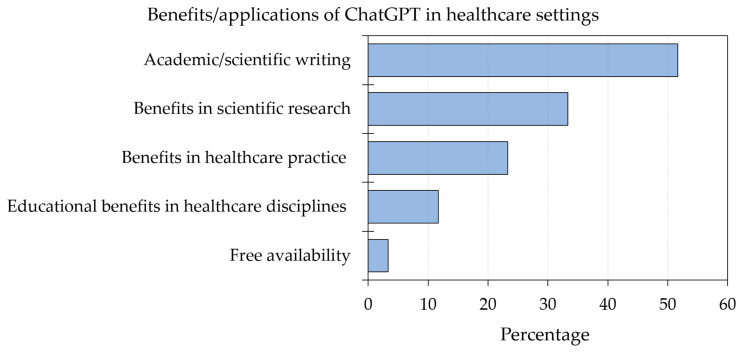
- Benefits were most frequently cited for academic/scientific writing (31 records, 51.7%), followed by scientific research (20, 33.3%), healthcare practice (14, 23.3%), healthcare education (7, 11.7%), and being a free package (2, 3.3%).
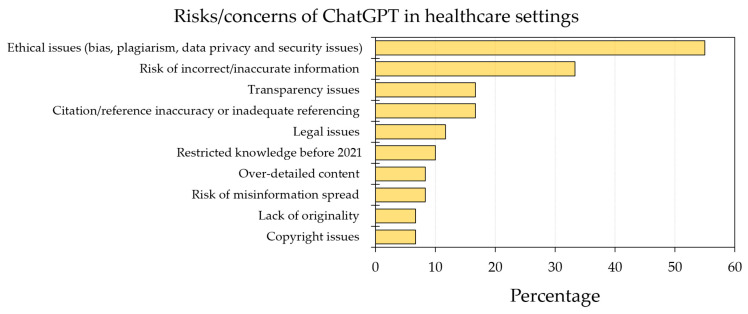
- Ethical concerns were the most common risk category (33 records, 55.0%), including risk of bias (18, 30.0%) and plagiarism (14, 23.3%); incorrect/inaccurate information was cited in 20 records (33.3%), citation/reference inaccuracy in 10 (16.7%), and transparency issues in 10 (16.7%).
- Other reported concerns included legal issues (7, 11.7%), restricted knowledge before 2021 (6, 10.0%), misinformation spread (5, 8.3%), over-detailed content (5, 8.3%), copyright issues (4, 6.7%), and lack of originality (4, 6.7%).
- The review states that ChatGPT does not qualify as an author under current ICMJE/COPE guidelines unless those guidelines are revised, and calls for stakeholder-developed ethics guidance for responsible LLM use in healthcare and academia.
Methods
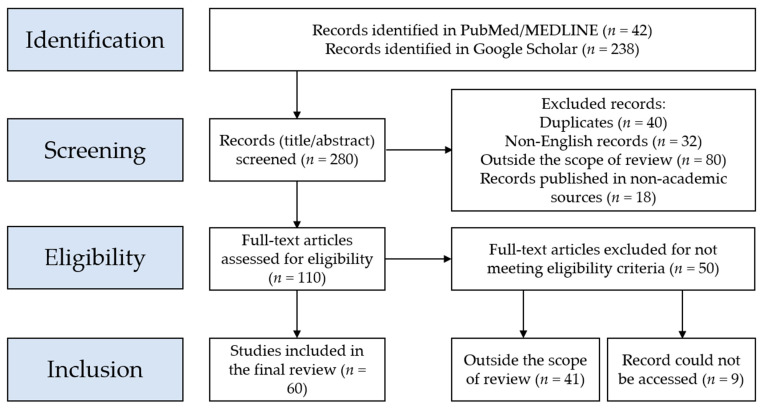
- Systematic review conducted according to PRISMA guidelines, searching PubMed/MEDLINE and Google Scholar for English records on ChatGPT in healthcare practice/research, healthcare education, or academic writing; searches concluded on 16 February 2023.
- PubMed/MEDLINE yielded 42 records and Google Scholar yielded 238 records, totaling 280 records; after duplicate removal (n = 40), non-English exclusion (n = 32), out-of-scope exclusion (n = 80), non-academic source exclusion (n = 18), full-text screening exclusions (n = 41), and inaccessible full texts (n = 9), 60 records were included.
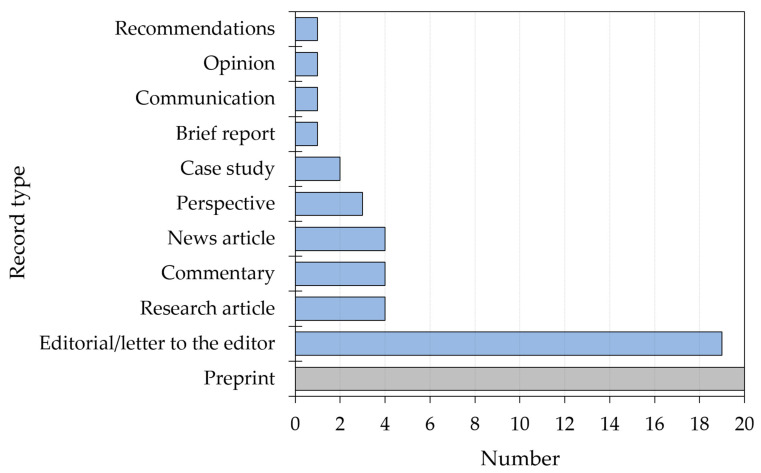
- Each included record was searched for record type, listed benefits/applications, listed risks/concerns, and main conclusions/recommendations regarding ChatGPT in healthcare education, practice, or scientific research/academic writing.
Limitations
- The paper states that included records had variable quality, non-English exclusion may have caused selection bias, inaccessible records may have led to missing relevant data, preprints were not peer reviewed, the literature is growing rapidly with the search ending 16 February 2023, and screening/interpretation was performed by a single author.
- Evident from the text: the review reports descriptive counts of mentions across heterogeneous record types rather than a formal meta-analysis or independent risk-of-bias assessment.
Model-written summary. Check it against the paper before relying on it.
Integrity signals
Registry
Cites
Statistics
Figures
Verification
Claims the paper makes
53 Valid · 1 Not valid · 6 Not checked · 37 Own results and interpretations
Every source the paper cites for this claim was checked and supports it.
In the paper
“This comes in light of the ability of ChatGPT to generate incorrect content that appears plausible from a scientific point of view [81].”
§ ChatGPT Utility in Healthcare Education, Research, and Practice: Systematic Review on the Promising Perspectives and Valid Concerns > 4. Discussion > 4.2. Limitations of ChatGPT Use in Scientific Research
What the sources say
- Supportedcites [81] Cascella M. Montomoli J. Bellini V. Bignami E. Evaluating the Feasibility of ChatGPT in Healthcare: An Analysis of Multiple Clinical and Research Scenarios J. Med. Syst. 2023 47 33 10.1007/s10916-023-01925-4 36869927 PMC9985086 source
In “Reasoning About Public Health Topics,” the paper says ChatGPT can produce believable answers that may be incorrect or nonsensical. In “Possible Misuse of GPT in Medicine and Research,” it describes a scientific abstract that appeared reliable and simulated statistical outputs that could seem plausible to readers. Together, these passages support the claim. (LLM, conf=0.94)
plain- Asserted: passes — The authors put it forward as true.
- Checkable: passes — It can be checked against evidence.
- Load-bearing: passes — The paper’s conclusions depend on it.
- Based: passes — The paper gives a reason why it holds.
- Supported
The sources with a verdict support this claim; the rest weren’t checked yet, have no full text we could read, or their verdicts aren’t rated yet.
In the paper
“This comes in light of the fact that authorship entails legal obligations that are not met by ChatGPT [43,48].”
§ ChatGPT Utility in Healthcare Education, Research, and Practice: Systematic Review on the Promising Perspectives and Valid Concerns > 4. Discussion > 4.2. Limitations of ChatGPT Use in Scientific Research
What the sources say
- Supportedcites [43] Zielinski C. Winker M. Aggarwal R. Ferris L. Heinemann M. Lapeña J. Pai S. Ing E. Citrome L. Chatbots, ChatGPT, and Scholarly Manuscripts WAME Recommendations on ChatGPT and Chatbots in Relation to Scholarly Publications Maced J. Med. Sci. 2023 11 83 86 10.3889/oamjms.2023.11502 37615142 source
The Introduction (p. 2) says chatbots are not legal entities, cannot be held legally liable, and that listing ChatGPT as an author may not be legally defensible. The WAME Recommendations (p. 2) add that chatbots cannot take responsibility for a paper or have the legal standing to sign a statement. (LLM, conf=0.93)
- Not checked — no full text of the sourcecites [48] Liebrenz M. Schleifer R. Buadze A. Bhugra D. Smith A. Generating scholarly content with ChatGPT: Ethical challenges for medical publishing Lancet Digit. Health 2023 5 e105 e106 10.1016/S2589-7500(23)00019-5 36754725 source
plain- Asserted: passes — The authors put it forward as true.
- Checkable: passes — It can be checked against evidence.
- Load-bearing: passes — The paper’s conclusions depend on it.
- Based: passes — The paper gives a reason why it holds.
- Supported
The cited sources support only part of this claim — read each source’s verdict below.
In the paper
“On one hand, ChatGPT, among other LLMs, can be beneficial in conversational and writing tasks, assisting to increase the efficiency and accuracy of the required output [11].”
§ ChatGPT Utility in Healthcare Education, Research, and Practice: Systematic Review on the Promising Perspectives and Valid Concerns > 1. Introduction
What the sources say
- Partly supportedcites [11] Deng J. Lin Y. The Benefits and Challenges of ChatGPT: An Overview Front. Comput. Intell. Syst. 2023 2 81 83 10.54097/fcis.v2i2.4465 sourceExperimental — accuracy not yet measured
Sections 4.1 (Increased Efficiency) and 4.2 (Improved Accuracy) say ChatGPT can make conversations more efficient and generate more accurate responses. The paper does not establish those benefits for writing tasks or for other LLMs, so the broader claim is only partially supported. (LLM, conf=0.88)
plainstates a cause- Asserted: passes — The authors put it forward as true.
- Checkable: passes — It can be checked against evidence.
- Load-bearing: unclear — It is unclear whether the paper’s conclusions depend on it.
- Based: passes — The paper gives a reason why it holds.
- Partly supported
The cited sources support only part of this claim — read each source’s verdict below.
In the paper
“Importantly, the concept of ChatGPT hallucination could be risky if the generated content is not thoroughly evaluated by researchers and health providers with proper expertise [37,56,73,77,79].”
§ ChatGPT Utility in Healthcare Education, Research, and Practice: Systematic Review on the Promising Perspectives and Valid Concerns > 4. Discussion > 4.2. Limitations of ChatGPT Use in Scientific Research
What the sources say
- Not checked — no full text of the sourcecites [37] Shen Y. Heacock L. Elias J. Hentel K.D. Reig B. Shih G. Moy L. ChatGPT and Other Large Language Models Are Double-edged Swords Radiology 2023 230163 10.1148/radiol.230163 36700838 source
- Partly supportedcites [56] Huh S. Are ChatGPT’s knowledge and interpretation ability comparable to those of medical students in Korea for taking a parasitology examination?: A descriptive study J. Educ. Eval. Health Prof. 2023 20 1 10.3352/jeehp.2023.20.1 36627845 PMC9905868 sourceExperimental — accuracy not yet measured
The Background says medical students must evaluate the accuracy of AI-generated medical information before creating reliable information for patients and the public. The Interpretation also reports that some ChatGPT explanations contained incorrect information. These passages support the need for scrutiny, but the paper does not specifically discuss hallucination or evaluation by researchers and health providers. (LLM, conf=0.84)
- Partly supportedcites [73] Duong D. Solomon B.D. Analysis of large-language model versus human performance for genetics questions medRxiv 2023 Preprint 10.1101/2023.01.27.23285115 PMC10999420 37246194 sourceExperimental — accuracy not yet measured
The Discussion (p. 6) says ChatGPT can give plausible explanations for incorrect answers and that its correctness requires additional verification, which is concerning in medical or other high-stakes settings. This supports the risk and need for evaluation, but the paper does not specify that researchers and health providers with proper expertise must perform it. (LLM, conf=0.83)
- Supportedcites [77] Jeblick K. Schachtner B. Dexl J. Mittermeier A. Stüber A.T. Topalis J. Weber T. Wesp P. Sabel B. Ricke J. ChatGPT Makes Medicine Easy to Swallow: An Exploratory Case Study on Simplified Radiology Reports arXiv 2022 10.48550/arxiv.2212.14882 2212.14882 PMC11126432 37794249 source
The Results (Free-text analysis) identify a ChatGPT hallucination that radiologists judged potentially harmful to a patient. The Key Points state that minimizing harm requires supervision by medical experts, supporting the claim’s warning about unevaluated medical content. (LLM, conf=0.90)
- Partly supportedcites [79] Lin Z. Why and how to embrace AI such as ChatGPT in your academic life PsyArXiv 2023 Preprint 10.31234/osf.io/sdx3j PMC10445029 37621662 sourceExperimental — accuracy not yet measured
The “Limitations of generative AI” section says ChatGPT may fabricate facts and false citations (“hallucination”) and urges users to critically evaluate and verify its responses, particularly when reliability is critical. It does not specifically say that researchers and health providers with proper expertise must evaluate the content; that part is more specific than the source. (LLM, conf=0.84)
hedgedstates a possible cause- Asserted: passes — The authors put it forward as true.
- Checkable: passes — It can be checked against evidence.
- Load-bearing: passes — The paper’s conclusions depend on it.
- Based: passes — The paper gives a reason why it holds.
- Rests on an assumption not shown here.
The sources with a verdict support this claim; the rest weren’t checked yet, have no full text we could read, or their verdicts aren’t rated yet.
In the paper
“This is particularly relevant for researchers who are non-native English speakers [23,25,63].”
§ ChatGPT Utility in Healthcare Education, Research, and Practice: Systematic Review on the Promising Perspectives and Valid Concerns > 4. Discussion > 4.1. Benefits of ChatGPT in Scientific Research
What the sources say
- Supportedcites [23] Chen T.J. ChatGPT and Other Artificial Intelligence Applications Speed up Scientific Writing Available online: https://journals.lww.com/jcma/Citation/9900/ChatGPT_and_other_artificial_intelligence.174.aspx (accessed on 16 February 2023) PMC12755446 36791246 source
In the main text (page not provided), Chen says many scientists who are not native English speakers struggle to write in English and describes AI translation and writing tools as ways to overcome that barrier. This supports the claim that language assistance in scientific writing is particularly relevant to those researchers. (LLM, conf=0.91)
- Not checked — no full text of the sourcecites [25] Kitamura F.C. ChatGPT Is Shaping the Future of Medical Writing but Still Requires Human Judgment Radiology 2023 230171 10.1148/radiol.230171 36728749 source
- Supportedcites [63] Gao C.A. Howard F.M. Markov N.S. Dyer E.C. Ramesh S. Luo Y. Pearson A.T. Comparing scientific abstracts generated by ChatGPT to original abstracts using an artificial intelligence output detector, plagiarism detector, and blinded human reviewers bioRxiv 2022 10.1101/2022.12.23.521610 source
The Discussion/Abstract section of our copy states directly that the technology 'could be used by scientists publishing in a language that is not their native language, to improve equity,' alongside the point that generated text 'may help alleviate the burden of writing' and that LLMs are 'a powerful tool to create readable scientific abstracts.' That covers the attributed content — AI-assisted language improvement being especially pertinent for non-native-English researchers — with the source's own hedge ('could be used') slightly weaker than the citing sentence's flat 'is particularly relevant.' No passage in our copy contradicts it. (LLM, conf=0.82)
plainstates an association- Asserted: passes — The authors put it forward as true.
- Checkable: passes — It can be checked against evidence.
- Load-bearing: unclear — It is unclear whether the paper’s conclusions depend on it.
- Based: passes — The paper gives a reason why it holds.
- Supported
42 more claims · 23 with their cited sources checked
Create a free account to see all 97 claims and to verify the 16 references still open.
- Probably not a substantial claim. 31
- It may state two separate claims as one. 27
Claims other papers make about this one
Each is checked against this paper’s own text: does it say what the citing paper says it does?
The source backs part of the claim, not all of it — or backs it for a different population, condition or comparison.
In the citing paper
“The reliance on ChatGPT may result in hindering the development of the skills needed to interpret and respond to social cues, which should be considered in health care education [9,91].”
From Assessing Health Students' Attitudes and Usage of ChatGPT in Jordan: Validation Study (2023) · cites this paper as [9]
Experimental — accuracy not yet measuredThe source backs part of the claim, not all of it — or backs it for a different population, condition or comparison.
In the citing paper
“A recent surge in the use of ChatGPT, in particular for mental health, is emergent for providing crucial personalized advice without clinical explanation, which can hurt user's safety, and thus trust (Sallam, 2023).”
From A review of the explainability and safety of conversational agents for mental health to identify avenues for improvement (2023) · cites this paper as Sallam, 2023
Experimental — accuracy not yet measuredThe source backs part of the claim, not all of it — or backs it for a different population, condition or comparison.
In the citing paper
“ChatGPT plays a crucial role in pandemic management by aiding in the swift and accurate dissemination of critical information.”
From A Systematic Review and Meta-Analysis of Artificial Intelligence Tools in Medicine and Healthcare: Applications, Considerations, Limitations, Motivation and Challenges (2024) · cites this paper as [6]
Experimental — accuracy not yet measuredThe source backs part of the claim, not all of it — or backs it for a different population, condition or comparison.
In the citing paper
“Its natural language processing capabilities enable it to generate coherent responses, making it a valuable tool for healthcare organisations.”
From A Systematic Review and Meta-Analysis of Artificial Intelligence Tools in Medicine and Healthcare: Applications, Considerations, Limitations, Motivation and Challenges (2024) · cites this paper as [6]
Experimental — accuracy not yet measuredThe source backs part of the claim, not all of it — or backs it for a different population, condition or comparison.
In the citing paper
“Specific advantages include its ability to provide rapid updates, preventive measures, and medical guidelines to the public.”
From A Systematic Review and Meta-Analysis of Artificial Intelligence Tools in Medicine and Healthcare: Applications, Considerations, Limitations, Motivation and Challenges (2024) · cites this paper as [6]
Experimental — accuracy not yet measured
31 more claims about this paper
Create a free account to see every claim other papers make about this one.
Citations
Cites
Preferred Reporting Items for Systematic Reviews and Meta-Analyses: the PRISMA statement
Moher, D., Liberati, A., Tetzlaff, J., Altman, D. G., & for the PRISMA Group (2009) · BMJ · doi:10.1136/bmj.b2535 · Cited by 83,823
Preferred Reporting Items for Systematic Reviews and Meta-Analyses: The PRISMA Statement
Moher, D., Liberati, A., Tetzlaff, J., Altman, D. G., & The PRISMA Group (2009) · PLoS Medicine · doi:10.1371/journal.pmed.1000097 · Cited by 64,042 · cited 1×
“The current systematic review was conducted according to the Preferred Reporting Items for Systematic Reviews and Meta-Analyses (PRIMSA) guidelines [21].”
Language Models are Few-Shot Learners
Brown, T. B., Mann, B., Ryder, N., Subbiah, M., Kaplan, J., Dhariwal, P., Neelakantan, A., Shyam, P., Sastry, G., Askell, A., et al. (2020) · arXiv · doi:10.48550/arxiv.2005.14165 · Cited by 23,372 · cited 3×
“The GPT architecture utilizes a neural network to process natural language, thus generating responses based on the context of input text [7].”
BackgroundWang, G., Ma, R., Qiao, G., Wada, K., Aizawa, Y., & Satoh, T. (2015) · Integrative Medicine International · doi:10.1159/000368408 · Cited by 18,657
Kaugeranna, R., Kaugeranna, E., & Aion, (. S. 4. 6. (2023) · DROPS (Schloss Dagstuhl – Leibniz Center for Informatics) · doi:10.4230/lipics.giscience.2023.43 · Cited by 13,690
Machine learning: Trends, perspectives, and prospects
Jordan, M. I., & Mitchell, T. M. (2015) · Science · doi:10.1126/science.aaa8415 · Cited by 9,955
Kung, T. H., Cheatham, M., Medenilla, A., Sillos, C., De Leon, L., Elepaño, C., Madriaga, M., Aggabao, R., Diaz-Candido, G., Maningo, J., et al. (2023) · PLOS Digital Health · doi:10.1371/journal.pdig.0000198 · Cited by 4,115 · cited 2×
“[59] An article showing the ChatGPT raised accuracy which enabled passing the USMLE Accuracy with high concordance and insight; it can facilitate patient communication; improved personalized medicine ChatGPT has a promising potential in medical education; future studies are recommended to consider non-biased approach…”
BackgroundKung, T. H., Cheatham, M., ChatGPT, Medenilla, A., Sillos, C., De Leon, L., Elepaño, C., Madriaga, M., Aggabao, R., Diaz-Candido, G., et al. (2022) · doi:10.1101/2022.12.19.22283643 · Cited by 4,115
Rajpurkar, P., Chen, E., Banerjee, O., & Topol, E. J. (2022) · Nature Medicine · doi:10.1038/s41591-021-01614-0 · Cited by 3,212 · cited 1×
“The promising utility of AI in health care has been outlined previously with possible benefits in personalized medicine, drug discovery, and the analysis of large datasets aside from the potential applications to improve diagnosis and clinical decisions [17,18].”
BackgroundChatting and cheating: Ensuring academic integrity in the era of ChatGPT
Cotton, D. R. E., Cotton, P. A., & Shipway, J. R. (2024) · Innovations in Education and Teaching International · doi:10.1080/14703297.2023.2190148 · Cited by 3,087 · cited 1×
“[62] An EdArXiv 2 preprint on the academic integrity in ChatGPT era Risk of plagiarism; academic dishonesty Careful thinking of educational assessment tools”
Background
Cited by
Items 501–600 of 3,095
Below average ChatGPT performance in medical microbiology exam compared to university students
Sallam, M., & Al-Salahat, K. (2023) · Frontiers in Education · doi:10.3389/feduc.2023.1333415 · Cited by 39
Self-citationKedia, N., Sanjeev, S., Ong, J., & Chhablani, J. K. (2024) · Eye · doi:10.1038/s41433-023-02915-z · Cited by 50
“There have been several reports showing incorrect citations generated by ChatGPT [69, 85].”
Performance of ChatGPT and Bard in self-assessment questions for nephrology board renewal
Noda, R., Izaki, Y., Kitano, F., Komatsu, J., Ichikawa, D., & Shibagaki, Y. (2024) · Clinical and Experimental Nephrology · doi:10.1007/s10157-023-02451-w · Cited by 38
Surviving ChatGPT in healthcare
Liu, Z., Zhang, L., Wu, Z., Yu, X., Cao, C., Dai, H.-X., Liu, N., Liu, J., Liu, W., Li, Q., et al. (2024) · Frontiers in Radiology · doi:10.3389/fradi.2023.1224682 · Cited by 46
“One of the foremost concerns regarding AGI in healthcare is the risk of providing inaccurate medical advice [7, 6].”
BackgroundYalcinkaya, T., & Cinar Yucel, S. (2024) · Nurse Education in Practice · doi:10.1016/j.nepr.2024.103956 · Cited by 39
The Application of ChatGPT in Medicine: A Scoping Review and Bibliometric Analysis
Wu, J., Ma, Y., Wang, J., & Xiao, M. (2024) · Journal of Multidisciplinary Healthcare · doi:10.2147/jmdh.s463128 · Cited by 52
Korucu‐Kış, S. (2024) · Thinking Skills and Creativity · doi:10.1016/j.tsc.2024.101639 · Cited by 58
Tortella, F., Palese, A., Turolla, A., Castellini, G., Pillastrini, P., Landuzzi, M. G., Cook, C., Galeoto, G., Giovannico, G., Rodeghiero, L., et al. (2025) · BMC Medical Education · doi:10.1186/s12909-025-07176-w · Cited by 38
“Recent advances in Artificial Intelligence (AI) have shown that computers can simulate human intelligence to perform tasks such as comprehension, reasoning, and problem-solving [1, 2].”
Cross, J., Robinson, R., Devaraju, S., Vaughans, A., Hood, R., Kayalackakom, T., Honnavar, P., Naik, S., & Sebastian, R. (2023) · Cureus · doi:10.7759/cureus.41399 · Cited by 38
“, who found ethical issues such as bias and plagiarism to be the main concern, followed by incorrect information generation as the second highest concern, in a systematic review on the utility of ChatGPT in the healthcare sector [14].”
BackgroundKatib, I., Assiri, F. Y., Abdushkour, H. A., Hamed, D., & Ragab, M. (2023) · Mathematics · doi:10.3390/math11153400 · Cited by 38
Al Shboul, M. K. I., Alwreikat, A., & Alotaibi, F. A. (2024) · Science & Technology Libraries · doi:10.1080/0194262x.2023.2250835 · Cited by 38
“A study of mental health and ChatGPT discovered that it may perpetuate stereotypes and stigma associated with mental illness and it may increase the risk of infodemics (Sallam 2023).”
Kleinig, O., Gao, C., Kovoor, J. G., Gupta, A. K., Bacchi, S., & Chan, W. O. (2024) · Eye · doi:10.1038/s41433-023-02772-w · Cited by 37
“While powerful tools, LLMs have well-documented limitations [20].”
BackgroundLi, L. T., Haley, L. C., Boyd, A. K., & Bernstam, E. V. (2023) · Journal of Biomedical Informatics · doi:10.1016/j.jbi.2023.104531 · Cited by 56
Desideri, L. F., Roth, J., Zinkernagel, M. S., & Anguita, R. (2023) · International Journal of Retina and Vitreous · doi:10.1186/s40942-023-00511-7 · Cited by 49
“Furthermore, they have been extensively trained on diverse text sources, including articles, books, and websites, enabling them to generate responses that mimic human language when prompted [21].”
BackgroundMachine learning models in phononic metamaterials
Liu, C., Yu, G., & Liu, Z. (2023) · Current Opinion in Solid State and Materials Science · doi:10.1016/j.cossms.2023.101133 · Cited by 39
Quttainah, M. A., Mishra, V., Madakam, S., Lurie, Y., & Mark, S. (2024) · JMIR AI · doi:10.2196/51834 · Cited by 61
“ChatGPT has many potential applications in health care education, research, and practice [12], which can enhance medical education by helping students develop subjective learning and expression skills [13].”
BackgroundChatGPT: Literate or intelligent about UN sustainable development goals?
Raman, R., Lathabai, H. H., Mandal, S., Das, P., Kaur, T., & Nedungadi, P. (2024) · PLoS ONE · doi:10.1371/journal.pone.0297521 · Cited by 53
“Given AI’s wide-ranging applications across sectors, including healthcare [6–8], education [9–11], manufacturing [12], marketing [13,14], finance [15], and supply chain and logistics [16], it is crucial to explore the optimal uses of AI-driven LLMs for text-generation capabilities.”
BackgroundSee Widely, Think Wisely: Toward Designing a Generative Multi-agent System to Burst Filter Bubbles
Zhang, Y., Sun, J., Feng, L., Yao, C., Fan, M., Zhang, L., Wang, Q., Geng, X., & Rui, Y. (2024) · CHI Conference on Human Factors in Computing Systems · doi:10.1145/3613904.3642545 · Cited by 73
Jyothy, S. N., Kolil, V. K., Raman, R., & Achuthan, K. (2024) · Cogent Engineering · doi:10.1080/23311916.2024.2353494 · Cited by 54
“ChatGPT ’ s ability to analyze and interpret complex datasets assists researchers in gaining insights and understanding the implications of their research findings (Sallam, 2023).”
A comparative evaluation of ChatGPT 3.5 and ChatGPT 4 in responses to selected genetics questions
McGrath, S., Kozel, B. A., Graceffo, S., Sutherland, N., Danford, C. J., & Walton, N. (2024) · Journal of the American Medical Informatics Association · doi:10.1093/jamia/ocae128 · Cited by 46
“34,50 Our study’s primary aim was to evaluate the efficacy of ChatGPT, specifically version 4.0, in accurately and effectively delivering genetic information.”
BackgroundInfluentialLong, C., Subburam, D., Lowe, K., dos Santos, A., Zhang, J., Hwang, S., Saduka, N., Horev, Y., Su, T., Côté, D. W. J., et al. (2024) · Otolaryngology–Head and Neck Surgery · doi:10.1002/ohn.864 · Cited by 46
Küçükkaya, A., İlaslan, E., & Göktaş, P. (2024) · Nursing Outlook · doi:10.1016/j.outlook.2024.102287 · Cited by 48
Chow, J. C. L., & Li, K. (2025) · JMIR Cancer · doi:10.2196/66633 · Cited by 46
“Its ability to understand nuanced queries and generate contextually appropriate responses has made it a valuable tool for preliminary consultations, particularly in telemedicine where immediate access to health care professionals may be limited [25].”
Wang, L., & Ren, B. (2024) · Education Sciences · doi:10.3390/educsci14121329 · Cited by 38
Luykx, J. J., Gerritse, F., Habets, P. C., & Vinkers, C. H. (2023) · World Psychiatry · doi:10.1002/wps.21145 · Cited by 37
Exploring the potential of AI-Chatbots in organic chemistry: An assessment of ChatGPT and Bard
Hallal, K., Hamdan, R., & Tlais, S. (2023) · Computers and Education: Artificial Intelligence · doi:10.1016/j.caeai.2023.100170 · Cited by 37
Exploring the Potential of Chatbots in Critical Care Nephrology
Suppadungsuk, S., Thongprayoon, C., Miao, J., Krisanapan, P., Qureshi, F., Kashani, K., & Cheungpasitporn, W. (2023) · Medicines · doi:10.3390/medicines10100058 · Cited by 37
“Healthcare professionals in critical care nephrology can leverage chatbots to access up-to-date medical literature, guidelines, and protocols [83].”
BackgroundGray, M., Samala, R. K., Liu, Q., Skiles, D., Xu, J., Tong, W., & Wu, L. (2023) · Clinical Pharmacology & Therapeutics · doi:10.1002/cpt.3117 · Cited by 55
“13,37,38 Furthermore, to a certain extent, ChatGPT and other LLMs may be used to answer a patient’s medical questions and suggest potential avenues of care.”
BackgroundInfluentialSahin, M. C., Sozer, A., Kuzucu, P., Turkmen, T., Sahin, M. B., Sozer, E., Tufek, O. Y., Nernekli, K., Emmez, H., & Celtikci, E. (2024) · Computers in Biology and Medicine · doi:10.1016/j.compbiomed.2023.107807 · Cited by 36
Jiang, Y., & Yang, C. P. (2024) · ISPRS International Journal of Geo-Information · doi:10.3390/ijgi13010026 · Cited by 50
Morreel, S., Verhoeven, V., & Mathysen, D. (2024) · PLOS Digital Health · doi:10.1371/journal.pdig.0000349 · Cited by 37
“Next to the field of medical education, bots might also be useful in clinical practice [28,29].”
BackgroundHoussaini, M. S., Aboutajeddine, A., Toughrai, İ., & Ibrahimi, A. (2024) · Thinking Skills and Creativity · doi:10.1016/j.tsc.2024.101491 · Cited by 59
ChatGPT in supply chains: exploring potential applications, benefits and challenges
Haddud, A. (2024) · Journal of Manufacturing Technology Management · doi:10.1108/jmtm-02-2024-0075 · Cited by 50
Isiaku, L., Muhammad, A. S., Kefas, H. I., & Ukaegbu, F. C. (2024) · Quality Education for All · doi:10.1108/qea-07-2024-0055 · Cited by 82
Kacperski, C., Ulloa, R., Bonnay, D., Kulshrestha, J., Selb, P., & Spitz, A. (2025) · PLoS ONE · doi:10.1371/journal.pone.0309047 · Cited by 63
“…much scientific attention [12], most of it has focused on the implications of CAs in very narrow thematic areas, e.g., questioning the consequences for healthcare [13] and medicine [14], education [15] and research [16,17], and the consequences to human decision-making and behavior [18 – 20].”
Gheisarifar, M., Shembesh, M., Köseoğlu, M., Fang, Q., Afshari, F. S., Yuan, J. C., & Sukotjo, C. (2025) · Journal of Prosthetic Dentistry · doi:10.1016/j.prosdent.2025.03.009 · Cited by 45
Ethics and governance of generative AI in education: a systematic review on responsible adoption
Alfiras, M., Emran, A. Q., & Mohamed, A. M. A. (2025) · Discover Education · doi:10.1007/s44217-025-01051-y · Cited by 87
“To reduce reporting bias, multiple strategies were employed: • cross-checking results across databases, • including both peer-reviewed and grey literature, • documenting exclusion reasons, • conducting sensitivity comparisons before and after including lower-rigor studies [7, 57].”
Yang, Z., Yao, Z., Tasmin, M., Vashisht, P., Jang, W. S., Ouyang, F., Wang, B., Berlowitz, D., & Yu, H. (2023) · medRxiv · doi:10.1101/2023.10.26.23297629 · Cited by 36
Organizational preparedness for the use of large language models in pathology informatics
Hart, S. N., Hoffman, N. G., Gershkovich, P., Christenson, C., McClintock, D. S., Miller, L. J., Jackups, R., Azimi, V., Spies, N., & Brodsky, V. (2023) · Journal of Pathology Informatics · doi:10.1016/j.jpi.2023.100338 · Cited by 36
“Additional research has delved into the use of LLMs for generating pathology reports 19 and automating the coding of diagnoses, 20 providing pertinent textual descriptions and diagnoses, 21 and classifying whole slide images.”
Artificial intelligence in higher education. A protocol paper for a systematic literature review
(2023) · Journal of Applied Learning & Teaching · doi:10.37074/jalt.2023.6.2.34 · Cited by 36
Razdan, S., Siegal, A. R., Brewer, Y., Sljivich, M., & Valenzuela, R. J. (2023) · International Journal of Impotence Research · doi:10.1038/s41443-023-00797-z · Cited by 44
Unraveling the landscape of large language models: a systematic review and future perspectives
Ding, Q., Ding, D., Wang, Y., Guan, C., & Ding, B. (2023) · Journal of Electronic Business & Digital Economics · doi:10.1108/jebde-08-2023-0015 · Cited by 58
GPT-4 in a Cancer Center — Institute-Wide Deployment Challenges and Lessons Learned
Umeton, R., Kwok, A., Maurya, R., Leco, D., Lenane, N., Willcox, J., Abel, G. A., Tolikas, M., & Johnson, J. M. (2024) · NEJM AI · doi:10.1056/aics2300191 · Cited by 36
Engin, C. D., Karataş, E., & Öztürk, T. (2024) · Children · doi:10.3390/children11060750 · Cited by 48
“This lack of variance can likely be attributed to the standardized and well-known nature of disease definitions, which are straightforward in the LLMs’ training data, resulting in similar outputs across all models [29].”
ResultDiagnostic Accuracy of a Custom Large Language Model on Rare Pediatric Disease Case Reports
Young, C. C., Enichen, E., Rivera, C., Auger, C. A., Grant, N., Rao, A. S., & Succi, M. D. (2024) · American Journal of Medical Genetics Part A · doi:10.1002/ajmg.a.63878 · Cited by 47
“…(Clusmann et al. 2023; Hirosawa et al. 2023; Koranteng et al. 2023; Rao, Kim, Kamineni et al. 2023; Rao et al. 2024; Rao, Pang, Kim et al. 2023; Sallam 2023; Thirunavukarasu et al. 2023; Young, Enichen, Rao et al. 2024; Young, Enichen, Rao, Succi 2024), including medical genetics (Ahimaz et…”
Guo, J., Wang, M., Yin, H., Song, B., Chi, Y., Yu, F. R., & Yuen, C. (2024) · IEEE Internet of Things Journal · doi:10.1109/jiot.2024.3496491 · Cited by 52
Monzon, N., & Hays, F. A. (2025) · JMIR Medical Education · doi:10.2196/59210 · Cited by 71
“Generative artificial intelligence (GenAI) is impacting educational spaces in ways that few technologies have since the personal computer and calculator [1-3].”
Esmailpour, H., Rasaie, V., Hemmati, Y. B., & Falahchai, M. (2025) · BMC Oral Health · doi:10.1186/s12903-025-05965-9 · Cited by 49
Garg, R. K., Urs, V. L., Agrawal, A. A., Chaudhary, S. K., Paliwal, V., & Kar, S. K. (2023) · medRxiv · doi:10.1101/2023.06.13.23291311 · Cited by 36
Urman, A., & Makhortykh, M. (2023) · doi:10.31219/osf.io/q9v8f · Cited by 35
Use and Application of Large Language Models for Patient Questions Following Total Knee Arthroplasty
Bains, S. S., Dubin, J. A., Hameed, D., Sax, O. C., Douglas, S., Mont, M. A., Nace, J., & Delanois, R. E. (2024) · The Journal of Arthroplasty · doi:10.1016/j.arth.2024.03.017 · Cited by 36
ChatGPT: A Conceptual Review of Applications and Utility in the Field of Medicine
Rao, S. J., Isath, A., Krishnan, P., Tangsrivimol, J. A., Virk, H. U. H., Wang, Z., Glicksberg, B. S., & Krittanawong, C. (2024) · Journal of Medical Systems · doi:10.1007/s10916-024-02075-x · Cited by 35
“This can help to speed up the research process and reduce the cost of generating new insights [3, 17, 43, 44].”
InfluentialLiu, F., Chang, X., Zhu, Q., Huang, Y., Li, Y., & Wang, H. (2024) · BMC Medical Education · doi:10.1186/s12909-024-06232-1 · Cited by 35
“The items related to perceived usefulness and perceived ease of use are adapted from Davis (1989) and Malik Sallam (2023) [14, 24].”
BackgroundMethodInfluentialCevasco, K. E., Morrison Brown, R. E., Woldeselassie, R., & Kaplan, S. (2024) · Journal of Medical Systems · doi:10.1007/s10916-024-02059-x · Cited by 35
“A newer generation artificial intelligence (AI)- based conversational large language model (LLM), such as ChatGPT, have potential to improve health care applications over traditional chatbots’ Natural Language Processing (NLP) [ 23].”
BackgroundAccuracy of GPT-4 in histopathological image detection and classification of colorectal adenomas
Laohawetwanit, T., Namboonlue, C., & Apornvirat, S. (2025) · Journal of Clinical Pathology · doi:10.1136/jcp-2023-209304 · Cited by 35
“22 Pathologists must be aware of these potential limitations and act as gatekeepers to maximise benefits and minimise harm from AI tool use.”
BackgroundGoktas, P., Kucukkaya, A., & Karacay, P. (2023) · Skin Research and Technology · doi:10.1111/srt.13417 · Cited by 35
Innovating Personalized Nephrology Care: Exploring the Potential Utilization of ChatGPT
Miao, J., Thongprayoon, C., Suppadungsuk, S., Garcia Valencia, O. A., Qureshi, F., & Cheungpasitporn, W. (2023) · Journal of Personalized Medicine · doi:10.3390/jpm13121681 · Cited by 36
“A systematic review indicated that the benefits of ChatGPT were most frequently cited in the context of academic and/or scientific writing, such as efficiency and versatility in writing with text of high quality, improved language, and good readability [10].”
BackgroundInfluentialExploring ChatGPT for next-generation information retrieval: Opportunities and challenges
Huang, Y., & Huang, J. X. (2024) · Web Intelligence · doi:10.3233/web-230363 · Cited by 57
“This is particularly concerning in critical applications such as decision-making, where the propagation of false information can lead to adverse outcomes [6,66].”
Taylor, W. L., Cheng, R., Weinblatt, A. I., Bergstein, V., & Long, W. J. (2024) · The Journal of Arthroplasty · doi:10.1016/j.arth.2024.02.005 · Cited by 40
Artificial intelligence: ChatGPT as a disruptive didactic strategy in dental education
Saravia‐Rojas, M. Á., Fonseca, A. C., León-Manco, R. A., & Vivanco, R. G. (2024) · Journal of Dental Education · doi:10.1002/jdd.13485 · Cited by 36
A Bibliometric Analysis of Research on ChatGPT in Education
Polat, H., Topuz, A. C., Yıldız, M., Taşlıbeyaz, E., & Kurşun, E. (2024) · International Journal of Technology in Education · doi:10.46328/ijte.606 · Cited by 35
Chauke, T. A., Mkhize, T. R., Methi, L. M., & Dlamini, N. P. (2024) · Journal of Curriculum Studies Research · doi:10.46303/jcsr.2024.4 · Cited by 62
“Sallam (2023) further affirms that ChatGPT plays a crucial role in ensuring that postgraduate students generate research that is free from poor sentence construction.”
BackgroundThe Use of ChatGPT in Source-Based Writing Tasks
Tarchi, C., Zappoli, A., Casado-Ledesma, L., & Brante, E. W. (2024) · International Journal of Artificial Intelligence in Education · doi:10.1007/s40593-024-00413-1 · Cited by 69
“ChatGPT can assume a valuable role in providing versatile assistance at different stage of writing (Sallam, 2023), spanning from generating ideas to finalizing proofreading and editing for written content.”
The Utility of ChatGPT in Educational Research—Potential Opportunities and Pitfalls
Karakose, T. (2023) · Educational Process International Journal · doi:10.22521/edupij.2023.122.1 · Cited by 35
“In addition to the risk of generating superficial, fabricated or over-detailed content (Sallam, 2023), ChatGPT is also unable to provide references or often refers to non-existent resources when asked (Kitamura, 2023; Macdonald et al., 2023; Wen and Wang, 2023).”
BackgroundInfluentialVan Wyk, M. M. (2024) · Journal of Applied Learning and Teaching · doi:10.37074/jalt.2024.7.1.15 · Cited by 35
Role of artificial intelligence in pharmacy practice: A narrative review
Wong, A., Wentz, E., Palisano, N., Dirani, M., Elsamadisi, P., Qashou, F., Celi, L. A., Badawi, O., & Nazer, L. H. (2023) · JACCP JOURNAL OF THE AMERICAN COLLEGE OF CLINICAL PHARMACY · doi:10.1002/jac5.1856 · Cited by 45
Teaching and Assessment of the Future Today: Higher Education and AI
Lacey, M. M., & Smith, D. P. (2023) · Microbiology Australia · doi:10.1071/ma23036 · Cited by 34
Roman, A., Al‐Sharif, L., & Gharyani, M. F. A. (2023) · Cureus · doi:10.7759/cureus.43502 · Cited by 45
Using ChatGPT and Persuasive Technology for Personalized Recommendation Messages in Hotel Upselling
Remountakis, M., Kotis, K., Kourtzis, B., & Tsekouras, G. E. (2023) · Information · doi:10.3390/info14090504 · Cited by 77
“…articles, and websites [18,19], exhibiting remarkable performance in language-related tasks such as multilingual text creation, assistance in language translation, creative content generation, question answering, code creation and debugging, story writing, semantic analysis, and more [19–21].”
BackgroundMethodMYCRUNCHGPT: A LLM ASSISTED FRAMEWORK FOR SCIENTIFIC MACHINE LEARNING
Kumar, V., Gleyzer, L., Kahana, A., Shukla, K., & Karniadakis, G. E. (2023) · Journal of Machine Learning for Modeling and Computing · doi:10.1615/jmachlearnmodelcomput.2023049518 · Cited by 79
Humans are still better than ChatGPT: Case of the IEEEXtreme competition
Koubâa, A., Qureshi, B., Ammar, A., Khan, Z., Boulila, W., & Ghouti, L. (2023) · Heliyon · doi:10.1016/j.heliyon.2023.e21624 · Cited by 51
“In addition, many recent research works have investigated the case of using ChatGPT in patient education, where ChatGPT provides patients with educational information about their health conditions, treatments, and medications [9].”
BackgroundBečulić, H., Begagić, E., Skomorac, R., Mašović, A., Selimović, E., & Pojskić, M. (2023) · Medicinski Glasnik · doi:10.17392/1661-23 · Cited by 48
Kienzle, A., Niemann, M., Meller, S., & Gwinner, C. (2024) · Journal of Personalized Medicine · doi:10.3390/jpm14010069 · Cited by 39
“This may also benefit patients in regions or countries with very limited access to healthcare providers most significantly, such as third world countries [21].”
BackgroundPirzado, F. A., Ahmed, A., Mendoza-Urdiales, R. A., & Terashima‐Marín, H. (2024) · IEEE Access · doi:10.1109/access.2024.3443621 · Cited by 66
“Recent evaluations have dug into specific applications of LLMs, such as their utility in healthcare [19], banking [20], and code generation and explanation abilities in computing education [6].”
BackgroundUrman, A., & Makhortykh, M. (2024) · Telematics and Informatics · doi:10.1016/j.tele.2024.102211 · Cited by 113
Enhancing AI Chatbot Responses in Health Care: The SMART Prompt Structure in Head and Neck Surgery
Vaira, L. A., Lechien, J. R., Abbate, V., Gabriele, G., Frosolini, A., Vito, A. D., Maniaci, A., Mayo‐Yáñez, M., Boscolo‐Rizzo, P., Saibene, A. M., et al. (2025) · OTO Open · doi:10.1002/oto2.70075 · Cited by 40
Unveiling GPT-4V's hidden challenges behind high accuracy on USMLE questions: Observational Study
Yang, Z., Yao, Z., Tasmin, M., Vashisht, P., Jang, W. S., Ouyang, F., Wang, B., McManus, D. D., Berlowitz, D. R., & Yu, H. Q. (2025) · Journal of Medical Internet Research · doi:10.2196/65146 · Cited by 51
“One future direction is to integrate GPT-4V and a probabilistic model with CI and citations from credible sources to show the reliability of the response [40,61,62].”
Dermata, A., Arhakis, A., Makrygiannakis, M. A., Giannakopoulos, K., & Kaklamanos, E. G. (2025) · European Archives of Paediatric Dentistry · doi:10.1007/s40368-025-01012-x · Cited by 49
“To form coherent and relevant dialogues, ChatGPT includes a huge dataset from Wikipedia, books, and online articles (Vaishya 2023; Sallam 2023; Fergus 2023).”
Radiology-GPT: A large language model for radiology
Liu, Z., Li, Y., Shu, P., Zhong, A., Jiang, H., Pan, Y., Yang, L., Ju, C., Wu, Z., Ma, C., et al. (2025) · Meta-Radiology · doi:10.1016/j.metrad.2025.100153 · Cited by 53
Human‐ and AI‐based authorship: Principles and ethics
Teixeira da Silva, J. A., & Tsigaris, P. (2023) · Learned Publishing · doi:10.1002/leap.1547 · Cited by 34
“On the other hand, several studies have argued for the rights of AI, like ChatGPT, to be authors on academic papers, given their technical skills and abilities, equivalent to those of human authors that are typically listed as authors in currently indexed academic papers (Sallam, 2023), even in journals that claim to…”
BackgroundRole of ChatGPT in health science and research: A correspondence addressing potential application
Islam, M. R., Urmi, T. J., Mosharrafa, R. A., Rahman, M. S., & Kadir, M. F. (2023) · Health Science Reports · doi:10.1002/hsr2.1625 · Cited by 43
“10,11 ChatGPT can provide access to educational materials, training modules, and other resources that can help improve health literacy and promote evidence ‐ based practice.”
The Influence of AI ChatGPT on Improving Teachers' Creative Thinking
Liu, Z., Vobolevich, A., & Oparin, A. (2023) · International Journal of Learning, Teaching and Educational Research · doi:10.26803/ijlter.22.12.7 · Cited by 33
Morjaria, L., Burns, L., Bracken, K., Levinson, A. J., Ngo, Q. N., Lee, M., & Sibbald, M. (2024) · International Medical Education · doi:10.3390/ime3010004 · Cited by 33
“The use of large language models (LLMs) has, in particular, drawn consideration for potential use in medical education since the public launch of ChatGPT (OpenAI, CA, USA) in November 2022 [3–5].”
Current applications and future potential of C hat GPT in radiology: A systematic review
Temperley, H. C., O’Sullivan, N. J., Curtain, B. M. M., Corr, A., Meaney, J. F., Kelly, M. E., & Brennan, I. M. (2024) · Journal of Medical Imaging and Radiation Oncology · doi:10.1111/1754-9485.13621 · Cited by 41
“6,24 Previously, it has been thought the software lacks the requisite capabilities for effectively analysing medical images, thereby impeding its realistic usability in this domain 12 ; however, the newer iterations of the model may alter this limitation.”
BackgroundWang, L., Bi, W., Zhao, S., Ma, Y., Lv, L., Meng, C., Fu, J., & Lv, H. (2024) · JMIR Formative Research · doi:10.2196/53216 · Cited by 37
“…LLMs have been extensively used for tasks such as intelligent medical history collection and preliminary diagnosis, personalized treatment and drug recommendations, medical record documentation and report generation, literature retrieval and analysis, and medical education and training [3-6].”
MethodRoldan‐Vasquez, E., Mitri, S., Bhasin, S., Bharani, T., Capasso, K., Haslinger, M. L., Sharma, R., & James, T. A. (2024) · Journal of Surgical Oncology · doi:10.1002/jso.27715 · Cited by 40
“9,10 However, ChatGPT's release has also raised several concerns, such as potential misuse, the spread of misinformation, factual inaccuracies, and ethical implications.”
Zhang, D., & Zhao, X. (2024) · Computers in Human Behavior · doi:10.1016/j.chb.2024.108359 · Cited by 40
ChatGPT in academia: exploring university students’ risks, misuses, and challenges in Jordan
Gammoh, L. A. (2024) · Journal of Further and Higher Education · doi:10.1080/0309877x.2024.2378298 · Cited by 33
“This weakness leads to the generation of inaccurate or unreliable information, consequently lowering the overall quality of the content (Gravel, D’amours-Gravel, and Osmanlliu 2023; Sallam 2023b).”
InfluentialLarge language models and synthetic health data: progress and prospects
Smolyak, D., Bjarnadóttir, M. V., Crowley, K., & Agarwal, R. (2024) · JAMIA Open · doi:10.1093/jamiaopen/ooae114 · Cited by 60
Esmaeilzadeh, P., Maddah, M., & Mirzaei, T. (2025) · Computers in Human Behavior Artificial Humans · doi:10.1016/j.chbah.2025.100127 · Cited by 61
Policies on artificial intelligence chatbots among academic publishers: a cross-sectional audit
Bhavsar, D., Duffy, L., Jo, H., Lokker, C., Haynes, R. B., Iorio, A., Marušić, A., & Ng, J. Y. (2025) · Research Integrity and Peer Review · doi:10.1186/s41073-025-00158-y · Cited by 52
“Similarly, most policies do not allow the citation of AI chatbots as primary sources as information generated by AI chatbots may be inaccurate, and prone to errors and biases [1, 23].”
Kim, T., Makutonin, M., Sirous, R., & Javan, R. (2025) · Radiographics · doi:10.1148/rg.240073 · Cited by 45
Madden, M. G., McNicholas, B. A., & Laffey, J. G. (2023) · Intensive Care Medicine · doi:10.1007/s00134-023-07128-2 · Cited by 33
“It is important to note potential risks of data privacy and data security using current-generation LLMs for medical applications [5].”
BackgroundRau, S., Rau, A., Nattenmüller, J., Fink, A., Bamberg, F., Reisert, M., & Russe, M. F. (2024) · European Radiology Experimental · doi:10.1186/s41747-024-00457-x · Cited by 33
Hang, C. N., Tsai, Y.-Z., Yu, P.-D., Chen, J., & Tan, C. W. (2023) · Big Data and Cognitive Computing · doi:10.3390/bdcc7020108 · Cited by 38
“• Large language models: Advanced large language models [175], such as ChatGPT, can be leveraged to improve communication and information dissemination in DCT applications [176].”
BackgroundFuture implications of ChatGPT in pharmaceutical industry: drug discovery and development
Zhao, A., & Wu, Y. (2023) · Frontiers in Pharmacology · doi:10.3389/fphar.2023.1194216 · Cited by 34
“After giving input texts, it can rapidly generate intelligent information like human based on a large amount of data with multiple languages, which relies on a neural nwtwork architecture to deal with natural language (Sallam, 2023).”
BackgroundEvaluating the Artificial Intelligence Performance Growth in Ophthalmic Knowledge
Jiao, C., Edupuganti, N., Patel, P. A., Bui, T., & Sheth, V. S. (2023) · Cureus · doi:10.7759/cureus.45700 · Cited by 46
Can ChatGPT Guide Parents on Tympanostomy Tube Insertion?
Moise, A., Centomo-Bozzo, A., Orishchak, O., Alnoury, M. K., & Daniel, S. J. (2023) · Children · doi:10.3390/children10101634 · Cited by 40
“One of the tool’s fundamental strengths is its ability to elucidate complex medical terminology and describe complex physiology in a succinct manner [1–4].”
BackgroundWillms, A., & Liu, S. (2023) · JMIR Medical Education · doi:10.2196/51426 · Cited by 37
“Although ChatGPT has great potential to improve the efficiency with which digital health content creation can occur, it is not possible to replicate responses by ChatGPT while using the same prompt [58,59].”
InfluentialTao, B. K.-L., Hua, N. J., Milkovich, J., & Micieli, J. A. (2024) · Eye · doi:10.1038/s41433-024-03037-w · Cited by 38
“Recent works recommend that caution be exercised for any immediate application of AI in this capacity [14].”
Metadata
- Authors
- Sallam, M.
- Affiliations
- University of Jordan (JO)
- Corresponding author
- Sallam, Malik
- ORCID
- Sallam, Malik
- Venue
- Healthcare
- Publisher
- MDPI AG
- Published
- 2023-03-19
- Volume
- 11
- Issue
- 6
- Pages
- 887
- ISSN
- 2227-9032 (ISSN-L)
- PMC
- PMC10048148
- OpenAlex
- W4327946446
- Cited by
- 3,126
- References
- 114
- Citations by year
- 2026: 561 · 2025: 839 · 2024: 1052 · 2023: 669
- FWCI
- 36.67
- Type
- journal article
- Language
- en
- Open access
- gold
- doi.org
- Licence
- Locations
- Healthcare (publishedVersion, cc-by)
- medRxiv (acceptedVersion, cc-by-nc-nd)
- Preprints.org (acceptedVersion, cc-by)
- PubMed Central (publishedVersion, cc-by)
- PubMed (publishedVersion)
- Topics
- Health Sciences › Medicine › Health Informatics › Artificial Intelligence in Healthcare and Education
- Physical Sciences › Computer Science › Artificial Intelligence › Artificial Intelligence Applications
- Social Sciences › Education › Artificial Intelligence in Education
- Keywords
- ChatGPT, large language models, artificial intelligence in healthcare, healthcare education, health care research, clinical practice, scientific writing, research equity, drug discovery, personalized medicine, health literacy, plagiarism, hallucinations, authorship criteria, AI ethics, infodemic
About these checks
Registry, retraction, Cites and statistics results are computed, not judged, with one exception: a printed reference that no index lists is read once by a model before it counts as a citation error. Claims are extracted by a model and kept only when their quote appears verbatim in the text; each cited source is then checked, with a model’s help, for whether it says what the claim relies on. Those verdicts can be wrong — read the claim’s quote and the cited source before relying on one.
The claim verdicts this report counts are experimental: their accuracy is not yet measured.
A language model drew the claims from the paper on 2026-10-10, under version 3 of the claim definition (model deepseek-v4.1-flash, prompt extract-v3).
A second model labelled each claim on 2026-10-10 (model jev-1.13-20260917, definition revision gold-guideline-v0.2).
Cited sources are checked with a language model’s help (gpt-6-sol and qwen3.8-omni-flash).
Statistics and arithmetic are recomputed, not judged.
Confidence bands are shown only for fields calibrated on our annotated test set. None is calibrated yet, so no band is shown.
What counts as a claim ›How we measure confidence ›How we check this ›
Are you an author, or do you see a problem with this page? Request a review
Data sources
Bibliographic data: Semantic Scholar, OpenAlex, Crossref.
Contains information from the Semantic Scholar Academic Graph Datasets, made available under the ODC Attribution License (ODC-BY 1.0).
Semantic Scholar’s data is described in: Kinney, R., et al. (2023). The Semantic Scholar Open Data Platform. arXiv:2301.10140.
