

ChatGPT Utility in Healthcare Education, Research, and Practice: Systematic Review on the Promising Perspectives and Valid Concerns
Open accessPublished version of a preprint
The DOI matches its Crossref record; 116 of the 117 references it cites were found in a registry or an index; 110 of the 179 sources its claims cite were checked for support.
Abstract
ChatGPT is an artificial intelligence-powered chatbot. This systematic review synthesised the evidence regarding its application in healthcare education, research, and practice. ChatGPT shows remarkable utilities in summarizing research, translating materials, serving as a virtual tutor, drafting case scenarios, and automating administrative workflows. However, concerns regarding incorrect outputs (hallucinations), lack of analytical depth, risk of plagiarism, and algorithmic bias remain significant across the literature.
Overview
CoChat Summary
TL;DR
This systematic review of 60 records found that ChatGPT was cited as beneficial in 51/60 (85.0%) records for healthcare education, research, and practice, while concerns were raised in 58/60 (96.7%) records. The author concludes that ChatGPT has promising applications but requires cautious, guideline-driven use, and does not currently qualify for scientific authorship under ICMJE/COPE guidelines.
Key findings
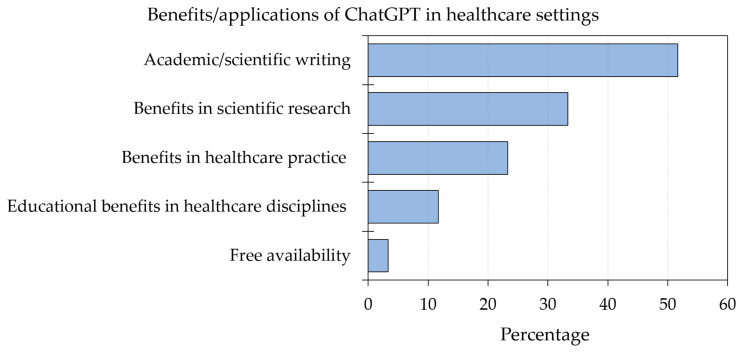
- Benefits were most frequently cited for academic/scientific writing (31 records, 51.7%), followed by scientific research (20, 33.3%), healthcare practice (14, 23.3%), healthcare education (7, 11.7%), and being a free package (2, 3.3%).
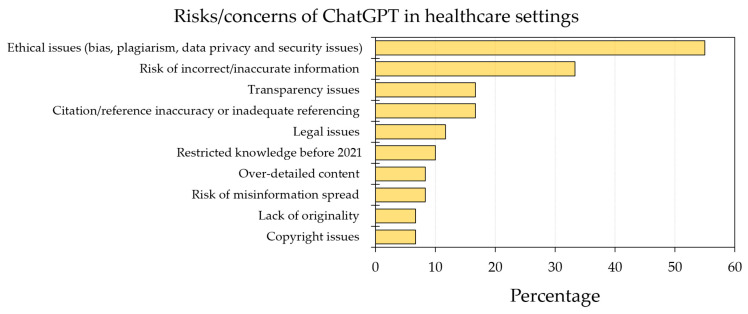
- Ethical concerns were the most common risk category (33 records, 55.0%), including risk of bias (18, 30.0%) and plagiarism (14, 23.3%); incorrect/inaccurate information was cited in 20 records (33.3%), citation/reference inaccuracy in 10 (16.7%), and transparency issues in 10 (16.7%).
- Other reported concerns included legal issues (7, 11.7%), restricted knowledge before 2021 (6, 10.0%), misinformation spread (5, 8.3%), over-detailed content (5, 8.3%), copyright issues (4, 6.7%), and lack of originality (4, 6.7%).
- The review states that ChatGPT does not qualify as an author under current ICMJE/COPE guidelines unless those guidelines are revised, and calls for stakeholder-developed ethics guidance for responsible LLM use in healthcare and academia.
Methods
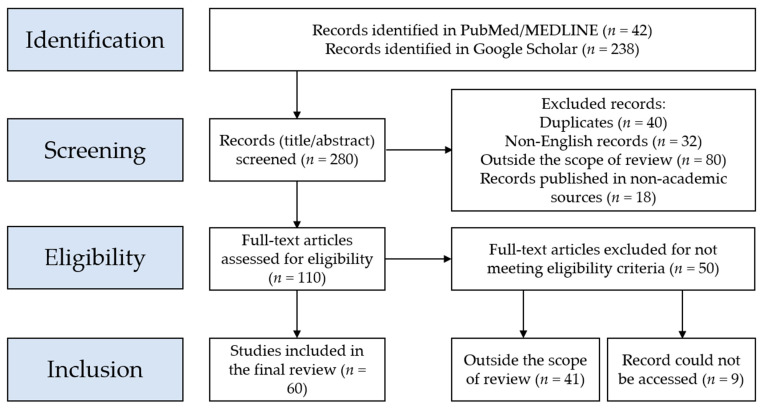
- Systematic review conducted according to PRISMA guidelines, searching PubMed/MEDLINE and Google Scholar for English records on ChatGPT in healthcare practice/research, healthcare education, or academic writing; searches concluded on 16 February 2023.
- PubMed/MEDLINE yielded 42 records and Google Scholar yielded 238 records, totaling 280 records; after duplicate removal (n = 40), non-English exclusion (n = 32), out-of-scope exclusion (n = 80), non-academic source exclusion (n = 18), full-text screening exclusions (n = 41), and inaccessible full texts (n = 9), 60 records were included.
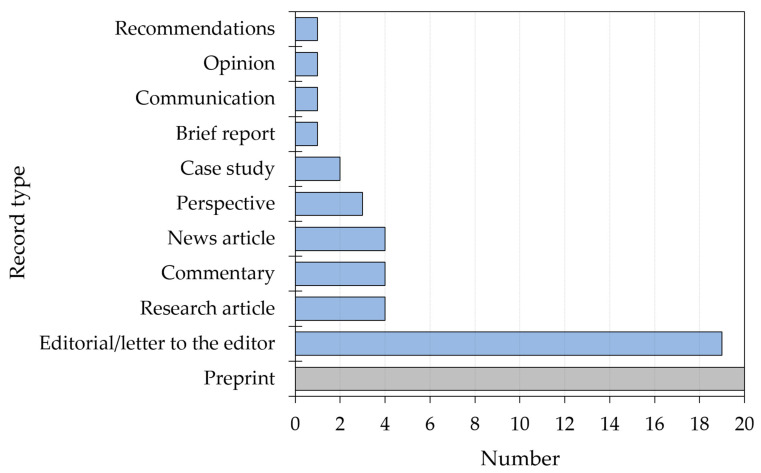
- Each included record was searched for record type, listed benefits/applications, listed risks/concerns, and main conclusions/recommendations regarding ChatGPT in healthcare education, practice, or scientific research/academic writing.
Limitations
- The paper states that included records had variable quality, non-English exclusion may have caused selection bias, inaccessible records may have led to missing relevant data, preprints were not peer reviewed, the literature is growing rapidly with the search ending 16 February 2023, and screening/interpretation was performed by a single author.
- Evident from the text: the review reports descriptive counts of mentions across heterogeneous record types rather than a formal meta-analysis or independent risk-of-bias assessment.
Model-written summary. Check it against the paper before relying on it.
Integrity signals
Registry
Cites
Statistics
Figures
Verification
Claims the paper makes
53 Valid · 1 Not valid · 6 Not checked · 37 Own results and interpretations
Every source the paper cites for this claim was checked and supports it.
In the paper
“This comes in light of the ability of ChatGPT to generate incorrect content that appears plausible from a scientific point of view [81].”
§ ChatGPT Utility in Healthcare Education, Research, and Practice: Systematic Review on the Promising Perspectives and Valid Concerns > 4. Discussion > 4.2. Limitations of ChatGPT Use in Scientific Research
What the sources say
- Supportedcites [81] Cascella M. Montomoli J. Bellini V. Bignami E. Evaluating the Feasibility of ChatGPT in Healthcare: An Analysis of Multiple Clinical and Research Scenarios J. Med. Syst. 2023 47 33 10.1007/s10916-023-01925-4 36869927 PMC9985086 source
In “Reasoning About Public Health Topics,” the paper says ChatGPT can produce believable answers that may be incorrect or nonsensical. In “Possible Misuse of GPT in Medicine and Research,” it describes a scientific abstract that appeared reliable and simulated statistical outputs that could seem plausible to readers. Together, these passages support the claim. (LLM, conf=0.94)
plain- Asserted: passes — The authors put it forward as true.
- Checkable: passes — It can be checked against evidence.
- Load-bearing: passes — The paper’s conclusions depend on it.
- Based: passes — The paper gives a reason why it holds.
- Supported
The sources with a verdict support this claim; the rest weren’t checked yet, have no full text we could read, or their verdicts aren’t rated yet.
In the paper
“This comes in light of the fact that authorship entails legal obligations that are not met by ChatGPT [43,48].”
§ ChatGPT Utility in Healthcare Education, Research, and Practice: Systematic Review on the Promising Perspectives and Valid Concerns > 4. Discussion > 4.2. Limitations of ChatGPT Use in Scientific Research
What the sources say
- Supportedcites [43] Zielinski C. Winker M. Aggarwal R. Ferris L. Heinemann M. Lapeña J. Pai S. Ing E. Citrome L. Chatbots, ChatGPT, and Scholarly Manuscripts WAME Recommendations on ChatGPT and Chatbots in Relation to Scholarly Publications Maced J. Med. Sci. 2023 11 83 86 10.3889/oamjms.2023.11502 37615142 source
The Introduction (p. 2) says chatbots are not legal entities, cannot be held legally liable, and that listing ChatGPT as an author may not be legally defensible. The WAME Recommendations (p. 2) add that chatbots cannot take responsibility for a paper or have the legal standing to sign a statement. (LLM, conf=0.93)
- Not checked — no full text of the sourcecites [48] Liebrenz M. Schleifer R. Buadze A. Bhugra D. Smith A. Generating scholarly content with ChatGPT: Ethical challenges for medical publishing Lancet Digit. Health 2023 5 e105 e106 10.1016/S2589-7500(23)00019-5 36754725 source
plain- Asserted: passes — The authors put it forward as true.
- Checkable: passes — It can be checked against evidence.
- Load-bearing: passes — The paper’s conclusions depend on it.
- Based: passes — The paper gives a reason why it holds.
- Supported
The cited sources support only part of this claim — read each source’s verdict below.
In the paper
“On one hand, ChatGPT, among other LLMs, can be beneficial in conversational and writing tasks, assisting to increase the efficiency and accuracy of the required output [11].”
§ ChatGPT Utility in Healthcare Education, Research, and Practice: Systematic Review on the Promising Perspectives and Valid Concerns > 1. Introduction
What the sources say
- Partly supportedcites [11] Deng J. Lin Y. The Benefits and Challenges of ChatGPT: An Overview Front. Comput. Intell. Syst. 2023 2 81 83 10.54097/fcis.v2i2.4465 sourceExperimental — accuracy not yet measured
Sections 4.1 (Increased Efficiency) and 4.2 (Improved Accuracy) say ChatGPT can make conversations more efficient and generate more accurate responses. The paper does not establish those benefits for writing tasks or for other LLMs, so the broader claim is only partially supported. (LLM, conf=0.88)
plainstates a cause- Asserted: passes — The authors put it forward as true.
- Checkable: passes — It can be checked against evidence.
- Load-bearing: unclear — It is unclear whether the paper’s conclusions depend on it.
- Based: passes — The paper gives a reason why it holds.
- Partly supported
The cited sources support only part of this claim — read each source’s verdict below.
In the paper
“Importantly, the concept of ChatGPT hallucination could be risky if the generated content is not thoroughly evaluated by researchers and health providers with proper expertise [37,56,73,77,79].”
§ ChatGPT Utility in Healthcare Education, Research, and Practice: Systematic Review on the Promising Perspectives and Valid Concerns > 4. Discussion > 4.2. Limitations of ChatGPT Use in Scientific Research
What the sources say
- Not checked — no full text of the sourcecites [37] Shen Y. Heacock L. Elias J. Hentel K.D. Reig B. Shih G. Moy L. ChatGPT and Other Large Language Models Are Double-edged Swords Radiology 2023 230163 10.1148/radiol.230163 36700838 source
- Partly supportedcites [56] Huh S. Are ChatGPT’s knowledge and interpretation ability comparable to those of medical students in Korea for taking a parasitology examination?: A descriptive study J. Educ. Eval. Health Prof. 2023 20 1 10.3352/jeehp.2023.20.1 36627845 PMC9905868 sourceExperimental — accuracy not yet measured
The Background says medical students must evaluate the accuracy of AI-generated medical information before creating reliable information for patients and the public. The Interpretation also reports that some ChatGPT explanations contained incorrect information. These passages support the need for scrutiny, but the paper does not specifically discuss hallucination or evaluation by researchers and health providers. (LLM, conf=0.84)
- Partly supportedcites [73] Duong D. Solomon B.D. Analysis of large-language model versus human performance for genetics questions medRxiv 2023 Preprint 10.1101/2023.01.27.23285115 PMC10999420 37246194 sourceExperimental — accuracy not yet measured
The Discussion (p. 6) says ChatGPT can give plausible explanations for incorrect answers and that its correctness requires additional verification, which is concerning in medical or other high-stakes settings. This supports the risk and need for evaluation, but the paper does not specify that researchers and health providers with proper expertise must perform it. (LLM, conf=0.83)
- Supportedcites [77] Jeblick K. Schachtner B. Dexl J. Mittermeier A. Stüber A.T. Topalis J. Weber T. Wesp P. Sabel B. Ricke J. ChatGPT Makes Medicine Easy to Swallow: An Exploratory Case Study on Simplified Radiology Reports arXiv 2022 10.48550/arxiv.2212.14882 2212.14882 PMC11126432 37794249 source
The Results (Free-text analysis) identify a ChatGPT hallucination that radiologists judged potentially harmful to a patient. The Key Points state that minimizing harm requires supervision by medical experts, supporting the claim’s warning about unevaluated medical content. (LLM, conf=0.90)
- Partly supportedcites [79] Lin Z. Why and how to embrace AI such as ChatGPT in your academic life PsyArXiv 2023 Preprint 10.31234/osf.io/sdx3j PMC10445029 37621662 sourceExperimental — accuracy not yet measured
The “Limitations of generative AI” section says ChatGPT may fabricate facts and false citations (“hallucination”) and urges users to critically evaluate and verify its responses, particularly when reliability is critical. It does not specifically say that researchers and health providers with proper expertise must evaluate the content; that part is more specific than the source. (LLM, conf=0.84)
hedgedstates a possible cause- Asserted: passes — The authors put it forward as true.
- Checkable: passes — It can be checked against evidence.
- Load-bearing: passes — The paper’s conclusions depend on it.
- Based: passes — The paper gives a reason why it holds.
- Rests on an assumption not shown here.
The sources with a verdict support this claim; the rest weren’t checked yet, have no full text we could read, or their verdicts aren’t rated yet.
In the paper
“This is particularly relevant for researchers who are non-native English speakers [23,25,63].”
§ ChatGPT Utility in Healthcare Education, Research, and Practice: Systematic Review on the Promising Perspectives and Valid Concerns > 4. Discussion > 4.1. Benefits of ChatGPT in Scientific Research
What the sources say
- Supportedcites [23] Chen T.J. ChatGPT and Other Artificial Intelligence Applications Speed up Scientific Writing Available online: https://journals.lww.com/jcma/Citation/9900/ChatGPT_and_other_artificial_intelligence.174.aspx (accessed on 16 February 2023) PMC12755446 36791246 source
In the main text (page not provided), Chen says many scientists who are not native English speakers struggle to write in English and describes AI translation and writing tools as ways to overcome that barrier. This supports the claim that language assistance in scientific writing is particularly relevant to those researchers. (LLM, conf=0.91)
- Not checked — no full text of the sourcecites [25] Kitamura F.C. ChatGPT Is Shaping the Future of Medical Writing but Still Requires Human Judgment Radiology 2023 230171 10.1148/radiol.230171 36728749 source
- Supportedcites [63] Gao C.A. Howard F.M. Markov N.S. Dyer E.C. Ramesh S. Luo Y. Pearson A.T. Comparing scientific abstracts generated by ChatGPT to original abstracts using an artificial intelligence output detector, plagiarism detector, and blinded human reviewers bioRxiv 2022 10.1101/2022.12.23.521610 source
The Discussion/Abstract section of our copy states directly that the technology 'could be used by scientists publishing in a language that is not their native language, to improve equity,' alongside the point that generated text 'may help alleviate the burden of writing' and that LLMs are 'a powerful tool to create readable scientific abstracts.' That covers the attributed content — AI-assisted language improvement being especially pertinent for non-native-English researchers — with the source's own hedge ('could be used') slightly weaker than the citing sentence's flat 'is particularly relevant.' No passage in our copy contradicts it. (LLM, conf=0.82)
plainstates an association- Asserted: passes — The authors put it forward as true.
- Checkable: passes — It can be checked against evidence.
- Load-bearing: unclear — It is unclear whether the paper’s conclusions depend on it.
- Based: passes — The paper gives a reason why it holds.
- Supported
42 more claims · 23 with their cited sources checked
Create a free account to see all 97 claims and to verify the 16 references still open.
- Probably not a substantial claim. 31
- It may state two separate claims as one. 27
Claims other papers make about this one
Each is checked against this paper’s own text: does it say what the citing paper says it does?
The source backs part of the claim, not all of it — or backs it for a different population, condition or comparison.
In the citing paper
“The reliance on ChatGPT may result in hindering the development of the skills needed to interpret and respond to social cues, which should be considered in health care education [9,91].”
From Assessing Health Students' Attitudes and Usage of ChatGPT in Jordan: Validation Study (2023) · cites this paper as [9]
Experimental — accuracy not yet measuredThe source backs part of the claim, not all of it — or backs it for a different population, condition or comparison.
In the citing paper
“A recent surge in the use of ChatGPT, in particular for mental health, is emergent for providing crucial personalized advice without clinical explanation, which can hurt user's safety, and thus trust (Sallam, 2023).”
From A review of the explainability and safety of conversational agents for mental health to identify avenues for improvement (2023) · cites this paper as Sallam, 2023
Experimental — accuracy not yet measuredThe source backs part of the claim, not all of it — or backs it for a different population, condition or comparison.
In the citing paper
“ChatGPT plays a crucial role in pandemic management by aiding in the swift and accurate dissemination of critical information.”
From A Systematic Review and Meta-Analysis of Artificial Intelligence Tools in Medicine and Healthcare: Applications, Considerations, Limitations, Motivation and Challenges (2024) · cites this paper as [6]
Experimental — accuracy not yet measuredThe source backs part of the claim, not all of it — or backs it for a different population, condition or comparison.
In the citing paper
“Its natural language processing capabilities enable it to generate coherent responses, making it a valuable tool for healthcare organisations.”
From A Systematic Review and Meta-Analysis of Artificial Intelligence Tools in Medicine and Healthcare: Applications, Considerations, Limitations, Motivation and Challenges (2024) · cites this paper as [6]
Experimental — accuracy not yet measuredThe source backs part of the claim, not all of it — or backs it for a different population, condition or comparison.
In the citing paper
“Specific advantages include its ability to provide rapid updates, preventive measures, and medical guidelines to the public.”
From A Systematic Review and Meta-Analysis of Artificial Intelligence Tools in Medicine and Healthcare: Applications, Considerations, Limitations, Motivation and Challenges (2024) · cites this paper as [6]
Experimental — accuracy not yet measured
31 more claims about this paper
Create a free account to see every claim other papers make about this one.
Citations
Cites
Preferred Reporting Items for Systematic Reviews and Meta-Analyses: the PRISMA statement
Moher, D., Liberati, A., Tetzlaff, J., Altman, D. G., & for the PRISMA Group (2009) · BMJ · doi:10.1136/bmj.b2535 · Cited by 83,823
Preferred Reporting Items for Systematic Reviews and Meta-Analyses: The PRISMA Statement
Moher, D., Liberati, A., Tetzlaff, J., Altman, D. G., & The PRISMA Group (2009) · PLoS Medicine · doi:10.1371/journal.pmed.1000097 · Cited by 64,042 · cited 1×
“The current systematic review was conducted according to the Preferred Reporting Items for Systematic Reviews and Meta-Analyses (PRIMSA) guidelines [21].”
Language Models are Few-Shot Learners
Brown, T. B., Mann, B., Ryder, N., Subbiah, M., Kaplan, J., Dhariwal, P., Neelakantan, A., Shyam, P., Sastry, G., Askell, A., et al. (2020) · arXiv · doi:10.48550/arxiv.2005.14165 · Cited by 23,372 · cited 3×
“The GPT architecture utilizes a neural network to process natural language, thus generating responses based on the context of input text [7].”
BackgroundWang, G., Ma, R., Qiao, G., Wada, K., Aizawa, Y., & Satoh, T. (2015) · Integrative Medicine International · doi:10.1159/000368408 · Cited by 18,657
Kaugeranna, R., Kaugeranna, E., & Aion, (. S. 4. 6. (2023) · DROPS (Schloss Dagstuhl – Leibniz Center for Informatics) · doi:10.4230/lipics.giscience.2023.43 · Cited by 13,690
Machine learning: Trends, perspectives, and prospects
Jordan, M. I., & Mitchell, T. M. (2015) · Science · doi:10.1126/science.aaa8415 · Cited by 9,955
Kung, T. H., Cheatham, M., Medenilla, A., Sillos, C., De Leon, L., Elepaño, C., Madriaga, M., Aggabao, R., Diaz-Candido, G., Maningo, J., et al. (2023) · PLOS Digital Health · doi:10.1371/journal.pdig.0000198 · Cited by 4,115 · cited 2×
“[59] An article showing the ChatGPT raised accuracy which enabled passing the USMLE Accuracy with high concordance and insight; it can facilitate patient communication; improved personalized medicine ChatGPT has a promising potential in medical education; future studies are recommended to consider non-biased approach…”
BackgroundKung, T. H., Cheatham, M., ChatGPT, Medenilla, A., Sillos, C., De Leon, L., Elepaño, C., Madriaga, M., Aggabao, R., Diaz-Candido, G., et al. (2022) · doi:10.1101/2022.12.19.22283643 · Cited by 4,115
Rajpurkar, P., Chen, E., Banerjee, O., & Topol, E. J. (2022) · Nature Medicine · doi:10.1038/s41591-021-01614-0 · Cited by 3,212 · cited 1×
“The promising utility of AI in health care has been outlined previously with possible benefits in personalized medicine, drug discovery, and the analysis of large datasets aside from the potential applications to improve diagnosis and clinical decisions [17,18].”
BackgroundChatting and cheating: Ensuring academic integrity in the era of ChatGPT
Cotton, D. R. E., Cotton, P. A., & Shipway, J. R. (2024) · Innovations in Education and Teaching International · doi:10.1080/14703297.2023.2190148 · Cited by 3,087 · cited 1×
“[62] An EdArXiv 2 preprint on the academic integrity in ChatGPT era Risk of plagiarism; academic dishonesty Careful thinking of educational assessment tools”
Background
Cited by
Items 601–700 of 3,095
Famaye, T., Bailey, C. S., Adisa, I. O., & Irgens, G. A. (2024) · International Journal of Technology in Education · doi:10.46328/ijte.651 · Cited by 54
Hudon, A., Kiepura, B., Pelletier, M., & Phan, V. (2024) · JMIR Medical Education · doi:10.2196/54067 · Cited by 32
“As such, a recent review on the use of ChatGPT in health care has identified that this form of AI can be used for problem-based learning and critical thinking in health care education [31].”
BackgroundAI Versus MD: Evaluating the surgical decision-making accuracy of ChatGPT-4
Palenzuela, D. L., Mullen, J. T., & Phitayakorn, R. (2024) · Surgery · doi:10.1016/j.surg.2024.04.003 · Cited by 35
Evaluation of ChatGPT as a Tool for Answering Clinical Questions in Pharmacy Practice
Munir, F., Gehres, A., Wai, D., & Song, L. (2024) · Journal of Pharmacy Practice · doi:10.1177/08971900241256731 · Cited by 32
Li, H., & Vasarhelyi, M. A. (2024) · Journal of Emerging Technologies in Accounting · doi:10.2308/jeta-2023-065 · Cited by 53
Generating TRIZ-inspired guidelines for eco-design using Generative Artificial Intelligence
Lee, C. K. M., Liang, J., Yung, K. L., & Keung, K. L. (2024) · Advanced Engineering Informatics · doi:10.1016/j.aei.2024.102846 · Cited by 46
Large language models vs human for classifying clinical documents
Mustafa, A., Naseem, U., & Azghadi, M. R. (2025) · International Journal of Medical Informatics · doi:10.1016/j.ijmedinf.2025.105800 · Cited by 47
Sallam, M., Al-Mahzoum, K., Alaraji, H., Albayati, N., Alenzei, S., AlFarhan, F., Alkandari, A., Alkhaldi, S., Alhaider, N., Al-Zubaidi, D., et al. (2025) · Frontiers in Education · doi:10.3389/feduc.2025.1542769 · Cited by 46
Self-citationProblematic ChatGPT Use Scale: AI-Human Collaboration or Unraveling the Dark Side of ChatGPT
Maral, S., Naycı, N., Bilmez, H., Erdemir, E. İ., & Satıcı, S. A. (2025) · International Journal of Mental Health and Addiction · doi:10.1007/s11469-025-01509-y · Cited by 60
“The concept of Problematic ChatGPT Use (PCGU) specifically refers to habitual and excessive interactions with ChatGPT that undermine users’ well being and productivity (Sallam, 2023; Wu et al., 2023).”
Goyanes, M., Lopezosa, C., & Jordá, B. (2025) · Quality & Quantity · doi:10.1007/s11135-025-02199-3 · Cited by 111
“The paper also offers theoretical implications, as it extends ongoing scholarly conversations about the use of AI and ChatGPT specifically in key aspects of research (e.g., De Paoli and Mathis 2024; Kumar 2023; Sallam 2023; Shtykalo and Yamnenko 2024).”
Li, X., Yan, X., & Lai, H. (2025) · PLoS ONE · doi:10.1371/journal.pone.0333411 · Cited by 46
Atallah, S. B., Banda, N. R., Banda, A., & Roeck, N. A. (2023) · Techniques in Coloproctology · doi:10.1007/s10151-023-02837-8 · Cited by 40
ChatGPT applications in Academic Research: A Review of Benefits, Concerns, and Recommendations
AlZaabi, A., ALAmri, A., Albalushi, H., Aljabri, R., & AalAbdulsalam, A. (2023) · doi:10.1101/2023.08.17.553688 · Cited by 32
“[30], [35], [38], [40], [41], [43], [46], [47], [51], [55], [57], [61], [63], [67], [72], [77], [79]–[81], [85], [89], [104]–[113] that is extremely helpful to facilitate literature review, detecting research gaps and construct hypothesis in a timely manner[10], [14], [16], [24], [46], [47], [50], [62]–[64], [67], [72…”
BackgroundInfluentialSalvagno, M., Cassai, A. D., Zorzi, S., Zaccarelli, M., Pasetto, M., Sterchele, E. D., Chumachenko, D., Gerli, A. G., Azamfirei, R., & Taccone, F. S. (2024) · PLOS ONE · doi:10.1371/journal.pone.0309208 · Cited by 32
“However, AI output is far from being perfect, as AI hallucination has been well described and documented in the current literature [8, 9].”
BackgroundAbu-Farha, R., Fino, L., Al-Ashwal, F. Y., Zawiah, M., Gharaibeh, L., Harahsheh, M. M., & Darwish Elhajji, F. (2023) · Journal of the American Pharmacists Association · doi:10.1016/j.japh.2023.08.020 · Cited by 32
Lim, J. S., Shin, D., Lee, C., Kim, J., & Zhang, J. (2025) · Journal of Broadcasting & Electronic Media · doi:10.1080/08838151.2025.2487679 · Cited by 32
Zafar, S., Shaheen, F., & Rehan, J. (2024) · iRASD Journal of Educational Research · doi:10.52131/jer.2024.v5i1.2463 · Cited by 32
“It helps create discharge summaries and shows promise in various medical applications (Sallam, 2023).”
BackgroundPratiwi, H., Suherman, Hasruddin, & Ridha, M. (2025) · European Journal of Education · doi:10.1111/ejed.70083 · Cited by 31
Zagirova, D., Pushkov, S., Leung, G. H. D., Liu, B. H. M., Urban, A., Sidorenko, D., Kalashnikov, A., Kozlova, E., Naumov, V., Pun, F. W., et al. (2023) · Aging · doi:10.18632/aging.205055 · Cited by 37
“genomics, to enable sophisticated text-based analyses and predictions [16, 17].”
BackgroundAllehyani, S. H., & Algamdi, M. A. (2023) · International Journal of Learning Teaching and Educational Research · doi:10.26803/ijlter.22.11.18 · Cited by 62
McLean, A. L., Wu, Y., McLean, A. C. L., & Hristidis, V. (2024) · Journal of Cancer Research and Clinical Oncology · doi:10.1007/s00432-024-05673-x · Cited by 39
“Effective integration is key to optimizing the utility of LLMs and securing their acceptance within the medical community (Sallam 2023b).”
BackgroundMethodAvsheniuk, N., Lutsenko, O., Svyrydiuk, T., & Seminikhyna, N. (2024) · Arab World English Journal · doi:10.24093/awej/chatgpt.14 · Cited by 31
“Recognizing the role of ChatGPT in enhancing learners' critical thinking, media literacy, and digital navigation skills is essential for developing effective teaching strategies in the digital age (Pang, 2022; Sallam, 2023; Susnjak, 2022; Trang, 2021; Young, 2003).”
BackgroundScott, I. A., & Zuccon, G. (2024) · Internal Medicine Journal · doi:10.1111/imj.16393 · Cited by 39
“74,75 Prospective clinical trials will need to be pragmatic, adopt appropriate ef fi cacy and safety endpoints and only test LLM applications with a realistic chance of being implemented in terms of acceptance, effectiveness and feasibility.”
BackgroundXu, Z., Fang, Q., Huang, Y., & Xie, M. (2024) · PLoS ONE · doi:10.1371/journal.pone.0302502 · Cited by 55
“In healthcare, research indicates that ChatGPT holds enormous potential in virtual consultations, improving public mental health and well-being [26].”
BackgroundProtocol for the development of the Chatbot Assessment Reporting Tool (CHART) for clinical advice
Collaborative, T. C. (2024) · BMJ Open · doi:10.1136/bmjopen-2023-081155 · Cited by 35
Choi, M., Choi, Y., Bangura, E., & Kim, D. (2024) · International Journal of Hospitality Management · doi:10.1016/j.ijhm.2024.103852 · Cited by 36
Sallam, M., Al‐Salahat, K., Eid, H., Egger, J., & Puladi, B. (2024) · Advances in Medical Education and Practice · doi:10.2147/amep.s479801 · Cited by 51
Self-citationSun, H., Kim, M., Kim, S., & Choi, L. (2024) · International Journal of Hospitality Management · doi:10.1016/j.ijhm.2024.103974 · Cited by 46
Hsu, W.-L., & Silalahi, A. D. K. (2024) · Computers and Education Artificial Intelligence · doi:10.1016/j.caeai.2024.100329 · Cited by 57
Kunze, K. N., Nwachukwu, B. U., Cote, M. P., & Ramkumar, P. N. (2024) · Arthroscopy The Journal of Arthroscopic and Related Surgery · doi:10.1016/j.arthro.2024.12.010 · Cited by 40
Zada, T., Tam, N., Barnard, F., Sittert, M. V., Bhat, V., & Rambhatla, S. (2025) · JMIR Formative Research · doi:10.2196/66207 · Cited by 60
“Research has explored its applications in medical education, including its effectiveness on licensing examinations, tailored learning experiences, and comprehension of complex medical concepts and clinical reasoning [20,24,27,33,36].”
Uddin, J., Feng, C., & Xu, J. (2025) · Journal of Medical Internet Research · doi:10.2196/66032 · Cited by 31
“…advantageous for health communication, enabling it to address various health inquiries, deliver customized health information, provide education, offer consultations, assist in disease diagnosis, simplify complex health reports, and translate health-related questions into multiple languages [5-7].”
Morjaria, L., Burns, L., Bracken, K., Ngo, Q. N., Lee, M., Levinson, A. J., Smith, J., Thompson, P., & Sibbald, M. (2023) · Journal of Medical Education and Curricular Development · doi:10.1177/23821205231204178 · Cited by 31
The opportunities and challenges of adopting ChatGPT in medical research
Alsadhan, A., Al-Anezi, F., Almohanna, A., Alnaim, N., Alzahrani, H., Shinawi, R., AboAlsamh, H., Bakhshwain, A., Alenazy, M., Arif, W., et al. (2023) · Frontiers in Medicine · doi:10.3389/fmed.2023.1259640 · Cited by 31
Legal and ethical considerations regarding the use of ChatGPT in education
Panagopoulou, F., Parpoula, C., & Karpouzis, K. (2023) · doi:10.31235/osf.io/c5hf3 · Cited by 35
Maita, I., Saide, S., Putri, A. M., & Muwardi, D. (2024) · IEEE Engineering Management Review · doi:10.1109/emr.2024.3394540 · Cited by 30
“In this article,the systematic reviews and meta-analyses (PRIMSA) method was adopted and guided refers to studies [10],[21].”
BackgroundMethodBuholayka, M., Zouabi, R., & Tadinada, A. (2023) · Cureus · doi:10.7759/cureus.39386 · Cited by 30
The impact of artificial intelligence on online assessment: A preliminary review
Karadağ, N. (2023) · Journal of Educational Technology and Online Learning · doi:10.31681/jetol.1351548 · Cited by 43
Bubaš, G., Čižmešija, A., & Kovačić, A. (2023) · Future Internet · doi:10.3390/fi16010004 · Cited by 48
Validity of ChatGPT-generated musculoskeletal images
Ajmera, P., Nischal, N., Ariyaratne, S., Botchu, B., Bhamidipaty, K. D. P., Iyengar, K. P., Ajmera, S. R., Jenko, N., & Botchu, R. (2024) · Skeletal Radiology · doi:10.1007/s00256-024-04638-y · Cited by 34
“For future attempts to produce illustrations—with novel LLMs, the focus would also need to shift to the ethics surrounding it and the risk of plagiarism [10].”
ChatGPT Earns American Board Certification in Hand Surgery
Ghanem, D., Nassar, J. E., Bachour, J. E., & Hanna, T. (2024) · Hand surgery & rehabilitation · doi:10.1016/j.hansur.2024.101688 · Cited by 35
Knoedler, L., Knoedler, S. A., Hoch, C. C., Prantl, L., Frank, K., Soiderer, L., Cotofana, S. C., Dorafshar, A. H., Schenck, T. L., Vollbach, F. H., et al. (2024) · Scientific Reports · doi:10.1038/s41598-024-63997-7 · Cited by 34
Ando, K., Masaki, S., Wakatsuki, S., Nagai, R., Chino, K., Kai, H., Sasaki, T., Kato, R., Nguyen, T. P., Guo, N., et al. (2024) · BJA Open · doi:10.1016/j.bjao.2024.100296 · Cited by 40
Anti-dependency teaching strategy for innovation in the age of AI among technology-based students
Calzada, K. P. D. (2024) · Environment and Social Psychology · doi:10.59429/esp.v9i8.3026 · Cited by 53
“This theory is consistent with Sallam [32] 58/60 (96.7”
ResultInfluentialSallam, M., Al-Mahzoum, K., Almutairi, Y. M., Alaqeel, O., Abu Salami, A., Almutairi, Z. E., Alsarraf, A. N., & Barakat, M. (2024) · International Medical Education · doi:10.3390/ime3040031 · Cited by 30
“Recently, several potential benefits of genAI models in healthcare education, research, and practice have been well recognized [3,11,15].”
InfluentialSelf-citationSaatçi, G., Korkut, S., & Ünsal, A. (2024) · Nurse Education in Practice · doi:10.1016/j.nepr.2024.104186 · Cited by 40
Haider, S., Rashid, M., Tariq, M. A. U. R., & Nadeem, A. (2024) · Discover Water · doi:10.1007/s43832-024-00173-y · Cited by 42
Maaß, L., Grab‐Kroll, C., Koerner, J., Öchsner, W., Schön, M., Messerer, D. A. C., Boeckers, T. M., & Böckers, A. (2024) · Journal of CME · doi:10.1080/28338073.2024.2437293 · Cited by 48
“…“AI and medical students”, “AI readiness”, “ChatGPT and healthcare students”, as well as the scientific publications cited by Sallam in his systematic review “ChatGPT Utility in Healthcare Education, Research, and Practice: Systematic Review on the Promising Perspectives and Valid Concerns” [6].”
Ajalo, E., Mukunya, D., Nantale, R., Kayemba, F., Pangholi, K., Babuya, J., Langoya Akuu, S., Namiiro, A. M., Nsubuga, Y. B., Mpagi, J. L., et al. (2025) · PLOS ONE · doi:10.1371/journal.pone.0313776 · Cited by 29
The Future of Patient Education: AI-Driven Guide for Type 2 Diabetes
Hernandez, C. A., Gonzalez, A. E. V., Polianovskaia, A., Sanchez, R. A., Arce, V. M., Mustafa, A., Vypritskaya, E., Gutierrez, O. P., Bashir, M., & Sedeh, A. E. (2023) · Cureus · doi:10.7759/cureus.48919 · Cited by 42
“While its quality is currently not thoroughly studied, it is possible that language models may evolve to establish a new standard for patients and healthcare professionals seeking reliable medical information in the future [16-18].”
BackgroundYapar, D., Avcı, Y. D., Sonuvar, E. T., Eğerci, Ö. F., & Yapar, A. (2023) · Joint Diseases and Related Surgery · doi:10.52312/jdrs.2023.1402 · Cited by 40
“[16] The consistent evaluation scores across orthopedists, regardless of their academic standing, prior experience with ChatGPT, or age, indicate that ChatGPT provides universally understandable and standardized responses.”
BackgroundKhalifa, A. A., & Ibrahim, M. A. (2024) · Arab Gulf Journal of Scientific Research · doi:10.1108/agjsr-09-2023-0423 · Cited by 43
AlShehri, Y., McConkey, M. O., & Lodhia, P. (2024) · Arthroscopy The Journal of Arthroscopic and Related Surgery · doi:10.1016/j.arthro.2024.06.017 · Cited by 34
Sallam, M., Al-Mahzoum, K., Alshuaib, O., Alhajri, H., Alotaibi, F., Alkhurainej, D., Al-Balwah, M. Y., Barakat, M. M., & Egger, J. (2024) · BMC Infectious Diseases · doi:10.1186/s12879-024-09725-y · Cited by 57
“Understanding and addressing the limitations of AI-based models is essential for the safe and effective use of AI in healthcare communication [16, 33, 48, 51].”
BackgroundInfluentialSelf-citationBognár, L., Ágoston, G., Bacsa-Bán, A., Fauszt, T., Gubán, G., Joós, A., Juhász, L. Z., Kocsó, E., Kovács, E., Maczó, E. C., et al. (2024) · Education Sciences · doi:10.3390/educsci14090974 · Cited by 64
Prandner, D., Wetzelhütter, D., & Hese, S. (2025) · Frontiers in Education · doi:10.3389/feduc.2024.1417900 · Cited by 56
Evaluating the Reliability of ChatGPT for Health-Related Questions: A Systematic Review
Beheshti, M., Toubal, I. E., Alaboud, K., Almalaysha, M., Ogundele, O. B., Turabieh, H., Abdalnabi, N., Boren, S. A., Scott, G. J., & Dahu, B. M. (2025) · Informatics · doi:10.3390/informatics12010009 · Cited by 47
“In healthcare, ChatGPT offers a wide range of opportunities, including patient education, academic research, triage, diagnosis, decision-making, clinical documentation, and trial enrollment [8–10].”
Lynch, C. J., Jensen, E. J., Zamponi, V., O’Brien, K., Frydenlund, E. F., & Gore, R. J. (2023) · Future Internet · doi:10.3390/fi15120375 · Cited by 40
Agharia, S., Szatkowski, J., Fraval, A., Stevens, J. M., & Zhou, Y. (2023) · Journal of Orthopaedics · doi:10.1016/j.jor.2023.11.063 · Cited by 33
Radha Krishnan, R. P., Hung, E. H., Ashford, M., Edillo, C. E., Gardner, C., Hatrick, H. B., Kim, B., Lai, A. W. Y., Li, X., Zhao, Y. X., et al. (2024) · British Journal of Clinical Pharmacology · doi:10.1111/bcp.16275 · Cited by 29
Komorowski, M., Lopez, M. D. P. A., & Chang, A. C. (2023) · Intensive Care Medicine · doi:10.1007/s00134-023-07096-7 · Cited by 33
“There is much more work that will need to be done for a biomedical LLM to provide accurate and up-to-date answers to very specific and technical questions, but it has the potential to be a robust educational tool that is equal to or better than learning from textbooks or scientific literature [10].”
BackgroundMethodInfluentialBabu, C. V. S., & Adhithya, S. (2023) · Advances in educational technologies and instructional design book series · doi:10.4018/979-8-3693-0205-7.ch007 · Cited by 32
Hakam, H. T., Prill, R., Korte, L., Lovreković, B., Ostojić, M., Ramadanov, N., & Muehlensiepen, F. (2024) · JMIR Formative Research · doi:10.2196/52164 · Cited by 53
“Besides the ability to falsify results, AI presents researchers with the capacity to present false results in a plausible manner [22,23].”
BackgroundDevelopment of search strategies for systematic reviews in health using ChatGPT: a critical analysis
Guimarães, N. S., Joviano‐Santos, J. V., Reis, M. G., & Martins‐Chaves, R. R. (2024) · Journal of Translational Medicine · doi:10.1186/s12967-023-04371-5 · Cited by 39
“This AI has been trained to access an enormity of data, texts, newspapers and scientific articles been evaluated for validity and execution in scientific research [2–4].”
MethodValentini, M., Szkandera, J., Smolle, M. A., Scheipl, S., Leithner, A., & Andreou, D. (2024) · Frontiers in Public Health · doi:10.3389/fpubh.2024.1303319 · Cited by 36
Chat bots to Virtual Tutors: An Overview of Chat GPT's Role in the Future of Education
Graefen, B., & Fazal, N. (2024) · Archives of Pharmacy Practice · doi:10.51847/touppjedsx · Cited by 28
“Finally, there is a risk of incorrect content and the potential for an infodemic, whereby Chat GPT produces inaccurate or misleading content that has the potential to spread rapidly and harm both people and society [30].”
BackgroundSufi, F. K. (2024) · Information · doi:10.3390/info15050264 · Cited by 43
“Medical Question Answering and Decision Support Systems: Studies like [11,17,18] show the role of AI in assisting medical professionals with accurate information, aiding diagnosis, and providing decision support in clinical settings.”
BackgroundShort-term learning effect of ChatGPT on pharmacy students' learning
Svendsen, K., Askar, M., Umer, D., & Halvorsen, K. H. (2024) · Exploratory Research in Clinical and Social Pharmacy · doi:10.1016/j.rcsop.2024.100478 · Cited by 28
Practical Evaluation of ChatGPT Performance for Radiology Report Generation
Soleimani, M., Seyyedi, N., Ayyoubzadeh, S. M., Kalhori, S. R. N., & Keshavarz, H. (2024) · Academic Radiology · doi:10.1016/j.acra.2024.07.020 · Cited by 36
Eğitimde Yapay Zekâ Kullanımı: ChatGPT’nin KEFE ve PEST Analizi
Kutlucan, E., & Seferoğlu, S. S. (2024) · Türk Eğitim Bilimleri Dergisi · doi:10.37217/tebd.1368821 · Cited by 41
Yang, H., Hu, M., Most, A. K., Hawkins, W. A., Murray, B., Smith, S. E., Li, S., & Sikora, A. N. (2025) · Frontiers in Artificial Intelligence · doi:10.3389/frai.2024.1514896 · Cited by 37
“…et al., 2024), and generating personalized treatment plans (Benary et al., 2023); however, these tasks have largely focused on more structured diagnostic problems with clearly delineated correct and incorrect answers (Sallam, 2023; Chowdhery et al., 2022; Bommasani et al., 2023; Yang et al., 2023).”
Vizniuk, A., Diachenko, G., Laktionov, І., Siwocha, A., Xiao, M., & Smoląg, J. (2025) · Journal of Artificial Intelligence and Soft Computing Research · doi:10.2478/jaiscr-2025-0007 · Cited by 42
Large Language Models for Health Care Text Classification: Systematic Review
Sakai, H., & Lam, S. S. (2026) · JMIR AI · doi:10.2196/79202 · Cited by 74
“Over the past few years, several systematic reviews have summarized and discussed research studies using LLMs in health care without focusing on specific tasks such as text classification [27-30].”
Tülübaş, T., Demirkol, M., Özdemir, T. Y., Polat, H., Karakose, T., & Yirci, R. (2023) · Educational Process International Journal · doi:10.22521/edupij.2023.122.6 · Cited by 28
Breeding, T., Martinez, B., Patel, H. S., Nasef, H., Arif, H., Nakayama, D. K., & Elkbuli, A. (2023) · The American Surgeon · doi:10.1177/00031348231180950 · Cited by 40
“14 Arif et al noted the potential of ChatGPT to revolutionize scienti fi c writing by serving as an add-on tool for researchers to write constructively, review information, and rephrase sentences.”
BackgroundSentiment Analysis of Using ChatGPT in Education
Tubishat, M., Al-Obeidat, F. N., & Shuhaiber, A. (2023) · International Conference on Smart Applications, Communications and Networking (SmartNets) · doi:10.1109/smartnets58706.2023.10215977 · Cited by 37
Nghi, T. T., & Tran, H. P. (2023) · Proceedings of the AsiaCALL International Conference · doi:10.54855/paic.2341 · Cited by 62
“…learners' critical thinking skills, media literacy, and proficiency in navigating digital environments, effective pedagogical practices can be developed to prepare learners for the digital world (Kasneci et al., 2023; Pang, 2022; Sallam, 2023; Susnjak, 2022; Trang, 2021; Young, 2003; Zhai, 2022).”
BackgroundKumamoto, T., Yoshida, Y., & Fujima, H. (2023) · Research Square · doi:10.21203/rs.3.rs-3719038/v1 · Cited by 35
Luo, Y., Weng, H., Yang, L., Ding, Z., & Wang, Q. (2023) · JMIR Formative Research · doi:10.2196/50413 · Cited by 28
“However, it also runs the risk of moral hazard, plagiarism, and misinformation dissemination [10-12].”
BackgroundPharmacy student use of ChatGPT: A survey of students at a U.S. School of Pharmacy
Anderson, H. D., Kwon, S., Linnebur, L. A., Valdez, C. A., & Linnebur, S. A. (2024) · Currents in Pharmacy Teaching and Learning · doi:10.1016/j.cptl.2024.102156 · Cited by 28
A Case of Bromism Influenced by Use of Artificial Intelligence
Eichenberger, A., Thielke, S., & Van Buskirk, A. (2025) · Annals of Internal Medicine: Clinical Cases · doi:10.7326/aimcc.2024.1260 · Cited by 28
Large Language Model-based Chatbot as a Source of Advice on First Aid in Heart Attack
Birkun, A. A., & Gautam, A. (2023) · Current Problems in Cardiology · doi:10.1016/j.cpcardiol.2023.102048 · Cited by 41
Vargas-Murillo, A. R., Pari-Bedoya, I. N. M. D. L. A., & Guevara-Soto, F. D. J. (2023) · International Conference on Distance Education and Learning (ICDEL) · doi:10.1145/3606094.3606101 · Cited by 44
How ChatGPT performs in Oral Medicine: The case of oral potentially malignant disorders
Freitas, M. D., Mundiña, B. R., Iglesias, J. R. G., García‐Mato, E., & Dios, P. D. (2023) · Oral Diseases · doi:10.1111/odi.14750 · Cited by 32
Is ChatGPT ready to change mental healthcare? Challenges and considerations: a reality-check
Pandya, A., Lodha, P., & Ganatra, A. (2024) · Frontiers in Human Dynamics · doi:10.3389/fhumd.2023.1289255 · Cited by 27
Pressman, S. M., Borna, S., Gomez-Cabello, C. A., Haider, S. A., & Forte, A. J. (2024) · Journal of Clinical Medicine · doi:10.3390/jcm13102832 · Cited by 30
VITO, A. D., Colpani, A., Moi, G., Babudieri, S., Calcagno, A., Calvino, V., Ceccarelli, M., Colpani, G., d’Ettorre, G., Biagio, A. D., et al. (2024) · AIDS and Behavior · doi:10.1007/s10461-024-04391-2 · Cited by 33
Suleiman, A., von Wedel, D., Munoz-Acuna, R., Redaelli, S., Santarisi, A., Seibold, E.-L., Ratajczak, N., Kato, S., Said, N., Sundar, E., et al. (2024) · Computer Methods and Programs in Biomedicine · doi:10.1016/j.cmpb.2024.108313 · Cited by 33
Alomari, E. A. (2024) · Computer Modeling in Engineering & Sciences · doi:10.32604/cmes.2024.052256 · Cited by 52
Brondani, M., Alves, C. M. C., Ribeiro, C. C. C., Braga, M. M., Garcia, R. C. M. R., Ardenghi, T. M., & Pattanaporn, K. (2024) · Journal of Dental Education · doi:10.1002/jdd.13663 · Cited by 67
“19, 20, 22, 26 Its Likewise, certain research outputs generated by AI—in this case the thematic analysis—seem to resemble those produced by humans, or at least augment what humans can do.”
Köhler, C., & Hartig, J. (2024) · Contemporary Educational Technology · doi:10.30935/cedtech/15144 · Cited by 96
Large language models to process, analyze, and synthesize biomedical texts: a scoping review
Doneva, S. E., Qin, S., Sick, B., Ellendorff, T., Goldman, J.-P., Schneider, G., & Ineichen, B. V. (2024) · Discover Artificial Intelligence · doi:10.1007/s44163-024-00197-2 · Cited by 50
“A related systematic review evaluated the benefits and limitations of ChatGPT in healthcare education, research, and practice, based on an analysis of 60 publications from PubMed/MEDLINE and Google Scholar [14].”
University Educators Perspectives on ChatGPT: A Technology Acceptance Model-Based Study
Barakat, M. M., Salim, N. A., & Sallam, M. (2025) · Open Praxis · doi:10.55982/openpraxis.17.1.718 · Cited by 61
“Generative AI as exemplified by the widely used model, namely ChatGPT (OpenAI, San Francisco, CA, U.S.), can revolutionize teaching and learning methodologies in addition to its potential utility in expediting academic research (Aksoy & Kursun, 2024; Lin, 2023; Sallam, 2023).”
Self-citationA survey for large language models in biomedicine
Wang, C., Li, M., He, J., Wang, Z., Darzidehkalani, E., Chen, Z., Ye, J., Li, T., Su, Y., Ke, J., et al. (2025) · Artificial Intelligence in Medicine · doi:10.1016/j.artmed.2025.103268 · Cited by 77
Awosanya, O. D., Harris, A., Creecy, A., Qiao, X., Toepp, A. J., McCune, T., Kacena, M. A., & Ozanne, M. V. (2024) · Current Osteoporosis Reports · doi:10.1007/s11914-023-00855-x · Cited by 27
“As such, discussion concerning the application of AI in medicine and research have become a heated topic for debate [1, 2].”
BackgroundLeveraging ChatGPT for ophthalmic education: A critical appraisal
Gurnani, B., & Kaur, K. (2023) · European Journal of Ophthalmology · doi:10.1177/11206721231215862 · Cited by 29
“6 The advantages of ChatGPT in ophthalmic education”
BackgroundThe use of artificial intelligence to aid in oral hygiene education: A scoping review
Tay, J. R. H., Ng, E., Chow, D. Y., & Sim, C. P. C. (2023) · Journal of Dentistry · doi:10.1016/j.jdent.2023.104564 · Cited by 34
Alrishan, A. M. H. (2023) · International Journal of Learning Teaching and Educational Research · doi:10.26803/ijlter.22.12.10 · Cited by 45
“These nuanced concerns underscore the imperative need for a comprehensive exploration of the multifaceted impact of this technology (Sallam, 2023). http://ijlter.org/index.php/ijlter Nonetheless, despite early insights into the potential and challenges associated with ChatGPT, it remains a…”
BackgroundLarge Language Models in Oncology: Revolution or Cause for Concern?
Caglayan, A., Slusarczyk, W., Rabbani, R. D., Ghose, A., Papadopoulos, V. P., & Boussios, S. (2024) · Current Oncology · doi:10.3390/curroncol31040137 · Cited by 30
“This includes creating content to facilitate the learning process, including the generation of realistic oncology clinical vignettes, customisable simulated clinical cases providing immediate feedback, and fast access to information through the summarisation of the medical literature [54].”
BackgroundInfluentialTran, C. G., Chang, J., Sherman, S. K., & Andrade, J. P. D. (2024) · Journal of Surgical Research · doi:10.1016/j.jss.2024.04.060 · Cited by 29
Retracted
Metadata
- Authors
- Sallam, M.
- Affiliations
- University of Jordan (JO)
- Corresponding author
- Sallam, Malik
- ORCID
- Sallam, Malik
- Venue
- Healthcare
- Publisher
- MDPI AG
- Published
- 2023-03-19
- Volume
- 11
- Issue
- 6
- Pages
- 887
- ISSN
- 2227-9032 (ISSN-L)
- PMC
- PMC10048148
- OpenAlex
- W4327946446
- Cited by
- 3,126
- References
- 114
- Citations by year
- 2026: 561 · 2025: 839 · 2024: 1052 · 2023: 669
- FWCI
- 36.67
- Type
- journal article
- Language
- en
- Open access
- gold
- doi.org
- Licence
- Locations
- Healthcare (publishedVersion, cc-by)
- medRxiv (acceptedVersion, cc-by-nc-nd)
- Preprints.org (acceptedVersion, cc-by)
- PubMed Central (publishedVersion, cc-by)
- PubMed (publishedVersion)
- Topics
- Health Sciences › Medicine › Health Informatics › Artificial Intelligence in Healthcare and Education
- Physical Sciences › Computer Science › Artificial Intelligence › Artificial Intelligence Applications
- Social Sciences › Education › Artificial Intelligence in Education
- Keywords
- ChatGPT, large language models, artificial intelligence in healthcare, healthcare education, health care research, clinical practice, scientific writing, research equity, drug discovery, personalized medicine, health literacy, plagiarism, hallucinations, authorship criteria, AI ethics, infodemic
About these checks
Registry, retraction, Cites and statistics results are computed, not judged, with one exception: a printed reference that no index lists is read once by a model before it counts as a citation error. Claims are extracted by a model and kept only when their quote appears verbatim in the text; each cited source is then checked, with a model’s help, for whether it says what the claim relies on. Those verdicts can be wrong — read the claim’s quote and the cited source before relying on one.
The claim verdicts this report counts are experimental: their accuracy is not yet measured.
A language model drew the claims from the paper on 2026-10-10, under version 3 of the claim definition (model deepseek-v4.1-flash, prompt extract-v3).
A second model labelled each claim on 2026-10-10 (model jev-1.13-20260917, definition revision gold-guideline-v0.2).
Cited sources are checked with a language model’s help (gpt-6-sol and qwen3.8-omni-flash).
Statistics and arithmetic are recomputed, not judged.
Confidence bands are shown only for fields calibrated on our annotated test set. None is calibrated yet, so no band is shown.
What counts as a claim ›How we measure confidence ›How we check this ›
Are you an author, or do you see a problem with this page? Request a review
Data sources
Bibliographic data: Semantic Scholar, OpenAlex, Crossref.
Contains information from the Semantic Scholar Academic Graph Datasets, made available under the ODC Attribution License (ODC-BY 1.0).
Semantic Scholar’s data is described in: Kinney, R., et al. (2023). The Semantic Scholar Open Data Platform. arXiv:2301.10140.
